
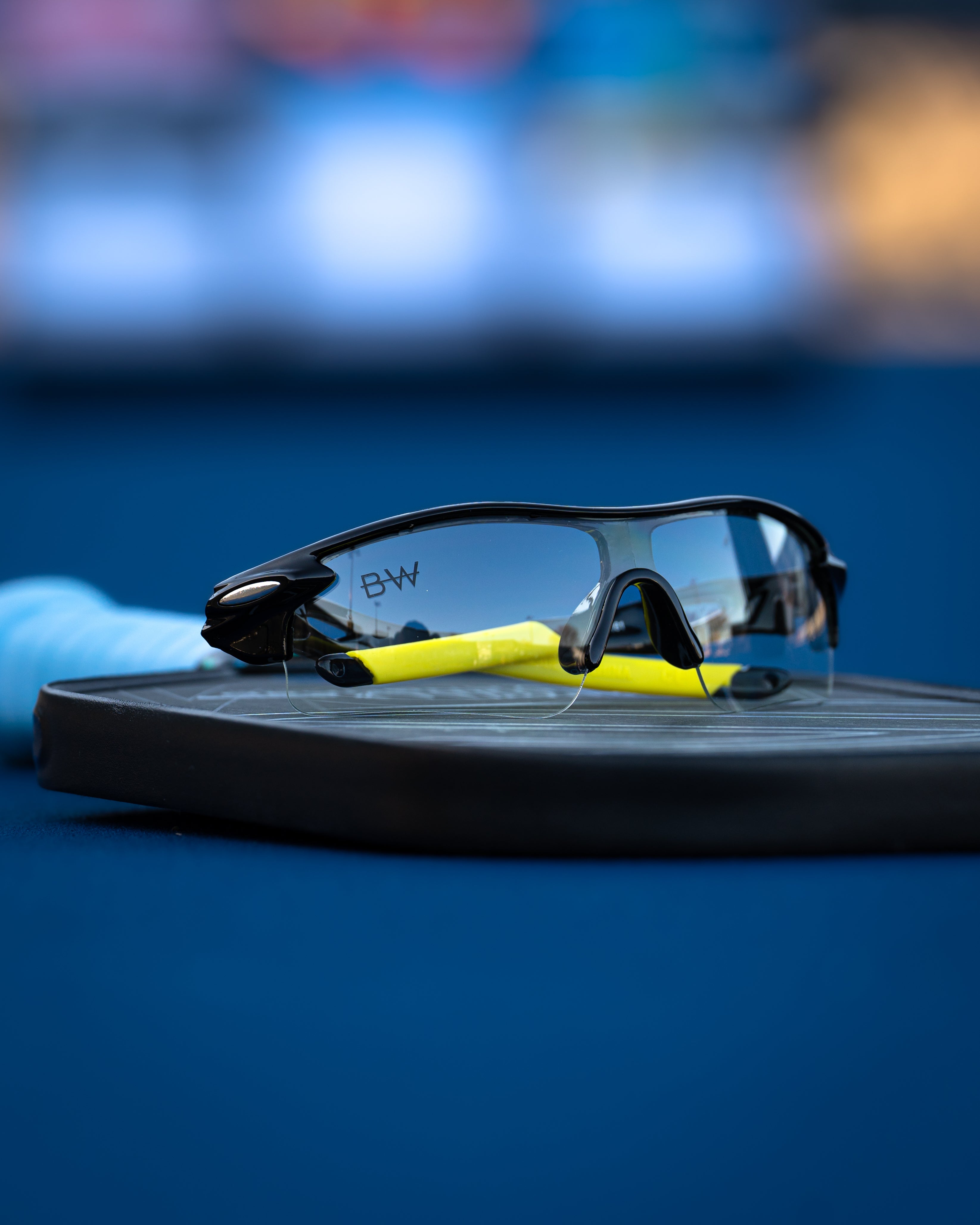
Why Our Frames Withstand Years of Tournament Travel
Share
Find Your Perfect Pickleball Glasses
Whether you need prescription (RX) or non-prescription eyewear, choosing the right pair means considering your prescription needs, playing environment, fit preferences, and how you plan to store and transport your glasses.
Why Sports Eyewear Durability Matters for Tournament Travel
Pickleball tournament travel can put eyewear through conditions it may not experience during an ordinary practice session. Glasses can be packed into crowded bags, moved between hotels and courts, exposed to changing temperatures, handled repeatedly between matches, dropped, or accidentally placed underneath other equipment.
That makes durability important, but no sports frame should be described as indestructible or guaranteed to survive years of travel.
A better approach is to combine durable sports-oriented eyewear with careful storage, regular inspection, appropriate cleaning, and a backup plan for prescription eyewear you depend on.
Blinded Wear offers lightweight sports frames and impact-resistant lens options designed with active players in mind. For prescription customers, high-index prescription lenses are included at no additional cost.
What Tournament Travel Can Do to Eyewear
Travel exposes glasses to several different types of stress, and each should be considered separately.
- Compression: other items in a packed bag can press against the eyewear.
- Impact: bags and loose equipment can be dropped or struck.
- Abrasion: lenses can contact dirt, debris, fabric, or other objects.
- Repeated handling: glasses may be removed, stored, and put back on many times throughout a tournament.
- Heat: eyewear can be exposed to elevated temperatures during travel or storage.
- Moisture and residue: perspiration, sunscreen, fingerprints, dust, and water can accumulate during outdoor events.
These stresses are different. A frame that handles normal athletic use should not automatically be assumed to resist crushing, scratching, extreme heat, or every possible travel accident.
Durable Does Not Mean Indestructible
Sports eyewear can be designed for active use without being immune to damage.
Frames can still be damaged by excessive force. Lenses can still become scratched. Hinges and other components can still be affected by improper handling. Even impact-resistant materials have limits.
For that reason, responsible durability claims should focus on verified materials and characteristics rather than promising that a pair will survive any drop, suitcase, flight, or tournament schedule.
What Does Impact Resistance Mean?
Impact resistance and indestructibility are not the same thing.
Blinded Wear offers impact-resistant eyewear options for active players. That characteristic can be relevant when choosing sports eyewear, but it should not be interpreted as a promise that the glasses cannot crack, chip, bend, or break.
Impact resistance also does not automatically establish:
- A particular safety certification
- Ballistic protection
- Scratch resistance
- Heat resistance
- Crush resistance
- An unlimited lifespan
If a particular certification or technical specification matters to you, verify it for the exact product rather than inferring it from the phrase “sports eyewear.”
Frame Material Is Only One Part of Travel Durability
The original version of this guide referred to a proprietary “Sport-Flex” material. Unless a specific product is currently documented as using that named material, it is more accurate to evaluate the verified construction of the exact frame.
Durability is influenced by the complete eyewear system, including:
- Frame construction
- Frame geometry
- Hinge construction
- Lens material and configuration
- How the eyewear is stored
- How it is handled
- The type and severity of an impact
- Environmental exposure
No single material name can guarantee that eyewear will survive every travel scenario.
Why Lightweight Sports Frames Can Be Practical for Travel
Blinded Wear offers lightweight sports frames intended for active use. Lightweight eyewear can be convenient when you are already carrying paddles, shoes, clothing, water, and other tournament equipment.
However, lightweight should not be treated as another word for indestructible. Weight and durability are separate characteristics.
A lightweight frame still deserves appropriate storage and handling between matches and during transportation.
Hinges Are an Important Part of Any Travel Routine
Hinges experience repeated movement whenever traditional temples are opened and closed. They can also be affected if a frame is twisted, crushed, or stored under pressure.
Do not assume that every Blinded Wear frame uses a reinforced micro-hinge or another proprietary hinge system unless that feature is verified for the exact model.
Regardless of hinge design, avoid forcing temples beyond their intended range or packing the eyewear where heavy equipment can place unnecessary pressure on the frame.
Protect the Temples From Unnecessary Bending
Temples contribute to how a frame sits on the wearer and are also exposed when glasses are packed, removed, and handled repeatedly.
Avoid intentionally bending or twisting the temples to test their durability.
If a frame becomes noticeably crooked after travel, inspect it rather than repeatedly forcing it back into position without understanding the frame construction.
Do Not Ignore the Bridge
The bridge is another important structural area of eyewear. Packing pressure or accidental force can affect the way a frame sits even when there is no dramatic visible break.
After travel, check whether the eyewear still sits comfortably and reasonably level.
A change in fit does not automatically mean the prescription lenses themselves changed, but significant physical deformation deserves attention.
Inspect the Lens and Frame Connection After Rough Travel
If eyewear has been dropped, crushed, or struck, inspect the relationship between the lenses and frame before relying on the pair during competition.
Look for:
- Visible cracks
- Chips
- Lens displacement
- Frame separation
- Obvious deformation
- Loose or damaged components
Do not continue using visibly damaged eyewear simply because the prescription still appears readable.
High-Index Prescription Lenses and Tournament Travel
Blinded Wear RX products include high-index prescription lenses at no additional cost.
High-index refers to a category of prescription lens material commonly used to help manage lens thickness, particularly as prescription strength increases.
Finished lens thickness can depend on several factors, including:
- Prescription strength
- Frame dimensions
- Lens dimensions
- Lens geometry
- Lens design
- Other optical requirements
High-index should not be interpreted as a durability rating.
High-Index Does Not Automatically Mean Shatterproof
The original article described 1.61 high-index lenses as “shatter-resistant” and implied that the material itself guaranteed exceptional travel durability.
Refractive index and impact performance are different characteristics. A high-index designation by itself does not establish that a lens is shatterproof, safety-certified, scratchproof, or resistant to every travel impact.
Likewise, a thinner lens should not automatically be described as tougher than another lens material.
Does a Thinner Prescription Lens Travel Better?
Not necessarily.
Thickness alone does not establish how a lens will respond to an impact, scratch, crushing force, or environmental exposure.
Choose high-index prescription lenses for their relevant optical and thickness-management characteristics rather than treating thinness as proof of superior travel durability.
Scratches Are One of the Most Practical Travel Risks
Eyewear does not need to break for travel damage to become noticeable. Abrasive contact can create scratches on a lens surface.
Reduce unnecessary contact between the lenses and:
- Keys
- Loose equipment
- Dirty fabric
- Sand or grit
- Hard objects inside a bag
- Contaminated cleaning material
Scratch resistance should not be assumed for an exact lens unless that specification is verified.
Scratch-Resistant and Scratchproof Are Not the Same Thing
Even when a lens has a verified scratch-resistant treatment, that does not mean the surface cannot be scratched.
Travel introduces opportunities for lenses to contact debris and hard objects, so physical protection remains important regardless of lens treatment.
Clean Tournament Eyewear Without Creating More Damage
Dust, perspiration, sunscreen, and other residue can accumulate quickly during travel and tournament play.
Avoid aggressively rubbing visible debris across the lens surface. When compatible with the exact lens, removing loose debris before wiping can reduce unnecessary abrasive contact.
Also avoid DIY scratch-removal techniques such as:
- Toothpaste
- Baking soda
- Car wax
- Abrasive polishing compounds
- Unverified household cleaners
Cleaning can remove contamination. It cannot restore physically removed lens material or guarantee the repair of a scratch.
Keep Your Cleaning Material Clean Too
A cloth that contains dirt, grit, or other debris can work against the goal of gentle lens cleaning.
Store whatever appropriate lens-cleaning material you use away from loose debris rather than leaving it exposed at the bottom of a tournament bag.
Heat Is Different From Impact
Eyewear can encounter elevated temperatures during tournament travel, particularly when equipment is stored in vehicles or other hot environments.
Heat exposure is a separate durability issue from impact resistance.
Do not assume that a frame or lens described as impact resistant is therefore resistant to unlimited heat exposure.
Avoid unnecessary prolonged extreme heat and follow any care instructions provided for the exact eyewear.
Be Careful About Leaving RX Eyewear in Extreme Conditions
A parked vehicle can become a demanding environment for many everyday products. If you have the option, avoid intentionally leaving prescription sports eyewear exposed to prolonged extreme conditions.
There is no need to invent one universal temperature threshold for every frame, lens material, or lens treatment.
Cold-to-Warm Transitions Can Create Temporary Condensation
Moving eyewear between different environments can sometimes result in temporary condensation on the lenses.
Fogging is not the same thing as frame damage, prescription change, or lens warping.
Allowing the eyewear to adjust to the environment and cleaning it appropriately when necessary can help distinguish temporary condensation from an actual equipment problem.
Bag Pressure Is Different From Drop Resistance
A frame may experience very different forces when something heavy presses on it for an extended period compared with a brief accidental drop.
That means impact resistance should not be translated into a blanket promise of crush resistance.
Avoid storing prescription eyewear underneath paddles, shoes, water bottles, electronics, or other heavy equipment when possible.
Can Prescription Sports Glasses Survive Checked Luggage?
No brand should guarantee that eyewear will survive every checked-luggage scenario.
Bags can be handled in unpredictable ways, and other packed items can place pressure on the eyewear.
If your prescription glasses are important for playing or everyday vision, keeping them accessible and protected rather than intentionally exposing them to unnecessary baggage risk is a practical strategy.
Why Keeping Essential RX Eyewear Accessible Can Help
If you depend on prescription eyewear for competition, accessibility matters as much as durability.
Keeping your primary pair somewhere you can monitor reduces the chance that you arrive at a tournament while the eyewear is inaccessible in delayed or misplaced baggage.
This is a travel-planning benefit rather than a claim about frame strength.
Protective Storage Matters
When eyewear is not being worn, avoid leaving it loose in a bag where other objects can press against the frame or contact the lenses.
A protective storage solution can reduce direct contact with surrounding equipment.
Do not assume that a specific hard case or other accessory is included with a Blinded Wear purchase unless the current product listing confirms it.
How to Pack RX Sports Glasses for Tournament Travel
- Clean the lenses appropriately before packing. This makes it easier to inspect the pair for existing damage.
- Avoid placing the eyewear loose with hard objects.
- Protect the lenses from direct abrasive contact.
- Avoid packing heavy equipment directly on top of the frame.
- Keep essential prescription eyewear accessible when practical.
- Bring an appropriate backup if losing the primary pair would prevent you from playing comfortably.
- Inspect the eyewear after arriving.
A Backup Pair Can Matter More Than Trying to Make One Pair Indestructible
No matter how durable a pair of sports glasses is, accidents can happen.
If you depend on prescription eyewear, redundancy can be more practical than expecting one frame to survive every possible situation.
An appropriate backup can be useful if the primary pair is:
- Lost
- Damaged
- Cracked
- Otherwise unusable during the event
Keep in mind that an old pair is not automatically an ideal backup if its prescription no longer reflects your current visual needs.
A Two-Pair Tournament Strategy
Players who rely heavily on prescription eyewear may choose to travel with two usable pairs.
One can serve as the primary competition pair while the second provides redundancy.
If the pairs use different frames or lens configurations, practice with both before the tournament rather than assuming they will feel identical.
Use a Quick Daily Eyewear Inspection
A short inspection can identify problems before you step onto the court.
Check:
- Frame condition
- Lens condition
- Visible cracks or chips
- Obvious frame deformation
- Loose or damaged components
- Lens cleanliness
- Whether the frame still sits comfortably
This is particularly useful after flights, long drives, bag drops, or other situations where the eyewear may have experienced unusual stress.
What to Do After Dropping Your Sports Glasses
Do not judge the condition only by whether the frame immediately looks intact.
Inspect the lenses and frame carefully for visible damage. If the eyewear now sits differently, investigate the physical fit before assuming that the prescription itself has changed.
If there is a significant crack, chip, broken component, or other structural concern, continuing to use the eyewear may not be appropriate.
What to Check After Your Glasses Were Crushed in a Bag
If heavy equipment was packed against the eyewear, check whether:
- The frame is visibly deformed
- The temples open and close normally
- The lenses remain properly seated
- Any component is cracked
- The eyewear now sits noticeably differently
A frame that has physically changed shape should not simply be ignored because it can still be placed on the face.
What If a Hinge Feels Different After Travel?
A hinge that suddenly feels loose, damaged, or abnormal deserves inspection.
Do not force a damaged component repeatedly to see whether it “works itself out.”
Likewise, do not assume every hinge can be repaired or adjusted in the same way. Construction varies by frame.
What If a Lens Becomes Displaced?
If a prescription lens is no longer seated as intended, avoid forcing components together without understanding the frame construction.
A displaced lens and a dirty lens are very different problems.
When you are uncertain about physical damage, appropriate evaluation is safer than improvising a repair immediately before a match.
Do Not Aggressively Bend a Travel-Damaged Frame Back Into Shape
Different frame materials respond differently to force and adjustment.
Heating, twisting, or aggressively bending eyewear can create additional damage.
If the frame has become significantly deformed, avoid assuming that a DIY adjustment is appropriate for that exact material and construction.
Travel Damage and Prescription Problems Are Not the Same Thing
If your glasses feel different after a trip, identify what actually changed.
| Observation | What to Check |
|---|---|
| Frame visibly bent | Physical frame condition |
| Lens scratched | Physical lens damage |
| View smeared | Surface contamination |
| Frame sits differently | Physical fit or deformation |
| Persistent unexplained blur | Lens condition, prescription, positioning, or current vision |
| New or persistent double vision | Appropriate eye-care evaluation |
A Damaged Frame Does Not Rewrite Your Prescription
Physical frame damage does not change the SPH, CYL, AXIS, ADD, or prism values manufactured into prescription lenses.
However, significant physical changes can alter how the finished eyewear sits relative to the wearer.
That is why physical condition and prescription accuracy should be evaluated as separate questions.
Lens Damage Does Not Automatically Change Prescription Power
A scratch, chip, or crack is physical damage rather than a new prescription.
A scratch does not rewrite the lens power, although damage may become noticeable depending on its location and severity.
A cracked or structurally damaged lens should also not be treated as merely a cosmetic scratch.
Scratch vs. Crack: Know the Difference
A scratch affects the lens surface. A crack involves structural damage.
These should not be treated as interchangeable.
Also avoid describing an ordinary scratch as something that will inevitably “spread” through the lens in the same way a structural crack might propagate.
Clean Vision After Travel Starts With Identifying the Right Problem
If your lenses look hazy after a trip, first check for contamination rather than assuming that pressure changed the prescription.
Possible causes of a smeared or hazy surface can include:
- Fingerprints
- Sunscreen
- Perspiration
- Dust
- Water residue
- Condensation
If cleaning does not resolve persistent unexpected blur, consider whether there is physical damage or another optical concern.
Perspiration Is a Maintenance Issue Too
Tournament play can leave perspiration and other residue on both the lenses and frame.
Regular appropriate cleaning can help maintain usability, but do not assume that every Blinded Wear product is sweatproof or uses a specific moisture-resistant treatment unless verified for the exact product.
What About Rain and Wet Tournament Conditions?
Water on the lens surface can temporarily interfere with a clear view without physically damaging the prescription.
After wet conditions, clean and dry the eyewear using methods appropriate for the exact product.
Do not infer hydrophobic coatings or water-repellent technology unless those specifications are verified.
Sunscreen and Outdoor Tournament Eyewear
Sunscreen can transfer from skin or hands onto lenses and frames during outdoor events.
If the lens becomes smeared, clean it appropriately rather than repeatedly rubbing the surface with whatever fabric happens to be available.
A smeared lens is a contamination problem, not evidence that the prescription has changed.
Dust and Grit Deserve Extra Care
Visible particles can create unnecessary abrasive contact when they are rubbed across a lens surface.
When appropriate for the exact lens, remove loose debris carefully before wiping.
Do not intentionally polish grit into a lens in an attempt to clean it quickly between matches.
Where Should You Put Your Glasses Between Matches?
Avoid placing prescription eyewear lens-down on rough surfaces or tossing it loose into a bag with other equipment.
Between matches, choose a protected location where the frame is less likely to be crushed and the lenses are less likely to contact abrasive objects.
This simple habit can matter more over time than exaggerated claims about a frame being impossible to damage.
Driving to Tournaments With RX Eyewear
Road travel avoids some baggage-handling risks, but eyewear can still be damaged when packed under equipment, dropped in parking lots, or exposed to unnecessary extreme conditions.
Keep essential prescription eyewear somewhere protected and accessible rather than at the bottom of a fully loaded gear compartment.
Flying With Prescription Pickleball Glasses
When flying to a tournament, think beyond whether the frame can physically survive the trip.
Also consider whether you could compete if the bag containing your primary prescription eyewear were delayed or lost.
Keeping essential RX eyewear accessible and considering a backup pair can reduce that dependency.
Protect Your Glasses at the Hotel Too
Travel damage does not happen only in transit.
Eyewear can be knocked from a nightstand, covered by clothing, placed underneath luggage, or accidentally packed against hard objects.
Use a consistent protected storage location so the glasses are less likely to be misplaced or crushed.
Can Any Frame Be Guaranteed to Last for Years of Tournament Travel?
No responsible durability claim can guarantee that every individual frame will last a specific number of years regardless of use, accidents, storage, and environmental exposure.
Actual lifespan depends on many variables, including:
- Frequency of use
- Handling
- Storage
- Accidental impacts
- Exposure conditions
- Frame and lens configuration
- Maintenance
Rather than promising a fixed lifespan, focus on selecting appropriate sports eyewear and taking reasonable steps to protect it.
Do Not Confuse Tournament Use With Tournament Testing
A product being suitable for an athlete or sold for pickleball does not prove that it has completed a particular laboratory or tournament-travel testing protocol.
Unless a specific test is documented, avoid claims such as:
- “Tournament tested for years”
- “TSA tested”
- “Crush tested”
- “Heat tested”
- “Drop tested for tournament travel”
- “Proven to survive thousands of trips”
Verified product specifications are stronger than invented testing language.
Are Sports Frames Automatically More Durable Than Traditional Glasses?
Do not make a universal claim that ordinary prescription or designer glasses are fragile while every sports frame is more durable.
Construction varies widely across eyewear.
The more useful comparison is between the verified materials, design, intended use, fit, lens configuration, and support policy of the specific products you are considering.
Choosing Blinded Wear RX Glasses for Tournament Travel
Rather than ranking specific models as the “most durable” without verified comparative testing, choose among current RX products based on the specifications, style, prescription requirements, fit preferences, and configuration available for each model.
- Steel Ice RX
- Blue Shield RX
- Havana Melt RX
- Zebra II RX
- Frost RX
- Gray Wash RX
- Lava Rock RX
- Rippled X RX
- Crystal Wave II RX
Visit the Blinded Wear Prescription Pickleball Glasses Collection to compare current options and verify the exact specifications available for the product you are considering.
Why We Do Not Call One Frame the “Most Durable” Without Comparative Testing
Claims such as “strongest,” “toughest,” or “most durable” imply a comparative advantage that should be supported by meaningful evidence.
Without verified head-to-head testing, it is more accurate to compare current products by their documented characteristics rather than inventing a durability leaderboard.
Product Names Do Not Prove Durability Features
A model name or visual appearance does not establish a particular frame material, hinge system, impact rating, heat resistance, or travel lifespan.
Do not infer features such as:
- Reinforced hinges
- Grip-lock temples
- Protective lens pockets
- Cushioned wraps
- Heat-resistant construction
- Crush-resistant frames
- Special travel materials
Verify features for the exact current product before using them as a reason to purchase.
Order the Prescription Carefully Before Your Trip
Durability cannot compensate for incorrect prescription information.
For applicable Blinded Wear custom RX products, upload a clear image of your eyeglass prescription on the product page before adding the customized eyewear to your cart.
Do not:
- Substitute a contact lens prescription
- Guess unclear values
- Swap OD and OS
- Change plus or minus signs
- Alter CYL or AXIS for sports
- Remove prescribed prism
Review How to Order RX Glasses for current ordering information.
Do Not Leave a New RX Setup Untested Until Tournament Day
Once you receive new prescription sports eyewear, use it during ordinary practice before relying on it for an important event.
This gives you an opportunity to evaluate:
- Frame comfort
- Practical fit during movement
- Your experience with the prescription
- The selected lens configuration
- Any persistent unexpected visual concern
Travel durability and prescription suitability are different questions, and both matter before competition.
Custom RX Eyewear Is Final Sale
Customized Blinded Wear RX eyewear is final sale and excluded from the standard 30-day return policy.
Before ordering for an upcoming trip, review your prescription information, frame selection, current product specifications, and selected lens configuration carefully.
The final-sale policy is separate from applicable replacement support for eligible broken glasses.
What Happens If Eligible Blinded Wear Glasses Break?
Blinded Wear offers 50% lifetime replacement support if eligible glasses break, subject to current policy terms.
This is different from an unlimited free replacement warranty.
Eligible damaged eyewear must be returned according to the current process. Once the applicable requirements are met, qualifying customers can receive 50% credit toward a replacement pair.
For damaged RX eyewear, contact blindedwearco@gmail.com before returning the pair.
Review the Blinded Wear Protection Plan, Replacement & Returns information for current eligibility and policy details.
What the 50% Lifetime Replacement Support Does Not Mean
Avoid interpreting the policy as:
- A free lifetime replacement
- A no-questions-asked replacement
- A guarantee against every form of damage
- A promise that no damaged eyewear needs to be returned
- A guarantee that travel damage is always eligible
- A free replacement whenever your prescription changes
Eligibility depends on the current policy terms.
Tournament Travel Durability: Myth vs. Reality
| Myth | More Accurate Explanation |
|---|---|
| Sports frames cannot break | Sports-oriented eyewear can still be damaged by sufficient force or improper handling |
| Impact resistant means crushproof | Impact and compression are different types of stress |
| High-index means shatterproof | Refractive index is not a universal impact or safety rating |
| A thin lens is automatically tougher | Thickness alone does not establish durability |
| A sports frame can be thrown loose into any bag | Protected storage reduces unnecessary contact and pressure |
| Heat cannot affect sports eyewear | Avoid unnecessary prolonged extreme conditions |
| Every scratch can be polished away | DIY polishing can damage prescription lens surfaces |
| Lifetime support means unlimited free replacements | Blinded Wear provides 50% lifetime replacement support for eligible broken glasses subject to current terms |
Tournament Travel Eyewear Checklist
Before leaving:
- Inspect your frame and lenses.
- Clean the lenses appropriately.
- Confirm you packed the intended prescription pair.
- Protect the eyewear from loose hard objects.
- Consider an appropriate backup pair.
- Keep essential RX eyewear accessible when practical.
After arriving:
- Inspect for cracks, chips, scratches, or deformation.
- Check that lenses remain properly seated.
- Confirm the frame still sits comfortably.
- Clean travel residue before playing.
- Address significant damage before competition.
FAQ: RX Sports Glasses and Tournament Travel
Are Blinded Wear frames indestructible?
No. Sports eyewear can still be damaged by sufficient force, improper storage, accidents, or other conditions.
Can I put RX glasses loose in my tournament bag?
It is better to reduce direct contact with hard, heavy, or abrasive equipment whenever practical.
Can I put heavy equipment on top of my glasses?
Avoid unnecessary compression. Impact resistance should not be interpreted as a guarantee against crushing force.
Can sports glasses survive checked luggage?
No specific pair should be guaranteed to survive every baggage-handling scenario. Protect essential prescription eyewear and consider keeping it accessible.
Should I travel with a backup pair?
If you depend on prescription eyewear, an appropriate backup can provide useful redundancy if the primary pair is damaged or lost.
Does high-index mean the lenses cannot break?
No. High-index is a lens-material category and should not be interpreted as a shatterproof guarantee.
Does Blinded Wear include high-index RX lenses?
Blinded Wear RX products include high-index prescription lenses at no additional cost.
Are high-index lenses always lighter?
Not necessarily. Finished weight depends on the complete lens and frame configuration.
Are Blinded Wear lenses scratchproof?
Do not assume scratchproof performance. Protect lens surfaces from abrasive contact and verify any specific treatment for the exact configuration.
Can I remove a scratch with toothpaste?
Avoid abrasive DIY polishing methods such as toothpaste, baking soda, or car wax on prescription lenses.
Does a scratch change my prescription?
No. A scratch is physical surface damage and does not rewrite the prescription values manufactured into the lens.
Is a scratch the same as a crack?
No. A scratch is surface damage, while a crack is structural damage.
Can heat damage sports eyewear?
Materials and lens treatments vary, so unnecessary prolonged extreme heat should be avoided.
Is there one safe maximum temperature for every pair?
No universal temperature threshold should be assumed for every frame, lens material, and treatment.
Can I leave my RX glasses in a hot car?
Avoid unnecessary prolonged exposure to extreme conditions when you have a practical alternative.
Does impact resistance mean safety certified?
No. A particular safety certification should be verified independently.
Does impact resistance mean scratch resistant?
No. Impact resistance and scratch resistance are different characteristics.
Does impact resistance mean heat resistant?
No. Impact and heat are different types of exposure.
What should I do if the frame looks bent after travel?
Inspect the eyewear carefully and avoid aggressively bending or heating it without knowing how the exact frame should be adjusted.
What if a lens appears displaced?
Avoid forcing the lens or frame if you are uncertain about the construction. Physical damage may require appropriate evaluation.
Why are my lenses blurry after a flight?
First check for condensation, fingerprints, dust, residue, or other contamination. Persistent unexplained blur can require additional investigation.
Does travel pressure change my prescription?
Physical pressure does not rewrite SPH, CYL, AXIS, ADD, or prism values, although significant damage can affect the physical eyewear and its wearing position.
Can I keep using glasses after a major impact?
Inspect them first. Visible cracks, chips, broken components, lens displacement, or significant deformation deserve attention before continued use.
Does Blinded Wear guarantee that frames last for years?
A specific lifespan should not be guaranteed because actual longevity depends on use, handling, storage, impacts, environmental exposure, and the individual eyewear configuration.
What happens if eligible glasses break?
Blinded Wear offers 50% lifetime replacement support for eligible broken glasses, subject to current policy terms.
Is the replacement completely free?
No. Eligible customers can receive 50% credit toward a replacement pair according to the current policy process.
Do I need to return damaged eyewear?
Eligible damaged eyewear must be returned according to the applicable current process.
What should I do if my custom RX pair is damaged?
Contact blindedwearco@gmail.com before returning damaged RX eyewear and review the current replacement policy.
10 Rules for Protecting RX Glasses During Tournament Travel
- Do not treat impact resistance as indestructibility.
- Protect lenses from loose hard or abrasive objects.
- Avoid unnecessary crushing pressure inside packed bags.
- Keep essential prescription eyewear accessible when practical.
- Consider an appropriate backup pair for important tournaments.
- Avoid unnecessary prolonged extreme heat.
- Clean lenses appropriately instead of using abrasive DIY polishing.
- Inspect eyewear after drops, impacts, flights, and long drives.
- Do not aggressively bend a damaged frame back into shape.
- Know the current replacement policy before you need it.
Build a More Reliable Tournament Eyewear Setup
- Prescription Pickleball Glasses — explore current Blinded Wear RX eyewear.
- Non-RX Pickleball Sunglasses — compare non-prescription options.
- How to Order RX Glasses — review the custom prescription ordering process.
- Pickleball Performance Lens Guide — compare lens considerations.
- Protection Plan, Replacement & Returns — review current policy information.
- 2026 Pickleball Glasses Hub — continue comparing eyewear for your game.
What Makes Sports Eyewear Ready for Tournament Travel?
Tournament-ready eyewear is not about finding a frame that supposedly cannot break. It is about choosing sports-oriented eyewear that fits your needs and then protecting it from avoidable damage.
For prescription players, that means thinking about the entire system: frame construction, impact-resistant options, prescription requirements, high-index lens configuration, storage, cleaning, handling, environmental exposure, and backup planning.
Blinded Wear provides lightweight sports eyewear for active players, impact-resistant options, high-index prescription lenses at no additional cost, and 50% lifetime replacement support for eligible broken glasses under the current policy.
Those are meaningful features without promising that a frame will survive every suitcase, drop, hot vehicle, flight, or tournament for a guaranteed number of years.
Protect your eyewear, inspect it regularly, travel with a backup when prescription vision is essential, and address damage before it becomes a tournament-day problem.
Explore the Blinded Wear Prescription Pickleball Glasses Collection to compare current RX options for your next practice session, road trip, or tournament.
What Actually Determines Whether Eyewear Holds Up During Tournament Travel?
Long-term durability is not determined by a single feature. A pair of prescription sports glasses travels as a complete system, and its lifespan can be influenced by the frame, lenses, storage habits, handling, environmental exposure, and accidents.
For tournament players, it helps to think about five separate durability categories:
| Durability Factor | What It Means for Tournament Travel |
|---|---|
| Frame condition | Whether the frame remains structurally intact and maintains a practical wearing position |
| Lens condition | Whether the lenses remain free from significant physical damage that interferes with use |
| Storage | How well the eyewear is protected from compression, abrasion, and loose equipment |
| Environment | Exposure to heat, moisture, dust, sunscreen, and changing conditions |
| Handling | How the eyewear is removed, cleaned, packed, transported, and inspected |
Improving several of these factors can be more useful than searching for a frame marketed as impossible to break.
Durability and Longevity Are Related, but They Are Not Identical
Durability generally describes how a product handles use and physical stress. Longevity describes how long the individual product remains usable.
A durable sports frame can still have a shortened lifespan if it is repeatedly crushed under equipment, stored improperly, exposed to damaging conditions, or involved in a severe accident.
Likewise, a carefully maintained pair may remain usable for a long time without proving that every identical pair will have the same lifespan.
That is why a fixed claim such as “lasts five years of tournament travel” is less useful than explaining how to protect the eyewear you actually own.
Not Every Tournament Trip Creates the Same Risk
A short drive to a local event and a multi-flight tournament trip expose eyewear to different situations.
| Travel Scenario | Common Considerations |
|---|---|
| Local tournament | Gear-bag storage, vehicle conditions, court handling, perspiration, cleaning |
| Weekend road trip | Repeated packing, hotel storage, vehicle exposure, multiple days of play |
| Flight with carry-on | Bag compression, security handling, limited storage space, accessibility |
| Checked baggage | Less control over handling and pressure from surrounding luggage |
| Multi-event trip | Repeated packing, cleaning, transportation, and daily use |
Your packing strategy can change according to the trip without changing the fundamental characteristics of the eyewear itself.
Local Tournament Travel Still Requires Eyewear Protection
It is easy to think durability matters only when flying. In reality, prescription glasses can be damaged during a normal drive to the courts if they are placed underneath other equipment or left loose inside a crowded bag.
For local events, a simple routine can help:
- Inspect the glasses before leaving.
- Keep them separated from loose hard objects.
- Avoid placing heavy gear directly on top of them.
- Know where the eyewear is stored instead of repeatedly searching through the bag.
- Inspect the pair again if the bag experiences a significant drop or impact.
Multi-Day Tournaments Add Repeated Handling
A multi-day event can involve repeated cycles of wearing, removing, cleaning, storing, transporting, and repacking the same pair.
That repeated handling is one reason a consistent routine matters.
Instead of dropping the eyewear into a different pocket every time, establish one protected location for it whenever it is not being worn.
Consistency also makes it easier to notice when something has changed between tournament days.
Before Each Tournament Day
Take a brief look at your eyewear before heading to the courts.
- Are the lenses reasonably clean?
- Are there any new cracks or chips?
- Does the frame look noticeably different?
- Do the temples operate normally?
- Are the lenses still seated as intended?
- Does the eyewear still feel comfortable?
This does not require specialized testing. It is simply a practical inspection that can reveal obvious damage before competition begins.
After Each Tournament Day
At the end of play, remove accumulated contamination appropriately and inspect the eyewear before packing it away.
This is particularly useful after:
- Outdoor play in dusty conditions
- Heavy perspiration
- Rain
- A dropped pair
- A bag impact
- Repeated travel between venues
Finding a problem at the end of the day gives you more time to address it than discovering it minutes before the next match.
Airport Travel With Prescription Sports Glasses
Air travel adds another consideration: access.
If your prescription eyewear is necessary for playing, placing every usable pair in one checked bag creates a single point of failure if that baggage is delayed or lost.
When practical, keep essential prescription eyewear somewhere accessible during travel.
This strategy does not make the glasses physically stronger, but it can make your overall tournament setup more resilient.
Protect Eyewear During Repeated Airport Handling
Airports can involve repeatedly removing and repacking personal items. Avoid leaving prescription eyewear loose where another item can be placed directly on top of it.
Before leaving a security area or boarding area, confirm that the eyewear has returned to its intended protected location.
A consistent storage location also reduces the chance of simply leaving an essential pair behind.
Be Careful With Seat Pockets and Loose Cabin Storage
Convenient temporary storage can become risky if you forget where the eyewear was placed or another object presses against it.
If you remove your glasses during a flight, return them to a protected and memorable location rather than leaving them loose on a seat or underneath another item.
If RX Eyewear Must Go in Checked Baggage
Sometimes checked baggage is unavoidable. If prescription eyewear must travel there, reduce unnecessary pressure and abrasive contact as much as practical.
Avoid packing the eyewear:
- Directly underneath heavy shoes
- Against hard equipment
- Loose beside keys or metal objects
- Where closing the suitcase compresses the frame
- Where lenses directly contact rough materials
Even then, checked-baggage handling remains outside your control, so no survival guarantee should be made.
Road Trips Create Different Eyewear Risks
Driving gives you more control over your equipment, but vehicles can create their own problems.
Eyewear can become buried underneath luggage, knocked from a console, stepped on during unloading, or left in demanding environmental conditions.
Keep the pair in a predictable protected location rather than treating the vehicle itself as protective storage.
Be Careful During Loading and Unloading
Travel damage often happens during transitions rather than during the actual drive or flight.
Players may be carrying:
- Paddles
- Shoes
- Clothing
- Water
- Food
- Electronics
- Multiple bags
Know where your prescription eyewear is before moving everything at once. A frame accidentally dropped in a parking lot can experience a very different impact than normal athletic use.
Create a Hotel Eyewear Routine
Hotel rooms introduce unfamiliar surfaces and storage locations. Instead of leaving prescription glasses wherever you happen to remove them, choose one consistent protected location.
Avoid:
- Placing eyewear underneath clothing
- Leaving it where luggage will be unpacked
- Putting it lens-down on rough surfaces
- Leaving it on the floor beside the bed
- Throwing it loose into a gear bag overnight
Do Not Forget RX Eyewear in Rental Cars
For traveling athletes, loss can be just as disruptive as physical damage.
Before returning a rental car, check the storage areas where eyewear may have been placed during the trip.
A durability-focused travel plan should account for loss and misplacement as well as breakage.
Protect Glasses at the Tournament Venue
Once you arrive at the courts, the travel risk does not disappear.
Bags may be moved, stacked, kicked, or placed near benches and fences. Keep prescription eyewear in a consistent location that reduces unnecessary contact with other equipment.
If you switch between two pairs during the day, immediately protect the pair that is not being worn.
Avoid Leaving Eyewear Exposed on the Sideline
Loose eyewear on a bench or court-side surface can be knocked off, sat on, covered by towels, or contacted by other equipment.
When a pair is not in use, protected storage is generally a better long-term strategy than relying on the frame to survive whatever happens to it.
Your Paddle Bag Can Protect Gear or Damage It
A tournament bag contains objects with very different shapes, weights, and surfaces.
Prescription eyewear should not share an unprotected compartment with items that can directly press against or abrade it.
Organization is therefore part of eyewear durability.
How to Travel With Two Prescription Pairs
If you carry a primary and backup pair, consider separating them rather than placing both in the exact same vulnerable location.
That way, one bag accident is less likely to affect both pairs simultaneously.
The backup should also be a pair you can appropriately use. An old prescription should not automatically be treated as suitable merely because the frame is still intact.
Primary Pair vs. Backup Pair
| Primary Pair | Backup Pair |
|---|---|
| Intended for regular tournament use | Available if the primary pair becomes unusable |
| Should be familiar before competition | Should also be familiar enough to use appropriately |
| Protected during transportation | Ideally stored separately from the same major risk |
| Inspected regularly | Should also be inspected rather than forgotten in a bag |
Do Not Ignore the Prescription in Your Backup Pair
A backup frame can remain physically intact long after the prescription inside it stops reflecting your current visual needs.
If your vision or prescription has changed, consider that before depending on an older pair during a tournament.
Physical durability and prescription suitability are separate questions.
Traveling With an RX Clip System
Some prescription eyewear configurations use a separate inner prescription insert within a compatible eyewear system.
When traveling with a multi-component configuration, protect all components rather than focusing only on the outer frame.
Do not assume that every Blinded Wear RX product uses a clip system. Direct RX and RX clip configurations are distinct and should be verified for the exact product.
Do RX Clips Make Eyewear More or Less Durable?
There is no universal durability ranking between direct prescription eyewear and a compatible RX clip system.
The configurations differ, but actual durability depends on the construction of the specific products, the type of stress involved, and how they are handled.
Choose between direct RX and an RX clip based on the complete configuration rather than assuming one is inherently tougher.
Lens Technology and Travel Durability Are Separate Questions
A lens may use a particular tint or optical technology without that feature establishing its resistance to travel damage.
For example:
- Grey tint does not establish impact resistance.
- Polarization does not establish scratch resistance.
- Photochromic technology does not establish crush resistance.
- High-index material does not establish safety certification.
- A mirror appearance does not establish heat resistance.
Evaluate each specification for what it actually describes.
Grey Lenses and Tournament Travel
A grey tint relates to visible-light transmission and the appearance of the lens. It does not make the frame stronger or the lens automatically more resistant to scratches, heat, or impact.
If you use grey prescription lenses for outdoor play, protect them during travel the same way you would protect another prescription lens configuration.
Photochromic Lenses and Tournament Travel
Photochromic technology is designed to change tint according to the characteristics of the specific lens technology and environmental conditions.
That adaptive behavior should not be confused with physical durability.
If an exact RX configuration includes photochromic technology, follow the appropriate care guidance for that lens rather than assuming that its adaptive behavior makes it more or less resistant to travel damage.
Polarization Does Not Determine Travel Durability
Polarization is a separate lens technology designed to reduce certain reflected light.
It does not establish whether a lens is scratchproof, impact resistant, heat resistant, or appropriate for a particular type of physical abuse.
Clear Lenses Still Need Physical Protection
A clear lens simply lacks a dark sunglass tint. Its appearance does not establish its impact performance, scratch resistance, UV characteristics, safety certification, or other durability properties.
Do not treat clear eyewear as disposable simply because surface damage may initially be less obvious than on a darker lens.
Do Not Assume Every RX Lens Has the Same Coatings
Coatings and treatments can vary by lens and configuration.
Unless verified for the exact product, do not assume the presence of:
- Anti-fog treatment
- Anti-reflective coating
- Hydrophobic coating
- Oleophobic coating
- Scratch-resistant coating
- Blue-light filtering
Likewise, do not use a cleaning product solely because it is compatible with a different pair of glasses. Follow care guidance appropriate for the eyewear you are cleaning.
Fogging Is Not Travel Damage
Condensation can temporarily obscure a lens without changing its prescription or physically damaging the frame.
If lenses fog after moving between environments, distinguish that temporary condition from scratches, cracks, coating problems, or prescription concerns.
Do not assume anti-fog technology unless it is verified for the exact lens.
A Scratch Does Not Mean the Frame Failed
Frame durability and lens-surface durability are different characteristics.
A frame can remain structurally intact while a lens becomes scratched through abrasive contact.
Similarly, an undamaged lens does not prove that a frame has not been bent or otherwise affected.
Inspect the entire pair rather than using one component as proof of the condition of everything else.
Should You Replace a Scratched RX Lens Before a Tournament?
There is no universal scratch-size threshold that determines whether eyewear must be replaced.
Consider the location and severity of the damage and whether it meaningfully interferes with use.
If you are uncertain about a damaged prescription lens, appropriate optical evaluation can provide more useful information than attempting to polish the scratch yourself.
A Crack Deserves More Attention Than Ordinary Surface Residue
A structural crack is different from dust, fingerprints, condensation, or a superficial mark.
If a prescription lens or frame is visibly cracked, inspect the damage appropriately before relying on the eyewear for athletic activity.
Do not attempt to hide structural damage through cleaning or polishing.
Do Not Diagnose “Heat Warping” From Appearance Alone
If eyewear looks different after exposure to demanding conditions, avoid immediately assuming heat caused the change.
Physical deformation can have multiple possible causes, including pressure or impact.
The important practical step is to inspect the condition of the eyewear rather than inventing a cause from appearance alone.
Temperature Myths to Avoid
- Impact resistance does not prove unlimited heat resistance.
- High-index does not prove superior heat resistance.
- A sports frame should not be assumed immune to extreme conditions.
- There is no universal safe temperature threshold for every frame and lens configuration.
- Temporary condensation is not automatically evidence of heat or cold damage.
Water, Cleaning, and Tournament Travel
When compatible with the exact eyewear, removing loose debris before wiping can help reduce unnecessary abrasive contact.
Avoid assuming that every soap, solvent, or household cleaner is appropriate for every lens treatment.
When you are uncertain, use lens-care guidance appropriate for the specific eyewear rather than improvising with aggressive chemicals.
Why Improvised Cleaning Can Be Risky
The issue with grabbing a random shirt, towel, or other material is not that every single contact will automatically scratch a lens.
The concern is that improvised material may be inappropriate for the lens or may contain debris that can create abrasive contact.
Using clean, appropriate lens-care material is a more controlled approach.
Do Not Let Tournament Residue Become a Cleaning Problem
After a long day of outdoor play, the eyewear may have accumulated perspiration, dust, sunscreen, fingerprints, or other residue.
Cleaning the pair appropriately before storing it can prevent you from beginning the next day with heavily contaminated lenses.
This is maintenance, not a claim that the eyewear is or is not “sweatproof.”
A 60-Second Post-Travel Inspection
- Look at the frame from the front. Check for obvious deformation or damage.
- Inspect both lenses. Look for cracks, chips, significant scratches, and contamination.
- Inspect the lens-frame connection. Make sure nothing appears displaced.
- Open the temples normally. Notice obvious damage or unusual behavior without forcing them.
- Put the eyewear on. Check whether it still feels reasonably comfortable.
- Clean contamination appropriately.
- Investigate persistent unexpected visual problems separately.
What If Your Vision Feels Different After Traveling?
Do not automatically conclude that travel changed the prescription.
Work through the simpler possibilities first:
- Check for fingerprints or residue.
- Check for condensation.
- Inspect for scratches, cracks, or other physical damage.
- Check whether the frame is visibly deformed or sitting differently.
- Consider whether you accidentally switched to another pair.
- If the problem remains unexplained, consider appropriate optical or eye-care evaluation.
Travel Does Not Automatically Change Lens Power
Your prescription values do not become stronger or weaker simply because the glasses went through an airport, car ride, or tournament bag.
Physical damage and changes in wearing position are separate from the optical prescription manufactured into the lens.
That distinction is important when troubleshooting a pair after a demanding trip.
Know When a Problem Goes Beyond Travel Durability
If you experience persistent unexpected blur, meaningful new double vision, or another significant visual change that cannot be explained by contamination or obvious equipment damage, do not continue tightening, bending, or cleaning the frame indefinitely.
An appropriate optical or eye-care professional can evaluate concerns that cannot be resolved through ordinary equipment inspection.
How to Shop for RX Eyewear When You Travel Frequently
If tournament travel is part of your season, evaluate potential eyewear across several categories instead of focusing on a single durability claim.
| Category | What to Consider |
|---|---|
| Prescription | Whether the configuration supports your prescription needs |
| Frame | Current dimensions, construction, fit, and verified specifications |
| Lenses | Prescription material and exact verified lens characteristics |
| Playing environment | Indoor, outdoor, changing light, and your intended use |
| Travel routine | How you will store, transport, clean, and inspect the eyewear |
| Backup strategy | Whether you need another usable prescription pair |
| Support policy | What happens if eligible eyewear breaks |
Current Blinded Wear RX Options to Compare
There is no need to invent a “most durable” ranking without comparative durability testing. Instead, compare current prescription models based on the exact configuration that fits your needs.
- Steel Ice RX
- Blue Shield RX
- Havana Melt RX
- Zebra II RX
- Frost RX
- Gray Wash RX
- Lava Rock RX
- Rippled X RX
- Crystal Wave II RX
Browse the complete Prescription Pickleball Glasses Collection for current options.
Questions to Ask Before Choosing Tournament Eyewear
- Does the exact product support my prescription requirements?
- How do its dimensions compare with eyewear that fits me comfortably?
- Which product specifications are actually verified?
- What lens configuration am I ordering?
- How will I protect the eyewear while traveling?
- Would I benefit from a second usable RX pair?
- Have I reviewed the custom RX final-sale policy?
- Do I understand the 50% lifetime replacement support policy?
Durability Claims Worth Questioning
When shopping for sports eyewear, be cautious about absolute marketing language that does not explain the underlying specification or test.
Examples include:
- “Unbreakable”
- “Indestructible”
- “Crushproof”
- “TSA-proof”
- “Guaranteed to last for years”
- “Impossible to scratch”
- “Survives any impact”
- “Heatproof”
- “Built to take unlimited abuse”
Specific, verifiable product information is more useful than an absolute durability promise.
Impact-Resistant Sports Eyewear Is Not Automatically Certified Protective Eyewear
Players should also distinguish general impact resistance from a specific protective-eyewear certification.
A product should not be described as meeting a particular safety standard unless that standard is verified for the exact product.
Likewise, sports-oriented eyewear should not automatically be described as tactical, ballistic, or occupational protective equipment.
Protecting Your Existing Pair Can Be Part of the Value Equation
Prescription eyewear is customized equipment. Protecting it during travel can reduce avoidable damage regardless of the brand or frame selected.
Good travel habits do not make a pair immortal, but they can reduce unnecessary exposure to common problems such as crushing, abrasion, loss, and careless handling.
Durability Is Part Product Selection and Part Maintenance
The frame you purchase matters, but what happens afterward matters too.
A practical long-term routine includes:
- Protected storage
- Appropriate cleaning
- Avoiding unnecessary extreme conditions
- Inspecting eyewear after significant impacts
- Not forcing damaged components
- Separating glasses from abrasive equipment
- Keeping a usable backup when prescription vision is essential
More Questions About Traveling With Prescription Sports Glasses
Should I keep my primary RX pair in my carry-on?
If you depend on the pair for competition, keeping essential prescription eyewear accessible can reduce your dependence on checked baggage.
Should my backup pair be stored beside my primary pair?
You can store them separately if you want to reduce the chance that one bag accident affects both pairs.
Can I use an old prescription as my tournament backup?
An older pair may physically function as eyewear, but its prescription should not automatically be assumed appropriate if your visual needs have changed.
Can airport scanners damage my prescription power?
Ordinary travel does not rewrite the SPH, CYL, AXIS, ADD, or prism values manufactured into your prescription lenses.
Why do my glasses look foggy after changing environments?
Temporary condensation can occur when environmental conditions change. Fogging should be distinguished from scratches, prescription problems, or structural damage.
Can I clean my glasses with my tournament shirt?
Improvised fabric may contain debris or may not be appropriate for the lens. Clean lens-care material provides a more controlled option.
Are darker lenses more durable?
No. Tint darkness does not establish impact resistance, scratch resistance, heat resistance, or frame strength.
Are polarized lenses tougher?
Polarization does not establish physical durability.
Are photochromic lenses tougher?
Photochromic technology describes adaptive tint behavior rather than a universal durability advantage.
Are clear lenses easier to damage?
Clear appearance alone does not establish durability.
Are high-index lenses designed specifically for tournament travel?
No. High-index refers to lens material and is commonly relevant to managing prescription lens thickness. It is not a tournament-travel durability rating.
Can I tell whether a frame is damaged from one photo?
A photo may reveal obvious visible damage, but it cannot establish every structural or optical characteristic of the eyewear.
What if the glasses suddenly sit crooked after a flight?
Inspect the frame for physical deformation or damage rather than assuming the prescription changed.
What if the glasses look normal but my vision suddenly feels different?
Check for contamination and physical lens damage first. Persistent unexplained visual changes may require appropriate optical or eye-care evaluation.
Should I bend the frame until it looks straight again?
Avoid aggressively bending an unfamiliar frame. Different materials and constructions can require different handling.
Can I use heat to reshape a bent sports frame?
Do not apply heat without knowing that the adjustment method is appropriate for the exact frame material and construction.
Does a scratch mean I need an entirely new prescription?
No. A scratch does not change your written prescription.
Can I polish scratches out before a tournament?
Avoid abrasive DIY polishing methods on prescription lenses.
Does Blinded Wear provide a free replacement if my glasses break while traveling?
Blinded Wear offers 50% lifetime replacement support for eligible broken glasses, subject to current policy terms. It is not an unlimited free replacement guarantee.
Do I have to return damaged eyewear for an eligible replacement claim?
Eligible damaged eyewear must be returned according to the current process.
Who should I contact about damaged Blinded Wear RX glasses?
Contact blindedwearco@gmail.com before returning damaged RX eyewear.
Pre-Trip RX Eyewear Checklist
- Confirm you packed the correct prescription eyewear.
- Inspect the frame for visible damage.
- Inspect the lenses for scratches, chips, and cracks.
- Clean the lenses appropriately.
- Choose a protected storage location.
- Keep the eyewear away from loose abrasive objects.
- Avoid packing heavy equipment directly on top of it.
- Pack a usable backup if appropriate.
- Consider separating the primary and backup pairs.
- Know how to access the current replacement policy if damage occurs.
Arrival-Day RX Eyewear Checklist
- Remove the eyewear from travel storage.
- Check for obvious frame deformation.
- Inspect the lenses.
- Confirm that nothing appears displaced.
- Clean any travel residue appropriately.
- Put the eyewear on and check basic comfort.
- Use it during practice or warmup before competition when possible.
- Investigate significant damage or persistent unexpected visual concerns.
End-of-Day Tournament Checklist
- Inspect the eyewear after play.
- Remove contamination appropriately.
- Check for damage from any known drop or impact.
- Return the pair to protected storage.
- Keep it away from heavy equipment overnight.
- Confirm that your backup remains accessible if you brought one.
The Best Durability Strategy Is to Reduce Avoidable Stress
No frame needs to prove itself by being intentionally bent, dropped, crushed, or exposed to extreme conditions.
Durability testing should not become destructive experimentation with your own prescription eyewear.
The more useful strategy is to reduce unnecessary stress while using the eyewear normally for the athletic activity it was selected for.
Plan Your Next Tournament Eyewear Setup
- Prescription Pickleball Glasses — compare current RX options.
- Non-RX Pickleball Sunglasses — explore non-prescription sports eyewear.
- How to Order RX Glasses — review the current prescription ordering process.
- Pickleball Performance Lens Guide — learn how lens characteristics differ from frame durability.
- Protection Plan, Replacement & Returns — review current replacement eligibility and policy details.
- 2026 Pickleball Glasses Hub — compare more eyewear options and educational resources.
How to Build a Tournament Eyewear Setup That Can Handle Frequent Travel
The most reliable tournament setup is not based on finding eyewear that supposedly cannot break. It is based on choosing appropriate sports eyewear, protecting it from avoidable damage, inspecting it regularly, and having a plan if your primary pair becomes unusable.
For prescription players, use this decision framework:
- Start with the prescription. Make sure the eyewear is ordered using appropriate current eyeglass prescription information.
- Choose the frame and configuration. Compare current product specifications, dimensions, fit preferences, and lens options.
- Plan for transportation. Decide where the glasses will remain during flights, drives, hotel stays, and tournament days.
- Reduce unnecessary physical stress. Keep the eyewear away from crushing pressure and abrasive objects.
- Establish a cleaning routine. Remove contamination using methods appropriate for the eyewear.
- Inspect after unusual events. Drops, bag impacts, and visible deformation deserve attention.
- Consider redundancy. If prescription eyewear is essential to your play, an appropriate backup pair can reduce the consequences of damage or loss.
- Understand replacement support. Know the current policy before an accident happens.
Should Tournament Players Travel With One RX Pair or Two?
There is no universal requirement to carry two pairs, but players who depend on prescription eyewear should consider what would happen if their only pair were lost or damaged.
| Traveling With One Pair | Traveling With Two Pairs |
|---|---|
| Less equipment to manage | Provides a backup if the primary pair becomes unusable |
| Requires careful protection of the only usable pair | Allows the pairs to be stored separately |
| Loss or significant damage can become a larger problem | Requires maintaining and inspecting another pair |
| May be sufficient for players who do not depend heavily on RX eyewear | Can be practical for players who rely on prescription correction |
If you bring two prescription pairs, make sure the backup is actually appropriate for you rather than assuming any old prescription will work simply because the frame remains intact.
Consider Separating Your Primary and Backup RX Glasses
Putting both prescription pairs in the same vulnerable location can defeat some of the value of carrying a backup.
For important travel, you may choose to separate the pairs so one dropped, delayed, lost, or heavily compressed bag is less likely to affect both.
This is a redundancy strategy rather than a durability feature of the eyewear itself.
If You Switch Eyewear During a Tournament, Protect the Pair You Remove
Players sometimes carry more than one eyewear configuration because playing conditions can change during a long tournament day.
Whenever you remove one pair, immediately place it somewhere protected instead of setting it loose on a bench, table, fence, or gear pile.
The pair you are not wearing can be exposed to more accidental damage than the pair currently on your face.
All-Day Tournament Eyewear Strategy
A long tournament day can involve warmups, multiple matches, meal breaks, changing weather, transportation between venues, and hours of repeated handling.
A practical routine can look like this:
| Stage | Eyewear Check |
|---|---|
| Before leaving | Inspect frame and lenses and confirm you packed the intended pair |
| Warmup | Confirm basic comfort and identify obvious problems before competition |
| Between matches | Store unused eyewear in a protected location |
| After contamination | Clean appropriately instead of aggressively wiping debris across the lens |
| After a drop | Inspect the frame, lenses, and lens-frame connection |
| End of day | Clean, inspect, and return eyewear to protected storage |
Tournament Eyewear Troubleshooting Guide
| Problem | First Thing to Check | What Not to Assume |
|---|---|---|
| View suddenly looks smeared | Fingerprints, sunscreen, perspiration, water, or other residue | That the prescription changed |
| Temporary fogging | Environmental conditions and condensation | That the lens is permanently damaged |
| Frame sits differently | Physical position or visible deformation | That lens power changed |
| Visible scratch | Location and severity of physical surface damage | That the written prescription changed |
| Visible crack | Structural condition of the lens or frame | That it is merely dirt or a cosmetic mark |
| Lens appears displaced | Lens-frame connection | That forcing it back into place is always appropriate |
| Temple behaves unusually | Hinge and frame condition | That repeated force will fix it |
| Persistent unexplained blur | Lens cleanliness, damage, wearing position, and prescription considerations | That travel alone explains the problem |
| New or persistent double vision | Appropriate professional evaluation | That cleaning or bending the frame is necessarily the solution |
Cosmetic Damage and Structural Damage Are Not the Same
Not every visible mark means the eyewear has suffered structural failure.
At the same time, obvious structural damage should not be dismissed as cosmetic.
Separate the possibilities:
- Contamination: material sitting on the surface that may be removable through appropriate cleaning.
- Surface damage: a physical scratch or mark in the lens.
- Structural lens damage: a crack, chip, or significant displacement.
- Frame damage: broken, deformed, or otherwise compromised frame components.
Identifying the type of problem helps you choose a more appropriate next step.
What If You Discover a Scratch Before a Tournament?
A scratch does not automatically mean that prescription eyewear is unusable, and there is no universal scratch-size threshold that determines when replacement is required.
Consider where the scratch is located, how severe it is, and whether it meaningfully interferes with your use of the eyewear.
Avoid attempting to polish prescription lenses with toothpaste, baking soda, automotive products, or other abrasive DIY methods. Removing lens material is not the same thing as cleaning the surface.
If you are uncertain about meaningful lens damage, an appropriate optical professional can help evaluate the pair.
What If You Discover a Crack Before a Tournament?
A crack should be distinguished from a superficial scratch or removable residue.
If the lens, frame, or another component is visibly cracked, inspect the condition appropriately before relying on the eyewear during athletic activity.
Do not intentionally flex or stress the damaged area to determine how much additional force it can withstand.
What If the Frame Sits Differently After Travel?
A frame can physically change position without the prescription values inside the lenses changing.
If your eyewear suddenly sits noticeably differently after being crushed, dropped, or otherwise stressed, inspect the frame for physical changes.
Avoid assuming that repeatedly bending the frame yourself is appropriate. Adjustment methods can depend on the material and construction of the exact frame.
Is an Older Pair Good Enough as a Tournament Backup?
Possibly, but age alone does not answer the question.
An older frame can remain physically intact while the prescription no longer reflects your current visual needs. Conversely, a current prescription can be installed in eyewear that later becomes physically damaged.
When evaluating an old pair as a backup, consider both:
- The physical condition of the eyewear
- Whether the prescription remains appropriate for you
If your vision has changed or you are uncertain about an older prescription, consult an eye-care professional rather than guessing.
Know What Travel Cannot Change
Normal transportation does not rewrite the prescription values manufactured into a lens.
These can include:
- SPH
- CYL
- AXIS
- ADD when prescribed
- Prism when prescribed
A bent frame, scratch, dirty lens, or different wearing position should therefore not be described as a spontaneous change in prescription power.
Travel Does Not Change Your Pupillary Distance
Pupillary distance, commonly abbreviated PD, is related to positioning prescription lenses for the wearer. It is not a durability rating and does not change because your glasses went through a flight or road trip.
PD is also not the same thing as the complete concept of optical centering.
If eyewear is significantly deformed, the way it sits relative to the wearer can change even though the person's PD and the lens prescription values themselves have not changed.
Physical Damage Can Affect Wearing Position Without Changing Lens Power
Prescription eyewear involves more than simply placing a numerical prescription somewhere inside a frame. Lens positioning and the way the finished eyewear sits on the wearer can also matter.
That does not mean every tiny frame movement creates a clinically significant optical problem.
It means significant deformation should be evaluated as a physical eyewear issue rather than described as the prescription itself changing.
Travel Considerations for Stronger or More Complex Prescriptions
Players with stronger or more complex prescriptions may be particularly dependent on their prescription eyewear, which can make backup planning more valuable.
There is no universal prescription threshold at which a player suddenly needs different travel procedures.
The practical question is simple: How disruptive would it be if your primary prescription pair became unavailable?
If the answer is “very disruptive,” protecting the primary pair and carrying an appropriate backup becomes more important.
What High-Index Lenses Do and Do Not Tell You About Durability
Blinded Wear RX products include high-index prescription lenses at no additional cost.
High-index lens material is commonly used to help manage lens thickness, particularly as prescription strength increases. Finished thickness varies according to the individual prescription, frame and lens dimensions, lens design, and other optical requirements.
High-index alone does not establish:
- Shatterproof performance
- Scratchproof performance
- A specific safety certification
- Heatproof performance
- Crush resistance
- A guaranteed lifespan
Refractive index and physical durability should not be treated as interchangeable specifications.
What Impact Resistance Does and Does Not Tell You
Blinded Wear offers impact-resistant eyewear options for active players.
Impact resistance can be relevant to sports eyewear, but it should not be expanded into claims that the eyewear is impossible to damage.
Impact resistance alone does not prove:
- Ballistic protection
- A specific occupational safety rating
- Scratch resistance
- Crush resistance
- Heat resistance
- Unlimited drop resistance
- That every component has identical impact characteristics
If a particular safety standard matters to your use case, verify that standard for the exact product.
Fit Still Matters After Repeated Travel
As you inspect eyewear over a season, pay attention to how the frame physically sits and feels.
Useful observations include:
- Whether the frame remains reasonably level
- Whether it has become noticeably uncomfortable
- Whether one temple behaves differently
- Whether the frame has visible deformation
- Whether the lenses appear properly seated
Do not translate these observations directly into claims about reaction time, depth perception, ball tracking, or other athletic-performance outcomes.
A Secure Fit Does Not Make Eyewear Indestructible
Fit and durability overlap only in limited ways.
A frame that fits you comfortably during activity can still be damaged when it is not being worn. Likewise, an extremely tight frame is not automatically more durable or more appropriate for sports.
The goal is not maximum pressure against the face. It is an appropriate, comfortable fit for the individual wearer.
Do Not Ignore Comfort During a Multi-Day Tournament
A frame can be physically durable and still be the wrong fit for an individual wearer.
Before traveling to an important tournament with new eyewear, practice in it first. Pay attention to:
- Bridge comfort
- Temple comfort
- How the frame feels during normal athletic movement
- Whether you repeatedly feel the need to adjust it
- Whether the prescription experience is what you expected
Durability does not replace fit evaluation.
Do Not Make Tournament Travel the First Test of a New Prescription Pair
When possible, use new prescription sports eyewear during normal practice before depending on it at an important tournament.
This provides time to distinguish among:
- Frame-fit preferences
- Prescription concerns
- Lens configuration preferences
- Cleaning issues
- Physical equipment problems
There is no universal adaptation period that applies to every new prescription or wearer.
Build a Simple Eyewear-Care Routine for Travel
Your travel routine does not need to be complicated. The goal is to avoid unnecessary abrasive contact and keep the eyewear reasonably clean.
Whatever lens-care materials you use should themselves be kept clean and protected from grit.
Do not assume a specific case, cloth, cleaner, or accessory is included with a Blinded Wear purchase unless the current product listing says so.
Why Cleaning Before Storage Can Help
After outdoor tournament play, eyewear may carry perspiration, sunscreen, dust, fingerprints, or water residue.
Appropriate cleaning before long-term storage can prevent that contamination from simply remaining on the eyewear until the next session.
Cleaning does not make a lens scratchproof, restore damaged material, or correct an inaccurate prescription.
Avoid Turning Travel Damage Into a DIY Repair Experiment
When tournament gear breaks away from home, the temptation to improvise can be strong.
Be cautious about:
- Aggressively bending frames
- Applying uncontrolled heat
- Forcing displaced lenses
- Using abrasive scratch-removal compounds
- Applying household chemicals without knowing lens compatibility
- Disassembling unfamiliar frame components
A temporary problem can become more serious if an inappropriate repair method causes additional damage.
Loss and Breakage Require Different Plans
A replacement policy for eligible broken eyewear should not automatically be interpreted as coverage for lost eyewear.
That distinction makes travel organization important.
Keeping prescription eyewear in a consistent location reduces the chance of leaving it behind at:
- Hotels
- Airports
- Rental cars
- Restaurants
- Tournament benches
- Practice courts
Understand Blinded Wear Replacement Support Before You Travel
Blinded Wear offers 50% lifetime replacement support if eligible glasses break, subject to current policy terms.
Eligible damaged eyewear must be returned according to the applicable process. Once the claim meets current requirements, qualifying customers can receive 50% credit toward a replacement pair.
This should not be described as:
- A free replacement
- An unlimited no-questions-asked warranty
- Automatic coverage for every type of travel damage
- Automatic coverage for lost eyewear
- A replacement simply because your prescription changed
For damaged RX eyewear, contact blindedwearco@gmail.com before returning the pair.
Review the Blinded Wear Protection Plan, Replacement & Returns information for current eligibility and policy details.
Remember That Customized RX Eyewear Is Final Sale
Customized Blinded Wear RX eyewear is final sale and excluded from the standard 30-day return policy.
That makes careful ordering especially important.
Before purchasing, verify the information you are submitting and review the exact product configuration you have selected.
The custom RX final-sale policy is separate from applicable 50% lifetime replacement support for eligible broken eyewear.
Ordering RX Glasses for an Upcoming Tournament
For applicable Blinded Wear custom RX products, upload a clear image of your eyeglass prescription on the product page before adding the customized eyewear to your cart.
Use the prescription information provided for your eyeglasses rather than substituting a contact lens prescription.
Do not guess or intentionally modify prescription values for sports use.
Review How to Order RX Glasses for current ordering information.
Avoid Prescription Ordering Errors Before a Trip
When reviewing prescription information, pay careful attention to the information provided by your eye-care professional.
Do not:
- Swap right-eye and left-eye information
- Change plus and minus signs
- Guess an unclear number
- Round values yourself
- Alter CYL or AXIS because the glasses are for sports
- Remove prescribed prism
- Substitute contact-lens prescription values
If the prescription is unclear or you are unsure whether it remains appropriate, contact the relevant eye-care professional rather than guessing.
Perform a Mid-Season Eyewear Check
If you travel and compete frequently, do not wait for catastrophic damage before looking at your eyewear.
Periodically check:
- Overall frame condition
- Lens surfaces
- Visible cracks or chips
- Lens seating
- Hinge behavior
- Whether the frame has become noticeably deformed
- Whether your prescription needs have changed independently of the frame
Routine inspection cannot prevent every accident, but it can reveal obvious problems earlier.
Store Tournament Eyewear Carefully Between Seasons
Travel durability also includes what happens when the tournament schedule slows down.
Avoid throwing prescription eyewear into a drawer underneath hard objects for months and expecting it to emerge in unchanged condition.
Clean the eyewear appropriately, inspect it, and place it somewhere protected from unnecessary pressure and abrasive contact.
Replacement Support Is Not a Substitute for Proper Care
Knowing that eligible broken glasses may qualify for replacement support does not make preventable damage desirable.
The better strategy is still to:
- Protect the eyewear
- Handle it appropriately
- Inspect it after accidents
- Keep it reasonably clean
- Avoid destructive DIY repairs
- Maintain a backup strategy when needed
10 Common Tournament Travel Mistakes With RX Glasses
- Throwing prescription eyewear loose into a gear bag.
- Packing heavy objects directly on top of the frame.
- Putting every usable RX pair in the same checked bag.
- Leaving eyewear in unnecessary extreme conditions.
- Rubbing visible grit across the lenses.
- Trying abrasive DIY scratch-removal methods.
- Ignoring a visible crack because the glasses still fit.
- Aggressively bending a damaged frame back into shape.
- Depending on an outdated backup prescription without considering whether it remains appropriate.
- Assuming a replacement policy means every accident is covered for free.
RX Tournament Travel: Myth vs. Fact
| Claim | More Accurate Answer |
|---|---|
| Sports glasses are unbreakable | Sports-oriented eyewear can still be damaged |
| Impact-resistant means crushproof | Compression and impact are different types of stress |
| High-index means shatterproof | Refractive index does not establish shatterproof performance |
| High-index means scratchproof | Refractive index and scratch resistance are separate characteristics |
| A darker tint makes lenses tougher | Tint darkness does not establish physical durability |
| Polarized lenses are more durable | Polarization does not establish physical durability |
| Photochromic lenses are more durable | Adaptive tint technology does not establish a durability advantage |
| A scratch changes your RX | Surface damage does not rewrite prescription values |
| A bent frame changes your RX power | Physical frame position and lens power are separate issues |
| Lifetime support means free replacements forever | Blinded Wear provides 50% lifetime replacement support for eligible broken glasses subject to current policy terms |
What Should You Do If Your RX Glasses Are Damaged While Traveling?
Step 1: Is It Just Surface Contamination?
If you see fingerprints, sunscreen, perspiration, dust, water residue, or condensation, clean the eyewear appropriately and reassess it.
Step 2: Is There a Scratch?
Do not try to polish prescription lenses with abrasive DIY compounds. Consider the scratch's location and severity.
Step 3: Is There a Crack or Chip?
Treat visible structural damage differently from ordinary surface contamination.
Step 4: Is the Frame Deformed?
Avoid aggressively forcing the frame back into shape without knowing the appropriate adjustment method.
Step 5: Is a Lens Displaced?
Do not force unfamiliar components together if you are unsure how the eyewear is constructed.
Step 6: Is Your Vision Still Unexpectedly Different?
If cleaning and basic inspection do not explain persistent unexpected visual changes, consider appropriate optical or eye-care evaluation.
Step 7: Is the Blinded Wear Pair Broken?
If you believe your eyewear may qualify for replacement support, review the current policy. For damaged RX eyewear, contact blindedwearco@gmail.com before returning it.
Create a Tournament Eyewear Emergency Plan
If prescription correction is essential to your ability to compete, decide what you would do before a problem occurs.
Your plan might include:
- Knowing where your backup pair is
- Keeping primary and backup eyewear separated during important travel
- Having access to your current prescription information
- Knowing the Blinded Wear RX contact process
- Knowing where to find the current replacement policy
- Inspecting damaged eyewear instead of improvising a destructive repair
A plan cannot prevent an accident, but it can reduce the disruption caused by one.
Explore Current Blinded Wear RX Pickleball Glasses
Without verified head-to-head durability testing, it is more accurate to compare current models by their documented specifications, configuration, appearance, and your individual requirements rather than declaring one frame the toughest.
- Steel Ice RX
- Blue Shield RX
- Havana Melt RX
- Zebra II RX
- Frost RX
- Gray Wash RX
- Lava Rock RX
- Rippled X RX
- Crystal Wave II RX
Visit the Blinded Wear Prescription Pickleball Glasses Collection to compare current RX options.
RX Tournament Travel Buyer Checklist
Before ordering, ask:
- Does this configuration support my prescription requirements?
- Have I reviewed the current product information?
- Do the frame dimensions make sense for my preferences?
- Which lens characteristics are actually verified?
- Am I assuming any feature that the product page does not state?
- How will I store the eyewear while traveling?
- Would a backup prescription pair be useful?
- Have I reviewed the custom RX final-sale policy?
- Do I understand the 50% lifetime replacement support?
Advanced FAQ: RX Glasses, Durability, and Tournament Travel
Can sports glasses last for several tournament seasons?
Individual eyewear may remain usable across multiple seasons, but no universal lifespan should be promised. Longevity depends on construction, frequency of use, storage, handling, accidents, environmental exposure, and other factors.
Does Blinded Wear guarantee that an RX frame will last for years?
No fixed lifespan should be guaranteed for every individual pair regardless of how it is used or handled.
What is the biggest travel risk for prescription glasses?
There is no single universal risk. Compression, impact, abrasion, loss, environmental exposure, and improper handling can all matter.
Should I intentionally bend a sports frame to test its durability?
No. There is no practical reason to intentionally stress your prescription eyewear to the point of possible damage.
Can I test impact resistance by dropping my glasses?
Intentionally dropping prescription eyewear is not necessary and can create avoidable damage.
Does a sports frame need to be extremely tight to survive movement?
No. Secure and comfortable fit should not be confused with maximum pressure against the face.
Can repeated travel change the power of my RX lenses?
Normal travel does not rewrite the prescription values manufactured into the lenses.
Can a bent frame affect how the glasses sit?
Yes. Physical deformation can affect wearing position even though the lens prescription itself has not changed.
Does a lens scratch affect PD?
No. A scratch is physical surface damage and does not change the wearer's pupillary distance.
Does a scratch automatically damage my eyes?
A lens scratch should not automatically be described as causing eye damage. Its practical effect depends on factors such as location and severity.
Can scratched glasses cause headaches?
Do not diagnose headaches from a scratch alone. If symptoms are persistent or concerning, appropriate professional evaluation is more useful than assuming one cause.
Does a crack always begin as a scratch?
No. Surface scratching and structural cracking are different forms of damage and should not be treated as the same process.
Can an optician always polish out prescription lens scratches?
No universal repair promise should be made. Avoid attempting abrasive DIY polishing.
Can Blinded Wear replace only my scratched lens?
Do not assume a lens-only replacement service unless the current company policy or product information specifically provides one.
Does Blinded Wear cover scratches under lifetime replacement support?
Eligibility should be determined from the current policy rather than assumed. Review the current Protection Plan, Replacement & Returns information for applicable terms.
Does the replacement policy cover lost glasses?
Do not assume that support for eligible broken glasses also covers loss. Review the current policy for eligibility.
Can I get a replacement just because my prescription changed?
The 50% lifetime replacement support for eligible broken glasses should not be represented as a free prescription-change program.
Are custom RX glasses returnable under the standard 30-day return policy?
Customized Blinded Wear RX eyewear is final sale and excluded from the standard 30-day return policy.
Does final sale eliminate replacement support if eligible glasses break?
No. The custom RX final-sale policy and applicable 50% lifetime replacement support for eligible broken glasses are separate policies.
What should I do before returning damaged RX eyewear?
Contact blindedwearco@gmail.com before returning damaged RX eyewear and review the current policy instructions.
Should I keep my prescription information while traveling?
Having access to your current prescription information can be useful when traveling, particularly if prescription eyewear is essential to you.
Can I use my contact lens prescription to order replacement glasses?
Contact lens prescriptions and eyeglass prescriptions are not interchangeable. Use appropriate eyeglass prescription information when ordering prescription glasses.
Does a high-index lens automatically provide better impact protection?
No. Refractive index and impact performance are separate characteristics.
Does a high-index lens automatically weigh less?
Not necessarily. Finished lens weight depends on the complete prescription and eyewear configuration.
Does a thinner lens automatically survive travel better?
No. Lens thickness alone does not establish resistance to impact, scratches, crushing, or environmental exposure.
Does grey tint protect a lens from travel damage?
No. Tint color does not establish physical durability.
Does polarization make a lens more resistant to scratches?
No. Polarization and scratch resistance are separate characteristics.
Does photochromic technology make a lens stronger?
Photochromic behavior does not establish a universal physical-durability advantage.
Can I assume every Blinded Wear frame uses reinforced hinges?
No. Verify construction details for the exact current product rather than applying one feature to every model.
Can I assume every Blinded Wear frame is sweatproof?
No. Do not apply a universal sweatproof claim unless it is specifically verified.
Can I assume every pair includes a hard case?
No. Verify included accessories on the current product listing.
Can I assume every RX lens is scratch resistant?
No. Verify specific treatments for the exact lens configuration rather than assuming them across the entire collection.
Can I assume every RX pair is safety certified?
No. A specific safety certification must be verified for the exact product.
15 Rules for Traveling With Prescription Sports Eyewear
- Protect lenses from loose hard and abrasive objects.
- Avoid unnecessary crushing pressure.
- Do not treat impact resistance as indestructibility.
- Do not treat high-index as a durability rating.
- Keep essential prescription eyewear accessible when practical.
- Consider a usable backup for important events.
- Consider separating your primary and backup pairs.
- Clean contamination appropriately.
- Avoid abrasive DIY scratch removal.
- Inspect eyewear after significant drops or impacts.
- Do not aggressively bend damaged frames.
- Avoid unnecessary prolonged extreme conditions.
- Practice with new RX eyewear before an important tournament.
- Understand the custom RX final-sale policy.
- Review the replacement policy before you need to use it.
More Blinded Wear RX Resources
- Prescription Pickleball Glasses — browse current custom RX options.
- Non-RX Pickleball Sunglasses — compare non-prescription eyewear.
- How to Order RX Glasses — review the current prescription ordering process.
- Pickleball Performance Lens Guide — learn more about lens characteristics and RX options.
- Protection Plan, Replacement & Returns — review current policy information.
- 2026 Pickleball Glasses Hub — explore additional eyewear guides.
Built for Active Use, Protected for the Journey
Tournament travel asks a lot from prescription eyewear. Your glasses may move through vehicles, airports, hotels, tournament bags, warmups, matches, and repeated storage cycles in a matter of days.
The strongest long-term strategy is not to assume that any frame is indestructible. Instead, combine sports-oriented eyewear, impact-resistant options, appropriate prescription lenses, careful storage, appropriate cleaning, regular inspection, and a backup plan when prescription vision is essential.
Blinded Wear RX products include high-index prescription lenses at no additional cost, and eligible broken glasses may qualify for 50% lifetime replacement support under the current policy.
Those benefits can be explained without promising that every frame will survive every suitcase, drop, impact, temperature, or tournament for a guaranteed number of years.
Protect the eyewear when it is off your face, inspect it after demanding travel, and treat visible damage according to what it actually is rather than relying on exaggerated durability claims.
Explore Blinded Wear Prescription Pickleball Glasses and build an RX setup that is ready for both the court and the travel that gets you there.