
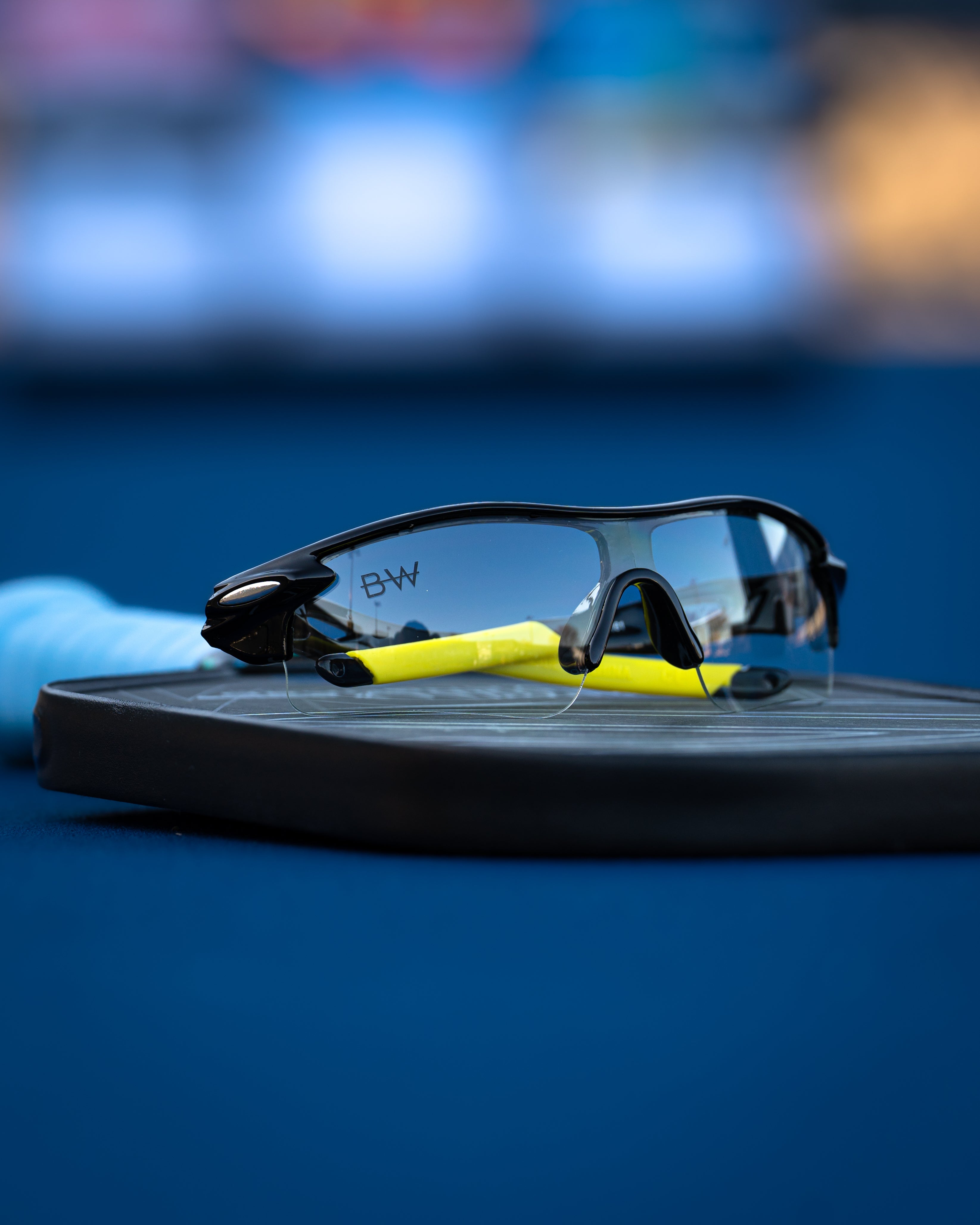
These RX Frames Won’t Interfere With Your Paddle Grip
Share
RX Pickleball Glasses Should Stay Out of the Way of Your Paddle Grip
Your paddle grip is controlled by your hands, fingers, wrist, forearm, technique, and personal preferences. Prescription eyewear should not be marketed as something that directly changes those mechanics.
What RX pickleball glasses can do is give players who need corrective lenses a sports-oriented eyewear option that can be selected around their prescription, frame fit, playing environment, and individual comfort.
That distinction matters.
A frame should not be promised to improve grip pressure, create better paddle control, eliminate overgripping, or make your swing mechanics smoother. Those are player-dependent outcomes.
Instead, this guide explains how to choose RX pickleball eyewear that fits into your overall setup without making unsupported claims about paddle grip or hand mechanics.
Find Pickleball Glasses for Your Setup
Compare prescription and non-prescription eyewear according to your vision needs, playing environment, frame preferences, and intended use.
Does Eyewear Actually Affect Your Paddle Grip?
Not in a direct mechanical sense.
Your paddle grip is determined by how you hold the paddle and how you use your hand, wrist, and forearm during play.
Eyewear does not physically control:
- Grip pressure
- Finger position
- Wrist angle
- Paddle-face angle
- Swing path
- Forearm tension
- Grip changes between shots
That means claims such as "these glasses improve your paddle grip" or "this frame gives you better paddle control" go beyond what the eyewear itself can establish.
Why Eyewear Can Still Matter During Pickleball
Even though your glasses do not control your paddle, prescription eyewear can still be an important part of your playing setup if you require corrective lenses.
When choosing RX pickleball glasses, consider:
- Your current eyeglass prescription
- Prescription compatibility with the exact frame
- Frame dimensions
- Individual fit
- Frame weight and design
- Current lens options
- Indoor or outdoor use
- How the eyewear feels during movement
- How it feels over longer sessions
Those are more useful buying criteria than promises about grip mechanics.
What if You Keep Adjusting Your Glasses Between Points?
If you frequently touch or reposition your eyewear during play, that can be a reason to evaluate your individual frame fit.
It does not automatically mean the glasses are changing your grip pressure or paddle mechanics.
Instead, ask practical questions:
- Do the frame dimensions suit me?
- How does the bridge feel?
- How do the temples feel?
- Do I notice frame movement during normal play?
- Does the fit feel different later in the session?
These questions keep the evaluation focused on the eyewear itself.
Can RX Glasses Cause or Prevent Overgripping?
Overgripping is a technique and tension issue involving the player.
A pair of glasses should not be claimed to eliminate overgripping, and a frame should not automatically be blamed for excessive paddle pressure without evidence.
If you are working on a more relaxed grip, focus on grip technique, paddle preparation, swing mechanics, and coaching or practice rather than expecting eyewear to change the habit for you.
What About Eyewear Distraction?
Distraction is subjective.
Some players may be more aware of a frame than others, especially when first switching to new prescription eyewear.
Instead of promising that a frame will "disappear from awareness," evaluate whether you personally like how it feels during:
- Serves
- Returns
- Dinks
- Volleys
- Backhands
- Lateral movement
- Transition-zone play
- Overheads
- Longer sessions
RX Frames to Compare for Your Pickleball Setup
There is no need to label one frame as the best for paddle grip because the frame does not determine how you hold the paddle.
A better approach is comparing current Blinded Wear RX options according to prescription compatibility, dimensions, fit, lens configuration, and style.
Crystal Wave II RX
Crystal Wave II RX is one current prescription option for pickleball players building a dedicated court setup.
Rather than claiming it has sweat-proof security, guaranteed wraparound clarity, or a fit that automatically improves hand mechanics, compare its documented product characteristics with your actual prescription and fit needs.
Consider:
- Prescription compatibility
- Current dimensions
- Available lens configuration
- Your normal playing environment
- Your individual fit preferences
- Your style preference
Blue Shield RX
Blue Shield RX gives prescription players another sports-oriented frame to compare.
Do not assume that it has specialized grip technology, zero-bounce construction, or a universally balanced fit unless those characteristics are documented for the exact product.
Instead, evaluate Blue Shield RX according to the specifications currently provided, your prescription requirements, available dimensions, fit preferences, and intended use.
Steel Ice RX
Steel Ice RX is another direct RX option for pickleball players.
It should not automatically be described as more stable, more rigid, better for control players, or less likely to move than another frame without verified comparative specifications.
Its role in your shortlist is simpler: it gives you another prescription frame to compare around fit, dimensions, current lens options, and style.
Frost RX
Frost RX is a direct RX option with a white frame and bright blue lens appearance.
If you want prescription pickleball eyewear with a visually distinct sports-oriented look, Frost RX can be part of your comparison.
Do not assume it is universally sweat-resistant, slip-proof, featherlight, or better for paddle control unless those characteristics are specifically documented.
Zebra II RX
Zebra II RX gives players another direct prescription option with a distinctive visual style.
Once prescription compatibility and practical fit requirements are satisfied, appearance can legitimately help you choose among several RX frames.
There is no need to turn that style preference into a claim that the frame improves grip, swing mechanics, or paddle control.
More RX Pickleball Frames to Compare
Additional current prescription options include:
Browse the full RX Pickleball Glasses Collection to compare the current lineup.
Frame Fit and Paddle Mechanics Are Separate
It is useful to separate two different questions:
- Does my eyewear fit the way I want during pickleball?
- Am I using the paddle grip and mechanics I want?
The first is an eyewear question.
The second is a technique question.
Combining them can make it harder to understand what is actually happening during play.
What Determines Paddle Grip Pressure?
Grip pressure is controlled by the player rather than the eyewear.
It can vary depending on:
- The shot being attempted
- Technique
- Paddle weight and balance
- Grip size
- Overgrip choice
- Hand size
- Fatigue
- Habit
- Match tension
- Coaching and practice
A prescription frame should not be marketed as a direct solution to any of those grip variables.
Will RX Glasses Change Your Serve Grip?
No. The frame does not determine how you hold the paddle during a serve.
If you notice yourself changing grip pressure while serving, evaluate your technique separately from your eyewear.
You can still assess how the glasses themselves feel during the serving motion, including how they sit as your head and body move.
What About Paddle Grip During Fast Volleys?
Fast kitchen exchanges can require quick paddle preparation and repeated changes in shot direction.
Eyewear does not control how firmly you hold the paddle during those exchanges.
If you are evaluating a new RX frame at the kitchen, focus on the frame itself:
- How does it feel during head movement?
- Do you notice movement during lateral shuffles?
- How does the bridge feel?
- How do the temples feel?
- Does your impression change later in the session?
Will RX Glasses Affect Your Backhand Grip?
Your backhand grip and technique are determined by the player.
A frame should not be promised to create freer paddle angles, smoother backhands, or better wrist mechanics.
What you can evaluate is whether you like how your prescription eyewear feels while turning, reaching, and moving through a normal backhand sequence.
Will RX Glasses Improve Your Dink Grip?
No eyewear can guarantee a softer grip, better touch, or more consistent dink mechanics.
Those skills are developed through technique, repetition, paddle control, and experience.
If you need prescription correction, your RX eyewear can address that separate need while you continue developing touch at the kitchen.
Do RX Glasses Improve Grip Recovery After Defensive Blocks?
No. Grip recovery and paddle readiness are player skills.
A frame does not physically reset your hand after a block or speed up the movement of your paddle.
Claims that prescription eyewear creates faster grip recovery should therefore be avoided.
Do RX Glasses Improve Hand-Eye Coordination?
Hand-eye coordination should not be treated as a feature built into a particular frame.
If you need prescription correction, wearing the appropriate prescription addresses your corrective requirements. That does not justify claiming that the frame itself improves neurological coordination between your eyes and hands.
Hand-eye coordination also involves attention, timing, anticipation, motor control, repetition, and experience.
Does "Optical Precision" Create Better Muscle Precision?
No direct claim should be made that clearer prescription optics automatically produce smoother swings, better aim, or more precise muscle movement.
Your prescription lenses and your physical technique perform different roles.
Prescription correction addresses your individual visual requirements.
Muscle control comes from the player.
Do RX Lenses Send Faster Visual Signals to Your Brain?
That is not an appropriate product claim.
Prescription lenses should not be marketed as increasing neurological processing speed or making visual signals travel faster.
Reaction during pickleball involves multiple processes, including vision, attention, anticipation, decision-making, and physical response.
A particular RX frame should not be credited with speeding up that complete process.
What About Peripheral Vision?
Frame geometry and lens dimensions can influence how much of a frame or lens edge a wearer notices, but a universal "full peripheral vision" or "zero tunnel distortion" claim should not be made without product-specific evidence.
Individual experience can also depend on:
- Prescription
- Lens design
- Frame dimensions
- Frame position
- Individual facial dimensions
- Where the wearer looks through the lens
Evaluate the actual finished eyewear rather than assuming a frame guarantees unrestricted peripheral vision.
Do Blinded Wear RX Lenses Have Zero Distortion?
A universal zero-distortion claim should not be made.
Prescription optics depend on the individual prescription, lens material, optical design, lens dimensions, frame geometry, and other factors.
If you have concerns about how a prescription lens should perform for your corrective needs, use the appropriate current prescription and confirm compatibility with the exact RX product.
Can Sweat Affect Your RX Eyewear?
Perspiration can influence an individual's wearing experience during active play.
That does not justify promising that every Blinded Wear RX frame is sweat-proof, slip-proof, or equipped with specialized moisture-wicking components.
Those characteristics should only be claimed when documented for the exact product.
If you sweat heavily during pickleball, evaluate how your finished frame feels later in a realistic session as well as during the first few minutes.
Do Blinded Wear RX Frames Have Anti-Slip Nose Pads?
Do not assume every RX frame includes specialized anti-slip nose pads or temple grips unless those features are documented for the exact product.
Individual fit can still be evaluated without inventing a proprietary grip system.
Compare available dimensions and pay attention to how the finished frame feels during the movements you actually make on court.
Can an RX Frame Be Guaranteed to Have Zero Bounce?
No universal zero-bounce guarantee should be made.
Frame movement can depend on:
- Facial dimensions
- Frame dimensions
- Bridge fit
- Temple fit
- Frame geometry
- Head movement
- Perspiration
- Prescription configuration
What feels stable on one wearer may not feel identical on another.
Are Blinded Wear RX Glasses Fog-Proof?
No collection-wide fog-proof claim should be made.
Condensation can depend on temperature, humidity, airflow, perspiration, surface conditions, and the overall eyewear configuration.
Likewise, do not assume every RX lens includes a specialized anti-fog coating unless that feature is documented for the exact lens configuration.
Does Fogging Change Your Paddle Grip?
Fogging and paddle grip should be treated as separate issues.
If condensation obstructs part of a lens, that can affect what the wearer can see through that area. It does not establish a specific change in grip pressure, swing mechanics, or paddle control.
Avoid turning a visibility issue into an unsupported biomechanical claim.
Do High-Index RX Lenses Affect Paddle Grip?
No. Refractive index does not measure or control paddle grip.
Blinded Wear includes high-index prescription lenses at no additional cost with custom RX eyewear.
High-index refers to a category of prescription lens material commonly used to help manage finished lens thickness, particularly as prescription strength increases.
Final lens thickness depends on factors such as:
- Your individual prescription
- Frame dimensions
- Lens dimensions
- Lens geometry
- Optical design
- Other corrective requirements
High-Index Is Not a Performance Rating
High-index does not automatically mean a lens provides:
- Better hand-eye coordination
- Better paddle control
- Faster reaction time
- Better ball tracking
- Improved depth perception
- More impact resistance
- Scratch-proof construction
- Anti-fog performance
- Safety certification
Keep prescription lens material separate from pickleball performance claims.
Impact-Resistant Lens Options for Active Play
Blinded Wear offers impact-resistant lens options for active use.
Impact resistance can be relevant when comparing sports-oriented eyewear, but it should not be confused with other claims.
Impact-resistant does not automatically mean:
- Shatterproof
- Unbreakable
- Scratch-proof
- Ballistic
- Certified to a particular protective standard
If you specifically require certified protective eyewear, verify the applicable certification for the exact product.
Does Lens Color Affect Paddle Grip?
No lens tint should be claimed to improve grip pressure, paddle control, hand positioning, or wrist mechanics.
Different tints can change visible-light transmission and color appearance.
That is separate from physical paddle mechanics.
Choose among verified lens options based on the conditions where you play and your personal visual preferences rather than expecting a lens color to change how you hold the paddle.
Does Polarization Affect Paddle Control?
Polarization status does not determine how you physically control your paddle.
Polarized lenses are designed to reduce certain reflected light. Blinded Wear also offers non-polarized lens options, and some court players may prefer a non-polarized configuration.
Neither polarized nor non-polarized lenses should automatically be claimed to produce:
- Better paddle control
- Better grip pressure
- Faster reactions
- Better ball tracking
- Improved depth perception
Learn more in the Pickleball Performance Lens Guide.
How to Order Blinded Wear RX Pickleball Glasses
Once you have narrowed your frame options, make sure your prescription information is submitted correctly.
- Browse the RX Pickleball Glasses Collection.
- Choose the frame you want to explore.
- Review the current product information and available options.
- Have your current eyeglass prescription ready.
- Upload a clear photo or picture of your eyeglass prescription on the product page before adding the eyewear to your cart.
- Add your custom RX eyewear to the cart and complete your order.
For additional information, visit the How to Order RX Glasses guide.
Your Paddle Grip Comes From You
Prescription eyewear does not determine how tightly you hold the paddle, how your wrist moves, what grip you use, or how smoothly you execute a shot.
Your technique controls those things.
If you require corrective lenses, your RX eyewear has a different job: provide the prescribed correction you need within an eyewear setup you choose for active pickleball use.
Compare prescription compatibility, frame dimensions, current lens options, individual fit, playing environment, and style. Then evaluate the finished pair during the movements that make up your actual game.
Part 2 will go deeper into direct RX versus RX Clip systems, grip changes, serves, volleys, backhands, indoor and outdoor play, frame sizing, stronger prescriptions, on-court fit testing, and how to separate eyewear characteristics from paddle mechanics.
How Frame Fit Can Affect Your On-Court Routine
Your glasses and paddle do not physically interact during normal pickleball play, but eyewear that feels distracting can still interrupt your routine.
If you repeatedly reach up to reposition a frame between points, wipe the lenses, or think about how the eyewear feels, your attention is being divided between your equipment and the next rally.
That does not mean the glasses directly change your paddle grip. Instead, it means a comfortable, appropriate fit can help keep your eyewear from becoming another piece of equipment you are constantly thinking about.
The goal is simple: find prescription eyewear that meets your corrective needs and feels appropriate during the movements you actually make on court.
Does Prescription Eyewear Change Paddle Grip Pressure?
There is no reason to claim that a particular RX frame automatically produces lighter grip pressure or prevents overgripping.
Paddle grip pressure can be influenced by technique, shot selection, tension, experience, paddle setup, and the situation during a point.
Eyewear should be evaluated separately.
When testing a new RX pair, ask whether you are comfortable wearing it rather than trying to determine whether it directly changed your grip mechanics.
Your Paddle Mechanics Still Come From You
Prescription pickleball glasses cannot create proper paddle mechanics.
Your eyewear should not be credited with or blamed for:
- Continental grip technique
- Grip-pressure changes
- Wrist position
- Paddle-face angle
- Swing path
- Contact point
- Reset technique
- Dink mechanics
- Volley preparation
- Backhand technique
If you want to improve those areas, practice and instruction are more relevant than changing eyewear.
If you need prescription correction while practicing them, however, choosing a dedicated RX setup can address that separate requirement.
Do RX Pickleball Glasses Improve Hand-Eye Coordination?
It is tempting to connect clearer prescription vision with an automatic improvement in hand-eye coordination, but that goes beyond what should be promised from an eyewear product.
Hand-eye coordination involves visual information, processing, timing, learned movement, repetition, attention, and physical execution.
Your prescription addresses your individual corrective requirements. A particular frame should not be marketed as making the brain process visual information faster or automatically producing smoother swings and better aim.
Does "Optical Precision" Create Better Muscle Precision?
No direct performance guarantee should be made between an RX lens and the precision of your paddle movement.
Your prescription eyewear and your motor skills are related to different parts of the playing experience.
Use the appropriate corrective prescription for your vision needs. Develop paddle control through repetition, technique, positioning, and experience.
Keeping those concepts separate produces a more useful way to evaluate prescription pickleball eyewear.
Frame Stability Still Matters—Just Not Because It Controls Your Paddle
How a frame fits during movement can matter to the wearer. What should be avoided is turning that into an unsupported claim that a certain frame directly improves paddle control.
Frame movement can depend on:
- Overall frame dimensions
- Facial dimensions
- Bridge fit
- Temple fit
- Frame geometry
- Head movement
- Perspiration
- Individual wearing preferences
This is why absolute terms such as "zero bounce," "bounce-proof," and "locked in for everyone" should be avoided.
The more useful question is whether the specific frame fits you appropriately during the way you play.
How to Test Your RX Frame Without Confusing Fit With Performance
You can evaluate prescription eyewear during a normal pickleball session without treating your score as the test.
Start With Your Normal Warmup
Wear the finished RX pair while moving naturally and getting familiar with the frame.
Dink at the Kitchen
Use normal head movement while evaluating how the eyewear feels.
Practice Volleys
Pay attention to the frame during quick changes in head and body position rather than trying to determine whether the glasses made your hands faster.
Serve and Return
Evaluate the eyewear through the larger movements involved in your normal serve and return routine.
Move Laterally
Shuffle and recover the way you normally would during a point.
Track an Overhead
Looking upward gives you another head position from which to evaluate fit.
Play Complete Games
Extended wear can tell you more than a few minutes of standing in front of a mirror.
What if You Keep Reaching Up to Adjust Your Glasses?
If you repeatedly feel the need to reposition your eyewear, investigate the fit instead of assuming that all sports glasses should feel identical.
Consider whether:
- The overall frame dimensions suit you
- The bridge position feels appropriate
- The temples feel comfortable
- The frame feels different during movement than at rest
- Perspiration changes your experience
- The issue develops only after extended wear
Do not assume that simply tightening a frame is always the answer. Excessively tight eyewear is not automatically better-fitting eyewear.
Does a Tighter RX Frame Mean Better Paddle Control?
No.
A tighter frame does not create better paddle control, and excessive pressure is not a performance feature.
The objective is an appropriate individual fit rather than maximum tightness.
When available, compare frame dimensions with eyewear you already know fits you well. Then evaluate the finished pair during realistic court movement.
Do Lightweight RX Frames Improve Paddle Mechanics?
Blinded Wear offers lightweight sports-frame options, which can be appealing to players who prefer a lighter-feeling eyewear setup.
That does not mean a lightweight frame automatically:
- Improves wrist movement
- Reduces grip pressure
- Produces faster hands
- Improves paddle angle
- Stays in place better than every heavier frame
- Improves reaction time
Frame weight is one characteristic within the complete fit and wearing experience.
What About Peripheral Vision During Volleys and Backhands?
Do not assume every RX frame provides "full-court vision," unlimited peripheral visibility, or zero tunnel distortion.
Your experience can depend on the complete optical and frame configuration, including:
- Your prescription
- Lens dimensions
- Frame geometry
- Frame position
- Individual facial dimensions
- Where you direct your eyes and head
If peripheral awareness is important to you, compare the dimensions and design of the RX frames you are considering and evaluate the finished eyewear yourself.
What About "Zero Distortion" RX Lens Claims?
A blanket promise of zero distortion should not be used without product-specific optical evidence supporting that claim.
Prescription lenses are individualized optical products, and the wearer's experience can depend on the prescription, lens design, dimensions, frame configuration, and other optical factors.
Likewise, do not promise that a particular RX frame automatically provides faster visual signals to the brain or improves paddle accuracy.
High-Index Prescription Lenses: What Paddle Players Should Know
Blinded Wear includes high-index prescription lenses at no additional cost with custom RX eyewear.
High-index refers to a category of prescription lens material commonly used to help manage finished lens thickness, particularly as prescription strength increases.
Final lens thickness can depend on:
- Your individual prescription
- Lens dimensions
- Frame dimensions
- Lens geometry
- Optical design
- Other prescription requirements
High-index does not describe paddle control or court performance.
High-Index Is Not a Pickleball Performance Rating
A higher refractive index should not automatically be interpreted as:
- Better hand-eye coordination
- Faster reaction time
- Better ball tracking
- Better depth perception
- Improved paddle control
- Greater impact resistance
- Greater scratch resistance
- Safety certification
Keep prescription lens material separate from those other characteristics.
Impact-Resistant Lens Options for Active Pickleball Use
Blinded Wear offers impact-resistant lens options for active use.
Impact resistance can be a relevant consideration when comparing sports-oriented eyewear, but it should not be expanded into unsupported terminology.
Impact-resistant does not automatically mean:
- Shatterproof
- Unbreakable
- Scratch-proof
- Ballistic
- Certified to a particular protective standard
If you require eyewear certified to a specific standard, verify the exact certification rather than assuming it from a sports-oriented design.
Sweat, RX Glasses, and Paddle Grip Are Separate Issues
A demanding pickleball session can involve perspiration, but avoid turning that into a claim that every Blinded Wear RX frame contains moisture-wicking padding, anti-slip nose pads, or specialized sweat-control technology.
Those features should only be claimed when documented for the exact product.
Likewise, perspiration affecting your eyewear does not automatically mean your paddle grip changes.
If you sweat heavily, evaluate the finished eyewear during the conditions in which you normally play.
Can Lens Fogging Distract You During a Point?
Fogging can be distracting, but no collection-wide fog-proof guarantee should be made.
Condensation can be influenced by:
- Temperature
- Humidity
- Airflow
- Perspiration
- Surface conditions
- The complete eyewear configuration
Do not assume every RX lens includes an anti-fog coating unless that treatment is documented for the exact configuration.
Clear RX Lens Considerations for Pickleball
A clear lens has no dark sunglass tint.
Players who do not want a dark tint for indoor, evening, or lower-brightness environments may want to investigate the current clear RX options available for the exact product they are considering.
Clear appearance alone does not establish:
- UV specifications
- Impact resistance
- Polarization
- Safety certification
- Anti-fog treatment
- Scratch resistance
- Anti-reflective treatment
- Blue-light filtering
For non-prescription options, you can separately browse the Clear Lens Collection.
Can a Lens Tint Improve Paddle Control?
No specific lens color should universally be promised to improve paddle control.
Different tints can change visible-light transmission and color appearance. Some players may prefer certain lens colors or brightness levels based on their playing environment and subjective visual preferences.
That does not establish an automatic improvement in:
- Grip pressure
- Hand-eye coordination
- Paddle angle
- Ball tracking
- Reaction time
- Depth perception
- Shot accuracy
Choose among verified lens options according to the environment where you play and your individual preferences.
Does Polarization Affect Paddle Control?
Polarized lenses are designed to reduce certain reflected light. Blinded Wear also offers non-polarized lens options, and some court players may prefer a non-polarized setup.
Polarization status alone does not determine paddle control, depth perception, contrast, reaction time, or ball-tracking ability.
It is one lens characteristic rather than a direct measure of pickleball performance.
Learn more in the Pickleball Performance Lens Guide.
RX Frames to Compare for Your Pickleball Setup
Instead of ranking frames according to unsupported claims about paddle control, compare current Blinded Wear RX options according to prescription compatibility, dimensions, lens configuration, individual fit, and style.
| RX Frame | What to Evaluate |
|---|---|
| Crystal Wave II RX | Current specifications, prescription compatibility, dimensions, lens configuration, fit, and style. |
| Frost RX | Prescription compatibility, current specifications, dimensions, individual fit, and white-frame, bright-blue-lens appearance. |
| Blue Shield RX | Current product information, prescription requirements, dimensions, fit, and styling. |
| Steel Ice RX | Prescription compatibility, dimensions, documented characteristics, lens configuration, and individual fit. |
| Havana Melt RX | Prescription compatibility, current product information, dimensions, lens configuration, fit, and appearance. |
| Zebra II RX | Current specifications, prescription requirements, individual fit, and distinctive styling. |
| Lava Rock RX | Current product details, prescription compatibility, dimensions, lens configuration, and style. |
| Gray Wash RX | Current specifications, prescription compatibility, available dimensions, fit, and appearance. |
Browse the complete RX Pickleball Glasses Collection for additional options.
How to Narrow Your RX Frame Shortlist
If your goal is eyewear that stays out of your way while you focus on paddle mechanics, build your shortlist around practical factors rather than promises of better grip.
- Start with prescription compatibility. Your corrective requirements come first.
- Compare available dimensions. Use glasses you already know fit well as a reference when possible.
- Review the current lens configuration. Do not assume every RX frame offers identical options.
- Consider your playing environment. Think about indoor, outdoor, daytime, evening, or mixed use.
- Consider session length. Evaluate how the eyewear feels beyond the first few minutes.
- Test realistic movement. Include serving, returning, dinking, volleys, lateral movement, and overheads.
- Choose the style you prefer. Once the practical requirements are satisfied, appearance can help determine the final choice.
Direct RX vs. RX Clip for Pickleball
Blinded Wear prescription eyewear can include direct RX products as well as compatible RX Clip systems.
Direct RX
With a direct RX configuration, prescription correction is incorporated into the direct prescription setup of the compatible product.
RX Clip
An RX Clip uses a separate inner prescription insert within a compatible eyewear system. Your prescription correction is contained in the inner RX insert rather than the primary outer sports lens.
An RX Clip should not be described as a universal insert that can be used with arbitrary sunglasses.
Neither configuration automatically produces better grip mechanics, faster hands, or better paddle control.
High-Index Lenses in RX Clip Systems
Blinded Wear includes high-index prescription lenses at no additional cost in custom RX Clip configurations.
The prescription correction is contained in the inner insert, while the primary outer sports lens remains a separate part of the compatible eyewear system.
As with direct RX, verify the exact product configuration and prescription compatibility rather than assuming every prescription works with every frame.
What if You Have a Stronger Prescription?
A stronger prescription does not automatically prevent you from considering sports-oriented RX eyewear, but compatibility becomes especially important.
High-index materials can help manage finished lens thickness in comparable prescriptions, but final thickness depends on the individual prescription, frame and lens dimensions, geometry, optical design, and other requirements.
No single RX frame should be described as universally compatible with every prescription.
What if Your Prescription Includes Astigmatism Correction?
If your eyeglass prescription includes cylinder and axis values, those values are part of your individual corrective requirements.
Use your current prescription and verify compatibility with the exact RX product rather than changing or simplifying prescription information because you intend to play pickleball.
What if You Need Progressive or Specialized Prescription Lenses?
Do not assume every RX sports frame supports every specialized prescription design.
If you need progressive, multifocal, or another specialized lens configuration, verify current availability and compatibility for the exact product before ordering.
How to Order Blinded Wear RX Pickleball Glasses
Once you have narrowed your frame options, make sure you follow the custom RX ordering process carefully.
- Browse the RX Pickleball Glasses Collection.
- Select the frame you want to explore.
- Review its current specifications and available lens options.
- Confirm compatibility with your prescription requirements.
- Have your current eyeglass prescription ready.
- Upload a clear photo or picture of your prescription on the product page before adding the eyewear to your cart.
- Add the custom RX eyewear to your cart and complete your order.
For additional details, read How to Order RX Glasses.
Continue Comparing Your Pickleball Eyewear Options
- RX Pickleball Glasses — Browse current prescription options.
- 2026 Pickleball Glasses Hub — Compare RX and non-RX options.
- Pickleball Performance Lens Guide — Learn about lens colors, clarity, and RX options.
- Pickleball Sunglasses Quiz — Narrow the collection according to your preferences.
- How to Order RX Glasses — Review the prescription ordering process.
Keep Your Eyewear and Paddle Mechanics in Their Proper Roles
Your prescription eyewear should address your corrective requirements and suit the way you use it on court.
Your hands still control the paddle.
Your technique determines grip pressure, wrist position, paddle angle, contact, and swing mechanics. Your prescription glasses do not need to claim credit for those skills to be useful equipment.
The better buying strategy is to choose an RX configuration around your prescription, frame fit, lens needs, playing environment, and individual preferences.
Part 3 will finish the guide with detailed FAQs about grip interference, frame movement, straps, peripheral vision, sweat, fogging, prescription compatibility, high-index lenses, impact resistance, RX policies, 50% lifetime replacement support, common myths, a final pre-purchase checklist, and the complete decision framework for choosing your pair.
RX Pickleball Glasses and Paddle Grip: Frequently Asked Questions
The most important distinction is simple: your eyewear can be evaluated for prescription correction, fit, comfort, lens configuration, and active use, while your paddle grip remains a matter of technique.
These answers separate the two so you can compare RX pickleball glasses without relying on exaggerated performance claims.
Can RX glasses interfere with my paddle grip?
Your glasses do not physically determine how your fingers, hand, wrist, or forearm hold the paddle. If you find yourself repeatedly adjusting your eyewear, however, evaluate the frame fit separately rather than assuming that the glasses are directly changing your grip mechanics.
Can RX pickleball glasses improve my paddle grip?
No specific frame should be promised to improve grip technique or grip pressure. Those are player-controlled skills.
Can prescription glasses make me grip the paddle too tightly?
Do not assume a direct cause-and-effect relationship. Overgripping can involve technique, tension, habits, paddle setup, and other player-specific factors.
Will a better-fitting frame give me better paddle control?
An appropriate frame fit can be valuable for the eyewear itself, but it should not be converted into a guarantee of better paddle control.
Do lightweight RX glasses make your hands faster?
No. Lightweight sports-frame options can appeal to players who prefer a lighter-feeling eyewear setup, but frame weight does not determine hand speed.
FAQ: Frame Movement During Pickleball
Are Blinded Wear RX glasses guaranteed not to bounce?
No. A universal zero-bounce guarantee would ignore differences in facial dimensions, frame dimensions, bridge fit, temple fit, head movement, perspiration, and individual preferences.
Should my RX glasses move at all during play?
There is no universal amount of acceptable movement for every wearer. Evaluate your finished eyewear during realistic court movement and decide whether the fit works for you.
Does a tighter frame always stay in place better?
No. Maximum tightness is not the same thing as appropriate fit.
Does a lightweight frame automatically move less?
No. Weight is only one characteristic of the complete frame and fit.
What movements should I use to evaluate my glasses?
Try your normal serves, returns, dinks, volleys, lateral movement, transition-zone movement, overheads, and complete games. Evaluate the eyewear itself rather than using your score as the test.
FAQ: Do You Need a Strap With RX Pickleball Glasses?
Does every player need an eyewear strap?
No universal answer applies to every player, frame, or playing situation.
Can Blinded Wear guarantee I will never need a strap?
No. That would require assuming that every frame fits every wearer identically.
Should I buy a tighter frame instead of considering a strap?
Do not deliberately choose excessive pressure simply because you assume tighter always means more stable. Start by choosing an appropriate frame size and fit.
FAQ: Sweat and RX Pickleball Eyewear
Are all Blinded Wear RX frames sweat-proof?
No collection-wide sweat-proof claim should be made.
Do all RX frames have moisture-wicking padding?
Do not assume specialized moisture-wicking components unless they are documented for the exact product.
Do all RX frames use anti-slip nose pads?
Do not make a collection-wide anti-slip nose-pad claim without product-specific documentation.
Can perspiration affect frame fit?
Perspiration can influence an individual's experience with eyewear during active use. This is one reason it can be useful to evaluate the finished pair during realistic playing conditions.
Does sweating mean my paddle grip will change?
Not necessarily. Eyewear fit and paddle grip mechanics should be evaluated separately.
FAQ: Fogging During Pickleball
Are Blinded Wear RX glasses fog-proof?
No collection-wide fog-proof guarantee should be made.
Do all RX lenses have anti-fog coatings?
No. An anti-fog treatment should only be claimed when it is documented for the exact lens configuration.
Why can eyewear fog during pickleball?
Condensation can be influenced by temperature, humidity, airflow, perspiration, surface conditions, and the overall eyewear configuration.
Does anti-fog automatically mean the glasses will never fog?
A treatment and a universal performance guarantee are not the same thing. Avoid interpreting a documented lens treatment as proof that condensation can never occur under any condition.
FAQ: Peripheral Vision and RX Pickleball Glasses
Do all Blinded Wear RX frames provide unlimited peripheral vision?
No universal claim of unrestricted peripheral vision should be made.
Do RX sports glasses eliminate tunnel vision?
Do not promise "zero tunnel distortion" without product-specific optical evidence.
What can affect my experience at the edges of an RX lens?
Your individual prescription, lens design, lens dimensions, frame geometry, frame position, facial dimensions, and where you look through the lens can all be relevant.
Can a wraparound appearance prove better peripheral vision?
No. Frame appearance by itself does not establish a specific optical performance result.
FAQ: Vision, Reaction Time, and Paddle Performance
Will Blinded Wear RX glasses make my reaction time faster?
No eyewear should be promised to increase biological reaction speed. Reaction involves visual information, attention, anticipation, decision-making, and physical response.
Will they improve my hand-eye coordination?
A particular frame should not be marketed as automatically improving hand-eye coordination.
Will RX lenses improve my paddle accuracy?
No specific frame or lens should guarantee better shot accuracy. Technique remains the player's responsibility.
Will RX glasses help me track the ball better?
Improved ball tracking should not be guaranteed as an automatic result of purchasing a particular frame or lens. Your prescription, individual vision, lighting, environment, attention, and experience can all contribute to what you perceive.
Will they improve depth perception?
Depth perception should not be treated as a feature that a particular frame, tint, or polarization status automatically improves.
Can they help me see spin sooner?
No lens should universally be promised to create earlier recognition of ball rotation.
FAQ: Prescription Lens Options for Pickleball
Does Blinded Wear include high-index prescription lenses?
Yes. Blinded Wear includes high-index prescription lenses at no additional cost with custom RX eyewear.
What does high-index mean?
High-index refers to a category of prescription lens material commonly used to help manage finished lens thickness, particularly as prescription strength increases.
Does high-index mean thinner lenses?
A higher refractive-index material can help manage thickness in comparable prescriptions, but final thickness depends on the individual prescription, lens dimensions, frame dimensions, lens geometry, optical design, and other requirements.
Does high-index mean lighter?
Not automatically. Finished lens weight depends on the complete lens configuration and material characteristics.
Does high-index mean more impact-resistant?
No. Refractive index and impact resistance are separate characteristics.
Does Blinded Wear use the same refractive index for every RX order?
Do not assume an exact refractive index unless it is confirmed for the specific prescription configuration being ordered.
FAQ: Impact-Resistant Lens Options
Does Blinded Wear offer impact-resistant lens options?
Yes. Blinded Wear offers impact-resistant lens options for active use.
Does impact-resistant mean shatterproof?
No. Impact resistance should not be interpreted as a guarantee that a lens cannot break.
Does impact-resistant mean scratch-proof?
No. Scratch resistance and impact resistance are different characteristics.
Does impact-resistant automatically mean safety-certified?
No. Certification to a specific protective standard requires applicable product documentation.
Are Blinded Wear RX glasses automatically ballistic eyewear?
No. Ballistic performance is a specialized claim requiring appropriate product-specific evidence.
FAQ: Polarized vs. Non-Polarized Pickleball Lenses
What does polarization do?
Polarized lenses are designed to reduce certain reflected light.
Does Blinded Wear offer non-polarized lens options?
Yes. Blinded Wear offers non-polarized lens options. Verify the exact configuration available for the product you are considering.
Are non-polarized lenses automatically better for pickleball?
No. Some court players may prefer non-polarized lenses, but polarization status alone does not determine overall suitability.
Do polarized lenses reduce depth perception?
Polarization alone should not be claimed to reduce depth perception.
Do non-polarized lenses improve reaction time?
No. Polarization status alone does not determine reaction speed.
Can polarized lenses interact with digital displays?
Polarized lenses can interact with some digital displays depending on the display technology, viewing angle, and orientation.
FAQ: Lens Tint and Paddle Play
Does a darker lens improve paddle control?
No. Tint darkness does not determine paddle mechanics.
Can a lens color improve reaction time?
No tint should universally be promised to increase reaction speed.
Can a tint improve ball tracking?
Different tints can change visible-light transmission and color appearance, but improved ball tracking should not be guaranteed from a specific lens color.
Does a darker tint mean greater UV protection?
No. Tint darkness and UV specifications are separate characteristics.
Does a darker lens mean greater impact protection?
No. Tint and impact resistance are separate characteristics.
Does a mirrored appearance prove that a lens is polarized?
No. Appearance alone does not establish polarization status.
FAQ: Clear Lenses for Pickleball
What does a clear lens mean?
A clear lens means there is no dark sunglass tint.
Can clear lenses be useful for indoor or evening play?
Players who do not want a dark sunglass tint indoors, in the evening, or in lower-brightness environments may want to investigate clear options. Verify exact RX availability for the product you are considering.
Do clear lenses create more light?
No. A clear lens does not create or amplify available light.
Does clear appearance prove UV protection?
No. Lens appearance alone does not establish a particular UV specification.
Does clear mean impact-resistant?
No. Clear appearance and impact resistance are separate characteristics.
For non-prescription options, browse the Clear Lens Collection.
FAQ: Prescription Compatibility
Can every prescription be made in every Blinded Wear RX frame?
Do not assume universal compatibility. Your individual prescription requirements should be checked against the exact RX product and configuration.
Can I order RX pickleball glasses with astigmatism correction?
If your prescription contains cylinder and axis values, use the prescription provided for you and verify compatibility with the exact product.
Can stronger prescriptions work with sports-oriented frames?
Potential compatibility depends on the individual prescription and product. High-index lens materials can help manage finished lens thickness, but they do not guarantee that every prescription is compatible with every frame.
Can I order progressive lenses?
Progressive and other specialized prescription availability should be verified for the exact product rather than assumed across the collection.
Should I change my prescription because I am using the glasses for pickleball?
Use your current eyeglass prescription rather than changing prescription values yourself for sports use.
FAQ: Direct RX vs. RX Clip Systems
What is direct RX?
With a direct RX configuration, prescription correction is incorporated into the direct prescription setup of a compatible product.
What is an RX Clip?
An RX Clip uses a separate inner prescription insert within a compatible eyewear system. The corrective prescription is contained in the inner insert rather than the primary outer sports lens.
Can I use an RX Clip with any sunglasses?
No. An RX Clip is designed for a compatible eyewear system and should not be described as universally compatible with arbitrary sunglasses.
Are high-index prescription lenses included in custom RX Clip configurations?
Yes. Blinded Wear includes high-index prescription lenses at no additional cost in custom RX Clip configurations.
Does direct RX provide better paddle control than an RX Clip?
No universal paddle-performance advantage should be assigned to either configuration.
FAQ: Uploading Your Prescription
When do I submit my eyeglass prescription?
Upload a clear photo or picture of your eyeglass prescription on the RX product page before adding the eyewear to your cart.
Can I use the Pickleball Sunglasses Quiz instead of a prescription?
No. The Pickleball Sunglasses Quiz can help with product discovery, but it does not replace an eyeglass prescription.
Where can I review the complete RX ordering process?
Visit the How to Order RX Glasses guide before purchasing.
RX Pickleball Glasses and Paddle Grip: Myths vs. Facts
| Common Claim | What to Know |
|---|---|
| "The right RX frame improves paddle grip." | Paddle grip is controlled by the player rather than the frame. |
| "Sports glasses prevent overgripping." | No frame should be promised to eliminate a technique or tension habit. |
| "A tighter frame means better control." | Maximum tightness is not the same as appropriate fit and does not establish better paddle control. |
| "Lightweight glasses make your hands faster." | Frame weight does not determine hand speed or reaction time. |
| "Wraparound frames guarantee full peripheral vision." | Individual optical experience depends on more than external frame appearance. |
| "High-index lenses improve court performance." | High-index is a prescription lens-material category, not a pickleball performance rating. |
| "Impact-resistant means shatterproof." | Impact resistance does not mean a lens is unbreakable. |
| "All sports eyewear is fog-proof." | Do not assume anti-fog treatment or universal fog prevention without product-specific documentation. |
| "Non-polarized lenses improve depth perception." | Polarization status alone does not determine depth perception. |
| "A certain tint improves reaction time." | Lens color should not be promised to increase biological reaction speed. |
What You Can Actually Compare Before Buying
Instead of ranking RX frames using unsupported performance claims, compare characteristics that can actually inform your purchase.
| Comparison | Useful? | Why |
|---|---|---|
| Prescription compatibility | Yes | The frame and RX configuration need to work with your corrective requirements. |
| Available frame dimensions | Yes | Dimensions can help you compare the frame with eyewear you already know fits. |
| Direct RX vs. RX Clip | Yes | These are different prescription configurations worth understanding before purchase. |
| Current verified lens options | Yes | The exact configuration should match your intended use and preferences. |
| Style | Yes | Appearance is a legitimate preference once practical requirements are satisfied. |
| Guaranteed paddle-control improvement | No | Eyewear does not determine your paddle mechanics. |
| Guaranteed reaction-time improvement | No | Biological reaction speed is not a frame specification. |
| Guaranteed zero bounce | No | Individual fit varies between wearers. |
A Practical On-Court Test for New RX Glasses
When your finished prescription eyewear arrives, test the eyewear rather than expecting it to transform your game.
- Wear it before an important match. Give yourself time to become familiar with a new prescription eyewear setup.
- Warm up normally. Notice how the frame feels while moving rather than standing still.
- Dink from the kitchen. Evaluate the eyewear through normal head movement.
- Practice volleys. Include faster exchanges and lateral movement.
- Serve and return. Evaluate the frame during larger body and head movements.
- Practice transition-zone movement. Move forward and backward as you normally would.
- Hit overheads. Evaluate the fit while looking upward.
- Play complete games. Determine how the eyewear feels over a realistic session.
- Separate technique from equipment. Do not treat every missed shot as an eyewear problem or every successful shot as proof that the glasses improved performance.
Using New RX Glasses Before League or Tournament Play
If you have an important event approaching, becoming familiar with new prescription eyewear beforehand is a practical approach.
Use the pair during practice or recreational games so you can evaluate the finished prescription, frame fit, and overall wearing experience before relying on it for a longer competitive session.
This does not guarantee better tournament performance. It simply gives you time to become familiar with new equipment before the event matters.
Should Prescription Players Carry Backup Eyewear?
If you depend on corrective lenses, carrying backup corrective eyewear can be useful during longer pickleball days, travel, leagues, or tournaments.
A backup pair does not need to be identical to your primary court eyewear to serve as a contingency if your primary pair becomes unavailable or damaged.
Whether you need a backup depends on how dependent you are on corrective eyewear and how important uninterrupted access to prescription correction is during the activity.
Can You Return Custom Blinded Wear RX Glasses?
Blinded Wear offers a 30-day return policy for eligible standard purchases.
Customized RX eyewear is final sale and excluded from the standard 30-day return policy.
That makes pre-purchase review especially important. Check your prescription information, exact product, available dimensions, current lens configuration, and RX compatibility before completing the order.
RX final-sale status is separate from applicable replacement support for eligible broken eyewear.
Review the Blinded Wear Protection Plan, Replacement & Returns information for current policy details.
What Happens if Eligible RX Glasses Break?
Blinded Wear offers 50% lifetime replacement support if eligible glasses break, subject to current policy terms.
The damaged eyewear must be returned. Once the applicable claim and return requirements are satisfied, qualifying customers can receive 50% credit toward a replacement pair.
This is not a free full replacement.
For damaged RX eyewear, contact blindedwearco@gmail.com before returning the pair.
Review the Protection Plan, Replacement & Returns information for current eligibility and policy details.
Does Lifetime Replacement Support Cover Lost RX Glasses?
Do not assume that replacement support for eligible broken eyewear automatically applies to lost glasses.
Coverage should be understood according to the current policy terms rather than treated as universal replacement coverage.
What if Your Prescription Changes?
A prescription change is different from eligible physical breakage.
Do not assume the 50% lifetime replacement support for eligible broken eyewear applies solely because your prescription changes.
If you need a new custom RX pair after your prescription changes, use your current eyeglass prescription when placing the new order.
Pre-Purchase Checklist for RX Pickleball Glasses
- Use your current eyeglass prescription.
- Verify compatibility with the exact RX product.
- Understand whether you are considering direct RX or an RX Clip system.
- Compare available frame dimensions.
- Use eyewear you already know fits as a sizing reference when possible.
- Review the current lens options for the exact product.
- Think about whether you primarily play indoors, outdoors, or both.
- Keep lens tint and UV specifications separate.
- Keep tint and polarization separate.
- Keep high-index and impact resistance separate.
- Keep impact resistance and safety certification separate.
- Do not assume a sports frame is universally slip-proof.
- Do not assume every RX lens has an anti-fog treatment.
- Do not assume darker lenses automatically provide more protection.
- Do not expect a lens color to change your paddle mechanics.
- Do not expect a frame to increase reaction speed.
- Do not expect eyewear to eliminate overgripping.
- Review the custom RX final-sale policy.
- Review the current replacement policy.
- Upload a clear photo or picture of your prescription on the product page before adding the RX eyewear to your cart.
How to Order Your RX Pickleball Glasses
- Visit the Blinded Wear RX Pickleball Glasses Collection.
- Choose the frame you want to explore.
- Review its current specifications, prescription configuration, and available lens options.
- Confirm compatibility with your prescription requirements.
- Have your current eyeglass prescription ready.
- Upload a clear photo or picture of the prescription on the RX product page before adding the eyewear to your cart.
- Add your custom RX eyewear to the cart and complete your order.
For additional guidance, review How to Order RX Glasses.
Explore More Pickleball Eyewear Resources
- RX Pickleball Glasses — Browse current prescription options.
- Non-RX Pickleball Sunglasses — Explore non-prescription court eyewear.
- Clear Lens Collection — Browse non-prescription clear-lens options.
- 2026 Pickleball Glasses Hub — Compare the broader RX and non-RX lineup.
- Best Pickleball Sunglasses 2026 — Explore the broader pickleball sunglasses guide.
- Pickleball Performance Lens Guide — Learn about lens colors, clarity, and RX options.
- Pickleball Sunglasses Quiz — Narrow your options based on your preferences.
- How to Order RX Glasses — Review the prescription ordering process.
- Protection Plan, Replacement & Returns — Review current policy information.
What Should You Actually Look for in RX Pickleball Glasses?
Forget the idea that a pair of glasses can control your paddle for you.
A more useful RX buying decision focuses on the things eyewear can actually provide and the characteristics you can actually compare.
Start with your prescription. Confirm compatibility with the exact product. Understand whether you are considering direct RX or an RX Clip system. Compare available dimensions. Review the current lens configuration. Think about where and when you normally play. Then choose a style you want to wear.
Once the finished eyewear arrives, evaluate it during realistic movement instead of expecting an instant change in your pickleball ability.
Your paddle mechanics remain yours.
The Bottom Line: Your RX Frames and Paddle Have Different Jobs
Your paddle grip controls how you hold and manipulate the paddle.
Your prescription eyewear addresses your corrective vision requirements.
Those jobs do not need to be combined into exaggerated claims about faster hands, perfect grip pressure, better wrist mechanics, or automatic shot accuracy.
Blinded Wear gives pickleball players prescription eyewear options built around active use, including lightweight sports-frame options, high-index prescription lenses at no additional cost, impact-resistant lens options, and non-polarized options.
The right choice comes down to your prescription, the exact frame and lens configuration, individual fit, playing environment, and personal preferences.
Let your eyewear handle your prescription. Let your hands handle the paddle.
Find Your RX Pickleball Pair
Explore the Blinded Wear RX Pickleball Glasses Collection to compare current prescription frames and find an option that fits your corrective requirements and court setup.
If you are still narrowing your choices, use the Pickleball Sunglasses Quiz or visit the 2026 Pickleball Glasses Hub.
Choose for your prescription. Compare for your needs. Keep your paddle mechanics in your hands.