
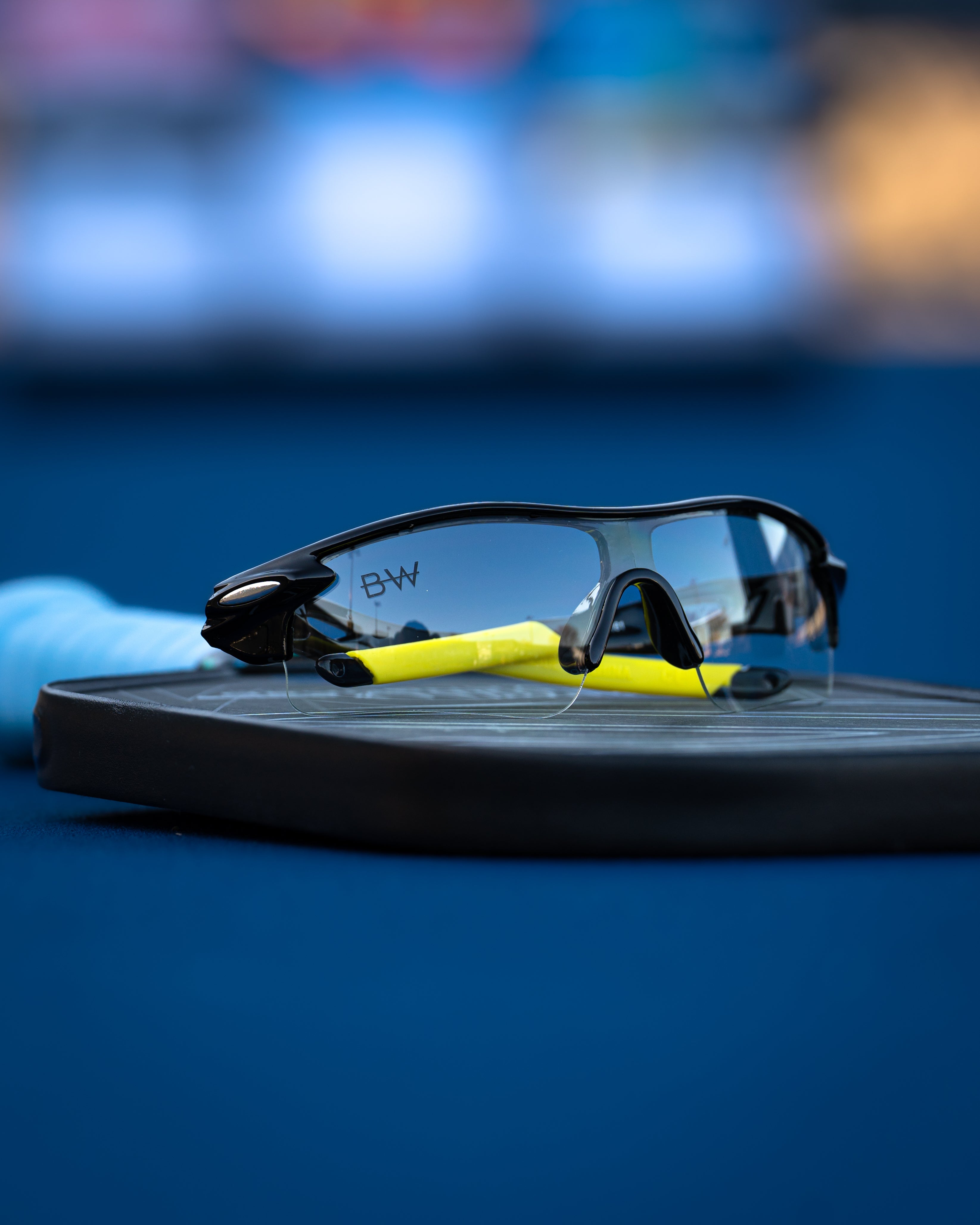
The RX Glasses That Keep Your Depth Perception Sharp
Share
RX Glasses and Depth Perception in Pickleball: What Actually Matters?
Depth perception matters throughout pickleball. Players continually judge where the ball is traveling, how far away it is, when it may arrive, where opponents are positioned, and how they should move in response.
If you require prescription correction, the practical goal is not to find a pair of glasses that magically "boosts" depth perception. It is to use an appropriate current prescription in an eyewear configuration that works for your individual vision, fit, and playing environment.
The right prescription sports eyewear should therefore be evaluated around your corrective needs, prescription compatibility, frame fit, lens configuration, and real playing conditions rather than promises of sharper depth, faster reactions, or automatic improvements in ball tracking.
This guide explains what depth perception is, what prescription eyewear can and cannot do, how fit and lens configuration matter, and how to compare Blinded Wear RX pickleball glasses without relying on exaggerated optical claims.
Quick Answer: Can RX Glasses Keep Your Depth Perception Sharp?
If you need prescription correction, wearing an appropriate current prescription can help provide the corrective vision your prescription is intended to provide while you play.
That is different from saying a particular sports frame, tint, polarization status, or lens material independently improves depth perception.
Your experience of depth and spatial relationships can involve multiple factors, including:
- Your individual vision
- Your current prescription requirements
- The finished prescription lens configuration
- Frame and lens geometry
- How the eyewear sits on you
- Lighting and playing conditions
- Visual attention and anticipation
- Experience reading ball movement and court positioning
For RX pickleball eyewear, the useful objective is therefore appropriate correction and a suitable eyewear setup, not a promise to enhance your underlying depth perception.
Explore Prescription Pickleball Eyewear
Why Does Depth Perception Matter in Pickleball?
Pickleball constantly requires players to interpret three-dimensional movement and positioning.
During a point, you may need to judge:
- The apparent distance between you and the incoming ball
- The ball's path through space
- Your distance from the kitchen line or baseline
- The position of your partner
- The position of your opponents
- How an incoming shot is moving relative to your paddle
- Where you need to move before making contact
These tasks involve more than eyewear. Vision, prescription correction when needed, attention, anticipation, experience, movement, and court awareness all contribute to how a player responds.
What Is Depth Perception?
Depth perception refers broadly to perceiving spatial relationships and distance in a three-dimensional environment.
It should not be treated as a feature that can simply be added to a pair of glasses. Prescription eyewear can provide optical correction according to the prescription built into the lenses, but the frame itself does not create a new depth-perception ability.
Is Depth Perception the Same as Ball Tracking?
No. The terms are related to visual experience but should not be used interchangeably.
Following a moving pickleball can involve individual vision, corrective needs, attention, anticipation, lighting, experience, and the movement of both the player and the ball.
That is why a pair of RX glasses should not be marketed as automatically making you track the ball better simply because it is designed for pickleball.
Is Depth Perception the Same as Reaction Time?
No.
Reaction time involves more than seeing an object. A player's response can involve perception, decision-making, anticipation, technique, movement, and physical execution.
Prescription correction can address corrective-vision needs, but a frame or lens tint should not be promised to make a player react faster.
Do RX Pickleball Glasses Improve Depth Perception?
Do not assume that a sports frame independently improves a person's underlying depth perception.
If you require prescription correction, appropriately prescribed lenses can provide the correction they are designed to provide while you play. That can be important for someone who would otherwise be playing without the correction they need.
The more accurate goal is therefore to choose an RX setup that is compatible with your prescription and appropriate for your individual use rather than looking for eyewear that promises to create enhanced spatial vision.
Can the Wrong Prescription Affect What You See on Court?
If your corrective needs have changed, an outdated prescription may no longer represent your current prescription requirements.
That is one reason to use your current eyeglass prescription when ordering customized RX sports eyewear.
If you experience persistent visual changes or have concerns about depth perception, do not attempt to diagnose or correct them by selecting a different frame or tint from an online article. Appropriate vision-care guidance is the better route for concerns about your vision.
Should You Change Your Prescription for Pickleball?
Do not independently modify your prescription because you are ordering sports eyewear.
Use the current eyeglass prescription provided for you. If you believe your corrective needs are different on the court, discuss that with an appropriate vision-care professional rather than changing prescription values yourself.
Why Fit Still Matters With Prescription Sports Eyewear
Even though a frame should not be credited with improving depth perception, fit remains an important part of choosing prescription sports eyewear.
Consider:
- Overall frame dimensions
- Bridge geometry
- Temple dimensions
- Your facial dimensions
- The complete prescription configuration
- How the finished eyewear sits during normal movement
- Whether you repeatedly need to reposition the frame
The goal is appropriate individual fit, not maximum tightness.
Can a Frame Move During Pickleball?
Yes. No sports frame should automatically be described as incapable of moving.
Movement can be influenced by:
- Frame dimensions
- Bridge fit
- Temple fit
- Facial geometry
- Perspiration
- Player movement
- Finished eyewear weight
If you repeatedly reposition your glasses during play, consider that part of evaluating the individual fit rather than assuming every sports frame should remain perfectly stationary.
Does a Tight Frame Improve Depth Perception?
No. Maximum tightness is not a depth-perception feature.
An excessively tight frame can create unwanted pressure, while a loose frame may require repeated repositioning. The more practical objective is an appropriate individual fit.
Does Bridge Fit Matter?
Yes, as part of overall eyewear fit.
The bridge contributes to how the frame sits and how part of the eyewear's weight is distributed. If the bridge does not suit the wearer, the glasses may feel uncomfortable or require repositioning.
Do not assume an RX frame has adjustable nose pads, specialized grip material, or other fit technology unless that feature is documented for the exact product.
Do Temple Arms Keep the Optical Center Perfectly Aligned?
Do not make that guarantee.
Temple geometry contributes to overall fit, but terms such as "balanced pressure temples," "zero bounce," or "perfect optical alignment" should not be assumed without specific supporting information.
Evaluate how the complete finished eyewear fits you during realistic movement.
Do Polarized Lenses Hurt Depth Perception in Pickleball?
Polarization alone should not be blamed for impaired depth perception.
Polarized lenses are designed to reduce certain reflected light. Some players may prefer polarized eyewear in particular environments, while some court-sport players may prefer non-polarized lenses.
Polarization alone does not determine depth perception, contrast, reaction time, or ball tracking. Your prescription, individual vision, lighting conditions, playing environment, and overall eyewear configuration also contribute to what you see on the court.
Why Do Some Pickleball Players Prefer Non-Polarized Lenses?
Lens preference can vary by player and environment. Some court-sport players prefer non-polarized eyewear, while other players may prefer polarization in environments where reflected light is a concern.
That preference should not be converted into a claim that non-polarized lenses inherently create better depth perception.
Do Non-Polarized Lenses Preserve "Raw Depth"?
That is not an appropriate general claim.
Non-polarized describes the absence of polarization. It does not independently establish superior depth perception, better contrast, faster reactions, improved ball tracking, or greater optical accuracy.
Are All Blinded Wear Lenses Non-Polarized?
Blinded Wear offers non-polarized lens options for pickleball players. Verify the exact lens configuration of the product you are considering rather than assuming polarization status solely from the lens color or appearance.
Does Lens Tint Affect Depth Perception?
Different tints can change visible-light transmission and color appearance. Individual visual preferences can also vary across lighting environments.
Do not assume a particular tint universally improves or damages depth perception. Tint selection should instead be considered alongside your playing environment and personal visual preference.
Do Clear Lenses Improve Depth Perception?
Do not assume that they do.
A clear lens means the lens does not have dark sunglass tint. That can make clear eyewear appealing in indoor, evening, or other environments where a player does not want a dark lens.
Clear appearance alone does not establish:
- Improved depth perception
- Better ball tracking
- Faster reaction time
- Improved contrast
- UV specifications
- Polarization
- Impact resistance
- Protective certification
- Anti-fog treatment
- Blue-light filtering
Do Gray Lenses Preserve Depth Better?
Do not assume a gray tint inherently preserves or improves depth perception.
Gray is a tint choice that can affect visible-light transmission and color appearance. Whether you prefer it depends on your environment and individual visual preference.
Do Blue-Light Lenses Improve Indoor Court Vision?
Do not assume blue-light filtering improves depth perception, ball tracking, reaction time, or visibility under gym lighting.
Also remember that a blue-colored lens does not automatically mean that the lens filters blue light. Lens color and blue-light filtering are separate characteristics.
Do Photochromic Lenses Improve Depth Perception?
Photochromic lenses should not be credited with improving depth perception simply because they can change tint in response to environmental conditions.
Some players may find changing tint useful when their playing conditions vary, but availability and exact characteristics should be verified for the product you are considering.
Does a Darker Lens Mean Better Court Vision?
No. Darker tint means greater visible-light reduction relative to a lighter version of an otherwise comparable lens. It does not automatically mean better court vision.
Tint darkness also does not by itself establish:
- Greater UV protection
- Polarization
- Better depth perception
- Improved contrast
- Impact resistance
- Protective certification
Can Fogging Interfere With What You See During a Rally?
Yes. Condensation on a lens surface can temporarily reduce visual clarity.
That does not mean every blurry moment during pickleball is caused by fog. Perspiration, water, fingerprints, dust, debris, and other lens-surface contamination can also interfere with a clear view.
Are Blinded Wear RX Glasses Fog-Proof?
Do not assume a blanket fog-proof guarantee across the RX collection.
Fogging can depend on:
- Temperature
- Humidity
- Perspiration
- Moisture
- Airflow
- Eyewear position
- The complete frame and lens configuration
Does Venting Guarantee Fog-Free Vision?
No. Even when a frame has design characteristics intended to influence airflow, it should not automatically be described as incapable of fogging.
Environmental conditions and the complete eyewear setup still matter.
Is Every Moment of Blur Caused by the Prescription?
No.
| What You Notice | Possible Factor | What to Consider |
|---|---|---|
| Cloudy film that changes with conditions | Condensation | Temperature, humidity, moisture, and airflow may contribute. |
| Droplets or streaks | Perspiration or water | The lens may need appropriate cleaning. |
| Smears | Fingerprints or skin oils | Use an appropriate cleaning method and clean microfiber cloth. |
| Visible particles | Dust or debris | Remove loose debris before rubbing the lens. |
| Persistent visual concern not explained by the lens surface | Potential prescription, eyewear, or vision issue | Do not assume changing tint or cleaning the lens will resolve every visual concern. |
Do High-Index Lenses Affect Depth Perception?
High-index refers to a category of prescription lens material. It should not be treated as a depth-perception rating.
Blinded Wear includes high-index prescription lenses at no additional cost with custom RX eyewear.
High-index material is commonly used to help manage lens thickness, particularly as prescription strength increases. Finished lens thickness depends on the individual prescription, lens dimensions, frame dimensions, geometry, optical design, and other requirements.
Does High-Index Cause More Distortion?
Do not make a blanket claim that high-index material inherently causes or eliminates visual distortion.
Your finished prescription experience depends on the complete optical configuration rather than the refractive-index number alone.
Does Blinded Wear Use 1.61 High-Index Lenses?
Blinded Wear includes high-index prescription lenses at no additional cost with custom RX eyewear. Do not assume a specific refractive index such as 1.61 unless that specification is documented for the exact current configuration.
Does High-Index Mean More Impact-Resistant?
No. Refractive index is not an impact rating.
High-index, impact resistance, tint, polarization, UV specifications, and formal protective certification are separate characteristics.
Does High-Index Guarantee a Thinner Lens?
Higher refractive-index material can help manage thickness in comparable prescriptions, but it does not guarantee a particular finished thickness.
Finished thickness can depend on:
- Prescription strength
- Lens dimensions
- Frame dimensions
- Lens geometry
- Optical design
- Other prescription requirements
Does a Thinner Lens Always Mean a Lighter Pair?
No. Thinner does not automatically mean lighter.
Total finished eyewear weight depends on the prescription, lens material, lens dimensions, frame, geometry, and complete configuration.
RX Pickleball Glasses to Compare for Your Prescription and Playing Style
No Blinded Wear frame should be ranked as the universal "best for depth perception." Instead, compare prescription sports options around your current prescription, compatibility, dimensions, individual fit, lens configuration, and playing environment.
Useful direct RX options to compare include Crystal Wave II RX, Frost RX, Zebra II RX, Steel Ice RX, Ocean Wave RX, Gray Wash RX, Blue Shield RX, and additional styles in the full prescription collection.
Crystal Wave II RX
Crystal Wave II RX is a direct prescription sports-eyewear option for players comparing RX frames for regular pickleball use.
Instead of assuming Crystal Wave II RX produces "consistent depth" or eliminates blur during movement, evaluate:
- Compatibility with your complete prescription
- Current frame dimensions
- Individual bridge and temple fit
- The exact lens configuration you select
- Your normal indoor or outdoor environment
- How the finished eyewear feels during realistic practice
Frost RX
Frost RX is a direct RX option with a white frame and bright blue lens appearance.
Do not assume Frost RX is automatically better for smaller faces, creates more precise eye-lens alignment, or improves side-angle reads. Compare its actual dimensions and prescription compatibility with your individual requirements.
Zebra II RX
Zebra II RX is another dedicated direct RX option to include when comparing prescription pickleball eyewear.
Evaluate it using the same criteria: prescription compatibility, frame dimensions, fit, exact lens configuration, playing environment, and personal style preference.
Steel Ice RX
Steel Ice RX provides another direct RX frame for players who want a dedicated prescription sports option.
Its suitability should be determined by your individual requirements rather than a promise of enhanced depth perception or faster court reads.
Ocean Wave RX
Ocean Wave RX is another direct prescription option for players comparing sports eyewear around both function and personal style.
Do not infer optical-performance characteristics from the frame's appearance. Verify the exact current configuration and compare it with your prescription and fit requirements.
Gray Wash RX
Gray Wash RX expands the direct RX selection for players who want another frame and design option to compare.
As with the other RX models, evaluate actual prescription compatibility and product characteristics rather than assuming the frame improves spatial judgment because it is designed for sports.
Blue Shield RX
Blue Shield RX is another direct RX option within the Blinded Wear prescription lineup.
The product name should not be interpreted as proof of blue-light filtering or any other optical characteristic that is not documented for the exact lens configuration.
Lava Rock RX
Lava Rock RX provides another style for players comparing dedicated prescription pickleball eyewear.
Use prescription compatibility, dimensions, individual fit, lens configuration, and personal preference to decide whether it belongs on your shortlist.
Havana Melt RX
Havana Melt RX is another direct RX frame available for players who want to compare multiple designs before placing a custom prescription order.
As with every frame in this guide, suitability is individual rather than based on a universal depth-perception ranking.
What About Cold Slate RX?
Older Blinded Wear content may describe Cold Slate RX using claims such as anti-fog venting, specialized interior grip, or particular lens configurations.
Do not rely on those legacy descriptions unless the characteristics are documented for the current exact product. Current product information should take priority over older marketing language.
What About Smoked Shadow RX?
Older content may describe Smoked Shadow RX using claims about non-polarized gray lenses, zero bounce, high-contrast play, or maintaining surface definition.
Those claims should not automatically be carried forward. If you are considering a current direct RX or RX Clip product, evaluate the specifications of that exact configuration.
Direct RX vs. RX Clip for Pickleball
Blinded Wear prescription eyewear can include direct RX products as well as compatible RX Clip systems.
The important distinction is where the prescription correction is located.
| Configuration | Where Is the Prescription? | What Should You Compare? |
|---|---|---|
| Direct RX | Prescription correction is incorporated into the direct prescription lens setup. | Prescription compatibility, frame dimensions, fit, lens configuration, and playing environment. |
| RX Clip | A separate inner prescription insert provides correction within a compatible eyewear system. | Prescription compatibility, fit, inner RX insert, outer-lens characteristics, and overall configuration. |
Neither system should automatically be described as better for depth perception.
Can an RX Clip Go Into Any Pair of Sunglasses?
No. An RX Clip is a separate inner prescription insert designed for a compatible eyewear system. It should not be treated as a universal insert for arbitrary sunglasses.
Does Blinded Wear Include High-Index Lenses With RX Clips?
Yes. Blinded Wear includes high-index prescription lenses at no additional cost with the custom inner RX clip.
How to Compare RX Glasses Without Chasing "Depth-Enhancing" Claims
A useful comparison process is much simpler than searching for a frame that promises to make spatial judgment sharper.
- Start with your current prescription.
- Verify compatibility with the exact RX product.
- Compare frame dimensions.
- Consider your individual bridge and temple fit.
- Choose among verified lens configurations for your normal playing environment.
- Separate tint, polarization, UV specifications, impact characteristics, and high-index material instead of treating them as the same feature.
- Evaluate the finished eyewear during realistic pickleball practice.
How to Order Blinded Wear RX Pickleball Glasses
- Select the product and available options.
- Have your current eyeglass prescription ready.
- Upload a clear photo or picture of your eyeglass prescription on the product page before adding the eyewear to your cart.
- Your prescription information will be associated with your custom RX order.
For additional ordering information, visit How to Order RX Glasses.
What Should You Verify Before Ordering?
- Your eyeglass prescription is current.
- The exact RX configuration is compatible with your prescription requirements.
- You reviewed available frame dimensions.
- You understand the lens configuration you selected.
- You know whether the exact lens is polarized or non-polarized if that matters to you.
- You are not inferring UV, blue-light, anti-fog, scratch, or protective characteristics from lens color alone.
- You have considered where and when you normally play.
- You reviewed the custom RX return policy before placing the order.
Indoor vs. Outdoor Pickleball: Does the Environment Change What You See?
Yes. Playing environments can differ substantially in brightness, shadows, background colors, court colors, artificial lighting, and changing outdoor conditions.
That does not mean one environment automatically requires a particular tint or that a certain lens color improves depth perception. Instead, choose among verified lens configurations based on where you actually play and your individual visual preferences.
What Should RX Players Consider for Indoor Pickleball?
Indoor courts can vary widely. One facility may be brightly illuminated while another may have darker areas, different fixture placement, or visually busy backgrounds.
Consider:
- Your current prescription requirements
- Whether you want dark sunglass tint indoors
- The exact lens configurations available for your RX frame
- Your individual preference under artificial lighting
- How the eyewear works in the facilities where you actually play
Do not assume every indoor player needs a clear, yellow, blue, or blue-light-filtering lens.
Are Clear Lenses Better for Indoor Depth Perception?
Clear lenses avoid dark sunglass tint, which may appeal to players who do not want substantial visible-light reduction indoors.
That does not mean a clear lens inherently improves depth perception, contrast, reaction time, or ball tracking. "Clear" describes the absence of dark tint rather than a performance-enhancing optical characteristic.
What Should RX Players Consider for Outdoor Pickleball?
Outdoor conditions can change throughout a session. Morning light, midday sun, shade, cloud cover, and evening conditions can create different visible-light environments.
When comparing an outdoor RX configuration, consider:
- Your preferred amount of visible-light reduction
- Whether you regularly move between sun and shade
- Whether your sessions continue toward evening
- The exact lens configurations currently available
- Polarization status if that characteristic matters to you
- Documented UV specifications if those are important to your purchase
Does Bright Sun Reduce Depth Perception?
Do not assume that bright sunlight automatically reduces a player's underlying depth perception or that a particular tint restores it.
Bright conditions can affect visual comfort and lens preferences, but the appropriate response depends on the individual and the exact environment.
Does Shade Change Depth Perception?
Moving between brighter and darker areas changes the visible-light environment. That does not establish that your underlying depth perception itself has changed.
Players who frequently experience changing conditions can consider that when selecting among available lens configurations without assuming a particular tint guarantees better spatial judgment.
Can One Pair Work for Indoor and Outdoor Pickleball?
Potentially. Whether one RX configuration works for both depends on the exact lens setup and your individual preferences.
Some players prefer one primary pair. Others who regularly play in substantially different environments may prefer more than one configuration. Neither approach is required.
Tint, Polarization, High-Index, and Impact Resistance Are Different Characteristics
One of the easiest ways to misunderstand sports eyewear is to treat every lens characteristic as though it controls visual performance in the same way.
| Characteristic | What It Describes | What It Does Not Automatically Establish |
|---|---|---|
| Tint | Visible-light transmission and color appearance | Improved depth perception, polarization, UV specifications, impact resistance, or safety certification |
| Polarization | A lens characteristic designed to reduce certain reflected light | Better or worse depth perception, faster reaction time, or improved ball tracking |
| High-Index | A category of prescription lens material | A depth-perception rating, impact rating, tint, polarization status, or protective certification |
| Impact Resistance | An impact-related characteristic of the lens or configuration | Improved depth perception, shatterproof construction, polarization, or formal protective certification |
| UV Specification | A documented ultraviolet-related lens characteristic | Something that can be determined solely from lens darkness or color |
Does UV Protection Affect Depth Perception?
UV specifications and depth perception are separate topics.
Do not assume that a lens with a particular UV specification provides better depth perception, and do not infer UV performance from how dark or colorful a lens appears.
If UV specifications matter to your purchase, verify the documented characteristics of the exact lens configuration.
Does Impact Resistance Improve Visual Depth?
No. Impact resistance is a physical lens characteristic, not a depth-perception feature.
Blinded Wear offers impact-resistant lens options for sports use. That should not be converted into a claim that the lens improves spatial judgment or visual performance.
Does Impact-Resistant Mean Shatterproof?
No.
Impact-resistant should not be interpreted as:
- Shatterproof
- Unbreakable
- Impact-proof
- Indestructible
- Guaranteed to withstand every possible impact
Are RX Pickleball Glasses the Same as Certified Safety Glasses?
Not automatically.
Prescription correction, sports design, impact resistance, and formal protective certification are separate characteristics. If a specific protective standard matters for your intended use, verify documented certification for the exact product and configuration.
What Does "Lens Distortion" Mean in Prescription Eyewear?
"Distortion" is often used loosely in sports-eyewear marketing. Prescription lenses are optical products whose finished visual characteristics depend on more than whether a frame is labeled for sports.
Relevant factors can include:
- Your individual prescription
- Lens design
- Lens material
- Lens dimensions
- Frame dimensions and geometry
- Optical measurements
- The complete finished prescription configuration
Do not assume that ordinary prescription glasses inherently create distorted depth cues or that a Blinded Wear frame automatically eliminates all optical distortion.
Does Lens Curvature Automatically Cause Distortion?
Do not make a universal claim in either direction.
The visual experience of a finished prescription lens depends on the complete optical configuration. Curvature should not be discussed as though one shape automatically destroys depth perception while another guarantees perfect spatial accuracy.
Can Sports Frames Guarantee Perfect Optical Alignment?
No. Avoid promises such as "perfect optical alignment," "zero distortion," or "spatial integrity at every angle."
Prescription compatibility, accurate prescription information, appropriate optical configuration, and individual fit are more useful considerations.
Can Lens Coatings Improve Depth Perception?
Do not assume that a lens coating improves underlying depth perception.
Specific coatings may have specific documented purposes, but anti-reflective, scratch-related, hydrophobic, oleophobic, anti-fog, or other treatments should not be claimed unless they are verified for the exact lens configuration.
Does Blinded Wear Use Multi-Surface Coatings for Better Depth?
Do not rely on older marketing language claiming that unspecified multi-surface coatings improve clarity during glare or heat unless that coating and its characteristics are documented for the current exact product.
Product-specific specifications should take priority over legacy descriptions.
Do Strong Prescriptions Change How You Should Shop for RX Pickleball Glasses?
A stronger or more complex prescription can make compatibility and finished lens construction especially important, but there is no universal prescription threshold at which a particular pickleball frame becomes the automatic choice.
Compatibility can depend on:
- Sphere
- Cylinder
- Axis
- Lens dimensions
- Frame dimensions
- Lens geometry
- Optical design
- Other prescription requirements
Do not assume every prescription can be produced in every sports frame.
Can Astigmatism Affect Depth Perception?
Astigmatism can be represented within an eyeglass prescription. If your prescription includes cylinder and axis values, use your current prescribed values when ordering customized RX eyewear.
Do not modify those values in an attempt to optimize your glasses for pickleball.
Can Players With Astigmatism Wear RX Pickleball Glasses?
Potentially. Compatibility depends on the complete prescription and exact RX configuration rather than the presence of one prescription component alone.
What if Your Two Eyes Have Different Prescriptions?
Use the complete current eyeglass prescription associated with each eye rather than attempting to simplify or equalize the values for sports use.
Your custom RX order should reflect the prescription information provided for you.
What if You Wear Progressive Lenses?
Do not assume every RX sports frame supports every progressive or multifocal lens design.
If your prescription requires a particular lens design, verify compatibility with the exact product before ordering rather than assuming that age, sport, or frame shape determines what you need.
Are Single-Vision Lenses Better for Depth Perception?
Do not make a universal claim that single-vision lenses provide better depth perception than progressive or other prescribed lens designs.
The appropriate lens design depends on your individual prescription requirements.
Why a Consistent, Comfortable Fit Matters During Long Sessions
Fit should not be marketed as a way to enhance depth perception, but it still matters during active use.
A frame that repeatedly requires repositioning can become distracting during a long session. A frame that is excessively tight may create unwanted pressure.
Evaluate:
- How the bridge feels
- How the temples feel
- Whether the frame repeatedly changes position
- Whether perspiration changes how the eyewear sits
- How the finished eyewear weight feels over time
- Whether you repeatedly touch or adjust the glasses during play
Does a Wraparound Frame Improve Depth Perception?
Do not assume that it does.
Frame geometry can affect physical coverage, lens shape, and how noticeable the frame is to the wearer. Those characteristics are different from improving a person's underlying depth perception.
Does a Larger Lens Improve Peripheral Vision?
A larger lens may provide a different physical viewing area or make parts of the frame less noticeable within the wearer's field of view. That is not the same as improving underlying peripheral vision.
Can a Frame Improve Court Awareness?
Do not promise that a frame improves court awareness.
Court awareness involves attention, positioning, anticipation, communication, experience, vision, and other factors. Prescription eyewear can provide the corrective function it is designed to provide, but it does not replace those skills.
Can RX Glasses Help You Read Ball Spin?
Prescription correction can address the corrective needs represented in your prescription, but do not promise that a particular pair of RX glasses improves a player's ability to read spin.
Recognizing spin can involve visual information, experience, anticipation, opponent mechanics, ball movement, and lighting conditions.
Can RX Glasses Help You Read Ball Speed?
Do not describe prescription sports eyewear as a technology that independently improves ball-speed recognition.
The useful role of RX eyewear is to provide the corrective function built into the prescribed lenses while offering a frame configuration intended for active use.
Can RX Glasses Help With Dinks and Drops?
Do not promise that a frame or lens makes dinks, drops, resets, or volleys more accurate.
Those shots involve technique, touch, positioning, timing, decision-making, practice, and visual information. Appropriate prescription correction can address corrective-vision needs, but eyewear should not be credited with creating shot accuracy.
Can Better Glasses Make You Hit the Sweet Spot More Often?
Do not make that guarantee. Paddle contact involves timing, technique, movement, visual information, and other factors.
RX sports eyewear should be selected for appropriate correction and practical use rather than marketed as a shortcut to more consistent contact.
Can RX Glasses Make Kitchen Exchanges Easier?
Prescription correction may be important for a player who needs it, but a particular RX frame should not be promised to make fast kitchen exchanges easier or improve close-range reaction time.
Fast net play involves anticipation, positioning, paddle preparation, technique, decision-making, and visual information.
Why You Should Practice in New RX Glasses Before a Tournament
New prescription sports eyewear can differ from your everyday glasses in frame shape, dimensions, lens geometry, weight distribution, and overall wearing experience.
Use ordinary practice sessions to become familiar with the finished eyewear before depending on it during an important tournament or league event.
During practice, evaluate:
- How the prescription feels during normal use
- How the frame sits while you move
- Whether you repeatedly reposition the eyewear
- Whether unwanted pressure develops
- How the lens configuration works in your normal lighting conditions
- How the complete setup feels over a full session
Should You Test New RX Glasses With Dinks, Drives, and Overheads?
Using new eyewear during your normal range of pickleball activity can help you evaluate the complete wearing experience.
You might practice:
- Serves and returns
- Dinks
- Third-shot drops
- Drives
- Resets
- Volleys
- Overheads
- Lateral movement
- Transitions between the baseline and kitchen
The purpose is not to prove that the glasses improve those shots. It is to become familiar with the eyewear under the movements and situations you normally encounter.
What if New RX Glasses Feel Visually Different?
A new frame and prescription lens configuration can provide a different wearing experience from your previous eyewear.
Become familiar with new prescription sports eyewear during normal use. If you have persistent concerns about the prescription, depth perception, visual distortion, or your vision, address those through appropriate vision-care guidance rather than assuming every concern is normal adaptation.
Should Your First Test Be During a Tournament?
Ideally, become familiar with new customized RX eyewear during ordinary use and practice first.
That gives you an opportunity to evaluate fit, comfort, the prescription experience, and the selected lens configuration before an event where you may be less willing to make equipment changes.
Common Myths About RX Glasses and Depth Perception
| Myth | More Accurate Explanation |
|---|---|
| "Polarized lenses ruin depth perception." | Polarization alone does not determine depth perception. |
| "Non-polarized lenses improve depth." | Non-polarized status does not independently establish better depth perception. |
| "Clear lenses preserve raw depth." | Clear means no dark sunglass tint; it is not a depth-enhancing feature. |
| "Gray lenses prevent visual warping." | Tint color does not establish distortion performance. |
| "Photochromic lenses improve spatial judgment." | Photochromic technology relates to changing tint, not automatic depth-perception enhancement. |
| "High-index lenses are more accurate." | High-index refers to prescription lens material, not an optical-accuracy score. |
| "High-index lenses distort depth." | Do not make a blanket distortion claim based on refractive index alone. |
| "Sports frames eliminate distortion." | The finished prescription experience depends on the complete optical configuration. |
| "Tighter glasses improve optical alignment." | Maximum tightness is not an optical-performance feature; appropriate individual fit is the goal. |
| "Anti-fog glasses improve depth perception." | Condensation can interfere with a clear view, but anti-fog characteristics and underlying depth perception are separate concepts. |
| "Wraparound glasses improve peripheral vision." | Frame geometry can change physical viewing area without improving underlying peripheral vision. |
| "RX pickleball glasses make you react faster." | Reaction time depends on multiple visual, cognitive, technical, and physical factors. |
Which RX Frame Is Best for a Fast Kitchen Player?
Do not select a frame based on a promise that it improves reaction time at the kitchen.
Instead, compare RX options around:
- Your complete prescription
- Frame dimensions
- Individual fit
- Extended-wear comfort
- Your normal playing environment
- Verified lens characteristics
- Personal style
Which RX Frame Is Best for Baseline Players?
There is no frame that automatically improves distance judgment from the baseline.
Use the same prescription-first process and choose based on compatibility, fit, lens configuration, environment, and personal preference.
Which RX Frame Is Best for All-Court Players?
No single frame is universally best for all-court play. A player's style does not replace the need to verify prescription compatibility and individual fit.
If you regularly move between the baseline, transition zone, and kitchen, test new eyewear throughout those normal situations before relying on it during competition.
Which RX Frame Is Best for Tournament Players?
Tournament participation does not automatically require a different prescription frame from recreational play.
If your primary RX setup works appropriately for your prescription, fit, environment, and individual needs, familiarity with that eyewear may be useful. Consider suitable backup corrective eyewear if you depend on prescription correction.
Blinded Wear RX Frames to Compare
| RX Frame | Why Include It in Your Comparison? | What Should You Verify? |
|---|---|---|
| Crystal Wave II RX | A direct RX sports option for regular pickleball use | Prescription compatibility, dimensions, current lens configuration, and individual fit |
| Frost RX | A direct RX option with a white frame and bright blue lens appearance | Prescription compatibility, dimensions, current configuration, and individual fit |
| Zebra II RX | A dedicated direct RX sports option | Prescription compatibility, frame dimensions, lens configuration, and fit |
| Steel Ice RX | Another direct RX option for a regular pickleball routine | Prescription compatibility, dimensions, extended-wear experience, and preference |
| Ocean Wave RX | A direct RX option for players also comparing frame aesthetics | Prescription compatibility, dimensions, exact lens configuration, and fit |
| Gray Wash RX | An additional direct RX style | Prescription compatibility, dimensions, current lens configuration, and fit |
| Blue Shield RX | Another direct RX design to compare | Prescription compatibility, dimensions, current configuration, and verified characteristics |
| Lava Rock RX | An additional direct RX frame for expanding your shortlist | Prescription compatibility, dimensions, lens configuration, and personal fit |
| Havana Melt RX | Another direct RX style for players comparing multiple designs | Prescription compatibility, dimensions, current configuration, and individual preference |
Browse the complete Blinded Wear RX Pickleball Glasses Collection for the current selection.
A Better Buying Process Than Searching for "Depth-Enhancing" Glasses
- Use your current eyeglass prescription. Your corrective requirements come first.
- Verify RX compatibility. Do not assume every prescription works in every sports frame.
- Compare dimensions. Use glasses that already fit you appropriately as a reference when possible.
- Consider your playing environment. Indoor, outdoor, evening, and mixed-condition players may have different preferences.
- Verify lens characteristics individually. Tint, polarization, UV specifications, high-index material, and impact resistance are different characteristics.
- Avoid performance promises. Do not choose based on claims that a frame will improve depth perception, reaction time, or ball tracking.
- Practice in the finished eyewear. Become familiar with your new RX setup before an important event.
- Review current policies. Custom RX eyewear has different return considerations from eligible standard purchases.
Use the Lens Guide to Understand Your Options
Before choosing a lens because of a color or marketing term, review the Pickleball Performance Lens Guide.
Separating tint, polarization, prescription material, clarity, and other lens characteristics can make it easier to compare eyewear without assuming one feature controls depth perception.
Use the Pickleball Sunglasses Quiz to Narrow Your Preferences
The Pickleball Sunglasses Quiz can help organize your preferences and narrow the collection.
Treat the quiz as a discovery tool rather than a medical or optical assessment. It does not determine your prescription or diagnose depth-perception concerns.
Explore the Full RX Collection
Instead of searching for one pair advertised as the universal solution for depth perception, compare the current RX Pickleball Glasses Collection around your individual prescription and playing routine.
Part 3 will cover the most common depth-perception and RX eyewear questions, additional myths, returns and lifetime replacement support, a final pre-purchase checklist, and the key takeaways for choosing prescription pickleball glasses.
Frequently Asked Questions About RX Glasses and Depth Perception
Can prescription glasses improve depth perception?
If you require prescription correction, appropriately prescribed lenses can provide the corrective function they are designed to provide. That should not be expanded into a claim that a particular sports frame independently enhances your underlying depth perception.
Can the wrong prescription affect what I see during pickleball?
If your corrective needs have changed, an outdated prescription may no longer reflect your current requirements. Use your current eyeglass prescription when ordering custom RX eyewear.
Should I change my prescription for pickleball?
Do not independently alter prescription values for sports use. If you believe your corrective needs are different on the court, seek appropriate vision-care guidance rather than modifying the prescription yourself.
Do polarized lenses hurt depth perception?
Do not assume that they do. Polarized lenses are designed to reduce certain reflected light, but polarization alone does not determine depth perception, contrast, reaction time, or ball tracking.
Are non-polarized lenses better for depth perception?
Not automatically. Some court-sport players may prefer non-polarized eyewear, but non-polarized status does not independently establish better depth perception.
Why might a pickleball player prefer non-polarized lenses?
Individual preferences vary by player and environment. Some court-sport players prefer non-polarized eyewear, while others may prefer polarization in environments where reflected light is a concern. Neither configuration should be described as universally superior.
Do clear lenses improve depth perception?
No automatic depth-perception benefit should be assumed. Clear means the lens does not have dark sunglass tint. That may appeal to players who do not want a dark lens indoors, at night, or in other lower-light environments.
Do gray lenses improve depth perception?
Do not assume they do. Gray tint can change visible-light transmission and color appearance but should not be marketed as universally improving depth perception, contrast, reaction time, or ball tracking.
Do yellow lenses improve depth perception?
Do not make a universal depth-perception claim based on yellow or any other tint. Different lens colors can change visible-light transmission and color appearance, and individual preferences vary.
Do blue lenses improve court vision?
A blue lens appearance does not establish improved court vision or blue-light filtering. Lens color and blue-light-filtering characteristics are separate.
Do photochromic lenses improve depth perception?
No. Photochromic technology relates to changing tint in response to environmental conditions. It should not be described as a technology that inherently improves depth perception.
Can fog affect what I see?
Yes. Condensation on the lens surface can temporarily interfere with a clear view. Perspiration, water, fingerprints, dust, and debris can also affect what you see through the lens.
Are Blinded Wear RX glasses fog-proof?
Do not assume a blanket fog-proof guarantee. Fogging can depend on temperature, humidity, perspiration, moisture, airflow, eyewear position, and the complete frame and lens configuration.
Does venting prevent fog?
Do not assume that a particular frame design guarantees fog-free use. Environmental conditions and the complete eyewear configuration still matter.
Can frame movement affect my experience?
Yes. A frame that repeatedly requires repositioning can become distracting during active play. That makes appropriate individual fit important, but it does not mean a tighter frame improves underlying depth perception.
Does a tighter frame improve optical alignment?
Do not assume that it does. Maximum tightness is not an optical-performance feature. The goal is an appropriate individual fit without unnecessary pressure or repeated repositioning.
Do wraparound glasses improve depth perception?
Do not assume they do. Frame geometry can affect physical coverage and the viewing area, but that is different from improving a person's underlying depth perception.
Do larger lenses improve peripheral vision?
A larger lens can change the physical viewing area or how noticeable parts of the frame are to the wearer. That does not mean the eyewear improves underlying peripheral vision.
Do high-index lenses improve depth perception?
No. High-index refers to a category of prescription lens material. It is not a depth-perception rating.
Do high-index lenses cause depth distortion?
Do not make a blanket claim that high-index material inherently causes depth distortion. The finished prescription experience depends on the complete optical configuration rather than refractive index alone.
Does Blinded Wear include high-index prescription lenses?
Yes. Blinded Wear includes high-index prescription lenses at no additional cost with custom RX eyewear.
Are high-index lenses more impact-resistant?
Not automatically. Refractive index and impact resistance are separate characteristics.
Can strong prescriptions work in sports frames?
Potentially. Compatibility depends on the complete prescription, frame and lens dimensions, geometry, optical design, and other prescription requirements.
Can players with astigmatism order RX pickleball glasses?
Potentially. Astigmatism can be represented within an eyeglass prescription, and compatibility depends on the complete prescription and exact RX configuration.
Are progressive lenses better or worse for depth perception?
Do not make a universal claim in either direction. Lens design should be based on individual prescription requirements. Verify compatibility if you require a progressive or other multifocal configuration.
Are single-vision lenses better for pickleball?
Not universally. The appropriate lens design depends on your individual prescription requirements rather than the sport alone.
Can RX glasses help me see the ball sooner?
Prescription correction can address the corrective needs represented in your prescription, but do not promise that a particular frame makes a player detect the ball sooner or react faster.
Can RX glasses help me judge third-shot drops?
Do not promise that a particular pair of glasses improves third-shot judgment. Shot recognition involves visual information, anticipation, experience, positioning, and other factors.
Can RX glasses improve my dinks and volleys?
Prescription correction can address corrective-vision needs, but a sports frame should not be credited with improving shot technique or accuracy.
Can RX glasses improve court awareness?
Do not promise that they do. Court awareness can involve attention, anticipation, positioning, communication, experience, and visual information.
Are RX pickleball glasses safety glasses?
Not automatically. Prescription correction, sports design, impact characteristics, and formal protective certification are separate concepts. If you require a specific protective standard, verify documented certification for the exact configuration.
What if Depth or Distance Suddenly Feels Different?
Do not assume that every persistent change in how you perceive distance is caused by your sports frame, lens tint, polarization status, or a dirty lens.
If cleaning the eyewear and checking for obvious physical problems does not explain a persistent visual concern, appropriate vision-care guidance is more useful than repeatedly changing sports-eyewear configurations on your own.
What if Only One Pair of Glasses Feels Visually Different?
Different eyewear can vary in frame geometry, lens dimensions, lens material, optical design, and complete prescription configuration.
If one pair creates a persistent visual concern that another does not, do not simply assume that the unusual experience proves one frame has better or worse "depth technology." The complete prescription configuration should be considered.
What if the Court Looks Different Through New RX Glasses?
A new prescription sports configuration can provide a different wearing experience from previous eyewear.
Become familiar with new custom RX glasses during ordinary use and practice. Persistent concerns about your prescription, visual distortion, or depth perception deserve appropriate attention rather than being dismissed as a normal feature of sports eyewear.
How to Evaluate New RX Glasses on the Pickleball Court
The goal of testing new prescription sports eyewear is not to prove that it enhances depth perception. It is to determine whether the finished eyewear works appropriately for your individual needs during realistic use.
- Start with normal wear. Become familiar with the finished prescription configuration.
- Use the eyewear during an ordinary practice session.
- Practice from multiple court positions. Spend time at the baseline, transition zone, and kitchen.
- Use your normal shot selection. Include serves, returns, dinks, drops, drives, volleys, resets, and overheads.
- Evaluate frame fit. Notice repeated movement, repositioning, or unwanted pressure.
- Evaluate your normal lighting conditions. Test the configuration where you actually intend to use it.
- Wear the eyewear long enough to evaluate extended comfort.
- Address persistent concerns. Do not ignore ongoing prescription or visual issues simply because the frame is marketed for sports.
Should You Compare New RX Glasses With Your Current Pair?
Your existing eyewear can provide a useful reference for physical dimensions, general fit, and your normal prescription-wearing experience.
That comparison should not be turned into an informal medical test of depth perception. Instead, use it to identify practical differences such as frame size, bridge position, temple fit, lens configuration, and overall comfort.
Keeping Your View Clear During Long Pickleball Sessions
A dirty lens surface can interfere with a clear view regardless of how appropriate the underlying prescription is.
During long sessions:
- Check the lenses if clarity suddenly seems reduced.
- Look for condensation, perspiration, water, fingerprints, dust, or debris.
- Remove loose debris before rubbing the lens.
- Use an appropriate cleaning method for the exact lenses.
- Use a clean microfiber cloth intended for eyewear.
- Avoid repeatedly cleaning lenses with dirty clothing.
Should You Use Anti-Fog Spray?
Verify that any aftermarket anti-fog spray, wipe, or treatment is compatible with your exact prescription lenses and existing lens treatments before applying it.
Do not assume every anti-fog product is appropriate for every lens configuration.
How Should You Store RX Pickleball Glasses?
When you are finished playing:
- Inspect the eyewear for visible damage.
- Clean the lenses appropriately if needed.
- Allow the eyewear to be appropriately clean and dry.
- Store it where it will not be unnecessarily crushed or rubbed against other equipment.
- Avoid routinely leaving prescription eyewear exposed to excessive heat for extended periods.
What if Your RX Glasses Take a Direct Hit?
If your eyewear experiences a meaningful impact, inspect it rather than automatically continuing as though its condition has not changed.
Look for:
- Cracks
- Chips
- Lens displacement
- Frame deformation
- Loose components
- An unexpected change in fit
Impact-resistant eyewear should not be treated as indestructible eyewear.
Should You Keep Playing in Damaged RX Glasses?
Do not treat visibly damaged prescription eyewear as though its condition is unchanged.
A substantially cracked or displaced lens, significantly deformed frame, loose component, or other meaningful damage should be addressed before you continue relying on the eyewear.
Should Prescription Players Carry Backup Glasses?
If you depend on prescription correction, suitable backup corrective eyewear can be useful during long open-play sessions, leagues, tournaments, and pickleball travel.
Your backup does not necessarily need to be an identical sports frame. Its purpose is to provide an appropriate corrective alternative if your primary pair becomes unavailable.
Do You Need Two RX Sports Pairs?
Not automatically.
Some frequent players may prefer multiple configurations because they regularly play under substantially different lighting conditions. Others use one primary RX sports pair and keep ordinary corrective eyewear as backup.
Choose based on your actual playing routine rather than assuming multiple sports pairs are required for good depth perception.
Can You Return Custom RX Pickleball Glasses?
Blinded Wear offers a 30-day return policy for eligible standard purchases. Customized RX eyewear is final sale and excluded from the standard 30-day return policy.
Because RX eyewear is customized, carefully review your current prescription, product selection, available dimensions, selected configuration, and current policy information before ordering.
What if Custom RX Glasses Break?
Custom RX final-sale status and applicable replacement support are separate policy concepts.
Blinded Wear offers 50% lifetime replacement support if eligible glasses break, subject to current policy terms.
Review the Blinded Wear Protection Plan, Replacement & Returns information for current eligibility and policy details.
How Does the 50% Lifetime Replacement Support Work?
For eligible broken eyewear, the damaged pair must be returned. Once the applicable claim and return requirements are satisfied, qualifying customers can receive 50% credit toward a replacement pair.
This is not a free full replacement.
For damaged RX eyewear, contact blindedwearco@gmail.com before returning the pair.
Does Replacement Support Cover a Prescription Change?
Do not assume that a routine prescription change qualifies solely because Blinded Wear provides replacement support for eligible broken eyewear.
Prescription changes and physical breakage are separate situations unless current policy terms specifically state otherwise.
Does Replacement Support Cover Lost RX Glasses?
Do not assume lost eyewear qualifies for the same support as eligible broken glasses. Eligible broken-eyewear claims require the damaged eyewear to be returned.
Final Checklist Before Buying RX Pickleball Glasses
- Prescription: Are you using your current eyeglass prescription?
- Compatibility: Can the exact RX configuration support your complete prescription requirements?
- Lens Design: If you require a particular lens design, have you verified compatibility?
- Frame Dimensions: Have you compared the measurements with eyewear that already fits you appropriately?
- Fit: Have you considered bridge geometry, temples, and overall frame dimensions?
- Environment: Do you primarily play indoors, outdoors, at night, or across changing conditions?
- Tint: Are you treating tint as a visible-light and color characteristic rather than a depth-perception enhancer?
- Polarization: Have you verified polarization status rather than assuming it from lens appearance?
- Clear Lens: Do you understand that clear means no dark sunglass tint rather than improved depth perception?
- High-Index: Do you understand that refractive index is not a depth, impact, or safety rating?
- Fogging: Are you avoiding unsupported fog-proof expectations?
- Impact Resistance: Do you understand that impact-resistant does not mean indestructible?
- Certification: If you require a specific protective standard, have you verified documented certification?
- Practice: Will you become familiar with the finished RX eyewear before an important event?
- Policy: Have you reviewed the final-sale status of customized RX eyewear?
- Replacement Support: Have you reviewed current eligibility and terms for broken eyewear?
How to Order Blinded Wear RX Glasses
- Select the product and available options.
- Have your current eyeglass prescription ready.
- Upload a clear photo or picture of your eyeglass prescription on the product page before adding the eyewear to your cart.
- Your prescription information will be associated with your custom RX order.
Read the complete How to Order RX Glasses guide before submitting a custom prescription order.
Compare Blinded Wear RX Pickleball Glasses
Instead of ranking frames by supposed depth-perception enhancement, compare current RX options around your prescription, dimensions, individual fit, lens configuration, playing environment, and design preference.
- Crystal Wave II RX
- Frost RX
- Zebra II RX
- Steel Ice RX
- Ocean Wave RX
- Gray Wash RX
- Blue Shield RX
- Lava Rock RX
- Havana Melt RX
Browse the complete Blinded Wear RX Pickleball Glasses Collection for the current selection.
More Resources for Choosing Pickleball Eyewear
- Best Pickleball Glasses 2026 — Explore the main pickleball-eyewear hub.
- Pickleball Performance Lens Guide — Learn how tint, clarity, RX options, and other lens terms differ.
- How to Order RX Glasses — Review the custom prescription-ordering process.
- Pickleball Sunglasses Quiz — Narrow eyewear options based on your preferences.
- Protection Plan, Replacement & Returns — Review current policy information.
- Non-RX Pickleball Sunglasses — Explore sports eyewear without prescription correction.
- Non-RX Clear Lens Glasses — Compare options without dark sunglass tint.
Final Takeaway: Prescription First, Depth-Perception Claims Second
Depth perception matters in pickleball, but it should not become an excuse for exaggerated eyewear claims.
A sports frame should not be promised to sharpen depth perception, make drop shots easier to read, improve side-angle judgment, increase reaction speed, or create better ball tracking simply because it is marketed for pickleball.
If you require corrective lenses, start with your current eyeglass prescription. Verify compatibility with the exact RX product. Compare frame dimensions and individual fit. Choose among verified lens configurations based on the environments where you actually play. Then become familiar with the finished eyewear during realistic practice.
Keep the lens terminology separate as you shop. Tint is not polarization. Polarization is not depth perception. High-index is not an impact rating. Clear does not mean better ball tracking. Darker does not automatically mean more UV protection. Impact-resistant does not mean indestructible.
That gives you a more useful standard for prescription pickleball eyewear: not whether a frame promises to "unlock perfect depth," but whether the complete RX configuration appropriately addresses your prescription needs and works for your individual fit, environment, and playing routine.
Explore the Blinded Wear RX Pickleball Glasses Collection to compare current prescription options.