
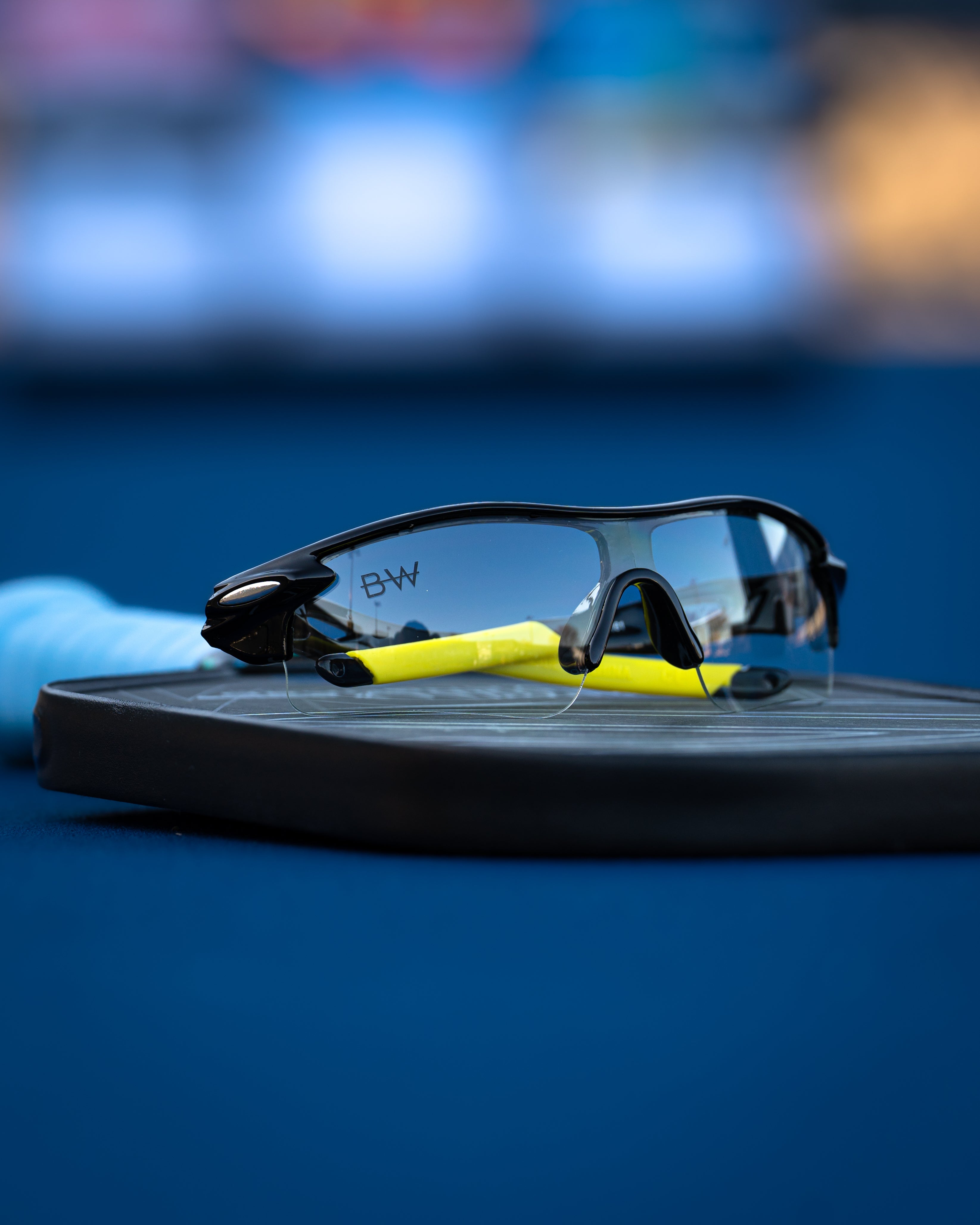
Precision Under Pressure: RX Glasses Built for High-Intensity Pickleball Play
Share
Train the High-Speed Response Chain—Not Just Your Eyes
High-intensity pickleball training becomes more useful when practice recreates the sequence that occurs during an actual rally.
Instead of trying to isolate a vague concept like “faster vision,” progressively train:
recognition → decision → movement → preparation → contact → recovery
| Stage | Training Focus | Example |
|---|---|---|
| 1. Recognition | Identify the developing ball | Controlled feeds with two possible directions |
| 2. Decision | Select an appropriate response | Block or counter based on the feed |
| 3. Movement | Organize body position | Add lateral movement before contact |
| 4. Preparation | Keep the response efficient | Compact paddle preparation during faster feeds |
| 5. Contact | Execute the selected response | Control the ball toward a broad target |
| 6. Recovery | Prepare immediately for another ball | Feed two or more balls instead of ending after one |
| 7. Live Transfer | Combine every stage | Unscripted kitchen points and full games |
If you require prescription correction, use the RX setup you intend to compete in as these drills become more realistic.
High-Speed Hands Drill for Pickleball
Begin at the kitchen with a cooperative volley exchange. The goal is not immediately hitting as hard as possible.
Progress through:
- Controlled back-and-forth volleys
- Alternating forehand and backhand feeds
- Changing direction
- Increasing pace while maintaining control
- Randomized placement
- Two- and three-ball sequences
- Live speed-up points
As the drill becomes less predictable, recognition and decision-making become increasingly important.
Track whether errors come from late recognition, paddle preparation, body position, contact, or failure to recover for the next ball.
Block-or-Counter Drill: Train the Decision, Not Just the Reaction
During a fast exchange, responding quickly is not enough. The player also needs an appropriate response.
Have a partner create controlled attacking balls while you practice choosing between:
- Blocking
- Countering
- Redirecting
- Allowing an inappropriate attack to travel out when you can confidently recognize it
Begin with predictable feeds. Then let the feeder vary placement and pace.
The purpose is to connect recognition with a decision instead of training every incoming ball as if it deserves the same response.
The Two-Ball Recovery Drill
Many players can respond to one fast ball but struggle immediately afterward because they admire the shot or remain out of position.
The two-ball drill exposes that weakness.
- Your partner attacks the first ball.
- You block or counter.
- Your partner immediately sends another playable ball.
- You respond again without resetting the drill.
Once that becomes controlled, progress to three-ball sequences and eventually unscripted exchanges.
This trains a critical high-intensity concept:
the first successful response is not the end of the point.
Speed-Up Recognition: Can You Identify the Attack Before It Arrives?
One reason experienced players can appear extremely fast is that their preparation may begin before the ball crosses the net.
During partner drills, pay attention to information available before and around contact rather than focusing only on the ball after it has already been struck.
Practice observing:
- Opponent court position
- Paddle preparation
- Available attack height
- Your own court position
- Open spaces
- Patterns the opponent has previously used
Do not try to guess every shot. The goal is learning which information is useful and becoming familiar with recurring pickleball situations.
Random Feeds Are the Bridge Between Drills and Matches
A drill can create impressive results when the player knows exactly where every ball is going. Matches remove that certainty.
Progress from:
known direction → two possible directions → random direction → variable pace → movement → live opponent
The less predictable the drill becomes, the more the athlete must recognize and decide instead of simply rehearsing a memorized movement.
This is an important distinction when evaluating “reaction training.” Predictable speed alone does not reproduce the full decision demands of competition.
Why Compact Movement Matters When the Rally Speeds Up
When available time decreases, unnecessarily large movements can become difficult to complete before the ball arrives.
High-speed training can therefore emphasize:
- Appropriate ready position
- Efficient paddle preparation
- Controlled movement
- Balanced contact
- Quick recovery
This is a technique issue, not an eyewear feature. RX correction can provide the visual correction you require while you practice those movements.
Sometimes a “Reaction-Time Problem” Is Really a Spacing Problem
If a fast ball repeatedly jams your body, you may feel as though you were too slow.
But consider whether:
- You were positioned too close to the ball's path
- Your paddle started in an inefficient position
- Your previous movement left you off balance
- You failed to create enough space
- You recognized the developing attack late
Video can be especially useful here because what feels like slow vision during the rally may look like a positioning problem when reviewed afterward.
Use Video to Diagnose High-Speed Errors
Record a short sequence of live kitchen exchanges or practice games and review the errors without immediately blaming “slow reactions.”
| What to Review | Question |
|---|---|
| Ready Position | Where was my paddle before the opponent attacked? |
| Recognition | When did I begin responding to the developing shot? |
| Movement | Was I balanced or still moving unnecessarily? |
| Preparation | Did I use more backswing than the situation allowed? |
| Contact | Was the ball too close, too far away, early, or late? |
| Recovery | Was I ready for the next ball? |
| Decision | Did I choose a realistic response for the incoming ball? |
This creates a more useful training plan than simply deciding you need “faster eyes.”
A 7-Level High-Intensity Pickleball Training Progression
| Level | Drill | Challenge Added |
|---|---|---|
| 1 | Controlled volley exchange | Repeatable contact |
| 2 | Two-direction feeds | Recognition |
| 3 | Random direction | Uncertainty |
| 4 | Variable pace | Changing available response time |
| 5 | Block-or-counter decisions | Response selection |
| 6 | Multi-ball sequences | Recovery |
| 7 | Live kitchen points | Full competitive context |
Move forward when control remains reasonable. Simply increasing speed while technique collapses is not the only way to create useful intensity.
High-Intensity RX Pickleball in Doubles
Doubles creates especially dense decision environments near the kitchen because the player must account for the ball, two opponents, a partner, and changing open space.
During a fast exchange, doubles players may need to manage:
- Middle responsibility
- Partner position
- Opponent attacks
- Open court
- Potential counters
- Recovery after contact
Communication and repeated partner practice can reduce unnecessary uncertainty.
RX eyewear provides required correction while these decisions occur. It does not automatically create doubles awareness.
High-Intensity RX Pickleball in Singles
Singles creates a different kind of pressure. One athlete is responsible for substantially more court, so high intensity may involve larger movement demands rather than only rapid kitchen exchanges.
Useful singles training can include:
- Serve-plus-recovery patterns
- Return-plus-approach movement
- Crosscourt recovery
- Passing-shot situations
- Short/deep recognition
- Lob recovery
- Live points from disadvantaged positions
The visual correction remains one part of the setup while movement and tactical coverage remain player skills.
RX Glasses for Fast Indoor Pickleball
Indoor players who require prescription correction may prefer a configuration without dark sunglass tint.
Clear eyewear can be considered when you want:
- Prescription correction without a dark tint
- A sports-oriented eyewear setup
- Impact-resistant lenses
- Non-polarized lenses
Clear lenses should not automatically be marketed as increasing available light, enhancing contrast, reducing fatigue, or making the ball easier to track.
RX Glasses for High-Intensity Outdoor Pickleball
Outdoor competition adds environmental variables to an already fast sport.
When choosing RX eyewear for outdoor play, compare:
- Your prescription requirements
- Current available lens configurations
- Whether you prefer clear, fixed-tint, or available adaptive options
- Frame dimensions
- How long you typically play
- Whether your conditions frequently change
Do not assume that a darker or more technologically described lens automatically creates better athletic performance.
Choose RX Eyewear by Environment, Not Hype
| Playing Environment | RX Category to Compare |
|---|---|
| Primarily indoor | Clear RX and other current non-dark-tint configurations |
| Consistent outdoor conditions | Available fixed-tint RX sunglasses |
| Changing outdoor conditions | Available adaptive/photochromic RX options |
| Indoor + outdoor schedule | Compare versatile RX configurations with separate environment-specific pairs |
| Tournament travel | Primary RX setup plus another suitable corrective option |
Should You Practice in New RX Glasses Before Competing?
Yes, if you intend to compete in a particular corrective setup, using it during practice gives you experience with the equipment before tournament play.
Progress through familiar pickleball situations:
- Controlled dinks
- Serves and returns
- Volleys
- Transition movement
- Faster exchanges
- Randomized drills
- Live games
The purpose is equipment familiarity—not a claim that repeated use makes the lenses neurologically faster.
Frame Fit Matters When Movement Gets Intense
When comparing RX sports frames, avoid assuming words such as “performance” or “athletic” guarantee an identical fit for every player.
When current measurements are available, compare:
- Overall frame width
- Lens dimensions
- Bridge measurements
- Temple length
- General frame shape
A useful strategy is comparing those dimensions with eyewear you already know fits comfortably.
Do not invent anti-slip, adjustable, aerodynamic, or universal secure-fit characteristics when they are not verified for the specific frame.
What Competitive RX Players Should Test Before Tournament Day
Before relying on eyewear during a full tournament, test it in the situations you actually expect to encounter.
| Test | What You're Learning |
|---|---|
| Dink Session | Basic familiarity and frame feel |
| Fast Volley Drill | How the setup feels during compact high-speed movement |
| Transition Drill | How the eyewear feels while your body changes position |
| Long Practice | Whether the setup remains comfortable for your normal playing duration |
| Live Games | How familiar the eyewear feels in unscripted situations |
| Normal Competition Environment | Whether the chosen lens configuration suits where you actually play |
Vision Problem or Technique Problem? How to Tell What to Investigate
Many pickleball errors can have more than one possible cause.
| What You Notice | Possible Area to Investigate |
|---|---|
| Late on speed-ups | Recognition, anticipation, ready position, decision, preparation |
| Getting jammed | Spacing and body position |
| Missing after moving | Balance and contact position |
| Making first block but missing second ball | Recovery |
| Frequently choosing the wrong response | Decision-making and tactical recognition |
| Unexpected blur despite normal correction | Potential corrective or visual concern |
| Double vision or concerning visual change | Appropriate professional evaluation |
Training can address sport skills. Persistent or concerning visual changes deserve appropriate professional evaluation rather than simply harder drills.
Why High-Pressure Points Can Feel Faster Than Practice
Cooperative practice and tournament competition are not identical tasks.
A scored point adds:
- Unpredictable opponents
- Tactical consequences
- More difficult shot selection
- Changing pace
- Greater uncertainty
- The need to recover after mistakes
A player who handles a predictable volley drill comfortably may still struggle during a live speed-up because the decision is no longer known in advance.
That is why training should eventually progress toward unscripted and scored situations.
What Happens to Your Game Late in a Long Session?
Instead of assuming every late-session mistake is caused by “eye fatigue,” identify the pattern.
Ask whether you are:
- Preparing the paddle later
- Moving less efficiently
- Choosing lower-percentage attacks
- Recovering more slowly
- Standing in a less useful ready position
- Losing technical consistency
Those observations can produce specific training changes. If you experience persistent or concerning visual symptoms, address those separately rather than assuming they are simply part of competition.
Track High-Intensity Errors Instead of Guessing
A simple training log can reveal what actually breaks down as pace increases.
| Metric | What to Record |
|---|---|
| Late Recognition | How often an attack surprises you |
| Jammed Contact | How often the ball reaches your body without useful spacing |
| Oversized Swing | How often preparation is too large for available time |
| Recovery Error | How often the next ball catches you unprepared |
| Decision Error | How often you recognize the ball but choose an ineffective response |
| Unforced Execution Error | How often the correct read still produces poor contact |
This gives you measurable sport-specific information without inventing a “reaction score” or attributing every improvement to eyewear.
A 4-Week High-Intensity Pickleball Training Plan
Week 1: Position & Preparation
- Controlled volley exchanges
- Ready-position checks
- Compact blocks
- Two-ball recovery drills
Week 2: Recognition & Direction
- Two-direction feeds
- Randomized placement
- Block-or-counter decisions
- Opponent-cue observation
Week 3: Pace & Uncertainty
- Variable-speed feeds
- Multi-ball sequences
- Transition-to-kitchen attacks
- Random live speed-ups
Week 4: Competition Transfer
- Live kitchen points
- Scored speed-up games
- Different opponents
- Full matches
- Post-session video review
If you require RX correction, train in the eyewear configuration you plan to use during competition so the equipment is already familiar when intensity increases.
How to Choose RX Glasses for High-Intensity Pickleball
- Start with your prescription. Determine the correction you actually require.
- Identify your environment. Indoor, outdoor, variable conditions, or a mixture?
- Compare lens configurations. Consider currently available clear, tinted, adaptive, or other options.
- Review verified product characteristics. Do not buy based on unsupported performance promises.
- Compare frame dimensions. Use eyewear that already fits as a reference when possible.
- Practice in the finished setup. Test it during realistic movement and pace.
- Plan for competition. Consider another suitable corrective option if you rely on RX vision.
High-Performance RX Marketing: What Do the Claims Really Mean?
| Marketing Claim | Question to Ask |
|---|---|
| “Boosts reaction time” | Was actual reaction performance tested with this exact product? |
| “Enhanced contrast” | Which verified lens characteristic produces the claimed contrast effect? |
| “Anti-glare technology” | What specific verified lens feature is being described? |
| “Fog resistant” | Does the exact product have a verified anti-fog treatment? |
| “Anti-slip fit” | What verified frame feature supports the claim? |
| “Impact tested” | Which test or certification was performed? |
| “Spot spin sooner” | Was spin-recognition performance actually measured? |
| “Improves shot accuracy” | Was pickleball shot accuracy tested in a relevant population? |
| “Elite-level performance” | Which measurable product characteristic is being described? |
Strong sports eyewear does not need unsupported performance claims. Verified correction, lens characteristics, frame design, and replacement support give shoppers concrete features to evaluate.
How to Order Blinded Wear RX Pickleball Glasses
- Have your current eyeglass prescription ready.
- Browse the RX pickleball collection.
- Compare frames and current lens configurations.
- Review available frame dimensions when provided.
- Select the eyewear that fits your environment and preferences.
- Upload a clear photo or picture of your eyeglass prescription before purchasing.
High-index prescription lenses are included at no additional cost with Blinded Wear RX eyewear.
Replacement Support for Competitive RX Players
Blinded Wear offers 50% lifetime replacement support if glasses break, subject to current policy terms.
That does not mean every type of damage is automatically covered, the eyewear is unbreakable, or every replacement is free.
Review the current policy before purchasing so you understand how replacement support works.
More Questions About RX Glasses for High-Intensity Pickleball
What makes pickleball visually difficult at high speed?
Faster play reduces the time available for recognition, decisions, movement, preparation, contact, and recovery.
Why am I late against speed-ups?
Possible causes include late recognition, anticipation, ready position, decision-making, paddle preparation, movement, or recovery. It should not automatically be diagnosed as slow eyesight.
Can I train faster pickleball reactions?
You can train sport-specific recognition and responses by progressively adding pace, direction changes, uncertainty, decisions, multi-ball sequences, and live opponents.
What's the best drill for fast hands?
Controlled volley exchanges that progress toward variable direction, increasing pace, random placement, and live speed-ups provide a useful progression.
Why can I handle fast drills but struggle in games?
Predictable drills remove much of the uncertainty and decision-making found in competition. Progress toward random feeds and live points.
Why can experienced players react so quickly?
Experience can contribute to earlier recognition and anticipation of familiar situations, while positioning and efficient movement can also reduce the response required.
Can RX glasses improve anticipation?
Prescription eyewear provides required correction. Anticipation develops through experience and recognition of useful patterns rather than being an automatic lens effect.
Do I need clear RX glasses for indoor pickleball?
If you require prescription correction and do not want dark sunglass tint indoors, clear RX is one category worth comparing.
Should I use my RX glasses during reaction drills?
If you intend to compete in that corrective setup, practicing in it provides familiarity with the equipment during realistic movement.
Why do I get jammed during fast rallies?
Spacing, positioning, paddle preparation, balance, and late recognition are all worth investigating.
How can I tell whether my problem is vision or technique?
Review when and how the errors occur. Persistent unexpected blur, double vision, or another concerning visual change deserves appropriate professional evaluation rather than simply harder technique training.
Are expensive RX glasses automatically better for competitive players?
Price alone does not establish better athletic performance. Compare your prescription needs, verified lens characteristics, frame dimensions, environment, and support policies.
Should tournament players carry backup RX glasses?
If you depend on prescription correction during play, another suitable corrective option can provide useful redundancy if your primary pair becomes unavailable.
Does Blinded Wear offer replacement support?
Yes. Blinded Wear offers 50% lifetime replacement support if glasses break, subject to current policy terms.
Train the High-Speed Response Chain—Not Just Your Eyes
High-intensity pickleball training becomes more useful when practice recreates the sequence that occurs during an actual rally.
Instead of trying to isolate a vague concept like “faster vision,” progressively train:
recognition → decision → movement → preparation → contact → recovery
| Stage | Training Focus | Example |
|---|---|---|
| 1. Recognition | Identify the developing ball | Controlled feeds with two possible directions |
| 2. Decision | Select an appropriate response | Block or counter based on the feed |
| 3. Movement | Organize body position | Add lateral movement before contact |
| 4. Preparation | Keep the response efficient | Compact paddle preparation during faster feeds |
| 5. Contact | Execute the selected response | Control the ball toward a broad target |
| 6. Recovery | Prepare immediately for another ball | Feed two or more balls instead of ending after one |
| 7. Live Transfer | Combine every stage | Unscripted kitchen points and full games |
If you require prescription correction, use the RX setup you intend to compete in as these drills become more realistic.
High-Speed Hands Drill for Pickleball
Begin at the kitchen with a cooperative volley exchange. The goal is not immediately hitting as hard as possible.
Progress through:
- Controlled back-and-forth volleys
- Alternating forehand and backhand feeds
- Changing direction
- Increasing pace while maintaining control
- Randomized placement
- Two- and three-ball sequences
- Live speed-up points
As the drill becomes less predictable, recognition and decision-making become increasingly important.
Track whether errors come from late recognition, paddle preparation, body position, contact, or failure to recover for the next ball.
Block-or-Counter Drill: Train the Decision, Not Just the Reaction
During a fast exchange, responding quickly is not enough. The player also needs an appropriate response.
Have a partner create controlled attacking balls while you practice choosing between:
- Blocking
- Countering
- Redirecting
- Allowing an inappropriate attack to travel out when you can confidently recognize it
Begin with predictable feeds. Then let the feeder vary placement and pace.
The purpose is to connect recognition with a decision instead of training every incoming ball as if it deserves the same response.
The Two-Ball Recovery Drill
Many players can respond to one fast ball but struggle immediately afterward because they admire the shot or remain out of position.
The two-ball drill exposes that weakness.
- Your partner attacks the first ball.
- You block or counter.
- Your partner immediately sends another playable ball.
- You respond again without resetting the drill.
Once that becomes controlled, progress to three-ball sequences and eventually unscripted exchanges.
This trains a critical high-intensity concept:
the first successful response is not the end of the point.
Speed-Up Recognition: Can You Identify the Attack Before It Arrives?
One reason experienced players can appear extremely fast is that their preparation may begin before the ball crosses the net.
During partner drills, pay attention to information available before and around contact rather than focusing only on the ball after it has already been struck.
Practice observing:
- Opponent court position
- Paddle preparation
- Available attack height
- Your own court position
- Open spaces
- Patterns the opponent has previously used
Do not try to guess every shot. The goal is learning which information is useful and becoming familiar with recurring pickleball situations.
Random Feeds Are the Bridge Between Drills and Matches
A drill can create impressive results when the player knows exactly where every ball is going. Matches remove that certainty.
Progress from:
known direction → two possible directions → random direction → variable pace → movement → live opponent
The less predictable the drill becomes, the more the athlete must recognize and decide instead of simply rehearsing a memorized movement.
This is an important distinction when evaluating “reaction training.” Predictable speed alone does not reproduce the full decision demands of competition.
Why Compact Movement Matters When the Rally Speeds Up
When available time decreases, unnecessarily large movements can become difficult to complete before the ball arrives.
High-speed training can therefore emphasize:
- Appropriate ready position
- Efficient paddle preparation
- Controlled movement
- Balanced contact
- Quick recovery
This is a technique issue, not an eyewear feature. RX correction can provide the visual correction you require while you practice those movements.
Sometimes a “Reaction-Time Problem” Is Really a Spacing Problem
If a fast ball repeatedly jams your body, you may feel as though you were too slow.
But consider whether:
- You were positioned too close to the ball's path
- Your paddle started in an inefficient position
- Your previous movement left you off balance
- You failed to create enough space
- You recognized the developing attack late
Video can be especially useful here because what feels like slow vision during the rally may look like a positioning problem when reviewed afterward.
Use Video to Diagnose High-Speed Errors
Record a short sequence of live kitchen exchanges or practice games and review the errors without immediately blaming “slow reactions.”
| What to Review | Question |
|---|---|
| Ready Position | Where was my paddle before the opponent attacked? |
| Recognition | When did I begin responding to the developing shot? |
| Movement | Was I balanced or still moving unnecessarily? |
| Preparation | Did I use more backswing than the situation allowed? |
| Contact | Was the ball too close, too far away, early, or late? |
| Recovery | Was I ready for the next ball? |
| Decision | Did I choose a realistic response for the incoming ball? |
This creates a more useful training plan than simply deciding you need “faster eyes.”
A 7-Level High-Intensity Pickleball Training Progression
| Level | Drill | Challenge Added |
|---|---|---|
| 1 | Controlled volley exchange | Repeatable contact |
| 2 | Two-direction feeds | Recognition |
| 3 | Random direction | Uncertainty |
| 4 | Variable pace | Changing available response time |
| 5 | Block-or-counter decisions | Response selection |
| 6 | Multi-ball sequences | Recovery |
| 7 | Live kitchen points | Full competitive context |
Move forward when control remains reasonable. Simply increasing speed while technique collapses is not the only way to create useful intensity.
High-Intensity RX Pickleball in Doubles
Doubles creates especially dense decision environments near the kitchen because the player must account for the ball, two opponents, a partner, and changing open space.
During a fast exchange, doubles players may need to manage:
- Middle responsibility
- Partner position
- Opponent attacks
- Open court
- Potential counters
- Recovery after contact
Communication and repeated partner practice can reduce unnecessary uncertainty.
RX eyewear provides required correction while these decisions occur. It does not automatically create doubles awareness.
High-Intensity RX Pickleball in Singles
Singles creates a different kind of pressure. One athlete is responsible for substantially more court, so high intensity may involve larger movement demands rather than only rapid kitchen exchanges.
Useful singles training can include:
- Serve-plus-recovery patterns
- Return-plus-approach movement
- Crosscourt recovery
- Passing-shot situations
- Short/deep recognition
- Lob recovery
- Live points from disadvantaged positions
The visual correction remains one part of the setup while movement and tactical coverage remain player skills.
RX Glasses for Fast Indoor Pickleball
Indoor players who require prescription correction may prefer a configuration without dark sunglass tint.
Clear eyewear can be considered when you want:
- Prescription correction without a dark tint
- A sports-oriented eyewear setup
- Impact-resistant lenses
- Non-polarized lenses
Clear lenses should not automatically be marketed as increasing available light, enhancing contrast, reducing fatigue, or making the ball easier to track.
RX Glasses for High-Intensity Outdoor Pickleball
Outdoor competition adds environmental variables to an already fast sport.
When choosing RX eyewear for outdoor play, compare:
- Your prescription requirements
- Current available lens configurations
- Whether you prefer clear, fixed-tint, or available adaptive options
- Frame dimensions
- How long you typically play
- Whether your conditions frequently change
Do not assume that a darker or more technologically described lens automatically creates better athletic performance.
Choose RX Eyewear by Environment, Not Hype
| Playing Environment | RX Category to Compare |
|---|---|
| Primarily indoor | Clear RX and other current non-dark-tint configurations |
| Consistent outdoor conditions | Available fixed-tint RX sunglasses |
| Changing outdoor conditions | Available adaptive/photochromic RX options |
| Indoor + outdoor schedule | Compare versatile RX configurations with separate environment-specific pairs |
| Tournament travel | Primary RX setup plus another suitable corrective option |
Should You Practice in New RX Glasses Before Competing?
Yes, if you intend to compete in a particular corrective setup, using it during practice gives you experience with the equipment before tournament play.
Progress through familiar pickleball situations:
- Controlled dinks
- Serves and returns
- Volleys
- Transition movement
- Faster exchanges
- Randomized drills
- Live games
The purpose is equipment familiarity—not a claim that repeated use makes the lenses neurologically faster.
Frame Fit Matters When Movement Gets Intense
When comparing RX sports frames, avoid assuming words such as “performance” or “athletic” guarantee an identical fit for every player.
When current measurements are available, compare:
- Overall frame width
- Lens dimensions
- Bridge measurements
- Temple length
- General frame shape
A useful strategy is comparing those dimensions with eyewear you already know fits comfortably.
Do not invent anti-slip, adjustable, aerodynamic, or universal secure-fit characteristics when they are not verified for the specific frame.
What Competitive RX Players Should Test Before Tournament Day
Before relying on eyewear during a full tournament, test it in the situations you actually expect to encounter.
| Test | What You're Learning |
|---|---|
| Dink Session | Basic familiarity and frame feel |
| Fast Volley Drill | How the setup feels during compact high-speed movement |
| Transition Drill | How the eyewear feels while your body changes position |
| Long Practice | Whether the setup remains comfortable for your normal playing duration |
| Live Games | How familiar the eyewear feels in unscripted situations |
| Normal Competition Environment | Whether the chosen lens configuration suits where you actually play |
Vision Problem or Technique Problem? How to Tell What to Investigate
Many pickleball errors can have more than one possible cause.
| What You Notice | Possible Area to Investigate |
|---|---|
| Late on speed-ups | Recognition, anticipation, ready position, decision, preparation |
| Getting jammed | Spacing and body position |
| Missing after moving | Balance and contact position |
| Making first block but missing second ball | Recovery |
| Frequently choosing the wrong response | Decision-making and tactical recognition |
| Unexpected blur despite normal correction | Potential corrective or visual concern |
| Double vision or concerning visual change | Appropriate professional evaluation |
Training can address sport skills. Persistent or concerning visual changes deserve appropriate professional evaluation rather than simply harder drills.
Why High-Pressure Points Can Feel Faster Than Practice
Cooperative practice and tournament competition are not identical tasks.
A scored point adds:
- Unpredictable opponents
- Tactical consequences
- More difficult shot selection
- Changing pace
- Greater uncertainty
- The need to recover after mistakes
A player who handles a predictable volley drill comfortably may still struggle during a live speed-up because the decision is no longer known in advance.
That is why training should eventually progress toward unscripted and scored situations.
What Happens to Your Game Late in a Long Session?
Instead of assuming every late-session mistake is caused by “eye fatigue,” identify the pattern.
Ask whether you are:
- Preparing the paddle later
- Moving less efficiently
- Choosing lower-percentage attacks
- Recovering more slowly
- Standing in a less useful ready position
- Losing technical consistency
Those observations can produce specific training changes. If you experience persistent or concerning visual symptoms, address those separately rather than assuming they are simply part of competition.
Track High-Intensity Errors Instead of Guessing
A simple training log can reveal what actually breaks down as pace increases.
| Metric | What to Record |
|---|---|
| Late Recognition | How often an attack surprises you |
| Jammed Contact | How often the ball reaches your body without useful spacing |
| Oversized Swing | How often preparation is too large for available time |
| Recovery Error | How often the next ball catches you unprepared |
| Decision Error | How often you recognize the ball but choose an ineffective response |
| Unforced Execution Error | How often the correct read still produces poor contact |
This gives you measurable sport-specific information without inventing a “reaction score” or attributing every improvement to eyewear.
A 4-Week High-Intensity Pickleball Training Plan
Week 1: Position & Preparation
- Controlled volley exchanges
- Ready-position checks
- Compact blocks
- Two-ball recovery drills
Week 2: Recognition & Direction
- Two-direction feeds
- Randomized placement
- Block-or-counter decisions
- Opponent-cue observation
Week 3: Pace & Uncertainty
- Variable-speed feeds
- Multi-ball sequences
- Transition-to-kitchen attacks
- Random live speed-ups
Week 4: Competition Transfer
- Live kitchen points
- Scored speed-up games
- Different opponents
- Full matches
- Post-session video review
If you require RX correction, train in the eyewear configuration you plan to use during competition so the equipment is already familiar when intensity increases.
How to Choose RX Glasses for High-Intensity Pickleball
- Start with your prescription. Determine the correction you actually require.
- Identify your environment. Indoor, outdoor, variable conditions, or a mixture?
- Compare lens configurations. Consider currently available clear, tinted, adaptive, or other options.
- Review verified product characteristics. Do not buy based on unsupported performance promises.
- Compare frame dimensions. Use eyewear that already fits as a reference when possible.
- Practice in the finished setup. Test it during realistic movement and pace.
- Plan for competition. Consider another suitable corrective option if you rely on RX vision.
High-Performance RX Marketing: What Do the Claims Really Mean?
| Marketing Claim | Question to Ask |
|---|---|
| “Boosts reaction time” | Was actual reaction performance tested with this exact product? |
| “Enhanced contrast” | Which verified lens characteristic produces the claimed contrast effect? |
| “Anti-glare technology” | What specific verified lens feature is being described? |
| “Fog resistant” | Does the exact product have a verified anti-fog treatment? |
| “Anti-slip fit” | What verified frame feature supports the claim? |
| “Impact tested” | Which test or certification was performed? |
| “Spot spin sooner” | Was spin-recognition performance actually measured? |
| “Improves shot accuracy” | Was pickleball shot accuracy tested in a relevant population? |
| “Elite-level performance” | Which measurable product characteristic is being described? |
Strong sports eyewear does not need unsupported performance claims. Verified correction, lens characteristics, frame design, and replacement support give shoppers concrete features to evaluate.
How to Order Blinded Wear RX Pickleball Glasses
- Have your current eyeglass prescription ready.
- Browse the RX pickleball collection.
- Compare frames and current lens configurations.
- Review available frame dimensions when provided.
- Select the eyewear that fits your environment and preferences.
- Upload a clear photo or picture of your eyeglass prescription before purchasing.
High-index prescription lenses are included at no additional cost with Blinded Wear RX eyewear.
Replacement Support for Competitive RX Players
Blinded Wear offers 50% lifetime replacement support if glasses break, subject to current policy terms.
That does not mean every type of damage is automatically covered, the eyewear is unbreakable, or every replacement is free.
Review the current policy before purchasing so you understand how replacement support works.
More Questions About RX Glasses for High-Intensity Pickleball
What makes pickleball visually difficult at high speed?
Faster play reduces the time available for recognition, decisions, movement, preparation, contact, and recovery.
Why am I late against speed-ups?
Possible causes include late recognition, anticipation, ready position, decision-making, paddle preparation, movement, or recovery. It should not automatically be diagnosed as slow eyesight.
Can I train faster pickleball reactions?
You can train sport-specific recognition and responses by progressively adding pace, direction changes, uncertainty, decisions, multi-ball sequences, and live opponents.
What's the best drill for fast hands?
Controlled volley exchanges that progress toward variable direction, increasing pace, random placement, and live speed-ups provide a useful progression.
Why can I handle fast drills but struggle in games?
Predictable drills remove much of the uncertainty and decision-making found in competition. Progress toward random feeds and live points.
Why can experienced players react so quickly?
Experience can contribute to earlier recognition and anticipation of familiar situations, while positioning and efficient movement can also reduce the response required.
Can RX glasses improve anticipation?
Prescription eyewear provides required correction. Anticipation develops through experience and recognition of useful patterns rather than being an automatic lens effect.
Do I need clear RX glasses for indoor pickleball?
If you require prescription correction and do not want dark sunglass tint indoors, clear RX is one category worth comparing.
Should I use my RX glasses during reaction drills?
If you intend to compete in that corrective setup, practicing in it provides familiarity with the equipment during realistic movement.
Why do I get jammed during fast rallies?
Spacing, positioning, paddle preparation, balance, and late recognition are all worth investigating.
How can I tell whether my problem is vision or technique?
Review when and how the errors occur. Persistent unexpected blur, double vision, or another concerning visual change deserves appropriate professional evaluation rather than simply harder technique training.
Are expensive RX glasses automatically better for competitive players?
Price alone does not establish better athletic performance. Compare your prescription needs, verified lens characteristics, frame dimensions, environment, and support policies.
Should tournament players carry backup RX glasses?
If you depend on prescription correction during play, another suitable corrective option can provide useful redundancy if your primary pair becomes unavailable.
Does Blinded Wear offer replacement support?
Yes. Blinded Wear offers 50% lifetime replacement support if glasses break, subject to current policy terms.
A 7-Minute High-Intensity Pickleball Warm-Up
A match-day warm-up should prepare you for the pace and decisions you are about to encounter without exhausting you before competition begins.
Minutes 1–2: Controlled Dinks
Establish spacing, contact, and movement while becoming comfortable with the court and your normal RX setup.
Minutes 3–4: Volleys
Progress from controlled exchanges toward changing forehand and backhand directions while keeping the paddle response compact.
Minute 5: Block and Counter
Have your partner introduce controlled attacks so you make simple block-or-counter decisions.
Minute 6: Multi-Ball Exchanges
Continue the rally after the first fast response. Focus on recovery rather than treating one successful contact as the end of the sequence.
Minute 7: Live Points
Finish with several unscripted points where pace, direction, and shot selection are no longer predetermined.
The objective is not to “activate” faster vision. It is to move from controlled contact toward the recognition, decisions, movement, and recovery required during competition.
High-Intensity RX Tournament Checklist
- ☐ Current prescription setup is ready
- ☐ You have already practiced in the eyewear
- ☐ Lenses are clean before warm-up
- ☐ Frame feels familiar during normal movement
- ☐ Lens configuration fits the expected environment
- ☐ Another suitable corrective option is available if needed
- ☐ Warm-up progresses toward realistic rally speed
- ☐ You have practiced unpredictable attacks, not only scripted feeds
- ☐ You know your normal ready position and recovery priorities
High-pressure competition already introduces enough uncertainty. Your primary eyewear should not be another unfamiliar variable.
What Happens During One Fast Pickleball Point?
A fast exchange may look almost instantaneous from outside the court, but the athlete is continuously processing a sequence of changing problems.
| Moment | Player Task |
|---|---|
| Opponent prepares | Observe the developing situation |
| Ball is contacted | Recognize the developing path and available response |
| Ball approaches | Position the body and prepare the paddle |
| Before contact | Select and organize the response |
| Contact | Execute the chosen shot |
| Immediately after contact | Recover rather than watching the result |
| Opponent responds | Begin the sequence again |
Prescription correction supports the visual component when correction is required. The complete high-speed response remains a combination of vision, recognition, decisions, positioning, technique, and experience.
Don't Train Only the First Fast Ball
One of the biggest differences between a reaction drill and actual pickleball is what happens after the first response.
In a match, blocking a speed-up may immediately produce:
- Another attack
- A counter
- A redirected ball
- A ball toward your partner
- A ball that slows the exchange
- An opportunity to attack
Training should eventually reflect this.
Instead of:
feed → response → stop
progress toward:
attack → response → recovery → recognition → next response → recovery → continue
This makes recovery part of high-intensity training rather than an afterthought.
Anticipation Is Not the Same as Guessing
Good anticipation uses information. Guessing commits to an outcome without enough information.
| Anticipation | Guessing |
|---|---|
| Uses opponent tendencies | Assumes a shot without useful evidence |
| Uses court position | Commits too early |
| Uses previous patterns | Ignores alternative possibilities |
| Maintains ability to respond | Can leave the player exposed when wrong |
| Develops through experience | Relies heavily on prediction |
RX glasses do not create anticipation. Appropriate correction provides the visual correction you require while experience helps you learn which information is useful.
Five High-Speed Errors That Can Look Like “Slow Vision”
1. Paddle Starts Too Far From Ready
The athlete recognizes the ball but needs unnecessary movement before making contact.
2. Recognition Comes Late
The player begins responding only after the attack is already well developed.
3. The Player Gets Jammed
Spacing leaves too little room for a controlled response.
4. The First Response Is Fine—but Recovery Is Late
The next ball arrives while the player is still organized around the previous contact.
5. The Player Hesitates Between Responses
The ball is recognized, but the decision to block, counter, move, or leave occurs too late.
Identifying the actual breakdown creates a more useful training target than simply deciding you need faster reflexes.
Faster Isn't Always Better: Train Speed Without Losing Control
Increasing ball speed can make a drill harder, but difficulty alone does not guarantee useful training.
If increasing pace causes every rally to collapse immediately, reduce the speed enough to maintain repeated responses and then progress again.
A practical progression is:
control → direction → uncertainty → pace → decisions → recovery → live competition
This allows intensity to increase without turning the drill into random survival.
How to Practice Precision Under Pressure
Once technique remains reasonably controlled during drills, introduce consequences and uncertainty.
Try:
- First to 7 kitchen points
- Only the attacking player can score
- Two-ball sequences before a point becomes live
- Random block-or-counter feeds
- Starting points from the transition zone
- Playing different partners and opponents
- Beginning games at 8–8 or another pressure score
The goal is to practice making decisions when the outcome matters instead of only succeeding in cooperative repetition.
Primary RX Pair vs. Backup Pair for Tournament Play
If prescription correction is important to your normal vision, depending entirely on one pair during a tournament creates an avoidable equipment risk.
| Primary RX Pair | Backup RX Option |
|---|---|
| Your familiar competition setup | Redundancy if the primary pair becomes unavailable |
| Chosen for your expected environment | Another suitable corrective configuration |
| Used during normal practice | Ideally tested before the event as well |
| Part of your normal warm-up | Stored accessibly during competition |
A backup does not need to provide an additional performance advantage. Its value is ensuring that one equipment problem does not leave an RX-dependent player without a suitable corrective option.
Which RX Setup Fits Your Competitive Pickleball Routine?
| Player | Starting Point |
|---|---|
| Indoor competitive player | Compare clear RX and other current non-dark-tint configurations |
| Outdoor tournament player | Compare current RX sunglass configurations for your environment |
| Player facing changing outdoor conditions | Compare available adaptive/photochromic RX configurations |
| Indoor + outdoor competitor | Compare versatile RX options with separate environment-specific pairs |
| Frequent tournament traveler | Primary familiar RX setup plus another suitable corrective option |
| Player unsure what to choose | Use the eyewear quiz and compare current RX options |
What Makes a Good RX Setup for High-Intensity Pickleball?
A strong competition setup does not need to promise superhuman vision.
Focus on six practical pieces:
- Correction: The RX setup addresses your prescription needs.
- Environment: The lens configuration fits where you play.
- Frame: You choose a sports frame and compare available dimensions.
- Verified Features: You understand what the product actually offers.
- Familiarity: You have practiced in the finished setup.
- Redundancy: You have another corrective option when competition or travel makes that worthwhile.
Everything else—recognition, anticipation, movement, decisions, technique, and recovery—is developed by the player.
7 Mistakes Competitive Players Should Avoid When Buying RX Sports Glasses
1. Buying Based on a “Faster Reflexes” Promise
Prescription correction should not be confused with neurological reaction-time enhancement.
2. Assuming “Sports” Means Unbreakable
Impact-resistant does not automatically mean shatterproof or certified to a particular protective standard.
3. Ignoring Your Actual Environment
Indoor, outdoor, and variable conditions can lead players toward different lens configurations.
4. Assuming Non-Polarized Automatically Improves Depth Perception
Some court players prefer non-polarized eyewear, but a universal depth-perception benefit should not be claimed.
5. Ignoring Frame Dimensions
When measurements are available, compare them with eyewear that already fits you comfortably.
6. Wearing New RX Eyewear for the First Time in Competition
Practice provides equipment familiarity before high-pressure play.
7. Expecting Eyewear to Correct Technical Errors
Late preparation, poor spacing, inefficient movement, and weak recovery remain training problems.
High-Intensity RX Pickleball in 30 Seconds
| Question | Bottom Line |
|---|---|
| What do RX glasses provide? | Prescription correction in an eyewear setup suitable for active use |
| Do RX glasses automatically improve reaction time? | No |
| Do they automatically improve depth perception? | No |
| Do they automatically improve ball tracking? | No |
| What makes players look fast? | Recognition, anticipation, positioning, efficient movement, decisions, technique, and experience can all contribute |
| How should high-speed play be trained? | Progress from controlled responses toward random, decision-based, multi-ball, and live situations |
| Should you practice in competition RX eyewear? | Using the intended setup provides equipment familiarity |
| Should RX-dependent players consider a backup? | A suitable backup can provide useful redundancy |
Final FAQs for Competitive Pickleball Players
What are the best prescription glasses for high-intensity pickleball?
Start with eyewear that addresses your prescription needs, then compare current lens configurations, verified product characteristics, frame dimensions, playing environment, and personal preferences.
Can prescription glasses make fast pickleball easier to see?
If you require correction, RX lenses provide that correction while you play. That should remain separate from claims that a particular frame automatically improves reaction time or tracking ability.
Why do fast pickleball rallies feel overwhelming?
Increasing pace reduces the time available for recognition, decisions, movement, preparation, contact, and recovery while uncertainty remains high.
How can I get better at defending speed-ups?
Practice ready position, recognition, compact responses, block-or-counter decisions, spacing, recovery, randomized attacks, and eventually live points.
Should I watch the opponent or the pickleball?
High-level court awareness involves gathering useful information as the play develops rather than reducing the entire task to one fixed visual instruction. Practice recognizing opponent cues while still responding to the developing ball.
Why do I freeze during fast exchanges?
Uncertainty about the incoming ball or response can contribute to hesitation. Progressive decision-based drills can help expose which situations are causing the delay.
How do I stop taking huge swings during hands battles?
Practice controlled fast exchanges with an emphasis on compact preparation and recovery before gradually increasing pace and unpredictability.
How do I improve recovery after a fast volley?
Use multi-ball drills where the feed continues after your first successful response. This forces recovery to become part of the repetition.
Are clear RX glasses good for indoor tournament pickleball?
Clear RX can be worth comparing if you require prescription correction and do not want dark sunglass tint indoors.
Are adaptive RX lenses useful for outdoor tournaments?
When available, changing-tint functionality may be useful for players who encounter variable outdoor conditions. It should not automatically be credited with improved athletic performance.
Do high-index lenses make reactions faster?
No. High-index describes a prescription lens-material category, not neurological reaction speed.
Are impact-resistant lenses shatterproof?
No. Impact-resistant should not automatically be interpreted as shatterproof, unbreakable, or certified to a particular protective standard.
Does non-polarized mean better depth perception?
No universal biological depth-perception improvement should be assumed. Some court players prefer non-polarized eyewear.
Can RX glasses fix bad timing?
Prescription correction addresses the corrective component of vision. Timing also involves recognition, movement, preparation, technique, and experience.
How do I know whether I need an eye exam instead of more training?
Persistent unexpected blur, double vision, or another concerning change from your normal corrected vision should not simply be treated as a pickleball-training problem. Consider appropriate professional evaluation.
How do I order Blinded Wear RX glasses?
Choose your RX eyewear and upload a clear photo or picture of your eyeglass prescription before purchasing.
Are high-index prescription lenses extra?
No. High-index prescription lenses are included at no additional cost with Blinded Wear RX eyewear.
What replacement support does Blinded Wear provide?
Blinded Wear offers 50% lifetime replacement support if glasses break, subject to current policy terms.
Build Your Competitive Pickleball Eyewear Setup
Build Your Vision Setup for the Speed of Competitive Pickleball
High-intensity pickleball demands more than simply seeing the ball.
You must recognize what is developing, choose a response, organize your movement, control the paddle, make contact, and recover—often before the rally changes again.
If you require prescription correction, RX sports eyewear gives you the correction you need while that process unfolds.
Blinded Wear RX eyewear combines prescription correction with lightweight sports frames, impact-resistant non-polarized lenses, comfort for extended matches, performance-first design, and high-index prescription lenses included at no additional cost.
Then the competitive work belongs to you:
recognize earlier → prepare efficiently → move with purpose → control the response → recover for the next ball.
The Bottom Line: Correct the Vision, Train the Response
Prescription sports glasses can be an important piece of equipment for a pickleball player who requires correction. Their role does not need to be exaggerated.
RX eyewear provides the corrective component. High-intensity pickleball performance still depends on a larger chain:
corrected visual input → recognition → anticipation → decision → movement → preparation → contact → recovery.
A lens does not automatically create faster reflexes, better anticipation, superior depth perception, or more accurate shots. Those abilities depend on multiple athlete-specific factors and develop through appropriate practice and experience.
Choose RX eyewear based on your prescription, environment, verified product characteristics, frame preferences, and familiarity. Then train against increasingly realistic pace and uncertainty.
Your glasses provide the correction. Your preparation creates readiness. Your experience builds recognition. Your training develops the response.