
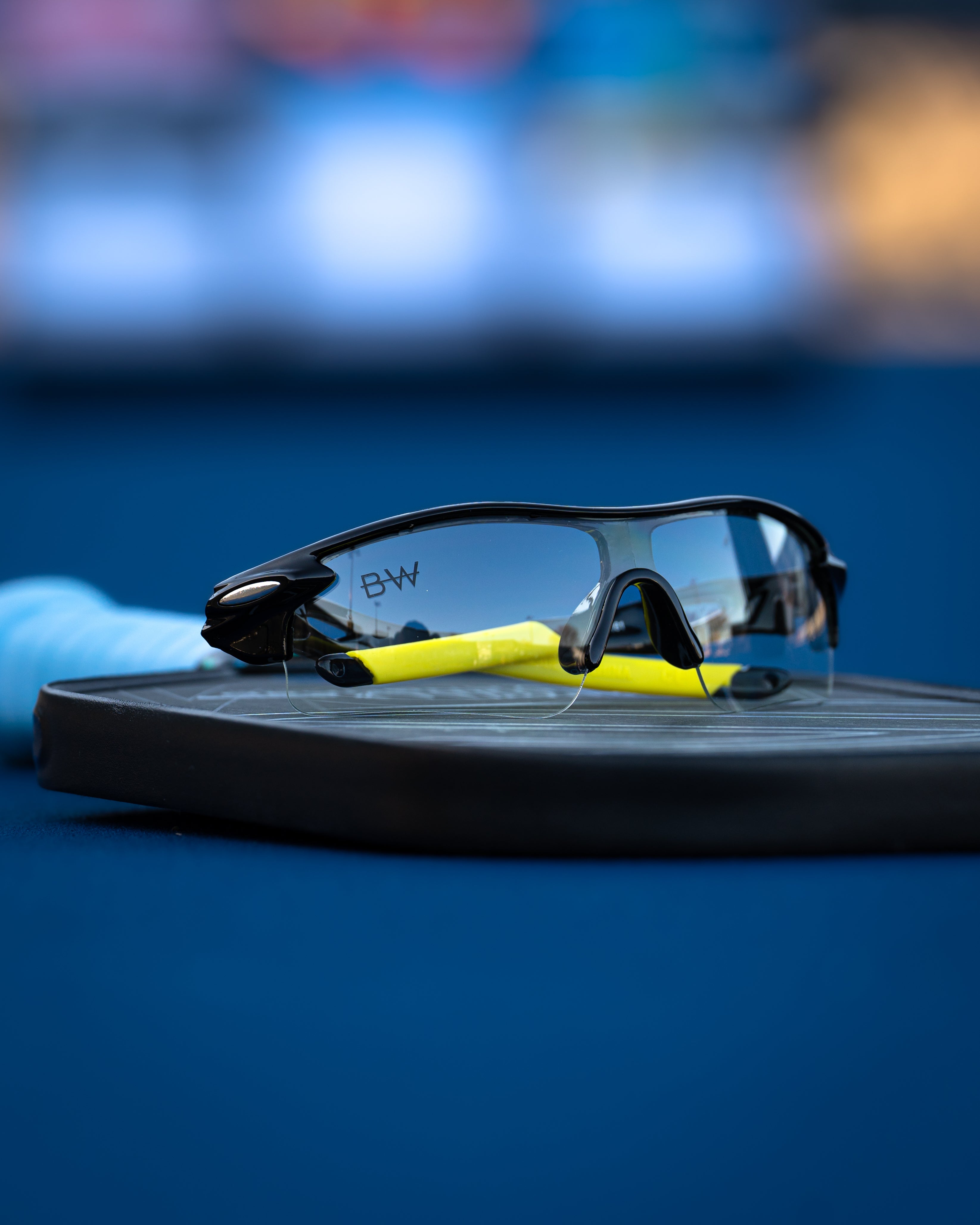
How RX Glasses Improve Reaction Time in High-Speed Pickleball Matches ⚡👓
Share
How RX Glasses Fit Into Reaction Time in High-Speed Pickleball Matches
Fast pickleball rallies can demand rapid visual recognition, anticipation, decision-making, and movement—especially during hands battles, volleys, counters, and exchanges near the kitchen line.
If you require prescription correction, RX pickleball glasses can provide that prescribed correction while you play. But there is an important distinction: prescription lenses should not automatically be credited with making your brain or body react faster.
Instead, think of reaction time as a chain. Visual information is received, interpreted, turned into a decision, and followed by a physical response. Prescription correction can address the refractive-correction component when needed, while anticipation, positioning, decision-making, technique, and movement remain separate parts of the response.
This guide breaks down exactly where RX eyewear fits into high-speed pickleball—and where the performance claims should stop.
Prescription Pickleball Eyewear Quick Access
What Does “Reaction Time” Mean in Pickleball?
Reaction time is often discussed as though it is a single ability: see the ball and move faster.
On court, the process is more complicated.
A simplified high-speed response can be viewed as:
- Visual information becomes available.
- The player recognizes relevant cues.
- The player anticipates or identifies what is happening.
- A response is selected.
- Movement is initiated.
- The shot or defensive action is executed.
That distinction matters when discussing prescription glasses. RX lenses can provide prescribed refractive correction, but they do not automatically speed up the brain's decision-making or the body's physical response.
Do RX Glasses Actually Improve Reaction Time in Pickleball?
RX glasses should not automatically be described as increasing neurological reaction speed.
If a player requires prescription correction, wearing the appropriate corrective lenses addresses that refractive need during play. That is different from claiming the lenses directly make the player's nervous system process information faster.
| Part of a Fast Pickleball Response | Role of RX Eyewear |
|---|---|
| Prescription Correction | RX lenses provide the prescribed refractive correction. |
| Recognizing Opponent Cues | Requires perception, experience, attention, and anticipation; it should not be credited automatically to the glasses. |
| Shot Selection | A decision-making skill. |
| Reaction Speed | Should not automatically be described as increased by RX lenses. |
| Footwork | A physical and technical component. |
| Paddle Preparation | A technique and positioning component. |
| Shot Execution | Depends on movement, timing, technique, and other factors. |
For a player who needs correction, the practical goal is straightforward: play with the prescribed correction you need without confusing correction with an automatic athletic enhancement.
Why Does Vision Matter During High-Speed Pickleball?
Pickleball can create situations where players have very little time between an opponent's contact and their own response.
Examples include:
- Fast exchanges at the kitchen line
- Volley-to-volley battles
- Defending a speed-up
- Countering a hard drive
- Responding to an opponent's change of direction
- Transition-zone exchanges
- Quick changes between offense and defense
Players who require prescription correction still require that correction during these situations. But receiving corrective vision and developing the skills needed to handle fast exchanges are two separate issues.
The Visual-to-Movement Chain in a Fast Pickleball Rally
Understanding the sequence helps explain why “RX glasses improve reaction time” is too broad a claim.
| Stage | What Is Happening | Where RX Fits |
|---|---|---|
| 1. Visual Input | Information from the court becomes available to the player. | Prescription correction is relevant when the player requires it. |
| 2. Recognition | The player identifies relevant information and patterns. | Not automatically improved by an RX lens. |
| 3. Anticipation | The player uses available cues and experience to prepare for what may happen next. | Primarily a perceptual and sport-specific skill. |
| 4. Decision | The player selects a response. | Not automatically accelerated by prescription eyewear. |
| 5. Movement Initiation | The body begins the selected response. | A neurological and physical component. |
| 6. Execution | The player moves the paddle and body to execute the response. | Depends on technique, positioning, timing, and movement. |
RX correction belongs within this larger system rather than replacing it.
Reaction Time vs. Anticipation: Why the Difference Matters
Sometimes what looks like an exceptionally fast reaction begins before the ball is traveling toward the player.
A pickleball player may use information such as:
- Opponent positioning
- Paddle preparation
- Body orientation
- Previous shot patterns
- Court position
- Available angles
- Game situation
Experienced players can use relevant cues to prepare for likely outcomes. That can make a response appear extremely fast even though anticipation contributed to the result.
Prescription eyewear should not be credited with creating that anticipation. Players develop it through experience, practice, pattern recognition, and sport-specific training.
What If You Play Pickleball Without the Prescription Correction You Need?
If you have been prescribed vision correction for the distances and situations relevant to your activity, choosing not to use that correction is different from comparing two sports-lens technologies.
RX sports eyewear provides a way to incorporate prescribed correction into a sports-oriented frame.
That is the useful comparison:
appropriate corrective setup vs. not using the correction you need—not “ordinary reaction speed vs. enhanced reaction speed.”
If you are unsure what correction is appropriate for your individual visual needs, consult an eye-care professional rather than intentionally altering prescription strength for pickleball.
Do High-Index RX Lenses Improve Pickleball Reaction Time?
No automatic reaction-time improvement should be attributed to high-index lenses.
High-index describes a category of prescription lens material. It should remain separate from claims about neurological processing, anticipation, or athletic performance.
Blinded Wear includes high-index prescription lenses at no additional cost with RX eyewear.
High-index lenses should not automatically be described as:
- Increasing reaction speed
- Improving hand-eye coordination
- Enhancing depth perception
- Improving ball tracking
- Reducing sports-related eye fatigue
- Making a player perform better
Do Non-Polarized Lenses Help Pickleball Players React Faster?
Blinded Wear sports eyewear uses non-polarized lenses. A non-polarized lens does not add a polarization filter and preserves visual information available without that filter.
Some court players prefer non-polarized eyewear, but the absence of a polarization filter should not automatically be credited with faster reactions.
| Claim | What You Should Know |
|---|---|
| “Non-polarized improves reaction time.” | Do not automatically attribute faster neurological reactions to polarization choice. |
| “Non-polarized improves depth perception.” | Do not automatically attribute enhanced depth perception to the absence of a polarization filter. |
| “Non-polarized improves ball tracking.” | Do not treat improved tracking as an automatic lens outcome. |
| “Some court players prefer non-polarized.” | This is an appropriate way to describe the preference without promising a performance advantage. |
What Role Does Depth Perception Play in Fast Pickleball?
Depth perception is relevant to how people perceive spatial relationships, but it should not be reduced to a single eyewear characteristic.
Claims such as “this lens improves depth perception” require more support than simply identifying the lens as non-polarized, high-index, clear, tinted, or sports-oriented.
Similarly, a player responding successfully to a fast ball involves more than depth perception alone. Positioning, anticipation, decision-making, paddle preparation, movement, and technique all contribute to what happens next.
Reaction Demands in Singles vs. Doubles Pickleball
Singles and doubles can create different court situations, but neither format automatically requires a different prescription.
| Singles | Doubles |
|---|---|
| More court may need to be covered by one player. | Fast exchanges can occur with multiple players positioned near the kitchen. |
| Movement and court coverage can play a major role. | Quick volleys, counters, and speed-ups can create rapid exchanges. |
| Players may encounter larger changes in court position. | Positioning and anticipation can influence preparation for fast exchanges. |
| Prescription correction should be based on individual visual needs rather than whether the player primarily competes in singles or doubles. | |
You do not need to intentionally change RX strength between singles and doubles simply because the tactical demands differ.
Why Kitchen-Line Exchanges Feel So Fast
At the non-volley zone line, players can be positioned relatively close to the action. Fast volleys, counters, and speed-ups can therefore leave less time to respond than slower exchanges from deeper court positions.
Players often work on:
- Ready position
- Paddle preparation
- Efficient movement
- Reading relevant opponent cues
- Anticipation
- Compact responses
- Recovering for the next ball
Those are trainable pickleball skills. Prescription eyewear can provide required correction while those skills are being used, but it should not be presented as a replacement for them.
How Can Pickleball Players Actually Work on Faster Responses?
If your goal is to handle fast rallies better, training the response itself is more useful than expecting a lens to create faster reactions.
Examples of practice areas include:
- Volley exchanges: Practice controlled rapid exchanges with a partner.
- Speed-up recognition: Work on identifying relevant cues during realistic drills.
- Counter practice: Train compact responses to faster incoming balls.
- Ready position: Practice returning to an effective preparation position between shots.
- Anticipation: Learn common patterns and opponent tendencies.
- Decision-making: Use drills that require choosing between multiple responses rather than repeating one predetermined shot.
- Footwork: Improve movement and recovery so physical positioning does not unnecessarily delay the response.
If you require prescription correction, practice in the corrective setup you expect to use during matches so the eyewear is already familiar.
Why Practice in the RX Glasses You Plan to Compete In?
New corrective eyewear should ideally become familiar during normal training before an important tournament or match.
A simple progression is:
- Wear the new RX eyewear in an appropriate normal setting.
- Try basic pickleball drills.
- Add normal court movement.
- Practice faster exchanges.
- Play complete recreational or practice games.
- Use the setup in competition once it is familiar.
There is no universal adaptation period that applies to every player or prescription.
Persistent unexpected distortion, double vision, significant discomfort, or another concerning visual change should be evaluated appropriately rather than treated as something a player must simply push through.
Does Sports-Glasses Fit Affect Reaction Time?
A frame should not automatically be credited with making a player react faster. However, fit remains an important practical consideration when selecting eyewear for active use.
Instead of relying on claims such as “guaranteed non-slip,” compare:
- Available frame dimensions
- Overall frame shape
- Measurements from eyewear that already fits you
- Your individual fit preferences
- Verified frame characteristics for the exact model
Do not assume a product has grip temples, adjustable nose pads, anti-slip materials, or another retention feature unless it is specifically verified.
What Does Impact-Resistant Mean for Pickleball RX Glasses?
Blinded Wear sports eyewear uses impact-resistant lenses.
Impact resistance is a physical lens characteristic. It should not be expanded into unsupported claims that the eyewear is:
- Shatterproof
- Indestructible
- Certified to an unspecified protective standard
- Guaranteed to prevent an eye injury
- Immune to damage during competition
If you require eyewear meeting a specific protective standard, verify that requirement and the exact product certification separately.
Blinded Wear RX Pickleball Glasses to Compare
There is no single RX frame that automatically produces faster reactions. Instead, compare current prescription configurations, frame dimensions, lens characteristics, design, and intended environment.
| RX Model | What to Compare | Explore |
|---|---|---|
| Frost RX | Current RX configuration, frame dimensions, design, and intended environment | View Frost RX → |
| Crystal Wave II RX | Current RX sunglass configuration, dimensions, design, and intended use | View Crystal Wave II RX → |
| Rocket Fire RX | Prescription configuration, available dimensions, design, and environment | View Rocket Fire RX → |
| Phantom II RX | Current RX configuration, available dimensions, frame design, and intended use | View Phantom II RX → |
| Silver Line RX | Current prescription configuration, available dimensions, design, and intended environment | View Silver Line RX → |
RX Pickleball Glasses Checklist for Fast-Paced Play
When comparing eyewear for faster pickleball, focus on concrete characteristics rather than reaction-time promises.
- Prescription: Do you require RX correction while playing?
- Environment: Are you primarily playing indoors or outdoors?
- Lens configuration: Does it match where you actually play?
- Frame dimensions: How do they compare with eyewear that already fits?
- Impact resistance: Is this characteristic specifically verified?
- Polarization: Is the lens polarized or non-polarized?
- Additional treatments: Are they actually verified for the exact configuration?
- Protective requirements: Does your activity require a particular standard?
- Familiarity: Have you practiced in the corrective setup before competition?
RX Glasses and Pickleball Reaction Time: FAQs
Do prescription glasses make you react faster in pickleball?
Prescription lenses should not automatically be credited with increasing neurological reaction speed. Their primary role is providing prescribed refractive correction.
Can clearer corrected vision make me a better pickleball player?
Appropriate prescription correction addresses a refractive need. Athletic performance also depends on anticipation, decision-making, positioning, movement, technique, practice, and other factors.
Do high-index lenses improve reaction time?
No automatic reaction-time improvement should be attributed to high-index lenses. High-index describes a prescription lens-material category.
Do non-polarized lenses improve reaction time?
Do not automatically attribute faster reactions to non-polarized lenses. Some court players prefer non-polarized eyewear.
Do non-polarized lenses improve depth perception?
Do not automatically attribute improved depth perception to the absence of a polarization filter.
Can I use the same RX glasses for singles and doubles?
Potentially. Your prescription does not automatically need to change according to singles or doubles play. Consider the lens configuration, environment, frame, and individual preferences.
Should I train in my RX pickleball glasses?
If you plan to compete in a particular corrective setup, practicing in it beforehand can help make that setup familiar during normal play.
Are Blinded Wear RX pickleball lenses impact-resistant?
Blinded Wear sports eyewear uses impact-resistant lenses. Impact-resistant should not automatically be interpreted as shatterproof or as an unspecified protective certification.
Are high-index prescription lenses included?
Yes. Blinded Wear includes high-index prescription lenses at no additional cost with RX eyewear.
How do I submit my prescription?
Have a clear photo or picture of your eyeglass prescription ready to upload before purchasing RX eyewear.
Can Anticipation Matter More Than Pure Reaction Speed?
In many fast pickleball exchanges, the player who appears to have the quickest reaction may actually have started preparing earlier.
Anticipation can involve recognizing information before the opponent completes the shot, including:
- Opponent paddle position
- Body orientation
- Court positioning
- Previous shot patterns
- Available angles
- Whether the opponent appears prepared to attack
- The player's own position and likely defensive options
This is an important distinction for players shopping for RX pickleball glasses. Prescription correction can address refractive needs, but pattern recognition and anticipation are skills developed through experience and training.
That means improving your response to fast pickleball does not have to depend entirely on becoming physically faster after the ball is hit. Better preparation before contact can also change how much time you effectively have to respond.
What Happens When an Opponent Speeds Up the Ball?
A speed-up can turn a slower exchange into a rapid sequence requiring several processes to happen close together.
- The opponent begins preparing the shot.
- You receive visual information about their positioning and movement.
- You recognize or anticipate the developing attack.
- You select an appropriate response.
- You prepare the paddle and body.
- You execute the response.
- You recover for the next ball.
Players often describe all of this as “reaction time,” even though anticipation, decision-making, positioning, and technique are involved.
If you require prescription correction, RX eyewear belongs at the visual-correction stage of this sequence. It should not be credited with automatically improving every stage that follows.
RX Glasses During Fast Pickleball Hands Battles
Rapid volley exchanges can make the difference between corrective vision and reaction speed especially important to understand.
A player may need their prescription correction while simultaneously relying on:
- Compact paddle preparation
- Ready position
- Opponent-cue recognition
- Anticipation
- Quick decision-making
- Efficient movement
- Recovery after each contact
Prescription glasses do not perform those actions for the player. Their role is to provide the prescribed refractive correction when correction is needed.
For players who depend on RX correction, the practical objective is to have a corrective setup they are already familiar with when the rally becomes fast.
Does “Sharper Vision” Automatically Mean Faster Pickleball Reactions?
No. Sports-eyewear marketing can sometimes collapse several different concepts into a single claim.
Terms such as clarity, reaction time, tracking, depth perception, anticipation, and hand-eye coordination should not be treated as interchangeable.
| Concept | What It Means in This Context |
|---|---|
| Prescription Correction | Correcting refractive error according to the prescribed RX. |
| Reaction Time | The time associated with responding to a stimulus; it should not automatically be credited to an RX lens. |
| Anticipation | Using available information and experience to prepare for what may happen next. |
| Decision-Making | Selecting an appropriate response from available options. |
| Depth Perception | Perception of spatial relationships; it should not automatically be attributed to one lens feature. |
| Ball Tracking | A broader visual task that should not automatically be claimed as improved by a particular lens. |
| Hand-Eye Coordination | Coordination between visual information and physical action; not an automatic RX-lens outcome. |
Keeping these concepts separate creates a more accurate explanation of what prescription pickleball glasses actually do.
Does Indoor vs. Outdoor Pickleball Change Reaction Time?
Indoor and outdoor pickleball can create different playing environments, but that does not mean a player needs a different neurological reaction speed—or a different prescription strength—for each setting.
Instead, the environment can influence which eyewear configuration a player prefers.
| Environment | RX Eyewear Consideration |
|---|---|
| Indoor Courts | A clear or other non-dark-tinted RX configuration may be worth comparing when prescription correction is required. |
| Evening Play | A non-dark-tinted configuration may be preferred when a sunglass tint is not wanted. |
| Outdoor Courts | Players requiring correction can compare current RX sunglass configurations according to their preferences. |
| Mixed Environments | Determine whether one configuration works for your routine or whether separate setups have distinct roles. |
A clear lens should not automatically be described as increasing available light, improving reaction time, or enhancing ball tracking. Likewise, an outdoor tint should not automatically be credited with improving athletic performance.
Can Lens Tint Improve Reaction Time in Pickleball?
A lens tint should not automatically be described as increasing reaction speed.
When comparing tinted RX eyewear, focus on the actual lens configuration and the environment where you intend to wear it rather than assuming a particular color will:
- Make you react faster
- Automatically increase contrast
- Improve ball tracking
- Improve depth perception
- Increase focus
- Improve shot accuracy
If a specific lens technology or treatment carries a verified characteristic, evaluate that characteristic on its own rather than converting it into a broader performance promise.
RX Pickleball Glasses vs. Contacts: Which Is Better for Fast Play?
There is no universal reaction-time winner between prescription sports glasses and contact lenses.
They are different methods of providing correction.
| Corrective Setup | How It Works |
|---|---|
| RX Pickleball Glasses | Prescription correction is incorporated into the eyewear. |
| Contacts + Non-RX Sports Eyewear | Contacts provide correction while sports eyewear is selected separately. |
| Everyday RX Glasses | Everyday prescription eyewear may already meet some players' needs during activity. |
Choose a corrective approach according to your individual visual needs, preferences, and appropriate eye-care guidance—not because one setup is marketed as producing universally faster reactions.
Should You Change Your Prescription Strength for Faster Pickleball?
Do not intentionally make an RX stronger or weaker in an attempt to improve reaction time.
A prescription should address the wearer's individual refractive needs. Competitive level, paddle speed, singles vs. doubles play, or the pace of a rally does not automatically determine prescription strength.
If your current prescription no longer seems appropriate, seek professional eye-care evaluation rather than attempting to compensate through sports-eyewear marketing features.
Do Wraparound RX Glasses Improve Peripheral Vision and Reactions?
A sports-oriented or wraparound appearance should not automatically be described as measurably improving peripheral vision.
When comparing RX frames for fast-paced pickleball, focus on characteristics you can actually evaluate:
- Available frame dimensions
- Overall frame shape
- Current prescription configuration
- Lens configuration
- Individual fit preferences
- Verified product characteristics
If a product has a specifically verified field-of-view or other optical characteristic, it can be evaluated accordingly. Do not infer a measurable visual-performance improvement from appearance alone.
Do RX Glasses Reduce Eye Fatigue During Long Pickleball Matches?
Reduced eye fatigue should not automatically be promised as an outcome of RX sports glasses, high-index lenses, or non-polarized lenses.
Players can experience visual discomfort for many reasons, and those causes should not be diagnosed from a product description.
If you require prescription correction, appropriate RX eyewear provides that correction. If persistent eye strain, headaches, unexpected visual changes, or significant discomfort occur, appropriate professional evaluation may be warranted rather than assuming a different sports lens will automatically solve the issue.
Does a Secure Sports-Glasses Fit Make You React Faster?
A comfortable, appropriate fit is useful for active eyewear, but it should not be converted into a reaction-time claim.
Likewise, sports glasses should not automatically be described as guaranteed to stay perfectly positioned during every:
- Kitchen-line exchange
- Sprint
- Lateral movement
- Jump
- Reset
- Defensive scramble
Individual fit varies. Compare available frame dimensions with eyewear that already fits you, and verify any specific retention or adjustment features for the exact product.
Can Fogging Affect a Fast Pickleball Rally?
Fogging can interfere with the practical experience of wearing eyewear, but sports glasses should not automatically be marketed as anti-fog unless that characteristic is verified.
Fogging can be influenced by:
- Moisture
- Temperature differences
- Airflow
- Activity intensity
- Frame and lens configuration
- Environmental conditions
If anti-fog performance is important to you, verify whether that characteristic is offered for the exact RX configuration you are considering.
The same principle applies to hydrophobic, anti-reflective, and scratch-resistant treatments.
What Should You Train for Faster Pickleball Exchanges?
If the goal is to respond more effectively during fast rallies, train the skills that actually make up the response.
| Training Focus | What You're Practicing |
|---|---|
| Rapid Volley Drills | Repeated preparation, contact, and recovery during faster exchanges. |
| Speed-Up Recognition | Recognizing relevant cues before an attack develops. |
| Counter Drills | Selecting and executing responses to faster incoming balls. |
| Randomized Drills | Decision-making when the next shot is not predetermined. |
| Ready-Position Practice | Returning to an efficient preparation position between contacts. |
| Footwork Drills | Moving and recovering efficiently around the court. |
| Pattern Recognition | Learning common situations and relevant opponent cues. |
If you require RX correction, using your normal corrective setup during realistic drills can make your training environment more representative of match play.
A Simple Progression for Training High-Speed Pickleball Responses
Instead of beginning with an uncontrolled hands battle, players can progressively increase the difficulty of their drills.
- Controlled volleys: Start with predictable exchanges and focus on preparation and recovery.
- Increase pace: Gradually make the exchanges faster while maintaining control.
- Add direction changes: Force movement and repositioning between contacts.
- Add uncertainty: Allow multiple possible shot locations or responses.
- Practice speed-ups and counters: Introduce realistic attacking situations.
- Play live points: Apply the skills when the next shot is no longer predetermined.
The purpose is to train recognition, decision-making, preparation, movement, and execution together rather than expecting eyewear alone to shorten the entire response process.
Do Advanced Pickleball Players Need Different RX Glasses for Faster Play?
Playing at a faster or more competitive level does not automatically create a different prescription requirement.
| Player | What Changes With Skill | What Does Not Automatically Change |
|---|---|---|
| Newer Player | May still be developing positioning, anticipation, shot recognition, and technique. | Prescription strength is not determined by skill rating. |
| Experienced Player | May recognize patterns and relevant cues earlier through experience. | Does not automatically require a different RX lens technology. |
| Competitive Player | May encounter faster exchanges and more demanding competition. | Does not automatically need a “faster” prescription. |
The eyewear decision should still begin with individual corrective needs, environment, fit preferences, and verified product characteristics.
Do RX Glasses Improve Reaction Time in Other Fast Sports?
The same distinction applies outside pickleball: prescription correction and neurological reaction speed are not the same thing.
A player may require RX correction during tennis, another court sport, running, or other compatible activities, but the eyewear should not automatically be credited with making the athlete react faster.
If you want one RX setup for several activities, compare whether the prescription, environment, frame, lens configuration, and any sport-specific protective requirements are compatible.
RX Glasses and Reaction Time: Claims vs. Reality
| Claim | Better Explanation |
|---|---|
| “RX lenses make you react faster.” | RX lenses provide prescribed refractive correction; faster neurological reactions should not automatically be claimed. |
| “High-index lenses speed up visual processing.” | High-index describes a prescription lens-material category. |
| “Non-polarized lenses increase depth perception.” | Non-polarized means a polarization filter is not added; enhanced depth perception should not automatically be inferred. |
| “Clear lenses make the ball easier to track indoors.” | Clear lenses provide a non-dark-tinted configuration; improved tracking should not automatically be claimed. |
| “Tinted lenses improve reaction speed outdoors.” | A tint should not automatically be credited with faster reactions. |
| “Sports frames improve peripheral vision.” | Do not infer a measurable peripheral-vision improvement from frame appearance alone. |
| “Impact-resistant means shatterproof.” | Impact-resistant does not mean indestructible or shatterproof. |
| “Anti-fog comes standard on sports eyewear.” | Anti-fog is a separate characteristic that should be verified. |
Are RX Pickleball Glasses Worth It If They Don't Make You React Faster?
They can be—because reaction-time enhancement does not need to be the reason for buying them.
If you require prescription correction during pickleball, RX sports eyewear can combine that correction with a sports-oriented frame and verified characteristics suited to active use.
Consider RX pickleball glasses if:
- You require prescription correction while playing
- You play frequently enough to benefit from a dedicated sports setup
- You prefer prescription eyewear over using contacts during play
- You want to keep everyday RX glasses separate from your sports eyewear
- You can use the same corrective setup across compatible activities
- You want access to Blinded Wear's replacement support
The value proposition is therefore much stronger when it is based on correction, practical use, and verified product characteristics rather than an unsupported promise of faster reactions.
What Blinded Wear RX Glasses Actually Offer
For players comparing prescription pickleball eyewear, Blinded Wear provides concrete characteristics that can be evaluated without promising an automatic reaction-time advantage.
- Prescription correction for players who require RX eyewear
- High-index prescription lenses included at no additional cost
- Impact-resistant lenses
- Non-polarized lenses
- Lightweight sports frames
- Comfort-oriented designs for extended matches
- Multiple RX styles to compare according to individual preferences
- 50% lifetime replacement support if glasses break, subject to current policy terms
Those characteristics can stand on their own. They do not need to be converted into claims that the glasses automatically improve reaction time, depth perception, ball tracking, or hand-eye coordination.
60-Second RX Checklist for Fast Pickleball
-
Do you need prescription correction while playing?
If yes, start with an RX configuration rather than expecting a non-prescription lens to provide correction.
-
Where do you play most?
Match the lens configuration to your typical indoor, outdoor, evening, or mixed environment.
-
Does the frame size make sense for you?
Compare available dimensions with eyewear you already wear comfortably.
-
Which characteristics are actually verified?
Separate confirmed lens and frame characteristics from implied athletic outcomes.
-
Have you practiced in the eyewear?
Become familiar with your corrective setup before relying on it in an important match.
-
Want faster responses?
Train anticipation, decision-making, positioning, movement, and technique rather than expecting a lens to create neurological speed.
More Questions About RX Glasses and Fast Pickleball
Why do I feel faster when I wear my prescription glasses?
If you require correction, wearing the appropriate RX addresses that refractive need. A subjective feeling of responding better should not automatically be interpreted as proof that the lenses increased neurological reaction speed.
Can the wrong prescription make fast pickleball harder?
Prescription needs are individual. If you suspect your correction is no longer appropriate or experience persistent unexpected visual symptoms, seek appropriate professional evaluation.
Can I order a stronger RX for faster ball tracking?
Do not intentionally strengthen a prescription to pursue an athletic-performance effect. Prescription correction should reflect your individual visual needs.
Are clear RX lenses better for fast indoor rallies?
A clear or other non-dark-tinted RX configuration may be worth comparing when you require correction indoors and do not want a dark sunglass tint. It should not automatically be credited with faster reactions or better tracking.
Do RX sunglasses improve outdoor reaction time?
No automatic reaction-time improvement should be attributed to an RX sunglass configuration. Players who require correction and prefer sunglasses outdoors can compare available options according to their needs.
Does frame shape affect reaction speed?
Do not automatically attribute faster reaction speed to a particular frame shape. Compare frame dimensions, individual fit preferences, and verified characteristics instead.
Does a lightweight frame make you react faster?
No automatic reaction-time advantage should be attributed to frame weight.
Do anti-fog lenses improve reaction time?
Anti-fog and reaction time are separate concepts. If anti-fog characteristics are important to you, verify whether they are included with the exact product configuration.
Can better anticipation compensate for limited reaction time?
Anticipation can allow a player to begin preparing based on relevant cues before a shot fully develops. It is a trainable sport-specific skill and is different from simply making a neurological reaction faster.
How can I get better at pickleball hands battles?
Practice areas can include ready position, compact volley exchanges, speed-up recognition, counters, anticipation, decision-making, movement, and recovery. Use your normal corrective setup during realistic practice if you require RX correction.
Should I use different prescription glasses for singles and doubles?
Singles and doubles do not automatically require different prescription strengths. Choose correction according to your individual visual needs.
Can one RX pair work for pickleball and other fast sports?
Potentially, if the prescription, lens configuration, frame, environment, and any sport-specific protective requirements are compatible.
Are impact-resistant lenses protective sports goggles?
Not automatically. Impact resistance is a lens characteristic and should not be treated as equivalent to an unspecified protective certification.
Should I wear new RX glasses for the first time in a tournament?
It is more practical to become familiar with a new corrective setup during normal training before relying on it during important competition.
What's the most important feature of RX glasses for reaction time?
There is no lens feature that should automatically be described as increasing neurological reaction speed. If you require prescription correction, begin with an appropriate corrective setup and then evaluate the eyewear's verified characteristics and fit for your routine.
Where Reaction Demands Show Up Most in Pickleball
Not every pickleball point places the same demands on a player's response. Some situations allow more preparation, while others can develop rapidly.
| Match Situation | What the Player May Rely On | Role of RX Eyewear |
|---|---|---|
| Kitchen Hands Battle | Preparation, anticipation, compact movement, decision-making, and recovery | Provides prescribed correction when needed |
| Opponent Speed-Up | Cue recognition, anticipation, positioning, and response selection | Provides prescribed correction when needed |
| Hard Drive | Preparation, positioning, decision-making, movement, and technique | Provides prescribed correction when needed |
| Counterattack | Recognition, paddle preparation, timing, and execution | Provides prescribed correction when needed |
| Transition-Zone Exchange | Movement, positioning, recognition, and shot selection | Provides prescribed correction when needed |
| Slower Dink Exchange | Anticipation, placement, patience, positioning, and decision-making | Provides prescribed correction when needed |
This is why describing RX eyewear as a direct “reaction-time booster” oversimplifies what actually happens during a point.
RX Glasses for High-Speed Tournament Pickleball
Tournament play can make familiarity with your corrective setup especially practical. If you require RX correction, an important match is not the ideal time to discover that you dislike a new frame or lens configuration.
Before tournament day:
- Practice in the RX eyewear you plan to use
- Test it during normal singles or doubles play
- Use it during faster drills and live points
- Confirm that the lens configuration suits the expected environment
- Keep the eyewear appropriately stored between uses
- Consider a suitable backup corrective option if you depend on RX correction
The objective is consistency and familiarity—not creating an artificial reaction-time advantage.
Should Competitive Pickleball Players Carry Backup RX Glasses?
A backup pair does not make you react faster, but it can provide practical redundancy if prescription correction is important to your ability to play.
A suitable backup becomes more useful when you:
- Play tournaments frequently
- Travel for pickleball
- Depend on RX correction during matches
- Use one primary pair for most of your training
- Would have difficulty continuing if your primary corrective eyewear became unusable
How to Evaluate “Reaction-Enhancing” Sports Eyewear Claims
When a product claims to make athletes react faster, separate the verified physical characteristic from the promised athletic outcome.
Ask:
- What exact lens or frame characteristic is being described?
- Is that characteristic actually verified for this product?
- Is the claim about prescription correction or athletic performance?
- Does the evidence support the specific outcome being promised?
- Is a subjective preference being presented as a universal advantage?
- Could anticipation, training, positioning, or technique better explain the claimed result?
For example, “non-polarized” is a lens characteristic. “Makes you react faster” is an athletic-performance claim. One does not automatically establish the other.
7 Mistakes to Avoid When Buying RX Glasses for Fast Pickleball
-
Buying a lens because it promises faster reactions.
Prescription correction and neurological reaction speed should be treated as separate concepts.
-
Changing prescription strength for sports performance.
Your RX should address your individual corrective needs rather than your desired pickleball speed.
-
Assuming non-polarized automatically improves depth perception.
Some court players prefer non-polarized eyewear, but improved depth perception should not automatically be claimed.
-
Assuming every sports frame fits securely.
Individual fit varies. Compare available dimensions and verified frame characteristics.
-
Assuming impact-resistant means shatterproof.
These terms are not interchangeable.
-
Assuming every sports lens includes specialized treatments.
Anti-fog, hydrophobic, anti-reflective, scratch-resistant, and specific UV claims should be verified individually.
-
Trying completely new corrective eyewear during an important match.
Become familiar with your intended competition setup during normal training first.
How to Order Blinded Wear RX Pickleball Glasses
If prescription correction is part of your pickleball setup, ordering begins with your actual eyeglass prescription—not a special “sports” prescription designed to make you react faster.
- Browse the Blinded Wear Prescription Pickleball Collection.
- Select an RX product rather than its non-prescription counterpart.
- Compare available frame dimensions and verified product characteristics.
- Consider whether the lens configuration matches your normal playing environment.
- Have a clear photo or picture of your eyeglass prescription ready.
- Upload the prescription before purchasing your RX eyewear.
- Review current processing, delivery, and replacement information.
Blinded Wear includes high-index prescription lenses at no additional cost with RX eyewear.
What Happens If Your Pickleball Glasses Break?
Blinded Wear offers 50% lifetime replacement support if glasses break, subject to current policy terms.
For frequent players, tournament competitors, and athletes who depend on prescription correction, replacement support can be one practical factor when evaluating the overall value of sports eyewear.
It should not be interpreted as an unlimited warranty covering every possible loss, scratch, damage, upgrade, or replacement situation.
RX Glasses and High-Speed Pickleball: Final FAQs
What glasses are best for fast pickleball?
There is no universal best pair based solely on rally speed. If you require prescription correction, compare RX eyewear according to your prescription needs, playing environment, available frame dimensions, verified characteristics, and individual preferences.
Can prescription pickleball glasses make me faster at the kitchen?
RX lenses should not automatically be credited with faster neurological reactions. Kitchen-line performance also involves anticipation, positioning, preparation, decision-making, movement, and technique.
Why do professional or advanced players seem to react so quickly?
What appears to be pure reaction speed can also involve earlier anticipation, pattern recognition, positioning, efficient preparation, movement, technique, and experience.
Can anticipation make my reactions look faster?
Anticipating a likely outcome from relevant cues can allow preparation to begin earlier. That is different from simply reducing neurological reaction time after an event occurs.
Can RX glasses improve anticipation?
Do not automatically attribute improved anticipation to prescription eyewear. Anticipation is developed through experience, pattern recognition, practice, and other sport-specific skills.
Do high-index lenses process visual information faster?
No. High-index describes a prescription lens-material category and should not be presented as a faster visual-processing technology.
Are non-polarized lenses faster than polarized lenses?
Do not describe polarization choice as a universal reaction-speed advantage. Blinded Wear uses non-polarized sports lenses, and some court players prefer that configuration.
Do clear lenses help reaction time indoors?
A clear lens provides a non-dark-tinted configuration. It should not automatically be credited with improving neurological reaction time, contrast, or ball tracking.
Does lens color affect pickleball reaction time?
A particular tint should not automatically be described as increasing reaction speed. Evaluate verified lens characteristics and your environment instead.
Can prescription sunglasses improve reaction time outdoors?
RX sunglasses can provide prescription correction in a sunglass configuration, but they should not automatically be credited with increasing reaction speed.
Can dirty or damaged eyewear affect my experience during play?
Eyewear condition can affect the practical experience of using the glasses. Follow appropriate care instructions and inspect eyewear after significant damage rather than assuming sports lenses remain unchanged indefinitely.
Should I use a different prescription for tournament pickleball?
Competition does not automatically require a different prescription. Prescription correction should reflect your individual visual needs.
Are Blinded Wear RX glasses designed only for advanced players?
No. Recreational and competitive players who require prescription correction can compare RX options according to their individual needs.
Can beginners benefit from RX pickleball glasses?
If a beginner requires prescription correction during play, RX sports eyewear can provide that prescribed correction. It should not be marketed as automatically accelerating skill development.
Are RX glasses necessary if I already play in contacts?
Not necessarily. Some players use contacts with non-RX sports eyewear. The appropriate corrective setup depends on individual needs and preferences.
Do Blinded Wear RX glasses have anti-fog lenses?
Do not assume anti-fog characteristics unless they are verified for the exact product or lens configuration.
Are Blinded Wear RX lenses scratch-resistant?
Scratch resistance should be verified for the exact configuration rather than assumed from the sports-eyewear category.
Are Blinded Wear RX glasses shatterproof?
Blinded Wear sports eyewear uses impact-resistant lenses. Impact-resistant does not mean shatterproof or indestructible.
How can I improve my response to fast pickleball shots?
Practice areas can include anticipation, ready position, speed-up recognition, decision-making, compact counters, movement, recovery, and realistic rapid-exchange drills.
What should I do if my prescription glasses suddenly feel wrong during play?
Persistent unexpected distortion, double vision, significant discomfort, or another concerning visual change should be evaluated appropriately rather than treated as something to ignore.
RX Pickleball Vision & Reaction-Time Resource Hub
Key Takeaways: RX Glasses and Pickleball Reaction Time
- RX pickleball glasses provide prescribed refractive correction; they should not automatically be described as neurological reaction-time enhancers.
- A fast pickleball response involves visual input, recognition, anticipation, decision-making, movement initiation, and execution.
- What appears to be exceptionally fast reaction time can partly reflect anticipation and early preparation.
- Prescription correction addresses one part of the visual-to-movement chain rather than accelerating every stage.
- High-index lenses are a prescription lens-material category and should not automatically be credited with faster visual processing.
- Blinded Wear uses non-polarized sports lenses, but non-polarized should not automatically be credited with improved reaction time, depth perception, or ball tracking.
- Clear lenses provide a non-dark-tinted configuration; they do not automatically increase available light or reaction speed.
- Impact-resistant does not mean shatterproof, indestructible, or certified to an unspecified protective standard.
- Individual frame fit matters for practical active use, but a particular frame should not automatically be credited with making you react faster.
- Players who want to handle fast exchanges better can train anticipation, positioning, ready position, decision-making, movement, counters, and recovery.
- If you require RX correction, practice in the corrective setup you expect to use during competition.
- Do not intentionally change prescription strength in an attempt to gain a pickleball-performance advantage.
Choose RX Pickleball Glasses for Correction—Train Reaction Skills on the Court
The most useful way to think about prescription eyewear and reaction time is to give each one its proper role.
Your RX glasses provide the prescription correction you need. Your pickleball training develops anticipation, positioning, decision-making, movement, technique, and responses to fast play.
Blinded Wear RX eyewear offers prescription correction, high-index prescription lenses included at no additional cost, impact-resistant non-polarized lenses, lightweight sports frames, comfort-oriented designs for extended matches, and multiple RX styles to compare.
Blinded Wear also offers 50% lifetime replacement support if glasses break, subject to current policy terms.
The Bottom Line: RX Correction Supports Your Vision—Reaction Speed Is More Than a Lens
During a high-speed pickleball rally, a successful response can involve much more than simply seeing the ball and reacting.
You may be recognizing an opponent's setup, anticipating an attack, selecting a response, preparing the paddle, moving into position, making contact, and recovering for the next shot—all within one rapid sequence.
If you require prescription correction, RX pickleball glasses can provide that correction while you play. That is a meaningful function without claiming the eyewear transforms neurological reaction speed.
For faster pickleball, separate the two goals:
Use appropriate correction for your individual vision needs. Train the sport-specific skills that help you respond effectively when the game speeds up.
That distinction creates a more accurate way to choose prescription pickleball eyewear—and a better roadmap for improving what happens during fast rallies.