
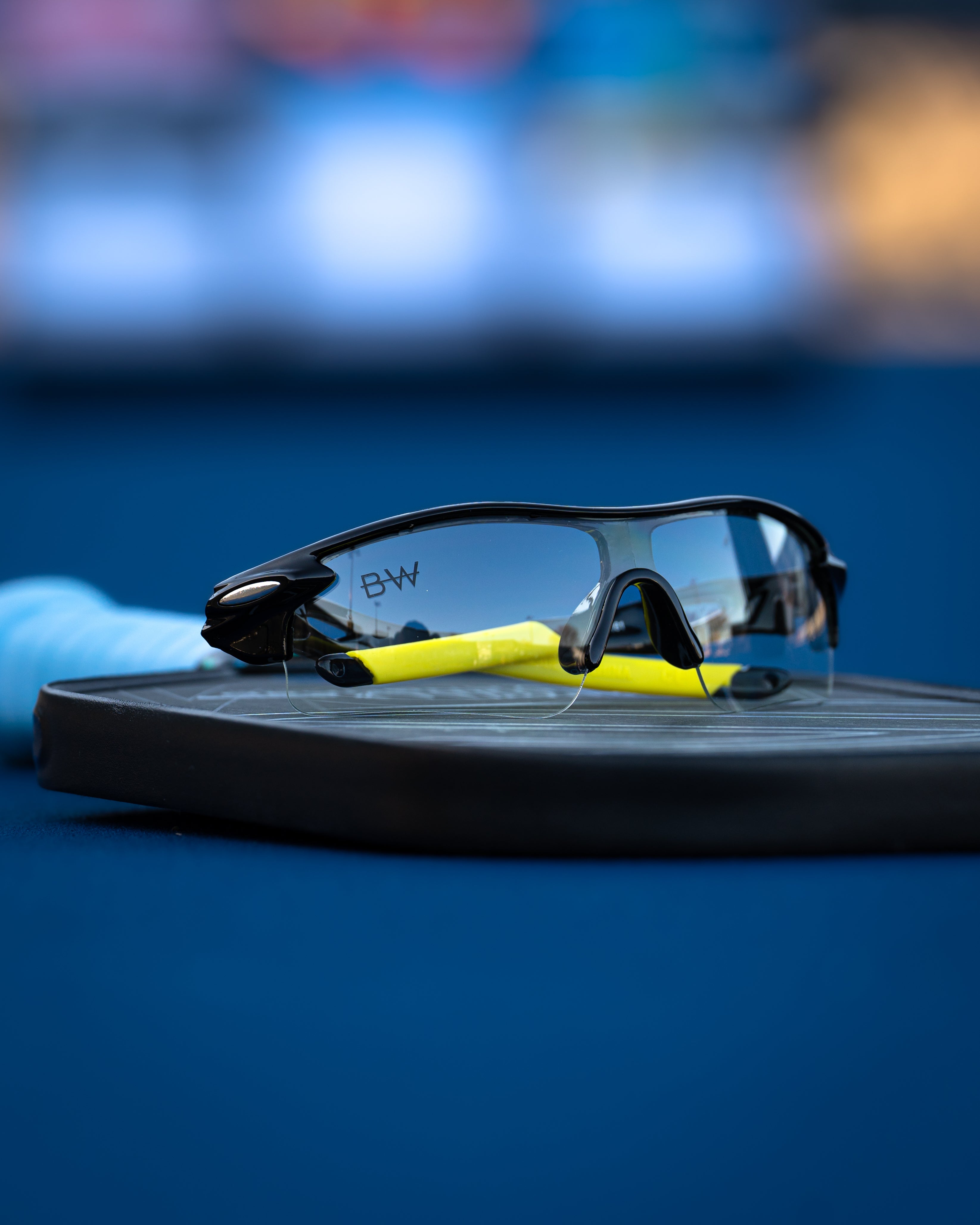
RX Glasses That Help You Own the Middle
Share
Find Your Prescription Pickleball Glasses
Prescription pickleball eyewear should start with the fundamentals: accurate prescription correction, compatible frame and lens options, individual fit, comfort during movement, and a configuration that makes sense for where you actually play.
RX Glasses That Help You Own the Middle: What Actually Matters
The middle is one of the most important areas to understand in doubles pickleball. Players have to coordinate with a partner, respond to balls traveling through shared space, move toward and around the non-volley zone, and make decisions during fast exchanges.
Prescription eyewear can matter in a straightforward way: if you require vision correction, your eyewear needs to provide the prescription correction you rely on while fitting appropriately for active play.
That is different from claiming that a particular pair of glasses makes you intercept more balls, recognize spin faster, anticipate opponents earlier, or automatically dominate the middle.
The original version of this guide connected RX eyewear with faster ball tracking, improved middle-court awareness, better depth judgment, clearer recognition of spin, and faster decision-making. Those outcomes should not be guaranteed by an eyewear product. :chatgpt-content-reference{index="0"}
This updated guide focuses on the factors a prescription player can actually evaluate: prescription compatibility, frame fit, lens configuration, movement, comfort, playing environment, and familiarity with the eyewear.
What Does "Owning the Middle" Mean in Pickleball?
In doubles, the middle is shared territory. Depending on positioning, handedness, strategy, shot location, and partner communication, either player may become involved with a ball traveling through the center of the court.
Middle play can involve:
- Coordinating with your partner
- Responding to balls traveling between both players
- Moving laterally along the non-volley-zone line
- Transitioning from deeper court positions
- Handling quick exchanges near the kitchen
- Deciding when to take or leave a ball
- Recovering court position after a shot
Eyewear does not make those strategic decisions for you. It should support the prescription correction and wearing experience you need while you execute them.
Why Vision Matters in the Middle Without Overstating What Glasses Do
Pickleball is a visually demanding activity. Players look at the ball, opponents, court, and partner while their own body is moving.
If you normally require prescription correction, wearing an appropriate prescription during play can therefore be an important part of your individual setup.
But there is an important distinction between correcting vision and enhancing athletic ability.
| Reasonable Eyewear Goal | Claim That Should Not Be Assumed |
|---|---|
| Provide your prescribed vision correction | Automatically track the ball faster |
| Fit appropriately during active use | Automatically improve reaction time |
| Remain comfortable enough for your playing session | Automatically improve decision-making |
| Use a lens configuration appropriate for your preferences and environment | Automatically improve depth perception |
| Offer sports-oriented eyewear options | Automatically improve peripheral awareness |
| Offer impact-resistant lens options | Make the eyewear indestructible |
Visual Demands During Middle-Court Play
The original article identified peripheral awareness, contrast sensitivity, depth judgment, and adaptability as important to middle play. :chatgpt-content-reference{index="1"} Those concepts can be useful when discussing the sport, but they should not automatically be turned into product-performance claims.
Watching the Ball
The ball remains an obvious visual reference throughout a rally. Your prescription eyewear should provide the corrective configuration prescribed for you rather than promising enhanced ball tracking.
Awareness of Your Partner
Doubles players also use positioning, communication, and experience to coordinate shared space. A frame should not be advertised as automatically improving awareness of your partner.
Judging Court Position
Players constantly adjust their location relative to the kitchen line, baseline, sidelines, partner, and opponents. Proper prescription correction may be important to an individual player, but no lens should be promised to automatically improve depth judgment.
Responding to Fast Exchanges
Reaction time involves the player, not simply the eyewear. Avoid claims that a particular frame or tint creates faster reactions.
Start With Prescription Correction, Not "Middle-Control Technology"
If you need corrective lenses, your first question should not be, "Which glasses help me poach more?"
Start with:
- What is my complete current eyeglass prescription?
- Is that prescription compatible with the exact RX product I am considering?
- What are the frame dimensions?
- How do those dimensions compare with eyewear I already find comfortable?
- Is the product direct RX or an RX Clip configuration?
- What lens options are currently available for that exact product?
- Where and when will I normally wear it?
Those questions are much more useful than choosing eyewear because of an unsupported promise that it will make you faster through the middle.
Sports RX Eyewear vs. Everyday Prescription Glasses for Pickleball
Everyday prescription glasses are often selected around work, driving, errands, and general daily wear. Sports-oriented prescription eyewear gives you an opportunity to evaluate a separate setup specifically around active use.
That does not mean every pair of everyday glasses is unsuitable for pickleball or that every sports frame automatically fits better.
| Consideration | Everyday Prescription Eyewear | Sports-Oriented RX Eyewear |
|---|---|---|
| Prescription correction | Based on your individual prescription | Based on your individual prescription |
| Primary selection context | Often daily activities | Can be selected specifically with active use in mind |
| Movement testing | May not have been chosen around court movement | Can be evaluated during realistic pickleball movement |
| Extended sports comfort | Depends on the exact frame and wearer | Can be specifically tested through longer playing sessions |
| Impact-resistant options | Depends on the exact eyewear | Blinded Wear offers impact-resistant lens options |
Frame Fit Matters During Middle-Court Movement
Middle play can involve frequent changes of direction and head position. That makes realistic fit testing useful for any sports frame.
Do not reduce fit to a marketing phrase such as "no-slip."
Instead, evaluate:
- Overall frame dimensions
- Bridge comfort
- Temple comfort
- Starting frame position
- Fit during lateral movement
- Fit while transitioning forward
- Fit after perspiration begins
- Comfort after multiple games
The original article claimed Blinded Wear RX glasses universally include no-slip grip technology and later stated that all RX glasses use anti-slip nose bridges and side arms. :chatgpt-content-reference{index="2"} Those collection-wide claims should not be made unless the exact features are verified for every applicable product.
Do RX Pickleball Glasses Need to Be Tight for Middle Play?
Not necessarily.
A frame should not be selected simply by finding the tightest option possible. Excessive pressure can become uncomfortable during extended wear.
The more useful goal is balance:
- Appropriate frame position
- Acceptable stability during normal movement
- Bridge comfort
- Temple comfort
- Comfort after perspiration begins
- Comfort across multiple games
More pressure on your face does not automatically equal better pickleball performance.
Do Pickleball Glasses Need Zero Movement?
No universal zero-movement standard is necessary.
Human faces move. Players sweat. Head position changes. Skin moves during physical activity. Individual frame fit varies.
Instead of demanding that the frame remain perfectly motionless, ask whether its movement becomes distracting or requires repeated adjustment during normal play.
If you constantly reposition the eyewear, that is useful information about your individual fit. If a frame remains comfortable and appropriately positioned, tiny amounts of movement do not automatically mean it is unsuitable.
How to Test RX Glasses for Middle-Court Movement
A realistic test is more useful than standing in front of a mirror and deliberately shaking your head.
Start With Dinks
Use the eyewear during controlled kitchen play and normal lateral movement.
Add Volleys
Continue with faster exchanges while moving naturally along the non-volley-zone line.
Practice Middle Balls
Work through the same communication and positioning patterns you normally use with a partner.
Transition Forward
Start deeper in the court and move toward the kitchen using your normal footwork.
Use Overhead Movements
Look upward naturally and notice whether the frame position or comfort changes.
Continue After Perspiration Begins
A dry five-minute fitting does not necessarily represent a longer playing session.
Play Multiple Games
Extended wear can reveal comfort preferences that are not obvious during the first few minutes.
Do Wraparound RX Glasses Improve Peripheral Vision?
The original guide described wraparound frames as providing an advantage in peripheral tracking. :chatgpt-content-reference{index="3"} That should not be treated as a universal performance outcome.
Sports-oriented frame geometry can differ from conventional everyday eyewear, but frame shape alone does not prove that a player will experience better peripheral awareness, faster recognition, or improved ball tracking.
Your individual prescription, lens configuration, frame geometry, fit, and visual requirements all contribute to the complete wearing experience.
Can RX Pickleball Glasses Improve Depth Perception?
Prescription eyewear should provide the corrective configuration prescribed for you. It should not be marketed as automatically enhancing depth perception beyond that correction.
In particular, avoid assuming that:
- A particular tint improves depth perception.
- Polarized lenses automatically improve depth perception.
- Non-polarized lenses automatically improve depth perception.
- A wraparound frame automatically improves depth perception.
- High-index material automatically improves depth perception.
These are separate characteristics and should not be converted into universal athletic-performance claims.
Can RX Glasses Help You Read Spin Better?
The original article suggested specialized RX eyewear allows players to identify shot spin without visual delay. That goes beyond what should be promised by the eyewear itself. :chatgpt-content-reference{index="4"}
Spin recognition can involve visual information from the ball, opponent, paddle path, and previous playing experience. A prescription product should not be credited with automatically improving that skill.
If you require prescription correction, the defensible goal is simpler: use an appropriate prescription configuration while playing.
Do RX Sports Glasses Improve Reaction Time?
No universal reaction-time improvement should be promised.
Reaction time involves the player and the situation. Lens color, polarization status, high-index material, frame shape, or sports styling should not automatically be described as making someone react faster.
That does not make prescription sports eyewear irrelevant. It simply keeps the benefit in the right category: vision correction and an active-use eyewear configuration, rather than guaranteed athletic enhancement.
High-Index Prescription Lenses for Pickleball
Blinded Wear includes high-index prescription lenses at no additional cost with custom RX eyewear.
High-index refers to a category of prescription lens material commonly used to help manage lens thickness, particularly as prescription strength increases.
The original guide specified an exact 1.61 index and described it as producing ultra-clear, ultra-light vision. :chatgpt-content-reference{index="5"} Unless that exact index is verified for the current product being discussed, it is better to use the broader verified high-index description.
Finished lens thickness depends on factors including:
- Your individual prescription
- Lens dimensions
- Frame dimensions
- Lens geometry
- Differences between the two eyes
- Other optical requirements
What High-Index Does Not Automatically Mean
High-index should not become a catch-all performance claim.
It does not automatically mean:
- Better ball tracking
- Faster reaction time
- Better depth perception
- Better peripheral awareness
- Improved contrast
- Impact resistance
- Shatterproof construction
- Scratch resistance
- Anti-fog performance
- Polarization
Refractive index is not a durability score or an athletic-performance score.
Impact-Resistant Lens Options for Pickleball
Blinded Wear offers impact-resistant lens options. For sports eyewear, that is a physical lens characteristic worth understanding separately from tint, polarization, or refractive index.
Impact-resistant does not mean:
- Indestructible
- Shatterproof
- Scratch-proof
- Automatically safety-certified
- Automatically polarized
- Automatically UV-rated to a particular specification
If a specific certification matters for your intended use, verify that certification for the exact product rather than inferring it from sports styling or impact resistance.
Choosing a Lens for Middle-Court Pickleball
The middle of the court does not require its own special lens color.
Instead, choose according to your actual environment and the current options compatible with your RX product.
| Playing Situation | Useful Question |
|---|---|
| Indoor pickleball | Do I want a dark sunglass tint in this facility? |
| Bright outdoor play | What available tint do I personally find comfortable? |
| Sun and shade | Which current compatible lens option fits the environments I encounter? |
| Evening play | Is my daytime lens preference still appropriate as available light decreases? |
| Long tournament day | Would another appropriate corrective configuration be useful as conditions change? |
For more lens education, visit the Pickleball Performance Lens Guide.
Clear Lenses for Indoor and Lower-Light Pickleball
A clear lens has no dark sunglass tint.
For players who do not want a dark tint, an appropriate clear configuration may be worth considering for indoor, evening, or lower-light environments when compatible with the exact prescription product.
Clear lenses should not be described as creating more light or automatically improving:
- Contrast
- Reaction time
- Depth perception
- Ball tracking
- Middle-court awareness
The Blinded Wear Clear Lens Collection contains non-prescription clear-lens options and should not be confused with the RX collection.
Does Lens Tint Help You Control the Middle?
Different lens tints can change visible-light transmission and color appearance. Some players may prefer particular tints or brightness levels in particular environments.
That does not mean a tint automatically helps you:
- Recognize the ball sooner
- Read paddle angles faster
- See spin better
- React faster
- Judge depth better
- Poach more effectively
Those are athletic and visual-performance outcomes that should not be guaranteed from lens color alone.
Polarized vs. Non-Polarized Lenses for Middle Play
Polarized lenses are designed to reduce certain reflected light. Some players may prefer polarization in particular outdoor environments, while other court players may prefer non-polarized lenses.
Blinded Wear offers non-polarized lens options.
Neither configuration should be described as universally superior for controlling the middle.
- Polarization alone does not determine depth perception.
- Non-polarized lenses do not automatically improve depth perception.
- Non-polarized lenses do not automatically improve ball tracking.
- Polarized lenses do not automatically improve reaction time.
- Polarization and tint are separate characteristics.
- Polarization and UV specifications are separate characteristics.
- Polarization and impact resistance are separate characteristics.
Photochromic Lenses and Changing Pickleball Conditions
Photochromic lenses are designed to change tint in response to particular light conditions.
They may interest players whose sessions span changing environments, but availability should be verified for the exact RX product.
Do not assume that every Blinded Wear RX frame offers a photochromic option or that photochromic behavior automatically improves middle-court performance.
Likewise, do not promise a specific transition speed or behavior without exact product-level information.
Keep Tint, Polarization, UV, and Impact Resistance Separate
| Visible or Technical Characteristic | What It Does Not Automatically Prove |
|---|---|
| Dark tint | Polarization, UV specifications, impact resistance, or better ball tracking |
| Clear appearance | UV specifications, anti-fog treatment, impact resistance, or blue-light filtering |
| Blue appearance | Blue-light filtering |
| Mirrored appearance | Polarization |
| Polarization | Better depth perception, UV specifications, or impact resistance |
| High-index material | Impact resistance, polarization, or better athletic performance |
Fogging During Fast Kitchen Exchanges
Fogging can be frustrating during any part of a match, but a frame should not automatically be described as fog-proof because it has a sports-oriented appearance.
Condensation can be influenced by several variables, including:
- Temperature
- Humidity
- Perspiration
- Airflow
- Frame position
- Transitions between different environments
The source article described Zebra II RX as using anti-fog vents and Frost RX as being built for fog-free play. :chatgpt-content-reference{index="6"} Those claims should not be repeated unless they are currently verified for the exact products.
Sweat, Quick Pivots, and RX Frame Fit
Perspiration can change how eyewear feels during physical activity. The exact effect depends on the wearer, frame, environment, and fit.
That is why the source's claim that sweat will not cause slippage because all Blinded Wear RX glasses have anti-slip bridges and side arms is too absolute. :chatgpt-content-reference{index="7"}
Instead, test the completed eyewear after you begin sweating.
Ask:
- Has the frame position changed noticeably?
- Am I repeatedly adjusting it?
- Does the bridge remain comfortable?
- Do the temples remain comfortable?
- Would I comfortably continue wearing this setup through several more games?
Direct RX vs. RX Clip Systems for Middle-Court Play
Blinded Wear prescription eyewear can use different RX constructions. Neither construction should automatically be declared better for middle control.
Direct RX
With a direct RX configuration, prescription correction is incorporated into the direct prescription setup of compatible eyewear.
RX Clip
An RX Clip uses a separate inner prescription insert within compatible eyewear. The prescription correction is contained in the inner RX clip rather than the primary outer sports lens.
| Question | Direct RX | RX Clip |
|---|---|---|
| Provides prescription correction | Yes, through the direct prescription configuration | Yes, through the inner RX insert |
| Automatically improves ball tracking | No | No |
| Automatically improves peripheral awareness | No | No |
| Automatically more stable | No | No |
| Requires prescription compatibility | Yes | Yes |
| Should be evaluated for individual fit | Yes | Yes |
Middle-Court RX Eyewear for Stronger Prescriptions
If you have a stronger prescription, frame selection should begin with compatibility rather than choosing whichever model is marketed as the most aggressive sports frame.
The complete prescription can include:
- Sphere
- Cylinder
- Axis
- Differences between the two eyes
- Other optical requirements
Frame dimensions, lens dimensions, lens geometry, and other requirements can also affect the finished prescription configuration.
Blinded Wear includes high-index prescription lenses at no additional cost, but that does not mean every prescription is compatible with every frame or that an exact finished lens thickness can be promised.
What If Your Prescription Includes Astigmatism?
If your prescription includes astigmatism correction, cylinder and axis are part of the complete prescription requirements.
Do not determine compatibility from sphere alone.
The same principle applies to specialized prescriptions: evaluate the complete prescription against the exact RX product rather than relying on a generic statement that a frame works for everyone.
Progressive and Multifocal Prescriptions for Pickleball
Do not assume every Blinded Wear RX frame supports every progressive, multifocal, or specialized prescription design.
If your prescription requires a particular lens design, confirm compatibility with the exact product before purchasing.
Sports styling alone does not establish compatibility with every prescription configuration.
Zebra II RX for Pickleball: What to Evaluate
Zebra II RX is a current Blinded Wear prescription option and was one of the primary products featured in the original middle-court guide.
The older article described Zebra II RX as engineered for explosive footwork, maximum clarity in sun or shade, anti-fog performance, and faster recognition of middle balls. :chatgpt-content-reference{index="8"} Those performance claims should not be carried forward without current product-level evidence.
Instead, compare Zebra II RX using:
- Your complete prescription
- Prescription compatibility
- Frame dimensions
- Current lens configuration
- Individual fit
- Playing environment
- Style preference
Crystal Wave II RX for Middle-Court Play
Crystal Wave II RX is another current prescription option.
The original article assigned it specific mixed-lighting benefits and claimed it helped a player see middle balls earlier. :chatgpt-content-reference{index="9"} Those statements should not become universal product promises.
Evaluate the current product according to its actual specifications, prescription compatibility, dimensions, fit, and current lens configuration.
Frost RX for Pickleball
Frost RX is a direct RX option with a white frame and bright blue lens appearance.
The original guide described Frost RX as fog-free, suitable for sweat-heavy play, and guaranteed not to slip in the quoted experience. :chatgpt-content-reference{index="10"} Those should not be treated as universal product characteristics.
Likewise, the bright blue lens appearance does not automatically establish blue-light filtering, polarization, UV specifications, contrast enhancement, or a particular athletic-performance benefit.
Blue Shield RX: Do Not Infer Lens Technology From the Name
Blue Shield RX is another current Blinded Wear prescription option.
The original article described Blue Shield RX as providing blue-light protection and sunlight-glare benefits. :chatgpt-content-reference{index="11"} Those characteristics should not be assumed from the product name.
"Blue Shield" alone does not establish:
- Blue-light filtering
- Polarization
- UV specifications
- Anti-reflective treatment
- Anti-fog treatment
- Glare reduction
- Impact certification
Review current product information instead of using the name as a technical specification.
Current Blinded Wear RX Frames to Compare
There is no need to force one frame into the role of universal "best middle-court RX glasses." Compare multiple current prescription options using the same criteria.
- Zebra II RX
- Crystal Wave II RX
- Frost RX
- Blue Shield RX
- Steel Ice RX
- Gray Wash RX
- Havana Melt RX
- Lava Rock RX
- Rippled X RX
Browse the full Prescription Pickleball Glasses Collection for current options.
How to Compare RX Frames for Middle-Court Play
| Factor | What to Check |
|---|---|
| Prescription | Whether your complete prescription is compatible with the exact product |
| Dimensions | How the frame compares with eyewear you already find comfortable |
| RX construction | Whether it uses direct RX or a compatible RX Clip system |
| Lens configuration | Which current options are actually available for that product |
| Playing environment | Indoor, outdoor, bright sun, shade, evening, or changing conditions |
| Initial fit | Bridge and temple comfort |
| Movement | How the complete eyewear feels during realistic pickleball movement |
| Perspiration | Whether the wearing experience changes once you begin sweating |
| Extended wear | Whether the frame remains comfortable across multiple games |
Can RX Glasses Improve Partner Awareness?
Doubles awareness comes from a combination of vision, positioning, communication, familiarity with your partner, and experience.
A frame should not be promised to make you read your partner's body language faster.
Instead, prescription sports eyewear should be evaluated around whether the prescription and frame configuration work appropriately for you while you play your normal doubles game.
Can Better RX Glasses Make You a Better Poacher?
Poaching is a tactical action. It involves positioning, anticipation, communication, decision-making, movement, and execution.
The source article claimed clearer middle visibility could lead to more interceptions, cleaner poaches, fewer pop-ups, and improved partner rhythm. :chatgpt-content-reference{index="12"} Those outcomes should not be guaranteed by eyewear.
Prescription sports eyewear can address the eyewear side of the equation. Training and strategy address the pickleball side.
Indoor vs. Outdoor RX Glasses for Middle-Court Play
The strategic middle of the court does not change because you move indoors or outdoors, but the lighting environment can.
Indoor Play
Consider whether you want a dark sunglass tint in the facility and whether the exact RX product supports a configuration appropriate for your preference.
Bright Outdoor Play
You may personally prefer a sunglass tint. Review the actual available options rather than assuming a specific tint universally improves pickleball vision.
Mixed Sun and Shade
Consider how comfortable you are with your chosen configuration as environmental brightness changes.
Evening Play
A configuration you prefer at midday may not necessarily be your preferred choice as available natural light decreases.
First-Session Test for New RX Pickleball Glasses
When your completed prescription eyewear arrives, use a normal playing session to learn how it feels.
- Put the eyewear on normally.
- Notice initial prescription comfort.
- Evaluate bridge and temple comfort.
- Warm up with normal dinks and volleys.
- Add lateral movement along the kitchen line.
- Practice transition-zone movement.
- Continue after perspiration begins.
- Play multiple games.
- Notice whether repeated adjustment occurs.
- Evaluate how you feel after extended wear rather than only during the first few minutes.
Test RX Eyewear Before an Important Tournament
If possible, do not make an important tournament the first meaningful test of new custom prescription sports eyewear.
Use practice sessions to evaluate:
- Prescription comfort
- Frame fit
- Movement
- Perspiration
- Extended wear
- Your normal indoor or outdoor environment
- Your chosen lens configuration
The goal is familiarity. By tournament day, you should already understand how the completed setup feels during your normal game.
Lens Care During Long Pickleball Sessions
Prescription sports eyewear can collect fingerprints, perspiration, dust, and other residue during use.
Before wiping the lenses aggressively, inspect them for visible debris.
If particles or grit are present, avoid grinding abrasive debris across the lens surface. Use appropriate lens-cleaning materials and follow care guidance applicable to the exact lenses.
Do not assume that every lens is scratch-proof, hydrophobic, oleophobic, or coated with a specific treatment unless that characteristic is verified.
What to Do if Your RX Glasses Take an Impact
If your eyewear experiences a significant impact during play, inspect it before continuing to rely on it.
Look for:
- Visible lens damage
- Visible frame damage
- Displaced components
- Loose components
- Changes in alignment
- A sudden change in fit
Impact-resistant does not mean indestructible. If the eyewear appears damaged or no longer appropriate to use, switch to an appropriate backup.
Bring Backup Vision Correction for Important Events
If prescription correction is essential for you, consider what you would use if your primary sports eyewear became damaged or unavailable during an event.
An appropriate backup depends on your individual vision needs, but the general principle is useful: do not make an entire tournament vision plan depend on one physical item when another suitable corrective option can be available.
How to Order Blinded Wear RX Pickleball Glasses
- Browse the Blinded Wear Prescription Pickleball Glasses Collection.
- Select the RX product you want to evaluate.
- Review current frame and lens information.
- Compare frame dimensions with eyewear you already find comfortable when possible.
- Confirm compatibility with your complete prescription.
- Understand whether the product uses direct RX or an RX Clip configuration.
- Review the exact lens options currently available.
- Upload a clear photo or picture of your eyeglass prescription on the product page before adding the eyewear to your cart and before purchasing.
- Review the complete custom RX order carefully before checkout.
For additional instructions, visit How to Order RX Glasses.
Customized RX Eyewear Is Final Sale
Blinded Wear offers a 30-day return policy for eligible standard purchases, but customized prescription eyewear is final sale and excluded from the standard 30-day return policy.
That makes pre-purchase evaluation important.
Before ordering:
- Review your complete prescription.
- Confirm compatibility with the exact RX product.
- Review frame dimensions.
- Review the current lens configuration.
- Understand the RX construction.
- Review the completed order before checkout.
What If Your RX Pickleball Glasses Break?
Blinded Wear offers 50% lifetime replacement support if eligible glasses break, subject to current policy terms.
This is not a free full replacement.
For an eligible claim, the damaged eyewear must be returned. Once applicable claim and return requirements are satisfied, qualifying customers can receive 50% credit toward a replacement pair.
For damaged RX eyewear, contact blindedwearco@gmail.com before returning the pair.
Do not assume that loss, a prescription change, or every type of damage automatically qualifies.
Review the Blinded Wear Protection Plan, Replacement & Returns information for current eligibility and policy details.
RX Glasses and Middle-Court Pickleball Myths
| Myth | More Accurate Explanation |
|---|---|
| RX sports glasses make you see the middle ball earlier. | Prescription eyewear provides corrective vision according to its prescription configuration; it should not guarantee earlier recognition. |
| Wraparound frames improve peripheral tracking. | Frame shape alone does not establish a universal peripheral-vision advantage. |
| High-index lenses improve reaction time. | High-index primarily relates to prescription lens material and thickness management. |
| High-index means impact-resistant. | Refractive index and impact resistance are separate characteristics. |
| A no-slip frame can never move. | Individual fit, movement, perspiration, and extended wear can affect the wearing experience. |
| Sports frames are automatically anti-fog. | Anti-fog characteristics should be verified for the exact product. |
| Blue lenses automatically block blue light. | Lens appearance does not establish blue-light filtering. |
| Polarized lenses improve depth perception. | Polarization alone does not determine depth perception. |
| Non-polarized lenses improve ball tracking. | No universal ball-tracking advantage should be attributed to polarization status alone. |
| Clear lenses improve reaction time indoors. | Clear lenses simply avoid a dark sunglass tint; they do not guarantee faster reactions. |
RX Pickleball Glasses Buying Checklist for Middle-Court Players
- Do I have my complete current eyeglass prescription?
- Is my prescription compatible with this exact RX product?
- Have I reviewed the frame dimensions?
- Have I compared those dimensions with eyewear I already find comfortable?
- Is the product direct RX or an RX Clip configuration?
- What lens options are currently available?
- Do I primarily play indoors or outdoors?
- What time of day do I normally play?
- Do I understand that tint and polarization are separate?
- Do I understand that high-index and impact resistance are separate?
- Have I avoided assuming anti-fog, scratch-resistant, or non-slip features?
- Can I test the completed eyewear during realistic court movement?
- Can I evaluate it after perspiration begins?
- Can I test it for multiple games before an important tournament?
- Do I understand the final-sale policy for customized RX eyewear?
- Have I reviewed current replacement-support terms?
Part 1 Takeaway: Prescription Eyewear Supports Your Vision, Not Your Strategy
Owning the middle is a pickleball skill. It involves positioning, communication, movement, anticipation, decision-making, and execution.
Prescription eyewear has a different job.
If you require corrective lenses, the goal is to find a sports-oriented RX configuration that works with your prescription, fits appropriately, remains comfortable during active use, and makes sense for your playing environment.
Keep the technical distinctions clear:
High-index is not a performance enhancer. Impact resistance does not mean indestructible. Tint does not determine polarization. Dark tint does not automatically mean more UV protection. Polarization alone does not determine depth perception. Clear lenses do not create more light. Wraparound styling does not guarantee better peripheral tracking. Lens color does not guarantee better reaction time, ball tracking, spin recognition, or middle-court awareness.
Part 2 will go deeper into middle-court fit testing, lateral movement and frame stability, sweat and fogging, indoor versus outdoor lens selection, direct RX versus RX Clip systems, stronger prescriptions, current Blinded Wear RX frame comparisons, tournament preparation, lens care, and a complete middle-court testing routine.
How to Evaluate RX Frame Fit for Fast Middle-Court Movement
Middle-court play can expose fit issues that are easy to miss during a stationary try-on. Doubles pickleball frequently involves short lateral movements, forward transitions, quick changes in head position, and repeated movement around the non-volley-zone line.
The useful question is not whether a frame is marketed as "locked in." It is whether the completed prescription eyewear works appropriately for your face, prescription, movement, and normal playing session.
Evaluate the frame in stages rather than judging everything from the first few minutes.
Stage 1: Initial Position
Put the eyewear on normally. Avoid deliberately forcing it higher, lower, tighter, or farther back than you would naturally wear it.
Notice:
- Where the bridge naturally rests
- How the temples feel
- Whether the frame feels balanced
- Whether the prescription feels comfortable initially
- Whether anything immediately creates distracting pressure
Stage 2: Normal Head Movement
Look left, right, upward, and downward as you naturally would during play. This is more relevant than aggressively shaking your head to create an artificial stress test.
Stage 3: Pickleball Movement
Use the eyewear during actual dinks, volleys, transitions, serves, returns, overhead movements, and lateral footwork.
Stage 4: Perspiration
Continue testing once you begin sweating. The wearing experience can change during active play.
Stage 5: Extended Wear
Play multiple games. A frame that feels comfortable for five minutes may feel different after a longer session.
Lateral Movement Is an Important RX Frame Test
Movement along the kitchen line is particularly useful when evaluating sports eyewear because it resembles a common movement pattern during doubles play.
Try several normal sequences:
- Begin in your normal ready position.
- Dink cross-court and move laterally as the rally requires.
- Return toward your starting position.
- Transition into several volley exchanges.
- Practice balls traveling through the center with a partner.
- Repeat after perspiration begins.
Do not focus on whether the eyewear remains mathematically motionless. Focus on whether frame movement becomes distracting, changes the wearing position substantially, or repeatedly causes you to adjust the glasses.
A Simple Middle-Ball Drill for Testing New RX Glasses
You can combine normal doubles practice with eyewear evaluation without pretending the glasses themselves improve your strategy.
Controlled Middle Dinks
Have a partner or practice group send balls toward shared middle space. Use your normal communication and positioning rules.
Faster Middle Volleys
Increase the pace gradually. Notice the eyewear only when something about its fit or comfort becomes distracting.
Transition-Zone Repetitions
Begin farther from the kitchen and move forward using normal transition footwork.
Overhead Movement
Include several realistic overhead movements so you can evaluate the frame while looking upward.
Extended Play
Finish with ordinary games. A frame should ultimately be evaluated in the type of play for which you purchased it.
Frame Stability vs. Excessive Tightness
It is tempting to treat stability as a simple equation: tighter equals better.
That is incomplete.
A useful sports fit balances several factors:
| Factor | What to Evaluate |
|---|---|
| Frame position | Whether the eyewear remains in an acceptable wearing position during normal movement |
| Bridge comfort | Whether pressure remains comfortable over a longer session |
| Temple comfort | Whether the sides of the frame create distracting pressure |
| Movement | Whether movement becomes distracting or causes repeated adjustment |
| Perspiration | Whether the wearing experience changes after you begin sweating |
| Extended wear | Whether the frame remains comfortable through multiple games |
A frame that feels extremely tight for five minutes is not automatically a better pickleball frame than one that achieves an appropriate individual fit without excessive pressure.
Watch for Pressure Points During Longer Sessions
Prescription sports eyewear should not be evaluated only at the beginning of a session.
Pay attention to how the frame feels around:
- The bridge
- The temples
- The sides of the head
- The areas where the frame contacts your face
Comfort is individual. A particular frame can work well for one player and feel different on another person's face.
This is one reason frame dimensions can be useful before ordering custom RX eyewear. They do not guarantee fit, but they provide a more concrete comparison than product photos alone.
Use Frame Dimensions Before Ordering Custom RX Glasses
If you already own prescription glasses or sunglasses that fit comfortably, compare their dimensions with the RX frame you are considering.
Depending on the measurements provided for the product, useful comparisons can include:
- Overall frame width
- Lens width
- Lens height
- Bridge measurement
- Temple length
Measurements do not tell the entire fit story because frame geometry and individual facial dimensions also matter. However, they provide useful pre-purchase context, particularly because customized Blinded Wear RX eyewear is final sale.
How Sweat Can Change the RX Eyewear Experience
Pickleball can involve significant perspiration, especially during long outdoor sessions, warm indoor play, tournament days, or repeated games without long breaks.
Do not assume that every frame responds to perspiration identically.
Once you begin sweating, reevaluate:
- Frame position
- Bridge comfort
- Temple comfort
- Frequency of adjustment
- Overall comfort
The relevant comparison is between the dry and active wearing experience, not between a marketing claim and an unrealistic expectation that sports glasses can never move.
Fogging Is Different From Frame Slippage
Fogging and frame movement are separate issues.
Fogging involves condensation on or around the lens surfaces. Slippage describes a change in the physical position of the frame.
One does not prove the other.
Conditions that can contribute to condensation around eyewear include:
- Temperature differences
- Humidity
- Perspiration
- Airflow
- Frame position
- Movement between different environments
Do not assume that a sports frame is anti-fog simply because of its shape, styling, openings, or intended activity.
RX Glasses for Indoor Middle-Court Play
Indoor pickleball presents a different lighting environment from bright outdoor courts. If you do not want a dark sunglass tint indoors, an appropriate clear configuration may be worth considering when available for the exact RX product.
Clear means no dark sunglass tint.
It does not mean that the lens:
- Creates additional light
- Improves reaction time
- Improves contrast automatically
- Improves ball tracking automatically
- Improves depth perception automatically
- Is automatically anti-fog
- Is automatically impact-resistant
- Has a particular UV specification
Verify the characteristics of the exact lens configuration rather than inferring them from clear appearance.
RX Glasses for Outdoor Middle-Court Play
Outdoor pickleball can expose players to substantially different brightness depending on the time of day, weather, court orientation, surrounding structures, and shade.
A player may prefer a sunglass tint in brighter conditions. Tint selection is still an individual decision rather than a universal performance formula.
Different tints can change visible-light transmission and color appearance. They should not automatically be described as improving:
- Middle-ball recognition
- Reaction speed
- Spin recognition
- Depth perception
- Peripheral awareness
- Shot selection
What If Your Court Moves Between Sun and Shade?
Some outdoor courts contain a mixture of direct sunlight and shade. Conditions can also change during a longer playing session as the sun moves or cloud cover changes.
Before selecting an RX lens configuration, consider the environment you encounter most often:
- Consistently bright outdoor courts
- Partially shaded courts
- Changing cloud cover
- Morning sessions that become brighter
- Afternoon sessions that continue toward evening
- Indoor and outdoor play on different days
No single lens configuration should be described as universally best for all of these conditions.
Photochromic RX Lenses for Changing Conditions
Photochromic lenses are designed to change tint in response to particular light conditions. This can make the category relevant to players researching eyewear for environments with changing brightness.
However, several distinctions matter.
- Do not assume photochromic availability for every RX frame.
- Do not assume an exact activation or fading speed without verified lens specifications.
- Do not assume identical behavior in every environment.
- Do not assume photochromic behavior improves reaction time.
- Do not assume photochromic behavior improves ball tracking.
- Do not assume photochromic behavior improves depth perception.
Verify the current options for the exact RX product you are considering.
Gray-Tinted RX Lenses for Outdoor Pickleball
Gray is a common sunglass tint category. Like other tints, it changes the amount and appearance of visible light reaching the wearer depending on the exact lens.
A player may personally prefer a gray tint in brighter environments.
Do not convert that preference into claims that gray lenses universally:
- Improve ball tracking
- Increase reaction speed
- Improve depth perception
- Reveal spin
- Improve middle-court positioning
- Reduce visual fatigue for every wearer
Exact tint characteristics should be verified for the specific lens rather than inferred from the word "gray."
Should Middle-Court Players Use Polarized Lenses?
Polarized lenses are designed to reduce certain reflected light. That can make polarization relevant in some outdoor environments.
Some players may prefer polarized eyewear. Other court players may prefer non-polarized lenses. Blinded Wear offers non-polarized lens options.
Neither preference should be turned into a universal rule about pickleball performance.
Polarization Does Not Automatically Determine Depth Perception
Do not claim that polarized lenses inherently damage depth perception or that non-polarized lenses inherently improve it.
Polarization Does Not Determine Ball Tracking
No automatic ball-tracking advantage should be assigned to either polarized or non-polarized lenses.
Polarization Is Separate From Tint
A lens can have a visible tint without that appearance establishing polarization.
Polarization Is Separate From UV Specifications
Do not use polarization status alone to infer a specific UV rating.
Polarization Is Separate From Impact Resistance
One characteristic does not establish the other.
Polarized Lenses and Digital Displays
One practical difference worth understanding is that polarized lenses can interact with some digital displays depending on display technology, viewing angle, and orientation.
This may matter if you regularly look at a phone, scoreboard, tablet, or another digital screen while wearing your sports eyewear.
It does not establish whether polarized or non-polarized lenses are universally better for pickleball.
Direct RX for Pickleball: What It Means
In a direct RX configuration, prescription correction is incorporated into the direct prescription setup of compatible eyewear.
Players considering direct RX should evaluate:
- Complete prescription compatibility
- Frame dimensions
- Current lens options
- Individual fit
- Playing environment
- Extended comfort
Direct RX should not automatically be described as providing better peripheral awareness, better depth perception, less distortion, greater stability, or faster ball tracking than an RX Clip configuration.
RX Clip Systems for Pickleball: What They Mean
An RX Clip uses a separate inner prescription insert within a compatible eyewear system. Prescription correction is provided by the inner RX insert rather than the primary outer sports lens.
The RX Clip is part of a compatible eyewear system. It should not be described as a universal prescription insert that can be installed in arbitrary sunglasses.
Blinded Wear includes high-index prescription lenses at no additional cost in custom RX Clip prescription configurations.
As with direct RX, the useful evaluation criteria include:
- Your complete prescription
- Compatibility
- Frame dimensions
- Current outer-lens configuration
- Individual fit
- Playing environment
- Comfort during active use
Direct RX vs. RX Clip for Middle-Court Pickleball
| Consideration | Direct RX | RX Clip |
|---|---|---|
| Prescription correction | Provided through the direct prescription configuration | Provided through the inner prescription insert |
| High-index availability from Blinded Wear | Included at no additional cost with custom RX eyewear | Included at no additional cost with custom RX Clip prescription configurations |
| Prescription compatibility required | Yes | Yes |
| Individual fit matters | Yes | Yes |
| Automatically improves reaction time | No | No |
| Automatically improves depth perception | No | No |
| Automatically improves ball tracking | No | No |
| Automatically more stable | No | No |
Stronger Prescriptions and Sports Frame Selection
As prescription requirements become more complex, it becomes increasingly important to start with compatibility rather than choosing a frame solely because you like its appearance.
High-index lens material is commonly used to help manage lens thickness, particularly as prescription strength increases. Blinded Wear includes high-index prescription lenses at no additional cost with custom RX eyewear.
However, no exact finished lens thickness should be guaranteed from refractive index alone.
Finished thickness can depend on:
- Sphere values
- Cylinder values
- Axis requirements
- Differences between the two eyes
- Frame dimensions
- Lens dimensions
- Lens geometry
- Other optical requirements
High-Index and Impact Resistance Are Not the Same Thing
This distinction is especially important when shopping for prescription sports eyewear.
High-index refers to prescription lens material and is commonly relevant to lens-thickness management.
Impact resistance describes a different physical characteristic.
Do not assume that a higher refractive index automatically means:
- Greater impact resistance
- Greater durability
- Shatterproof construction
- Scratch resistance
- A particular safety certification
Blinded Wear offers impact-resistant lens options, but the two concepts should remain separate when comparing prescription configurations.
RX Pickleball Glasses for Astigmatism
If your prescription contains cylinder and axis values, those values are part of your complete prescription requirements.
Do not evaluate sports-frame compatibility using sphere alone.
When comparing Blinded Wear RX products:
- Use the complete current prescription.
- Confirm compatibility with the exact product.
- Review frame dimensions.
- Review the RX construction.
- Review current lens options.
- Upload a clear image of the prescription during the ordering process.
Progressive and Multifocal RX Options Require Product-Level Compatibility
Do not assume that every sports frame supports every progressive, multifocal, or specialized prescription design.
If your prescription requires a specific lens design, compatibility should be confirmed for the exact RX product before ordering.
The fact that a frame is available in prescription form does not automatically mean every possible prescription design can be produced in it.
Current Blinded Wear RX Frames for Middle-Court Players to Compare
The most accurate way to compare Blinded Wear prescription eyewear is to avoid assigning unsupported specializations such as "best for poaching," "best for spin," or "best for middle-ball reaction time."
Instead, compare current RX options according to prescription compatibility, dimensions, construction, available lens configuration, individual fit, and style.
| RX Option | Useful Comparison |
|---|---|
| Zebra II RX | Review current prescription compatibility, dimensions, lens configuration, fit, and style. |
| Crystal Wave II RX | Compare current dimensions, prescription compatibility, lens configuration, and individual fit. |
| Frost RX | Direct RX option with a white frame and bright blue lens appearance. |
| Blue Shield RX | Review actual current specifications rather than inferring technical lens features from the product name. |
| Steel Ice RX | Compare current prescription compatibility, dimensions, configuration, fit, and style. |
| Gray Wash RX | Review its actual current lens configuration rather than assuming technical characteristics from the product name. |
| Havana Melt RX | Compare prescription compatibility, current configuration, dimensions, and style. |
| Lava Rock RX | Evaluate current configuration, prescription compatibility, dimensions, fit, and style. |
| Rippled X RX | Review current RX configuration, dimensions, prescription compatibility, and fit. |
See the complete Blinded Wear RX Pickleball Glasses Collection for current products and options.
Zebra II RX: A Better Way to Evaluate It
Zebra II RX appeared prominently in the original version of this guide. Instead of positioning it as a frame that automatically improves middle-ball recognition or athletic performance, evaluate the current product on measurable and individual factors.
- Is your prescription compatible?
- How do its dimensions compare with eyewear you already wear comfortably?
- What current lens options are available?
- Does its style fit your preferences?
- How does the completed eyewear feel during normal court movement?
- How does it feel after perspiration begins?
- Does it remain comfortable across multiple games?
View the current Zebra II RX product page for current product information.
Crystal Wave II RX: Evaluate the Current Configuration
Crystal Wave II RX was previously described as a specialized mixed-lighting frame. A safer approach is to review the actual current configuration rather than assigning a universal lighting specialization.
Compare:
- Prescription compatibility
- Current lens configuration
- Frame dimensions
- Individual fit
- Style
- Your normal playing environment
View Crystal Wave II RX.
Frost RX: Direct RX With a Distinctive Look
Frost RX is a direct RX option with a white frame and bright blue lens appearance.
Those visible characteristics can be described without assigning unverified technical properties to the lens.
The bright blue appearance alone does not prove:
- Blue-light filtering
- Polarization
- Anti-reflective treatment
- Anti-fog treatment
- A specific UV rating
- Enhanced contrast
- Improved ball tracking
Use current product information for technical specifications.
Blue Shield RX: Product Names Are Not Lens Specifications
Blue Shield RX is another current prescription option.
When comparing it with other RX frames, do not assume that "Blue Shield" itself proves blue-light filtering or another technical lens characteristic.
Product names, colors, and visual appearance should remain separate from verified specifications.
Prepare Your RX Eyewear Before Tournament Day
Middle-court strategy becomes more demanding during competitive play, but tournament preparation should not begin with a promise that eyewear will make you play better.
Prepare the equipment side instead.
Several Sessions Before the Event
- Use the completed prescription eyewear during normal games.
- Evaluate prescription comfort.
- Evaluate lateral movement.
- Evaluate forward transitions.
- Continue after perspiration begins.
- Wear the eyewear for multiple games.
Before the Event
- Inspect the frame.
- Inspect the lenses.
- Clean the lenses appropriately.
- Prepare an appropriate backup corrective option.
- Consider the expected playing environment.
During Warmup
- Wear the same eyewear configuration you plan to use during play.
- Use normal lateral movement.
- Hit dinks, volleys, serves, returns, and overheads.
- Notice unexpected changes in fit or comfort.
What to Keep With Your RX Eyewear on Tournament Day
A practical eyewear setup can include:
- Your primary prescription sports eyewear
- An appropriate backup corrective option
- Appropriate lens-cleaning materials
- Appropriate eyewear storage
- Any other eyewear configuration you legitimately use for substantially different playing conditions
Do not rely on unsupported assumptions that a sports frame is immune to scratches, impacts, fogging, or other real-world issues.
Keep Prescription Lenses Clean During Play
Fingerprints, perspiration, dust, and other residue can collect on sports eyewear during a playing session.
If the lenses need cleaning:
- Inspect them for visible debris.
- Avoid aggressively rubbing abrasive particles across the surface.
- Use appropriate lens-cleaning materials.
- Follow care guidance applicable to the exact lenses.
Do not assume that a lens is scratch-resistant, hydrophobic, oleophobic, or treated with another surface coating unless that characteristic is verified.
Inspect RX Eyewear After a Significant Impact
Impact-resistant lens options are valuable to understand, but impact resistance does not make eyewear indestructible.
After a significant impact, look for:
- Visible lens damage
- Visible frame damage
- Loose or displaced components
- Changes in alignment
- A sudden change in fit
If the eyewear appears damaged, do not assume that it remains appropriate to use simply because it was originally sold as sports eyewear.
50% Lifetime Replacement Support for Eligible Broken Glasses
Blinded Wear offers 50% lifetime replacement support if eligible glasses break, subject to current policy terms.
An eligible claim requires the damaged eyewear to be returned. Once the applicable claim and return requirements are satisfied, qualifying customers can receive 50% credit toward a replacement pair.
This should not be described as a free full replacement.
For damaged prescription eyewear, contact blindedwearco@gmail.com before returning the RX pair.
Review the Blinded Wear Protection Plan, Replacement & Returns information for current eligibility and policy details.
Why Fit Research Matters Before Ordering RX Eyewear
Customized Blinded Wear prescription eyewear is final sale and excluded from the standard 30-day return policy that applies to eligible standard purchases.
Before purchasing custom RX eyewear:
- Review your complete current prescription.
- Confirm compatibility with the exact RX product.
- Review frame dimensions.
- Compare dimensions with eyewear you already find comfortable when possible.
- Understand whether the product uses direct RX or an RX Clip.
- Review current lens options.
- Review the complete custom order before checkout.
This is more useful than relying on generalized claims that a particular frame will never slip, fog, or become uncomfortable.
Prescription Upload Process
When ordering Blinded Wear custom RX eyewear, upload a clear photo or picture of your eyeglass prescription on the product page before adding the eyewear to your cart and before purchasing.
The prescription should be clear enough to review the relevant information rather than relying on manually remembered values.
For additional guidance, visit How to Order RX Glasses.
Common Mistakes When Buying RX Glasses for Pickleball
Choosing a Frame Only Because It Looks Aggressive
Sports styling does not establish prescription compatibility or individual fit.
Assuming Tighter Is Always Better
Excessive pressure can become uncomfortable during extended wear.
Assuming "High-Index" Means More Durable
Refractive index and physical durability are separate concepts.
Assuming a Lens Color Guarantees Better Vision
Tint can change visible-light transmission and color appearance, but it does not guarantee improved reaction time, depth perception, contrast, or ball tracking.
Assuming Darker Means More UV Protection
Tint darkness and UV specifications are separate characteristics.
Assuming Mirrored Means Polarized
Mirrored appearance alone does not establish polarization.
Assuming Blue Means Blue-Light Filtering
Lens color alone does not establish blue-light filtering.
Assuming Sports Styling Means Anti-Fog
Anti-fog characteristics should be verified for the exact product.
Assuming One RX Configuration Works for Every Prescription
Compatibility depends on the complete prescription and exact product.
Waiting Until Tournament Day to Test Custom RX Glasses
When possible, build familiarity during practice first.
Complete RX Pickleball Glasses Testing Routine
Use this routine after receiving your completed prescription sports eyewear.
Test 1: Stationary Fit
- Put the eyewear on normally.
- Evaluate initial prescription comfort.
- Notice bridge pressure.
- Notice temple pressure.
- Notice the natural frame position.
Test 2: Warmup
- Dink normally.
- Hit controlled volleys.
- Serve and return.
- Look upward during normal overhead movements.
Test 3: Middle-Court Movement
- Move laterally along the kitchen line.
- Practice balls through shared middle space.
- Transition from deeper court positions.
- Recover to your normal position.
Test 4: Perspiration
- Continue after sweating begins.
- Reevaluate frame position.
- Reevaluate bridge comfort.
- Reevaluate temple comfort.
- Notice repeated adjustments.
Test 5: Extended Wear
- Play several games.
- Notice whether comfort changes over time.
- Evaluate the eyewear in your normal playing environment.
Test 6: Repeat
One short session may not represent every environment you normally encounter. When practical, use the eyewear across several normal playing sessions before relying on it during an important event.
What RX Glasses Cannot Do for Your Middle-Court Strategy
Prescription eyewear should not replace training claims with product claims.
No RX frame should automatically be credited with teaching you:
- Who takes the middle ball
- When to poach
- When to stay home
- How to communicate with your partner
- How to recognize opponent tendencies
- How to reset from the transition zone
- How to position at the kitchen
- How to react faster
- How to anticipate a shot
Those are parts of playing pickleball. The eyewear's role is narrower and more defensible: provide the prescription configuration and physical wearing setup you selected for active use.
What Prescription Pickleball Eyewear Can Realistically Provide
A realistic RX eyewear decision can focus on:
- Your required prescription correction
- A sports-oriented frame
- Lightweight frame options
- High-index prescription lenses at no additional cost with custom RX eyewear
- Impact-resistant lens options
- Non-polarized lens options
- Multiple RX frame styles
- Direct RX and compatible RX Clip configurations across the collection
- Individual fit and comfort
- A lens configuration appropriate for your preferences and playing environment
These are more useful buying considerations than promises of an "unfair advantage" or guaranteed middle-court dominance.
Part 2 Takeaway: Test the Eyewear Where You Actually Play
The best way to evaluate prescription pickleball eyewear is not to ask whether it can win the middle for you.
Ask whether the complete setup works appropriately for you while you play the middle.
Test lateral movement. Test forward transitions. Continue after perspiration begins. Play several games. Evaluate bridge and temple comfort. Compare indoor and outdoor conditions. Understand the difference between direct RX and an RX Clip. Keep high-index material separate from impact resistance. Keep tint separate from polarization. Verify product-level specifications instead of assuming them from colors or names.
Most importantly, build familiarity before an important event.
Part 3 will complete the guide with detailed FAQs, RX fit troubleshooting, lens and polarization questions, high-index and impact-resistance FAQs, direct RX versus RX Clip questions, middle-court myths, tournament checklists, ordering guidance, final-sale and replacement-policy details, and a complete decision framework for choosing prescription pickleball glasses.
RX Pickleball Glasses for Middle-Court Play FAQ
What should I look for in prescription pickleball glasses for doubles?
Start with your complete prescription, compatibility with the exact RX product, frame dimensions, current lens configuration, individual fit, and comfort during active use. Then test the completed eyewear during the movements and environmental conditions you normally experience on court.
Can RX glasses help me own the middle in pickleball?
Prescription sports eyewear can provide the corrective vision configuration it was made to provide, but it should not be promised to improve positioning, anticipation, reaction time, shot selection, communication, or middle-court strategy.
Can prescription pickleball glasses help me see the ball earlier?
No universal earlier-recognition benefit should be promised. If you require prescription correction, the appropriate goal is to use eyewear that provides your corrective configuration while fitting appropriately for active play.
Do RX pickleball glasses improve reaction time?
No. Reaction time should not automatically be attributed to a frame, lens tint, polarization status, high-index material, or sports-oriented design.
Can sports glasses improve ball tracking?
No universal ball-tracking improvement should be attributed to eyewear construction, tint, polarization status, or frame shape alone.
Do RX glasses improve depth perception?
Prescription eyewear provides the correction it is configured to provide. It should not be described as automatically enhancing depth perception beyond that correction.
Can RX glasses help me read spin?
No automatic spin-recognition benefit should be promised. Reading spin can involve visual information from the ball, opponent, paddle path, and playing experience.
RX Pickleball Frame Fit FAQ
How should pickleball glasses fit?
A useful goal is an appropriate balance between frame position, acceptable stability during normal movement, and extended comfort. Individual fit varies, so there is no universal tightness standard that works for every player.
Should sports glasses fit tightly?
Not necessarily. Excessive pressure can become uncomfortable during longer sessions. Tighter does not automatically mean better.
Should pickleball glasses remain completely motionless?
No universal zero-movement standard is necessary. Human faces and skin move during activity, and players change head position throughout a rally. The more useful question is whether movement becomes distracting or requires repeated adjustment.
What if I keep pushing my RX glasses back into place?
Repeated repositioning during realistic play is useful fit information. Reevaluate the frame position, dimensions, bridge fit, temple fit, and how the eyewear behaves once perspiration begins.
What if my glasses feel secure but hurt around my temples?
Security should not come at the expense of acceptable extended comfort. Evaluate how the frame feels across multiple games rather than judging it only during a short try-on.
What if the bridge becomes uncomfortable later in a session?
That is another reason extended testing matters. A frame that feels comfortable initially can feel different after prolonged active wear.
Are lightweight frames automatically more stable?
No. Blinded Wear offers lightweight sports frames, but frame weight alone does not determine individual fit or stability.
Do all Blinded Wear RX glasses have non-slip nose pads?
Do not assume a collection-wide non-slip feature unless it is verified for the exact product.
Do all Blinded Wear RX frames have adjustable nose pads?
No collection-wide adjustable nose-pad feature should be assumed unless documented for the exact frame.
RX Pickleball Glasses Fit Troubleshooting
| What You Notice | What to Evaluate |
|---|---|
| Frame changes position during lateral movement | Evaluate overall fit, dimensions, bridge position, and temple fit during realistic play. |
| Frame repeatedly needs adjustment | Treat repeated repositioning as useful fit information rather than ignoring it. |
| Fit changes once you begin sweating | Compare the dry and active wearing experience. |
| Bridge pressure increases over time | Evaluate whether extended comfort remains acceptable for your normal session length. |
| Temple pressure becomes distracting | Do not assume additional tightness is beneficial simply because the frame feels secure. |
| Frame moves slightly but remains comfortable | Small amounts of movement do not automatically indicate poor fit. |
| Eyewear suddenly fits differently after an impact | Inspect the frame, lenses, alignment, and components before continuing to rely on it. |
| Lenses develop condensation | Consider temperature, humidity, perspiration, airflow, frame position, and environmental transitions. |
Sweat and RX Pickleball Glasses FAQ
Can sweat affect how prescription sports glasses fit?
Yes. The wearing experience can change after activity and perspiration begin, which is why realistic court testing is more useful than judging sports eyewear only during a dry stationary fitting.
Does sweat make every sports frame slide?
No. The experience depends on the individual wearer, frame, fit, movement, and environmental conditions.
Should I test RX glasses after I begin sweating?
Yes. If you intend to wear the eyewear during active pickleball, testing under realistic conditions provides more relevant information.
Does lightweight construction prevent slippage?
No. Lightweight construction and individual frame stability are separate considerations.
Can I assume a sports frame will never slip?
No. Avoid universal no-slip assumptions. Evaluate the exact frame on your face during the type of activity for which you intend to use it.
Fogging and Condensation FAQ
Can prescription pickleball glasses fog?
Yes. Condensation can occur when environmental and wearing conditions allow it.
What can contribute to fogging?
Temperature, humidity, perspiration, airflow, frame position, and transitions between environments can all contribute to conditions around the lenses.
Are all Blinded Wear RX glasses anti-fog?
No collection-wide anti-fog characteristic should be assumed unless it is verified for the exact product.
Does a frame that looks vented guarantee anti-fog performance?
No. Visual appearance alone does not establish a particular anti-fog characteristic or performance level.
Do high-index lenses prevent fog?
No. High-index describes prescription lens material and should not be treated as an anti-fog feature.
Does polarization prevent fog?
No. Polarization and condensation are separate considerations.
Can I use an aftermarket anti-fog product?
If you use an aftermarket lens-care or anti-fog product, confirm that it is appropriate for the exact prescription lenses and any applicable lens treatments.
Lens Selection FAQ for Middle-Court Pickleball
Is there a best lens color for controlling the middle?
No universal lens color should be presented as the best choice for middle-court performance. Different tints can change visible-light transmission and color appearance, while individual preferences and playing environments vary.
Can a lens tint improve reaction time?
No universal reaction-time improvement should be attributed to tint alone.
Can lens color improve ball tracking?
No universal ball-tracking improvement should be attributed to lens color alone.
Can lens color improve depth perception?
No universal depth-perception improvement should be attributed to tint alone.
Does a darker lens mean greater UV protection?
No. Tint darkness and UV specifications are separate characteristics.
Does a darker lens mean greater impact protection?
No. Tint and impact resistance are separate characteristics.
Does a mirrored lens mean it is polarized?
No. Mirrored appearance alone does not establish polarization.
Does a blue lens mean it filters blue light?
No. Lens color alone does not establish blue-light filtering.
Clear Lens FAQ for Indoor Pickleball
What is a clear lens?
A clear lens has no dark sunglass tint.
Can clear lenses make sense indoors?
Players who do not want a dark sunglass tint may consider an appropriate clear configuration for indoor, evening, or lower-light play when it is available and compatible with their prescription needs.
Do clear lenses create more light?
No. A clear lens does not create or amplify environmental light.
Do clear lenses improve reaction time?
No automatic reaction-time advantage should be attributed to clear appearance.
Do clear lenses improve ball tracking?
No automatic ball-tracking improvement should be attributed to a clear lens.
Does clear mean impact-resistant?
No. Clear appearance and impact resistance are separate characteristics.
Does clear mean anti-fog?
No.
For non-prescription eyewear without a dark sunglass tint, browse the Blinded Wear Clear Lens Collection. This collection is non-RX and should not be confused with prescription eyewear.
Polarized vs. Non-Polarized Pickleball Glasses FAQ
What are polarized lenses designed to do?
Polarized lenses are designed to reduce certain reflected light.
Does Blinded Wear offer non-polarized options?
Yes. Blinded Wear offers non-polarized lens options.
Are polarized lenses better for outdoor pickleball?
Not universally. Some players may prefer polarization in particular outdoor environments, while other court players may prefer non-polarized lenses.
Are non-polarized lenses better for pickleball?
Not universally. Individual preference and environment matter.
Do polarized lenses hurt depth perception?
Polarization alone should not be described as automatically harming depth perception.
Do non-polarized lenses improve depth perception?
No. The absence of polarization does not automatically create a depth-perception advantage.
Do non-polarized lenses improve ball tracking?
No universal ball-tracking advantage should be attributed to polarization status alone.
Can polarized lenses interact with digital screens?
Yes. Polarized lenses can interact with some digital displays depending on display technology, viewing angle, and orientation.
Photochromic Lens FAQ for Pickleball
What are photochromic lenses?
Photochromic lenses are designed to change tint in response to particular light conditions.
Does every Blinded Wear RX frame offer photochromic lenses?
Do not assume collection-wide availability. Verify the current options for the exact RX product you are considering.
Do photochromic lenses change instantly?
Do not assume a specific transition speed without verified specifications for the exact lens.
Are photochromic lenses best for sun-and-shade courts?
Not universally. Their suitability depends on the exact available configuration, playing environment, prescription requirements, and individual preference.
Do photochromic lenses improve reaction time or ball tracking?
No automatic improvement in reaction time, ball tracking, depth perception, or middle-court performance should be attributed to photochromic behavior.
High-Index Prescription Lens FAQ
Does Blinded Wear include high-index prescription lenses?
Yes. Blinded Wear includes high-index prescription lenses at no additional cost with custom RX eyewear.
What does high-index mean?
High-index refers to a category of prescription lens material commonly used to help manage lens thickness, particularly as prescription strength increases.
Does high-index guarantee thin lenses?
No exact finished thickness should be guaranteed. Final thickness depends on the individual prescription, frame and lens dimensions, lens geometry, and other optical requirements.
Does high-index always mean lighter lenses?
No. Finished lens weight depends on the complete prescription and lens configuration.
Does high-index mean impact-resistant?
No. Refractive index and impact resistance are separate characteristics.
Does high-index mean shatterproof?
No.
Does high-index mean scratch-proof?
No.
Does high-index improve ball tracking?
No. High-index should not be presented as an athletic-performance technology.
Does high-index improve reaction time?
No. Refractive index alone does not establish a reaction-time advantage.
Impact-Resistant Lens FAQ
Does Blinded Wear offer impact-resistant lens options?
Yes. Blinded Wear offers impact-resistant lens options.
Does impact-resistant mean indestructible?
No. Impact-resistant eyewear can still be damaged.
Does impact-resistant mean shatterproof?
No.
Does impact resistance mean scratch resistance?
No. Impact resistance and scratch resistance are separate characteristics.
Does impact resistance automatically mean safety-certified?
No. If a particular safety certification matters for your intended use, verify it for the exact product.
Should I inspect RX glasses after an impact?
Yes. Check for visible lens or frame damage, loose or displaced components, alignment changes, and sudden changes in fit.
Prescription Compatibility FAQ
Can every prescription be made in every Blinded Wear RX frame?
Do not assume universal compatibility. Your complete prescription should be considered with the exact RX product.
What if I have a strong prescription?
Compatibility and finished lens characteristics can depend on your complete prescription, frame and lens dimensions, lens geometry, and other optical requirements.
What if I have astigmatism?
If your prescription includes astigmatism correction, cylinder and axis values are part of the complete prescription requirements. Confirm compatibility with the exact product.
What if my eyes have significantly different prescriptions?
Use the complete prescription for both eyes rather than judging compatibility from a single value.
Can every RX frame support progressive lenses?
Do not assume every RX frame supports every progressive, multifocal, or specialized prescription design. Verify compatibility with the exact product before ordering.
Direct RX vs. RX Clip FAQ
What is direct RX?
In a direct RX configuration, prescription correction is incorporated into the direct prescription setup of compatible eyewear.
What is an RX Clip?
An RX Clip uses a separate inner prescription insert within compatible eyewear. Prescription correction is provided by the inner RX insert rather than the primary outer sports lens.
Can an RX Clip be used with any sunglasses?
No. An RX Clip should not be treated as a universal prescription insert for arbitrary sunglasses.
Is direct RX better for middle-court play?
Not universally. Prescription compatibility, fit, available lens configuration, playing environment, and individual preference matter more than assigning one construction a universal performance advantage.
Is direct RX more stable?
Not automatically. RX construction alone does not determine how a particular frame fits an individual wearer.
Does an RX Clip reduce peripheral vision?
No universal peripheral-vision conclusion should be made from construction alone.
Are high-index prescription lenses included in Blinded Wear RX Clip configurations?
Yes. High-index prescription lenses are included at no additional cost in custom Blinded Wear RX Clip prescription configurations.
Blinded Wear RX Pickleball Glasses to Compare
Rather than assigning one frame a universal "best for the middle" label, compare current prescription options according to your complete prescription, dimensions, available lens configuration, fit preferences, playing environment, and style.
- Zebra II RX — Compare current prescription compatibility, dimensions, lens configuration, individual fit, and style.
- Crystal Wave II RX — Review current specifications, prescription compatibility, dimensions, and fit.
- Frost RX — A direct RX option with a white frame and bright blue lens appearance.
- Blue Shield RX — Review actual current specifications rather than inferring lens technology from the product name.
- Steel Ice RX — Compare current prescription compatibility, dimensions, configuration, and individual fit.
- Gray Wash RX — Review the current lens configuration rather than assuming technical characteristics from its name.
- Havana Melt RX — Compare prescription compatibility, dimensions, current configuration, and style.
- Lava Rock RX — Evaluate current configuration, dimensions, prescription compatibility, and fit.
- Rippled X RX — Review current RX configuration, dimensions, prescription compatibility, and fit.
Browse the complete Blinded Wear Prescription Pickleball Glasses Collection for current options.
Middle-Court RX Glasses: Myths vs. Facts
| Myth | More Accurate Explanation |
|---|---|
| RX glasses make you own the middle. | Middle control depends on the player, partner, positioning, communication, strategy, movement, and execution. |
| Sports glasses make you recognize middle balls sooner. | Prescription eyewear provides its configured correction but should not guarantee earlier recognition. |
| Wraparound frames automatically improve peripheral vision. | Frame shape alone does not establish a universal peripheral-awareness advantage. |
| High-index lenses improve reaction time. | High-index primarily relates to prescription lens material and thickness management. |
| High-index means impact-resistant. | Refractive index and impact resistance are separate characteristics. |
| The tightest frame is the best sports fit. | Appropriate stability should be balanced with extended comfort. |
| Sports glasses should never move. | Small amounts of movement do not automatically indicate poor fit. |
| Sports frames are automatically anti-fog. | Anti-fog characteristics should be verified for the exact product. |
| Blue lenses automatically filter blue light. | Lens appearance does not establish blue-light filtering. |
| Darker lenses automatically provide more UV protection. | Tint darkness and UV specifications are separate. |
| Polarized lenses improve depth perception. | Polarization alone does not determine depth perception. |
| Polarized lenses hurt depth perception. | Polarization alone should not be described as automatically harming depth perception. |
| Non-polarized lenses improve ball tracking. | No universal ball-tracking advantage should be attributed to polarization status alone. |
| Clear lenses create more light indoors. | A clear lens simply has no dark sunglass tint. |
| Direct RX is always better than an RX Clip. | The appropriate configuration depends on prescription compatibility, available options, fit, and individual preference. |
Keep RX Eyewear Specifications Separate
One of the easiest ways to misunderstand prescription sports eyewear is to treat unrelated lens characteristics as if they mean the same thing.
| Characteristic | What It Primarily Tells You | What It Does Not Automatically Establish |
|---|---|---|
| Prescription | The corrective configuration prescribed for the wearer | Fit, impact resistance, polarization, or athletic performance |
| High-index | A category of prescription lens material commonly relevant to thickness management | Impact resistance, scratch resistance, polarization, or better ball tracking |
| Impact resistance | A physical lens characteristic | Indestructibility, scratch resistance, or automatic safety certification |
| Tint | Changes visible-light transmission and color appearance depending on the exact lens | Polarization, UV specifications, impact resistance, or improved reaction time |
| Polarization | Designed to reduce certain reflected light | Improved depth perception, better ball tracking, or a specific UV rating |
| Clear appearance | No dark sunglass tint | Anti-fog treatment, UV specifications, impact resistance, or blue-light filtering |
| Mirrored appearance | A visible lens appearance | Polarization |
Complete Practice Test for New RX Pickleball Glasses
When possible, evaluate completed prescription sports eyewear across several playing sessions before relying on it during an important event.
Session 1: Prescription and Initial Fit
- Check initial prescription comfort.
- Notice bridge comfort.
- Notice temple comfort.
- Evaluate the natural frame position.
- Use normal head movement.
- Play several ordinary games.
Session 2: Kitchen and Middle Movement
- Dink cross-court and through the middle.
- Move laterally along the non-volley-zone line.
- Practice normal middle-ball communication with a partner.
- Hit controlled volleys.
- Use normal overhead movements.
- Notice repeated frame adjustments.
Session 3: Transition Movement and Perspiration
- Begin deeper in the court.
- Move toward the kitchen using normal transition footwork.
- Continue playing after perspiration begins.
- Reevaluate frame position.
- Reevaluate bridge and temple comfort.
Session 4: Extended Wear
- Play multiple games.
- Evaluate comfort later in the session.
- Notice whether fit changes over time.
- Use the eyewear in the environment where you normally play.
Session 5: Tournament-Like Conditions
- Wear the eyewear through a full warmup.
- Use your normal competitive movement.
- Test the lighting conditions you expect to encounter when practical.
- Have an appropriate backup corrective option available.
Five-Minute Pre-Match RX Eyewear Check
- Inspect the frame. Look for visible damage or displaced components.
- Inspect the lenses. Look for visible damage or debris.
- Clean when needed. Use appropriate lens-cleaning materials.
- Put the eyewear on normally. Confirm that the fit feels familiar.
- Move. Use lateral movement and normal transition footwork.
- Hit. Dink, volley, serve, return, and use several overhead movements.
- Notice. Pay attention to unexpected changes in fit or comfort.
- Prepare. Keep an appropriate backup corrective option available.
RX Pickleball Tournament Eyewear Checklist
- Primary prescription pickleball eyewear
- An appropriate backup corrective option
- Appropriate lens-cleaning materials
- Appropriate eyewear storage
- Pre-match frame inspection
- Pre-match lens inspection
- Familiarity with the eyewear before tournament day
- A plan for substantially different lighting conditions when relevant
Whenever practical, use your competition eyewear during practice before the event rather than making tournament day its first meaningful test.
How to Choose RX Pickleball Glasses for Middle-Court Play
Use a repeatable buying framework instead of searching for one frame that supposedly gives every player better middle control.
- Start with your complete prescription. Use all relevant prescription values rather than judging compatibility from a single number.
- Confirm product compatibility. Do not assume every prescription works with every frame.
- Compare dimensions. Use eyewear you already find comfortable as a reference when possible.
- Understand the RX construction. Determine whether the product uses direct RX or an RX Clip configuration.
- Review current lens options. Verify what is actually available for the exact product.
- Consider where you play. Indoor, outdoor, bright sun, shade, evening, and changing conditions can create different preferences.
- Keep technical characteristics separate. High-index, impact resistance, tint, polarization, UV specifications, and surface treatments are different characteristics.
- Evaluate fit realistically. Consider bridge comfort, temple comfort, and frame position.
- Test lateral movement. Use realistic kitchen-line movement rather than an artificial shake test.
- Test transitions. Move from deeper court positions toward the kitchen.
- Continue after perspiration begins. Compare the dry and active wearing experience.
- Test extended wear. Play enough games to evaluate longer-term comfort.
- Build familiarity. When practical, use the eyewear during several sessions before an important tournament.
- Prepare a backup. Have another appropriate corrective option available for important events.
How to Order Blinded Wear Prescription Pickleball Glasses
- Browse the Prescription Pickleball Glasses Collection.
- Select the RX product you want to evaluate.
- Review current frame dimensions and product information.
- Compare dimensions with eyewear you already find comfortable when possible.
- Confirm compatibility with your complete prescription.
- Determine whether the product uses direct RX or an RX Clip configuration.
- Review the exact lens options currently available.
- Upload a clear photo or picture of your eyeglass prescription on the product page before adding the eyewear to your cart and before purchasing.
- Review the complete custom RX order carefully before checkout.
For additional ordering guidance, visit How to Order RX Glasses.
Custom RX Final-Sale FAQ
Does Blinded Wear have a 30-day return policy?
Blinded Wear offers a 30-day return policy for eligible standard purchases.
Can customized RX eyewear be returned under the standard 30-day policy?
No. Customized prescription eyewear is final sale and excluded from the standard 30-day return policy.
Why should I compare frame dimensions before ordering?
Fit is individual, and customized RX eyewear is final sale. Comparing dimensions with eyewear you already find comfortable can provide useful context before purchasing.
Should I confirm my prescription before ordering?
Yes. Review your complete prescription and confirm compatibility with the exact RX product.
Should I verify the lens configuration before checkout?
Yes. Do not assume that a tint, polarization status, photochromic option, or another lens configuration mentioned elsewhere is available with every RX frame.
50% Lifetime Replacement Support FAQ
What happens if eligible Blinded Wear glasses break?
Blinded Wear offers 50% lifetime replacement support if eligible glasses break, subject to current policy terms.
Does that mean I receive a free replacement?
No. Once applicable claim and return requirements are satisfied, qualifying customers can receive 50% credit toward a replacement pair.
Does damaged eyewear have to be returned?
Yes. An eligible claim requires the damaged eyewear to be returned.
What should I do if my RX glasses are damaged?
Contact blindedwearco@gmail.com before returning damaged RX eyewear.
Does losing the glasses automatically qualify?
Do not assume that loss qualifies for replacement support.
Does getting a new prescription automatically qualify?
Do not assume eligibility solely because your prescription changes.
Review the Blinded Wear Protection Plan, Replacement & Returns information for current eligibility and policy details.
More Pickleball Eyewear Resources
- Prescription Pickleball Glasses — Browse current Blinded Wear RX options.
- Non-RX Pickleball Sunglasses — Explore sports eyewear when built-in prescription correction is not needed.
- Clear Lens Pickleball Glasses — Browse non-prescription eyewear without a dark sunglass tint.
- Best Pickleball Glasses 2026 — Explore the main pickleball eyewear guide.
- Pickleball Performance Lens Guide — Learn more about lens colors, clarity, and RX options.
- Pickleball Sunglasses Quiz — Narrow your eyewear preferences.
- How to Order RX Glasses — Review the prescription ordering process.
- Protection Plan, Replacement & Returns — Review current policy information.
RX Glasses Do Not Own the Middle for You
The title "RX Glasses That Help You Own the Middle" points toward a real problem for prescription players: you need an eyewear setup that works while you are moving, communicating with a partner, transitioning toward the kitchen, and playing through fast exchanges.
But the glasses should not receive credit for the pickleball skills themselves.
They do not decide who takes the middle ball. They do not tell you when to poach. They do not communicate with your partner. They do not automatically recognize spin earlier, improve depth perception, increase reaction speed, or create better ball tracking.
Those are separate from the core job of prescription sports eyewear.
If you require corrective lenses, start with your complete prescription. Confirm compatibility with the exact RX product. Compare frame dimensions. Understand whether the eyewear uses direct RX or an RX Clip configuration. Verify current lens options. Consider where and when you normally play.
Then test the completed eyewear realistically.
Move laterally along the kitchen line. Transition forward. Dink. Volley. Serve. Return. Look upward during overhead movements. Continue after perspiration begins. Play multiple games. Determine whether the frame remains comfortable and appropriately positioned for you.
Keep the technical distinctions clear:
High-index is not impact resistance. Impact resistance does not mean indestructible. Tint is not polarization. Darker tint does not automatically mean greater UV protection. Polarization alone does not determine depth perception. Clear lenses do not create more light. Wraparound styling does not guarantee better peripheral awareness. Lens color does not guarantee faster reactions, better spin recognition, improved ball tracking, or better middle-court performance.
Blinded Wear offers lightweight sports frames, high-index prescription lenses at no additional cost with custom RX eyewear, impact-resistant lens options, non-polarized lens options, and multiple prescription frame styles to compare.
The right RX configuration is therefore not the one with the biggest performance promise. It is the one that appropriately matches your prescription, your fit requirements, your lens preferences, your playing environment, and your comfort needs.
Start with the Blinded Wear Prescription Pickleball Glasses Collection, compare current products carefully, and use the Pickleball Performance Lens Guide to better understand the lens considerations relevant to your playing environment.
Your positioning, communication, anticipation, movement, and execution are what help you own the middle. Your RX eyewear should handle its own job: providing the prescription configuration and wearing setup you selected so you can focus on playing yours.