
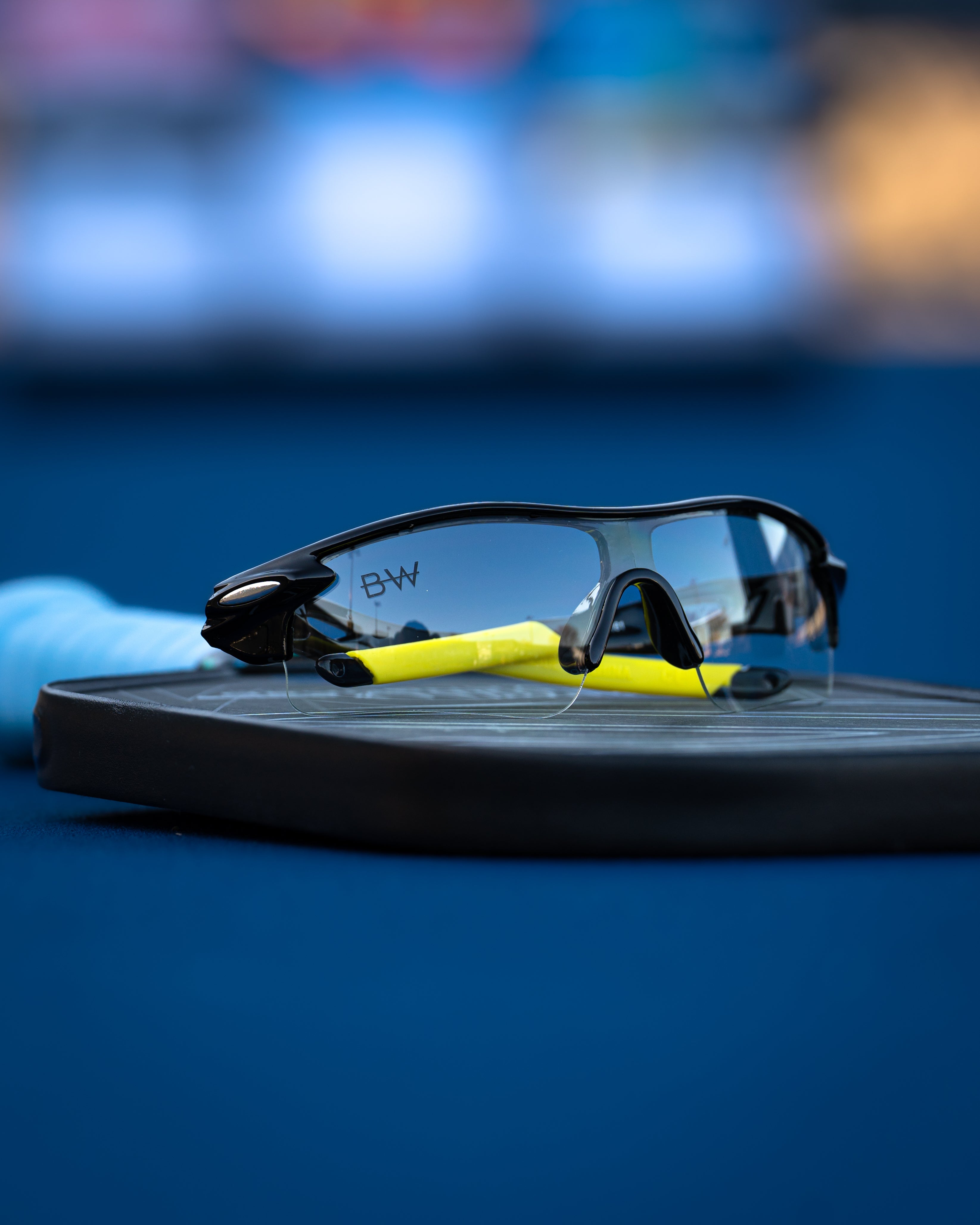
RX Glasses That Hold Up to Rough Play and Travel 💪🧳
Share
RX Glasses That Hold Up to Rough Play and Travel 💪🧳
Pickleball travel can be rough on prescription eyewear. Glasses move from your face to a paddle bag, through a car or airport, into a hotel room, back onto the court, and sometimes through several matches in a single day.
For an RX player, the goal is not finding a pair of glasses that is supposedly indestructible. It is building a smarter system around impact-resistant prescription sports eyewear, secure storage, backup correction, and good travel habits.
Blinded Wear RX eyewear is designed with pickleball players in mind, using lightweight sports frames, impact-resistant lenses, and non-polarized lenses. High-index prescription lenses are also included at no additional cost.
This guide breaks down how to choose and travel with RX pickleball glasses without relying on exaggerated claims about shatterproof lenses, scratch-proof coatings, waterproof frames, or eyewear that can supposedly survive anything.
Build Your Pickleball Travel Eyewear Setup
What Does “Rough Play” Actually Mean for RX Pickleball Glasses?
Pickleball is not a collision sport, but your eyewear can still encounter plenty of stress during an active season.
Think beyond dramatic impacts. Most travel and court risks are ordinary situations:
- Glasses getting dropped while changing equipment
- Eyewear being placed underneath other gear
- A loose pair moving around inside a paddle bag
- Sweat and fingerprints accumulating through long sessions
- Repeatedly taking glasses on and off between matches
- Airline, car, and hotel travel
- Moving between indoor and outdoor courts
- Keeping multiple pairs organized during tournaments
The practical durability question is therefore not, “Can these glasses survive everything?”
A better question is: “How do I choose appropriate sports eyewear and reduce unnecessary damage while I play and travel?”
The 4-Layer RX Durability System
Travel-ready prescription eyewear is easier to understand when you divide durability into four layers.
| Layer | What Matters | Your Job |
|---|---|---|
| 1. Lens | Impact-resistant sports lenses | Keep the surface clean and avoid unnecessary contact with loose objects |
| 2. Frame | Lightweight sports-frame design | Compare available dimensions and choose an appropriate fit |
| 3. Storage | Protection when eyewear is not being worn | Use suitable protective storage rather than throwing glasses loose into a bag |
| 4. Backup | Another source of corrective vision | Bring backup eyewear when losing access to your primary pair would interrupt play |
A strong travel setup uses all four layers rather than expecting the frame and lenses to compensate for poor storage habits.
Impact-Resistant Lenses Matter for Active Pickleball
Blinded Wear sports eyewear uses impact-resistant lenses, making impact resistance a relevant feature for active pickleball players.
It is also important to understand what that term does not mean.
Impact-resistant does not automatically mean:
- Shatterproof
- Unbreakable
- Scratch-proof
- Certified for every type of impact
- Protective equipment for every sport or hazard
Those stronger claims require evidence beyond simply describing a lens as impact-resistant.
For pickleball players, the useful takeaway is simpler: choose sports eyewear appropriate for active use, then protect that eyewear when it leaves your face.
Where Are Your RX Glasses Most Likely to Get Damaged?
The court is only one part of the journey. Map the entire trip from home to match and back.
| Location | Common Risk | Better Habit |
|---|---|---|
| Home | Leaving glasses on an exposed surface | Keep a consistent storage location |
| Car | Loose eyewear moving with other items | Use protective storage |
| Airport | Frequent bag handling | Keep important RX eyewear organized and accessible |
| Checked luggage | Pressure from surrounding belongings | Avoid relying on soft clothing alone to protect glasses |
| Paddle bag | Paddles, bottles, keys, and gear contacting lenses | Use a dedicated protected location |
| Court bench | Pair gets knocked or sat on | Return unused eyewear to storage |
| Hotel | Glasses placed somewhere unfamiliar | Use the same designated location every trip |
This reveals something important: travel durability is partly an equipment decision and partly an organization decision.
Your Paddle Bag Can Be Harder on Glasses Than the Match
A paddle bag may contain paddles, balls, keys, chargers, water bottles, towels, shoes, and other equipment. Loose prescription eyewear should not have to compete for space with all of it.
Avoid the Loose-Bag Habit
Taking your glasses off and dropping them into the main compartment creates unnecessary opportunities for the lenses or frame to contact other objects.
Create an Eyewear Zone
Dedicate one protected location in your bag to eyewear. If you carry multiple pairs, keep them separated rather than allowing the lenses and frames to rub against each other.
Return Them After Every Change
If you switch from tinted RX eyewear to clear RX eyewear, put the unused pair back into its designated storage location immediately.
The easiest travel system is the one you can repeat without thinking.
Use Protective Storage Instead of Testing How Tough Your Glasses Are
Even impact-resistant eyewear benefits from proper storage.
When your glasses are not being worn, a sturdy protective eyewear case can help separate them from the rest of your equipment.
This is especially useful when:
- Flying
- Road-tripping
- Carrying several paddles
- Sharing luggage
- Playing multi-day tournaments
- Switching between multiple pairs
A case is a travel recommendation here—not a claim that every Blinded Wear product automatically includes one.
Flying With RX Pickleball Glasses: Carry-On or Checked Bag?
If you depend on prescription eyewear to play, keeping your primary pair and an important backup accessible can simplify travel.
| Item | Practical Travel Role |
|---|---|
| Primary RX pair | Keep readily accessible |
| Backup corrective pair | Keep available if the primary pair becomes unavailable |
| Alternative lens setup | Useful if your destination includes substantially different court environments |
| Lens cloth | Keep accessible for appropriate cleaning |
| Protective storage | Separate eyewear from loose travel equipment |
For an RX player traveling specifically to compete, prescription eyewear deserves the same planning attention as the other equipment you would not want to arrive without.
No, You Don't Need to Loosen Your Glasses Before a Flight
One piece of advice worth removing from the old version of this guide is the idea that you should loosen eyewear screws before flying because cabin pressure will loosen them.
Instead, leave a properly functioning frame alone. If you notice an actual mechanical issue with your eyewear, address the specific issue rather than deliberately loosening hardware before travel.
The bigger concern during a flight is ordinary handling and storage: where the glasses are placed and what can press against them.
5 Blinded Wear RX Frames to Compare for Pickleball Travel
Several Blinded Wear RX styles can be considered when choosing dedicated prescription pickleball eyewear. Rather than assigning unverified durability technology to individual frames, compare the designs based on the product information currently available and your own prescription and fit needs.
Frost RX
Frost RX is one frame option for players building a dedicated prescription pickleball setup. Compare its available dimensions, design, and prescription options with eyewear that already fits you comfortably.
Smoked Shadow RX
Smoked Shadow RX gives traveling RX players another sports-frame design to compare without assuming unsupported features such as scratch-proof lenses or specialized shock-absorption technology.
Steel Ice RX
Steel Ice RX can be compared as another prescription sports-eyewear option based on its design, available measurements, and your individual RX requirements.
Sea Sand RX
Sea Sand RX adds another style to the RX lineup for players comparing prescription eyewear for pickleball and travel.
Crystal Wave II RX
Crystal Wave II RX provides another frame design to consider when building your primary or backup prescription sports-eyewear setup.
Compare the RX Travel Lineup
| RX Model | Why Compare It | What to Check |
|---|---|---|
| Frost RX | Dedicated RX sports-frame option | Available dimensions, design, prescription needs |
| Smoked Shadow RX | Alternative RX frame design | Available dimensions, design, prescription needs |
| Steel Ice RX | Alternative RX frame design | Available dimensions, design, prescription needs |
| Sea Sand RX | Alternative RX frame design | Available dimensions, design, prescription needs |
| Crystal Wave II RX | Alternative RX frame design | Available dimensions, design, prescription needs |
If you are unsure where to begin, use the Pickleball Glasses Quiz to narrow your options.
The Most Important Travel Feature Might Be a Second Pair
If you require prescription correction to play comfortably, backup eyewear can be more useful than trying to find one supposedly indestructible frame.
Consider carrying another corrective option when traveling for:
- Multi-day tournaments
- Out-of-state competitions
- Pickleball vacations
- Long road trips
- Events with several matches per day
- Trips where replacing prescription eyewear quickly would be difficult
Your backup does not necessarily need to duplicate your primary pair.
For example, a player who uses tinted RX eyewear during outdoor daytime matches could carry clear RX eyewear that serves both as an alternative for indoor or lower-light play and as another source of prescription correction.
Primary, Secondary, Emergency: Build a Travel Eyewear Hierarchy
Frequent travelers can organize eyewear into three roles.
| Role | Purpose |
|---|---|
| Primary | The RX pair you expect to wear for most matches |
| Secondary | A different lens setup for another common environment |
| Emergency | Backup corrective eyewear if your playing pair becomes unavailable |
You do not necessarily need three separate pairs. One secondary pair can also serve as your emergency backup.
Traveling Between Outdoor and Indoor Courts? Consider a Clear Option
Travel tournaments can put you in environments that differ from your home court. If you use tinted RX eyewear outdoors but also expect indoor, evening, or lower-light sessions, an untinted pair can add flexibility.
Clear RX lenses provide prescription correction without dark sunglass tint.
They should not automatically be claimed to:
- Increase available light
- Enhance contrast
- Improve ball tracking
- Increase reaction speed
Their role is simpler: they provide an untinted prescription option when that better matches your playing environment.
Travel Lens Care: Clean Without Creating More Problems
Travel exposes eyewear to fingerprints, sweat, dust, and repeated handling. A simple cleaning routine can help keep the lens surface usable throughout the trip.
Before the Trip
- Start with clean eyewear
- Pack a clean lens cloth
- Pack an appropriate lens cleaner if you use one
- Give each pair a designated storage location
During the Tournament
- Inspect lenses between matches
- Clean them when necessary rather than repeatedly rubbing dry debris across the surface
- Keep unused pairs stored instead of leaving them exposed
After Playing
- Check the lens surface
- Clean the eyewear appropriately
- Allow wet equipment around it to dry separately
- Return the glasses to their designated storage location
9 Travel Mistakes That Put RX Pickleball Glasses at Risk
-
Throwing glasses loose into a paddle bag.
Give eyewear a dedicated protected location.
-
Putting heavy equipment on top of eyewear.
Impact resistance does not make poor storage harmless.
-
Leaving your only prescription pair somewhere difficult to access.
Keep essential corrective eyewear organized during travel.
-
Traveling to a multi-day event without backup correction.
If RX eyewear is necessary for your game, redundancy can be valuable.
-
Assuming impact-resistant means unbreakable.
Those terms are not interchangeable.
-
Cleaning lenses with whatever fabric is nearby.
Pack appropriate lens-cleaning supplies instead.
-
Leaving an unused pair exposed on the court bench.
Return it to its designated storage location.
-
Deliberately loosening eyewear hardware before a flight.
There is no need to create a mechanical issue in an otherwise properly functioning frame.
-
Expecting one tint to cover every destination.
Consider the actual court environments on your trip.
Does More Durable Eyewear Automatically Improve Your Pickleball Performance?
No. Durability and performance should not be blended into one exaggerated claim.
Impact-resistant sports eyewear can make practical sense for active play. Proper storage can reduce unnecessary exposure to damage. Backup eyewear can keep a trip from depending entirely on one pair.
But those things do not automatically make you:
- Track the ball faster
- React more quickly
- Read spin better
- Improve depth perception
- Hit more accurate shots
Your prescription correction, practice, anticipation, positioning, technique, and decision-making remain separate parts of your game.
Non-Polarized RX Lenses for Pickleball
Blinded Wear uses non-polarized lenses. Non-polarized lenses do not add a polarization filter and preserve the visual information available without that filter.
Some court players prefer non-polarized eyewear.
That does not mean non-polarized lenses inherently improve depth perception, ball tracking, or reaction time. It is simply one characteristic to understand when comparing your prescription sports-eyewear options.
High-Index Prescription Lenses Are Included
Blinded Wear includes high-index prescription lenses at no additional cost with RX eyewear.
You do not need to select a specific lens index simply because you travel or play pickleball. Your individual prescription requirements remain the starting point.
Quick Answers About Durable RX Pickleball Glasses and Travel
What makes prescription glasses good for pickleball travel?
Look for prescription sports eyewear appropriate for active use, then combine it with protective storage, lens-care supplies, and backup corrective eyewear when appropriate.
Are Blinded Wear RX lenses impact-resistant?
Yes. Blinded Wear sports eyewear uses impact-resistant lenses.
Are impact-resistant lenses shatterproof?
No. Impact-resistant should not automatically be interpreted as shatterproof or unbreakable.
Are Blinded Wear RX glasses scratch-proof?
Scratch-proof performance is not being claimed as a standard verified feature. Proper storage and lens care are still important.
Does Blinded Wear use TR90 frames?
TR90 should not be assumed as a universal Blinded Wear frame material unless it is specifically verified for the individual product.
Do Blinded Wear glasses include hydrophobic coatings?
A hydrophobic coating is not being treated as a standard verified feature across the RX lineup.
Are Blinded Wear glasses anti-fog?
Anti-fog performance is not being claimed as a standard verified feature.
Should I loosen the screws on my glasses before flying?
No. There is no reason to deliberately loosen properly functioning eyewear before a flight.
Should prescription glasses go in checked luggage?
If you rely on prescription eyewear, consider keeping important pairs accessible and protected rather than making your trip depend entirely on luggage you cannot immediately access.
Should I bring backup RX glasses to a pickleball tournament?
Backup corrective eyewear can be useful for multi-day events, travel tournaments, and other situations where losing access to your primary pair could interfere with play.
Can clear RX glasses be useful while traveling?
Yes. Clear RX eyewear can provide an untinted prescription option for indoor, evening, or lower-light environments.
Does Blinded Wear include high-index prescription lenses?
Yes. High-index prescription lenses are included at no additional cost with Blinded Wear RX eyewear.
Next: Build a Travel System That Protects Your RX Eyewear
Choosing impact-resistant prescription sports eyewear is only the beginning. The next step is controlling what happens to your glasses during airports, road trips, hotels, tournament days, paddle-bag storage, weather changes, and repeated matches.
Part 2 will build a door-to-court packing system, airport and road-trip strategy, tournament bag map, primary-versus-backup RX plan, indoor/outdoor travel setup, post-match inspection routine, multi-day tournament checklist, destination lighting plan, and practical damage-prevention system for keeping prescription pickleball eyewear organized throughout the entire trip.
The Door-to-Court RX Travel System
The easiest way to protect prescription pickleball glasses while traveling is to give them a repeatable path from your home to the court and back again.
Instead of moving glasses randomly between pockets, suitcases, cup holders, benches, and paddle bags, assign each pair a specific location.
- Home: clean and inspect the eyewear before packing.
- Travel: place each pair in suitable protective storage.
- Arrival: keep the primary RX pair accessible.
- Warmup: wear the pair that matches the playing environment.
- Between matches: return unused eyewear to its designated location.
- After play: inspect and clean the lenses when needed.
- Hotel or home: return every pair to the same storage system.
Consistency matters because many travel problems happen when glasses are temporarily placed somewhere they normally would not be.
Divide Your Pickleball Bag Into 4 Travel Zones
A packed tournament bag becomes easier to manage when eyewear is not mixed indiscriminately with everything else.
| Zone | What Goes There | Why It Helps |
|---|---|---|
| RX Zone | Primary and backup prescription eyewear in suitable storage | Keeps important corrective eyewear organized |
| Court Gear Zone | Paddles, balls, grips, and related equipment | Separates larger equipment from eyewear |
| Cleaning Zone | Clean lens cloth and appropriate lens cleaner | Makes basic lens care easy between matches |
| Personal Zone | Keys, wallet, chargers, and other loose items | Keeps hard objects away from exposed lenses |
You do not literally need a four-compartment bag. The point is to create separation so your prescription eyewear is not floating loose among harder or heavier objects.
Flying to a Pickleball Tournament? Treat RX Glasses Like Essential Gear
If prescription correction is important to your game, your eyewear deserves a different travel strategy from equipment that can be easily replaced after arrival.
Keep Your Primary Pair Accessible
If you are wearing your primary RX glasses during travel, you already know where they are. If not, keep them protected somewhere you can access without unpacking your entire trip.
Keep Backup Correction Organized
If you bring a second prescription pair, give it its own protected location.
Do Not Depend on One Bag for Everything
If practical, avoid creating a situation where every source of corrective vision you brought on the trip is inaccessible at the same time.
Pack Cleaning Supplies Where You Can Reach Them
A clean lens cloth is more useful in an accessible bag than buried underneath several days of clothing.
Airport RX Pickleball Checklist
- □ Primary prescription eyewear accounted for
- □ Backup corrective eyewear accounted for
- □ Each unused pair stored appropriately
- □ Lens cloth packed
- □ Appropriate lens cleaner packed if needed
- □ Eyewear separated from keys and loose hard objects
- □ Tournament destination and court environment checked
- □ Clear or alternative pair packed if your destination requires it
- □ Prescription information accessible if useful during travel
Road Trips Create a Different RX Eyewear Problem
Driving to a tournament removes airport handling, but it creates another temptation: putting glasses wherever they are convenient inside the car.
Common temporary locations can become bad long-term storage habits.
Instead, Create One Car Location
When a pair is not being worn, return it to suitable protective storage in a consistent location.
Do Not Stack Gear on Top
A packed trunk can contain bags, shoes, paddles, coolers, luggage, and other equipment. Keep prescription eyewear away from areas where heavier items can press against it.
Account for Every Pair Before Leaving
If you brought two pairs to the court, make sure two pairs leave the court.
That simple habit becomes especially valuable during multi-stop pickleball trips.
The Hotel-Room Rule: Your Glasses Get One Home
Hotels introduce unfamiliar nightstands, bathrooms, desks, luggage racks, and countertops. That makes it easier to misplace eyewear or leave a pair somewhere exposed.
Choose one location as soon as you arrive.
For example:
- One section of your travel bag
- A designated eyewear organizer
- A protected location on the desk
- Your tournament-bag RX compartment
When the glasses leave your face, they go back there.
This is particularly useful if you are traveling with a primary RX pair, a clear pair, and ordinary everyday prescription eyewear.
Primary vs. Backup RX Glasses: Don't Pack Two Pairs Without a Plan
A second pair is more useful when you know exactly why it is coming with you.
| Pair | Role | When You Use It |
|---|---|---|
| Primary RX | Main pickleball eyewear | Most matches |
| Alternative RX | Different lens setup | When the playing environment changes substantially |
| Backup Correction | Redundancy | If the primary pair becomes unavailable |
One pair can fill two roles. For example, clear RX eyewear might be your indoor option while also giving you another source of corrective vision during an outdoor tournament trip.
When Clear RX Glasses Earn a Spot in the Travel Bag
Clear RX eyewear becomes particularly practical when your trip includes different playing environments.
Consider packing an untinted RX pair if your itinerary includes:
- Indoor pickleball
- Evening matches
- Lower-light sessions
- Outdoor matches that may continue after sunset
- A tournament that moves between indoor and outdoor courts
Clear RX lenses provide prescription correction without dark sunglass tint. That gives them a clearly defined role without needing unsupported claims about increased light, enhanced contrast, or faster ball recognition.
Check the Destination Before Packing Your RX Rotation
Traveling players should pack for the courts at their destination rather than automatically bringing the same setup used at home.
Before leaving, answer these questions:
- Is the tournament indoors, outdoors, or both?
- What time does play begin?
- Could matches continue into the evening?
- Will you practice at a different facility?
- Do you normally prefer different lens setups in those environments?
Then pack accordingly.
| Trip Type | RX Strategy to Consider |
|---|---|
| Outdoor daytime tournament | Primary outdoor RX + backup correction |
| Indoor tournament | Preferred indoor RX + backup correction |
| Outdoor day-to-night event | Primary outdoor RX + untinted alternative |
| Indoor/outdoor event | Consider separate lens setups for each environment |
| Multi-day pickleball vacation | Primary + alternative or backup based on planned courts |
The Multi-Day Tournament RX System
A single evening of open play and a three-day tournament create very different demands on your gear.
For longer events, organize your eyewear routine around the beginning and end of each day.
Morning
- Confirm your primary RX pair is accounted for
- Check the lenses before leaving
- Confirm your backup pair is packed
- Review whether the day's court environment differs from the previous day
Between Matches
- Return unused eyewear to protective storage
- Inspect lenses when necessary
- Clean them appropriately when needed
- Avoid placing glasses loose on benches or tables
After the Final Match
- Account for every pair
- Inspect your primary eyewear
- Clean it when appropriate
- Return each pair to its designated travel location
- Prepare the setup for the next day
The 30-Second Post-Match RX Inspection
You do not need an elaborate maintenance ritual after every pickleball game. A quick inspection can catch obvious issues before the glasses disappear back into your bag.
- Look at both lenses. Check whether they need cleaning.
- Look at the frame. Notice anything visibly unusual.
- Check how the eyewear feels. Does it still sit as expected?
- Clean when necessary. Use appropriate supplies.
- Store it. Put the pair back into its designated location.
If everything looks and feels normal, there is no reason to turn routine travel into constant mechanical adjustment.
Don't Over-Maintain Your Glasses Just Because You're Traveling
More maintenance is not automatically better maintenance.
Avoid creating unnecessary problems by constantly:
- Adjusting screws that are functioning normally
- Bending the frame to “test” flexibility
- Removing components without a reason
- Testing impact resistance yourself
- Using random cleaning products on the lenses
- Repeatedly rubbing dry debris across the lens surface
Inspect, clean appropriately, store carefully, and address actual problems when they appear.
What Should You Do If Your RX Glasses Get Dropped?
A drop does not automatically mean the eyewear is damaged, and impact-resistant does not mean you should assume everything is fine without looking.
Use a simple inspection:
1. Check the Lens Surface
Look for visible changes before putting the eyewear back on.
2. Check the Frame
Look for obvious changes in the frame or how components sit.
3. Put the Glasses On
Determine whether they still sit and feel as expected.
4. Check Your View
If something appears significantly different through the eyewear after the incident, do not assume it should simply be ignored.
5. Use Your Backup When Necessary
This is exactly why another source of prescription correction can be valuable during travel.
Rough Play Doesn't Mean You Should Deliberately Test Durability
Impact-resistant sports eyewear is designed for active use, but there is no benefit to intentionally dropping, twisting, bending, or striking prescription glasses to see what they can survive.
Your goal is longevity—not proving a marketing point.
Treat impact resistance as an equipment feature that supports active use while continuing to handle the eyewear appropriately.
Traveling to Different Weather? Protect the Eyewear, Not Just the Lens Choice
A tournament trip may expose your equipment to conditions that differ from your normal home court.
You might encounter:
- Heat
- Cold
- Rain
- Humidity
- Dry conditions
- Indoor air conditioning between outdoor matches
You do not need unsupported claims about weatherproof frames or specialized moisture coatings to prepare effectively.
Instead:
- Keep unused eyewear protected
- Keep lens-cleaning supplies available
- Avoid leaving glasses loose with wet equipment
- Clean the lens surface when needed
- Bring another corrective option during important travel events
After a Long, Sweaty Tournament Day
A multi-match day can leave your eyewear needing attention before it gets packed away for tomorrow.
After your final match:
- Remove the eyewear normally.
- Inspect it for obvious debris or moisture.
- Clean it appropriately when needed.
- Keep it separate from wet towels or clothing.
- Return it to suitable storage.
- Confirm your backup pair is also accounted for.
The goal is to start tomorrow's matches with organized equipment rather than discovering an issue during warmup.
How to Choose an RX Frame for Frequent Pickleball Travel
Do not choose a travel pair solely because a product description uses words such as “rugged” or “durable.” Start with characteristics you can actually evaluate.
Prescription Compatibility
Your corrective needs come first.
Frame Dimensions
When measurements are available, compare them with eyewear you already know fits comfortably.
Frame Design
Choose a sports-frame design you are comfortable wearing during active sessions.
Weight
Blinded Wear uses lightweight sports frames, which can be relevant when eyewear is worn through extended matches.
Lens Construction
Blinded Wear sports eyewear uses impact-resistant lenses.
Lens Setup
Consider whether your destination requires your normal tinted setup, an untinted option, or both.
Which Blinded Wear RX Frames Should Travelers Compare?
The best choice depends on your prescription, fit, design preference, and playing environment. The following models give you several starting points within the Blinded Wear RX collection.
| RX Frame | Use It as a Starting Point If... |
|---|---|
| Frost RX | You prefer the Frost frame design |
| Smoked Shadow RX | You prefer the Smoked Shadow frame design |
| Steel Ice RX | You prefer the Steel Ice frame design |
| Sea Sand RX | You prefer the Sea Sand frame design |
| Crystal Wave II RX | You prefer the Crystal Wave II frame design |
For each option, compare the available dimensions and current product information rather than assuming unverified features such as reinforced hinges, rust-resistant hardware, adjustable nose pads, or scratch-resistant coatings.
Do Singles and Doubles Players Need Different Travel Glasses?
Not simply because one player competes in singles and another competes in doubles.
Your prescription requirements, frame preference, playing environment, and travel schedule are more useful starting points than assigning a particular RX frame to one pickleball format.
A player entering both singles and doubles at the same tournament may be perfectly comfortable using the same primary RX pair for both.
The more important question is whether the event changes:
- From indoor to outdoor courts
- From daytime to evening
- Across multiple facilities
- Across several days
If it does, your secondary lens setup may matter more than whether the bracket says singles or doubles.
Would a Backup Pair Actually Save Your Tournament?
Use this quick scenario test.
If your primary RX glasses became unavailable 30 minutes before your next match, could you still play with appropriate corrective vision?
If the answer is yes, your backup plan is doing its job.
If the answer is no, consider whether an additional corrective pair deserves space in your travel bag.
This is especially worth thinking about when you are hundreds of miles from home and cannot quickly access your usual eyewear options.
Pack Light Without Packing Unprepared
You do not need five pairs of glasses for every weekend tournament. Use the smallest eyewear system that covers your actual needs.
| Question | If Yes... |
|---|---|
| Do I need RX correction to play? | Bring your appropriate prescription eyewear |
| Would losing my primary pair interrupt the trip? | Consider backup correction |
| Will I play in substantially different lighting? | Consider an alternative lens setup |
| Can my alternative pair also serve as backup? | A two-pair system may be enough |
| Am I bringing a pair with no defined role? | Consider leaving it home |
The Complete Multi-Day Pickleball Travel Checklist
- □ Primary RX pickleball glasses
- □ Backup corrective eyewear if appropriate
- □ Clear or alternative pair if the trip includes different court environments
- □ Suitable protective storage for each pair
- □ Clean lens cloth
- □ Appropriate lens cleaner if used
- □ Dedicated eyewear location inside your bag
- □ Destination court type checked
- □ Match times reviewed
- □ Indoor/outdoor schedule reviewed
- □ Primary pair inspected before departure
- □ All pairs accounted for after each playing day
More Questions About Traveling With Prescription Pickleball Glasses
How should I pack prescription glasses for a pickleball tournament?
Keep unused eyewear in suitable protective storage and separate it from loose equipment that could contact the frame or lenses.
Should I bring two pairs of prescription glasses when traveling?
If losing access to your primary pair would interfere with your ability to play, another source of corrective vision can be useful.
Where should I keep RX glasses on a flight?
Keep important prescription eyewear protected and accessible rather than buried somewhere you cannot easily reach.
Does airplane cabin pressure damage eyeglasses?
You do not need to deliberately loosen properly functioning eyewear before flying. Focus instead on protecting the glasses from ordinary handling and pressure from surrounding objects.
Should I put prescription glasses loose in my paddle bag?
No. A dedicated protected location keeps eyewear separated from paddles, keys, bottles, and other equipment.
Do I need a special travel case for pickleball glasses?
Suitable protective storage is useful whenever eyewear is not being worn. This guide does not assume a specific case is included with every Blinded Wear product.
What should I do if my RX glasses fall during a tournament?
Inspect the lenses and frame, check how the eyewear sits, and determine whether your view remains as expected before continuing to rely on the pair.
Are impact-resistant lenses unbreakable?
No. Impact-resistant does not mean unbreakable or shatterproof.
Can I use the same RX glasses for singles and doubles?
Yes. There is no requirement to use different eyewear simply because you switch between singles and doubles.
Should I bring clear RX glasses on a pickleball trip?
If your trip includes indoor, evening, or lower-light play and you prefer an untinted lens in those environments, clear RX eyewear can fill a useful secondary role.
How many pairs of glasses should I pack for a tournament?
Bring enough to cover your prescription and playing-environment needs without carrying unnecessary pairs. For many RX players, a primary pair plus a well-chosen secondary or backup pair may cover the trip.
Does Blinded Wear include high-index prescription lenses?
Yes. High-index prescription lenses are included at no additional cost with Blinded Wear RX eyewear.
Are Blinded Wear lenses polarized?
No. Blinded Wear uses non-polarized lenses.
Are Blinded Wear sports lenses impact-resistant?
Yes. Blinded Wear sports eyewear uses impact-resistant lenses.
Part 3: Turn Your RX Glasses Into a Complete Travel Kit
At this point, your eyewear has a defined place during flights, road trips, hotel stays, tournament days, indoor/outdoor changes, and post-match storage. The final step is turning those habits into a system you can use for every pickleball trip.
Part 3 will finish the guide with a 24-hour pre-trip inspection, tournament-day bag layout, emergency RX plan, lost-or-damaged-pair decision tree, travel buying checklist, durability myths, expanded travel FAQ, Blinded Wear shopping resources, replacement support, and a final start-to-finish checklist for getting your prescription eyewear from home to the court and back safely.
24 Hours Before the Trip: Inspect Your RX Setup Once
The best time to discover an eyewear problem is not during warmup before your first tournament match. Give your primary and backup prescription eyewear a quick check the day before you leave.
- Clean the lenses appropriately. Start the trip with a clean lens surface.
- Inspect both lenses. Look for anything visibly unusual.
- Inspect the frame. Check for obvious changes or damage.
- Put the glasses on. Confirm they sit and feel as expected.
- Check your backup. Make sure your secondary corrective pair is ready too.
- Assign storage. Every pair should already have a protected location.
- Review the destination. Know whether you are playing indoors, outdoors, during the day, in the evening, or across several environments.
Once everything checks out, pack it. There is no reason to repeatedly bend, tighten, loosen, or otherwise stress properly functioning eyewear before traveling.
The Tournament-Day RX Bag Layout
On match day, organize your bag so you can find your eyewear without digging through every piece of equipment you brought.
| Bag Area | What Goes There | Access Priority |
|---|---|---|
| Primary RX | Your main prescription pickleball eyewear when not being worn | Immediate |
| Secondary RX | Alternative or backup corrective pair in suitable storage | Easy |
| Lens Care | Clean lens cloth and appropriate cleaner | Easy |
| Court Gear | Paddles, balls, grips, and accessories | Separate from exposed eyewear |
| Loose Items | Keys, chargers, wallet, and other hard objects | Separate from eyewear |
The objective is simple: you should be able to reach your backup glasses without moving a water bottle, shoes, keys, paddles, and half your luggage first.
Your 5-Minute Arrival Routine at an Unfamiliar Court
Travel often means playing somewhere you have never seen before. Instead of assuming your destination will feel exactly like your home court, use warmup to evaluate the environment.
Minute 1: Look Around
Identify whether you are indoors or outdoors, the general court orientation, and the environment surrounding the playing area.
Minute 2: Baseline Test
Hit from both ends if possible and make sure your primary RX setup feels appropriate.
Minute 3: Kitchen Test
Move forward and play several controlled dinks and volleys.
Minute 4: High-Ball Test
Follow several controlled lobs or high balls so you experience the overhead environment too.
Minute 5: Decide
If your primary eyewear feels comfortable, keep it simple and play. If the environment substantially differs from what you expected and you brought an alternative lens setup, decide whether you prefer that pair instead.
The Emergency RX Plan Every Traveling Player Should Know
If prescription correction is important to your ability to play, decide what you will do if your primary sports eyewear becomes unavailable before you travel.
Your emergency plan can be as simple as:
- Stop using the primary pair if you believe it has a significant problem.
- Retrieve your backup corrective eyewear.
- Determine whether the backup provides the correction you need for the situation.
- Store the primary pair instead of repeatedly handling it.
- Address replacement or repair after your immediate eyewear needs are covered.
The purpose of backup eyewear is not to make your bag more complicated. It is to prevent one unavailable pair from controlling the rest of your trip.
Lost or Damaged RX Glasses? Use This Decision Tree
| Situation | First Action | Next Step |
|---|---|---|
| Primary pair temporarily misplaced | Check your designated eyewear locations | Use backup correction if needed |
| Glasses were dropped | Inspect lenses and frame | Check fit and view before relying on them |
| Lens is dirty | Clean appropriately | Reassess before assuming damage |
| Frame visibly changed | Stop repeatedly manipulating it | Use backup eyewear when appropriate |
| View through the eyewear significantly changed | Do not assume the issue is harmless | Switch to suitable backup correction if available |
| Primary pair is unavailable for the rest of the trip | Move to your backup plan | Review replacement options |
Why Backup RX Eyewear Matters More When You're Far From Home
If something happens to your primary pair at your local court, you may be able to go home and access another pair. A travel tournament changes that equation.
You might be:
- Hundreds of miles from home
- Playing several tournament days
- Staying in an unfamiliar city
- Competing early the next morning
- Unable to quickly replace customized prescription eyewear
That is why backup correction deserves more attention for destination tournaments than an ordinary recreational session.
The backup does not have to be identical to your primary sports pair. It needs a clearly defined role in your travel plan.
How Many Pairs of Glasses Should You Actually Travel With?
Use your trip—not a generic packing list—to answer that question.
| Setup | Best Fit for the Trip |
|---|---|
| One Pair | Simple trip where one RX setup covers your needs and you accept having no dedicated backup |
| Two Pairs | Primary RX + backup, or primary RX + alternative pair that also provides backup correction |
| Three Pairs | Primary + environment-specific secondary + separate emergency correction when your trip warrants the extra redundancy |
For many traveling RX players, a well-planned two-pair setup can cover both environmental flexibility and backup correction without packing unnecessary eyewear.
A Simple Two-Pair Pickleball Travel Example
Imagine you are traveling for a three-day event with outdoor matches during the day and possible evening play.
Pair 1: Primary Outdoor RX
This is the prescription setup you prefer during most daytime matches.
Pair 2: Clear RX
This provides an untinted prescription option if you play indoors, later in the evening, or under conditions where you no longer prefer your daytime tint.
If the second pair also provides appropriate corrective vision when your primary pair becomes unavailable, it doubles as your backup.
Two pairs. Three potential roles. No need to carry an entire eyewear collection.
Travel-Ready RX Pickleball Glasses Buying Checklist
If frequent travel is part of your pickleball schedule, evaluate a new RX pair around what you can actually verify.
- □ Meets your prescription requirements
- □ Designed as sports eyewear
- □ Lightweight frame
- □ Impact-resistant lenses
- □ Non-polarized lens setup if that matches your preference
- □ Available dimensions reviewed
- □ Dimensions compared with eyewear that already fits when possible
- □ Lens setup matches your primary playing environment
- □ Secondary lens needs considered
- □ Suitable protective storage planned
- □ Backup correction planned for important trips
- □ Replacement support reviewed
Notice what is not required on this checklist: unverified claims about indestructible frames, shatterproof lenses, military-grade construction, rust-proof hardware, hydrophobic coatings, or scratch-proof surfaces.
Durability Claims Decoded: What Do They Actually Mean?
| Claim | How to Treat It |
|---|---|
| Impact-resistant | A useful verified Blinded Wear lens characteristic |
| Shatterproof | Do not assume this from impact resistance |
| Unbreakable | Do not assume |
| Scratch-proof | Do not assume |
| Hydrophobic | Do not assume unless specifically verified |
| Anti-fog | Do not assume unless specifically verified |
| Rust-resistant hardware | Do not assume unless specifically verified for the frame |
| Reinforced hinges | Do not assume unless specifically verified for the frame |
| TR90 | Do not assume as a universal frame material |
Accurate product language is more useful than stacking dramatic durability terms onto a pair of glasses.
8 Myths About Durable RX Sports Glasses
Myth 1: Impact-Resistant Means Shatterproof
Impact resistance should not be expanded into an unbreakable or shatterproof claim.
Myth 2: Sports Glasses Can Be Thrown Loose Into Your Bag
Sports-oriented construction does not eliminate the value of protective storage.
Myth 3: A Tougher Frame Automatically Improves Reaction Time
Frame durability should not be presented as a shortcut to faster visual or physical reactions.
Myth 4: Scratch-Resistant Means Scratch-Proof
Those terms are not interchangeable, and scratch resistance should not be assumed unless it is verified for the product.
Myth 5: You Should Loosen Eyewear Screws Before Flying
There is no reason to deliberately loosen properly functioning eyewear before boarding a plane.
Myth 6: Every Sports Frame Uses TR90
Frame material should be verified for the specific product rather than assumed from the sports-eyewear category.
Myth 7: You Need a Different RX Pair for Singles and Doubles
Your prescription, environment, fit, and lens preferences are more relevant than the tournament format alone.
Myth 8: The Most Expensive Travel Setup Uses the Most Pairs
A good system uses the smallest number of pairs necessary to cover your actual prescription, environment, and backup needs.
Example: A 3-Day Destination Pickleball Tournament
Here is what a simple RX eyewear plan could look like for a player traveling Friday through Sunday.
Friday: Travel + Practice
- Primary RX pair accessible
- Backup pair protected
- Practice at destination facility
- Test primary eyewear in the actual court environment
- Return both pairs to designated hotel storage after practice
Saturday: Main Tournament Day
- Inspect primary pair before leaving hotel
- Pack backup correction
- Keep cleaning supplies accessible
- Return unused eyewear to storage between matches
- Account for both pairs before leaving the venue
Sunday: Finals + Travel Home
- Repeat pre-match check
- Use the lens setup appropriate for the environment
- Inspect eyewear after the final match
- Clean when necessary
- Store every pair before packing the rest of your gear
Nothing about this system is complicated. That is exactly why it is repeatable.
RX Pickleball Frames to Compare Before Your Next Trip
If you are building a primary or backup prescription pickleball setup, these Blinded Wear RX styles provide several designs to compare.
| RX Frame | What to Compare |
|---|---|
| Frost RX | Design, available dimensions, prescription requirements, and lens setup |
| Smoked Shadow RX | Design, available dimensions, prescription requirements, and lens setup |
| Steel Ice RX | Design, available dimensions, prescription requirements, and lens setup |
| Sea Sand RX | Design, available dimensions, prescription requirements, and lens setup |
| Crystal Wave II RX | Design, available dimensions, prescription requirements, and lens setup |
How to Order Blinded Wear RX Glasses Before Your Next Trip
Once you have selected a frame and lens setup that fits your needs:
- Choose your preferred RX frame.
- Review the available product information.
- Compare available dimensions with eyewear that already fits you when possible.
- Have your current eyeglass prescription ready.
- Take a clear photo or picture of the prescription.
- Upload your prescription before purchasing.
- Complete your order.
Blinded Wear includes high-index prescription lenses at no additional cost with RX eyewear.
FAQ: RX Pickleball Glasses for Rough Play, Tournaments, and Travel
What are good prescription glasses for traveling pickleball players?
Look for prescription sports eyewear that meets your corrective needs, uses impact-resistant lenses, fits appropriately, and matches your normal playing environment. Then combine the eyewear with proper storage and a backup plan.
Are Blinded Wear RX glasses designed for pickleball?
Yes. Blinded Wear designs performance-first eyewear with pickleball players in mind.
Are Blinded Wear lenses impact-resistant?
Yes. Blinded Wear sports eyewear uses impact-resistant lenses.
Are they shatterproof?
Impact-resistant does not mean shatterproof or unbreakable.
Are Blinded Wear RX lenses scratch-resistant?
Scratch resistance is not being claimed here as a standard verified feature across the RX collection.
Are Blinded Wear glasses anti-fog?
Anti-fog performance is not being treated as a standard verified feature.
Are the lenses hydrophobic?
A hydrophobic coating should not be assumed as a standard feature unless specifically verified for the product.
Are Blinded Wear lenses polarized?
No. Blinded Wear uses non-polarized lenses.
Do non-polarized lenses improve depth perception?
No inherent improvement should be assumed. Non-polarized lenses simply do not add a polarization filter, and some court players prefer that setup.
Does Blinded Wear include high-index prescription lenses?
Yes. High-index prescription lenses are included at no additional cost with Blinded Wear RX eyewear.
Should I travel with a backup pair of prescription glasses?
If losing access to your primary pair could interrupt your ability to play, backup corrective eyewear can be especially useful during destination tournaments and multi-day trips.
Can my clear RX glasses serve as my backup pair?
They can if they provide the corrective vision you need. They may also serve as an untinted option for indoor, evening, or lower-light play.
How should I store pickleball glasses in my paddle bag?
Keep unused eyewear in suitable protective storage and separated from loose hard or heavy equipment.
Can I put two pairs of glasses in the same compartment?
It is better to prevent the pairs from moving against each other or contacting other loose equipment.
Should I keep my RX glasses in my carry-on?
If you depend on them, keeping important corrective eyewear protected and accessible can make travel simpler.
Does airplane pressure loosen eyeglass screws?
You do not need to deliberately loosen or adjust properly functioning eyewear before flying.
What should I do if my glasses are dropped?
Inspect the lenses and frame, check how the glasses sit, and determine whether your view remains as expected before continuing to rely on them.
Do I need separate glasses for singles and doubles pickleball?
No. Singles versus doubles alone does not require a different RX pair.
How many RX pairs should I bring to a tournament?
Bring enough to cover your corrective and playing-environment needs. A primary pair plus a secondary pair that also serves as backup may be sufficient for many trips.
Are clear lenses useful for pickleball travel?
Yes. Clear RX lenses provide prescription correction without dark sunglass tint, which can make them a useful option when your trip includes indoor, evening, or lower-light play.
Do clear lenses make low-light courts brighter?
No. Clear lenses do not create additional available light; they provide an untinted lens option.
Do tougher glasses improve reaction time?
Durability should not be interpreted as an automatic improvement in reaction time, ball tracking, depth perception, or other performance skills.
How far ahead should I order prescription pickleball glasses before traveling?
Because prescription eyewear requires your individual prescription and order processing, avoid waiting until immediately before an important trip. Review the current ordering information when planning your purchase.
Build Your Blinded Wear Travel Setup
Use your prescription needs, destination, playing environment, and backup strategy to decide what belongs in your bag.
Replacement Support Matters When Your Eyewear Gets Used
Travel and regular pickleball put eyewear into active use rather than leaving it sitting safely at home.
Blinded Wear offers 50% lifetime replacement support if your glasses break, subject to current policy terms.
That does not make the eyewear unbreakable, and it does not replace good storage habits. It gives customers a defined support option if a pair eventually breaks.
Performance-First Eyewear for Players Who Take Pickleball With Them
Blinded Wear designs lightweight, performance-first eyewear with pickleball players in mind, including prescription, non-prescription, and clear-lens options.
The Blinded Wear mission also extends beyond the court through its commitment to supporting children's vision.
The Ultimate RX Pickleball Travel Checklist
Before You Leave
- □ Primary RX pair inspected
- □ Backup corrective eyewear ready
- □ Destination court environment checked
- □ Match times reviewed
- □ Clear or alternative pair packed if needed
- □ Suitable protective storage assigned
- □ Lens cloth packed
- □ Appropriate lens cleaner packed if used
During Travel
- □ Essential RX eyewear protected
- □ Important pairs accessible
- □ Eyewear separated from loose hard objects
- □ Glasses not deliberately bent, loosened, or durability-tested
At the Tournament
- □ Primary pair tested during warmup
- □ Backup location known
- □ Unused eyewear returned to storage
- □ Lenses cleaned appropriately when needed
- □ Alternative pair used only when it serves a real purpose
After Playing
- □ Every pair accounted for
- □ Lenses inspected
- □ Frame visually checked
- □ Eyewear cleaned when necessary
- □ Wet equipment stored separately
- □ Glasses returned to their designated location
Before Coming Home
- □ Primary RX accounted for
- □ Backup RX accounted for
- □ Everyday corrective eyewear accounted for
- □ Cases and cleaning supplies packed
- □ Nothing left at the court, hotel, or rental property
Final Word: Travel-Ready RX Glasses Need a System, Not Superpowers
The best prescription pickleball travel setup is not the pair with the most dramatic durability claims.
Start with what matters: the prescription correction you need, a sports-frame design, impact-resistant lenses, an appropriate fit, and a lens setup that matches where you play.
Then protect that equipment.
Give your glasses a dedicated place in your bag. Keep them away from loose hard objects. Bring suitable cleaning supplies. Know where your backup pair is. If you travel between bright outdoor courts and indoor or evening play, consider whether a second untinted RX pair can cover both your alternative environment and your backup needs.
That system is more useful than pretending any pair of glasses is indestructible.
From the first airport terminal to the final tournament match, your objective is simple: keep the prescription eyewear you rely on organized, protected, accessible, and ready for the next court.