
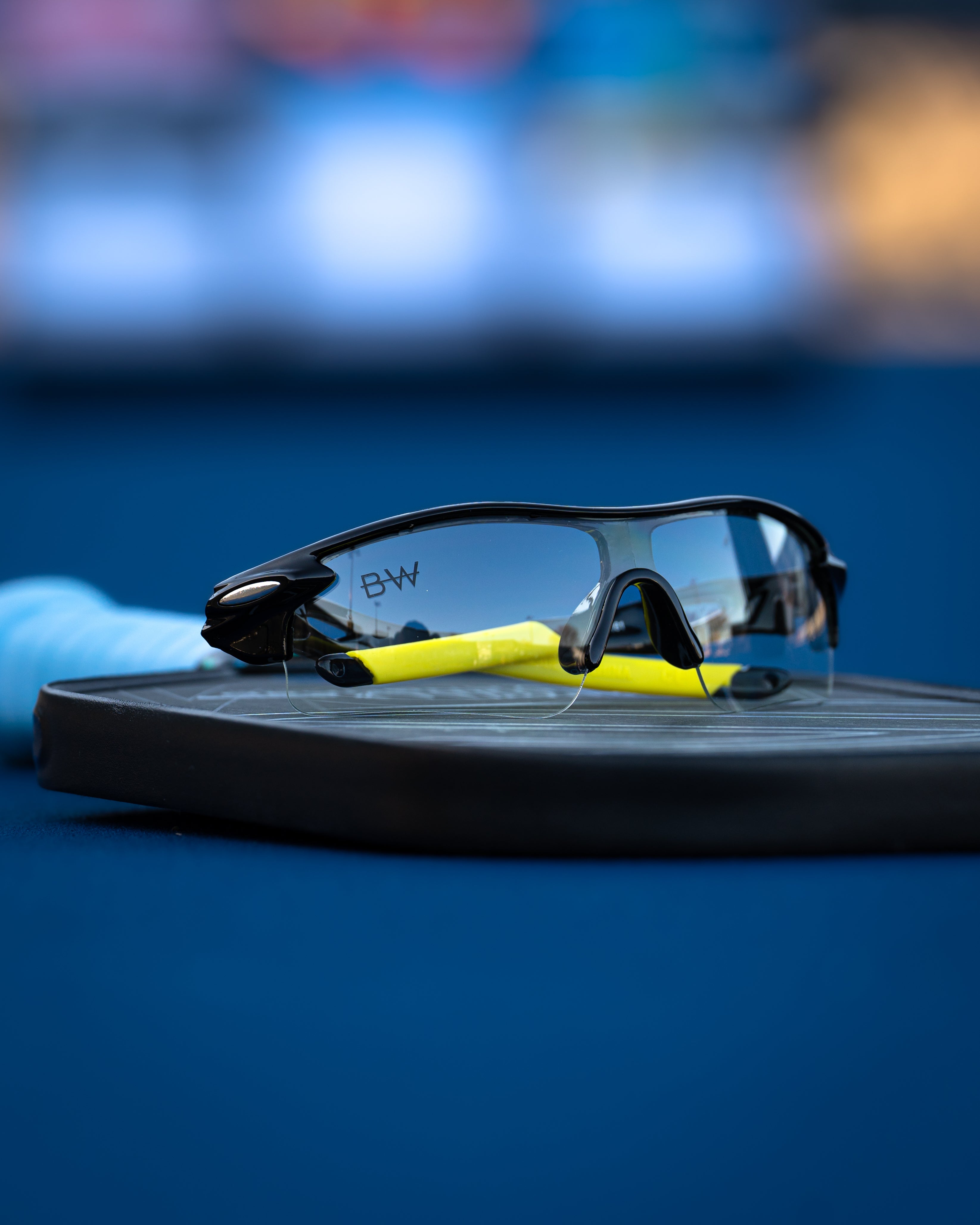
RX Glasses That Help You See Shot Depth Instantly
Share
RX Glasses That Help You See Shot Depth Instantly
Can prescription pickleball glasses help you judge shot depth? If you need vision correction, wearing the appropriate prescription addresses your corrective vision needs on court. But no pair of RX glasses should promise to instantly improve depth perception, make ball trajectory automatic, or turn late reactions into perfect reads.
Shot depth in pickleball is a combination of what you see and what you learn to interpret: ball position, speed, trajectory, bounce, opponent contact, your own positioning, and experience with familiar shot patterns.
The original version of this guide went much further, promising improved depth perception, faster reactions, motion-tuned prescriptions, full-field mapping, specialized coatings, and even immediate depth improvements. :contentReference[oaicite:0]{index=0} This rewrite separates prescription correction from pickleball skill so you can understand what RX eyewear can legitimately provide—and how players actually get better at judging short, deep, and attackable balls.
Need Prescription Pickleball Eyewear?
If you already know you need RX glasses, start with prescription options designed with pickleball players in mind. If you're trying to solve a shot-depth problem, continue through the guide first.
What Does “Reading Shot Depth” Actually Mean in Pickleball?
When players talk about reading depth, they are usually describing their ability to judge where an incoming ball is going relative to their position and the court.
That matters in situations such as:
- Recognizing whether a drop is landing short
- Preparing for a deeper drive
- Deciding how to position for an incoming ball
- Judging the developing path of a lob
- Deciding whether to move forward, hold position, or retreat
- Preparing for a ball before or after its bounce
Depth judgment is therefore important—but that does not establish that a sports frame creates better depth perception.
The Shot-Depth Chain: From Opponent Contact to Your Response
Instead of thinking about depth as a feature built into a lens, break a rally into stages.
-
1. Opponent Preparation
The opponent's position and preparation give context before the ball leaves the paddle.
-
2. Contact
The ball leaves the paddle and begins its path toward your side.
-
3. Early Flight
The developing trajectory begins providing information about where the shot may travel.
-
4. Your Read
You interpret what is happening based on the available visual information and previous experience.
-
5. Your Decision
You choose whether and how to move, prepare, or wait.
-
6. Your Execution
You position your body and paddle to play the ball.
Your prescription eyewear addresses prescription correction. It does not independently perform the recognition, decision, positioning, and execution stages.
Depth Perception vs. Reading Shot Depth: They're Not the Same Thing
These phrases are often blended together in sports-eyewear marketing, but separating them creates a more useful discussion.
| Depth Perception | Reading Shot Depth |
|---|---|
| A component of human visual perception | A practical pickleball decision |
| Relates to perceiving spatial relationships and distance | Involves interpreting where an incoming shot is likely to travel |
| Individual vision concerns belong with an eye-care professional | Can also depend heavily on experience and pattern recognition |
| Should not be promised to improve because of a specific sports frame | Can be practiced through drills and match experience |
This distinction matters because missing a drop shot does not diagnose poor depth perception.
Why Do Pickleball Players Misjudge Short and Deep Balls?
There are many possible reasons, and blaming eyewear first can send you toward the wrong solution.
Late Recognition
If you wait until the ball is well into its flight before processing where it may land, you have less time to prepare.
Poor Positioning
A good visual read still has to be followed by appropriate movement and positioning.
Opponent Deception
Players can intentionally make shots less predictable through changes in pace, direction, and selection.
Unfamiliar Shot Patterns
Experience matters. The more situations you've encountered, the more information you may have available when interpreting a developing rally.
Guessing Too Early
Anticipation can help, but committing before enough information is available can produce the opposite problem.
Prescription-Vision Concerns
If something consistently looks unclear or unusual while wearing prescription eyewear, that deserves attention—but a pickleball article cannot determine the cause.
What Can RX Pickleball Glasses Actually Do?
If you require prescription correction, dedicated RX sports eyewear gives you another way to wear that correction while playing.
Verified Blinded Wear RX characteristics include:
- Designed with pickleball players in mind
- Lightweight sports frames
- Impact-resistant lenses
- Non-polarized lenses
- Comfort for extended matches
- Performance-first design
- Suitable for recreational and competitive players
- High-index prescription lenses included at no additional cost
Those characteristics can stand on their own.
They do not need to become claims that Blinded Wear RX glasses automatically:
- Improve depth perception
- Make shot depth instantly obvious
- Improve ball tracking
- Reduce reaction time
- Improve spin recognition
- Improve trajectory judgment
- Increase win rate
Are Regular Prescription Glasses Bad for Judging Shot Depth?
No. Everyday prescription glasses should not automatically be characterized as inferior for moving objects or sports.
The old article claimed standard prescription glasses were optimized for static vision and could introduce distortion, compression, and “micro-delays,” while sports RX lenses supposedly removed those artifacts. :contentReference[oaicite:1]{index=1}
That comparison goes beyond what should be claimed.
A player can use ordinary prescription glasses for pickleball. Dedicated sports eyewear is an alternative for players who prefer a lightweight, performance-first frame designed with court use in mind.
| Everyday RX Glasses | Dedicated Blinded Wear RX Eyewear |
|---|---|
| Can provide your prescription correction | Can provide your prescription correction |
| May be the pair you already wear daily | Designed with pickleball players in mind |
| Frame characteristics vary | Lightweight sports frames |
| Lens construction varies | Impact-resistant lenses |
| Polarization varies by eyewear | Non-polarized lenses |
| Can be used for pickleball | Dedicated court-oriented option |
| Not automatically worse for depth perception | Not automatically better for depth perception |
Do Non-Polarized Lenses Improve Depth Perception?
Blinded Wear lenses are non-polarized. That means they do not add a polarization filter.
Some court players prefer non-polarized eyewear, making this a useful product characteristic when comparing pickleball glasses.
However, the original article claimed polarized lenses could flatten spatial cues, alter contrast, suppress vertical light information, and make distance judgment more difficult. :contentReference[oaicite:2]{index=2}
That should not be turned into a universal rule.
Blinded Wear should not claim that non-polarized lenses inherently give players:
- Better depth perception
- More accurate distance judgment
- Better trajectory recognition
- Better ball tracking
- Faster reactions
Non-polarized construction is a verified characteristic—not a guaranteed depth-perception upgrade.
What Information Helps You Read Whether a Pickleball Is Short or Deep?
Instead of looking for a “depth-optimized” lens, become more deliberate about the information available during a rally.
Ball Flight
The developing path of the ball provides information as the shot travels.
Opponent Position
Where and how the opponent contacts the ball adds context to the shot.
Your Court Position
The same incoming ball can require a different response depending on where you are standing.
Previous Patterns
If an opponent repeatedly chooses similar shots from similar situations, experience can help you recognize those tendencies.
Bounce
When a ball bounces before you play it, the bounce adds another stage of information to process.
Learning to use these cues is a pickleball skill, not a lens coating.
The Short-or-Deep Drill: Train the Skill the Glasses Can't Give You
This drill directly targets the search intent behind “seeing shot depth faster” without pretending eyewear creates the skill.
Round 1: Two Choices
Have a partner alternate unpredictably between a shorter ball and a deeper ball.
Your first goal is recognition—not winning the point.
Round 2: Call the Read
When practical, identify “short” or “deep” as the trajectory becomes apparent.
Pay attention to when you have enough information to make the call reliably.
Round 3: Add Movement
Respond appropriately after making the read instead of standing still.
Round 4: Add More Variation
Let your partner vary direction and pace so you're no longer solving only one predictable pattern.
Round 5: Play Normal Points
Return to normal rallies and try to recognize the same information without consciously calling every shot.
The goal is not to guess earlier. The goal is to recognize useful information earlier.
Misjudging Drop Shots? Don't Immediately Blame Your Prescription
A well-placed drop creates a positioning problem because the player has to recognize the developing shot and respond appropriately.
If you repeatedly arrive late to drops, consider:
- Your starting position
- How quickly you're recognizing the developing trajectory
- Whether you're watching the opponent's preparation and contact
- Your movement after recognition
- Whether you're hesitating between moving and staying
If the ball itself consistently appears visually unclear while wearing your prescription eyewear, that is a different issue and may warrant a conversation with an eye-care professional.
Separating “I read the shot late” from “I cannot see clearly” is essential.
What If You're Late on Deep Drives?
A fast, deep ball can leave less time for decision-making, but missing it does not prove that your lenses created a delay.
Ask yourself:
- Was I in an appropriate ready position?
- Was my paddle prepared?
- Did I recognize the developing shot early enough?
- Did I hesitate after recognizing it?
- Was I positioned appropriately?
- Was the ball visually clear through my prescription eyewear?
The final question concerns prescription vision. The others concern pickleball execution.
Reading Lob Depth: Vision Is Only the Beginning
Lobs create another obvious depth question: can you play the ball overhead, or do you need to move back?
That decision requires interpreting the developing shot and then moving appropriately.
RX sports glasses should not promise that they will automatically:
- Tell you whether a lob is in or out
- Improve overhead timing
- Improve depth judgment
- Make trajectory reads automatic
- Prevent overcommitting
Your prescription correction provides the vision associated with your prescription. Your experience determines what you do with the information available to you.
Shot Depth and Spin Are Different Problems
Players often group spin, trajectory, depth, and bounce together because they all influence the developing point.
But an RX lens should not be marketed as automatically improving any of them.
| Court Question | What the Player Is Trying to Determine |
|---|---|
| Depth | How short or deep is the developing shot relative to the court and my position? |
| Direction | Where is the shot traveling laterally? |
| Trajectory | How is the ball's path developing? |
| Spin | How may ball rotation influence what happens next? |
| Bounce | How should I respond after the ball contacts the playing surface? |
These are skills players develop through repetition and experience.
What About “Depth-Optimized” RX Lens Technology?
The old article included highly specific technical claims about full-field prescription mapping, pantoscopic tilt optimization, contrast-preserving coatings, anti-reflective coatings, anti-fog coatings, and lens curvature designed to improve moving-object clarity and depth cues. :contentReference[oaicite:3]{index=3}
Those claims should not be retained unless they are independently verified for the products being sold.
For Blinded Wear, stick to verified characteristics:
- Prescription eyewear options
- High-index prescription lenses at no additional cost
- Lightweight sports frames
- Impact-resistant lenses
- Non-polarized lenses
- Comfort for extended matches
- Performance-first designs
- Designed with pickleball players in mind
Do not automatically add claims about anti-fog coatings, anti-reflective treatments, specialized optical mapping, contrast enhancement, dynamic visual acuity, or distortion reduction.
When Is a Shot-Depth Problem More Than a Pickleball Problem?
There is an important difference between struggling to read a skilled opponent and experiencing a persistent concern about your vision.
Consider professional eye-care guidance if you are concerned about your vision or prescription, especially if something consistently appears unusual beyond one particular pickleball situation.
Examples worth describing specifically include:
- Persistent blur while wearing your prescription
- A noticeable change from your normal vision
- Difficulty that also occurs away from pickleball
- A problem that began after changing prescriptions or eyewear
- Concerns about your individual depth perception
A sports-eyewear article can help you shop. It should not diagnose a vision condition.
Is It Your Vision or Your Read? Take This 8-Question Court Audit
After your next session, answer these questions:
- Was the ball visually clear through my prescription?
- Did I recognize short balls early enough?
- Was I repeatedly surprised by deep balls?
- Was I watching only the ball instead of the developing point?
- Did I hesitate even after recognizing where the ball was going?
- Was poor positioning making the shot harder than necessary?
- Does anything look unusual through my glasses away from pickleball?
- Did this problem begin after a prescription or eyewear change?
Questions 1, 7, and 8 may point toward something worth discussing about your prescription vision.
Questions 2 through 6 may reveal areas where court experience, recognition, positioning, or decision-making deserve more attention.
Ocean Wave RX, Zebra II RX, and Frost RX: Which Is Best for Shot Depth?
The original article ranked these three frames according to unverified depth-performance roles: Ocean Wave RX for “ultra-crisp edge vision,” Zebra II RX for motion depth and spin tracking, and Frost RX for mixed-light depth conditions. :contentReference[oaicite:4]{index=4}
Those claims should not determine the recommendation.
Instead, all three can be evaluated as RX sports-eyewear options according to verified characteristics, available product information, frame preferences, and playing environment.
Ocean Wave RX
Consider Ocean Wave RX according to its current frame design, available measurements, prescription information, and your individual preferences—not because it promises instant depth reads.
Zebra II RX
Consider Zebra II RX according to the same practical criteria rather than assuming it automatically improves motion depth, spin recognition, or indoor contrast.
Frost RX
Consider Frost RX according to current product information and your prescription and frame preferences rather than an unverified indoor/outdoor depth advantage.
Part 2 will build a Shot Depth Decision System around these three frames, cover indoor versus outdoor depth-reading myths, explain clear versus tinted RX options, break down bounce and trajectory recognition, compare everyday glasses with dedicated sports eyewear, and give you a practical training progression for getting better at recognizing short and deep balls.
The Shot Depth Decision System: What Are You Actually Trying to Fix?
If you feel like you're misjudging depth on the pickleball court, start by identifying the problem before shopping for new RX glasses.
Use this decision system:
| What You're Experiencing | What to Evaluate |
|---|---|
| The ball looks visually unclear | Consider whether your current prescription vision is meeting your needs and discuss persistent concerns with an eye-care professional. |
| You see the ball clearly but recognize short shots late | Work on trajectory recognition, opponent cues, positioning, and experience. |
| You recognize the shot but hesitate | The issue may be decision-making rather than prescription clarity. |
| You recognize the shot but arrive late | Evaluate movement, starting position, and how quickly you respond after making the read. |
| Your vision changed after a new prescription | Describe the change specifically to an eye-care professional if it persists. |
| Your everyday glasses work but you want dedicated court eyewear | Compare lightweight RX sports frames according to prescription needs, available measurements, environment, and style. |
This distinction matters because better eyewear cannot fix every problem that feels visual during a fast rally.
When Should You Recognize Shot Depth?
Players sometimes think the goal is to know exactly where a ball will land the instant it leaves an opponent's paddle.
That is not realistic.
Instead, think of your read as becoming more informed as the point develops.
Before Contact
You have context: opponent position, your position, previous patterns, and the situation that produced the upcoming shot.
At Contact
The shot begins, giving you additional information to process.
Early Flight
The developing ball path provides more information about direction and trajectory.
Later Flight or Bounce
More of the shot has revealed itself, but waiting this long for every decision may leave less time to respond.
The skill is balancing early recognition with enough evidence. Moving before you have enough information becomes guessing; waiting for certainty can make you late.
Short, Deep, or Attackable? Build a Better Court Classification System
Instead of trying to calculate exact distance during a rally, it can be more useful to recognize categories that affect your next decision.
| Read | What You're Recognizing | Your Next Job |
|---|---|---|
| Short | The developing ball requires you to account for a shorter landing area relative to your position. | Recognize it early enough to make an appropriate movement decision. |
| Deep | The ball is carrying farther into your available court space. | Avoid treating it like a shorter ball and prepare accordingly. |
| Attackable | The developing situation may provide an offensive opportunity. | Recognize the opportunity without assuming every higher ball should be attacked. |
| Defensive | The situation may require more conservative positioning or shot selection. | Respond to the actual point rather than forcing an offensive decision. |
| Uncertain | You do not yet have enough information for a confident read. | Stay prepared instead of committing to a guess. |
Does Indoor vs. Outdoor Pickleball Change Shot Depth Perception?
Indoor and outdoor environments can feel different to players, but that does not justify promising that a particular RX frame or tint will automatically improve depth judgment in one environment.
When choosing eyewear, separate environmental preference from performance claims.
Indoor Pickleball
If you play indoors and do not want dark sunglass tint, clear eyewear may be a natural option to consider.
Evening and Lower-Light Play
Clear lenses can also be considered when a dark tint is not preferred.
Outdoor Daytime Pickleball
Some players prefer tinted sports eyewear outdoors. Tint preference should not automatically be described as improving depth perception, contrast, tracking, or reaction time.
Your playing environment can influence which eyewear you prefer without turning lens color into a guaranteed performance technology.
Do Clear Pickleball Glasses Improve Depth Perception Indoors?
Clear describes the absence of a dark sunglass tint.
That makes clear eyewear relevant for players searching for:
- Clear pickleball glasses
- Indoor pickleball glasses
- Clear lens sports eyewear
- Evening pickleball eyewear
- Lower-light pickleball glasses
But clear lenses should not be credited with inherently improving:
- Depth perception
- Contrast
- Reaction time
- Ball tracking
- Spin recognition
- Trajectory judgment
If clear eyewear better matches your playing environment and preferences, explore the Clear Lens Pickleball Glasses Collection.
Do Tinted Pickleball Glasses Help You Judge Distance?
Lens tint and prescription correction are separate characteristics.
A tint changes the amount and characteristics of light passing through the lens, but Blinded Wear should not automatically claim a particular tint improves your ability to judge distance.
That means avoiding promises such as:
- Gray lenses create more accurate depth
- A colored tint makes the ball easier to track
- A tint automatically enhances contrast
- A particular lens color improves reaction time
- A tint makes trajectory easier to predict
Choose tint according to verified product information, environment, and preference rather than an unsupported promise of better depth perception.
Ocean Wave RX: A Prescription Pickleball Option
Ocean Wave RX can be considered by players looking for dedicated prescription sports eyewear.
Verified Blinded Wear RX characteristics include:
- Designed with pickleball players in mind
- Lightweight sports-frame construction
- Impact-resistant lenses
- Non-polarized lenses
- Comfort for extended matches
- High-index prescription lenses included at no additional cost
What should not determine your decision is the old promise that Ocean Wave RX provides “ultra-crisp edge vision” for faster depth reads.
Instead, compare its current product information, available measurements, appearance, and prescription options with what you actually need from your court eyewear.
Zebra II RX: Another RX Sports-Frame Option
Zebra II RX gives prescription players another frame to compare.
Like other Blinded Wear RX options, it can be evaluated using verified characteristics rather than claims that it is “engineered for tracking motion depth and spin.”
Do not choose Zebra II RX solely because you expect it to inherently provide:
- Better indoor depth perception
- Improved spin recognition
- Enhanced contrast
- Better ball tracking
- Faster reaction time
Choose it if its current frame design, available dimensions, prescription information, and overall style better match your preferences.
Frost RX: Compare the Frame, Not a “Hybrid Depth” Claim
Frost RX is another prescription sports-frame option for pickleball players.
The original article characterized Frost RX as a hybrid frame for indoor and outdoor “depth conditions.”
That is not a verified performance category.
Instead, compare Frost RX according to:
- Your prescription requirements
- Current product information
- Available frame measurements
- Frame appearance
- Your playing environment
- Your clear or tinted eyewear preference
Do not assume Frost RX automatically adapts your depth perception to changing environments.
Ocean Wave RX vs. Zebra II RX vs. Frost RX
There is no verified reason to rank these three frames according to which one gives you the “best depth perception.”
| Characteristic | Ocean Wave RX | Zebra II RX | Frost RX |
|---|---|---|---|
| Prescription eyewear | Yes | Yes | Yes |
| Designed with pickleball players in mind | Yes | Yes | Yes |
| Lightweight sports frame | Yes | Yes | Yes |
| Impact-resistant lenses | Yes | Yes | Yes |
| Non-polarized lenses | Yes | Yes | Yes |
| High-index RX included at no additional cost | Yes | Yes | Yes |
| Guaranteed depth-perception improvement | No | No | No |
| Guaranteed ball-tracking improvement | No | No | No |
| Guaranteed faster reactions | No | No | No |
The differentiators should come from current product information, available measurements, frame design, prescription compatibility, environment, and your preferences rather than invented athletic advantages.
Can Frame Size or Shape Improve Shot Depth?
A frame's dimensions and shape matter when deciding whether you like the eyewear and how its available measurements compare with glasses that already fit you.
But do not turn those physical differences into unsupported optical conclusions.
A larger, wider, or more curved-looking frame does not automatically provide:
- Better depth perception
- Better peripheral vision
- Better trajectory recognition
- More accurate distance judgment
- Better ball tracking
If exact fit is unknown, compare the available dimensions of the RX frame with a pair of glasses that already fits you comfortably.
Do High-Index Prescription Lenses Improve Shot Depth?
Blinded Wear includes high-index prescription lenses at no additional cost with RX eyewear.
High-index describes a category of prescription lens material. It should not be interpreted as a depth-enhancement technology.
Final lens characteristics can depend on factors such as:
- Prescription strength
- Lens dimensions
- Frame characteristics
- Individual optical requirements
No exact numerical lens index should be assumed unless specifically verified for the applicable order.
Most importantly, high-index does not mean high-performance depth perception. They are entirely different concepts.
Train the Bounce: A Better Way to Learn Depth Judgment
If you repeatedly misread how deep a ball will travel, build a drill around prediction and feedback.
Stage 1: Watch Without Hitting
Have a partner send balls with different depths. Before each ball lands, predict its general landing area.
The immediate bounce gives you feedback on your prediction.
Stage 2: Divide the Court Into Zones
Instead of predicting an exact spot, identify broad landing zones.
This reduces the temptation to guess with false precision.
Stage 3: Add Direction
Allow balls to move left and right as well as short and deep.
Stage 4: Add Your Response
Move and play the ball after making the read.
Stage 5: Remove the Drill Structure
Play normal points and see whether the recognition begins transferring into rallies.
This progression trains prediction, recognition, and feedback instead of expecting eyewear to make distance automatic.
Trajectory vs. Landing Point: Stop Treating Them as the Same Read
The ball's developing path and its eventual landing point are related, but they are not identical pieces of information.
Early in flight, you are working with an incomplete trajectory. As the ball continues moving, additional information becomes available.
This is why skilled recognition is not simply “seeing the final landing point sooner.”
A useful mental sequence is:
- Observe the developing shot.
- Estimate what the trajectory suggests.
- Stay adjustable while additional information appears.
- Commit when the read is sufficiently reliable.
This prevents anticipation from becoming reckless guessing.
5 Patterns That Can Make Shot Depth Easier to Anticipate
Depth recognition is not limited to staring at the ball after contact. The surrounding point gives context.
1. Your Previous Shot
The quality and location of your own shot influence the options available to your opponent.
2. Opponent Position
Where the opponent is contacting the ball can help you understand the developing situation.
3. Repeated Tendencies
If a player repeatedly chooses similar shots from similar positions, recognize the pattern without assuming it will continue forever.
4. Pressure
Pay attention to what a particular opponent tends to do when forced into a difficult position.
5. Rally Context
A shot does not happen in isolation. The previous exchanges provide information about how the current situation developed.
The more context you recognize, the less your decision depends on trying to process everything after the ball has already left the paddle.
Can Any RX Glasses Make You See Shot Depth “Instantly”?
No pair of prescription sports glasses should promise instant pickleball depth recognition.
If you require prescription correction, the appropriate RX eyewear addresses your corrective vision needs.
From there, recognizing shot depth still involves:
- Visual information
- Experience
- Opponent recognition
- Trajectory interpretation
- Positioning
- Decision-making
- Movement
This is an important distinction for the title of this guide.
RX glasses can help you play with the prescription correction you need. They cannot make the strategic interpretation of shot depth instantaneous.
Will Better RX Glasses Improve Your Win Rate?
There is no responsible percentage or guaranteed number that can be attached to changing prescription sports eyewear.
Your results can depend on:
- Skill level
- Partner and opponents
- Technique
- Decision-making
- Positioning
- Consistency
- Physical movement
- Practice
- Competition level
Dedicated RX sports eyewear can be part of your equipment setup. It should not be marketed as a guaranteed win-rate upgrade.
What About Testimonials Claiming Better Depth Perception?
A testimonial should only be published as a customer review when it is authentic and appropriately sourced.
Even a genuine customer's personal experience does not prove that the same eyewear will create the same depth-perception result for everyone.
For that reason, this updated guide does not rely on unverified quotes claiming that a specific Blinded Wear frame made depth feel natural, fixed late swings, or transformed court perception.
Product recommendations should stand on verified product characteristics rather than fabricated or unsupported performance testimonials.
Ordering RX Pickleball Glasses: What You Actually Need
If you've decided you want dedicated prescription court eyewear, keep the ordering process focused on verified requirements.
- Choose an RX frame. Compare current product information, available measurements, and style.
- Prepare your eyeglass prescription.
- Take a clear photo or picture of the prescription.
- Upload the prescription before purchasing.
- Review the available product and prescription options before completing your order.
Blinded Wear includes high-index prescription lenses at no additional cost.
Do not assume every RX frame automatically includes or supports transition lenses, specialized coatings, progressive lenses, or specific tints unless those options are currently verified.
Quick Answers About RX Glasses and Shot Depth
Can prescription glasses help me judge distance in pickleball?
If you require prescription correction, appropriate RX eyewear addresses your corrective vision needs. That is different from promising that a sports frame inherently improves depth perception.
Are sports prescription glasses better than regular glasses for depth perception?
Dedicated sports frames should not automatically be credited with better depth perception. Regular prescription glasses can also be used for pickleball.
Do non-polarized lenses improve depth perception?
No inherent improvement should be promised. Blinded Wear uses non-polarized lenses, and some court players prefer that construction.
Can clear pickleball glasses help me judge depth indoors?
Clear eyewear may match indoor and lower-light preferences when dark tint is not desired, but clear lenses should not automatically be claimed to improve depth judgment.
Does lens color affect shot depth?
Do not assume a specific tint automatically improves depth perception, contrast, tracking, or reaction time.
Do high-index RX lenses improve depth perception?
No. High-index describes a lens-material category, not a depth-enhancement feature.
Can RX glasses make me react faster?
Prescription eyewear should not be claimed to inherently reduce neurological reaction time.
Why am I constantly misjudging drop shots?
Possible factors include recognition, positioning, decision-making, opponent deception, movement, and experience. If the ball itself consistently appears visually unclear, consider discussing your prescription vision with an eye-care professional.
Can new glasses fix my depth perception?
A generic sports-eyewear article cannot determine the cause of an individual depth-perception concern. Persistent vision concerns belong with an eye-care professional.
Which Blinded Wear RX frame is best for depth perception?
No Blinded Wear frame should be ranked as inherently providing better depth perception. Compare frames according to prescription requirements, current product information, available measurements, environment, and style.
Good Shot-Depth Reads Come From the Complete System
RX eyewear can provide the prescription correction you need while playing, but the ability to recognize a short drop, deeper drive, changing trajectory, or developing lob is not contained in the frame.
The strongest setup combines appropriate prescription correction with trained recognition, positioning, movement, and experience.
Part 3 will finish this guide with a Shot Depth Scorecard, match-day observation worksheet, short-vs.-deep troubleshooting map, advanced depth-reading drills, RX buying mistakes, expanded long-tail FAQ, an Ocean Wave RX vs. Zebra II RX vs. Frost RX final selector, replacement support, shopping resources, and the final answer on what prescription pickleball glasses can—and cannot—do for your depth judgment.
The Shot Depth Scorecard: Find Where Your Read Is Breaking Down
If you repeatedly misjudge short and deep balls, score the entire sequence instead of assuming your prescription glasses are responsible.
After a game or practice session, rate each category from 1 to 5:
| Category | Question | Score |
|---|---|---|
| Prescription clarity | Was the ball visually clear through my prescription eyewear? | 1–5 |
| Early recognition | How consistently did I recognize short versus deep balls before I needed to act? | 1–5 |
| Trajectory reading | Did I stay aware of how the shot was developing rather than guessing its final location? | 1–5 |
| Positioning | Was I starting from a position that gave me a reasonable opportunity to respond? | 1–5 |
| Decision-making | Once I recognized the shot, did I make a timely decision? | 1–5 |
| Movement | Did my movement match the read I made? | 1–5 |
| Pattern recognition | Was I noticing repeated opponent tendencies? | 1–5 |
| Adaptability | Could I adjust when the shot developed differently than expected? | 1–5 |
A low score for prescription clarity is different from a low score for positioning, recognition, or movement. That distinction can help you decide whether you need to evaluate your eyewear or train a specific court skill.
Short vs. Deep Troubleshooting Map
Use the mistake itself to narrow down what deserves attention.
You Keep Arriving Late to Short Balls
Ask whether you're recognizing the developing shot late, hesitating after the read, or starting from a position that makes forward movement difficult.
You Keep Getting Pushed Back by Deep Balls
Consider whether you're committing forward too early or failing to recognize that the developing shot is carrying deeper.
You Move Forward and Then Have to Retreat
You may be committing before enough information is available. Anticipation should narrow possibilities—not force you to guess.
You Know the Ball Is Short but Still Can't Reach It
Recognition and execution are separate. If the read was correct, look at starting position, movement, and hesitation.
The Ball Itself Looks Unclear
That is different from making a poor pickleball read. If prescription vision consistently seems unclear or unusual, consider discussing the specific experience with an eye-care professional.
Everything Looks Clear but Your Prediction Is Wrong
That points more toward recognition, experience, or decision-making than basic prescription clarity.
The Match-Day Shot Depth Observation Card
During your next session, choose one opponent and study their patterns rather than trying to consciously analyze every player and every shot.
| Observe | Question |
|---|---|
| Starting position | Where is the opponent when different shots are produced? |
| Contact situation | What was happening immediately before the shot? |
| Short-ball tendency | When does this player repeatedly send the ball shorter? |
| Deep-ball tendency | When does this player repeatedly play deeper? |
| Pressure response | What does this player tend to do when placed under pressure? |
| Pattern change | When do they break a pattern they've established? |
| Your previous shot | How does your shot influence what they can comfortably do next? |
You are not trying to predict every ball perfectly. You're building a library of situations that can make future points more familiar.
4 Shot-Depth Drills That Train Recognition Instead of Guessing
1. Short-or-Deep Callout
Have a partner feed varied balls. Identify the shot as generally short or deep once you believe enough information is available.
Do not reward yourself simply for calling early. The goal is an early reliable read, not the fastest guess.
2. Three-Zone Landing Drill
Divide the relevant court area conceptually into three depth zones.
Before the bounce, predict the general zone where the ball will land. Then compare the prediction with what actually happened.
This creates immediate feedback without requiring unrealistic exact-location predictions.
3. Read-and-Move Drill
Add movement after the short/deep read.
This reveals whether the problem is recognition or what happens after recognition. A player may correctly identify a shorter ball but still hesitate before moving.
4. Pattern-Break Drill
Have a partner establish a repeated pattern and occasionally change it.
The purpose is to learn the difference between using tendencies and blindly predicting the next shot.
A 3-Level System for Better Shot-Depth Recognition
Level 1: Recognize
Start by identifying whether shots are generally developing shorter or deeper.
At this stage, prioritize correct recognition over speed.
Level 2: Respond
Add movement and shot preparation after the read.
Now you're training the transition from seeing what is happening to actually doing something about it.
Level 3: Anticipate Without Overcommitting
Use opponent tendencies, positioning, previous shots, and rally context to narrow the likely possibilities before the shot fully develops.
Stay adjustable enough to respond when the opponent changes the pattern.
This is a more realistic route toward feeling like you have “more time” on court than expecting eyewear to make depth instantly obvious.
6 Mistakes That Make Shot Depth Harder to Read
-
Waiting for certainty.
If you refuse to make a decision until the shot is completely obvious, you may leave yourself less time to respond.
-
Guessing before enough information exists.
The opposite extreme is committing to an expected shot too early.
-
Ignoring your own previous shot.
Your shot helped create the situation your opponent is responding to.
-
Watching the ball without reading the point.
Opponent position and rally context can provide useful information in addition to the developing ball path.
-
Confusing recognition with movement.
You can make the correct read and still execute too late.
-
Expecting equipment to perform the interpretation.
Prescription correction and pickleball decision-making are not the same thing.
7 Mistakes to Avoid When Buying RX Glasses for Shot Depth
-
Buying a frame because it promises better depth perception.
A specific sports frame should not automatically be credited with improving depth perception.
-
Assuming a wider lens means better distance judgment.
Physical lens dimensions do not establish a guaranteed depth-perception advantage.
-
Choosing non-polarized lenses because you expect better depth.
Some players prefer non-polarized eyewear, but non-polarized construction does not inherently improve depth perception.
-
Choosing clear lenses because you expect better tracking indoors.
Clear lenses avoid dark sunglass tint. They should not automatically be credited with better tracking, contrast, or depth judgment.
-
Assuming a specific tint creates better depth outdoors.
Choose tint based on verified product information and preference rather than an unsupported performance promise.
-
Ignoring available frame measurements.
If exact fit is unknown, compare available dimensions with glasses that already fit you comfortably.
-
Ignoring a persistent prescription-vision concern.
If something consistently looks unusual, don't try to solve an individual vision concern solely by buying a different sports frame.
Ocean Wave RX vs. Zebra II RX vs. Frost RX: Final Selector
Instead of asking which pair gives the “best depth perception,” use a practical frame-selection process.
Ocean Wave RX
Consider Ocean Wave RX if its current product information, available measurements, appearance, and prescription options align with what you want from dedicated pickleball eyewear.
Do not choose it solely because you expect: ultra-crisp edge vision, faster depth reads, improved peripheral vision, or automatic distance judgment.
Zebra II RX
Consider Zebra II RX if its current design and available product information better match your prescription, fit, environment, and style preferences.
Do not choose it solely because you expect: better motion-depth tracking, enhanced contrast, improved spin recognition, or more accurate trajectory reads.
Frost RX
Consider Frost RX according to the same criteria: current product information, prescription requirements, available measurements, environment, and appearance.
Do not choose it solely because you expect: specialized hybrid depth performance, automatic adaptation between environments, or better tournament depth perception.
The 60-Second RX Frame Selector
Give each RX frame one point for every question you can answer “yes” to:
- Does the current prescription offering match what I need?
- Do the available measurements make sense compared with eyewear I already like?
- Do I like the frame's overall appearance?
- Do I want a lightweight sports frame?
- Does the current product information fit the environment where I normally play?
- Would I realistically wear this frame throughout my normal pickleball sessions?
The highest-scoring frame deserves a closer look.
There is intentionally no point for “improves depth perception,” “tracks the ball better,” or “makes reactions faster.” Those outcomes should not be guaranteed from the frame.
Frequently Asked Questions About RX Glasses and Pickleball Depth Perception
Do prescription pickleball glasses improve depth perception?
If you require prescription correction, appropriate RX eyewear addresses your corrective vision needs. A pickleball-specific sports frame should not automatically be claimed to improve depth perception beyond that.
Can the wrong prescription affect how I see on the pickleball court?
If your prescription vision appears unclear or unusual, that can be worth discussing with an eye-care professional. A generic article cannot determine whether your prescription is appropriate.
Why do I keep misjudging how deep the pickleball is?
Possible factors include recognition, trajectory interpretation, positioning, movement, decision-making, opponent deception, and experience. If the ball itself appears consistently unclear, prescription vision may also deserve evaluation.
Why do I keep moving forward on balls that land deep?
You may be committing before enough information is available. Practice recognizing developing trajectory while remaining adjustable instead of predicting the final landing point too early.
Why am I late to short pickleball shots?
Late recognition is one possibility, but starting position, hesitation, movement, and technique can also contribute.
Can RX sports glasses help me track the pickleball?
Prescription eyewear can provide your prescribed correction, but sports glasses should not automatically be claimed to improve ball-tracking ability.
Do larger lenses improve depth perception?
No inherent depth-perception improvement should be attributed solely to larger lens dimensions.
Are curved lenses better for depth perception?
Visible lens curvature should not automatically be interpreted as a depth-perception advantage.
Do wraparound prescription glasses improve depth?
A wraparound appearance or frame shape does not establish improved depth perception.
Do non-polarized glasses help with depth perception?
Blinded Wear lenses are non-polarized, and some court players prefer non-polarized eyewear. That does not mean non-polarized construction inherently improves depth perception.
Are polarized lenses bad for pickleball depth perception?
Blinded Wear should not make a universal claim that polarization inherently harms depth perception. Lens preferences can vary between players.
Are clear lenses better for judging depth indoors?
Clear lenses may be appropriate when you do not want dark sunglass tint indoors, during evening play, or in lower-light environments. Clear construction should not automatically be credited with improved depth judgment.
Which lens color is best for pickleball depth perception?
No lens color should be universally promised to provide the best depth perception. Consider verified product information, environment, and personal preference.
Do high-index prescription lenses improve depth?
No. High-index describes a category of prescription lens material rather than a depth-enhancement feature.
Does Blinded Wear charge extra for high-index RX lenses?
No. Blinded Wear includes high-index prescription lenses at no additional cost.
Are Blinded Wear prescription lenses polarized?
No. Blinded Wear uses non-polarized lenses.
Are Blinded Wear RX lenses impact-resistant?
Yes. Blinded Wear uses impact-resistant lenses. Impact-resistant does not automatically mean shatterproof or establish an unspecified protective-eyewear certification.
Can normal prescription glasses be used for pickleball?
Yes. Dedicated sports eyewear is optional. Players who want a lightweight, performance-first frame specifically designed with pickleball in mind can also consider dedicated RX sports eyewear.
Which Blinded Wear RX glasses are best for shot depth?
There is no verified “best for depth” model. Compare Ocean Wave RX, Zebra II RX, Frost RX, and other frames according to prescription requirements, current product information, available dimensions, playing environment, and style.
Can prescription sports glasses make me react faster?
RX eyewear should not be claimed to inherently reduce neurological reaction time. Reaction involves perception, recognition, decision-making, and physical response.
How quickly should new RX glasses improve my pickleball depth perception?
There is no responsible universal timeline because dedicated sports eyewear should not be sold with a guaranteed depth-perception improvement in the first place.
Ready for Dedicated RX Pickleball Eyewear? Check These First
Once you've decided you want a separate prescription sports pair, keep the purchase focused on your actual eyewear needs.
- Choose your RX frame. Compare current product details, available measurements, and appearance.
- Confirm the prescription options you need.
- Prepare your eyeglass prescription.
- Take a clear photo or picture of it.
- Upload your prescription before purchasing.
- Review your selections before completing the order.
Blinded Wear includes high-index prescription lenses at no additional cost.
Do not assume a specific numerical index, tint, transition option, progressive design, anti-fog treatment, anti-reflective coating, or other lens feature unless it is currently verified for the applicable product or order.
Find Your Pickleball Eyewear
If you understand what your prescription eyewear can—and cannot—do for shot depth, use the path that matches what you're shopping for.
Lifetime Replacement Support for Your Pickleball Eyewear
If you're investing in dedicated prescription court eyewear, post-purchase support is another practical consideration.
Blinded Wear offers 50% lifetime replacement support if your glasses break, subject to current policy terms.
This should not be described as an unrestricted lifetime warranty, free replacement guarantee, or promise of 50% store credit for every possible return reason.
Review the current Protection Plan, Replacement Support & Returns for applicable details.
Performance-First Pickleball Eyewear With a Bigger Mission
Blinded Wear designs performance-first eyewear with pickleball players in mind, including prescription, non-prescription, and clear lens options for different player needs.
The brand also supports a broader mission connected to children's vision.
Learn more about the Blinded Wear mission.
Final Verdict: Can RX Glasses Help You See Shot Depth Instantly?
Prescription glasses can provide the corrective vision you need, but no sports frame should promise to make shot depth instantly obvious.
That distinction does not make RX pickleball eyewear less valuable. It makes the reason for buying it more accurate.
If you require prescription correction and want dedicated court eyewear, Blinded Wear offers performance-first RX options with:
- Lightweight sports frames
- Impact-resistant lenses
- Non-polarized lenses
- Comfort for extended matches
- Designs created with pickleball players in mind
- High-index prescription lenses included at no additional cost
What the glasses should not promise is instant:
- Depth-perception improvement
- Ball tracking
- Trajectory recognition
- Spin recognition
- Reaction-time improvement
- Shot anticipation
- Better decision-making
If something looks consistently unclear through your current prescription, address the vision concern appropriately.
If the ball looks clear but you're repeatedly misreading short and deep shots, train the read itself.
Study trajectory. Pay attention to opponent position. Learn tendencies. Understand what your previous shot makes possible. Practice short-versus-deep recognition. Get feedback from the actual bounce. Improve your positioning and movement after the read.
Over time, shot depth may begin to feel easier to recognize—not because a lens is calculating distance for you, but because you're becoming better at interpreting the information available during the point.
Use RX glasses for the prescription correction and court-oriented eyewear setup you need. Build depth judgment through experience.