
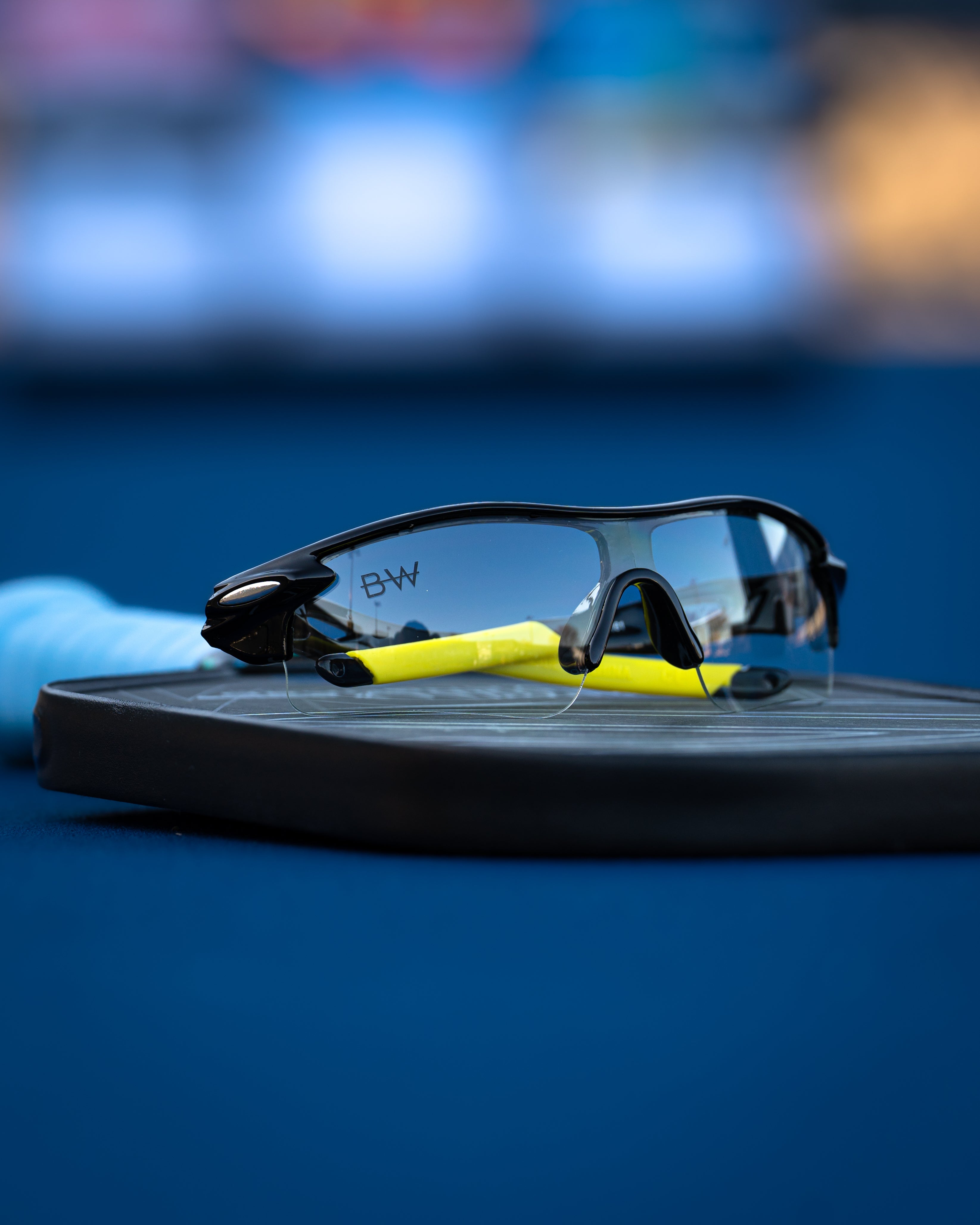
RX Glasses That Stay Clear During Smashes and Sprints
Share
RX Pickleball Glasses for Fast, Active Play
Pickleball can involve quick lateral movement, sudden direction changes, repeated acceleration, warm outdoor conditions, and long sessions on court. If you require prescription correction, your eyewear has to function within that environment while appropriately addressing your vision needs.
That makes prescription sports eyewear worth evaluating beyond appearance alone.
Players may want to consider:
- Prescription compatibility
- Frame dimensions and individual fit
- Finished eyewear weight
- How frequently the frame needs repositioning
- Fogging and moisture conditions
- Lens configuration
- Indoor versus outdoor use
- Verified impact characteristics
- Direct RX versus RX clip systems
No pair of glasses should be promised to remain perfectly clear, completely stationary, or fog-free through every sprint and rally. The better goal is to choose an RX configuration that matches your prescription, environment, fit preferences, and style of play.
Explore Blinded Wear Pickleball Eyewear
Why Eyewear Fit Matters During Smashes, Sprints, and Fast Rallies
A pickleball player may move very differently during a point than while standing, walking, or working at a desk.
Active court movement can include:
- Lateral movement at the kitchen line
- Quick transitions toward or away from the net
- Turning and repositioning
- Reaching for wide balls
- Overhead movements
- Repeated acceleration and deceleration
That is why a frame that feels acceptable while stationary should also be evaluated during the movements you actually make on court.
This does not mean a sports frame will never move. Frame stability depends on the complete eyewear configuration and individual wearer.
Why Can Glasses Move During Pickleball?
Eyewear movement can be influenced by several factors rather than one single feature.
These can include:
- Frame width
- Bridge geometry
- Temple fit
- Face shape
- Finished eyewear weight
- Perspiration
- Movement intensity
- How the frame is positioned on the wearer
A sports-oriented design does not justify promising that eyewear will be completely slip-proof or bounce-proof for every player.
Can RX Pickleball Glasses Slip During a Sprint?
Any eyewear can potentially move during physical activity.
The useful question is not whether a manufacturer can promise "zero slipping." It is whether the frame dimensions, bridge, temples, weight, and overall configuration work appropriately for the individual wearer during normal court movement.
If you repeatedly need to reposition your glasses during practice, that is useful information when evaluating whether the frame suits your preferences.
Can You Tell if Pickleball Glasses Will Fit From a Product Photo?
Appearance alone cannot establish how a frame will fit an individual face.
When comparing RX sports eyewear, review available dimensions and consider how those measurements compare with eyewear that already fits you well.
Style still matters, but it should not replace fit considerations when the glasses will be worn during active movement.
Should Pickleball Glasses Fit as Tight as Possible?
No. Tighter is not automatically better.
A frame can feel too tight just as it can feel too loose. The goal is an individual fit that remains comfortable and appropriate during normal use and movement.
Evaluate stability and comfort together instead of assuming maximum pressure creates the best sports fit.
Why Do Sports Glasses Fog?
Fogging can occur when moisture condenses on a lens surface. The conditions surrounding the eyewear can influence when and how much fogging occurs.
Relevant factors can include:
- Temperature differences
- Humidity
- Perspiration
- Moisture around the face
- Air movement
- How the eyewear sits
- The complete lens and eyewear configuration
This is why it is too absolute to promise that sports glasses will never fog during intense pickleball.
Does Sweating Automatically Make RX Glasses Fog?
Not necessarily. Sweat can contribute to moisture around the eyewear, but fogging depends on the overall conditions rather than perspiration alone.
A player can experience different amounts of fogging depending on weather, temperature, humidity, airflow, eyewear positioning, and other factors.
Do Blinded Wear RX Glasses Have Anti-Fog Coating?
Anti-fog treatment should not be assumed across the entire Blinded Wear RX collection.
If anti-fog technology is important to you, verify whether that characteristic is specifically established for the exact product and lens configuration you are considering.
Likewise, do not assume that an RX lens has hydrophobic, oleophobic, scratch-resistant, or other coatings unless those characteristics are explicitly established for that product.
Can Any Sports Glasses Be Guaranteed Fog-Free?
It is better to avoid an absolute guarantee that eyewear will remain fog-free under every playing condition.
Temperature, moisture, humidity, perspiration, airflow, and the complete eyewear setup can change from one court or session to another.
Instead of looking for a promise of "zero fog," evaluate the exact product and use appropriate lens-care practices.
What Should You Do if Your RX Glasses Fog During a Match?
If fogging significantly interferes with your ability to see through the eyewear, address the issue safely rather than continuing to play with obscured vision.
When appropriate:
- Move away from active play before handling the eyewear.
- Allow moisture conditions around the lenses to improve.
- Use lens-care materials appropriate for the exact eyewear.
- Avoid rubbing lenses with dirty or abrasive fabric.
- Return to play when you can see appropriately through the eyewear.
Should You Wipe Fogged RX Lenses With Your Shirt?
A clean microfiber cloth intended for eyewear is a better routine option than wiping prescription lenses with clothing, especially when a shirt may contain sweat, dust, sand, or other debris.
Remove loose particles before rubbing the lens surface.
Can You Use Anti-Fog Spray on RX Pickleball Glasses?
Do not assume every anti-fog spray, wipe, or cleaner is compatible with every prescription lens or lens treatment.
Before applying an additional product, confirm that it is appropriate for the exact eyewear and lens configuration.
Does Frame Ventilation Prevent Fogging?
Air movement around eyewear can be relevant to moisture conditions, but do not assume that a particular frame shape or visible opening guarantees fog prevention.
Likewise, do not advertise ventilation ports or specialized airflow technology for a product unless that design feature is actually established.
Does a Wraparound Frame Prevent Fog?
Frame shape alone does not guarantee fog prevention.
Fogging depends on the interaction between moisture, temperature, airflow, fit, lens positioning, and other environmental factors.
A wrap-style appearance should therefore not be used as evidence that a frame is automatically anti-fog.
Can RX Sports Glasses Stay Clear During Outdoor Pickleball?
Prescription eyewear can provide the corrective vision it is designed for, but "stay clear" should not be interpreted as a guarantee that the lens surface can never become fogged, wet, dirty, or otherwise obscured.
Outdoor conditions can introduce:
- Sweat
- Humidity
- Dust
- Wind
- Rain or moisture
- Changing temperatures
Routine care and an appropriate eyewear setup remain important even with sports-oriented prescription glasses.
Does Prescription Correction Help Keep Vision Clear?
Prescription correction and physical lens clarity are different concepts.
An appropriate prescription addresses an individual's corrective-vision needs. A lens surface can still become dirty, wet, fogged, scratched, or otherwise obscured.
Likewise, a perfectly clean lens does not substitute for appropriate prescription correction when a wearer requires it.
RX Vision vs. Lens Clarity: What Is the Difference?
| Factor | What It Refers To |
|---|---|
| Prescription Correction | Corrective vision according to the wearer's prescription requirements |
| Physical Lens Clarity | Whether the lens surface is free from things such as moisture, dirt, or other obstructions |
| Tint | Visible-light transmission and color appearance |
| Polarization | Reduction of certain reflected light |
| Impact Resistance | An impact-related characteristic of the eyewear or lens |
| Protective Certification | Compliance with a specified protective standard when documented |
These characteristics should not be treated as interchangeable.
Can Clearer RX Vision Make You React Faster?
Prescription sports eyewear should not be promised to make a player react faster.
If you require corrective vision, an appropriate prescription addresses that need. Reaction time still involves multiple processes, including:
- Visual information
- Attention
- Anticipation
- Decision-making
- Positioning
- Physical movement
- Training and experience
RX eyewear does not need an unsupported reaction-time claim to be useful.
Do RX Pickleball Glasses Improve Ball Tracking During Fast Rallies?
Do not automatically credit RX sports glasses with improving ball-tracking ability.
If you require corrective vision, appropriate prescription correction addresses that visual requirement. Tracking a moving pickleball involves additional visual, cognitive, and athletic factors.
Can Stable Glasses Improve Pickleball Performance?
A frame that fits appropriately can be more practical for active use than one a player repeatedly needs to adjust, but that should not be converted into a promise of better pickleball performance.
Fit does not automatically create:
- Faster reactions
- Better shot accuracy
- Better depth perception
- Better ball tracking
- More wins
Evaluate fit because you have to wear the eyewear, not because a frame should be marketed as a shortcut to better results.
Direct RX vs. RX Clip for Active Pickleball
Players who need prescription correction can encounter two different sports-eyewear configurations.
Direct RX
With direct RX eyewear, prescription correction is incorporated into the RX lens configuration.
RX Clip
An RX clip system uses a separate inner prescription insert within compatible sports eyewear. The prescription correction comes from the inner RX component rather than the primary outer sports lens.
Neither system should be declared universally more stable, clearer, or better for fast movement without evidence for the exact configuration.
Which Is Better for Sprints: Direct RX or an RX Clip?
There is no universal winner.
Instead, compare:
- Prescription compatibility
- Frame dimensions
- Complete eyewear weight
- Individual fit
- Available lens configurations
- Your preference for direct versus insert-based prescription correction
The best configuration is the one that appropriately supports your prescription and works with your preferred eyewear system.
Can You Wear Contacts With Non-RX Pickleball Glasses Instead?
Players who appropriately use contact lenses can consider contacts for prescription correction combined with Non-RX sports eyewear.
This separates the corrective-vision component from the outer sports glasses.
Whether contacts or dedicated RX eyewear are preferable depends on individual suitability and preference rather than a universal sports-performance advantage.
What Does High-Index Mean in RX Sports Glasses?
High-index refers to a category of prescription lens material commonly used to help manage lens thickness, particularly as prescription strength increases.
Blinded Wear custom RX eyewear includes high-index prescription lenses at no additional cost.
Finished lens thickness can still depend on:
- The individual prescription
- Frame dimensions
- Prescription lens or insert dimensions
- Lens geometry
- Optical design
- Other prescription requirements
Do High-Index Lenses Make RX Glasses More Stable?
High-index should not automatically be marketed as a frame-stability feature.
Although higher refractive-index materials can help manage lens thickness in comparable prescriptions, complete eyewear fit and movement depend on more than the lens material.
Frame dimensions, finished eyewear weight, weight distribution, bridge fit, temples, facial dimensions, and activity can all matter.
Does High-Index Mean Lightweight?
Not automatically.
Higher refractive-index material can help manage lens thickness, but thinner does not always mean lighter. Finished eyewear weight depends on the complete lens and frame configuration.
Does High-Index Mean More Impact-Resistant?
No. Refractive index is not a durability rating.
High-index should not automatically be described as:
- Shatterproof
- Impact-proof
- More impact-resistant
- Safety-certified
- More durable than another material
Impact characteristics should be evaluated separately.
RX Sports Glasses vs. Certified Protective Eyewear
Prescription correction, sports styling, impact resistance, and protective certification describe different characteristics.
| Term | What It Means | What It Does Not Automatically Mean |
|---|---|---|
| RX | Prescription correction | Protective certification |
| Sports Eyewear | Eyewear designed or positioned for active use | Compliance with a particular safety standard |
| Impact-Resistant | An impact-related characteristic | Shatterproof or indestructible construction |
| High-Index | A prescription lens material category | Greater impact protection |
| Protective Certification | Compliance with a specific standard when documented | Something that can be assumed from frame appearance |
Do RX Pickleball Glasses Need to Be Shatterproof?
"Shatterproof" is too absolute to substitute for impact resistance.
Blinded Wear offers impact-resistant lens options, but any eyewear can potentially be damaged under sufficient force or unfavorable conditions.
If you specifically require eyewear meeting a protective standard, verify the exact certification rather than relying on broad terms such as sports, durable, or impact-resistant.
What Lens Tint Is Best During Fast Pickleball?
Movement speed does not create one universally correct lens color.
Different tints can change visible-light transmission and color appearance. Players may prefer different lens colors and brightness levels depending on the environment and their subjective visual preferences.
A particular tint should not automatically be credited with:
- Faster reaction time
- Better ball tracking
- Better depth perception
- Better shot recognition
- Improved athletic performance
Learn more in the Pickleball Performance Lens Guide.
Are Dark RX Lenses Better for Outdoor Sprints and Smashes?
A darker tint can provide greater visible-light reduction than a lighter tint when comparing applicable lens configurations, but darker is not automatically better.
Your preferred amount of visible-light reduction can depend on the conditions where you normally play.
Tint darkness also does not automatically establish:
- UV protection
- Polarization
- Impact resistance
- Protective certification
- Better ball tracking
Are Clear Lenses Better for Indoor Pickleball?
A clear lens does not use dark sunglass tint, making clear eyewear an option to consider when a player does not want dark tint indoors or in another lower-light environment.
Clear appearance alone does not establish:
- UV specifications
- Impact characteristics
- Anti-fog treatment
- Scratch resistance
- Anti-reflective treatment
- Blue-light filtering
- Protective certification
Polarized vs. Non-Polarized RX Glasses for Fast Court Play
Polarized lenses are designed to reduce certain reflected light. Some pickleball and court-sport players may prefer non-polarized eyewear.
Polarization status alone does not determine:
- Depth perception
- Reaction time
- Contrast
- Ball tracking
- Prescription accuracy
- Fog resistance
- Frame stability
Neither polarized nor non-polarized eyewear should be declared universally better for every pickleball player.
Can Polarized RX Lenses Affect Digital Displays?
Polarized lenses can interact with some digital displays depending on the display technology, viewing angle, and orientation.
This can be worth considering if you frequently check a phone, watch, or digital scoreboard while wearing sports sunglasses.
How to Choose RX Glasses for High-Movement Pickleball
-
Start with your prescription.
Use your current eyeglass prescription rather than choosing RX strength based on sports marketing.
-
Choose the RX configuration.
Compare direct RX with a compatible RX clip system.
-
Review frame dimensions.
Compare measurements rather than assuming a sports frame will fit everyone.
-
Consider complete eyewear weight.
Frame and lens configuration both contribute to finished weight.
-
Think about your playing environment.
Indoor, outdoor, daytime, and evening conditions can lead to different tint preferences.
-
Verify the features that matter to you.
Do not assume anti-fog, UV, scratch resistance, coatings, or protective certification unless established for the exact product.
-
Test the eyewear during normal practice.
Evaluate comfort, fit, movement, and your experience with the selected configuration before an important tournament.
How to Order Blinded Wear RX Pickleball Glasses
- Select the product and available options.
- Have your current eyeglass prescription ready.
- Upload a clear photo or picture of your eyeglass prescription on the product page before adding the eyewear to your cart.
- Your prescription information will be associated with your custom RX order.
For additional information, visit How to Order RX Glasses.
Blinded Wear RX Frames to Start Comparing
There is no universal best frame for every sprint, smash, prescription, or face. Compare current RX options according to prescription compatibility, frame dimensions, available configurations, fit preferences, and style.
- Zebra II RX
- Crystal Wave II RX
- Frost RX
- Steel Ice RX
- Blue Shield RX
- Ocean Wave RX
- Gray Wash RX
- Lava Rock RX
- Havana Melt RX
Browse the complete Blinded Wear RX Pickleball Glasses Collection for current options.
What Should RX Glasses Feel Like During Intense Pickleball?
During active play, the goal is not to forget that eyewear exists because of a marketing promise. The more practical goal is to choose a prescription sports-eyewear setup that feels comfortable, fits appropriately, and does not require excessive attention during normal movement.
During practice, pay attention to:
- Whether the frame repeatedly moves out of your preferred position
- Whether you frequently push the glasses back into place
- Whether the bridge feels uncomfortable
- Whether the temples create unwanted pressure
- Whether perspiration changes how the frame feels
- Whether the lens configuration suits your playing environment
- Whether fogging becomes a recurring issue under your normal conditions
These observations can tell you more about your individual experience than a blanket claim that one frame is perfect for every athlete.
Why Does Frame Width Matter for RX Sports Glasses?
Frame width is one useful measurement when comparing sports eyewear because faces and eyewear dimensions vary.
A frame that is substantially different from the dimensions you normally wear may feel different in ways that cannot be predicted from a product photo alone.
If you already own glasses that fit comfortably, their measurements can provide a useful reference point when evaluating another frame.
Why Does Bridge Fit Matter During Pickleball?
The bridge influences how eyewear sits on the face. Individual facial dimensions vary, so one bridge design should not be promised to fit every player equally well.
During active use, consider whether the frame:
- Sits where you prefer without constant repositioning
- Feels comfortable across the bridge
- Maintains an appropriate position during ordinary court movement
- Creates unwanted pressure during longer sessions
Do not assume a visible nose-pad design automatically means a product is adjustable, moisture-wicking, or slip-proof unless those characteristics are specifically established.
Why Do Temple Dimensions Matter?
The temples are another part of overall frame fit. Their shape, dimensions, and relationship to the wearer's head can influence how the eyewear feels.
That does not justify claiming that a particular temple design will lock the glasses in place during every sprint or overhead.
Evaluate the complete frame rather than relying on one component as a guarantee of stability.
Can Lightweight RX Glasses Be More Comfortable?
Blinded Wear offers lightweight sports frames, and some players may prefer lighter-feeling eyewear during extended wear.
However, comfort cannot be predicted from weight alone.
It can also depend on:
- Weight distribution
- Frame dimensions
- Bridge fit
- Temple fit
- Prescription configuration
- Lens dimensions
- Individual preference
A lightweight description should not be converted into a promise that a frame will eliminate pressure, fatigue, slipping, or discomfort for every wearer.
Can Heavy RX Lenses Make Glasses Move More?
Finished eyewear weight and weight distribution can influence how glasses feel, but frame movement cannot be predicted from prescription lens weight alone.
The complete system matters, including the frame, lenses, bridge, temples, prescription, dimensions, and individual fit.
This is also why high-index lenses should not be marketed as an automatic solution to frame movement.
Can Strong Prescriptions Work in Pickleball Sports Glasses?
Potentially, but compatibility depends on the individual prescription and exact eyewear configuration.
Relevant factors can include:
- Prescription strength
- Prescription parameters
- Frame dimensions
- Lens shape
- Lens geometry
- Direct RX versus RX clip construction
- Other optical requirements
Do not assume that every sports frame can accommodate every prescription.
Can Astigmatism Prescriptions Work in RX Pickleball Glasses?
Astigmatism can be part of an eyeglass prescription, but compatibility should be evaluated using the complete prescription and the exact RX product.
If your prescription contains additional parameters or you are unsure whether a particular configuration can accommodate it, verify compatibility before ordering rather than relying on a blanket statement that every prescription is supported.
What About Progressive Prescription Lenses?
Do not assume every Blinded Wear RX frame supports every prescription lens design.
If you use progressive lenses or have another specific prescription requirement, verify availability and compatibility for the exact product before ordering.
Why Should You Use a Current Eyeglass Prescription?
Custom RX eyewear should be made according to your current corrective-vision requirements rather than an older prescription that may no longer reflect them.
Do not change prescription strength simply because the eyewear will be used for sports. Pickleball does not create a separate prescription strength that should be selected from a product page.
Can RX Glasses Be Both Sports Eyewear and Prescription Eyewear?
Yes. These terms describe different parts of the product.
RX refers to prescription correction. Sports eyewear refers to the frame or eyewear system being designed or positioned for active use.
Neither term automatically establishes every other characteristic a shopper may care about.
| If a Product Is... | You Still Need to Verify... |
|---|---|
| Prescription | Impact characteristics, coatings, tint, polarization, UV specifications, and certification when relevant |
| Sports-oriented | Prescription compatibility and any specific protective standard |
| Impact-resistant | Whether it has a specific protective certification if one is required |
| Tinted | Polarization, UV specifications, prescription characteristics, and impact properties |
| Clear | All other lens characteristics |
Fogging vs. Glare vs. Blur: They Are Not the Same Problem
Players sometimes describe very different visual experiences simply by saying their glasses are not clear.
Separating those experiences can make it easier to identify what actually needs attention.
| Issue | What It Can Describe |
|---|---|
| Fogging | Moisture condensation interfering with the lens surface |
| Water or Sweat | Physical moisture on or around the eyewear |
| Dirt or Smudges | Contamination on the lens surface |
| Blur | A visual concern that should not automatically be blamed on fog, tint, or frame style |
| Reflected Light | A separate optical consideration from fogging |
| Tint Darkness | The amount and character of visible-light reduction from the selected tint |
Changing frame style will not necessarily solve every one of these issues because they have different causes.
Can Outdoor Heat Make RX Glasses Fog?
Fogging is influenced by moisture and temperature conditions around the lens, so environmental changes can affect whether condensation occurs.
However, outdoor heat alone does not guarantee fogging. Humidity, perspiration, airflow, eyewear positioning, and changing conditions can all contribute.
Why Can RX Glasses Fog When Moving Between Temperatures?
Moving between environments with different temperatures and moisture conditions can create circumstances where condensation develops on a lens surface.
For example, transitions between climate-controlled indoor spaces and humid outdoor environments may expose eyewear to substantially different conditions.
No sports frame should be promised to eliminate condensation under every temperature transition unless an exact product claim is supported.
Can Humidity Affect Sports Eyewear?
Humidity can contribute to the moisture conditions surrounding eyewear. Combined with perspiration and temperature differences, it can influence a player's experience with fogging.
That is one reason the same pair of glasses may behave differently across different environments and sessions.
What About Sweat on the Lenses?
Sweat reaching a lens surface is different from condensation fogging, although both can interfere with visibility through the eyewear.
If moisture reaches the lenses:
- Move away from active play before cleaning when necessary.
- Avoid smearing moisture across the lens with dirty hands or clothing.
- Use materials appropriate for the eyewear.
- Remove loose debris before wiping.
Should You Touch RX Lenses With Sweaty Hands?
It is generally better to handle eyewear by the frame when practical rather than repeatedly touching the lens surfaces.
Fingerprints, perspiration, oils, and debris can leave the lens surface in need of cleaning.
Should You Clean RX Pickleball Glasses Before Every Match?
There is no required pickleball-specific cleaning schedule, but inspecting your eyewear before play is practical.
If the lenses are dirty, smudged, or contaminated, clean them appropriately before relying on them during active play.
A quick pre-match inspection can also identify visible damage that deserves attention.
How to Clean RX Pickleball Glasses
- Check for loose debris. Avoid immediately rubbing sand, grit, or visible particles across the lens.
- Use cleaning methods appropriate for the exact eyewear. Prescription lenses can have different materials or treatments.
- Use a clean microfiber cloth intended for eyewear.
- Avoid abrasive materials. Dirty clothing, rough paper products, or contaminated cloths can be poor choices for lens care.
- Handle the frame carefully. Avoid unnecessary force while cleaning.
- Store the eyewear appropriately afterward.
Should You Use Household Glass Cleaner on RX Sports Glasses?
Do not assume a household cleaner is appropriate for prescription eyewear or any treatments that may be present on the lenses.
Use lens-care products and methods compatible with the exact eyewear rather than applying a general household chemical simply because it cleans other glass surfaces.
How Should You Store RX Pickleball Glasses?
A protective case can help separate eyewear from other equipment when the glasses are not being worn.
Avoid leaving RX eyewear loose where paddles, keys, bottles, shoes, or other objects can contact the lenses or place pressure on the frame.
Can You Leave RX Sports Glasses in a Hot Car?
Excessive heat can potentially affect eyewear components depending on their materials and construction.
Avoid routinely leaving prescription eyewear on a hot dashboard, next to strong heat sources, or in an excessively hot parked vehicle for extended periods.
Should You Bend Sports Glasses to Improve the Fit?
Avoid uncontrolled DIY reshaping, aggressive bending, or heating of prescription sports eyewear.
If the fit appears incorrect or the frame has become deformed, use an appropriate adjustment or support route for the exact eyewear rather than forcing the frame into another shape.
What if Your RX Glasses Start Moving More Than Usual?
If a frame suddenly fits differently, inspect the eyewear instead of assuming the change is caused only by sweat.
Look for:
- Visible deformation
- Loose components
- Damage after an impact
- A lens or insert that no longer appears properly seated
- Changes in how the frame rests on your face
Visible damage should be addressed rather than ignored during continued sports use.
What Should You Do After a Pickleball Hits Your Glasses?
Inspect the eyewear after a meaningful impact.
Check for:
- Cracks
- Chips
- Frame deformation
- Loose components
- Displaced lenses
- Displaced RX inserts
- A substantial change in fit
- Other visible damage
Do not assume impact-resistant eyewear is unchanged simply because it did not visibly break apart.
Should You Keep Playing in Cracked RX Glasses?
Do not continue treating visibly cracked or substantially damaged eyewear as though it remains unchanged.
If damage affects the lens, frame, RX insert, fit, or normal use of the eyewear, evaluate replacement or appropriate inspection before continuing to rely on it.
Do RX Sports Glasses Protect Against Pickleball Impacts?
Protection claims should be based on the documented characteristics of the exact eyewear.
Blinded Wear offers impact-resistant lens options, but impact resistance should not be converted into claims such as:
- Impact-proof
- Shatterproof
- Unbreakable
- Guaranteed to prevent eye injuries
- Certified to a particular protective standard unless documented
Do Pickleball Glasses Need ASTM or ANSI Certification?
Sports styling and prescription correction do not automatically establish compliance with ASTM, ANSI, or another protective standard.
If a specific certification matters for your intended use, verify the exact standard and product documentation rather than assuming any RX sports frame qualifies.
Does More Lens Coverage Mean More Protection?
Lens size and physical coverage can be characteristics shoppers consider, but appearance alone should not be used to infer a specific level of protective performance.
If certified protection is important, evaluate documented testing or certification for the exact product rather than estimating protection from lens size or frame shape.
Can RX Glasses Be Used for Competitive Pickleball?
Players who require corrective vision can use prescription eyewear during pickleball. The appropriate configuration depends on the individual's prescription, eyewear, and any applicable event or facility requirements.
If you are playing in an organized event with specific equipment requirements, review the current event information rather than assuming all competitions apply identical policies.
Should You Practice in New RX Glasses Before a Tournament?
Yes, becoming familiar with new eyewear during normal practice is a practical step before relying on it during an important event.
Practice gives you an opportunity to evaluate:
- Frame comfort
- Individual fit
- Whether the frame requires frequent repositioning
- Your experience with the selected tint
- How the eyewear feels during normal movement
- Whether fogging is an issue under your typical playing conditions
- Whether you experience persistent unexpected visual difficulty
Should Tournament Players Carry Backup RX Glasses?
If you depend on prescription correction, backup corrective eyewear can be useful during tournaments and travel.
Your primary pair could become damaged, lost, or otherwise unavailable. A suitable backup can help prevent one eyewear problem from leaving you without the corrective vision setup you normally depend on.
RX Tournament Eyewear Packing Checklist
- Primary RX sports eyewear
- Suitable backup corrective eyewear
- Protective case
- Clean microfiber cloth
- Appropriate lens-cleaning supplies
- Accessible prescription information when useful for travel
- Any separate eyewear configuration you intentionally use for substantially different playing environments
How to Compare RX Frames for Smashes and Sprints
| Feature | What to Evaluate | What Not to Assume |
|---|---|---|
| Frame Fit | Dimensions, bridge, temples, and individual comfort | That a sports frame never slips |
| Weight | Complete finished eyewear | That lighter automatically means more stable |
| RX System | Direct RX versus compatible RX clip | That one is universally better |
| High-Index | Prescription lens thickness management | Greater impact resistance or guaranteed lighter weight |
| Tint | Visible-light transmission and color appearance | Better reaction time or ball tracking |
| Polarization | Whether reduction of certain reflected light matches your preference | Better or worse depth perception |
| Impact Resistance | Verified impact-related characteristics | Shatterproof construction |
| Anti-Fog | Verify any exact product claim | That all RX sports glasses include an anti-fog coating |
Blinded Wear RX Options to Compare
Rather than assigning unsupported claims such as "best grip," "zero fog," or "maximum stability" to individual models, compare current RX products according to the specifications and configurations actually available for each one.
Zebra II RX
Explore Zebra II RX if its frame style, dimensions, available RX configuration, and overall design match what you are looking for in dedicated pickleball eyewear.
Crystal Wave II RX
Compare Crystal Wave II RX according to your prescription requirements, fit preferences, available product options, and intended playing environment.
Frost RX
Frost RX is a direct RX option with a white frame and bright blue lens appearance. Review the current product page for its available configuration and exact specifications.
Steel Ice RX
Compare Steel Ice RX with other direct RX options according to frame preference, prescription requirements, available lens configuration, and fit.
Blue Shield RX
Consider Blue Shield RX as another direct RX style when comparing frame designs and current prescription options.
Gray Wash RX
Review Gray Wash RX according to its current product specifications rather than assuming the lens appearance automatically establishes polarization, UV specifications, glare performance, or another lens characteristic.
Ocean Wave RX
Explore Ocean Wave RX based on its current configuration and your individual prescription and frame preferences.
Lava Rock RX
Compare Lava Rock RX based on the current product page rather than assuming its lens appearance indicates blue-light filtering or another unverified treatment.
Havana Melt RX
Havana Melt RX provides another direct RX style to compare according to prescription compatibility, fit, frame preference, and available options.
Why We Do Not Call One RX Frame the "Best for Sprints"
The original question sounds simple, but frame performance is too individual for one model to be guaranteed as the best choice for every fast-moving player.
A useful comparison requires considering:
- Your prescription
- Your facial dimensions
- Your preferred frame dimensions
- Your RX configuration
- Your normal playing environment
- Your tint preferences
- Your comfort preferences
- The exact specifications of the product
That produces a more useful buying decision than ranking frames according to unsupported promises of grip, fog resistance, or athletic performance.
What About Real Player Reviews?
Customer feedback can be useful when it comes from verified, authentic experiences, but individual comments should not be invented or used to establish universal product performance.
A review saying that one wearer liked the fit does not prove that the same frame will fit every player. Likewise, one person's experience with fogging does not guarantee identical results across different temperatures, humidity levels, perspiration levels, and face shapes.
Use genuine customer feedback as one input alongside product specifications, prescription compatibility, dimensions, and your individual needs.
What Should You Prioritize: Fog Resistance or Fit?
These are not necessarily competing priorities, and neither should be evaluated in isolation.
For RX sports eyewear, consider the complete system:
- Appropriate prescription correction
- Prescription compatibility
- Individual frame fit
- Comfort during normal movement
- Lens configuration appropriate for your intended environment
- Verified product characteristics that matter to you
- Appropriate care and storage
A single marketing feature cannot replace the rest of the eyewear decision.
Can One Pair Work for Indoor and Outdoor Pickleball?
Potentially, depending on the exact lens configuration and your preferences.
However, players who regularly move between bright outdoor courts and substantially different indoor environments may prefer different amounts of visible-light reduction.
Do not assume every RX product includes photochromic or transitional lenses. Verify current availability for the exact product.
Can Transitional RX Lenses Help With Changing Conditions?
Photochromic or transitional lenses are designed to change tint in response to applicable light conditions, but availability and behavior depend on the exact lens product.
Do not assume every Blinded Wear RX model includes a transitional option or that a transition lens is automatically ideal for every indoor/outdoor tournament.
Review the exact configuration available for the product you are considering.
Do Blue-Colored RX Lenses Block Blue Light?
Not necessarily.
Lens color and blue-light filtering are separate characteristics. A blue lens, blue mirror appearance, or blue product name does not establish that the lens includes blue-light filtering.
Verify blue-light filtering only when it is specifically documented for the exact lens configuration.
Does Gray Tint Automatically Reduce Glare?
A gray tint changes visible-light transmission and color appearance, but tint color alone should not be used to make a blanket glare-reduction claim for every lens.
Likewise, a gray appearance does not automatically establish polarization, UV specifications, anti-reflective treatment, impact resistance, or another independent lens characteristic.
Can RX Glasses Eliminate Distractions During Pickleball?
No eyewear should be promised to eliminate every distraction.
A player may prefer eyewear that feels comfortable and requires fewer adjustments, but attention during pickleball still depends on the player and the surrounding environment.
Good sports-eyewear marketing does not need to promise that a frame becomes completely unnoticeable or removes every visual issue.
When Should You Consider a Different RX Frame?
It may be worth comparing another configuration if your current eyewear repeatedly creates practical problems for you, such as:
- Frequent repositioning
- Persistent discomfort
- A frame size that does not suit your fit preferences
- An RX configuration that no longer matches your prescription needs
- A tint that does not suit your normal playing environment
- Physical damage
- A need for a different prescription configuration
That does not mean every inconvenience requires a new pair. Evaluate the specific issue first.
When Should You Consider Updating the Prescription Instead of the Frame?
If your concern is persistent blur or a meaningful change in vision, do not automatically assume the sports frame is responsible.
A frame and prescription solve different problems. Vision concerns may require appropriate eye-care evaluation, while frame fit and sports configuration are separate eyewear decisions.
RX Glasses for Smashes and Sprints: Buying Checklist
- I have my current eyeglass prescription.
- I know whether I want direct RX or a compatible RX clip.
- I have reviewed prescription compatibility where necessary.
- I have checked the frame dimensions.
- I have considered bridge and temple fit.
- I understand that no frame can be universally promised to never slip.
- I understand that no lens should be universally promised to never fog.
- I know my primary playing environment.
- I have reviewed the available lens configuration for the exact product.
- I understand that tint and polarization are separate characteristics.
- I understand that high-index is not a durability rating.
- I understand that impact-resistant does not mean shatterproof.
- I have verified any UV specification that matters to me.
- I have verified any protective certification I specifically require.
- I have appropriate cleaning and storage materials.
- I plan to become familiar with new eyewear during practice before an important event.
The Goal Is Reliable RX Eyewear, Not Impossible Promises
Fast pickleball can expose weaknesses in an eyewear setup that may be less noticeable during ordinary daily use. Fit, comfort, prescription configuration, moisture, lens condition, and playing environment can all become more noticeable when movement and perspiration increase.
But that does not mean RX sports glasses should be marketed as completely fog-proof, slip-proof, bounce-proof, or capable of improving athletic performance.
A better standard is straightforward: choose prescription sports eyewear that appropriately addresses your corrective-vision needs, fits your preferences, works with your intended playing environment, and has product characteristics you can actually verify.
RX Pickleball Glasses Frequently Asked Questions
Can RX pickleball glasses stay completely fog-free?
No pair of sports glasses should be universally promised to remain completely fog-free under every condition. Temperature, humidity, perspiration, moisture, airflow, eyewear positioning, and the complete lens configuration can all influence fogging.
Do Blinded Wear RX glasses have anti-fog coating?
Do not assume anti-fog treatment across the entire RX collection. If an anti-fog feature matters to you, verify that characteristic for the exact product and lens configuration you are considering.
Why do my glasses fog when I play pickleball?
Fogging can occur when moisture condenses on a lens surface. Temperature differences, humidity, perspiration, moisture around the face, airflow, and eyewear positioning can all contribute.
Why do my glasses fog more when I sweat?
Perspiration can increase moisture around the eyewear, but sweat alone does not determine whether lenses will fog. The surrounding temperature, humidity, airflow, and complete eyewear configuration also matter.
Can RX glasses fog even if they are designed for sports?
Yes. Sports-oriented construction does not make eyewear immune to condensation. Avoid treating the words "sports glasses" as a guarantee of zero fogging.
What should I do if my RX glasses fog during a point?
If fogging significantly interferes with your ability to see, address the issue safely rather than continuing to play with obscured vision. Move away from active play when appropriate and use lens-care methods compatible with the exact eyewear.
Can I wipe sweaty RX lenses with my shirt?
A clean microfiber cloth intended for eyewear is a better routine choice, particularly when clothing may contain perspiration, dust, sand, or other debris. Remove loose particles before rubbing the lens surface.
Can I use anti-fog spray?
Do not assume every anti-fog spray or wipe is compatible with every prescription lens or lens treatment. Confirm compatibility with the exact eyewear before applying an additional product.
Do RX pickleball glasses stay in place during sprints?
No frame should be guaranteed never to move. Stability depends on frame dimensions, bridge fit, temples, finished eyewear weight, facial dimensions, perspiration, movement, and individual fit.
Why do my glasses slide when I sweat?
Perspiration can influence how eyewear feels during activity, but repeated movement can also involve frame dimensions, bridge fit, temple fit, weight distribution, and individual facial dimensions.
Should sports glasses fit extremely tight?
No. Maximum tightness is not the goal. Eyewear can also be too tight and uncomfortable. Look for an individual fit that feels appropriate during normal movement and extended wear.
Are lightweight RX glasses better for pickleball?
Some players prefer lightweight eyewear, and Blinded Wear offers lightweight sports frames. However, weight alone does not determine comfort, fit, or stability.
Does high-index mean lightweight?
Not automatically. Higher refractive-index materials can help manage lens thickness in comparable prescriptions, but finished eyewear weight depends on the complete frame and lens configuration.
Does high-index mean impact-resistant?
No. Refractive index is not a durability or impact-resistance rating.
Does Blinded Wear charge extra for high-index RX lenses?
Blinded Wear includes high-index prescription lenses at no additional cost with custom RX eyewear.
Are RX pickleball glasses shatterproof?
Impact-resistant should not be rewritten as shatterproof, impact-proof, or indestructible. Blinded Wear offers impact-resistant lens options, but eyewear can still potentially be damaged.
Are RX pickleball glasses safety glasses?
Not automatically. Prescription correction, sports styling, impact resistance, and protective certification are separate characteristics. If you require a specific protective standard, verify it for the exact product.
Do larger lenses automatically provide better protection?
Physical coverage is one characteristic a shopper can consider, but lens size or frame appearance alone does not establish a specific level of protective performance or certification.
Can strong prescriptions work in sports glasses?
Potentially. Compatibility can depend on prescription strength and parameters, frame dimensions, lens geometry, RX construction, and other optical requirements. Do not assume every prescription works with every frame.
Can astigmatism prescriptions work in RX sports eyewear?
Astigmatism can be part of an eyeglass prescription, but compatibility should be evaluated using the complete prescription and exact RX product.
Can progressive lenses work in pickleball glasses?
Do not assume every RX frame supports every prescription lens design. If you require progressive lenses, verify availability and compatibility for the exact product.
Is direct RX better than an RX clip for fast movement?
Neither system is universally better. Compare prescription compatibility, frame dimensions, complete eyewear weight, fit, available configurations, and your preference for direct versus insert-based prescription correction.
Can I wear contacts with Non-RX pickleball glasses?
Players who appropriately use contact lenses can consider contacts for corrective vision combined with Non-RX sports eyewear.
Do RX glasses improve reaction time during fast rallies?
Prescription sports eyewear should not be promised to make an athlete react faster. Reaction time involves visual information, anticipation, attention, decision-making, movement, training, and experience.
Do RX glasses improve ball tracking?
Do not automatically credit prescription sports eyewear with improving ball-tracking ability. Appropriate prescription correction addresses corrective-vision needs, while tracking a moving ball involves additional visual, cognitive, and athletic factors.
Does non-polarized eyewear improve depth perception?
Polarization status alone does not determine depth perception, reaction time, contrast, or ball tracking.
Are clear lenses automatically anti-fog?
No. Clear describes the absence of dark sunglass tint. It does not automatically establish anti-fog treatment, impact characteristics, UV specifications, scratch resistance, or protective certification.
Does darker tint mean more UV protection?
No. Tint darkness and UV specifications are separate characteristics. Verify the UV characteristics of the exact lens rather than estimating them from appearance.
Fogging, Sweat, Fit, and Prescription: Quick Troubleshooting Guide
| What You Notice | What to Evaluate | What Not to Assume |
|---|---|---|
| Lens fogging | Moisture, temperature, humidity, airflow, and eyewear conditions | That your prescription is wrong |
| Sweat on the lens | Physical moisture and appropriate lens cleaning | That condensation is the only issue |
| Frame repeatedly slides | Frame dimensions, bridge, temples, weight, and individual fit | That every sports frame will fit better |
| Persistent blur | Your corrective-vision needs and appropriate evaluation | That anti-fog treatment will solve it |
| Lens feels too dark | Tint and playing environment | That prescription strength is responsible |
| Frame feels uncomfortable | Dimensions, bridge, temples, weight distribution, and fit | That tighter is automatically better |
| Eyewear changed after an impact | Lens, frame, components, RX insert, and overall fit | That impact-resistant means no damage occurred |
What to Do Before a Hot or Humid Pickleball Session
If you know you will be playing in conditions where perspiration and moisture are likely, a simple eyewear check can help you start the session with your equipment in good condition.
- Inspect the lenses. Check for visible contamination or damage.
- Clean the eyewear appropriately. Begin with reasonably clean lens surfaces rather than old smudges and debris.
- Check the frame. Look for visible deformation or loose components.
- Put the glasses on before play. Make sure the frame feels appropriate before the match starts.
- Bring a clean microfiber cloth. Keep appropriate lens-care materials accessible.
- Use a protective case. Give the eyewear an appropriate place to go when it is not being worn.
What to Do if Your RX Glasses Keep Sliding
If you repeatedly reposition your eyewear throughout a match, evaluate the underlying fit rather than immediately assuming you need a specific advertised "grip technology."
Consider:
- Whether the frame width suits you
- How the bridge sits
- How the temples feel
- Whether the eyewear feels substantially different once you begin sweating
- Whether the frame has become deformed
- Whether any component appears loose or damaged
- Whether another frame size or design may better match your preferences
A product should not need invented claims about moisture-wicking nose pads or anti-slip technology to be evaluated as sports eyewear.
What to Do if Your RX Glasses Keep Fogging
Recurring fogging deserves a different troubleshooting approach from recurring frame movement.
- Identify when it occurs. Notice whether the issue is associated with humidity, temperature changes, perspiration, or particular environments.
- Keep the lenses appropriately clean. Dirt and smudges are separate from condensation but can add to poor visibility through the lens.
- Use compatible lens-care products only. Do not apply random household chemicals or unverified treatments.
- Address significant fogging safely. Do not continue active play when you cannot appropriately see through the eyewear.
- Verify product-specific features. If anti-fog treatment is a purchasing priority, confirm it for the exact product rather than assuming every sports lens includes it.
What if the Problem Is Blur Instead of Fog?
Fogging is a physical condition on the lens surface. Persistent visual blur can be a different issue.
If cleaning the lens or allowing condensation to clear does not address what you are experiencing, do not assume a sports-eyewear feature can diagnose the cause.
If you experience persistent blur, double vision, unexplained changes in vision, or another meaningful visual concern, seek appropriate professional evaluation when needed.
Can You Prevent Every Eyewear Problem With One Pair?
No single frame or lens configuration should be expected to solve every possible eyewear concern.
Different characteristics address different needs:
- Prescription correction addresses corrective-vision requirements.
- Frame fit concerns how the eyewear sits on the individual wearer.
- Tint affects visible-light transmission and color appearance.
- Polarization is designed to reduce certain reflected light.
- Impact resistance describes an impact-related characteristic.
- Protective certification establishes compliance with a particular standard when documented.
- Anti-fog treatment is a separate product characteristic that must be verified when claimed.
Good eyewear selection comes from evaluating the complete configuration instead of expecting one feature to solve everything.
When Should You Stop and Clean Your Glasses During a Match?
If sweat, condensation, dirt, or another obstruction significantly interferes with your ability to see through the eyewear, address it safely rather than trying to continue through compromised visibility.
Wait until you are away from active play, handle the eyewear appropriately, and use compatible cleaning materials.
How to Inspect RX Glasses After an Impact
A quick visual inspection is useful after the eyewear experiences a meaningful impact.
- Look across both lens surfaces for cracks or chips.
- Check whether either lens appears displaced.
- If the system uses an RX insert, check whether it appears properly positioned.
- Inspect the frame for visible deformation.
- Look for loose or broken components.
- Put the eyewear on and notice whether its position has substantially changed.
- Do not rely on obviously damaged eyewear as though nothing happened.
When Should RX Pickleball Glasses Be Replaced?
There is no universal replacement interval for every pair of sports glasses.
Replacement may be worth evaluating when:
- The prescription no longer reflects your current corrective-vision needs.
- The lens is cracked or substantially damaged.
- The frame is significantly damaged.
- An RX insert or lens is damaged or displaced.
- The eyewear no longer fits appropriately for you.
- The glasses can no longer be used as intended.
Do not replace eyewear according to an arbitrary sports-marketing schedule if the prescription, condition, and configuration remain appropriate.
What Happens if Blinded Wear RX Glasses Break?
Blinded Wear offers 50% lifetime replacement support if eligible glasses break, subject to current policy terms.
Eligible claims require the damaged eyewear to be returned. Once the applicable claim and return requirements are satisfied, the customer can receive 50% credit toward a replacement pair.
This is not a free full-replacement warranty and should not automatically be interpreted as coverage for lost eyewear, routine prescription changes, or every possible type of damage.
For damaged RX eyewear, contact blindedwearco@gmail.com before returning the pair.
Review the Blinded Wear Protection Plan, Replacement & Returns information for current eligibility and policy details.
Are Custom Blinded Wear RX Glasses Returnable?
Blinded Wear offers a 30-day return policy for eligible standard purchases. Customized RX eyewear is final sale and excluded from the standard 30-day return policy.
Custom RX final-sale status is separate from applicable 50% lifetime replacement support for eligible broken eyewear.
Because RX eyewear is customized, review your prescription information, selected product, available options, and the current Replacement & Returns information before purchasing.
Does Lifetime Replacement Support Cover Prescription Changes?
Do not assume a routine prescription change qualifies as broken-eyewear replacement coverage.
The 50% lifetime replacement support applies to eligible broken glasses subject to current policy terms. A change in corrective-vision needs and physical breakage are separate situations unless the current policy states otherwise.
Does Replacement Support Cover Lost RX Glasses?
Do not assume lost eyewear qualifies for the same support as eligible broken glasses.
Eligible broken-eyewear claims require the damaged eyewear to be returned, so review the current policy for specific eligibility questions.
How to Order Blinded Wear RX Pickleball Glasses
- Select the product and available options.
- Have your current eyeglass prescription ready.
- Upload a clear photo or picture of your eyeglass prescription on the product page before adding the eyewear to your cart.
- Your prescription information will be associated with your custom RX order.
For additional ordering information, visit How to Order RX Glasses.
RX Pickleball Glasses for Active Play: Final Buying Checklist
- I have my current eyeglass prescription.
- I understand direct RX versus RX clip systems.
- I have checked prescription compatibility when necessary.
- I have reviewed the frame dimensions.
- I have considered bridge and temple fit.
- I have considered the complete finished eyewear rather than frame weight alone.
- I understand that no frame should be guaranteed never to slip.
- I understand that no sports lens should be guaranteed never to fog.
- I know that anti-fog treatment must be verified for the exact product.
- I know that a colored lens does not automatically establish blue-light filtering or another treatment.
- I understand that tint darkness and UV specifications are separate.
- I understand that polarization alone does not determine depth perception or ball tracking.
- I understand that high-index is not an impact-resistance rating.
- I understand that impact-resistant does not mean shatterproof.
- I have verified any protective certification I specifically require.
- I have appropriate cleaning and storage materials.
- I plan to practice in new eyewear before relying on it during an important tournament.
- I understand the custom RX final-sale policy.
- I understand how the 50% lifetime replacement support works for eligible broken eyewear.
RX Sports Eyewear Myths vs. What You Should Actually Check
| Marketing Claim | Better Way to Evaluate It |
|---|---|
| "Never fogs." | Fogging depends on moisture, temperature, humidity, airflow, perspiration, and the complete eyewear setup. |
| "Never slips." | Evaluate dimensions, bridge, temples, weight, and individual fit. |
| "Sweat-proof." | Consider how the actual frame feels during your normal activity rather than relying on an absolute promise. |
| "Shatterproof." | Verify documented impact characteristics and any certification you specifically require. |
| "Improves reaction time." | Prescription eyewear should not be marketed as an automatic athletic reaction-time enhancement. |
| "Tracks the ball better." | Appropriate prescription correction addresses corrective-vision needs without guaranteeing better ball tracking. |
| "High-index is stronger." | Refractive index and impact resistance are different characteristics. |
| "Dark lenses provide maximum UV protection." | Verify UV specifications independently of tint darkness. |
| "Non-polarized improves depth perception." | Polarization status alone does not determine depth perception. |
| "Sports frame means safety-certified." | Verify a specific protective standard when certification matters. |
What Matters Most During Smashes and Sprints?
Fast movement makes it tempting to look for one dramatic eyewear feature that solves everything: anti-fog coating, maximum grip, ultralight construction, a particular tint, or a specific lens material.
RX sports eyewear is better evaluated as a complete system.
Start with the essentials:
- Appropriate prescription correction
- A compatible RX configuration
- A frame that suits your individual fit preferences
- A lens configuration appropriate for your intended environment
- Verified product characteristics rather than assumed features
- Proper cleaning, inspection, and storage
Those factors provide a much stronger foundation than promising that one pair of glasses will never move, never fog, and never distract you.
Explore Blinded Wear RX Pickleball Eyewear
If you require corrective vision and want dedicated eyewear for active pickleball, compare current RX options according to your prescription, frame preferences, playing environment, and available product configurations.
- Shop RX Pickleball Glasses
- Learn How to Order RX Glasses
- Explore the Pickleball Performance Lens Guide
- Take the Pickleball Sunglasses Quiz
- Explore the 2026 Pickleball Glasses Hub
- Review Replacement & Returns Information
The goal is not impossible "never fog, never slip" marketing. The goal is RX sports eyewear that appropriately addresses your corrective-vision needs and matches how, where, and how often you play.