
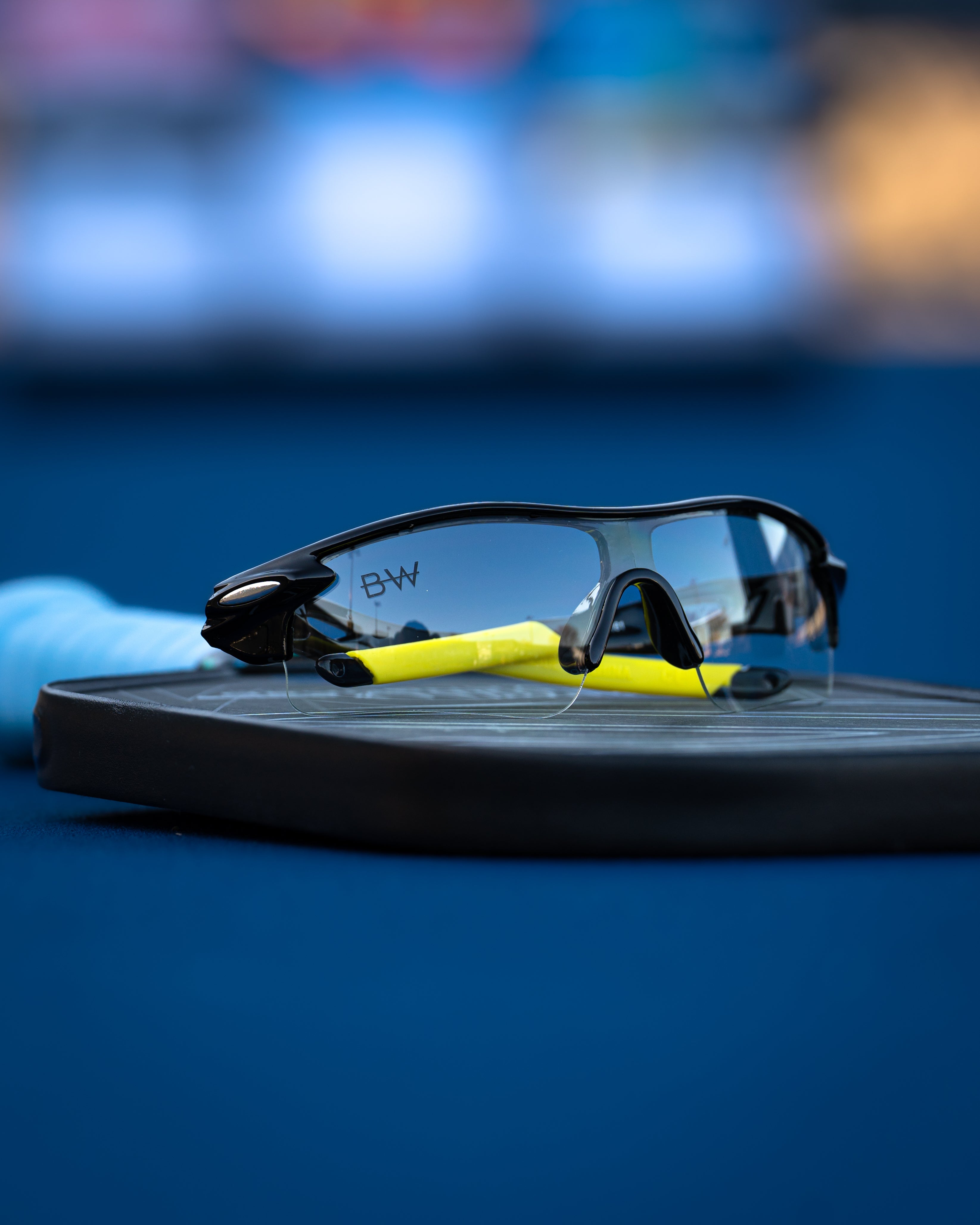
RX Glasses for Teen Athletes: Safe, Stylish & Durable
Share
RX Glasses for Teen Athletes: Safe, Stylish & Durable
The best prescription sports glasses for teen athletes should combine accurate vision correction, comfortable active-use fit, verified lens construction, lightweight design, and a style the teen actually wants to wear. Parents should also distinguish between impact-resistant eyewear and certified protective sports eyewear rather than assuming that every product labeled “sports glasses” offers the same level of protection.
For teens who play pickleball, basketball, soccer, or other active sports, everyday prescription glasses may work in some situations, but a dedicated sports pair can make more sense when movement, repeated use, impact resistance, or keeping everyday glasses separate from athletic gear becomes important.
This guide explains how to choose prescription sports glasses for teens, what parents should verify before buying, when eyewear may need to be replaced, and how Blinded Wear's verified RX features fit into the decision.
Shop Prescription Sports Eyewear for Teen Athletes
Why Teen Athletes May Benefit From Dedicated RX Sports Glasses
Teen athletes often move differently in sports than they do during school or everyday activities. Sprinting, lateral movement, jumping, quick head turns, and longer practice sessions can make fit and comfort more important.
Dedicated sports eyewear can be useful when a teen needs:
- Prescription correction during activity
- A lightweight frame for longer wear
- Impact-resistant lenses
- A frame selected around active movement
- A different lens setup for indoor or outdoor sports
- A separate athletic pair instead of using everyday glasses
That does not mean every teen automatically needs a separate sports pair. If their existing prescription glasses fit well, feel comfortable during movement, and meet the lens requirements for their sport, they may already have a workable setup.
Teen Sports Glasses vs. Regular Prescription Glasses
| Feature | Dedicated RX Sports Glasses | Regular Prescription Glasses |
|---|---|---|
| Vision correction | Can include the teen's prescription | Can include the teen's prescription |
| Primary use | Active or sports-focused wear | General everyday wear |
| Movement | Can be selected around active fit | Varies by frame |
| Weight | Often an important sports-comfort consideration | Varies widely |
| Impact resistance | Should be verified for the exact lens; Blinded Wear uses impact-resistant lenses | Depends on the lens material and configuration |
| Protective certification | Must be verified separately | Must be verified separately |
| Style | Can combine athletic styling with prescription correction | Often chosen primarily for everyday use |
Are Prescription Sports Glasses Safer for Teen Athletes?
Safety depends on the actual construction and documented specifications of the eyewear—not simply whether the frame is marketed as “sports glasses.”
Parents should distinguish between:
- Impact-resistant lenses
- Sports-oriented eyewear
- Certified protective sports eyewear
These terms are not interchangeable.
Blinded Wear's verified claim is impact-resistant lenses. That should not be interpreted as impact-proof, shatter-proof, unbreakable, or automatically certified to a particular protective standard.
If a teen's sport requires or strongly benefits from a specific protective standard, verify that standard for the exact eyewear before relying on it.
Impact-Resistant Does Not Mean Impact-Proof
| Term | What It Means |
|---|---|
| Impact-resistant | The lens is designed to resist impact |
| Impact-proof | A much stronger claim that should not be assumed |
| Sports eyewear | Eyewear designed or marketed for active use |
| Certified protective eyewear | Eyewear with documented compliance with a named standard |
Parents should look for documented product information rather than relying on phrases such as “built tough,” “game-proof,” or “unbreakable.”
Fit Is One of the Most Important Features for Teen Athletes
A teen's prescription can be correct while the frame itself still feels uncomfortable or distracting during sports.
Evaluate:
- Overall frame width
- Bridge comfort
- Temple pressure
- Frame weight
- How the eyewear behaves during movement
- How it feels after a full practice or match
No sports frame should be described as universally slip-proof. Fit varies by face shape, movement, perspiration, and frame dimensions.
Teen Growth Can Change Eyewear Fit
Teenagers can outgrow a frame even when the prescription has not changed.
Reassess fit if:
- The temples begin feeling too tight.
- The frame feels noticeably loose.
- The bridge no longer sits comfortably.
- The eyewear moves more during activity than it used to.
- The frame no longer aligns comfortably on the face.
There is no universal schedule requiring teens to replace sports glasses every 12 or 18 months. Condition, fit, prescription, growth, and playing needs are more useful decision factors than an arbitrary calendar interval.
Prescription Accuracy Comes Before Sports Features
Sports styling does not compensate for an inappropriate prescription.
Before comparing frame colors, lens treatments, or other optional features, confirm:
- The prescription being used is appropriate.
- The selected frame supports the prescription.
- The finished lenses are compatible with the frame.
- The teen can see comfortably through the completed eyewear.
If a teen experiences persistent blur, double vision, unusual distortion, or other unexpected visual symptoms, seek guidance from an appropriate eye-care or optical professional.
High-Index RX Lenses and Teen Sports Eyewear
Blinded Wear includes high-index prescription lenses at no additional cost.
High-index is a lens-material characteristic, not a sports-performance technology.
It should not be interpreted as automatically providing:
- Better reaction time
- Improved coordination
- Better depth perception
- More impact resistance
- Better athletic performance
Its value should be considered as part of the overall prescription package rather than as a performance claim.
Why Lightweight Sports Frames Matter for Teens
Teen athletes may wear prescription glasses through practices, matches, tournaments, and other long sessions.
A lightweight frame can help support comfort during extended use, especially when combined with appropriate fit.
Blinded Wear uses lightweight sports frames designed with extended-match comfort in mind.
Lightweight does not automatically mean stronger, more secure, or more protective. It is one part of the overall fit-and-comfort equation.
Style Matters More Than Parents Sometimes Think
A technically suitable frame has limited value if the teen dislikes it enough that they avoid wearing it.
Once prescription compatibility, fit, and verified lens characteristics are satisfied, let the athlete have meaningful input on:
- Frame shape
- Color
- Sporty versus understated styling
- Whether they want a frame they can also wear casually
There is no evidence-based reason a particular color or visual style is better for teen athletes. Personal preference is enough.
Safety, Fit, or Style: What Should Come First?
A practical buying order is:
- Prescription compatibility
- Required protective specifications
- Fit
- Comfort
- Lens configuration
- Style
Style matters, but it should come after the features necessary for the eyewear to function appropriately for the athlete's needs.
Best RX Glasses for Teens Playing Indoor Sports
For indoor pickleball and other indoor activities, an untinted prescription lens can be practical when reducing brightness is not the goal.
Indoor athletes should consider:
- Prescription compatibility
- Comfort during movement
- Lens construction
- Facility lighting
- Whether an untinted configuration is appropriate
Best RX Glasses for Teens Playing Outdoors
Outdoor athletes may want a different lens configuration from the eyewear they use in class or indoors.
When comparing outdoor options, verify:
- The available lens configuration
- Whether the lens is polarized or non-polarized
- Any documented UV specification
- Whether the configuration suits the actual brightness conditions
Do not assume that darker lenses automatically provide better protection, better ball tracking, or a particular UV rating.
Do Teen Athletes Need Polarized Sports Glasses?
Not automatically.
Polarized lenses can reduce certain reflected glare, but they are not universally required for sports.
Blinded Wear uses non-polarized lenses as part of its performance-first pickleball approach, intended to preserve natural visual information while avoiding potential depth-perception concerns associated with polarization during court play.
Polarization does not universally cause depth-perception problems, and non-polarized lenses do not guarantee better performance.
Are Transition Lenses Good for Teen Athletes?
Photochromic lenses can be convenient for some athletes who move between lighting environments, but they are not automatically best for every teen.
Their behavior depends on the specific lens technology and environmental conditions.
Before choosing them:
- Confirm that the exact frame offers the configuration.
- Understand how the specific lens technology behaves.
- Consider whether the teen primarily plays indoors, outdoors, or both.
- Do not assume the lens changes instantly.
Photochromic availability should not be assumed across every Blinded Wear RX model.
Do Teen Sports Glasses Need Anti-Fog Coatings?
Anti-fog treatment can be useful for athletes who experience recurring fogging, but it should not be assumed to come standard.
Fogging can be influenced by:
- Humidity
- Temperature
- Perspiration
- Airflow
- Frame position
- Lens treatments
If anti-fog performance matters, verify the treatment for the exact product and lens configuration.
Scratch Resistance and Impact Resistance Are Different
Parents should not assume that an impact-resistant sports lens is automatically scratch-resistant.
- Impact resistance relates to physical impact.
- Scratch resistance relates to surface abrasion.
Blinded Wear verifies impact-resistant lenses. A separate scratch-resistant treatment should be confirmed for the exact product if it is important to you.
What About Anti-Reflective Coatings?
Anti-reflective treatment is another lens characteristic that should be verified rather than assumed.
A sports frame does not automatically include anti-reflective technology, and an anti-reflective coating should not be presented as guaranteeing improved reaction time, coordination, or sports performance.
Can One Pair of RX Sports Glasses Work for Multiple Sports?
Possibly, but parents should not assume one pair is appropriate for every activity.
Different sports can have different:
- Movement patterns
- Impact risks
- Protective requirements
- Indoor or outdoor environments
- Rules regarding eyewear
Blinded Wear's verified positioning centers on pickleball eyewear. Do not assume that its products meet the requirements of basketball, soccer, or another sport without checking the needs and rules for that activity.
Prescription Glasses for Teen Pickleball Players
Teen pickleball players who need vision correction can benefit from evaluating eyewear around:
- Prescription compatibility
- Lightweight sports-frame construction
- Impact-resistant lenses
- Active comfort
- Indoor versus outdoor court conditions
- Playing frequency
Blinded Wear is designed specifically around pickleball use and offers RX eyewear for recreational and competitive players.
Verified Blinded Wear RX Features
| Feature | Verified |
|---|---|
| Prescription availability | Yes |
| High-index RX lenses at no additional cost | Yes |
| Lightweight sports frames | Yes |
| Impact-resistant lenses | Yes |
| Non-polarized lenses | Yes |
| Designed for pickleball players | Yes |
| Extended-match comfort focus | Yes |
| Recreational and competitive use | Yes |
| 50% lifetime replacement warranty if glasses break | Yes |
Features Parents Should Verify Before Buying
| Feature | What to Do |
|---|---|
| Protective certification | Verify the exact standard if required |
| Anti-fog treatment | Verify for the exact lens configuration |
| Scratch-resistant treatment | Verify separately from impact resistance |
| Anti-reflective treatment | Confirm for the exact product |
| Photochromic lenses | Confirm availability for the exact frame |
| Specific UV rating | Verify documented specifications |
| Wraparound construction | Confirm for the exact model |
| Anti-slip components | Confirm for the exact model |
Blinded Wear RX Glasses Parents and Teen Athletes Can Compare
Rather than labeling one unverified model as universally “best for teens,” compare known Blinded Wear RX frames using prescription compatibility, frame dimensions, available lens configuration, and style.
Do not assume these frames share identical sizing, coatings, lens colors, photochromic availability, or other model-specific features.
7-Step Parent Buying Guide for Teen Prescription Sports Glasses
-
Start With the Prescription
Make sure the eyewear supports the teen's actual corrective needs.
-
Check Sport Requirements
Determine whether the activity has specific eyewear or protective standards.
-
Compare Frame Dimensions
Use an existing pair that fits well as a reference.
-
Prioritize Active Comfort
Think about movement and longer sessions rather than a short try-on.
-
Verify Lens Construction
Confirm impact resistance and any other important characteristics.
-
Match the Lens Setup to the Environment
Indoor, outdoor, daytime, and lower-light use can create different needs.
-
Let the Teen Choose the Style
After the practical requirements are satisfied, give the athlete meaningful input on appearance.
Compare RX Sports Glasses for Teen Pickleball Players
If your teen needs prescription correction on court, compare Blinded Wear RX options by prescription compatibility, fit, verified lens construction, playing environment, and style.
Shop Prescription Pickleball Glasses →
Want help narrowing down the options?
What Makes Prescription Sports Glasses Durable Enough for Teen Athletes?
Durability should be judged by specific product characteristics rather than by phrases such as “teen-proof” or “built for anything.”
When parents compare prescription sports eyewear, useful questions include:
- What lens material or construction is documented?
- Are the lenses impact-resistant?
- Does the frame fit the athlete correctly?
- Are there any documented protective standards?
- What replacement coverage is available?
- How will the glasses be stored and transported between uses?
Blinded Wear uses impact-resistant lenses and lightweight sports frames, but those verified characteristics should not be expanded into unsupported claims that the eyewear is unbreakable or appropriate for every contact sport.
Can Teen Athletes Wear the Same RX Glasses at School and During Sports?
Potentially. Whether one pair works for both uses depends on the teen's prescription, frame fit, lens configuration, comfort preferences, and the demands of the sport.
A single pair may make sense if:
- The teen likes the style for everyday wear.
- The frame remains comfortable during activity.
- The prescription works appropriately for both uses.
- The lens configuration suits the environments in which it will be worn.
- The eyewear meets any protection requirements for the sport.
Other families may prefer separate everyday and sports pairs so that school glasses are not the same pair being exposed to repeated athletic use.
Should a Teen Athlete Have Separate Everyday and Sports Glasses?
There is no universal requirement, but separate pairs can provide practical advantages for teens who play frequently.
| One-Pair Setup | Separate Everyday + Sports Pair |
|---|---|
| Less eyewear to manage | Keeps everyday glasses separate from athletic use |
| Potentially lower initial cost | Allows a sports-focused frame and lens configuration |
| Can be convenient for teens who wear the same frame everywhere | Provides a backup prescription option |
| Must work well across all intended environments | Each pair can be selected around a different use case |
The more frequently a teen practices or competes, the more useful a dedicated sports pair may become.
Why a Backup Vision Option Can Matter for Teen Athletes
If a teen cannot comfortably participate without prescription correction, having a backup option can be useful for practices, tournaments, travel, and school athletics.
A backup might include:
- A second prescription pair
- The teen's everyday prescription glasses
- Contact lenses if they already wear and tolerate them appropriately
The backup should be familiar before it is needed during an important event.
Different Sports Can Require Different Eyewear
Parents should avoid assuming that eyewear suitable for pickleball is automatically appropriate for every sport a teen plays.
| Sport Factor | Why It Matters |
|---|---|
| Ball or object speed | Can influence the type of protection a sport calls for |
| Player contact | May change eyewear requirements |
| Indoor vs. outdoor use | Can affect lens-configuration priorities |
| League rules | Some organizations may have specific equipment requirements |
| Protective standards | Should be verified for the exact sport and product |
Blinded Wear's verified sports positioning is focused on pickleball. Parents shopping for another sport should confirm that sport's requirements separately.
Are Regular RX Sports Glasses Appropriate for Contact Sports?
Do not assume so.
Contact and higher-impact sports may call for eyewear with specific protective characteristics or standards beyond general impact-resistant lenses.
If a teen plays basketball, soccer, lacrosse, hockey, or another activity where impacts or player contact are a major concern, verify the appropriate sport-specific eyewear requirements before purchasing.
Impact-resistant lenses alone do not prove that a pair is certified protective eyewear for a contact sport.
How to Check Sports-Glasses Fit as a Teen Grows
Fit should be reassessed periodically because teenagers can experience significant physical changes over relatively short periods.
Check whether:
- The frame sits comfortably without excessive pressure.
- The temples are not digging into the sides of the head.
- The bridge feels comfortable.
- The frame is not obviously too wide or too narrow.
- The eyewear remains comfortable during movement.
- The frame has not become bent or damaged.
A frame that fit well previously may no longer be ideal after growth or repeated use.
How Parents Can Compare Frame Size Online
One of the easiest ways to evaluate an online frame is to compare its dimensions with glasses the teen already wears comfortably.
When dimensions are available, compare:
- Overall frame width
- Lens width
- Lens height
- Bridge dimensions
- Temple length
Do not assume a product is appropriate for a teen simply because it is described as sporty, youthful, or unisex. Face and frame dimensions matter more than age labels.
Do Teen Athletes Need Smaller Sports Frames?
Not always. Some teenagers fit smaller frames, while others fit standard adult dimensions.
Age alone is not enough to determine frame size.
Use actual measurements and fit experience rather than assuming:
- All teens need small frames
- Older teens need adult frames
- Girls need narrower frames
- Boys need wider frames
Fit is individual.
What if a Teen's Prescription Changes?
A change in prescription can be a reason to reassess sports eyewear, but there is no universal replacement timetable.
Consider the condition of the eyewear along with:
- Current prescription needs
- Frame fit
- Lens condition
- Frame condition
- Current sport and playing environment
If a teen reports meaningful changes in vision or persistent difficulty seeing, an appropriate eye-care professional should evaluate the vision concern.
When Should Teen Sports Glasses Be Replaced?
Teen prescription sports glasses should generally be reassessed based on condition, prescription, fit, and use rather than replaced automatically every 12 or 18 months.
| Reassess or Replace When... | Why It Matters |
|---|---|
| The prescription no longer meets the teen's needs | The eyewear may no longer provide appropriate correction |
| The frame has become too tight or loose | Growth or wear can change comfort and fit |
| The frame is cracked or significantly damaged | Damaged eyewear should be evaluated rather than assumed to perform normally |
| The lenses have significant damage | Damage can make the eyewear less practical or comfortable to use |
| The teen changes sports | The new activity may have different eyewear requirements |
| Playing conditions change substantially | A different lens configuration may become more appropriate |
A Quick Pre-Game Eyewear Check for Teen Athletes
Before a practice, league match, or tournament, take a few seconds to inspect the glasses.
-
Look at the Lenses
Check for visible damage that could interfere with comfortable use.
-
Inspect the Frame
Look for cracks, bends, or obvious damage.
-
Check the Fit
Make sure the frame still feels comfortable and appropriately positioned.
-
Clean the Lenses
Use an appropriate cleaning method and a clean microfiber cloth.
-
Confirm the Backup
If prescription correction is essential, know where the backup eyewear or correction option is located.
How to Make Teen Prescription Sports Glasses Last Longer
- Keep the glasses in a protective case when they are not being worn.
- Avoid throwing loose eyewear into backpacks or sports bags.
- Do not place lenses face-down on hard surfaces.
- Remove loose particles before wiping lenses.
- Use a clean, appropriate microfiber cloth.
- Follow product-specific cleaning instructions.
- Inspect the eyewear after a meaningful impact or visible damage.
No lens should be assumed to be scratch-proof simply because it is designed for sports.
How Should Teen Athletes Clean RX Sports Glasses?
Proper cleaning helps avoid unnecessary wear and keeps lenses usable.
A simple approach is:
- Remove loose dirt or debris before rubbing the lens.
- Use cleaning methods appropriate for the specific lens.
- Dry with a clean microfiber cloth.
- Store the eyewear in a case afterward.
Avoid assuming that shirts, jerseys, paper products, or whatever happens to be inside a sports bag are always appropriate lens-cleaning materials.
The Best Teen Sports Glasses Are the Ones They Will Actually Wear
Parents may focus primarily on practical specifications, while teenagers may care more about appearance. A good buying decision can accommodate both.
After the necessary prescription, fit, and sport-specific requirements are satisfied, allowing a teen to choose among suitable styles can make the eyewear feel more personal.
That could mean choosing:
- A bold frame
- A more neutral design
- A sporty look
- A frame that works with their usual clothing
There is no need to claim that a preferred style improves confidence or athletic performance. It is enough that the teen prefers wearing it.
What Parents Should Choose vs. What Teens Should Choose
| Decision | Best Approach |
|---|---|
| Prescription requirements | Use appropriate professional prescription information |
| Sport-specific protection requirements | Parent and athlete should verify them before purchasing |
| Frame dimensions | Compare measurements and fit |
| Comfort | The teen's real experience matters |
| Style and color | Let the teen choose among suitable options |
| Budget | Parent or household decision |
How to Compare the Cost of Teen Prescription Sports Glasses
Compare the finished RX price, not just the advertised frame price.
Look at:
- Frame cost
- Prescription lens cost
- High-index lens charges
- Selected lens options
- Any optional treatments
- Shipping or other applicable charges
- Replacement coverage
Blinded Wear includes high-index prescription lenses at no additional cost, so there is no separate Blinded Wear high-index upgrade charge to add to the completed RX price.
Why Replacement Coverage Can Matter for Teen Athletes
Sports eyewear may be used frequently, transported between school and practice, and exposed to more active conditions than an everyday pair.
Blinded Wear offers a 50% lifetime replacement warranty if the glasses break.
That does not mean every scratch, prescription change, cosmetic issue, loss, or form of wear is automatically covered. Review the current terms for exact details.
Sports Eyewear Claims Parents Should Question
Be cautious when teen sports eyewear is promoted with absolute performance or safety promises.
| Marketing Claim | Better Question to Ask |
|---|---|
| “Shatter-proof” | What lens construction or certification is actually documented? |
| “Never slips” | What are the frame dimensions, and does it fit this athlete? |
| “Fog-proof” | Is a specific anti-fog treatment documented? |
| “Improves reaction time” | What evidence supports an athletic-performance effect? |
| “Boosts coordination” | Is this simply a marketing claim? |
| “Safe for every sport” | Which sport-specific requirements or certifications does it meet? |
| “Perfect for teens” | What dimensions and prescription compatibility does the frame actually have? |
What Not to Assume From the Words “Teen Sports Glasses”
A teen-focused product label alone does not tell you:
- Whether the frame will fit
- Whether it supports the teen's prescription
- Whether it carries a protective certification
- Whether it includes anti-fog treatment
- Whether it includes scratch-resistant treatment
- Whether it includes anti-reflective treatment
- Whether it is appropriate for a contact sport
- Whether the teen will find it comfortable
Each of those points should be evaluated separately.
Where Blinded Wear Fits for Teen Pickleball Athletes
Blinded Wear is a particularly relevant option for teens who need prescription eyewear for pickleball and want sports-focused styling rather than traditional everyday frames.
Verified Blinded Wear characteristics include:
- Prescription availability
- High-index RX lenses at no additional cost
- Lightweight sports frames
- Impact-resistant lenses
- Non-polarized lenses
- Pickleball-focused design
- Comfort focus for extended matches
- Options intended for recreational and competitive players
- 50% lifetime replacement warranty if glasses break
These verified fundamentals provide a stronger buying basis than unverified claims about special teen sizing, anti-slip coatings, anti-fog technology, or all-sport protection.
How to Compare Blinded Wear RX Frames for a Teen Athlete
Rather than assigning one model as universally best for teenagers, compare the available RX frames using the teen's individual needs.
-
Check Prescription Compatibility
Confirm that the frame supports the teen's prescription.
-
Compare Dimensions
Use a comfortable existing frame as a reference.
-
Consider the Playing Environment
Indoor and outdoor athletes may have different lens priorities.
-
Verify Product-Specific Features
Do not assume every model has identical coatings, tints, or lens options.
-
Let the Teen Choose the Look
Once the practical requirements are met, style can help narrow the final choice.
Blinded Wear RX Models to Compare
These verified Blinded Wear RX product pages provide useful starting points for teen pickleball players and their parents:
Verify the exact frame dimensions, available lens configurations, and product-specific features rather than assuming every model is equally appropriate for every teen.
10 Questions Parents Should Ask Before Ordering Teen RX Sports Glasses
- Does this frame support my teen's exact prescription?
- How do its dimensions compare with their current glasses?
- Is the frame comfortable during movement?
- What lens construction is documented?
- Are the lenses impact-resistant?
- Does the sport require a specific protective standard?
- Which lens configurations are available for this exact model?
- Are any anti-fog, scratch-resistant, or anti-reflective treatments documented?
- What is the complete prescription price?
- What replacement coverage applies?
Safe, Durable Teen Sports Eyewear Starts With Verified Features
The right RX sports glasses for a teen athlete should not be chosen from age-based marketing alone.
Start with:
- Prescription needs
- Sport-specific requirements
- Frame dimensions
- Fit
- Comfort
- Verified lens construction
- Playing environment
- Replacement value
- Style
A teen does not have to choose between practical sports eyewear and a frame they like wearing. The goal is to satisfy the important functional requirements first, then choose a style that fits the athlete.
Compare Prescription Pickleball Glasses for Teen Athletes
Browse Blinded Wear RX eyewear and compare frames according to prescription compatibility, fit, verified features, playing environment, and personal style.
Want a broader comparison before choosing?
View the 2026 Pickleball Glasses Guide →
Need help narrowing the options?
Frequently Asked Questions About RX Sports Glasses for Teen Athletes
What should parents look for in prescription sports glasses for teens?
Start with prescription compatibility, sport-specific requirements, frame dimensions, comfortable fit, verified lens construction, playing environment, and total prescription cost. Style can then help the teen choose among suitable options they actually want to wear.
Are prescription sports glasses safer than regular glasses for teen athletes?
Not automatically. Safety depends on the actual lens and frame construction and any documented protective standards. Blinded Wear uses impact-resistant lenses, but impact resistance does not mean impact-proof construction or automatically establish a specific sports-protection certification.
Can teens wear regular prescription glasses while playing sports?
Sometimes. Regular prescription glasses may be workable when they fit comfortably, remain practical during movement, and meet the requirements of the activity. A dedicated sports pair can become more useful for frequent athletes or teens who want to keep everyday eyewear separate from sports gear.
Are impact-resistant lenses the same as protective sports goggles?
No. Impact resistance is a lens characteristic. Certified protective sports eyewear has documented compliance with a particular protective standard. Parents should verify any standard required for the teen's sport.
Can teen athletes use the same prescription sports glasses for every sport?
Not necessarily. Different sports can involve different impact risks, rules, environments, and protective requirements. Eyewear appropriate for pickleball should not automatically be assumed appropriate for a contact or higher-impact sport.
Do teen athletes need anti-fog lenses?
Not every athlete does. If fogging is a recurring problem, check whether an anti-fog treatment is documented for the exact lens configuration rather than assuming all sports eyewear includes one.
Are scratch-resistant and impact-resistant lenses the same?
No. Impact resistance concerns physical impact, while scratch resistance concerns surface abrasion. One should not be inferred from the other.
Are transition lenses good for teen athletes?
Photochromic lenses can be convenient for some teens who move between different lighting environments, but their behavior depends on the exact lens technology and environmental conditions. Confirm availability for the specific frame before purchasing.
Do teen athletes need polarized sunglasses?
Not automatically. Polarization can reduce certain reflected glare, but it is not universally required for sports. Blinded Wear uses non-polarized lenses as part of its performance-first pickleball approach.
How often should teen prescription sports glasses be replaced?
There is no universal replacement interval. Reassess the eyewear when the prescription changes, the teen outgrows the frame, fit becomes uncomfortable, the frame or lenses become significantly damaged, or the athlete's needs change.
Should a teen have separate sports and everyday prescription glasses?
It can be useful for frequent athletes, but it is not mandatory. Separate pairs allow the sports eyewear to be selected specifically for active use while preserving the teen's everyday pair and providing another prescription option if one pair becomes unavailable.
Does Blinded Wear charge extra for high-index prescription lenses?
No. Blinded Wear includes high-index prescription lenses at no additional cost.
Best RX Sports Glasses by Teen Athlete Scenario
| Teen Athlete | What to Prioritize |
|---|---|
| New recreational pickleball player | Prescription compatibility, comfort, lightweight construction, and value |
| Teen playing pickleball several times per week | Active fit, extended comfort, impact-resistant lenses, and replacement value |
| Indoor pickleball player | An appropriate prescription lens configuration for the facility's lighting |
| Outdoor pickleball player | An available lens configuration suited to the actual brightness conditions |
| Competitive teen pickleball player | Familiar fit, long-session comfort, tested eyewear, and a backup correction option |
| Teen who wears contacts | Compare dedicated RX eyewear with contacts plus non-RX sports glasses |
| Teen who wants one pair for school and pickleball | Comfort, style, prescription compatibility, and suitability for both environments |
| Teen who plays multiple sports | Verify the requirements of each sport rather than assuming one pair works for all activities |
Teen Sports Eyewear Safety Checklist for Parents
Before relying on a new pair during sports, check the actual product information rather than the marketing category alone.
- Confirm the frame supports the teen's prescription.
- Verify the lens construction.
- Confirm whether the lenses are impact-resistant.
- Check whether the sport requires a specific protective standard.
- Verify that standard for the exact product if necessary.
- Make sure the frame fits comfortably.
- Inspect the eyewear for significant damage.
- Do not assume “sports” means impact-proof.
- Do not assume “durable” means unbreakable.
- Do not assume an impact-resistant lens guarantees prevention of eye injury.
What RX Sports Glasses Can and Cannot Do
| RX Sports Glasses Can... | RX Sports Glasses Cannot Be Assumed to... |
|---|---|
| Provide prescription correction when properly configured | Improve athletic skill automatically |
| Use sports-oriented frame designs | Guarantee faster reaction time |
| Use impact-resistant lenses when documented | Be impact-proof |
| Be selected around active comfort | Never move or slip |
| Use different available lens configurations | Guarantee better depth perception or ball tracking |
| Serve as dedicated athletic eyewear | Automatically meet every sport's protective requirements |
How to Evaluate a Teen's New RX Sports Glasses Before Practice
-
Check Normal Wear
Have the teen wear the completed glasses under normal conditions and make sure the prescription feels appropriate.
-
Check Bridge and Temple Comfort
Look for persistent pressure or obvious fit problems.
-
Test Normal Athletic Movement
Have the athlete perform controlled head turns and movement similar to what occurs during the sport.
-
Test the Actual Playing Environment
Use the eyewear under indoor or outdoor conditions similar to normal practice.
-
Complete a Practice Session
A full practice can reveal comfort issues that a short try-on does not.
If the prescription eyewear causes persistent unexpected visual problems, seek guidance from an appropriate eye-care or optical professional.
Which Teen Sports Eyewear Features Matter Most?
| Feature | Priority | Why |
|---|---|---|
| Prescription compatibility | Essential | The frame must support the athlete's corrective needs |
| Required sport-specific protection | Essential when applicable | Requirements can differ by activity |
| Fit | Essential | A poorly fitting frame can become uncomfortable or distracting |
| Comfort | High | Especially relevant during longer practices and matches |
| Verified lens construction | High | Provides useful information about the actual product |
| Playing environment | High | Indoor and outdoor conditions can create different lens needs |
| Replacement coverage | Useful | Can add value for frequently used sports eyewear |
| Style | Important | Lets the teen choose among options that already meet the practical requirements |
Verified Feature or Marketing Claim? Know the Difference
| Feature or Claim | Blinded Wear Status |
|---|---|
| Prescription availability | Verified |
| High-index RX lenses at no additional cost | Verified |
| Lightweight sports frames | Verified |
| Impact-resistant lenses | Verified |
| Non-polarized lenses | Verified |
| Designed for pickleball players | Verified |
| Extended-match comfort focus | Verified |
| 50% lifetime replacement warranty if glasses break | Verified |
| Universal teen-specific sizing | Do not assume; compare dimensions |
| Anti-fog treatment | Verify for the exact product |
| Scratch-resistant treatment | Verify for the exact product |
| Anti-reflective treatment | Verify for the exact product |
| Photochromic availability | Verify for the exact product |
| Specific UV rating | Verify documented specifications |
| Specific protective certification | Verify documented certification |
| Fog-proof or slip-proof performance | Do not assume |
10 Mistakes to Avoid When Buying RX Glasses for a Teen Athlete
-
Buying Based on Age Alone
Teenagers do not all have the same face dimensions or frame needs.
-
Ignoring the Exact Prescription
Confirm compatibility before falling in love with a frame.
-
Assuming Sports Glasses Are Automatically Protective Goggles
Verify any specific protection standard required for the activity.
-
Assuming Impact-Resistant Means Unbreakable
Impact resistance is not the same as impact-proof construction.
-
Buying an Oversized Frame for a Teen to “Grow Into”
Current fit matters during athletic movement.
-
Ignoring the Teen's Opinion on Style
Once the practical requirements are met, their preference should help determine the final frame.
-
Assuming Every Sports Pair Is Fog-Proof
Verify anti-fog treatment if it matters for the athlete.
-
Assuming One Pair Is Appropriate for Every Sport
Different sports can have different eyewear requirements.
-
Comparing Only the Frame Price
Compare the completed prescription package and any lens upcharges.
-
Using New RX Eyewear for the First Time During Competition
Have the athlete practice in the completed glasses first.
Keep or Replace? A Quick Decision Guide
| Situation | Next Step |
|---|---|
| Prescription still works, frame fits, eyewear is in good condition | Replacement may not be necessary solely because of age |
| Teen has outgrown the frame | Reassess frame sizing and fit |
| Prescription needs have changed | Reassess the RX setup |
| Frame is significantly damaged | Evaluate replacement rather than assuming it remains suitable |
| Lenses have significant damage | Evaluate the lens condition and replacement options |
| Teen begins a different sport | Check that sport's eyewear requirements |
| Teen begins competing more frequently | Consider whether dedicated sports eyewear and a backup setup make sense |
Final Buying Checklist for Teen Prescription Sports Glasses
- Confirm the teen's prescription needs.
- Confirm the frame supports that prescription.
- Check the requirements of the specific sport.
- Verify any protective standard that is required.
- Compare frame dimensions with glasses that already fit.
- Do not choose frame size from age or gender alone.
- Prioritize comfortable active fit.
- Check comfort during longer practice sessions.
- Verify lens construction.
- Verify impact resistance.
- Do not interpret impact-resistant as impact-proof.
- Verify anti-fog treatment if important.
- Verify scratch-resistant treatment if important.
- Verify anti-reflective treatment if important.
- Verify photochromic availability if important.
- Verify any specific UV specification you need.
- Match the lens configuration to the playing environment.
- Compare the finished RX price.
- Review replacement coverage.
- Let the teen help choose the style after the practical requirements are met.
- Practice in the finished eyewear before important competition.
Key Takeaways: Choosing Safe, Stylish & Durable RX Glasses for Teen Athletes
- The best teen prescription sports glasses combine appropriate vision correction, fit, comfort, verified lens construction, and a style the athlete wants to wear.
- Sports eyewear is not automatically certified protective eyewear.
- Impact-resistant does not mean impact-proof, shatter-proof, or unbreakable.
- Teen frame size should be based on actual fit and dimensions rather than age or gender assumptions.
- Growing teens may need fit reassessed even when their prescription has not changed.
- There is no universal calendar schedule for replacing teen sports glasses.
- Different sports can require different eyewear characteristics.
- Blinded Wear includes high-index prescription lenses at no additional cost.
- Blinded Wear uses lightweight sports frames and impact-resistant lenses.
- Blinded Wear uses non-polarized lenses as part of its performance-first pickleball approach.
- Anti-fog, scratch-resistant, anti-reflective, photochromic, UV, and certification claims should be verified for the exact product.
- Eyewear should not be claimed to guarantee better reaction time, coordination, athletic performance, or injury prevention.
Compare RX Eyewear for Teen Pickleball Players
Final Verdict: What Are the Best RX Glasses for Teen Athletes?
The best RX sports glasses for a teen athlete are not determined by age, gender, price, or aggressive sports styling alone. Start with prescription compatibility and any sport-specific requirements, then evaluate frame dimensions, fit, comfort, lens construction, playing environment, replacement value, and style.
For teen pickleball players, Blinded Wear offers a performance-first prescription option with high-index RX lenses at no additional cost, lightweight sports frames, impact-resistant lenses, non-polarized construction, and designs intended for recreational and competitive play.
Parents should still verify any product-specific coating, lens option, UV specification, or protective certification they require. The strongest buying decision is based on documented features rather than promises that eyewear is “unbreakable,” “fog-proof,” or guaranteed to improve athletic performance.
Once those practical requirements are satisfied, let the teen choose a frame they actually like. Safe, practical sports eyewear and personal style do not have to be competing priorities.
Find Prescription Pickleball Glasses for Your Teen Athlete
Compare Blinded Wear RX eyewear by prescription compatibility, fit, playing environment, verified lens characteristics, and style.
Shop Prescription Pickleball Glasses →
Want to compare more pickleball eyewear before choosing?
View the 2026 Pickleball Glasses Guide →
Need help narrowing down the options?