
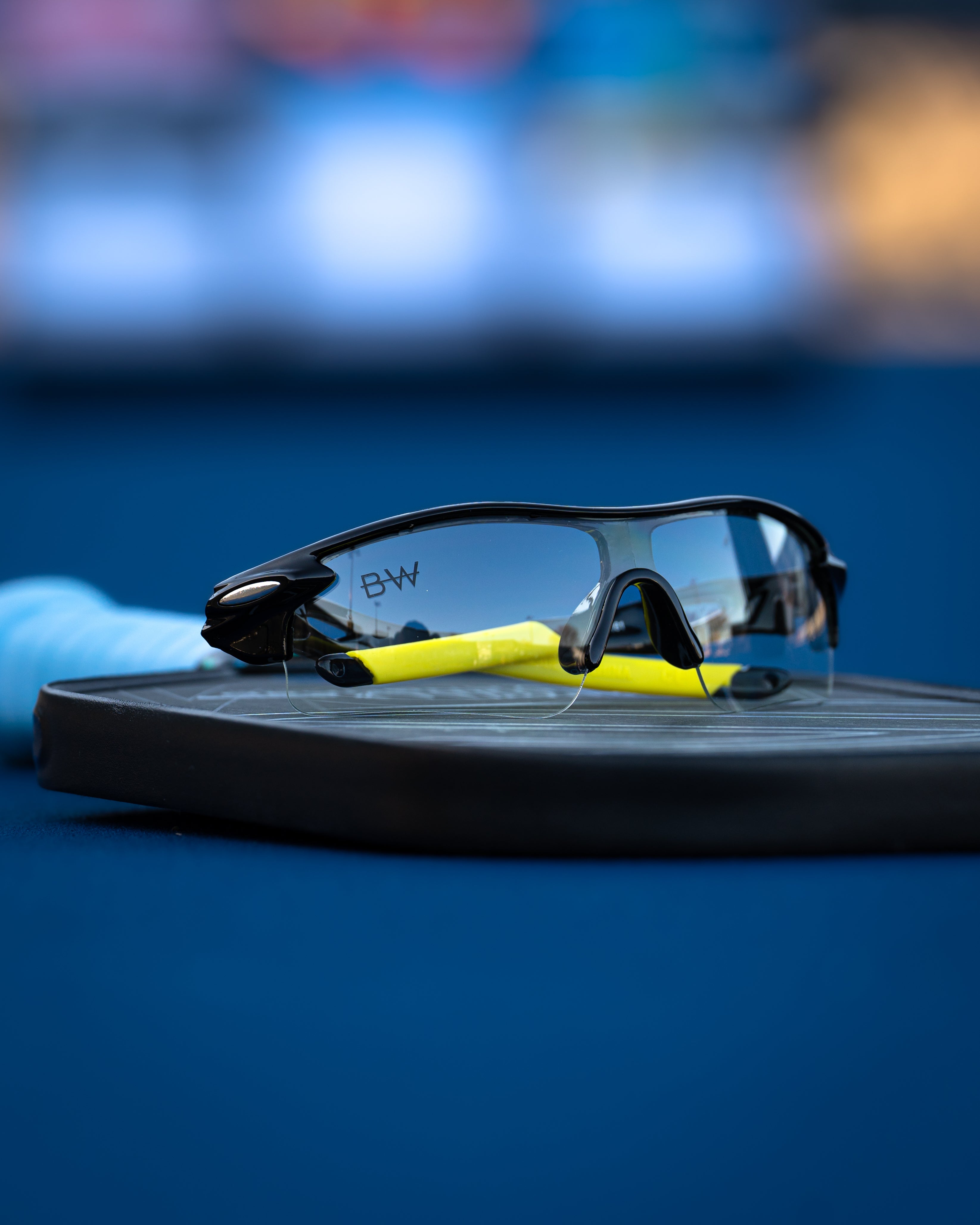
RX Glasses That Handle Overhead Smashes With No Slip
Share
RX Glasses for Overhead Smashes: How to Find a Stable Fit for Pickleball
An overhead smash puts your eyewear through one of pickleball's more demanding movements. You look upward, move underneath the ball, rotate through the shot, and accelerate your head and body—all while depending on your prescription eyewear to remain comfortable and properly positioned.
That makes frame fit important. But no pair of prescription glasses should be promised to deliver literal “zero slip” for every player. Face shape, frame dimensions, sweat, movement, and individual fit all influence how much eyewear moves during play.
The better goal is simple: choose prescription sports eyewear that fits you well enough that you're not constantly thinking about or readjusting it during overheads, volleys, serves, and fast rallies.
Find Your Pickleball Glasses
Compare prescription and non-prescription sports eyewear based on your vision needs, frame dimensions, playing environment, and individual fit.
Quick Answer: What Makes RX Glasses Better for Overhead Smashes?
For overhead-heavy pickleball, prioritize the complete fit of the frame rather than looking for a single “anti-slip” feature.
| Factor | Why It Matters |
|---|---|
| Frame dimensions | Help determine whether a frame is appropriately sized for your face |
| Bridge fit | Influences how the eyewear sits on your nose |
| Temple fit | Affects how the frame sits around the sides of your head |
| Overall weight | Contributes to how the completed pair feels during movement |
| Prescription compatibility | Ensures the selected frame can accommodate your RX requirements |
| Movement testing | Helps you evaluate the actual pair before competitive play |
No single specification guarantees that glasses will never move. Fit is a system.
Why Overhead Smashes Put Eyewear Fit to the Test
An overhead isn't a stationary shot. Depending on the rally, you may need to:
- Look upward to locate the ball
- Move backward or laterally
- Rotate your upper body
- Accelerate into the swing
- Recover quickly for the next shot
If your everyday glasses already require frequent adjustment during ordinary movement, those issues can become more noticeable during active play.
That doesn't mean standard eyewear always “fails” during pickleball. Some everyday frames may work adequately for some players. Dedicated sports-focused RX eyewear simply gives players another option when they want a frame selected specifically for active use.
Can Pickleball Glasses Really Guarantee “No Slip”?
No frame can responsibly guarantee zero movement for every face and every overhead smash.
The original version describes Blinded Wear RX eyewear as delivering “zero-slip performance” and says the frames remain secure through jumps, dives, and rapid head turns. Those claims are too absolute without product-specific testing and individual fit data.
Eyewear stability can vary with:
- Face shape
- Head size
- Nose and bridge shape
- Temple dimensions
- Frame geometry
- Perspiration
- How aggressively you move
- How the individual pair fits you
A better standard is stable, comfortable fit for the individual wearer rather than an impossible universal no-slip promise.
Frame Fit Matters More Than a “No-Slip” Label
Before buying RX sports eyewear for pickleball, compare the dimensions of the frame with eyewear that already fits you well.
Look at factors such as:
- Overall frame width
- Lens width
- Lens height
- Bridge dimensions
- Temple length
- Frame shape
A frame that's too large for one player may move more than desired, while a frame that's too tight can create pressure or discomfort. Neither extreme is ideal.
The best sports frame isn't simply the tightest frame you can wear. You're looking for a practical balance of fit, comfort, prescription compatibility, and movement stability.
Do Nose Pads Prevent RX Glasses From Sliding?
Nose and bridge design can influence how eyewear sits on your face, but don't assume every Blinded Wear model uses adjustable, grippy, or sweat-resistant nose pads unless that feature is verified for the exact product.
The original article attributes its anti-slip performance to “secure-fit nose pads” and “sweat-resistant, flexible grips.” Those characteristics shouldn't be applied across the RX collection without product-specific verification.
Instead, evaluate how the actual frame sits on your nose during normal movement.
What About Temple Fit?
The temples are another important part of the complete frame fit. They shouldn't create excessive pressure, but eyewear that feels obviously oversized or loose before you even begin playing may not be ideal for active movement.
When trying a pair, pay attention to:
- Pressure around the sides of your head
- Comfort behind the ears
- Whether the frame feels noticeably oversized
- Whether you repeatedly push the glasses back into position
- Whether normal head movement changes the frame position significantly
Those observations are more useful than relying on a generic “anti-slip” label.
Does Lightweight Eyewear Move Less During Overhead Shots?
The original article says “less weight = less bounce” and identifies Runway RX and Cold Slate RX as ultra-light options.
That's too simple. Weight is only one component of frame behavior.
A lightweight pair can be comfortable for active use, but reducing weight doesn't automatically guarantee less movement. Frame dimensions, geometry, bridge fit, temples, prescription lenses, and the wearer's face all contribute to the completed fit.
Likewise, don't describe individual RX models as “ultra-light” unless their current product specifications support that claim.
Your Prescription Still Comes First
A frame that feels stable isn't useful if it isn't appropriate for your prescription.
Before choosing RX pickleball eyewear, consider:
- Your current prescription.
- Whether the selected frame is compatible with that prescription.
- The frame dimensions and individual fit.
- The available lens configuration.
- Where you normally play.
Blinded Wear customers provide a clear photo of their eyeglass prescription before purchasing, and high-index prescription lenses are included at no additional cost.
Do High-Index RX Lenses Help Glasses Stay in Place?
Not inherently.
High-index prescription material can help manage lens thickness for some prescriptions. It shouldn't be marketed as an anti-slip technology.
High-index lenses don't automatically:
- Prevent frame movement
- Make eyewear bounce-free
- Improve ball tracking
- Improve reaction time
- Improve overhead accuracy
Their primary value is related to prescription lens construction, not securing a frame to your face.
Do Non-Polarized Lenses Improve Overhead Depth Perception?
Blinded Wear uses non-polarized lenses in its sports eyewear. That means a polarization filter isn't added.
The original article goes further by saying non-polarized lenses maintain natural depth perception and allow players to judge ball height and drop angles with “absolute precision.” That performance claim shouldn't be made.
Non-polarized lenses don't inherently guarantee:
- Better depth perception
- More accurate overheads
- Better ball-height judgment
- Faster tracking
- Better reaction time
Some court players simply prefer non-polarized sports eyewear. That's enough reason to offer it without attaching an unsupported athletic advantage.
For more context, read Depth Perception Science for Pickleball.
Are Blinded Wear RX Glasses Fog-Resistant?
Don't assume so.
The original article says each frame is ventilated to reduce fogging. Unless ventilation or anti-fog characteristics are verified for a specific model, they shouldn't be presented as collection-wide features.
Fogging can depend on:
- Temperature
- Humidity
- Perspiration
- Airflow
- Frame position
- Lens treatments
- Environmental changes
No RX frame should be described as fog-free without evidence supporting that claim.
Impact Resistance Matters—But It Isn't “Smash-Proof”
Blinded Wear sports eyewear uses impact-resistant lenses. That's relevant in an active sport where balls, paddles, falls, and accidental contact can occur.
But the original phrase “smash-proof play” overstates what impact resistance means.
Impact-resistant does not mean:
- Shatterproof
- Unbreakable
- Smash-proof
- Guaranteed to prevent injury
- Certified protective eyewear unless the applicable certification is verified
Learn more in Why Impact Resistance Matters in Sports Eyewear.
RX Pickleball Glasses to Compare for Active Play
Instead of ranking models by unsupported “no-slip” performance, compare verified RX options according to prescription compatibility, dimensions, current configuration, and fit.
| RX Model | What to Evaluate |
|---|---|
| Havana Melt RX | Prescription compatibility, frame dimensions, current configuration, individual fit |
| H Blue Shield RX | Prescription compatibility, dimensions, current lens configuration |
| Frost RX | Frame dimensions, prescription compatibility, fit |
| Ocean Wave RX | Prescription compatibility, dimensions, current configuration |
| Rocket Fire RX | Frame dimensions, prescription compatibility, individual fit |
The original article also recommends Runway RX and Cold Slate RX. Because their exact current configurations aren't established here, avoid assigning specific grip, weight, ventilation, or stability advantages to those models without verification.
Does Blue Shield RX Reduce Glare During Overhead Shots?
The original article specifically claims Blue Shield RX reduces glare from overhead lights during aggressive play.
That claim shouldn't be carried forward unless the current Blue Shield RX lens configuration has a verified glare-reduction feature.
A product name, tint, or appearance isn't enough to establish anti-glare or glare-reduction performance.
The At-Home Movement Test Before You Play
Once you receive your prescription sports glasses, test the actual fit before relying on them in a tournament.
- Put the glasses on normally. Don't intentionally overtighten or alter them just for the test.
- Look left and right. Notice whether the frame remains comfortable.
- Look upward. This begins to simulate the head position used for an overhead.
- Move through controlled athletic motions. Pay attention to frame position.
- Check for repeated adjustment. If you're constantly pushing the glasses back, reassess the fit.
- Wear them during normal practice before competition. A real session tells you more than a product label.
The goal isn't to prove that the frame literally never moves. It's to determine whether the eyewear feels stable and comfortable enough for you.
What About the “No More Slips” Player Reviews?
The original article includes named testimonials claiming Havana Melt RX never slid during jumping smashes and Cold Slate RX remained firm through difficult matches.
Only publish those quotes if the customers, purchases, statements, and permission to use them can be verified.
For this topic, useful verified customer feedback would include:
- The exact RX frame worn
- The player's approximate fit experience
- How frequently they play
- Whether they used the eyewear during overhead-heavy matches
- Whether they needed to readjust the frame
- How long they wore the pair before reviewing it
That provides meaningful real-world context without turning an individual experience into a universal no-slip guarantee.
What Actually Makes RX Glasses Work for Overhead-Heavy Play?
There isn't one magic “anti-slip formula.” A strong RX pickleball setup combines several factors:
- An appropriate prescription
- A prescription-compatible sports frame
- Frame dimensions that suit the wearer
- Comfortable bridge and temple fit
- An appropriate lens configuration
- Impact-resistant sports lenses
- Real movement testing before important matches
If you're repeatedly adjusting your glasses every time you look up for an overhead, that's a fit problem worth addressing. But the solution is finding eyewear that fits you well—not believing a frame can universally guarantee “zero slip.”
FAQ: RX Glasses for Overhead Smashes and Active Pickleball
How do I keep prescription glasses from slipping during overhead smashes?
Start with the complete fit rather than a single anti-slip feature. Frame dimensions, bridge fit, temple fit, prescription lenses, perspiration, and your individual face shape can all affect how eyewear behaves during movement. Test the completed pair during practice before relying on it in competition.
Can RX pickleball glasses guarantee zero slip?
No. No frame should be universally promised to remain completely motionless on every player. A better goal is a comfortable, stable fit that doesn't require constant readjustment during normal play.
Should my sports glasses fit tighter than my regular glasses?
Not necessarily. Excessive tightness can create pressure and discomfort. Look for a balanced fit that feels stable during movement without uncomfortable pressure around your nose, temples, or ears.
Why do my glasses move when I look up for an overhead?
Looking upward changes your head position and can expose an existing fit issue. Frame dimensions, bridge fit, temples, perspiration, and overall geometry may all contribute. Repeated movement is worth evaluating, but it doesn't automatically identify one specific cause.
Do lightweight RX glasses stay on better?
Not automatically. Weight contributes to how eyewear feels, but lightweight construction doesn't guarantee less movement. The complete frame-and-lens setup matters.
Do non-polarized lenses improve overhead tracking?
Non-polarized simply means a polarization filter isn't added. Blinded Wear uses non-polarized sports lenses, but they shouldn't be promised to improve depth perception, tracking, reaction time, or overhead accuracy.
Are Blinded Wear RX glasses impact-resistant?
Blinded Wear sports eyewear uses impact-resistant lenses. Impact-resistant doesn't mean shatterproof, unbreakable, or certified protective eyewear unless an applicable certification is separately verified.
Are Blinded Wear RX glasses anti-fog?
Don't assume anti-fog performance across the collection unless that feature is verified for the exact lens or product. Fogging can depend on environmental conditions, airflow, perspiration, frame position, and lens treatments.
Can I wear progressive RX glasses for pickleball?
Progressive prescriptions may be compatible with some sports-eyewear configurations, but compatibility depends on the prescription, lens design, measurements, and frame. Confirm the exact configuration before ordering.
What if I have a strong prescription?
Start with prescription compatibility. Blinded Wear includes high-index prescription lenses at no additional cost, which can help manage lens thickness for some prescriptions. High-index material doesn't guarantee that every prescription works in every frame.
Should I practice in new RX glasses before a tournament?
Yes. Practice gives you an opportunity to evaluate comfort, frame position, prescription experience, and movement through serves, volleys, groundstrokes, and overheads before competition.
Overhead Smash Eyewear Myths vs. Reality
| Claim | Reality |
|---|---|
| “Sports glasses never slip.” | Fit varies by wearer, frame, movement, and conditions. |
| “Tighter always means better.” | Excessive tightness can create discomfort. |
| “Lightweight means bounce-free.” | Weight is only one part of the complete fit. |
| “Non-polarized improves depth perception.” | Non-polarized means no polarization filter is added; better depth isn't guaranteed. |
| “High-index lenses prevent slipping.” | High-index primarily relates to prescription lens construction. |
| “Impact-resistant means smash-proof.” | Impact-resistant eyewear can still be damaged. |
| “Every sports frame is anti-fog.” | Anti-fog performance must be verified separately. |
| “The most wrapped frame is automatically best.” | Prescription compatibility and individual fit matter more than appearance alone. |
Which RX Setup Makes Sense for Your Playing Situation?
| Player | What to Prioritize |
|---|---|
| Frequent overhead attacker | Individual frame fit and movement testing |
| Indoor player | RX compatibility, fit, and an appropriate available lens configuration |
| Outdoor player | RX compatibility, fit, and an appropriate outdoor lens configuration |
| Strong prescription | Prescription compatibility, frame dimensions, and lens thickness considerations |
| Progressive wearer | Progressive compatibility and appropriate optical measurements |
| Tournament player | Proven fit, comfort, storage, and backup RX planning |
| Player who constantly adjusts glasses | Reassess frame dimensions and complete fit |
The Overhead Smash Fit Test
Before deciding that a pair is ready for competitive pickleball, put it through a controlled movement test.
- Start stationary. Make sure the eyewear feels comfortable in your normal ready position.
- Look upward. Simulate locating a lob without making sudden movements.
- Move underneath an imaginary ball. Add controlled backward and lateral movement.
- Perform a controlled overhead motion. Notice the position of the eyewear before and after the swing.
- Recover into ready position. Pay attention to whether you instinctively adjust the frame.
- Repeat during real practice. One movement isn't enough to evaluate a pair you may wear for hours.
If you repeatedly have to reposition the frame, that information is more valuable than a product description promising “no slip.”
Evaluate Fit Late in the Match, Too
A frame that feels comfortable for five minutes may feel different later in a long session.
When testing RX sports eyewear, evaluate it:
- At the beginning of play
- After you've started sweating
- After repeated overheads
- During rapid changes of direction
- After an extended playing session
This gives you a more realistic picture of the fit than putting the glasses on briefly at home.
What Matters Most for Stable RX Pickleball Eyewear?
For players worried about glasses moving during overheads, prioritize these factors in order:
- Prescription compatibility — the eyewear must work with the correction you need.
- Appropriate frame dimensions — compare measurements with eyewear that already fits.
- Bridge and temple fit — evaluate how the complete frame sits on your face.
- Comfort — secure shouldn't mean painfully tight.
- Movement testing — practice in the actual pair.
- Playing environment — select an appropriate available lens configuration.
- Backup planning — particularly if you can't play comfortably without prescription correction.
RX Pickleball Frames to Compare
Rather than declaring one model “best for smashes,” compare current RX frames according to your prescription, dimensions, and fit.
| RX Model | Useful Comparison |
|---|---|
| Havana Melt RX | Prescription compatibility, frame dimensions, current configuration |
| H Blue Shield RX | Prescription compatibility, dimensions, current lens configuration |
| Frost RX | Frame dimensions, prescription compatibility, individual fit |
| Ocean Wave RX | Prescription compatibility, frame dimensions, current configuration |
| Rocket Fire RX | Frame dimensions, prescription compatibility, individual fit |
| Silver Line RX | Prescription compatibility, dimensions, current specifications |
No model in this comparison should be interpreted as universally more secure than another without product-specific testing and individual fit information.
How to Evaluate Reviews About “No-Slip” Sports Glasses
A customer saying a frame stayed in place for them can be useful information—but it's still an individual fit experience.
When reading reviews, look for context:
- Which exact frame was worn?
- Was the reviewer using prescription lenses?
- How long did they play?
- Were they playing indoors or outdoors?
- Did they specifically test overheads and rapid movement?
- Did they describe their fit experience rather than making universal performance claims?
Even a verified review saying “these didn't move on me” shouldn't be rewritten as “these glasses never slip.”
What If Your RX Glasses Break During Aggressive Play?
Sports eyewear can still break. If your Blinded Wear pair is damaged, keep the broken eyewear and review the current replacement-support terms.
Blinded Wear offers 50% lifetime replacement support for eligible broken eyewear, subject to current policy terms.
This doesn't mean the eyewear is indestructible, and it doesn't guarantee that every type of damage, loss, or wear qualifies.
How to Choose and Order RX Glasses for Pickleball
- Start with your current eyeglass prescription.
- Browse prescription sports frames.
- Compare frame dimensions.
- Confirm prescription compatibility.
- Review currently available lens configurations.
- Provide a clear photo of your eyeglass prescription before purchasing.
- Test the completed pair during normal practice.
Blinded Wear includes high-index prescription lenses at no additional cost with its RX eyewear and uses non-polarized, impact-resistant sports lenses.
Overhead-Smash RX Buying Checklist
- Is my prescription current?
- Is this frame compatible with my prescription?
- Have I checked the frame dimensions?
- How does the size compare with glasses that already fit me?
- Does the bridge feel comfortable?
- Do the temples feel secure without excessive pressure?
- Have I tested the eyewear while looking upward?
- Have I practiced overheads in the actual pair?
- Does the frame still feel comfortable later in a session?
- Am I repeatedly adjusting it?
- Is the lens configuration appropriate for where I play?
- Would a backup RX pair be useful for tournaments?
Related RX Pickleball Guides
Final Verdict: The Best RX Glasses for Overhead Smashes Are the Ones That Fit You
An overhead smash demands movement, but that doesn't mean you need eyewear marketed with an absolute “zero-slip” promise.
What you need is prescription sports eyewear that fits your face, works with your RX, remains comfortable during active movement, and doesn't require constant adjustment.
Blinded Wear RX eyewear is designed for pickleball players and combines prescription correction with sports-focused frames, non-polarized lenses, impact-resistant lenses, and high-index prescription lenses at no additional cost.
But individual fit still matters. No frame shape, lens material, nose design, or marketing term can guarantee that the same pair will remain perfectly motionless on every player.
So test the things that actually matter: prescription compatibility, dimensions, bridge fit, temple fit, comfort, and real movement during practice.
If you can track a lob, move underneath it, complete your overhead, recover for the next ball, and continue playing without repeatedly thinking about your glasses, you've found a much more meaningful measure of fit than “no slip.”