
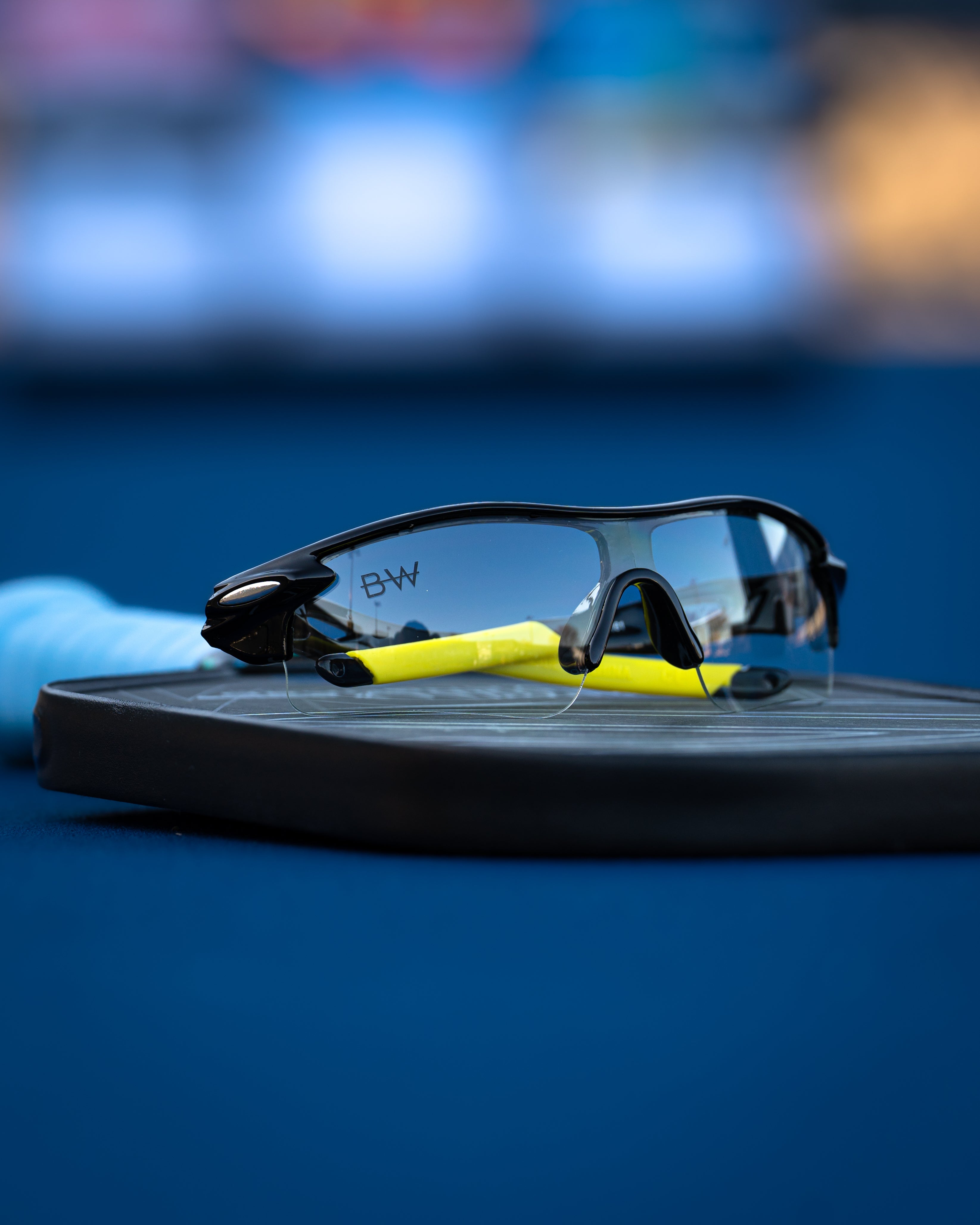
The Best Blinded RX Glasses for Intermediate Players
Share
The Best Blinded RX Glasses for Intermediate Pickleball Players
Intermediate pickleball players are often at the stage where equipment choices become more intentional. You're playing more consistently, developing preferred strategies, entering longer sessions or tournaments, and learning what actually feels comfortable on court.
If you need prescription correction, that can make a dedicated pair of RX pickleball glasses worth considering. But there isn't one Blinded Wear frame that's automatically “best” for every intermediate player.
Your prescription compatibility, frame dimensions, playing environment, lens configuration, and personal fit matter more than your skill rating alone. This guide compares several Blinded Wear RX options and explains how an intermediate player can narrow the collection without relying on unsupported promises about reaction time, ball tracking, or court performance.
Compare Pickleball Glasses
Quick Comparison: RX Glasses for Intermediate Players
Instead of ranking frames by unverified performance benefits, use this shortlist as a starting point and then verify your prescription and preferred configuration.
| RX Model | Why Compare It | What to Verify |
|---|---|---|
| Crystal Wave II RX | Another RX frame option for players comparing sports-focused designs | Prescription compatibility, dimensions, current lens configuration, fit |
| Frost RX | A dedicated RX model to compare for regular pickleball use | Prescription compatibility, dimensions, current lens configuration |
| Ocean Wave RX | Useful comparison for players considering another frame shape and style | Frame dimensions, RX compatibility, lens configuration, fit |
| H Blue Shield RX | Another current RX option for building a shortlist | Prescription compatibility, frame dimensions, current configuration |
| Lava Rock RX | Alternative RX design for comparing style and physical fit | Prescription compatibility, dimensions, lens configuration |
What Should an Intermediate Pickleball Player Look for in RX Glasses?
Your skill level doesn't create a special prescription requirement. An intermediate player doesn't need a fundamentally different prescription lens simply because they're improving at pickleball.
Instead, this stage often makes practical eyewear considerations more noticeable because you may be playing more frequently.
Prioritize:
- Correct prescription: the eyewear first needs to provide the correction you require
- Prescription compatibility: not every frame necessarily supports every RX configuration
- Physical fit: compare actual frame dimensions rather than assuming a sports frame will fit securely
- Playing environment: indoor, outdoor, evening, and changing-light play can call for different lens preferences
- Impact-resistant lenses: evaluate actual lens construction rather than frame appearance alone
- Comfort: especially relevant as sessions and tournament days become longer
RX Glasses Don't Replace Intermediate-Level Court Skills
The previous version of this article focused heavily on reading paddle angles and suggested RX eyewear could amplify shot awareness, reaction time, paddle-edge perception, and strategic decision-making. :chatgpt-content-reference{index="0"}
That gives prescription eyewear too much credit.
Correcting your vision can help you see according to your prescription, but RX glasses shouldn't be marketed as a shortcut to intermediate or advanced pickleball skills.
Skills such as these still come from practice and experience:
- Reading an opponent's paddle position
- Anticipating shot direction
- Recognizing patterns
- Controlling your own paddle angle
- Positioning at the kitchen
- Choosing when to attack
- Improving reaction and decision-making
The job of prescription eyewear is to provide the correction you require—not to manufacture better court awareness.
1. Start With Your Prescription
Before comparing frame colors, lens tints, or sports styling, determine what your prescription requires.
Important considerations can include:
- Prescription strength
- Astigmatism correction
- Single vision vs. multifocal requirements
- Frame and lens compatibility
- Any other requirements specific to your prescription
Blinded Wear customers provide a clear photo of their eyeglass prescription before purchasing.
If you're unsure which type of prescription correction you require, that decision should come from your eye-care professional rather than your pickleball skill level.
2. Understand What High-Index Lenses Actually Do
Blinded Wear RX eyewear includes high-index prescription lenses at no additional cost.
The original article described an exact 1.61 index as eliminating distortion, improving visual acuity, and maintaining crisp paddle edges during rapid gaze changes. :chatgpt-content-reference{index="1"} Those performance claims shouldn't be inferred from high-index material.
High-index lenses don't inherently:
- Improve reaction time
- Improve ball tracking
- Improve paddle-angle recognition
- Eliminate all optical distortion
- Improve depth perception
- Increase court awareness
Think of high-index as a prescription-lens material consideration—not a pickleball performance technology.
3. Understand Blinded Wear's Non-Polarized Lenses
Blinded Wear sports eyewear uses non-polarized lenses.
The old article argued that polarization flattens visual depth and that non-polarized lenses preserve details needed to read paddle angles. :chatgpt-content-reference{index="2"} That shouldn't be treated as an established performance advantage.
Non-polarized simply means an added polarization filter isn't present.
Some court players prefer non-polarized eyewear, but it doesn't inherently:
- Improve depth perception
- Improve paddle recognition
- Improve ball tracking
- Improve spin recognition
- Increase reaction speed
It's a lens characteristic and preference—not a guarantee of better pickleball.
4. Match Your Lens Configuration to Where You Play
Intermediate players often begin playing in a wider variety of environments—recreational games, leagues, indoor facilities, outdoor courts, and tournaments.
That's where lens configuration can become an important practical consideration.
| Environment | What to Consider |
|---|---|
| Indoor | A clear or other appropriate configuration if you don't want a conventional dark sunglass tint |
| Outdoor daylight | Compare available tinted configurations and documented lens specifications |
| Evening / lower light | Consider whether a lighter or clear configuration better suits your preference |
| Changing conditions | Consider available configurations, a backup pair, or photochromic options when verified for the exact product |
The old article described clear, gray, and transitional lenses as though each automatically delivered a particular pickleball benefit. :chatgpt-content-reference{index="3"} Tint changes the visual appearance and amount/type of light reaching the eye, but it shouldn't automatically be translated into improved tracking, contrast, or reactions.
5. Prioritize Impact-Resistant Lens Construction
As you play more frequently, it's reasonable to pay closer attention to the physical construction of your sports eyewear.
Blinded Wear sports eyewear uses impact-resistant lenses.
However, impact-resistant doesn't automatically mean:
- Shatterproof
- Indestructible
- Certified protective eyewear
- Compliant with an unspecified ANSI or ASTM standard
- Guaranteed to prevent an eye injury
If you require a particular protective certification, verify that certification for the exact product.
Learn more in Why Impact Resistance Matters in Sports Eyewear.
6. Don't Assume “Sports Frame” Means Secure Fit
Fit is individual.
The previous article attributed anti-slip properties, secure grip zones, wraparound stability, and minimal movement to several frames. :chatgpt-content-reference{index="4"} Those characteristics shouldn't be assumed without verification for the exact product.
Instead, compare:
- Overall frame width
- Bridge dimensions
- Temple length
- Frame shape
- How similar dimensions fit you now
A frame that fits one intermediate player perfectly may be uncomfortable or poorly sized for another.
Crystal Wave II RX: One Option to Compare
Crystal Wave II RX can be included on an intermediate player's shortlist when comparing prescription sports eyewear.
The older article described Crystal Wave II RX as providing enhanced field of view, transitional adaptability, stable movement, and improved paddle-angle tracking. :chatgpt-content-reference{index="5"} Those claims shouldn't be assumed from the frame itself.
Instead, evaluate Crystal Wave II RX according to:
- Your prescription compatibility
- Current lens configuration
- Frame dimensions
- Frame shape
- Your fit preferences
- Your primary playing environment
Frost RX: Another Pickleball RX Option
Frost RX is another current Blinded Wear prescription frame worth comparing if you're building a dedicated pickleball setup.
The previous article described Frost RX as anti-slip, exceptionally lightweight, fog-free, and specifically useful for angle tracking. :chatgpt-content-reference{index="6"} Those characteristics shouldn't be treated as verified collection-wide performance promises.
Instead, compare Frost RX based on:
- Prescription compatibility
- Frame dimensions
- Current lens configuration
- Physical fit
- Where you expect to use it
Don't Limit Your Search to Two Frames
Intermediate players don't need to buy whichever model is labeled the “best.” Your strongest option may simply be the frame that works with your prescription and fits your preferences.
Other RX models worth comparing include:
Browse the complete RX Pickleball Glasses Collection before deciding.
What About Zebra II RX?
The original article prominently recommended Zebra II RX and attributed a wide field of view, secure rubberized temple tips, improved ball detail, lateral stability, and better paddle recognition to the model. :chatgpt-content-reference{index="7"}
Those exact characteristics aren't established strongly enough here to use them as current buying claims.
If Zebra II RX is currently available, evaluate the current product configuration directly rather than relying on the older performance description.
The 3 Biggest Priorities for an Intermediate RX Player
1. Correct Vision
Your prescription correction comes first. Eyewear can't help you play comfortably if the frame and lenses aren't appropriate for your actual RX needs.
2. Comfortable, Appropriate Fit
As your weekly playing volume increases, a frame you can comfortably wear for full sessions becomes more valuable than exaggerated performance claims.
3. The Right Configuration for Your Courts
Think about where you actually play. Someone playing primarily indoors may shop differently from a player spending several afternoons each week outdoors.
Those three considerations are more useful than searching for glasses that promise to “see the angle and play the angle.” The previous article ultimately positioned its featured frames as directly enhancing performance and court awareness. :chatgpt-content-reference{index="8"} Prescription eyewear should instead be evaluated as eyewear first and sports equipment second.
How Intermediate Players Should Think About Eyewear
As an intermediate player, you're probably becoming more consistent with fundamentals while developing a more complete game. That can mean longer rallies, more intentional positioning, more frequent play, and greater awareness of what equipment feels comfortable over a full session.
RX eyewear can provide the prescription correction you need while giving you a dedicated sports pair, but it shouldn't be treated as something that moves you from intermediate to advanced.
The original article connected clearer vision with greater shot confidence, tighter angles, better doubles teamwork, faster on-court IQ, and fewer missed opportunities. :chatgpt-content-reference{index="0"} Those outcomes depend on far more than eyewear.
A better goal is straightforward: find prescription eyewear that meets your vision needs without becoming an unnecessary distraction while you play.
Does Playing More Often Make Dedicated RX Glasses Worth It?
Potentially. The more often you play, the easier it can be to justify keeping a dedicated pair of prescription sports glasses rather than relying exclusively on everyday eyewear.
| Playing Frequency | What to Consider |
|---|---|
| Occasional recreational play | Whether your existing prescription eyewear already meets your needs |
| Several sessions per week | Whether a dedicated sports pair would be useful for convenience and regular use |
| League play | Fit, prescription compatibility, lens configuration, and having eyewear available specifically for court use |
| Tournaments | Long-session comfort, playing environment, prescription needs, and potentially carrying a backup pair |
Your rating isn't what makes dedicated RX eyewear valuable. How frequently you play and how much you rely on prescription correction are more practical considerations.
Dedicated RX Pickleball Glasses vs. Everyday Prescription Glasses
You don't automatically need separate glasses for pickleball. Many players can use everyday prescription eyewear if it provides the correction and fit they need.
A dedicated sports pair can still make sense if you want eyewear specifically reserved for court use.
| Consideration | Everyday RX Glasses | Blinded Wear RX Sports Glasses |
|---|---|---|
| Prescription correction | According to your prescription | According to your compatible prescription |
| Primary purpose | General everyday use | Sports-focused eyewear |
| Impact resistance | Depends on the exact lenses | Impact-resistant lenses |
| Polarization | Depends on configuration | Non-polarized |
| High-index RX | Depends on provider and configuration | High-index prescription lenses included at no additional cost |
| Fit during movement | Depends on individual fit | Still depends on individual fit |
RX Sports Glasses vs. Contacts + Non-RX Eyewear
Intermediate players who use prescription correction may also be deciding between RX sports glasses and contacts paired with non-prescription pickleball eyewear.
Neither setup is universally better.
| Setup | Potential Advantage | Consideration |
|---|---|---|
| RX sports glasses | Prescription correction is built into the eyewear | The chosen frame must support your prescription |
| Contacts + non-RX sports glasses | Provides access to additional non-RX frame choices | Depends on whether you can and want to wear contacts |
| Everyday prescription glasses | No additional sports pair required | May not be your preferred option for regular athletic use |
If you're already comfortable in contacts, you don't need to abandon them simply because you're becoming a more serious pickleball player. Likewise, players who prefer glasses can consider a dedicated RX pair without assuming contacts are necessary for competitive play.
What If You Wear Progressive Lenses?
Don't assume every Blinded Wear RX frame supports every progressive prescription.
The original article stated that all Blinded RX frames support progressive lenses with the same optical performance. :chatgpt-content-reference{index="1"} That blanket claim is too broad.
If you require progressives, confirm compatibility with the exact frame and your individual prescription before purchasing.
Your pickleball skill level doesn't determine whether you need progressives. That choice should follow your actual prescription requirements.
What If You Have a Strong or Complex Prescription?
A stronger prescription doesn't prevent you from considering sports eyewear, but it makes exact compatibility more important.
Factors that may need to be considered include:
- Prescription power
- Cylinder and axis requirements
- Lens dimensions
- Frame shape and curvature
- Single vision or multifocal requirements
- Other prescription-specific needs
Don't choose a frame solely because it's marketed toward intermediate or competitive players. Confirm that it actually works with your prescription first.
Clear RX Glasses for Indoor Intermediate Players
If most of your games are indoors or in lower-light environments, you may prefer a configuration without a conventional dark sunglass tint.
Clear lenses can be useful for that purpose, but they don't inherently:
- Increase available light
- Improve ball tracking
- Increase contrast
- Improve reaction time
- Improve depth perception
The goal is simply to choose a lens configuration appropriate for the environment and your preferences.
Players who don't need prescription correction can also compare the Clear Lens Pickleball Eyewear Collection.
Tinted RX Glasses for Outdoor Intermediate Players
If you primarily play outdoors, compare the current tinted RX configurations available for the frame you're considering.
Don't assume a darker or colored tint automatically improves pickleball performance. The previous article associated gray and transitional configurations with specific visual advantages and paddle-recognition benefits. :chatgpt-content-reference{index="2"}
Instead, evaluate:
- How bright your normal courts are
- Your personal tint preference
- Whether conditions change significantly during play
- The exact lens specifications
- Any documented UV specifications for that lens
Lens tint should make sense for your environment rather than being chosen because of an unsupported promise about seeing the ball sooner.
What About Photochromic RX Lenses?
Photochromic lenses change tint in response to environmental conditions. They can be convenient for some players who move between different lighting environments.
However, photochromic availability should be confirmed for the exact RX product you're considering.
Photochromic lenses shouldn't automatically be described as:
- Instantly changing tint
- Improving ball tracking
- Improving contrast
- Improving reaction time
- Anti-fog
- Scratch-resistant
- Polarized
If you're considering this configuration, compare its actual specifications rather than assuming “adaptive” means better athletic performance.
Do Intermediate Players Need Wraparound RX Glasses?
No. A wraparound frame isn't required as you become a better pickleball player.
The old article repeatedly connected wraparound styling and wider lens shapes with improved field of view, lateral vision, paddle awareness, and stability. :chatgpt-content-reference{index="3"} :chatgpt-content-reference{index="4"}
A curved frame can provide a different shape and potentially additional physical side coverage, but that doesn't inherently improve your biological peripheral vision or court awareness.
Choose wraparound, semi-wrap, or less-curved RX frames according to prescription compatibility, fit, and preference.
Fogging During Longer Pickleball Sessions
As your sessions get longer and more intense, fogging may become a practical concern. But no RX frame should be called fog-free unless that characteristic is supported for the exact configuration.
Fogging can be affected by:
- Temperature
- Humidity
- Perspiration
- Airflow
- Frame position
- Actual lens treatments
High-index, non-polarized, clear, tinted, or progressive lenses aren't inherently anti-fog.
The old Frost RX testimonial claimed “no fog, no slip,” but an individual quote—especially without documented verification—shouldn't become a product-wide guarantee. :chatgpt-content-reference{index="5"}
What About the “Real Player” Reviews?
The original article included named testimonials for Crystal Wave II RX, Frost RX, and Zebra II RX that attributed better paddle tracking, stability, clarity, and shot placement to those products. :chatgpt-content-reference{index="6"} :chatgpt-content-reference{index="7"} :chatgpt-content-reference{index="8"}
Unless those quotes come from documented customers and are approved for publication, they shouldn't be presented as real customer reviews.
Even verified reviews are individual experiences rather than proof that a frame will improve another player's performance.
For an intermediate player, product dimensions, prescription compatibility, lens specifications, and your own fit are stronger buying criteria than an anecdotal performance claim.
A Better Way to Test New RX Pickleball Glasses
The old article proposed a paddle-angle drill and stated that all three featured frames passed it with a stable view regardless of movement. :chatgpt-content-reference{index="9"} Without standardized testing, that shouldn't be presented as a verified product result.
You can still use normal practice sessions to evaluate how new prescription eyewear feels for you.
- Wear the glasses during an ordinary warm-up.
- Hit forehands and backhands from different areas of the court.
- Practice dinks, volleys, serves, and returns.
- Notice whether the prescription feels appropriate and familiar.
- Pay attention to physical comfort as the session continues.
- Check whether the frame position remains comfortable during normal movement.
- Become familiar with the eyewear before relying on it during an important tournament.
This tests your experience with the glasses without claiming that the eyewear itself improves paddle awareness or shot placement.
Should Intermediate Tournament Players Carry a Backup RX Pair?
If you rely on prescription correction to see clearly, carrying a backup pair can become increasingly useful as you start playing leagues, tournaments, or longer sessions away from home.
A backup pair can help if your primary eyewear is lost or damaged during the day.
The backup doesn't need to promise identical “visual cues” or performance characteristics, as the original guide suggested. :chatgpt-content-reference{index="10"} It simply needs to provide appropriate prescription correction and be suitable for how you intend to use it.
8 RX Eyewear Mistakes Intermediate Players Should Avoid
- Buying based on skill level alone. “Intermediate” doesn't determine your prescription or frame fit.
- Choosing a frame before confirming RX compatibility. Your prescription comes first.
- Assuming a tint improves tracking. Tint doesn't automatically create a pickleball performance advantage.
- Assuming non-polarized means better depth perception. Polarization status alone doesn't establish that benefit.
- Assuming a sports frame won't slip. Fit remains individual.
- Treating impact-resistant as shatterproof. Those aren't equivalent claims.
- Believing unverified testimonials. Use documented product characteristics to make the decision.
- Ignoring a backup pair before tournaments. If you depend on prescription correction, redundancy can be practical.
How to Choose Your Blinded Wear RX Glasses
Use this order to narrow the collection:
- Start with your prescription. Know what correction you actually require.
- Confirm compatibility. Make sure the exact frame can support your prescription.
- Compare dimensions. Use glasses that already fit you as a reference.
- Consider where you play. Indoor, outdoor, evening, and mixed conditions can influence your lens preference.
- Review current lens specifications. Don't rely on assumptions based on tint or frame appearance.
- Compare several RX models. Don't assume the first frame labeled “best” is automatically right for you.
- Consider a backup. Especially if you're beginning to travel or compete more often.
For most intermediate players, that's a more useful buying process than trying to find eyewear that promises faster reactions or better paddle-angle recognition.
Frequently Asked Questions About RX Glasses for Intermediate Pickleball Players
What are the best Blinded Wear RX glasses for intermediate pickleball players?
There isn't one model that's automatically best for every intermediate player. Crystal Wave II RX, Frost RX, Ocean Wave RX, H Blue Shield RX, Lava Rock RX, Phantom II RX, and Rocket Fire RX are among the options worth comparing. Start with prescription compatibility, then compare frame dimensions, current lens configuration, fit, and where you normally play.
Do intermediate pickleball players need prescription sports glasses?
Not necessarily. If you require prescription correction, dedicated RX sports eyewear can be worth considering as you begin playing more frequently. But your skill rating alone doesn't create a need for separate sports glasses.
Can RX pickleball glasses improve my reaction time?
Prescription eyewear can provide the correction you require, but it shouldn't be expected to make your athletic reactions inherently faster. Reaction time also involves anticipation, decision-making, experience, and physical movement.
Can prescription glasses help me read an opponent's paddle angle?
Correct prescription eyewear can help you see according to your prescription, but no frame should be assumed to improve paddle-reading ability. Recognizing paddle position and anticipating shots are skills developed through practice and experience.
Are non-polarized lenses better for intermediate pickleball players?
Blinded Wear sports eyewear uses non-polarized lenses, and some court players prefer them. However, non-polarized construction doesn't inherently improve depth perception, reaction time, ball tracking, or paddle recognition.
Do Blinded Wear RX glasses include high-index lenses?
Yes. Blinded Wear RX eyewear includes high-index prescription lenses at no additional cost. High-index describes a prescription lens material characteristic and shouldn't be interpreted as a guarantee of improved pickleball performance.
Are Blinded Wear RX lenses impact-resistant?
Yes. Blinded Wear sports eyewear uses impact-resistant lenses. Impact-resistant doesn't automatically mean shatterproof, indestructible, or certified to a particular protective standard.
Should intermediate players use clear or tinted RX glasses?
Choose according to your playing environment and preferences rather than skill level. Clear eyewear may be useful when you don't want a conventional dark tint, while outdoor players may prefer one of the available tinted configurations. Neither automatically improves tracking or reaction time.
Are photochromic lenses good for intermediate players?
They may be convenient for players moving through changing lighting conditions, provided they're available for the exact RX frame and prescription configuration you need. Photochromic technology shouldn't automatically be associated with improved contrast, tracking, or reactions.
Do I need wraparound RX glasses as I become a better player?
No. Wraparound styling isn't a requirement for intermediate or advanced pickleball. Choose frame curvature according to prescription compatibility, dimensions, fit, coverage preference, and comfort.
Can I use my everyday prescription glasses for pickleball?
Potentially. Some players use everyday prescription glasses successfully. A dedicated sports pair can be useful if you want eyewear specifically for court use, but it isn't mandatory simply because you've reached an intermediate level.
Can intermediate players wear progressive RX glasses?
Potentially. Progressive compatibility should be confirmed for your exact prescription and frame. Your pickleball rating doesn't determine whether you require progressive lenses.
Should I carry backup prescription glasses to a tournament?
If you rely on prescription correction, a backup pair can be practical in case your primary eyewear is lost or damaged during a long tournament day.
Blinded Wear RX Comparison for Intermediate Players
Use this table as a shortlist rather than a performance ranking:
| RX Model | Good Reason to Compare It | What Matters Before Buying |
|---|---|---|
| Crystal Wave II RX | Another sports-focused RX frame option | RX compatibility, dimensions, current lens configuration, fit |
| Frost RX | Dedicated RX pickleball model to include in your comparison | RX compatibility, dimensions, current configuration |
| Ocean Wave RX | Alternative frame shape and style | RX compatibility, frame dimensions, lens configuration |
| H Blue Shield RX | Additional current RX option for building a shortlist | RX compatibility, dimensions, current configuration |
| Lava Rock RX | Alternative RX design and styling | RX compatibility, dimensions, current lens configuration |
| Phantom II RX | Another RX frame to compare before narrowing your selection | Prescription compatibility, dimensions, fit, configuration |
| Rocket Fire RX | Additional prescription sports frame option | RX compatibility, dimensions, current lens configuration |
Calling one of these the universal “best intermediate frame” would create an artificial ranking. Your prescription and fit provide a stronger basis for the decision.
Intermediate Pickleball Eyewear Myths
| Claim | What to Know |
|---|---|
| “Intermediate players need more advanced lenses” | Your prescription and environment determine your lens needs, not your rating |
| “RX glasses improve paddle-angle recognition” | Prescription correction shouldn't be turned into a court-reading performance claim |
| “High-index lenses improve reaction time” | High-index describes lens material, not athletic reaction speed |
| “Non-polarized lenses preserve better depth perception” | Polarization status alone doesn't establish improved depth perception |
| “Wraparound frames improve peripheral vision” | They may provide additional physical coverage, but don't inherently improve biological peripheral vision |
| “Clear lenses improve indoor tracking” | Clear lenses avoid a conventional dark tint but don't inherently improve tracking |
| “Tinted lenses automatically increase contrast” | Don't assume a performance benefit from tint color alone |
| “Better eyewear will move you from intermediate to advanced” | Skill development still comes from practice, strategy, movement, technique, and experience |
What Changes as You Move From Intermediate to Advanced?
Your pickleball skills may change dramatically. Your prescription requirements don't automatically change with them.
As you improve, you may:
- Play more frequently
- Enter more leagues or tournaments
- Travel to play
- Spend longer periods on court
- Play in a wider variety of environments
- Become more particular about equipment comfort
Those changes can make dedicated sports eyewear more valuable to you, but they don't mean you need an “advanced” prescription lens.
The original article connected the progression toward advanced play with sharper reads, better angle recognition, improved reactions, and greater court awareness from RX eyewear. :chatgpt-content-reference{index="0"} Those are primarily player-development outcomes rather than characteristics that should be promised by prescription glasses.
Are Dedicated RX Pickleball Glasses Worth It for Intermediate Players?
They can be—particularly if you require prescription correction and play often enough to value a dedicated sports pair.
They may make the most practical sense if you:
- Play multiple times per week
- Depend on prescription correction
- Want to keep your everyday glasses separate from sports use
- Are beginning to enter leagues or tournaments
- Want impact-resistant prescription sports lenses
- Have found a frame compatible with your prescription and dimensions
They may be less necessary if you only play occasionally and your existing prescription eyewear already meets your needs comfortably.
The value comes from having appropriate prescription sports eyewear—not from expecting glasses to create a higher pickleball rating.
How to Order Blinded Wear RX Pickleball Glasses
A practical buying process is:
- Have your current eyeglass prescription available.
- Browse the RX Pickleball Glasses Collection.
- Choose several frames you like rather than relying on one universal “best” model.
- Confirm prescription compatibility for the exact frame.
- Compare frame dimensions with glasses that already fit you.
- Review the current lens configuration for your playing environment.
- Provide a clear photo of your eyeglass prescription before purchasing.
If you're unsure about the type of prescription correction you require, consult your eye-care professional rather than choosing based on your pickleball skill level.
Replacement Support for Your RX Eyewear
Blinded Wear provides 50% lifetime replacement support for eligible eyewear that breaks, subject to current policy terms.
This shouldn't be interpreted as free lifetime replacement, coverage for every cosmetic issue, or a guarantee against damage.
Review the current Protection Plan & Returns before purchasing.
Intermediate Player RX Checklist
Before choosing your glasses, ask yourself:
- What prescription correction do I actually need?
- Is the exact frame compatible with my prescription?
- Do its dimensions match eyewear that fits me well?
- Will I primarily play indoors, outdoors, or both?
- What current lens configurations are available?
- Am I relying on verified specifications rather than performance marketing?
- Do I play frequently enough to want a dedicated sports pair?
- Would a backup RX pair be useful for tournaments or travel?
More Guides for Choosing RX Pickleball Glasses
Final Verdict: The Best Blinded RX Glasses for Intermediate Players
There isn't one Blinded Wear RX frame that's automatically best for every intermediate pickleball player.
Crystal Wave II RX, Frost RX, Ocean Wave RX, H Blue Shield RX, Lava Rock RX, Phantom II RX, and Rocket Fire RX give you several options to compare, but the strongest choice is the frame that works with your prescription, fits your face, and offers a lens configuration appropriate for where you play.
Don't choose RX eyewear because it promises to improve paddle-angle recognition, reaction time, ball tracking, depth perception, or court awareness. Those claims go beyond what prescription eyewear should promise.
Instead, prioritize accurate prescription correction, RX compatibility, fit, impact-resistant lens construction, playing environment, and comfort.
Blinded Wear RX eyewear includes high-index prescription lenses at no additional cost and uses impact-resistant, non-polarized lenses. Customers provide a clear photo of their eyeglass prescription before purchasing.
As you progress from intermediate toward advanced play, your strategy and technique will continue developing. Your eyewear's job is simpler: provide the prescription correction you need in a sports frame that works for you.