
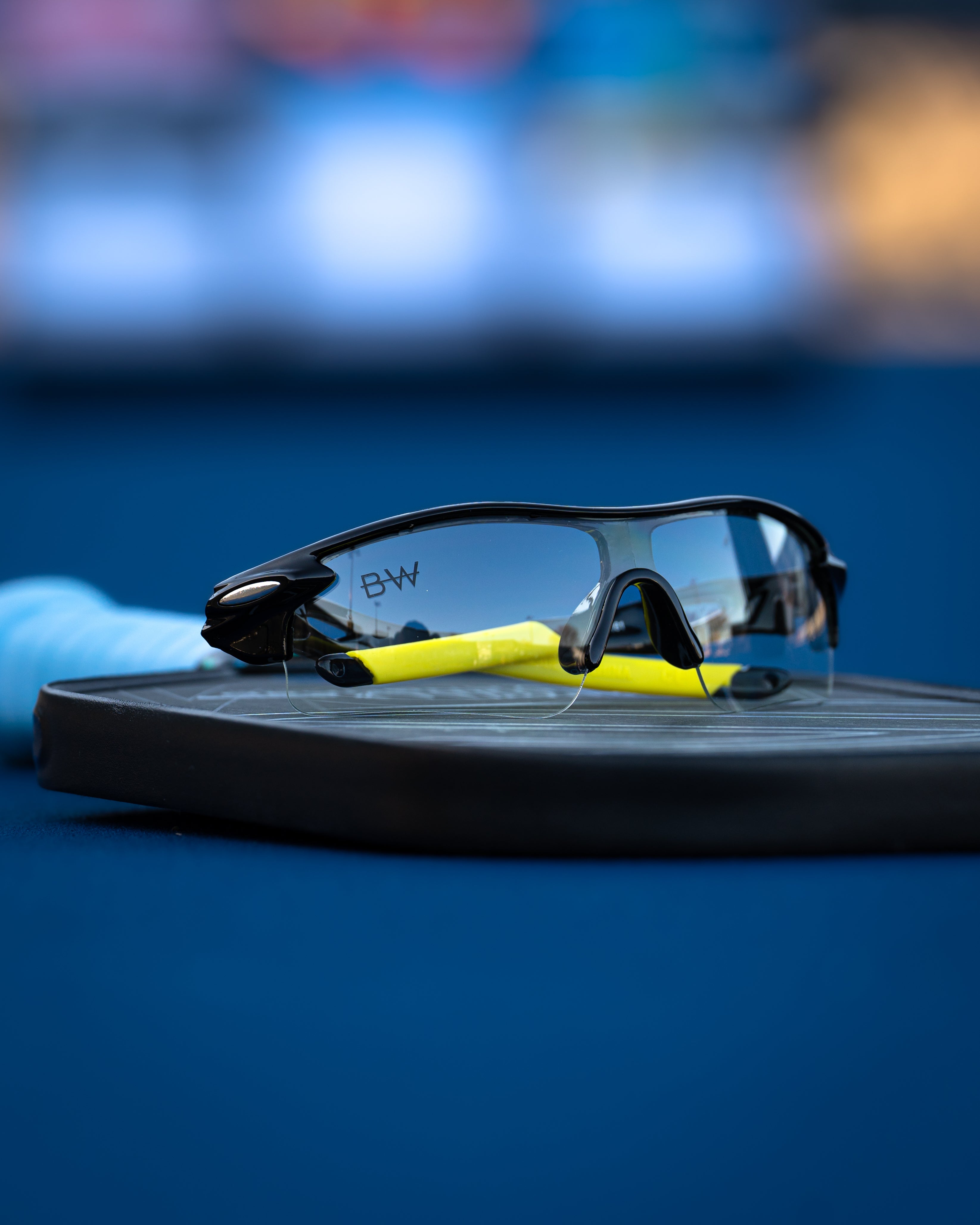
The RX Pair That Helps You Spot Slice Spin Sooner
Share
The RX Pair That Helps You Spot Slice Spin Sooner
Recognizing slice earlier can help you prepare for what the ball may do next—but prescription lenses do not automatically reveal spin, increase reaction speed, or make ball rotation easier to track.
Slice recognition is a pickleball skill built from several pieces of information: the opponent's preparation, paddle path, contact, the developing flight of the ball, previous shot patterns, and eventually the bounce. If you require prescription correction, appropriate RX eyewear addresses that corrective need while you process those cues.
This guide breaks down how to recognize slice and backspin in pickleball, which visual cues deserve your attention, why players often identify spin too late, and where dedicated prescription pickleball glasses such as Zebra II RX fit into the equation—without unsupported promises about contrast enhancement, motion tracking, dynamic visual acuity, or faster reactions
Looking for RX Pickleball Glasses?
If you already know you need prescription court eyewear, start with the RX collection. If you're still comparing frames, use the quiz or 2026 eyewear guide.
What Is Slice in Pickleball?
Players commonly use terms such as slice and backspin when describing shots created with an undercutting or downward component through contact.
For the receiver, the important challenge is not memorizing a technical definition. It is recognizing that spin may be present early enough to prepare for the developing shot rather than being surprised after the bounce.
That read can begin before you clearly observe the ball rotating.
The Slice Recognition Chain: Don't Wait Until the Bounce
A common mistake is treating visible ball rotation as the only way to identify spin. Instead, build your read across several stages.
| Stage | Information Available | Your Goal |
|---|---|---|
| 1. Situation | Opponent position, incoming ball, court location, previous patterns | Understand which responses may be available. |
| 2. Preparation | Opponent movement and developing paddle path | Begin narrowing the possibilities. |
| 3. Contact | Paddle movement and contact situation | Update your expectation about spin and direction. |
| 4. Early flight | Developing trajectory and ball behavior | Confirm or revise the initial read. |
| 5. Bounce | Additional information about how the shot behaves | Respond to the ball rather than being surprised by it. |
| 6. Feedback | What actually happened compared with your prediction | Improve the next read against that opponent. |
The goal is to move from “I saw what happened after the bounce” toward “I recognized clues earlier and stayed ready for what followed.”
Why Is Slice Spin Hard to Read?
Several factors can make spin recognition challenging, especially against an unfamiliar opponent.
The Ball Is Small and Moving
Trying to visually identify every detail of a rotating pickleball during live play is different from examining a stationary ball.
Good Players Can Use Similar Preparations
If several shots begin from similar-looking setups, committing based on the first cue can produce the wrong read.
You're Processing More Than Spin
Direction, pace, court position, your partner, opponent positioning, and your own movement all compete for attention.
Spin May Become More Obvious Later
If you rely primarily on the bounce to tell you what happened, your recognition may come later than it could have from preparation and contact information.
Opponent Tendencies Differ
A cue that becomes useful against one player may not have the same predictive value against another.
The Slice Cue Hierarchy: What Should You Watch?
Instead of obsessing over whether you can literally see the pickleball rotating, build a hierarchy of information.
1. Opponent's Situation
What type of ball did they receive? Where are they on the court? Are they comfortable, reaching, attacking, or defending?
2. Paddle Preparation
Observe how the paddle is being prepared as part of the overall shot setup.
3. Paddle Path and Contact
The way the opponent moves through contact can provide useful information about the shot they are attempting.
4. Initial Ball Flight
Once the ball leaves the paddle, you gain another source of information. Use it to confirm or reject the prediction you formed before contact.
5. Bounce
The bounce provides additional feedback—but ideally it is not the first moment you begin thinking about spin.
6. Opponent History
After several rallies, repeated shot choices can become part of your anticipation system.
Seeing Spin vs. Recognizing Spin: They're Not the Same Skill
This distinction is especially important for an RX eyewear article.
You do not necessarily need to visually resolve every rotation of the ball to recognize that a sliced shot may be developing.
| Skill | What It Means |
|---|---|
| Seeing | Receiving visual information through your current vision and prescription correction. |
| Observing | Directing attention toward useful information. |
| Recognizing | Understanding what those cues may indicate. |
| Anticipating | Using the information to narrow what may happen next. |
| Responding | Making and executing a decision as the shot develops. |
Prescription correction participates in the visual side of this chain when you need it. It does not automatically perform the remaining stages.
Where Do RX Pickleball Glasses Fit Into Spin Recognition?
If you require prescription correction, appropriate RX eyewear addresses that corrective need while you play.
Blinded Wear RX eyewear offers verified characteristics including:
- Designed with pickleball players in mind
- Lightweight sports frames
- Impact-resistant lenses
- Non-polarized lenses
- Comfort for extended matches
- Performance-first design
- Options for recreational and competitive players
- High-index prescription lenses included at no additional cost
Those are legitimate reasons to consider dedicated RX sports eyewear. They do not require claiming that a lens makes ball seams, texture, or rotation automatically more visible.
Zebra II RX: A Prescription Pickleball Option for Spin-Heavy Matches
Zebra II RX is one frame to consider if you're looking for dedicated prescription pickleball eyewear.
The original version of this guide described Zebra II RX as “engineered for spin recognition” through precision mapping, edge-to-edge sharpness, contrast enhancement, and dynamic visual acuity optimization.
Those performance outcomes should not be treated as verified Zebra II RX capabilities.
Instead, consider Zebra II RX according to:
- Your prescription requirements
- Current product information
- Available frame measurements
- Lightweight sports construction
- Impact-resistant lenses
- Non-polarized lenses
- Extended-match comfort
- Frame appearance
Zebra II RX does not need an invented spin-detection technology to be relevant to prescription pickleball players.
What RX Lenses Should NOT Promise About Slice Spin
Prescription sports eyewear should not automatically promise:
- Earlier slice recognition
- Improved ball tracking
- More visible ball rotation
- Enhanced dynamic visual acuity
- Improved contrast sensitivity
- Enhanced depth perception
- Faster reactions
- Better anticipation
- More visible pickleball seams or texture
- Automatic recognition of paddle-face changes
These claims turn a prescription product into a visual-performance technology without sufficient support.
A better message is straightforward: use RX eyewear for the corrective vision you need, then train spin recognition as a court skill.
Does Depth Perception Help You Read Slice?
Depth perception is relevant to how people perceive spatial relationships, but that does not mean a non-polarized RX sports lens automatically improves depth perception or makes slice easier to recognize.
The original article connected Zebra II RX, non-polarized lenses, preserved depth perception, and earlier spin recognition as though one automatically produced the next.
That chain should not be used.
If you need prescription correction, use appropriate prescription eyewear. Treat spin recognition and depth perception as distinct concepts rather than turning one into an unsupported product benefit.
Are Non-Polarized Lenses Better for Seeing Slice Spin?
Blinded Wear uses non-polarized lenses, and some court players prefer non-polarized eyewear.
However, non-polarized lenses should not automatically be credited with:
- Preserving superior depth perception
- Improving spin recognition
- Increasing contrast
- Reducing glare
- Improving ball tracking
- Making rotation easier to see
Likewise, polarized eyewear should not universally be described as distorting depth perception.
Keep polarization preference separate from claims about detecting slice.
Does More Contrast Make Slice Spin Easier to See?
The original copy claimed optional lens tints could make the pickleball stand out against different backgrounds and therefore improve spin recognition.
Do not assume that effect from lens color alone.
A tint should not automatically be described as:
- Contrast-enhancing
- Spin-enhancing
- Ball-tracking optimized
- Better for seeing paddle movement
- Better for recognizing rotation
unless those specific optical effects have been verified.
If clear or tinted options are available for a product, describe the actual option and its intended environment without inventing a performance outcome.
What About Clear Lenses for Indoor Slice Recognition?
Clear lenses can make sense for indoor, evening, and lower-light pickleball when you do not want dark sunglass tint.
That is enough of a reason to consider them.
Clear lenses should not automatically be credited with:
- Increasing available light
- Enhancing contrast
- Making spin more visible
- Improving ball tracking
- Improving reaction time
If untinted eyewear better matches your playing environment, explore the Clear Lens Pickleball Glasses Collection.
Zebra II RX Isn't Your Only Prescription Option
If you're comparing RX frames, don't assume each model needs a different spin-tracking specialty.
Crystal Wave II RX
Crystal Wave II RX is another prescription sports-frame option designed with pickleball players in mind.
It should not automatically be described as providing wider visual coverage, better crosscourt rotation tracking, or enhanced peripheral clarity unless those characteristics are specifically verified.
Red Shine RX
Red Shine RX provides another frame design to compare according to prescription needs, current product information, available measurements, and style.
Do not infer enhanced red-green contrast, paddle-face recognition, or superior performance against spin-heavy drops from the product name or lens appearance.
Blue Shield RX
Blue Shield RX can also be evaluated as part of your prescription eyewear search.
Claims about extreme-brightness optimization, glare resistance, or improved motion tracking should only be used if those features are specifically verified for the product.
Zebra II RX vs. Crystal Wave II RX vs. Red Shine RX vs. Blue Shield RX
There is no verified “best RX frame for seeing spin.” Compare these models using characteristics that can actually support a purchase decision.
| Characteristic | Zebra II RX | Crystal Wave II RX | Red Shine RX | Blue Shield RX |
|---|---|---|---|---|
| Prescription eyewear | Yes | Yes | Yes | Yes |
| Designed with pickleball players in mind | Yes | Yes | Yes | Yes |
| Lightweight sports frame | Yes | Yes | Yes | Yes |
| Impact-resistant lenses | Yes | Yes | Yes | Yes |
| Non-polarized lenses | Yes | Yes | Yes | Yes |
| Comfortable for extended matches | Yes | Yes | Yes | Yes |
| High-index RX included at no additional cost | Yes | Yes | Yes | Yes |
| Guaranteed spin-recognition improvement | No | No | No | No |
| Guaranteed contrast enhancement | No | No | No | No |
| Guaranteed motion-tracking improvement | No | No | No | No |
The Before-the-Bounce Slice Drill
If you currently recognize slice primarily after the bounce, train yourself to make an earlier prediction.
Round 1: Known Slice
Have a practice partner intentionally send sliced shots while you observe preparation, paddle movement, contact, flight, and bounce.
Because you already know slice is coming, your only job is to identify which cues consistently appear before the bounce.
Round 2: Slice or No Slice
Your partner now varies the shot.
Call your prediction after contact but before the bounce:
- “Slice”
- “Not slice”
- “Unsure”
Allowing “unsure” is important. It discourages random guessing.
Round 3: Earlier Prediction
Once your accuracy improves, attempt to form the prediction closer to contact while remaining willing to update it.
Round 4: Return the Ball
Add your normal response so recognition becomes connected to actual play.
Score Your Slice Reads by Accuracy, Not Just Speed
Use a simple scoring system during controlled practice:
| Read | Score |
|---|---|
| Correct prediction before the bounce | +2 |
| Correct prediction after more flight information | +1 |
| Unsure | 0 |
| Wrong prediction without overcommitting | 0 |
| Wrong prediction with major early commitment | -1 |
This rewards early, accurate recognition rather than simply guessing as soon as possible.
Is Your Slice Problem Vision—or Recognition?
Before replacing your eyewear because you keep misreading spin, ask where the problem actually occurs.
The Opponent, Paddle, or Ball Looks Visually Unclear
If you require prescription correction and visual clarity is persistently concerning, your individual vision may deserve attention.
Everything Looks Clear, but You Don't Recognize Slice Until the Bounce
This may be more of an observation and recognition issue. Train preparation, contact, and early-flight cues.
You Recognize Slice but Still Mishit the Return
That can involve technique, positioning, decision-making, or execution rather than visual clarity.
You Read Familiar Opponents Better Than New Players
Opponent-pattern recognition may be contributing significantly to your reads.
You Guess Spin Too Early and Get Fooled
Your problem may be overcommitment rather than slow recognition.
Three Signs You Should Train the Read Before Blaming Your Glasses
1. The Ball Is Visually Clear
If you can see the ball clearly but do not identify the opponent's shot until after the bounce, additional spin-recognition practice may be more relevant than a new performance claim.
2. You Read Some Players Easily
If the same glasses work well against one opponent but you struggle against another, opponent tendencies and disguise may be influencing the difference.
3. You Identify the Spin Correctly but Still Miss
Correct recognition does not guarantee correct execution. Return technique and movement remain separate skills.
Quick Answers About RX Glasses and Slice Spin
Can RX glasses help me see slice spin?
If you require prescription correction, appropriate RX eyewear addresses that corrective need while you play. It should not automatically be claimed to enhance spin visibility.
Can Zebra II RX make me recognize backspin faster?
No guaranteed improvement in spin-recognition speed should be promised. Zebra II RX is dedicated prescription sports eyewear designed with pickleball players in mind.
Do high-index lenses make spin easier to see?
No. High-index describes a category of prescription lens material. It should not be treated as spin-recognition or motion-tracking technology.
Do non-polarized lenses improve spin tracking?
Blinded Wear uses non-polarized lenses, and some court players prefer them. Non-polarized construction should not automatically be credited with improved spin tracking.
Which lens tint is best for seeing slice?
Do not assign a universal spin-recognition advantage to a tint without verified product-specific evidence. Choose according to available options and your playing environment.
Can I train myself to recognize slice sooner?
You can practice identifying information available before the bounce, including opponent preparation, paddle movement, contact, early ball flight, and repeated tendencies.
Do I need to see the ball physically rotating to recognize slice?
Not necessarily. Spin recognition can use information from the shot sequence rather than relying solely on visibly resolving ball rotation.
Don't Chase the Spin—Read the Shot That Creates It
If you're waiting to clearly see the pickleball rotating before deciding that slice is present, you may be ignoring information available earlier in the shot.
Start with the opponent. Observe preparation. Learn what their paddle movement and contact situations look like. Form an initial prediction. Use early ball flight and the bounce as additional evidence. Then remember what happened so the next similar situation becomes easier to recognize.
Part 2 will build a complete Slice Recognition Playbook: sliced returns, dink slice, drops and resets, serve-return situations, spin versus trajectory, opponent-pattern scouting, indoor versus outdoor considerations, a Zebra II RX vs. Crystal Wave II RX vs. Red Shine RX vs. Blue Shield RX decision system, advanced drills, and a deeper FAQ for players trying to recognize backspin before the bounce.
The Slice Recognition Playbook: Read the Shot Before You Read the Bounce
If you want to recognize slice sooner, do not make visible ball rotation your only signal. The more useful skill is learning how the entire shot develops—from the opponent's situation before contact through the ball's early flight.
Use this five-part sequence during practice:
- Situation: What kind of ball is the opponent receiving, and what options does that situation create?
- Preparation: What does the opponent begin doing with their body and paddle?
- Contact: What information becomes available as the paddle meets the ball?
- Early flight: Does the developing trajectory support or contradict your initial prediction?
- Bounce and result: What actually happened, and what can you learn for the next similar shot?
The objective is not to predict every sliced ball perfectly. It is to build a larger library of recognizable situations so you become less dependent on waiting for the bounce.
Reading Slice on a Pickleball Return of Serve
A sliced return gives you an excellent training situation because you can observe the opponent from preparation through contact rather than encountering the ball unexpectedly in the middle of a rapid exchange.
Instead of trying to identify spin from the ball alone, ask:
- How was the receiver positioned before contact?
- What did their preparation look like?
- What did you observe through the contact sequence?
- What trajectory developed immediately afterward?
- Have they used the same return repeatedly?
If the opponent frequently uses slice on the return, that history becomes part of your read. You are no longer processing each return as though you have never seen the player before.
That is anticipation through pattern recognition—not a lens automatically identifying spin.
How to Recognize Slice During Dink Exchanges
Slice can feel particularly difficult to read during kitchen exchanges because several decisions occur in a short period of time. You may be evaluating direction, height, pace, court position, your partner, and the opponent simultaneously.
Break the read into smaller pieces.
Before the Opponent Contacts the Ball
Start with the ball you gave them. Was it comfortable? Did it force them to reach? Where are they contacting it relative to their position?
During Preparation
Observe the developing paddle movement without assuming one visible angle guarantees slice.
Around Contact
Use the contact sequence to update your prediction.
After Contact
Let the developing flight provide additional information before you fully commit.
The better question is not simply, “Can I see the ball spinning?”
Ask, “How much evidence do I have that this is a sliced shot?”
Reading Slice on Drops, Resets, and Softer Shots
Spin recognition becomes more complicated when pace is removed from the equation. A softer shot can still require you to interpret trajectory, direction, contact, and what may happen after the bounce.
Use the same recognition system rather than trying to create a separate visual rule for every shot:
| Question | Why It Matters |
|---|---|
| What situation created the shot? | Opponent position and pressure can narrow the likely options. |
| What did preparation suggest? | It gives you an early hypothesis without guaranteeing the result. |
| What happened around contact? | Additional information becomes available closer to the actual shot. |
| What is the early trajectory doing? | Ball flight can confirm or challenge your first prediction. |
| What happened after the bounce? | The result becomes feedback for future recognition. |
The bounce is useful information. The goal is simply to avoid making it your only information.
Spin vs. Trajectory: Don't Confuse the Two
Players sometimes describe any unusual-looking ball flight or bounce as something they “saw spinning.” But spin and trajectory are related concepts, not interchangeable ones.
During a rally, you are processing several things at once:
- Where the ball is traveling
- How high or low its path appears
- How quickly it is moving
- What the opponent did around contact
- What you expect after the bounce
You may correctly anticipate a sliced shot without visually resolving individual rotations of the pickleball.
That is why training should focus on shot recognition, not just trying to stare harder at the surface of the ball.
Use a Spin-Read Confidence Scale Instead of Guessing
Not every shot gives you the same amount of information. Build a simple confidence scale during practice.
| Confidence | Interpretation | Response |
|---|---|---|
| 1 — Very Low | You have little evidence about the spin. | Stay neutral and collect more information. |
| 2 — Low | One weak cue suggests slice. | Do not overcommit. |
| 3 — Moderate | Multiple pieces of information point toward slice. | Prepare while remaining adjustable. |
| 4 — High | Preparation, contact, or opponent patterns strongly support your read. | Use the expectation while continuing to watch the ball. |
| 5 — Very High | The developing shot strongly confirms your prediction. | Commit to the appropriate response. |
This approach trains something more useful than instant guessing: confidence that increases as evidence accumulates.
Build a Slice Profile on Your Opponent
You are not playing against a generic pickleball player. You are playing against someone with individual habits.
During the first several rallies, start collecting information:
- Do they frequently slice returns?
- Do they use slice primarily from one side?
- Do they use it more when defending?
- Do they cut certain dinks repeatedly?
- Do they use similar preparation for different shots?
- Do they disguise slice effectively?
- Do they change tendencies when under pressure?
After enough repetitions, your opponent's history can become another predictive cue.
That does not mean assuming, “They sliced this ball last time, so they must slice again.” Instead, previous behavior changes the probability you assign to different possibilities.
The Match-Day Slice Scouting Card
Use this quick mental checklist during your next match:
| Situation | What to Record Mentally |
|---|---|
| Serve return | Does this player frequently use slice? |
| Crosscourt dink | Do they cut the ball from particular positions? |
| Defensive ball | What spin tendencies appear when they are under pressure? |
| Comfortable attackable ball | Does their normal spin pattern change? |
| Repeated setup | Does similar preparation consistently produce a similar shot? |
| Disguise | Which early cues have produced incorrect predictions? |
By the middle of a match, you should ideally know more about the opponent's spin tendencies than you did during the first rally.
Reading Slice Indoors vs. Outdoors
Your playing environment can influence which eyewear setup you prefer, but avoid turning environmental differences into unsupported lens-performance claims.
Indoor Pickleball
Some players prefer clear eyewear indoors because they do not want a dark sunglass tint in that environment.
Clear lenses should not automatically be described as improving contrast, increasing available light, or making spin easier to see.
Evening and Lower-Light Play
The same principle applies when playing later in the day or in lower-light environments. If dark tint is not preferred, a clear lens can be a practical option.
Outdoor Pickleball
Players may prefer different available lens options outdoors depending on conditions and personal preference. Do not infer glare reduction, contrast enhancement, or better spin tracking unless those effects are verified for the product.
If you specifically want untinted court eyewear, browse Clear Lens Pickleball Glasses.
Does Visual Fatigue Make Spin Harder to Read?
Long playing sessions can feel different from the first few rallies of the day, but avoid turning that observation into a product claim that a particular RX frame prevents visual fatigue or preserves spin-tracking ability.
If your reads deteriorate late in a session, consider the complete situation:
- Are you still paying attention to opponent preparation?
- Are you becoming more reactive and less observant?
- Is your positioning changing?
- Are you making quicker assumptions instead of collecting information?
- Are you physically tired?
- Is your eyewear still comfortable?
Blinded Wear RX eyewear is designed to be comfortable for extended matches, but that should not be expanded into a claim that the glasses prevent visual fatigue or preserve neurological processing speed.
How to Read Slice When the Opponent Uses Disguise
A player who disguises shots exposes the weakness of any system built around one visual cue.
If similar preparation can produce slice, topspin, or a relatively neutral shot, adjust your strategy.
Stop Demanding an Instant Answer
You do not need to classify the shot at the earliest imaginable moment.
Assign Probabilities
Your first observation can make slice more or less likely without making it certain.
Wait for Stronger Evidence
Contact and early ball flight provide additional information.
Remember What Fooled You
If a particular setup repeatedly creates incorrect predictions, reduce the importance you give that cue.
The goal is an early but adjustable read.
Which RX Pickleball Glasses Should You Choose for Spin-Heavy Play?
There is no verified frame that automatically identifies slice sooner. Instead of ranking RX glasses by unproven spin-tracking ability, use a buying decision based on your actual needs.
Step 1: Start With Your Prescription
Your corrective needs come before sports-performance marketing.
Step 2: Compare Available Measurements
If measurements are available, compare them with glasses you already know fit you comfortably.
Step 3: Decide Where You Play Most
Indoor, evening, lower-light, and outdoor environments may influence which available lens option you prefer.
Step 4: Compare Current Product Details
Do not assume two RX frames are functionally identical or invent differences between them. Use the current product information available for each model.
Step 5: Consider Extended Wear
Lightweight sports construction and comfort for extended matches can matter if you spend hours on court.
Step 6: Choose the Style You Prefer
If multiple options satisfy your functional requirements, appearance is a legitimate deciding factor.
Zebra II RX vs. Crystal Wave II RX vs. Red Shine RX vs. Blue Shield RX
Zebra II RX
Consider Zebra II RX if its current product details, available measurements, prescription setup, and appearance match what you want from dedicated pickleball eyewear.
Do not choose it solely because you expect: enhanced spin recognition, dynamic visual acuity, edge-to-edge motion clarity, enhanced contrast, or faster reactions.
Crystal Wave II RX
Compare Crystal Wave II RX according to your prescription requirements, available measurements, current product information, comfort preferences, and style.
Do not choose it solely because you expect: wider peripheral vision, improved crosscourt tracking, more visible rotation, or better depth perception.
Red Shine RX
Consider Red Shine RX if its current frame information and appearance better match your preferences.
Do not choose it solely because you expect: red-green contrast enhancement, easier paddle-face recognition, better slice detection, or improved spin-heavy drop recognition.
Blue Shield RX
Blue Shield RX provides another prescription sports-frame option to compare using current product information and your individual needs.
Do not choose it solely because you expect: glare resistance, extreme-brightness optimization, improved motion tracking, or faster ball recognition unless those specific characteristics are verified.
High-Index RX Lenses: What They Do—and What They Don't
Blinded Wear includes high-index prescription lenses at no additional cost.
That is a useful RX benefit, but “high-index” should not be confused with sports-vision enhancement.
High-index should not automatically be claimed to provide:
- More visible pickleball rotation
- Better spin tracking
- Faster visual processing
- Enhanced dynamic visual acuity
- Better depth perception
- Improved contrast
- Faster reaction time
Do not assign a specific numerical lens index unless it has been verified for the applicable order.
Drill 1: Rotation vs. Shot-Cue Recognition
This drill helps determine whether you're relying too heavily on trying to visually resolve ball rotation.
Round A: Watch the Ball
Have a partner alternate between sliced and non-sliced shots. Focus heavily on the ball and make your prediction.
Round B: Watch the Shot Development
Repeat the drill, but shift more attention toward preparation, paddle movement, and contact before transitioning your attention to the developing ball.
Compare the Results
Which approach allowed you to classify the shot more accurately before the bounce?
The exercise helps you discover which information is actually useful to you rather than assuming visible rotation must always be the primary cue.
Drill 2: Slice / No Slice / Unsure
Have a partner randomize shots. Before the bounce, make one of three calls:
- Slice
- No slice
- Unsure
Do 30 repetitions.
Record:
- Correct slice calls
- Correct no-slice calls
- Incorrect calls
- Unsure calls
- Wrong reads caused by early commitment
Repeat the exercise later and compare your accuracy.
The goal is not to eliminate “unsure.” A player who intelligently waits for more information can make a better decision than someone who guesses immediately.
Drill 3: The Pattern-Break Test
Opponent patterns help anticipation, but they can also become a trap.
Have your practice partner establish a pattern—for example, repeatedly using the same general shot from a particular situation.
After several repetitions, your partner intentionally breaks the pattern.
Your goal is to:
- Use the established tendency as information.
- Avoid treating it as certainty.
- Notice when new information contradicts the expected shot.
- Adjust before overcommitting.
This is particularly valuable for learning the difference between anticipation and guessing.
Drill 4: Bring Spin Recognition Into Live Points
Controlled drills can teach cues, but eventually the skill needs to survive real decision-making.
Play normal points with one additional objective: after each rally, identify one spin read that mattered.
Ask:
- What did I predict?
- When did I predict it?
- Which cue influenced me?
- Was the prediction correct?
- Did I respond appropriately?
- What would I change next time?
This turns each point into a small feedback cycle without forcing you to consciously analyze every detail while the rally is happening.
A Four-Stage Progression for Earlier Slice Recognition
You do not need to master everything in one session. Progress the difficulty as your reads become more reliable.
| Stage | Training Focus | Goal |
|---|---|---|
| Stage 1 | Known sliced shots | Learn which cues appear throughout the shot. |
| Stage 2 | Slice vs. non-slice | Improve classification accuracy. |
| Stage 3 | Randomized shot type and direction | Recognize spin without knowing the intended pattern. |
| Stage 4 | Live points | Use recognition while simultaneously handling positioning, strategy, and execution. |
8 Mistakes That Make Slice Feel Impossible to Read
-
Waiting until after the bounce.
Useful information can appear earlier in the shot sequence.
-
Trying to see every rotation.
You can recognize spin using more than visible ball rotation.
-
Watching only the paddle.
Opponent situation, contact, early ball flight, and patterns also matter.
-
Turning one paddle cue into a guarantee.
Similar preparation can sometimes produce different shots.
-
Ignoring opponent tendencies.
Repeated behavior can become useful contextual information.
-
Guessing earlier instead of reading earlier.
A faster prediction is not useful when accuracy collapses.
-
Assuming every mishit is a vision problem.
Recognition, positioning, technique, decision-making, and movement can all affect the result.
-
Expecting RX lenses to identify spin for you.
Prescription eyewear addresses corrective vision needs; spin recognition remains a player skill.
Why Did I Misread That Slice? A Quick Troubleshooter
| Problem | What to Investigate |
|---|---|
| Opponent, paddle, or ball appears visually unclear | Your individual prescription vision may deserve attention. |
| Everything looks clear, but spin surprises you | Train preparation, contact, and early-flight recognition. |
| You predict slice when there isn't any | You may be overweighting one early cue. |
| You identify slice correctly but mishit | Evaluate positioning, technique, decision-making, and execution. |
| You struggle against only one opponent | Study that player's individual patterns and disguise. |
| You recognize spin only after the bounce | Practice making a prediction earlier in the shot sequence. |
| Your reads become worse as rallies accelerate | Progress recognition drills toward more randomized and live situations. |
How to Order Blinded Wear RX Pickleball Glasses
If dedicated prescription sports eyewear makes sense for you, keep the purchase centered on your actual corrective and product needs.
- Browse the RX collection.
- Choose a frame using current product information, available measurements, and style.
- Prepare your eyeglass prescription.
- Take a clear photo or picture of the prescription.
- Upload your prescription before purchasing.
- Review the available options and complete your order.
Blinded Wear includes high-index prescription lenses at no additional cost.
Do not assume a particular numerical lens index, progressive design, transition option, anti-reflective coating, anti-fog treatment, contrast-enhancing tint, or other specialized lens technology unless it is currently verified for the applicable product or order.
More Questions About Seeing Slice and Backspin in Pickleball
How can I tell if a pickleball has backspin?
Do not rely only on visually seeing the ball rotate. Opponent preparation, paddle movement, contact, early ball flight, previous tendencies, and the eventual bounce can all contribute information.
Should I watch the paddle to identify slice?
The paddle can provide useful information, but it should be interpreted within the entire shot rather than treated as a perfect spin indicator.
Why can I only recognize backspin after the ball bounces?
You may be relying heavily on bounce behavior instead of information available during preparation, contact, and early flight. Controlled drills can help move your recognition earlier.
Do I need to see the pickleball rotating to read spin?
Not necessarily. Players can use information from how the shot develops rather than depending solely on resolving the ball's visible rotation.
Can prescription pickleball glasses improve spin recognition?
Appropriate RX eyewear addresses your corrective vision needs. A specific improvement in spin recognition should not automatically be attributed to prescription sports eyewear.
Is Zebra II RX the best prescription frame for seeing slice?
There is no verified “best for slice recognition” frame. Compare Zebra II RX and other models according to prescription requirements, current product information, available measurements, environment, comfort preferences, and style.
Does Crystal Wave II RX provide better peripheral spin tracking?
A peripheral-vision or spin-tracking advantage should not be claimed without product-specific evidence.
Does Red Shine RX enhance contrast for spin?
Do not infer contrast enhancement or improved spin visibility from lens or product color alone.
Is Blue Shield RX better in bright outdoor conditions?
Only describe a brightness-specific optical advantage if it is verified in the current product information. The product name alone does not establish that benefit.
Are clear lenses better for seeing spin indoors?
Clear lenses provide an untinted option for indoor, evening, and lower-light environments where dark sunglass tint may not be preferred. They should not automatically be credited with better spin recognition.
Do non-polarized lenses preserve depth perception?
Blinded Wear uses non-polarized lenses, and some court players prefer them. Avoid the universal claim that non-polarized lenses inherently improve or preserve superior depth perception compared with polarized eyewear.
Do high-index lenses help you see the ball rotate?
No automatic spin-visibility benefit should be attributed to high-index lens material. Blinded Wear includes high-index prescription lenses at no additional cost.
Can better eyewear make my reactions faster?
Prescription sports eyewear should not be claimed to inherently reduce neurological reaction time.
Why can I read one player's slice but not another's?
Players have different preparations, tendencies, levels of disguise, and shot patterns. Familiarity with an opponent can influence recognition.
Spotting Slice Sooner Is About Building Evidence Earlier
The most useful progression is not “see more rotation → react faster.” It is “recognize more of the shot → form a better prediction → confirm it → respond.”
Prescription correction matters when you need it. But once the opponent, paddle, and ball are visually clear, the next gains come from learning what the available information means.
Part 3 will complete the guide with a Spin Recognition Scorecard, slice-return and dink troubleshooting maps, a 30-ball recognition test, advanced disguise scenarios, RX buying mistakes, a final Zebra II RX vs. Crystal Wave II RX vs. Red Shine RX vs. Blue Shield RX selector, expanded search-friendly FAQ, ordering resources, lifetime replacement support, the Blinded Wear mission, and the final verdict on what RX lenses can—and cannot—do for earlier slice recognition.
The Spin Recognition Scorecard: Are Your Reads Actually Getting Earlier?
If you're training yourself to recognize slice sooner, measure more than whether you eventually identified the spin correctly. The useful question is when you had enough information to make an accurate read.
| Recognition Result | What It Suggests | Training Priority |
|---|---|---|
| Correct read before contact | You recognized useful preparation or opponent-pattern information early. | Maintain accuracy and avoid overcommitting when opponents disguise shots. |
| Correct read immediately after contact | You combined preparation and contact information effectively. | Continue building familiarity with recurring situations. |
| Correct read during early flight | You needed additional ball information before becoming confident. | Study which earlier cues were present. |
| Correct read only after the bounce | Bounce behavior is doing most of the recognition work. | Train preparation, contact, and early-flight observation. |
| Incorrect early read | You may be overweighting an unreliable cue. | Identify what caused the prediction and demand more evidence. |
| Correct read but poor return | Spin recognition may not be the primary problem. | Evaluate positioning, decision-making, technique, and execution. |
The goal is not simply to move every prediction earlier. A slightly later accurate read can be more useful than an instant guess that repeatedly sends you in the wrong direction.
The 30-Ball Slice Recognition Test
Use this test to establish a baseline instead of relying on the feeling that you're “bad at reading spin.”
Setup
Have a practice partner send 30 controlled balls containing a randomized mixture of sliced and non-sliced shots.
Your partner should know which type they intend to send. You should not.
Your Job
For each ball, call:
- Slice
- No slice
- Unsure
Also record approximately when you became confident:
- Before contact
- Around contact
- During early flight
- After the bounce
What to Measure
After 30 balls, calculate:
- Total correct reads
- Total incorrect reads
- Total unsure calls
- Correct reads made before the bounce
- Incorrect reads caused by early commitment
Repeat the same general test after additional practice.
You are looking for a useful combination of accuracy, earlier recognition, and fewer costly guesses.
Slice Return Troubleshooting: Why Did That Ball Surprise You?
| What Happened | Possible Breakdown | What to Check Next |
|---|---|---|
| You recognized slice only after the bounce | Late recognition | Study preparation, contact, and early ball flight. |
| You expected slice but got a different shot | Overprediction | Determine which cue you treated as stronger evidence than it really was. |
| You correctly identified slice but mishit | Execution | Separate spin recognition from return technique. |
| You read the same opponent correctly after several games | Pattern learning | Identify which tendencies became familiar. |
| You struggle only against disguised slice | Early commitment | Stay adjustable longer and use additional information around contact. |
| The ball itself looks visually unclear | Visual clarity | If you require prescription correction, consider whether your individual corrective needs are being met. |
Why Do Sliced Dinks Keep Fooling You?
Kitchen exchanges create a different recognition problem from slower, more structured repetitions.
If sliced dinks repeatedly catch you off guard, ask these questions in order:
- What did my previous shot give the opponent?
- Where were they contacting the ball?
- What did their preparation suggest?
- What did I observe around contact?
- Did I commit before enough information was available?
- Did the early ball flight confirm or contradict my prediction?
This turns a vague problem—“I can't read their slice”—into specific stages you can practice.
Three Advanced Slice-Disguise Scenarios
Scenario 1: The Opponent Uses Similar Preparation
You have seen the same preparation lead to both sliced and non-sliced shots.
Your adjustment: lower your confidence in the early preparation cue and wait for information closer to contact.
Scenario 2: The Opponent Establishes a Pattern and Breaks It
After several sliced returns, you begin expecting another. The opponent changes the shot.
Your adjustment: use tendencies to influence your expectation without treating them as certainty.
Scenario 3: You Correctly Read Slice but Guess Direction
You identify the likely spin but assume that tells you exactly where the ball will travel.
Your adjustment: separate spin recognition from direction recognition. Identifying one characteristic does not automatically reveal the other.
Spin, Direction, Pace, and Trajectory Are Separate Reads
One reason spin-heavy shots can feel complicated is that you are not solving one visual problem.
| Question | What You're Trying to Recognize |
|---|---|
| Is there slice? | Spin characteristics |
| Where is it going? | Direction |
| How quickly is it arriving? | Pace |
| What path is it taking? | Trajectory |
| What should I do? | Decision and response |
A correct spin read does not automatically answer every other question.
This is another reason claims such as “see spin sooner and react faster” oversimplify what actually happens during a pickleball rally.
9 RX Buying Mistakes to Avoid When Spin Recognition Is Your Goal
-
Buying glasses because they promise to reveal ball rotation.
RX sports eyewear should not automatically be credited with making pickleball seams, texture, or rotation more visible.
-
Assuming “dynamic visual acuity optimized” is a verified product feature.
A sports-vision concept does not automatically establish a measurable benefit for an individual frame.
-
Assuming high-index means better spin tracking.
High-index is a prescription lens-material category, not spin-recognition technology.
-
Choosing a tint because you expect automatic contrast enhancement.
Do not infer enhanced ball-background contrast from lens color alone.
-
Buying non-polarized lenses specifically for better depth perception.
Blinded Wear uses non-polarized lenses, but they should not universally be credited with superior depth perception.
-
Assuming a sports frame improves neurological reaction time.
Prescription sports eyewear should not be marketed as inherently making biological reactions faster.
-
Assuming clear lenses improve indoor spin recognition.
Clear lenses provide an untinted option where dark sunglass tint may not be preferred. That does not establish enhanced spin visibility.
-
Assuming everyday prescription glasses are automatically inadequate.
Regular prescription eyewear is not inherently incapable of being used for pickleball.
-
Replacing training with equipment.
If the opponent, paddle, and ball appear clear but you still identify slice late, train recognition directly.
Zebra II RX vs. Crystal Wave II RX vs. Red Shine RX vs. Blue Shield RX: Final Selector
There is no verified spin-recognition winner. Choose based on your prescription needs and the current characteristics of each product rather than an invented visual advantage.
Zebra II RX
Put Zebra II RX on your shortlist if its current product information, available measurements, prescription setup, and appearance match what you want from dedicated pickleball eyewear.
Do not choose Zebra II RX solely because you expect:
- Enhanced spin recognition
- More visible ball rotation
- Dynamic visual acuity improvement
- Contrast enhancement
- Faster reaction time
Crystal Wave II RX
Put Crystal Wave II RX on your shortlist if its current specifications, available measurements, prescription information, and style fit your preferences.
Do not choose Crystal Wave II RX solely because you expect:
- Wide-angle spin tracking
- Enhanced peripheral sharpness
- Better crosscourt rotation recognition
- Improved depth perception
Red Shine RX
Put Red Shine RX on your shortlist if its current product details, available measurements, prescription setup, and appearance align with your needs.
Do not choose Red Shine RX solely because you expect:
- Enhanced red-green contrast
- Better paddle-face recognition
- Earlier slice detection
- Better performance against spin-heavy drops
Blue Shield RX
Put Blue Shield RX on your shortlist if its current product information and design better match your prescription and frame preferences.
Do not choose Blue Shield RX solely because you expect:
- Glare-resistant performance
- Extreme-brightness optimization
- Better motion tracking
- Enhanced spin visibility
If none of these four immediately matches your preferences, browse the full RX Pickleball Glasses Collection.
The 60-Second RX Buying Checklist
Before choosing a frame, answer these questions:
- Does the prescription offering match what I need?
- Have I compared available measurements with eyewear that fits me?
- Do I want a lightweight sports frame?
- Do impact-resistant lenses matter to me?
- Do I prefer non-polarized eyewear?
- Will I regularly wear these through extended matches?
- Does the current product information fit my intended use?
- Do I actually like the frame's appearance?
- Would I still choose it if the page never promised better spin tracking?
That final question is especially useful. A prescription sports frame should make sense without requiring an unsupported performance claim to close the sale.
Ordering Blinded Wear RX Pickleball Glasses
Once you've selected an RX frame, the prescription process is straightforward.
- Choose your prescription frame.
- Prepare your eyeglass prescription.
- Take a clear photo or picture of your prescription.
- Upload the prescription before purchasing.
- Review the available product and prescription options.
- Complete your order when the information is correct.
Blinded Wear includes high-index prescription lenses at no additional cost.
Do not assume a specific numerical lens index or an unlisted progressive design, transition option, contrast-enhancing tint, anti-reflective coating, anti-fog coating, hydrophobic coating, or other lens technology unless it is currently verified for your order.
FAQ: Slice, Backspin, RX Glasses, and Spin Recognition
How do you recognize slice earlier in pickleball?
Start collecting information before the bounce. Opponent situation, preparation, paddle movement, contact, early ball flight, previous patterns, and the eventual bounce can all contribute to the read.
How do you read backspin before the ball bounces?
Train yourself to make a prediction using information available during preparation, contact, and early flight. Then use the bounce as feedback rather than making it your only spin indicator.
Can you see the spin on a pickleball?
You may sometimes observe information from the moving ball, but you do not need to visually resolve every rotation to begin recognizing that a sliced shot may be developing.
Do you need to watch the pickleball seams to read spin?
No. Spin recognition can incorporate the opponent's preparation, paddle movement, contact, trajectory, patterns, and ball behavior rather than depending exclusively on visible seams.
Should I watch the paddle to see slice?
Paddle information can be useful, but no single paddle movement should be treated as a guaranteed spin indicator. Interpret it alongside the complete shot situation.
Why does slice surprise me after the bounce?
You may be relying primarily on bounce behavior to classify the shot. Practice identifying information that appears earlier in the sequence.
Why can I read some players' slice more easily?
Opponents differ in preparation, shot tendencies, contact patterns, and disguise. Familiarity with a player's repeated behaviors can contribute to anticipation.
Is anticipation the same as reaction time?
No. Anticipation involves using available information and experience to form an expectation about what may happen. Reaction and physical response are separate parts of the sequence.
Can RX lenses make my reactions faster?
Prescription sports eyewear should not be claimed to inherently reduce neurological reaction time.
Can Zebra II RX help me see the pickleball rotating?
Zebra II RX is prescription sports eyewear designed with pickleball players in mind. It should not be promised to make ball rotation, seams, or texture inherently more visible.
Does Zebra II RX improve dynamic visual acuity?
A measurable improvement in dynamic visual acuity should not be attributed to Zebra II RX without supporting product-specific evidence.
Does Crystal Wave II RX help with crosscourt spin tracking?
A specific crosscourt, peripheral, or spin-tracking advantage should not be claimed without verification.
Does Red Shine RX improve contrast for seeing spin?
Do not infer contrast enhancement or improved spin recognition from lens or product color alone.
Is Blue Shield RX better for bright pickleball courts?
Only make a brightness-specific optical claim if that characteristic is verified for the current product. The product name itself does not establish that benefit.
Do non-polarized lenses help you see backspin?
Blinded Wear uses non-polarized lenses, and some court players prefer them. Non-polarized construction should not automatically be credited with better spin recognition.
Are polarized glasses bad for reading spin?
Do not make a universal claim that polarized eyewear inherently prevents accurate spin recognition or harms depth perception.
What color lens is best for seeing pickleball spin?
A universal spin-recognition advantage should not be assigned to a lens color without verified evidence. Choose among available options according to the current product information and your playing environment.
Are clear lenses good for indoor pickleball?
Clear lenses provide an untinted option for indoor, evening, and lower-light environments where dark sunglass tint may not be preferred.
Do clear lenses make spin easier to see?
Clear lenses should not automatically be credited with enhanced contrast, better ball tracking, or improved spin recognition.
Do high-index lenses improve sports vision?
High-index describes a category of prescription lens material. It should not automatically be marketed as improving reaction time, spin tracking, contrast, depth perception, or dynamic visual acuity.
Does Blinded Wear include high-index prescription lenses?
Yes. High-index prescription lenses are included at no additional cost.
Are Blinded Wear RX lenses impact-resistant?
Yes. Blinded Wear uses impact-resistant lenses. Impact-resistant does not automatically mean shatterproof or establish an unspecified ANSI or other protective-eyewear certification.
Are Blinded Wear RX glasses only for advanced players?
No. Blinded Wear designs eyewear for recreational and competitive pickleball players.
Can regular prescription glasses be used for pickleball?
Yes. Everyday prescription eyewear is not automatically unsuitable for pickleball. Dedicated sports eyewear is an option for players who want a lightweight, performance-first frame designed with pickleball players in mind.
Find Your Pickleball Eyewear Setup
Choose the path that matches your prescription needs and playing environment.
Lifetime Replacement Support for Pickleball Eyewear
If you're regularly taking your prescription eyewear to practices, recreational games, leagues, and tournaments, post-purchase support can be another useful part of the buying decision.
Blinded Wear offers 50% lifetime replacement support if your glasses break, subject to current policy terms.
This should not be described as an unrestricted lifetime warranty or a free replacement guarantee.
Review the current Protection Plan, Replacement Support & Returns for applicable details.
Pickleball-Focused Eyewear With a Bigger Mission
Blinded Wear designs performance-first eyewear with pickleball players in mind, including prescription, non-prescription, and clear lens options for different player needs.
The brand also supports a broader mission connected to children's vision.
Learn more about the Blinded Wear mission.
Final Verdict: Can RX Lenses Help You Spot Slice Spin Sooner?
If you require prescription correction, appropriate RX eyewear can provide that correction while you play. What it should not promise is automatic earlier spin recognition.
Zebra II RX and other Blinded Wear prescription options provide legitimate court-oriented characteristics:
- Lightweight sports frames
- Impact-resistant lenses
- Non-polarized lenses
- Comfort for extended matches
- Performance-first designs
- Eyewear designed with pickleball players in mind
- Options for recreational and competitive players
- High-index prescription lenses included at no additional cost
What those characteristics do not automatically establish is:
- Enhanced spin recognition
- More visible ball rotation
- Improved dynamic visual acuity
- Enhanced contrast sensitivity
- Better depth perception
- Improved motion tracking
- Faster reaction time
- Automatic anticipation
If the opponent, paddle, and ball are visually unclear through your prescription, that is a corrective-vision question worth addressing appropriately.
If everything appears clear but slice still surprises you, train the recognition process itself.
Start before contact. Read the opponent's situation. Observe preparation. Notice the developing paddle movement. Use contact as another piece of evidence. Watch early ball flight. Learn what happens after the bounce. Remember the opponent's tendencies.
Then repeat.
Eventually, the goal is not to stare at the pickleball until you can physically count its rotations. It is to recognize the shot that is creating the spin and use each additional piece of information to make your prediction more reliable.
Use RX eyewear for the prescription correction and sports-oriented setup you need. Build earlier slice recognition through observation, repetition, opponent scouting, and feedback.