
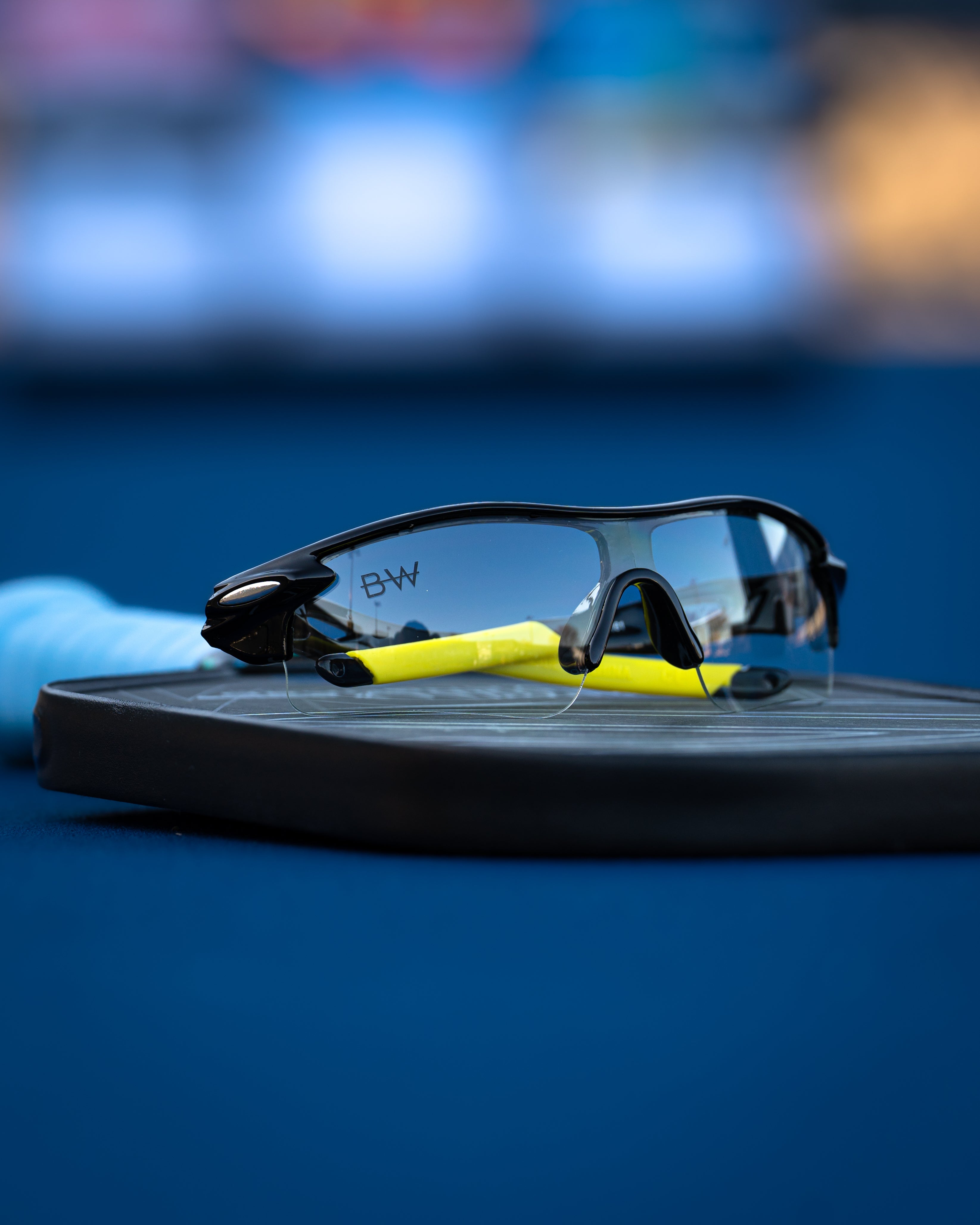
How RX Glasses Train Your Brain to Read the Court Faster
Share
Find Your Perfect Pickleball Glasses
Whether you need prescription (RX) or non-prescription eyewear, our 2026 guide helps you compare current options for prescription needs, playing conditions, comfort, and court use.
Do RX Glasses Actually Train Your Brain to Read the Court Faster?
Prescription glasses do not directly train your brain to process pickleball faster, increase reaction speed, or teach you to anticipate opponents. Their primary job is much simpler: providing the refractive correction prescribed for your vision.
That distinction matters because court reading is a learned sports skill. Experienced pickleball players can become better at recognizing patterns, anticipating likely shots, positioning themselves, and deciding where to move, but those improvements come from practice, experience, attention, strategy, and learning rather than from prescription lenses acting as a neural-training device.
For a player who needs vision correction, however, appropriate RX eyewear can help ensure that uncorrected refractive error is not unnecessarily interfering with the visual information available during play.
A more accurate way to think about the relationship is:
RX eyewear provides the correction you need. Your eyes receive visual information. Your brain interprets that information. Practice and experience help you learn what the information means on the court.
Vision Is One Part of Reading a Pickleball Court
Pickleball requires players to gather information continuously. Before and during a rally, you may visually monitor:
- The ball
- Your opponent's position
- Your partner's position in doubles
- The net
- Court boundaries
- Open court space
- Opponent movement
- Paddle and body positioning
But seeing these elements and understanding what to do with them are different processes.
A player can have excellent prescription correction and still make a poor strategic decision. Another player may recognize a developing pattern quickly because they have encountered it hundreds of times before.
That is why prescription eyewear should not be marketed as automatically creating faster decisions or superior court awareness.
Seeing the Court vs. Reading the Court
These phrases sound similar, but they describe different ideas.
| Concept | What It Means |
|---|---|
| Prescription correction | Correcting refractive error according to the wearer's prescription |
| Visual acuity | The ability to resolve visual detail under specific testing conditions |
| Peripheral vision | Vision outside the central point of gaze |
| Depth perception | Perception of spatial relationships and depth |
| Attention | Which information receives mental focus |
| Anticipation | Using available information and experience to predict what may happen next |
| Court awareness | Understanding relevant positions, space, and developing play |
| Decision-making | Selecting an action from the available options |
These processes can interact, but they should not be treated as interchangeable.
What Prescription Glasses Actually Do
Prescription lenses are designed to provide refractive correction according to an eyeglass prescription.
Depending on the prescription, values can include:
- SPH: spherical lens power
- CYL: cylinder power associated with astigmatism correction
- AXIS: orientation associated with cylinder correction
- ADD: additional near power when prescribed
- Prism: prism correction when prescribed
The exact prescription should come from an appropriate eye-care professional. Sports use does not create a separate rule allowing an athlete to independently strengthen, weaken, round, or otherwise modify those values.
Why “Neural Training Device” Is the Wrong Description
Calling ordinary prescription sports glasses a neural-training device goes beyond what the eyewear itself does.
RX glasses should not be claimed to automatically:
- Train the brain to process visual information faster
- Increase neurological processing speed
- Improve reaction time
- Improve anticipation
- Teach better shot selection
- Increase decision-making speed
- Improve partner coordination
- Improve depth perception
- Increase peripheral awareness
- Train faster ball tracking
Those are different abilities and should not be attributed directly to prescription eyewear without specific evidence supporting the exact claim.
What Actually Helps You Read the Court Faster?
Players can become quicker at recognizing common situations because they gain experience with the sport.
For example, repeated practice can help you become familiar with:
- Common opponent positioning
- Typical doubles rotations
- Patterns that develop during dink exchanges
- When open court space appears
- How different shots tend to develop
- Where your partner is likely to move
- How your own positioning affects available options
This is learning from repetition and experience. Prescription eyewear may be part of the equipment you wear while learning, but the glasses themselves are not performing the training.
Does Better-Corrected Vision Make Decisions Faster?
It is tempting to create a simple equation:
Clearer vision = faster brain = faster decision.
Real athletic decision-making is more complicated.
A player's response can depend on visual information, attention, experience, anticipation, strategy, positioning, physical ability, and the number of possible choices available at that moment.
Appropriate prescription correction addresses the refractive error it was prescribed to correct. It should not automatically be translated into a measurable improvement in decision speed.
Reaction Time and Court Decisions Are Not the Same Thing
A simple reaction task may involve responding to a single known stimulus with a predetermined action.
A pickleball rally frequently involves something more complex. A player may need to identify what is happening, evaluate several possible responses, select one, and physically execute it.
That means a missed shot cannot automatically be blamed on visual reaction speed.
Positioning, anticipation, technique, balance, paddle preparation, shot selection, and opponent quality can all contribute to the outcome.
What Is Dynamic Visual Acuity?
Dynamic visual acuity broadly relates to resolving visual detail when the observer, target, or both are moving.
It is a useful concept when discussing sports vision, but it should not be turned into an unsupported product claim.
Prescription glasses do not automatically “train” dynamic visual acuity simply because you wear them during pickleball.
Likewise, dynamic visual acuity is not interchangeable with:
- Reaction time
- Decision-making speed
- Depth perception
- Peripheral vision
- Anticipation
- General court awareness
Do RX Glasses Improve Ball Tracking?
Do not promise that prescription eyewear directly improves ball-tracking ability.
If you need refractive correction, wearing an appropriate prescription addresses that visual need. Tracking a moving pickleball, however, involves more than simply having an RX lens in front of the eye.
Eye movements, attention, target movement, player movement, experience, lighting, and other visual factors can contribute to what a player experiences during a rally.
Do Prescription Glasses Improve Depth Perception?
Depth perception is a separate visual function and should not be used as a blanket marketing benefit for RX sports glasses.
An appropriate prescription can correct the refractive error for which it was prescribed, but that does not justify promising that a particular pair of glasses will increase a player's depth perception or distance judgment.
If you experience persistent or meaningful concerns involving depth, double vision, or other aspects of your vision, appropriate eye-care evaluation is more useful than attempting to solve the issue through sports-eyewear marketing claims.
Do Sports Frames Increase Peripheral Vision?
A frame can change how much physical eyewear structure appears within your field of view, but a larger or wider lens does not increase the biological extent of your peripheral vision.
Likewise, prescription eyewear should not be advertised as teaching your brain to process peripheral cues faster.
Frame geometry can still matter for comfort, coverage, prescription compatibility, and personal preference. Those are legitimate reasons to compare different frames without turning them into neurological performance claims.
What High-Index RX Lenses Actually Mean
Blinded Wear RX products include high-index prescription lenses at no additional cost.
High-index refers to a category of prescription lens material commonly used to help manage lens thickness, particularly as prescription strength increases.
Finished lens thickness depends on multiple factors, including:
- Your individual prescription
- Frame dimensions
- Lens geometry
- Optical requirements
High-index should not be interpreted as a brain-training technology or sports-performance rating.
What High-Index Does Not Automatically Mean
The term “high-index” alone does not establish:
- Faster focus switching
- Faster reaction time
- Better depth judgment
- Improved ball tracking
- Better court awareness
- Edge-to-edge distortion-free vision
- Superior prescription accuracy
- Impact certification
- Scratch resistance
- Anti-fog performance
- Polarization
- UV specifications
Those characteristics should be evaluated separately and only claimed when they are supported for the exact product or lens configuration.
Do RX Lenses Make Your Eyes Switch Focus Faster?
No blanket claim should be made that a high-index or sports prescription lens speeds the biological process of changing focus.
Accommodation is the process through which the eye changes optical focusing power, particularly for near viewing. It is not the same thing as reaction time, attention, saccadic eye movement, or court awareness.
Your prescribed correction and your eye's biological focusing processes should not be combined into one generic idea of “faster vision.”
Eye Movements and Focusing Are Different Processes
During a rally, your eyes may shift from one location to another. These rapid eye movements are not the same thing as accommodation.
Likewise, moving your gaze from an opponent to the ball does not mean your prescription lenses are actively training the brain.
Separating these concepts makes it easier to understand what prescription eyewear can realistically do.
Does Your Brain Adapt to New Prescription Glasses?
A new prescription or eyewear configuration can feel different from a familiar old pair. The visual system may need to become familiar with those differences, but there is no universal adjustment period that applies to every person, prescription, frame, and lens design.
Adaptation to new eyewear should also not be confused with sports training.
Becoming accustomed to a new pair does not prove that the glasses are increasing neurological processing speed.
Why an Old RX Pair Can Feel More Natural Than a New Pair
An older pair may feel immediately familiar because you have spent substantial time wearing it.
That familiarity does not prove that:
- The old prescription is still appropriate
- The old pair is more accurate
- The new prescription is wrong
- The old pair produces faster visual processing
If a new prescription feels meaningfully wrong or causes persistent visual concerns, appropriate professional evaluation is more useful than simply returning to an older pair indefinitely.
How Long Should You Give New RX Glasses?
There is no single adjustment period that should be promised to every wearer.
The experience can vary depending on what changed between the old and new eyewear.
Changes may include:
- Prescription values
- Frame geometry
- Lens material
- Lens design
- Lens dimensions
- Optical positioning
- Wearing position
Persistent unexpected blur, dizziness, new double vision, or another meaningful visual change should not simply be dismissed as normal adaptation.
Frame Fit Matters, but Not Because It Makes Your Brain Faster
Active eyewear should fit appropriately for the wearer and intended activity.
A frame that repeatedly requires adjustment can be inconvenient during play, while an excessively tight frame may reduce comfort.
Neither extreme provides a neurological advantage.
A practical sports fit should prioritize appropriate positioning and comfort rather than promises such as “zero movement,” “locked-in vision,” or “faster processing.”
Does Frame Movement Cause Visual Delay?
Do not automatically describe ordinary frame movement as creating neurological lag or delayed vision.
If eyewear shifts significantly, the wearing position can change. That may be worth evaluating, particularly with prescription lenses, but the correct response is to investigate fit and optical positioning rather than claim that the brain has become slower.
A Tighter Frame Does Not Make Your Vision Faster
Choosing the tightest possible sports frame does not increase reaction time or processing speed.
Evaluate:
- Comfort
- Pressure points
- Repeated shifting
- Prescription compatibility
- How the eyewear feels during realistic movement
Fit is personal. There is no universal “performance-tightness” standard.
Optical Positioning Is Different From Brain Training
Prescription lens positioning can matter to the experience of wearing corrective eyewear, particularly with stronger or more complex prescriptions.
Relevant concepts can include pupillary distance, lens reference points, frame geometry, and wearing position.
These optical considerations should not be translated into claims that properly positioned lenses directly increase reaction speed, anticipation, or cognitive processing.
What Role Does PD Play?
Pupillary distance is related to prescription lens positioning. It is not a measurement of court awareness or neurological processing speed.
Also remember:
- PD is separate from SPH, CYL, and AXIS.
- Binocular and monocular PD are different ways of expressing measurements.
- A binocular PD should not automatically be divided in half and assumed to represent two identical monocular measurements.
- Sports use does not independently change your PD.
Does Prescription Strength Affect How Fast You Read the Court?
A stronger prescription does not automatically mean a slower athlete, slower visual processing, or worse court awareness.
Likewise, intentionally reducing prescription strength should not be promoted as a way to make sports vision feel faster.
The goal is to use an appropriate eyeglass prescription rather than manipulating prescription power based on unsupported performance theories.
What About Astigmatism?
An eyeglass prescription for astigmatism may include cylinder and axis information.
Those values should be preserved as prescribed rather than independently rounded, omitted, or modified for sports.
Astigmatism correction should also not be marketed as automatically improving reaction time, paddle reading, or ball tracking.
What If Your Prescription Includes Prism?
Prism is an intentional prescription component when prescribed and should not be omitted or altered because you are ordering sports eyewear.
If you have a more complex prescription and are unsure whether a particular frame or lens configuration is appropriate, obtain suitable professional guidance rather than simplifying the prescription yourself.
Do Not Use a Contact Lens Prescription as an Eyeglass Prescription
Contact lens and eyeglass prescriptions should not be treated as interchangeable.
If you are ordering Blinded Wear prescription glasses, use the appropriate eyeglass prescription.
Do not independently convert contact-lens values into eyeglass values in an attempt to create a “sports RX.”
Do You Need a Special Pickleball Prescription?
There is no general rule that pickleball players need a stronger, weaker, or neurologically optimized prescription simply because they play a fast sport.
Your refractive prescription should be determined according to your visual needs by an appropriate eye-care professional.
After that, you can compare sports frames and available lens configurations based on fit, environment, comfort, and verified product characteristics.
What Are You Actually Learning When You “Read the Court”?
As pickleball experience grows, players may become more familiar with recurring tactical situations.
For example, you may learn to recognize:
- When an opponent has left open space
- When your team should move together
- When an opponent is out of position
- Common patterns during kitchen exchanges
- Likely responses to particular shots
- When attacking a ball may be higher risk
- How positioning changes available angles
That is tactical learning. The eyewear you wear during practice can provide your prescribed correction, but it does not encode those patterns into your brain.
Why Anticipation Can Look Like Faster Reaction Time
An experienced player may appear to react extraordinarily quickly because they begin recognizing what is likely to happen before a less experienced player does.
That does not necessarily mean their nervous system is simply reacting faster to the same information.
Experience, positioning, pattern recognition, and anticipation can influence when a player begins preparing for the next action.
Prescription glasses should not take credit for skills developed through that experience.
Visual Attention Matters Too
Having visual information available does not mean every detail receives equal attention.
A player can look toward the correct area of the court and still focus on the wrong cue.
Learning what deserves attention in different situations is part of sports development. Prescription eyewear does not automatically direct attention toward the most useful information.
Equipment Supports the Player; It Does Not Replace Experience
A useful way to evaluate prescription sports glasses is to ask whether they meet your actual eyewear needs rather than whether they promise to transform your brain.
Consider:
- Is the prescription appropriate?
- Is the frame comfortable?
- Does it fit appropriately during activity?
- Does the lens configuration suit the environment?
- Are the product characteristics you care about actually verified?
Then develop anticipation, positioning, strategy, and decision-making through practice.
Practice in New RX Glasses Before Tournament Day
If you purchase new prescription sports eyewear, use it during practice before relying on it during an important tournament.
This gives you an opportunity to evaluate:
- General comfort
- Fit during realistic movement
- Whether repeated adjustments are necessary
- Whether the lens configuration suits your playing environment
- Whether you notice unexpected visual concerns
This is familiarization with equipment, not evidence that the eyewear is neurologically training you.
If the Court Does Not Look Right, Identify the Actual Cause
| What You Notice | What to Check | Do Not Automatically Assume |
|---|---|---|
| Persistent blur | Prescription, lens condition, positioning, or current vision | Your brain needs more training |
| Hazy view | Dirt, perspiration, fingerprints, sunscreen, or condensation | Your prescription is wrong |
| Frame repeatedly shifts | Fit and wearing position | Your reaction time is being slowed |
| New pair feels different | Prescription, frame, lens design, material, and positioning | The old pair is automatically more accurate |
| Difficulty anticipating shots | Positioning, attention, experience, and tactical recognition | You need stronger RX lenses |
| One eye consistently looks blurrier | Prescription, lens, positioning, or vision | Both eyes should have identical prescription values |
| New double vision | Appropriate eye-care evaluation | You simply need to adapt longer |
Dirty Lenses Are Not a Brain-Processing Problem
Pickleball eyewear can accumulate perspiration, fingerprints, sunscreen, dust, water, and other residue.
If the view becomes smeared or hazy, check the lens surface before assuming the prescription or your visual processing has changed.
Appropriate cleaning can remove contamination. It cannot:
- Change prescription values
- Repair scratches
- Repair cracks
- Change PD
- Improve neurological processing speed
- Train reaction time
Fogging Is Also a Separate Issue
Fog is condensation on the lens surface. It can temporarily interfere with the view, but it does not mean your brain has stopped processing the court correctly.
Do not assume every Blinded Wear lens includes anti-fog technology unless that feature is verified for the exact product.
Lighting Can Change What You Experience on Court
Indoor lighting, direct sunlight, shade, cloud cover, court orientation, and evening conditions can all change the visual environment.
Those changes do not alter the written prescription inside your lenses.
Instead, athletes can compare available lens configurations according to the environments where they actually play.
Lens Tint Does Not Train Faster Processing Either
Clear, grey, and available photochromic configurations can serve different environmental preferences, but tint should not be advertised as a neurological training technology.
Lens tint alone does not establish improvements in:
- Reaction time
- Decision speed
- Ball tracking
- Depth perception
- Anticipation
- Court awareness
Polarization Does Not Determine Processing Speed
Polarization is a separate lens technology designed to reduce certain reflected light.
It should not be claimed that non-polarized lenses make the brain process the court faster or that polarized lenses inherently slow depth judgment.
Polarization alone does not determine reaction time, ball tracking, depth perception, or decision-making speed.
Impact Resistance Is About Physical Lens Characteristics
Impact resistance and visual processing are separate subjects.
An impact-resistant lens should not automatically be described as:
- Shatterproof
- Safety certified
- Scratchproof
- Distortion-free
- Faster for visual processing
If a particular safety certification matters to you, verify that certification independently for the exact eyewear.
Current Blinded Wear RX Frames to Explore
Blinded Wear offers prescription pickleball eyewear for athletes who need refractive correction. Instead of ranking frames by unsupported claims about reaction speed or brain processing, compare current styles according to your prescription needs, fit preferences, and available lens configurations.
- Steel Ice RX
- Blue Shield RX
- Zebra II RX
- Frost RX
- Gray Wash RX
- Havana Melt RX
- Lava Rock RX
- Crystal Wave II RX
- Rippled X RX
- Ocean Wave RX
Browse the complete Prescription Pickleball Glasses Collection for current options.
How to Choose an RX Frame Without Performance Hype
Instead of asking which frame will make your brain read the court fastest, consider:
- Does the frame support your prescription needs?
- Does the frame fit comfortably?
- Does it remain appropriately positioned during your normal movement?
- Does the available lens configuration suit your playing environment?
- Are the exact product specifications you care about verified?
- Have you practiced in the eyewear before tournament use?
This creates a more useful buying decision than ranking frames by neurological claims that the product cannot substantiate.
How Blinded Wear Custom RX Ordering Works
For applicable Blinded Wear custom RX products, upload a clear image of your eyeglass prescription on the product page before adding the eyewear to your cart.
Before uploading your prescription:
- Make sure the image is readable.
- Use an appropriate eyeglass prescription rather than a contact lens prescription.
- Do not crop important information.
- Do not guess unclear numbers.
- Do not independently alter prescription values for sports.
- Pay attention to plus and minus signs.
- Do not swap OD and OS.
For more information, review How to Order RX Glasses.
Remember That Custom RX Eyewear Is Final Sale
Customized Blinded Wear RX eyewear is final sale and excluded from the standard 30-day return policy.
That makes it especially important to review your prescription information, selected frame, lens configuration, and current product details before completing the order.
What Happens If Your RX Glasses Break?
Blinded Wear offers 50% lifetime replacement support if eligible glasses break, subject to current policy terms.
Eligible damaged eyewear must be returned according to the current process. Once applicable requirements are met, qualifying customers can receive 50% credit toward a replacement pair.
This is not an unlimited free replacement warranty, and a change in prescription should not be treated as the same thing as eligible broken eyewear.
For damaged custom RX eyewear, contact blindedwearco@gmail.com before returning the pair.
Review the Blinded Wear Protection Plan, Replacement & Returns information for current eligibility and policy details.
RX Glasses and Court Reading: Myth vs. Reality
| Claim | More Accurate Explanation |
|---|---|
| “RX glasses train your brain” | Prescription lenses provide refractive correction; sports learning comes from practice and experience |
| “Clearer RX makes you react faster” | Appropriate correction addresses refractive error but does not guarantee faster reaction time |
| “High-index makes your brain process faster” | High-index is a lens-material category, not a neurological performance technology |
| “RX glasses improve ball tracking” | No automatic ball-tracking improvement should be promised from prescription eyewear |
| “RX glasses improve depth perception” | Depth perception is a separate visual function and should not be promised as a generic RX benefit |
| “A wider frame improves peripheral vision” | Frame design does not increase the biological extent of peripheral vision |
| “Sports RX makes you anticipate faster” | Anticipation develops through factors such as experience, pattern recognition, positioning, and attention |
| “The strongest RX gives the sharpest court reading” | Use the appropriate prescription rather than intentionally increasing prescription power |
FAQ: Prescription Glasses, the Brain, and Pickleball
Can prescription glasses help me see the court appropriately if I need vision correction?
An appropriate eyeglass prescription is intended to correct the refractive error for which it was prescribed. That is different from promising faster tactical decisions or neurological processing.
Do RX glasses make you react faster?
No direct reaction-time improvement should be promised simply from wearing prescription glasses.
Do RX glasses train your brain?
Ordinary prescription sports glasses should not be described as neural-training devices. They provide refractive correction rather than a dedicated cognitive-training intervention.
Can RX glasses make me better at reading opponents?
Reading opponents involves experience, attention, positioning, pattern recognition, strategy, and other factors. Prescription eyewear does not automatically teach those skills.
Can RX glasses improve anticipation?
Do not claim a direct improvement in anticipation from prescription lenses. Anticipation is strongly connected to how a player interprets developing situations and prior experience.
Can high-index lenses improve reaction time?
High-index material should not be advertised as increasing reaction time.
Do high-index lenses improve focus speed?
Do not claim that high-index material speeds biological accommodation or near-to-far focusing.
Can a new prescription initially feel different?
Yes. A different prescription, frame, lens design, material, or wearing position can create a different experience, but there is no universal adjustment period for every wearer.
Should I wear my new RX sports glasses before a tournament?
Practicing in new eyewear beforehand can help you evaluate comfort, fit, the lens configuration, and whether you notice unexpected visual concerns.
Should I increase my prescription for faster sports?
No. Do not independently strengthen your prescription based on the speed of the sport.
Can tint make my brain process the ball faster?
No direct neurological processing-speed improvement should be attributed to tint color alone.
Does non-polarized eyewear improve depth perception?
Polarization alone does not determine depth perception, reaction time, or ball tracking.
Does a larger sports lens increase peripheral vision?
It does not increase the biological extent of your peripheral vision.
What if my vision suddenly changes?
Meaningful new or persistent visual changes, especially symptoms such as double vision, should be evaluated appropriately rather than treated as a sports-eyewear adjustment issue.
The Better Way to Think About RX Glasses and Court Awareness
Prescription sports glasses do not need exaggerated brain-training claims to be useful.
If you need vision correction, the role of RX eyewear is to provide the appropriate refractive correction while giving you a frame and lens configuration suitable for your needs.
Your ability to read a pickleball court develops through the player side of the equation: practice, experience, attention, positioning, anticipation, strategy, and pattern recognition.
In other words, your glasses do not learn the game for you. They provide your prescribed correction while you develop the skills required to interpret what is happening around you.
Explore the Blinded Wear Prescription Pickleball Glasses Collection, compare current lens options in the Pickleball Performance Lens Guide, or visit the 2026 Pickleball Glasses Hub to find eyewear that fits your prescription needs and playing environment.
How to Train Court Reading While Wearing RX Glasses
If prescription glasses do not directly train the brain, what should a player actually do to become faster at reading the court?
The most useful approach is to separate vision correction from sports learning. Wear the appropriate prescription eyewear you need, then use purposeful practice to develop recognition, positioning, anticipation, and decision-making.
That creates a simple framework:
- Correct what needs correction: use an appropriate eyeglass prescription.
- Make the equipment practical: choose eyewear that fits appropriately and suits your playing environment.
- Practice realistic situations: expose yourself to recurring pickleball patterns.
- Learn useful cues: pay attention to positioning, available space, and developing play.
- Review decisions: identify what you recognized early and what you noticed too late.
The improvement comes from learning the sport while receiving the prescription correction you need—not from the lenses independently increasing processing speed.
Pattern Recognition Is a Major Part of “Fast” Court Reading
A rally can appear completely unpredictable to a new player while looking more familiar to an experienced player.
With repeated exposure, players may begin recognizing situations they have encountered before. Instead of waiting for every event to unfold before deciding what it means, they can use prior experience to interpret the developing rally.
Examples can include recognizing:
- An opponent moving out of position
- Open space developing on the court
- A partner beginning to rotate
- A ball that creates an attacking opportunity
- A defensive situation that calls for patience
- A recurring pattern an opponent has used several times
This type of learning can make experienced players appear faster even though prescription eyewear itself has not accelerated their brain.
Anticipation Can Matter as Much as Raw Reaction
Imagine two players receiving the same shot.
One waits until the ball is already traveling toward an open area before beginning to respond. The other recognizes the developing situation earlier and begins preparing sooner.
The second player may appear to have dramatically faster reactions, but the difference can involve anticipation, positioning, and pattern recognition rather than simply faster biological reaction time.
This is an important distinction when evaluating sports eyewear. Prescription glasses should not receive credit for anticipation skills that the athlete developed through experience.
Can You Learn to Read Opponent Cues?
Players can become more familiar with relevant visual information during repeated competition and practice.
Depending on the situation, that information may include:
- Opponent position
- Available court space
- Movement direction
- Paddle preparation
- Body positioning
- The location and trajectory of the ball
However, seeing a cue does not guarantee that you can predict the next shot correctly. Skilled opponents can disguise intentions, change patterns, and make unexpected decisions.
RX eyewear should therefore not be marketed as automatically allowing you to “read the paddle” or predict an opponent's shot.
Learning to Recognize Open Court Space
Court awareness includes understanding where players are positioned and where space is available.
That awareness can improve through practice because you become more familiar with common formations and movement patterns.
Prescription correction can address the refractive error for which it was prescribed, but it does not automatically teach spatial strategy.
Learning when open space matters—and whether attacking that space is actually the correct decision—is a tactical skill.
RX Glasses and Doubles Court Awareness
Doubles adds another player to your team and another opponent to monitor, creating additional positional information.
A doubles player may need to consider:
- Partner position
- Opponent positions
- Distance between teammates
- Open areas of the court
- Which player is responding to the current ball
- How the team's formation changes during the rally
Appropriate RX eyewear can provide the wearer's prescribed refractive correction, but partner coordination develops through communication, experience, movement, and shared tactical understanding.
What Changes in Singles?
Singles requires one player to cover the court without a partner, which changes movement and tactical demands.
That does not mean singles requires a stronger prescription, a weaker prescription, or a special lens that processes visual information faster.
Your prescription does not change simply because the match format changes.
Instead, the player adapts strategy, positioning, movement, and shot selection to the format.
Do You Need Different RX Glasses for Singles and Doubles?
Not simply because one match is singles and another is doubles.
If your prescription eyewear is appropriate for your vision, fit, and playing environment, the match format itself does not create a new refractive prescription.
Different eyewear may still make sense when environmental conditions change—for example, moving from bright outdoor play to an indoor or evening environment—but that is a separate consideration from singles versus doubles strategy.
Why Repetition Helps Court Recognition
Repeated exposure to game situations gives players more opportunities to learn what different situations look like.
A beginner may need significant conscious thought to identify positioning or decide between several options. With experience, some familiar situations may become easier to recognize.
That learning can happen while wearing prescription eyewear, but the distinction remains important:
You are training the player, not the prescription lens.
Practice Drills Can Target Court Reading More Directly Than Eyewear
If your goal is to recognize situations earlier, use drills that expose you to realistic decisions instead of assuming a lens upgrade will create the skill.
Examples include:
- Cross-court dink patterns
- Reset and transition-zone practice
- Third-shot decision drills
- Partner movement and rotation practice
- Attack-versus-reset decision drills
- Point play beginning from specific court positions
- Games that require identifying open space before attacking
The value of these drills comes from repeated decision-making and pattern exposure rather than a special property of prescription eyewear.
Why Unpredictable Drills Can Be Useful
A drill where you already know exactly where every ball will go can help with technique, but it does not recreate every decision involved in an unpredictable rally.
Adding appropriate variability can require the player to observe the developing situation and select a response.
This distinction also helps explain why “seeing clearly” and “making the right decision” should not be treated as the same ability.
Video Review Can Help You Understand What You Missed
If you want to improve court reading, reviewing your own points can reveal information that was difficult to notice while playing.
You can ask:
- Where were both opponents positioned?
- Where was my partner?
- Was open court space available?
- Was I balanced before the opponent contacted the ball?
- Did I recognize the developing pattern early?
- Was the problem visual, tactical, technical, or positional?
This type of review can help separate a genuine eyewear concern from a sports-learning issue.
A Missed Ball Does Not Automatically Mean You Have a Vision Problem
There are many reasons a player can be late to a ball or make an incorrect decision.
Possibilities can include:
- Poor positioning
- Incorrect anticipation
- Slow physical movement
- Late paddle preparation
- Unexpected opponent shot selection
- Loss of balance
- Technical error
- Attention directed toward the wrong information
- A genuine visual concern
Do not diagnose the cause from a single missed shot.
Vision Problems and Technique Problems Can Feel Similar During Play
If you repeatedly mistime contact, it can be tempting to assume that your glasses are responsible.
But timing can also be influenced by footwork, preparation, swing mechanics, positioning, and judgment.
Conversely, persistent unexpected blur should not simply be dismissed as poor technique.
Separating equipment, vision, and sports-skill variables can help you investigate the right problem.
Use This Court-Reading Troubleshooting Framework
| Problem | First Area to Consider | Possible Next Step |
|---|---|---|
| Everything consistently looks blurry | Prescription, lens condition, or current vision | Clean the lenses and seek appropriate optical or eye-care evaluation if the issue persists |
| View becomes hazy during play | Perspiration, residue, water, or condensation | Inspect and appropriately clean the lens |
| You see clearly but repeatedly choose the wrong shot | Strategy and decision-making | Practice, coaching, or video review may be more relevant |
| You react late despite seeing the ball | Anticipation, positioning, preparation, or physical response | Review the complete play rather than assuming RX failure |
| The frame repeatedly shifts | Fit and wearing position | Evaluate frame fit |
| Only one environment causes difficulty | Lighting and lens configuration | Compare the environment with the lens configuration you are using |
| New double vision develops | Vision | Seek appropriate eye-care evaluation |
Does Fatigue Affect Court Reading?
Long matches and tournament days can change how a player feels and performs.
Physical fatigue, attention, decision-making, movement, and technique can all vary over the course of competition.
Do not automatically describe late-match mistakes as evidence that RX lenses are causing “visual fatigue,” and do not promise that a particular prescription lens eliminates mental or physical fatigue.
Can Hydration Make Your Eyes Focus Faster?
Hydration is relevant to general athletic preparation, but it should not be advertised as a direct method for accelerating accommodation or neurological visual processing.
Likewise, prescription sports eyewear should not be promoted as preventing performance decline caused by dehydration.
Keep general athletic preparation and specific optical claims separate.
What About Confidence?
An athlete may personally feel more confident when using equipment they trust and feel comfortable wearing.
That subjective experience should not be converted into a universal claim that prescription glasses biologically increase confidence, aggression, decisiveness, or competitive performance.
Confidence can be influenced by many factors, including preparation, experience, recent performance, familiarity, and personal preference.
Do RX Glasses Reduce Cognitive Load?
Be careful with claims that prescription glasses “free up brainpower” or reduce cognitive load during competition.
Appropriate prescription correction addresses refractive error. That does not automatically establish a measurable reduction in mental workload during a pickleball match.
Sports decision-making still involves attention, strategy, experience, uncertainty, and physical execution.
Can Clearer Vision Make Your Brain Process Information Faster?
Prescription correction and neural processing speed are not the same measurement.
An appropriate prescription can provide the refractive correction it was prescribed to provide. That does not mean the lens increases the speed at which the brain processes every piece of visual information.
Avoid turning a legitimate optical function into an unsupported neurological performance claim.
There Is No Universal Millisecond Advantage From RX Sports Glasses
Claims that a particular prescription lens saves a specific number of milliseconds during a rally require evidence that should not be assumed.
Do not assign an exact reaction-time advantage to:
- High-index lenses
- Clear lenses
- Grey lenses
- Non-polarized lenses
- A particular frame shape
- A wider lens
- A tighter fit
Product characteristics can be discussed accurately without inventing a measurable neurological advantage.
What About “Eye-Brain Coordination”?
The phrase “eye-brain coordination” is often used broadly in sports marketing, but it can blur together several distinct processes.
Visual acuity, eye movements, attention, depth perception, decision-making, anticipation, and physical coordination are not one single ability.
Prescription eyewear should therefore not be claimed to strengthen all of them simply because it corrects refractive error.
Do RX Glasses Improve Hand-Eye Coordination?
Do not promise that prescription lenses directly improve hand-eye coordination.
Sports coordination involves perception, timing, learned motor skills, physical execution, and practice.
If a player needs refractive correction, using the appropriate prescription addresses that optical need. Coordination remains a broader athletic skill.
Can RX Glasses Improve Paddle Contact?
Prescription eyewear should not be marketed as guaranteeing cleaner contact with the ball.
Paddle contact can be influenced by:
- Technique
- Footwork
- Balance
- Timing
- Paddle preparation
- Ball trajectory
- Decision-making
- Visual factors
One piece of equipment should not receive credit for the entire outcome.
Does a Faster Ball Require a Different Prescription?
No general rule says that a faster ball requires stronger prescription power.
Your eyeglass prescription should be based on your visual needs rather than the speed of an opponent's drive.
Do not independently increase or decrease SPH, CYL, AXIS, ADD, or prism because you are moving into faster competition.
Do Advanced Players Need a Different RX Strength?
Skill level does not independently determine prescription strength.
A beginner, intermediate player, and advanced competitor should each use the prescription appropriate for their individual vision rather than selecting stronger correction as their competition level rises.
Tournament Pressure Does Not Change Your Written Prescription
Competition may feel very different from practice, but tournament pressure does not independently change the prescription values written for your eyeglasses.
If decision-making becomes less consistent under pressure, investigate the complete competitive situation rather than assuming you need a stronger sports prescription.
Indoor and Outdoor Play Can Feel Different Without Requiring Different RX Strength
Lighting conditions can differ significantly between an indoor facility and a bright outdoor court.
That can make different lens configurations worth considering, but it does not automatically mean the refractive prescription itself should change.
Keep these variables separate:
- Prescription correction
- Tint
- Visible-light transmission
- Polarization
- Photochromic behavior
- Frame fit
- Lighting environment
Do Clear RX Lenses Help the Brain Read Indoor Courts Faster?
Clear prescription lenses provide prescription correction without a dark sunglass tint when that configuration is appropriate and available.
They should not be described as making the brain process an indoor court faster.
The legitimate distinction is the absence of a dark sunglass tint, not a neurological speed advantage.
Do Grey RX Lenses Improve Outdoor Court Reading?
A grey prescription sunglass lens can reduce visible-light transmission according to the specifications of the exact lens while providing the wearer's prescription correction.
That does not establish that grey tint improves:
- Ball tracking
- Reaction time
- Depth perception
- Decision speed
- Opponent recognition
- Anticipation
Choose tint based on verified lens characteristics and your environment rather than a promise of faster brain processing.
Do Photochromic RX Lenses Train Visual Adaptability?
No. Photochromic technology is designed to change tint according to the specific lens technology and environmental conditions.
That changing tint should not be described as training the brain to adapt faster to lighting changes.
If photochromic technology is available for the exact configuration you are considering, evaluate it for convenience and suitability to your environment rather than as a neurological training feature.
Does VLT Affect Brain Processing Speed?
Visible Light Transmission, or VLT, describes the percentage of visible light transmitted through a lens.
Higher VLT means more visible light is transmitted. Lower VLT means less visible light is transmitted.
VLT is useful for describing lens transmission, but it should not be converted into a universal brain-processing or reaction-time score.
Darker Is Not Automatically Better for Court Reading
A darker lens transmits less visible light according to its specifications, but that does not mean it improves court awareness.
Likewise, a lighter lens does not automatically improve reaction time.
The useful question is whether the exact lens configuration suits the conditions where you are using it.
UV Protection and Court Reading Are Separate Topics
UV-related lens specifications should not be confused with prescription correction or sports decision-making.
A UV specification does not independently prove that a lens improves reaction time, and tint darkness does not establish UV characteristics.
Verify UV information separately when it matters to your purchase.
Sports Protection Does Not Equal Faster Vision
Physical lens characteristics and neurological performance should remain separate in product descriptions.
Impact resistance relates to physical impact characteristics. It does not mean that a lens:
- Improves reaction speed
- Processes motion faster
- Improves depth perception
- Creates better anticipation
- Improves court awareness
Likewise, impact resistance should not automatically be described as a particular safety certification.
Can Scratched RX Lenses Slow Your Brain?
A scratch is physical surface damage. It does not literally reduce the processing speed of your brain or change the written prescription values.
Depending on location and severity, physical lens damage may be noticeable while looking through the eyewear.
Do not attempt to “fix” scratches with toothpaste, baking soda, car wax, or other abrasive DIY polishing methods.
A Scratch and a Crack Are Not the Same Thing
Surface scratches should be distinguished from cracks, chips, displaced lenses, and other structural damage.
There is no universal scratch-size threshold at which every prescription lens must be replaced.
Structural damage deserves separate consideration, especially when the eyewear is being used during an active sport.
Keep the View Clean Without Overcomplicating It
Surface contamination can make otherwise appropriate eyewear appear hazy.
Use appropriate lens-care methods and avoid aggressive household cleaners or abrasive polishing techniques whose compatibility with the exact lens is unknown.
Cleaning can remove contamination. It does not improve your prescription, reaction time, depth perception, or tactical awareness.
Can Frame Geometry Affect the Experience of a Prescription?
Yes. Two pairs containing the same written prescription can still feel different because the eyewear itself may differ.
Relevant differences can include:
- Frame dimensions
- Lens dimensions
- Lens material
- Lens design
- Frame wrap
- Wearing position
- Optical positioning
That does not mean one frame necessarily makes the brain faster than another.
Does More Frame Wrap Mean Faster Court Awareness?
No.
Wrap can affect frame geometry, coverage, and prescription considerations, but it should not automatically be described as increasing peripheral vision or processing speed.
More wrap is not universally better for every prescription or wearer.
Does a Larger Lens Help You Read More of the Court?
A larger lens can change the physical eyewear design and coverage, but it does not expand the biological limits of peripheral vision.
For prescription eyewear, larger lens dimensions can also influence finished lens characteristics depending on the prescription and design.
Choose frame dimensions for appropriate fit and prescription compatibility rather than assuming the largest possible lens creates the fastest court awareness.
Strong Prescriptions and Sports Eyewear
Players with stronger prescriptions should not assume they need special “brain-training” optics.
Instead, consider practical optical factors such as:
- The complete prescription
- Frame dimensions
- Lens geometry
- Available lens material
- Appropriate positioning
There is no universal prescription threshold at which a player's brain suddenly becomes slower at reading the court.
Why High-Index Can Still Matter Without Performance Claims
High-index prescription lens material can be useful for managing lens thickness, particularly as prescription strength increases.
That is already a meaningful optical benefit without claiming that the material improves neurological speed.
Final thickness depends on more than refractive index, so two high-index prescriptions can still produce different finished lenses.
Thinner Lenses Do Not Mean Faster Vision
Lens thickness is a physical characteristic, not a measurement of how quickly the brain interprets a rally.
A thinner lens should not automatically be advertised as producing:
- Faster reactions
- Faster focusing
- Better anticipation
- Improved depth perception
- Improved tracking
Direct RX vs. RX Clip: Which Processes the Court Faster?
Neither configuration should automatically be ranked as neurologically faster.
A direct RX configuration incorporates prescription correction into the prescription lens setup of the eyewear.
A compatible RX clip system uses a separate inner prescription insert within the eyewear system.
Compare them based on prescription compatibility, fit, available lens configurations, maintenance, and personal preference rather than claims about brain-processing speed.
Why a Backup RX Pair Can Matter More Than a “Faster” Lens
If you depend on prescription eyewear to play, having an appropriate backup pair can provide useful redundancy during a tournament.
A backup can matter if your primary pair:
- Breaks
- Develops structural damage
- Is misplaced
- Uses a lens configuration that no longer suits the current environment
Your backup should use an appropriate prescription. Do not intentionally make it stronger or weaker to create a supposed performance advantage.
Can an Older Pair Be Your Tournament Backup?
Potentially, if the prescription remains appropriate and the eyewear is in usable condition.
Age alone does not determine whether a pair is suitable.
Consider:
- Whether your prescription has changed
- Lens condition
- Frame condition
- Fit
- Whether the lens configuration suits the environment
Prepare Your RX Eyewear Before Tournament Day
A simple preparation routine can prevent avoidable equipment problems:
- Inspect the frame and lenses.
- Clean the lenses appropriately.
- Make sure the eyewear remains comfortable during normal movement.
- Practice in unfamiliar prescription eyewear before competition.
- Prepare an appropriate backup pair if you depend on RX correction.
- Consider whether your expected lighting conditions match your lens configuration.
None of these steps guarantees better athletic performance, but they can help ensure your eyewear is ready for use.
How to Compare Blinded Wear RX Frames
Rather than ranking prescription frames by supposed brain-training ability, compare current options using practical criteria.
| Question | Why It Matters |
|---|---|
| Does it support my prescription requirements? | Prescription compatibility comes before sports marketing |
| Does the frame fit appropriately? | Comfort and wearing position matter during activity |
| Which lens configurations are actually available? | Availability can differ by product |
| Will I use it indoors, outdoors, or both? | Environment can influence lens preference |
| Which specifications are verified? | Do not infer technology from appearance or product name |
| Have I reviewed the custom RX policy? | Customized RX eyewear is final sale |
A Product Name Does Not Prove a Visual Technology
Names such as Steel Ice RX, Blue Shield RX, Gray Wash RX, Crystal Wave II RX, or Ocean Wave RX identify products. The names themselves do not establish technical features.
Do not infer from a product name that it provides:
- Blue-light filtering
- Photochromic behavior
- Polarization
- Anti-fog technology
- Scratch resistance
- A particular VLT
- A particular UV specification
- Improved reaction time
- Improved court awareness
Verify important specifications on the exact current product configuration.
Explore Current Prescription Pickleball Glasses
Blinded Wear offers multiple current RX styles for players who need prescription correction. Options to explore include:
- Rippled X RX
- Zebra II RX
- Steel Ice RX
- Blue Shield RX
- Frost RX
- Ocean Wave RX
- Gray Wash RX
- Crystal Wave II RX
- Lava Rock RX
- Havana Melt RX
Use the Prescription Pickleball Glasses Collection to compare current styles and verify the exact lens options available for the frame you are considering.
Avoid Prescription Ordering Errors
Sports performance is not a reason to modify the prescription information supplied by your eye-care professional.
When ordering applicable custom RX eyewear:
- Use the appropriate eyeglass prescription.
- Upload a clear, readable prescription image.
- Do not substitute a contact lens prescription.
- Do not swap OD and OS.
- Do not remove cylinder or axis information.
- Do not change plus signs to minus signs or vice versa.
- Do not round values because another number seems more convenient.
- Do not strengthen the prescription for faster play.
- Do not weaken it because you think sports require “softer” vision.
What If Your Prescription Is Old?
There is no universal age at which every eyeglass prescription automatically becomes unsuitable.
However, an old prescription can be manufactured accurately while no longer reflecting a person's current visual needs.
If your vision has meaningfully changed or you are unsure whether your prescription remains appropriate, an eye-care professional can determine your current refractive prescription.
A new sports frame cannot compensate for a prescription that no longer suits your vision.
Who Can Help When Your RX Glasses Do Not Feel Right?
Different concerns may call for different types of evaluation.
| Concern | Appropriate Area of Help |
|---|---|
| Is my current prescription still appropriate? | Eye-care professional |
| Meaningful new visual symptoms | Eye-care professional |
| Persistent new double vision | Eye-care professional |
| Does finished eyewear match relevant prescription characteristics? | Optical professional using appropriate equipment |
| Frame fit or adjustment | Optical professional where appropriate |
| Blinded Wear product or order question | Blinded Wear customer support |
Can You Verify an RX Lens at Home?
A home vision chart, photograph, phone application, or comparison with an old pair cannot fully verify the prescription characteristics of a finished lens.
Optical professionals can use instruments such as a lensmeter or focimeter to evaluate relevant characteristics of prescription lenses.
If you suspect a manufacturing or prescription issue, objective evaluation is more useful than attempting to diagnose the problem from how quickly you reacted during a pickleball rally.
What If Only One Eye Looks Blurry?
Do not assume both eyes should have identical prescription values.
OD and OS can legitimately differ.
If one eye consistently appears unexpectedly blurry, possible areas to investigate can include the prescription, lens condition, positioning, or the wearer's vision.
Persistent or meaningful concerns should be evaluated appropriately rather than corrected through DIY changes to prescription values.
Do Not Treat New Double Vision as Sports Adaptation
New or persistent double vision should not be explained away as the brain “learning” a new sports lens.
Likewise, do not try to correct it by:
- Choosing a darker tint
- Tightening the frame excessively
- Changing prescription values yourself
- Waiting indefinitely for neurological adaptation
Seek appropriate eye-care evaluation for meaningful new visual symptoms.
More Myths About RX Glasses and Faster Court Reading
Myth: The brain works faster when the lens is thinner.
Reality: Lens thickness is not a measure of neurological processing speed.
Myth: A stronger prescription gives an athlete more detail.
Reality: Use the prescription appropriate for your vision rather than intentionally increasing lens power.
Myth: Non-polarized lenses increase depth perception.
Reality: Polarization alone does not determine depth perception.
Myth: Wide sports frames increase peripheral vision.
Reality: Frame geometry does not expand the biological limits of peripheral vision.
Myth: High-index lenses make near-to-far focusing faster.
Reality: High-index is a lens-material category and should not be described as speeding biological accommodation.
Myth: A secure frame increases reaction time.
Reality: Appropriate fit can be practically useful during activity, but it should not be converted into a measurable reaction-time claim.
Myth: Grey tint makes the ball easier for the brain to process.
Reality: Grey tint should not automatically be claimed to improve ball tracking, contrast, or processing speed.
Myth: Photochromic lenses train your eyes to adapt to changing light.
Reality: Photochromic technology changes lens tint according to its technology and environmental conditions; it does not independently train biological visual adaptation.
More Questions About RX Glasses and Court Reading
Can practice while wearing RX glasses help me become a better player?
You can improve sports skills through practice while wearing the prescription correction you need. The learning comes from the practice rather than the glasses functioning as a training device.
Can repeated use of RX glasses make me recognize shots sooner?
Repeated pickleball experience can help you become more familiar with developing situations, but do not attribute that learning directly to prescription lenses.
Can RX glasses help me predict where the ball will go?
Prescription correction does not predict ball trajectory. Anticipation depends on the developing play, experience, attention, and other factors.
Do RX glasses improve pickleball IQ?
No. Tactical understanding develops through learning and experience.
Can better lenses replace sports vision training?
Prescription eyewear and sports training serve different purposes. RX lenses correct refractive error according to the prescription; training develops skills.
Will high-index lenses make moving objects look sharper?
Do not infer improved dynamic visual acuity or moving-target performance solely from high-index material.
Does frame stability keep my optical center perfectly aligned?
No frame should be promised to maintain perfect optical alignment through every possible movement.
Should sports glasses be extremely tight?
No. Appropriate fit should balance positioning and comfort rather than maximum tightness.
Can a different frame make the same prescription feel different?
Yes. Frame geometry, lens dimensions, lens design, material, optical positioning, and wearing position can contribute to a different experience.
Does that mean the new frame is wrong?
Not necessarily. A different experience alone does not identify the cause.
Can I determine whether my RX is wrong by playing a match?
A match is not a complete optical verification method. Persistent concerns can be evaluated using appropriate professional methods.
Can a phone app verify my finished sports prescription?
A phone app should not be treated as a complete substitute for professional evaluation of finished prescription eyewear.
Should I copy the prescription from my old glasses?
Use an appropriate current eyeglass prescription rather than assuming an old familiar pair still represents your current visual needs.
Does an old pair train my brain better because I am used to it?
No. Familiarity with old eyewear does not establish superior neurological training or prescription accuracy.
Can I use a darker tint when I need faster reactions?
Tint darkness should be selected according to relevant lens characteristics and environment, not as a reaction-time setting.
Can RX glasses reduce mental fatigue late in a tournament?
Do not promise a direct reduction in mental fatigue from prescription eyewear.
Can RX glasses make me more aggressive at the kitchen line?
No direct change in confidence, aggression, or playing style should be promised from prescription lenses.
The Key Difference: Visual Correction Supports the Player, Practice Trains the Player
The most useful takeaway is not that prescription glasses “train your brain.” It is that prescription correction and sports learning perform different jobs.
Your RX eyewear can provide the refractive correction you need. It can be selected for appropriate fit, comfort, prescription compatibility, and the environments where you play.
Your court-reading ability develops through:
- Practice
- Experience
- Pattern recognition
- Attention
- Positioning
- Anticipation
- Strategy
- Decision-making
Keeping those roles separate creates a more accurate—and ultimately more useful—way to choose prescription pickleball eyewear.
Explore the Blinded Wear Prescription Pickleball Glasses Collection to compare current RX frames, or review the Pickleball Performance Lens Guide for more information about choosing a lens configuration for your playing environment.
A Complete Framework for RX Glasses and Faster Court Reading
The relationship between prescription eyewear and court reading becomes much clearer when each part of performance is assigned the correct role.
| Part of Performance | Primary Role |
|---|---|
| Prescription eyewear | Provides refractive correction according to the appropriate eyeglass prescription |
| Frame and lens configuration | Provides the physical eyewear setup selected for the wearer and environment |
| Eyes and visual system | Receive and process visual information through multiple visual functions |
| Attention | Helps determine which available information receives focus |
| Experience | Builds familiarity with recurring situations and patterns |
| Anticipation | Uses available information and experience to predict what may happen next |
| Strategy | Helps determine what response makes sense in a given situation |
| Physical execution | Turns the decision into movement and a shot |
RX glasses can be an important part of this system for a player who needs refractive correction, but they should not be credited with performing every other part of the process.
What Actually Happens During a Fast Pickleball Rally?
Consider a simplified rally sequence. An opponent contacts the ball, the ball travels across the net, you interpret the developing play, select a response, move, position the paddle, and attempt the shot.
Multiple factors contribute to that sequence:
- Relevant visual information is available.
- Attention is directed toward some of that information.
- The developing situation is interpreted.
- Previous experience may influence anticipation.
- A response is selected.
- The body executes the response.
- The outcome provides another opportunity to learn.
Prescription correction can be relevant to the visual-input portion for a player with refractive error. It does not independently control every stage that follows.
Reading the Court Before Your Opponent Contacts the Ball
One way experienced players can appear faster is by gathering useful information before the opponent has completed the shot.
Depending on the rally, relevant information may include:
- Where both opponents are positioned
- Where your partner is positioned
- Which areas of the court are open
- How the previous ball affected everyone's position
- Whether an opponent is balanced or moving
- Where you are positioned relative to the next likely play
Learning which cues matter is a sports skill. RX eyewear does not automatically teach a player where to direct attention.
Reading the Ball After Contact
Once the opponent contacts the ball, additional information becomes available as the rally develops.
The player still has to interpret that information, determine an appropriate response, move, and execute the shot.
This is why the phrase “reaction time” can oversimplify pickleball. Many points involve choices rather than a single predetermined response to a single stimulus.
Better Positioning Can Make a Player Look Faster
A well-positioned player may need less movement to reach the next ball than a poorly positioned player.
That player can therefore appear to have superior reactions even when positioning explains part of the difference.
Prescription glasses do not automatically improve positioning. Positioning develops through knowledge of the game, movement habits, strategy, communication, and experience.
Preparation Can Also Change How Fast You Respond
A player who is prepared for the developing rally may begin the next movement more efficiently than someone who is caught out of position or still recovering from the previous shot.
When evaluating why you were late to a ball, ask more than “Did I see it?”
Also consider:
- Was I positioned appropriately?
- Was I balanced?
- Was I prepared for the next shot?
- Did I recognize the developing situation?
- Did I choose the response quickly enough?
- Could I physically execute the movement?
These questions are usually more useful than assuming a different lens would automatically create faster reactions.
Not Every Visual Skill Is the Same
Sports discussions often combine many visual concepts into the word “vision,” but these concepts should remain distinct.
| Visual or Cognitive Concept | What It Is Not Automatically Equivalent To |
|---|---|
| Visual acuity | Reaction time |
| Dynamic visual acuity | Anticipation |
| Peripheral vision | Court awareness |
| Depth perception | Decision-making speed |
| Accommodation | Eye-movement speed |
| Attention | Prescription strength |
| Pattern recognition | Lens clarity |
| Physical reaction | Prescription accuracy |
A product description becomes more accurate when it avoids turning all of these into one generic claim about “faster vision.”
Visual Acuity Is Important, but It Is Not the Whole Game
Visual acuity concerns the ability to resolve detail under particular conditions. For someone with refractive error, an appropriate prescription is intended to provide the correction prescribed for that refractive error.
But a visual-acuity measurement does not tell you everything about how someone will perform in a pickleball rally.
A player still needs tactical knowledge, movement, attention, anticipation, technique, and decision-making.
Moving Targets Add Complexity
A pickleball does not remain stationary while a player studies it. The ball, opponents, partner, and player can all be moving.
That makes sports vision more complicated than simply reading stationary letters.
However, this complexity should not be used to claim that ordinary RX sports glasses automatically improve dynamic visual acuity, tracking speed, or neurological processing.
Depth Perception Should Not Be Used as a Catch-All Claim
Depth perception is frequently mentioned in sports-eyewear marketing, but prescription eyewear should not automatically be advertised as increasing it.
Likewise, neither high-index material nor the absence of polarization proves superior depth perception.
If a player has persistent concerns about depth, double vision, or another meaningful aspect of vision, appropriate eye-care evaluation is more useful than selecting a product based on an unsupported performance claim.
Peripheral Vision Is Not the Same as Peripheral Attention
A player may have visual information available outside the central point of gaze without necessarily directing attention toward it.
That distinction matters because a wide-looking sports frame cannot automatically be credited with improving peripheral awareness.
Frame design can affect the physical eyewear experience, but it does not expand the biological limits of peripheral vision or guarantee that the brain will notice every available cue.
Attention Can Be the Bottleneck Even When Vision Is Corrected
A player can receive appropriate refractive correction and still focus attention on information that turns out to be less useful.
For example, an athlete may become so focused on the ball that they fail to recognize how opponent positioning has changed.
Another player may become distracted by the previous mistake and fail to prepare for the next point.
Prescription lenses do not determine where attention goes.
More Choices Can Make a Decision More Complicated
Pickleball frequently presents several possible responses rather than one automatic action.
A player may need to decide whether to:
- Attack
- Reset
- Dink
- Drive
- Defend
- Move forward
- Hold position
- Cover a particular area
Seeing the developing play is only one part of choosing among those options.
This is another reason not to promise that RX eyewear directly makes decisions faster.
Three Different Problems Can Produce the Same Missed Point
Imagine that you are late to a passing shot. At least three broad categories could contribute:
Visual or eyewear issue
You may have persistent unexpected blur, contaminated lenses, a damaged lens, an inappropriate prescription, or another visual concern.
Court-reading issue
You may have recognized the developing play later than your opponent.
Execution issue
You may have recognized the shot correctly but lacked the positioning, balance, movement, or technique to reach it.
All three can result in a lost point, but they require different solutions.
Was It Your Vision, Your Decision, or Your Execution?
| Question | If Yes |
|---|---|
| Does the environment consistently appear unexpectedly blurry? | Investigate the prescription, lens condition, eyewear positioning, or vision |
| Is the problem present outside pickleball too? | An optical or eye-care issue may deserve more attention |
| Can you see the situation but repeatedly choose the wrong response? | Strategy and decision-making may be more relevant |
| Do you recognize the shot but still arrive late? | Positioning, preparation, movement, or physical execution may be more relevant |
| Does the view become hazy only after perspiration or condensation develops? | Check the lens surface rather than assuming the prescription changed |
| Does the frame repeatedly move out of position? | Evaluate fit and wearing position |
| Are you experiencing new or persistent double vision? | Seek appropriate eye-care evaluation |
A Practical Court-Reading Practice Session
If you want to become more efficient at interpreting rallies, structure practice around decisions instead of expecting eyewear to provide the improvement.
Step 1: Use your appropriate prescription eyewear
Start with the refractive correction appropriate for your vision rather than intentionally changing lens power for the drill.
Step 2: Create realistic situations
Practice situations where the next ball is not completely predetermined.
Step 3: Identify useful information
Pay attention to positioning, available space, the developing ball, and the movement of other players.
Step 4: Make a decision
Choose an appropriate response based on the situation rather than simply executing a memorized shot.
Step 5: Review the outcome
Ask whether the mistake came from recognition, decision-making, positioning, technique, movement, or a genuine visual concern.
Step 6: Repeat
Repeated exposure gives you more opportunities to recognize similar situations in the future.
Drill: Read the Open Court
One player or team can vary placement while the responding player practices recognizing where space develops.
The goal is not simply to hit harder or move faster. The player should identify how positioning changes before selecting the response.
This trains a tactical skill through repetition. It does not prove that the prescription lenses themselves increased court awareness.
Drill: Attack or Reset?
Create situations where the player must decide between attacking a ball and using a more controlled response.
Because the correct decision is not predetermined on every repetition, the athlete has to interpret the developing situation.
This is closer to the decision demands of actual competition than a drill where every response is known in advance.
Drill: Partner Position Awareness
During doubles practice, periodically review where your partner was positioned when a point broke down.
Questions can include:
- Were we moving together?
- Did one player leave an unnecessary gap?
- Did I recognize my partner's movement?
- Was I watching only the ball?
- Could communication have solved the problem?
Prescription correction does not replace doubles communication or tactical awareness.
Drill: Pattern Recognition Through Point Play
Play points from a repeated starting situation while allowing the rally to become unpredictable after the opening sequence.
This can expose you to recurring tactical patterns without guaranteeing exactly how every point will develop.
Over time, repeated exposure can help familiar situations become easier to recognize.
Use Video to Separate What You Saw From What Actually Happened
Memory during a fast rally can be imperfect. Video can give you another perspective after the point is over.
When reviewing a rally, pause before the decisive shot and ask:
- Where is every player?
- What space is open?
- What options appear available?
- What did I choose?
- Was I already moving in the wrong direction?
- Did I recognize the situation late?
- Was the decision reasonable but execution poor?
This type of analysis develops understanding without attributing tactical learning to the eyewear.
Establish a Baseline When You Get New RX Sports Glasses
When you first receive new prescription eyewear, evaluate it before trying to judge whether it affects your pickleball performance.
Start with basic questions:
- Is the prescription information correct?
- Are the lenses clean and undamaged?
- Does the frame feel comfortable?
- Does it sit appropriately during normal use?
- Does it repeatedly shift during realistic movement?
- Does the lens configuration suit the environment?
- Do you notice persistent unexpected visual symptoms?
Once those practical issues are addressed, use normal practice to become familiar with the eyewear.
Your First Practice in New RX Glasses
A first practice session should be treated as familiarization rather than a scientific performance experiment.
One good session does not prove the glasses increased reaction time. One bad session does not prove they slowed your brain.
Instead, pay attention to repeatable equipment-related observations such as comfort, fit, lens condition, and whether you experience an unexpected visual concern.
Do Not Measure RX Accuracy by Wins and Losses
Winning more games after purchasing new eyewear does not prove that the lenses accelerated neurological processing.
Losing more games does not prove the prescription is inaccurate.
Match outcomes are affected by too many variables to function as an optical test, including:
- Opponent ability
- Partner performance
- Strategy
- Shot selection
- Technique
- Physical condition
- Normal performance variation
Can You Test Prescription Accuracy at Home?
Home observations can identify that something feels different, but they cannot completely verify the optical characteristics of finished prescription lenses.
A phone application, selfie, home chart, or pickleball drill should not be treated as a substitute for appropriate professional evaluation when a genuine prescription concern exists.
An optical professional can use suitable equipment to evaluate relevant characteristics of finished eyewear.
Does a Small Prescription Difference Automatically Slow Reactions?
No universal prescription difference should be presented as an automatic reaction-time threshold.
The significance of a difference can depend on which prescription component differs, the complete prescription, the wearer, the lens design, positioning, and other factors.
A prescription concern should be evaluated as an optical issue rather than translated directly into a claim about milliseconds of athletic performance.
Keep Every Prescription Component in Context
Different prescription values describe different aspects of refractive correction.
Do not:
- Round SPH for sports
- Remove CYL because it seems small
- Guess AXIS
- Omit prescribed prism
- Change ADD independently
- Swap OD and OS
- Change plus and minus signs
There is no special “faster court-reading” prescription formula that replaces the prescription appropriate for your vision.
High Prescriptions Do Not Mean Slow Court Reading
A stronger prescription does not automatically mean the athlete processes visual information more slowly.
For stronger prescriptions, practical eyewear considerations can include frame dimensions, lens geometry, lens material, and other optical requirements.
Blinded Wear includes high-index prescription lenses at no additional cost with its RX products, helping provide an option for managing prescription lens thickness without turning refractive index into a performance claim.
High-Index: What Matters and What Does Not
| High-Index Can Be Relevant To | High-Index Does Not Automatically Improve |
|---|---|
| Managing prescription lens thickness | Reaction time |
| Prescription lens material selection | Anticipation |
| Finished lens characteristics | Ball tracking |
| Stronger prescription considerations | Depth perception |
| Frame and lens geometry decisions | Court awareness |
| Prescription compatibility considerations | Decision-making speed |
Fit Matters for Practical Reasons
A well-selected sports frame does not need a claim about brain processing to have value.
During active use, consider whether the eyewear:
- Feels comfortable
- Creates unwanted pressure
- Repeatedly requires manual adjustment
- Sits in a usable position
- Works with your prescription requirements
Do not demand literal zero movement from every frame or assume that the tightest frame is automatically the best one.
Perspiration Can Create an Equipment Issue Without Creating a Vision Disorder
During a long match, perspiration can reach the eyewear or contribute to residue on the lenses.
If the view becomes smeared, inspect the lens before concluding that your prescription suddenly stopped working.
Likewise, do not assume a product is sweat-proof, hydrophobic, anti-fog, or slip-proof unless that feature is specifically verified.
A Clean Lens Helps You Evaluate the Right Problem
Surface contamination can make troubleshooting unnecessarily confusing.
If the lens is visibly dirty, use appropriate lens-care methods before evaluating whether you have a persistent visual concern.
Avoid:
- Toothpaste
- Baking soda
- Car wax
- Abrasive polishing
- Unverified household cleaning chemicals
- Rubbing obvious grit across the lens
Cleaning removes contamination. It does not change the prescription or repair physical scratches.
When a Scratch Is in Your Viewing Area
A physical scratch can be noticeable depending on its location and severity, but it does not change the prescribed SPH, CYL, AXIS, ADD, or prism values.
There is no universal scratch-size rule that predicts how every wearer will experience the damage.
Do not attempt to compensate for a scratch by changing your prescription.
Know When You Are Dealing With Physical Damage
A cosmetic mark, scratch, crack, chip, displaced lens, and broken frame component are not identical issues.
If your eyewear experiences a significant impact, inspect it rather than assuming everything is fine because the prescription still seems clear.
Physical condition and prescription accuracy are separate considerations.
A Two-Pair Strategy for Players Who Depend on RX Eyewear
A second appropriate prescription pair can provide practical redundancy during tournaments.
For example, a player who spends most of a tournament in bright outdoor conditions but may continue into evening could consider two configurations that suit those different environments.
The purpose is not to switch prescriptions for faster processing. It is to have appropriate eyewear available when conditions or equipment needs change.
Day-to-Night Tournaments: Change the Lens Strategy, Not the RX
If your tournament begins in bright daylight and continues after sunset, the preferred lens configuration may change even though your refractive prescription does not.
Depending on available configurations and personal preference, options can include:
- A daytime prescription sunglass configuration plus another appropriate lower-light pair
- An available photochromic prescription configuration
- Another RX setup suitable for the expected environments
Do not independently weaken or strengthen prescription values based on time of day.
Indoor and Night Play Do Not Require a “Faster” RX Lens
If you do not want a dark sunglass tint indoors or under artificial court lighting, compare an appropriate available lens configuration without turning the choice into a neurological performance claim.
The relevant distinction is the lens configuration and environment—not whether one pair makes your brain faster.
Choose Tint for the Environment, Not for Intelligence or Reaction Speed
Tint can change the amount and spectral distribution of visible light reaching the eye according to the exact lens, but it should not be marketed as increasing pickleball IQ.
Do not automatically claim that a particular tint:
- Makes the ball easier to track
- Improves depth perception
- Improves anticipation
- Speeds decisions
- Improves paddle reading
- Creates better court awareness
Use verified lens characteristics and real playing conditions to guide tint selection.
VLT Is a Lens Measurement, Not a Reaction-Time Rating
Visible Light Transmission describes the percentage of visible light transmitted through a lens.
A lower VLT means less visible light is transmitted. A higher VLT means more visible light is transmitted.
There is no universal VLT percentage that makes the brain read pickleball faster.
Likewise, VLT does not independently establish UV specifications, polarization, impact resistance, prescription accuracy, or safety certification.
Polarized vs. Non-Polarized Does Not Determine Court IQ
Polarization is designed to reduce certain reflected light. Some players may have preferences about polarized or non-polarized eyewear for their environment.
Do not turn that preference into claims that:
- Polarized lenses slow reaction time
- Polarized lenses destroy depth perception
- Non-polarized lenses improve depth perception
- Non-polarized lenses improve ball tracking
- Non-polarized lenses make decisions faster
Those outcomes should not be inferred from polarization status alone.
How to Select Blinded Wear RX Glasses for Court Use
A useful product-selection process begins with your actual eyewear requirements rather than a promise about brain speed.
- Start with your prescription: use an appropriate eyeglass prescription.
- Consider prescription compatibility: make sure the frame and lens configuration suit your requirements.
- Consider the environment: think about indoor, outdoor, daytime, evening, and changing conditions.
- Evaluate fit: prioritize appropriate positioning and comfort during realistic movement.
- Verify specifications: do not infer technology from a frame name or product photograph.
- Practice before competition: become familiar with new eyewear before an important event.
Current Blinded Wear RX Styles to Compare
Explore current prescription frames based on your prescription needs, fit preferences, style, and available lens configurations rather than ranking them by unsupported claims about processing speed.
- Zebra II RX
- Steel Ice RX
- Blue Shield RX
- Frost RX
- Gray Wash RX
- Havana Melt RX
- Lava Rock RX
- Crystal Wave II RX
- Rippled X RX
- Ocean Wave RX
Browse the full Prescription Pickleball Glasses Collection and verify the current configuration available for the exact product you want.
Order the Prescription You Actually Need
For applicable Blinded Wear custom RX products, upload a clear image of your eyeglass prescription on the product page before adding the customized eyewear to your cart.
Before submitting it:
- Use an appropriate eyeglass prescription.
- Make sure the prescription image is readable.
- Do not substitute a contact lens prescription.
- Do not guess unclear values.
- Do not swap OD and OS.
- Preserve plus and minus signs.
- Preserve CYL and AXIS information as prescribed.
- Preserve prism when prescribed.
- Do not strengthen or weaken the RX for pickleball.
Review How to Order RX Glasses for more information about the current ordering process.
Review Your Order Carefully Before Purchasing
Customized Blinded Wear RX eyewear is final sale and excluded from the standard 30-day return policy.
Before completing an order, verify your prescription information, selected frame, selected lens configuration, and the current specifications that matter to you.
Do not order based solely on an assumption that a product name, tint, or frame appearance establishes a particular technology.
Lifetime Replacement Support for Eligible Broken Glasses
Blinded Wear offers 50% lifetime replacement support if eligible glasses break, subject to current policy terms.
Eligible damaged eyewear must be returned according to the current process. Once the applicable requirements are met, qualifying customers can receive 50% credit toward a replacement pair.
This is not an unlimited free replacement warranty and should not be presented as coverage for ordinary prescription changes.
For damaged custom RX eyewear, contact blindedwearco@gmail.com before returning the pair.
Review the Blinded Wear Protection Plan, Replacement & Returns information for current eligibility and policy details.
Advanced FAQ: RX Glasses, Reaction Time, and Court Awareness
Can RX glasses make my brain process a pickleball faster?
Prescription eyewear should not be claimed to directly increase neurological processing speed. Its primary role is providing the refractive correction prescribed for your vision.
Can wearing RX glasses repeatedly train reaction time?
Do not attribute reaction-time training directly to ordinary prescription eyewear. Sports practice can involve repeated perception, decisions, and physical responses, but the lenses themselves are not the training intervention.
Can I learn to read the court faster?
Players can become more familiar with recurring patterns, positioning, and tactical situations through practice and experience.
Does that mean my brain is learning?
Practice and experience can produce learning. That does not mean prescription glasses themselves are a neural-training device.
Can better court reading make me look like I have faster reactions?
It can. Recognizing a developing situation earlier or being positioned appropriately can allow a player to begin preparing sooner.
Do experienced players see the ball faster?
Do not reduce experience to a claim that the eyes literally see the ball faster. Experienced players can differ in anticipation, attention, positioning, pattern recognition, decision-making, and other skills.
Can RX glasses improve pattern recognition?
Do not claim that ordinary prescription lenses directly improve pattern recognition. Pattern recognition develops through learning and repeated exposure.
Can RX glasses improve paddle reading?
No automatic improvement in reading an opponent's paddle should be promised from prescription eyewear.
Can RX glasses improve opponent anticipation?
Anticipation should not be marketed as a direct prescription-lens benefit.
Can RX glasses improve court awareness?
Prescription correction and court awareness are different concepts. Court awareness involves attention, positioning, experience, and tactical understanding in addition to available visual information.
Can RX glasses improve decision-making?
Do not promise that prescription lenses directly improve decision-making speed or quality.
Can RX glasses reduce hesitation?
Hesitation can involve uncertainty, strategy, experience, confidence, and many other factors. Do not promise that prescription lenses eliminate it.
Do RX glasses improve hand-eye coordination?
No direct improvement in hand-eye coordination should be promised solely from wearing prescription eyewear.
Can high-index lenses make me react faster?
No. High-index describes a category of lens material, not a reaction-time technology.
Can thinner lenses improve court awareness?
Lens thickness does not independently determine court awareness.
Can non-polarized lenses make decisions faster?
No. Polarization status alone does not determine decision-making speed.
Can grey RX lenses improve tracking?
Do not claim a universal ball-tracking improvement from grey tint.
Can clear RX lenses improve reaction time indoors?
Clear prescription lenses avoid a dark sunglass tint, but they should not be described as directly increasing reaction time.
Can photochromic RX lenses train light adaptation?
No. Photochromic technology changes tint according to the specific technology and environmental conditions; it should not be described as training biological visual adaptation.
Does a wide frame increase peripheral vision?
A frame does not expand the biological extent of peripheral vision.
Does more wrap improve court awareness?
No universal improvement in court awareness should be attributed to frame wrap.
Should sports RX glasses fit as tightly as possible?
No. Appropriate fit should consider both positioning and comfort rather than maximum tightness.
Does frame movement slow brain processing?
Do not describe ordinary frame movement as directly slowing neurological processing. Significant shifting can change wearing position and should instead be evaluated as a fit issue.
Can an outdated prescription make me a slower player?
An outdated prescription may no longer reflect current visual needs, but do not assign a specific reaction-time penalty to it.
Can I strengthen my prescription for tournaments?
Do not independently change prescription power for competition.
Can I weaken my prescription to make movement feel more natural?
Do not intentionally undercorrect yourself for sports without appropriate professional guidance.
Does each eye need the same prescription for sports?
No. OD and OS can legitimately have different prescription values.
Can I use my contact lens prescription to order RX glasses?
Do not treat a contact lens prescription as interchangeable with an eyeglass prescription.
Can I test my reaction time to see whether my RX is correct?
Reaction-time testing does not verify the optical characteristics of a finished prescription lens.
Can a pickleball drill verify my RX?
No. A sports drill is not a substitute for appropriate optical evaluation.
Should I practice in new RX glasses before a tournament?
Yes, becoming familiar with new prescription eyewear during practice can help you evaluate practical factors such as fit, comfort, lens configuration, and unexpected visual concerns.
What should I do if the new pair causes persistent unexpected blur?
Check obvious issues such as lens contamination and eyewear position. If the concern persists, appropriate optical or eye-care evaluation may be useful.
What if I experience new double vision?
Meaningful new or persistent double vision should receive appropriate eye-care evaluation rather than being treated as normal sports-eyewear adaptation.
Final Myth Check: What RX Glasses Do and Do Not Do
| Claim | Better Explanation |
|---|---|
| RX glasses train your brain | Practice and experience train sports skills; RX lenses provide prescription correction |
| RX glasses make decisions faster | Decision-making involves attention, experience, strategy, anticipation, and other factors |
| RX glasses improve reaction time | No universal reaction-time improvement should be promised |
| RX glasses improve ball tracking | No automatic tracking improvement should be attributed to prescription eyewear |
| High-index means faster vision | High-index is a lens-material category commonly relevant to thickness management |
| Non-polarized means better depth perception | Polarization status alone does not determine depth perception |
| Wide frames increase peripheral vision | Frame dimensions do not expand biological peripheral vision |
| A stronger RX is better for competition | Use the prescription appropriate for your individual vision |
| More expensive eyewear makes the brain faster | Price does not establish neurological processing speed |
Final Checklist for Prescription Pickleball Players
Before relying on RX eyewear in competition:
- Use an appropriate eyeglass prescription.
- Do not alter prescription values for sports performance.
- Verify that the frame and lens configuration support your needs.
- Evaluate fit and comfort during realistic movement.
- Practice in unfamiliar eyewear before an important tournament.
- Keep lenses appropriately clean.
- Inspect eyewear for meaningful physical damage.
- Consider a suitable backup if you depend on prescription correction.
- Match the lens configuration to the environment rather than expecting one tint to optimize every condition.
- Seek appropriate professional evaluation for persistent or meaningful visual concerns.
- Develop court reading through practice, pattern recognition, positioning, anticipation, and strategy.
Explore More Pickleball Eyewear Resources
- Prescription Pickleball Glasses — browse current Blinded Wear RX eyewear.
- Non-RX Pickleball Sunglasses — explore current non-prescription options.
- Pickleball Performance Lens Guide — compare lens concepts, colors, clarity considerations, and RX options.
- How to Order RX Glasses — review the current custom RX ordering process.
- 2026 Pickleball Glasses Hub — explore the main Blinded Wear pickleball eyewear guide.
- Protection Plan, Replacement & Returns — review current policy information.
Final Answer: Can RX Glasses Help You Read the Court Faster?
Prescription glasses can provide the refractive correction you need, but ordinary RX sports glasses should not be described as directly training your brain to read the court faster.
That does not make prescription sports eyewear unimportant. If you require refractive correction, using an appropriate prescription can address that visual need while you play. The frame and lens configuration can then be selected around practical considerations such as prescription compatibility, fit, comfort, and playing environment.
But the ability to read a pickleball court develops primarily through the athlete: repeated practice, attention, positioning, tactical knowledge, pattern recognition, anticipation, decision-making, and experience.
An experienced player may appear to have dramatically faster reactions because they recognize a developing situation earlier, position themselves more effectively, or anticipate a likely response. Those skills are learned. They should not be credited to a high-index lens, tint color, frame width, polarization status, or another ordinary eyewear characteristic.
The most useful formula is therefore:
Appropriate prescription correction + suitable eyewear + purposeful practice + experience = a better foundation for developing court-reading skills.
Let your RX glasses handle the job they are designed to handle: your prescription correction. Then train the athlete through realistic rallies, pattern recognition, positioning, anticipation, and better decisions.
Explore the Blinded Wear Prescription Pickleball Glasses Collection to compare current RX styles, and visit the 2026 Pickleball Glasses Hub for more help choosing eyewear for your prescription needs and playing environment.