
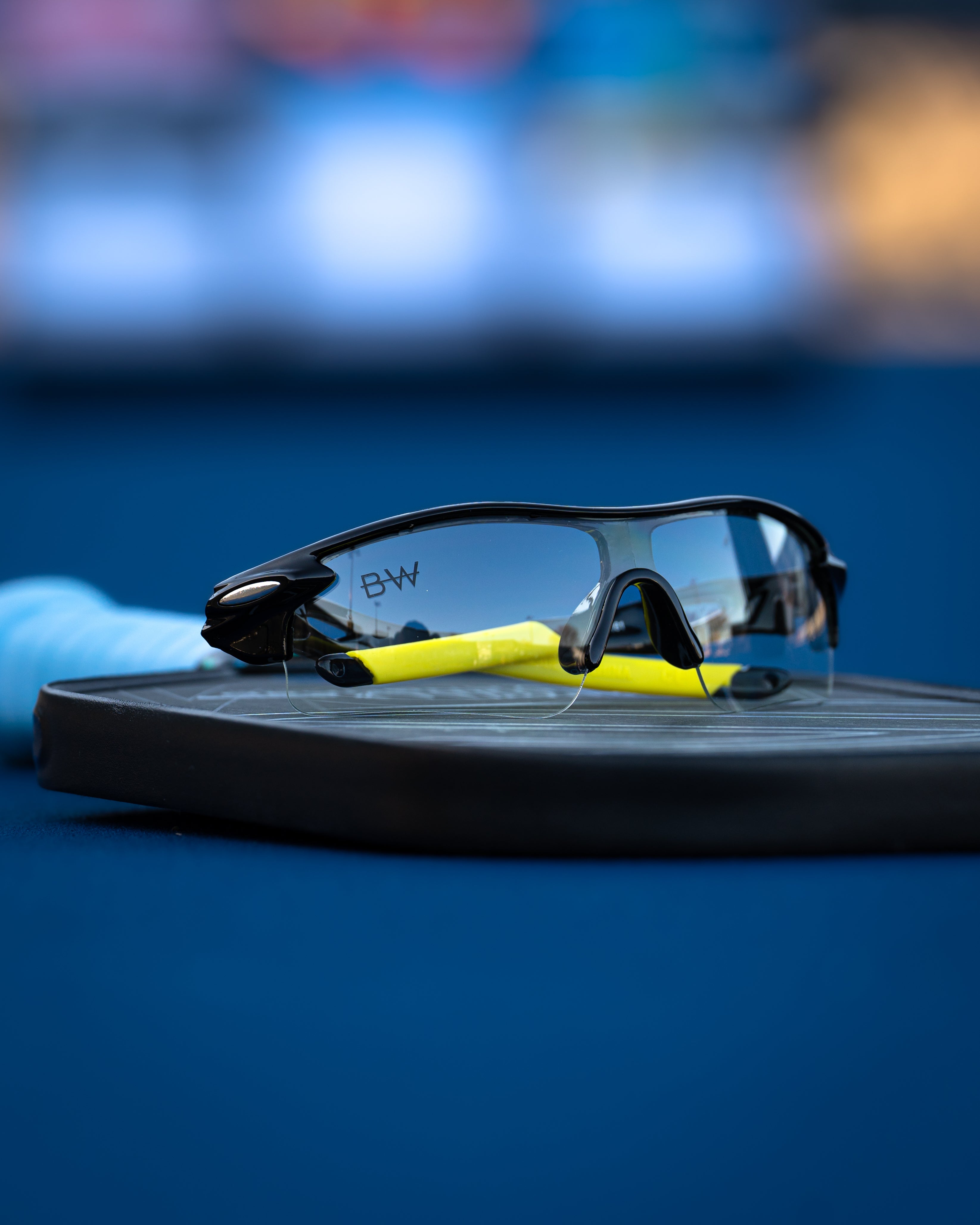
The Only RX Glasses I’d Trust in the Semifinals
Share
The Only RX Glasses I’d Trust in the Semifinals
Reaching the semifinals changes the feel of a pickleball tournament. You have already played multiple games, accumulated court time, dealt with changing conditions, and made it deep enough into the bracket that every remaining point feels more important.
If you depend on prescription correction, that is not the moment you want to start thinking about whether your eyewear actually suits you.
The RX glasses you trust late in a tournament should already be familiar. You should understand the prescription, know how the frame feels during movement, know how it behaves after extended wear, and have experience with the exact lens configuration in conditions similar to those you expect to face.
That is what "trust" means in this guide. It does not mean prescription glasses can win a semifinal for you, improve your reaction time, eliminate mistakes, or automatically elevate your game.
It means choosing prescription pickleball eyewear you have evaluated carefully enough that you are comfortable making it part of your tournament setup.
Build Your Prescription Pickleball Setup
Compare RX and non-RX eyewear according to your prescription needs, playing environment, frame preferences, and current product options.
Why Prescription Eyewear Matters More When You Depend on It
If you need prescription correction to see appropriately, your RX eyewear serves a straightforward purpose throughout the tournament: providing that correction.
That does not suddenly change because you reach a semifinal.
What does change is the context. By the later rounds, you may have been at the venue for hours. You may have played in changing light, perspired through multiple games, taken long breaks between matches, and repeatedly removed and replaced your eyewear.
That makes familiarity valuable.
A tournament is not the ideal place to discover that you dislike a frame's fit, that a particular lens configuration does not suit the environment, or that you never tested your new prescription eyewear during an extended session.
What Makes RX Glasses Tournament-Ready?
"Tournament-ready" should not be treated as a technical certification. For an individual player, it is better understood as eyewear that has been appropriately selected and tested for the way that person intends to use it.
Before calling your RX glasses tournament-ready, consider whether you have evaluated:
- Prescription compatibility: The exact product works with your individual prescription requirements.
- Frame fit: You have evaluated the frame on your face rather than assuming a sports design guarantees stability.
- Movement: You know how the eyewear feels during realistic pickleball movement.
- Extended comfort: You have worn the frame beyond a short try-on.
- Perspiration: You know how the fit feels after warming up.
- Lens configuration: You understand what you actually ordered rather than assuming undocumented lens technologies.
- Environment: You have considered whether you primarily play indoors, outdoors, or across changing conditions.
- Backup planning: You have another appropriate corrective option available if you depend on prescription vision correction.
The Pair You Trust Should Be the Pair You Already Know
The best time to learn how new prescription sports eyewear feels is during practice, not when your tournament bracket reaches its most important rounds.
Before competition, wear your RX eyewear through:
- A normal warmup
- Side-to-side movement
- Baseline-to-kitchen transitions
- Overheads and upward head movement
- Multiple games
- Periods of heavier perspiration
- The lighting environment where you normally play
The goal is not to prove that the frame can never move, fog, become uncomfortable, or be damaged. The goal is to understand your individual experience before tournament pressure enters the equation.
Great RX Eyewear Does Not Win the Match for You
Prescription eyewear should not be marketed as a shortcut to better pickleball.
An RX frame cannot automatically:
- Make you react faster
- Improve your resets
- Increase your court awareness
- Improve your footwork
- Make the ball easier to track for everyone
- Improve your anticipation
- Increase shot accuracy
- Improve your depth perception beyond appropriate individual correction
- Keep you mentally focused under pressure
- Win a semifinal
Your prescription correction and your pickleball ability are different things.
The purpose of selecting dedicated RX sports eyewear is to build a setup around your vision needs, environment, fit preferences, and playing routine without attaching unrealistic athletic promises to the product.
What "Clear Vision" Should Mean for an RX Player
For prescription eyewear, clarity should begin with appropriate vision correction rather than vague claims about enhanced court vision.
Your visual experience can depend on:
- Your individual prescription
- Whether your prescription is appropriate for your current needs
- Lens dimensions
- Frame dimensions
- Lens geometry
- The finished prescription configuration
- Individual vision
- Lighting and playing environment
No sports frame should be described as giving every player "laser focus," "X-ray vision," or perfect visual awareness.
High-Index Prescription Lenses Are Included at No Additional Cost
Blinded Wear includes high-index prescription lenses at no additional cost with custom RX eyewear.
High-index refers to a category of prescription lens material commonly used to help manage finished lens thickness, particularly as prescription strength increases.
Final lens thickness can still depend on:
- Your prescription
- Frame dimensions
- Lens dimensions
- Lens geometry
- Other optical requirements
That is why an exact finished thickness should not be promised simply because a lens is high-index.
High-Index Is Not a Tournament Performance Rating
High-index lens material can be relevant to prescription-lens construction, but the term should not be stretched into unrelated performance claims.
High-index does not automatically mean:
- Zero frame bounce
- Better ball tracking
- Faster reactions
- Less optical distortion in every prescription
- Greater impact resistance
- Scratch resistance
- Anti-fog performance
- Polarization
- A specific UV specification
- Safety certification
Refractive index should be evaluated for what it actually describes rather than used as a general measure of lens quality or athletic performance.
Impact Resistance Is Worth Considering for Active Eyewear
Blinded Wear offers impact-resistant lens options, which can be a relevant characteristic when choosing eyewear for an active sport.
Impact-resistant does not mean:
- Indestructible
- Shatterproof under every condition
- Ballistic
- Automatically safety-certified
- Scratch-proof
- Guaranteed to survive every direct impact
If a specific protective certification matters to you, verify that certification for the exact product rather than assuming it from an impact-resistance description.
Fit Matters When the Match Gets More Physical
Late-round pickleball can involve quick lateral movement, forward transitions, overheads, low balls, and repeated changes of direction.
A frame that feels fine while standing in front of a mirror may feel different once you are moving and sweating.
That is why sports-eyewear fit should be evaluated dynamically.
Important factors can include:
- Head width
- Bridge fit
- Temple fit
- Ear position
- Frame dimensions
- Prescription configuration
- Perspiration
- Movement style
- Extended wear
Do Tournament RX Glasses Need to Be "Zero-Slip"?
Zero-slip is too absolute to use as a universal standard.
Faces differ. Frame dimensions differ. Players move differently. Perspiration varies. Even the same player may experience a frame differently across environments.
A better question is:
Does this frame feel appropriate and reasonably stable for me during the way I actually play?
That is something you can evaluate. A guarantee that a frame will never move on anyone is not.
Put Your RX Glasses Through a Practice-Bracket Test
Before relying on prescription sports eyewear deep into a tournament, recreate some of the demands of a longer competition day.
Start With a Normal Warmup
Notice initial bridge, temple, and ear comfort.
Test Lateral Movement
Move side to side using realistic court footwork rather than simply shaking your head.
Test Forward Movement
Transition from the baseline toward the kitchen as you normally would.
Look Up
Use normal upward head movement associated with tracking higher balls.
Play Multiple Games
Give yourself enough time to determine whether extended wear changes the experience.
Evaluate After Sweating
Notice whether perspiration changes comfort or how often you adjust the frame.
Take a Break and Put Them Back On
Tournaments can include downtime between matches. Make sure the eyewear remains familiar throughout your normal routine.
Comfort Becomes More Important as Court Time Accumulates
A frame does not have to feel uncomfortable during the first game to become distracting later.
When evaluating RX eyewear for longer sessions, pay attention to:
- Bridge pressure
- Temple pressure
- Comfort behind the ears
- Repeated repositioning
- How the frame feels once you begin sweating
- Whether your experience changes after several games
Lightweight sports frames can appeal to players who prefer less perceived bulk, but lightweight does not guarantee zero pressure or universal comfort.
Sweat Is a Fit Variable, Not a Reason to Invent Grip Technology
Perspiration is a normal part of active play and can influence how eyewear feels.
However, sports eyewear should not automatically be described as having moisture-wicking bridges, specialized grip arms, multi-point locking systems, or other retention technologies unless those exact features are documented for the product.
The more useful approach is to test your individual frame after you have warmed up.
If you repeatedly need to adjust it, that matters. If the frame remains comfortable throughout your normal movement, that matters too.
What About Fog During Tournament Play?
Fogging can be frustrating, especially when temperature, humidity, perspiration, and airflow change throughout a tournament.
But no RX frame should automatically be labeled fog-free.
Condensation can depend on:
- Temperature
- Humidity
- Perspiration
- Airflow
- Frame position
- Lens-surface conditions
- The complete eyewear configuration
An anti-fog coating, treatment, or ventilation feature should only be attributed to a specific product when it is verified for that exact configuration.
Do Not Assume Tournament RX Lenses Are Scratch-Proof
Scratch resistance is separate from prescription correction, high-index construction, impact resistance, tint, and frame design.
Unless scratch resistance is verified for your exact lens configuration, do not assume it is present.
Regardless of configuration, appropriate lens care and storage are important during a long tournament day.
Prepare for the Lighting You Will Actually Face
A tournament can begin under one set of conditions and reach bracket play under another.
An outdoor event might start in softer morning light and continue into brighter midday conditions. Indoor facilities can also differ substantially in brightness, background colors, and overhead lighting.
Your eyewear decision should begin with the exact available lens configuration rather than a promise that one lens automatically adapts perfectly from "cloud to sun."
Lens Tint Is About More Than Calling One Color "Best"
Different tints can change visible-light transmission and color appearance.
Some players may prefer different colors or brightness levels depending on their environment and subjective visual preference.
What tint color does not automatically establish is:
- Better ball tracking
- Faster reactions
- Improved depth perception
- Greater impact resistance
- Polarization
- A specific UV specification
- Anti-fog performance
- Safety certification
Clear Lenses for Indoor or Lower-Light Environments
A clear lens means there is no dark sunglass tint.
For players who do not want a dark tint indoors or in lower-light conditions, a clear configuration can be worth considering when available for the exact product.
Clear appearance does not mean the lens creates more light, improves reaction speed, increases contrast, or automatically includes anti-fog, impact-resistant, UV, anti-reflective, or blue-light-filtering characteristics.
If you do not need prescription correction, you can also explore the Blinded Wear Clear Lens Collection.
Polarized vs. Non-Polarized for Tournament Play
Polarized lenses are designed to reduce certain reflected light. Blinded Wear also offers non-polarized lens options for players who prefer them.
Neither choice should be marketed as universally superior for pickleball.
Polarization status alone does not determine:
- Depth perception
- Contrast
- Reaction time
- Ball tracking
- Prescription accuracy
- Impact resistance
If you use a phone, tablet, scoreboard, or other digital display during a tournament, remember that polarized lenses can interact with some displays depending on the display technology, viewing angle, and orientation.
What About Photochromic or Transitional Lenses?
Photochromic lenses are designed to change tint in response to particular light conditions, but availability should be confirmed for the exact RX product you are considering.
Do not assume every Blinded Wear RX frame supports transitional or photochromic lenses simply because an older product guide mentioned them.
If changing light is a major concern for your tournament schedule, review the current product configuration before ordering.
Blue-Light Filtering Is a Separate Lens Characteristic
Blue-light filtering should only be attributed to a lens when it is verified for the exact configuration.
Prescription correction, high-index construction, tint, clear appearance, and sports-frame styling do not automatically establish blue-light filtering.
Direct RX vs. RX Clip for Tournament Pickleball
Blinded Wear's prescription lineup includes direct RX options as well as compatible RX Clip systems.
Direct RX incorporates prescription correction into the direct prescription configuration of a compatible product.
RX Clip uses a separate inner prescription insert within a compatible eyewear system. The prescription correction is contained in that inner insert rather than the primary outer sports lens.
| Consideration | Direct RX | RX Clip |
|---|---|---|
| Prescription correction | Direct prescription configuration | Separate inner RX insert |
| High-index prescription lenses | Included at no additional cost | Included at no additional cost in custom RX clip |
| Compatibility | Verify exact product and prescription | Requires a compatible RX Clip system |
| Universal zero-slip guarantee | No | No |
| Automatic performance improvement | No | No |
Why Some Tournament Players May Prefer Direct RX
A player may prefer direct RX because they want their prescription correction incorporated into dedicated court eyewear instead of wearing contact lenses or using a separate inner RX insert.
That preference does not make direct RX universally better.
Prescription compatibility, frame dimensions, available lens configuration, fit, comfort, and personal preference remain important.
Why Some Players May Prefer an RX Clip System
Other players may prefer the structure of a compatible RX Clip system, where prescription correction is contained in a separate inner insert.
When comparing an RX Clip with direct RX, consider the complete eyewear system rather than assuming the two configurations will feel identical.
An RX Clip should not be assumed compatible with arbitrary sunglasses or eyewear outside the intended compatible system.
Stronger Prescriptions Deserve Extra Attention Before Tournament Day
If you have a stronger prescription, frame and lens selection can involve additional considerations.
Final lens characteristics can depend on:
- Prescription strength
- Frame dimensions
- Lens dimensions
- Lens geometry
- Other optical requirements
High-index prescription lenses are included at no additional cost with Blinded Wear custom RX eyewear, but high-index does not guarantee one exact finished thickness or weight.
Confirm compatibility with the exact RX product before ordering.
What if Your Prescription Includes Astigmatism Correction?
If your prescription contains cylinder and axis values, those are part of your individual prescription requirements.
Do not assume that every prescription can be produced in every sports frame or RX configuration. Confirm compatibility with the exact product before placing a custom order.
What About Progressive or Multifocal Prescriptions?
Progressive, multifocal, and other specialized prescription compatibility should be confirmed for the exact product and individual prescription.
Do not rely on an older article claiming that progressive or another specialized lens design is universally available across the entire RX collection.
Current RX Frames to Compare Before Your Next Tournament
There is no single frame that every player must trust in the semifinals. Instead, compare current RX options according to your prescription, frame preferences, environment, and style.
- Frost RX
- Steel Ice RX
- Blue Shield RX
- Zebra II RX
- Gray Wash RX
- Havana Melt RX
- Lava Rock RX
- Crystal Wave II RX
- Rippled X RX
Browse the full Prescription Pickleball Glasses Collection for current options.
Frost RX: A Distinctive Direct RX Option
Frost RX is a direct RX option with a white frame and bright blue lens.
It can be considered by prescription players who like that visual direction and want to compare a dedicated sports-oriented RX frame.
Do not assume Frost RX automatically provides:
- Zero bounce
- Faster visual recovery
- Improved ball tracking
- Reduced peripheral distortion
- Fog-proof performance
Evaluate the frame according to its current product information and your individual requirements.
Steel Ice RX: Another Current RX Frame to Compare
Steel Ice RX provides another prescription option for players building a dedicated pickleball setup.
Rather than assuming a frame is "tournament-proven" or universally more durable because of its name or appearance, compare the current product specifications, prescription compatibility, frame dimensions, lens options, fit preferences, and style.
Blue Shield RX: Compare the Current Product, Not Old Claims
Blue Shield RX is another current prescription option to explore.
Claims about moisture-wicking nose bridges, specialized temple locking, ball-tracking lens curvature, or tournament preference should not be assumed unless those exact characteristics are documented for the current product.
Use the current product information as the basis of your decision.
Lava Rock RX: Compare It for Your Own Tournament Setup
Lava Rock RX gives RX shoppers another frame to compare within the current prescription collection.
Do not assume ultra-stable sidearms, hot-weather specialization, or transitional lens availability without verifying those exact characteristics for the current configuration.
The useful comparison is your prescription compatibility, current options, fit preferences, playing environment, and style.
Crystal Wave II RX: Another Option for the Shortlist
Crystal Wave II RX can also be included when comparing prescription pickleball eyewear.
Rather than promising perfect indoor-outdoor versatility, seamless fit, or guaranteed all-day comfort, evaluate the exact current product and how it aligns with your individual needs.
How to Compare RX Frames Without Falling for Tournament Hype
Use the same comparison process regardless of which frame catches your attention first.
- Prescription: Is your prescription compatible with the exact product?
- Configuration: Is it direct RX or an RX Clip system?
- Dimensions: Does the frame size make sense for your preferences?
- Lens characteristics: Which features are actually verified?
- Environment: Where do you normally play?
- Movement: How does the frame feel during realistic court activity?
- Comfort: How does it feel after several games?
- Style: Do you actually want to wear it?
The Tournament RX Decision at a Glance
| Factor | What to Evaluate | What Not to Assume |
|---|---|---|
| Prescription | Compatibility with your individual Rx | Every Rx works with every frame |
| High-index | Included at no additional cost | Guaranteed thickness, weight, or durability |
| Impact resistance | Verified impact-resistant options | Indestructible or shatterproof |
| Fit | Your individual experience during movement | Universal zero-slip performance |
| Comfort | Extended wear during realistic play | Guaranteed all-day comfort |
| Fogging | Your experience and verified product features | Every sports frame is fog-free |
| Tint | Visible-light and color preference | Guaranteed performance improvement |
| Polarization | Verified lens configuration and preference | Automatic improvement or harm to depth perception |
| Tournament use | Practice-tested familiarity | Professional or tournament endorsement |
Your Tournament Setup Should Include a Backup Vision Plan
If you depend on prescription correction, bringing an appropriate backup is a practical part of tournament preparation.
Your primary pair could become:
- Damaged
- Lost
- Unavailable
- Uncomfortable
- Otherwise unsuitable for continued use
A backup should provide appropriate correction for your individual needs. It is not enough to bring an arbitrary spare pair of sunglasses if those sunglasses do not address your prescription requirements.
RX Eyewear Tournament Bag Checklist
Before leaving for an event, consider whether you have:
- Your primary prescription eyewear
- An appropriate backup corrective option
- Suitable lens-cleaning materials
- Appropriate eyewear storage
- Reviewed the expected playing environment
- Already tested your primary pair during practice
The purpose is simple: reduce avoidable surprises before the bracket gets deep.
What if Your RX Glasses Take an Impact Mid-Tournament?
Impact-resistant eyewear can still be damaged.
After a significant impact, inspect the pair before continuing to rely on it.
Look for:
- Visible lens damage
- Visible frame damage
- A lens that appears displaced
- Loose or damaged components
- A noticeable alignment change
- A significant change in how the frame fits
If your primary pair is no longer appropriate to use, that is where a backup corrective option becomes valuable.
Take Care of Your RX Eyewear Between Matches
Tournament days can involve repeated handling, travel between courts, bags full of equipment, sweat, and long periods between matches.
Good habits include:
- Using appropriate lens-cleaning methods
- Avoiding abrasive cleaning materials
- Not storing eyewear loose with paddles, keys, or other hard equipment
- Addressing moisture appropriately after play
- Inspecting the pair after a significant impact
- Using appropriate storage between matches
Custom RX Means the Pre-Order Decision Matters
Blinded Wear offers a 30-day return policy for eligible standard purchases, but customized RX eyewear is final sale and excluded from the standard 30-day return policy.
That makes it especially important to review your order before purchasing.
Confirm:
- Your prescription information
- Compatibility with the exact product
- Frame selection
- Relevant frame dimensions
- The current lens configuration
- Your intended playing environment
- Your individual preferences
Have Your Prescription Ready Before Ordering
Blinded Wear RX customers upload a clear photo or picture of their eyeglass prescription on the product page before adding the eyewear to the cart and before purchasing.
Make sure the prescription information you intend to submit is readable and appropriate for your current needs.
For additional guidance, visit How to Order RX Glasses.
What if Your RX Pair Breaks?
Blinded Wear offers 50% lifetime replacement support if eligible glasses break, subject to current policy terms.
For an eligible claim, the damaged eyewear must be returned. Once the applicable claim and return requirements are satisfied, qualifying customers can receive 50% credit toward a replacement pair.
This is not a free full replacement.
For damaged RX eyewear, contact blindedwearco@gmail.com before returning the pair.
Review the Blinded Wear Protection Plan, Replacement & Returns information for current eligibility and policy details.
Not Sure Which RX Frame Belongs in Your Tournament Bag?
There is no need to choose a frame based on an unsupported claim that one model is universally best for aggressive players, resetters, net players, or semifinalists.
Use the Pickleball Sunglasses Quiz to narrow your preferences, then review the current specifications of the products that interest you.
You can also compare the full RX Pickleball Glasses Collection.
Pre-Tournament RX Buying Checklist
- I have my current eyeglass prescription available.
- I have confirmed compatibility with the exact RX product.
- I have reviewed the current product information.
- I have considered frame dimensions and fit preferences.
- I understand which lens configuration I am ordering.
- I am not assuming undocumented anti-fog, scratch-resistant, grip, or optical technology.
- I understand what high-index means and what it does not mean.
- I understand that impact-resistant does not mean indestructible.
- I have considered my normal playing environment.
- I understand customized RX eyewear is final sale.
- I have reviewed applicable replacement-support terms.
- I plan to test the eyewear during practice before an important tournament.
Trust Comes From Familiarity, Not Tournament Hype
The RX glasses you trust in a semifinal should not be the pair with the biggest performance promise. They should be the pair you selected carefully, ordered for your prescription needs, and tested under realistic conditions before the match mattered most.
Prescription correction does not replace preparation. High-index does not create faster reactions. Impact resistance does not make eyewear indestructible. A sports frame does not guarantee zero movement. A particular tint does not automatically improve ball tracking.
What you can do is build a thoughtful prescription setup around compatibility, fit, comfort, verified lens characteristics, environment, and familiarity.
Part 2 will go deeper into how RX eyewear fits into a full tournament day, direct RX versus RX Clip systems, indoor and outdoor conditions, long-match comfort, sweat and fogging, lens tint and polarization, stronger prescriptions, semifinal preparation, backup planning, frame comparisons, and how to evaluate your eyewear from warmup through the final rounds without relying on unsupported performance claims.
From Warmup to Semifinals: Your RX Eyewear Has to Last the Whole Day
A semifinal does not happen in isolation. By the time you reach that stage of a tournament, your eyewear may already have been through warmups, pool play, bracket matches, breaks, changing temperatures, perspiration, repeated cleaning, and hours of wear.
That is why tournament eyewear should be evaluated across the entire day rather than only during one short game.
A useful tournament test asks:
- How does the frame feel during the first warmup?
- Does that comfort remain after several games?
- Does perspiration change the fit?
- Do you repeatedly reposition the frame?
- Does your chosen lens configuration suit the environment?
- How does the eyewear feel after a long break and restart?
- Are you comfortable relying on the prescription correction for the full session?
The goal is familiarity. By the time you reach a semifinal, your prescription eyewear should not feel like an experiment.
Start Evaluating Your RX Glasses During Warmup
Your first warmup gives you an early opportunity to notice anything unusual before tournament play becomes more demanding.
Pay attention to:
- Bridge comfort
- Temple comfort
- Comfort behind the ears
- How the prescription feels
- Whether the frame repeatedly needs repositioning
- How the chosen lens configuration feels in the current lighting
If something feels substantially different from your practice sessions, investigate it before assuming it will disappear once competition starts.
Early Matches Reveal More Than a Stationary Fit Test
Standing still cannot reproduce the movement of pickleball.
Once your first games begin, notice the eyewear during:
- Quick head turns
- Lateral movement
- Forward transitions
- Looking up for higher balls
- Looking down toward lower balls and court lines
- Repeated changes of direction
- Longer rallies
This is a more meaningful fit evaluation than assuming a sports-oriented frame will automatically remain perfectly stationary.
What to Do With Your RX Eyewear Between Matches
Long tournament days often include downtime. How you handle your eyewear during those breaks can matter too.
Between matches:
- Use appropriate lens-cleaning materials when cleaning is needed.
- Avoid abrasive materials that could unnecessarily contact the lenses.
- Use appropriate storage rather than placing the eyewear loose with hard equipment.
- Inspect the pair if it has been dropped or struck.
- Address accumulated moisture appropriately.
- Keep your backup corrective option accessible.
Do not assume a lens is scratch-proof simply because it is intended for active use.
Long Breaks Can Make the Restart Feel Different
Tournament schedules are not always continuous. You may finish one match, wait for another court, sit through other bracket games, and then return to play.
Your eyewear does not need special "focus reset" technology to handle this situation.
Instead, use the restart to check:
- Whether the lenses need appropriate cleaning
- Whether the frame still feels normal
- Whether anything was damaged during the break
- Whether lighting conditions have changed
- Whether you still feel comfortable with the prescription correction
Mental and physical readiness after a break still come from the player. Eyewear should not be credited with resetting concentration or focus.
What if the Lighting Changes Before the Semifinals?
A tournament can span several hours, which means the environment may not look exactly the same when you reach the later rounds.
Outdoor events can move from morning conditions into brighter midday light or later-afternoon conditions. Indoor facilities can have different lighting from court to court.
That does not mean one lens automatically adapts perfectly to every situation.
Before ordering tournament eyewear, think about the conditions you encounter most often and review the lens configurations actually available for the exact product.
RX Eyewear for Indoor Pickleball Tournaments
Indoor play changes the lens decision because many players do not want the same dark sunglass tint they might choose for a bright outdoor court.
When an appropriate clear configuration is available, it can be considered by players who want prescription correction without a dark sunglass tint.
Clear appearance alone does not establish:
- Contrast enhancement
- Better ball tracking
- Faster reaction time
- Anti-fog performance
- Anti-reflective treatment
- Blue-light filtering
- Impact resistance
- UV specifications
- Safety certification
Those characteristics must be considered separately.
RX Eyewear for Outdoor Pickleball Tournaments
Outdoor tournaments can expose players to changing brightness, court orientation, surrounding surfaces, weather, and time-of-day differences.
Instead of looking for a lens color that supposedly makes everyone play better, evaluate:
- The brightness you normally encounter
- Your preferred lens appearance
- The exact tint available for the product
- Whether the selected lens is polarized or non-polarized
- Verified impact-resistant options
- Your prescription requirements
- Your individual visual preferences
One player's preferred outdoor lens does not automatically become the best choice for another player.
What if a Tournament Uses Indoor and Outdoor Courts?
Mixed environments make it especially important to understand the exact configuration you are buying.
Do not assume every RX frame automatically offers clear, tinted, mirrored, polarized, non-polarized, or photochromic options.
If you expect to move between environments, compare the currently available configurations before ordering and decide which setup best aligns with your expected use.
How to Compare Lens Tints for Tournament Play
Lens tint can change visible-light transmission and color appearance. Those are useful characteristics to understand, but tint should not be treated as an athletic-performance setting.
| Lens Characteristic | What It Can Tell You | What It Does Not Automatically Tell You |
|---|---|---|
| Clear appearance | No dark sunglass tint | Better tracking, contrast, anti-fog, or a specific UV rating |
| Colored tint | Can change visible-light transmission and color appearance | Guaranteed reaction-time or depth-perception improvement |
| Dark tint | A visibly darker lens configuration | Automatically greater UV or impact protection |
| Mirrored appearance | A visual lens characteristic | Automatic polarization or a particular UV specification |
| Polarization | Designed to reduce certain reflected light | Automatic improvement in tracking, contrast, or depth perception |
What About Yellow, Gray, or Other Lens Colors?
Different lens colors can change visible-light transmission and color appearance, and individual players may prefer different configurations in different environments.
However, a color should not automatically be described as:
- Making the pickleball easier to track
- Increasing depth perception
- Improving reaction speed
- Creating additional available light
- Reducing eye fatigue for every player
- Increasing shot accuracy
Use tint as one part of the complete lens decision rather than treating color as a performance upgrade.
Polarized vs. Non-Polarized in a Long Tournament
Polarized lenses are designed to reduce certain reflected light. Some pickleball players may prefer non-polarized options, and Blinded Wear offers non-polarized lens options.
Neither category should be declared universally better for tournament pickleball.
Polarization alone does not determine:
- Depth perception
- Contrast
- Reaction time
- Ball tracking
- Prescription quality
- Impact resistance
If you frequently check phones or other digital displays between matches, remember that polarized lenses can interact with some displays depending on the display technology, viewing angle, and orientation.
Tint Darkness and UV Protection Are Different
A darker-looking lens does not automatically establish a greater level of UV protection.
Likewise, a clear-looking lens does not tell you whether a particular UV specification is present.
UV characteristics should be based on verified specifications for the exact lens rather than inferred from appearance.
Tint and Impact Resistance Are Also Separate
A lens does not become more physically protective simply because it is darker, mirrored, brightly colored, or clear.
Blinded Wear offers impact-resistant lens options, but impact resistance should be evaluated separately from tint.
Impact-resistant also does not mean indestructible, shatterproof under every condition, or automatically safety-certified.
Managing Fogging During a Long Tournament
Fogging can occur when moisture condenses on a lens surface. Tournament conditions can introduce several variables at once, including perspiration, temperature changes, humidity, and changing airflow.
Instead of assuming that sports eyewear will never fog, prepare for the possibility.
Useful considerations include:
- Allowing eyewear to acclimate when moving between significantly different temperatures
- Keeping lenses appropriately clean
- Addressing accumulated moisture between games
- Paying attention to how the frame sits on your individual face
- Using only lens-care products appropriate for your exact eyewear
If you use an anti-fog product, confirm that it is appropriate for your exact lens and any applicable treatments rather than assuming every cleaner or coating is compatible.
Common Tournament Fogging Myths
"Sports Frames Are Automatically Anti-Fog"
No. Sports-oriented styling does not establish an anti-fog treatment.
"Clear Lenses Fog Less"
Clear versus tinted appearance does not by itself determine fog resistance.
"High-Index Lenses Do Not Fog"
High-index refers to a prescription lens-material category, not a fog-prevention specification.
"Polarized Lenses Prevent Fog"
Polarization and condensation are separate characteristics.
"A Tight Frame Prevents Fog"
A tighter fit does not automatically eliminate condensation. Airflow, environment, moisture, and frame position can all contribute.
How Sweat Changes the Fit Test
Perspiration is one reason your practice test should last longer than a few minutes.
A frame can feel different after you have been moving for an extended period.
After warming up, ask:
- Am I repeatedly adjusting the frame?
- Has bridge comfort changed?
- Has temple comfort changed?
- Does moisture accumulate around the eyewear?
- Does the frame still feel appropriate during normal movement?
Do not assume specialized moisture-wicking materials, locking systems, or no-slip technology unless those features are documented for the exact frame.
Tighter Is Not Automatically Better for Tournament Play
It can be tempting to assume that the tightest possible frame is the most secure option for competition.
That is too simplistic.
More pressure does not automatically mean better fit, and excessive pressure can affect comfort over a long day.
Look for a frame that feels appropriate for your individual face and remains comfortable through the type of movement and session length you expect.
Test Comfort for Hours, Not Minutes
If your goal is to wear RX eyewear from warmup through bracket play, a five-minute try-on cannot reproduce that experience.
Use practice sessions to evaluate extended wear.
Notice:
- Whether bridge pressure develops over time
- Whether the temples become uncomfortable
- Whether comfort behind the ears changes
- Whether perspiration changes the fit
- Whether you become increasingly aware of the frame
- Whether you repeatedly remove or reposition it
Comfort is individual. No frame should be guaranteed to feel identical for every player over an entire tournament day.
Does a Lightweight Frame Matter?
Some players prefer lightweight sports frames because they want less perceived bulk during extended wear.
That preference is reasonable, but lightweight should not be turned into unsupported claims.
Lower frame weight does not automatically mean:
- Zero bounce
- Zero slipping
- No pressure
- Better reaction time
- Better ball tracking
- Greater durability
The complete frame design and individual fit still matter.
High-Index Lenses: What Tournament Players Actually Need to Know
Blinded Wear includes high-index prescription lenses at no additional cost with custom RX eyewear.
High-index is particularly relevant when discussing prescription lens construction. A higher refractive index can help manage lens thickness in comparable prescriptions, but the finished result depends on more than one number.
Finished lens thickness can depend on:
- Prescription strength
- Sphere values
- Cylinder and axis requirements
- Frame dimensions
- Lens dimensions
- Lens geometry
- Other optical requirements
High-index should therefore be understood as a lens-material category rather than a promise of one exact thickness, weight, or athletic result.
High-Index vs. Polycarbonate: Do Not Compare Them With the Wrong Metric
High-index is commonly discussed in relation to prescription lens thickness management, particularly as prescription strength increases.
Polycarbonate is widely associated with lightweight construction and impact resistance.
Neither term should automatically be translated into:
- Shatterproof performance
- Universal safety certification
- Better ball tracking
- Faster reaction time
- Guaranteed comfort
- Guaranteed lens weight
The appropriate lens choice depends on the actual prescription, frame, lens configuration, and individual requirements.
Stronger Prescriptions Need More Than a Generic "Sports Lens" Recommendation
If you have a stronger prescription, do not choose a tournament frame solely because it looks athletic.
Confirm that the exact product can accommodate your prescription requirements.
Frame and lens dimensions can influence the finished prescription lens, which is one reason compatibility should be established before a custom order is placed.
Blinded Wear includes high-index prescription lenses at no additional cost, but that does not eliminate the need to confirm compatibility with your individual prescription.
Playing With Astigmatism Correction
If your prescription includes cylinder and axis values, those requirements remain part of your custom RX order.
The presence of astigmatism correction does not justify claims that one frame universally improves tracking, depth perception, or reaction speed.
What matters is whether your individual prescription is compatible with the exact RX product and whether the completed eyewear is appropriate for your needs.
Progressive and Specialized Prescriptions
Do not assume progressive, multifocal, or another specialized prescription configuration is available for every Blinded Wear RX frame.
Compatibility should be verified for the exact current product and your individual prescription requirements.
An older article mentioning a lens type does not establish current collection-wide availability.
Direct RX vs. RX Clip for a Full Tournament Day
Both approaches can provide prescription correction, but the configurations are different.
A direct RX option incorporates prescription correction into the direct prescription configuration of the compatible eyewear.
An RX Clip uses a separate inner prescription insert inside a compatible eyewear system. The prescription correction is in that inner RX insert rather than the primary outer sports lens.
Neither should be declared universally better for tournament play.
Direct RX Tournament Considerations
Some players prefer direct RX because they want their prescription correction incorporated into dedicated court eyewear.
When comparing direct RX options, consider:
- Prescription compatibility
- Frame dimensions
- Current lens configuration
- Individual fit
- Extended comfort
- Playing environment
- Style preference
Direct RX does not automatically mean better stability, wider vision, less fogging, or better athletic performance.
RX Clip Tournament Considerations
An RX Clip system can appeal to players who prefer a separate inner prescription insert within compatible sports eyewear.
High-index prescription lenses are included at no additional cost in Blinded Wear custom RX Clip configurations.
When considering an RX Clip, evaluate:
- Prescription compatibility
- Compatibility with the exact eyewear system
- The complete frame and insert configuration
- Individual fit
- Current outer-lens characteristics
- Extended comfort
Do not assume an RX Clip can be installed into arbitrary sunglasses or eyewear outside a compatible system.
What if You Prefer Contact Lenses During Tournaments?
Dedicated RX sports eyewear is not the only way a player can address prescription correction.
Some players use contact lenses for correction and wear separate non-prescription sports eyewear.
Others prefer direct RX eyewear or an RX Clip system.
The better setup depends on your individual prescription, contact-lens tolerance, comfort, environment, and preferences. There is no need to declare one approach universally superior.
If you use contacts and do not need prescription lenses built into your eyewear, browse the Non-RX Pickleball Sunglasses Collection.
Can You Play a Tournament in Everyday Prescription Glasses?
Everyday prescription glasses remain a corrective option for many people.
A player may choose dedicated sports-oriented RX eyewear because they prefer a different frame design, fit, lens configuration, or overall court setup.
That does not mean every sports frame automatically fits better or provides better vision than every pair of everyday glasses.
The comparison should be based on the actual eyewear and the individual player.
Current Blinded Wear RX Frames to Compare
Rather than treating one frame as the universal "semifinal winner," compare current prescription options based on your own requirements.
- Frost RX
- Zebra II RX
- Steel Ice RX
- Blue Shield RX
- Gray Wash RX
- Havana Melt RX
- Lava Rock RX
- Crystal Wave II RX
- Rippled X RX
For the complete current lineup, browse the Prescription Pickleball Glasses Collection.
Frost RX for Tournament Players
Frost RX is a direct RX option with a white frame and bright blue lens.
Its distinctive appearance can appeal to players who want their prescription court eyewear to look different from conventional everyday glasses.
Evaluate Frost RX based on its current configuration, prescription compatibility, fit preferences, and style rather than assuming it provides zero bounce, faster visual recovery, enhanced tracking, or other undocumented performance advantages.
Zebra II RX for Tournament Players
Zebra II RX gives prescription players another sports-oriented design to consider.
If you prefer a more noticeable court aesthetic, Zebra II RX can be compared with other current frames according to prescription compatibility, dimensions, lens configuration, fit, comfort, and style.
A statement-frame appearance should not be confused with an automatic athletic advantage.
Steel Ice RX for Tournament Players
Steel Ice RX is another current prescription option.
When comparing it with another RX frame, avoid unsupported assumptions that one model is automatically tougher, more stable, or better for aggressive tournament play.
Use the current product information and your individual prescription and fit requirements instead.
Blue Shield RX for Tournament Players
Blue Shield RX can also be included in a tournament RX shortlist.
Evaluate the current product rather than relying on older descriptions of moisture-wicking bridges, specialized locking arms, ball-tracking curvature, or tournament adoption.
Those characteristics should only be used when specifically verified for the current product.
Gray Wash RX for Tournament Players
Gray Wash RX provides another direct RX option for players comparing current prescription pickleball eyewear.
Do not infer polarization, glare reduction, enhanced contrast, UV specifications, or another lens technology simply from the product name or lens appearance.
Review the current product configuration before making those distinctions.
Havana Melt RX for Tournament Players
Havana Melt RX gives players another direct RX style to compare.
As with every custom RX option, begin with prescription compatibility and the current product configuration. Then compare frame dimensions, fit preferences, intended environment, and style.
Lava Rock RX for Tournament Players
Lava Rock RX can be compared with the broader RX lineup without relying on older claims about specialized sidearms, hot-weather performance, or universally available transitional lenses.
Verify the exact current configuration before ordering.
Crystal Wave II RX for Tournament Players
Crystal Wave II RX is another current RX option to explore.
Do not assume any frame is automatically perfect for hybrid indoor-outdoor tournaments, universally featherlight in feel, or guaranteed comfortable for every full-bracket day.
Those experiences depend on the exact configuration and individual wearer.
Rippled X RX for Tournament Players
Rippled X RX expands the current RX comparison for players looking at prescription court eyewear.
As with the rest of the collection, compare prescription compatibility, current lens configuration, frame dimensions, fit preferences, playing environment, and style rather than expecting one frame to automatically improve your game.
How to Compare Tournament RX Frames
| Question | Why It Matters |
|---|---|
| Is my prescription compatible? | A custom RX frame must work with your individual prescription requirements. |
| Is it direct RX or an RX Clip? | The two configurations incorporate prescription correction differently. |
| What are the frame dimensions? | Dimensions provide more useful fit information than a generic "secure-fit" label. |
| Which lens configuration is currently available? | Do not assume every lens technology is offered with every frame. |
| Where will I play? | Indoor, outdoor, and mixed environments can lead to different preferences. |
| Have I tested extended wear? | A tournament can involve hours of cumulative use. |
| Have I tested the frame while sweating? | Warmup and active play can feel different from a stationary try-on. |
| Do I actually like the frame? | Style and personal preference remain legitimate parts of the decision. |
Common Mistakes When Buying RX Glasses for a Tournament
Mistake #1: Buying Right Before the Event
Give yourself an opportunity to become familiar with custom prescription eyewear before relying on it during an important tournament.
Mistake #2: Assuming "Sports" Means Zero Slip
Fit varies by individual wearer.
Mistake #3: Assuming High-Index Means Impact-Proof
Refractive index and impact resistance are separate characteristics.
Mistake #4: Assuming Darker Means More UV Protection
Tint darkness and UV specifications are separate.
Mistake #5: Assuming a Lens Color Improves Tracking
Tint preference should not be converted into a universal ball-tracking claim.
Mistake #6: Assuming Every RX Frame Has Anti-Fog Technology
Anti-fog characteristics must be verified for the exact product and configuration.
Mistake #7: Ignoring Extended Comfort
A tournament pair should be evaluated for longer sessions, not only a short try-on.
Mistake #8: Forgetting a Backup
If you depend on prescription correction, an appropriate backup can be valuable.
Mistake #9: Ignoring the Final-Sale Policy
Customized RX eyewear is final sale, making pre-order review particularly important.
How to Test New RX Glasses Before Tournament Weekend
Instead of waiting until competition day, use normal practice to learn the eyewear.
- Wear them during warmup. Establish your initial comfort baseline.
- Play normal games. Do not limit the test to stationary movement.
- Use them during longer sessions. Evaluate cumulative comfort.
- Test them after perspiration increases. Notice whether fit changes.
- Use them in your typical lighting. Evaluate the actual lens configuration in the environment you expect.
- Take normal breaks. Recreate the stop-and-start nature of tournaments.
- Clean and store them normally. Make eyewear care part of the routine.
The Day-Before Tournament RX Checklist
- Inspect the frame for obvious damage.
- Inspect the lenses for visible damage.
- Clean the eyewear appropriately.
- Confirm your primary pair is packed.
- Pack an appropriate backup corrective option.
- Pack appropriate lens-cleaning materials.
- Use suitable eyewear storage.
- Review whether the expected environment matches the lens configuration you plan to use.
The 60-Second Check Before a Semifinal
You do not need a complicated eyewear ritual before an important match.
A quick check can include:
- Make sure the lenses are appropriately clean.
- Check for obvious damage.
- Put the frame on and confirm it feels normal.
- Notice whether anything has changed since your previous match.
- Confirm your backup corrective option remains accessible.
Then turn your attention back to playing. Eyewear should support your vision needs without becoming the center of your match strategy.
Your Glasses Do Not Create Semifinal Focus
Deep tournament rounds can feel different because the stakes are higher, but no RX frame creates mental focus, confidence, composure, or competitive discipline.
Those elements belong to the player.
Familiar eyewear may remove one unnecessary variable from your preparation, but it should not be marketed as psychologically transforming your game.
Can RX Glasses Help You Track the Ball?
If you require prescription correction, having appropriate correction can matter to your individual visual experience.
That is different from saying a sports frame contains technology that automatically improves ball tracking.
Ball tracking can involve:
- Individual vision
- Prescription correction
- Lighting
- Ball and background appearance
- Attention
- Movement
- Experience
- The complete eyewear configuration
No frame should be credited with doing the tracking for the player.
Can RX Glasses Make You React Faster?
No universal reaction-time improvement should be promised from switching prescription frames.
Your eyewear can provide appropriate prescription correction when compatible with your needs. Your reactions still depend on you.
The same applies to hand speed, anticipation, footwork, resets, counters, and defensive decisions.
What About Depth Perception?
Prescription correction can be important to an individual's visual needs, but a particular frame, tint, or polarization status should not automatically be credited with improving depth perception.
Individual vision, prescription, and the complete eyewear configuration all matter.
Does a Sports Frame Improve Court Awareness?
No universal court-awareness improvement should be attributed to a frame.
Court awareness involves vision, attention, positioning, anticipation, experience, communication, and decision-making.
A frame can be part of your vision-correction setup. It does not replace those skills.
Frame Shape and Peripheral Awareness
Frame and lens geometry can affect how an individual experiences the boundaries of eyewear.
However, a sports-oriented frame should not automatically be described as expanding peripheral vision or allowing a player to see more of the court.
The experience can depend on:
- Individual facial dimensions
- Frame dimensions
- Frame position
- Lens dimensions
- Prescription
- Individual vision
Can the Right RX Pair Make You Feel More Confident?
Confidence is subjective. Some players may personally feel more prepared when they are comfortable with their equipment and prescription setup.
That should not be converted into a promise that a particular frame will increase confidence or make someone perform better under pressure.
The practical goal is to arrive at the semifinal already familiar with your eyewear rather than introducing an avoidable unknown.
Choose Evidence Over Tournament Testimonials
Claims such as "these gave me X-ray vision," "my court awareness leveled up," or "this frame gave me laser focus" may sound persuasive, but they should not be treated as objective product specifications.
A stronger buying decision focuses on information you can actually evaluate:
- Prescription compatibility
- Frame dimensions
- Direct RX or RX Clip configuration
- Verified lens characteristics
- Fit
- Comfort
- Playing environment
- Current policies
Order Early Enough to Learn Your Tournament Pair
Because custom RX eyewear should be tested before an important competition, do not plan around making tournament day your first meaningful wear session.
When you are ready to order:
- Browse the Prescription Pickleball Glasses Collection.
- Choose a product that fits your prescription and eyewear preferences.
- Review the current product information and available configuration.
- Confirm prescription compatibility.
- Review the frame and relevant dimensions.
- Upload a clear photo or picture of your eyeglass prescription on the product page before adding the eyewear to your cart.
- Review your custom RX selection carefully before purchasing.
For additional guidance, visit How to Order RX Glasses.
Why the Custom RX Final-Sale Policy Matters Before a Tournament
Blinded Wear offers a 30-day return policy for eligible standard purchases, but customized RX eyewear is final sale and excluded from the standard 30-day return policy.
Before purchasing, review:
- Your prescription information
- Compatibility with the exact product
- The frame selection
- Relevant frame dimensions
- The current lens configuration
- Your playing environment
- Your fit and style preferences
Custom RX final-sale status is separate from applicable 50% lifetime replacement support for eligible broken glasses.
Replacement Support if Eligible RX Eyewear Breaks
Blinded Wear offers 50% lifetime replacement support if eligible glasses break, subject to current policy terms.
For an eligible claim, the damaged eyewear must be returned. Once the applicable claim and return requirements are satisfied, qualifying customers can receive 50% credit toward a replacement pair.
This is not a free full replacement and should not be described as "no questions asked."
For damaged RX eyewear, contact blindedwearco@gmail.com before returning the pair.
Review the Blinded Wear Protection Plan, Replacement & Returns information for current eligibility and policy details.
What 50% Lifetime Replacement Support Does Not Automatically Mean
Do not assume replacement support applies solely because:
- Your prescription changes
- You want a different frame
- You want a different lens appearance
- You lose the eyewear
- You decide you prefer another configuration
Eligibility is determined by the current policy terms for eligible broken eyewear.
A Complete RX Tournament Routine
| Stage | What to Do |
|---|---|
| Before tournament week | Practice in the exact eyewear and become familiar with fit, prescription, and lens configuration. |
| Day before | Inspect, appropriately clean, and pack your primary and backup corrective options. |
| Warmup | Check initial comfort, prescription experience, and frame position. |
| Early matches | Notice fit during realistic movement and perspiration. |
| Between matches | Clean and store eyewear appropriately when necessary. |
| Long break | Recheck the eyewear before returning to play. |
| Bracket rounds | Continue using the familiar setup rather than introducing unnecessary changes. |
| Before semifinals | Perform a quick cleanliness, damage, and fit check. |
| After significant impact | Inspect the eyewear before continuing to rely on it. |
| After tournament | Clean, inspect, and store the eyewear appropriately. |
Who Should Consider Dedicated RX Pickleball Eyewear?
Dedicated RX pickleball eyewear may be worth exploring if you:
- Need prescription correction during play
- Want a sports-oriented frame rather than relying exclusively on everyday glasses
- Prefer not to wear contact lenses during pickleball
- Want to compare direct RX and compatible RX Clip configurations
- Want high-index prescription lenses included at no additional cost
- Prefer a dedicated pair for practices, leagues, or tournaments
Who May Prefer Another Setup?
Another eyewear configuration may make more sense if you:
- Do not require prescription correction
- Prefer contact lenses with separate non-RX sports eyewear
- Prefer your existing corrective eyewear
- Need a specialized prescription not compatible with the exact product
- Want a lens configuration not currently available with the frame you are considering
If you do not need built-in prescription correction, explore the Non-RX Pickleball Sunglasses Collection.
Build Your Tournament Eyewear Setup
- RX Pickleball Glasses — Compare current prescription options.
- Non-RX Pickleball Sunglasses — Explore non-prescription court eyewear.
- Clear Lens Pickleball Glasses — Browse non-RX options without a dark sunglass tint.
- 2026 Pickleball Glasses Hub — Compare broader eyewear categories.
- Pickleball Performance Lens Guide — Learn about lens colors, clarity, and RX options.
- Pickleball Sunglasses Quiz — Narrow your preferences.
- How to Order RX Glasses — Review the prescription ordering process.
- Protection Plan, Replacement & Returns — Review current policy information.
The Semifinal Pair Should Already Feel Familiar
The strongest tournament eyewear strategy is not chasing a frame that promises to transform your game when the bracket gets tight.
It is choosing prescription eyewear carefully enough that by the time you reach a semifinal, you already understand how it fits, how the prescription feels, how the exact lens configuration works for your environment, and how comfortable the frame is after extended play.
That familiarity cannot guarantee a win. It cannot make your hands faster, improve your resets, create better court awareness, or track the ball for you.
What it can do is give you a prescription setup you have already evaluated before the pressure rises.
Part 3 will finish the guide with a comprehensive tournament RX FAQ, semifinals FAQ, high-index questions, impact-resistance education, fit and movement myths, sweat and fogging questions, indoor and outdoor lens FAQs, tint and polarization myths, direct RX versus RX Clip questions, contacts and everyday-glasses comparisons, tournament preparation checklists, post-impact care, custom RX ordering, final-sale and replacement questions, and a final framework for choosing the RX eyewear you would trust when the bracket reaches its final rounds.
RX Pickleball Glasses for Tournament Play: Frequently Asked Questions
By the time a tournament reaches the semifinal rounds, the most useful questions about prescription eyewear are practical ones. Does the prescription work for your needs? Have you tested the frame during realistic movement? Is the lens configuration appropriate for the environment? Can you comfortably wear the setup through multiple games?
The answers below separate those useful questions from claims that prescription sports eyewear can automatically improve athletic performance.
What are the best RX glasses for a pickleball semifinal?
There is no single prescription frame that is universally best for every semifinalist. The useful choice is an RX setup compatible with your prescription, appropriate for your playing environment, comfortable for your individual face, and familiar from practice before tournament day.
Should I wear brand-new RX glasses in an important tournament?
Whenever possible, become familiar with new prescription eyewear during practice first. A tournament is not the ideal time to discover how a new frame feels after several games, how perspiration affects its position, or whether you prefer a different lens configuration for the environment.
Can RX pickleball glasses make me play better under pressure?
Prescription eyewear should not be presented as an athletic-performance shortcut. Appropriate prescription correction can address your individual vision needs, but the glasses do not create better strategy, faster hands, cleaner footwork, improved anticipation, or better decision-making.
What should "trust" mean when choosing tournament RX eyewear?
Trust should come from familiarity and appropriate selection. You have reviewed the product, confirmed prescription compatibility, tested the fit, worn the eyewear during realistic play, and understand the lens configuration you ordered.
Can Prescription Pickleball Glasses Improve Performance?
Do RX pickleball glasses improve reaction time?
No universal reaction-time improvement should be promised from a prescription frame. Reaction time depends on the player and many factors beyond eyewear.
Do RX glasses improve ball tracking?
A player who requires prescription correction may value having appropriate correction while playing, but that is different from claiming a frame or lens automatically improves ball tracking. Individual vision, prescription, lighting, attention, movement, background conditions, and the complete eyewear configuration can all contribute to the visual experience.
Can a certain lens color help me see the pickleball sooner?
Different tints can change visible-light transmission and color appearance. Individual players may prefer different lens colors in different environments, but a particular tint should not be promised to make every player identify the ball sooner.
Do sports glasses improve court awareness?
Not automatically. Court awareness involves vision, attention, positioning, experience, anticipation, communication, and decision-making. Eyewear can be part of a player's vision-correction setup without replacing those skills.
Can RX glasses improve depth perception?
A particular frame, tint, or polarization status should not automatically be credited with improving depth perception. Appropriate individual prescription correction matters, but the complete visual experience depends on more than the frame.
Can RX glasses improve shot accuracy?
No universal improvement in shot accuracy should be attributed to prescription eyewear. Technique, timing, positioning, decision-making, practice, and other player-specific factors remain central.
High-Index RX Lens FAQ for Pickleball Players
Does Blinded Wear charge extra for high-index prescription lenses?
No. Blinded Wear includes high-index prescription lenses at no additional cost with custom RX eyewear.
What does high-index mean?
High-index refers to a category of prescription lens material commonly used to help manage lens thickness, particularly as prescription strength increases.
Does high-index guarantee thinner lenses?
No exact finished thickness should be guaranteed from refractive index alone. Final lens thickness can depend on prescription strength, frame dimensions, lens dimensions, lens geometry, and other optical requirements.
Does high-index always mean lighter lenses?
Not necessarily. Finished lens weight depends on the complete lens design, dimensions, prescription, material, and other characteristics. "Thinner" and "lighter" should not automatically be treated as interchangeable promises.
Does high-index mean more impact-resistant?
No. Refractive index is not an impact-resistance rating. Blinded Wear offers impact-resistant lens options, but impact resistance and high-index construction should be evaluated as separate characteristics.
Are high-index lenses scratch-proof?
No. High-index does not automatically establish scratch resistance or make a lens scratch-proof.
Are high-index lenses anti-fog?
No. High-index describes a prescription lens-material category and does not automatically establish an anti-fog treatment.
Are high-index lenses polarized?
Not automatically. Prescription lens material and polarization are separate characteristics.
Does high-index establish a specific UV rating?
No. Do not infer a particular UV specification solely from the term "high-index."
Does high-index mean safety-certified?
No. A refractive-index description does not establish a protective safety certification.
Impact-Resistant Lens FAQ for Tournament Pickleball
Does Blinded Wear offer impact-resistant lens options?
Yes. Blinded Wear offers impact-resistant lens options for players considering eyewear for active use.
Does impact-resistant mean indestructible?
No. Impact-resistant eyewear can still be damaged.
Does impact-resistant mean shatterproof?
Do not treat impact resistance as a guarantee that a lens cannot break under any condition.
Does impact-resistant mean ballistic?
No. Impact resistance should not be converted into a ballistic claim.
Does impact resistance automatically mean the glasses have a specific safety certification?
No. If a particular protective certification is important to you, verify that certification for the exact product rather than inferring it from a general impact-resistance description.
Does impact resistance mean scratch resistance?
No. Physical impact resistance and scratch resistance are different lens characteristics.
What Should You Do After Your RX Glasses Take an Impact?
Even impact-resistant eyewear should be inspected after a significant impact.
Before continuing to rely on the pair, check for:
- Visible lens damage
- Visible frame damage
- A displaced lens
- Loose or damaged components
- A noticeable alignment change
- A significant change in how the frame sits or feels
If the eyewear no longer appears appropriate to use, switch to an appropriate backup corrective option rather than assuming the pair is fine because it is described as impact-resistant.
RX Pickleball Glasses Fit and Movement FAQ
Should pickleball glasses never move?
A universal zero-movement guarantee is unrealistic. Faces, frame dimensions, perspiration, movement patterns, and fit preferences vary between players.
How should I test RX glasses for pickleball?
Test them during realistic play. Include lateral movement, baseline-to-kitchen transitions, upward and downward head movement, multiple games, periods of perspiration, and normal breaks between games.
Should sports glasses fit extremely tight?
Not necessarily. More pressure does not automatically equal better fit. Excessive pressure can also become uncomfortable during extended wear.
What areas should I monitor during a long fit test?
Pay attention to bridge pressure, temple pressure, comfort behind the ears, repeated repositioning, frame movement, and how the experience changes once you begin sweating.
Does a lightweight frame guarantee better fit?
No. Lightweight sports frames can appeal to players who prefer less perceived bulk, but frame weight alone does not guarantee stability, comfort, durability, or zero movement.
Does lightweight mean no pressure behind the ears?
No. Individual frame geometry and fit still matter.
Sweat and RX Pickleball Eyewear FAQ
Can perspiration change how my glasses fit?
Yes, the experience of wearing a frame can change once you begin sweating. That is why an active fit test is more useful than evaluating sports eyewear only while standing still.
Do all sports frames have non-slip grips?
No. Do not assume specialized grip materials or no-slip technology unless those features are documented for the exact product.
Do Blinded Wear RX frames automatically have moisture-wicking nose bridges?
That should not be assumed across the RX collection unless documented for the exact frame.
What if I keep adjusting my glasses during practice?
Repeated adjustment is useful information about your individual fit. Evaluate whether the frame and its dimensions are appropriate for you rather than relying on a generic "secure-fit" description.
Fogging FAQ for Tournament RX Glasses
Are Blinded Wear RX glasses automatically anti-fog?
No collection-wide anti-fog characteristic should be assumed. An anti-fog coating, treatment, or ventilation feature should only be attributed to a specific product when verified for that configuration.
Why can glasses fog during a tournament?
Condensation can be influenced by temperature, humidity, perspiration, airflow, frame position, lens-surface conditions, and the complete eyewear configuration.
Do clear lenses fog less than tinted lenses?
Clear versus tinted appearance does not by itself determine fog resistance.
Do polarized lenses prevent fog?
No. Polarization and fogging are separate characteristics.
Do high-index lenses prevent fog?
No. High-index is not an anti-fog specification.
Can I use an anti-fog product?
If you use an aftermarket anti-fog product, confirm that it is appropriate for the exact lens and any applicable lens treatments. Do not assume every chemical or cleaner is compatible with every lens.
What can I do if my glasses fog between matches?
Address accumulated moisture appropriately, keep the lenses appropriately clean, consider temperature transitions and airflow, and use lens-care products suitable for the exact eyewear.
Indoor Pickleball RX Lens FAQ
Are clear lenses useful for indoor pickleball?
A clear lens has no dark sunglass tint. When an appropriate clear prescription configuration is available, it may appeal to players who do not want a dark tint indoors or in lower-light environments.
Do clear lenses create more light?
No. Clear lenses do not create or amplify available light.
Do clear lenses improve reaction time?
No automatic reaction-time improvement should be attributed to clear appearance.
Do clear lenses improve contrast?
Clear appearance alone does not establish a contrast-enhancing technology.
Are clear lenses automatically impact-resistant?
No. Clear appearance and impact resistance are separate characteristics.
Are clear lenses automatically UV protective?
Do not infer a particular UV specification from whether a lens looks clear or tinted.
Players who do not require prescription correction can browse the Clear Lens Pickleball Glasses Collection.
Outdoor Pickleball RX Lens FAQ
Which lens color is best for outdoor pickleball?
There is no universal tint that should be declared best for every outdoor pickleball player. Brightness, environment, individual visual preference, available product configurations, and personal tint preference can all influence the decision.
Does a darker tint provide more UV protection?
Not automatically. Tint darkness and UV specifications are separate characteristics.
Does a mirrored lens mean it is polarized?
No. Mirrored appearance alone does not establish polarization.
Does a darker lens provide more impact protection?
No. Tint darkness and impact resistance should be evaluated separately.
What if my tournament starts in the morning and ends in the afternoon?
Consider the range of lighting conditions you realistically expect and review the exact lens configurations currently available for the product you are considering. Do not assume every RX frame automatically adapts to changing light.
Polarized vs. Non-Polarized Pickleball Glasses FAQ
What do polarized lenses do?
Polarized lenses are designed to reduce certain reflected light.
Does Blinded Wear offer non-polarized options?
Yes. Blinded Wear offers non-polarized lens options.
Are non-polarized lenses automatically better for pickleball?
No. Some players may prefer non-polarized eyewear, but neither polarized nor non-polarized lenses should be declared universally superior for pickleball.
Does polarization hurt depth perception?
Polarization alone should not be described as automatically harming depth perception.
Do non-polarized lenses improve depth perception?
No automatic depth-perception improvement should be attributed to the absence of polarization.
Does polarization determine ball tracking?
No. Polarization alone does not determine ball tracking, reaction time, contrast, or depth perception.
Can polarized lenses affect digital displays?
Polarized lenses can interact with some digital displays depending on display technology, viewing angle, and orientation. That may be worth considering if you frequently check a phone or other display during tournament breaks.
Photochromic and Transitional Lens FAQ
Can I assume every Blinded Wear RX frame offers photochromic lenses?
No. Photochromic or transitional availability should be confirmed for the exact current product.
What do photochromic lenses do?
Photochromic lenses are designed to change tint in response to particular light conditions. That does not mean every photochromic configuration behaves identically in every environment.
Should I choose photochromic lenses for an indoor-outdoor tournament?
First confirm that the option is available for the exact RX product. Then evaluate whether the configuration aligns with your expected environment and preferences rather than assuming it is automatically the best mixed-light solution.
Direct RX vs. RX Clip FAQ
What is direct RX eyewear?
Direct RX incorporates prescription correction into the direct prescription configuration of a compatible product.
What is an RX Clip?
An RX Clip uses a separate inner prescription insert within a compatible eyewear system. The prescription correction is contained in the inner RX insert rather than the primary outer sports lens.
Can I put an RX Clip into any pair of sunglasses?
No. An RX Clip should be used within its intended compatible eyewear system rather than assumed to fit arbitrary sunglasses.
Which is better for tournament pickleball: direct RX or RX Clip?
Neither configuration is universally better. Compare prescription compatibility, frame and lens configuration, fit, comfort, playing environment, and personal preference.
Are high-index lenses included with both?
Blinded Wear includes high-index prescription lenses at no additional cost with custom RX eyewear, including custom RX Clip prescription configurations.
Does direct RX guarantee less movement?
No. Fit and movement depend on the complete eyewear configuration and the individual wearer.
Does an RX Clip automatically provide more protection?
No. The presence of an inner prescription insert should not be converted into a universal protection claim.
RX Glasses vs. Contacts for Tournament Pickleball
Do I need RX sports glasses if I already wear contacts?
Not necessarily. Some players use contact lenses for prescription correction and separate non-prescription sports eyewear. Others prefer dedicated direct RX eyewear or an RX Clip system.
Are RX glasses better than contacts for pickleball?
There is no universal answer. Prescription needs, contact-lens tolerance, environment, comfort, and individual preference can all affect the decision.
Can I wear non-RX pickleball sunglasses over my contact-lens correction?
Players who use contact lenses for their correction may consider separate non-prescription sports eyewear based on their individual needs and preferences.
Explore the Blinded Wear Non-RX Pickleball Sunglasses Collection if you do not need prescription correction built into the eyewear.
Everyday Prescription Glasses vs. Dedicated Pickleball RX Eyewear
Can I play pickleball in my normal prescription glasses?
Everyday prescription glasses remain a corrective option for many people. A player may instead prefer dedicated sports-oriented RX eyewear because of frame design, fit preference, lens configuration, or the desire to keep a separate pair for court use.
Are sports RX glasses automatically more stable?
No universal stability advantage should be assumed without considering the actual frames and the individual wearer.
Are sports RX glasses automatically clearer?
No. Prescription clarity depends on the individual prescription and completed lens configuration, not simply whether a frame is marketed for sports.
Why would someone keep a dedicated pickleball pair?
Some players simply prefer having eyewear selected specifically around their court routine rather than relying exclusively on their everyday pair. That is a use preference, not a guarantee of improved athletic performance.
Stronger Prescriptions, Astigmatism, and Specialized RX FAQ
Can stronger prescriptions work with sports frames?
Compatibility depends on the individual prescription and exact product. Frame dimensions, lens dimensions, lens geometry, prescription strength, and other optical requirements can influence the finished configuration.
Does high-index help with stronger prescriptions?
High-index lens materials are commonly used to help manage lens thickness as prescription strength increases, but no exact finished thickness or weight should be promised from refractive index alone.
What if my prescription includes astigmatism correction?
Cylinder and axis values are part of your individual prescription requirements. Confirm compatibility with the exact RX product rather than assuming every prescription works with every frame.
Can I order progressive lenses in every Blinded Wear RX frame?
Do not assume collection-wide availability of progressive, multifocal, or another specialized prescription design. Compatibility should be confirmed for the exact current product and individual prescription.
What if I am unsure whether my prescription will work?
Resolve compatibility before placing a custom RX order rather than relying on an older article or a general statement about the collection.
Tournament RX Eyewear Myths vs. Facts
| Myth | More Accurate Explanation |
|---|---|
| Sports RX glasses make you react faster. | Prescription correction and athletic reaction time are different things. |
| High-index means impact-proof. | Refractive index and impact resistance are separate characteristics. |
| Impact-resistant means indestructible. | Impact-resistant eyewear can still be damaged. |
| A sports frame will never slip. | Fit depends on the individual wearer, frame dimensions, movement, perspiration, and other variables. |
| The tightest frame is the best frame. | More pressure does not automatically mean better fit or better long-session comfort. |
| Clear lenses improve reaction time indoors. | Clear means no dark sunglass tint; it does not establish a reaction-time benefit. |
| A darker tint means more UV protection. | Tint darkness and UV specifications are separate. |
| Mirrored means polarized. | Mirrored appearance does not establish polarization. |
| Non-polarized lenses improve depth perception. | Polarization status alone does not determine depth perception. |
| Sports glasses are automatically anti-fog. | Anti-fog characteristics must be verified for the exact product or configuration. |
| High-index lenses are scratch-proof. | High-index does not establish scratch resistance. |
| A certain tint makes everyone track the ball better. | Tint can change visible-light transmission and color appearance, while visual preference remains individual. |
| The most expensive configuration must be the best tournament option. | Compatibility, fit, environment, prescription needs, and familiarity are more useful decision factors. |
What Tournament RX Eyewear Can and Cannot Promise
| Reasonable Product Consideration | Claim You Should Not Assume |
|---|---|
| Prescription correction when appropriately configured | Automatic athletic-performance improvement |
| High-index prescription lenses included at no additional cost | Guaranteed thickness, weight, impact resistance, or scratch resistance |
| Impact-resistant lens options | Indestructible, ballistic, or universally safety-certified eyewear |
| Lightweight sports-frame options | Zero pressure, zero slipping, or zero bounce |
| Non-polarized lens options | Guaranteed improvement in depth perception or tracking |
| Different lens appearances and configurations where offered | One tint universally improves pickleball performance |
| Sports-oriented eyewear designed for pickleball players | A guaranteed tournament result or competitive advantage |
| 50% lifetime replacement support for eligible broken glasses | A free replacement for every situation |
One Week Before the Tournament: RX Eyewear Checklist
- Use the exact RX pair you plan to wear during the event.
- Play multiple games in the eyewear.
- Evaluate bridge, temple, and behind-the-ear comfort.
- Notice whether perspiration changes the fit.
- Test the frame during realistic lateral and forward movement.
- Evaluate the lens configuration in conditions similar to the tournament environment.
- Make sure your backup corrective option is available.
- Become familiar with appropriate cleaning and storage for the pair.
If something about the eyewear feels unsuitable during practice, investigate it before the tournament rather than waiting for bracket play.
The Night-Before RX Tournament Checklist
- Inspect the frame for obvious damage.
- Inspect the lenses for visible damage.
- Clean the lenses appropriately.
- Pack the primary RX pair in appropriate storage.
- Pack an appropriate backup corrective option.
- Pack suitable lens-cleaning materials.
- Review the expected playing environment.
- Avoid making an unnecessary last-minute change to an unfamiliar eyewear setup.
Tournament Morning: Keep the Eyewear Routine Simple
- Put on the same prescription setup you already tested.
- Confirm the frame feels normal.
- Check that the lenses are appropriately clean.
- Complete a normal warmup.
- Notice whether the fit changes once you begin moving and sweating.
- Keep your backup corrective option accessible.
The goal is not to obsess over the glasses. It is to establish that the familiar setup still feels appropriate before play begins.
Between Tournament Rounds: Five Things to Check
- Lens condition: Clean appropriately if needed.
- Frame condition: Check for obvious damage if the eyewear was dropped or struck.
- Fit: Notice whether anything feels meaningfully different.
- Environment: Consider whether lighting or temperature conditions have changed.
- Backup: Keep an appropriate corrective alternative available.
Before the Semifinal: A 60-Second RX Check
Once you reach the semifinal, there is no need to reinvent your eyewear setup.
- Check that the lenses are appropriately clean.
- Look for obvious damage.
- Put the frame on and confirm it feels normal.
- Notice whether anything has changed since the previous match.
- Keep your backup correction available.
Then put your attention back on the match. The purpose of preparing your RX eyewear in advance is to avoid making it a new variable when the bracket gets tight.
After the Tournament: Inspect, Clean, and Store Your RX Pair
A long competition day can expose eyewear to repeated handling, perspiration, bags, benches, temperature changes, and occasional impacts.
After play:
- Clean the eyewear using appropriate methods.
- Address accumulated moisture appropriately.
- Inspect the lenses and frame.
- Pay attention to anything that feels different from the start of the day.
- Store the eyewear appropriately rather than loose with hard equipment.
If the pair experienced a significant impact, inspect it carefully before relying on it again.
Ordering Blinded Wear RX Glasses: Tournament FAQ
How do I submit my prescription?
Upload a clear photo or picture of your eyeglass prescription on the product page before adding the eyewear to your cart and before purchasing.
Should I check prescription compatibility first?
Yes. Compatibility with the exact RX product is particularly important for stronger, progressive, multifocal, astigmatism, or other specialized prescription requirements.
Where can I review the ordering process?
Visit How to Order RX Glasses for additional ordering guidance.
Should I order based only on the frame's appearance?
No. Style can absolutely be part of the decision, but also consider prescription compatibility, dimensions, lens configuration, playing environment, and your individual preferences.
Should tournament day be my first full session in the new pair?
Whenever possible, test the completed eyewear during practice before relying on it in an important event.
Custom RX Final-Sale FAQ
Does Blinded Wear have a 30-day return policy?
Blinded Wear offers a 30-day return policy for eligible standard purchases.
Are customized RX glasses included in the standard 30-day return policy?
No. Customized RX eyewear is final sale and excluded from the standard 30-day return policy.
Why should I review my RX order carefully?
Because the eyewear is customized, confirm your prescription information, product compatibility, frame selection, relevant dimensions, current lens configuration, intended playing environment, and individual preferences before purchasing.
Does final sale eliminate applicable replacement support if eligible RX glasses break?
No. Custom RX final-sale status is separate from applicable 50% lifetime replacement support for eligible broken glasses, subject to current policy terms.
50% Lifetime Replacement Support FAQ
What happens if eligible Blinded Wear glasses break?
Blinded Wear offers 50% lifetime replacement support if eligible glasses break, subject to current policy terms.
Is that a free replacement?
No. It should not be described as a free full replacement. Once the applicable claim and return requirements are satisfied, qualifying customers can receive 50% credit toward a replacement pair.
Do I need to return the damaged eyewear?
For an eligible claim, the damaged eyewear must be returned.
What should I do with damaged RX eyewear?
Contact blindedwearco@gmail.com before returning damaged RX eyewear.
Does replacement support automatically cover a prescription change?
Do not assume eligibility solely because your prescription changed. Eligibility is governed by the current replacement policy.
Does it automatically cover lost eyewear?
Do not assume loss qualifies under replacement support. Review the current policy terms for eligible broken eyewear.
For current eligibility and policy details, review the Blinded Wear Protection Plan, Replacement & Returns information.
How to Choose the RX Pair You Would Trust in a Semifinal
Instead of asking which frame has the strongest performance slogan, work through the decision in order.
- Start with your prescription. Confirm that the exact RX product can accommodate your individual requirements.
- Choose your RX format. Decide whether a direct RX option or compatible RX Clip configuration better aligns with your preferences.
- Review frame dimensions. Do not substitute a generic "secure" description for actual fit considerations.
- Review verified lens characteristics. Separate high-index, impact resistance, tint, polarization, and other characteristics instead of assuming one establishes another.
- Consider the environment. Think about indoor, outdoor, mixed-light, and time-of-day conditions.
- Consider extended comfort. Tournament eyewear may be worn through multiple games and long breaks.
- Test movement. Evaluate the frame during the movements you actually make on court.
- Test perspiration. Learn whether your experience changes after warming up.
- Practice in the completed pair. Familiarity should come before an important match.
- Bring a backup. If you depend on prescription correction, have another appropriate corrective option available.
Current Blinded Wear RX Pickleball Glasses to Explore
Your shortlist can include multiple current prescription options rather than treating one frame as mandatory for tournament play.
- Frost RX — A direct RX option with a white frame and bright blue lens.
- Zebra II RX — A current RX option to compare for prescription compatibility, fit, and style.
- Steel Ice RX — Another prescription frame to compare within the current lineup.
- Blue Shield RX — A current RX option for players comparing dedicated pickleball eyewear.
- Gray Wash RX — Another current prescription option to include in your shortlist.
- Havana Melt RX — A current RX frame to evaluate according to your prescription and preferences.
- Lava Rock RX — Another RX option for players comparing current frames.
- Crystal Wave II RX — A prescription option to evaluate using the same compatibility and fit process.
- Rippled X RX — Another current RX frame to compare before building your tournament setup.
For the complete current lineup, browse the Blinded Wear Prescription Pickleball Glasses Collection.
The Final Tournament RX Decision Framework
| Decision | Question to Ask | Good Evidence |
|---|---|---|
| Prescription | Can this exact product accommodate my Rx? | Confirmed product and prescription compatibility |
| RX format | Do I prefer direct RX or a compatible RX Clip system? | Understanding how the specific configuration provides correction |
| Fit | Does this frame feel appropriate on my face? | Individual fit evaluation and realistic movement testing |
| Comfort | Can I comfortably use this setup through my normal sessions? | Extended practice wear rather than a short stationary try-on |
| Perspiration | Does the fit change after I warm up? | Practice experience under realistic conditions |
| Lens configuration | What characteristics does this exact lens actually have? | Current verified product information |
| Tint | Does this appearance and brightness level suit my preference? | Your environment and individual visual preference |
| Polarization | Which verified configuration do I prefer? | Actual lens specification rather than assumptions about performance |
| Impact resistance | Is an impact-resistant option available? | Verified lens characteristic without treating it as indestructible |
| Tournament readiness | Have I already practiced in this exact setup? | Repeated familiarity before competition |
| Backup plan | What happens if my primary pair becomes unavailable? | An appropriate alternative corrective option |
Before You Buy RX Pickleball Glasses
- Confirm your current prescription information.
- Confirm compatibility with the exact product.
- Determine whether you are buying direct RX or an RX Clip configuration.
- Review relevant frame dimensions.
- Review the current lens configuration.
- Separate high-index from impact-resistance claims.
- Do not assume anti-fog or scratch-resistant technology.
- Do not infer UV specifications from tint darkness.
- Do not infer polarization from lens appearance.
- Consider where and when you normally play.
- Consider your own style preferences.
- Understand that custom RX eyewear is final sale.
- Review applicable replacement-support terms.
- Plan to practice in the completed pair before an important tournament.
Continue Building Your Pickleball Eyewear Setup
- Prescription Pickleball Glasses — Browse current Blinded Wear RX options.
- Non-RX Pickleball Sunglasses — Explore court eyewear when built-in prescription correction is not needed.
- Clear Lens Pickleball Glasses — Browse non-RX eyewear without a dark sunglass tint.
- Best Pickleball Glasses 2026 Hub — Explore broader pickleball-eyewear guidance.
- Pickleball Performance Lens Guide — Learn more about lens colors, clarity, and RX options.
- Pickleball Sunglasses Quiz — Narrow your eyewear preferences.
- How to Order RX Glasses — Review the prescription ordering process.
- Protection Plan, Replacement & Returns — Review current policy information.
- The Blinded Wear Mission — Learn more about the mission behind the brand.
The RX Glasses I’d Trust in the Semifinals Are the Ones I Already Know
The title of this guide is intentionally personal: The Only RX Glasses I’d Trust in the Semifinals. But the useful lesson is not that every pickleball player should trust one identical frame.
The pair worth trusting is the one that has earned familiarity before the semifinal begins.
You have confirmed that the prescription configuration is appropriate for your needs. You understand whether you are using direct RX or an RX Clip system. You have reviewed the frame and lens characteristics that are actually documented. You have worn the eyewear while moving, sweating, taking breaks, and playing multiple games. You know how it feels in the environment where you expect to compete.
You also understand what the eyewear cannot promise.
High-index prescription lenses do not make your reactions faster. Impact-resistant options are not indestructible. A lightweight frame does not guarantee zero movement. A clear lens does not create additional light. A dark tint does not automatically provide greater UV protection. Polarization status alone does not determine depth perception. No pair of glasses can manufacture confidence, anticipation, footwork, shot selection, or tournament composure.
Those distinctions do not make dedicated prescription pickleball eyewear less useful. They make the buying decision more credible.
If you depend on prescription correction, the goal is to build an eyewear setup around your prescription, your face, your playing environment, your preferences, and your tournament routine.
Then test it before the bracket matters.
By the time you reach a semifinal, the best outcome is simple: your RX eyewear is no longer something you are trying to figure out. It is already a familiar part of the setup you brought to the court.
Ready to compare current options? Explore the Blinded Wear Prescription Pickleball Glasses Collection, review the Pickleball Performance Lens Guide, or use the Pickleball Sunglasses Quiz to narrow your preferences before ordering.