
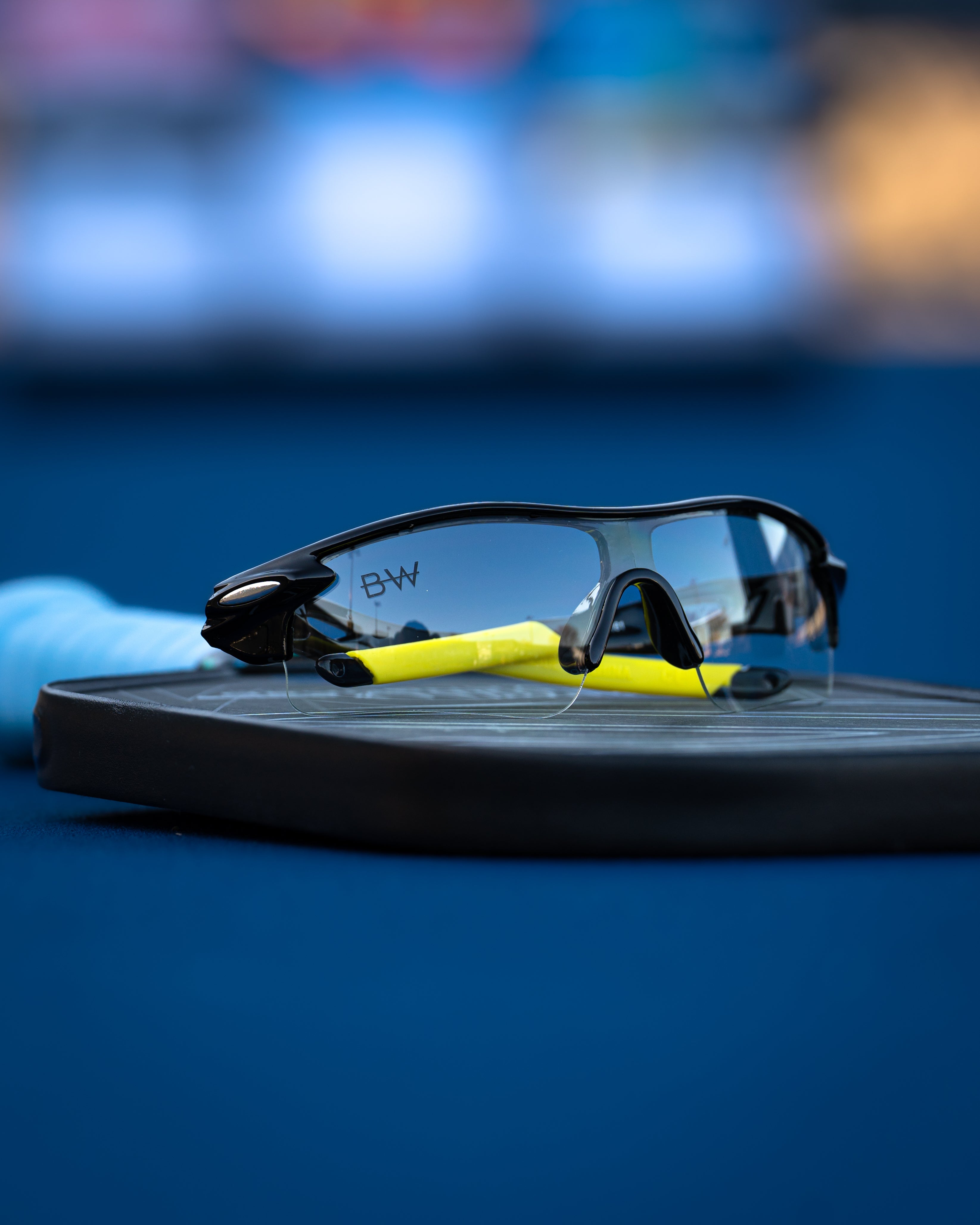
How Wearing the Right RX Lens Reduces Motion Blur
Share
Find Your Perfect Pickleball Glasses
Prescription eyewear can help provide the refractive correction you need on the pickleball court, but moving objects introduce visual challenges that are more complicated than simply choosing a lens marketed as “fast.” Understanding the difference between refractive blur, motion-related blur, frame movement, surface contamination, and other visual effects can help you make a better RX eyewear decision.
How Wearing the Right RX Lens Can Help With Motion-Related Blur
A pickleball can move quickly across your visual field. During a rally, your eyes, head, attention, and body may all be moving while you try to follow the ball and prepare for the next shot.
If the ball appears blurry during motion, it is tempting to assume that your prescription lenses are “too slow.” That explanation is misleading. Prescription lenses do not need to keep pace with a moving ball, and they do not create a processing delay simply because the scene is moving.
What an appropriate prescription can do is correct the refractive error it was prescribed to correct. If your distance vision is blurred because your refractive correction is no longer appropriate, that blur may also be present when you try to view a moving pickleball.
But motion-related blur can have many possible contributors. Prescription accuracy is only one of them.
What Does “Motion Blur” Mean?
The phrase motion blur can describe an object appearing less distinct while it, the observer, or both are moving. But players often use the same phrase to describe several different experiences.
For example, someone saying “the ball gets blurry” could actually be describing:
- Refractive blur
- Difficulty resolving a rapidly moving target
- Double or ghosted images
- Fog on the lenses
- Sweat or fingerprints on the lens surface
- Frame movement
- A scratched or damaged lens
- An unfamiliar new prescription
- A lighting or contrast issue
- Another visual concern
Those problems should not all be labeled motion blur because their causes and solutions can be very different.
Myth: Your Prescription Lenses Cannot “Keep Up” With Fast Motion
A conventional prescription lens does not process a visual scene frame by frame. It is not a display with a refresh rate and does not become too slow because a pickleball is moving quickly.
The lens bends incoming light according to its optical characteristics. A fast drive does not outrun the prescription.
So statements such as these should be avoided:
- “Your lenses are lagging behind the ball.”
- “Slow prescription lenses create visual delay.”
- “High-index lenses process movement faster.”
- “Sports lenses give your brain extra milliseconds.”
None of those accurately describes how ordinary prescription spectacle lenses work.
Where the Prescription Actually Matters
If you need refractive correction, an appropriate eyeglass prescription can help provide the correction prescribed for your vision.
Common prescription terms can include:
- SPH: Spherical lens power
- CYL: Cylinder power when prescribed
- AXIS: Orientation associated with cylinder correction
- ADD: Additional power when prescribed
- Prism: Prescribed prism when applicable
If your refractive needs have changed, an older prescription may no longer provide the correction currently appropriate for you. But a missed drive or blurry fast ball alone cannot determine that your prescription is outdated.
Static Blur vs. Blur During Movement
One useful troubleshooting question is whether the target looks blurry only when it moves or whether your distance vision also appears blurry when the scene is relatively still.
| What You Notice | What It May Tell You |
|---|---|
| Stationary distant objects also look blurry | The concern is not limited to moving targets |
| Only very fast targets seem difficult to resolve | Do not automatically assume a prescription error |
| Everything becomes hazy after sweating | Check the lens surface first |
| Blur begins after the frame moves | Check fit and wearing position |
| Blur occurs after an impact | Inspect the eyewear for physical damage |
| Two images appear instead of one | Do not automatically label this ordinary motion blur |
Motion Blur and Dynamic Visual Acuity Are Not Identical
Dynamic visual acuity broadly concerns visual resolution when the target, observer, or both are moving under particular conditions.
It should not be treated as a feature manufactured into a prescription lens.
Likewise, wearing an RX lens does not automatically improve:
- Dynamic visual acuity
- Reaction time
- Visual processing speed
- Ball tracking
- Anticipation
- Hand-eye coordination
Appropriate refractive correction can address refractive error. Those additional functions should be discussed separately.
Seeing a Moving Ball and Tracking It Are Different Concepts
Players often use “tracking” to describe the entire process of watching and responding to a pickleball. In reality, several stages may be involved.
You may need to:
- Detect the ball.
- Direct attention toward relevant visual information.
- Follow its changing position.
- Interpret trajectory and other contextual information.
- Decide how to respond.
- Move into position.
- Execute the shot.
Prescription lenses participate in the optical part of the visual experience. They do not independently control every stage of the sequence.
Clearer Refractive Correction Does Not Automatically Mean Faster Reactions
Reaction time involves more than whether an image is optically sharp. Attention, anticipation, decision-making, experience, movement, and the complexity of the situation can all matter.
That means it is not accurate to claim that prescription sports glasses automatically give an athlete additional milliseconds to respond.
Similarly, high-index material should not be marketed as making the brain process motion faster.
Ghosting Is Not Always Ordinary Motion Blur
Some players describe seeing a faint second image, shadow, or trail around a ball as “motion blur.” The description alone cannot establish the cause.
If ghosting is persistent, occurs with stationary objects, appears in only one eye, occurs with both eyes, or represents a meaningful new visual change, that pattern can be useful information for an eye-care professional.
Do not diagnose persistent ghosting as an incorrect PD, astigmatism, lens defect, or sports-vision problem from the symptom alone.
Double Vision Should Not Be Dismissed as Motion Blur
Seeing two distinct images is different from simply finding a fast-moving object difficult to resolve.
New or persistent double vision should not be explained away as:
- Normal pickleball motion blur
- Frame adaptation
- A high-index lens effect
- An ordinary PD issue
- A normal consequence of playing fast
If you experience meaningful new or persistent double vision, seek appropriate professional evaluation.
Does PD Cause Motion Blur?
Pupillary distance (PD) is used in positioning prescription lenses. It is not a measurement of motion-processing ability.
An appropriate PD measurement can be important to prescription lens positioning, but you cannot determine that a PD is wrong simply because you lose sight of the ball during a fast rally.
PD does not directly measure:
- Dynamic visual acuity
- Reaction time
- Ball-tracking skill
- Depth perception ability
- Visual processing speed
Optical Positioning Is More Complex Than “Center the Lens Over the Pupil”
Prescription lens positioning should not be reduced to the claim that the optical center must always sit directly over the pupil.
Depending on the prescription and lens design, relevant optical reference points and fitting considerations can be more nuanced.
That is why a selfie or missed pickleball cannot establish that prescription lenses are incorrectly centered.
Can Frame Movement Make Vision Feel Unstable?
If prescription eyewear moves substantially relative to the wearer's face, the wearing position changes. That can create a different experience from a frame that remains in its intended position.
However, frame movement does not cause the prescription itself to lag behind the ball.
If your glasses repeatedly move during active play, evaluate the fit rather than assuming you need stronger lenses.
How to Check RX Frame Stability for Pickleball
Test new prescription sports eyewear using normal athletic movement rather than exaggerated stress tests.
Check whether the frame:
- Feels comfortable
- Sits consistently during ordinary movement
- Requires frequent repositioning
- Becomes uncomfortable as the session continues
- Changes position substantially after perspiration
- Appears bent or asymmetric
The goal is an active fit that works for you—not an unrealistic promise of zero movement under every condition.
No Frame Should Be Promised as “Zero Slip” for Every Player
Fit depends on the individual wearer, frame dimensions, movement, perspiration, and other factors.
A sports-focused frame can be designed for active use without justifying claims such as:
- Zero bounce
- Zero slip
- Locked-in vision
- Perfect centering during every movement
- No frame shift under any condition
Individual fit should be evaluated rather than guaranteed.
Do High-Index RX Lenses Reduce Motion Blur?
High-index describes a category of lens material with a higher refractive index than conventional lens materials. It can help manage finished lens thickness, particularly as prescription requirements increase.
Blinded Wear includes high-index prescription lenses at no additional cost.
That is a legitimate lens-material benefit, but high-index should not be described as a motion-blur technology.
What High-Index Does Not Automatically Do
High-index material does not inherently:
- Process movement faster
- Reduce reaction time
- Improve dynamic visual acuity
- Improve depth perception
- Improve ball tracking
- Eliminate optical distortion
- Prevent frame movement
- Provide anti-reflective properties
- Provide anti-fog properties
- Provide scratch resistance
- Provide UV protection
- Provide impact certification
Each characteristic should be evaluated separately.
Does 1.61 High-Index Eliminate Motion Blur?
No. A refractive index such as 1.61 is a material specification, not a measure of motion clarity.
It should not be marketed as:
- Optically pure
- Distortion-free
- Faster during head movement
- Better for reaction time
- A solution for ghosting
- A guarantee of better ball tracking
Blinded Wear's verified general RX benefit is that high-index prescription lenses are included at no additional cost. Do not assume that every RX configuration uses an exact 1.61 material unless that specification is confirmed for the exact product.
Thinner Lenses Do Not Automatically Mean Clearer Motion
A thinner finished lens can be desirable for practical or cosmetic reasons, particularly for some prescriptions and frame combinations.
But thickness is not a motion-clarity score.
Final lens thickness can depend on:
- Prescription
- Lens material
- Lens dimensions
- Decentration
- Frame selection
- Lens design
- Other optical requirements
Do not assume that the thinnest possible lens will automatically provide the best sports vision.
What About Chromatic Dispersion and Abbe Value?
Abbe value is associated with chromatic dispersion in optical materials. It is a separate material characteristic from refractive index.
It should not be converted into a simplistic rule that one lens material always produces better pickleball tracking or less motion blur for every wearer.
Likewise, refractive index alone cannot tell you the complete optical experience of finished prescription eyewear.
Does a Stronger Prescription Create More Motion Blur?
There is no universal prescription threshold at which a person suddenly develops sports motion blur.
Prescription magnitude can be relevant to lens design, thickness, positioning, and other optical considerations, but stronger correction should not automatically be described as slower or blurrier during movement.
Players with stronger or more complex prescriptions should use appropriate correction rather than intentionally weakening the RX for sports.
Astigmatism Correction and Moving Objects
If your eyeglass prescription includes cylinder correction, the CYL and AXIS values are meaningful prescription information.
Do not remove cylinder correction, change the axis, or reduce the prescription because you believe doing so will make a moving ball appear faster or clearer.
A player cannot determine that an axis is wrong from a missed return alone.
Could an Outdated Prescription Contribute to Blur?
If your refractive needs have changed, an older prescription may no longer provide the correction that is currently appropriate.
A useful distinction is whether blur is present beyond high-speed pickleball situations.
If stationary distant objects, signs, or other everyday targets are also persistently less clear than expected, that provides different information than occasionally losing visual detail during a very fast rally.
An eye-care professional can determine whether your prescription needs to be updated.
Do Not Diagnose “Overcorrection” From Sports Performance
A prescription should not be labeled overcorrected simply because a player experiences eye strain, misses shots, or reports blur during movement.
Those symptoms can have multiple possible explanations.
If you suspect the prescription itself is inappropriate, professional evaluation is more reliable than changing lens power based on court performance.
Sometimes the “Motion Blur” Is on the Lens Surface
Pickleball can expose eyewear to perspiration, fingerprints, sunscreen, dust, water, and other residue.
When contamination covers the lens, moving objects may become harder to see clearly even though nothing about the prescription has changed.
Before assuming an optical problem, inspect the lenses.
Fog Is Not a Prescription Problem
Fog is condensation on the lens surface. It can temporarily obscure the scene, but it does not alter SPH, CYL, AXIS, PD, or prescribed prism.
Likewise, the presence of fog does not prove that the lens material is defective.
Anti-fog characteristics, when present and verified, should be treated as a separate lens feature rather than part of the prescription itself.
Scratches Can Interfere With the View Without Changing the RX
A physical scratch does not rewrite the prescription values manufactured into the lens.
Depending on the scratch's characteristics and location, however, it may be noticeable or interfere with part of the viewing area.
Do not attempt to polish prescription lenses with toothpaste, baking soda, automotive compounds, wax, or other abrasive DIY methods.
A Crack or Chip Is Different From Blur
If a lens is visibly cracked, chipped, displaced, or otherwise structurally questionable, do not treat the problem as ordinary motion blur.
Physical damage deserves inspection, particularly if it follows an impact or if the visual experience suddenly changed at the same time.
Blur After an Impact: Check the Eyewear First
If vision suddenly feels different after the glasses are hit, dropped, or compressed:
- Inspect the lenses for visible damage.
- Check whether either lens appears displaced.
- Inspect the frame for deformation.
- Determine whether the glasses now sit differently.
- Clean away surface contamination appropriately.
- Do not aggressively bend the frame or force a lens back into place.
- Have questionable damage evaluated.
An impact does not automatically change lens power, but it can potentially affect the physical eyewear system.
Does Anti-Reflective Coating Eliminate Motion Blur?
No. Anti-reflective treatment and motion blur are different issues.
An anti-reflective treatment is intended to manage certain lens-surface reflections. It should not be described as automatically:
- Increasing reaction speed
- Improving dynamic visual acuity
- Eliminating motion blur
- Improving depth perception
- Preventing eye strain for every wearer
Do not assume anti-reflective treatment is included on every Blinded Wear RX lens unless it is verified for the exact configuration.
Blue-Light Filtering Is Not a Motion-Tracking Technology
Blue-light filtering should not be marketed as a way to make pickleballs easier to track, improve reaction time, or prevent motion blur.
Likewise, do not assume every Blinded Wear prescription lens includes blue-light filtering unless the exact product specification confirms it.
Indoor court lighting does not by itself establish a need for a blue-light-filtering lens.
UV Characteristics Are Separate From Motion Clarity
UV characteristics and the appearance of moving objects are different lens considerations.
A UV specification does not directly establish:
- Reduced motion blur
- Better tracking
- Faster reactions
- Better depth perception
- Reduced glare
UV characteristics should be verified for the exact lens rather than assumed from tint darkness or sports styling.
Does Polarization Reduce Motion Blur?
Polarization is designed to manage certain reflected light. It should not be described as a universal motion-blur solution.
Likewise, non-polarized lenses do not automatically provide faster visual processing, better depth perception, or superior ball tracking.
Polarization status is one lens characteristic among many and should be evaluated according to the exact product and environment.
Does Lens Tint Reduce Motion Blur?
A tint changes visible-light transmission according to the exact lens. Tint does not directly change the speed at which a conventional prescription lens handles motion.
Do not assume that:
- Grey tint eliminates motion blur.
- Clear lenses provide faster visual processing.
- A darker lens makes the ball easier to track.
- A particular color automatically improves reaction time.
- One tint universally improves contrast for pickleball.
Choose tint according to verified lens characteristics, environmental conditions, and individual preference.
VLT Is Not a Motion-Clarity Rating
Visible Light Transmission (VLT) describes the percentage of visible light transmitted through a lens.
A higher VLT means more visible light is transmitted. A lower VLT means less visible light is transmitted.
VLT does not directly measure:
- Motion blur
- Reaction time
- Dynamic visual acuity
- Prescription accuracy
- Depth perception
- Ball-tracking ability
There is no universal VLT percentage that guarantees better motion clarity for every pickleball player.
What About Photochromic Lenses?
Photochromic lenses are designed to change tint according to their particular technology and environmental conditions.
They can provide convenience for some wearers when moving through changing light environments, but they should not be marketed as automatically adapting to ball speed or eliminating motion blur.
Exact photochromic availability, activation behavior, tint range, and other characteristics depend on the specific lens configuration.
Lighting Can Affect What You See During Fast Play
A ball moving through changing backgrounds and lighting can present a different visual challenge than a stationary eye-chart target.
Pickleball environments may include:
- Bright outdoor sunlight
- Shade
- Cloud cover
- Artificial indoor lighting
- Evening conditions
- Reflections from surrounding surfaces
- Complex visual backgrounds
If blur occurs primarily in one environment, consider the environment as a variable rather than automatically blaming the prescription.
Background and Ball Visibility Matter Too
A moving ball can be more or less visually distinct depending on the surrounding background and lighting.
This should not be confused with a prescription lens physically creating or removing motion blur.
For example, visual conditions can change as the ball moves across:
- Sky
- Trees
- Fencing
- Walls
- Spectators
- Adjacent courts
The scene itself can become more or less visually demanding.
Fast Head Turns Do Not Make RX Lenses “Lag”
A conventional prescription lens does not develop processing lag because you turn your head quickly.
However, a rapid head movement can combine several variables at once:
- The visual scene moves across the retina.
- The eyes may move relative to the lens.
- The frame may move on the face.
- The target may also be moving.
- Your body may be repositioning simultaneously.
If vision feels unusual during head movement, do not automatically attribute the experience to slow lens material.
You Do Not Always Look Through the Same Part of a Lens
During active play, the eyes can rotate behind the spectacle lenses as gaze changes. Depending on head and eye movement, the wearer may view through different portions of the lens.
The resulting optical experience depends on the complete prescription lens system and should not be reduced to claims such as “wide lenses eliminate lateral blur.”
No frame geometry guarantees perfect clarity through every gaze angle for every prescription.
Do Wider Lenses Prevent Motion Blur?
A wider lens can change physical lens coverage and frame geometry, but it does not automatically prevent motion blur or increase biological peripheral vision.
Likewise, wraparound styling alone does not prove:
- Better ball tracking
- Less lateral blur
- Better depth perception
- Faster reactions
- Distortion-free peripheral viewing
Evaluate the complete RX configuration rather than relying on frame shape as a performance guarantee.
Contacts vs. RX Glasses for Moving Targets
Contact lenses and prescription glasses are different methods of providing refractive correction. Neither should be declared universally superior for following a moving pickleball.
Some players prefer contacts. Others prefer prescription sports glasses. Some may combine contact lenses with compatible non-prescription sports eyewear.
The appropriate option can depend on:
- Prescription
- Eye health
- Comfort
- Environment
- Individual preference
- Professional guidance
Do Contacts Automatically Shift or Dry Out During Pickleball?
No. Contact-lens experiences vary.
Some wearers may experience discomfort in dry, windy, dusty, or other challenging conditions, but it is inaccurate to say that contacts universally shift, dry out, or become blurry during long matches.
Likewise, ordinary prescription sports glasses should not be described as sealed protection from wind, sweat, or debris unless the exact eyewear is designed and rated for that purpose.
Do Not Use a Contact-Lens Prescription for RX Glasses
A contact-lens prescription is not interchangeable with an eyeglass prescription.
For applicable Blinded Wear RX products, upload a clear image of your eyeglass prescription on the product page before adding the eyewear to your cart.
Do not attempt to convert the contact prescription yourself.
Review How to Order RX Glasses before purchasing.
Fast Ball Looks Blurry? Start With This Checklist
- Look at a stationary distant target. Is it also blurry?
- Check the lens surface. Look for sweat, fog, fingerprints, water, or residue.
- Check the frame position. Is it sitting normally?
- Inspect for damage. Look for scratches, cracks, chips, or deformation.
- Consider whether the prescription is new. Did the problem begin after changing eyewear?
- Compare environments. Does it happen indoors, outdoors, or everywhere?
- Notice the type of blur. Is it general blur, ghosting, or actual double vision?
- Consider whether the problem exists outside pickleball. Persistent everyday symptoms provide important context.
This checklist cannot diagnose the cause, but it can help you describe the problem more accurately.
When Persistent Blur Deserves Professional Evaluation
Do not use pickleball performance as a substitute for an eye examination.
Consider appropriate professional evaluation when you experience:
- Persistent blur through clean, intact eyewear
- A meaningful new change in vision
- New or persistent double vision
- Persistent ghosting
- A concern that the current prescription is no longer appropriate
- A visual change that occurs outside sports as well
An eye-care professional can evaluate the relevant aspects of your vision rather than assuming that the cause is the lens material or frame.
When the Glasses Themselves Should Be Checked
If the concern began after receiving new eyewear or after the glasses were physically damaged, an optical inspection may also be useful.
Depending on the situation, an optical professional can evaluate relevant characteristics of the finished lenses, frame condition, fit, and wearing position.
A lensmeter or focimeter can help evaluate relevant lens characteristics, but it does not measure your reaction time, ball-tracking skill, or dynamic visual acuity.
Current Blinded Wear RX Options
No Blinded Wear model should be described as universally providing “blur-free vision.” Instead, compare current RX eyewear according to your prescription requirements, individual fit, verified lens characteristics, and playing environment.
- Steel Ice RX
- Blue Shield RX
- Havana Melt RX
- Gray Wash RX
- Zebra II RX
- Lava Rock RX
- Frost RX
- Rippled X RX
- Crystal Wave II RX
Browse the complete Prescription Pickleball Glasses Collection for current options.
What to Prioritize When Choosing RX Pickleball Glasses
If moving objects appear blurry, avoid shopping for eyewear based on a promise to “eliminate motion blur.” Instead, prioritize verifiable factors.
- Appropriate prescription correction: Start with the eyeglass prescription appropriate for your vision.
- Accurate prescription information: Do not guess or modify prescription values.
- Suitable frame fit: Choose eyewear that works for your individual face and active use.
- Verified lens characteristics: Evaluate high-index material, tint, polarization, photochromic technology, impact characteristics, and coatings separately.
- Playing environment: Consider where and under what lighting conditions you usually play.
- Physical lens condition: Keep the lenses appropriately clean and inspect damaged eyewear.
- Professional evaluation when necessary: Persistent visual problems deserve more than a product change.
Common Myths About RX Lenses and Motion Blur
| Myth | More Accurate Explanation |
|---|---|
| Prescription lenses can be too slow for a pickleball. | Conventional spectacle lenses do not have a visual refresh rate. |
| High-index lenses process motion faster. | High-index refers to refractive index and can help manage lens thickness. |
| 1.61 lenses eliminate motion blur. | A refractive-index number is not a motion-clarity specification. |
| Incorrect PD always causes motion blur. | PD concerns prescription lens positioning; blur during movement alone cannot diagnose a PD problem. |
| Wide lenses prevent lateral blur. | Lens width alone does not guarantee better dynamic visual acuity. |
| Anti-reflective coating eliminates motion blur. | Surface-reflection management and motion-related blur are separate. |
| Blue-light filtering improves indoor ball tracking. | Blue-light filtering should not be treated as a sports motion-tracking technology. |
| Non-polarized lenses improve reaction speed. | Polarization status alone does not determine reaction time. |
| Contacts always shift during sports. | Contact-lens experiences vary between wearers and environments. |
| A missed fast ball proves your prescription is wrong. | Sports execution involves many visual and non-visual factors. |
FAQ: RX Lenses and Motion Blur
Can the wrong prescription cause blur?
An inappropriate refractive correction can affect visual clarity, but blur during a fast rally alone cannot determine that the prescription is wrong.
Can an outdated prescription make a moving ball harder to see?
If an older prescription no longer provides the correction currently appropriate for you, visual clarity may be affected. An eye-care professional can determine whether your prescription needs to be updated.
Does incorrect PD cause motion blur?
PD is important to prescription lens positioning, but motion blur alone does not diagnose an incorrect PD.
Does high-index reduce motion blur?
High-index material can help manage lens thickness. It should not be described as a motion-blur treatment.
Does Blinded Wear include high-index RX lenses?
Yes. Blinded Wear includes high-index prescription lenses at no additional cost.
Are all Blinded Wear RX lenses exactly 1.61?
Do not assume an exact refractive index across every configuration unless that specification is verified for the exact product.
Can glasses bounce and make vision feel unstable?
Substantial frame movement changes the wearing position of the eyewear. If a frame repeatedly moves during play, evaluate the fit rather than assuming the prescription itself is lagging.
Do Blinded Wear glasses guarantee zero slippage?
No universal zero-slip promise should be made because fit and movement vary by wearer and conditions.
Does anti-reflective coating eliminate blur?
No. Anti-reflective properties concern surface reflections and do not automatically eliminate motion-related blur.
Does blue-light filtering help me track a pickleball indoors?
Blue-light filtering should not be marketed as automatically improving pickleball tracking or reaction time.
Does tint make motion easier to see?
Tint changes visible-light transmission according to the exact lens. It does not automatically improve dynamic visual acuity or eliminate motion blur.
Are clear lenses always better for fast play?
No. Clear appearance alone does not establish better motion clarity.
Does polarization create motion blur?
Polarization alone should not be treated as a universal cause of motion blur.
Are non-polarized lenses better for fast tracking?
Not automatically. Non-polarized status alone does not establish better ball tracking or reaction time.
Can scratches cause blur?
A scratch may interfere with the view depending on its characteristics and location, but it does not rewrite the prescription.
Can sweat change my prescription during a match?
No. Sweat may contaminate the lens surface or affect how a frame feels on the face, but it does not change the prescription values.
Can fog make a ball look blurry?
Yes. Condensation can obscure the view through a lens, but that is different from the prescription itself being incorrect.
What if I see two balls?
New or persistent double vision should not be dismissed as ordinary sports motion blur. Seek appropriate professional evaluation.
Can RX glasses make my reaction time faster?
Prescription eyewear should not be marketed as automatically increasing reaction speed. Appropriate RX lenses provide refractive correction rather than a guaranteed neurological or athletic performance enhancement.
Do RX glasses eliminate motion blur?
No pair of prescription sports glasses should be promised to eliminate every form of blur during movement. The visual experience can involve prescription correction, target speed, eye and head movement, lighting, lens condition, frame position, and individual visual function.
The Bottom Line on RX Lenses and Motion Blur
The right prescription matters because a player who needs refractive correction should have the correction appropriate for their vision. But that is different from saying a prescription lens can “keep up” with a pickleball or make the brain process motion faster.
If fast-moving objects appear blurry, separate the possibilities. Check whether stationary targets are also blurry. Inspect the lens surface. Check frame fit. Look for damage. Consider whether the eyewear or prescription recently changed. Pay attention to whether the issue occurs only in one environment or persists in everyday vision.
Blinded Wear RX eyewear provides a sports-focused prescription option with high-index prescription lenses included at no additional cost. High-index can help manage lens thickness, but it should not be presented as a motion-blur, reaction-time, or ball-tracking technology.
The goal is not to promise “blur-free” pickleball. It is to start with appropriate refractive correction, choose a suitable RX configuration, maintain the eyewear properly, and investigate persistent visual problems rather than masking them with unsupported performance claims.
Why “The Ball Looks Blurry” Needs a More Specific Answer
For an RX pickleball player, saying “the ball looks blurry when it moves” is a useful starting point, but it does not identify the cause.
Before changing prescription glasses, try to describe exactly what you are seeing.
| Visual Experience | What to Check | What Not to Assume |
|---|---|---|
| Ball looks generally soft or unfocused | Compare with stationary distance targets | Do not assume the lens material is too slow |
| Ball seems to leave a faint trail | Notice whether the effect also occurs with other moving or stationary objects | Do not automatically diagnose the prescription |
| Two distinct balls appear | Determine whether this is a meaningful new or persistent visual change | Do not dismiss it as ordinary sports blur |
| Entire scene becomes hazy | Inspect for fog, sweat, water, fingerprints, or residue | Do not assume the RX changed |
| Vision changes when glasses move | Evaluate frame fit and wearing position | Do not assume stronger lenses are needed |
| One area of the lens looks distorted | Inspect for contamination, scratches, cracks, or other damage | Do not diagnose a coating or material failure from appearance alone |
| Blur is present throughout everyday distance vision | Consider whether the current correction remains appropriate | Do not diagnose yourself from pickleball performance alone |
Step One: Compare Moving and Stationary Targets
A simple observation can provide useful context: compare what you see when looking at a stationary distant object with what you experience while following a moving pickleball.
If distant stationary objects are also persistently less clear than expected through clean, intact eyewear, the concern is broader than motion alone.
If stationary vision seems appropriate and the difficulty occurs only during extremely fast exchanges, that does not prove anything is wrong with the prescription.
This is a troubleshooting observation, not a home eye examination.
Does the Blur Seem Different Between Your Eyes?
If you are experiencing a persistent visual problem, an eye-care professional may ask whether the experience appears to involve one eye, both eyes, or only binocular viewing.
That information can be useful when describing the problem, but it should not be used to self-diagnose the cause.
Differences between the eyes can involve many possible visual or optical factors. Do not respond by independently changing one lens power, removing cylinder correction, changing an axis, or modifying prism.
What If Motion Looks Different After Getting New RX Glasses?
A new pair of prescription pickleball glasses can differ from an older pair in more ways than prescription power.
Possible differences include:
- Prescription values
- Lens material
- Lens dimensions
- Frame size
- Frame shape
- Wearing position
- Lens design
- Tint or other verified lens characteristics
Because several variables may change simultaneously, an unfamiliar experience does not automatically prove that the new prescription is incorrect.
Is There a Normal Adaptation Period for New RX Glasses?
People can have different experiences when changing prescriptions, frames, or lens designs. There is no single adaptation timetable that should be promised to every wearer.
A new pair should not automatically be declared defective because it feels different immediately, but persistent or significant visual concerns should not be dismissed indefinitely as “normal adaptation” either.
If something continues to feel meaningfully wrong, appropriate professional evaluation is more useful than relying on a universal number of days.
Frame Geometry Can Change the Wearing Experience
Two pairs containing the same written prescription do not necessarily place the lenses in exactly the same physical relationship to the wearer.
Differences can include:
- Frame dimensions
- Lens shape
- Lens position
- Frame tilt
- Vertex distance
- Wrap
- How the frame sits on the individual wearer
These concepts are more nuanced than simply saying one frame has “better motion optics.”
What Is Vertex Distance?
Vertex distance broadly refers to the distance between a spectacle lens and the eye. It is one aspect of the wearing configuration of prescription eyewear.
It should not be treated as a DIY performance setting. A player should not intentionally push glasses dramatically closer to or farther from the eyes in an attempt to make a pickleball appear sharper.
If a frame fits poorly or sits unusually, address the fit rather than trying to engineer your own optical correction.
What About Frame Tilt?
Spectacle frames can sit at different angles relative to the wearer. Frame tilt is one component of the complete wearing position.
It does not mean that every small movement during pickleball creates a meaningful prescription error.
However, a substantially bent or poorly fitting frame should not be ignored if the visual experience changed at the same time.
Does More Wrap Mean Less Motion Blur?
No universal relationship should be assumed.
Wrap changes frame and lens geometry, but a more wrapped appearance does not automatically mean:
- Less motion blur
- Better peripheral clarity
- Better depth perception
- Better prescription accuracy
- Faster ball tracking
- Less optical distortion
Prescription requirements and the complete lens design matter. Sports styling alone cannot establish optical performance.
Eye Movement vs. Head Movement During Pickleball
Players do not follow every ball using one type of movement. During a point, the eyes and head may move in different combinations as attention shifts around the court.
This is another reason the phrase “my lenses cannot keep up” is misleading. The visual system is interacting with a changing scene while the eyewear remains part of the optical path.
A prescription lens does not acquire a slower response because the wearer moves their eyes instead of their head.
Why a Fast Rally Can Feel Visually Harder
A rapid exchange can place more demands on the player than a stationary visual task because multiple things are happening at once.
The player may be:
- Following a moving ball
- Changing gaze direction
- Repositioning the head
- Moving the body
- Reading opponents
- Maintaining court awareness
- Deciding which shot to play
- Preparing the paddle
Difficulty during that sequence cannot automatically be attributed to the prescription lenses.
Why a Dink and a Fast Drive Create Different Visual Tasks
A slower dink and a fast drive can differ in speed, trajectory, viewing distance, background, player movement, and the amount of time available to respond.
If one type of shot seems easier to see than another, that difference does not prove the eyewear is selectively blurring fast balls.
Sports performance combines the visual scene with anticipation, positioning, experience, decision-making, and physical execution.
What About Motion Blur on Overheads?
Overheads can involve looking upward while simultaneously changing head and body position. The ball may also pass through changing backgrounds such as sky, lights, ceilings, or surrounding structures.
If overheads seem visually different from balls viewed directly ahead, consider the entire visual situation rather than assuming the upper portion of the prescription lens is defective.
No sports frame should be promised to eliminate every visual challenge associated with upward gaze.
Peripheral Vision and Lens Coverage Are Not the Same Thing
Biological peripheral vision is a characteristic of the visual system. Physical lens coverage is a characteristic of eyewear.
A larger or wider lens may provide different physical coverage, but it should not be marketed as expanding the wearer's biological peripheral vision.
Likewise, a larger lens does not automatically improve motion tracking at the edges of the visual field.
Motion Blur and Depth Perception Are Different
Depth perception concerns the perception of three-dimensional spatial relationships. Motion blur describes a different visual experience.
A player can report difficulty judging distance without necessarily experiencing blur, and a player can report blur without establishing a depth-perception problem.
Do not treat either symptom as proof that the PD, lens material, or frame is incorrect.
Contrast Sensitivity and Motion Blur Are Different Too
Contrast sensitivity broadly concerns the ability to distinguish differences in contrast. It should not be used as another name for motion clarity.
Likewise, a lens marketed for a particular tint or visible-light transmission should not automatically be claimed to improve contrast sensitivity unless the exact claim is appropriately supported.
Prescription correction, tint, VLT, contrast, and motion-related visual performance are separate concepts.
Moving Between Sun and Shade
Outdoor pickleball can involve rapid changes in the visual environment as the ball, player, or gaze moves between bright and shaded areas.
A fixed-tint lens remains substantially fixed while the environment changes. A photochromic lens, when available, changes according to its particular technology and conditions rather than instantaneously matching every moment of a rally.
Neither should be promised to eliminate motion blur.
Motion Blur During Indoor Pickleball
If a player reports that moving balls seem more difficult to see indoors than outdoors, several environmental variables may differ:
- Overall illumination
- Background
- Fixture placement
- Reflections
- Court colors
- Wall colors
- Visual clutter
That pattern does not automatically prove that indoor play requires a different prescription.
Evaluate lens configuration and environment separately from the refractive correction itself.
Motion Blur During Evening or Night Play
Lower-light environments can feel visually different from bright daylight. A fixed dark tint may also transmit less visible light than an untinted or higher-VLT option.
However, do not convert that observation into a universal rule that one exact tint or VLT is best for every player at night.
Use verified specifications for the exact lens and consider the conditions in which you actually play.
Do Clear Lenses Eliminate Motion Blur?
No. A clear lens generally refers to a lens without a dark sunglass tint. It does not mean:
- 100% visible-light transmission
- Zero reflections
- Zero distortion
- Zero motion blur
- Perfect dynamic visual acuity
- Faster reaction time
Players interested in current untinted options can explore the Blinded Wear Clear Lens Collection.
Do Grey Lenses Reduce Motion Blur?
Grey tint can reduce visible-light transmission according to the exact lens, but grey coloration should not be described as a motion-blur treatment.
A grey lens also should not automatically be described as:
- Polarized
- Contrast-enhancing
- Better for depth perception
- Better for reaction time
- Better for ball tracking
- UV protective solely because it is dark
Verify each lens characteristic independently.
Photochromic Lenses and Fast Light Changes
Photochromic technology is designed to alter tint in response to particular activating and environmental conditions. The exact response depends on the specific technology.
It should not be described as an electronic system that instantly analyzes each patch of light during a rally.
Photochromic convenience and motion clarity are separate considerations.
Reflections Can Be Mistaken for Blur
Surface reflections and moving-image blur are different optical phenomena.
If reflections are distracting, determine whether the issue appears to be a reflection rather than describing every unwanted visual effect as motion blur.
An anti-reflective treatment, when present, concerns surface reflections. It does not make the prescription respond faster to movement.
Rain Can Make a Moving Ball Harder to See Without Changing the RX
Water droplets on the lens can interfere with the view. Rain may also alter the visual environment, court reflections, and lighting.
None of that changes the prescription values manufactured into the lenses.
Do not assume that high-index material is waterproof or that ordinary sports glasses are rainproof unless the exact product has verified characteristics supporting those claims.
Sweat Can Create Two Separate Issues
During active pickleball, perspiration may affect eyewear in at least two practical ways:
- It can contaminate the lens surface.
- It can affect how the frame feels or sits on the individual wearer.
Neither means the prescription itself has changed.
If clarity returns after appropriate cleaning, the issue was not necessarily a refractive error.
Clean First Before Diagnosing a Lens Problem
If the visual experience suddenly becomes hazy during a match, inspect the lens surface before assuming something has happened to the prescription.
- Move to a safe location away from active play.
- Inspect the lens for visible moisture, fog, fingerprints, dust, or other contamination.
- If loose grit is present, avoid grinding it across the lens.
- Use an appropriate lens-care method compatible with the eyewear.
- Reassess the view after the lens is clean.
Cleaning cannot correct an inappropriate prescription, but it can eliminate a simple surface problem from the troubleshooting process.
Avoid Aggressive DIY Lens Cleaning
Cleaning-product compatibility can depend on the lens and any applicable treatments. Avoid assuming that every household cleaner is safe for every prescription lens.
Likewise, do not attempt to improve “motion clarity” by applying automotive water repellents, waxes, abrasive polish, or other unverified products to prescription lenses.
Adding an incompatible substance can create a new surface problem rather than solving the original one.
Residue or Scratch? Check Before You Assume
A mark on the lens is not necessarily a scratch. It may be dried water, sunscreen, skin oil, dust, or another contaminant.
If appropriate cleaning removes it, the mark was not permanent physical surface damage.
If a permanent mark remains, avoid trying to polish it away with abrasive DIY methods.
Does Heat Cause Motion Blur in RX Lenses?
There is no useful universal rule that a certain temperature suddenly causes prescription lenses to develop sports motion blur.
Lens materials, frames, and coatings can respond differently to environmental exposure. Avoid unnecessary prolonged extreme heat rather than relying on a single temperature threshold.
If eyewear appears physically altered after significant heat exposure and vision through it has changed, have the eyewear evaluated rather than diagnosing the material yourself.
Does Cold Weather Make RX Lenses Too Slow?
No. Conventional prescription lenses do not become visually “slow” because the weather is cold.
Environmental temperature can be relevant to certain materials, coatings, condensation, and photochromic technologies, but those issues should not be confused with a lens developing processing lag.
Hydrophobic Does Not Mean Motion-Blur Resistant
A hydrophobic surface treatment concerns how water interacts with a lens surface. It does not directly change:
- Prescription accuracy
- Reaction time
- Dynamic visual acuity
- Depth perception
- Ball-tracking skill
Hydrophobic properties should also be verified for the exact lens rather than assumed.
Anti-Fog and Motion Blur Are Separate Features
An anti-fog treatment or design feature, when present, concerns condensation management. It does not directly correct refractive blur or increase motion-processing speed.
Do not assume that every Blinded Wear RX lens includes anti-fog treatment unless that feature is verified for the exact product.
Impact Resistance Does Not Mean Better Motion Clarity
Impact resistance concerns physical performance under relevant impact conditions. It is separate from optical correction and dynamic visual performance.
An impact-resistant lens should not automatically be described as:
- Shatterproof
- Scratchproof
- Distortion-free
- Motion-blur reducing
- Safety certified
- Ballistic
Each claim requires its own support.
Does a Lighter Lens Reduce Motion Blur?
Lens weight and motion blur are not the same characteristic.
A lighter finished eyewear system may affect comfort or how the product feels to an individual wearer, but it should not be claimed to make moving objects optically sharper.
Likewise, high-index does not automatically mean the lightest possible finished lens because final weight depends on material density, lens volume, prescription, dimensions, and design.
Does a Lightweight Frame Guarantee Better Stability?
No. Frame weight is only one aspect of fit.
A lightweight frame should not automatically be described as:
- More secure
- Zero-slip
- More optically stable
- Better for reaction time
- Better for motion clarity
The individual wearer should evaluate comfort and active fit.
Tighter Is Not Automatically Better
A sports frame does not need to squeeze excessively to be useful during active play.
An overly tight frame can create discomfort, while a poorly fitting loose frame may require repeated repositioning.
The objective is a suitable individual fit—not maximum pressure.
Recheck Fit During a Longer Pickleball Session
A frame that feels comfortable for several minutes may feel different after extended wear and movement.
During a normal playing session, pay attention to whether:
- The frame repeatedly slides
- You constantly reposition it
- Pressure points develop
- The frame becomes uncomfortable
- The eyewear remains usable after perspiration
This gives you practical fit information without requiring exaggerated movement tests.
Use New RX Sports Glasses Before Tournament Day
When practical, become familiar with new prescription sports eyewear during ordinary practice before relying on it in an important tournament.
This gives you time to evaluate:
- Comfort
- Fit
- Frame movement
- Lens configuration
- Different playing environments
- Whether any unusual visual concern persists
There is no universal number of practice sessions required.
A Backup RX Pair Can Be Useful
If prescription correction is important to your ability to play, carrying usable backup eyewear can be practical during tournaments or travel.
A backup can be especially helpful if the primary pair becomes:
- Damaged
- Lost
- Unusable due to an unexpected equipment issue
Make sure the backup prescription remains appropriate for you rather than assuming an old pair is automatically equivalent to your current eyewear.
When to Stop Playing and Check Your Vision or Eyewear
A missed shot does not require an eye examination. A meaningful new visual problem deserves more attention.
Stop and assess the situation when:
- The glasses are visibly damaged
- A lens appears displaced
- Vision suddenly changes after an impact
- You develop significant new blur
- You experience new or persistent double vision
- The eyewear suddenly sits substantially differently
Safety and appropriate evaluation matter more than finishing a point with questionable vision or damaged eyewear.
RX vs. Non-RX Pickleball Glasses
The primary distinction is straightforward: prescription eyewear provides refractive correction for a wearer who needs it, while non-prescription eyewear does not contain that individualized correction.
That does not mean every RX pair provides better athletic performance than every non-RX pair.
Players who do not require prescription correction can explore the Blinded Wear Non-RX Pickleball Glasses Collection.
Players who require eyeglass correction can explore the Blinded Wear RX Pickleball Glasses Collection.
RX Pickleball Lens Buying Matrix
| Feature | What It Addresses | Does It Automatically Reduce Motion Blur? |
|---|---|---|
| Prescription correction | Prescribed refractive error | It addresses refractive correction, not every form of motion-related blur |
| High-index material | Can help manage lens thickness | No |
| PD | Prescription lens positioning | No universal motion-blur guarantee |
| Fixed tint | Visible-light transmission according to the lens | No |
| Photochromic technology | Variable tint according to technology and conditions | No |
| Polarization | Management of certain reflected light | No |
| Anti-reflective treatment | Surface reflections | No |
| Anti-fog treatment | Condensation management | No |
| Hydrophobic treatment | Water interaction with the lens surface | No |
| Impact resistance | Physical impact performance | No |
| Frame fit | How eyewear sits on the individual wearer | Does not eliminate all causes of motion blur |
Choose RX Eyewear by Verified Features, Not “Visual Speed” Claims
When comparing prescription pickleball glasses, focus on concrete characteristics instead of claims that one pair makes your visual system faster.
Useful questions include:
- Can this configuration accommodate my prescription requirements?
- What lens material is included?
- What tint is this exact lens?
- Is a VLT specification provided?
- Is the exact lens polarized or non-polarized?
- Is photochromic technology available for this configuration?
- What impact characteristics are actually specified?
- Which coatings or treatments are explicitly listed?
- Does the frame fit me comfortably during active movement?
- What are the current RX ordering, return, and replacement terms?
These questions are more useful than asking whether a lens is “fast enough” for pickleball.
Explore Current RX Pickleball Options
Blinded Wear offers prescription sports eyewear with high-index prescription lenses included at no additional cost. Compare individual models based on your prescription needs, fit preferences, playing environment, and verified lens configuration.
- Steel Ice RX
- Blue Shield RX
- Havana Melt RX
- Gray Wash RX
- Zebra II RX
- Lava Rock RX
- Frost RX
- Rippled X RX
- Crystal Wave II RX
See all current options in the Prescription Pickleball Glasses Collection.
Order RX Pickleball Glasses Without Guessing Your Prescription
For applicable Blinded Wear prescription eyewear, upload a clear image of your eyeglass prescription on the product page before adding the eyewear to your cart.
Before submitting your order:
- Make sure the prescription is readable.
- Use your eyeglass prescription, not your contact-lens prescription.
- Check OD and OS carefully.
- Pay attention to plus and minus signs.
- Do not guess SPH or CYL values.
- Do not change AXIS yourself.
- Do not remove ADD or prism when prescribed simply because the glasses are for sports.
- Provide appropriate measurement information when required.
For additional guidance, review How to Order RX Glasses.
What If You Think the Finished RX Is Wrong?
Do not try to verify prescription power by comparing how many pickleball drives you return successfully.
If there is a genuine concern about the finished lenses, appropriate optical evaluation can help assess relevant lens characteristics.
Likewise, if there is a concern that the written prescription itself is no longer appropriate, that is a vision-care question rather than a pickleball equipment test.
Do Not Perform Destructive “Motion Lens” Tests at Home
There is no useful reason to test RX sports eyewear by deliberately:
- Dropping it
- Hitting it with a ball
- Bending the frame
- Heating it
- Freezing it
- Compressing it under heavy objects
- Scratching the lens
Those actions do not measure motion clarity and can damage the eyewear.
What RX Pickleball Glasses Can and Cannot Promise
Accurate product language matters, especially when discussing vision.
| Reasonable Statement | Claim to Avoid Without Evidence |
|---|---|
| RX lenses provide prescribed refractive correction. | RX lenses make athletes react faster. |
| High-index can help manage lens thickness. | High-index eliminates motion blur. |
| Sports frames are intended for active use. | The frame never moves during play. |
| Fit matters during active movement. | A secure fit guarantees better ball tracking. |
| Tint changes visible-light transmission. | A particular tint guarantees better shot accuracy. |
| Prescription eyewear can be used for pickleball. | Prescription eyewear automatically improves depth perception. |
More Questions About Motion Blur and RX Sports Glasses
Why does a pickleball look clear when still but blurry when moving?
A moving target presents a different visual task from a stationary target. That observation alone does not establish a prescription error or defective lens.
Should I increase my prescription for sports?
Do not intentionally increase prescription power to make a moving ball appear sharper unless an appropriate eye-care professional has prescribed a change.
Should I weaken my prescription for pickleball?
Do not independently reduce prescription power because you believe stronger lenses create motion blur.
Does astigmatism cause motion blur?
Astigmatism is a refractive condition that may be addressed by prescribed cylinder and axis values. Blur during motion alone cannot diagnose astigmatism or establish that its correction is wrong.
Can I remove my cylinder correction for sports?
Do not independently remove prescribed cylinder correction for pickleball.
Can I change my axis to improve tracking?
No. AXIS is prescription information, not a sports-performance adjustment.
Does PD need to change for sports glasses?
Do not invent a separate sports PD. Appropriate measurements and lens positioning depend on the actual eyewear and prescription requirements.
Can my PD change when I move my eyes?
PD should not be treated as a real-time motion-tracking measurement. Eye movement behind the lenses and prescription lens positioning are different concepts.
Do wide lenses give me a wider field of vision?
A larger lens changes physical eyewear coverage, but it does not expand the biological limits of peripheral vision.
Do wraparound glasses eliminate side blur?
No universal claim should be made. Wrap, prescription, lens design, and wearing position can interact in more complex ways.
Does a lighter frame make the ball clearer?
Frame weight does not directly determine optical clarity of a moving ball.
Do sports glasses have a faster refresh rate?
No. Conventional prescription spectacle lenses do not operate like electronic displays and do not have a refresh rate.
Can lens coatings increase visual processing speed?
No coating should be described as making the brain process movement faster without specific evidence supporting that claim.
Will anti-fog lenses stop all blur?
No. Anti-fog characteristics concern condensation and do not address every possible source of blur.
Will hydrophobic lenses keep moving objects sharper?
Hydrophobic treatment concerns water interaction with the lens surface. It does not directly increase dynamic visual acuity.
Are polarized lenses slower than non-polarized lenses?
Polarization should not be described as making a conventional lens optically slower.
Does a darker tint reduce motion blur?
Tint darkness changes visible-light transmission according to the lens. It is not a direct motion-blur rating.
Can photochromic lenses change quickly enough for a rally?
Photochromic behavior depends on the specific technology and environmental conditions. It should not be described as instantly changing tint for each moment of a rally.
Can scratched lenses make a fast ball harder to see?
A scratch can interfere with part of the view depending on its location and characteristics, but it does not change the underlying prescription values.
Why does cleaning my lenses sometimes fix the “blur”?
Because sweat, skin oils, water, dust, and other residue can obscure the visual scene without changing the prescription.
What if blur started immediately after my glasses were hit?
Inspect the lenses and frame for physical damage or displacement. If the eyewear appears damaged or vision remains meaningfully different, have it evaluated.
Can I tell if my prescription is accurate from my pickleball game?
No. Athletic performance is not a prescription-verification test.
What if my vision is blurry outside pickleball too?
Persistent blur during everyday vision deserves appropriate evaluation rather than being treated solely as a sports-eyewear issue.
Motion Clarity Starts With Identifying the Actual Problem
When a pickleball looks blurry, the solution is not automatically a “faster” lens. Conventional prescription lenses do not lag behind moving objects, and high-index material does not function as motion-processing technology.
The more useful approach is to separate possible causes: refractive blur, a changing prescription, lens contamination, fog, scratches, frame movement, physical damage, lighting, an unfamiliar new eyewear configuration, or another visual concern.
For RX players, the foundation remains straightforward: use appropriate refractive correction, submit accurate eyeglass prescription information, choose a suitable frame and verified lens configuration, keep the lenses appropriately clean, and evaluate persistent visual changes rather than guessing.
Blinded Wear includes high-index prescription lenses at no additional cost, giving players a prescription option designed around sports use without needing unsupported claims that the lens eliminates motion blur or makes the visual system faster.
Explore the Pickleball Performance Lens Guide to learn more about choosing among verified lens characteristics.
A Match-Day Framework for RX Players Who Notice Blur
If a pickleball becomes difficult to see clearly during play, avoid immediately blaming the prescription, lens material, or your own reaction speed. A structured check can help separate an equipment issue from an environmental or visual concern.
- Move out of active play safely. Do not troubleshoot eyewear while a point is continuing around you.
- Check the lens surface. Look for fog, sweat, water, fingerprints, sunscreen, dust, or other residue.
- Check the frame. Make sure it has not shifted substantially, bent, or become damaged.
- Look at a stationary target. Notice whether distance vision also appears less clear than expected.
- Identify the type of problem. General blur, haze, ghosting, and double vision are not interchangeable descriptions.
- Consider the environment. Lighting, background, reflections, rain, and other conditions may have changed.
- Do not modify your prescription yourself. Persistent concerns deserve appropriate evaluation.
This process will not diagnose a vision condition, but it can help you avoid treating every difficult visual moment as a lens failure.
Quick Decision Tree: The Ball Suddenly Looks Blurry
| Question | If Yes | Next Step |
|---|---|---|
| Is the lens visibly fogged or dirty? | Surface contamination may be interfering with the view. | Clean the eyewear appropriately and reassess. |
| Did the frame just move? | The wearing position may have changed. | Reposition the eyewear and evaluate fit. |
| Was the eyewear just struck or dropped? | Physical damage is possible. | Inspect the frame and lenses before continuing. |
| Are stationary distant objects blurry too? | The concern is not limited to fast motion. | Consider whether further optical or vision evaluation is appropriate. |
| Are you seeing two distinct images? | This is not simply ordinary motion blur. | New or persistent double vision deserves professional evaluation. |
| Does it happen only in one lighting environment? | Environmental conditions may be contributing. | Compare conditions before assuming the prescription is wrong. |
| Does it persist through clean, intact eyewear? | A simple surface issue is less likely to explain it. | Consider appropriate professional evaluation. |
What to Do If Your RX Glasses Hit the Court
A dropped pair of glasses should be evaluated for physical condition rather than automatically assumed to be fine because the lenses still look clear.
- Pick up the eyewear carefully.
- Inspect both lenses for visible cracks, chips, scratches, or displacement.
- Look at the frame from the front and sides for obvious deformation.
- Check whether the temples and hinges appear normal.
- Put the glasses on only if there is no obvious reason not to.
- Notice whether the frame now sits differently.
- Do not force a displaced lens or severely bent component back into position during a match.
- Have questionable damage inspected when appropriate.
A drop does not automatically alter the prescription power, but physical damage can affect the finished eyewear system.
Separate Impact Damage From Prescription Accuracy
If eyewear is struck by a ball or paddle, two questions should be considered separately:
- Is the eyewear physically intact?
- Is the prescription still appropriate for the wearer?
An impact can potentially damage a frame or lens, but it does not rewrite the SPH, CYL, AXIS, ADD, or prism values on your written prescription.
Likewise, an appropriate written prescription does not guarantee that physically damaged eyewear should continue to be used.
Scratch, Crack, Residue, or Surface Issue?
Not every visible lens mark means the same thing.
| What You Notice | What It Could Represent | Best Response |
|---|---|---|
| Mark disappears after appropriate cleaning | Surface contamination | Continue normal lens care |
| Permanent fine line remains | Possible scratch | Avoid abrasive DIY polishing |
| Visible fracture or chip | Possible structural damage | Have questionable eyewear evaluated |
| Unusual surface appearance | Cause may not be identifiable visually | Do not self-diagnose a coating failure |
| Lens appears displaced in frame | Possible mounting or frame issue | Do not force it back into position |
A photograph or quick visual inspection may not be enough to distinguish every type of lens-surface or structural problem.
How Prescription Lenses Can Be Professionally Checked
If there is a genuine concern about finished prescription eyewear, an optical professional can evaluate relevant characteristics of the glasses rather than relying on sports performance as the test.
A lensmeter or focimeter can be used to assess relevant optical characteristics of spectacle lenses. An optical professional may also inspect the frame, lens condition, and wearing configuration.
That is different from an eye examination. The eyewear can be manufactured according to a written prescription while the wearer's visual needs have subsequently changed.
Written Prescription vs. Finished Lens Verification
These are two separate questions:
- Is the written prescription currently appropriate for the wearer?
- Does the finished eyewear correspond appropriately to the order and prescription?
An eye-care professional addresses the wearer's vision and prescription. Finished-lens concerns can involve optical verification of the eyewear.
Neither question should be answered by counting missed returns, dinks, drives, or overheads.
How to Distinguish a Possible Prescription Change From a Dirty Lens
Surface contamination and changing refractive needs can both be described casually as “blurry vision,” but they are very different.
If appropriate cleaning immediately restores the expected view, that is useful information. If blur remains persistent through clean, intact eyewear and also affects ordinary visual tasks away from the court, that provides a different reason to consider professional evaluation.
Do not repeatedly replace sports glasses while ignoring a persistent change in everyday vision.
Frame Deformation Can Change Wearing Position
If a frame is substantially bent, the lenses may no longer sit in the same physical position relative to the wearer.
That does not mean the written prescription changed. It means the physical eyewear configuration may have changed.
Signs worth checking after a significant impact or compression include:
- The frame looks visibly asymmetric
- One temple sits differently
- The eyewear is suddenly tilted
- The glasses repeatedly slide when they did not before
- A lens appears displaced
- The frame no longer sits comfortably
Avoid repeatedly bending prescription sports frames by hand in an attempt to restore precise alignment yourself.
Why Lens Positioning Is More Nuanced Than “Centered Over the Pupil”
Prescription eyewear involves optical reference points, measurements, lens design, and the physical relationship between the finished lenses and wearer.
That is why simplistic rules such as “the center of every lens must always sit directly over the pupil” can be misleading.
PD is important information, but it is not the only concept relevant to every prescription lens design.
Likewise, small ordinary movements of sports eyewear should not automatically be interpreted as major optical misalignment.
What About Unwanted Prism?
Optical decentration and prism can be discussed mathematically in ophthalmic optics, including through concepts such as Prentice's rule. That does not make a home calculation an appropriate way to diagnose sports blur.
The practical takeaway is simpler: prescription lens positioning matters, particularly when evaluating more complex corrections, but a player should not try to redesign the lens layout based on how a few rallies feel.
Stronger Prescriptions Deserve Individualized Lens Planning
As prescription requirements become more significant or complex, factors such as lens dimensions, material, design, and positioning can become especially relevant to the finished eyewear.
That does not justify a universal threshold where a prescription becomes “too strong for sports.”
High-index material can be useful for managing thickness in many prescriptions, but it does not independently solve every optical consideration associated with stronger correction.
Why High-Index Can Still Be Valuable for RX Pickleball Glasses
Rejecting exaggerated motion-blur claims does not mean high-index lens material lacks value.
High-index materials are commonly used to help manage finished lens thickness compared with lower-index alternatives under comparable conditions, particularly as prescription requirements increase.
Blinded Wear includes high-index prescription lenses at no additional cost.
The important distinction is that this is a lens-material and thickness-management benefit—not a claim that high-index makes the brain faster or eliminates blur during rallies.
What Determines Finished RX Lens Thickness?
Refractive index is only one factor. Finished thickness can also depend on:
- SPH power
- CYL power
- Lens dimensions
- Frame shape
- Lens positioning
- Decentration
- Lens design
- Other optical requirements
This is why two people ordering high-index lenses can receive finished lenses with visibly different thicknesses.
Refractive Index Is Not the Same as Lens Weight
Refractive index and density describe different material characteristics.
A higher refractive index can help reduce the amount of material required to achieve certain optical powers under comparable conditions, but final lens weight depends on more than index alone.
Do not market high-index as automatically producing the lightest possible eyewear or as guaranteeing that a frame will not move.
“Optically Pure” Is Not a Useful Substitute for Real Specifications
Marketing language such as “optically pure,” “perfect optics,” or “distortion-free at every angle” can sound impressive while providing little useful information about the actual prescription lens.
More meaningful information includes:
- The wearer's appropriate prescription
- Relevant measurements
- Lens material
- Lens design when applicable
- Verified tint or VLT information
- Verified polarization status
- Verified photochromic characteristics
- Verified coatings or treatments
- Physical frame fit
These characteristics should still not be converted into unsupported promises of improved athletic performance.
Court Position Changes the Visual Task
The visual situation at the kitchen line can differ substantially from the visual situation at the baseline.
At different moments, the ball can vary in:
- Distance
- Apparent speed
- Trajectory
- Background
- Viewing angle
- Time available for response
If a player finds one type of exchange more difficult than another, it is not enough to conclude that the lenses perform differently at different court positions.
Prescription Correction Is Only One Part of Reading a Rally
Experienced pickleball players often use more than the ball itself when interpreting a point. Paddle position, opponent movement, partner position, court boundaries, and prior patterns may all contribute to decision-making.
Prescription correction can provide the refractive correction prescribed for the wearer, but it should not be marketed as automatically improving anticipation, tactical awareness, or decision speed.
Seeing Clearly and Reacting Quickly Are Not the Same Measurement
It is reasonable to want appropriate visual correction while playing a fast sport. It is not reasonable to turn that into a guaranteed reaction-time improvement.
A player may see a ball clearly and still react late because of:
- Positioning
- Anticipation
- Decision-making
- Technique
- Fatigue
- Attention
- The speed and placement of the opponent's shot
RX eyewear should correct refractive error rather than receive credit or blame for every element of sports performance.
Does Fatigue Mean Your RX Lenses Stopped Working?
No. Prescription lenses do not lose their optical correction simply because you have played several matches.
If your visual experience changes late in a long session, consider the broader situation rather than assuming the lens prescription has weakened.
For example, check for:
- Lens contamination
- Fog or moisture
- Frame movement
- Changing light
- General fatigue
- Whether the visual concern also persists away from play
Persistent symptoms should be evaluated appropriately rather than attributed automatically to match duration.
Eye Strain Does Not Diagnose a Prescription Error
Eye discomfort or a feeling of visual fatigue can have multiple possible explanations. It cannot establish from symptoms alone that the RX power, PD, lens material, or frame is incorrect.
Likewise, do not promise that a particular Blinded Wear lens will eliminate eye strain.
If symptoms are persistent, significant, or concerning, professional evaluation is more appropriate than self-adjusting the prescription.
A Headache After Pickleball Does Not Prove the Glasses Are Wrong
A headache is nonspecific and should not be used as a home prescription test.
If headaches repeatedly occur with new eyewear or are accompanied by persistent visual concerns, that information can be discussed with an appropriate professional.
Avoid assuming that changing PD, weakening the prescription, or switching lens material will automatically solve the problem.
Can You Train Away a Prescription Problem?
Practice can improve pickleball skills, positioning, anticipation, and familiarity with game situations. It does not replace refractive correction when refractive correction is needed.
Similarly, prescription eyewear does not replace training.
Keep those two roles separate:
- Appropriate RX eyewear: provides prescribed refractive correction.
- Practice and coaching: develop sport-specific skills.
Skip Viral “Sports Vision” Tests as a Prescription Diagnosis
Online videos and home exercises may ask players to follow moving objects, read rapidly changing targets, or compare vision through different parts of a lens.
Those activities should not be treated as proof that:
- Your prescription is wrong
- Your PD is wrong
- Your lenses are defective
- You need a different refractive index
- Your reaction time is impaired
Home observations can help you describe what you experience, but they are not a substitute for appropriate optical or eye-care evaluation.
A Phone Camera Cannot Verify Motion Clarity of Your RX Lenses
Recording a pickleball through prescription glasses may create an interesting video, but the camera, autofocus, exposure, frame rate, compression, viewing angle, and position relative to the lens introduce their own variables.
A phone video should not be used to prove that one RX lens has better dynamic visual acuity than another.
Water Beading Does Not Prove Better Motion Vision
Some players may look at how water behaves on a lens and try to infer its optical performance. Water behavior does not establish prescription accuracy, motion clarity, or dynamic visual acuity.
It also should not be used to identify a specific coating with certainty unless the lens specifications confirm that treatment.
RX Tournament Packing Checklist
If prescription eyewear is important to your ability to play, a little preparation can prevent an equipment problem from becoming a tournament problem.
- Primary RX sports glasses
- Usable backup prescription eyewear when practical
- Appropriate protective storage
- Lens-care supplies compatible with your eyewear
- Your current prescription information when useful for travel
- Any additional lens configuration you intentionally use for substantially different playing environments
Do not assume an old backup pair is suitable simply because it contains a previous prescription.
When a Two-Pair Strategy Can Make Sense
Some prescription players may prefer separate eyewear configurations for substantially different environments rather than asking one lens to cover every possible condition.
For example, a player may prefer different visible-light transmission characteristics for bright outdoor conditions and lower-light environments.
This is a convenience and preference decision—not evidence that two pairs improve reaction time or ball tracking.
Photochromic technology may offer another approach for some players when available in the desired configuration, but its exact behavior depends on the specific technology and conditions.
Plan for Indoor and Outdoor Play Separately
Indoor and outdoor courts can present substantially different lighting environments. If you frequently move between them, evaluate whether the exact lens configuration suits both environments.
Questions worth asking include:
- Is the lens fixed tint or variable tint?
- What is the verified VLT, if provided?
- Is photochromic technology available?
- Is the lens polarized or non-polarized?
- Are any relevant coatings explicitly specified?
None of these specifications alone establishes better motion vision. They simply help describe the lens you are actually buying.
Protect RX Glasses Between Matches and During Travel
Prescription sports glasses can encounter more than ball impact during tournament travel. They may also be exposed to compression, abrasion, repeated handling, moisture, residue, and unnecessary heat.
Good habits include:
- Avoid storing eyewear loose with keys or abrasive objects.
- Use appropriate protective storage when the glasses are not being worn.
- Do not leave eyewear under heavy equipment.
- Avoid unnecessary prolonged extreme heat.
- Inspect the glasses after significant impact or compression.
- Clean away contamination using appropriate lens-care methods.
Sports eyewear should not be described as crushproof, heatproof, or travel-proof without specific evidence.
Avoid Using a Hot Vehicle as a Lens Durability Test
Do not intentionally leave prescription eyewear in extreme heat to test whether high-index lenses can withstand it.
There is no useful universal temperature at which every lens, coating, and frame behaves identically.
High-index describes refractive index. It should not be used as proof of heat resistance.
Between Matches: A 60-Second RX Check
During a tournament break, a quick inspection can be more useful than waiting until something interferes with play.
- Check both lenses for contamination.
- Look for visible scratches, chips, or cracks.
- Check that each lens appears properly seated.
- Inspect the frame for obvious deformation.
- Check how the glasses sit on your face.
- Clean the lenses appropriately when needed.
- Store them safely if you remove them.
This does not replace professional inspection when there is meaningful damage or a persistent visual concern.
What If Your Blinded Wear RX Glasses Break?
Blinded Wear offers 50% lifetime replacement support if eligible glasses break, subject to the current policy terms.
For an eligible replacement claim, damaged eyewear must be returned and the customer can receive a 50% credit toward a replacement pair according to the current policy.
This is not an unlimited free lifetime replacement warranty, and it should not be described as automatic coverage for every visual complaint, prescription change, scratch, heat exposure, moisture issue, loss, or other situation.
For damaged RX eyewear, contact blindedwearco@gmail.com before returning the pair.
Review the Blinded Wear Protection Plan, Replacement & Returns information for current eligibility and policy details.
RX Final Sale and Replacement Support Are Different Policies
Customized prescription eyewear is final sale and excluded from the standard 30-day return policy. That is separate from applicable lifetime replacement support for eligible broken glasses.
| Policy Question | General Blinded Wear Guidance |
|---|---|
| Are customized RX glasses part of the standard 30-day return policy? | No. Customized RX eyewear is final sale. |
| Does RX final sale automatically eliminate eligible replacement support? | No. Applicable 50% lifetime replacement support is a separate policy. |
| Is an eligible replacement a free new pair? | No. Eligible claims can receive 50% credit toward a replacement pair under the current policy. |
| Does a prescription change automatically qualify? | Do not assume that it does. |
| Is every motion-blur complaint covered? | No automatic coverage should be promised. |
| Where should damaged RX customers start? | Contact blindedwearco@gmail.com and review the current policy. |
10 Questions to Ask Before Buying RX Pickleball Glasses
- Is my eyeglass prescription current and appropriate for me?
- Does this exact product accommodate my prescription requirements?
- What lens material is actually included?
- What tint does this exact configuration use?
- Is a VLT specification available?
- Is the lens polarized or non-polarized?
- Is photochromic technology available in this exact configuration?
- Which coatings or treatments are explicitly verified?
- What impact characteristics are actually specified?
- Does the frame fit comfortably and consistently during active use?
This approach produces a more informed purchase than choosing eyewear because it promises “faster vision.”
10 Rules for RX Motion Clarity on the Pickleball Court
- Use appropriate refractive correction. Do not intentionally alter prescription values for sports without appropriate professional guidance.
- Do not confuse blur with reaction time. Seeing and responding are related parts of play, but they are not the same measurement.
- Do not treat high-index as motion technology. Its primary relevance here is lens material and thickness management.
- Keep the lenses appropriately clean. Surface contamination can obscure the view without changing the prescription.
- Evaluate fit during actual movement. Avoid universal zero-slip expectations.
- Separate tint from prescription. Tint changes light transmission; it does not rewrite the RX.
- Separate coatings from lens power. Anti-reflective, hydrophobic, anti-fog, and other treatments address different characteristics when present.
- Inspect after impacts. Physical damage and prescription accuracy are separate issues.
- Do not diagnose persistent symptoms from pickleball performance. Missed shots are not an eye examination.
- Get meaningful visual changes evaluated. Especially when they persist away from the court.
Advanced FAQ: Prescription Pickleball Glasses and Moving Vision
Can the correct RX guarantee that the pickleball always looks sharp?
No. Appropriate refractive correction addresses the refractive error it was prescribed to correct. It cannot guarantee perfect perception of every moving target under every condition.
Does a faster pickleball require a different prescription?
No. Prescription power is not selected according to ball speed.
Should tournament players use a stronger RX than recreational players?
Prescription correction should be based on the wearer's visual needs, not competitive level.
Can high-index lenses keep up with fast drives better than standard lenses?
High-index refers to refractive index and can help manage lens thickness. It should not be described as processing fast objects more quickly.
Does 1.61 high-index mean less motion blur?
No. A 1.61 refractive index is not a motion-blur rating. Blinded Wear includes high-index prescription lenses at no additional cost, but an exact index should only be stated when verified for the specific configuration.
Do thinner lenses make the ball appear faster?
No. Finished lens thickness does not determine the perceived speed of a pickleball.
Does lens weight affect reaction time?
Lens weight should not be claimed to directly change neurological reaction time.
Can a bent frame make the prescription feel different?
A substantially changed frame can alter how the eyewear sits relative to the wearer. That is different from changing the written prescription itself.
Can I fix a bent RX frame myself?
Avoid aggressive DIY bending, particularly when the frame or lens position appears significantly altered. Appropriate inspection or adjustment is preferable when needed.
Can an optician tell whether my RX lenses are correct?
Relevant finished-lens characteristics can be evaluated with appropriate optical equipment. Whether the written prescription remains appropriate for your vision is a separate question.
Can a lensmeter test motion blur?
No. A lensmeter or focimeter can assess relevant spectacle-lens characteristics; it does not measure pickleball reaction time or dynamic visual acuity.
Does frame wrap improve dynamic visual acuity?
Wrap alone should not be claimed to improve dynamic visual acuity.
Does a bigger lens improve peripheral vision?
A bigger lens can alter physical coverage, but it does not expand the biological limits of peripheral vision.
Can anti-reflective coating make my reactions faster?
Anti-reflective properties concern surface reflections. They should not be marketed as neurological reaction-time enhancement.
Can anti-fog treatment improve motion clarity?
Preventing or reducing condensation can help keep the lens surface usable when that treatment is present and effective, but anti-fog treatment is not a general motion-blur correction.
Does hydrophobic coating improve tracking in rain?
Hydrophobic treatment concerns water behavior on a lens surface. It should not be claimed to improve biological tracking ability.
Are darker lenses better for fast outdoor rallies?
Not universally. Tint and VLT should be chosen according to the exact lens, environment, and individual preference rather than ball speed alone.
Are clear lenses best indoors?
An untinted configuration may be appropriate for some indoor environments, but no single lens should be declared universally best without considering the actual lighting and wearer.
Do photochromic lenses react to a ball moving between sun and shade?
Photochromic lenses respond according to their particular technology and environmental conditions. They do not electronically track a ball and instantly change tint around it.
Can sweat change optical centering?
Sweat does not rewrite lens measurements, but if it contributes to substantial frame movement, the physical wearing position may change.
Can I diagnose incorrect PD by moving my head quickly?
No. Rapid head movement is not a reliable PD verification test.
Can an old RX still be manufactured accurately?
A pair can correspond to the prescription information supplied while that prescription may no longer represent the wearer's current visual needs. Those are separate issues.
Should I use my contact prescription when ordering RX pickleball glasses?
No. Contact-lens and eyeglass prescriptions are not interchangeable. Use the appropriate eyeglass prescription.
Does Blinded Wear guarantee blur-free pickleball vision?
No responsible RX eyewear claim should guarantee elimination of every form of blur. Prescription correction is one component of the complete visual experience.
Continue Your RX Pickleball Eyewear Research
- Prescription Pickleball Glasses — Browse current Blinded Wear RX options.
- Non-RX Pickleball Glasses — Explore non-prescription options.
- Clear Lens Collection — Browse current untinted options.
- Best Pickleball Glasses 2026 Hub — Compare eyewear categories and learn what to consider.
- Pickleball Performance Lens Guide — Learn about lens colors, clarity considerations, and RX options.
- How to Order RX Glasses — Review the prescription ordering process.
- Protection Plan, Replacement & Returns — Review current policy information.
Final Verdict: The Right RX Corrects Your Vision—It Does Not Make Motion Slower
The most important correction to the motion-blur conversation is simple: a conventional prescription lens does not need to “keep up” with a pickleball. It does not have a refresh rate, and high-index material does not make visual information reach the brain faster.
What appropriate RX eyewear can do is provide the refractive correction prescribed for the wearer. That matters when refractive error would otherwise leave the visual scene less clear.
When a moving pickleball appears blurry, consider the full picture. The prescription may be relevant, but so may lens contamination, fog, physical damage, frame movement, wearing position, lighting, background, an unfamiliar eyewear configuration, or another visual issue.
The best approach is therefore not to shop for a lens promising “zero motion blur.” Start with appropriate prescription correction. Submit accurate eyeglass prescription information. Choose a frame that fits you well during active play. Compare verified lens characteristics separately. Keep the eyewear appropriately clean and protected. Investigate persistent visual changes instead of assuming they are normal sports blur.
Blinded Wear includes high-index prescription lenses at no additional cost, giving prescription players a sports-focused RX option while keeping the role of the lens clear: refractive correction first, without unsupported promises of faster reactions, better tracking, or automatic performance gains.
Key Takeaways
- The right prescription can correct refractive blur, but no RX lens can guarantee elimination of every form of motion blur.
- Conventional spectacle lenses do not have a refresh rate or processing delay.
- High-index material can help manage lens thickness; it does not automatically improve reaction time, tracking, depth perception, or dynamic visual acuity.
- PD and other fitting considerations relate to prescription lens positioning, not athletic processing speed.
- Tint, VLT, polarization, photochromic technology, impact characteristics, and coatings are separate lens properties.
- Fog, sweat, water, fingerprints, and residue can interfere with the view without changing the prescription.
- Frame movement changes wearing position but does not cause the prescription to lag behind the ball.
- Scratches, cracks, lens displacement, and frame deformation should be distinguished from ordinary blur.
- A missed shot does not diagnose an incorrect prescription.
- Persistent or meaningful visual changes deserve appropriate professional evaluation.
For players who need prescription correction, the goal is straightforward: wear an appropriate RX, choose eyewear that works for your individual fit and playing environment, and judge lens features by what they actually do rather than by exaggerated sports-performance claims.