
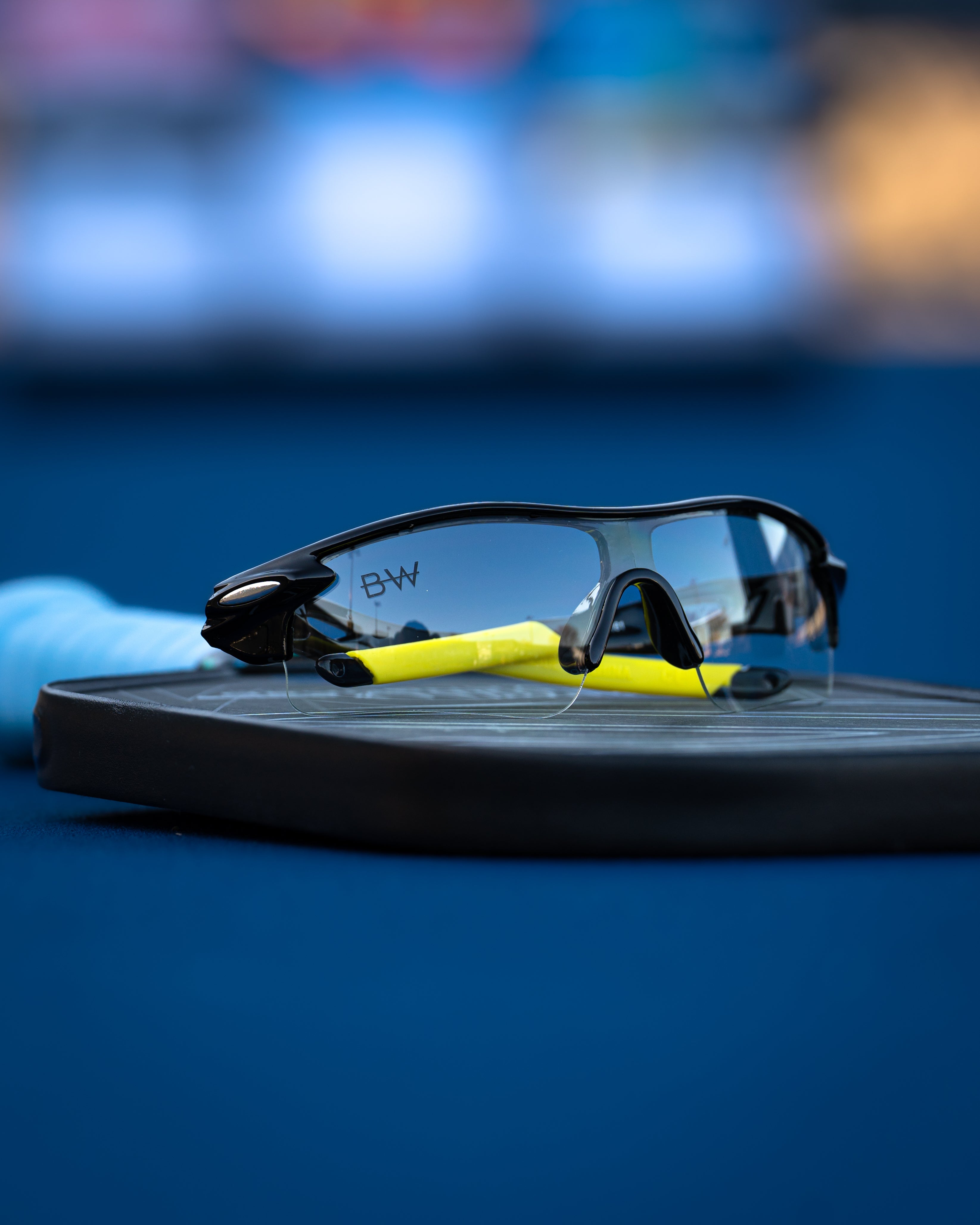
How RX Lenses Improve Reaction Time in Pickleball
Share
How RX Lenses Fit Into Reaction Time in Pickleball
Pickleball can move quickly—especially during kitchen exchanges, counters, drives, and defensive resets. But reaction time is not controlled by your prescription lenses alone. A reaction involves seeing relevant information, processing what is happening, deciding how to respond, and physically executing the movement.
For players who need vision correction, properly prescribed RX eyewear can support the visual-input stage by providing the correction they require. That is different from claiming that prescription lenses directly make your nervous system faster or automatically improve your reaction time.
This guide breaks down where prescription eyewear fits into the reaction process, what actually influences fast responses in pickleball, which eyewear claims to avoid, and how to combine appropriate vision correction with reaction-focused training.
Explore RX Pickleball Eyewear
Do RX Lenses Improve Reaction Time in Pickleball?
RX lenses should not be described as directly making your reaction time faster. Their primary role is prescription correction. If you need corrective lenses, an appropriate prescription can help provide the visual correction you require while playing.
From there, your response still depends on multiple steps:
- Visual input: Information from the developing play reaches your visual system.
- Recognition: You identify useful cues from the opponent, paddle, ball, and court.
- Anticipation: Experience can help you predict likely outcomes before the ball reaches you.
- Decision: You select a response.
- Movement: Your body executes that response.
Prescription eyewear can address the corrective component of the first stage for someone who needs it. It does not automatically accelerate every stage that follows.
Reaction Time vs. Vision: Why the Difference Matters
It is tempting to simplify the process into “see better, react faster.” In reality, pickleball reactions are more complex.
| Component | What It Involves | Role of RX Eyewear |
|---|---|---|
| Prescription Correction | Addressing an individual's refractive correction needs | Directly relevant |
| Visual Information | Receiving information from the ball, paddle, opponent, and court | Correction can be relevant if you require it |
| Cue Recognition | Identifying meaningful information in the developing play | Not created by RX lenses |
| Anticipation | Using patterns and cues to predict what may happen next | Not created by RX lenses |
| Decision-Making | Selecting an appropriate response | Not automatically accelerated by RX lenses |
| Movement Execution | Physically carrying out the selected response | Not controlled by RX lenses |
This distinction gives prescription eyewear an important but realistic role: correct the vision you need corrected, then develop the remaining parts of the reaction process through practice and experience.
The Pickleball Reaction Chain: From Opponent to Response
A fast exchange can feel instantaneous, but several things happen between an opponent initiating a shot and you returning the ball.
1. The Play Develops
Your opponent moves, positions the paddle, contacts the ball, and sends it toward your side.
2. You Receive Visual Information
You gather information from the developing play. If you require prescription correction, this is where an appropriate RX setup can be relevant.
3. Your Brain Interprets the Situation
You begin identifying direction, trajectory, pace, positioning, and other useful cues.
4. You Select a Response
Depending on the situation, you may block, counter, reset, volley, move, or leave the ball.
5. Your Body Executes
Your feet, body position, paddle preparation, and swing carry out the decision.
A prescription lens does not independently speed up this entire chain. It addresses vision correction for the wearer who requires it.
Reaction Time vs. Anticipation in Pickleball
Some responses that look like extraordinary reflexes are partly the result of anticipation. Experienced players can learn to recognize useful patterns and cues before the ball has traveled very far.
Examples of information a player may learn to use include:
- Opponent positioning
- Paddle preparation
- Contact location
- Common shot patterns
- Available court space
- Your own position and your partner's position
This matters because reaction-focused improvement should not be reduced to buying eyewear. Appropriate prescription correction can support the visual foundation for a player who needs it, while anticipation develops through sport-specific experience and practice.
Where Prescription Clarity Fits Into Fast Pickleball
If you require corrective lenses, playing without the correction you need can leave relevant visual information less clear for you. Prescription eyewear is designed to address that refractive need.
However, avoid turning that straightforward function into claims such as:
- “RX lenses make the ball move more clearly.”
- “Prescription glasses guarantee faster reactions.”
- “RX eyewear makes you anticipate shots sooner.”
- “Prescription lenses automatically improve dynamic visual acuity.”
- “RX lenses eliminate visual processing delays.”
A more accurate takeaway is: if you require vision correction, use appropriate corrective eyewear so your reaction process is not being discussed separately from your actual visual needs.
Why RX Eyewear Can Matter During Fast Kitchen Exchanges
Fast exchanges near the non-volley zone place significant demands on recognition, anticipation, decision-making, paddle preparation, and movement.
For a player who needs prescription correction, appropriate RX eyewear can provide that correction during the exchange. But winning a fast hands battle still depends on much more than the lenses.
| Fast-Exchange Factor | Can RX Lenses Create It? |
|---|---|
| Required Prescription Correction | RX lenses are directly relevant. |
| Reading Opponent Cues | No. This is developed through attention and experience. |
| Anticipation | No. This develops through pattern recognition and practice. |
| Quick Paddle Preparation | No. This is a technique and movement skill. |
| Efficient Decision-Making | No automatic improvement from RX lenses. |
| Physical Response Speed | No. RX lenses do not make muscles contract faster. |
What About Depth Perception and Reaction Time?
Depth perception and reaction time are related topics, but they should not be treated as the same thing.
Depth perception involves how the visual system interprets spatial information. Reaction time describes the time involved in responding to a stimulus or situation. Both can matter in sports, but saying that a lens is prescription, high-index, clear, grey, or non-polarized does not automatically prove that it improves either one.
For the dedicated science-focused explanation, read Depth Perception Science in Pickleball →.
Do Non-Polarized RX Lenses Improve Pickleball Reaction Time?
No automatic reaction-time improvement should be attributed to a lens simply because it is non-polarized.
Blinded Wear sports eyewear uses non-polarized lenses. In practical terms, that means a polarization filter is not added.
Some court players prefer non-polarized eyewear, but the following claims should remain separate:
| Claim | How to Treat It |
|---|---|
| Blinded Wear sports lenses are non-polarized. | Verified. |
| Non-polarized means a polarization filter is not added. | Accurate description. |
| Non-polarized lenses improve reaction time. | Do not assume. |
| Non-polarized lenses improve depth perception. | Do not assume. |
| Non-polarized lenses improve ball tracking. | Do not assume. |
| Non-polarized lenses improve peripheral awareness. | Do not assume. |
Do High-Index RX Lenses Improve Reaction Time?
High-index describes a prescription lens-material category. It should not be turned into a reaction-time claim.
Blinded Wear includes high-index prescription lenses at no additional cost with its RX eyewear. That does not automatically mean high-index lenses:
- Make reactions faster
- Improve peripheral vision
- Eliminate edge distortion
- Improve depth perception
- Improve ball tracking
- Increase durability
- Guarantee a particular finished lens weight
Do not assume an exact index such as 1.61 unless that number is verified for the current product configuration.
Do RX Lenses Improve Peripheral Awareness?
Do not claim that prescription lenses universally improve peripheral awareness or that high-index lenses automatically reduce peripheral distortion.
Your experience with a finished prescription lens can depend on factors beyond the simple RX label. Likewise, frame design and individual fit can affect how eyewear feels during sport.
If peripheral awareness is important to you, evaluate the complete finished RX setup rather than relying on a broad promise tied to one lens-material category.
Do RX Lenses Reduce Eye Strain and Make You React Faster?
It is too broad to say that prescription sports glasses universally eliminate eye strain and therefore improve reaction speed.
If you need prescription correction, appropriate corrective eyewear addresses that need. Individual visual comfort, however, can depend on many factors and should not be converted into a guaranteed reaction-time benefit.
In other words:
Prescription correction ≠ guaranteed reduced eye strain ≠ guaranteed faster reaction time.
Why Frame Fit Still Matters During Fast Play
Even though this guide focuses on reaction time, your complete eyewear setup includes more than the prescription.
If you repeatedly notice or adjust your glasses during quick movement, investigate the frame fit rather than assuming a different lens material will solve the problem.
When shopping online:
- Find eyewear that already fits you well.
- Review any available dimensions.
- Compare them with the RX frame you are considering.
- Remember that similar measurements do not guarantee identical fit.
- Test the finished eyewear during realistic pickleball movement.
For the dedicated fit guide, see Prescription Glasses That Stay Secure During Pickleball Rallies →.
RX Pickleball Glasses to Compare for Fast-Paced Play
No Blinded Wear frame should be ranked as the universal “fastest-reaction” RX model. Instead, compare prescription options according to your prescription, environment, available dimensions, individual fit, verified lens characteristics, and familiarity.
| RX Model | Why Compare It | What to Evaluate |
|---|---|---|
| Frost RX | Prescription pickleball-eyewear option | Current configuration, dimensions, prescription requirements, and individual fit |
| Phantom II RX | RX sports-eyewear option | Current lens configuration, dimensions, prescription requirements, and fit |
| Lava Rock RX | Lightweight RX option | Current configuration, dimensions, prescription requirements, and individual fit |
| H Blue Shield RX | Prescription sports-eyewear option | Exact current lens characteristics, dimensions, and fit |
| Crystal Wave II RX | Prescription sunglass option | Outdoor environment, dimensions, exact current lens configuration, and fit |
| Red Shine RX | Prescription sunglass option | Outdoor environment, prescription configuration, dimensions, and fit |
The purpose of this comparison is not to claim that one frame produces faster reflexes. It is to help you identify an RX setup you can evaluate for your own game.
Prescription Pickleball Frames to Explore
Frost RX
Frost RX is a prescription pickleball-eyewear option. Compare its current configuration and available dimensions rather than assuming its lightweight design directly improves reaction speed.
Phantom II RX
Phantom II RX is another RX sports-eyewear option to compare according to prescription needs, exact lens configuration, dimensions, and fit.
Lava Rock RX
Lava Rock RX provides a lightweight RX option. Lightweight construction can be useful to consider when comparing sports frames, but it should not be converted into a faster-reaction claim.
H Blue Shield RX
H Blue Shield RX is another prescription sports-eyewear option. Verify the exact current product configuration before attaching additional lens-performance claims.
Crystal Wave II RX
Crystal Wave II RX is an RX sunglass option to compare for outdoor play according to your prescription, environment, dimensions, and individual preferences.
Red Shine RX
Red Shine RX is another prescription sunglass option for players comparing outdoor RX configurations.
Indoor vs. Outdoor RX Eyewear for Fast Pickleball
Reaction-focused marketing can distract from a more basic question: does your eyewear configuration make sense for the environment where you play?
| Environment | RX Configuration to Compare | Why |
|---|---|---|
| Typical Indoor Court | RX without a dark sunglass tint | Provides correction without intentionally darkening the environment. |
| Evening / Lower-Light Play | RX without a dark sunglass tint | A non-dark configuration may better match the environment. |
| Bright Outdoor Court | RX sunglass configuration | Compare a prescription sunglass setup designed for outdoor use. |
| Changing Environments | Separate RX pairs or verified transition RX | Choose according to how often your lighting conditions change. |
Choosing an environment-appropriate configuration is more defensible than claiming one lens color creates faster reactions.
How to Train Faster Pickleball Responses
If your goal is to become faster during rallies, combine appropriate vision correction with pickleball-specific practice. Training cannot guarantee a particular reaction-time improvement, but it can target the recognition, anticipation, decision, and movement components that RX lenses do not create for you.
1. Controlled Kitchen Volley Exchanges
Use cooperative volleys to practice compact preparation and responding to repeated close-range shots.
2. Progressively Unpredictable Feeds
Have a partner vary placement rather than telling you exactly where every ball will go.
3. Paddle-Cue Awareness
Practice paying attention to useful information from the opponent before and around contact instead of waiting until the ball is already close to you.
4. Block-and-Counter Drills
Alternate between defensive blocks and counters so the correct response is not predetermined every repetition.
5. Transition-Zone Drills
Practice responding while moving through the court rather than only from a stationary position.
6. Live Point Play
Ultimately, real points provide decision-making and anticipation demands that isolated reaction drills cannot completely reproduce.
A Simple Reaction-Focused Practice Progression
| Stage | Drill Style | Primary Focus |
|---|---|---|
| 1 | Predictable cooperative volleys | Technique and preparation |
| 2 | Variable placement | Recognition and movement |
| 3 | Randomized block/counter feeds | Decision-making |
| 4 | Live kitchen exchanges | Anticipation + response |
| 5 | Full points | Integrating perception, decisions, positioning, and movement |
The objective is to progressively add uncertainty. A drill in which you already know exactly where the next ball is going does not reproduce every demand of reacting during a real rally.
Should You Practice in the Same RX Glasses You Compete In?
When practical, building familiarity with the finished eyewear you intend to use in competition can remove an unnecessary equipment change on match day.
Practice gives you an opportunity to evaluate:
- Your experience with the finished prescription
- Individual frame fit during movement
- Comfort over your normal playing duration
- The lens configuration in your actual environment
- Whether you repeatedly adjust or notice the eyewear
- Whether the setup remains appropriate during fast exchanges
Familiarity should not be described as a guaranteed reaction-time boost. It is simply a practical reason to test sports eyewear under realistic conditions before depending on it during competition.
10 Mistakes Players Make When Thinking About RX Lenses and Reaction Time
-
Believing RX lenses directly make reflexes faster.
Prescription correction and neurological or muscular response speed are not the same thing.
-
Ignoring anticipation.
Recognizing patterns and cues can influence how early you begin responding to a developing play.
-
Assuming non-polarized means faster reactions.
Polarization status does not establish a reaction-time improvement.
-
Assuming high-index means better peripheral vision.
High-index is a lens-material category, not a universal peripheral-performance claim.
-
Assuming prescription correction eliminates eye fatigue.
Individual comfort has multiple possible influences.
-
Buying based on “ball tracking” marketing.
Verify what a lens actually does rather than assuming a broad performance effect.
-
Ignoring frame fit.
The complete eyewear setup matters during movement.
-
Using an environment-inappropriate configuration.
Indoor, outdoor, evening, and changing environments can call for different lens considerations.
-
Changing eyewear immediately before a tournament.
Give yourself an opportunity to become familiar with the finished setup.
-
Trying to buy reaction time instead of training it.
Use appropriate corrective eyewear if you need it, then train recognition, anticipation, decision-making, and movement.
RX Lenses and Pickleball Reaction Time FAQ
Do prescription glasses make you react faster in pickleball?
Do not assume prescription glasses directly increase reaction speed. If you require vision correction, appropriate RX lenses address that corrective need while reaction also depends on recognition, anticipation, decision-making, and physical execution.
Can blurry vision affect playing pickleball?
If you require corrective lenses, your uncorrected vision differs from the correction your prescription is intended to provide. Use appropriate corrective eyewear based on your individual needs rather than trying to compensate through sport-specific lens claims.
Can RX lenses improve ball tracking?
Do not claim that prescription lenses automatically improve ball tracking. RX lenses provide corrective vision according to the wearer's prescription needs; tracking involves a broader visual and perceptual process.
Do RX glasses improve dynamic visual acuity?
Do not assume that wearing an RX sports frame automatically improves dynamic visual acuity. Prescription correction and sport-specific visual abilities should not be treated as interchangeable.
Do high-index lenses make reactions faster?
No automatic reaction-time benefit should be attributed to high-index lens material.
Does Blinded Wear use 1.61 high-index lenses?
Blinded Wear includes high-index prescription lenses at no additional cost, but do not assume a specific index such as 1.61 unless it is verified for the exact current configuration.
Are non-polarized lenses better for reaction time?
Blinded Wear sports lenses are non-polarized, but that characteristic should not automatically be described as improving reaction time.
Do non-polarized lenses improve depth perception?
No automatic depth-perception improvement should be inferred solely from the absence of a polarization filter.
Can prescription glasses improve peripheral awareness?
Do not make a universal peripheral-awareness improvement claim based only on a lens being prescription or high-index.
Which RX glasses are best for fast pickleball?
Rather than choosing a frame based on a “fastest reaction” claim, compare RX options according to your prescription, playing environment, available dimensions, individual fit, verified lens characteristics, familiarity, and final configured price.
Should I train reaction time while wearing my prescription pickleball glasses?
If those are the glasses you plan to use during play, practicing in the finished eyewear gives you an opportunity to evaluate the complete setup under realistic conditions.
Where Reaction Speed Matters Most in a Pickleball Match
Not every pickleball shot creates the same reaction demands. Understanding the situations that give you less time to respond helps separate reaction speed from positioning, anticipation, technique, and prescription correction.
| Match Situation | Primary Challenge | Role of RX Eyewear |
|---|---|---|
| Kitchen Volley Exchange | Limited response time, compact preparation, and rapid decisions | Provides required prescription correction for players who need it |
| Defending a Drive | Reading the developing shot and preparing an appropriate response | Corrective role; does not create the defensive technique |
| Counterattack | Recognizing an opportunity and executing quickly | Does not automatically increase recognition or movement speed |
| Speed-Up | Recognizing cues and responding to a change in pace | Provides correction rather than anticipation |
| Overhead Defense | Reading trajectory, positioning, and moving appropriately | Prescription correction can be relevant if required |
| Unexpected Deflection | Responding to a sudden change with minimal preparation time | Does not independently create faster reflexes |
The closer and faster the exchange becomes, the less useful it is to think of reaction time as a single eyewear feature. Your visual needs, court awareness, anticipation, technique, and physical response all operate together.
RX Lenses and Reacting to Pickleball Speed-Ups
A speed-up can quickly turn a controlled kitchen exchange into a faster sequence. Players may have less time to recognize what is developing, select a response, and position the paddle.
If you require prescription correction, your RX eyewear addresses that visual requirement while you play. What it does not do is automatically teach you to recognize when an opponent is about to accelerate the ball.
That distinction makes training important. Instead of relying on a “reaction-enhancing” lens claim, practice situations where:
- Your partner alternates between dinks and speed-ups.
- You do not know in advance which ball will be accelerated.
- You practice recognizing useful pre-contact information.
- You alternate between blocking and countering.
- You maintain compact paddle preparation.
- You progress from controlled feeds to live points.
The goal is to develop your response to the uncertainty of the rally, not simply your ability to return a ball when you already know what is coming.
Fast Hands in Pickleball: What RX Glasses Can and Cannot Do
“Fast hands” is commonly used to describe quick exchanges at the kitchen, but the phrase combines several abilities rather than one measurable skill.
| Fast-Hands Component | What Helps Develop It | Can RX Lenses Create It? |
|---|---|---|
| Ready Position | Technique and repetition | No |
| Opponent Cue Recognition | Experience and focused practice | No |
| Anticipation | Pattern recognition and match experience | No |
| Prescription Correction | Appropriate corrective lenses when required | Yes, this is the RX lens's role |
| Paddle Preparation | Technique | No |
| Decision Speed | Sport-specific experience and practice | No automatic RX improvement |
| Movement Execution | Physical and technical development | No |
This is why buying prescription pickleball glasses and training fast exchanges should be viewed as complementary—not interchangeable—decisions.
RX Lenses vs. Ball Tracking: What Is the Difference?
Prescription correction and ball tracking are not synonymous. RX lenses are designed to provide the correction specified for the wearer. Tracking a moving pickleball involves the broader visual system, attention, prediction, and continued processing of a moving target.
Avoid automatically interpreting any of these terms as “better ball tracking”:
- Prescription
- High-index
- Non-polarized
- Clear lens
- Grey tint
- Impact-resistant
- Lightweight frame
Those terms describe specific characteristics. None should be expanded into an unsupported promise that the eyewear makes a player track a pickleball faster or more accurately.
Visual Processing vs. Prescription Correction
One of the biggest mistakes in sports-eyewear marketing is treating visual processing and prescription correction as though they are the same function.
They are not.
| Term | What It Describes |
|---|---|
| Prescription Correction | Optical correction according to an individual's refractive prescription requirements |
| Visual Input | Information entering the visual system from the developing play |
| Visual Processing | How visual information is interpreted and used |
| Recognition | Identifying meaningful cues and patterns |
| Anticipation | Using available information and experience to predict what may happen next |
| Reaction | Responding after relevant information is detected and processed |
If you need prescription correction, RX lenses can address that optical requirement. They do not automatically make the brain process information faster.
Why Anticipation Can Make a Player Look Faster
Imagine two players with similar physical response speed. One recognizes a developing shot earlier because they have seen the same pattern hundreds of times. The other recognizes it later.
The first player may appear to have dramatically faster reflexes even though the difference began before the physical reaction.
Pickleball experience can help players become more familiar with:
- Common patterns from particular court positions
- Situations where an opponent may attack
- Typical responses after particular shots
- Available angles based on player positioning
- How paddle preparation can relate to a developing shot
- When a ball may be left rather than played
This is why reaction training should include realistic decision-making instead of only attempting to move faster after the ball is already on its way.
Reaction Time for Beginner vs. Experienced Pickleball Players
Both newer and experienced players can require prescription correction, but they may experience fast rallies differently because experience affects recognition and anticipation.
| Player | Reaction-Focused Priority |
|---|---|
| New Player | Learn positioning, ready position, basic shot recognition, and predictable rally patterns. |
| Developing Player | Add variable feeds, speed-up recognition, and decision-based drills. |
| Experienced Player | Refine cue recognition, anticipation, counter decisions, and responses under greater uncertainty. |
| RX Wearer at Any Level | Use appropriate prescription correction while developing the sport-specific skills above. |
An expensive or specialized-looking RX frame cannot replace the experience that helps a player recognize a developing situation earlier.
Reaction Time in Singles vs. Doubles Pickleball
Singles and doubles create different positioning and movement demands, but neither format has a special prescription lens that automatically produces faster reactions.
Doubles
Doubles can produce rapid close-range exchanges involving multiple players near the kitchen. Anticipation, paddle preparation, positioning, and communication all contribute to how quickly a player appears to respond.
Singles
Singles generally requires greater individual court coverage. Players may need to combine recognition and decision-making with larger movements across open space.
For either format, choose RX eyewear according to your prescription requirements, environment, frame dimensions, individual fit, and verified lens configuration rather than a format-specific reaction-time promise.
Does Indoor vs. Outdoor Pickleball Change Reaction Time?
The environment can change your eyewear needs without changing the fundamental reaction chain.
A player who requires prescription correction still needs an appropriate corrective setup, but the preferred lens configuration may differ depending on the environment.
Indoor Pickleball
A prescription configuration without a dark sunglass tint may be a logical starting point when you do not want to intentionally darken an indoor environment.
Outdoor Pickleball
Players who need prescription correction may compare RX sunglass configurations for bright outdoor play.
Changing Environments
Players who regularly move between conditions may compare separate RX pairs with a verified transition or photochromic configuration.
These are environmental eyewear decisions. None establishes a universal improvement in reaction time.
Do Clear or Tinted RX Lenses Improve Reaction Speed?
Lens tint should not be treated as a reaction-time setting.
| Lens Configuration | What It Changes | What It Does Not Automatically Do |
|---|---|---|
| Clear RX | Provides prescription correction without a dark sunglass tint | Improve reaction time, tracking, or contrast |
| Fixed-Tint RX | Adds a particular tint to the prescription configuration | Improve reaction time, depth perception, or tracking |
| Transition RX | Designed to change tint under particular conditions when that functionality is offered | Automatically improve reaction speed or athletic performance |
Match the configuration to the environment and your preferences rather than looking for a tint marketed as a shortcut to faster reflexes.
RX Sports Glasses vs. Contacts for Fast Pickleball
Players who use vision correction may have more than one way to address their corrective needs. Prescription sports eyewear and contact lenses are different setups, and neither should automatically be labeled the faster-reaction option.
| Setup | What to Consider |
|---|---|
| RX Sports Glasses | Prescription requirements, frame dimensions, individual fit, environment, lens configuration, and familiarity |
| Contacts + Non-RX Sports Eyewear | Whether contacts are appropriate for you, plus the characteristics and fit of the non-RX eyewear |
| Contacts Alone | Your individual corrective needs and whether this setup is appropriate for you |
If you are considering changing how you correct your vision, particularly contact lenses, discuss your individual needs with an appropriate eye-care professional.
How to Choose RX Pickleball Glasses Without Falling for Reaction-Time Marketing
Instead of searching for “the RX glasses with the fastest reaction time,” use a buyer framework based on characteristics you can actually evaluate.
-
Start with your prescription.
The primary purpose of RX eyewear is to provide the correction you require.
-
Identify your environment.
Indoor, outdoor, evening, and mixed-environment players can have different lens-configuration needs.
-
Review verified lens characteristics.
Separate documented features from broad claims about reaction time, tracking, contrast, or depth perception.
-
Compare frame dimensions.
Use eyewear that already fits you as a reference when possible.
-
Evaluate individual fit.
Do not assume a sports frame is automatically non-slip or secure for every face.
-
Review the finished price.
Compare the complete configured RX product rather than an incomplete advertised starting point.
-
Practice in the eyewear.
Use realistic pickleball movement and match situations to evaluate the finished setup.
Verified Blinded Wear RX Features vs. Claims to Verify
When comparing prescription pickleball glasses, distinguish documented characteristics from assumptions about athletic performance.
| Feature or Claim | Status |
|---|---|
| Prescription RX eyewear | Verified. |
| Designed for pickleball players | Verified. |
| Lightweight sports frames | Verified. |
| Impact-resistant lenses | Verified. |
| Non-polarized sports lenses | Verified. |
| High-index prescription lenses included at no additional cost | Verified. |
| Faster reaction time | Do not claim automatically. |
| Improved ball tracking | Do not claim automatically. |
| Improved depth perception | Do not claim automatically. |
| Improved peripheral awareness | Do not claim automatically. |
| Glare reduction | Verify for the exact lens before claiming. |
| Contrast enhancement | Verify for the exact lens before claiming. |
| Anti-fog treatment | Verify before claiming. |
| Anti-reflective coating | Verify before claiming. |
| Scratch resistance | Verify before claiming. |
| Exact 1.61 high-index material | Do not assume from “high-index.” |
| Specific protective certification | Verify before claiming. |
What Does Impact-Resistant Mean for Pickleball Eyewear?
Blinded Wear sports eyewear uses impact-resistant lenses. That is a relevant product characteristic for sports eyewear, but it should remain separate from reaction-time claims.
Impact-resistant does not automatically mean:
- Shatterproof
- Indestructible
- Certified to a particular sports-protection standard
- Guaranteed protection against every impact
- Faster reaction time
If a specific certification or testing standard matters to your purchase, verify that standard for the exact product rather than inferring it from the phrase “impact-resistant.”
Is It Worth Buying RX Glasses Just for Faster Reactions?
Do not buy prescription sports glasses because you expect the eyewear itself to make your reflexes faster.
A better reason to consider RX pickleball glasses is that you require prescription correction and want an eyewear setup intended for active use.
When evaluating value, ask:
- Do I require prescription correction while playing?
- How frequently will I use the glasses?
- Does the lens configuration match my normal environment?
- Do the available dimensions make sense for me?
- Have I reviewed the verified product characteristics?
- Will this be my primary or backup RX pair?
- What is the complete configured price?
- What replacement support applies?
This produces a much stronger buying decision than attempting to assign a dollar value to an unsupported reaction-time improvement.
Think in Cost Per Use, Not “Seconds Saved”
Because RX eyewear should not promise a specific reaction-time improvement, value is better evaluated through actual use.
A simple framework is:
Cost per use = total purchase cost ÷ number of times you use the eyewear
For example, a frequently used RX pair may produce a very different long-term value calculation from a specialized pair that spends most of its time unused. The exact result depends on your purchase price and actual usage.
This framework is especially useful for players deciding between:
- One primary RX pair
- Separate indoor and outdoor RX pairs
- A primary pair plus backup correction
- A verified transition RX configuration
Blinded Wear RX Replacement Support
Blinded Wear offers 50% lifetime replacement support if glasses break, subject to current policy terms.
This is not the same as saying every pair receives free lifetime replacement, and it should not be described simply as a generic “lifetime warranty.” Review the current policy before purchasing.
How to Order RX Pickleball Glasses
-
Browse prescription options.
Start with the Blinded Wear RX Pickleball Collection →.
-
Identify your playing environment.
Consider whether you primarily play indoors, outdoors, in the evening, or across changing environments.
-
Compare the current configuration.
Verify the lens characteristics offered with the exact RX model you are considering.
-
Review frame dimensions.
Compare available measurements with eyewear that already fits you when possible.
-
Prepare your prescription.
Have a clear photo or picture of your eyeglass prescription ready to upload before purchasing.
-
Review the configured price.
Blinded Wear includes high-index prescription lenses at no additional cost, but review the complete current order configuration.
-
Test the finished pair.
Evaluate your prescription experience, individual fit, comfort, and environment during realistic pickleball practice.
The 5-Session RX Pickleball Test
Rather than judging sports eyewear from a few minutes at home, evaluate the finished pair across several normal playing sessions.
Session 1: Basic Familiarity
Wear the eyewear during a controlled practice and become familiar with the finished prescription and frame.
Session 2: Movement
Add lateral movement, transitions, volleys, and other normal court actions. Notice whether you repeatedly adjust the frame.
Session 3: Fast Exchanges
Use kitchen volley and speed-up drills to evaluate the complete eyewear setup during faster play.
Session 4: Live Games
Play normal points where positioning, anticipation, decisions, and movement are unpredictable.
Session 5: Normal Competitive Intensity
Evaluate whether the RX setup feels familiar and appropriate under the type of play for which you purchased it.
This is an equipment-familiarity test, not a scientific reaction-time experiment. If you want to measure reaction time itself, use a repeatable testing method rather than assuming that subjective improvement proves a lens made you faster.
How to Tell Whether Your Pickleball Reactions Are Actually Improving
Players often confuse “this feels faster” with measurable improvement. If reaction-focused training is a goal, track your performance in a repeatable way.
You might record:
- Success during the same controlled volley drill
- Ability to handle increasingly unpredictable feeds
- Consistency during block-and-counter drills
- Errors during fast kitchen exchanges
- How often you correctly recognize and respond to speed-ups
- Performance across repeated versions of the same drill
Keep conditions as consistent as practical when comparing sessions. Improvements may reflect practice, anticipation, technique, decision-making, familiarity, physical changes, or several factors together—not simply the eyewear.
Reaction-Time Preparation for Tournament Day
If fast exchanges are important to your tournament game, preparation should combine equipment familiarity with sport-specific practice.
Before competition:
- Use the RX eyewear you intend to compete in during practice.
- Confirm the prescription setup meets your needs.
- Test the frame during realistic movement.
- Practice unpredictable speed-ups and counters.
- Include live-point decision-making.
- Avoid relying exclusively on predictable reaction drills.
- Consider suitable backup prescription eyewear if losing your primary pair would prevent you from playing normally.
- Store unused RX eyewear appropriately between matches.
The goal is not to find a pair of glasses that “creates” tournament reflexes. It is to arrive with an RX setup you already know and skills you have practiced.
Should You Carry Backup RX Glasses?
If you rely heavily on prescription correction, losing access to your primary pair during a tournament or long playing day can create a practical problem. That is where backup RX eyewear may become useful.
A backup pair does not need to be marketed as a second “reaction-time” pair. Its primary purpose is corrective redundancy.
Read the dedicated guide: When to Bring a Spare RX Pair in Your Bag →.
10 RX Lens and Reaction-Time Myths
Myth 1: RX lenses automatically make your reflexes faster.
Reality: Prescription lenses provide corrective vision according to the wearer's needs. Reaction includes additional perceptual, decision, and physical components.
Myth 2: High-index lenses process visual information faster.
Reality: High-index describes a lens-material category, not neurological processing speed.
Myth 3: Non-polarized lenses automatically improve depth perception.
Reality: Non-polarized means a polarization filter is not added. That alone does not establish better depth perception.
Myth 4: Clear lenses improve ball tracking.
Reality: Clear means no dark sunglass tint. It does not automatically create a ball-tracking benefit.
Myth 5: Grey lenses improve reaction timing.
Reality: Grey tint does not automatically make a player react faster.
Myth 6: Better eyewear can replace anticipation training.
Reality: Pattern recognition and anticipation develop through experience and practice.
Myth 7: A lightweight frame automatically produces faster head movement.
Reality: Lightweight construction is a frame characteristic, not a guaranteed athletic-performance improvement.
Myth 8: Impact resistance means the lens is shatterproof.
Reality: Impact-resistant should not be expanded into an indestructibility or certification claim.
Myth 9: The most expensive RX frame must produce the fastest reactions.
Reality: Price does not establish a reaction-time advantage.
Myth 10: Reaction training is only about reflexes.
Reality: Recognition, anticipation, decision-making, positioning, technique, and movement all contribute to fast responses in pickleball.
More Questions About RX Lenses and Pickleball Reactions
Can prescription lenses make me see the pickleball sooner?
If you require prescription correction, appropriate RX lenses address that corrective need. Do not convert that function into a universal claim that the lenses make every player detect a ball sooner.
Can RX lenses help during fast kitchen battles?
For a player who requires vision correction, RX lenses provide that correction during fast exchanges. The player's anticipation, decisions, technique, and physical response still determine much of the actual exchange.
Why do experienced pickleball players seem to react so quickly?
Physical response speed can matter, but experienced players may also recognize familiar cues and patterns earlier, allowing them to begin responding sooner.
Can anticipation be more important than raw reaction speed?
They are different components of performance. Anticipating a likely outcome can give a player more time to respond, while true reaction demands still occur when unexpected events happen.
Do sports glasses improve visual processing speed?
Do not assume a sports frame or RX lens automatically increases visual-processing speed.
Do clear RX lenses improve reaction time indoors?
No automatic reaction-time improvement follows from a lens being clear. A clear RX configuration provides prescription correction without adding a dark sunglass tint.
Do tinted RX sunglasses improve reaction time outdoors?
Tint can be part of an outdoor lens configuration, but it should not automatically be described as increasing reaction speed.
Do transition RX lenses improve reaction time?
Transition or photochromic functionality addresses changing tint under particular conditions when offered. It does not automatically make athletic reactions faster.
Are Blinded Wear RX lenses non-polarized?
Yes. Blinded Wear sports eyewear uses non-polarized lenses. This means a polarization filter is not added; it does not establish an automatic reaction-time benefit.
Are Blinded Wear RX lenses impact-resistant?
Blinded Wear sports eyewear uses impact-resistant lenses. Impact-resistant does not mean shatterproof, indestructible, or certified to a particular standard unless separately verified.
Does Blinded Wear include high-index prescription lenses?
Yes. High-index prescription lenses are included at no additional cost with Blinded Wear RX eyewear.
Should I buy new RX glasses before a pickleball tournament?
If you need new prescription eyewear, give yourself time to evaluate the finished pair before depending on it during important competition. Avoid treating unfamiliar equipment as a guaranteed tournament-performance upgrade.
How can I practice reaction time for pickleball?
Use progressive drills that move from predictable exchanges toward variable feeds, decision-based block-and-counter work, live kitchen exchanges, and full points.
What is the biggest mistake when training pickleball reaction time?
One common mistake is practicing only predetermined movements. Real rallies require recognition and decisions, so progressively adding uncertainty can make reaction-focused practice more representative of actual play.
The Complete RX + Reaction-Time Framework
If your goal is faster responses on the pickleball court, separate the things your eyewear can address from the things you need to develop through practice.
| Area | Primary Solution | Role of RX Eyewear |
|---|---|---|
| Prescription Correction | Appropriate corrective lenses | Direct role |
| Frame Fit | Compare dimensions and test during movement | Complete eyewear setup matters |
| Environment | Choose an appropriate clear, tinted, or other verified configuration | Lens configuration matters |
| Cue Recognition | Sport-specific practice | Not created by RX lenses |
| Anticipation | Experience and pattern recognition | Not created by RX lenses |
| Decision-Making | Variable and live-ball practice | No automatic RX improvement |
| Paddle Preparation | Technique training | Not created by RX lenses |
| Movement Execution | Technical and physical training | Not created by RX lenses |
The practical formula is simple: correct what needs correcting, choose eyewear appropriate for your environment and fit, then train the parts of reaction performance that equipment cannot create for you.
Which Reaction-Time Strategy Fits Your Game?
If You Need Prescription Correction
Prioritize an appropriate RX configuration, then train recognition, anticipation, decisions, and movement while wearing the eyewear you plan to use.
If You Already Have an RX Pair You Like
You may gain more practical value from reaction-focused practice than replacing your eyewear solely because another pair is marketed around speed or tracking.
If Your Current Frame Distracts You During Movement
Evaluate frame dimensions and individual fit. A frame-related issue should not automatically be blamed on the prescription lens.
If You Primarily Play Indoors
Compare prescription configurations without a dark sunglass tint when you do not want to intentionally darken the environment.
If You Primarily Play Outdoors
Compare RX sunglass configurations according to your prescription, environment, verified characteristics, dimensions, and individual preference.
If You Play Indoors and Outdoors
Compare dedicated RX pairs with a verified transition RX configuration according to how frequently your environment changes.
If You Compete in Tournaments
Build familiarity with your primary RX setup and consider suitable backup correction if losing your main pair would significantly disrupt your ability to play.
A Reaction-Focused Pickleball Warm-Up
A warm-up can progress from predictable movement toward the uncertainty you will face during actual points. Adjust the volume and intensity to your own abilities and normal routine.
-
Begin with controlled exchanges.
Use cooperative shots to establish rhythm and become comfortable with the court and your eyewear.
-
Add kitchen volleys.
Progress toward compact exchanges while maintaining normal positioning and preparation.
-
Add variable placement.
Stop sending every ball to the same predictable location.
-
Mix dinks and speed-ups.
Force yourself to recognize what is developing rather than knowing the next shot in advance.
-
Alternate blocks and counters.
Add a decision instead of rehearsing only one predetermined response.
-
Finish with live points.
Integrate recognition, anticipation, positioning, decisions, and movement under realistic uncertainty.
The purpose is not to prove your glasses made you faster. It is to prepare the complete reaction process for actual play.
What Should You Upgrade First: RX Eyewear or Reaction Training?
The answer depends on the problem you are actually trying to solve.
| Problem | What to Address First |
|---|---|
| I require prescription correction while playing. | Appropriate corrective eyewear |
| My current frame repeatedly needs adjustment. | Frame fit and dimensions |
| My current lens configuration does not match my environment. | Environment-appropriate lens configuration |
| I recognize speed-ups too late. | Cue-recognition and anticipation practice |
| I know where the ball is going but respond inefficiently. | Technique, preparation, and movement practice |
| I perform well in drills but struggle in games. | Add uncertainty and decision-making to practice |
| I want glasses that guarantee faster reflexes. | Reframe the goal: eyewear does not guarantee faster reaction time |
RX Pickleball Glasses Buying Checklist
Before buying prescription eyewear because of a reaction-time claim, work through this checklist:
- ☐ I know my prescription requirements.
- ☐ I have a clear photo or picture of my eyeglass prescription ready.
- ☐ I identified whether I primarily play indoors, outdoors, or across both.
- ☐ I reviewed the exact current lens configuration.
- ☐ I compared available frame dimensions.
- ☐ I compared those dimensions with eyewear that already fits me when possible.
- ☐ I am not assuming RX lenses automatically make reflexes faster.
- ☐ I am not assuming high-index lenses improve visual-processing speed.
- ☐ I am not assuming non-polarized lenses improve depth perception.
- ☐ I am not assuming a tint automatically improves ball tracking.
- ☐ I am not assuming lightweight construction guarantees secure fit.
- ☐ I understand impact-resistant does not mean shatterproof.
- ☐ I verified any coating or lens-technology claim that matters to me.
- ☐ I reviewed the complete configured RX price.
- ☐ I understand the current replacement-support terms.
- ☐ I plan to practice in the finished eyewear before important competition.
Reaction-Time Marketing Claim Decoder
When you see performance language while shopping for sports eyewear, translate it into a question you can actually verify.
| Marketing Phrase | Better Question to Ask |
|---|---|
| “Faster reactions” | What verified feature of the eyewear is actually being described? |
| “Better ball tracking” | Is there verified product-specific evidence for that claim? |
| “Enhanced depth perception” | What specific lens characteristic supposedly creates this effect? |
| “Improved peripheral vision” | Is this supported for the exact frame and prescription configuration? |
| “Glare reducing” | What exact lens technology or coating provides the claimed effect? |
| “High-index performance” | Which characteristics are actually verified beyond the high-index material category? |
| “Non-polarized for performance” | Is the statement simply describing polarization status, or making an unsupported athletic claim? |
| “Impact protection” | Is the product described as impact-resistant, or does it have a specific verified certification? |
Good sports-eyewear shopping starts by separating documented product characteristics from conclusions about athletic performance.
What Matters Most for Faster Pickleball Responses?
For a player who requires prescription correction, eyewear is one part of a larger system.
- Use appropriate vision correction.
- Learn efficient positioning.
- Maintain useful paddle preparation.
- Practice recognizing developing shots.
- Build anticipation through repeated match situations.
- Train decisions rather than only predetermined movements.
- Develop efficient physical responses.
- Practice under realistic uncertainty.
- Become familiar with the eyewear and equipment you actually use.
That framework is less dramatic than promising that a particular lens makes reactions faster, but it is much more useful for understanding where RX eyewear actually fits.
Final FAQ: Prescription Lenses and Pickleball Reaction Time
What is the relationship between vision and reaction time in pickleball?
Visual information is one part of the reaction process. After receiving relevant information, a player still has to recognize what is happening, make a decision, and execute a physical response.
Can the wrong prescription make it harder to play pickleball?
If you require corrective lenses, your prescription needs are relevant during sport just as they are in other visual tasks. Use appropriate corrective eyewear based on your individual needs.
Will new RX glasses immediately improve my pickleball reaction time?
Do not expect a guaranteed reaction-time improvement from changing eyewear. Prescription lenses address corrective needs; reaction performance involves additional perceptual, technical, and physical factors.
What is more important: reaction time or anticipation?
Both can contribute to fast responses. Anticipation can allow a player to begin preparing earlier, while reaction remains important when responding to developing or unexpected events.
Can you train anticipation in pickleball?
Sport-specific experience and drills with uncertain outcomes can help players practice recognizing patterns and useful cues from developing plays.
How do I practice reacting to pickleball speed-ups?
Progress from controlled dinks to drills where a partner can unpredictably dink or speed up. Add decisions such as blocking versus countering, then progress toward live points.
Are reaction-ball drills enough for pickleball?
General reaction drills can target particular skills, but pickleball also requires sport-specific recognition, anticipation, positioning, decisions, and paddle responses. Include actual pickleball situations in your training.
Why can I react during drills but not during games?
A predictable drill removes much of the uncertainty found in real points. Gradually adding variable placement, multiple possible responses, and live play can make practice more representative of match demands.
Does frame weight affect reaction time?
Do not assume a lightweight frame automatically increases reaction speed. Lightweight construction is a product characteristic, not a guaranteed reflex advantage.
Does secure fit improve reaction time?
A frame that works well for your individual fit can reduce the practical issue of repeatedly adjusting eyewear, but secure fit should not be converted into a guaranteed reaction-time improvement.
Does lens tint affect reaction time?
No tint should automatically be described as making reactions faster. Choose lens configuration according to your environment, prescription needs, and individual preference.
Are clear RX lenses best for fast indoor pickleball?
A clear RX configuration can be a logical starting point indoors because it provides prescription correction without adding a dark sunglass tint. That does not mean clear lenses inherently increase reaction speed.
Are prescription sunglasses better for fast outdoor pickleball?
RX sunglasses can provide prescription correction in a tinted configuration for outdoor use, but they should not automatically be described as improving reaction time.
Can transition RX lenses help when I play indoors and outdoors?
A verified transition or photochromic configuration may be worth comparing when your routine involves changing environments. Its primary role is adapting tint under particular conditions, not increasing reaction speed.
What should I look for in RX pickleball glasses?
Start with prescription requirements, playing environment, exact current lens configuration, available frame dimensions, individual fit, verified product characteristics, familiarity, final configured price, and applicable replacement support.
How do I submit my prescription to Blinded Wear?
Have a clear photo or picture of your eyeglass prescription ready to upload before purchasing your RX eyewear.
Are high-index lenses included with Blinded Wear RX glasses?
Yes. Blinded Wear includes high-index prescription lenses at no additional cost with its RX eyewear.
Are Blinded Wear lenses non-polarized?
Blinded Wear sports eyewear uses non-polarized lenses, meaning a polarization filter is not added.
Are Blinded Wear lenses impact-resistant?
Yes. Blinded Wear sports eyewear uses impact-resistant lenses. This should not be interpreted as shatterproof, indestructible, or automatically certified to a particular protective standard.
What replacement support does Blinded Wear offer?
Blinded Wear offers 50% lifetime replacement support if glasses break, subject to current policy terms.
Related RX Pickleball Vision Guides
Key Takeaways: RX Lenses and Pickleball Reaction Time
- RX lenses should not be described as directly making your reflexes faster.
- If you require prescription correction, appropriate RX lenses address that corrective need during pickleball.
- Reaction involves visual input, recognition, anticipation, decision-making, and physical execution.
- Prescription eyewear primarily addresses the corrective component rather than accelerating the entire reaction chain.
- Experienced players may appear faster partly because they recognize familiar patterns and cues earlier.
- Anticipation and raw reaction speed are related but different concepts.
- Non-polarized lenses do not automatically improve reaction time, depth perception, or ball tracking.
- High-index lenses do not automatically improve peripheral vision, visual processing, or reaction speed.
- Clear lenses do not automatically improve tracking or contrast.
- Tinted lenses do not automatically improve reaction timing.
- Lightweight frames do not automatically make physical reactions faster.
- Impact-resistant does not mean shatterproof or automatically certified protective eyewear.
- Blinded Wear sports eyewear uses impact-resistant, non-polarized lenses.
- Blinded Wear includes high-index prescription lenses at no additional cost with RX eyewear.
- Do not assume an exact index such as 1.61 unless verified for the current configuration.
- Frame dimensions and individual fit should be evaluated separately from reaction-time claims.
- Reaction-focused practice should progress from predictable drills toward uncertain, decision-based situations.
- Practicing in the RX eyewear you intend to use can help you evaluate and become familiar with the finished setup.
- Backup RX eyewear may be useful when you depend heavily on prescription correction.
- Buy RX sports eyewear for its actual corrective and verified product characteristics—not a promise of faster reflexes.
Find RX Glasses for Your Pickleball Game
If you need prescription correction while playing pickleball, start by finding an RX setup that matches your prescription, environment, frame-fit needs, and individual preferences.
Then work on reaction performance where it actually develops: recognition, anticipation, decision-making, positioning, technique, and repeated experience under realistic conditions.
Bottom Line: Can RX Lenses Make You React Faster in Pickleball?
Prescription lenses should not be marketed as a shortcut to faster reflexes. If you need vision correction, an appropriate RX setup addresses the corrective part of your visual needs while you play. That is meaningful without claiming that the glasses independently speed up your brain, decisions, or body.
Fast pickleball responses are a chain: receive information → recognize the situation → anticipate when possible → decide → move. RX eyewear can address prescription correction at the visual foundation of that chain, while the remaining components depend heavily on the player.
Choose prescription pickleball glasses for the things you can actually evaluate: your RX requirements, environment, verified lens characteristics, available frame dimensions, individual fit, familiarity, and overall value. Then train the reaction skills that no pair of glasses can manufacture for you.