
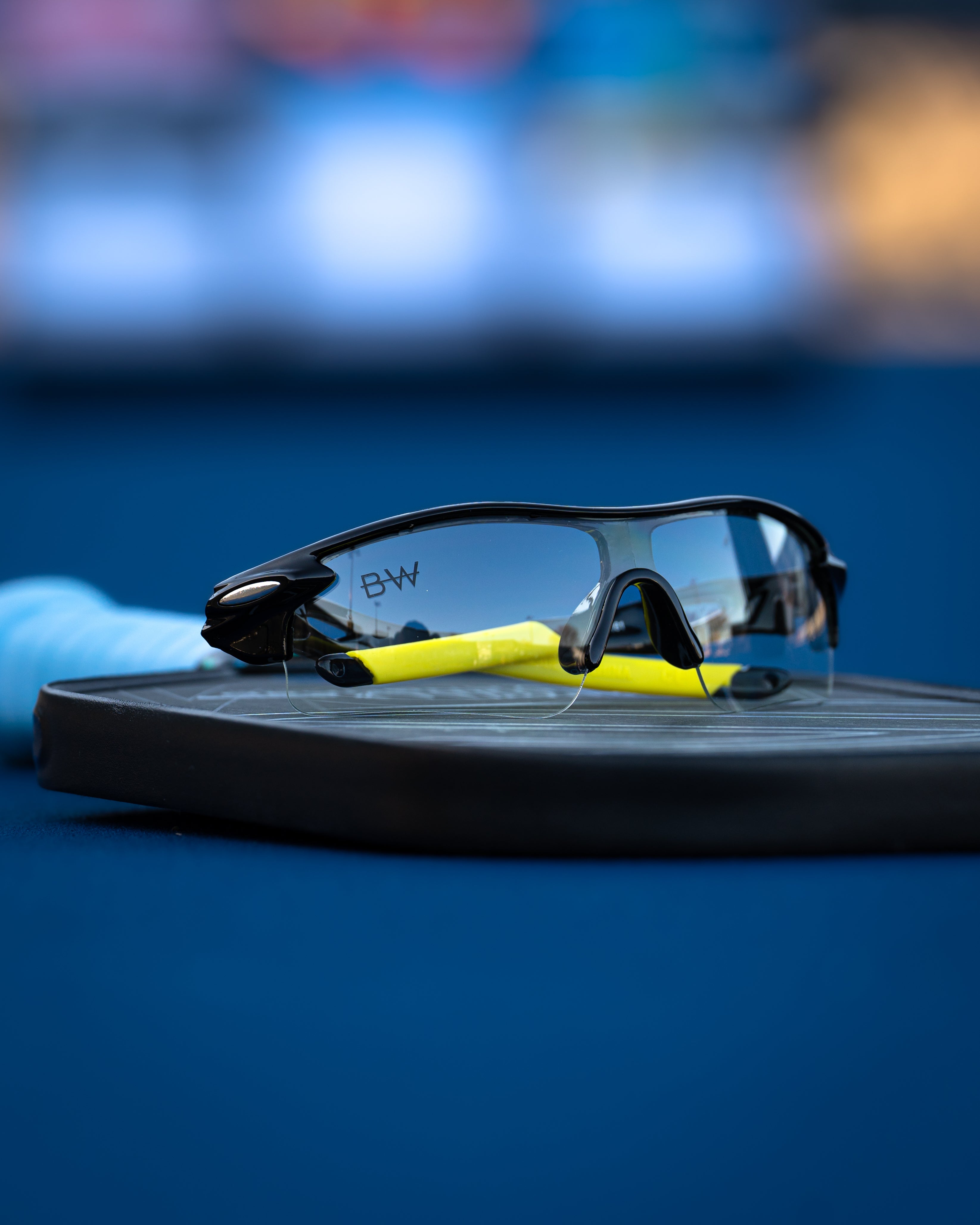
These RX Lenses Help You See Trajectory Like a Pro
Share
RX Pickleball Lenses and Ball Trajectory: What Prescription Eyewear Can Actually Do
Pickleball gives players very little time to process a developing point. Serves, drives, drops, dinks, volleys, and lobs can travel at different speeds, heights, angles, and spin rates, creating very different ball paths.
If you need prescription correction, seeing according to your prescription can be an important part of your visual experience on the court. But prescription sports eyewear should not be marketed as a shortcut that automatically makes you read trajectory like a professional player.
This guide explains the relationship between RX pickleball glasses, ball trajectory, prescription correction, lens configuration, tint, polarization, frame fit, and court conditions while separating documented eyewear characteristics from unsupported performance promises.
Explore Pickleball Eyewear
Start with the eyewear category that matches how you use vision correction, then compare the exact products and lens configurations currently available.
What Is Ball Trajectory in Pickleball?
Ball trajectory is the path the pickleball follows through space after it leaves a paddle. The path of a shot can vary according to several interacting factors, including:
- Initial ball speed
- Shot height
- Launch direction and angle
- Spin
- Paddle contact
- Gravity
- Environmental conditions
- What happens after the ball bounces
Players use visual information along with experience, anticipation, positioning, and knowledge of the game to respond to that developing path.
What Does It Mean to "Read" Ball Trajectory?
Reading trajectory is not a special feature built into an RX lens. It describes the player's process of observing a developing shot and responding to where the ball appears to be traveling.
Depending on the situation, a player may notice:
- The opponent's contact with the ball
- The ball's initial direction
- Height above the net
- Apparent speed
- Spin-related movement
- The developing arc
- The bounce
- Opponent and partner positioning
Prescription eyewear does not perform this interpretation for the player.
Can RX Lenses Make You See Trajectory "Like a Pro"?
No prescription frame should be promised to give a recreational player professional-level trajectory reading.
Experienced players may recognize developing shots through a combination of visual information, repetition, anticipation, pattern recognition, positioning, decision-making, and extensive court experience.
If you require corrective eyewear, an appropriate RX configuration can provide the prescription correction represented by your prescription. That is different from creating professional-level anticipation or court performance.
Where Prescription Correction Fits Into Trajectory Vision
If your vision requires correction, your prescription addresses specific corrective needs. Wearing appropriately prescribed eyewear can provide that correction while you play.
That does not mean an RX lens automatically:
- Predicts where the ball will land
- Improves reaction time
- Improves depth perception beyond the correction provided
- Enhances ball tracking
- Increases contrast
- Makes spin easier to read
- Improves positioning
- Turns a developing trajectory into a guaranteed read
Trajectory Reading Depends on More Than Eyewear
| Factor | Role During a Developing Shot | What Eyewear Can and Cannot Do |
|---|---|---|
| Prescription Correction | Addresses the wearer's corrective requirements | Appropriately prescribed eyewear can provide the correction represented by the prescription. |
| Experience | Helps players recognize familiar shot patterns | A lens does not create court experience. |
| Anticipation | Involves interpreting cues before and after contact | A frame does not predict the opponent's shot. |
| Reaction Time | Includes visual, cognitive, and physical processing | A lens should not be promised to make reactions faster. |
| Positioning | Affects how a player responds to the developing point | Eyewear does not automatically improve court position. |
| Lighting | Changes the visual environment | The exact lens configuration can be selected with the environment in mind, but it does not guarantee better trajectory reads. |
Reading Lob Trajectory in Pickleball
A lob creates a higher ball path than many other pickleball shots. Players may use the ball's direction, height, speed, their own position, and experience to decide how to respond.
Prescription eyewear should not be promised to make lobs automatically easier to judge. If you require vision correction, the practical goal is to have appropriate correction while tracking the developing point.
Reading Fast Drives
Fast drives can reduce the time available to respond. That makes experience, positioning, attention, anticipation, and physical response important.
No RX lens should be promised to slow down the visual experience, create faster reactions, or guarantee more accurate reads of fast shots.
Reading Drop Shots
Drop shots use a different path and pace than hard drives. Recognizing how a shot is developing can involve observing the ball before and after it crosses the net and combining that information with court experience.
Prescription correction can be relevant for players who need it, but a particular RX lens should not be promised to make drops automatically easier to read.
Reading Dinks and Shorter Ball Paths
Dinks generally create shorter trajectories around the non-volley zone. During dink exchanges, players may respond to changes in direction, height, pace, spin, and opponent positioning.
Eyewear does not replace the anticipation and experience required to respond to those changes.
Reading Serve Trajectory
A serve can vary in direction, pace, depth, height, and spin. The receiver uses visual information and experience to respond to the developing serve.
No RX lens should be promised to make serves automatically easier to read or to improve return accuracy.
Can RX Lenses Help You See Spin?
Do not promise that a particular prescription lens, tint, or frame makes ball spin easier to detect.
Players may use multiple cues when interpreting a shot, including paddle contact, ball movement, bounce behavior, and experience. The ability to interpret those cues should not be attributed to an unsupported lens technology.
Trajectory Before and After the Bounce
The ball's path does not end when it reaches the court. After the bounce, its movement can be affected by the incoming shot, spin, contact with the playing surface, and other conditions.
Experience with different shots and court situations can help players respond to what happens next. Prescription eyewear does not guarantee that a player will predict the bounce correctly.
Do RX Pickleball Lenses Improve Depth Perception?
Do not promise enhanced depth perception from a particular frame, tint, or polarization status.
If your prescription corrects a visual need, appropriately prescribed eyewear can provide that correction. That is different from claiming the sports lens itself creates superior depth perception.
Do RX Lenses Improve Reaction Time?
No lens should be promised to make a player's reactions faster.
Reaction time involves multiple stages and factors, including:
- Visual information
- Attention
- Recognition
- Decision-making
- Physical response
- Experience
Prescription correction may be important for a player who needs it, but it does not justify a guaranteed reaction-time claim.
Do RX Lenses Improve Ball Tracking?
Do not promise improved ball tracking from a particular RX product.
What a player sees during a rally can depend on prescription correction when needed, individual vision, attention, lighting, movement, experience, the playing environment, and the complete eyewear configuration.
Do Certain RX Lenses Boost Ball Contrast?
Different tints can change visible-light transmission and color appearance. However, do not automatically describe a tint as "contrast-enhancing" or promise that it makes the pickleball stand out more clearly against every background unless that characteristic is specifically supported for the exact lens.
A player's visual experience can vary across bright sky, shaded areas, indoor courts, fences, spectators, trees, walls, and other backgrounds.
Lens Tint and Ball Trajectory
Tint selection can be relevant to the amount and character of visible light reaching the eyes, but tint should not be treated as a trajectory-enhancement technology.
| Lens Characteristic | What It Can Tell You | What It Does Not Automatically Establish |
|---|---|---|
| Tint Color | Changes color appearance and can be associated with different visible-light characteristics | Better ball tracking, faster reactions, improved depth perception, or enhanced trajectory reading |
| Tint Darkness | Relates to visible-light characteristics | More UV protection, greater impact resistance, or better performance |
| Mirrored Appearance | A visible lens characteristic | Polarization, UV specifications, better trajectory reading, or improved contrast |
| Clear Appearance | No dark sunglass tint | Safety certification, UV specifications, impact resistance, or enhanced ball tracking |
What About Cold Slate RX?
The previous version of this guide described Cold Slate RX as reducing glare and boosting contrast to help players follow the ball's path.
Do not carry those trajectory-performance claims forward without exact product-specific support. If considering Cold Slate RX, verify its current configuration and documented characteristics rather than assuming it improves contrast, glare control, spin recognition, or trajectory reading.
For the current prescription lineup, start with the RX Pickleball Glasses Collection.
What About Roses Quartz RX?
The previous article described Roses Quartz RX as improving spin and trajectory visibility in changing shadows and sunlight.
Do not treat that as a verified performance specification without current product-specific support. Lens color or appearance alone does not establish improved spin recognition, enhanced contrast, better depth perception, or superior trajectory tracking.
Current RX Pickleball Glasses to Compare
Instead of ranking prescription frames according to unsupported trajectory-performance claims, compare current RX options around prescription compatibility, frame dimensions, exact lens configuration, individual fit, comfort, and playing environment.
| RX Style | Configuration | What to Compare |
|---|---|---|
| Crystal Wave II RX | Direct RX | Prescription compatibility, dimensions, current lens configuration, fit, and playing environment |
| Frost RX | Direct RX | Prescription compatibility, dimensions, current configuration, individual fit, and white-frame/bright-blue-lens appearance |
| Zebra II RX | Direct RX | Prescription compatibility, frame geometry, dimensions, current lens configuration, and fit |
| Steel Ice RX | Direct RX | Prescription compatibility, dimensions, exact lens configuration, individual fit, and preferences |
| Gray Wash RX | Direct RX | Prescription compatibility, dimensions, current lens characteristics, fit, and playing environment |
| Lava Rock RX | Direct RX | Prescription compatibility, dimensions, current configuration, fit, and personal preference |
Crystal Wave II RX and Trajectory Vision
Crystal Wave II RX is a direct RX option for players comparing prescription pickleball eyewear.
The previous article described Crystal Wave II RX as having "sharp optics" that kept trajectory reading accurate and called it a favorite among doubles players. Those claims should not be treated as verified product specifications or popularity data.
Instead, compare Crystal Wave II RX according to your prescription requirements, frame dimensions, exact current lens configuration, individual fit, comfort, and playing environment.
Zebra II RX and Frame Geometry
Zebra II RX is another direct RX option to compare.
The previous article attributed a panoramic field of vision and improved trajectory tracking to its wraparound design. Frame geometry alone does not establish a measured panoramic field of view or an improvement in ball tracking.
Evaluate Zebra II RX around prescription compatibility, current dimensions, exact lens configuration, fit, and your preferences instead.
What About Ocean Wave RX?
The previous version of this article also connected Ocean Wave RX with a wider visual field and better trajectory tracking.
Do not carry that claim forward without current product-specific support. For current availability and configuration, review the RX Pickleball Glasses Collection and verify the exact product details before ordering.
Polarized vs. Non-Polarized Lenses for Ball Trajectory
Polarized lenses are designed to reduce certain reflected light. Some pickleball players may prefer non-polarized sports eyewear, while others may prefer polarization in particular outdoor environments.
Polarization alone does not determine:
- Depth perception
- Ball tracking
- Spin recognition
- Reaction time
- Trajectory prediction
- Shot accuracy
- Court awareness
Choose according to the complete lens configuration, playing environment, prescription requirements, and your preferences.
Do Polarized Lenses Interfere With Depth Perception?
Do not claim that polarization inherently damages or reduces depth perception.
The previous version of this article stated that polarized lenses can interfere with subtle depth cues and that non-polarized lenses preserve "natural 3D vision." That should not be treated as a general rule.
Your prescription, individual vision, lighting conditions, playing environment, and complete eyewear configuration all contribute to what you see.
Do Non-Polarized Lenses Improve Trajectory Tracking?
No. Non-polarized construction should not automatically be marketed as improving trajectory tracking, depth perception, reaction time, contrast, or ball visibility.
Non-polarized simply means the lens is not using polarization as a lens characteristic.
Glare and RX Pickleball Eyewear
Do not assume every Blinded Wear RX lens reduces glare. Glare-related characteristics depend on the exact lens configuration.
Keep these concepts separate:
- Polarization: designed to reduce certain reflected light
- Anti-reflective treatment: a separate treatment that should be verified for the exact lens
- Tint: changes visible-light characteristics and color appearance
- UV specifications: separate from tint darkness and polarization
Do Wraparound RX Frames Create Panoramic Vision?
Do not automatically describe a wraparound sports frame as creating panoramic vision.
Frame geometry can affect how eyewear sits around the face and how much physical frame material appears in parts of the wearer's view. But a wraparound appearance does not establish a measured field-of-view advantage or improved peripheral vision.
Peripheral Vision and Ball Trajectory
Peripheral vision is a characteristic of the visual system. A frame can influence the physical eyewear visible around portions of the wearer's view, but it should not be promised to enhance peripheral vision.
The visual experience through prescription sports eyewear can also depend on:
- The individual prescription
- Lens design
- Frame geometry
- Lens geometry
- Fit
- Viewing direction
Can RX Sports Lenses Eliminate Distortion?
Do not make a universal distortion-free or zero-distortion claim.
The previous article stated that Blinded Wear RX lenses minimize distortion across the lens and preserve sharp peripheral vision. The visual experience through different areas of a prescription lens can depend on the complete prescription and optical configuration.
No prescription sports lens should be promised to provide identical optical characteristics across every point and every viewing angle.
What About Edge-to-Edge Clarity?
"Edge-to-edge clarity" can imply that every portion of a prescription lens produces an identical experience. That should not be guaranteed.
Prescription, lens design, frame geometry, fit, lens dimensions, and viewing direction can all contribute to what the wearer experiences when looking through different areas of the lens.
What Does "Precision Optics" Mean?
Terms such as "precision optics," "advanced optics," and "trajectory-enhancing optics" can imply measurable performance advantages if they are not tied to a documented specification.
A more useful RX comparison focuses on the wearer's prescription requirements, exact lens configuration, frame dimensions, fit, and documented lens characteristics.
High-Index RX Lenses and Pickleball
Blinded Wear includes high-index prescription lenses at no additional cost with custom RX eyewear.
High-index refers to a category of prescription lens material commonly used to help manage lens thickness, particularly as prescription strength increases.
Final lens thickness can depend on:
- Your individual prescription
- Lens dimensions
- Frame dimensions
- Lens geometry
- Optical design
- Other prescription requirements
High-index should not be interpreted as a trajectory-enhancement feature.
High-Index Does Not Mean Better Ball Tracking
Refractive index describes a material characteristic. It does not establish:
- Better ball tracking
- Improved depth perception
- Faster reaction time
- Enhanced contrast
- Better spin recognition
- Improved peripheral vision
- Greater impact resistance
High-index and impact resistance are separate concepts.
Impact-Resistant Lens Options for Pickleball
Blinded Wear offers impact-resistant lens options for sports use.
Impact-resistant should not be interpreted as:
- Shatterproof
- Unbreakable
- Indestructible
- Impact-proof
- Automatically certified to a particular protective standard
Impact resistance describes a different characteristic from trajectory visibility, tint, polarization, refractive index, or formal safety certification.
Why Frame Fit Still Matters
A player may turn the head, look upward, move laterally, approach the kitchen, retreat, or reposition during a point. This makes individual frame fit a practical consideration for active use.
Fit can depend on:
- Overall frame dimensions
- Bridge geometry
- Temple geometry
- Facial dimensions
- The finished prescription configuration
- Perspiration
- Movement
An appropriate individual fit can reduce unwanted adjustment, but no frame should be guaranteed to remain completely motionless for every player.
Does Frame Movement Affect Trajectory Reading?
If eyewear repeatedly requires adjustment during play, that can be inconvenient. This makes fit worth evaluating during realistic movement.
However, do not turn that practical consideration into a claim that a particular frame improves trajectory reading or reaction time.
Lightweight RX Sports Frames
Blinded Wear designs lightweight sports frames, which can be useful to consider when comparing eyewear for active use.
Lightweight construction does not automatically establish:
- Perfect fit
- Zero movement
- All-day comfort for every wearer
- Better trajectory tracking
- Improved peripheral vision
- Faster reactions
Compare Frame Dimensions Before Choosing an RX Style
Product photography can help you understand a frame's appearance, but it cannot tell you exactly how that frame will fit your face.
When available, compare:
- Lens width
- Bridge width
- Temple length
- Overall frame width
Comparing measurements with eyewear that already fits you appropriately can provide a more concrete starting point than choosing solely according to sports styling.
Indoor vs. Outdoor Trajectory Vision
Indoor and outdoor pickleball can create very different visual environments. Lighting intensity, background appearance, shadows, court surroundings, and other conditions can change what the player sees.
There is no single lens configuration that should be promised to provide superior trajectory reading in every environment.
Choose the exact lens configuration according to your prescription requirements, playing environment, documented lens characteristics, and preferences.
Clear Lenses and Lower-Light Pickleball
A clear lens has no dark sunglass tint. Clear eyewear can therefore be relevant for indoor, evening, or lower-light situations when a dark tint is not desired.
Clear appearance does not automatically establish:
- Enhanced trajectory tracking
- Improved contrast
- UV specifications
- Polarization
- Impact resistance
- Safety certification
- Anti-fog treatment
- Scratch resistance
- Anti-reflective treatment
- Blue-light filtering
The Blinded Wear Clear Lens Collection is non-prescription.
Contacts Plus Non-RX Pickleball Eyewear
Players who already use appropriately prescribed contact lenses can also consider compatible non-prescription sports eyewear.
Explore non-RX pickleball sunglasses for sunglass options or the non-RX clear lens collection when a dark sunglass tint is not desired.
How to Order Blinded Wear RX Pickleball Glasses
- Select the product and available options.
- Have your current eyeglass prescription ready.
- Upload a clear photo or picture of your eyeglass prescription on the product page before adding the eyewear to your cart.
- Your prescription information will be associated with your custom RX order.
For additional ordering information, read the How to Order RX Glasses guide.
Direct RX vs. RX Clip for Pickleball Trajectory Vision
Blinded Wear prescription eyewear can use different approaches to prescription correction depending on the product. The important distinction is how the prescription is incorporated into the eyewear—not a promise that one configuration makes ball trajectory easier to read.
Direct RX
Direct RX incorporates prescription correction into the direct prescription lens setup.
RX Clip
An RX Clip uses a separate inner prescription insert within a compatible eyewear system. The prescription correction comes from the inner RX clip rather than the primary outer sports lens.
| Consideration | Direct RX | RX Clip |
|---|---|---|
| Prescription Correction | Integrated into the direct RX setup | Provided by a separate inner prescription insert |
| Outer Sports Lens | Part of the direct prescription configuration | Separate from the inner prescription correction |
| Compatibility | Depends on the prescription and exact direct RX product | Requires a compatible eyewear system and prescription insert |
| High-Index RX Lenses | Included at no additional cost | Included at no additional cost in the custom RX clip |
| Trajectory Advantage | Neither configuration should be promised to improve trajectory reading, reaction time, depth perception, or ball tracking. | |
Can You Add an RX Clip to Any Pair of Pickleball Sunglasses?
No. An RX Clip is designed to work within a compatible eyewear system. It should not be described as a universal prescription insert that can be added to arbitrary sunglasses.
Verify the exact product configuration before ordering.
Prescription Compatibility Comes Before Trajectory Claims
When shopping for RX pickleball glasses, start with your corrective requirements rather than claims about seeing the ball's flight path better.
Prescription compatibility can depend on factors such as:
- Sphere values
- Cylinder values when applicable
- Axis information when applicable
- Differences between the right and left eyes
- The dimensions of the prescription lens or insert
- Frame geometry
- Lens geometry
- The complete prescription and optical requirements
An RX label should not be interpreted as universal compatibility with every prescription.
Strong Prescriptions and Pickleball Eyewear
As prescription strength changes, lens thickness and other aspects of the finished prescription lens can also change. High-index materials are commonly used to help manage lens thickness, particularly as prescription strength increases.
Blinded Wear includes high-index prescription lenses at no additional cost with custom RX eyewear.
However, high-index material does not guarantee that every prescription can be produced in every frame. Compatibility still depends on the exact prescription and eyewear configuration.
What if Your Prescription Includes Astigmatism Correction?
If your prescription contains cylinder and axis values, those values form part of the complete prescription requirements for the custom RX order.
Do not assume that a particular frame is compatible solely because it is offered as an RX product. The exact prescription and product configuration still matter.
Use Your Current Eyeglass Prescription
A sports frame cannot compensate for an inappropriate or outdated prescription. Custom RX eyewear should be ordered using the current eyeglass prescription required for the order.
Blinded Wear requires customers to upload a clear photo or picture of their eyeglass prescription on the product page before adding the eyewear to the cart.
Prescription Lens Design and Different Viewing Directions
Pickleball does not keep the ball directly in front of the player at all times. During a point, a player may look upward toward a lob, across the court toward a drive, downward toward a bounce, or toward another part of the playing area.
The visual experience through different areas of a prescription lens can depend on:
- The individual prescription
- Lens design
- Lens geometry
- Frame geometry
- Frame position
- Fit
- Viewing direction
For that reason, avoid promising identical optical characteristics through every portion of every RX lens.
Looking Through Different Areas of an RX Sports Lens
Players naturally use combinations of eye and head movement during a rally. The ball may move rapidly across different parts of the wearer's view.
No sports frame should be marketed as eliminating every possible difference associated with looking through different areas of a prescription lens.
When you receive new RX sports eyewear, become familiar with the finished configuration during ordinary practice before relying on it for an important tournament or match.
Looking Up to Follow a Lob
A lob can require the player to redirect attention upward while also repositioning on the court. The player may use the developing ball path, court position, opponent position, and experience to determine the response.
A prescription frame should not be promised to create a clearer lob arc, improve backward movement, or guarantee more accurate judgment of where the ball will land.
Looking Down Toward a Bounce
Players may shift their gaze downward as a ball approaches the court. The visual experience through the lower portion of a prescription lens can depend on the complete optical configuration.
A universal claim that an RX lens keeps every bounce perfectly sharp at every gaze angle should therefore be avoided.
Does Ball Speed Change How Difficult Trajectory Is to Read?
Faster shots generally leave less time for a player to observe, decide, and respond. Slower shots can create different timing and positioning demands.
Eyewear does not change the actual speed of the ball or guarantee that the player will process a faster shot more effectively.
Spin Can Influence What Happens to the Ball
Spin can contribute to how a pickleball travels and behaves after contact with the court. Players may learn to interpret spin-related cues through observation and experience.
Do not claim that a specific tint, polarization status, or RX material automatically makes spin visible or easier to read.
Trajectory Reading Can Begin Before the Ball Crosses the Net
Experienced players may pay attention to an opponent's preparation and paddle contact in addition to the ball after it leaves the paddle.
This is an important distinction because trajectory reading is not simply a matter of making the ball appear more visually prominent. Anticipation can involve recognizing patterns and cues developed through repeated play.
An RX lens does not create that experience or anticipation automatically.
Backgrounds Can Change During a Pickleball Rally
A pickleball can appear against many different backgrounds during the same point, including:
- The court surface
- The net
- Fencing
- Walls
- Trees
- The sky
- Other players
- Spectators
- Shaded areas
A tint should not be promised to make the ball stand out equally well against every possible background.
Changing Light and Ball Trajectory
Outdoor courts can include combinations of direct sun, shade, cloud cover, and changing sun angles. Indoor facilities can vary in fixture placement, brightness, wall color, and court surroundings.
These environmental differences are useful to consider when choosing eyewear, but no lens should be promised to produce perfect trajectory visibility under every lighting condition.
Moving Between Sun and Shade
When a court contains both bright and shaded areas, the visual environment can change as the ball travels.
Different lens configurations may feel different to individual players in these conditions. That does not establish that a particular tint universally improves contrast, depth perception, ball tracking, or trajectory recognition.
Photochromic Lenses and Variable Lighting
Photochromic lenses are designed to change tint in response to certain light conditions. If a photochromic option is currently available for the exact RX product you are considering, it may be relevant when comparing eyewear for changing environments.
Do not assume that photochromic lenses:
- Are available on every RX product
- Change tint instantly
- Behave identically in every environment
- Are automatically polarized
- Improve trajectory reading
- Improve depth perception
- Improve ball tracking
- Improve reaction time
Visible Light Is Different From Athletic Performance
Lens configurations can affect the amount and character of visible light reaching the eyes. That is a lens characteristic, not proof of improved athletic performance.
A player's ability to respond to a developing trajectory still involves vision, attention, experience, anticipation, decision-making, positioning, and physical response.
Why Tint Preference Can Be Individual
Some players may prefer different lens colors or brightness levels in different environments. Personal preference does not need to be converted into a universal performance claim.
A useful way to compare tint options is to ask:
- Where do I normally play?
- How bright is that environment?
- Do I usually play indoors, outdoors, or both?
- Do I prefer a darker or lighter visual experience?
- What exact lens characteristics are documented for this product?
Does a Darker Lens Make the Ball Easier to Track?
Not automatically. A darker lens changes visible-light characteristics, but darkness alone does not establish improved ball tracking, contrast, trajectory recognition, or depth perception.
Darker tint also does not automatically mean greater UV protection, polarization, impact resistance, or safety certification.
Does a Clear Lens Improve Trajectory Vision Indoors?
A clear lens avoids dark sunglass tint. That can make clear eyewear relevant when a player does not want a dark tint indoors or in lower-light conditions.
However, clear appearance does not establish enhanced trajectory vision, contrast enhancement, faster reactions, or better ball tracking.
Blinded Wear's Clear Lens Collection is non-RX.
Does a Blue Lens Improve Ball Visibility?
A blue lens appearance by itself does not establish a ball-visibility advantage.
It also does not automatically establish:
- Blue-light filtering
- Polarization
- UV specifications
- Contrast enhancement
- Anti-reflective treatment
- Impact resistance
- Safety certification
What Polarization Actually Tells You
Polarized lenses are designed to reduce certain reflected light. That can be relevant in environments where reflected light is a concern.
It does not mean polarized lenses automatically improve or reduce:
- Depth perception
- Trajectory judgment
- Spin recognition
- Reaction time
- Ball tracking
- Court positioning
Some players may prefer polarized eyewear while others may prefer non-polarized lenses.
Polarized Lenses and Digital Displays
Polarized lenses can interact with some digital displays depending on the display technology, viewing angle, and orientation.
This is separate from their use on the pickleball court and should not be interpreted as evidence that polarization improves or harms trajectory reading.
UV Protection and Ball Trajectory Are Separate Topics
Do not infer a particular UV specification from lens darkness, lens color, mirrored appearance, polarization status, or sports styling.
If a particular UV specification matters to you, verify that specification for the exact lens configuration.
UV characteristics do not establish improved ball tracking or trajectory reading.
Do RX Pickleball Lenses Automatically Include Anti-Reflective Treatment?
No collection-wide anti-reflective characteristic should be assumed unless it is documented for the exact lens configuration.
Anti-reflective treatment, polarization, tint, UV characteristics, and impact resistance are separate lens characteristics.
Fogging Can Interrupt the Viewing Surface
Fogging generally refers to condensation forming on the lens surface. It can be influenced by temperature differences, humidity, perspiration, moisture, airflow, frame position, and the complete eyewear configuration.
Do not assume Blinded Wear RX eyewear includes collection-wide anti-fog technology or is fog-proof.
Does Frost RX Have Guaranteed Anti-Fog Ventilation?
Do not carry forward the older article's claim that Frost RX includes special anti-fog ventilation unless that feature is documented for the current product.
Frost RX is a direct RX option with a white frame and bright blue lens appearance. Those visible characteristics do not establish anti-fog performance, polarization, UV specifications, blue-light filtering, or trajectory enhancement.
Sweat, Fog, and Fingerprints Can Affect the Lens Surface
During active play, the lens surface can be affected by different things that should not be confused with one another.
| Issue | What It Generally Means |
|---|---|
| Fog | Condensation on the lens surface |
| Sweat | Perspiration reaching the lens |
| Fingerprints | Oil or residue transferred through handling |
| Dust and Debris | Material accumulating on the lens surface |
Keeping the physical lens surface clean is different from claiming the lens itself enhances trajectory recognition.
Keep RX Lenses Clean During Pickleball
Appropriate lens care can help keep sweat, fingerprints, dust, and debris from remaining on the physical lens surface.
- Remove loose debris before rubbing the lens.
- Use a cleaning method appropriate for the exact lens.
- Use a clean microfiber cloth intended for eyewear.
- Avoid repeatedly wiping lenses with dirty or sweaty clothing.
- Store eyewear appropriately when it is not being worn.
Are RX Pickleball Lenses Scratch-Resistant?
Do not assume a collection-wide scratch-resistant coating unless that characteristic is documented for the exact lens configuration.
Scratch resistance and impact resistance are different characteristics. An impact-resistant lens should not automatically be described as scratch-resistant.
What Does Impact-Resistant Mean?
Blinded Wear offers impact-resistant lens options for sports use. Impact resistance should not be expanded into claims that the lens is:
- Shatterproof
- Unbreakable
- Indestructible
- Crush-proof
- Scratch-proof
- Automatically safety-certified
Impact resistance also does not mean the lens improves trajectory reading.
Inspect Eyewear After a Meaningful Impact
If sports eyewear is struck, dropped, or experiences another meaningful impact, inspect it before continuing to rely on it.
Look for:
- Visible cracks
- Chips
- Lens displacement
- Frame deformation
- Loose components
- An unexpected change in fit
Sports Styling Does Not Establish Safety Certification
A frame can have an athletic or wraparound appearance without being certified to a particular protective standard.
If you require a specific certification, verify documented certification for the exact eyewear configuration rather than inferring it from appearance or impact-resistant characteristics.
Frame Stability During Ball Tracking
If a frame repeatedly requires adjustment while you play, that can be distracting or inconvenient. This makes individual fit a practical consideration when choosing sports eyewear.
However, do not promise that a particular frame will remain perfectly stationary during every sprint, pivot, head turn, overhead, or lateral movement.
How to Evaluate New RX Eyewear During Practice
Once you receive new prescription sports eyewear, evaluate the finished pair during normal practice rather than only while standing still.
Notice the fit while:
- Looking forward at the developing point
- Turning your head naturally
- Looking upward during lob situations
- Moving laterally
- Approaching the kitchen
- Recovering after a shot
- Playing long enough to evaluate comfort
The goal is to evaluate fit and comfort—not to prove that the eyewear improved your trajectory-reading ability.
Become Familiar With New RX Sports Eyewear Before an Important Match
A new frame, prescription configuration, or lens geometry may feel different from eyewear you have previously worn.
Rather than first using new custom RX eyewear during an important tournament, become familiar with the finished pair during ordinary wear and practice.
If you experience unexpected or concerning visual symptoms with prescription eyewear, seek appropriate professional guidance rather than assuming that discomfort is a sports-performance issue.
Use the Pickleball Sunglasses Quiz as a Discovery Tool
The Pickleball Sunglasses Quiz can help you explore eyewear according to your preferences.
The quiz should not be treated as:
- An eye examination
- A prescription assessment
- A guarantee of prescription compatibility
- A perfect-fit test
- A test of trajectory-reading ability
- A guarantee of athletic performance
How to Build an RX Pickleball Eyewear Shortlist
- Start with your current prescription. Corrective requirements come before trajectory marketing.
- Confirm product compatibility. Do not assume every RX frame works with every prescription.
- Understand the RX configuration. Determine whether the product uses direct RX or a compatible RX Clip.
- Compare frame dimensions. Use eyewear that already fits appropriately as a reference when possible.
- Review the exact lens configuration. Verify the current product rather than relying on assumptions based on color or appearance.
- Consider where you play. Indoor, outdoor, bright, shaded, and evening environments can create different needs and preferences.
- Evaluate fit during movement. Test the finished eyewear during ordinary pickleball practice.
- Keep performance expectations realistic. Prescription eyewear does not replace experience, anticipation, positioning, or practice.
What to Verify Before Ordering RX Pickleball Glasses
- Your complete current eyeglass prescription
- Compatibility between your prescription and the exact product
- Whether the product uses direct RX or a compatible RX Clip
- Current frame dimensions
- The exact available lens configuration
- Tint characteristics when relevant
- Polarization status when relevant
- Documented UV specifications when important to you
- Impact-resistant characteristics when relevant
- Any documented lens coatings or treatments
- Your usual indoor or outdoor playing environment
- The custom RX return-policy terms
Can One RX Pair Work for Every Pickleball Environment?
Not necessarily. A player who competes in bright outdoor conditions and also plays in a lower-light indoor facility may have different preferences for each environment.
Whether one pair works for your routine depends on the exact lens configuration and your individual needs. Avoid assuming that one tint or lens setup is universally ideal for every court and every time of day.
Consider Backup Corrective Eyewear
If you depend on prescription correction, having suitable backup corrective eyewear available can be practical, particularly for tournaments, travel, or longer playing days.
Backup eyewear does not need to be marketed as a performance tool. Its practical purpose is to give you another corrective option if your primary pair becomes unavailable or unusable.
What RX Pickleball Eyewear Can Realistically Offer
The most defensible reason to choose prescription pickleball eyewear is straightforward: you require prescription correction and want that correction in eyewear intended for active sports use.
From there, compare:
- Prescription compatibility
- Direct RX vs. RX Clip configuration
- Frame dimensions
- Fit
- Comfort
- Lens configuration
- Playing environment
- Documented product characteristics
- Personal preferences
That creates a stronger buying decision than relying on promises of professional-level trajectory reading, instant reaction improvements, enhanced depth perception, or guaranteed ball tracking.
FAQ: RX Pickleball Lenses and Ball Trajectory
Can RX pickleball lenses help me see ball trajectory?
If you require prescription correction, appropriately prescribed eyewear can provide the correction represented by your prescription while you follow a developing point. That should not be expanded into a claim that the lens enhances trajectory reading beyond the correction it provides.
Can RX lenses make me read trajectory like a professional player?
No. Professional-level trajectory reading involves experience, anticipation, attention, positioning, pattern recognition, decision-making, and physical response in addition to visual information.
Can prescription pickleball glasses predict where the ball will land?
No. Eyewear does not predict the final location of a shot. Players interpret the developing ball path using visual information and experience.
Can RX lenses improve ball tracking?
Do not promise improved ball tracking from a particular RX lens. Prescription correction when needed, individual vision, attention, experience, lighting, movement, and the playing environment can all contribute to what a player sees.
Can RX lenses improve reaction time?
No lens should be promised to make reactions faster. Reaction time involves visual, cognitive, and physical processes.
Can RX lenses improve depth perception?
Do not promise enhanced depth perception from a particular frame, tint, lens material, or polarization status. Appropriately prescribed eyewear can provide the correction represented by the prescription.
Can RX lenses improve shot accuracy?
No. Shot accuracy involves technique, timing, paddle control, positioning, decision-making, practice, and other factors beyond eyewear.
Can RX lenses improve court awareness?
Do not promise improved court awareness from a particular lens. Court awareness involves visual information, attention, experience, positioning, partners, opponents, strategy, and the developing point.
FAQ: Spin, Bounce, and Shot Recognition
Can RX pickleball glasses make spin easier to see?
Do not promise enhanced spin recognition from a particular prescription lens, tint, or polarization status. Players may interpret multiple cues, including paddle contact, ball movement, bounce behavior, and experience.
Can a lens help me identify topspin?
No lens should be universally promised to make topspin easier to identify. Recognizing a shot can involve visual information, anticipation, experience, and observation of the opponent's contact.
Can a lens help me identify backspin or slice?
The same limitation applies. Do not attribute better slice or backspin recognition to a lens unless a specific supported characteristic establishes the claim.
Can RX lenses help predict the bounce?
No. Ball behavior after the bounce can be influenced by the incoming shot, spin, court contact, and other conditions. Eyewear does not guarantee correct prediction of that behavior.
Can RX lenses make lobs easier to judge?
Prescription correction can be important for a player who needs it, but no particular lens should be promised to make lob height, depth, or landing position automatically easier to judge.
Can RX lenses make fast drives easier to read?
Faster shots generally leave less time to observe, decide, and respond. Eyewear does not slow the ball or guarantee more accurate recognition of a fast drive.
Can RX lenses help with dinks and drops?
Do not promise better dink or drop recognition from a particular RX product. Players develop recognition through visual information, practice, positioning, and experience.
FAQ: Contrast, Lens Color, and Ball Visibility
Do certain lens colors make a pickleball easier to see?
Different tints can change visible-light transmission and color appearance. Individual players may prefer different tints in different environments, but a lens color should not automatically be described as improving ball visibility or contrast in every setting.
What is the best lens color for tracking a pickleball?
There is no universal best tint for ball tracking. Lighting, background, individual visual preference, exact lens characteristics, and playing environment can all differ.
Do contrast-enhancing lenses improve trajectory?
Do not assume a lens provides contrast enhancement unless that characteristic is documented for the exact product. Even a documented lens characteristic should not automatically be converted into a guarantee of better trajectory reading or athletic performance.
Does a dark lens improve ball tracking?
Not automatically. Tint darkness affects visible-light characteristics but does not establish improved ball tracking, trajectory recognition, depth perception, or reaction time.
Does a darker lens provide more UV protection?
Not automatically. Tint darkness and UV specifications are separate characteristics.
Does a mirrored lens improve ball visibility?
Mirrored appearance alone does not establish improved ball visibility, contrast enhancement, polarization, or trajectory performance.
Does a blue lens improve trajectory vision?
No trajectory advantage should be inferred solely from blue lens appearance.
Does a blue lens mean blue-light filtering?
No. Blue appearance does not establish blue-light-filtering technology.
FAQ: Polarized and Non-Polarized Pickleball Lenses
What do polarized lenses do?
Polarized lenses are designed to reduce certain reflected light.
Are polarized lenses better for reading ball trajectory?
Do not promise a trajectory-reading advantage from polarization. Some players may prefer polarized lenses in particular environments, while others may prefer non-polarized sports eyewear.
Are non-polarized lenses better for pickleball?
Not universally. Non-polarized lenses should not automatically be described as better for pickleball.
Do polarized lenses hurt depth perception?
Polarization alone does not determine depth perception. Prescription correction, individual vision, lighting, environment, and the complete eyewear configuration can all contribute to what a player sees.
Do non-polarized lenses improve depth perception?
No. Do not promise enhanced depth perception solely because a lens is non-polarized.
Do non-polarized lenses improve ball tracking?
No. Polarization status alone does not determine ball-tracking ability.
Do non-polarized lenses improve reaction time?
No. Polarization status alone does not determine reaction time.
Can polarized lenses affect digital displays?
Polarized lenses can interact with some digital displays depending on display technology, viewing angle, and orientation.
FAQ: Clear Lenses for Indoor and Evening Pickleball
What does a clear lens mean?
A clear lens has no dark sunglass tint.
Are clear lenses useful indoors?
Clear eyewear can be relevant for indoor, evening, or lower-light environments when a dark sunglass tint is not desired.
Do clear lenses improve ball tracking?
No. Clear appearance should not be converted into a ball-tracking or trajectory-performance claim.
Do clear lenses improve contrast?
Do not infer contrast enhancement solely from a clear appearance.
Are clear lenses automatically impact-resistant?
No. Clear appearance and impact resistance are separate characteristics.
Are clear lenses automatically UV protective?
No particular UV specification should be inferred from clear appearance alone.
Is the Blinded Wear Clear Lens Collection RX?
No. The Blinded Wear Clear Lens Collection is non-prescription.
FAQ: High-Index Prescription Lenses
Does Blinded Wear include high-index prescription lenses?
Yes. Blinded Wear includes high-index prescription lenses at no additional cost with custom RX eyewear.
What does high-index mean?
High-index refers to a category of prescription lens material commonly used to help manage lens thickness, particularly as prescription strength increases.
Does high-index mean the lens is 1.61?
Do not assume a specific refractive index such as 1.61 unless that specification is documented for the exact configuration.
Does high-index always mean a thinner finished lens?
Higher refractive-index material can help manage thickness in comparable prescriptions, but final lens thickness also depends on prescription strength, frame and lens dimensions, geometry, optical design, and other requirements.
Does high-index always mean lighter?
No. Finished lens weight depends on multiple factors.
Does high-index improve trajectory vision?
No. Refractive index is a material characteristic rather than a trajectory-enhancement feature.
Does high-index improve depth perception?
Do not promise improved depth perception based on refractive index.
Does high-index mean impact-resistant?
No. Refractive index and impact resistance describe different characteristics.
FAQ: Impact Resistance and Pickleball Eyewear
Does Blinded Wear offer impact-resistant lens options?
Yes. Blinded Wear offers impact-resistant lens options for sports use.
Does impact-resistant mean shatterproof?
No. Impact-resistant should not be expanded into shatterproof, unbreakable, indestructible, or impact-proof.
Does impact-resistant mean safety-certified?
Not automatically. Impact resistance and formal safety certification are separate characteristics.
Does a wraparound sports frame mean protective certification?
No. Frame shape and sports styling do not establish certification to a particular protective standard.
Should sports eyewear be inspected after an impact?
Yes. After a meaningful impact, inspect the eyewear for visible cracks, chips, lens displacement, frame deformation, loose components, or an unexpected change in fit.
FAQ: Anti-Fog, Anti-Reflective, and Scratch-Resistant Features
Are all Blinded Wear RX lenses anti-fog?
Do not assume collection-wide anti-fog treatment or a fog-proof guarantee.
Are all Blinded Wear RX lenses anti-reflective?
Do not assume collection-wide anti-reflective treatment. Verify the exact prescription lens configuration.
Are all Blinded Wear RX lenses scratch-resistant?
Do not assume collection-wide scratch resistance unless it is documented for the exact lens configuration.
Is impact resistance the same as scratch resistance?
No. They describe different lens characteristics.
Can fog affect what I see during a rally?
Condensation on the physical lens surface can interfere with the viewing surface. Fogging can depend on humidity, temperature differences, moisture, perspiration, airflow, frame position, and other conditions.
FAQ: Direct RX vs. RX Clip
What is direct RX?
Direct RX incorporates prescription correction into the direct prescription lens setup.
What is an RX Clip?
An RX Clip uses a separate inner prescription insert within a compatible eyewear system. The prescription correction comes from the inner insert rather than the primary outer sports lens.
Can an RX Clip be used with any sunglasses?
No. An RX Clip is designed for a compatible eyewear system.
Does direct RX provide better trajectory vision?
Do not promise a trajectory-reading advantage based solely on direct RX construction.
Does an RX Clip provide better trajectory vision?
No trajectory-reading advantage should be promised solely because the eyewear uses an RX Clip.
Which RX configuration is better for pickleball?
Neither is universally better. Compare prescription compatibility, frame dimensions, lens configuration, individual fit, comfort, playing environment, and personal preference.
Common Myths About RX Lenses and Ball Trajectory
| Myth | More Accurate Explanation |
|---|---|
| "RX sports lenses let you see trajectory like a pro." | Professional-level shot recognition involves experience, anticipation, attention, positioning, and decision-making in addition to vision. |
| "Prescription lenses automatically improve ball tracking." | Appropriately prescribed eyewear can provide the correction represented by the prescription. Ball tracking involves additional factors. |
| "A certain tint makes spin easier to see." | Do not infer improved spin recognition solely from lens color. |
| "Darker lenses give you better trajectory vision." | Tint darkness changes visible-light characteristics but does not establish better trajectory recognition. |
| "Dark lenses provide more UV protection." | Tint darkness and UV specifications are separate. |
| "Polarized lenses hurt depth perception." | Polarization alone does not determine depth perception. |
| "Non-polarized lenses improve depth perception." | Non-polarized construction does not establish a depth-perception advantage. |
| "Wraparound frames create panoramic vision." | Frame geometry alone does not establish a measured field-of-view advantage. |
| "High-index lenses provide better optics for sports." | High-index describes refractive index and is commonly relevant to prescription lens thickness management. |
| "High-index means high-impact." | Refractive index and impact resistance are separate characteristics. |
| "Impact-resistant means shatterproof." | Impact resistance does not mean unbreakable or indestructible. |
| "Sports-looking eyewear must be safety-certified." | Appearance does not establish certification to a specific protective standard. |
Common Mistakes When Shopping for RX Pickleball Lenses
1. Buying Based on a Trajectory-Enhancement Promise
Start with prescription compatibility and documented lens characteristics instead of assuming eyewear will create professional-level shot recognition.
2. Assuming a Tint Automatically Enhances Contrast
Different tints can change visible-light transmission and color appearance, but contrast-enhancement claims should be supported for the exact lens.
3. Treating Polarization as a Depth-Perception Setting
Polarization status alone does not determine depth perception, ball tracking, or reaction time.
4. Assuming Wraparound Means Panoramic Vision
A wrapped frame appearance does not establish a measured field-of-view advantage.
5. Confusing High-Index With Impact Resistance
High-index refers to refractive index. Impact resistance is a separate characteristic.
6. Assuming Every Lens Coating Is Standard
Verify anti-fog, anti-reflective, scratch-resistant, and other treatments for the exact lens configuration.
7. Ignoring Frame Dimensions
Compare available frame measurements with eyewear that already fits you appropriately.
8. Assuming Every RX Frame Fits Every Prescription
Prescription compatibility can depend on the exact prescription, lens configuration, frame dimensions, and geometry.
9. Using New RX Eyewear for the First Time During a Tournament
Become familiar with the finished prescription eyewear during ordinary practice first.
10. Treating Eyewear as a Substitute for Trajectory Practice
Shot recognition develops through repetition, anticipation, positioning, observation, and court experience.
Practice Trajectory Recognition Without Turning Eyewear Into a Performance Claim
Eyewear and skill development should be treated separately. Once you have the corrective eyewear you need, trajectory recognition itself can be developed through normal pickleball practice and experience.
Players can pay attention to different shot characteristics during ordinary practice, including:
- Where the opponent contacts the ball
- The initial direction after contact
- Height over the net
- Developing arc
- Apparent pace
- Changes before and after the bounce
- Opponent positioning
- The relationship between familiar shots and their resulting paths
The goal is to develop recognition through repetition rather than expect a lens to perform the recognition for you.
Match the Lens Configuration to Where You Actually Play
| Playing Environment | Questions to Ask |
|---|---|
| Bright Outdoor Court | What tint and exact lens characteristics are currently available? Is polarization offered if I prefer it? |
| Mixed Sun and Shade | Am I comfortable with the selected tint across the environments where I normally play? |
| Indoor Court | Do I want a dark sunglass tint in this facility, or would another current configuration better match my preference? |
| Evening Play | Is the exact lens configuration appropriate for the amount of available light? |
| Multiple Environments | Can one current configuration meet my preferences, or would separate eyewear be more practical? |
Can You Return Custom RX Pickleball Glasses?
Blinded Wear offers a 30-day return policy for eligible standard purchases. Customized RX eyewear is final sale and excluded from the standard 30-day return policy.
Because RX eyewear is customized, review your current prescription, product compatibility, frame dimensions, exact lens configuration, and product information carefully before ordering.
Custom RX final-sale status does not eliminate applicable 50% lifetime replacement support for eligible broken eyewear under current policy terms.
What if Your RX Pickleball Glasses Break?
Blinded Wear offers 50% lifetime replacement support if eligible glasses break, subject to current policy terms.
The damaged eyewear must be returned. Once the applicable claim and return requirements are satisfied, qualifying customers can receive 50% credit toward a replacement pair.
This is not a free full replacement.
For damaged RX eyewear, contact blindedwearco@gmail.com before returning the pair.
Review the Blinded Wear Protection Plan, Replacement & Returns information for current eligibility and policy details.
Does Lifetime Replacement Support Cover Lost RX Glasses?
Do not assume lost eyewear qualifies for the same support as eligible broken eyewear. Eligible broken-eyewear claims require the damaged pair to be returned.
If you depend on prescription correction, having suitable backup corrective eyewear available can be practical.
Does a Prescription Change Qualify for Replacement Support?
Do not assume a prescription change qualifies solely because Blinded Wear provides 50% lifetime replacement support for eligible broken eyewear.
A prescription change and eligible physical breakage are separate situations unless current policy terms specifically state otherwise.
How to Order Blinded Wear RX Pickleball Glasses
- Select the product and available options.
- Have your current eyeglass prescription ready.
- Upload a clear photo or picture of your eyeglass prescription on the product page before adding the eyewear to your cart.
- Your prescription information will be associated with your custom RX order.
For additional ordering information, read the How to Order RX Glasses guide.
Final Checklist Before Choosing RX Pickleball Eyewear
- Prescription: Do you have your current eyeglass prescription?
- Compatibility: Is the exact product compatible with your corrective requirements?
- Configuration: Is it direct RX or a compatible RX Clip system?
- Dimensions: Have you compared the available frame measurements with eyewear that already fits you?
- Lens options: Have you verified the exact current lens configuration?
- Environment: Do you primarily play indoors, outdoors, at night, or across multiple conditions?
- Tint: Are you choosing according to environment and preference rather than an unsupported performance promise?
- Polarization: If polarization matters to you, have you verified whether it is offered on the exact configuration?
- UV specifications: If a particular UV specification matters to you, have you verified it rather than inferred it from tint?
- Impact resistance: Have you distinguished impact resistance from shatterproof construction or formal safety certification?
- Coatings: Have you verified any anti-fog, anti-reflective, or scratch-resistant characteristics that matter to you?
- Fit: Will you evaluate the finished eyewear during realistic movement?
- Practice: Will you become familiar with new RX eyewear before an important match?
- Expectations: Are you separating prescription correction from claims about ball tracking, depth perception, contrast, spin recognition, and reaction time?
- Policy: Do you understand that customized RX eyewear is final sale?
More Pickleball Eyewear Resources
- RX Pickleball Glasses — Browse current prescription eyewear.
- How to Order RX Glasses — Review the custom RX ordering process.
- Pickleball Performance Lens Guide — Learn about lens terminology, colors, clarity, and RX options.
- Pickleball Sunglasses Quiz — Explore eyewear according to your preferences.
- Best Pickleball Glasses 2026 — Visit the main pickleball eyewear hub.
- Best Pickleball Sunglasses 2026 — Explore the broader sunglasses guide.
- Non-RX Pickleball Sunglasses — Browse current non-prescription sports eyewear.
- Non-RX Clear Lens Glasses — Explore eyewear without dark sunglass tint.
- Protection Plan, Replacement & Returns — Review current policy information.
Final Takeaway: RX Correction Can Support Your Vision—Trajectory Reading Is Still a Skill
Pickleball trajectories can change dramatically from one shot to the next. Drives, dinks, drops, serves, volleys, lobs, and spin can create different speeds, heights, arcs, and bounce behavior.
If you require prescription correction, appropriately prescribed sports eyewear can provide that correction while you play. But the lens does not predict the ball's path, turn recreational players into professional trajectory readers, or guarantee improved depth perception, contrast, ball tracking, spin recognition, reaction time, or shot accuracy.
Trajectory recognition develops through a combination of visual information, experience, attention, anticipation, positioning, pattern recognition, decision-making, and physical response.
When choosing RX pickleball eyewear, focus on prescription compatibility, frame dimensions, exact lens configuration, individual fit, comfort, playing environment, and documented product characteristics.
Keep the technical distinctions clear: tint color does not automatically enhance contrast. Darker tint does not automatically provide more UV protection. Polarization status does not determine depth perception. Wraparound styling does not automatically create panoramic vision. High-index does not mean high-impact. Impact-resistant does not mean shatterproof. And sports styling does not establish safety certification.
Current direct RX options to compare include Crystal Wave II RX, Frost RX, Zebra II RX, Steel Ice RX, Gray Wash RX, and Lava Rock RX.
Explore Blinded Wear RX Pickleball Glasses and compare your options around your prescription, fit, playing environment, lens preferences, and individual needs.