
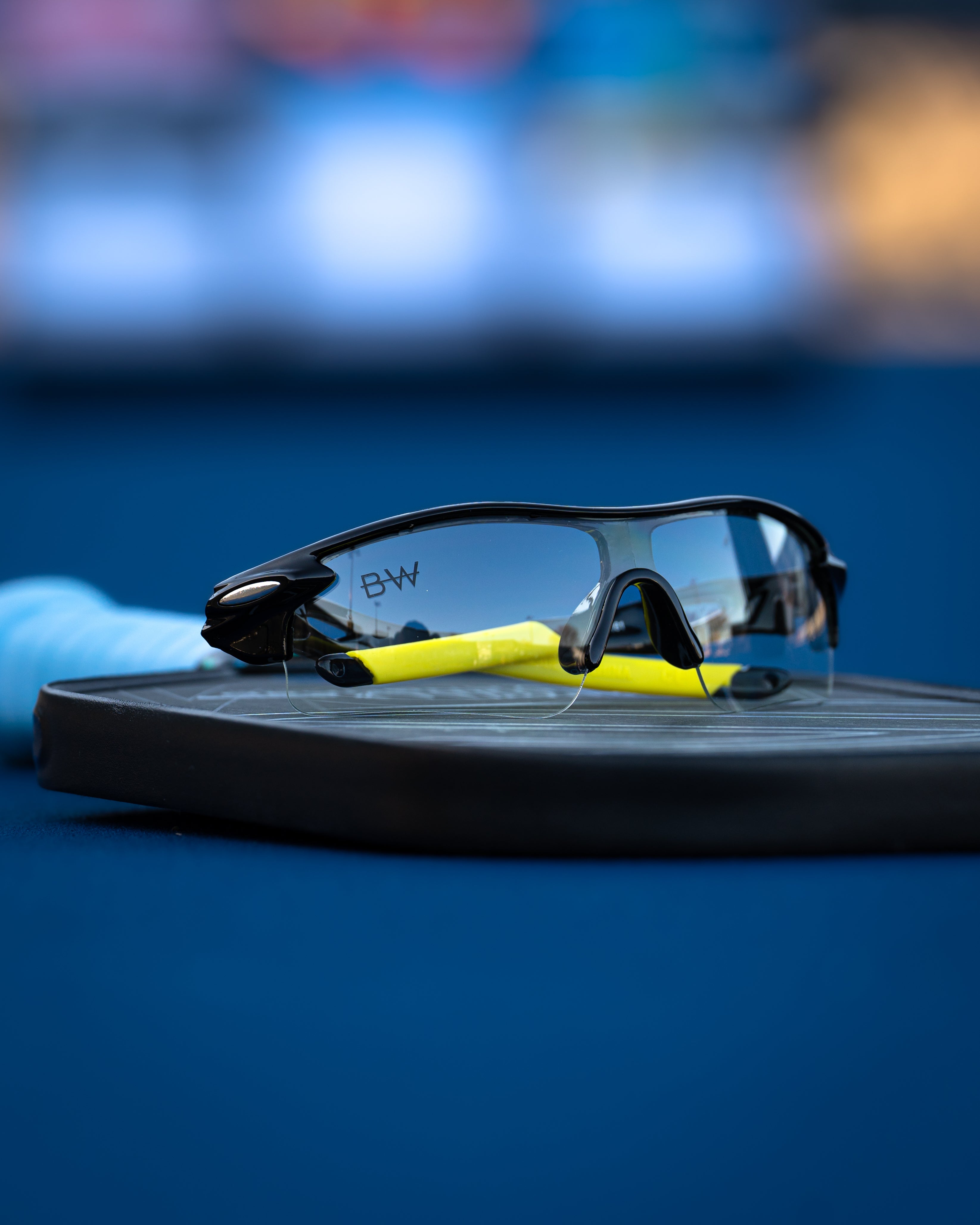
RX Sunglasses vs. Clip-Ons for Pickleball: What’s Better?
Share
RX Sunglasses vs. Clip-Ons for Pickleball: What’s Better?
For most prescription pickleball players, dedicated RX sunglasses are the simpler choice when they regularly play in similar outdoor lighting, while a clip-on system can be more versatile when a player frequently changes between indoor, outdoor, bright, and lower-light courts. Neither option is automatically better for every player. Your prescription, fit, court conditions, playing frequency, comfort preferences, and the exact features of the eyewear matter more than the format alone.
The biggest difference is straightforward: RX sunglasses build your prescription and sun-lens configuration into the eyewear itself, while clip-ons use a separate removable lens or shield over a base pair. That can affect convenience, flexibility, weight, storage, cost, and how many lighting conditions one setup can cover.
This guide compares prescription pickleball sunglasses vs. clip-on glasses by the factors that matter most on court so you can decide which setup makes more sense for your game.
Compare Pickleball Eyewear Options
Quick Answer: RX Sunglasses or Clip-Ons for Pickleball?
| Choose | When It May Make More Sense |
|---|---|
| Dedicated RX sunglasses | You want a simple prescription sports setup and usually play under similar lighting conditions |
| Clip-on system | You want to change the outer lens configuration as lighting conditions change |
| Separate RX pairs | You want dedicated configurations for significantly different environments |
| Contacts + non-RX eyewear | You already wear contacts comfortably and want maximum flexibility between non-RX eyewear options |
There is no universal winner. Players who value simplicity may prefer integrated RX eyewear. Players who regularly switch environments may place more value on a modular system, provided the exact clip-on configuration is available and works comfortably for them.
What Are Prescription Pickleball Sunglasses?
Prescription sports sunglasses combine corrective vision and a sports-oriented frame in one completed pair of eyewear.
Instead of wearing an everyday prescription frame underneath another lens system, the prescription is incorporated into the sports eyewear configuration.
For pickleball players, potential advantages include:
- One integrated pair to wear on court
- No separate removable shield to attach before play
- Fewer individual components to carry
- A sports-focused frame rather than relying on everyday glasses
- Prescription correction built into the eyewear
The actual tint, clear-lens availability, photochromic technology, coatings, and other lens characteristics still need to be verified for the exact product.
What Are Clip-On Pickleball Glasses?
A clip-on system uses a removable outer lens or shield with a compatible base frame. Depending on the specific design, the player may be able to remove or change that outer component when conditions change.
The potential appeal is flexibility. A player who moves between bright outdoor courts and lower-light environments may prefer modifying one compatible setup instead of carrying multiple complete prescription frames.
However, clip-on systems differ substantially. Before purchasing one, verify:
- Which frames are actually compatible
- Which clip or shield options are available
- How the prescription is incorporated into the complete system
- How the clip attaches
- Whether the completed setup feels comfortable
- How replacement clips or shields are stored and purchased
Do not assume that every Blinded Wear RX frame supports clips or that every clip system offers the same lens configurations.
RX Sunglasses vs. Clip-Ons: Side-by-Side Comparison
| Factor | Dedicated RX Sunglasses | Clip-On System |
|---|---|---|
| Prescription correction | Built into the completed RX eyewear | Depends on the specific base-frame and clip system |
| Simplicity | Generally fewer separate components | Requires managing the removable component |
| Changing conditions | May require another pair or another available lens solution | Can be more flexible if compatible clip options exist |
| Storage | One complete pair | Base eyewear plus clips or shields |
| Weight | Depends on the completed frame and lenses | Adding another component can change total weight |
| Cost | Compare finished RX price | Compare base RX price plus any additional compatible clips |
| Style | Integrated appearance | Appearance can change with the outer component |
| Best for | Players prioritizing simplicity | Players prioritizing modularity |
Advantages of Dedicated RX Sunglasses for Pickleball
1. One Integrated Setup
Prescription correction and the sports frame are part of one completed pair. That can be convenient for players who do not want to manage extra pieces before, during, or after a match.
2. Simple Pre-Match Routine
You can put on the eyewear and play without attaching an additional shield.
3. Fewer Parts to Carry
A dedicated pair can be easier for players who already carry paddles, balls, water, shoes, and other equipment.
4. Familiarity
Players who use the same RX sports pair frequently can become accustomed to the frame's fit and feel.
5. Straightforward Replacement Planning
One complete pair can simplify the decision about what needs to be stored, cleaned, and eventually replaced.
Potential Drawbacks of Dedicated RX Sunglasses
Less Modular Than a Clip System
If the lens configuration is fixed, changing dramatically different lighting conditions may require another eyewear option.
A Dark Outdoor Pair May Not Work for Night Play
A daytime sunglass tint can become impractical after sunset or indoors. Players who regularly move between environments should plan for that before buying.
Multiple RX Pairs Can Increase Total Cost
If you want separate dedicated configurations for bright outdoor play, indoor courts, and nighttime use, buying multiple complete RX pairs may cost more than one compatible modular setup.
However, the actual cost difference depends on the products and options being compared. Do not assume a clip system is always cheaper.
Advantages of Clip-On Pickleball Eyewear
1. Potential Flexibility Across Lighting Conditions
A compatible removable outer lens can make it easier to change configurations without changing the entire base frame.
2. Useful for Players Who Change Courts
Players who move between indoor and outdoor facilities or play tournaments throughout the day may value the ability to modify the eyewear setup.
3. One Base Frame Can Potentially Serve Multiple Uses
If multiple compatible clip configurations are available, one base frame may cover more than one lighting scenario.
4. Style Can Be More Modular
Different outer components can potentially change the appearance of the eyewear as well as its lens characteristics.
All of these advantages depend on the exact clip system. They should not be assumed across every frame or product.
Potential Drawbacks of Clip-On Systems
More Components to Manage
A modular system means there are more individual pieces to keep clean, store, transport, and avoid losing.
Total Weight Can Change
Adding a clip or shield can alter the completed eyewear's weight and balance. Whether that difference feels meaningful is individual.
Compatibility Matters
A clip designed for one frame should not be assumed to fit another.
More Surfaces to Keep Clean
Layered systems can create additional surfaces that require cleaning and inspection.
Availability May Limit Your Options
If the clip or shield you want is not offered for your specific frame, the theoretical versatility of a clip-on system may not help.
Do RX Sunglasses Have Better Optical Clarity Than Clip-Ons?
Do not assume that a dedicated RX lens automatically provides “maximum clarity” or that a clip-on system automatically reduces clarity.
Visual quality can depend on:
- Your prescription
- Lens design
- Lens material
- Frame fit and positioning
- The quality and condition of the outer clip
- Cleanliness
- Any reflections between surfaces
- The exact optical design of the complete system
The better comparison is between the actual products you are considering, not a blanket claim that one format always produces better vision.
Are RX Sunglasses Lighter Than Clip-Ons?
Not necessarily. A dedicated system has fewer separate layers, but finished weight depends on frame dimensions, lens construction, prescription, and any added components.
Blinded Wear uses lightweight sports frames, but exact weight differences between a dedicated RX frame and a clip-on configuration should be evaluated for the specific products.
Comfort is also about more than grams. Frame width, bridge pressure, temple fit, and balance can matter during long matches.
Does Prescription Strength Affect the Choice?
It can. The first step for either system is confirming that the exact frame and lens configuration support your prescription.
A strong or complex prescription should not automatically be matched to one format based on marketing language alone.
Before comparing clip-ons and dedicated RX sunglasses, verify:
- Prescription compatibility
- Lens configuration compatibility
- Frame dimensions
- Comfort of the completed setup
Blinded Wear includes high-index prescription lenses at no additional cost. High-index is a lens-material characteristic and should not be treated as proof that a particular frame is suitable for every prescription.
RX Sunglasses vs. Clip-Ons for Indoor Pickleball
For indoor play, the key issue is usually whether reducing brightness is necessary at all.
An appropriate clear or untinted prescription configuration can be practical when the goal is corrective vision without a dark sunglass tint.
If a clip-on system allows the tinted outer component to be removed while preserving the appropriate prescription base, that modularity could be useful for players who regularly switch from outdoor to indoor courts.
However, verify the exact system before buying. Do not assume every clip-on configuration works this way.
RX Sunglasses vs. Clip-Ons for Outdoor Pickleball
For players who almost always play outdoors in similar daytime conditions, a dedicated RX sunglass setup may offer the simplest experience.
A clip-on system becomes more interesting when the outdoor environment varies substantially, such as:
- Morning to midday play
- Bright sun followed by cloud cover
- Tournaments lasting into dusk
- Travel between facilities with different lighting
- Indoor and outdoor matches on the same day
The goal is not to own the greatest number of lens colors. It is to have a configuration that actually matches the conditions where you play.
Which Is Better for Day-to-Night Pickleball?
Players who routinely start in sunlight and finish under court lights should think carefully about how their eyewear changes with the environment.
A dark dedicated RX sunglass configuration may require switching to another pair after sunset. A compatible clip-on system may offer a modular alternative if removing or changing the outer component produces a suitable lower-light configuration.
Another option is an appropriate photochromic RX lens, but exact photochromic behavior and availability vary by lens technology and product.
There is no universal best solution:
- Dedicated RX pairs can provide predictable configurations for different conditions.
- Clip-ons can potentially reduce the number of complete frames you carry.
- Photochromic RX lenses may offer adaptation if the exact technology suits your needs.
- Contacts + non-RX eyewear can provide another modular approach for existing contact-lens users.
Do Different Clip-On Colors Improve Pickleball Performance?
A lens color may change how a scene looks, but it should not automatically be claimed to improve ball tracking, reaction time, depth perception, contrast, or match performance.
The original clip-on marketing language around specific colors should be treated cautiously unless the exact product characteristics and effects are documented.
When choosing a lens color or tint, consider:
- Actual court brightness
- Indoor versus outdoor use
- Personal comfort
- How much light the lens transmits
- The specific manufacturer's documentation
Choose a tint because it suits the environment and your preferences, not because a color name promises a competitive advantage.
What About Polarized Clip-Ons?
Polarization is another feature that should be verified for the exact product rather than assumed from the clip's appearance.
Blinded Wear's verified lens positioning is non-polarized. This performance-first approach is intended to preserve natural visual information and avoid potential depth-perception concerns associated with polarization during court play.
Polarization does not universally cause depth-perception problems, and non-polarized lenses do not guarantee improved performance.
Does Lens Curvature Make One System Better?
No. Curvature alone does not determine whether dedicated RX sunglasses or clip-ons are better for pickleball.
Frame and lens geometry can influence fit, coverage, prescription compatibility, and optical design, but avoid assuming a curved lens automatically:
- Reduces glare
- Prevents fog
- Improves peripheral vision
- Improves depth perception
- Improves reaction time
- Provides better protection
Evaluate the complete eyewear system instead of treating curvature as a performance score.
Impact Resistance: What Matters With Both Systems
Whether you choose dedicated RX sunglasses or a clip-on setup, lens tint and modularity are separate from impact resistance.
Blinded Wear uses impact-resistant lenses. That does not mean impact-proof, shatter-proof, unbreakable, or certified protective eyewear unless a specific certification is documented.
If a particular protective standard matters to you, verify it independently of whether the eyewear uses a clip-on or integrated RX format.
Fit May Matter More Than the RX-vs.-Clip-On Debate
A technically versatile eyewear system is not useful if it does not fit comfortably during play.
For either format, evaluate:
- Overall frame width
- Bridge comfort
- Temple pressure
- Frame balance
- Movement during lateral motion
- Comfort during longer matches
If you are considering a clip-on system, evaluate fit with the clip attached as well as without it because the completed configuration is what you will actually wear.
Does a Clip-On System Fog More?
Do not assume so. Fogging can depend on airflow, humidity, temperature, perspiration, frame position, and lens treatments.
A layered lens system may create different airflow characteristics, but that does not justify a universal claim that clip-ons fog more or less than dedicated RX eyewear.
If anti-fog performance matters to you, verify the specific treatment or design for the exact product rather than assuming one format solves fogging.
Which Is Easier to Clean?
Dedicated RX sunglasses generally involve one complete eyewear system, while clip-ons can introduce an additional removable component and additional surfaces.
For both systems:
- Remove loose debris before wiping.
- Use an appropriate lens-cleaning method.
- Use a clean microfiber cloth.
- Store the eyewear properly when not in use.
For clip-ons, also keep the removable component protected when it is not attached to the frame.
Which Costs Less: RX Sunglasses or Clip-Ons?
There is no reliable universal answer. Compare the finished system cost rather than assuming the modular option is automatically cheaper.
For dedicated RX sunglasses, consider:
- Frame price
- Prescription lens cost
- Lens material
- Selected lens configuration
- Optional treatments
- Replacement coverage
For a clip-on system, also consider:
- Base prescription eyewear cost
- Cost of compatible clips or shields
- Whether you expect to buy multiple clips
- Replacement cost if a clip is lost or damaged
Blinded Wear includes high-index prescription lenses at no additional cost, which means there is no separate high-index upcharge when comparing the completed Blinded Wear RX price.
Which Option Offers Better Long-Term Value?
Value depends on how often you use the flexibility you are paying for.
| Playing Pattern | Potentially Better Fit |
|---|---|
| Mostly one outdoor court at the same time of day | Dedicated RX sunglasses may keep things simple |
| Regular indoor and outdoor play | A modular system may offer more practical flexibility |
| Frequent tournaments | Compare a clip-on system against the cost and convenience of multiple dedicated pairs |
| Mostly indoor play | An appropriate clear RX pair may make more sense than buying a complex sun-lens system |
| Existing contact-lens wearer | Contacts plus non-RX eyewear may be worth comparing |
Replacement Coverage Matters for Sports Eyewear
Whatever format you choose, review the coverage that applies to the exact eyewear you are buying.
Blinded Wear offers a 50% lifetime replacement warranty if the glasses break.
Do not assume this automatically covers lost clips, every scratch, prescription changes, cosmetic wear, or every removable component. Review the current terms for exact details.
Verified Blinded Wear Features to Compare
| Feature | Verified Blinded Wear Position |
|---|---|
| Prescription availability | Yes |
| High-index RX lenses at no additional cost | Yes |
| Lightweight sports frames | Yes |
| Impact-resistant lenses | Yes |
| Non-polarized lenses | Yes |
| Pickleball-focused design | Yes |
| Comfort focus for extended matches | Yes |
| Recreational and competitive use | Yes |
| 50% lifetime replacement warranty if glasses break | Yes |
Clip compatibility, specific tint colors, photochromic availability, anti-reflective treatment, anti-fog treatment, scratch-resistant treatment, UV specifications, and protective certifications should be verified for the exact product rather than assumed across the collection.
Blinded Wear RX Pickleball Glasses to Compare
These verified Blinded Wear RX product pages are useful starting points when comparing dedicated prescription sports eyewear. Verify any clip-on compatibility or lens option on the exact product before purchasing.
7 Questions to Decide Between RX Sunglasses and Clip-Ons
-
Where Do You Play Most Often?
Consistent lighting favors simplicity. Frequently changing environments increase the value of flexibility.
-
Does the Exact Frame Support Your Prescription?
Prescription compatibility comes before modularity, tint, or style.
-
How Often Do You Change Lighting Conditions?
If you regularly move indoors, outdoors, or into evening play, think about how easily your eyewear can adapt.
-
Do You Want to Carry Extra Components?
Clip-ons can be flexible, but they also need to be stored and managed.
-
What Does the Complete System Cost?
Compare finished RX prices and any additional clip costs rather than only the base frame price.
-
Which Setup Fits Better?
Comfort during real movement matters more than theoretical versatility.
-
Which Setup Will You Actually Use Consistently?
The better system is the one that suits your real playing schedule and preferences.
Compare Prescription Pickleball Eyewear
Start with your prescription, court conditions, fit, and how often you need to change lens configurations. Then compare the eyewear format that best matches those needs.
Shop Prescription Pickleball Glasses →
Want to compare more pickleball eyewear before choosing?
View the 2026 Pickleball Glasses Guide →
Need help narrowing down your options?
Which Is More Comfortable for Long Pickleball Matches?
Comfort depends more on the complete fit of the eyewear than on whether the design is dedicated RX or clip-on.
During a long recreational session, league match, or tournament day, pay attention to:
- Bridge pressure
- Temple pressure
- Overall frame width
- How the frame sits during quick head movement
- Whether the complete setup feels balanced
- Whether an attached clip changes the way the frame feels
- Comfort after an hour or more of wear
Blinded Wear uses lightweight sports frames and designs its eyewear for extended pickleball matches, but individual fit still matters. A clip-on configuration should be evaluated with the clip actually attached rather than judging the base frame alone.
Do Clip-Ons Stay Secure During Fast Pickleball Movement?
That depends on the exact attachment system and frame. A clip-on should not automatically be described as slip-proof, movement-proof, or secure under every playing condition.
Before relying on a removable shield during competitive play, test it during:
- Side-to-side movement
- Quick head turns
- Looking upward for lobs
- Serving
- Repeated bending and movement at the kitchen line
- A full practice session
If an attachment shifts, feels loose, or distracts you during practice, address that before using it in competition.
Do RX Sunglasses or Clip-Ons Give Better Peripheral Vision?
Neither format automatically provides better peripheral vision. Peripheral visibility can depend on frame shape, lens geometry, frame position, prescription design, and the dimensions of any attached shield.
A wider-looking frame should not automatically be claimed to increase peripheral vision or improve court awareness.
When comparing options, put the eyewear on and evaluate whether:
- The frame itself enters your field of view in a distracting way.
- A clip or shield creates an edge you notice during play.
- You can comfortably scan across the court.
- The eyewear remains positioned correctly during movement.
Can Clip-On Layers Create Reflections?
Any eyewear system with multiple surfaces can behave differently from a single integrated lens system, but that does not mean clip-ons universally cause distracting reflections.
Visual experience can depend on:
- The exact lens and shield design
- Lighting angle
- Surface treatments
- Lens cleanliness
- Distance between lens surfaces
- The player's individual sensitivity
If reflections are a concern, test the complete clip-on configuration under the same type of lighting where you normally play rather than relying on a general claim about layered lenses.
Which Is Better for Pickleball Tournaments?
Tournament players often experience more lighting variation than someone who plays at the same recreational court every week.
A tournament day can include:
- Early-morning matches
- Midday sun
- Cloud cover
- Indoor backup courts
- Late-afternoon matches
- Evening play under court lights
That makes versatility more valuable, but it does not automatically make clip-ons the winner.
| Tournament Priority | Potential Approach |
|---|---|
| Simple setup | Dedicated RX eyewear |
| Multiple lighting environments | Compatible modular system or multiple dedicated configurations |
| Minimal loose equipment | Dedicated RX pair |
| Ability to alter an outer lens | Compatible clip-on system |
| Backup prescription correction | Second RX pair or another familiar corrective option |
RX Sunglasses vs. Clip-Ons for Traveling Pickleball Players
Players who travel for pickleball may encounter unfamiliar facilities and weather, making flexibility useful.
A clip-on setup can potentially reduce the number of complete frames you carry, but you still need to protect and organize each removable component.
A dedicated RX setup may involve more than one complete pair if you want different configurations, but separate pairs can also provide redundancy if one becomes unavailable or damaged.
For travel, compare:
- Total number of pieces
- Storage space
- Replacement availability
- Prescription backup options
- How easily you can change configurations
- Whether you are likely to lose small removable components
What About Cloudy or Variable Outdoor Conditions?
Variable weather is one of the stronger arguments for considering flexibility rather than buying solely for bright midday sun.
During one outdoor session, conditions can move between:
- Full sun
- Cloud cover
- Partial shade
- Late-afternoon light
A compatible clip-on system may allow a player to change the outer configuration. A dedicated RX player may instead carry another pair or use an appropriately verified adaptive lens.
Do not assume a particular tint automatically improves visibility in cloudy conditions. Match the lens to actual brightness and personal comfort.
Which Is Better for Dusk and Evening Pickleball?
Dusk is where a fixed dark sunglass configuration can become less convenient. The environment is gradually losing available light, so a lens selected for bright sun may become unnecessarily dark.
A clip-on system can be useful if removing the tinted component leaves an appropriate prescription base for lower-light play. Dedicated RX players may instead switch to a separate clear prescription pair.
Either approach can work. The important question is whether your final configuration is appropriate for the available light.
How Do Photochromic RX Lenses Compare With Clip-Ons?
Photochromic prescription lenses provide a third approach for players who want one pair across changing conditions.
Instead of physically changing a shield, the lens itself changes tint in response to environmental conditions.
| Approach | How It Changes | Main Consideration |
|---|---|---|
| Dedicated fixed-tint RX | Does not automatically change | Simple but may require another pair in different light |
| Clip-on system | Player manually changes or removes a compatible component | More modular but requires extra pieces |
| Photochromic RX | Lens tint changes according to its technology and environment | Behavior varies by exact lens technology |
Photochromic availability and behavior should be verified for the exact product. Do not assume every Blinded Wear RX model offers transition lenses or that every photochromic lens reacts identically.
What if You Already Wear Contact Lenses?
Players who already wear contacts comfortably have another option: prescription correction through contacts combined with non-RX sports eyewear.
This can make it easier to change between different non-prescription eyewear configurations without purchasing each sports frame in prescription form.
Potential benefits include:
- More freedom to change non-RX eyewear
- No prescription incorporated into each sports frame
- Easy comparison of different sports styles
Contacts are not appropriate for everyone, and this should not be interpreted as a recommendation to begin wearing them solely for pickleball.
What Happens if Your Prescription Changes?
A prescription change can affect the economics of both systems.
With dedicated RX sunglasses, the completed prescription lenses may need to be updated depending on your new corrective needs and the frame.
With a modular system, a reusable outer clip could theoretically remain useful if it is compatible with the updated base eyewear. However, that depends entirely on the exact system and should not be assumed.
When comparing long-term cost, consider:
- How frequently your prescription has historically changed
- Whether the frame can accommodate your current prescription
- Whether removable components are reusable with a replacement base
- The cost of replacing prescription lenses or complete eyewear
RX Sunglasses vs. Clip-Ons for Strong Prescriptions
A stronger prescription does not automatically make one format better.
The correct process is to verify:
- The exact prescription range supported by the frame.
- The lens design used for that prescription.
- The finished fit and comfort.
- Whether adding an outer clip affects how the complete setup feels.
Blinded Wear includes high-index prescription lenses at no additional cost, but high-index availability should not be interpreted as universal compatibility with every prescription or frame.
What About Progressive or Multifocal Prescription Players?
Players who use multifocal or progressive correction should evaluate the actual prescription configuration rather than assuming that either a clip-on or dedicated sunglass format is automatically superior.
Important factors can include:
- Whether the frame supports the prescribed lens design
- Frame dimensions
- Lens positioning
- How the player uses different viewing zones
- Comfort during court movement
If you have complex prescription needs, confirm compatibility with an appropriate optical or eye-care professional before choosing eyewear primarily because of tint or clip functionality.
Which Option Is Better for Older Pickleball Players?
Age alone does not determine whether dedicated RX sunglasses or clip-ons are better.
Older players may have different prescriptions, fit preferences, or lighting sensitivities, but there is no universal age-based lens system.
Prioritize:
- Correct prescription
- Comfort
- Ease of handling
- Lighting conditions
- Frame fit
- Any specific visual needs
Someone who dislikes managing small removable parts may prefer a dedicated RX pair, while another player may value the versatility of interchangeable components.
Is One Option Better for Men or Women?
No. Dedicated RX sunglasses and clip-ons should not be selected according to gender alone.
Frame dimensions, prescription compatibility, comfort, court conditions, and personal style are more useful decision factors.
Players with narrower or wider faces should compare actual measurements rather than relying on labels such as men's, women's, or unisex.
Which Looks Better: RX Sunglasses or Clip-Ons?
Style is subjective, but the two formats can create different aesthetics.
Dedicated RX sunglasses may appeal to players who prefer:
- A more integrated appearance
- Fewer visible components
- A simple one-frame setup
Clip-ons may appeal to players who prefer:
- A modular appearance
- The ability to change the outer look
- More flexibility between available configurations
Once prescription compatibility, fit, and practical playing needs are satisfied, personal style is a valid way to make the final choice.
How Should You Store RX Sunglasses and Clip-Ons?
Both systems benefit from careful storage between matches.
For dedicated RX sunglasses:
- Use a protective case.
- Avoid placing lenses face-down.
- Keep the lenses clean before storage.
For clip-on systems:
- Protect the base eyewear.
- Store each removable component so it does not become scratched or bent.
- Avoid dropping loose shields into a paddle bag without protection.
- Keep track of which clip belongs to which frame.
How to Clean Clip-On Pickleball Glasses
A modular system may require cleaning both the base prescription lens and the removable outer component.
- Remove loose debris before rubbing either surface.
- Follow the product-specific cleaning instructions.
- Use a clean microfiber cloth appropriate for eyewear.
- Clean both sides of each component.
- Allow the components to be properly positioned before reattaching them.
- Store the removed clip safely when it is not being used.
Do not assume that a sports lens is scratch-proof. Scratch resistance should be verified separately if it matters to you.
Which Is More Durable: RX Sunglasses or Clip-Ons?
There is no universal durability winner.
Dedicated eyewear has fewer removable pieces, but durability still depends on the actual frame and lens construction. Clip-on systems introduce an additional component, but that alone does not mean they are fragile.
When comparing durability, verify:
- Lens construction
- Frame construction
- Attachment mechanism
- Replacement availability
- Warranty or replacement terms
Blinded Wear uses impact-resistant lenses. Impact-resistant does not mean unbreakable, shatter-proof, or certified protective eyewear.
What Happens if a Clip Gets Lost or Damaged?
This is an important practical question before investing in a modular system.
Check whether:
- Replacement clips are sold separately.
- The same component is still available for your frame.
- Your warranty or protection coverage applies to removable pieces.
- You have another usable configuration if the clip becomes unavailable.
Do not assume Blinded Wear's 50% lifetime replacement warranty for broken glasses automatically applies to every removable clip or accessory. Review the current terms for exact coverage.
Which Is More Convenient on Court?
Convenience depends on what you dislike managing.
| If You Prefer... | Consider... |
|---|---|
| One complete pair | Dedicated RX sunglasses |
| Changing a lens setup without changing the whole frame | A compatible clip-on system |
| No small accessories | Dedicated RX eyewear |
| More potential configurations from one base frame | Clip-ons, if the desired options are actually available |
| Automatic adaptation | Compare an appropriate photochromic RX option |
Does Recreational vs. Competitive Pickleball Change the Choice?
Both recreational and competitive players can use either format. Playing level alone does not determine the better system.
A frequent competitive player may care more about:
- Consistent fit
- Backup eyewear
- Fast adaptation between tournament environments
- Keeping equipment organized
A recreational player may place greater priority on simplicity and value.
Neither dedicated RX sunglasses nor clip-ons should be claimed to improve rankings, reaction time, or competitive results simply because of the eyewear format.
Best Setup by Pickleball Lighting Scenario
| Playing Environment | What to Consider |
|---|---|
| Consistent bright daytime outdoor play | A dedicated RX sunglass setup can be simple and practical |
| Indoor-only pickleball | An appropriate clear RX setup may be more relevant than a sun-focused system |
| Indoor + outdoor play | A modular system or separate configurations may provide useful flexibility |
| Morning through midday tournaments | Consider how changing brightness affects your chosen lens configuration |
| Day-to-night pickleball | Plan how you will move from bright-light eyewear to a suitable lower-light setup |
| Frequent travel | Compare modular convenience against the reliability of separate complete pairs |
RX Sunglasses vs. Clip-Ons by Player Type
| Player | Likely Priority | Option to Compare First |
|---|---|---|
| Outdoor recreational player | Simplicity | Dedicated RX sunglasses |
| Indoor and outdoor league player | Lighting flexibility | Compatible clip-on system or separate RX configurations |
| Tournament traveler | Multiple environments | Compare modular system with multiple dedicated pairs |
| Player who dislikes accessories | Minimal components | Dedicated RX sunglasses |
| Player who changes lens preferences often | Modularity | Clip-on system if exact options are compatible |
| Existing contact wearer | Maximum non-RX flexibility | Contacts + non-RX sports eyewear |
| Evening player | Preserving available light | Appropriate clear RX configuration |
Claims to Question When Comparing Clip-Ons and RX Sunglasses
| Claim | What to Ask Instead |
|---|---|
| “Maximum optical clarity” | What is documented about the actual lens design? |
| “No glare” | What specific feature is being referenced? |
| “Enhances ball contrast” | What evidence supports the claim for this exact lens? |
| “Fog-proof” | Is an anti-fog treatment documented? |
| “Never slips” | What are the dimensions, and how does it fit you? |
| “Perfect for every lighting condition” | What exact configurations are available? |
| “Shatter-proof” | What impact properties or certification are actually documented? |
| “Better peripheral vision” | What about the frame geometry supports that statement? |
How to Evaluate Your Choice After It Arrives
Whichever format you choose, evaluate the completed eyewear before relying on it in competition.
-
Check Prescription Comfort
Make sure the correction feels appropriate during normal wear.
-
Check Stationary Fit
Look for excessive bridge or temple pressure.
-
Test Athletic Movement
Perform normal pickleball movements, including lateral motion and quick head turns.
-
Test Every Configuration
If using clip-ons, practice with each component you actually plan to use.
-
Test Under Real Lighting
Evaluate the eyewear on a court similar to where you normally play.
-
Play a Full Practice
Short try-ons may not reveal comfort issues that appear later in a match.
Why Blinded Wear RX Eyewear Is Worth Comparing
Regardless of whether your final choice involves a dedicated configuration or a compatible modular option, Blinded Wear's verified RX value proposition includes:
- Prescription availability
- High-index prescription lenses at no additional cost
- Lightweight sports frames
- Impact-resistant lenses
- Non-polarized lenses
- Design focused on pickleball players
- Comfort for extended matches
- Options for recreational and competitive players
- 50% lifetime replacement warranty if glasses break
The exact clip compatibility, lens tint, clear-lens configuration, photochromic option, coating, and other product-specific features should still be verified before purchase.
The Simplest Way to Decide
If you are still deciding between RX sunglasses and clip-ons, reduce the choice to two questions:
- How often do your playing conditions change?
- How much do you value simplicity versus modularity?
If you mostly play outdoors under similar conditions and want as few components as possible, dedicated RX sports eyewear can be the more straightforward choice.
If you routinely move between different courts, times of day, or lighting environments, a compatible clip-on system may be worth the added complexity.
Neither approach is inherently superior. The better purchase is the one that matches your prescription, fit, court schedule, and actual playing habits.
Find Your Pickleball Eyewear Setup
Compare Blinded Wear prescription eyewear by prescription compatibility, court conditions, fit, verified lens characteristics, and how much flexibility you need.
If you already wear contacts or do not need prescription correction:
Shop Non-RX Pickleball Glasses →
Want to compare the broader Blinded Wear lineup?
View the 2026 Pickleball Glasses Guide →
Need help narrowing your choices?
Frequently Asked Questions About RX Sunglasses vs. Clip-Ons for Pickleball
Are prescription sunglasses better than clip-ons for pickleball?
Dedicated prescription sunglasses can be better for players who want a simple, integrated setup and usually play in similar lighting conditions. Clip-ons can make more sense for players who frequently change between indoor, outdoor, bright, cloudy, dusk, and evening environments. The better choice depends on your prescription, fit, court conditions, and how much you value simplicity versus modularity.
Are clip-on sunglasses good for pickleball?
They can be, provided the complete system fits comfortably, supports your prescription needs, and offers lens configurations appropriate for where you play. Do not assume every clip-on system is designed for sports or that every Blinded Wear frame accepts a clip.
What are the advantages of prescription sunglasses over clip-ons?
Dedicated RX sunglasses generally provide one complete pair with fewer separate components to carry, attach, clean, and store. That simplicity can be valuable for players who consistently play in similar outdoor conditions.
What are the advantages of clip-ons over prescription sunglasses?
The primary potential advantage is flexibility. A compatible clip-on system may allow you to remove or change an outer component when lighting changes without replacing the entire prescription base frame.
Are clip-ons cheaper than prescription sunglasses?
Not necessarily. Compare the total cost of the base prescription eyewear and every clip you expect to purchase against the finished price of dedicated RX sunglasses. If multiple dedicated RX pairs would otherwise be required, a compatible modular system may provide value, but the actual prices determine which option costs less.
Are clip-on sunglasses heavier than RX sunglasses?
Adding an outer component can increase the total weight of a setup, but that does not mean every clip-on system is heavier than every dedicated RX frame. Compare the specific products and evaluate how the complete setup feels on your face.
Do clip-ons affect vision quality?
Do not assume that they automatically do. Visual quality can depend on the prescription, lens design, fit, condition, cleanliness, lighting, and construction of the complete system. Multiple surfaces may behave differently from an integrated lens, but the actual product should be evaluated rather than assuming clip-ons inherently reduce clarity.
Are clip-ons better for indoor and outdoor pickleball?
They can offer useful flexibility if the compatible system lets you change from an outdoor configuration to an appropriate indoor configuration. A player can also accomplish this with separate dedicated RX pairs, an appropriate adaptive lens, or contacts plus non-RX eyewear.
What is best for prescription pickleball players who play at night?
When reducing brightness is no longer necessary, an appropriate clear RX configuration can be a practical starting point. Players using dark daytime RX sunglasses should plan how they will change their eyewear if play continues after sunset.
Can I use one pair of prescription glasses for indoor and outdoor pickleball?
Possibly. Whether one pair works well across both environments depends on the exact lens configuration and your needs. A modular or adaptive system may increase flexibility, while separate dedicated pairs can provide predictable configurations for each environment.
Are polarized clip-ons better for pickleball?
Polarization should not automatically be considered better for pickleball. Blinded Wear uses non-polarized lenses as part of its performance-first approach intended to preserve natural visual information and avoid potential depth-perception concerns associated with polarization during court play. Polarization does not universally cause depth-perception problems.
Does Blinded Wear include high-index prescription lenses?
Yes. Blinded Wear includes high-index prescription lenses at no additional cost, with no separate high-index upcharge.
RX Sunglasses vs. Clip-Ons: Which Wins Each Category?
| Category | Potential Advantage | Why |
|---|---|---|
| Simplicity | Dedicated RX sunglasses | One integrated pair with fewer separate components |
| Lighting flexibility | Clip-ons | Compatible outer components may be changed or removed |
| Fewest accessories | Dedicated RX sunglasses | No separate clip is required |
| Indoor + outdoor versatility | Depends | Clip-ons can be flexible, but separate RX pairs or another appropriate lens configuration can also work |
| Comfort | Depends | Frame dimensions, balance, prescription, and individual fit matter more than format |
| Optical quality | Depends | Evaluate the actual lens and complete system rather than the category |
| Lowest cost | Depends | Compare the finished RX system price and any additional components |
| Tournament flexibility | Depends | Modular systems can be convenient, while multiple dedicated pairs provide another solution |
| Backup if one lens configuration is wrong for the conditions | Depends | A removable clip or separate complete pair can each provide another option |
| Integrated appearance | Dedicated RX sunglasses | The prescription and sunglass configuration are contained in one completed pair |
Overall winner: neither format wins every category. Dedicated RX sunglasses tend to win on simplicity, while compatible clip-ons tend to win on potential modularity.
What Should You Buy Based on Where You Play Pickleball?
| Where You Play | Option to Compare First | Reason |
|---|---|---|
| Mostly sunny outdoor courts | Dedicated RX sunglasses | A consistent environment may not require frequent lens changes |
| Mostly indoor courts | Clear RX eyewear | A dark outdoor sunglass configuration may be unnecessary |
| Indoor and outdoor courts | Clip-ons or multiple RX configurations | Lighting flexibility becomes more valuable |
| Outdoor courts with variable weather | Compare modular and adaptive options | Brightness may change throughout the session |
| Day-to-night play | Clip-on, separate clear RX pair, or appropriate adaptive configuration | A daytime tint may become too dark later |
| Frequent tournament travel | Compare both systems | Different venues can create substantially different lighting conditions |
Who Should Choose Dedicated RX Pickleball Sunglasses?
Dedicated prescription sports eyewear is especially worth comparing if you:
- Mostly play outdoors under similar lighting.
- Want one complete pair instead of separate attachments.
- Prefer fewer pieces in your pickleball bag.
- Do not frequently switch between dramatically different lighting environments.
- Want your prescription incorporated directly into your sports eyewear.
- Prefer an integrated appearance.
- Would rather carry a separate backup pair than manage removable clips.
For these players, the convenience of a dedicated RX pair may outweigh the additional flexibility offered by a modular system.
Who Should Consider Clip-On Pickleball Glasses?
A compatible clip-on system may be worth comparing if you:
- Frequently alternate between indoor and outdoor pickleball.
- Play tournaments lasting from morning through evening.
- Want to change an outer lens configuration without changing the complete base frame.
- Regularly encounter variable weather or lighting.
- Do not mind carrying and organizing removable components.
- Have verified that the exact system supports your prescription and preferred configurations.
The key word is compatible. The benefits of clip-ons only matter when the exact frame, prescription setup, and removable components work together.
What About Buying Two RX Pairs Instead of Clip-Ons?
Clip-ons are not the only solution for changing court conditions. Some prescription players may prefer two complete RX configurations.
For example, one pair could be selected for brighter outdoor conditions while another appropriate pair is used indoors or after sunset.
| Two Dedicated RX Pairs | One RX + Clip-On System |
|---|---|
| Each pair can be configured for its intended environment | One base frame may support multiple compatible outer configurations |
| Provides a complete backup frame | Can reduce the number of complete frames carried |
| Requires carrying two complete pairs | Requires managing removable components |
| May cost more depending on RX pricing | Total cost depends on base eyewear and additional clips |
| No mid-session clip attachment required | Can make configuration changes more compact |
If prescription correction is essential for you to play, the backup value of a second complete RX pair may be worth considering alongside the convenience of clip-ons.
Think About Cost Per Wear, Not Just Purchase Price
The cheapest initial option is not necessarily the best value.
Consider how often you will actually use each configuration. A dedicated RX pair used several times per week may provide better practical value than a complex modular setup whose extra components rarely leave the case.
Conversely, a player who constantly switches between indoor and outdoor courts may get substantial use from a modular system.
Before buying, ask:
- How many times per week do I play?
- How often do my lighting conditions change?
- How many separate lens configurations would I realistically use?
- Will I actually carry the additional components?
- Would a second complete RX pair also serve as a valuable backup?
Factor High-Index Lens Pricing Into Your RX Comparison
When comparing prescription pickleball eyewear prices, look beyond the advertised frame price and calculate what the completed prescription setup will cost.
Blinded Wear includes high-index prescription lenses at no additional cost. That means players are not charged a separate high-index upgrade when ordering qualifying Blinded Wear prescription eyewear.
This can make the finished RX price easier to compare against other prescription sports eyewear systems that may structure lens-material pricing differently.
High-index lenses should not be interpreted as a performance enhancement or proof that every prescription works with every frame. Prescription compatibility still needs to be confirmed.
Blinded Wear: What’s Verified vs. What You Should Check
| Feature | Status |
|---|---|
| Prescription eyewear available | Verified |
| High-index RX lenses included at no additional cost | Verified |
| Lightweight sports frames | Verified |
| Impact-resistant lenses | Verified |
| Non-polarized lenses | Verified |
| Designed for pickleball players | Verified |
| Comfort for extended matches | Verified |
| Suitable for recreational and competitive players | Verified |
| 50% lifetime replacement warranty if glasses break | Verified |
| Clip-on compatibility | Verify for the exact frame |
| Clear-lens availability | Verify for the exact product |
| Photochromic availability | Verify for the exact product and lens technology |
| Anti-reflective treatment | Verify for the exact lens |
| Anti-fog treatment | Verify for the exact lens |
| Scratch-resistant treatment | Verify for the exact lens |
| Specific UV rating | Verify documented specifications |
| Protective certification | Verify the exact named standard if required |
Marketing Claims to Be Careful With When Shopping
Whether you are considering RX sunglasses or clip-ons, avoid choosing solely because a product uses aggressive performance language.
- “Shatter-proof” — impact resistance does not automatically mean shatter-proof.
- “Unbreakable” — sports eyewear can still become damaged.
- “Never slips” — fit varies by wearer.
- “Fog-proof” — verify the exact treatment or documented performance.
- “Eliminates glare” — avoid interpreting a lens feature as eliminating every source of glare.
- “Improves reaction time” — do not assume eyewear format guarantees faster reactions.
- “Improves depth perception” — do not assume a particular tint, curvature, or clip creates better depth perception.
- “Best for every condition” — different lighting environments can require different lens considerations.
- “Certified protection” — look for the exact documented standard rather than the word “protective” alone.
8 Mistakes to Avoid When Choosing RX Sunglasses or Clip-Ons
-
Choosing Based Only on Price
Compare prescription compatibility, fit, total system cost, and how often you will actually use the eyewear.
-
Assuming Every Clip Fits Every Frame
Clip-on compatibility is product-specific.
-
Buying for Only One Hour of the Day
Think about how conditions change during your complete playing schedule.
-
Ignoring Indoor and Evening Play
A dark outdoor setup may not be practical when available light decreases.
-
Assuming More Lens Colors Mean Better Performance
Additional choices are only valuable if they suit environments you actually encounter.
-
Ignoring the Completed Weight and Fit
Evaluate the entire system, including an attached clip if applicable.
-
Assuming Impact-Resistant Means Impact-Proof
Impact resistance is not the same as an unlimited safety guarantee or a specific protective certification.
-
Skipping a Real Court Test
Test your eyewear during normal pickleball movement and realistic lighting before depending on it in competition.
The 3-Step RX Pickleball Eyewear Decision
Step 1: Start With Your Prescription and Fit
Confirm that the frame supports your prescription and compare dimensions with eyewear that already fits you comfortably.
Step 2: Map Your Real Playing Conditions
Write down where you actually play: outdoor sun, indoor courts, cloudy conditions, dusk, night, or a combination.
Step 3: Choose Simplicity or Modularity
If your conditions stay relatively consistent, dedicated RX eyewear may be the simpler purchase. If your conditions frequently change, compare a compatible modular system, separate RX pairs, or another appropriate lens configuration.
Final Buying Checklist: RX Sunglasses vs. Clip-Ons
- Confirm your current prescription.
- Verify that the exact frame supports your prescription.
- Compare frame dimensions.
- Consider bridge and temple comfort.
- Identify where you play most often.
- Identify how often your lighting changes.
- Decide whether you prefer one integrated pair or removable components.
- Verify clip compatibility instead of assuming it.
- Verify every lens configuration you want.
- Verify photochromic availability if relevant.
- Verify anti-reflective treatment if relevant.
- Verify anti-fog treatment if relevant.
- Verify scratch-resistant treatment if relevant.
- Verify specific UV claims if they matter to you.
- Verify any required protective certification.
- Compare the complete RX price.
- Include the cost of additional clips or separate pairs.
- Consider replacement coverage.
- Test the completed eyewear during real movement.
- Test each configuration under realistic lighting.
- Keep a backup correction option if you depend on RX eyewear to play.
Key Takeaways: Prescription Sunglasses vs. Clip-Ons for Pickleball
- Dedicated RX sunglasses are generally the simpler option.
- Compatible clip-ons can provide more flexibility across changing lighting conditions.
- Neither format automatically provides better optical clarity, comfort, durability, peripheral vision, or pickleball performance.
- Players who mostly play outdoors under similar conditions may not need the additional complexity of a modular system.
- Players who frequently move between indoor, outdoor, dusk, and nighttime courts may place more value on changing configurations.
- Separate RX pairs provide another alternative and can also serve as complete prescription backups.
- Contacts plus non-RX sports eyewear can be another option for existing contact-lens wearers.
- Prescription compatibility and fit should come before tint color or clip functionality.
- Blinded Wear includes high-index prescription lenses at no additional cost.
- Blinded Wear uses lightweight sports frames, impact-resistant lenses, and non-polarized lenses.
- Clip compatibility and optional lens features should be verified for the exact product.
Compare Your Pickleball Eyewear Options
Final Verdict: Are RX Sunglasses or Clip-Ons Better for Pickleball?
Choose dedicated RX sunglasses if you prioritize simplicity and usually play in similar conditions. Consider a compatible clip-on system if you prioritize flexibility and regularly move between different lighting environments.
For many prescription pickleball players, dedicated RX sports eyewear is the straightforward solution: one prescription, one frame, and fewer components to manage. That can be particularly appealing when most matches take place outdoors at roughly the same time of day.
Clip-ons become more compelling when flexibility is genuinely useful. A player moving from bright outdoor courts to indoor facilities, changing weather, dusk, or evening play may benefit from a compatible system that allows the outer configuration to change without replacing the entire base frame.
There is also no requirement to choose only between these two formats. Separate RX pairs, appropriate adaptive lenses, and contacts paired with non-RX sports eyewear can all be worth comparing depending on your needs.
Whichever route you choose, prioritize prescription compatibility, fit, comfort, actual court conditions, verified lens characteristics, and total finished cost over exaggerated performance claims.
Ready to Find Your Prescription Pickleball Glasses?
Blinded Wear offers prescription pickleball eyewear with high-index RX lenses included at no additional cost, lightweight sports frames, impact-resistant lenses, non-polarized lenses, and a performance-first design for recreational and competitive pickleball players.
Shop Prescription Pickleball Glasses →
Not sure which style fits your game?
Take the Pickleball Glasses Quiz →
Want to compare more options first?