
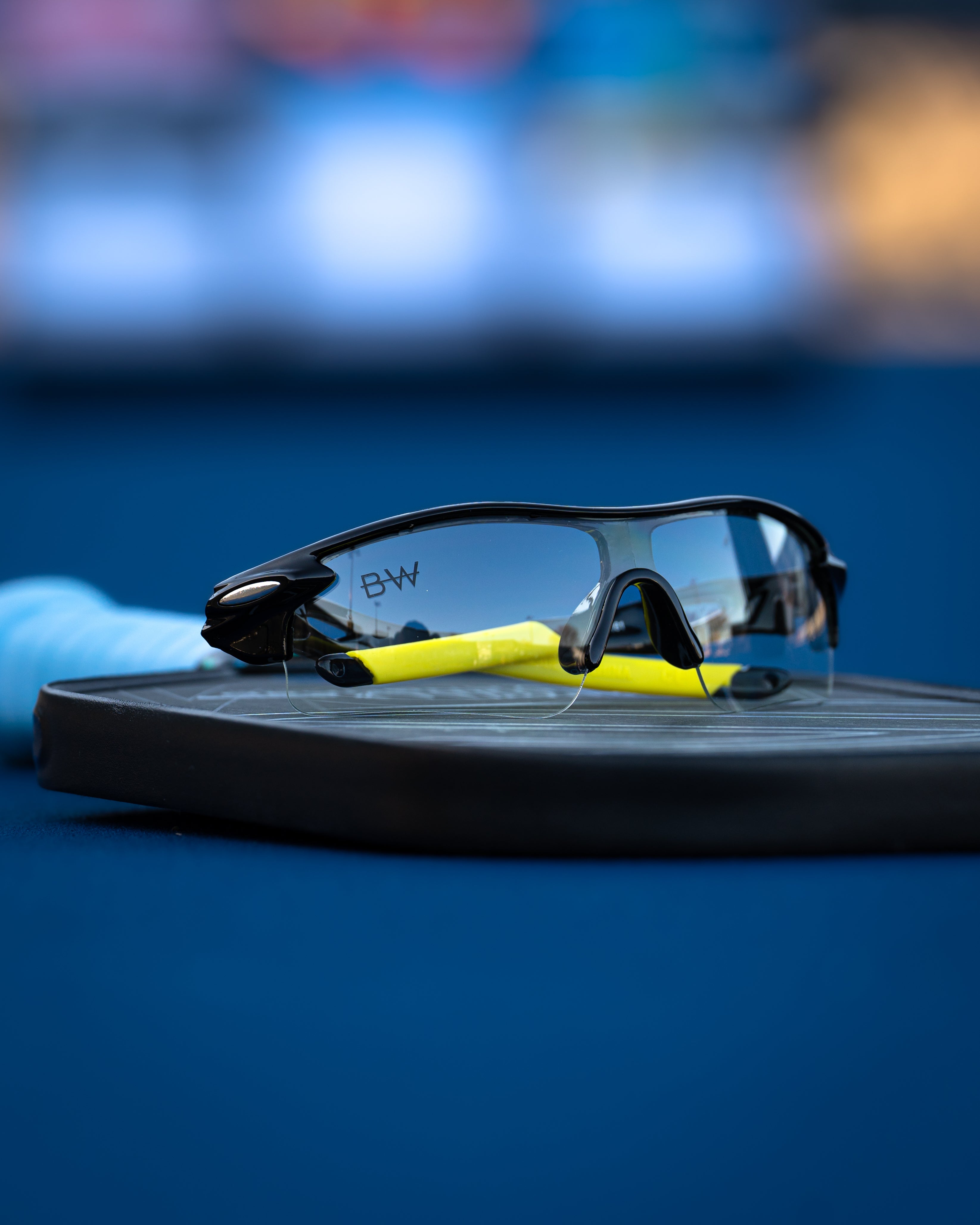
Transition RX Lenses for Travel & Competition: One Pair for Every Light
Share
Transition RX Lenses for Travel & Competition: One Pair for Every Light
Traveling athletes can move through dramatically different environments in a single day: an airport terminal in the morning, an outdoor practice in the afternoon, an indoor facility later, and another competition venue the next day. If you need prescription correction, that raises an important equipment question: can one RX lens setup cover enough of those environments to simplify what you pack?
Photochromic—often called transition—prescription lenses are designed to change tint in response to light exposure. That can make them appealing to athletes who want one corrective pair capable of moving between brighter outdoor conditions and environments where a dark sunglass tint may not be preferred.
But “one pair for every light” should be treated as a convenience goal rather than an absolute promise. Photochromic behavior can vary with the lens technology, environment, temperature, UV exposure, and where you are using the glasses. The right question is not whether transition RX lenses magically optimize your vision everywhere—it is whether one adaptive prescription setup matches enough of your real travel and competition schedule to be useful.
Find Your RX Pickleball Eyewear
What Are Transition RX Lenses?
Transition RX lenses combine prescription correction with photochromic lens technology. Photochromic lenses change tint according to their response to light exposure rather than maintaining one fixed tint all day.
That creates a different use case from standard clear prescription glasses or fixed-tint prescription sunglasses.
| Lens Setup | Basic Behavior | Potential Travel Role |
|---|---|---|
| Clear RX | Remains untinted | Corrective option when you prefer no dark sunglass tint |
| Fixed-Tint RX | Maintains its selected tint | Consistent configuration for environments where you prefer that tint |
| Photochromic / Transition RX | Tint changes in response to light exposure | Can potentially reduce how often you need to change between separate clear and tinted corrective pairs |
None of these configurations is universally superior. They solve different problems.
Why Traveling Athletes Consider Transition RX Lenses
The strongest argument for adaptive RX lenses is not an automatic performance advantage. It is equipment simplification.
Consider a competition day that includes:
- Travel through an airport or hotel
- Walking outside to the venue
- Outdoor warmups
- Indoor staging areas
- Outdoor competition
- Changing conditions throughout the day
- Travel back after competition
With separate clear RX glasses and prescription sunglasses, you may need to decide which pair to wear and keep track of the other.
A suitable photochromic RX setup can potentially cover more of that day with one corrective pair.
The Biggest Benefit: Fewer Eyewear Changes
For a prescription-dependent athlete, switching eyewear is not simply a matter of swapping fashion accessories. Each pair also needs to provide the correction you require.
An adaptive RX setup can make the routine simpler:
Prescription correction + changing tint behavior + sports-oriented frame = fewer situations where you may need to reach for another pair.
That can be particularly appealing when traveling because every additional piece of equipment creates another item to pack, store, locate, and remember.
One Competition Day, Multiple Lighting Environments
| Part of the Day | Environment | Why Adaptive RX May Be Relevant |
|---|---|---|
| 6:30 AM | Hotel / indoor environment | You may prefer less tint indoors |
| 7:30 AM | Outdoor walk to venue | Light exposure changes |
| 8:00 AM | Outdoor warmup | The same corrective pair remains in use |
| 10:30 AM | Indoor break | Environment changes again without necessarily changing frames |
| 1:00 PM | Outdoor competition | The RX setup continues serving as your corrective eyewear |
| 6:30 PM | Later-day conditions | Tint behavior can change as light exposure changes |
| 8:00 PM | Indoor restaurant or hotel | You may continue using the same prescription frame |
That is the travel-focused appeal behind “one pair for every light”: one prescription frame may cover more of your day without requiring constant eyewear swaps.
Do Transition RX Lenses Change Instantly?
No. Photochromic lenses should not be described as changing instantaneously from completely clear to fully dark—or back again.
The transition is a process. How quickly and how strongly a photochromic lens changes can depend on the particular lens technology and environmental conditions.
That distinction matters for sports.
If you repeatedly move between dramatically different environments, ask whether the transition behavior of the specific lens configuration matches your expectations rather than assuming every adaptive lens behaves identically.
Can Transition RX Lenses Work for Indoor and Outdoor Pickleball?
They may offer a convenient option for players who regularly move between indoor and outdoor environments, but the decision depends on your preferences and the specific lens configuration.
| Player Schedule | Question to Ask |
|---|---|
| Mostly Indoor | Would a standard untinted RX setup be simpler for most of my sessions? |
| Mostly Outdoor | Would I prefer adaptive lenses or a consistent fixed-tint RX setup? |
| Indoor + Outdoor | Could an adaptive RX setup reduce how often I switch corrective pairs? |
| Outdoor Day + Evening | Does the specific photochromic configuration fit the changing environments I encounter? |
| Frequent Travel | Would carrying fewer corrective setups simplify my equipment? |
Transition RX vs. Clear RX Glasses
Clear prescription sports eyewear and transition RX eyewear solve different problems.
| Factor | Clear RX | Transition RX |
|---|---|---|
| Tint | Untinted | Changes according to photochromic response |
| Indoor Simplicity | Consistently untinted | Behavior depends on light exposure and lens technology |
| Outdoor Use | Remains untinted | Can darken under activating conditions |
| Environment Changes | Lens remains visually consistent | Lens tint changes |
| Best Question | Do I prefer an untinted lens? | Do I value adaptive tint and fewer eyewear changes? |
If you specifically want untinted sports eyewear, explore the Clear Lens Pickleball Glasses Collection →.
Transition RX vs. Fixed-Tint Prescription Sunglasses
A fixed-tint RX sunglass provides a predictable tint rather than changing according to the environment. That can be desirable when you know you will spend most of your session in conditions where you prefer that configuration.
Transition RX lenses prioritize versatility instead.
| If You Prioritize... | Configuration to Compare |
|---|---|
| A consistent tint | Fixed-tint RX |
| An untinted setup | Clear RX |
| Tint that responds to light exposure | Photochromic / transition RX |
| Fewer eyewear changes while traveling | Transition RX may deserve closer consideration |
| Different dedicated setups for different environments | Separate clear and fixed-tint RX pairs may make more sense |
Can One Pair of Transition RX Glasses Really Work for Every Light?
“One pair for every light” describes the goal of adaptive eyewear, but athletes should avoid interpreting it literally.
No single lens configuration should automatically be assumed ideal for:
- Every indoor facility
- Every outdoor condition
- Every time of day
- Every temperature
- Every athlete's tint preference
- Every vehicle or travel environment
- Every sport
A more useful goal is:
Find one prescription setup that covers enough of your normal environments that you need to switch eyewear less often.
That is a realistic travel advantage without turning adaptive lenses into a universal solution.
Do Transition Lenses Work the Same Way Inside a Car?
This is an important question for athletes who drive between tournaments, practices, and training locations.
Photochromic behavior depends on how the specific lens technology is activated and how much relevant light exposure reaches the lens. A vehicle's windows can change that exposure, so do not assume a photochromic lens will darken inside a vehicle exactly as it does outdoors.
If driving performance is an important part of why you want transition RX eyewear, review the characteristics of the specific lens configuration before treating it as a replacement for dedicated prescription sunglasses.
Does Temperature Matter With Photochromic RX Lenses?
Environmental conditions can affect photochromic behavior. That matters to athletes traveling between climates or competing through changing seasons.
A player moving between:
- A climate-controlled airport
- A warm outdoor venue
- A cooler morning tournament
- An indoor facility
- A sunny afternoon
should not assume the lens will behave identically in every situation.
The key buying question is therefore not simply “Does it transition?” but “Does the specific adaptive-lens behavior fit the conditions where I expect to use it?”
Do Transition RX Lenses Improve Athletic Performance?
Adaptive tint should not automatically be credited with improving athletic ability.
| Transition RX Can Provide | Transition RX Does Not Automatically Provide |
|---|---|
| Your prescription correction | Faster reaction time |
| Adaptive tint behavior | Better depth perception |
| Potentially fewer eyewear changes | Improved ball tracking |
| One corrective setup across multiple environments | Better spin recognition |
| Travel convenience | Improved shot accuracy |
| A simplified equipment routine | Automatic competitive advantage |
The strongest reason to consider transition RX lenses is versatility, not an unsupported promise that tint-changing technology makes you a better athlete.
What About Reaction Time, Depth Perception, and Ball Tracking?
The original version of this guide connected adaptive lenses with faster reactions, improved depth perception, better motion tracking, and stronger athletic performance. Those claims go beyond what should be promised simply because a prescription lens changes tint.
Your prescription correction can be important to your visual experience, but photochromic behavior itself should not be presented as automatically:
- Making you react faster
- Improving depth perception
- Helping you recognize spin sooner
- Increasing focus accuracy
- Improving coordination
- Keeping your eyes “calibrated” for competition
Evaluate transition RX eyewear for what it actually offers: corrective vision combined with adaptive tint behavior.
Are Transition RX Lenses Useful for Multi-Sport Athletes?
The travel-convenience concept can extend beyond pickleball because athletes in many sports move between environments.
| Activity | Why Adaptive RX May Be Convenient |
|---|---|
| Pickleball | Players may move between indoor, outdoor, daytime, and evening sessions |
| Tennis | Travel and outdoor schedules can involve changing environments |
| Running | Training can begin or end under different light conditions |
| Cycling | Longer sessions can span changing outdoor conditions |
| Gym + Outdoor Training | One workout may move between indoor and outdoor environments |
| Travel Training | One corrective pair may potentially cover more of the trip |
The usefulness still depends on the athlete, prescription, frame, lens configuration, and environment rather than the sport name alone.
How Transition RX Lenses Can Simplify a Travel Bag
Without an adaptive setup, a prescription-dependent athlete might consider packing:
- Everyday clear prescription glasses
- Prescription sunglasses
- Dedicated sports RX eyewear
- Backup corrective eyewear
Depending on your needs, an adaptive sports RX pair may potentially combine some of those roles.
That does not mean you should automatically travel with only one pair. Versatility and redundancy are different goals.
A transition RX pair may reduce how often you switch glasses, while a backup corrective pair protects you if the primary eyewear becomes lost or damaged.
If Transition RX Is So Versatile, Do You Still Need a Backup Pair?
Possibly—especially if you rely heavily on prescription correction.
Adaptive lenses solve this problem:
“I want one corrective pair to cover more lighting environments.”
A backup solves a different problem:
“What will I wear if my primary corrective pair becomes unavailable?”
| Goal | Solution |
|---|---|
| Reduce eyewear switching | Transition RX may help simplify your setup |
| Maintain a consistent fixed tint | Fixed-tint RX may be preferable |
| Always have an untinted option | Clear RX provides a dedicated untinted setup |
| Protect against loss or damage | Carry suitable backup correction |
For tournament travel, versatility should not automatically replace redundancy.
Blinded Wear RX Frames to Compare for Travel and Competition
The original article highlighted several Blinded Wear RX frames as travel options. Rather than assigning unverified adaptive-lens behavior or performance characteristics to individual products, compare their current product configurations, frame designs, available dimensions, and your prescription needs.
Havana Melt RX
Havana Melt RX can be compared as an RX sports-eyewear option for athletes building a travel or competition setup.
Crystal Wave II RX
Crystal Wave II RX is another prescription sports frame to evaluate according to its current configuration and your playing routine.
Lava Rock RX
Lava Rock RX can be compared according to its current design, dimensions, lens configuration, and your intended environments.
H Blue Shield RX
H Blue Shield RX is another RX option for players comparing Blinded Wear prescription sports eyewear.
Do not assume that every RX frame automatically includes the same photochromic configuration. Review the current product options for the specific frame you are considering.
What Blinded Wear RX Sports Eyewear Does Include
When evaluating Blinded Wear prescription sports eyewear, focus on verified characteristics rather than unsupported claims about coatings or athletic performance.
- Designed for pickleball players
- Lightweight sports frames
- Impact-resistant lenses
- Non-polarized lenses
- High-index prescription lenses included at no additional cost
- 50% lifetime replacement support if glasses break, subject to current policy terms
Impact-resistant does not mean shatterproof or indestructible, and high-index lenses should not automatically be credited with improved sports performance.
High-Index RX Lenses for Traveling Athletes
Blinded Wear includes high-index prescription lenses at no additional cost with RX eyewear.
When comparing travel eyewear, include that in the total RX package rather than assuming the frame price represents the entire prescription-lens value.
No specific numerical index—such as 1.61—should be assumed unless that specification is verified for the current order.
Likewise, high-index should not automatically be described as distortion-free, performance-enhancing, or appropriate for every prescription simply because it is high-index.
Are Blinded Wear RX Sports Lenses Polarized?
Blinded Wear sports eyewear uses non-polarized lenses.
Non-polarized lenses do not add a polarization filter and preserve the visual information available without that filter. Some court players prefer non-polarized eyewear.
This should not be turned into claims that non-polarized lenses inherently improve:
- Depth perception
- Reaction time
- Ball tracking
- Spin recognition
- Shot accuracy
Polarization and photochromic behavior are also separate lens characteristics. Do not assume a transition lens is polarized simply because its tint changes.
10 Questions to Ask Before Buying Transition RX Sports Glasses
- Do I need prescription correction during sports?
- How often do I move between indoor and outdoor environments?
- Would I prefer adaptive tint or a consistent fixed tint?
- How much of my competition schedule occurs outdoors?
- Do I regularly play in the evening?
- How important is driving to my travel routine?
- How does the specific photochromic option behave in the environments where I will use it?
- Does the frame fit my dimensions and comfort preferences?
- Would one adaptive pair genuinely replace another pair I currently carry?
- Do I still need backup correction for tournaments and travel?
Are Transition RX Lenses a Good Fit for Your Routine?
Answer yes or no:
- □ I need prescription correction while playing
- □ I regularly move between indoor and outdoor environments
- □ I travel frequently for sports
- □ I dislike switching between multiple corrective pairs
- □ I play at different times of day
- □ I want one RX setup to cover more of my daily routine
- □ I understand that adaptive tint is not instantaneous
- □ I understand that photochromic behavior can vary by environment
- □ I have reviewed the specific lens options available for the frame I want
- □ I have a backup plan if my primary RX pair becomes unavailable
The more of the first six questions you answer yes to, the stronger your practical reason to compare an adaptive prescription setup. The final four questions help make sure your expectations match what you are actually buying.
Common Transition RX Lens Mistakes Athletes Should Avoid
Assuming the Tint Changes Instantly
Adaptive tint changes over time rather than functioning like an electronic on/off switch.
Assuming Every Photochromic Lens Behaves Identically
Specific lens technologies and environmental conditions can produce different behavior.
Assuming Transition Automatically Means Polarized
Photochromic response and polarization are different characteristics.
Assuming Adaptive Tint Improves Reaction Time
A tint-changing lens should not automatically be credited with faster athletic reactions.
Assuming One Pair Eliminates the Need for Backup Correction
Versatility does not protect you from losing or damaging your primary eyewear.
Assuming It Will Behave the Same Inside a Vehicle
Vehicle windows can affect the light exposure involved in photochromic activation.
Assuming Every RX Frame Offers Transition Lenses
Review the current product configuration before purchasing.
Buying for a Lifestyle You Don't Actually Have
If nearly all your play occurs in one stable environment, a clear or fixed-tint RX configuration may be simpler.
FAQ: Transition RX Lenses for Travel and Sports
What are transition prescription lenses?
They are prescription lenses using photochromic technology that changes tint in response to light exposure.
Are transition lenses the same as prescription sunglasses?
Not exactly. Fixed-tint prescription sunglasses maintain their tint, while photochromic lenses change tint according to their response to light.
Are transition lenses good for traveling athletes?
They can be convenient for athletes who regularly move between different environments and want to reduce how often they change corrective eyewear.
Can transition RX glasses replace clear glasses and sunglasses?
They may cover enough environments to reduce the need for separate pairs for some users, but they should not automatically be assumed to replace every specialized eyewear setup.
Do transition lenses change instantly?
No. Tint change is a process, and the speed can vary according to lens technology and environmental conditions.
Do transition RX lenses work indoors?
Photochromic behavior depends on light exposure and the specific lens technology. Review the configuration you are considering and decide whether its indoor state matches your preferences.
Do transition lenses work in a car?
Do not assume they will darken inside a vehicle exactly as they do outdoors. Vehicle windows can affect the light exposure involved in activation.
Do transition lenses improve reaction time?
They should not automatically be credited with faster reaction time.
Do transition lenses improve depth perception?
Adaptive tint alone should not be presented as automatically improving depth perception.
Do transition lenses help you track a pickleball?
Photochromic behavior should not automatically be claimed to improve ball tracking.
Are transition lenses polarized?
Photochromic and polarized describe different characteristics. A lens should not be assumed polarized simply because it changes tint.
Are Blinded Wear sports lenses polarized?
Blinded Wear sports eyewear uses non-polarized lenses.
Does Blinded Wear include high-index prescription lenses?
Yes. High-index prescription lenses are included at no additional cost with Blinded Wear RX eyewear.
Are the lenses impact-resistant?
Blinded Wear sports eyewear uses impact-resistant lenses.
Does impact-resistant mean shatterproof?
No. Impact resistance should not be interpreted as shatterproof, impact-proof, or indestructible.
Should I carry backup RX glasses while traveling?
If you rely heavily on prescription correction, another suitable corrective option can provide redundancy if your primary pair becomes lost or damaged.
What's better for indoor and outdoor pickleball: transition RX or two separate pairs?
That depends on whether you prioritize the convenience of one adaptive setup or prefer dedicated configurations for each environment.
How do I know if transition RX is right for me?
Look at how often you change environments, your tint preferences, your travel schedule, the specific photochromic configuration available, and whether reducing eyewear changes would genuinely simplify your routine.
Part 2: Transition RX vs. Clear + Tinted Two-Pair Systems
Part 2 will go deeper into one-pair versus two-pair travel strategies, indoor-to-outdoor competition scenarios, tournament-day light changes, driving considerations, temperature and activation variables, travel packing, adaptive RX versus dedicated clear and tinted setups, cost-per-use, backup correction, frame-selection scenarios, and a practical decision matrix for determining whether transition RX lenses actually simplify your athletic routine.
Transition RX vs. Two Separate Pairs: Which Travel Setup Makes More Sense?
The biggest decision for a prescription-dependent athlete is not simply whether photochromic lenses sound convenient. It is whether one adaptive RX pair can realistically replace some of the eyewear you would otherwise carry.
There are two fundamentally different strategies:
| Strategy | How It Works | Main Advantage |
|---|---|---|
| One Adaptive RX Pair | One prescription pair changes tint according to its photochromic response | Fewer eyewear changes and a simpler travel setup |
| Clear RX + Fixed-Tint RX | Two dedicated prescription configurations are used for different environments | Each pair maintains its intended lens state |
Neither strategy automatically wins. The better setup depends on how often your environment changes, how particular you are about tint, how much equipment you want to carry, and whether you prefer versatility or dedicated configurations.
Where Do You Fall on the RX Travel Simplicity Spectrum?
Instead of treating adaptive lenses as an all-or-nothing decision, identify how much eyewear specialization you actually want.
Minimalist Setup: One Adaptive RX Pair
This approach is built around convenience. You want prescription correction available throughout the day without repeatedly switching between clear glasses and prescription sunglasses.
It may appeal to you if:
- You frequently move between environments
- You travel often
- You dislike carrying multiple corrective pairs
- You want one primary frame for much of the day
- You are comfortable with tint changing rather than remaining fixed
Hybrid Setup: Transition RX + Backup Correction
This preserves the convenience of adaptive tint while protecting against loss or damage.
Your transition RX pair handles most of the trip, while another suitable corrective pair remains available as backup.
Specialized Setup: Clear RX + Fixed-Tint RX + Backup Plan
This approach uses different eyewear for different jobs. It requires more equipment, but some athletes may prefer knowing exactly which lens configuration they will use in each environment.
How Transition RX Could Fit Into a Pickleball Tournament Day
Consider a tournament schedule where your surroundings change several times before the final match.
| Time | Tournament Environment | Adaptive RX Role |
|---|---|---|
| 7:00 AM | Hotel / breakfast | Prescription eyewear remains available without choosing a separate sports sunglass yet |
| 8:00 AM | Travel to venue | Same corrective frame can remain in use, subject to its specific photochromic behavior |
| 9:00 AM | Outdoor warmup | Lens tint can respond to activating light conditions |
| 11:00 AM | Indoor break | Lens begins responding to the changed environment |
| 1:30 PM | Outdoor match | Same RX frame remains your corrective setup |
| 5:30 PM | Later-day competition | Tint behavior changes as activating conditions change |
| 8:00 PM | Hotel / restaurant | No required switch back to a completely different prescription frame solely because you moved indoors |
The potential advantage is not that the lens optimizes every environment perfectly. It is that the same prescription frame can remain useful through more of the day.
What Happens When Lighting Changes Faster Than Your Lenses?
This is one of the most important limitations to understand before choosing adaptive sports eyewear.
Photochromic lenses do not electronically detect the environment and instantly jump between two tint states. Their response takes time.
Imagine repeatedly walking:
Bright outdoor court → indoor facility → outdoor court → indoor staging area.
Your environment may change immediately, while the lens transition occurs progressively.
For an athlete who constantly moves between dramatically different environments within short intervals, that behavior deserves more consideration than it would for someone spending hours at a time in each environment.
Stable Light vs. Constantly Changing Light: Who Benefits More?
| Your Typical Environment | What to Consider |
|---|---|
| Almost Always Indoors | A dedicated untinted RX setup may already cover most of your needs |
| Almost Always Outdoor Daytime | Compare adaptive RX with a fixed-tint prescription setup |
| Indoor + Outdoor Every Week | Adaptive RX may reduce the number of times you change corrective eyewear |
| Daytime + Evening Play | Adaptive behavior may provide additional versatility |
| Frequent Tournament Travel | One versatile RX setup may simplify packing |
| Very Rapid Environment Changes | Consider whether transition speed matches your expectations |
Driving to Tournaments: Why Transition RX Needs Extra Consideration
Athletes who travel by car should not choose photochromic eyewear based only on how the lenses behave while standing outside.
Traditional photochromic activation relies heavily on light exposure that can be affected by vehicle windows. As a result, the same pair may not reach the same tint state inside a vehicle that it reaches outdoors.
This creates an important distinction between two goals:
- Goal 1: One RX pair for moving between indoor and outdoor environments.
- Goal 2: One RX pair that also behaves exactly like dedicated sunglasses while driving.
Do not assume accomplishing the first automatically accomplishes the second.
If driving is a major part of your travel routine, evaluate the specific photochromic lens technology offered with the eyewear before deciding whether it can replace your normal driving sunglasses.
What About Airports, Flights, Hotels, and Tournament Travel?
Travel convenience extends beyond the court.
A prescription-dependent athlete may wear corrective eyewear from the moment they leave home until they return days later. That can include:
- Airport terminals
- Flights
- Rental cars
- Hotels
- Restaurants
- Outdoor walks
- Warmups
- Competition
- Post-match activities
One adaptive RX pair may potentially cover more of that routine than a dedicated sports sunglass that you only want to wear in certain environments.
That is where the travel argument becomes strongest: the eyewear can potentially function as part of your day rather than being equipment you put on only when the match begins.
Hot Tournament vs. Cool Tournament: Can Temperature Affect Transition Lenses?
Photochromic behavior can vary with environmental conditions, including temperature. That is worth understanding if your competition schedule takes you between different climates.
A tournament trip could include:
- A cool early-morning warmup
- A much warmer afternoon match
- Climate-controlled indoor spaces
- Outdoor travel between venues
The practical takeaway is simple: do not judge all photochromic performance from one test in one environment.
If adaptive behavior matters to your buying decision, evaluate the specifications of the actual lens option you are considering rather than relying on a universal transition-time promise.
What About Cloudy Days and Changing Weather?
Photochromic lenses respond to the light conditions relevant to their activation rather than simply checking whether the weather app says “sunny” or “cloudy.”
That means you should avoid thinking of adaptive eyewear as having only two modes:
Sunny = dark. Indoors = clear.
Real environments are more complicated. Outdoor light exposure can vary throughout the day, and the lens response can vary with it.
For travelers, this intermediate behavior is part of the versatility—but it is also why you should not expect one predetermined tint level every time you step outside.
Can Transition RX Actually Let You Pack One Less Pair?
This is one of the most useful ways to evaluate whether adaptive prescription eyewear is worth considering.
Write down what you currently pack:
- Everyday prescription glasses
- Clear RX sports glasses
- Fixed-tint RX sports sunglasses
- Backup prescription glasses
Then ask which roles an adaptive RX sports pair could realistically cover.
| Current Eyewear Role | Could Adaptive RX Potentially Cover It? |
|---|---|
| Primary Corrective Sports Eyewear | Potentially, if the frame and prescription meet your needs |
| Indoor Corrective Pair | Potentially, depending on the lens's indoor state and your preferences |
| Outdoor Corrective Pair | Potentially, depending on the adaptive behavior you want |
| Dedicated Driving Sunglasses | Do not assume this without checking the specific technology |
| Backup Correction | No—one physical pair cannot back itself up |
If an adaptive pair replaces two regular-use roles while you still keep one corrective backup, you have simplified your travel system without eliminating redundancy.
3 RX Travel Systems for Different Types of Athletes
System A: The Minimalist Traveler
Primary: Adaptive RX sports eyewear
Backup: Existing suitable corrective glasses
This setup prioritizes carrying fewer dedicated sports configurations while still preserving corrective redundancy.
System B: The Indoor + Outdoor Competitor
Primary: Adaptive RX sports eyewear
Secondary: Dedicated clear or fixed-tint RX pair based on the environment where you want a consistent lens state
This gives you adaptive versatility without forcing one pair to cover every possible situation.
System C: The Dedicated-Setup Athlete
Indoor: Untinted RX sports eyewear
Outdoor: Fixed-tint RX sports eyewear
Backup: Another suitable corrective option
This requires more equipment but may appeal to athletes who prioritize dedicated configurations over minimizing eyewear changes.
Are Transition RX Lenses Worth It for Frequent Travelers? Use Cost Per Use
The value of adaptive RX eyewear depends heavily on how often its versatility actually benefits you.
Instead of asking only whether the lens option costs more, use:
Total eyewear cost ÷ realistic number of uses = approximate cost per use.
| Usage Pattern | Approximate Annual Uses | How Versatility Changes the Value |
|---|---|---|
| 2 Sessions Per Month | About 24 | Adaptive convenience may matter less unless the pair is also used during everyday travel |
| 1 Session Per Week | About 52 | Environment changes begin creating more opportunities to use adaptive tint |
| 2 Sessions Per Week | About 104 | One versatile corrective setup could receive substantial use |
| 3 Sessions Per Week | About 156 | Frequent use can strengthen the cost-per-use case |
| 4 Sessions Per Week | About 208 | A primary RX pair may become heavily used equipment |
Travel days can add even more use if the frame serves as corrective eyewear beyond the court.
One Transition RX Pair vs. Two Dedicated RX Pairs: Compare Total Utility
Do not compare the options solely by asking which individual pair has the lower purchase price.
Compare the complete system:
| Question | Transition RX System | Two Dedicated RX Pair System |
|---|---|---|
| How many primary frames? | Potentially one | Usually two configurations |
| Do you manually switch for different environments? | Potentially less often | Yes, when you want the other configuration |
| Is the tint state fixed? | No | Yes, for clear or fixed-tint configurations |
| Can each pair be optimized around one intended role? | One pair is intended to cover multiple situations | Each pair can have a dedicated role |
| Do you still need backup correction? | Potentially yes | One suitable pair may provide redundancy for the other depending on your needs |
The Best Travel Setup May Be “One Main Pair + One Backup,” Not Literally One Pair
The phrase “one pair for every light” sounds appealing, but prescription-dependent athletes should distinguish between how many pairs they actively use and how many corrective options they bring.
A streamlined travel system might look like this:
- Wear one adaptive RX sports pair throughout most of the trip.
- Keep another suitable corrective pair stored as backup.
- Switch only if the primary pair becomes unavailable or a specific environment calls for the backup configuration.
You still gain most of the convenience of a one-pair routine without making one physical frame your only source of prescription correction.
Transition RX Tournament Travel Checklist
Before leaving for a competition, run through this checklist:
- □ Primary RX frame packed or being worn
- □ Prescription is suitable for your current needs
- □ Current lens configuration confirmed
- □ Photochromic behavior understood
- □ Driving needs considered
- □ Indoor competition conditions considered
- □ Outdoor competition conditions considered
- □ Evening sessions considered
- □ Backup corrective pair packed
- □ Suitable eyewear storage packed
- □ Both pairs visually checked for obvious damage
- □ Prescription information accessible if desired
This turns “travel-friendly eyewear” from a marketing phrase into an actual equipment plan.
Don't Let Lens Technology Distract You From Frame Fit
Adaptive tint can receive most of the attention when shopping for transition RX eyewear, but the frame still matters.
If you expect to wear one pair through travel, warmups, competition, and everyday movement, evaluate:
- Available frame dimensions
- Your existing eyewear measurements
- How the frame feels during extended wear
- Your normal sports-eyewear preferences
- Whether you would realistically wear the frame outside the court
- Whether the current product configuration fits the role you are assigning it
If exact fit information is available, compare it with eyewear you already know fits comfortably rather than assuming a sports frame will fit every athlete the same way.
Would You Actually Wear the Same Frame All Day?
This question is easy to overlook.
If your reason for buying transition RX is that you want one pair from hotel to tournament to dinner, then the frame itself needs to be something you would realistically use across that routine.
Ask:
- Would I wear this frame during competition?
- Would I keep wearing it while traveling?
- Would I wear it inside an airport or hotel?
- Would I be comfortable using it for several hours?
- Do I like the design enough to make it my primary travel pair?
A highly versatile lens inside a frame you only want to wear during matches does not fully solve the “one-pair travel” problem.
Which Blinded Wear RX Frame Fits Your Travel Strategy?
Rather than ranking the frames universally, compare them according to the role you want your travel eyewear to fill.
| RX Frame | Possible Travel Role | What to Compare Before Ordering |
|---|---|---|
| Havana Melt RX | Primary or secondary RX sports setup | Current lens configuration, dimensions, frame design, and your intended environments |
| Crystal Wave II RX | Primary or alternate competition RX setup | Current configuration, available dimensions, design, and travel routine |
| Lava Rock RX | Primary or backup RX sports frame | Current configuration, dimensions, appearance, and intended use |
| H Blue Shield RX | Another RX option to compare | Current product configuration, dimensions, design, and the role it would fill |
Before purchasing, verify that the specific lens configuration you want is currently available for the specific RX frame. Do not assume every prescription frame automatically includes photochromic lenses.
Why Impact Resistance Still Matters for Travel Eyewear
Travel creates more handling than a normal home-to-court routine. Glasses may move between your face, storage, luggage, sports bag, hotel room, and competition venue several times in one day.
Blinded Wear sports eyewear uses impact-resistant lenses, which is a relevant characteristic for active use.
However, impact-resistant does not mean:
- Unbreakable
- Shatterproof
- Crush-proof inside luggage
- Impossible to scratch
- Safe to leave loose underneath heavy equipment
- Guaranteed to survive every sports impact
Lens durability does not replace appropriate storage.
How Should You Store Transition RX Glasses While Traveling?
The safest travel habit is straightforward: when your eyewear is not being worn, use suitable storage and avoid unnecessary pressure or careless handling.
| Travel Habit | Better Approach |
|---|---|
| Loose in a suitcase | Use appropriate eyewear storage |
| Under shoes or paddles | Keep unnecessary pressure away from the frame |
| Randomly moved between bags | Give the eyewear a consistent travel location |
| Backup packed with no protection | Protect the backup as real corrective equipment |
| Leaving glasses behind at venues | Add both primary and backup eyewear to your departure checklist |
How to Care for RX Sports Glasses During Travel
Travel exposes eyewear to repeated handling, dust, sweat, bags, and changing environments. Follow the care guidance supplied for your specific lenses and frame rather than assuming every lens technology has identical maintenance requirements.
Useful general habits include:
- Handle the eyewear carefully when removing or storing it
- Use appropriate lens-cleaning materials
- Avoid wiping significant debris across a dry lens
- Store the glasses appropriately when they are not being worn
- Keep them away from unnecessary pressure inside luggage
- Inspect the frame and lenses if they experience an obvious impact
For more tournament redundancy planning, see When to Bring a Spare RX Pair in Your Bag →.
Travel With a Plan for Breakage, Too
Even a versatile pair of prescription sports glasses is still one physical piece of equipment. That is why travel planning should include both a backup and a plan for what happens if eyewear breaks.
Blinded Wear offers 50% lifetime replacement support if glasses break, subject to current policy terms.
Think of the system in three layers:
- Transition RX: reduces the number of environment-specific eyewear changes you may need.
- Backup correction: gives you another suitable corrective option if the primary pair becomes unavailable.
- Replacement support: helps address breakage afterward according to the current policy.
What Is Included With Blinded Wear RX Eyewear?
When comparing the value of an RX travel setup, account for the prescription-lens package rather than looking only at the frame.
Blinded Wear RX eyewear includes high-index prescription lenses at no additional cost.
Blinded Wear sports eyewear also uses:
- Lightweight sports frames
- Impact-resistant lenses
- Non-polarized lenses
- Pickleball-focused designs
No specific high-index number should be assumed unless it is verified for the order. Likewise, these characteristics should not be converted into unsupported promises about reaction speed, depth perception, ball tracking, or athletic performance.
Ordering RX Sports Eyewear for a Tournament or Trip
If you are buying prescription eyewear for an upcoming competition, avoid treating it like a last-minute non-prescription accessory.
A better planning sequence is:
- Determine which environments you need the eyewear to cover.
- Choose the RX frame you want to compare.
- Review the current lens options for that product.
- Check available dimensions against eyewear that already fits you well.
- Have your current eyeglass prescription available.
- Take a clear picture of the prescription.
- Upload your prescription before purchasing.
- Leave enough time before an important trip to receive and become familiar with your new eyewear.
Do not assume an exact production or delivery timeframe unless it is currently stated for your order.
Transition RX Decision Matrix: Which Setup Fits Your Schedule?
| Your Routine | Setup to Compare | Reason |
|---|---|---|
| Almost Entirely Indoor | Clear RX vs. transition RX | Determine whether adaptive tint adds enough utility to your routine |
| Almost Entirely Outdoor Daytime | Fixed-tint RX vs. transition RX | Compare consistent tint with adaptive versatility |
| Indoor + Outdoor Weekly | Transition RX vs. two dedicated pairs | You have a strong use case for reducing eyewear changes |
| Morning + Afternoon + Evening Play | Transition RX | Changing environments create more potential utility for adaptive tint |
| Frequent Flights + Tournaments | Transition RX + corrective backup | Prioritizes travel simplicity while retaining redundancy |
| Long Drives to Outdoor Events | Compare specific photochromic technology with fixed-tint RX | Vehicle behavior deserves separate consideration |
| Very Particular About Exact Tint | Separate dedicated RX configurations | Fixed configurations may better match that preference |
| Minimalist Traveler | Transition RX + compact backup correction | Reduces active eyewear switching without relying on one physical pair |
The 30-Day Question: Would Adaptive RX Actually Change Your Routine?
Before buying, think back over your last 30 days of training and competition.
Count how many times you:
- Moved between indoor and outdoor courts
- Played at different times of day
- Changed between prescription glasses and prescription sunglasses
- Carried multiple corrective pairs
- Traveled for practice or competition
- Needed prescription correction outside the actual match
If those situations happened repeatedly, adaptive RX eyewear has a clear convenience problem to potentially solve.
If they almost never happened, you may be trying to solve a problem your actual schedule does not create.
The “What Can I Leave Home?” Test
There is another simple way to judge travel value.
Imagine buying the adaptive RX pair you are considering. Now pack for your next tournament.
What pair of glasses would you confidently remove from your bag because the transition RX setup now fills that role?
If you can identify a real piece of eyewear you would no longer need to actively switch into, the adaptive setup has measurable practical utility.
If your answer is “none,” the transition feature may be adding versatility without actually simplifying your equipment.
More Questions About Transition RX Lenses for Competition and Travel
Are transition RX lenses better than carrying clear RX glasses and prescription sunglasses?
Not universally. Adaptive RX prioritizes versatility and fewer eyewear changes, while separate pairs provide dedicated lens configurations for different environments.
Can transition RX glasses be my only sports glasses?
Potentially, if the prescription, frame, current lens configuration, and photochromic behavior fit the environments where you play. Prescription-dependent travelers may still want suitable backup correction.
Should I carry a backup if I have transition lenses?
If losing access to your prescription eyewear would create a significant problem, a suitable backup can still be useful. Adaptive tint does not provide physical redundancy.
Do transition lenses immediately turn clear when I walk indoors?
No. Photochromic tint changes progressively rather than switching instantaneously.
Do transition lenses immediately darken outdoors?
No. Darkening also occurs as a transition process, and behavior can vary with the lens technology and environment.
Do transition RX lenses stay the same darkness all day?
No. The purpose of photochromic technology is for tint behavior to respond to activating conditions rather than remain at one fixed tint.
Are transition lenses always completely clear indoors?
Do not assume every photochromic product reaches exactly the same indoor state. Review the specifications of the particular lens configuration you are considering.
Will transition RX lenses work behind a windshield?
Do not assume they will behave exactly as they do outdoors. Vehicle windows can affect the light exposure involved in photochromic activation.
Are transition RX lenses useful for flights?
The primary benefit during travel is that the same prescription frame may remain useful through multiple parts of the trip. Photochromic behavior still depends on the environment.
Are transition lenses useful for indoor pickleball?
They may fit a mixed indoor/outdoor routine, but a player who competes almost entirely indoors may prefer comparing them with a dedicated untinted RX setup.
Are transition lenses useful for outdoor pickleball?
They can be considered for outdoor use when their adaptive behavior matches your preferences. Compare them with fixed-tint RX eyewear if most of your play occurs outdoors.
What if I play pickleball indoors and outdoors?
That creates a stronger use case for comparing adaptive RX with a two-pair clear-and-tinted system because you regularly encounter different environments.
Are transition lenses good for evening pickleball?
Evaluate how the specific photochromic configuration behaves as activating light conditions decrease and whether that behavior matches your evening-play preferences.
Does hot weather stop transition lenses from working?
Environmental conditions such as temperature can influence photochromic behavior, but specific performance depends on the actual lens technology.
Can transition RX replace dedicated driving sunglasses?
Do not assume so. If driving is important to your use case, verify the behavior of the specific photochromic technology behind vehicle windows.
Do transition lenses reduce eye fatigue?
Adaptive tint alone should not automatically be claimed to reduce eye fatigue for every athlete.
Do transition lenses improve sports vision?
They provide adaptive tint behavior alongside prescription correction. That should not automatically be translated into improved reaction time, depth perception, tracking, or athletic performance.
Are Blinded Wear RX sports lenses non-polarized?
Yes. Blinded Wear sports eyewear uses non-polarized lenses.
Does non-polarized mean better depth perception?
No automatic performance advantage should be assumed. Non-polarized lenses simply do not add a polarization filter.
Are Blinded Wear RX lenses impact-resistant?
Yes. Blinded Wear sports eyewear uses impact-resistant lenses.
Do Blinded Wear RX orders include high-index lenses?
Yes. High-index prescription lenses are included at no additional cost. No specific numerical index should be assumed unless verified for the order.
How do I send Blinded Wear my prescription?
RX customers upload a clear photo or picture of their eyeglass prescription before purchasing.
Does Blinded Wear offer replacement support?
Yes. Blinded Wear offers 50% lifetime replacement support if glasses break, subject to current policy terms.
What's the easiest travel setup for a prescription-dependent pickleball player?
One option is a versatile primary RX sports pair plus another suitable corrective pair for backup. Whether the primary should be adaptive, clear, or fixed-tint depends on the environments you encounter most.
Part 3: Build Your Final Transition RX Travel System
Part 3 will complete the guide with a one-pair-versus-two-pair final selector, tournament morning-to-night workflow, transition RX buying checklist, travel redundancy system, frame comparison questions, ordering workflow, replacement plan, pre-trip inspection, high-intent FAQs, internal shopping paths, and a final decision framework for determining whether adaptive prescription eyewear can genuinely simplify your competition schedule.
Final Selector: Transition RX, Clear RX, Fixed-Tint RX, or Two Pairs?
The easiest way to finish this decision is to stop asking which lens category is universally “best” and instead identify which setup removes the most friction from your actual training, travel, and competition schedule.
| Your Priority | Setup to Compare First | Why |
|---|---|---|
| One primary corrective pair across changing environments | Transition RX | Adaptive tint may reduce how often you change prescription eyewear |
| Consistently untinted lenses | Clear RX | The lens remains untinted rather than adapting |
| Consistent sunglass tint | Fixed-tint RX | The selected tint remains consistent rather than changing with light exposure |
| Indoor and outdoor play with dedicated setups | Clear RX + fixed-tint RX | Each pair can have a specific environment role |
| Frequent travel with changing environments | Transition RX + backup correction | Combines primary-pair versatility with corrective redundancy |
| Mostly one stable environment | Compare a dedicated configuration first | Adaptive tint may solve a problem your routine rarely creates |
| You depend heavily on prescription correction | Primary RX + suitable corrective backup | A second physical pair addresses loss or damage regardless of primary lens type |
A Morning-to-Night Tournament Workflow With Transition RX
The strongest use case for adaptive prescription sports eyewear appears when your day involves more than one lighting environment. Instead of evaluating the lens only during a match, consider the entire competition day.
Morning: Hotel and Tournament Preparation
You begin indoors and need prescription correction before you ever reach the court. An adaptive RX pair can already serve as your corrective eyewear rather than waiting in your sports bag as a dedicated outdoor-only pair.
Travel to the Venue
You continue wearing the same corrective frame. If you are driving, remember that photochromic behavior inside a vehicle may differ from outdoor behavior, so do not assume the lens will function exactly like a dedicated driving sunglass.
Outdoor Warmup
Once exposed to activating outdoor conditions, the photochromic lenses can begin changing tint according to their specific technology and environment.
Indoor Break
You move inside between matches. Instead of automatically changing prescription frames, the same lenses begin responding to the new environment.
Afternoon Competition
You return outdoors while continuing to use the same prescription frame. The lens tint again responds according to the conditions and photochromic technology.
Evening
As outdoor conditions change later in the day, adaptive behavior can continue changing rather than locking you into one fixed daytime tint.
Post-Tournament
You return to the hotel, restaurant, airport, or another indoor environment while retaining the same prescription correction.
That is the core travel proposition of transition RX eyewear: fewer reasons to change frames as your environment changes throughout the day.
What Could One Transition RX Pair Actually Replace?
Before spending money on adaptive lenses, identify what they would replace in your current routine.
| Current Item | Could Transition RX Potentially Replace the Role? | Key Question |
|---|---|---|
| Clear Everyday RX Glasses | Potentially for portions of your routine | Would you comfortably wear the sports frame outside competition? |
| Clear RX Sports Glasses | Potentially | Does the indoor state match your preferences? |
| Fixed-Tint RX Sports Sunglasses | Potentially | Do you prefer adaptive behavior or a consistent tint? |
| Dedicated Driving Sunglasses | Not automatically | How does the specific photochromic technology behave behind vehicle windows? |
| Backup RX Glasses | No | One physical pair cannot provide redundancy for itself |
If transition RX eliminates one regularly used eyewear change, the convenience is real. If it replaces nothing in your routine, the adaptive feature may have less practical value for you.
Transition RX Sports Glasses Buying Checklist
Use this checklist before choosing adaptive prescription eyewear for travel or competition:
- □ I need prescription correction during sports
- □ I regularly encounter more than one lighting environment
- □ I understand that photochromic tint does not change instantly
- □ I have reviewed the specific transition-lens option being offered
- □ I understand that photochromic behavior can vary with environmental conditions
- □ I have considered how much time I spend driving
- □ I know whether I prefer adaptive tint or a consistent fixed tint
- □ I have considered indoor and evening use
- □ I have checked available frame dimensions where provided
- □ I would realistically wear this frame through a long travel or competition day
- □ I have a suitable backup corrective option if I depend heavily on RX correction
- □ I have reviewed current replacement-support information
If several of the first ten points do not fit your routine, compare clear or fixed-tint prescription eyewear before assuming transition RX is necessary.
The 5-Minute Transition RX Travel Planner
Take your next tournament, league day, or sports trip and map it from start to finish.
-
List every environment.
Hotel, vehicle, airport, outdoor court, indoor court, restaurant, evening activity, and any other setting where you will need corrective eyewear.
-
Mark where you would normally switch glasses.
Identify the points where you currently move between clear prescription eyewear and prescription sunglasses.
-
Remove the switches an adaptive pair could potentially eliminate.
Those are the actual convenience gains.
-
Identify any environment the adaptive pair may not fully replace for you.
Driving or a strong preference for a particular fixed tint may be examples.
-
Add your backup.
If you depend heavily on prescription correction, decide what you would wear if the primary pair became unavailable.
You now have a travel system based on your schedule rather than a generic claim that one lens works perfectly everywhere.
How to Test New Transition RX Sports Glasses Before Competition
If you purchase new prescription sports eyewear for an important event, your first experience with it does not need to be tournament morning.
Step 1: Inspect the Eyewear
When it arrives, confirm that you received the intended frame and configuration and visually inspect it for obvious issues.
Step 2: Wear It in a Normal Indoor Environment
Become familiar with how the frame feels and how the lens appears in an environment where you may use it regularly.
Step 3: Use It Outdoors
Observe the actual photochromic behavior under the outdoor conditions you normally encounter.
Step 4: Move Between Environments
Pay attention to the transition itself rather than judging only the final tint state.
Step 5: Try a Normal Pickleball Session
Use the eyewear during regular movement and play before depending on it for an important competition.
Step 6: Test Your Real Travel Routine
If driving, walking between indoor and outdoor locations, or evening use matters to you, include those situations in your evaluation.
Step 7: Decide Whether You Still Want a Dedicated Second Configuration
After real-world use, you may find that the adaptive pair covers most of your schedule—or that you still prefer a separate clear or fixed-tint option for a particular environment.
One-Pair Travel Only Works If You Actually Want to Wear the Frame
A lens can be versatile while the overall eyewear setup is not.
If transition RX is supposed to become your primary travel pair, evaluate the frame during the types of movement and extended use you actually expect.
- Wear it during normal walking
- Move your head naturally
- Use it during warmups
- Try normal lateral pickleball movement
- Wear it through a typical practice session
- Consider how it feels after extended use
- Compare available dimensions with eyewear that already fits you well
The goal is not to deliberately stress, bend, drop, or impact the glasses. You are determining whether the frame is a realistic all-day option for your routine.
5 Competition Scenarios: Would Transition RX Simplify Them?
Scenario 1: Outdoor-Only Weekend Tournament
You arrive in the morning and remain outdoors for nearly the entire event.
Decision: Compare transition RX with a fixed-tint RX setup. Because the environment is relatively stable, the value of adaptive behavior depends more heavily on what happens before and after competition.
Scenario 2: Indoor League + Outdoor Weekend Play
You play indoors during the week and outdoors on weekends.
Decision: This is a stronger reason to compare one adaptive RX pair against separate clear and fixed-tint prescription setups.
Scenario 3: Morning-to-Evening Outdoor Event
Your competition begins early and continues through changing outdoor conditions later in the day.
Decision: Adaptive tint may have a clearer role because your environment changes while the same corrective pair remains in use.
Scenario 4: Flying to a Tournament
Your trip includes airports, flights, hotels, outdoor travel, warmups, competition, restaurants, and return travel.
Decision: One primary RX frame that covers more of the trip can simplify active eyewear use. Keep backup correction separate from the question of adaptive tint.
Scenario 5: Long Road Trip to an Outdoor Tournament
You spend several hours driving before competing outdoors.
Decision: Vehicle behavior becomes a more important buying consideration. Do not assume outdoor photochromic performance tells you exactly how the lenses will behave behind a windshield.
Versatility vs. Redundancy: Don't Confuse the Two
This distinction is especially important for traveling athletes.
| Problem | What Solves It? |
|---|---|
| I keep switching between clear and tinted corrective eyewear | An adaptive RX setup may reduce those changes |
| I play in several environments | Adaptive RX or multiple dedicated configurations |
| I want a consistent tint | A dedicated fixed-tint RX pair |
| I want consistently untinted lenses | A clear RX pair |
| My primary glasses break | A suitable second corrective pair provides immediate redundancy |
| My glasses are lost during travel | A separate backup corrective option |
| I need to address broken Blinded Wear eyewear afterward | Review current replacement-support terms |
Transition RX can potentially turn several environment-specific jobs into one primary pair. It cannot turn one physical pair into two.
A Simple Two-Pair Travel System for Prescription-Dependent Athletes
If you want to travel light without making one pair your only source of correction, consider this structure:
Pair 1: Primary Adaptive RX Sports Eyewear
- Used through most of the travel day
- Provides your prescription correction
- Adaptive tint responds to changing light exposure
- Used for the sports environments that match its configuration
Pair 2: Suitable Corrective Backup
- Stored appropriately
- Available if the primary is lost or damaged
- Can potentially serve another environment-specific role
- Does not necessarily need to be your everyday primary pair
This preserves the central benefit of transition RX—one pair doing most of the work—without eliminating redundancy.
What If Your Primary Transition RX Glasses Break While Traveling?
If the eyewear experiences an impact or appears damaged, inspect it rather than assuming it should continue to be used.
Look for obvious issues such as:
- Visible lens damage
- Frame damage
- A loose component
- A lens that is no longer positioned normally
- A significant change in how the frame sits
If the primary pair is no longer suitable for use, switch to your appropriate corrective backup.
For Blinded Wear eyewear, 50% lifetime replacement support is available if glasses break, subject to current policy terms.
Is Transition RX Worth Paying For? Use a Utility Formula
Cost per use is helpful, but adaptive lenses have another dimension: how many eyewear changes do they actually eliminate?
Use this simple framework:
Transition RX utility = frequency of use + number of environments covered + eyewear changes avoided + travel convenience.
Then compare that utility with your alternative.
Example A: Mostly Indoor Player
You play indoors three times per week and rarely compete outdoors. A clear RX sports pair may already cover nearly all of your sports use. Adaptive tint could add relatively little to your normal routine.
Example B: Indoor + Outdoor Player
You play indoors twice per week and outdoors every weekend. Adaptive RX has more opportunities to serve different environments.
Example C: Traveling Competitor
You regularly move through hotels, airports, outdoor venues, indoor areas, and changing competition schedules. A versatile primary corrective pair may be used far beyond the match itself.
The same technology can therefore have very different value for three athletes even if they play the same sport.
Should You Buy Transition RX Now—or Wait?
| Situation | Practical Next Step |
|---|---|
| You frequently change between clear RX and RX sunglasses | Compare transition RX now because you have a defined problem to solve |
| You regularly travel for competition | Compare adaptive RX with your current multi-pair packing system |
| You play almost entirely in one environment | Compare a dedicated clear or fixed-tint configuration first |
| You are new to pickleball and do not know where you will play most | Learn your actual routine before overbuilding your eyewear system |
| Your prescription needs updating | Address your prescription needs before building a new RX sports setup |
| You expect transition lenses to instantly optimize every environment | Revisit how photochromic technology works before purchasing |
| You need one pair to replace your backup | Keep backup correction as a separate decision |
How to Order Blinded Wear RX Sports Eyewear for Travel
-
Define your primary use.
Indoor, outdoor, mixed environments, tournament travel, daytime-to-evening play, or a combination.
-
Choose an RX frame to compare.
Review the current design, available dimensions, and product configuration.
-
Verify the lens configuration.
If you specifically want photochromic lenses, confirm that the desired option is available for the product you are considering rather than assuming every RX frame automatically includes it.
-
Have your eyeglass prescription ready.
Blinded Wear RX customers need their prescription information for the order.
-
Take a clear photo or picture of the prescription.
Make sure the relevant information is readable.
-
Upload the prescription before purchasing.
Follow the RX ordering process for the selected product.
-
Review your order.
Confirm the intended frame and current options before completing your purchase.
-
Plan time to become familiar with the eyewear.
Whenever possible, use new sports eyewear during normal activities and practice before relying on it during an important competition.
Blinded Wear includes high-index prescription lenses at no additional cost with RX eyewear.
Quick RX Frame Comparison for Your Travel Setup
The frame you choose should be based on its current configuration and how it fits your intended role—not an unsupported claim that one model automatically produces better athletic vision.
| RX Frame | Role to Consider | What to Review |
|---|---|---|
| Havana Melt RX | Primary travel or sports RX frame | Current lens options, design, dimensions, and intended environments |
| Crystal Wave II RX | Primary or alternate competition RX setup | Current configuration, dimensions, design, and personal preference |
| Lava Rock RX | Primary or secondary RX sports frame | Current lens configuration, dimensions, appearance, and intended role |
| H Blue Shield RX | Another RX sports option to compare | Current product options, dimensions, design, and your travel schedule |
Transition RX Travel Myths: Quick Answers
Myth: Transition RX means one pair is perfect everywhere.
Reality: Adaptive tint can increase versatility, but no single configuration should automatically be assumed ideal for every environment and preference.
Myth: The lenses instantly change when you walk outside.
Reality: Photochromic tint changes progressively.
Myth: Transition RX automatically replaces prescription driving sunglasses.
Reality: Vehicle windows can affect the light exposure involved in photochromic activation. Review the specific technology if driving matters to you.
Myth: Transition lenses automatically improve ball tracking.
Reality: Adaptive tint alone should not be credited with improved ball tracking.
Myth: Transition lenses improve reaction time.
Reality: Photochromic behavior does not automatically create faster athletic reactions.
Myth: Transition lenses automatically improve depth perception.
Reality: That should not be assumed from adaptive tint.
Myth: Transition means polarized.
Reality: Photochromic behavior and polarization are separate characteristics.
Myth: One versatile pair means you no longer need backup correction.
Reality: One physical pair cannot provide redundancy for itself.
Myth: Impact-resistant means unbreakable.
Reality: Impact resistance does not mean shatterproof or indestructible.
Transition RX Lenses for Travel & Competition: Final FAQ
Who should consider transition RX sports glasses?
Prescription-dependent athletes who regularly move between different environments, play at different times of day, or travel frequently may have a stronger practical reason to compare adaptive RX eyewear.
Who may not need transition RX?
An athlete who almost always plays in one stable environment may find that a dedicated clear or fixed-tint RX setup already covers most of their needs.
Are transition RX glasses good for pickleball tournaments?
They can be convenient when a tournament day includes changing environments. Their value comes primarily from adaptive tint and potentially fewer eyewear changes rather than an automatic performance advantage.
Can I use one transition RX pair indoors and outdoors?
That is one of the main reasons athletes consider adaptive lenses. Whether the specific configuration works for your preferences depends on its photochromic behavior and your environments.
Should I choose transition RX or clear RX for indoor pickleball?
If you play almost exclusively indoors and prefer an untinted lens, a dedicated clear RX setup may be simpler. If you frequently move between indoor and outdoor play, transition RX may provide additional versatility.
Should I choose transition RX or fixed-tint RX for outdoor pickleball?
Compare whether you prefer adaptive tint or a consistent fixed tint. The answer depends on your schedule and preferences rather than a universal performance ranking.
Can transition RX replace two pairs of prescription glasses?
It may reduce the number of environment-specific pairs some athletes actively use, but whether it truly replaces another pair depends on your routine.
Do I still need backup glasses for tournament travel?
If you depend heavily on prescription correction, another suitable corrective pair can protect against the primary pair becoming lost or damaged.
How should I pack a backup pair?
Store it appropriately, know where it is located, and avoid exposing both primary and backup eyewear to the same unnecessary storage risk.
Can transition RX be worn all day while traveling?
Potentially, if the frame, prescription, current lens configuration, and adaptive behavior match your needs across those environments.
Will transition lenses be as dark in my car as outdoors?
Do not assume so. Vehicle windows can affect the light exposure involved in photochromic activation.
Does temperature affect transition lenses?
Environmental conditions, including temperature, can influence photochromic behavior. The exact response depends on the specific lens technology.
Will transition RX lenses react the same way on every trip?
Not necessarily. Different light exposure, temperature, location, and environments can affect photochromic behavior.
Are transition RX lenses polarized?
Photochromic and polarized describe separate lens characteristics. One does not automatically imply the other.
Are Blinded Wear sports lenses polarized?
Blinded Wear sports eyewear uses non-polarized lenses.
Why might a court player prefer non-polarized eyewear?
Non-polarized lenses do not add a polarization filter and preserve the visual information available without that filter. This should not be interpreted as an automatic improvement in depth perception, reaction time, or ball tracking.
Are Blinded Wear RX lenses impact-resistant?
Yes. Blinded Wear sports eyewear uses impact-resistant lenses.
Does impact-resistant mean the glasses cannot break?
No. Impact-resistant does not mean shatterproof, impact-proof, or indestructible.
Does Blinded Wear include high-index RX lenses?
Yes. High-index prescription lenses are included at no additional cost with Blinded Wear RX eyewear.
Do I need to upload my prescription?
Yes. Blinded Wear RX customers upload a clear photo or picture of their eyeglass prescription before purchasing.
Does Blinded Wear offer replacement support for broken glasses?
Blinded Wear offers 50% lifetime replacement support if glasses break, subject to current policy terms.
What is the simplest transition RX travel system?
For a prescription-dependent athlete, one practical setup is a versatile primary RX pair plus another suitable corrective pair stored as backup.
What's the most important question before buying transition RX?
Ask: “How many real eyewear changes in my normal routine would this adaptive pair eliminate?” If the answer is several, transition RX has a clear convenience role. If the answer is none, a dedicated lens configuration may make more sense.
Choose Your Pickleball Eyewear Setup
Use your actual playing environments, prescription needs, and travel schedule to choose the next step.
Are Transition RX Lenses Worth It for Travel and Competition?
Transition RX lenses can make the most sense for prescription-dependent athletes whose days regularly cross multiple lighting environments. Their practical advantage is straightforward: one corrective pair can potentially cover more of your routine while reducing how often you switch between clear prescription glasses and tinted prescription eyewear.
For a pickleball player who moves from an indoor facility to an outdoor court, competes from morning into evening, or travels through airports, hotels, vehicles, and tournament venues, that versatility can become meaningful.
For someone who almost always plays under one stable condition, the equation is different. A dedicated clear RX or fixed-tint RX setup may already solve the primary problem without requiring adaptive tint.
The phrase “one pair for every light” is therefore best understood as a travel strategy—not a promise that one lens is perfect under every possible condition.
Photochromic lenses change tint rather than instantly switching states. Their behavior can vary according to the specific technology and environment. They should not automatically be credited with better depth perception, faster reactions, improved ball tracking, or another athletic advantage.
The real value is prescription correction + adaptive tint + fewer eyewear changes.
And if prescription correction is essential to your ability to play, the most resilient travel setup may not literally be one pair. It may be one versatile primary pair that handles most of the trip, plus one suitable corrective backup that stays out of the way until you need it.