
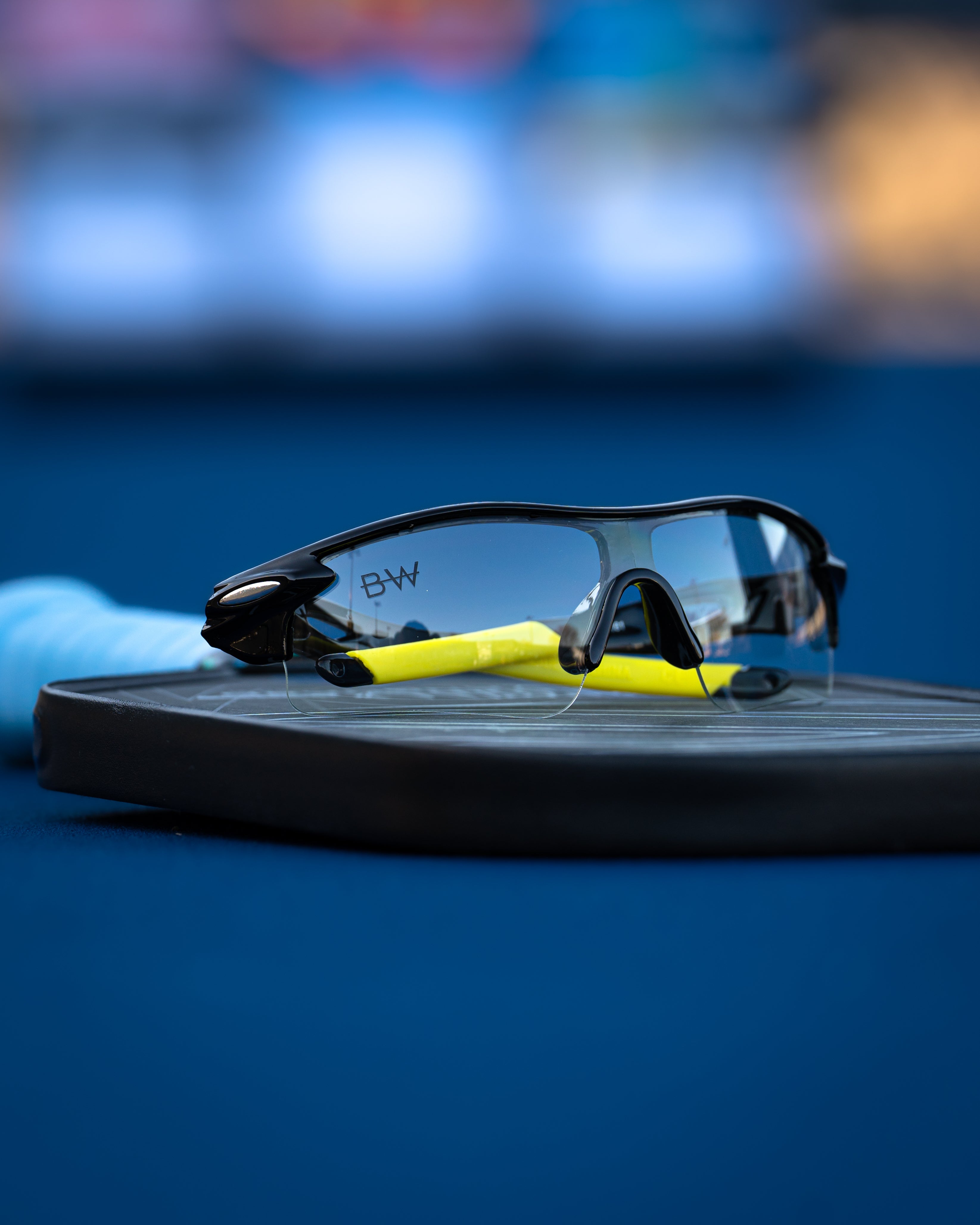
The RX Upgrade Racquet & Paddle Athletes Are Raving About
Share
Is Your Eyewear Keeping Up With Your Game?
You've upgraded your paddle. You've experimented with different racquet strings. You've spent hours practicing your serve, improving your footwork, and working on your consistency.
But when was the last time you evaluated the glasses you wear on the court?
For athletes who need prescription vision correction, eyewear deserves the same careful consideration as other equipment.
Pickleball, tennis, and padel involve rapidly changing ball positions, frequent head movements, and different lighting environments. Clear, appropriate vision correction is important for participating comfortably in these activities.
Yet some players continue using everyday glasses that don't fit securely during movement, contact lenses they find uncomfortable, or non-prescription sunglasses that don't correct their vision.
That raises an important question: Would upgrading your prescription eyewear make your time on the court more comfortable and practical?
The answer depends on your prescription, current eyewear, playing conditions, and individual needs.
At Blinded Wear Co., we offer prescription eyewear options for pickleball enthusiasts and other active individuals.
This guide explains what to consider when upgrading to RX eyewear for racquet and paddle sports, how to evaluate different lens technologies, and which Blinded Wear frames are worth comparing.
We'll also cover important limitations, including why sports-oriented styling does not automatically mean a frame provides certified impact protection.
Explore the collection: Blinded Wear Prescription Pickleball Glasses.
Quick Answer: Are Prescription Sports Glasses Worth Upgrading To?
Prescription sports glasses may be worth upgrading to if your current eyewear provides inadequate vision correction, fits poorly during movement, causes discomfort, or doesn't suit your playing environment.
However, a new pair of RX glasses does not automatically improve reaction time, shot accuracy, or athletic performance.
The goal is to obtain appropriate visual correction and eyewear that meets your practical needs.
Five Reasons to Consider an RX Eyewear Upgrade
- More appropriate prescription correction: Particularly if your current glasses no longer match your visual needs.
- Better-fitting frames: A different design may provide a more comfortable or stable fit during activity.
- Suitable outdoor lenses: Appropriate tints and documented UV protection may improve comfort in bright conditions.
- Reduced reliance on uncomfortable contacts: Prescription glasses may offer an alternative for some contact lens wearers.
- Activity-specific protection: Certified protective eyewear may be appropriate when a sport presents an impact risk.
The right upgrade depends on identifying which problem your current eyewear fails to solve.
Explore This RX Eyewear Upgrade Guide
Why Racquet and Paddle Athletes Are Reconsidering Their Prescription Eyewear
Pickleball, tennis, and padel all require players to observe moving objects, judge distances, and respond to changing situations.
Appropriate vision correction is therefore an important part of participating in these sports.
But vision correction isn't the only consideration.
Frame fit, lens transmission, comfort, and protective requirements can also influence whether a particular pair of glasses is suitable for the court.
1. Accurate Prescription Correction Matters
If you have a refractive error, properly prescribed lenses can help correct the blur associated with that condition.
For example, nearsightedness can make distant objects appear blurry, while astigmatism may affect image clarity at different distances.
Wearing an outdated or inappropriate prescription may leave your vision less clear than it could be with suitable correction.
However, accurate prescription correction should not be confused with a guarantee of improved athletic performance.
2. Court Sports Involve Frequent Head Movement
Racquet and paddle sports often involve looking up, down, and sideways while moving around the playing area.
Glasses that slip excessively or feel uncomfortable during these movements can become distracting.
A properly fitted frame may be more practical than one selected solely for appearance.
Fit depends on frame dimensions, bridge construction, temple design, and the individual wearer.
3. Different Courts Create Different Lighting Challenges
An indoor pickleball facility may have overhead artificial lighting, while an outdoor tennis court may be exposed to direct sunlight.
Padel courts may include glass walls and changing reflections.
These environments can create different visibility and comfort considerations.
Lens selection should reflect the conditions where you actually play.
4. Contact Lenses Aren't Everyone's Preferred Solution
Some athletes enjoy the convenience and unobstructed frame-free experience of contact lenses.
Others experience dryness, irritation, handling difficulties, or simply prefer glasses.
Prescription eyewear can be an alternative when appropriate.
Neither glasses nor contact lenses are universally better for every athlete.
5. Eye Protection Requires Separate Attention
Pickleball, tennis, and padel can involve accidental contact with balls, paddles, racquets, or other equipment.
Ordinary prescription sunglasses should not automatically be treated as protective sports eyewear.
If impact protection is important, verify that the complete eyewear assembly meets an appropriate standard for the activity.
For certain racquet and paddle sports applications, ASTM F803 may be relevant.
Lens impact resistance alone is not equivalent to certification of the entire frame-and-lens assembly.
6. Eyewear Can Be Part of an Athlete's Overall Equipment Setup
Players routinely evaluate footwear, grips, paddles, racquets, and clothing.
Prescription eyewear deserves a similar assessment when vision correction is necessary.
The goal isn't to purchase the most expensive product.
It's to choose equipment that meets your actual requirements.
Key takeaway: A worthwhile RX upgrade addresses a specific vision, fit, comfort, lighting, or protection need—not simply the desire for a newer frame.
Seven Signs Your Current Glasses May Not Be Right for Racquet and Paddle Sports
Before buying new prescription eyewear, evaluate how your current glasses perform during everyday activities and on the court.
These signs may indicate that an adjustment, updated prescription, or different eyewear configuration is worth considering.
1. Distant Objects Appear Blurry
If you struggle to see distant court markings or other objects clearly, your prescription may need evaluation.
Blur can have multiple causes, so an eye-care professional should assess persistent changes in vision.
2. Your Glasses Slide During Movement
Frames that frequently shift when you turn your head or move quickly may not fit appropriately.
A professional adjustment or different frame design may help, depending on the cause.
3. Your Frames Create Pressure or Discomfort
Excessive pressure around the nose, ears, or temples can make prolonged wear uncomfortable.
Frame dimensions and construction should be evaluated.
4. Your Outdoor Lenses Don't Suit Bright Conditions
Bright sunlight can make outdoor activities uncomfortable for some wearers.
Prescription sunglasses with appropriate lens transmission and documented UV protection may be worth considering.
5. Your Lenses Are Too Dark Indoors
Dark sunglasses can reduce visibility excessively in indoor or low-light environments.
If you regularly move between indoor and outdoor courts, separate lens configurations may be more practical.
6. Your Contact Lenses Frequently Feel Uncomfortable
Contact lens discomfort may warrant a discussion with your eye-care professional.
Depending on your needs, prescription glasses may provide an alternative for certain activities.
7. You Need Sports Protection Your Current Glasses Don't Provide
If you need certified impact protection, ordinary everyday frames may not be suitable.
Verify the protective requirements of your sport and select appropriately rated eyewear.
Should You Replace Your Glasses Immediately?
Not necessarily.
Some problems can be addressed through frame adjustment, lens cleaning, or an updated prescription.
Others may require a different frame or specialized eyewear.
Identify the underlying problem before spending money on an upgrade.
Pickleball vs. Tennis vs. Padel: What Changes When Choosing RX Eyewear?
These sports share certain visual demands, but their playing environments and equipment differ.
Understanding those differences can help you choose a more appropriate eyewear configuration.
Prescription Glasses for Pickleball
Pickleball involves short exchanges near the kitchen line, longer baseline rallies, and frequent changes in ball direction.
Players may move between indoor recreation centers and outdoor courts.
What to Evaluate
- Appropriate prescription correction.
- Frame comfort and retention during movement.
- Lens transmission for indoor or outdoor conditions.
- Documented UV protection for outdoor play.
- Applicable sports impact protection when required.
Useful resource: Best Pickleball Glasses of 2026.
Prescription Glasses for Tennis
Tennis frequently involves longer-distance ball tracking, overhead serves, lateral movement, and changing sun angles.
Players may encounter direct sunlight, shade, and varying court surfaces.
What to Evaluate
- Accurate distance correction.
- Comfortable frame fit during rapid movement.
- Outdoor lens specifications.
- Appropriate protective eyewear when necessary.
- Lens characteristics suited to the actual lighting environment.
Prescription Glasses for Padel
Padel combines racquet play with enclosed courts, glass walls, and rebounds.
Depending on the venue, players may encounter reflected light from glass surfaces or overhead lighting.
What to Evaluate
- Appropriate prescription correction.
- Frame retention during movement.
- Lens suitability for reflections and lighting.
- Impact protection appropriate to the activity.
- Comfort during repeated head movements.
Comparison: RX Eyewear Considerations Across Three Sports
| Consideration | Pickleball | Tennis | Padel |
|---|---|---|---|
| Typical environments | Indoor and outdoor courts. | Indoor and outdoor courts. | Enclosed courts, indoor and outdoor venues. |
| Movement | Quick lateral steps and short exchanges. | Running, lateral movement, and overhead actions. | Directional changes and rebound-based play. |
| Lighting considerations | Indoor illumination and outdoor sunlight. | Sun angles, shade, and court conditions. | Reflections and venue lighting. |
| Prescription needs | Individual correction requirements. | Individual correction requirements. | Individual correction requirements. |
| Protective considerations | Ball and paddle impact risks. | Ball and racquet impact risks. | Ball, racquet, and court-environment risks. |
Important: No single frame or lens configuration should be assumed appropriate for all three sports without checking its specifications and protective suitability.
Prescription Sports Glasses vs. Contact Lenses: Which Is Better for Racquet Athletes?
For athletes who need vision correction, glasses and contact lenses are two common options.
Both can be appropriate, but they offer different advantages and limitations.
Why Some Athletes Prefer Contact Lenses
Contact lenses move with the eyes and eliminate the need for a spectacle frame.
They may be convenient for people who dislike wearing glasses during physical activity.
However, contact lenses require appropriate hygiene, handling, and replacement practices.
Some wearers also experience dryness or discomfort.
Why Some Athletes Prefer Prescription Glasses
Prescription glasses do not sit directly on the eye and may be easier for some people to put on and remove.
They can also incorporate suitable lens tints or other available optical features.
However, glasses may shift during movement, fog under certain conditions, or require separate protective considerations.
What About Prescription Sports Goggles?
For activities where certified impact protection is important, appropriately rated prescription sports goggles may be worth considering.
These are not necessarily interchangeable with ordinary prescription sunglasses.
Glasses vs. Contacts vs. Protective Sports Eyewear
| Feature | Prescription Glasses | Contact Lenses | Certified Prescription Sports Eyewear |
|---|---|---|---|
| Vision correction | Yes, with appropriate prescription. | Yes, with appropriate prescription. | Yes, with appropriate prescription. |
| Frame on face | Yes. | No. | Yes. |
| Potential for frame movement | Depends on fit and activity. | Not applicable. | Depends on protective design and fit. |
| Lens tint options | Depends on product. | Not equivalent to prescription sunglasses. | Depends on certified product. |
| Impact protection | Not automatically certified. | Does not protect the eye from impacts. | Depends on documented certification. |
| Care requirements | Lens and frame maintenance. | Contact lens hygiene and replacement. | Lens, frame, and protective assembly maintenance. |
Can Prescription Glasses Replace Contact Lenses for Sports?
For some athletes, yes.
However, the appropriate choice depends on prescription needs, comfort, visual requirements, and the sport involved.
If you're considering changing your vision correction method, consult your eye-care professional when necessary.
Key takeaway: Neither glasses nor contact lenses are universally superior. Choose based on your visual needs, comfort, and protective requirements.
Eight RX Eyewear Features Worth Evaluating Before Your Next Purchase
Sports eyewear marketing frequently highlights advanced lenses, athletic designs, and performance benefits.
Some features can be useful, but their value depends on the wearer and intended activity.
1. Prescription Accuracy
The most important consideration is whether the lenses provide the correction you need.
An attractive frame cannot compensate for an unsuitable prescription.
2. Frame Fit and Retention
Review frame dimensions, bridge construction, temple design, and suitability for movement.
Do not assume a frame will remain secure simply because it is marketed toward active individuals.
3. Appropriate Lens Material
Lens materials differ in optical characteristics, weight, thickness, and impact properties.
The best choice depends on prescription requirements and intended use.
High-index materials can help reduce lens thickness for certain prescriptions, but high-index does not automatically establish superior sports impact protection.
4. UV Protection for Outdoor Play
Outdoor athletes should consider lenses with documented protection against harmful ultraviolet radiation.
Dark tint alone does not establish adequate UV protection.
5. Appropriate Visible-Light Transmission
Visible-light transmission describes how much visible light passes through a lens.
Dark sunglass lenses may be useful in bright conditions but unsuitable for indoor play.
Choose a configuration suited to the actual environment.
6. Anti-Reflective and Other Lens Treatments
Anti-reflective treatments can reduce certain reflections from lens surfaces.
Other available treatments may address water repellency, scratch resistance, or fogging.
However, no coating should be assumed to eliminate glare, scratches, or fogging completely.
7. Prescription Compatibility
Some frame shapes and lens designs may be more difficult to accommodate for certain prescriptions.
Strong prescriptions, astigmatism, and multifocal requirements can introduce additional considerations.
Confirm compatibility before ordering.
8. Verified Protective Certification
When impact protection is required, evaluate the complete eyewear assembly rather than relying on marketing terms such as "sports-ready" or "impact-resistant."
Check for documentation supporting the applicable protective standard.
Which Features Should You Prioritize?
| Your Main Concern | What to Evaluate | What Not to Assume |
|---|---|---|
| Blurry distance vision | Current prescription and optical correction. | That a premium frame fixes an outdated prescription. |
| Glasses slipping | Frame measurements and retention. | That all sports-styled frames fit securely. |
| Bright outdoor courts | Lens transmission and UV specifications. | That dark tint guarantees UV protection. |
| Indoor courts | Adequate light transmission. | That dark sunglasses are appropriate indoors. |
| Strong prescription | Frame geometry and lens material. | That high-index is always the best sports material. |
| Impact risk | Relevant protective certification. | That ordinary RX sunglasses are protective goggles. |
Five Myths About Prescription Sports Glasses That Athletes Should Know
Myth 1: RX Glasses Automatically Improve Reaction Time
Appropriate prescription correction can help address blur caused by refractive errors.
However, that does not establish that a particular pair of glasses will make every athlete react faster.
Reaction time depends on multiple factors, including attention, anticipation, decision-making, and motor response.
Myth 2: More Expensive RX Glasses Always Provide Better Vision
Price alone does not establish optical quality, fit, or suitability.
Compare actual prescription specifications and product features.
Myth 3: All Sports Sunglasses Protect Against Ball Impacts
Sports styling does not automatically mean eyewear meets an impact-protection standard.
Verify certification of the complete assembly when protection is needed.
Myth 4: One Lens Tint Is Best for Every Court
Lighting varies between indoor and outdoor facilities.
A tint that feels comfortable in bright sunlight may reduce visibility too much indoors.
Myth 5: Anti-Fog and Anti-Glare Coatings Eliminate Every Visibility Problem
Lens treatments have different purposes and limitations.
Anti-reflective coatings address certain surface reflections, while anti-fog treatments are intended to reduce condensation-related fogging.
Neither is a universal solution for every condition.
The better approach: Identify the problem you want to solve, then choose verified features that address it.
Meet the Nine Blinded Wear RX Models Featured in This Guide
Once you understand what matters in prescription eyewear, the next step is comparing available frame designs.
The following nine Blinded Wear models appeared in the original guide and provide a starting point for exploring different RX eyewear styles.
We'll examine each model's visual appeal, potential use cases, and important buying considerations in Part 2.
- Ocean Wave RX
- Heatseek RX
- Runway RX
- Cold Slate RX
- Steel Ice RX
- Havana White RX
- Silver Line RX
- Crystal Wave II RX
- Blue Ghost RX
Each model should be evaluated using its current product specifications, prescription compatibility, available lenses, and intended use.
1. Ocean Wave RX: A Prescription Eyewear Option for Players Who Want a Distinctive Court Look
When shopping for prescription eyewear for pickleball, tennis, or padel, the first step is identifying what you need your glasses to accomplish.
Some athletes prioritize comfort during recreational play. Others want prescription sunglasses for bright outdoor courts. Some simply prefer a particular frame appearance.
Ocean Wave RX is one Blinded Wear model worth exploring if you're interested in prescription eyewear with a sport-inspired aesthetic.
Why Consider Ocean Wave RX?
Ocean Wave RX may appeal to shoppers who want an alternative to conventional everyday prescription frames.
For athletes who regularly wear prescription eyewear, finding a frame that complements their active wardrobe can make the purchase more appealing.
However, appearance should be evaluated separately from the frame's technical characteristics.
What to Check Before Buying Ocean Wave RX
- Prescription compatibility: Confirm that your current eyeglass prescription can be accommodated.
- Frame dimensions: Compare measurements with glasses you already wear comfortably.
- Lens configuration: Review the available clear, tinted, or other options on the product page.
- Outdoor suitability: Verify documented UV protection and visible-light transmission if you play outside.
- Sports protection: Check whether the complete eyewear assembly has any applicable impact certification.
Could Ocean Wave RX Work for Pickleball and Tennis?
Potentially, depending on the selected configuration and your individual requirements.
Both sports involve movement, changing viewing distances, and possible impacts from equipment.
Before using any prescription eyewear for either activity, assess frame retention and protective suitability.
What About Semi-Rimless Frames?
The earlier version of this guide described Ocean Wave RX as having a semi-rimless design.
If that construction remains part of the current model, it may influence the frame's appearance and the amount of frame material visible near the lower lens area.
However, semi-rimless construction does not automatically guarantee a wider usable field of view, better impact resistance, or greater comfort.
Review current product photographs and specifications before relying on a particular construction detail.
Who Should Explore Ocean Wave RX?
- Pickleball players looking for a sport-inspired prescription eyewear style.
- Tennis enthusiasts comparing RX sunglasses for outdoor recreation.
- People who prefer a distinctive alternative to ordinary everyday frames.
- Buyers willing to evaluate lens options and fit before purchasing.
Buying takeaway: Ocean Wave RX is a model to compare based on its appearance, current specifications, and compatibility with your intended activity—not on promises of faster reactions or guaranteed improvements in play.
2. Heatseek RX: Prescription Eyewear for Players Evaluating Outdoor Court Comfort
Outdoor racquet and paddle sports introduce lighting conditions that can differ substantially from indoor recreation.
Direct sunlight, reflections, and changes in brightness can influence which prescription lens configuration feels appropriate.
Heatseek RX is another Blinded Wear RX model worth comparing when shopping for an outdoor-oriented eyewear setup.
Why Outdoor Players Should Think Beyond Frame Appearance
Choosing prescription sunglasses involves more than selecting a frame that looks athletic.
The lens configuration matters because it determines how much visible light passes through the eyewear.
Some lenses are better suited to bright sunlight, while others may be more appropriate for overcast or indoor conditions.
There is no universally ideal tint for every court.
What to Evaluate With Heatseek RX
- Available prescription lenses: Confirm which configurations can be ordered.
- UV specifications: Verify documented protection for outdoor use.
- Tint suitability: Consider whether the available lens options match your typical court lighting.
- Frame retention: Evaluate the design and fit for movement.
- Protective requirements: Confirm applicable impact certification when needed.
Do High-Contrast Lenses Improve Ball Tracking?
Certain lens tints can change the perceived contrast between objects and their backgrounds.
However, whether a particular tint is useful depends on the lens characteristics, lighting, court colors, and individual wearer.
A high-contrast marketing description does not establish that a lens will improve ball tracking for every athlete.
Should You Choose Heatseek RX for Indoor Play?
That depends on the available lens configuration.
Dark prescription sunglasses may reduce visibility too much for indoor environments.
If you play primarily indoors, verify that an appropriate lens option is available before ordering.
Who Should Explore Heatseek RX?
- Outdoor pickleball players comparing prescription sunglasses.
- Tennis players who frequently play in bright conditions.
- Buyers interested in an athletic eyewear aesthetic.
- People who want to compare lens choices for their specific playing environment.
Buying takeaway: Heatseek RX is worth evaluating if outdoor comfort is a priority, but the actual lens specifications should guide the decision.
3. Runway RX: A Style-Focused Option for Recreational Racquet and Paddle Athletes
Not every athlete wants eyewear that looks like traditional protective sports goggles.
Some prefer a prescription frame that complements athletic clothing while remaining suitable for ordinary everyday situations.
Runway RX is a model to explore if that balance is important to you.
Why Everyday Versatility Matters
Recreational players may wear their glasses before arriving at the court, during social activities, and after finishing a match.
A frame that complements different outfits can therefore have appeal beyond the playing environment.
However, visual versatility should not be confused with technical suitability for every sport.
What to Evaluate With Runway RX
- Frame dimensions: Review the fit measurements.
- Lens coverage: Compare lens shape and size with your needs.
- Prescription compatibility: Confirm the model accommodates your prescription.
- Lighting: Select an available lens configuration suitable for your primary environment.
- Protective suitability: Verify certification when impact protection is required.
Are Wraparound Prescription Glasses Better for Sports?
Wraparound designs can offer a different fit and coverage profile than flatter frames.
However, stronger frame curvature can also introduce prescription lens design considerations.
Not every prescription is equally straightforward to accommodate in every wraparound frame.
Check compatibility rather than assuming a particular shape will be ideal.
Could Runway RX Work for Doubles Players?
Potentially, provided the selected eyewear meets the player's visual and protective needs.
Doubles play involves communication, movement, and frequent changes in ball direction.
Those requirements do not make any one frame automatically superior.
Who Should Explore Runway RX?
- Recreational pickleball and tennis players.
- Buyers interested in sport-inspired prescription eyewear.
- People who want a frame that complements everyday clothing.
- Shoppers comparing different frame shapes and prescription configurations.
Buying takeaway: Runway RX may appeal to players seeking an athletic-to-everyday eyewear style. Evaluate its actual dimensions and lens options before purchasing.
4. Cold Slate RX: Modern Prescription Eyewear for Indoor and Outdoor Lifestyles
Many pickleball and tennis enthusiasts play at more than one facility.
They may practice indoors during the week and play outdoors on weekends.
This makes lens versatility an important consideration.
Cold Slate RX is worth comparing if you prefer a cool-toned eyewear aesthetic and regularly move between different environments.
Why Changing Light Conditions Matter
Indoor and outdoor courts can have very different lighting levels.
Dark lenses that feel comfortable in bright sunlight may be unsuitable inside a gym.
Conversely, clear lenses that work well indoors may not provide the brightness management you prefer outdoors.
Can One Pair Handle Both Environments?
Sometimes.
It depends on the available lenses and the wearer's needs.
Photochromic lenses may provide additional convenience in certain changing-light situations, but their activation and performance vary.
Do not assume Cold Slate RX includes photochromic functionality unless it is specifically offered for the selected configuration.
What to Check Before Ordering Cold Slate RX
- Current lens options.
- Prescription compatibility.
- Frame measurements.
- Documented UV protection where relevant.
- Suitability for indoor lighting.
- Applicable impact certification.
What Makes Cool-Toned Frames Appealing?
Gray and slate-inspired eyewear can complement black, white, navy, and other neutral athletic clothing.
This makes the style worth exploring for people who want a contemporary look without a particularly bold color combination.
Who Should Explore Cold Slate RX?
- Players who alternate between indoor and outdoor facilities.
- Buyers who prefer modern neutral eyewear styling.
- People comparing prescription configurations for different lighting environments.
- Shoppers who want sport-inspired glasses that complement casual clothing.
Buying takeaway: Cold Slate RX is worth exploring for its aesthetic and available RX options, but changing-light suitability depends on the actual lenses selected.
5. Steel Ice RX: Prescription Eyewear for Players Who Prefer a Contemporary Athletic Look
Some racquet and paddle athletes prefer eyewear with a modern, cool-toned appearance.
Gray, silver-inspired, and neutral finishes can complement a wide range of athletic outfits.
Steel Ice RX is a model worth considering if that visual style appeals to you.
Why Style Still Matters
Eyewear is something many prescription wearers use frequently.
Choosing a frame you enjoy wearing can be an important part of the purchase decision.
However, style should come after prescription accuracy, fit, lens suitability, and protective requirements.
What to Evaluate With Steel Ice RX
- Frame construction: Review current materials and dimensions.
- Prescription compatibility: Confirm that your prescription can be accommodated.
- Outdoor lens options: Check current tint and UV specifications.
- Fit: Consider comfort during movement.
- Durability: Review documented material information rather than relying on appearance.
- Impact protection: Verify applicable certification if required.
Are Mirrored Prescription Sunglasses Better for Bright Courts?
Mirror coatings can influence light reflection and create a distinctive appearance.
However, a mirrored finish does not automatically establish superior glare reduction, polarization, or UV protection.
The underlying lens tint and optical specifications remain important.
Can Steel Ice RX Withstand Diving or Accidental Impacts?
Do not assume a frame is suitable for diving, falls, or direct impacts without supporting test information.
The earlier article described Steel Ice RX as exceptionally durable, but that claim should not be treated as verified without appropriate documentation.
For activities involving potential impacts, choose eyewear with relevant protective certification.
Who Should Explore Steel Ice RX?
- Outdoor players comparing prescription sunglass styles.
- Buyers who prefer gray or metallic-inspired eyewear.
- People who want a modern athletic aesthetic.
- Shoppers willing to verify lens and protective specifications.
Buying takeaway: Steel Ice RX is worth comparing for its visual style and current product options, not for unverified claims of impact resistance.
6. Havana White RX: A Prescription Frame for Players Who Want Sport-Inspired Everyday Style
Prescription eyewear doesn't have to look identical to traditional athletic equipment.
Some players prefer frames that complement recreational clothing, travel outfits, and everyday accessories.
Havana White RX is one model worth exploring for that type of lifestyle.
Why Athletic-to-Everyday Styling Appeals to Some Players
Many recreational pickleball and tennis players spend time socializing before and after their matches.
They may prefer eyewear that complements both athletic clothing and casual outfits.
A versatile visual design can therefore be a meaningful purchasing consideration.
What to Evaluate With Havana White RX
- Frame measurements and fit.
- Prescription compatibility.
- Available lens configurations.
- Outdoor UV specifications.
- Suitability for your primary activities.
- Applicable protective certification when needed.
Can One Frame Work for Sports and Travel?
Potentially, depending on the activities involved.
For walking, sightseeing, and ordinary recreational use, prescription eyewear with suitable lenses may be practical.
For higher-impact activities, dedicated protective eyewear may be more appropriate.
Does Havana White RX Fit Every Face Shape?
No single frame should be assumed to fit every face comfortably.
Fit depends on facial dimensions, bridge shape, temple length, and individual preferences.
Compare the current measurements with eyewear you already wear comfortably.
Who Should Explore Havana White RX?
- Recreational athletes who prefer lifestyle-oriented eyewear.
- Buyers seeking prescription glasses that complement casual outfits.
- People comparing eyewear for everyday and outdoor activities.
- Shoppers who prioritize both appearance and practical fit.
Buying takeaway: Havana White RX is worth considering if visual versatility is important, provided its actual specifications meet your needs.
7. Silver Line RX: A Prescription Sunglass Option to Compare for Tournament-Day Needs
Tournament days can involve several hours at a venue, changes in weather, and different playing conditions.
For athletes who need prescription correction, planning their eyewear setup can be useful.
Silver Line RX is one model worth comparing when evaluating prescription sunglasses for recreational or tournament-related use.
What Makes Tournament Eyewear Different?
Longer days may involve more time outdoors, periods of waiting between matches, and movement between shaded and sunny areas.
Eyewear should be selected according to the conditions in which it will actually be worn.
What to Check With Silver Line RX
- Frame sizing: Compare the current measurements with your preferred fit.
- Lens transmission: Determine whether the selected lenses suit your court lighting.
- Prescription compatibility: Confirm your prescription can be accommodated.
- UV specifications: Verify documented protection for outdoor use.
- Lens treatments: Check which coatings are actually included or available.
- Protective certification: Verify suitability for the intended activity.
Are Anti-Fog Lenses Necessary for Tournaments?
Fogging can occur when moisture condenses on a lens surface.
Whether anti-fog treatment is useful depends on the environment, eyewear design, and wearer.
No anti-fog treatment should be assumed to prevent fogging completely.
Check current product specifications before assuming Silver Line RX includes a particular coating.
Are Scratch-Resistant Lenses Scratchproof?
No.
Scratch-resistant coatings can help reduce certain surface damage, but they do not make lenses immune to scratches.
Appropriate cleaning and storage remain important.
Who Should Explore Silver Line RX?
- Outdoor pickleball enthusiasts.
- Players planning longer recreational or tournament days.
- Buyers comparing prescription sunglasses with different frame styles.
- People who want to evaluate current lens-treatment options.
Buying takeaway: Silver Line RX is worth exploring as part of an outdoor prescription eyewear comparison. Select based on verified specifications rather than assumptions about all-day adaptability.
8. Crystal Wave II RX: A Prescription Eyewear Option for Players Who Prefer Minimalist Styling
Some players want their eyewear to be visually understated.
They may prefer a frame that complements their clothing without becoming the main focal point of an outfit.
Crystal Wave II RX is worth exploring if minimalist prescription eyewear styling appeals to you.
Does Minimalist Eyewear Offer Better Vision?
Not automatically.
Frame appearance alone does not establish optical quality, field of view, or prescription accuracy.
The actual lens design, frame dimensions, and position relative to the eyes all matter.
What to Evaluate With Crystal Wave II RX
- Prescription compatibility.
- Frame measurements.
- Lens dimensions and coverage.
- Available tints and treatments.
- Comfort during your intended activities.
- Protective certification if required.
Can Prescription Lenses Help You See Spin More Clearly?
Appropriate prescription correction can address refractive blur.
However, the ability to perceive spin and anticipate ball movement also depends on lighting, attention, experience, and other factors.
There is no basis for claiming that one specific frame automatically provides superior spin tracking without supporting evidence.
What About Peripheral Vision?
Frame shape and lens dimensions can influence how much of the wearer's view is obstructed by the frame.
However, the usable field of view depends on the complete optical configuration.
Do not assume a minimalist frame automatically provides the widest field of view.
Who Should Explore Crystal Wave II RX?
- Players who prefer understated eyewear.
- Buyers comparing minimalist prescription frame designs.
- People interested in athletic-to-everyday styling.
- Shoppers who want to compare lens dimensions and frame fit.
Buying takeaway: Crystal Wave II RX is worth exploring for its styling and current prescription options, not for unverified claims about enhanced peripheral vision or ball tracking.
9. Blue Ghost RX: A Distinctive Prescription Eyewear Style for Racquet and Paddle Enthusiasts
Some athletes prefer eyewear with a bold or distinctive appearance.
Color and styling can help a pair of glasses complement athletic clothing and personal preferences.
Blue Ghost RX is one model worth exploring if you're interested in a blue-inspired prescription eyewear aesthetic.
What Makes Blue-Toned Eyewear Appealing?
Blue and cool-toned eyewear can complement navy, white, gray, black, and other common athletic clothing colors.
For some buyers, that visual appeal is an important reason to consider a particular frame.
Does Blue-Tinted Eyewear Block Harmful Light?
The appearance of a blue lens or coating does not establish its UV protection, blue-light filtering characteristics, or other optical properties.
Those features must be verified through the selected lens's actual specifications.
There is also no universal evidence-based reason to assume blue-tinted lenses are best for every racquet or paddle sport.
What to Evaluate With Blue Ghost RX
- Current prescription options.
- Frame fit and measurements.
- Lens tint and visible-light transmission.
- Documented UV protection for outdoor use.
- Suitability for indoor or evening conditions.
- Protective certification when required.
Can Blue Ghost RX Be Used for Evening Matches?
That depends on the selected lens configuration and available light.
Dark prescription sunglasses can reduce visibility excessively in evening or low-light conditions.
Do not assume that a blue appearance makes a lens appropriate for night or evening play.
Who Should Explore Blue Ghost RX?
- Players interested in distinctive prescription eyewear.
- Buyers who prefer blue or cool-toned accessories.
- Outdoor enthusiasts comparing prescription sunglass styles.
- Shoppers willing to review actual lens characteristics before purchasing.
Buying takeaway: Blue Ghost RX is worth considering for its appearance and available RX configurations, but lens color alone should not determine its suitability for a playing environment.
Blinded Wear RX Comparison: Nine Prescription Eyewear Models for Racquet and Paddle Athletes
With several prescription eyewear options available, it can be difficult to know where to begin.
The comparison below organizes the nine featured models by shopping interest and the specifications worth checking.
These are editorial buying considerations rather than verified rankings of athletic performance, durability, or protective certification.
| RX Model | Why Explore It? | What to Verify | Product |
|---|---|---|---|
| Ocean Wave RX | Sport-inspired prescription eyewear styling. | Construction, lens options, fit, and impact certification. | View model |
| Heatseek RX | Outdoor-oriented RX shopping comparison. | Tint, UV protection, prescription compatibility, and fit. | View model |
| Runway RX | Athletic-to-everyday frame styling. | Frame dimensions, curvature, lens compatibility, and intended use. | View model |
| Cold Slate RX | Modern neutral styling for active lifestyles. | Available lenses, indoor suitability, and frame fit. | View model |
| Steel Ice RX | Contemporary cool-toned athletic aesthetic. | Lens specifications, materials, and protective suitability. | View model |
| Havana White RX | Sport-inspired everyday versatility. | Frame measurements, prescription options, and fit. | View model |
| Silver Line RX | Prescription sunglass comparison for longer outdoor days. | Lens treatments, transmission, sizing, and UV specifications. | View model |
| Crystal Wave II RX | Minimalist prescription eyewear styling. | Lens dimensions, optical compatibility, and protective certification. | View model |
| Blue Ghost RX | Distinctive blue-inspired prescription eyewear. | Lens tint, visible-light transmission, UV specifications, and fit. | View model |
Which RX Glasses Should Outdoor Pickleball Players Compare?
Start with models whose current product pages offer prescription lens configurations appropriate for outdoor use.
Ocean Wave RX, Heatseek RX, Steel Ice RX, and Silver Line RX are among the featured models worth investigating.
Compare documented UV protection, lens transmission, fit, and any applicable protective certification.
Which RX Glasses Should Indoor Players Compare?
Indoor players should prioritize lenses that allow sufficient visible light for their environment.
Runway RX, Cold Slate RX, and Crystal Wave II RX are models worth reviewing, provided appropriate lens configurations are available.
Do not assume any model includes clear or low-light lenses without checking its current options.
Which RX Glasses Are Worth Exploring for Everyday Wear?
Runway RX, Havana White RX, Cold Slate RX, and Crystal Wave II RX offer different visual styles to compare.
The best choice depends on personal preferences, fit, and the lens configuration.
Which RX Glasses Are Best for Strong Prescriptions?
There is no universally best model for strong prescriptions.
Frame size, curvature, lens shape, and the exact prescription can influence compatibility and finished lens thickness.
Blinded Wear includes high-index prescription lenses at no additional cost with RX eyewear, but confirm the appropriate material and configuration for your needs.
Which RX Glasses Are Best for Sports Impact Protection?
Choose eyewear with documented certification appropriate to the activity.
No featured model should be assumed to meet ASTM F803 or another protective standard without supporting documentation.
Should You Choose Based on Frame Color or Lens Color?
Both can matter, but they serve different purposes.
Frame color primarily influences appearance.
Lens tint and other optical characteristics influence how much light passes through the eyewear and how the wearer perceives the environment.
Prioritize visual needs before appearance.
How to Choose Prescription Lenses for Pickleball, Tennis, and Padel
Choosing the right prescription frame is only part of an eyewear upgrade. The lenses you select determine how your glasses correct your vision and how suitable they are for different lighting conditions.
Racquet and paddle athletes should consider prescription accuracy, visible-light transmission, UV protection, lens material, and any protective requirements before purchasing.
There is no single prescription lens configuration that is best for every player or court.
Clear Prescription Lenses for Indoor Courts
Indoor pickleball, tennis, and padel facilities often have artificial lighting and lower overall brightness than outdoor courts.
Clear prescription lenses are a practical option for many indoor environments because they do not substantially reduce visible-light transmission through a dark tint.
However, clear lenses are not automatically certified protective eyewear.
If your sport or playing environment requires impact protection, verify the complete eyewear assembly's applicable certification.
Gray Prescription Sunglasses for Bright Outdoor Courts
Gray-tinted prescription sunglasses are commonly used in bright outdoor conditions.
They reduce visible-light transmission while generally preserving relatively neutral color perception.
Some players prefer gray lenses when moving between different court colors and backgrounds.
However, the actual usefulness of a gray tint depends on its transmission characteristics, the environment, and the individual wearer.
Gray tint alone does not establish UV protection or impact certification.
Brown and Amber Prescription Lenses for Outdoor Play
Brown and amber lenses can alter perceived contrast and color relationships.
Some athletes prefer these tints in certain outdoor environments.
For example, a player may find one tint more comfortable against a particular court surface or background than another.
However, no lens color should be assumed to improve ball tracking, depth perception, or reaction time for every athlete.
Polarized Prescription Sunglasses for Reflected Glare
Polarized lenses are designed to reduce certain types of reflected glare.
They may be useful in environments with reflective surfaces.
However, polarization can affect the visibility of some electronic displays and may change how certain surfaces appear.
Polarization is not automatically preferable for every racquet or paddle sport.
It also does not establish UV protection or sports impact certification.
Photochromic Prescription Lenses for Changing Light
Photochromic lenses change their tint in response to environmental conditions, depending on the specific technology.
They may provide convenience for some people who move between indoor and outdoor environments.
However, activation varies with temperature, UV exposure, lens formulation, and other factors.
Not every photochromic lens becomes sufficiently dark for every bright outdoor environment.
Check whether the selected Blinded Wear RX product offers a compatible photochromic option before ordering.
High-Index Prescription Lenses for Stronger Prescriptions
High-index lens materials can reduce lens thickness compared with certain lower-index alternatives for some prescriptions.
This may be particularly relevant for athletes with stronger prescriptions.
However, the finished thickness and weight depend on prescription strength, frame dimensions, lens shape, and material characteristics.
Blinded Wear includes high-index prescription lenses at no additional cost with RX eyewear.
High-index does not automatically mean a lens provides superior impact protection.
Prescription Lens Comparison for Racquet and Paddle Sports
| Lens Configuration | Potential Application | Primary Consideration | Important Limitation |
|---|---|---|---|
| Clear RX | Indoor courts and everyday use. | Appropriate prescription correction. | Does not automatically provide impact certification. |
| Gray tint | Bright outdoor courts. | Visible-light transmission. | May be unsuitable indoors. |
| Brown or amber tint | Selected outdoor conditions. | Individual contrast preference. | No guaranteed athletic-performance improvement. |
| Polarized | Environments with certain reflected glare. | Glare characteristics and activity. | Can affect some displays and reflections. |
| Photochromic | Some changing-light environments. | Tint activation and available options. | Response varies by conditions and technology. |
| High-index | Prescription thickness management. | Prescription and frame compatibility. | Not equivalent to impact certification. |
Important: These are general lens categories, not a statement that every Blinded Wear RX model offers every configuration.
For additional guidance, explore the Blinded Wear Performance Lens Guide.
Which RX Eyewear Setup Makes Sense for Your Playing Conditions?
Instead of searching for a universally superior pair of prescription sports glasses, start by identifying where you play most often.
Scenario 1: Indoor Pickleball Player
You primarily play at recreation centers or indoor pickleball facilities.
Your biggest considerations may include adequate light transmission, prescription accuracy, frame comfort, and appropriate protective eyewear.
What to prioritize: Clear or otherwise suitable lenses for indoor conditions, an appropriate fit, and verified impact protection when needed.
Scenario 2: Outdoor Tennis Player
You frequently play in bright sunlight and encounter changing sun angles throughout matches.
Prescription sunglasses may be useful if they provide appropriate optical correction and suitable light transmission.
What to prioritize: Documented UV protection, suitable lens tint, comfortable fit, and any applicable protective requirements.
Scenario 3: Padel Player at an Enclosed Court
Your playing environment may include glass walls, overhead lighting, and changing reflections.
The appropriate eyewear configuration depends on whether the facility is indoors or outdoors and the actual lighting conditions.
What to prioritize: Prescription accuracy, lens suitability, frame fit, and impact protection appropriate to the activity.
Scenario 4: Player Who Alternates Between Indoor and Outdoor Courts
You play indoors during the week and outdoors on weekends.
A single lens configuration may not be ideal for both environments.
What to prioritize: Consider whether separate clear prescription glasses and prescription sunglasses would better meet your needs.
Scenario 5: Athlete With a Strong Prescription
Your prescription may affect finished lens thickness and compatibility with certain frame shapes.
What to prioritize: Appropriate lens material, frame dimensions, prescription compatibility, and a professional assessment when necessary.
Scenario 6: Contact Lens Wearer Looking for an Alternative
You find contact lenses uncomfortable during certain activities or prefer not to wear them every time you play.
What to prioritize: Current eyeglass prescription correction, appropriate frame fit, and a lens configuration suited to the playing environment.
Remember that a contact lens prescription cannot simply be substituted for an eyeglass prescription.
Scenario 7: Competitive Player Concerned About Eye Impacts
You want eyewear appropriate for situations involving accidental ball, paddle, or racquet contact.
What to prioritize: Certified protective eyewear appropriate to your activity.
Do not assume ordinary prescription sunglasses meet protective requirements because they have an athletic appearance.
Is an RX Eyewear Upgrade Actually Worth It? A Practical Decision Framework
Not every athlete needs to purchase new prescription glasses.
Sometimes, the best solution is adjusting an existing frame, updating a prescription, or changing how eyewear is maintained.
Other situations may justify replacing the glasses entirely.
Start With the Problem You're Experiencing
| Current Problem | Possible First Step | When an Upgrade May Help |
|---|---|---|
| Blurry vision | Schedule an appropriate eye examination. | If updated prescription lenses are needed. |
| Frames slipping | Check fit and professional adjustment options. | If the frame design or dimensions are unsuitable. |
| Outdoor brightness | Evaluate appropriate sunglass lenses. | If your current glasses lack suitable outdoor lens options. |
| Indoor lenses too dark | Review visible-light transmission. | If a separate clear RX configuration is needed. |
| Contact lens discomfort | Discuss symptoms with your eye-care professional. | If prescription glasses are a suitable alternative. |
| Impact protection concerns | Identify the applicable protective standard. | If current eyewear does not meet that standard. |
| Scratched lenses | Assess the extent of damage and replacement options. | If scratches affect vision or lens usability. |
When Keeping Your Current Glasses Makes Sense
You may not need new eyewear if your prescription remains appropriate, your glasses fit comfortably, and the lenses and protective characteristics meet your intended requirements.
Buying a newer model solely because it is advertised as an athletic upgrade may not provide meaningful value.
When New RX Eyewear May Be Worth Considering
An upgrade may be worthwhile when your existing eyewear cannot reasonably address a genuine problem involving prescription correction, fit, lighting, or activity-specific protection.
The bottom line: A successful eyewear upgrade solves a real problem. It should not depend on promises of automatic improvements in athletic performance.
Should Racquet and Paddle Athletes Own One Pair or Two Pairs of RX Glasses?
For players who regularly alternate between different environments, one prescription eyewear configuration may not always be enough.
However, purchasing multiple pairs is not necessary for everyone.
When One Pair May Be Practical
A single pair may be sufficient when you play primarily in one lighting environment and the selected eyewear meets all relevant visual and protective requirements.
For example, an indoor recreational player may prefer one appropriately configured prescription eyewear setup.
When Two Pairs May Be More Useful
Separate prescription glasses and prescription sunglasses may be practical when you frequently play both indoors and outdoors.
This can allow each lens configuration to be selected for a particular lighting environment.
When Dedicated Protective Eyewear Is Necessary
Some athletes may need appropriately certified protective eyewear in addition to their everyday prescription glasses.
That decision should be based on the sport's requirements and the eyewear's verified certification.
One Pair vs. Two Pairs
| Factor | One Pair | Two Pairs |
|---|---|---|
| Initial purchase cost | May be lower. | Usually higher. |
| Convenience | Fewer items to manage. | Requires switching between pairs. |
| Indoor-outdoor flexibility | Depends on the selected lenses. | Allows different configurations for different conditions. |
| Backup availability | No separate backup unless already owned. | May provide a backup when appropriate. |
| Protective suitability | Must meet the intended activity's requirements. | Allows a dedicated protective pair if needed. |
Our recommendation: Start with your actual playing schedule. If one pair cannot meet your different lighting or protective needs, consider a second appropriate configuration.
Why High-Index Prescription Lenses Matter When Comparing RX Eyewear Prices
Prescription eyewear prices can vary depending on the frame, lens material, prescription requirements, and selected options.
For some wearers, high-index lenses are an important consideration because they can help manage lens thickness.
What Are High-Index Prescription Lenses?
High-index lenses use materials with a relatively high refractive index, allowing certain prescriptions to be produced with less thickness than some lower-index alternatives.
The degree of thickness reduction depends on the prescription and frame.
Do High-Index Lenses Always Improve Comfort?
Not necessarily.
Although a lens may be thinner, finished weight also depends on material density, dimensions, and frame construction.
Comfort depends on the complete eyewear setup.
Are High-Index Lenses Impact-Protective?
A high refractive index does not establish that a lens is certified for sports impacts.
Protective suitability must be evaluated separately.
Does Blinded Wear Charge Extra for High-Index RX Lenses?
Blinded Wear includes high-index prescription lenses at no additional cost with RX eyewear.
This is worth considering when comparing the total price of completed prescription glasses.
However, the best lens material still depends on your prescription and intended activity.
The 12-Point Prescription Eyewear Upgrade Checklist for Racquet and Paddle Athletes
Before purchasing new RX glasses, use this checklist to make sure the eyewear meets your practical requirements.
1. Confirm Your Current Prescription
Use an appropriate eyeglass prescription and consult your eye-care professional if your vision has changed.
2. Identify Your Primary Sport
Consider whether you mainly play pickleball, tennis, padel, or a combination of activities.
3. Evaluate Your Playing Environment
Determine whether you play indoors, outdoors, or in both environments.
4. Compare Frame Measurements
Review frame width, bridge dimensions, and temple length.
5. Consider Frame Retention
Evaluate whether the eyewear is likely to remain appropriately positioned during your typical movements.
6. Check Prescription Compatibility
Confirm the selected frame and lens configuration can accommodate your prescription.
7. Select Appropriate Lens Transmission
Choose lenses that suit the actual lighting conditions where you play.
8. Verify UV Protection for Outdoor Use
Review documented UV specifications rather than relying on lens darkness.
9. Verify Sports Impact Certification
When protective eyewear is required, confirm that the complete assembly meets the applicable standard.
10. Compare the Total RX Price
Review the complete price, including the frame, prescription lenses, and selected options.
11. Understand the Return and Replacement Policies
Customized Blinded Wear RX purchases are final sale. Review applicable replacement support and other terms before ordering.
12. Choose Eyewear That Solves Your Actual Problem
Prioritize appropriate vision correction, fit, comfort, and protection rather than unsupported performance claims.
Final checklist principle: The best prescription eyewear upgrade is the one that meets your needs—not necessarily the most expensive or aggressively marketed option.
How to Order Blinded Wear Prescription Glasses for Pickleball, Tennis, or Padel
Once you've identified your eyewear requirements, ordering the appropriate prescription configuration is the next step.
Step 1: Obtain Your Current Eyeglass Prescription
Use a current, appropriate eyeglass prescription from your eye-care professional.
Do not substitute a contact lens prescription, because the two prescriptions are not automatically interchangeable.
Step 2: Browse the Blinded Wear RX Collection
Visit the Blinded Wear Prescription Eyewear Collection.
Compare available frame designs, prescription compatibility, and current lens options.
Step 3: Review the Nine Featured RX Models
- Ocean Wave RX
- Heatseek RX
- Runway RX
- Cold Slate RX
- Steel Ice RX
- Havana White RX
- Silver Line RX
- Crystal Wave II RX
- Blue Ghost RX
Step 4: Review the Available Prescription Lens Options
Check the selected product page for current prescription compatibility, lens configurations, and documented features.
Not every model necessarily offers the same options.
Step 5: Upload Your Eyeglass Prescription
Upload a clear picture of your current eyeglass prescription directly on the selected RX product page before adding the product to your cart.
Make sure all prescription details are readable.
For additional instructions, visit How to Order RX Glasses.
Step 6: Double-Check Your Order
Before completing checkout, confirm the selected frame, prescription information, available lens options, and total price.
Customized RX eyewear is final sale, so reviewing these details before purchase is especially important.
Step 7: Review Your Purchase Terms
Read the current Blinded Wear Protection and Returns Policy.
Make sure you understand which products qualify for standard returns and how eligible replacement support works.
What Happens If Your Blinded Wear RX Glasses Break?
Replacement support is an important consideration when evaluating the long-term value of prescription eyewear.
However, different policies cover different situations.
Blinded Wear's 50% Lifetime Replacement Support
Blinded Wear offers 50% lifetime replacement support for eligible broken eyewear, subject to the current policy terms.
Qualifying customers may receive 50% credit toward a replacement pair when the applicable requirements are met.
Eligible damaged eyewear must be returned as part of the replacement process.
This is not a promise of free replacement glasses, free replacement lenses, or automatic coverage for prescription changes.
What About Customized RX Returns?
Customized Blinded Wear RX purchases are final sale and excluded from the standard 30-day return policy.
Eligible noncustomized purchases may qualify for the standard return policy, subject to its terms.
How to Request Assistance With Damaged RX Eyewear
If your prescription eyewear is damaged, contact blindedwearco@gmail.com before sending the product back.
Follow the instructions provided for determining eligibility and completing the applicable replacement process.
Frequently Asked Questions About RX Glasses for Racquet and Paddle Sports
1. Are prescription sports glasses worth it for pickleball?
They may be worthwhile if you need prescription correction and your current eyewear does not adequately meet your needs for fit, comfort, lighting, or protection.
2. Can prescription glasses improve pickleball performance?
Appropriate prescription lenses can correct refractive blur, but no specific pair of glasses should be assumed to improve reaction time, shot accuracy, or match results automatically.
3. What are the best prescription glasses for tennis?
The best choice depends on prescription accuracy, frame fit, lens suitability, and protective requirements. There is no universally best frame for every tennis player.
4. Can I wear RX sunglasses for padel?
Potentially, if the lenses suit the playing environment and the eyewear meets your visual and protective requirements. Dark sunglasses may be unsuitable for some indoor courts.
5. Are prescription sports glasses better than contact lenses?
Neither option is universally better. Contact lenses and prescription glasses have different advantages and limitations depending on comfort, vision correction, and the activity.
6. What lens color is best for outdoor pickleball?
Gray, brown, and amber are among the tint categories people consider. The best choice depends on actual lens specifications, lighting, and personal preference.
7. Should I wear clear prescription lenses for indoor pickleball?
Clear prescription lenses are often practical for indoor lighting, but appropriate protective certification should be verified when needed.
8. Do polarized lenses help tennis players?
Polarized lenses can reduce certain reflected glare. However, their usefulness depends on the environment and individual preferences, and they are not automatically best for every player.
9. Are photochromic lenses good for pickleball?
They may provide convenience in some changing-light conditions, but activation and tint performance vary. Check availability and suitability before ordering.
10. Do prescription glasses improve depth perception?
Appropriate correction can address certain vision problems, but depth perception depends on multiple visual and neurological factors. No particular RX frame guarantees improvement.
11. Can prescription eyewear improve ball tracking?
Correcting refractive blur can help a wearer see more clearly. However, claims that a particular frame improves ball tracking require supporting evidence.
12. Are sports-styled prescription sunglasses impact-resistant?
Not necessarily. Sports styling does not establish protective certification. Verify the complete eyewear assembly's applicable rating.
13. What is ASTM F803?
ASTM F803 is a standard addressing eye protectors for selected sports. Applicability and requirements depend on the sport and product. Do not assume a frame meets the standard without documentation.
14. Can I use everyday prescription glasses for competitive pickleball?
Everyday prescription glasses may provide vision correction, but they should not automatically be treated as protective sports eyewear. Check applicable rules and safety requirements.
15. Are high-index prescription lenses better for sports?
High-index materials can reduce thickness for certain prescriptions, but they are not automatically the most appropriate material for sports impact protection.
16. Does Blinded Wear charge extra for high-index RX lenses?
No. Blinded Wear includes high-index prescription lenses at no additional cost with RX eyewear.
17. Which Blinded Wear RX models are featured in this guide?
Ocean Wave RX, Heatseek RX, Runway RX, Cold Slate RX, Steel Ice RX, Havana White RX, Silver Line RX, Crystal Wave II RX, and Blue Ghost RX.
18. Which RX glasses should I consider for outdoor pickleball?
Compare models with available prescription lenses suited to outdoor conditions. Check documented UV protection, lens transmission, fit, and any required impact certification.
19. Which RX glasses should I consider for indoor pickleball?
Look for appropriate prescription correction, sufficient light transmission, comfortable fit, and relevant protective certification. Confirm the selected model offers a suitable lens configuration.
20. Can I use one pair of RX glasses for pickleball, tennis, and padel?
Potentially, if the eyewear meets the visual, lighting, fit, and protective requirements of all three activities. Do not assume universal suitability without checking specifications.
21. How do I know whether my prescription is compatible with a sports frame?
Review the selected product's prescription compatibility information. Strong prescriptions, certain lens designs, and highly curved frames may require additional consideration.
22. Can I upload my contact lens prescription when ordering RX glasses?
No. A contact lens prescription is not automatically interchangeable with an eyeglass prescription. Use an appropriate eyeglass prescription.
23. How do I order Blinded Wear RX glasses?
Select an RX model, review the available options, and upload a clear image of your eyeglass prescription on the product page before adding the item to your cart. See the RX Ordering Guide.
24. Can I return customized Blinded Wear RX glasses?
Customized Blinded Wear RX purchases are final sale and excluded from the standard 30-day return policy. Review the current policy before purchasing.
25. Does Blinded Wear offer lifetime replacement support?
Blinded Wear offers 50% lifetime replacement support for eligible broken eyewear, subject to policy terms. Qualifying customers receive 50% credit toward a replacement pair, and eligible damaged eyewear must be returned. Contact Blinded Wear before returning damaged prescription eyewear.
Final Verdict: The RX Upgrade Worth Making Is the One That Fits Your Game
Racquet and paddle athletes invest considerable time into choosing their equipment.
For players who need prescription correction, eyewear deserves the same careful attention.
But a meaningful RX upgrade isn't about finding the most expensive frame or believing that one lens technology will transform your game.
It's about selecting prescription eyewear that meets your actual needs.
What Matters Most?
- Prescription accuracy: Your lenses should provide appropriate correction.
- Frame fit: Your glasses should fit comfortably and appropriately for your intended activity.
- Lighting: The selected lens configuration should suit your playing environment.
- Protection: Use appropriately certified eyewear when impact protection is required.
- Value: Compare complete prescription eyewear prices rather than frame prices alone.
Which Blinded Wear RX Models Should You Explore?
Start by comparing the nine models featured in this guide:
- Ocean Wave RX: Sport-inspired eyewear styling.
- Heatseek RX: An option to investigate for outdoor-oriented RX shopping.
- Runway RX: Athletic-to-everyday styling.
- Cold Slate RX: Modern neutral eyewear aesthetics.
- Steel Ice RX: Contemporary cool-toned styling.
- Havana White RX: Lifestyle-oriented prescription eyewear.
- Silver Line RX: An option to compare for outdoor prescription sunglasses.
- Crystal Wave II RX: Minimalist styling.
- Blue Ghost RX: Distinctive blue-inspired eyewear.
These are shopping categories, not verified performance rankings.
Final selection should depend on the selected product's current specifications and your individual needs.
Our recommendation: Identify what your existing eyewear fails to do, then choose a prescription configuration that addresses that problem without compromising essential fit, vision, or protection requirements.
Ready to Explore Your Next RX Eyewear Upgrade?
Whether you play pickleball, tennis, or padel, choosing appropriate prescription eyewear begins with understanding your vision needs and playing conditions.
Blinded Wear Co. offers prescription eyewear designs for active individuals who want to explore different frame styles and lens configurations.
Explore the Nine Featured Prescription Frames
- Ocean Wave RX
- Heatseek RX
- Runway RX
- Cold Slate RX
- Steel Ice RX
- Havana White RX
- Silver Line RX
- Crystal Wave II RX
- Blue Ghost RX
Helpful Resources Before You Order
- Best Pickleball Glasses of 2026 — Explore eyewear considerations for different players.
- Performance Lens Guide — Understand lens colors, clarity, and RX options.
- How to Order RX Glasses — Learn how to submit your eyeglass prescription.
- Protection and Returns Policy — Review final-sale terms and replacement support.
- Pickleball Sunglasses Quiz — Explore your eyewear preferences.
- Clear Lens Collection — Explore non-tinted eyewear.
- Non-Prescription Pickleball Sunglasses — Browse options if you don't need RX correction.
Discover the Blinded Wear Mission
Blinded Wear Co. connects its eyewear business with a broader mission focused on supporting children's vision.
Learn more about The Blinded Wear Mission.
Your Next Upgrade Starts With Better Questions
Does your current prescription still meet your needs? Do your frames fit comfortably? Are your lenses appropriate for the courts where you play? Do you need dedicated protective eyewear?
Answer those questions first.
Then explore the RX frames and lens configurations that make sense for your lifestyle.
Because the right eyewear upgrade isn't about chasing a promise. It's about choosing prescription glasses that are appropriate for your game.