
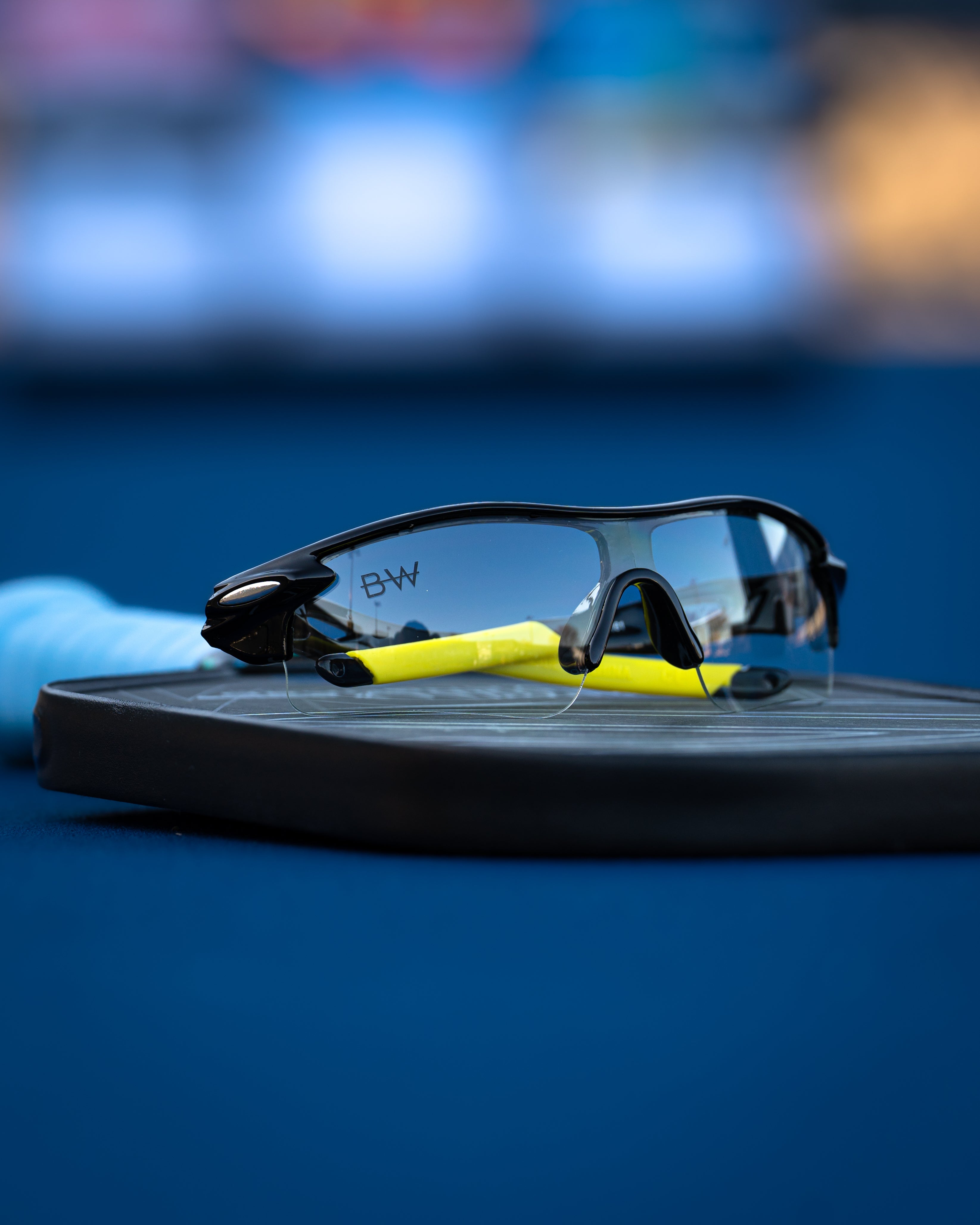
Science of Speed: How RX Lenses Boost Reaction Time in Pickleball
Share
Science of Speed: How RX Lenses Fit Into Reaction Time in Pickleball
Fast pickleball rallies can feel almost instantaneous. An opponent attacks, the ball crosses the kitchen, and you have to recognize what is happening, choose a response, move the paddle, and make contact—all in a short window.
That makes reaction time in pickleball an important skill. But there is a common misconception in sports-eyewear marketing: that prescription lenses themselves can make your brain react faster.
The science is more nuanced.
RX sports glasses provide the prescription correction you need. Reaction speed, meanwhile, involves visual information, recognition, anticipation, decision-making, movement, technique, and experience. The right prescription can be part of your visual setup without becoming a shortcut to faster neurological reactions.
This guide explains what actually happens between seeing a developing pickleball shot and responding to it, where prescription sports eyewear fits into that process, and how players can train the parts of reaction time that eyewear cannot provide.
Find Your Pickleball Eyewear
Do Prescription Glasses Improve Reaction Time in Pickleball?
Prescription lenses should not be described as automatically making neurological reaction time faster.
The primary role of RX lenses is to provide the refractive correction prescribed for the wearer. If you require correction, incorporating that prescription into sports eyewear can give you an appropriate corrective setup while you play.
But reacting to a pickleball shot requires much more than corrected vision.
| RX Eyewear Can... | RX Eyewear Does Not Automatically... |
|---|---|
| Provide your prescribed correction | Make your brain process information faster |
| Combine correction with a sports-oriented frame | Improve anticipation |
| Provide the selected lens configuration | Improve decision-making |
| Provide verified physical lens characteristics | Improve paddle preparation |
| Become part of a familiar playing setup | Improve footwork |
| Support your corrective needs during play | Guarantee faster returns or more points won |
What Is Reaction Time in Pickleball?
Reaction time is commonly understood as the interval between receiving a stimulus and initiating a response. On a pickleball court, however, what players casually call “reaction time” can involve several overlapping processes.
During a fast exchange, you may need to:
- Receive visual information about your opponent and the ball.
- Recognize the developing shot.
- Interpret direction, trajectory, and other available cues.
- Select an appropriate response.
- Initiate movement.
- Position the paddle.
- Execute the shot.
A delay at any stage can make the entire response look “slow,” even when basic neurological reaction speed is not the main problem.
The Pickleball Reaction Chain: From Visual Information to Paddle Contact
A useful way to understand fast exchanges is as a chain:
visual information → recognition → interpretation → decision → movement → preparation → contact
Prescription eyewear belongs near the beginning of that chain because it provides refractive correction for players who require it.
It does not control the entire chain.
| Stage | What Is Happening? | Is This Automatically Improved by RX Lenses? |
|---|---|---|
| Visual Input | Visual information reaches the player | RX lenses provide prescribed correction when required |
| Recognition | The player recognizes what is developing | No automatic improvement |
| Interpretation | The player interprets available cues | No automatic improvement |
| Decision | The player chooses a response | No automatic improvement |
| Movement | The body initiates the response | No automatic improvement |
| Preparation | The paddle and body move into position | No automatic improvement |
| Contact | The player executes the shot | Depends on timing, positioning, technique, and other factors |
Reaction Time vs. Anticipation: Why They Aren't the Same Thing
A player can appear incredibly fast without simply possessing a dramatically faster raw reaction time.
Why?
Anticipation can begin before the ball reaches you.
Experienced players can learn to recognize useful information from:
- Opponent positioning
- Paddle preparation
- Previous shot patterns
- Available court space
- Ball trajectory
- Situational tendencies
That experience can help a player prepare for likely outcomes earlier.
Prescription lenses cannot teach anticipation. That comes from practice, pattern recognition, match experience, and decision-making.
Why Do Advanced Pickleball Players Seem to React So Fast?
Watch an experienced player during a quick kitchen exchange and it may look like pure reflex.
But apparent speed can come from several factors working together:
- Recognizing patterns earlier
- Maintaining an efficient ready position
- Reducing unnecessary movement
- Preparing the paddle appropriately
- Anticipating likely responses
- Making faster decisions through experience
- Using efficient technique
In other words, a player can become functionally “faster” without eyewear changing the speed of neural transmission.
So Where Do RX Lenses Actually Fit Into Faster Pickleball?
If you require prescription correction, the role of RX sports eyewear is straightforward: provide that correction while you play.
That is different from claiming the lens independently creates faster reactions.
Think of the distinction this way:
Appropriate correction supports your visual setup. Training develops your response.
This avoids two extremes:
- Claiming prescription eyewear has nothing to do with a player's visual setup
- Claiming prescription eyewear automatically turns visual correction into faster athletic reactions
What If You Need Prescription Correction but Don't Wear It on Court?
If you require prescription correction, playing without the corrective setup you normally need is different from asking whether RX lenses create superhuman reaction speed.
The practical question becomes:
Are you using appropriate correction while playing?
Players who require correction may use different setups, including:
- Prescription sports glasses
- Contact lenses combined with non-RX sports eyewear
- Other appropriate corrective eyewear
Dedicated RX sports glasses are one way to incorporate the player's prescription directly into their sports eyewear.
RX Sports Glasses vs. Contacts for Reaction Time
Neither setup should automatically be declared faster.
| Setup | Where the Correction Comes From |
|---|---|
| RX Sports Glasses | The prescription is incorporated into the sports eyewear. |
| Contacts + Non-RX Sports Glasses | Contact lenses provide correction while the sports eyewear remains non-prescription. |
The better choice depends on individual corrective needs, preferences, environment, and appropriate eye-care guidance—not a claim that one method universally produces faster reflexes.
Can RX Lenses Really Shave Milliseconds Off Your Reaction Time?
Be cautious when a sports-eyewear product claims that its lenses remove a precise number of milliseconds from your response.
To support a statement such as “5% faster reactions,” “10% faster responses,” or “100 milliseconds quicker,” evidence would need to establish that the specific eyewear or intervention produced that specific outcome under relevant conditions.
A general discussion of vision or athletic reaction time does not automatically prove that a particular pair of prescription glasses creates the same effect.
For that reason, Blinded Wear does not need to promise a specific reaction-time improvement to explain the value of RX sports eyewear.
Do Prescription Lenses Reduce “Visual Latency”?
The phrase visual latency can sound convincing in sports-eyewear marketing, but it should not be used to imply that ordinary prescription lenses automatically accelerate neural processing.
Prescription lenses alter the optical path of light to provide refractive correction for the wearer.
That corrective function should not automatically be translated into claims that the lenses:
- Make signals travel through the nervous system faster
- Make the brain process motion faster
- Shorten a player's neurological response time
- Guarantee earlier paddle contact
Those are different claims from prescription correction.
Do RX Lenses Give Your Brain a “Cleaner Signal”?
This phrase is often used to make prescription correction sound like a neurological performance technology.
A more precise description is simpler:
Prescription lenses provide refractive correction according to the wearer's prescription.
The brain still has to interpret available visual information, recognize the developing play, choose an action, and coordinate a physical response.
Calling corrected vision a “cleaner signal” should not become evidence that the brain itself is processing information faster.
Does Lens Distortion Slow Reaction Time?
If you experience persistent unexpected distortion through eyewear, that deserves attention as a specific visual issue.
But it is too broad to claim that generic sports glasses universally distort peripheral vision or create measurable reaction delays.
If new eyewear produces persistent unexpected distortion, double vision, significant discomfort, or another concerning visual change, seek appropriate professional evaluation rather than trying to calculate how many milliseconds it might be costing you.
Reaction Time and Depth Perception Are Different
Reaction time and depth perception can both matter within athletic situations, but they should not be treated as interchangeable.
Depth perception involves spatial information. Reaction time concerns the timing of a response to a stimulus.
Prescription lenses provide refractive correction; they should not universally be described as either:
- Perfecting biological depth perception
- Accelerating neurological reaction time
For a deeper look at spatial judgment, read the Science of Depth Perception in Pickleball →
Do Non-Polarized Lenses Improve Reaction Time?
No automatic reaction-time improvement should be assigned to a lens simply because it is non-polarized.
Blinded Wear sports eyewear uses non-polarized lenses. A non-polarized lens does not add a polarization filter and preserves the visual information available without that filter.
Some court players prefer this configuration.
However, non-polarized lenses should not automatically be described as improving:
- Reaction time
- Depth perception
- Ball tracking
- Spin recognition
- Shot accuracy
Do Polarized Sunglasses Slow Your Reactions in Pickleball?
There is no need to make the opposite claim either.
Polarized eyewear should not universally be described as slowing reaction time, damaging depth perception, or making athletes late to the ball.
Polarization is a lens characteristic. Players can have different preferences for different environments.
The accurate takeaway is not “polarized is slow” or “non-polarized is fast.”
It is: understand the lens configuration you are buying and choose according to your needs and preferences.
Do Clear RX Lenses Help With Indoor Pickleball Reaction Time?
Clear prescription lenses provide correction without a dark sunglass tint.
That can make them an option worth comparing for:
- Indoor pickleball
- Evening play
- Lower-light environments
- Situations where a dark sunglass tint is not preferred
The useful advantage is the lens configuration itself—not a promise of faster reactions.
Clear lenses should not automatically be credited with increasing available light, enhancing contrast, improving ball tracking, or accelerating neurological response.
Does Blue-Light Filtering Improve Pickleball Reaction Time?
Blue-light filtering can be a verified product characteristic without being treated as a sports-performance claim.
For example, H Blue Shield RX has a verified blue-light filtering characteristic.
That does not automatically mean the feature:
- Speeds up reactions
- Improves concentration
- Improves ball tracking
- Reduces fatigue
- Improves athletic performance
Choose a verified filtering characteristic because you want that feature—not because it is presented as a shortcut to quicker hands.
Do High-Index RX Lenses Make You React Faster?
No. High-index describes a prescription lens-material category rather than an athletic reaction-time technology.
Blinded Wear includes high-index prescription lenses at no additional cost with RX eyewear.
That is a concrete product value without needing to claim that high-index lenses improve:
- Reaction speed
- Depth perception
- Tracking
- Accuracy
- Spin recognition
Do Anti-Reflective or Anti-Glare Coatings Make Reactions Faster?
A coating should not automatically be converted into a reaction-time claim.
If a specific pair includes a verified coating, evaluate that characteristic for what it actually does and according to the exact product specifications.
Do not assume every Blinded Wear RX configuration includes:
- Anti-reflective coating
- Anti-glare coating
- Anti-fog treatment
- Scratch-resistant coating
- Hydrophobic coating
And even when a coating is verified, avoid jumping from the physical characteristic to a guaranteed improvement in athletic response speed.
Can the Right Sports Frame Make Your Reflexes Faster?
A sports-oriented frame can be part of an athlete's equipment setup, but frame shape itself should not automatically be credited with faster neurological reactions.
When comparing frames, focus on practical information such as:
- Available dimensions
- Frame design
- Individual comfort preferences
- Playing environment
- Compatibility with your corrective needs
Terms such as “aerodynamic,” “reaction-ready,” or “speed frame” should not substitute for useful product specifications.
What Blinded Wear RX Eyewear Actually Provides
The value of prescription sports eyewear does not depend on promising that it will make you react 5%, 10%, or 100 milliseconds faster.
Blinded Wear RX eyewear offers verified characteristics that can be evaluated directly:
- Prescription correction for players who require RX eyewear
- High-index prescription lenses included at no additional cost
- Impact-resistant lenses
- Non-polarized sports lenses
- Lightweight sports frames
- Comfort-oriented designs intended for extended matches
- Multiple RX frame and lens configurations to compare
- 50% lifetime replacement support if glasses break, subject to current policy terms
These characteristics give players concrete reasons to compare RX sports eyewear without turning corrective lenses into a neurological performance product.
RX Pickleball Glasses to Compare
If you require prescription correction, compare frames according to your environment, current configuration, available dimensions, and personal preferences rather than claims about which model produces the fastest reactions.
| RX Model | What to Compare | Explore |
|---|---|---|
| Rocket Fire RX | Current RX configuration, frame design, dimensions, and intended use | Rocket Fire RX → |
| Frost RX | Current RX configuration, frame dimensions, environment, and design | Frost RX → |
| Ocean Wave RX | Current specifications, prescription configuration, dimensions, and preferences | Ocean Wave RX → |
| Phantom II RX | Prescription configuration, dimensions, frame design, and intended environment | Phantom II RX → |
| H Blue Shield RX | RX configuration, verified blue-light filtering characteristic, dimensions, and intended use | H Blue Shield RX → |
| Silver Line RX | Prescription sunglass configuration, outdoor routine, dimensions, and design | Silver Line RX → |
What Can Actually Make You React Earlier in Pickleball?
If the goal is to become functionally faster on court, focus on trainable parts of the response chain.
| Skill | What You're Developing |
|---|---|
| Pattern Recognition | Recognizing familiar situations sooner |
| Anticipation | Using available information before the shot fully develops |
| Ready Position | Reducing unnecessary movement before responding |
| Paddle Preparation | Preparing efficiently for likely responses |
| Footwork | Moving efficiently into useful positions |
| Decision-Making | Selecting appropriate responses more efficiently |
| Repetition | Building familiarity with common patterns and speeds |
| Match Experience | Applying recognition and decisions under realistic pressure |
That is where the biggest distinction lies:
RX eyewear handles correction. The athlete trains speed.
How to Train Faster Responses in Pickleball
You do not need to turn every practice into a laboratory reaction-time test. Build speed through increasingly realistic situations.
- Controlled volleys: begin with predictable exchanges and efficient paddle preparation.
- Direction changes: introduce forehand and backhand variation.
- Random feeds: reduce your ability to predict the next ball.
- Kitchen exchanges: practice compact responses from realistic positions.
- Speed-up recognition: work on recognizing developing attacks rather than waiting until the ball is already moving toward you.
- Transition drills: combine recognition with movement and positioning.
- Live points: apply the skills without knowing what shot comes next.
If you require prescription correction, perform these drills in the corrective setup you intend to use during matches.
FAQs About RX Lenses and Pickleball Reaction Time
Can prescription glasses make my reactions faster?
Prescription lenses provide refractive correction. They should not automatically be described as increasing neurological reaction speed.
Can better vision help me react sooner?
Appropriate correction can be part of your visual setup when you require it, but reacting sooner also involves recognition, anticipation, decisions, movement, preparation, and experience.
How much faster can RX sports glasses make me?
There is no universal percentage or number of milliseconds that should be promised simply from wearing prescription sports glasses.
Can RX glasses improve pickleball reflexes?
RX eyewear provides prescribed correction. Reflexes and athletic responses should not automatically be described as being improved by the lenses.
Can RX glasses help me return fast volleys?
Appropriate correction can be part of your playing setup, while successful fast-volley responses also depend on anticipation, ready position, paddle preparation, movement, timing, and technique.
Do RX lenses help you see the ball sooner?
Prescription lenses provide correction according to the wearer's prescription. They should not automatically be claimed to make visual events occur sooner or accelerate neural processing.
Do RX lenses improve ball tracking?
Improved ball tracking should not automatically be attributed to prescription lenses.
Do prescription lenses improve depth perception?
RX lenses provide refractive correction. Depth perception is a broader visual process and should not universally be described as being improved or perfected by prescription sports eyewear.
Do non-polarized lenses improve reaction time?
No automatic reaction-time benefit should be attributed to non-polarized lenses. Some court players simply prefer that lens configuration.
Are polarized lenses too slow for pickleball?
No. Polarized lenses should not universally be described as slowing neurological reactions or harming pickleball performance.
Are clear RX lenses better for reaction time indoors?
Clear RX lenses provide correction without a dark sunglass tint. That can suit some indoor environments, but faster reaction time should not automatically be attributed to the clear lens.
Do high-index lenses make reactions faster?
No. High-index describes a prescription lens-material category rather than an athletic reaction-time enhancement.
Does Blinded Wear include high-index prescription lenses?
Yes. High-index prescription lenses are included at no additional cost with Blinded Wear RX eyewear.
Are Blinded Wear sports lenses polarized?
No. Blinded Wear sports eyewear uses non-polarized lenses.
Are Blinded Wear lenses impact-resistant?
Yes. Impact-resistant should not automatically be interpreted as shatterproof, unbreakable, or certified to an unspecified protective standard.
How do I order Blinded Wear RX glasses?
Choose your RX eyewear and upload a clear photo or picture of your eyeglass prescription before purchasing.
What happens if my Blinded Wear glasses break?
Blinded Wear offers 50% lifetime replacement support if glasses break, subject to current policy terms.
Why “Reaction Time” Is Really Several Different Skills
When a player says, “My reactions are too slow,” the problem may occur at several different points before paddle contact.
That distinction matters because buying new eyewear cannot solve every type of delay.
| What Feels Slow | Possible Area to Examine | What to Work On |
|---|---|---|
| You recognize the attack late | Recognition and anticipation | Pattern-reading and live-ball drills |
| You recognize it but choose late | Decision-making | Repetition in common game situations |
| You know where the ball is going but feel jammed | Positioning or preparation | Ready position, spacing, and compact movement |
| Your paddle starts too far away | Preparation | More efficient paddle positioning |
| You move late | Recognition, decision, or movement initiation | Randomized movement drills |
| Vision is unexpectedly blurry through your eyewear | Corrective setup | Verify your prescription and seek appropriate professional evaluation when needed |
The solution becomes much easier to identify once “slow reactions” are broken into specific parts.
Simple Reaction Time vs. Choice Reaction Time in Pickleball
Not every reaction task is equally difficult.
Simple Reaction
You know what stimulus is coming and what response you will make. For example, reacting when a coach gives a predetermined cue.
Choice Reaction
You have to recognize what is happening and select between multiple possible responses.
Pickleball frequently resembles the second situation more closely. Your opponent may:
- Speed the ball up
- Reset
- Attack forehand
- Attack backhand
- Send the ball through the middle
- Change direction
- Use a different trajectory than expected
That is why a player's performance during a simple reaction test does not tell the entire story of how quickly they will respond during a real rally.
Recognition Can Matter Before the Ball Is Even Hit
Players sometimes imagine reaction time beginning only after the ball leaves the opponent's paddle.
In real play, useful information can appear earlier.
A player may be processing:
- Where the opponent is positioned
- Where their paddle is prepared
- How the previous ball was struck
- Which areas of the court are open
- How the rally has developed
- Patterns the opponent has already shown
Recognizing useful information earlier can give the player more time to prepare for what happens next.
This is one reason an experienced player can appear to have extraordinary reflexes: some of the work begins before a less experienced player recognizes the threat.
Can Ready Position Make You Functionally Faster?
Yes—in the practical sense that an efficient starting position can reduce unnecessary movement before contact.
Imagine two players recognizing the same shot at approximately the same moment.
One has the paddle prepared efficiently. The other first has to move the paddle through a larger unnecessary path before making contact.
The difference may look like reaction speed even though the issue occurs after recognition.
This is why improving your ability to handle fast pickleball should include technique and positioning rather than focusing exclusively on visual equipment.
Reaction Time vs. Paddle Speed: Don't Confuse the Two
A player can recognize a shot quickly and still arrive late with the paddle.
Likewise, a player can move the paddle quickly but recognize the developing shot too late.
| Component | Basic Question |
|---|---|
| Recognition | When did you understand what was happening? |
| Decision | How quickly did you select your response? |
| Movement Initiation | When did your body begin responding? |
| Paddle Path | How far did the paddle have to travel? |
| Positioning | Were you already in a useful position? |
| Contact | Did spacing and timing allow effective execution? |
Prescription correction belongs to the visual setup. It does not automatically improve each of these downstream stages.
Does a Faster Pickleball Automatically Mean You Have Less Reaction Time?
Ball speed is only one part of the situation.
The time available to respond can also depend on factors such as:
- Distance between players
- Where contact occurs
- Ball trajectory
- Whether you anticipated the shot
- Your starting position
- When you recognized the developing play
That is why broad statements such as “a pickleball travels at X mph, so every player has exactly Y milliseconds to react” can oversimplify a real rally.
The same measured ball speed can occur in situations that give a player very different amounts of useful preparation time.
Why Court Position Changes the Speed Problem
Distance matters when thinking about fast exchanges.
A hard shot received from farther away is not the same reaction problem as a fast exchange occurring much closer to the net.
At the kitchen, players often have limited time and less room for unnecessary movement. Farther back, the ball may travel a greater distance before reaching the player.
This is another reason reaction-time claims based only on ball speed should be treated cautiously.
Speed without distance and context does not describe the entire response window.
How Is Ball Travel Time Calculated?
A simple physics estimate can help explain why distance matters:
Travel time = distance ÷ speed
For example, if two hypothetical shots travel at the same speed but one begins much closer to the receiving player, the closer shot has a shorter travel time.
Real pickleball is more complicated because balls can change speed and trajectory during flight, players are moving, and useful recognition can begin before or around contact.
So a travel-time calculation should not be presented as the player's exact neurological reaction time.
Do Pickleball Players Really Have Only 400 Milliseconds to React?
You may see articles assign one specific reaction window to advanced pickleball.
There is no single reaction-time number that applies to every rally.
The available time changes with:
- Shot speed
- Shot distance
- Player position
- Trajectory
- Recognition timing
- Anticipation
Even when ball travel time can be estimated, it should not automatically be treated as the exact amount of time the brain has to complete the entire visual-to-motor response.
How to Train Anticipation Instead of Only Raw Reflexes
One way to become functionally faster is to get better at identifying useful information earlier.
1. Pattern Recognition Drills
Repeat common rally situations until familiar patterns become easier to recognize.
2. Randomized Feeds
Once predictable drills become comfortable, introduce uncertainty so you must recognize the developing shot before responding.
3. Opponent Observation
During live play, pay attention to positioning, preparation, tendencies, and the situation rather than watching only the final ball flight.
4. Video Review
Watch rallies and identify the earliest useful information that could have influenced your response.
5. Live Points
Practice under conditions where you cannot know the next shot in advance.
These approaches train recognition and decision-making rather than assuming an equipment change will make the nervous system faster.
A Reaction-Speed Drill Progression for Pickleball
Players can progressively increase uncertainty and game realism.
| Stage | Drill | Primary Focus |
|---|---|---|
| 1 | Predictable cooperative volleys | Compact preparation and control |
| 2 | Alternating forehand/backhand feeds | Efficient transitions between responses |
| 3 | Random forehand/backhand feeds | Recognition and choice |
| 4 | Controlled kitchen speed-ups | Recognizing developing attacks |
| 5 | Random speed-up or reset | Decision-making under uncertainty |
| 6 | Live kitchen points | Applying recognition, preparation, and technique |
| 7 | Full games | Integrating skills into realistic play |
If you require prescription correction, practicing in your normal corrective setup also helps make that equipment familiar before competition.
Can Wall Drills Help With Faster Pickleball Responses?
Wall drills can be useful for repetition because the ball returns repeatedly without requiring another player.
Depending on the drill, you can work on:
- Compact paddle preparation
- Alternating forehand and backhand responses
- Maintaining a ready position
- Controlling shorter movements
- Repeated contact under increasing pace
However, a wall cannot fully reproduce an opponent's body positioning, shot selection, deception, or match context.
Use wall work as one training tool rather than a complete substitute for live recognition and decision-making.
Should You Practice Reaction Drills in Your RX Pickleball Glasses?
If prescription sports glasses are the corrective setup you intend to use during matches, practicing in them is practical.
The goal is not to “activate” a reaction-time benefit from the lenses. It is to make your actual equipment familiar during:
- Movement
- Volleys
- Speed-ups
- Resets
- Transition play
- Full games
Competition is generally a poor time to discover that a new frame, prescription, or lens configuration feels unfamiliar.
Can New RX Glasses Temporarily Feel Different on Court?
Experiences with new prescription eyewear can vary, which is another reason to become familiar with a new setup before an important event.
Start in controlled situations before progressing into faster play.
- Wear the eyewear in an appropriate setting.
- Try controlled dinks and serves.
- Add volleys and movement.
- Progress to faster exchanges.
- Use the setup during full games.
If you experience persistent unexpected distortion, double vision, significant discomfort, or another concerning visual change, seek appropriate professional evaluation.
Would a Stronger Prescription Make the Ball Easier to React To?
No. Prescription strength is not a reaction-speed setting.
Your prescription should provide correction appropriate for your individual visual needs. Intentionally choosing stronger correction in an attempt to see the ball “extra sharp” or react faster is not the same as using an appropriate prescription.
More prescription does not mean more performance.
Could an Outdated Prescription Be a Problem?
If your corrective needs have changed, the question is whether your current prescription remains appropriate—not whether a newer prescription contains a special reaction-time advantage.
If you notice visual changes or are uncertain about your prescription, consult an eye-care professional rather than guessing at a different correction for sports.
Do Cheap or Generic Sunglasses Slow Your Reaction Time?
Price and brand category alone do not establish reaction speed.
It is too broad to claim that inexpensive or generic sunglasses universally:
- Create visual delays
- Distort depth cues
- Slow focus changes
- Reduce reaction speed
- Cause missed volleys
Evaluate the actual product and your actual corrective needs instead.
If you require prescription correction, the most obvious difference between generic non-prescription sunglasses and RX sports eyewear is that the generic non-RX pair does not contain your prescription.
Can You Play Fast Pickleball in Everyday Prescription Glasses?
Some players use their normal prescription eyewear during pickleball.
Dedicated RX sports eyewear gives players another option when they want to combine their prescription with a sports-oriented frame and current sports lens configuration.
Compare:
- Your prescription needs
- Frame dimensions
- Frame design
- Playing environment
- Verified lens characteristics
- Your individual comfort preferences
Everyday eyewear should not automatically be described as too slow, unstable, distorted, or unsuitable simply because it was not marketed specifically for pickleball.
Does Impact Resistance Improve Reaction Time?
No. Impact resistance is a physical lens characteristic, not a neurological speed feature.
Blinded Wear sports eyewear uses impact-resistant lenses.
That characteristic should be kept separate from claims about:
- Faster reactions
- Better tracking
- Better depth perception
- Faster decisions
- Improved accuracy
Impact-resistant also should not automatically be interpreted as shatterproof, indestructible, or certified to an unspecified protective standard.
Lens Feature vs. Performance Outcome: Know the Difference
One of the easiest ways to evaluate sports-eyewear marketing is to separate a measurable product characteristic from an athletic outcome.
| Product Characteristic | What You Should Not Automatically Conclude |
|---|---|
| Prescription Lens | Faster neurological reaction time |
| High-Index Lens | Better ball tracking |
| Non-Polarized Lens | Better depth perception |
| Clear Lens | Faster indoor reactions |
| Impact-Resistant Lens | Better shot accuracy |
| Blue-Light Filtering | Better concentration or faster responses |
| Sports-Oriented Frame | Faster reflexes |
A useful product does not need an unsupported performance claim attached to every feature.
7 Reaction-Time Eyewear Claims to Question
| Marketing Claim | Question to Ask |
|---|---|
| “React 10% faster” | Was that exact improvement demonstrated for this exact product and relevant population? |
| “Eliminates visual latency” | What specific type of latency was measured? |
| “Faster brain processing” | What evidence shows the lens changes neural processing speed? |
| “Instantly improves reflexes” | Were reflexes actually measured? |
| “Enhanced ball tracking” | Was tracking performance directly evaluated? |
| “Perfect optical clarity” | What objective specification supports an absolute claim? |
| “Proven to win more points” | Was competitive performance actually tested? |
Does Seeing Clearly Automatically Increase Confidence?
Confidence is personal and should not be promised as an automatic effect of prescription eyewear.
A player may prefer competing in equipment that feels familiar and appropriate for their needs, but statements such as “RX lenses make confidence skyrocket” go beyond the basic corrective function of prescription lenses.
Likewise, eyewear should not automatically be described as a mental-performance tool that creates:
- Better focus
- Greater confidence
- A flow state
- Reduced hesitation
- Better competitive decisions
Those outcomes involve the athlete, the situation, and many factors beyond eyewear.
If RX Lenses Don't Guarantee Faster Reactions, Why Buy Sports RX?
Because a product does not need to promise superhuman reflexes to be useful.
If you require prescription correction and want dedicated eyewear for pickleball, RX sports glasses can combine that correction with a sports-oriented setup.
With Blinded Wear RX eyewear, verified value includes:
- Prescription sports eyewear designed for pickleball players
- Lightweight sports frames
- Impact-resistant lenses
- Non-polarized lenses
- Comfort-oriented design for extended matches
- High-index prescription lenses included at no additional cost
- 50% lifetime replacement support if glasses break, subject to current policy terms
Those are concrete characteristics a customer can compare without needing a promise that the lenses will shave milliseconds from their reaction time.
How to Order RX Pickleball Glasses
If prescription sports eyewear fits your needs, start with your actual corrective requirements rather than choosing a lens based on reaction-time marketing.
- Have your eyeglass prescription available.
- Browse the current RX collection.
- Choose the frame and available lens configuration that fit your preferences.
- Review current product specifications and available dimensions.
- Upload a clear photo or picture of your eyeglass prescription before purchasing.
Blinded Wear includes high-index prescription lenses at no additional cost with RX eyewear.
More Questions About Pickleball Reaction Speed
Why do I feel slow during hands battles?
What feels like slow reflexes can involve recognition, anticipation, decision-making, ready position, paddle preparation, spacing, movement, timing, or execution.
Can anticipation make me react faster?
Anticipation can allow preparation to begin earlier by using available information and learned patterns. That is different from changing raw neurological reaction speed.
Why do professional pickleball players have such fast hands?
Apparent speed can involve recognition, anticipation, efficient positioning, compact preparation, decision-making, technique, repetition, and experience—not simply raw reflex speed.
Can a better ready position improve reaction speed?
An efficient starting position can reduce unnecessary movement after you recognize a shot, helping you respond more efficiently.
Does ball speed determine my exact reaction time?
No. Distance, trajectory, player position, recognition timing, anticipation, and other factors also affect the situation.
Is ball travel time the same as reaction time?
No. Ball travel time describes how long the ball takes to cover a distance. Reaction time describes a response to a stimulus, and real pickleball includes recognition, decisions, movement, and anticipation.
Can I train reaction time for pickleball?
You can train components that contribute to faster on-court responses, including recognition, anticipation, decision-making, ready position, movement, and efficient paddle preparation.
Are random drills better than predictable drills?
They train different things. Predictable drills can help build movement and technique, while randomized drills add recognition and decision-making demands.
Can wall drills improve my reactions?
Wall drills can provide useful repetition for preparation and repeated responses, but they do not reproduce every recognition and decision-making demand of a live opponent.
Should I train in my prescription sports glasses?
If those are the glasses you intend to use during matches, practicing in them can help make your actual playing setup familiar.
Will stronger prescription lenses make me react faster?
No. Prescription strength is not a performance setting. Your correction should be appropriate for your individual visual needs.
Do expensive sports glasses automatically improve reaction time?
No. Price alone does not establish a neurological or athletic performance benefit.
Do anti-glare lenses improve reaction time?
A verified coating characteristic should not automatically be converted into a faster-reaction claim.
Does impact resistance make sports glasses faster?
No. Impact resistance is a physical lens characteristic rather than a reaction-time feature.
Can prescription sports glasses still be valuable without improving reflexes?
Yes. For players who require correction, RX sports eyewear can provide that prescription in a sports-oriented frame and lens setup without needing to promise faster neurological reactions.
Where Reaction Speed Shows Up Most in Pickleball
Not every pickleball shot creates the same response demands. Some situations provide more time to recognize, move, and prepare, while others compress the sequence considerably.
| Situation | What Can Make It Feel Fast | Useful Training Focus |
|---|---|---|
| Kitchen Hands Battle | Shorter distance and rapidly changing directions | Ready position, compact preparation, recognition, and decisions |
| Opponent Speed-Up | The player must recognize the developing attack | Anticipation, paddle preparation, and positioning |
| Body Shot | Limited space for a large response | Efficient preparation and compact movement |
| Fast Return | Ball speed combined with positioning and trajectory | Preparation, movement, and contact spacing |
| Drive at the Transition Zone | Movement and shot recognition occur together | Balance, positioning, recognition, and decision-making |
| Unexpected Direction Change | The anticipated shot differs from the actual shot | Randomized drills and recovery |
If you require prescription correction, RX eyewear can provide that correction throughout these situations. The athlete still develops the recognition and movement required to respond effectively.
How to Get Faster in Pickleball Hands Battles
When exchanges become rapid at the kitchen, players often assume they need better reflexes. Sometimes the bigger opportunity is reducing how much work must happen after the opponent contacts the ball.
Focus on:
- Maintaining an efficient ready position
- Avoiding unnecessarily large paddle movements
- Recognizing likely attacks earlier
- Learning common speed-up patterns
- Recovering after each contact
- Staying balanced enough to respond again
- Practicing exchanges in unpredictable live situations
The objective is not simply to move your hands faster. It is to make the entire response more efficient.
Reaction vs. Anticipation: A Simple Pickleball Example
Imagine two players facing the same speed-up.
Player A recognizes the attack only after the ball is already traveling toward them.
Player B recognizes useful information from the developing situation and begins preparing earlier.
If Player B makes contact more comfortably, it can look like Player B has dramatically faster reflexes.
But the difference may partly come from earlier recognition and preparation.
This distinction matters because anticipation is trainable. Buying a lens marketed as “reaction enhancing” does not teach you to recognize an opponent's patterns.
Use Video to Find Where Your Reaction Chain Breaks Down
Recording your own matches can help separate a visual concern from a recognition, positioning, or technique problem.
When reviewing a point where you felt late, ask:
- When did the opponent begin preparing the shot?
- When did I appear to recognize the attack?
- Was my paddle in an efficient starting position?
- Did I make an unnecessary movement before responding?
- Was I balanced?
- Was my positioning appropriate for the situation?
- Did I choose a response quickly?
- Did I make contact too close to my body?
- Was there an actual visual issue through my eyewear?
If the same mechanical pattern appears repeatedly, training may be more useful than replacing your glasses.
What RX Lenses Can Fix vs. What Training Must Fix
| Issue | RX / Eyewear Role | Training Role |
|---|---|---|
| You require prescription correction | RX lenses provide prescribed correction | Not a training substitute |
| You recognize attacks late | No automatic solution | Pattern recognition and anticipation |
| Your paddle is late | No automatic solution | Ready position and preparation |
| You choose the wrong response | No automatic solution | Decision-making and match experience |
| You get jammed | No automatic solution | Spacing, positioning, and movement |
| Dark tint is not preferred in your environment | Compare another appropriate lens configuration | Not primarily a training issue |
| You are unfamiliar with new eyewear | Use the intended setup during practice | Build familiarity through realistic repetitions |
Indoor vs. Outdoor Pickleball: Does Reaction Time Change?
The playing environment can change, but it is too broad to claim that one environment universally creates faster or slower neurological reactions.
For eyewear selection, focus on whether your lens configuration is appropriate for where you play.
| Environment | Eyewear Question |
|---|---|
| Indoor | Would you prefer RX correction without a dark sunglass tint? |
| Outdoor | Does a current prescription sunglass configuration suit your needs? |
| Evening | Is a dark sunglass tint appropriate for the conditions? |
| Mixed Conditions | Would one versatile configuration or separate options better fit your routine? |
Reaction-Time Preparation Before a Pickleball Tournament
The week of an important tournament is usually not the ideal time to completely reinvent your equipment or technique.
A more practical approach is to arrive with a familiar setup:
- Your normal corrective eyewear
- A lens configuration suited to the expected environment
- Experience using the eyewear during realistic play
- An efficient ready position you have already practiced
- Familiar responses to common attacks
- Another suitable corrective option if you depend on RX eyewear
The objective is to reduce unfamiliar variables rather than search for a last-minute “reaction-time boost.”
Why RX Players Should Consider Backup Eyewear
If prescription correction is important to your normal playing setup, another suitable corrective option can be useful during tournaments and travel.
Your primary pair could become:
- Lost
- Damaged
- Forgotten
- Unavailable during travel
A backup does not make your reactions faster. It simply reduces your dependence on one piece of corrective equipment.
Which RX Pickleball Setup Should You Choose?
If you require prescription correction, choose your sports eyewear according to your actual use case rather than a promised reaction-time percentage.
| Your Situation | What to Compare |
|---|---|
| Primarily Indoor Player | Clear RX or another appropriate non-dark-tinted configuration |
| Primarily Outdoor Player | Current prescription sunglass configurations appropriate for your needs |
| Evening / Lower-Light Player | Consider whether a dark sunglass tint suits the environment |
| Indoor + Outdoor Player | Compare one versatile setup with separate environment-specific options |
| Tournament Player | Primary familiar RX setup plus another suitable corrective option when useful |
| No Prescription Needed | Compare non-RX sports eyewear instead |
Reaction-Time Claims: What to Check Before Buying Sports Glasses
Before purchasing eyewear because it promises better reactions, work through this checklist:
- Do I require prescription correction?
- Does this product actually provide my RX?
- Which lens characteristics are verified?
- Does the lens configuration fit where I play?
- Are performance claims supported for this exact product?
- Is a physical feature being turned into an unrelated athletic promise?
- Are precise percentages or milliseconds supported by relevant evidence?
- Do the available frame dimensions suit my preferences?
- What replacement support is provided?
- Will I practice in the eyewear before competition?
Red Flags in “Reaction-Enhancing” Sports Eyewear Marketing
Be especially cautious when an eyewear claim jumps directly from a product characteristic to a guaranteed athletic result.
| Red Flag | Why to Look Closer |
|---|---|
| Exact reaction-time percentage with no relevant product evidence | A precise number needs specific support. |
| “Instant reflex improvement” | Prescription correction is not the same as changing neurological reflex speed. |
| “Zero visual latency” | The phrase needs a clear definition and evidence. |
| “Guaranteed better ball tracking” | Tracking is an athletic visual task, not automatically established by a lens characteristic. |
| “Perfect depth perception” | Depth perception is broader than a single prescription-lens feature. |
| “Pro-level reaction technology” | Ask what specific technology and measured outcome the phrase refers to. |
| “Win more points instantly” | Competitive outcomes involve many variables beyond eyewear. |
Final FAQs: Vision, Reflexes & Pickleball Speed
What is the fastest way to improve my pickleball reactions?
There is no single shortcut. Train recognition, anticipation, ready position, decision-making, efficient paddle preparation, movement, and realistic live-ball responses.
Is reaction time more important than anticipation?
They are different. Anticipation can allow preparation to begin earlier, while reaction time describes response timing after a stimulus. Real pickleball can involve both.
Why am I always late on speed-ups?
Possible factors include recognition, anticipation, ready position, paddle preparation, positioning, decisions, movement, and technique. Review where the response chain is breaking down.
How can I get faster hands at the kitchen?
Practice compact preparation, efficient ready position, recognition of developing attacks, randomized exchanges, recovery after contact, and live kitchen points.
Can prescription glasses make my brain process the ball faster?
Prescription lenses provide refractive correction. They should not automatically be described as increasing neural processing speed.
Can RX glasses reduce visual processing delay?
Prescription correction should not automatically be translated into a measurable reduction in neurological processing delay.
Can corrected vision be part of a faster overall response?
If you require prescription correction, appropriate RX can be part of your visual setup. The overall response still depends on recognition, decisions, movement, preparation, and execution.
Can sports glasses make me anticipate shots earlier?
Anticipation is developed through recognition of useful information, patterns, experience, and practice rather than automatically provided by sports eyewear.
Does a clear lens increase reaction speed indoors?
No automatic speed benefit should be claimed. Clear lenses provide a non-dark-tinted option that some players may prefer for indoor or lower-light environments.
Does non-polarized eyewear make reactions faster?
No. Some court players prefer non-polarized lenses, but faster neurological reactions should not automatically be attributed to them.
Do high-index lenses process visual information faster?
No. High-index refers to a prescription lens-material category rather than visual-processing speed.
Can an impact-resistant lens improve my reflexes?
No. Impact resistance is a physical lens characteristic and should not be turned into a reaction-time claim.
Can better sports glasses fix late paddle preparation?
No. Paddle preparation is primarily a technique and positioning issue that should be trained.
Should I practice in the same RX glasses I compete in?
If those glasses are your intended competition setup, using them during realistic practice can help make the equipment familiar.
Do I need RX sports glasses if I wear contacts?
Not necessarily. Some players use contact lenses for correction with non-prescription sports eyewear.
What if my current glasses seem blurry during pickleball?
If you experience persistent unexpected blur or another concerning visual change, verify that your corrective setup is appropriate and seek professional evaluation when needed.
Does Blinded Wear claim its RX glasses make reactions faster?
The role of Blinded Wear RX eyewear is to provide prescription correction and verified product characteristics. Faster neurological reaction time should not be promised simply from wearing prescription sports glasses.
What does Blinded Wear RX eyewear include?
Blinded Wear RX eyewear includes high-index prescription lenses at no additional cost and uses lightweight sports frames, impact-resistant lenses, and non-polarized sports lenses.
How does Blinded Wear replacement support work?
Blinded Wear offers 50% lifetime replacement support if glasses break, subject to current policy terms.
Learn More About Pickleball Vision & RX Eyewear
Key Takeaways: RX Lenses and Pickleball Reaction Time
- RX lenses provide prescription correction; they do not automatically accelerate neurological reaction time.
- What players call “reaction time” can involve recognition, anticipation, decisions, movement, paddle preparation, and execution.
- Experienced players may appear faster because they recognize useful information earlier.
- An efficient ready position can reduce unnecessary movement after recognition.
- Ball speed alone does not determine a player's exact response window.
- Ball travel time and neurological reaction time are not the same measurement.
- Non-polarized lenses should not automatically be credited with faster reactions or better depth perception.
- Clear lenses provide a non-dark-tinted option; they do not automatically increase reaction speed.
- High-index is a prescription lens-material category, not a reaction-time technology.
- Impact resistance is a physical lens characteristic, not a reflex enhancement.
- If you require RX correction, practice in the corrective setup you intend to use during competition.
- Train anticipation, recognition, decisions, positioning, and preparation if your goal is to become functionally faster on court.
Build the Visual Setup—Then Train the Speed
You do not need an exaggerated “reaction-enhancing lens” claim to justify prescription sports eyewear.
If you require vision correction, the value of RX pickleball glasses starts with something much more concrete: putting your prescribed correction into eyewear intended for active play.
Blinded Wear RX eyewear combines prescription correction, lightweight sports frames, impact-resistant non-polarized lenses, comfort-oriented designs for extended matches, and high-index prescription lenses included at no additional cost.
Blinded Wear also offers 50% lifetime replacement support if glasses break, subject to current policy terms.
The Bottom Line: Correct Your Vision, Train Your Reaction
Pickleball reaction speed is not controlled by one lens, one frame, or one piece of equipment.
If you require prescription correction, RX sports eyewear can handle an important part of your setup by providing that correction while you play.
From there, becoming functionally faster depends on developing the rest of the response chain:
visual information → recognition → anticipation → decision → movement → preparation → contact.
The eyewear handles its role:
prescription correction + appropriate lens configuration + verified product characteristics + familiarity.
The player develops the rest:
recognition + anticipation + positioning + decisions + movement + timing + technique + experience.
That is the more accurate science of speed—and a better foundation for choosing RX pickleball glasses than a promise that a lens will magically shave milliseconds from your reflexes.