
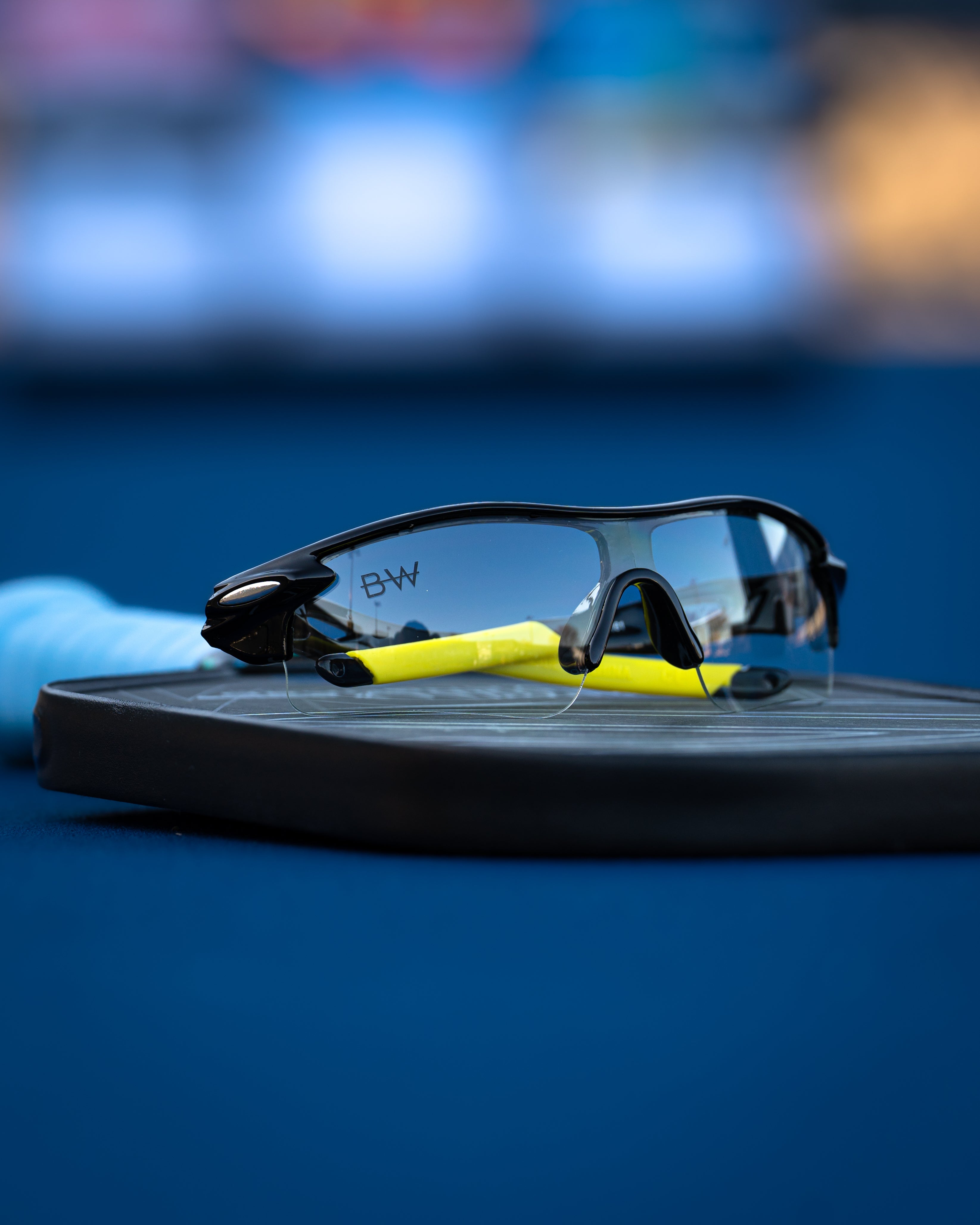
Exploring Our Scratch-Resistant Lens Tech for Pickleball
Share
Exploring Scratch-Resistant Lens Technology for Pickleball Eyewear
Scratch-resistant lens technology is designed to make a lens surface more resistant to everyday abrasions, but it does not make eyewear scratch-proof. For pickleball players, that distinction matters. Sports glasses are frequently handled, cleaned, stored in bags, and exposed to active environments where lens damage can occur.
This guide explains how scratch resistance works, what it can and cannot do, how scratches may affect prescription sports eyewear, and what pickleball players should verify before buying. Because the exact scratch-resistant treatment used across Blinded Wear products has not been independently verified here, this article does not claim that every Blinded Wear lens includes a particular coating or proprietary scratch-resistant technology.
Explore Pickleball Eyewear
What Is a Scratch-Resistant Lens?
Scratch resistance refers to a lens surface's ability to resist certain abrasions better than it otherwise might. Depending on the eyewear, this can involve a hard coating or another lens-surface treatment.
The important word is resistant.
A scratch-resistant lens can still become scratched when exposed to enough friction, abrasive particles, improper cleaning, rough storage, or physical damage.
| Term | What It Means |
|---|---|
| Scratch-resistant | Designed to provide greater resistance to certain surface abrasions |
| Scratch-proof | Suggests scratching cannot occur; this should not be assumed |
| Impact-resistant | Describes resistance to impact and is different from scratch resistance |
| Anti-reflective | Addresses certain lens-surface reflections and is a separate characteristic |
| Anti-fog | Addresses lens fogging and is separate from scratch resistance |
How Do Scratch-Resistant Lens Coatings Work?
Some eyewear uses a harder surface treatment intended to improve resistance to everyday abrasion. The exact construction, application method, and performance can differ among lens materials and manufacturers.
A scratch-resistant treatment may help a lens tolerate ordinary handling better, but it should not be interpreted as permission to clean or store eyewear carelessly.
Even treated lenses can be damaged by:
- Sand, grit, or other abrasive debris
- Rubbing debris across the lens while cleaning
- Placing lenses face-down on rough surfaces
- Carrying glasses loose alongside hard objects
- Repeated improper cleaning
- Significant physical contact or damage
Why Do Lens Scratches Matter for Pickleball Players?
Pickleball eyewear is active-use equipment. A pair may move between your face, a court bag, a case, a bench, your car, and different indoor or outdoor environments throughout the week.
That creates opportunities for lens surfaces to encounter:
- Dust and debris
- Perspiration
- Frequent cleaning
- Other equipment inside a bag
- Hard surfaces
- Repeated handling
Protecting the lens surface is therefore a reasonable durability consideration for players who use their eyewear frequently.
Can Scratched Glasses Affect What You See?
Lens scratches vary considerably. A tiny mark outside your normal viewing area may be little more than a cosmetic annoyance, while more significant damage in a frequently used portion of the lens can become visually distracting.
Depending on the location and severity of the damage, a wearer may notice:
- A visible mark in the field of view
- Distracting light interaction around the damaged area
- Reduced visual comfort
- A need to replace a significantly damaged lens
That does not mean every minor scratch will meaningfully affect pickleball performance or vision.
Do Scratch-Free Lenses Improve Ball Tracking?
Scratch resistance should not be marketed as a technology that automatically improves ball tracking.
Keeping lenses in good condition can help avoid unnecessary visual distractions, but tracking a pickleball depends on many factors, including your prescription when applicable, individual vision, attention, anticipation, lighting, ball-background contrast, head and eye movement, and experience.
Similarly, a scratch-resistant coating should not be claimed to improve reaction time, depth perception, shot accuracy, or match results.
Scratch Resistance vs. Impact Resistance: They're Not the Same
This is one of the most important distinctions for sports-eyewear shoppers.
Scratch resistance concerns surface abrasion. Impact resistance concerns how a lens responds to physical impact.
Blinded Wear uses impact-resistant lenses in its performance-first pickleball eyewear. That verified characteristic should not automatically be expanded into an unverified scratch-resistant claim.
| Characteristic | Primary Concern | What It Does Not Automatically Mean |
|---|---|---|
| Scratch resistance | Surface abrasion | Impact-proof or unbreakable |
| Impact resistance | Physical impact | Scratch-proof or certified protective eyewear |
Impact-resistant also does not mean impact-proof, shatter-proof, guaranteed prevention of injury, or compliance with a particular protective certification unless that standard has been specifically verified.
Scratch-Resistant vs. Anti-Reflective Coatings
Scratch-resistant and anti-reflective treatments address different issues.
A scratch-resistant treatment is concerned primarily with abrasion resistance. An anti-reflective treatment is intended to reduce certain reflections from lens surfaces.
One should not be assumed simply because the other is present.
The same applies to anti-fog treatments, tint, polarization, photochromic technology, and specific UV-protection claims. Each characteristic should be verified independently for the exact eyewear configuration.
Does Scratch Resistance Have Anything to Do With Polarization?
No. Scratch resistance and polarization describe different lens characteristics.
Blinded Wear uses non-polarized lenses as part of its performance-first approach to pickleball eyewear. This approach is intended to preserve natural visual information and avoid potential depth-perception concerns associated with polarization during court play.
Polarization does not universally cause depth-perception problems, and non-polarized lenses do not guarantee better depth perception or athletic performance.
Whether a lens is polarized tells you nothing by itself about whether it has a scratch-resistant surface treatment.
Why Lens Condition Matters for Prescription Pickleball Glasses
Prescription lenses are customized around a player's corrective needs, making proper care particularly worthwhile.
If you rely on RX eyewear during pickleball, your priorities should begin with:
- Appropriate prescription correction
- Prescription compatibility with the frame
- Comfortable fit
- Verified lens construction
- A lens configuration appropriate for your environment
- Reasonable care and storage
Blinded Wear includes high-index prescription lenses at no additional cost. High-index material, however, should not automatically be described as scratch-resistant, impact-proof, or more durable against every type of damage.
Are High-Index Lenses Automatically Scratch-Resistant?
No. High-index and scratch-resistant are not interchangeable terms.
High-index refers to the optical properties of a lens material and how it bends light. Scratch resistance concerns the lens surface's resistance to abrasion.
When shopping for prescription pickleball glasses, evaluate these characteristics separately rather than assuming one guarantees the other.
Common Ways Pickleball Glasses Can Get Scratched
Many scratches do not come from dramatic court incidents. Everyday handling can be just as important.
Storing Glasses Loose in a Pickleball Bag
Paddles, keys, bottles, zippers, and other objects can come into contact with exposed lenses. A protective case creates a physical barrier between your eyewear and the rest of your equipment.
Wiping Dust Directly Across the Lens
Rubbing abrasive debris across a lens can create unnecessary surface contact. Remove loose debris appropriately before wiping.
Using a Shirt as a Cleaning Cloth
Your shirt may contain dust, dirt, or other particles. An appropriate clean microfiber cloth is a better choice for routine lens care.
Placing Glasses Lens-Down
Direct lens contact with tables, benches, countertops, and other surfaces creates an avoidable opportunity for abrasion.
Throwing Glasses Into a Car or Equipment Compartment
Loose storage can expose lenses to other objects and rough surfaces even when you are nowhere near the court.
How Should You Clean Pickleball Glasses Without Unnecessarily Scratching Them?
Good cleaning habits matter whether or not your lenses have a verified scratch-resistant treatment.
-
Check for Loose Debris
Avoid immediately grinding visible dust or particles across the lens surface.
-
Follow the Eyewear's Care Instructions
Use cleaning methods and products appropriate for the exact lens configuration.
-
Use a Clean Microfiber Cloth
A dirty cleaning cloth can carry particles from previous use.
-
Avoid Excessive Pressure
Cleaning should not require aggressive rubbing.
-
Store the Glasses Properly Afterward
A clean lens can still become damaged if it is immediately placed against a rough surface.
Scratch-Resistant Lens Myths Pickleball Players Should Avoid
| Myth | More Accurate Explanation |
|---|---|
| “Scratch-resistant means scratch-proof.” | Resistance can reduce susceptibility to certain abrasions without making scratching impossible. |
| “Impact-resistant lenses are automatically scratch-resistant.” | Impact and abrasion are different characteristics. |
| “Scratch resistance improves reaction time.” | No direct athletic-performance improvement should be promised. |
| “Scratch-resistant lenses never need a case.” | Proper storage remains important. |
| “All sports glasses use the same coating.” | Lens treatments and construction can vary by product. |
| “A scratch-resistant coating means anti-fog is included.” | Anti-fog is a separate characteristic. |
| “Scratch resistance means the lenses are certified protective eyewear.” | Protective certifications must be verified separately. |
When Should a Scratched Lens Be Replaced?
There is no universal scratch size or replacement schedule that applies to every pair of sports glasses.
Replacement may be worth considering when damage:
- Frequently interferes with your normal field of view
- Creates persistent visual distraction
- Is extensive enough that the lens is difficult to use comfortably
- Occurs alongside other significant lens or frame damage
For prescription eyewear, unexplained blur, double vision, significant distortion, headaches, or changes in vision should not automatically be blamed on a lens scratch. Seek appropriate optical or eye-care guidance when necessary.
Questions to Ask Before Buying “Scratch-Resistant” Pickleball Glasses
- Is scratch resistance explicitly specified for this exact lens?
- Is it a coating, lens-material characteristic, or another treatment?
- Does the seller call the lenses scratch-resistant or make the stronger claim “scratch-proof”?
- Are impact resistance and scratch resistance being clearly distinguished?
- Are anti-fog and anti-reflective features verified separately?
- Is any specific protective certification actually documented?
- Does the frame work with my prescription if I need RX lenses?
- Does the available lens configuration make sense for my normal court conditions?
- What care instructions apply to the lenses?
- What replacement coverage is available if the eyewear eventually breaks?
What Is Verified About Blinded Wear Pickleball Eyewear?
When evaluating Blinded Wear, focus on product characteristics that can be stated confidently rather than adding unsupported coating claims.
- Prescription eyewear is available
- High-index prescription lenses are included at no additional cost
- Lightweight sports frames
- Impact-resistant lenses
- Non-polarized lenses
- Performance-first design
- Comfort-focused options for extended matches
- Designed for recreational and competitive pickleball players
- 50% lifetime replacement warranty if the glasses break
A specific scratch-resistant coating, anti-fog treatment, anti-reflective coating, smudge-resistant surface, UV protection level, or protective certification should be verified for the exact product before being presented as included.
Why Exact Lens Specifications Matter
Older product content may describe scratch-resistant coatings, anti-fog or anti-glare treatments, specific lens materials, or other technologies as standard across an entire eyewear range. Those statements should not automatically be applied to current products without verification.
For shoppers, the safer approach is simple: evaluate the exact product and lens configuration you are purchasing.
This prevents unrelated lens characteristics from being bundled together and makes it easier to compare products based on information that actually applies to them.
Is Scratch Resistance Worth Prioritizing for Pickleball?
Scratch resistance can be a useful durability feature for active eyewear, particularly for players who use their glasses frequently. However, it should be one part of the buying decision rather than the only consideration.
For prescription pickleball eyewear, a practical priority order is:
- Prescription accuracy and compatibility
- Comfortable frame fit
- Verified lens construction
- Appropriate lens configuration for your playing environment
- Durability characteristics that are actually documented
- Proper care and storage
- Total prescription value and replacement coverage
A highly marketed coating cannot compensate for an inappropriate prescription, poor fit, or a lens configuration that does not suit your needs.
What if Your Blinded Wear Glasses Eventually Break?
Even well-cared-for sports eyewear is not indestructible. Blinded Wear offers a 50% lifetime replacement warranty if your glasses break.
Do not assume this automatically covers scratches, prescription changes, ordinary wear, or every possible form of damage. Review the current terms for exact coverage.
Choose Pickleball Eyewear Based on Verified Features
Scratch resistance can be useful, but prescription compatibility, fit, impact-resistant lens construction, comfort, and the correct lens configuration should remain central to your decision.
Shop Prescription Pickleball Glasses →
Not sure which eyewear best fits your needs?
Scratch Resistance Doesn't Replace Good Lens Care
Even when a lens has a verified scratch-resistant treatment, proper handling still matters. Scratch resistance can help a lens surface withstand certain everyday abrasions, but it cannot prevent every mark caused by debris, rough surfaces, improper cleaning, or loose storage.
For pickleball players, the best approach combines appropriate lens construction with simple habits that reduce unnecessary surface contact.
| Situation | Better Habit |
|---|---|
| Glasses are covered in court dust | Remove loose debris appropriately before wiping the lenses |
| You finish a sweaty match | Clean the eyewear according to the applicable care instructions |
| Glasses are going into your pickleball bag | Use a protective case rather than leaving lenses exposed to other equipment |
| You need to wipe the lenses | Use an appropriate clean microfiber cloth rather than an abrasive or dirty material |
| You temporarily set the glasses down | Avoid placing the lenses directly against a hard or rough surface |
Your Pickleball Bag Can Be Tough on Eyewear
Players often focus on what happens to their glasses during a rally, but storage between games can also expose lenses to unnecessary wear.
A typical pickleball bag may contain paddles, balls, keys, water bottles, accessories, clothing, and other equipment. Leaving eyewear loose among those items creates opportunities for objects or debris to contact the lens surface.
A protective case is one of the simplest ways to reduce that exposure.
Scratch-resistant technology, when verified for a particular lens, should be considered an additional durability characteristic—not a substitute for proper storage.
How to Handle Dirty Lenses After a Pickleball Session
After several games, lenses may have perspiration, fingerprints, dust, or other debris on their surfaces. Immediately rubbing a visibly dirty lens can create unnecessary friction.
A more careful routine is:
-
Inspect the Lens
Look for visible particles or debris before wiping.
-
Remove Loose Debris Appropriately
Avoid dragging visible abrasive particles across the lens surface.
-
Use an Appropriate Cleaning Method
Follow the care guidance for your exact eyewear and lens configuration.
-
Use a Clean Microfiber Cloth
Make sure the cloth itself is clean rather than carrying dirt from previous use.
-
Return the Glasses to Proper Storage
Once clean, protect the lenses from unnecessary contact until you need them again.
Does Scratch Resistance Matter for Indoor Pickleball Glasses?
Yes, scratch resistance can still be a useful durability consideration for indoor eyewear. Playing indoors does not eliminate routine handling, cleaning, storage, or accidental contact with equipment and surfaces.
However, scratch resistance should not be confused with the lens characteristics that determine whether a particular configuration is appropriate for indoor lighting.
For indoor pickleball, evaluate separately:
- Your prescription needs
- The available lens configuration
- Frame fit and comfort
- Impact-resistant lens construction
- Any verified surface treatments
- The lighting conditions on your normal courts
If you are specifically looking for untinted eyewear, explore Blinded Wear's Clear Lens Collection and verify the exact features available for the product you are considering.
What About Scratch Resistance for Outdoor Pickleball?
Outdoor eyewear can encounter dust, debris, frequent handling, and repeated cleaning, making lens condition a practical consideration.
Still, scratch resistance does not tell you everything you need to know about an outdoor lens.
Do not assume that a scratch-resistant lens automatically includes:
- A particular tint
- Polarization
- Photochromic technology
- Anti-reflective treatment
- Anti-fog treatment
- A particular UV protection level
Each feature should be evaluated independently for the exact eyewear configuration.
Scratch Resistance in RX vs. Non-RX Pickleball Glasses
Both prescription and non-prescription sports lenses can experience surface damage. The main difference is that an RX player also depends on the eyewear for corrective vision.
| Consideration | Prescription Pickleball Glasses | Non-RX Pickleball Glasses |
|---|---|---|
| Vision correction | Built into the prescription lenses | No prescription correction in the frame |
| Scratch resistance | Must be verified for the exact lens | Must be verified for the exact lens |
| Impact resistance | Separate characteristic from scratch resistance | Separate characteristic from scratch resistance |
| Care requirements | Proper cleaning and storage remain important | Proper cleaning and storage remain important |
| Replacement decision | Consider lens condition, prescription needs, frame condition, and visual comfort | Consider lens condition, frame condition, and intended use |
Why Protecting Prescription Lenses Can Matter Financially
Prescription sports eyewear is more than a frame purchase because the finished pair also has to meet your corrective needs. Avoidable lens damage can therefore be particularly frustrating for an RX player.
That makes durability and proper care reasonable parts of the value calculation.
Blinded Wear includes high-index prescription lenses at no additional cost, so shoppers can compare the completed RX value without a separate high-index upcharge.
High-index material itself should not be confused with a scratch-resistant coating. If scratch resistance is important to your purchase, verify that characteristic separately for the exact lens.
Does Scratch Resistance Matter More for Competitive Players?
Not necessarily. A recreational player who plays several times per week may handle and clean their eyewear just as frequently as a tournament player.
The relevance of scratch resistance is better judged by:
- How frequently you wear the glasses
- How the eyewear is stored
- How often it is cleaned
- The environments where you play
- How carefully you handle your equipment
- How important the pair is to your prescription needs
Both recreational and competitive players can benefit from taking care of their lens surfaces.
Check Your Lenses Before a Pickleball Tournament
A tournament is a poor time to discover that your primary eyewear has significant damage or has become visually distracting.
Before competition:
- Inspect the lenses under normal lighting.
- Check for significant scratches or other visible damage.
- Clean the lenses appropriately.
- Inspect the frame for damage.
- Confirm that your prescription eyewear still feels visually appropriate.
- Practice in the eyewear before tournament day.
- Keep an appropriate backup vision-correction option available if needed.
These steps do not require any special scratch-resistant technology. They are simply useful habits for players who depend on eyewear during competition.
How to Evaluate Scratch-Resistant Lens Marketing Claims
Scratch resistance is a real lens characteristic, but marketing language can sometimes make it sound more absolute than it is.
| Claim | What to Ask |
|---|---|
| “Scratch-resistant” | What exact lens or treatment is being described? |
| “Scratch-proof” | Is there evidence supporting such an absolute claim? |
| “Built for athletes” | Which actual lens and frame characteristics support that description? |
| “Maximum durability” | How is durability defined and documented? |
| “All-condition clarity” | Which specific lens technology supports that claim? |
| “Protective lens” | Does the product have a specific verified protective certification? |
Specific product information is more useful than broad performance language.
What Scratch-Resistant Technology Cannot Do
Even a verified scratch-resistant treatment should not be expected to:
- Make lenses impossible to scratch
- Prevent every type of surface damage
- Make improper cleaning harmless
- Replace a protective case
- Make a lens impact-proof
- Establish a sports-safety certification
- Prevent every eye injury
- Eliminate fogging
- Eliminate glare
- Guarantee better ball tracking
- Improve reaction time
- Improve depth perception for every player
- Improve pickleball performance automatically
The realistic benefit is narrower: greater resistance to certain forms of surface abrasion when the treatment is actually present and properly maintained.
Don't Bundle Unrelated Lens Features Together
One of the easiest ways to misunderstand sports eyewear is to treat multiple lens technologies as if they are the same thing.
| Lens Characteristic | Primary Purpose or Description |
|---|---|
| Prescription correction | Corrects refractive error according to the prescribed configuration |
| High-index material | A lens-material characteristic related to refractive index |
| Scratch resistance | Resistance to certain surface abrasions |
| Impact resistance | Resistance to physical impact |
| Anti-reflective treatment | Reduces certain lens-surface reflections |
| Anti-fog treatment | Addresses lens fogging |
| Polarization | Filters particular orientations of reflected light |
| Photochromic technology | Changes lens tint according to the specific technology and environmental conditions |
A product having one of these characteristics does not prove that it has the others.
Which Matters More for Pickleball: Scratch Resistance or Impact Resistance?
They address different problems, so they should not be treated as substitutes.
Scratch resistance concerns everyday surface abrasion. Impact resistance concerns physical impact. For sports eyewear, both may be relevant depending on the product and the player's priorities.
Blinded Wear's verified feature is impact-resistant lenses. A separate scratch-resistant treatment should only be advertised for a particular product when that treatment has been verified.
Likewise, impact resistance should not be interpreted as proof of a particular protective certification or a guarantee against injury.
Does Scratch Resistance Keep Vision Clearer?
The relationship is more nuanced than a simple yes-or-no marketing claim.
A scratch-resistant surface may help reduce certain abrasions that could otherwise occur during use. Avoiding significant lens damage can help prevent those damaged areas from becoming visually distracting.
However, scratch resistance itself should not be described as improving:
- Visual acuity beyond your appropriate correction
- Depth perception
- Contrast sensitivity
- Reaction speed
- Peripheral vision
- Ball-tracking ability
Your prescription, individual visual system, frame and lens configuration, lighting, and other factors remain separate considerations.
Does a Pickleball Hitting the Lens Test Scratch Resistance?
A direct ball impact is primarily an impact-resistance issue rather than a scratch-resistance issue.
This distinction matters because a coating intended to resist surface abrasion should not be presented as evidence that a lens can safely withstand a particular sports impact.
If protection from sports impacts is a major concern, evaluate verified lens construction and any applicable documented protective standards rather than relying on the phrase “scratch-resistant.”
Do Scratch-Resistant Lenses Last Longer?
A scratch-resistant treatment may help a lens resist some surface wear, but there is no universal lifespan that applies to every treated lens.
How long sports eyewear remains useful can depend on:
- Frequency of use
- Cleaning habits
- Storage habits
- Environmental exposure
- Accidental damage
- Frame condition
- Lens condition
- Prescription changes for RX players
Instead of replacing sports eyewear according to an arbitrary timeline, evaluate its actual condition and whether it still meets your vision and playing needs.
Signs It May Be Time to Reevaluate Your Pickleball Lenses
A small cosmetic mark does not automatically mean a lens needs immediate replacement. More meaningful reasons to reevaluate your eyewear include:
- Damage that repeatedly interferes with your normal field of view
- Extensive lens damage
- Persistent visual distraction associated with the damaged area
- Frame damage that affects fit or use
- A prescription that no longer meets your needs
- Persistent blur or distortion that needs professional evaluation
If you cannot determine whether a prescription lens remains appropriate, an eye-care or optical professional can provide individualized guidance.
Should Frequent Players Keep a Backup Pair?
A backup pair can be useful for players who depend on prescription eyewear, particularly during tournaments, travel, or frequent play.
The backup does not necessarily need to duplicate every characteristic of your primary pair. The important question is whether it provides an appropriate vision-correction option if your primary eyewear becomes unavailable or damaged.
For competitive players, test both your primary and backup setups before relying on them during important matches.
How Much Should Scratch Resistance Matter to You?
| Player | Why Scratch Resistance May Matter | Higher-Priority Considerations |
|---|---|---|
| Frequent RX player | Regular handling and cleaning can increase exposure to abrasion | Prescription, fit, lens construction, and environment |
| Recreational player | Can help protect frequently handled eyewear when verified | Comfort, fit, and actual playing needs |
| Tournament player | Maintaining the condition of frequently used eyewear can be valuable | Prescription familiarity, fit, and practice testing |
| Occasional player | Still useful, but may be a lower buying priority | Basic vision and fit requirements |
| Player using contacts | May matter for the non-RX sports eyewear worn over contacts | Contact comfort and sports-eyewear fit |
Where Should Scratch Resistance Rank on Your Buying Checklist?
For most prescription pickleball shoppers, scratch resistance should be treated as a useful durability characteristic rather than the first reason to choose a pair.
A stronger buying sequence is:
-
Get the Vision Correction Right
Start with the prescription and confirm compatibility with the frame.
-
Get the Fit Right
Consider frame dimensions, comfort, and active use.
-
Verify Lens Construction
Separate impact resistance from scratch resistance and other lens characteristics.
-
Choose for Your Playing Environment
Evaluate the actual lens configuration available for your indoor or outdoor conditions.
-
Verify Durability Features
If scratch resistance matters to you, confirm that it applies to the exact lens being ordered.
-
Consider Long-Term Value
Compare the completed RX price, expected use, care requirements, and replacement coverage.
How Blinded Wear Fits Into the Pickleball Eyewear Decision
Blinded Wear focuses on performance-first eyewear for pickleball players. Instead of assuming every possible coating or lens technology is included, shoppers can begin with the features that are verified.
- Prescription options available
- High-index prescription lenses included at no additional cost
- Lightweight sports frames
- Impact-resistant lenses
- Non-polarized lenses
- Comfort-focused design for extended matches
- Options for recreational and competitive players
- 50% lifetime replacement warranty if the glasses break
If a particular scratch-resistant, anti-fog, anti-reflective, photochromic, UV, or other lens technology matters to you, verify its availability for the exact product rather than assuming it applies across the entire collection.
10 Questions to Ask Before Ordering Pickleball Eyewear
- Does the frame support my prescription if I need RX lenses?
- Do the frame dimensions make sense for me?
- Are the lenses impact-resistant?
- Is scratch resistance actually specified for this exact lens?
- What lens configuration is available for my normal court conditions?
- Are any coatings I care about explicitly verified?
- Am I assuming a certification that is not actually documented?
- What is the completed prescription price?
- What care does the eyewear require?
- What replacement coverage applies if the glasses break?
Compare Pickleball Glasses Beyond the Marketing Claims
Scratch resistance can be valuable, but the best pickleball eyewear decision considers your prescription, fit, verified lens construction, playing environment, durability needs, and total value together.
Browse Prescription Pickleball Glasses →
Don't need prescription lenses in the frame?
FAQs About Scratch-Resistant Lenses for Pickleball
What does scratch-resistant mean on glasses?
Scratch-resistant means a lens is designed to provide greater resistance to certain surface abrasions. It does not mean the lens is impossible to scratch.
Are scratch-resistant lenses scratch-proof?
No. Even lenses with a verified scratch-resistant treatment can be damaged by abrasive debris, rough surfaces, improper cleaning, loose storage, or sufficient physical contact.
Are scratch-resistant lenses good for pickleball?
Scratch resistance can be a useful durability feature for pickleball eyewear because sports glasses are frequently handled, cleaned, transported, and stored with other equipment. It should still be considered alongside prescription compatibility, fit, impact resistance, lens configuration, and comfort.
Are impact-resistant lenses also scratch-resistant?
Not necessarily. Impact resistance and scratch resistance describe different characteristics. Blinded Wear uses impact-resistant lenses, but that should not automatically be interpreted as proof of a separate scratch-resistant treatment.
Does Blinded Wear use scratch-resistant lenses?
A specific scratch-resistant coating or proprietary scratch-resistant technology should be verified for the exact Blinded Wear product and lens configuration before purchase. It should not be assumed across the entire collection.
Do scratch-resistant lenses improve pickleball performance?
No direct improvement in pickleball performance should be promised. Keeping lenses in good condition can help avoid unnecessary visual distractions, but scratch resistance does not guarantee better ball tracking, reaction time, depth perception, shot accuracy, or match results.
Can scratched lenses affect vision?
They can, depending on the location and severity of the damage. A small mark outside the normal viewing area may be primarily cosmetic, while significant damage in a frequently used area of the lens can become distracting.
Can I remove scratches from prescription glasses?
Avoid unverified DIY methods that could further damage the lens or its surface treatments. If a prescription lens has significant scratching, seek guidance appropriate to the exact eyewear rather than aggressively polishing or modifying it yourself.
How can I keep pickleball glasses from getting scratched?
Use a protective case, avoid placing lenses face-down, remove loose debris before wiping, use an appropriate clean microfiber cloth, and follow the care instructions for your exact eyewear.
Should I clean my pickleball glasses with my shirt?
A clean microfiber cloth intended for eyewear is a better choice. Clothing can carry particles or debris that you may not see.
Do high-index lenses resist scratches better?
High-index and scratch-resistant are different characteristics. Blinded Wear includes high-index prescription lenses at no additional cost, but high-index material should not automatically be described as having a particular scratch-resistant treatment.
Does scratch resistance mean anti-fog?
No. Scratch resistance and anti-fog treatments address different issues. The presence of one does not establish the presence of the other.
Does scratch resistance mean anti-reflective?
No. Anti-reflective treatments address certain lens-surface reflections, while scratch resistance concerns abrasion. Verify each feature separately.
How often should pickleball glasses be replaced?
There is no universal replacement schedule. Evaluate the actual condition of the lenses and frame, your prescription needs, visual comfort, and whether the eyewear still works appropriately for you.
Should I replace glasses because of one small scratch?
Not necessarily. The importance of a scratch depends on its location, severity, and whether it interferes with normal use. Significant or distracting damage deserves more attention than a minor cosmetic mark.
How Important Is Scratch Resistance for Your Pickleball Eyewear?
| Situation | Scratch Resistance Priority | What Else Matters |
|---|---|---|
| You play several times per week | Potentially useful because of frequent handling and cleaning | Fit, prescription, lens construction, and playing environment |
| You use RX glasses every match | Useful durability consideration when verified | Prescription compatibility and visual comfort come first |
| You frequently throw glasses loose into a bag | Potentially useful, but storage habits should also change | Use a protective case |
| You play occasionally | Useful but may be a lower priority | Comfort and actual playing needs |
| You want maximum sports protection | Scratch resistance alone does not answer that need | Verify impact characteristics and any required protective certification |
| You want better ball tracking | Scratch resistance should not be purchased as a performance enhancer | Appropriate vision correction and playing conditions are more relevant |
What Scratch-Resistant Lens Technology Can and Cannot Do
| Scratch Resistance Can | Scratch Resistance Cannot Be Assumed to |
|---|---|
| Provide greater resistance to certain surface abrasions when the treatment is present | Make lenses scratch-proof |
| Add a durability consideration for frequently handled eyewear | Make improper cleaning harmless |
| Help reduce some avoidable surface wear depending on the technology and use | Replace proper cleaning and storage |
| Be one factor in the overall lens-value decision | Make lenses impact-proof |
| Help preserve lens condition when combined with appropriate care | Guarantee better ball tracking or reaction time |
| Reduce susceptibility to certain abrasions | Establish a particular sports-safety certification |
Verify Each Pickleball Lens Feature Separately
Sports-eyewear descriptions can include several technical terms in the same product listing. That does not mean those terms describe the same technology.
| Feature | What to Verify |
|---|---|
| Scratch resistance | Whether the exact lens has a documented abrasion-resistant treatment or characteristic |
| Impact resistance | The actual lens construction and any documented standards that apply |
| Anti-reflective treatment | Whether it is specifically included in the selected configuration |
| Anti-fog treatment | Whether a specific anti-fog feature is documented |
| Photochromic lenses | Whether the exact product offers light-responsive lens technology |
| UV protection | The exact documented level rather than an assumption based on tint |
| Protective certification | The specific standard and whether the exact product is documented as meeting it |
The 60-Second Pickleball Lens Check
Before your next session, take a quick look at the eyewear you already own.
-
Inspect the Front and Back of Each Lens
Look for significant scratches, debris, or other visible damage.
-
Check Your Normal Viewing Area
Notice whether any damage becomes distracting when looking through the lenses normally.
-
Inspect the Frame
Check for damage that could affect fit or normal use.
-
Clean the Lenses Appropriately
Do not mistake dirt, fingerprints, or residue for permanent lens damage.
-
Check Your Vision
If you wear prescription eyewear, make sure the correction still feels appropriate for your needs.
What to Do With New Pickleball Glasses
Whether or not your new eyewear has a verified scratch-resistant treatment, establishing good habits immediately can help reduce avoidable wear.
- Keep the protective case accessible rather than leaving it at home.
- Use an appropriate clean microfiber cloth.
- Avoid storing the eyewear loose with paddles, keys, or other hard objects.
- Inspect the lenses before aggressively wiping away visible debris.
- Do not place the lenses face-down.
- Follow product-specific cleaning instructions.
- For RX eyewear, practice in the new prescription setup before important competition.
Prescription Player Lens Checklist
For RX players, lens durability is only one piece of the decision.
- Is your prescription current and appropriate for your needs?
- Does the frame support your prescription?
- Does the frame fit comfortably?
- Are the lens characteristics you care about actually documented?
- Are impact resistance and scratch resistance being treated separately?
- Does the lens configuration suit your normal playing environment?
- Have you checked the completed prescription price?
- Do you understand the applicable replacement policy?
- Do you have an appropriate storage and cleaning routine?
Blinded Wear includes high-index prescription lenses at no additional cost, which can be relevant when comparing the total price of RX pickleball eyewear.
Non-RX Player Lens Checklist
If you do not need prescription correction in the frame, focus on the features that actually matter for your intended use.
- Frame fit and comfort
- Verified lens construction
- Lens configuration for your playing environment
- Documented durability characteristics
- Proper cleaning and storage
- Replacement coverage
7 Mistakes That Can Shorten the Useful Life of Pickleball Lenses
-
Assuming Scratch-Resistant Means Scratch-Proof
Resistance reduces susceptibility to certain damage; it does not make scratching impossible.
-
Leaving Glasses Loose in a Court Bag
Other equipment can contact exposed lens surfaces.
-
Rubbing Visible Debris Across the Lens
Particles on the surface can create unnecessary abrasion during cleaning.
-
Using a Dirty Cleaning Cloth
A microfiber cloth should itself be kept reasonably clean.
-
Setting the Glasses Lens-Down
This creates direct contact between the lens and the surface underneath it.
-
Assuming Every Lens Feature Is Included
Scratch resistance, impact resistance, anti-fog, anti-reflective treatments, polarization, tint, and photochromic technology are separate characteristics.
-
Buying Based on a Coating Before Checking Fit and Prescription
A durability feature cannot compensate for eyewear that does not meet your fundamental vision and fit needs.
What Pickleball Players Can Verify About Blinded Wear
Blinded Wear's strongest product story does not require unsupported scratch-proof claims.
| Blinded Wear Feature | What It Means for the Shopper |
|---|---|
| Prescription availability | RX options are available for players who need corrective lenses |
| High-index prescription lenses | Included at no additional cost |
| Lightweight sports frames | Designed with active use and extended-match comfort in mind |
| Impact-resistant lenses | A verified lens-construction characteristic distinct from scratch resistance |
| Non-polarized lenses | Part of Blinded Wear's performance-first approach |
| Player focus | Designed for recreational and competitive pickleball players |
| Replacement warranty | 50% lifetime replacement warranty if the glasses break |
If scratch resistance or another specific coating is important to you, verify that feature for the exact product and lens configuration before ordering.
Final Buying Checklist for Pickleball Lenses
- Start with your prescription needs if you wear corrective lenses.
- Choose a frame that fits comfortably.
- Confirm prescription compatibility.
- Verify impact resistance independently from scratch resistance.
- Verify any scratch-resistant treatment for the exact lens.
- Do not interpret scratch-resistant as scratch-proof.
- Do not assume anti-fog or anti-reflective treatment is included.
- Do not infer a specific UV protection level without verification.
- Do not infer a protective certification from sports-eyewear marketing.
- Choose a lens configuration appropriate for your playing environment.
- Compare the completed RX price when shopping for prescription eyewear.
- Use an appropriate case and cleaning method.
- Review replacement coverage.
Key Takeaways About Scratch-Resistant Pickleball Lenses
- Scratch-resistant does not mean scratch-proof.
- Scratch resistance concerns surface abrasion, while impact resistance concerns physical impact.
- A scratch-resistant treatment does not automatically include anti-fog, anti-reflective, polarized, photochromic, or other lens technology.
- Significant scratches can become visually distracting depending on their location and severity.
- Scratch resistance should not be marketed as improving reaction time, depth perception, ball tracking, or pickleball performance.
- Proper cleaning and storage remain important even when a scratch-resistant treatment is present.
- Blinded Wear's verified lens feature is impact resistance; a separate scratch-resistant technology should be verified for the exact product before being claimed.
- Blinded Wear includes high-index prescription lenses at no additional cost.
- Blinded Wear offers a 50% lifetime replacement warranty if glasses break.
Explore Blinded Wear Pickleball Eyewear
Final Verdict: Does Scratch-Resistant Lens Technology Matter for Pickleball?
Scratch resistance can be a worthwhile durability feature for pickleball eyewear, especially for glasses that are worn, handled, cleaned, and transported frequently.
Its benefit should still be kept in perspective. Scratch-resistant technology is intended to increase resistance to certain surface abrasions; it does not make a lens impossible to scratch, impact-proof, fog-proof, or automatically better for tracking a pickleball.
For prescription players, start with accurate vision correction and frame compatibility. For all players, prioritize fit, comfort, verified lens construction, and a lens configuration appropriate for the courts where you play. Then consider documented scratch resistance as an additional durability feature.
For Blinded Wear specifically, impact-resistant lenses, lightweight sports frames, non-polarized lenses, high-index RX lenses at no additional cost, and the 50% lifetime replacement warranty are verified characteristics. A particular scratch-resistant coating should only be treated as a product feature when it is verified for the exact lens being ordered.
Find Pickleball Eyewear for Your Vision and Playing Needs
Compare eyewear based on the features that actually matter to you—prescription compatibility, fit, lens construction, playing environment, durability, and total value.
Shop Prescription Pickleball Glasses →
Don't need prescription lenses?
Shop Non-RX Pickleball Glasses →
Not sure which option fits your needs?