
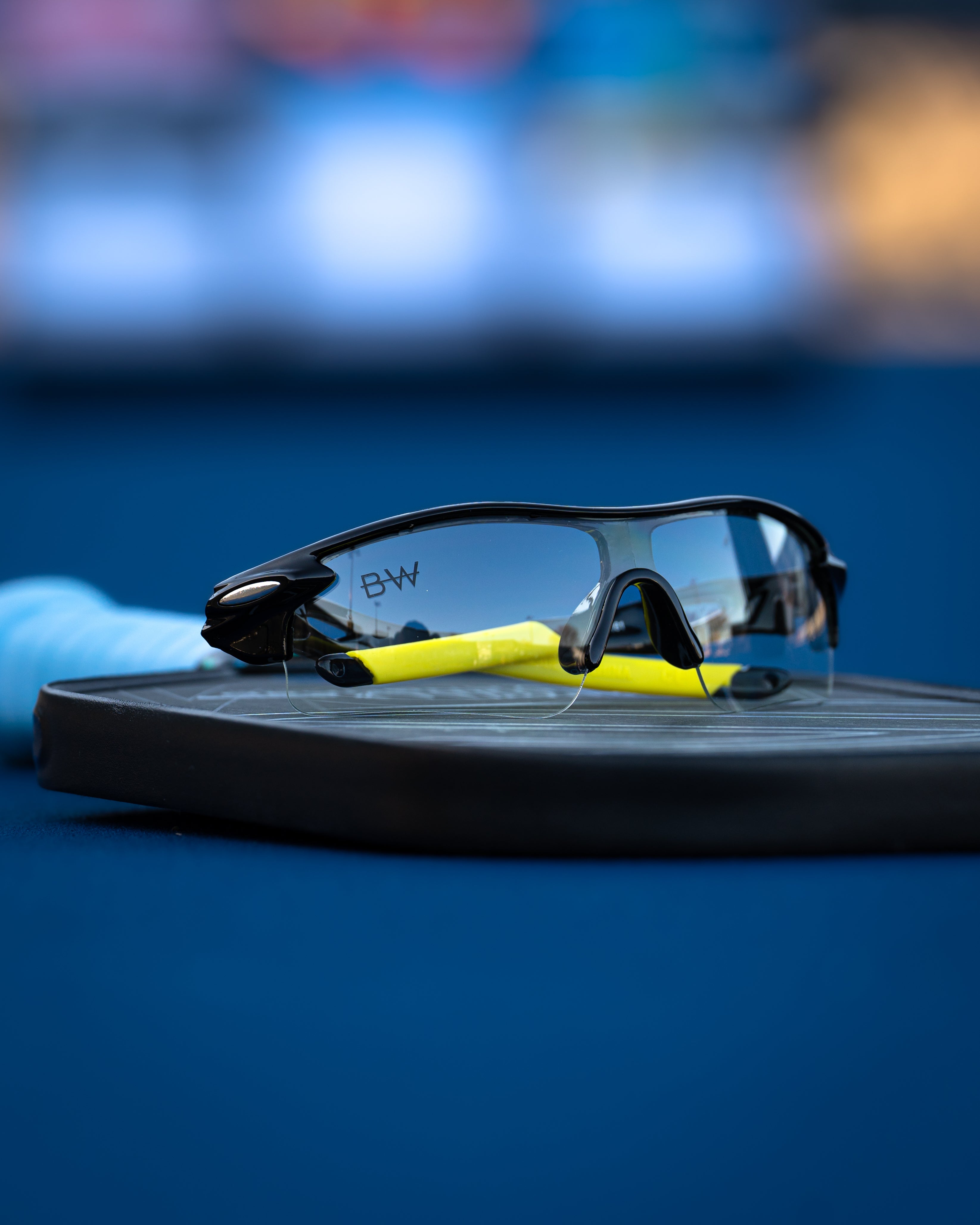
Sports Sunglasses in 2026: The Ultimate Guide to Performance Eyewear
Share
Sports Sunglasses in 2026: What Performance Eyewear Should Actually Do
Sports sunglasses in 2026 come in an enormous range of frame shapes, lens colors, prescription configurations, and sport-specific designs. The challenge is separating useful eyewear features from marketing claims that promise faster reactions, perfect clarity, better depth perception, or automatic athletic improvement.
Good performance eyewear does not replace technique, training, awareness, or decision-making. Instead, the goal is to choose eyewear whose fit, comfort, lens configuration, verified specifications, and prescription correction when needed make sense for the activity and environment in which you will actually wear it.
Blinded Wear focuses on performance eyewear designed for pickleball players, including non-prescription pickleball sunglasses and prescription pickleball eyewear.
This 2026 guide explains how to compare sports sunglasses without assuming that every tint, coating, frame shape, or lens technology produces the same result for every athlete.
Find Your Pickleball Glasses
If pickleball is your primary sport, start with the collection that matches your vision needs or explore the broader 2026 eyewear guide.
What Are Sports Sunglasses?
Sports sunglasses are eyewear intended for active use. Depending on the exact product, they can differ from ordinary fashion sunglasses in frame geometry, weight, physical coverage, lens construction, impact-resistant options, or other activity-oriented design considerations.
The phrase sports sunglasses does not establish one technical standard by itself. Two products marketed for sports can have very different specifications.
Do not assume that every sports sunglass automatically includes:
- Polarized lenses
- Non-polarized lenses
- UV400 protection
- Anti-fog treatment
- Anti-reflective treatment
- Scratch resistance
- Hydrophobic coatings
- Photochromic technology
- A particular impact certification
- Prescription compatibility
Those characteristics should be evaluated separately and verified for the exact eyewear configuration.
Sports Sunglasses vs. Regular Sunglasses
The most useful distinction is not simply whether one pair looks athletic. Compare how the eyewear is intended to be used and what specifications are actually provided.
| Consideration | Sports-Oriented Eyewear | General Sunglasses |
|---|---|---|
| Active-use design | May be designed around movement and extended wear | Varies widely |
| Lightweight construction | Common consideration | Varies |
| Impact-resistant options | May be available | Must be verified |
| Prescription configurations | Available in some models | Available in some models |
| Tint and lens technology | Product-specific | Product-specific |
| Safety certification | Must be specifically verified | Must be specifically verified |
A sports label alone does not prove that a pair is safer, clearer, tougher, or optically superior to every non-sports alternative.
What Matters in Sports Sunglasses in 2026?
Rather than searching for one supposedly revolutionary feature, evaluate several independent characteristics.
Fit
The frame should fit the individual wearer appropriately during the movements involved in the sport.
Comfort
Long practices, recreational sessions, and tournaments can involve hours of wear. Pressure points or persistent discomfort can make an otherwise appealing frame a poor match.
Lens Configuration
Consider whether you want a fixed tint, clear configuration, or an available adaptive technology such as photochromic lenses.
Visible Light Transmission
When exact VLT is provided, it offers more useful information about visible-light transmission than judging darkness from a product photo.
Impact Resistance
Impact-resistant lenses or options can be relevant in sports environments, but impact resistance should not be confused with shatterproof construction or a particular safety certification.
Prescription Correction
Athletes who require refractive correction should consider an appropriate RX configuration rather than assuming ordinary non-prescription sunglasses will meet their visual needs.
Fit Is One of the Most Important Parts of Sports Eyewear
Sports involve more movement than sitting at a desk or walking casually. Running, jumping, changing direction, bending, rotating the head, and perspiring can all expose weaknesses in frame fit.
That does not mean sports sunglasses should squeeze the head as tightly as possible.
A useful active fit balances:
- Comfort
- Appropriate stability
- Frame dimensions
- Individual face shape
- The movements involved in the sport
- Long-duration wear
No frame should be given a universal “never slips” or “zero movement” guarantee.
How to Test Sports Sunglasses for Active Fit
Evaluate new eyewear using realistic movements from your activity rather than an exaggerated shake test.
- Put the frame on normally.
- Look left, right, up, and down.
- Bend forward and return upright.
- Perform controlled movements similar to your sport.
- Wear the frame long enough to notice pressure points.
- Recheck fit after perspiration when practical.
A frame that moves substantially or repeatedly needs repositioning may not be the best fit for that wearer.
Should Sports Sunglasses Fit Tight?
Secure and excessively tight are not the same thing.
A frame can feel stable while remaining comfortable. Excessive pressure around the temples, nose, ears, or other contact areas can become increasingly noticeable during extended wear.
Choose an appropriate individual fit rather than assuming the tightest frame is automatically the best sports frame.
Why Lightweight Sports Frames Are Popular
Frame weight is a practical consideration when eyewear will be worn throughout a long training session or tournament. Blinded Wear offers lightweight sports frames designed around active wear and comfort.
Lightweight should not be confused with indestructible. Weight alone does not establish:
- Impact resistance
- Crush resistance
- Scratch resistance
- Heat resistance
- Safety certification
- Overall lifespan
Material, geometry, construction, lens retention, handling, and the forces involved all contribute to finished eyewear durability.
What Does “Durable Sports Sunglasses” Actually Mean?
Durability is not one specification. Eyewear can encounter several different types of stress.
| Stress | What It Involves |
|---|---|
| Impact | Sudden physical force |
| Abrasion | Surface contact that can scratch or mark lenses |
| Compression | Pressure from bags, equipment, or other objects |
| Heat | Exposure to elevated temperatures |
| Moisture | Water, sweat, and condensation |
| Repeated handling | Normal opening, closing, cleaning, storage, and transport |
A product that performs well against one stress should not automatically be assumed to be immune to all the others.
Impact-Resistant Sports Lenses Explained
Impact resistance can be particularly relevant in sports where balls, equipment, opponents, or unexpected falls create the possibility of contact.
Blinded Wear offers impact-resistant lens options for sports-oriented eyewear.
However, impact resistant does not mean indestructible. It also does not automatically mean:
- Shatterproof
- Scratchproof
- Crushproof
- Ballistic-rated
- Certified for occupational hazards
- Safe against every possible impact
Sports Eyewear and Certified Safety Eyewear Are Not Automatically the Same
Eyewear can be designed for athletic use without automatically meeting a particular industrial, occupational, tactical, or ballistic standard.
If your activity or workplace requires eyewear certified to a particular protective standard, verify that exact standard rather than relying on terms such as “sports,” “performance,” or “impact resistant.”
Sports Sunglass Lens Technology: Separate the Features
One of the biggest sources of confusion when shopping for performance eyewear is treating several unrelated lens properties as though they are the same technology.
| Feature | What It Describes |
|---|---|
| Tint | Coloration and visible-light characteristics of the lens |
| VLT | Percentage of visible light transmitted |
| Polarization | A separate optical characteristic involving polarization of transmitted light |
| Photochromic technology | A lens that changes tint according to its technology and environmental conditions |
| Impact resistance | Resistance to physical impact under applicable conditions |
| Anti-reflective treatment | A separate optical treatment when specified |
| Anti-fog treatment | A separate fog-management feature when specified |
| UV specification | A separate characteristic involving ultraviolet transmission |
| Prescription | Individualized refractive correction |
Never assume that the presence of one feature proves the presence of another.
What Is VLT in Sports Sunglasses?
VLT stands for Visible Light Transmission. It describes the percentage of visible light transmitted through a lens.
The basic relationship is straightforward:
- Higher VLT: more visible light is transmitted.
- Lower VLT: less visible light is transmitted.
VLT can help compare lenses intended for different lighting environments, but it is not a universal sports-performance score.
What VLT Does Not Tell You
VLT alone does not establish:
- UV protection
- Polarization
- Impact resistance
- Anti-fog performance
- Scratch resistance
- Photochromic technology
- Prescription accuracy
- Depth perception
- Reaction time
- Ball tracking
- Overall product quality
Two lenses can also have similar overall VLT while differing in color and other characteristics.
Are Darker Sports Sunglasses Better?
Not automatically.
A darker lens transmits less visible light when its VLT is lower, but the darkest available lens is not universally ideal for every sport or environment.
Consider whether you primarily use the eyewear in:
- Bright open sun
- Partial shade
- Changing sun and shade
- Cloudy conditions
- Morning or evening light
- Indoor environments
Choose according to the conditions in which you actually participate.
Clear Sports Lenses
Clear-lens eyewear can be useful for athletes who do not want a dark sunglass tint.
Blinded Wear offers a Clear Lens Collection for players exploring that type of configuration.
Clear appearance does not automatically establish:
- 100% VLT
- UV400 protection
- Impact certification
- Anti-fog treatment
- Anti-reflective treatment
- Scratch resistance
Those specifications should be verified separately.
Does Sports Sunglass Lens Color Matter?
Lens color can influence the visual appearance of the environment and can be associated with different spectral transmission characteristics, but broad color rules are often oversimplified.
Do not assume:
- Gray is universally the most accurate sports lens.
- Yellow automatically improves reaction time.
- Blue automatically improves ball tracking.
- Red automatically improves depth perception.
- Pink automatically increases contrast.
- One lens color is best for every athlete.
Use verified specifications for the exact lens rather than assigning universal performance effects based solely on color.
Do Not Judge Lens Performance From Product Photos Alone
Photography, display settings, lighting, reflections, editing, and the background behind a lens can all influence how dark or colorful a product appears online.
A product photo should not be used to determine an exact:
- VLT percentage
- Polarization status
- UV specification
- Impact rating
- Coating
- Photochromic response
Polarized vs. Non-Polarized Sports Sunglasses
Polarization is useful to understand, but it should not be treated as a simple “good for sports” or “bad for sports” label.
Most importantly, polarization alone does not determine:
- Depth perception
- Reaction time
- Ball tracking
- Peripheral vision
- Decision speed
- Shot accuracy
Likewise, non-polarized lenses should not automatically be described as improving those abilities.
Do Polarized Lenses Hurt Depth Perception?
It is too broad to claim that polarized sports sunglasses inherently damage depth perception.
Depth perception is a visual function influenced by multiple cues and individual factors. Polarization status by itself should not be used to predict an athlete's depth perception or sports performance.
Do Polarized Sunglasses Cause Visual Delay?
Polarization should not generically be described as creating a delay between what happens and what the athlete sees.
Athletic response involves:
- Visual information
- Attention
- Recognition
- Anticipation
- Decision-making
- Motor response
That process cannot be reduced to whether a sunglass lens is polarized.
Photochromic Sports Sunglasses in 2026
Photochromic technology can be useful for athletes interested in a lens that changes tint according to the specific technology and environmental conditions.
This can provide one-pair convenience when moving through changing environments, but photochromic lenses should not be described as instant electronic light sensors.
What to Expect From Photochromic Lenses
Exact behavior depends on the particular photochromic technology and conditions.
Avoid assuming that every photochromic lens:
- Changes at the same speed
- Becomes completely clear indoors
- Becomes equally dark outdoors
- Responds identically at every temperature
- Behaves identically behind every window
- Is polarized
- Is impact resistant
- Includes anti-fog treatment
- Has a particular UV specification
Fixed Tint vs. Photochromic Sports Eyewear
| Feature | Fixed Tint | Photochromic |
|---|---|---|
| Tint behavior | Remains substantially fixed | Changes according to technology and conditions |
| Predictability | Consistent fixed configuration | State can vary with environment |
| Changing environments | Environment changes while tint stays substantially fixed | Tint can change in response to applicable conditions |
| Instant transition | Not applicable | Should not be assumed |
| Automatically polarized | No | No |
| Automatically impact resistant | No | No |
What Does “Glare Reduction” Mean in Sports Sunglasses?
Glare is a broad term for problematic or uncomfortable brightness, and different optical features can affect different light conditions.
Avoid using “anti-glare” as though it proves a single universal technology.
When glare management matters, investigate the actual characteristics of the lens, which can include:
- Tint
- VLT
- Polarization status
- Verified optical treatments
- Photochromic behavior when applicable
No ordinary sports sunglasses should be promised to eliminate every glare condition.
Anti-Reflective Treatment Is a Separate Feature
Anti-reflective treatment should only be claimed when it is verified for the exact lens configuration.
Do not infer it merely because a lens is:
- Tinted
- Polarized
- Non-polarized
- Prescription
- High-index
- Designed for sports
What About Anti-Fog Sports Sunglasses?
Fog is condensation on the lens surface. Anti-fog performance is therefore different from tint, polarization, impact resistance, UV transmission, or prescription correction.
Do not assume a sports frame has an anti-fog coating or proprietary ventilation system unless that feature is specifically verified.
Does Frame Shape Prevent Fogging?
Frame geometry can influence how eyewear sits relative to the face, but it is too broad to promise that a particular sports shape prevents fogging in every environment.
Condensation can be affected by temperature, humidity, airflow, activity, perspiration, and other conditions.
UV Claims in Sports Sunglasses
UV performance is important to evaluate independently from visible tint.
A dark-looking lens does not, by appearance alone, prove:
- UV400 protection
- 100% UVA protection
- 100% UVB protection
- Any other exact UV specification
Use exact UV claims only when the specification is verified for the lens in question.
UV Protection and VLT Are Not the Same Thing
| Specification | What It Describes |
|---|---|
| VLT | Visible-light transmission |
| UV specification | Ultraviolet-transmission characteristics |
A darker visible tint should not automatically be described as providing greater UV protection.
Scratch Resistance vs. Scratchproof Sports Lenses
Scratch resistance, when verified, should not be converted into a scratchproof guarantee.
Lens surfaces can encounter:
- Dust
- Sand
- Grit
- Keys
- Sports equipment
- Dirty cleaning materials
- Other abrasive objects
Good storage and appropriate cleaning remain useful even with durable sports eyewear.
How to Clean Sports Sunglasses
Sports eyewear can accumulate fingerprints, perspiration, sunscreen, dust, water spots, and other residue.
A practical cleaning routine is to:
- Inspect the lenses for loose grit or particles.
- Remove loose debris appropriately before aggressive wiping.
- Use lens-compatible cleaning methods.
- Use clean lens-compatible material.
- Avoid abrasive DIY polishing methods.
- Store the eyewear after cleaning.
Sports Sunglass Cleaning Mistakes to Avoid
Avoid using abrasive DIY scratch-removal techniques such as:
- Toothpaste
- Baking soda polishing
- Automotive polishing compounds
- Household abrasive cleaners
- Unverified coating-removal methods
These methods can alter the lens surface rather than restoring it to its original condition.
Dirty Lens or Scratched Lens?
Not every visible mark is permanent damage.
Fingerprints, sunscreen, sweat, dried water, and other residue can affect the viewing surface. Appropriate cleaning can help determine whether a mark is contamination or physical damage.
A scratch is physical surface damage. It should also be distinguished from a structural crack or chip.
How to Store Sports Sunglasses
Protective storage helps separate eyewear from unnecessary abrasion, drops, and compression.
Avoid leaving sports sunglasses loose with:
- Keys
- Metal equipment
- Tools
- Loose grit
- Heavy objects
- Other hard or abrasive items
A structured case can provide greater separation from direct pressure, while a soft pouch primarily provides surface separation and more limited compression protection.
Sports Sunglasses and Extreme Heat
Avoid unnecessary prolonged exposure to extreme heat. This is particularly relevant when storing eyewear inside vehicles or other hot enclosed spaces.
There is no useful universal damage-temperature threshold for every frame, lens, coating, and exposure duration.
Also avoid extreme heat as a drying method after eyewear becomes wet.
Sports Sunglasses in Rain and Wet Conditions
Water droplets on a lens can interfere with the viewing surface, but ordinary water exposure should not automatically be described as structural lens damage.
Water also does not change:
- A prescription
- PD
- Fixed lens tint
- Refractive power
Do not assume that sports eyewear is waterproof or hydrophobic unless those characteristics are specifically verified.
Prescription Sports Sunglasses in 2026
Athletes who require vision correction do not necessarily have to choose between their prescription and sports-oriented eyewear.
Blinded Wear offers prescription pickleball eyewear for players who need individualized refractive correction.
Prescription sports eyewear can use different configurations, including direct prescription designs and compatible RX-insert designs depending on the product.
What Prescription Sports Eyewear Actually Does
An appropriate eyeglass prescription corrects the refractive error for which it was prescribed.
That is different from claiming that prescription sports eyewear independently:
- Increases reaction speed
- Improves anticipation
- Improves athletic decision-making
- Creates better strategy
- Guarantees better depth perception
- Guarantees better ball tracking
- Improves shot accuracy
Vision is one input into athletic performance, alongside skill, experience, attention, positioning, movement, decision-making, and physical execution.
Understanding Your Sports Eyewear Prescription
An eyeglass prescription may contain values such as:
- OD: right eye
- OS: left eye
- SPH: spherical refractive power
- CYL: cylindrical correction when prescribed
- AXIS: orientation associated with cylindrical correction
- ADD: additional power when prescribed
- Prism: prism correction when prescribed
- PD: pupillary distance used in lens positioning
Not every prescription contains every field.
Do You Need a Stronger Prescription for Sports?
Do not increase, decrease, round, transpose, or otherwise alter prescription values because eyewear will be used for sports.
An eye-care professional is the appropriate resource for determining individualized refractive correction.
Can You Use a Contact Lens Prescription for Sports Glasses?
Do not treat a contact-lens prescription and an eyeglass prescription as interchangeable.
If you are ordering prescription sports eyewear, use the appropriate eyeglass prescription rather than attempting to convert contact-lens values yourself.
How to Order Blinded Wear RX Sports Eyewear
For applicable Blinded Wear RX products, upload a clear image of your eyeglass prescription on the product page before adding the eyewear to your cart and purchasing.
For a step-by-step explanation, visit How to Order RX Glasses.
High-Index Prescription Sports Lenses
Blinded Wear includes high-index prescription lenses at no additional cost with RX eyewear.
High-index refers to a category of prescription lens material with a higher refractive index than conventional lens materials. It can be useful for managing finished lens thickness, particularly as prescription strength increases.
Final thickness still depends on factors including:
- Individual prescription
- Lens dimensions
- Frame dimensions
- Decentration and positioning
- Lens design
- Other optical requirements
What High-Index Does Not Automatically Mean
High-index should not automatically be interpreted as:
- Impact resistant
- Shatterproof
- Scratch resistant
- Anti-fog
- Polarized
- Photochromic
- Hydrophobic
- UV400
- Safety certified
- More prescription-accurate
- Better for reaction time
- Better for tracking
- Better for depth perception
Those are separate characteristics.
Strong Prescriptions and Sports Sunglasses
There is no universal prescription threshold at which sports eyewear suddenly becomes unsuitable.
As prescription strength increases, lens thickness management and the interaction between prescription, lens dimensions, and frame choice can become more relevant.
For minus prescriptions, edge thickness can become more noticeable depending on the configuration. For plus prescriptions, center thickness can become more relevant. High-index material can often help manage thickness, but it does not make every strong prescription identical in finished form.
Prescription Lens Positioning Matters
Prescription eyewear involves more than placing a prescription value somewhere inside a lens.
Depending on the design, relevant considerations can include:
- PD
- Horizontal positioning
- Vertical positioning or fitting height when applicable
- Frame geometry
- Vertex distance
- Wrap
- Pantoscopic tilt
- Overall wearing position
This is why “the optical center always sits directly over the pupil” is too simplistic as a universal description of modern prescription lens positioning.
What Is PD in Prescription Sports Eyewear?
PD stands for pupillary distance. It is used as part of positioning prescription lenses relative to the wearer.
PD does not change because:
- You start running
- You begin sweating
- The frame shifts
- You move indoors or outdoors
- The lens becomes darker
- You switch sports
Frame movement can change the eyewear's wearing position, but it does not change the wearer's anatomical PD.
Why the Same Prescription Can Feel Different in Different Sports Frames
Two pairs can use the same written prescription while differing in frame geometry, lens dimensions, curvature, positioning, vertex distance, lens design, tint, and overall fit.
Therefore, a different subjective experience does not automatically mean the written prescription changed or one pair is necessarily incorrect.
Should You Practice in New Sports Eyewear Before Competition?
When practical, wear new sports eyewear during ordinary practice before relying on it for an important tournament, race, match, or event.
This gives you an opportunity to evaluate:
- Fit
- Comfort
- Lens configuration
- Frame movement
- How the eyewear feels over longer sessions
There is no universal adaptation period that applies to every frame, prescription, or athlete.
Can Sports Sunglasses Improve Athletic Performance?
Be cautious with direct performance promises.
Sports sunglasses can provide an eyewear configuration suited to an athlete's preferences and environment. Prescription eyewear can provide the refractive correction for which it was prescribed.
That is different from proving that a pair independently makes an athlete:
- React faster
- Track objects better
- Make faster decisions
- Anticipate opponents earlier
- Become more accurate
- Gain better depth perception
- Play more confidently
Sports Sunglasses and Reaction Time
Reaction time involves more than simply seeing an object.
In many sports, an athlete must:
- Receive visual information.
- Direct attention appropriately.
- Recognize what is happening.
- Interpret relevant cues.
- Select a response.
- Initiate movement.
- Execute the movement.
No tint, frame shape, polarization status, or high-index material should automatically be credited with speeding up this entire process.
Sports Sunglasses and Ball Tracking
Tracking a moving object is a visual task influenced by the athlete, target, background, lighting, movement, attention, and viewing conditions.
Claims that one lens color universally improves ball tracking across tennis, pickleball, baseball, volleyball, cycling, and other sports oversimplify the task.
Sports Sunglasses and Depth Perception
Depth perception should not be reduced to one sunglass feature.
Do not assume that:
- Non-polarized lenses automatically improve depth perception.
- Polarized lenses automatically reduce depth perception.
- High-index lenses improve depth perception.
- A particular tint automatically improves depth perception.
- A sports frame creates better depth perception.
Sports Frames and Peripheral Vision
Frame shape can affect physical obstruction around the viewing area, but sunglasses do not expand the wearer's biological peripheral visual field.
A broad lens or curved sports appearance should therefore not automatically be marketed as producing superior peripheral vision or full-field tracking.
Should Sports Sunglasses Be Chosen by Sport?
The activity matters because different sports involve different environments, movement patterns, equipment, and lighting.
Useful questions include:
- Will you primarily be indoors or outdoors?
- How much does lighting change?
- How much head and body movement is involved?
- How long will you wear the eyewear?
- Is ball or equipment impact possible?
- Do you need prescription correction?
- Does the activity require certified protective eyewear?
Sports Sunglasses for Pickleball
Pickleball combines quick exchanges, longer rallies, overhead shots, lateral movement, changing viewing backgrounds, and indoor or outdoor playing environments.
When selecting pickleball eyewear, consider:
- Comfort during extended play
- Active fit
- Lightweight frame design
- Impact-resistant lens options
- Lighting environment
- Prescription correction when needed
- Whether you prefer tinted or clear eyewear
Explore Blinded Wear Pickleball Sunglasses for current non-RX options.
Prescription Sports Eyewear for Pickleball
Players who need vision correction can explore Blinded Wear's RX Pickleball Eyewear Collection.
Current RX styles to compare include:
- Zebra II RX
- Steel Ice RX
- Blue Shield RX
- Rippled X RX
- Frost RX
- Gray Wash RX
- Crystal Wave II RX
- Lava Rock RX
- Havana Melt RX
Compare the current configuration of each product rather than assuming every RX model includes identical tint, polarization, coatings, VLT, or adaptive-lens technology.
Waved II Sports Sunglasses
Waved II Sunglasses are one Blinded Wear non-prescription option to compare for active pickleball use.
As with any model, use the current product information for exact lens characteristics rather than inferring polarization, VLT, UV specifications, coatings, or other technical properties from appearance alone.
Indoor vs. Outdoor Sports Sunglasses
Indoor and outdoor environments can have substantially different amounts and sources of visible light.
A fixed dark tint that a wearer prefers in bright outdoor sun may not be that person's preferred configuration in a lower-light indoor facility.
Options to consider can include:
- A fixed tinted pair for bright outdoor conditions
- A clear-lens configuration when a dark tint is not desired
- Multiple pairs for substantially different environments
- An available photochromic configuration for one-pair convenience
There is no universal requirement that every athlete own separate indoor and outdoor eyewear.
Sports Eyewear for Changing Light Conditions
Lighting can change because of clouds, shadows, time of day, buildings, trees, stadium structures, or movement between indoor and outdoor environments.
A fixed tint remains substantially fixed while the environment changes.
Photochromic technology, when available, changes according to the specific technology and conditions, but it should not be promised to react instantly to every transition.
One Pair vs. Multiple Sports Sunglasses
| Consideration | One Pair | Multiple Pairs |
|---|---|---|
| Convenience | Simple to manage | More equipment to carry |
| Different lighting | One configuration covers your preferred range | Can provide different configurations |
| Backup | No dedicated backup | Can provide redundancy |
| Cost | One purchase | Additional purchase required |
| Universal requirement | No | No |
Why a Backup Pair Can Be Useful
A backup pair can be practical for athletes who depend heavily on their eyewear, especially prescription wearers.
A backup can help if the primary pair is:
- Lost
- Damaged
- Temporarily unavailable
- In need of cleaning
- Not the preferred configuration for a changed environment
A backup is a practical redundancy strategy rather than a requirement for serious athletes.
Traveling With Sports Sunglasses
Travel can expose eyewear to compression, abrasion, drops, loose equipment, heat, moisture, and repeated handling.
Protective storage is preferable to assuming sports sunglasses are crushproof or travel-proof.
If prescription eyewear is essential to your participation, keeping an appropriate backup accessible can also be practical.
Inspect Sports Eyewear After an Impact
If your eyewear experiences a significant impact, drop, or compression event, inspect the actual pair rather than relying solely on its original product description.
Look for:
- Cracks
- Chips
- Lens displacement
- Frame deformation
- Unexpected changes in fit
- Unusual hinge behavior
Avoid destructive home testing to determine how much additional force the eyewear can withstand.
Common Sports Sunglasses Buying Mistakes
Choosing by Appearance Alone
A dramatic lens color or wraparound design does not reveal all of the lens specifications.
Assuming Darker Means Better
Lower visible-light transmission is not automatically better for every environment.
Assuming Every Sports Lens Is Polarized
Polarization must be verified.
Assuming Non-Polarized Means Better Depth Perception
Polarization status alone does not determine depth perception.
Ignoring Fit
A technically appealing frame can still be a poor choice if it does not fit the wearer appropriately.
Ignoring Long-Term Comfort
A frame that feels acceptable for two minutes may feel different after hours of wear.
Assuming Impact Resistant Means Indestructible
Impact resistance is not an unlimited durability guarantee.
Assuming Every Lens Is Anti-Fog
Anti-fog performance should be verified rather than inferred.
Assuming Price Equals Performance
Price alone does not prove a particular optical or athletic benefit.
Sports Sunglasses Buying Checklist for 2026
Before purchasing performance eyewear, ask:
- What sport or activities will I use these for?
- Will I primarily be indoors, outdoors, or both?
- What lighting conditions do I encounter?
- Do I need prescription correction?
- Does the frame fit comfortably?
- Does it remain appropriately stable during realistic movement?
- What is the lens tint?
- Is exact VLT provided?
- Is polarization present or absent?
- Is impact resistance specified?
- Are UV specifications verified?
- Are anti-fog or anti-reflective treatments actually specified?
- Is photochromic technology available if I want it?
- Would a second pair or backup be useful?
- What are the current return and replacement policies?
Verify Each Sports Eyewear Feature Separately
| If You Care About... | Verify... |
|---|---|
| Brightness management | Tint and VLT |
| Polarization | Explicit polarization specification |
| Changing tint | Photochromic technology |
| Impact resistance | Impact-resistant lens specification |
| UV performance | Exact verified UV specification |
| Fog management | Verified anti-fog feature |
| Reflections | Verified anti-reflective treatment |
| Prescription correction | Appropriate RX configuration and eyeglass prescription |
| Safety certification | The exact required standard |
Sports Sunglass Marketing Claims to Treat Carefully
Performance eyewear is easier to compare when claims describe verifiable features rather than guaranteed athletic outcomes.
Be cautious with phrases such as:
- “Instantly improves reaction time”
- “Perfect ball tracking”
- “Maximum depth perception”
- “Zero distortion”
- “Zero glare”
- “Never fogs”
- “Never slips”
- “Shatterproof”
- “Indestructible”
- “Improves court awareness”
- “Makes athletes faster”
- “Guaranteed competitive advantage”
Specific, verifiable product information is more useful than absolute performance language.
Blinded Wear Sports Eyewear for Pickleball Players
Blinded Wear designs performance eyewear around pickleball players, with lightweight sports frames, impact-resistant lens options, RX and non-RX choices, and styles intended for active use.
Current non-prescription pickleball sunglasses are $149.99.
Players who need refractive correction can choose from Blinded Wear RX eyewear, with high-index prescription lenses included at no additional cost.
Rather than assuming every product has the same lens characteristics, compare the exact frame and configuration that fits your needs.
Compare Pickleball Lens Options
If you are trying to understand the differences between available lens colors and RX options, visit the Pickleball Performance Lens Guide.
The strongest lens choice is the one that matches your intended environment and preferences rather than the one with the most aggressive performance claim.
Not Sure Which Pickleball Sunglasses to Choose?
Use the Blinded Wear Pickleball Sunglasses Quiz to narrow your shopping options according to your preferences.
The quiz is a product-selection tool. It does not determine an eyeglass prescription, diagnose vision problems, or replace an eye-care professional.
Compare More Pickleball Glasses for 2026
For a broader look at current pickleball eyewear, visit the Best Pickleball Glasses 2026 Hub.
From there, you can compare RX, non-RX, clear-lens, and other sports-oriented eyewear options.
Sports Sunglasses in 2026: Start With the Features That Actually Matter
The modern sports-eyewear market includes lightweight frames, impact-resistant options, prescription configurations, fixed tints, clear lenses, polarization choices, and adaptive lens technologies. More options can be useful, but they also make accurate comparison more important.
Start with fit, comfort, activity, lighting environment, verified lens characteristics, impact considerations, and prescription needs.
Keep separate features separate. Tint is not polarization. VLT is not UV protection. Impact resistance is not shatterproof construction. High-index is not anti-glare technology. A sports frame is not automatically safety-certified. Prescription correction is not a shortcut to faster reactions.
For pickleball players, explore Blinded Wear Non-RX Pickleball Sunglasses or the Blinded Wear RX Pickleball Eyewear Collection to compare current options.
How to Choose Sports Sunglasses by Activity
The phrase performance eyewear covers many activities, but the environment and movement demands of each sport can be different. Instead of assuming one pair is universally best, identify what your activity actually asks of your eyewear.
| Activity | Useful Questions to Ask |
|---|---|
| Pickleball | Is the frame comfortable during quick movement and long sessions? What lighting conditions do you normally play in? Do you need RX correction? |
| Tennis | Will you primarily play in open sun, shade, or changing conditions? Does the frame remain comfortable during serving and lateral movement? |
| Running | Is the frame comfortable during repetitive movement? What conditions and time of day do you normally run in? |
| Cycling | What physical coverage, fit, and lighting configuration do you prefer? Does your use require a specific protective standard? |
| Baseball or Softball | What are your lighting conditions, fit requirements, and impact considerations? |
| Volleyball | Are you playing indoors, outdoors, or both? Does the frame remain comfortable during jumping and rapid movement? |
| General Training | Will you use the eyewear across several environments? Would one versatile configuration or multiple pairs better fit your routine? |
These questions are more useful than assuming a particular lens color or frame shape automatically improves performance in a specific sport.
Choosing Sports Sunglasses for Pickleball Courts
Pickleball is particularly useful for illustrating why environment matters. A player may encounter an exposed outdoor court at noon, partial tree shade, an overcast morning, an indoor facility, or changing light during an evening session.
Before choosing pickleball eyewear, consider:
- Whether you primarily play indoors or outdoors
- How bright your usual courts are
- Whether the court moves between sun and shade
- Whether you frequently play near sunrise or sunset
- How long your sessions typically last
- Whether you need prescription correction
- Whether you want a dark tint, clear lens, or another available configuration
These variables can help narrow your options without claiming that one lens automatically produces better pickleball performance.
Sports Sunglasses for Bright Outdoor Conditions
In bright environments, athletes often prefer a lens configuration that transmits less visible light than a clear configuration. Exact preference varies by wearer and environment.
If exact VLT information is available for a lens, use it rather than estimating transmission from a product image.
Remember that a lower VLT does not automatically establish:
- Greater UV protection
- Polarization
- Better contrast
- Better depth perception
- Faster reaction time
- Better ball tracking
- Greater impact resistance
Sports Eyewear for Shaded Courts and Fields
Shade can substantially change the amount of visible light reaching an athlete compared with an exposed area in direct sunlight.
A fixed tint does not become lighter simply because the athlete enters shade. This can matter in environments where the viewing background repeatedly changes between brighter and darker areas.
There is no universal tint or VLT that every athlete should use in shade. Evaluate the actual lens specification and your individual preference.
Sports Sunglasses for Mixed Light
Mixed-light environments can include combinations of direct sun, shadows, clouds, trees, buildings, and changing court orientation.
Possible approaches include:
- Using one fixed-tint configuration that you find comfortable across the expected range
- Carrying a second pair with a different lens configuration
- Using an available photochromic configuration when its behavior fits your needs
No option is universally best. The useful comparison is convenience, consistency, actual lighting conditions, and the verified characteristics of the specific lens.
Do You Need Sports Sunglasses on Cloudy Days?
Cloud cover does not create one consistent lighting condition. Some overcast days remain relatively bright, while others provide substantially less visible light.
Whether you prefer tinted eyewear depends on actual conditions and personal preference. Avoid assuming that “cloudy” automatically requires either clear or tinted lenses.
Sports Sunglasses for Evening Play
As ambient light decreases, a fixed dark tint continues transmitting light according to its substantially fixed characteristics. It does not automatically become clearer because the sun is setting.
If you frequently play from daylight into lower-light evening conditions, consider whether:
- Your existing fixed tint remains comfortable
- You prefer changing to another pair
- A clear configuration is useful later in the session
- An available photochromic configuration fits your preferences
Do not assume a particular color is universally the best sunset or evening sports lens.
Sports Eyewear for Indoor Competition
Indoor sports environments differ considerably. Lighting intensity, fixture placement, windows, court color, background, and building design can all influence what the athlete sees.
Players who do not want a dark tint indoors can explore clear-lens eyewear.
A clear lens should not automatically be described as providing perfect clarity, better reaction time, enhanced tracking, or a particular UV or impact specification unless those characteristics are independently verified.
Moving Between Outdoor and Indoor Sports Environments
Athletes who regularly move between outdoor and indoor environments have several possible strategies.
Use Separate Pairs
A tinted outdoor configuration and another appropriate indoor configuration provide distinct options for substantially different environments.
Use One Fixed Configuration
Some athletes prefer the simplicity of one pair if they are comfortable with it across their normal conditions.
Consider Photochromic Technology
When available, photochromic eyewear can offer one-pair convenience because its tint changes according to the specific technology and environmental conditions.
None of these approaches should be described as universally superior.
Photochromic Sports Sunglasses: Understand the Limitations
Adaptive tint can be convenient, but realistic expectations are important.
Photochromic technology should not automatically be described as:
- Instantly changing from clear to dark
- Instantly clearing when moving indoors
- Reacting identically in all temperatures
- Reaching the same darkness in every environment
- Responding identically behind every window
- Automatically polarized
- Automatically anti-fog
- Automatically impact resistant
Check the exact product and lens technology when photochromic behavior is important to your purchase.
When Should Athletes Consider Polarized Sunglasses?
Polarization is one lens characteristic that can be considered according to environment and preference. It should not be treated as a universal requirement or universal disadvantage for athletes.
When comparing polarized and non-polarized sports sunglasses, separate polarization from:
- Visible-light transmission
- Tint color
- UV specifications
- Prescription correction
- Impact resistance
- Photochromic technology
- Coatings
A lens can combine some of these characteristics, but one does not automatically imply the others.
What Are Non-Polarized Sports Sunglasses?
A non-polarized lens simply does not use polarization as a defining lens characteristic. That description should not be expanded into unsupported claims that the lens automatically produces better depth perception, faster visual processing, improved ball tracking, or more accurate movement.
When evaluating a non-polarized lens, continue checking its tint, VLT when available, impact characteristics, prescription configuration, and other verified specifications separately.
Why “Glare” Is More Complicated Than It Sounds
Athletes may use the word “glare” to describe several different experiences, including intense sunlight, reflections, bright sky, illuminated surfaces, or general visual discomfort.
Because the term covers different conditions, a blanket “glare-free” claim provides little useful technical information.
Instead, identify:
- The source of problematic brightness
- The environment in which it occurs
- The tint and VLT of the lens
- Whether polarization is relevant and present
- Whether any additional optical treatments are verified
Do Sports Sunglasses Enhance Contrast?
Do not assume every colored sports lens universally enhances contrast in a way that improves athletic performance.
Lens color and spectral transmission can influence the visual appearance of an environment, but exact effects depend on the lens, lighting, background, target, and wearer.
If a manufacturer makes a specific contrast-enhancement claim, evaluate the evidence and exact lens configuration rather than generalizing the claim to every tinted sports lens.
Should You Match Sports Sunglasses to Ball Color?
It can be tempting to choose a lens solely according to the color of a pickleball, tennis ball, baseball, or other object. Real sports environments are more complicated.
During play, the object may appear against:
- Sky
- Court surfaces
- Grass
- Fencing
- Buildings
- Signs
- Opponent clothing
- Spectators
- Shadows
Because the background changes, there is no universal lens color that guarantees superior tracking of a particular ball color.
Seeing a Ball and Tracking a Ball Are Not Identical Concepts
Visibility is one component of a much larger athletic task.
During a fast rally, pitch, serve, return, or pass, the athlete may need to combine:
- Visual information
- Attention
- Object motion
- Opponent movement
- Teammate position
- Spatial context
- Experience
- Anticipation
- Physical response
Sports sunglasses can be part of the visual setup, but they should not be marketed as independently creating these abilities.
Clearer Vision Does Not Mean the Brain Automatically Reacts Faster
For an athlete who requires prescription correction, appropriate RX eyewear can correct the refractive error for which it was prescribed.
That does not establish a direct one-to-one relationship in which clearer refractive correction automatically produces a particular reduction in reaction time.
Athletic reaction involves perception, attention, interpretation, decision-making, neuromuscular response, and physical execution.
Sports Eyewear and Decision-Making
Good decisions in sports depend on far more than eyewear.
For example, a pickleball player deciding whether to attack a ball may use:
- Ball height
- Ball speed
- Spin
- Opponent position
- Partner position
- Court position
- Score and strategy
- Experience
Eyewear does not independently create tactical awareness or decision speed.
Why Comfort Matters During Long Practices and Tournaments
Sports sunglasses may be worn for hours rather than minutes. Comfort therefore deserves the same attention as lens appearance.
During extended wear, evaluate:
- Temple pressure
- Nose contact
- Overall frame weight
- Whether the frame repeatedly needs repositioning
- Whether fit changes after perspiration
- Compatibility with other equipment you actually use
A comfortable frame does not guarantee athletic improvement, but discomfort can make eyewear less practical to wear for the intended activity.
Sweat and Sports Sunglasses
Perspiration can affect how eyewear feels and sits during activity. It can also leave residue on lenses and frames.
Do not automatically describe sports eyewear as sweatproof unless that claim is specifically supported.
After heavy activity, appropriate cleaning and storage can help remove accumulated residue.
Why Sports Sunglasses May Slip During Activity
Frame movement can involve several factors:
- Individual face shape
- Frame dimensions
- Wearing position
- Perspiration
- Movement intensity
- Frame adjustment
- Physical deformation or damage
Do not assume that a sports label means a frame will remain completely motionless on every wearer.
Can an Eyewear Retainer Help During Sports?
A compatible retainer can provide additional physical retention for some athletes. It can be useful in activities where the wearer prefers another point of retention.
A retainer does not:
- Correct a fundamentally poor frame fit
- Change prescription power
- Improve lens optics
- Change VLT
- Make eyewear impact-proof
Should You Adjust Sports Sunglasses Yourself?
Minor repositioning during normal wear is different from permanently reshaping a frame.
Avoid aggressive DIY heating, bending, or forcing of eyewear unless the adjustment method is known to be appropriate for that exact frame.
If a frame suddenly fits differently after an impact or compression event, inspect it for physical damage before assuming it merely needs adjustment.
Does Frame Movement Change Your Prescription?
No. A prescription is manufactured into the applicable prescription lens configuration.
If a frame shifts, the wearing position of the lenses relative to the wearer changes. The prescription values themselves do not suddenly change.
Likewise, your PD does not change because the frame moved.
RX vs. Non-RX Sports Sunglasses
| Question | RX Sports Eyewear | Non-RX Sports Eyewear |
|---|---|---|
| Provides individualized refractive correction? | Yes, according to the prescribed configuration | No |
| Can use sports-oriented frame designs? | Depending on product | Depending on product |
| Can use tinted lenses? | Depending on product | Depending on product |
| Automatically polarized? | No | No |
| Automatically anti-fog? | No | No |
| Automatically safety-certified? | No | No |
The main distinction is whether individualized prescription correction is part of the eyewear configuration.
Prescription Sports Sunglasses vs. Contacts With Non-RX Sunglasses
Some athletes who require vision correction use prescription sports eyewear. Others may use professionally prescribed contact lenses with non-prescription sports sunglasses.
Neither approach is universally superior.
Questions involving contact-lens suitability, comfort, eye health, or individual prescription needs are appropriate for an eye-care professional.
Direct RX vs. Prescription Insert Sports Eyewear
| Configuration | Basic Description |
|---|---|
| Direct RX | Prescription correction is incorporated into the applicable prescription-lens configuration |
| RX insert | A separate inner prescription component provides the refractive correction within a compatible eyewear system |
Neither configuration should automatically be described as producing faster vision, less visual delay, better reaction time, or greater prescription accuracy.
Evaluate the complete eyewear configuration and individual fit.
Understanding RX Insert Sports Glasses
In a compatible RX-insert system, the inner prescription component and outer sports lens perform different roles.
Do not assume a property of one component automatically applies to the other.
For example, an outer lens color does not establish:
- The prescription power of the insert
- The material of the RX lens
- Whether the RX component is polarized
- Whether the RX component has a particular coating
How Do You Know if Prescription Sports Sunglasses Match Your RX?
Athletic performance is not a reliable measurement tool for determining whether finished prescription eyewear matches prescribed refractive values.
A missed ball, bad shot, slow reaction, or difficult game does not by itself prove that the prescription lenses were manufactured incorrectly.
When objective verification is needed, appropriate optical equipment such as a lensmeter or focimeter can be used by a qualified professional to evaluate relevant lens properties.
Can a Selfie Verify Prescription Lens Positioning?
A selfie or phone photo can show general appearance and frame position, but it should not be treated as a complete optical verification of prescription sports eyewear.
Optical positioning can involve more than what is visible in a single photograph.
Can You Use an Older Prescription for Sports Sunglasses?
An older prescription can theoretically be manufactured accurately while no longer representing the wearer's current refractive needs.
If your vision has changed, the prescription is unclear, or you are unsure whether it remains appropriate, consult an eye-care professional rather than guessing new values.
When Visual Symptoms Should Not Be Treated as an Eyewear Shopping Problem
Sports sunglasses are consumer eyewear, not a diagnostic tool.
Persistent or meaningful new symptoms such as unexpected blur, double vision, or other concerning visual changes should not be self-diagnosed by repeatedly switching lens colors or sports frames.
An appropriate eye-care professional can evaluate vision and eye-health concerns.
Fog Is Not a Prescription Change
A fogged lens can make the viewing surface difficult to see through, but condensation does not change the refractive prescription manufactured into the lens.
Separate:
- Fog
- Dirt
- Water droplets
- Scratches
- Physical damage
- Prescription questions
They require different forms of troubleshooting.
A Scratch Does Not Rewrite Your Prescription
A scratch is physical surface damage. It can be noticeable depending on location and severity, but it does not alter the written prescription values originally used to manufacture the eyewear.
A scratch should also not automatically be interpreted as a crack, structural failure, or loss of every other lens property.
Scratch, Chip, and Crack: Know the Difference
| Issue | General Description |
|---|---|
| Residue | Material on the lens surface that may be removable with appropriate cleaning |
| Scratch | Physical surface damage |
| Chip | Localized physical material damage |
| Crack | Structural physical damage that should not be treated like ordinary dirt |
If eyewear has significant physical damage, address the actual damage rather than attempting aggressive DIY polishing.
What to Do After Sports Sunglasses Take a Hard Hit
If eyewear experiences a meaningful impact:
- Move to a safe location before inspecting it.
- Look for cracks or chips.
- Check whether a lens has shifted.
- Inspect the frame for deformation.
- Check whether the fit changed.
- Do not intentionally strike or bend the eyewear to test it further.
Impact-resistant construction can reduce certain risks without making a product immune to damage.
Impact Resistance and Crush Resistance Are Different
A sports lens designed with impact resistance in mind should not automatically be described as crushproof.
Compression inside a packed bag is a different physical event from a fast impact against a lens.
Protective storage remains useful even for durable sports eyewear.
Are Thinner Prescription Lenses Tougher?
Not automatically.
Lens thickness and impact behavior are different characteristics. Likewise, refractive index is an optical material property rather than a universal durability score.
Do not rank finished-lens toughness from refractive index alone.
Does High-Index Always Mean Lighter Sports Glasses?
High-index material can help manage prescription lens thickness, but thinner does not automatically mean lighter in every finished lens.
Finished weight can depend on material density, lens volume, prescription, dimensions, frame, and overall construction.
It is more accurate to describe high-index as a thickness-management option than as a universal guarantee of the lightest possible prescription eyewear.
Does High-Index Automatically Provide Better Clarity?
No. Refractive index alone does not establish that a finished lens provides universally superior visual clarity or sports performance.
High-index should not be marketed as a shortcut to faster visual processing, improved tracking, greater depth perception, or quicker reactions.
Does Frame Material Determine Sports Sunglass Durability?
Frame material is one part of finished eyewear construction, but it does not tell the entire durability story.
Finished performance can also involve:
- Frame geometry
- Hinges
- Lens mounting
- Lens dimensions
- Overall construction
- Type of force
- Handling
- Storage
- Environmental exposure
A material name alone should not be used to promise a specific lifespan or resistance to every form of damage.
Sports Sunglass Hinges and Everyday Durability
Hinges experience repeated movement during normal use. Avoid forcing temples beyond their intended movement or repeatedly flexing them as a durability test.
If a hinge behaves unusually after a fall or compression event, inspect the eyewear rather than assuming it remains unaffected.
How Long Should Sports Sunglasses Last?
There is no universal lifespan that applies to every athlete and every pair.
Longevity can vary with:
- Frequency of use
- Storage
- Cleaning
- Impacts
- Compression
- Heat exposure
- Surface abrasion
- Handling
- Individual product construction
Avoid assuming that any sports frame is guaranteed to last a specific number of years without product-specific evidence.
Should You Use a Case for Sports Sunglasses?
Protective storage can reduce unnecessary exposure to loose objects, abrasion, drops, and compression.
A structured case can provide greater physical separation from direct pressure than a soft pouch, but neither should be described as making eyewear indestructible.
Do not assume a case or pouch is included with a product unless the current product information confirms it.
How to Pack Sports Sunglasses in a Gym or Tournament Bag
Avoid placing exposed lenses directly against loose equipment or abrasive objects.
When practical:
- Use protective storage.
- Keep the storage area free of grit.
- Avoid loose keys and hard objects against the lenses.
- Avoid placing heavy equipment directly on top of eyewear.
- Keep essential RX eyewear accessible.
Should You Leave Sports Sunglasses in a Hot Car?
Avoid unnecessary prolonged extreme heat when practical.
The exact response to heat depends on the materials, construction, coatings, temperature, and duration of exposure, so there is no useful universal temperature at which every pair will become damaged.
Routine outdoor use should not be confused with deliberately storing eyewear for long periods in extreme heat.
What if Sports Sunglasses Get Wet?
Rain, sweat, and water can leave droplets or residue on eyewear. If loose dirt or grit is also present, avoid aggressively grinding it across the lens while cleaning.
Water does not automatically:
- Change prescription power
- Change PD
- Change a fixed tint
- Make a lens structurally damaged
Likewise, do not call eyewear waterproof unless that characteristic is specifically verified.
Post-Workout Sports Eyewear Care
After a long practice or competition:
- Inspect the eyewear.
- Check the lenses for dust, sweat, sunscreen, or other residue.
- Use appropriate lens-care methods.
- Avoid abrasive materials.
- Allow wet eyewear to dry appropriately.
- Avoid extreme heat as a drying method.
- Store the pair in a protected location.
Can You Clean Sports Sunglasses With Whatever Is Nearby?
Improvised cleaning materials can carry dust or debris and may not be appropriate for every lens surface.
When possible, use clean material intended to be compatible with eyewear rather than repeatedly wiping lenses with whatever fabric or paper happens to be available.
Avoid turning this into an absolute claim that every incidental contact with a particular material automatically destroys a lens.
Can Scratched Sports Sunglasses Be Polished at Home?
Avoid abrasive DIY methods intended to grind away a scratch. Toothpaste, baking soda, automotive compounds, and similar approaches can alter the lens surface or applicable treatments.
Cleaning can remove contamination. It does not reverse physical lens material that has already been scratched away.
Why Sports Sunglasses Fog
Fogging is condensation. It can occur when environmental and surface conditions allow moisture to condense on the lens.
Factors can include:
- Temperature differences
- Humidity
- Airflow
- Physical activity
- Perspiration
- How the eyewear sits relative to the face
Fogging should not automatically be interpreted as a defect in the prescription or lens material.
Should You Add an Anti-Fog Product Yourself?
Do not assume every aftermarket anti-fog treatment is compatible with every sports lens or coating.
If you are considering a lens treatment, verify compatibility with the specific eyewear rather than applying unrelated household or automotive products.
Sunscreen, Sweat, and Lens Residue
Outdoor athletes may transfer sunscreen, skin oils, and perspiration onto their eyewear. This can create visible residue without meaning that the lens is scratched or optically defective.
Appropriate cleaning can help distinguish removable contamination from physical surface damage.
Can Sports Sunglasses Be Used in Rain?
Whether the sport itself should continue in wet conditions depends on the activity, surface, weather, and safety conditions.
For the eyewear specifically, water droplets can interfere with the viewing surface. Ordinary sports glasses should not be assumed to be sealed, waterproof, or hydrophobic unless those characteristics are verified.
Weather safety should always take priority over eyewear selection.
Eyewear Does Not Override Environmental Safety
No lens technology makes unsafe weather, poor traction, dangerous heat, lightning, or another environmental hazard safe for athletic activity.
Performance eyewear should be considered one piece of equipment rather than a substitute for appropriate safety decisions.
Sports Eyewear Checklist Before an Event
- Inspect lenses for cracks or chips.
- Check the frame for visible deformation.
- Clean the viewing surfaces appropriately.
- Confirm the frame fits as expected.
- Review the expected lighting environment.
- Bring a backup if you rely on RX correction and consider one necessary.
- Pack an alternate lens configuration if you normally use one.
- Use protective storage for any unused pair.
Sports Eyewear Checklist During Competition
Between games, matches, heats, or training sessions:
- Check for sweat and residue.
- Inspect the eyewear after a significant impact.
- Reassess comfort.
- Reassess the lighting environment.
- Switch configurations if you carry another appropriate pair and prefer it.
- Store unused eyewear rather than leaving it exposed.
Sports Eyewear Checklist After Competition
- Inspect the frame and lenses.
- Remove residue appropriately.
- Allow wet eyewear to dry without extreme heat.
- Keep storage free from grit.
- Avoid placing lenses against hard objects.
- Address significant physical damage before the next event.
Sports Sunglasses for Beginners
Beginners do not need to purchase every available lens technology to participate in a sport.
A useful starting point is:
- Identify whether you need prescription correction.
- Choose an appropriate frame fit.
- Consider the environment where you participate most often.
- Evaluate verified lens characteristics.
- Prioritize comfort during actual movement.
You can refine preferences with experience rather than assuming the most complicated configuration is automatically the best.
Sports Sunglasses for Competitive Athletes
Competitive athletes can apply the same framework as recreational athletes while paying additional attention to long-duration comfort, backup planning, changing environments, and familiarity with equipment before an important event.
Competitive status does not create a separate biological requirement for a particular tint, polarization status, or frame color.
Do You Need the Sunglasses Professional Athletes Wear?
No. A professional athlete's eyewear choice may reflect individual preference, sponsorship, fit, sport, environment, prescription needs, or other factors.
An endorsement does not establish that the same configuration is optimal for every wearer.
Choose eyewear according to your needs rather than assuming professional adoption proves a universal performance advantage.
Should a Coach Choose Your Sports Sunglasses?
A coach can provide useful sport-specific feedback about training, technique, strategy, and equipment practicality. A coach is not a substitute for an eye-care professional when determining prescription correction or evaluating vision and eye-health concerns.
For prescription questions, use the appropriate professional rather than changing RX values based on sports advice alone.
What About Sports Eyewear for Younger Athletes?
Fit, prescription needs, activity, and applicable safety requirements remain important considerations for younger athletes.
Do not assume that adult eyewear specifications or frame dimensions automatically transfer appropriately to every younger wearer.
Vision and prescription questions should be addressed with an appropriate eye-care professional.
Can Sports Sunglasses Still Be Stylish?
Yes. Function and appearance do not have to be mutually exclusive.
Frame and lens color can be part of personal style while practical considerations such as fit, comfort, prescription needs, and verified lens characteristics remain part of the buying decision.
The mistake is not caring about style. The mistake is assuming appearance alone reveals technical performance.
Does a Higher Price Mean Better Sports Sunglasses?
Price by itself does not establish superior optical performance, greater impact resistance, better fit, longer lifespan, or improved athletic performance.
Compare what the product actually provides rather than relying solely on price as a quality score.
Cheap vs. Expensive Sports Sunglasses
A useful comparison examines specifications and construction rather than assuming every inexpensive product is poor or every expensive product is superior.
Compare:
- Frame fit
- Comfort
- Lens configuration
- Verified impact characteristics
- Verified UV specifications
- Polarization status
- VLT when provided
- Prescription availability
- Return policy
- Replacement support
How to Shop for Sports Sunglasses Online
Online product pages can provide useful information, but avoid inferring technical specifications from photos alone.
Before purchasing, look for clear information about:
- Product configuration
- Frame style
- Lens color
- RX availability
- Polarization when relevant
- Impact resistance when claimed
- VLT when specified
- Current return policy
- Current replacement policy
Ordering Prescription Sports Eyewear Online
Online ordering does not inherently make a prescription more or less accurate than an in-person purchase. What matters is whether the correct prescription information and necessary measurements are used and whether the finished eyewear is made appropriately.
For applicable Blinded Wear RX products, upload a clear image of your eyeglass prescription on the product page before adding the eyewear to your cart and purchasing.
Visit How to Order RX Glasses for more information.
Understand RX Return Policies Before Ordering
Customized Blinded Wear RX eyewear is final sale and excluded from the standard 30-day return policy.
Because customized prescription eyewear differs from an ordinary stock product, review your prescription submission carefully before purchasing.
Final-sale status should not be confused with applicable replacement support for eligible broken eyewear.
Blinded Wear Returns and Replacement Support
Eligible standard purchases are subject to Blinded Wear's current 30-day return policy.
Blinded Wear also offers 50% lifetime replacement support if eligible glasses break, subject to current policy terms.
For an eligible replacement claim, the damaged eyewear must be returned. Once the claim and return meet current policy requirements, the customer can receive 50% credit toward a replacement pair.
This should not be described as a free full replacement.
For damaged RX eyewear, contact blindedwearco@gmail.com before returning the pair.
Review the Blinded Wear Protection Plan, Replacement & Returns information for current eligibility and policy details.
What Replacement Support Should Not Be Assumed to Cover
Do not assume that replacement support automatically covers:
- Lost eyewear
- A changed prescription
- Every cosmetic issue
- Every type of damage
- A free full replacement
- An identical discontinued model
- Lens-only replacement
- Frame-only replacement
Current policy terms determine eligibility.
Sports Sunglasses Myths to Leave Behind in 2026
| Myth | More Accurate View |
|---|---|
| Sports sunglasses automatically improve reaction time | Reaction involves visual, cognitive, and physical processes |
| Polarized lenses ruin depth perception | Polarization alone does not determine depth perception |
| Non-polarized lenses improve tracking | Polarization status alone does not determine tracking ability |
| Darker lenses always provide more UV protection | Visible tint and UV specifications are separate |
| Impact resistant means shatterproof | Impact resistance is not an indestructibility guarantee |
| Sports frames never slip | Fit is individual and movement can occur |
| Every sports lens is anti-fog | Anti-fog must be verified |
| High-index means tougher | Refractive index is not a universal durability score |
| High-index means clearer | Refractive index alone does not establish superior clarity |
| Prescription glasses make athletes react faster | Appropriate RX corrects the refractive error for which it was prescribed |
Do Not Combine Unrelated Sports Eyewear Features
| If a Lens Has... | Do Not Automatically Assume... |
|---|---|
| Dark tint | UV400, polarization, or impact resistance |
| Polarization | Better depth perception or faster reactions |
| High-index material | Impact resistance, anti-fog, or polarization |
| Impact resistance | Scratchproof or crushproof construction |
| Clear appearance | 100% VLT |
| Photochromic technology | Instant transitions or polarization |
| Sports styling | Safety certification |
| Prescription correction | Improved athletic skill |
What Should You Prioritize When Buying Sports Sunglasses?
A practical priority order is:
- Correct prescription needs: If you require refractive correction, start there.
- Appropriate fit: The frame needs to work with your face and activity.
- Comfort: Especially important during extended wear.
- Environment: Consider the lighting conditions you actually encounter.
- Verified lens characteristics: Tint, VLT, polarization, impact resistance, photochromic behavior, and other features should be evaluated separately.
- Durability and care: Consider how the eyewear will be used, transported, cleaned, and stored.
- Backup strategy: Particularly useful for some prescription athletes and tournament players.
Shopping for Pickleball Performance Eyewear
Blinded Wear's performance-eyewear focus is pickleball, making it easier to narrow your search if that is your primary sport.
Start with:
- Non-RX Pickleball Sunglasses for current non-prescription options.
- RX Pickleball Eyewear if you require prescription correction.
- Clear Lens Eyewear if you do not want a dark sunglass tint.
Current Blinded Wear non-RX pickleball sunglasses are $149.99, while RX eyewear includes high-index prescription lenses at no additional cost.
How to Compare Two Sports Sunglasses
Instead of asking which pair is simply “better,” compare them across the characteristics relevant to you.
| Comparison | Pair A | Pair B |
|---|---|---|
| RX or Non-RX | Check configuration | Check configuration |
| Frame fit | Evaluate individually | Evaluate individually |
| Frame weight | Check product information | Check product information |
| Lens tint | Check exact lens | Check exact lens |
| VLT | Use verified value if provided | Use verified value if provided |
| Polarization | Verify | Verify |
| Impact resistance | Verify | Verify |
| Photochromic | Verify | Verify |
| Anti-fog | Verify | Verify |
| UV specification | Verify | Verify |
| Return eligibility | Review current policy | Review current policy |
Performance Eyewear Should Be Compared by Specifications, Not Promises
A strong sports-eyewear product page should help shoppers understand what the product actually is rather than promise a guaranteed athletic outcome.
Useful information includes:
- Whether the product is RX or non-RX
- Frame design and intended use
- Lens color
- Verified lens characteristics
- Available prescription configuration
- Fit considerations
- Care information
- Current policy information
Claims such as “makes you faster,” “guarantees better tracking,” or “eliminates missed shots” are much less useful because sports performance depends on far more than eyewear.
Sports Sunglasses in 2026: Build Your Setup Around How You Actually Play
The strongest sports-eyewear setup is not necessarily the one with the most technologies or the darkest lens. It is the setup that matches your vision needs, activity, fit, comfort preferences, lighting environment, and verified product specifications.
For pickleball players, this means considering the courts where you normally play, whether you need RX correction, how long you wear your eyewear, how conditions change, and whether a backup or alternate configuration makes sense.
Keep optical features separate. Polarization does not determine depth perception. High-index does not determine impact resistance. Tint does not establish UV protection. Impact resistance does not mean shatterproof. Sports styling does not prove safety certification. Prescription correction does not independently create better athletic performance.
Use the Pickleball Performance Lens Guide to explore lens considerations, or use the Pickleball Sunglasses Quiz to narrow your shopping options.
For a broader comparison, continue to the Best Pickleball Glasses 2026 Hub.
Sports Sunglasses FAQ for 2026
What are the best sports sunglasses in 2026?
There is no single pair of sports sunglasses that is best for every athlete. The strongest choice depends on your sport, individual fit, comfort preferences, lighting environment, prescription needs, and the verified characteristics of the exact lens and frame.
For pickleball specifically, Blinded Wear offers non-prescription pickleball sunglasses and prescription pickleball eyewear.
What should I look for in sports sunglasses?
Start with appropriate fit and comfort, then consider your lighting environment, lens tint, VLT when specified, polarization status, impact-resistant options, prescription requirements, and any other verified lens characteristics that matter to your activity.
Are sports sunglasses worth it?
Sports-oriented eyewear can be worthwhile when its frame, fit, lens configuration, and other characteristics better match your activity than ordinary casual eyewear. The value depends on the actual product and your needs rather than the word “sports” alone.
Do sports sunglasses make you a better athlete?
Sports sunglasses should not be expected to independently improve athletic skill. Training, technique, experience, attention, anticipation, strategy, decision-making, and physical execution remain central to performance.
Do sports sunglasses improve reaction time?
No universal reaction-time improvement should be attributed to sports sunglasses. Reaction involves receiving information, directing attention, interpreting what is happening, selecting a response, and physically executing that response.
Do sports sunglasses improve ball tracking?
No lens color, polarization status, frame style, or lens material should be assumed to universally improve ball tracking. Tracking is influenced by the athlete, target, lighting, background, motion, attention, and other visual conditions.
Do sports sunglasses improve depth perception?
Sports sunglasses should not automatically be credited with improving depth perception. Likewise, polarization alone should not be assumed to harm depth perception.
Sports Sunglass Lens FAQ
What is the best lens color for sports?
There is no universal best sports sunglass lens color. Different tints can alter the appearance of the environment, while exact spectral and visible-light characteristics depend on the specific lens. Choose according to verified specifications, environment, and individual preference rather than a universal color ranking.
What is the best lens color for pickleball?
No lens color can be guaranteed to improve pickleball tracking, reaction time, depth perception, or shot accuracy for every player. Consider your court environment and the characteristics of the exact lens instead.
Are darker sports sunglasses better?
Not automatically. A lower-VLT lens transmits less visible light, but the darkest option is not universally preferable for shade, clouds, evening play, indoor use, or changing environments.
What does VLT mean?
VLT means Visible Light Transmission. It describes the percentage of visible light transmitted through a lens. A higher VLT means more visible light is transmitted, while a lower VLT means less visible light is transmitted.
Does a low VLT mean better UV protection?
No. VLT and UV transmission are separate characteristics. A dark-looking lens does not establish an exact UV specification.
Are clear sports lenses actually 100% clear?
The word “clear” generally describes the absence of a dark sunglass tint. It should not automatically be interpreted as exactly 100% VLT.
Can two sports lenses with the same VLT look different?
Yes. VLT describes overall visible-light transmission rather than every spectral characteristic of a lens. Two lenses with similar VLT can differ in tint and visual appearance.
Polarized Sports Sunglasses FAQ
Are polarized sunglasses good for sports?
Polarized eyewear can be considered according to the sport, environment, exact lens, and individual preference. Polarization should not be treated as universally required or universally undesirable for athletes.
Are non-polarized sunglasses better for sports?
Not universally. A non-polarized lens should not automatically be credited with better tracking, faster reaction time, improved contrast, or better depth perception.
Do polarized sunglasses hurt depth perception?
Polarization alone does not determine an athlete's depth perception. It is too broad to claim that polarized sunglasses inherently damage depth perception.
Do polarized sports sunglasses create visual delay?
Polarization should not generically be described as creating a visual delay between an event and the athlete seeing it.
Does non-polarized mean glare-free?
No. A non-polarized lens does not automatically eliminate problematic brightness or reflections.
Does polarization tell me how dark a lens is?
No. Polarization and visible-light transmission are separate characteristics.
Photochromic Sports Sunglasses FAQ
Are photochromic lenses good for sports?
Photochromic technology can provide one-pair convenience for athletes who encounter changing environments. Whether it is preferable to a fixed tint depends on the specific technology, conditions, and individual preference.
Do photochromic sports sunglasses change instantly?
Do not assume instant transitions. Activation and clearing behavior vary according to the technology and environmental conditions.
Do photochromic lenses become completely clear indoors?
That should not be assumed universally. Exact indoor and outdoor states depend on the specific lens technology and conditions.
Do photochromic lenses always become equally dark outdoors?
No universal outdoor darkness should be assumed. Environmental conditions and specific lens technology can affect behavior.
Are photochromic sports sunglasses automatically polarized?
No. Photochromic behavior and polarization are separate characteristics.
Are photochromic lenses automatically impact resistant?
No. Photochromic behavior and impact resistance are separate characteristics that should be verified independently.
Are photochromic lenses better than fixed-tint sunglasses?
Neither configuration is universally superior. Fixed tint provides a substantially consistent tint configuration, while photochromic technology can change according to applicable conditions. The better choice depends on how and where you use the eyewear.
Prescription Sports Sunglasses FAQ
Can sports sunglasses have prescription lenses?
Yes. Prescription-compatible sports eyewear is available in different configurations. Blinded Wear offers RX pickleball eyewear for players who require individualized refractive correction.
Can I use my contact lens prescription to order sports glasses?
A contact-lens prescription and an eyeglass prescription should not be treated as interchangeable. Use the appropriate eyeglass prescription when ordering prescription eyewear.
Should my sports prescription be stronger than my normal prescription?
Do not increase or otherwise modify prescription values simply because the glasses will be used for sports. Individual prescription correction should be determined by an appropriate eye-care professional.
Do I need a special prescription for pickleball?
Do not create a separate “pickleball prescription” by changing your refractive values yourself. Use the appropriate eyeglass prescription determined for you.
Can prescription sports glasses improve reaction time?
Appropriate prescription eyewear corrects the refractive error for which it was prescribed. It should not be promised to independently increase reaction speed.
Can prescription sports glasses improve depth perception?
Prescription correction should not be converted into a universal claim that sports eyewear improves depth perception. Individual visual function is more complex than one product characteristic.
Can prescription sports sunglasses improve accuracy?
Eyewear should not be promised to make serves, shots, catches, throws, or other athletic movements more accurate. Athletic execution involves many factors beyond refractive correction.
High-Index Sports Lens FAQ
What are high-index prescription lenses?
High-index refers to a category of prescription lens material with a higher refractive index than conventional lens materials. It is commonly useful for managing finished lens thickness, particularly as prescription strength increases.
Does Blinded Wear charge extra for high-index RX lenses?
No. Blinded Wear includes high-index prescription lenses at no additional cost with RX eyewear.
Does high-index always mean thinner?
High-index material can help manage thickness, but finished thickness still depends on prescription, lens dimensions, frame dimensions, positioning, lens design, and other optical requirements.
Does high-index mean lighter?
Not automatically. Finished weight can depend on both material density and the amount of material used, along with the frame and overall configuration.
Are high-index sports lenses tougher?
Refractive index is not a universal durability score. High-index should not automatically be interpreted as more impact resistant, shatterproof, scratch resistant, or crush resistant.
Does high-index provide better sports vision?
High-index should not be marketed as automatically improving reaction time, tracking, depth perception, visual processing, or athletic performance.
Sports Sunglasses for Astigmatism
An eyeglass prescription that includes astigmatism correction may contain CYL and AXIS values. Those values should be reproduced according to the applicable prescription rather than rounded or altered for sports use.
Axis is an angular measurement associated with cylindrical correction. It is not measured in diopters and should not be treated as interchangeable with sphere or cylinder power.
If prescription information is unclear, use an eye-care professional rather than attempting to reconstruct it yourself.
What if Your Sports Eyewear Prescription Includes Prism?
Prism is an intentional component of some prescriptions. It should not be removed or modified merely because the eyewear is intended for athletic use.
If you have questions about whether your prescription or a particular eyewear configuration is appropriate for you, consult the relevant eye-care professional.
Pupillary Distance and Sports Sunglasses FAQ
What does PD mean?
PD means pupillary distance. It is used as part of positioning prescription lenses relative to the wearer.
Is PD always written on an eyeglass prescription?
Not necessarily. Prescription documents and dispensing information can vary.
Can I divide my binocular PD by two?
Do not automatically assume that dividing a binocular PD equally produces the correct monocular values for every person.
Does PD change when sports glasses slip?
No. The wearer's anatomical PD does not change because the frame moves. What changes is the wearing position of the eyewear relative to the wearer.
Does a different sports frame change my PD?
The wearer's PD remains the same anatomical measurement, although lens positioning and frame geometry can differ between eyewear configurations.
Optical Centering and Sports Eyewear
Prescription lens positioning is more nuanced than simply placing the geometric center of every lens directly in front of the pupil.
Depending on the lens and frame configuration, optical considerations can involve:
- PD
- Monocular or binocular measurements
- Vertical positioning
- Frame dimensions
- Lens design
- Decentration
- Vertex distance
- Wrap
- Pantoscopic tilt
Intentional decentration can be part of appropriate lens design. The geometric center of a lens should not automatically be treated as its required optical reference position.
What if New Prescription Sports Sunglasses Feel Different?
The same written prescription can feel different in a different frame because frame geometry, lens dimensions, curvature, positioning, vertex distance, tint, and overall wearing position can differ.
If something feels unusual, avoid diagnosing the cause from one symptom alone.
| What You Notice | Possible Area to Check |
|---|---|
| Lens looks cloudy | Check for fog, residue, or contamination |
| Frame repeatedly moves | Evaluate fit and wearing position |
| Problem began after an impact | Inspect frame, lens seating, cracks, chips, and deformation |
| Visible line or mark | Determine whether it is residue, a scratch, chip, or crack |
| Persistent unexpected visual problem | Seek appropriate professional evaluation |
| Need objective lens verification | A qualified professional can evaluate relevant lens properties with appropriate optical equipment |
Use New Sports Eyewear Before an Important Competition
When practical, try new sports eyewear during ordinary practice before making it your only pair for an important event.
This gives you time to evaluate:
- Fit during realistic movement
- Comfort during extended wear
- Your preference for the lens tint
- How the frame feels after perspiration
- How the configuration works in your normal environment
- Whether you want a backup or alternate pair
There is no universal number of hours or days that every athlete needs to adapt to new eyewear.
Can Sports Sunglasses Improve Line Calls?
Sports eyewear cannot guarantee accurate line calls.
Athletes making a line call may be dealing with object speed, viewing angle, distance, attention, obstruction, court markings, lighting, and limited observation time.
Do not market a tint, prescription, or frame as guaranteeing correct calls on close plays.
Visual Acuity Is Not the Same as Overall Sports Performance
Visual acuity describes one aspect of vision. Athletic performance combines substantially more information.
| Concept | What It Means |
|---|---|
| Refractive correction | Correction prescribed for refractive error |
| Visual acuity | One measure of visual resolution |
| Contrast | Difference between visual elements |
| Depth perception | Visual perception of spatial depth |
| Attention | Allocation of cognitive resources to relevant information |
| Anticipation | Using available cues and experience to predict what may happen |
| Reaction | Processing and physically responding to an event |
| Sports skill | Learned technical and tactical ability |
Eyewear can be part of an athlete's visual setup without independently controlling all of these processes.
Visual Comfort, Optical Correction, and Sports Performance Are Different
| Category | Examples | What Eyewear Can Realistically Address |
|---|---|---|
| Visual comfort | Individual preference for brightness and lens configuration | A suitable tint or other verified lens option may better match the wearer's preference |
| Optical correction | Myopia, hyperopia, astigmatism, and other prescribed correction | Appropriate RX lenses can provide the prescribed refractive correction |
| Physical fit | Frame position and comfort during movement | An appropriately fitting frame can better suit the individual wearer |
| Athletic performance | Technique, reaction, anticipation, positioning, strategy, execution | Eyewear should not be promised to independently create these abilities |
Sports Sunglasses by Playing Environment
| Environment | Questions to Consider |
|---|---|
| Bright outdoor sun | What tint and verified VLT do you prefer for the amount of visible light? |
| Mixed sun and shade | Are you comfortable with one fixed tint, or would another configuration be more practical? |
| Mostly shaded courts | Is your normal tint darker than you prefer in lower visible light? |
| Cloudy conditions | How bright are the actual conditions rather than simply whether clouds are present? |
| Indoor play | Do you want clear eyewear or another configuration appropriate to the facility? |
| All-day tournament | Will lighting change enough that a backup or alternate configuration is useful? |
| Travel competition | How will you protect, clean, store, and back up essential eyewear? |
Sports Sunglasses for All-Day Tournaments
An all-day event can expose an athlete to substantially different conditions between an early match and a late-afternoon match.
A practical tournament plan can include:
- Your primary eyewear
- A protected place to store it between matches
- Appropriate cleaning supplies
- A backup pair when practical
- An alternate configuration if you normally use one for different lighting
- Your RX backup if you depend on prescription correction
There is no requirement that every tournament player own multiple pairs, but redundancy can be useful when eyewear is essential to participation.
Sports Sunglasses Travel Checklist
Before traveling for a tournament, race, training session, or recreational trip:
- Inspect your primary eyewear.
- Clean it appropriately.
- Use protective storage.
- Keep abrasive objects away from exposed lenses.
- Avoid unnecessary compression in packed luggage.
- Keep essential prescription eyewear accessible when practical.
- Consider a backup pair.
- Avoid unnecessary prolonged extreme heat.
Sports styling does not make eyewear crushproof, airline-proof, or immune to travel damage.
Why Prescription Athletes May Want Backup Eyewear
If you depend on prescription eyewear to participate comfortably, a backup pair can reduce the consequences of accidental damage or loss during travel or competition.
The backup does not need to be justified by a performance claim. It is simply redundancy for an important piece of personal equipment.
Prescription Sports Eyewear Ordering Checklist
Before ordering custom RX sports eyewear:
- Use the appropriate eyeglass prescription.
- Make sure the prescription image is readable.
- Do not substitute a contact-lens prescription.
- Do not guess missing values.
- Do not round prescription values yourself.
- Do not change plus and minus signs.
- Do not alter CYL or AXIS for sports use.
- Do not remove prescribed prism yourself.
- Address unclear or outdated information with an appropriate professional.
- Review the product configuration.
- Review the current RX return policy before purchasing.
How to Submit Your Prescription to Blinded Wear
For applicable Blinded Wear prescription products, upload a clear photo or image of your eyeglass prescription directly on the product page before adding the eyewear to your cart and purchasing.
Do not attempt to convert a contact prescription or reconstruct unclear values.
For more information, visit How to Order RX Glasses.
What to Check When New Sports Eyewear Arrives
When you receive new eyewear, inspect the actual product before using it in competition.
- Inspect the frame for visible damage.
- Inspect the lenses for cracks, chips, or obvious physical damage.
- Confirm that the eyewear matches the product and configuration you ordered.
- Try the frame for general fit and comfort.
- Use realistic movements to evaluate active fit.
- For RX eyewear, wear it in an ordinary setting before relying on it during an important event when practical.
If there is a meaningful concern with prescription vision, do not diagnose the cause solely from athletic performance.
Sports Sunglasses Troubleshooting Guide
| Problem | First Thing to Check | What Not to Assume |
|---|---|---|
| Vision seems hazy | Fog, fingerprints, sunscreen, water, or residue | That the prescription changed |
| Frame slides during activity | Fit and wearing position | That PD changed |
| Lens has a visible mark | Determine whether it is contamination or physical damage | That every mark is a scratch |
| Lens is scratched | Location and severity of physical surface damage | That the RX itself changed |
| Frame feels different after impact | Deformation, lens seating, hinges, cracks, and chips | That it is automatically safe because it is sports eyewear |
| Tint feels too dark in shade | Your current lighting environment and lens configuration | That the lens is defective |
| Photochromic lens has not instantly changed | Specific technology and environmental conditions | That all photochromic lenses transition instantly |
| Persistent unexpected visual symptoms | Appropriate professional evaluation | That changing tint alone will solve the problem |
When Should Sports Sunglasses Be Replaced?
There is no universal calendar-based replacement interval for all sports sunglasses.
Replacement may become relevant when the eyewear has meaningful physical damage, no longer fits appropriately, no longer meets the wearer's needs, or an applicable prescription is no longer appropriate.
Visible cracks, chips, displaced components, or significant deformation should not be treated as ordinary cosmetic dirt.
What if Your Prescription Changes?
A change in your refractive needs is different from the eyewear physically breaking.
If an eye-care professional provides a new prescription, review what eyewear configuration you need rather than assuming an existing lens physically changes to match the new values.
Do not assume that a prescription change is automatically covered by a breakage replacement policy.
Blinded Wear 30-Day Returns and Lifetime Replacement Support
Eligible standard Blinded Wear purchases are subject to the current 30-day return policy. Customized RX eyewear is final sale and excluded from the standard 30-day return policy.
Blinded Wear also offers 50% lifetime replacement support if eligible glasses break, subject to current policy terms.
For an eligible replacement claim, the damaged eyewear must be returned. Once the claim and return meet current policy requirements, the customer can receive 50% credit toward a replacement pair.
This is not a free full replacement program.
For damaged RX eyewear, contact blindedwearco@gmail.com before returning the pair.
Review the Blinded Wear Protection Plan, Replacement & Returns information for current eligibility and policy details.
Understanding Replacement Support With Simple Examples
Example: Eligible Broken Pair
If an eligible pair breaks and the claim meets the current policy requirements, the damaged eyewear must be returned. The customer can then receive 50% credit toward a replacement pair according to the applicable policy terms.
Example: Custom RX Pair
A customized RX pair remains final sale under the standard return policy. Final-sale status does not by itself eliminate applicable 50% lifetime replacement support if the RX eyewear later breaks and the claim is eligible under current terms.
Example: Changed Prescription
A prescription change should not automatically be treated as a breakage claim. Review the current policy rather than assuming replacement support applies.
Example: Lost Pair
Do not assume that losing eyewear qualifies as an eligible broken-glasses replacement claim.
These examples explain the distinction between common situations and are not individual claim approvals. Current policy terms determine eligibility.
2026 Sports Sunglasses Feature Verification Checklist
Before relying on any performance-eyewear claim, verify the exact feature rather than filling in missing specifications from marketing language.
| Claim You See | What to Verify |
|---|---|
| “Sports lens” | The actual lens material and specifications |
| “Dark lens” | VLT if available and any separately verified UV specification |
| “Glare reduction” | What specific lens mechanism or characteristic supports the claim |
| “Polarized” | That the exact configuration is actually polarized |
| “Adaptive” | Whether the exact lens uses photochromic or another specified technology |
| “Impact resistant” | The exact impact characteristic without converting it into “shatterproof” |
| “Anti-fog” | Whether an actual anti-fog feature is specified |
| “UV protection” | The exact verified UV specification |
| “Prescription” | The RX configuration and ordering requirements |
| “Safety eyewear” | The exact required certification or standard |
How to Choose Sports Sunglasses in 2026: Step by Step
- Identify your sport. Consider its movement patterns, environment, and relevant physical hazards.
- Determine whether you need RX correction. Use an appropriate eyeglass prescription rather than changing values for sports.
- Identify your normal lighting. Bright sun, mixed light, shade, indoor play, and evening conditions can create different preferences.
- Choose an appropriate fit. Evaluate comfort and stability during realistic movement.
- Compare lens tint and VLT. Use exact specifications when available rather than product photos alone.
- Verify polarization separately. Do not infer it from tint.
- Verify impact characteristics separately. Do not turn impact resistance into an indestructibility claim.
- Verify coatings separately. Do not assume anti-fog, anti-reflective, scratch-resistant, or hydrophobic treatments.
- Consider changing conditions. Decide whether one fixed configuration, photochromic technology, or multiple pairs better suits you.
- Review return and replacement policies. This is particularly important before ordering customized RX eyewear.
- Practice before an important event. Become familiar with fit and comfort under realistic conditions.
Best Shopping Path for Pickleball Players
If pickleball is your primary sport, you can narrow the broader sports-eyewear search into a few useful paths.
If You Do Not Need Prescription Correction
Explore the Blinded Wear Non-RX Pickleball Sunglasses Collection.
If You Need Prescription Correction
Explore the Blinded Wear RX Pickleball Eyewear Collection. High-index prescription lenses are included at no additional cost.
If You Want Clear-Lens Eyewear
Explore the Blinded Wear Clear Lens Collection.
If You Want to Compare Lens Options
Read the Pickleball Performance Lens Guide.
If You Want Help Narrowing Your Options
Use the Pickleball Sunglasses Quiz. The quiz is a shopping tool and does not determine your prescription.
Explore Blinded Wear RX Pickleball Eyewear
Players who need prescription correction can compare current Blinded Wear RX options, including:
- Rippled X RX
- Zebra II RX
- Steel Ice RX
- Blue Shield RX
- Frost RX
- Gray Wash RX
- Crystal Wave II RX
- Lava Rock RX
- Havana Melt RX
Check the current product page for the exact configuration of the pair you are considering rather than assuming every RX model has identical tint, polarization, coatings, VLT, or adaptive-lens technology.
Build Your Complete Pickleball Eyewear Setup
For a broader comparison of pickleball eyewear in 2026, visit the Best Pickleball Glasses 2026 Hub.
The goal is not to collect the largest number of eyewear technologies. It is to find a configuration that makes sense for your actual vision needs, playing environment, fit preferences, and use case.
Final Verdict: What Makes Great Sports Sunglasses in 2026?
The best sports sunglasses are not defined by one buzzword. They are not automatically the darkest, most expensive, most colorful, most curved, or most technologically complicated pair.
Great performance eyewear starts with a more practical combination:
- Appropriate fit for the individual wearer
- Comfort during realistic activity and extended wear
- A lens configuration suited to the environment
- Verified specifications instead of assumed features
- Impact considerations appropriate to the activity
- Correct prescription correction when RX eyewear is needed
- Proper cleaning and storage to care for the eyewear
- Realistic expectations about what eyewear can and cannot do
Sports sunglasses can be an important part of an athlete's equipment, but they should not be sold as a shortcut to better reactions, perfect tracking, superior depth perception, flawless line calls, or guaranteed athletic improvement.
For prescription athletes, appropriate RX eyewear provides the refractive correction for which it was prescribed. For non-prescription athletes, sports-oriented eyewear can provide a frame and lens configuration selected for the conditions in which it will be used. In both cases, fit, comfort, verified lens characteristics, and the actual playing environment matter more than exaggerated performance promises.
Pickleball players can shop Blinded Wear Non-RX Pickleball Sunglasses, explore Blinded Wear RX Pickleball Eyewear, compare options with the Pickleball Performance Lens Guide, or visit the 2026 Pickleball Glasses Hub for a broader shopping path.
Choose the eyewear that fits your prescription needs, your environment, your face, and the way you actually play.