
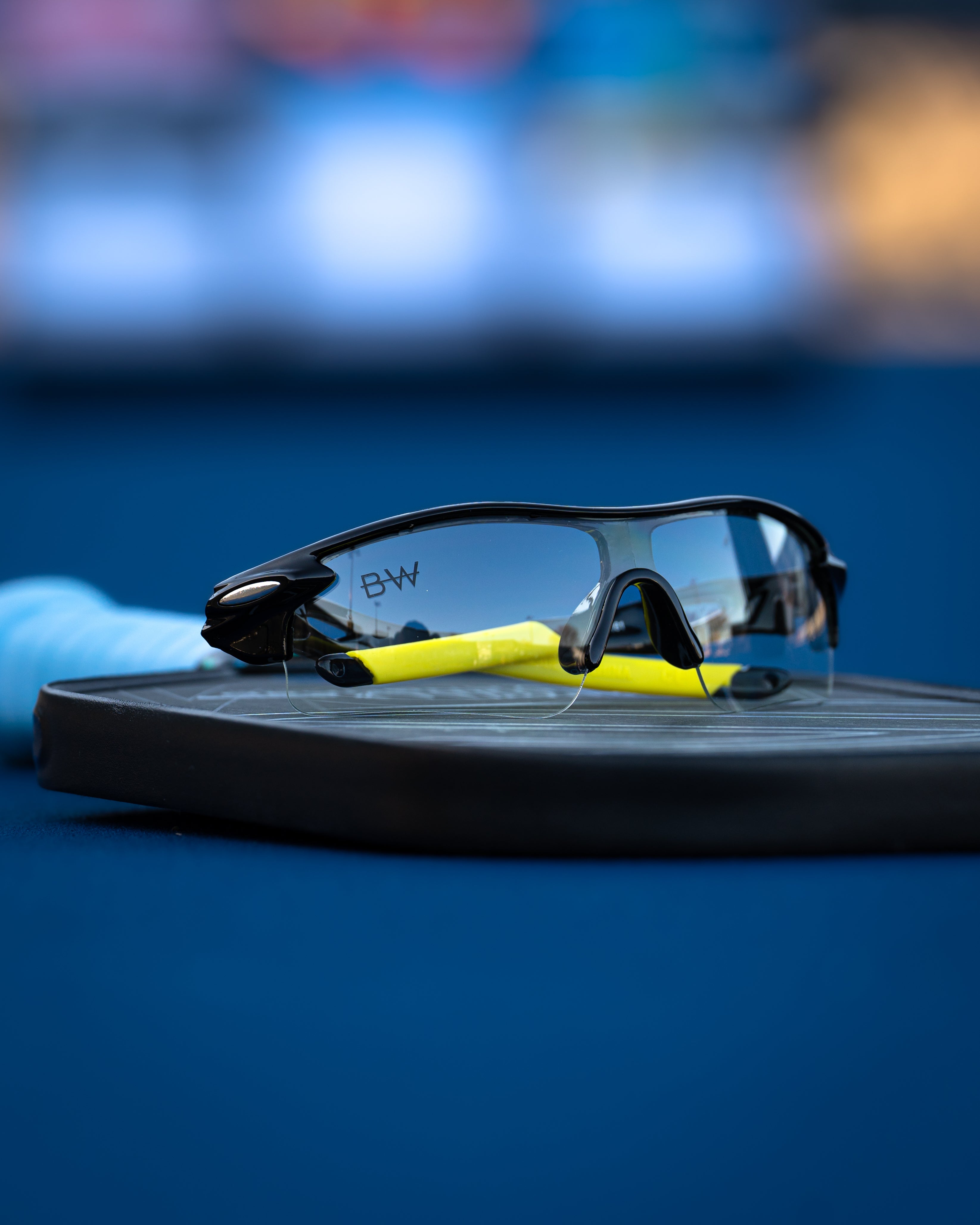
Storm-Resistant Lenses for All-Weather Pickleball Matches
Share
Storm-Resistant Lenses for All-Weather Pickleball Matches
Outdoor pickleball can change quickly. A bright morning can turn overcast, wind can pick up between games, humidity can rise, and a light drizzle can leave moisture across your lenses and court surface. For prescription players, changing weather makes one thing especially important: having eyewear that continues to provide the correction and comfort you need as conditions change.
There is no single lens that makes rain, wind, humidity, or cloudy skies disappear. A better all-weather strategy combines appropriate prescription correction, lightweight sports eyewear, sensible lens care, and knowing when court conditions have become unsuitable for play.
This guide covers how to build an all-weather RX pickleball eyewear setup, what to consider during cloudy and humid matches, how to manage moisture on your lenses, and which Blinded Wear RX frames you can compare for outdoor play.
Build Your Outdoor Pickleball Eyewear Setup
What Should “Storm-Resistant” Pickleball Eyewear Actually Mean?
Instead of looking for glasses that claim to be completely weatherproof, think about what your eyewear needs to handle during a real outdoor session.
| Weather Condition | What Changes | Your Eyewear Strategy |
|---|---|---|
| Cloudy skies | Overall lighting can feel different from a sunny session | Choose a lens setup you are comfortable using in those conditions |
| Light moisture | Water can collect on lens surfaces | Carry appropriate cleaning and drying supplies |
| High humidity | Heat, sweat, and moisture may make eyewear less comfortable | Keep lenses clean and monitor comfort |
| Wind | Dust and debris may become more noticeable outdoors | Keep lenses clean and use a sports-oriented frame |
| Changing conditions | The environment can look different as clouds and weather move through | Choose eyewear based on the conditions in which you actually play |
That approach is more useful than expecting one special coating or tint to solve every weather condition.
What Happens to Your Glasses When It Starts Raining?
Even light rain or mist can put droplets on a lens. Once that happens, you're no longer looking through the same clean surface you had at the start of the match.
If you're playing in changing weather, pay attention to:
- Water collecting on the lenses
- Fingerprints from repeatedly touching wet eyewear
- Sweat mixing with outside moisture
- Debris sticking to damp lens surfaces
- Whether your lenses need to be cleaned or dried between games
The practical solution is not complicated: keep appropriate lens-cleaning supplies accessible and maintain a clean viewing surface.
That matters regardless of whether you wear prescription or non-prescription sports eyewear.
Your Glasses Aren't the Only Thing That Changes in Rain
When weather deteriorates, eyewear is only one part of the situation. The court surface itself can change too.
If rain creates a wet or slippery playing surface, continuing the match simply because your eyewear still feels usable is not the goal. Court conditions should remain appropriate for safe play.
Think of all-weather eyewear as equipment for changing outdoor conditions, not permission to continue playing through unsafe weather.
Cloudy Pickleball Matches: Should You Change Your Lenses?
An overcast court can feel visually different from the same facility under direct sunlight. That does not automatically mean you need a special “storm lens.”
Instead, consider whether your normal outdoor tint still matches your preferences as conditions become darker.
Ask yourself:
- Do I still feel comfortable with this tint?
- Am I squinting?
- Does the court feel too dark through my current lenses?
- Will conditions likely change again during the session?
- Would I rather have a separate untinted option available?
Players who frequently encounter changing conditions may prefer having more than one eyewear option available instead of expecting one pair to feel identical in every environment.
Where Clear Lenses Fit Into Cloudy and Lower-Light Pickleball
Clear lenses provide an untinted option when you do not want dark sunglass tint.
That can make them worth considering for:
- Heavily overcast sessions
- Evening pickleball
- Lower-light environments
- Indoor/outdoor tournament schedules
- Players who want a separate untinted pair in their bag
Clear lenses should not be treated as a technology that automatically improves contrast, ball tracking, or reaction time. Their role is simpler: they give you an option without dark sunglass tint.
Windy Pickleball Matches: Think Beyond Lens Tint
Wind changes much more than your eyewear. It affects ball flight, positioning, shot selection, and the overall outdoor environment.
For your glasses, wind can also mean more airborne dust and debris around the court. If your lenses become dirty, stop between points or games when appropriate and clean them properly rather than repeatedly wiping them with whatever happens to be nearby.
A lightweight sports frame can also make more sense for active pickleball than relying on ordinary casual eyewear as your primary court setup.
Humidity, Sweat, and Long Outdoor Matches
A humid day introduces another source of moisture: you.
During long matches, sweat can reach your eyewear even when there is no rain at all. Add humidity or occasional mist and keeping your lenses clean becomes a more regular part of the session.
Use a simple between-game check:
- Look at the lenses. Check for visible moisture, sweat, fingerprints, or debris.
- Check your vision. Make sure you're still seeing comfortably through the lenses.
- Clean when needed. Use an appropriate lens-cleaning method.
- Check frame comfort. Notice how the eyewear feels after extended play.
- Reset for the next game.
It takes less than a minute and is much more practical than expecting sports eyewear to remain perfectly clean through hours of humid outdoor play.
Weather Problem or Vision Problem? Know the Difference
Changing conditions can make it tempting to blame every visual difficulty on the weather. Use this quick comparison before deciding what is happening.
| What You Notice | What to Check |
|---|---|
| Water spots on vision | Inspect the lens surface for moisture |
| Sudden difficulty after clouds move in | Consider whether your current tint still feels appropriate |
| Dirty or smeared view | Check for sweat, fingerprints, or debris |
| Recurring blur in multiple conditions | Consider your prescription correction needs |
| Difficulty judging a wind-affected ball | Remember that wind changes ball flight itself |
| General late-match difficulty | Consider physical and mental fatigue along with visual comfort |
The 3-Pair All-Weather Pickleball Strategy
Players who compete frequently do not necessarily need one pair of glasses that tries to cover every possible situation. A small eyewear rotation can give you more flexibility.
Pair 1: Your Primary Outdoor RX Pair
This is the prescription sports eyewear you normally prefer for outdoor daytime play.
Pair 2: Your Untinted or Lower-Light Option
If you frequently play as daylight fades, under heavy cloud cover, or indoors, you may choose to keep a clear-lens option available.
Pair 3: Backup Corrective Eyewear
For tournaments and travel, backup corrective eyewear gives you another option if your primary pair becomes unavailable.
You do not necessarily need three expensive specialized pairs. The important idea is redundancy: do not make one piece of corrective eyewear the single point of failure during an all-day event.
Weather Changed Mid-Match? Use This Eyewear Decision Tree
Did the Sky Simply Become Cloudier?
Yes: If your current eyewear still feels comfortable, there may be nothing you need to change.
Does Your Current Tint Now Feel Too Dark?
Yes: If you have an appropriate alternative available, consider switching between games or matches.
Is There Moisture on the Lenses?
Yes: Clean and dry them appropriately.
Is the Court Becoming Wet?
Yes: Evaluate the playing surface itself rather than focusing only on your eyewear.
Has Wind Increased?
Yes: Expect ball flight to change and be aware of additional dust or debris around the court.
Are Conditions No Longer Appropriate for Play?
Yes: Your eyewear strategy is no longer the important decision.
5 Blinded Wear RX Frames to Compare for Outdoor Pickleball
If you're building an RX setup for regular outdoor play, these five Blinded Wear models from the original all-weather lineup give you several frame designs to compare.
Lava Rock RX
Lava Rock RX is a prescription sports-frame option for players comparing dedicated pickleball eyewear for outdoor sessions.
Cold Slate RX
Cold Slate RX provides another frame and aesthetic to consider when building a prescription pickleball setup for regular play.
Havana Melt RX
Havana Melt RX gives prescription players another sports-oriented frame design to compare based on personal style, available dimensions, and playing preferences.
Steel Ice RX
Steel Ice RX is another performance-first RX frame for recreational and competitive pickleball players.
Roses Quartz RX
Roses Quartz RX adds a distinct frame and lens aesthetic for players who want their prescription sports eyewear to have a different look.
Compare the All-Weather RX Lineup
| RX Frame | Consider It If... | What to Compare |
|---|---|---|
| Lava Rock RX | You like the Lava Rock design for your outdoor setup | Frame appearance, available dimensions, lens option, prescription needs |
| Cold Slate RX | You prefer the Cold Slate design | Frame appearance, available dimensions, lens option, prescription needs |
| Havana Melt RX | You prefer the Havana Melt aesthetic | Frame appearance, available dimensions, lens option, prescription needs |
| Steel Ice RX | You prefer the Steel Ice frame design | Frame appearance, available dimensions, lens option, prescription needs |
| Roses Quartz RX | You want to compare the Roses Quartz aesthetic | Frame appearance, available dimensions, lens option, prescription needs |
If none immediately stands out, use the Pickleball Glasses Quiz → or browse the complete RX collection.
Why Impact-Resistant Lenses Make Sense for Active Pickleball
Blinded Wear sports eyewear uses impact-resistant lenses, which fits the active nature of pickleball.
Impact resistance should not be confused with a claim that eyewear is shatterproof or certified protective equipment. For everyday recreational and competitive players, it is simply one relevant construction feature to consider when comparing sports eyewear.
Non-Polarized Lenses for Changing Outdoor Conditions
Blinded Wear uses non-polarized lenses. These lenses do not add a polarization filter, preserving the visual information available without that filter.
Some court players prefer non-polarized eyewear for pickleball. It can be considered alongside your prescription, tint preference, frame choice, and the environments where you normally play.
High-Index RX Lenses Are Included
Prescription players also receive high-index prescription lenses at no additional cost with Blinded Wear RX eyewear.
Your prescription remains the foundation of your RX setup. From there, choose the frame and lens configuration that makes sense for your normal playing conditions.
The All-Weather Pickleball Bag Checklist
If the forecast looks unpredictable, preparation matters more than complicated eyewear technology.
- □ Primary pickleball eyewear
- □ Prescription correction if needed
- □ Backup corrective eyewear for tournaments or longer events
- □ Protective eyewear case
- □ Suitable lens-cleaning cloth
- □ Appropriate lens cleaner if desired
- □ Untinted eyewear option if you expect lower-light conditions
- □ A dry place in your bag to store unused eyewear
This gives you options when conditions change without requiring you to predict the weather perfectly before leaving home.
7 All-Weather Eyewear Mistakes Pickleball Players Make
-
Expecting one lens to be perfect in every condition.
Sun, clouds, evening light, indoor courts, and changing weather can create different preferences.
-
Ignoring water or sweat on the lenses.
Check the physical lens surface before assuming your vision has suddenly changed.
-
Wiping wet lenses with whatever is available.
Keep appropriate lens-cleaning supplies in your pickleball bag.
-
Blaming eyewear for a wind-affected ball.
Wind changes the ball's flight. Your shot preparation may need to change with it.
-
Ignoring your prescription needs.
If you require correction for play, make it part of your outdoor sports setup.
-
Bringing only one corrective pair to an all-day tournament.
Backup eyewear can be useful when your primary pair is unavailable.
-
Continuing because your glasses can handle the weather.
The condition of the playing surface still matters when rain arrives.
Quick Answers About All-Weather Pickleball Glasses
What are storm-resistant pickleball glasses?
Rather than treating “storm-resistant” as a special lens certification, think of all-weather pickleball eyewear as sports eyewear you can incorporate into a practical strategy for changing outdoor conditions.
Can I play pickleball in prescription sunglasses when it's cloudy?
Yes, if the tint remains comfortable for you. If your normal sunglasses begin feeling too dark as conditions change, you may prefer another lens option.
Are clear lenses good for cloudy pickleball?
Clear lenses provide an untinted option for overcast, evening, indoor, and other lower-light situations where dark sunglass tint may not be preferred.
Are Blinded Wear lenses waterproof?
Blinded Wear's verified product information does not rely on a waterproof-lens claim. If moisture reaches the lenses, clean and dry them appropriately.
Are Blinded Wear lenses anti-fog?
Anti-fog treatment is not a standard verified feature used here. Players should manage moisture and lens cleanliness during humid or changing conditions.
Do Blinded Wear glasses use hydrophobic coatings?
Hydrophobic coatings are not a standard verified feature used for these recommendations.
Do tinted lenses improve ball tracking in cloudy weather?
A tint should not automatically be credited with improved ball tracking. Choose your lens setup based on the conditions and viewing experience you prefer.
Are Blinded Wear RX lenses impact-resistant?
Yes. Blinded Wear RX sports eyewear uses impact-resistant lenses.
Are Blinded Wear RX lenses polarized?
No. Blinded Wear uses non-polarized lenses.
Do Blinded Wear RX glasses include high-index lenses?
Yes. High-index prescription lenses are included at no additional cost.
Weather Changes. Your Match Plan Should Be Able to Change With It.
The strongest all-weather strategy is not finding a pair of glasses that claims to defeat every storm. It is arriving prepared for the realistic conditions outdoor pickleball can create.
Part 2 will go deeper into rain and humidity scenarios, lens-moisture troubleshooting, cloudy-to-sunny transitions, windy-match eyewear care, tournament weather planning, backup RX strategy, and a practical match-day system for deciding whether to keep your current eyewear, switch pairs, clean your lenses, or stop play because conditions have changed.
Rain Starts Mid-Match: What Should You Do With Your RX Glasses?
Outdoor weather rarely changes on a convenient schedule. You might start a match under dry, overcast skies and notice light moisture halfway through the second game.
When conditions begin changing, use a simple sequence instead of immediately blaming your lenses or changing eyewear.
- Check the court first. Make sure conditions are still appropriate for play.
- Inspect your lenses. Look for droplets, sweat, fingerprints, or debris.
- Clean or dry them when needed. Use appropriate lens-care supplies rather than your shirt or a random towel.
- Reassess your tint. If the sky has become substantially darker, decide whether your current lens still feels comfortable.
- Use your backup option if necessary. A second pair can be useful during tournaments with changing conditions.
This turns unpredictable weather into a manageable equipment decision rather than a search for one “weatherproof” lens that supposedly handles everything automatically.
Water on Your Lenses? Identify the Problem Before Wiping
Not every moisture problem looks the same. Rain, mist, humidity, and sweat can all affect your eyewear differently.
| What You See | Possible Source | Practical Response |
|---|---|---|
| Individual droplets | Rain or mist | Dry and clean the lenses appropriately |
| Smears across the lens | Touching wet lenses or wiping them while dirty | Use proper lens-cleaning supplies |
| Sweat marks | Heat and physical activity | Clean the lenses between games when needed |
| Dust stuck to moisture | Wind plus damp lenses | Avoid aggressively rubbing debris across the surface |
| Repeated moisture buildup | Humid or wet playing environment | Use breaks to keep the lens surface clean and dry |
Keeping a suitable cleaning cloth and lens-care supplies in your pickleball bag is a small preparation step that becomes much more valuable when the forecast is unpredictable.
Clouds to Sun to Clouds: Handling Rapid Light Changes
Some outdoor matches never settle into one lighting condition. Clouds move across the sun, the court becomes brighter, then another cloud layer arrives ten minutes later.
Instead of trying to change glasses every time the sun disappears, judge your eyewear across the overall session.
Keep Your Current Pair If...
- Your vision remains comfortable
- The tint still feels appropriate
- You are not repeatedly thinking about your eyewear
- The temporary weather change is minor
Consider Another Pair If...
- The conditions have changed substantially
- Your current tint now feels too dark for you
- You are moving from daytime play into evening play
- You already know you prefer an untinted option in lower-light conditions
The objective is not to constantly optimize every passing cloud. It is to have enough flexibility that a major environmental change does not leave you stuck with eyewear you no longer want to use.
Think of an Outdoor Match in 3 Weather Zones
When conditions are unstable, divide the session into three simple zones.
| Weather Zone | Typical Situation | Eyewear Focus |
|---|---|---|
| Dry & Stable | Conditions are relatively consistent | Use your normal preferred setup |
| Changing | Clouds, wind, humidity, mist, or changing light | Monitor lens cleanliness, comfort, and tint preference |
| Unsuitable | Weather has affected the court or conditions enough that play should stop | Protect and store your eyewear rather than trying to adapt it to continued play |
This distinction matters because “all-weather pickleball glasses” should not imply that every type of weather is appropriate for a pickleball match.
Your RX Eyewear Plan for Hot, Humid Pickleball
Humidity can be part of outdoor pickleball even when there is no storm anywhere nearby. Add several hours of physical activity and moisture management becomes part of your normal equipment routine.
Before Play
- Start with clean lenses.
- Make sure your prescription sports eyewear is ready.
- Keep a suitable cleaning cloth somewhere dry.
- Store backup eyewear in a protective location.
During Play
- Avoid unnecessarily touching the lenses.
- Check them between games if your view starts looking smeared.
- Clean accumulated sweat when needed.
- Notice whether the frame remains comfortable through extended play.
After Play
- Clean your eyewear appropriately.
- Allow wet equipment to dry before long-term storage.
- Return the glasses to a protective case when ready.
Windy Match? Your Eyes Aren't the Only Thing Adjusting
A windy pickleball match creates two separate challenges: the outdoor environment around your eyewear and the effect of wind on the ball itself.
Your glasses cannot remove the wind from the rally. If the ball begins floating, holding up, or moving differently than expected, your strategy and positioning have to account for the conditions.
For your eyewear, focus on practical issues:
- Dust or debris reaching the lenses
- Dirty lenses after repeated outdoor exposure
- Keeping your cleaning cloth protected inside your bag
- Maintaining comfortable prescription correction throughout play
- Using a sports-oriented frame suited to active movement
This keeps the roles separate: your eyewear provides your lens setup; you adapt your pickleball game to the wind.
Use Warmup to Learn the Wind Before the Match
When the weather is windy, your warmup should tell you more than whether your glasses feel comfortable.
Try shots in several directions:
- Hit several drives from each baseline.
- Send a few controlled lobs.
- Watch how the ball behaves traveling into the wind.
- Notice how it behaves traveling with the wind.
- Check whether blowing dust or debris is accumulating on your lenses.
If the wind changes during the match, your ball-flight expectations may need to change too.
Check the Whole Tournament Day—not Just the Opening Match
A tournament starting early in the morning and ending late in the afternoon may expose you to very different conditions even without severe weather.
Your first match could be cool and overcast. Several hours later, the same courts could be brighter, warmer, and more humid.
That makes tournament eyewear planning different from preparing for a 60-minute recreational session.
| Tournament Stage | What May Change | What to Check |
|---|---|---|
| Early morning | Lower ambient brightness, cooler conditions | Lens preference and initial comfort |
| Late morning | Increasing brightness or temperature | Whether your current setup still feels appropriate |
| Afternoon | Heat, sweat, humidity, changing cloud cover | Lens cleanliness and extended-wear comfort |
| Weather delay | Conditions may be completely different after restart | Reassess the court and eyewear before returning |
| Late matches | Changing light and accumulated fatigue | Tint preference, clean lenses, and visual comfort |
Build an All-Day Tournament Eyewear Loadout
For a player who requires prescription correction, redundancy becomes especially useful during an outdoor tournament.
Primary Pair
Your primary pair should be the RX sports eyewear you expect to use through most of the event.
Secondary Environment Pair
If you already know your preferences change dramatically between bright and lower-light conditions, consider carrying a second appropriate option.
Backup Corrective Pair
Keep another source of corrective vision available in case your primary sports eyewear becomes unavailable.
Lens-Care Kit
Store appropriate cleaning supplies somewhere they can remain clean and dry.
Protective Storage
Keep whichever pair you are not wearing protected inside your bag rather than loose alongside paddles, balls, keys, or other equipment.
What to Do With Your RX Glasses During a Weather Delay
A weather delay gives you a useful opportunity to reset your equipment.
- Get your eyewear out of the weather.
- Inspect the lenses.
- Clean and dry them appropriately.
- Store them securely while you wait.
- Check the conditions again before play resumes.
If the delay lasts long enough for lighting or weather to change substantially, reassess whether you still want to use the same lens setup when you return to court.
The Match Is Restarting After Rain—Run This 60-Second Check
Do not assume the environment is identical just because officials or players are preparing to resume.
- □ Check your lenses for remaining moisture
- □ Check that your eyewear feels comfortable
- □ Look at the overall lighting
- □ Notice whether cloud cover has changed
- □ Reassess your preferred tint
- □ Pay attention to the playing surface
- □ Use warmup to reacclimate to the conditions
This is particularly useful after a longer interruption when both you and the environment have had time to change.
Why RX Players Should Think More Seriously About Backup Eyewear
If you do not require prescription correction, losing access to one pair of sunglasses may be inconvenient. If you rely on prescription eyewear to see appropriately for play, the situation can be more significant.
That makes backup corrective eyewear useful for:
- Outdoor tournaments
- Travel events
- Full-day round robins
- Multi-day competitions
- Events with unpredictable weather
Your backup does not necessarily need to duplicate your primary pair perfectly. Its most important job is giving you another source of the corrective vision you need if your primary eyewear cannot be used.
One Pair or Two? Choose Based on How Much Your Conditions Change
Not every player needs an eyewear rotation.
One Pair May Be Enough If...
- You normally play at similar times of day
- Your outdoor conditions are relatively predictable
- You remain comfortable with the same lens setup as clouds change
- You are playing short recreational sessions
Two Playing Pairs May Make Sense If...
- You regularly start in daylight and finish near evening
- You move between indoor and outdoor courts
- You strongly prefer different lens setups in bright and lower-light environments
- You compete in long tournaments
- You travel to unfamiliar venues
The second pair is about flexibility—not creating an unnecessarily complicated gear bag.
Choosing Between Lava Rock RX, Cold Slate RX, Havana Melt RX, Steel Ice RX, and Roses Quartz RX
The original all-weather lineup included five RX designs. Rather than assigning unsupported “storm technologies” to each frame, compare them around the factors that can actually guide your purchase.
| Frame | Start Here If... | Then Compare... |
|---|---|---|
| Lava Rock RX | The Lava Rock aesthetic stands out to you | Available dimensions, lens setup, prescription needs |
| Cold Slate RX | You prefer the Cold Slate design | Available dimensions, lens setup, prescription needs |
| Havana Melt RX | The Havana Melt design fits your style | Available dimensions, lens setup, prescription needs |
| Steel Ice RX | You prefer the Steel Ice frame | Available dimensions, lens setup, prescription needs |
| Roses Quartz RX | You prefer the Roses Quartz aesthetic | Available dimensions, lens setup, prescription needs |
All five give prescription players another frame to consider when building a dedicated pickleball eyewear setup.
Score Your Current Outdoor Pickleball Glasses
Before buying another pair, test what you already own across several sessions.
| Question | Yes | No |
|---|---|---|
| Do I have the prescription correction I need? | □ | □ |
| Is the frame comfortable through long matches? | □ | □ |
| Do I like my lens setup in normal daytime conditions? | □ | □ |
| Does the same setup remain comfortable when clouds arrive? | □ | □ |
| Can I keep the lenses reasonably clean during humid play? | □ | □ |
| Do I have another option for lower-light conditions? | □ | □ |
| Do I have backup corrective eyewear for tournaments? | □ | □ |
If most answers are yes, your current setup may already cover your needs. If the same problem appears repeatedly, you now have a much clearer reason for what your next pair should address.
5 “All-Weather Glasses” Claims to Think About More Carefully
1. “These Glasses Never Fog”
Heat, humidity, moisture, airflow, and activity all influence the experience of wearing eyewear. A universal never-fog promise is not necessary to choose useful pickleball glasses.
2. “This Tint Automatically Improves Ball Tracking”
Ball tracking involves your vision, attention, anticipation, experience, and the environment. Tint preference can vary from player to player.
3. “Storm-Proof Means You Can Keep Playing in Rain”
The court surface and overall weather conditions still determine whether continued play is appropriate.
4. “A Sports Frame Cannot Move During Play”
Fit varies by person. Compare available dimensions with eyewear that already fits you well rather than relying on universal fit promises.
5. “One Lens Is Perfect From Bright Sun to Darkness”
Players have different preferences as lighting changes. Some are happy with one setup while others prefer multiple pairs.
Ordering RX Pickleball Glasses for Your Outdoor Setup
If you're ready to add dedicated prescription sports eyewear to your pickleball bag, keep the process simple.
- Browse the RX Pickleball Glasses Collection.
- Compare the frame designs you prefer.
- Review available dimensions when provided.
- Have your current eyeglass prescription ready.
- Upload a clear photo or picture of your prescription before purchasing.
- Complete your order.
Blinded Wear includes high-index prescription lenses at no additional cost with RX eyewear.
More Questions About Pickleball Glasses for Rain, Wind, and Changing Weather
What should I do if rain gets on my pickleball glasses?
Use an appropriate lens-cleaning and drying method rather than repeatedly rubbing wet or dirty lenses with clothing.
What pickleball lenses are best for overcast days?
There is no universal best tint for every player. If your usual outdoor tint feels too dark under heavy cloud cover, an untinted clear-lens option is one category to consider.
Are clear lenses useful for outdoor pickleball?
Yes. Clear lenses can be useful outdoors when a player wants an untinted setup, particularly during overcast, evening, or other lower-light conditions.
Should I switch glasses every time the sun goes behind a cloud?
Usually there is no need to react to every brief change. Consider switching only when conditions change enough that you no longer prefer your current setup.
Can wind make a pickleball harder to read?
Wind can alter the ball's flight, so players may need to adjust their positioning, expectations, and shot selection.
Do sports glasses stop wind from affecting the ball?
No. Eyewear and ball-flight conditions are separate issues.
Should I bring two pairs of prescription glasses to a pickleball tournament?
Backup corrective eyewear can be useful during long tournaments, travel events, and situations where losing access to your primary RX pair would create a problem.
Should I have separate sunglasses and clear glasses?
That depends on your playing schedule and preferences. Players who regularly move between bright daytime and lower-light environments may find separate setups useful.
Can humidity make my glasses uncomfortable?
Heat, sweat, moisture, and extended wear can influence eyewear comfort during humid outdoor sessions.
Do Blinded Wear glasses have anti-fog lenses?
Anti-fog treatment is not a standard feature being claimed for these recommendations. Keeping lenses clean and managing moisture remain useful habits in humid conditions.
Are Blinded Wear RX lenses polarized?
No. Blinded Wear uses non-polarized lenses.
Are Blinded Wear RX lenses impact-resistant?
Yes. Blinded Wear uses impact-resistant lenses in its sports eyewear.
Do I pay extra for high-index prescription lenses?
No. High-index prescription lenses are included at no additional cost with Blinded Wear RX eyewear.
Build a Weather Plan Before the First Serve
The easiest time to prepare for changing conditions is before your match begins. Know your primary eyewear, know what you will switch to if the environment changes significantly, and keep the basic equipment needed to maintain your lenses during a long day.
Part 3 will finish the guide with a weather-by-weather RX decision matrix, tournament morning forecast routine, rain-delay reset plan, primary-versus-backup strategy, all-weather buying checklist, expanded search-friendly FAQ, Blinded Wear shopping resources, replacement support, and a final match-day storm checklist.
The All-Weather RX Decision Matrix
Outdoor pickleball conditions can shift several times during one session. Instead of searching for one lens that claims to handle everything, decide what you will do when each condition appears.
| Conditions | Eyewear Priority | Practical Move |
|---|---|---|
| Bright and dry | Prescription correction and preferred outdoor lens setup | Use your normal outdoor pair if it feels comfortable |
| Overcast | Tint preference | Keep your current pair or switch if you prefer an untinted option |
| Light mist | Clean lens surface | Check for droplets and clean or dry lenses as needed |
| Hot and humid | Moisture management and extended-wear comfort | Check lenses between games and clean accumulated sweat when needed |
| Windy | Lens cleanliness | Watch for dust and debris while adjusting your game to changing ball flight |
| Daylight fading | Lens preference in lower light | Consider an untinted option if your daytime tint becomes too dark for you |
| Rain delay | Protecting and resetting equipment | Clean, dry, and securely store your eyewear |
| Wet or unsuitable court | Court conditions | Stop treating eyewear as the problem and wait for appropriate playing conditions |
The advantage of this system is simplicity. You are responding to what actually changed rather than expecting your glasses to solve the entire outdoor environment.
Your 5-Minute Tournament Morning Weather Routine
When you have an outdoor tournament ahead, check the entire playing window rather than only the weather at your first match time.
1. Look at the Full Day
Consider whether you may encounter bright conditions, cloud cover, changing temperatures, wind, or rain during the hours you expect to be at the venue.
2. Pick Your Primary RX Pair
Choose the prescription sports eyewear you expect to use for most of the day.
3. Decide Whether You Want a Second Lens Setup
If conditions are expected to change substantially—or you regularly prefer different eyewear in bright and lower-light environments—pack your second option.
4. Pack Backup Correction
For an all-day tournament, having another source of corrective vision gives you redundancy if your primary pair becomes unavailable.
5. Protect Your Lens-Care Supplies
A cleaning cloth is far less useful if it has been sitting wet or dirty at the bottom of your bag. Keep your eyewear supplies stored somewhere clean and dry.
How to Organize an All-Weather Pickleball Bag
When weather changes quickly, you should be able to find your eyewear equipment without digging through everything else you brought to the court.
| Bag Area | What to Keep There |
|---|---|
| Quick-access pocket | Clean lens cloth and eyewear-care supplies |
| Protected compartment | Secondary eyewear inside its case |
| Backup section | Additional corrective eyewear for RX players |
| Main compartment | Paddles and other larger equipment |
A little organization becomes especially useful during a tournament when weather changes between matches and you only have a few minutes before returning to court.
The Rain-Delay Reset Plan
A rain delay can interrupt your rhythm, but it also gives you time to reset your eyewear before competition resumes.
- Move your glasses and backup eyewear somewhere dry.
- Inspect your primary lenses for water, fingerprints, and debris.
- Clean and dry them appropriately.
- Recheck the weather and lighting conditions.
- Decide whether your original lens setup still matches your preference.
- Protect whichever pair you are not using.
- Use the restart warmup to get comfortable with the court again.
If the delay takes the tournament from bright afternoon conditions into a darker evening environment, that can also be a logical time to reconsider whether you want to keep using the same tint.
Primary Pair vs. Weather Backup: Give Each Pair a Job
If you carry multiple pairs, decide what each one is for before the tournament begins.
Primary RX Pair
Your primary pair should cover the conditions you expect to encounter most often. It should provide your prescription correction and be a frame you are comfortable wearing through extended play.
Alternative-Condition Pair
This pair can cover a different environment. For example, a player who normally prefers tinted outdoor eyewear might keep a clear option available for evening, heavy cloud cover, or indoor matches.
Emergency Backup Correction
This pair does not have to be your favorite pickleball frame. Its purpose is to prevent your primary RX pair from becoming the only source of corrective vision you brought to the event.
Thinking in terms of roles keeps you from packing multiple pairs that all serve essentially the same purpose.
When Clear Lenses Make Sense as Your Weather Backup
Clear lenses can fill an especially simple role in an all-weather rotation: an untinted alternative.
That can be useful when:
- A tournament continues into the evening
- Heavy cloud cover changes your tint preference
- You move from outdoor courts to an indoor facility
- You regularly play after sunset
- You simply prefer an untinted lens in certain environments
They do not need to promise enhanced contrast or better ball tracking to be useful. Their job in this setup is to give you another lens option when you no longer want dark sunglass tint.
10 Things to Consider Before Buying All-Weather Pickleball Glasses
-
Prescription correction.
If you require RX lenses for play, start there.
-
Your most common environment.
Build around the conditions you encounter most often instead of rare extremes.
-
Tint preference.
Think about how your preferred lens setup changes between bright and overcast conditions.
-
Lower-light play.
If you regularly finish after sunset, decide whether you want an untinted option available.
-
Frame weight.
Lightweight sports frames can be appealing during long matches and tournaments.
-
Frame dimensions.
Compare available measurements with eyewear that already fits you comfortably.
-
Lens construction.
Blinded Wear sports eyewear uses impact-resistant, non-polarized lenses.
-
Backup strategy.
Consider whether you need another source of corrective vision for tournaments and travel.
-
Lens care.
Plan for sweat, moisture, fingerprints, and outdoor debris rather than assuming the lenses will stay clean automatically.
-
Your actual playing schedule.
A recreational player who plays for an hour in predictable conditions may need a simpler setup than someone competing in all-day outdoor tournaments.
Which Blinded Wear RX Frame Fits Your Outdoor Setup?
Once you've decided what role your eyewear needs to fill, frame selection becomes much easier.
| Frame | Why Add It to Your Shortlist? |
|---|---|
| Lava Rock RX | You prefer the Lava Rock frame design and want a dedicated RX sports option |
| Cold Slate RX | The Cold Slate aesthetic fits the outdoor setup you want to build |
| Havana Melt RX | You prefer the Havana Melt frame design for your prescription pair |
| Steel Ice RX | You want to compare another performance-first RX frame style |
| Roses Quartz RX | You prefer the distinct Roses Quartz aesthetic |
Rather than assigning a different weather condition to every frame, choose based on your prescription needs, preferred lens setup, available dimensions, and the design you actually want to wear.
Test Your Eyewear Across 5 Outdoor Sessions
If you play outdoors frequently, use real court time to learn where your current eyewear works best.
| Session | Conditions | Lens Comfort | Moisture Issues? | Would You Use This Setup Again? |
|---|---|---|---|---|
| 1 | __________ | 1–5 | Yes / No | Yes / No |
| 2 | __________ | 1–5 | Yes / No | Yes / No |
| 3 | __________ | 1–5 | Yes / No | Yes / No |
| 4 | __________ | 1–5 | Yes / No | Yes / No |
| 5 | __________ | 1–5 | Yes / No | Yes / No |
After five sessions, you may discover that one pair already works well across most of your normal conditions—or that there is a specific gap a second pair could fill.
How to Build Your Blinded Wear RX Setup
If prescription pickleball eyewear is part of your all-weather plan, ordering starts with the correction you already need.
- Browse the RX Pickleball Glasses Collection.
- Choose the frame that fits your preferences.
- Compare available frame dimensions when provided.
- Have your current eyeglass prescription ready.
- Upload a clear photo or picture of your prescription before purchasing.
- Complete your order.
Blinded Wear includes high-index prescription lenses at no additional cost with RX eyewear.
FAQ: All-Weather Pickleball Glasses and RX Lenses
What are the best glasses for outdoor pickleball in changing weather?
Look for sports eyewear that meets your prescription needs if applicable, feels comfortable during active play, and uses a lens setup you prefer across your normal outdoor conditions. Players facing larger changes in lighting may prefer having more than one pair available.
Are there waterproof pickleball glasses?
For this guide, the more useful strategy is planning for moisture rather than relying on a waterproof-lens claim. Keep suitable lens-care supplies available when playing in changing weather.
What should I do when raindrops get on my lenses?
Clean and dry the lenses appropriately. Avoid repeatedly rubbing dirty, wet lenses with whatever clothing or towel happens to be nearby.
Can I play pickleball in light rain?
The condition of the court matters more than whether your glasses can tolerate a few droplets. If the playing surface becomes wet or slippery, continuing play may no longer be appropriate.
What lenses should I use for cloudy pickleball?
Use a lens setup that remains comfortable for you. If your normal dark outdoor tint feels too dark under heavy cloud cover, you may prefer a lighter or untinted option.
Are clear lenses good for overcast pickleball?
Clear lenses provide an untinted option for players who do not want dark sunglass tint during overcast or lower-light play.
Can I use clear pickleball glasses outdoors?
Yes. Clear lenses are not limited to indoor courts and can be worn outdoors when an untinted setup matches your preferences.
Should I bring clear glasses to an outdoor tournament?
If you expect the tournament to continue into lower-light conditions or already know you prefer clear lenses when conditions darken, they can be a useful second option.
What should I do if my lenses get sweaty?
Use breaks between games to clean them appropriately when sweat begins affecting the lens surface.
Can humidity affect sports-eyewear comfort?
Heat, sweat, moisture, and long playing sessions can all influence how eyewear feels during humid conditions.
Do I need anti-fog lenses for pickleball?
Not necessarily. Managing moisture, keeping your lenses clean, and choosing eyewear you are comfortable wearing are useful starting points.
Are Blinded Wear pickleball lenses impact-resistant?
Yes. Blinded Wear sports eyewear uses impact-resistant lenses.
Are Blinded Wear lenses polarized?
No. Blinded Wear uses non-polarized lenses.
Do non-polarized lenses improve depth perception?
Non-polarized lenses should not automatically be credited with improving depth perception. They simply do not add a polarization filter, and some court players prefer that setup.
Does Blinded Wear include high-index prescription lenses?
Yes. High-index prescription lenses are included at no additional cost with RX eyewear.
Should I bring backup prescription glasses to a tournament?
Backup corrective eyewear can be useful during tournaments, travel events, and long competition days when losing access to your primary RX pair would create a problem.
Can one pair of pickleball glasses work in every type of weather?
One pair may cover most of your normal playing conditions if you remain comfortable using it. Players who regularly move between bright daytime and lower-light environments may prefer multiple options.
How should I choose between Lava Rock RX, Cold Slate RX, Havana Melt RX, Steel Ice RX, and Roses Quartz RX?
Compare the frame designs, available dimensions, lens setup, and your prescription needs. Choose the pair that best matches how you want your dedicated pickleball eyewear to look and feel.
Build Your Pickleball Eyewear Rotation
Whether you need one primary pair or a setup for multiple environments, these resources can help you narrow the search.
Replacement Support for Eyewear That Gets Real Court Time
Outdoor pickleball eyewear can see plenty of use across recreational games, leagues, drilling sessions, tournaments, and travel.
Blinded Wear offers 50% lifetime replacement support if your glasses break, subject to current policy terms.
Performance Eyewear With a Purpose Beyond the Match
Blinded Wear creates performance-first eyewear designed with pickleball players in mind, including prescription, non-prescription, and clear-lens options for different playing environments.
The brand's mission also extends beyond the pickleball court through its commitment to supporting children's vision.
Save This All-Weather Pickleball Match Checklist
- □ Check the conditions expected across your entire playing window
- □ Pack your primary pickleball eyewear
- □ Bring the prescription correction you need
- □ Consider an alternative lens setup if conditions may change significantly
- □ Bring backup corrective eyewear for long tournaments when appropriate
- □ Keep a clean lens cloth protected inside your bag
- □ Start every session with clean lenses
- □ Check for sweat, moisture, and debris between games
- □ Reassess your tint preference if lighting changes substantially
- □ Remember that wind changes the ball—not just the environment around your glasses
- □ Protect unused eyewear inside a case
- □ Recheck your setup after a long weather delay
- □ Stop focusing on eyewear if weather has made the court unsuitable for play
Final Word: The Best All-Weather Lens Strategy Is Being Prepared
Outdoor pickleball does not happen in a controlled environment. Sun disappears behind clouds. Wind changes direction. Humidity rises. Sweat reaches your lenses. A tournament can begin in one set of conditions and finish in another.
Your eyewear does not need a dramatic “storm-proof” label to be useful through those changes.
Start with the prescription correction you need. Choose a lightweight sports frame designed for pickleball. Use a lens setup that fits your normal playing conditions. Keep your lenses clean when moisture and debris accumulate. If your preferences change significantly between bright and lower-light play, consider carrying another option.
For tournament players, add backup corrective eyewear so one pair does not become the single point of failure for the entire day.
That is what a practical all-weather setup looks like: the right eyewear for your vision, enough flexibility for changing conditions, and a plan for taking care of your lenses when the weather stops cooperating.