
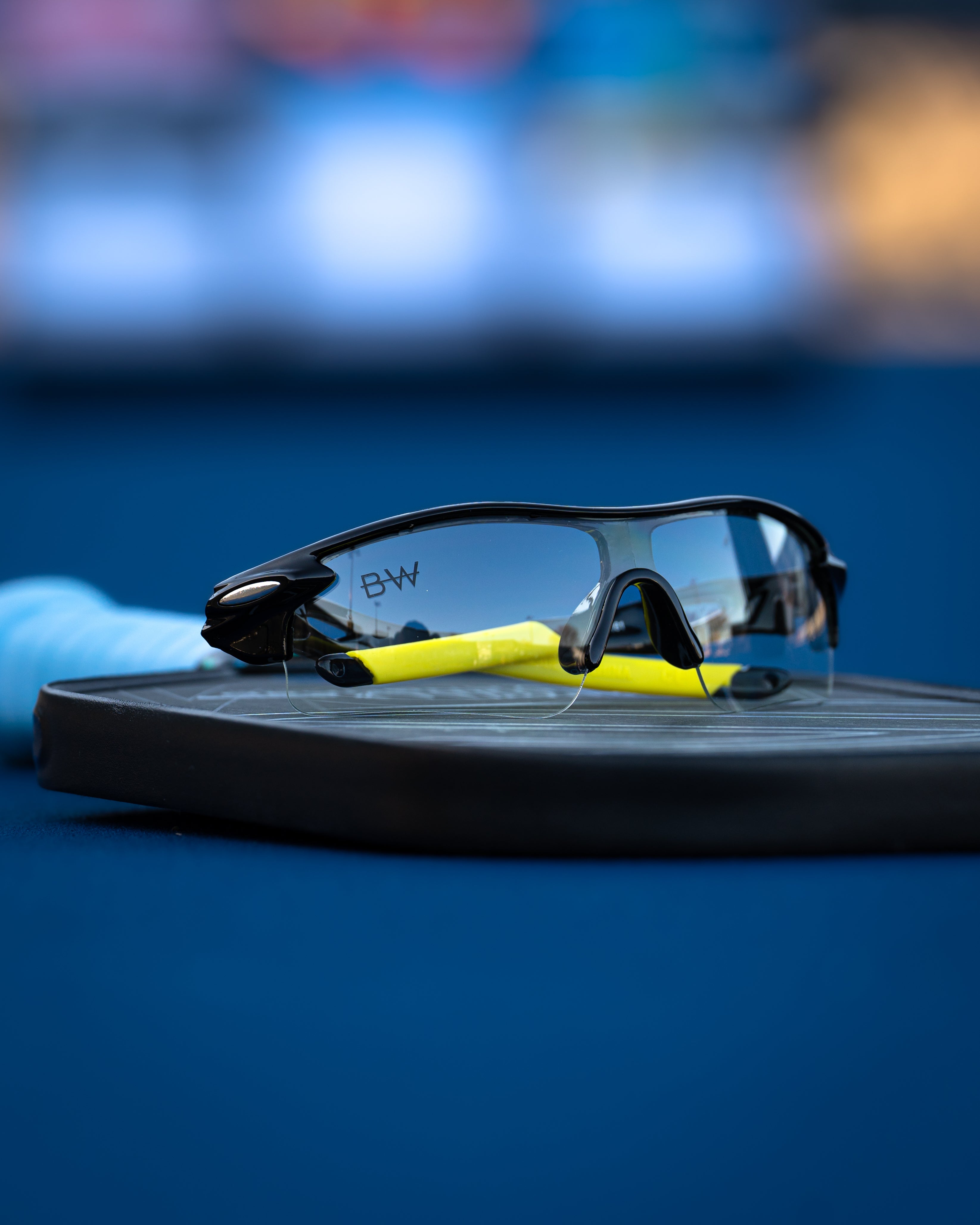
These RX Glasses Improve Your Court Angles Instantly
Share
RX Pickleball Glasses and Court Angles: What Players Should Actually Look For
Angles are everywhere in pickleball. Crosscourt dinks travel diagonally through the kitchen. Drives can pull opponents toward a sideline. Lobs change the vertical path of the point. Resets, drops, volleys, and passing shots can all require players to respond to a changing ball path while staying aware of court boundaries and player positions.
If you need prescription correction, seeing the court through an appropriate prescription matters. But prescription sports glasses do not instantly improve your angles, calculate shot geometry, increase reaction speed, or make a player more accurate.
This guide explains how RX pickleball glasses, prescription correction, frame geometry, fit, lens configuration, peripheral awareness, and playing environment relate to the visual side of angle-based pickleball—without turning eyewear into a shortcut for technique.
Explore Pickleball Eyewear
What Are Court Angles in Pickleball?
When players talk about creating or defending an angle, they are generally describing the direction and path of a shot relative to the net, sidelines, baseline, kitchen, opponents, and available open court.
Angle-based situations can include:
- Crosscourt dinks
- Wide drives
- Passing shots
- Third-shot drops
- Resets from difficult positions
- Diagonal lobs
- Sharp volleys
- Shots directed into open court
These situations involve far more than eyesight. Technique, paddle angle, contact point, positioning, anticipation, decision-making, ball speed, spin, and opponent position can all influence the result.
Can RX Pickleball Glasses Improve Your Court Angles?
Prescription glasses should not be promised to improve court angles instantly—or at all as a direct athletic-performance effect.
If you require vision correction, appropriately prescribed eyewear can provide the correction represented by your prescription while you play. That can be relevant to seeing the court, ball, lines, opponents, and other visual information according to your corrective needs.
Actually creating a successful angle remains a pickleball skill.
Vision and Angle Control Are Related—but They Are Not the Same Skill
A player uses visual information throughout a rally, but seeing the court does not automatically determine what happens next.
| Visual Consideration | Pickleball Skill |
|---|---|
| Seeing court boundaries | Choosing an appropriate target |
| Seeing opponent position | Deciding where to place the ball |
| Seeing the incoming ball | Timing paddle contact |
| Seeing the net and kitchen | Controlling height and placement |
| Seeing your partner and opponents | Maintaining doubles positioning |
| Prescription correction when needed | Executing the selected shot |
Eyewear belongs primarily on the visual side of that distinction. It does not replace the technical and strategic side of the game.
Pickleball Really Does Involve Constantly Changing Geometry
Every rally changes the spatial relationship between the ball, players, net, kitchen, sidelines, and baseline.
A crosscourt shot may travel through a different available space than a straight-ahead shot. An opponent pulled wide can leave another portion of the court open. A lob changes both horizontal and vertical considerations. A player moving forward changes the available angles again.
Calling pickleball a changing geometry problem can be a useful way to think about court strategy. But RX glasses do not solve that geometry for the player.
Can RX Glasses Help You See Pickleball Court Lines?
If you require prescription correction, appropriately prescribed eyewear provides that correction while you view the court.
However, no RX frame should be promised to make court lines universally sharper, easier to judge, or easier to play around. What you see can depend on your prescription, individual vision, lighting, distance, court colors, lens configuration, and other environmental factors.
Can RX Glasses Improve Shot Placement?
No pair of prescription glasses should be marketed as automatically improving shot placement.
Placement depends on factors such as:
- Paddle control
- Contact point
- Swing path
- Paddle-face orientation
- Timing
- Footwork
- Balance
- Target selection
- Practice
Prescription correction can address corrective vision needs. It does not aim the paddle or control the ball.
RX Eyewear and Crosscourt Dinks
A crosscourt dink involves the incoming ball, net, kitchen, sideline, opponent position, paddle contact, and intended target.
Players who require prescription correction can use appropriate RX eyewear while processing those visual elements, but the eyewear does not create a sharper dink angle or increase a player's crosscourt percentage.
Those outcomes remain dependent on execution and the developing point.
RX Eyewear and Third-Shot Angles
A third shot can involve a drop, drive, or another tactical choice depending on the situation. The player may consider opponent positioning, distance to the kitchen, ball height, and available space.
Prescription eyewear can provide corrective vision when needed, but it should not be described as producing sharper third shots or automatically pulling opponents wider.
RX Eyewear and Reset Angles
Resets can occur from difficult positions and may require control of pace, height, direction, and placement.
Seeing the ball through an appropriate prescription is one part of the visual environment for a player who needs correction. The ability to execute a reset remains a technical pickleball skill.
RX Eyewear and Drop Shots
Drop shots require players to control the ball into a particular area while accounting for the net, kitchen, opponents, ball height, and their own court position.
Do not promise that RX sports glasses make drops more accurate, more consistent, or easier to place at an angle.
RX Eyewear and Diagonal Lobs
Lobs introduce vertical height along with horizontal court position. Players may look upward while tracking the developing shot and repositioning around the court.
RX eyewear should not be promised to improve lob placement, trajectory judgment, depth perception, or the ability to catch an opponent off guard.
RX Eyewear and Passing-Shot Angles
A passing shot may target available space around an opponent. Successfully executing one depends on recognizing the situation and controlling the paddle and ball.
Eyewear does not identify the correct passing lane or guarantee more accurate placement.
Can RX Glasses Help You Read Opponent Positioning?
If prescription correction is necessary, appropriately prescribed eyewear provides that correction while you look at opponents and the surrounding court.
But reading positioning is also a learned court-awareness skill. Players decide what opponent movement means based on experience, strategy, attention, and the context of the rally.
Eyewear does not automatically interpret those movements.
Can RX Glasses Help You Read Paddle-Face Angle?
Players may watch an opponent's preparation and paddle as part of reading the developing shot.
However, no lens should be promised to make paddle-face angle easier to interpret or to let a player predict the next shot automatically.
Shot reading can involve visual information together with anticipation, experience, opponent tendencies, ball contact, positioning, and decision-making.
Can RX Glasses Help You Read Body Position?
Opponent body position can be one piece of information available during a rally. A player may notice movement, stance, court position, or preparation while deciding how to respond.
Prescription correction can address the wearer's corrective needs, but RX glasses should not be marketed as increasing the ability to interpret body cues.
Can RX Glasses Help You See Pickleball Spin?
Do not promise that an RX lens, tint, or frame makes spin easier to see.
Players may infer spin using information such as paddle contact, ball movement, bounce behavior, opponent technique, and experience.
A particular lens color should not automatically be described as revealing rotation or helping the player predict a spin-generated angle.
What About Side Spin and Changing Ball Angles?
Spin can influence a ball's movement and bounce, but predicting the result is a skill rather than an automatic eyewear function.
No prescription lens should be promised to reveal side spin, predict its effect, or produce an earlier response.
Do RX Pickleball Glasses Improve Ball Tracking?
Do not promise improved ball tracking from a particular RX frame or lens.
If you require prescription correction, appropriately prescribed eyewear provides that correction while you follow the ball. The overall experience can also involve:
- Individual vision
- Attention
- Ball speed
- Head and eye movement
- Lighting
- Background
- Player movement
- Experience
- The complete eyewear configuration
Can RX Glasses Give You "Instant Ball Tracking"?
"Instant ball tracking" should not be presented as a technical feature of prescription sports eyewear.
Prescription correction can be important for players who need it, but the lens does not automatically identify the ball's direction, speed, spin, or destination.
Can RX Glasses Make Your Reactions Faster?
No pair of RX glasses should be promised to increase reaction speed.
Responding to a pickleball involves receiving visual information, recognizing what is happening, deciding how to respond, moving, and executing a shot.
Prescription correction belongs to the visual side of that process. It does not guarantee faster processing or physical response.
Can RX Glasses Improve Spatial Awareness?
No universal improvement in spatial awareness should be promised from a particular RX frame.
Players use vision together with body awareness, movement, experience, court knowledge, attention, and positioning to navigate the playing area.
Appropriate prescription correction may be relevant when a player needs corrective lenses, but it should not be expanded into an automatic spatial-performance claim.
Do RX Pickleball Glasses Improve Depth Perception?
Do not promise enhanced depth perception from a sports frame, tint, wraparound shape, or polarization status.
For a person who requires prescription correction, appropriately prescribed eyewear can provide the correction represented by that prescription. That is different from claiming the glasses create superior depth perception.
Do Generic Glasses "Flatten" Depth Perception?
No blanket claim should be made that ordinary prescription glasses flatten depth perception simply because they were not marketed for pickleball.
The relevant questions are whether the eyewear appropriately addresses the wearer's prescription needs, fits appropriately for the intended activity, and has characteristics suitable for the environment.
Do RX Sports Glasses Improve Peripheral Vision?
No frame creates additional biological peripheral vision.
Frame geometry can affect how much physical frame material appears within portions of the wearer's view. That is different from claiming the eyewear enhances peripheral vision.
When comparing sports frames, evaluate geometry, dimensions, fit, and the complete prescription configuration without turning those characteristics into an unsupported field-of-view guarantee.
Peripheral Vision and Court Awareness Are Not the Same Thing
Peripheral vision is part of the visual system. Court awareness is a broader playing skill involving attention to the ball, opponents, partner, boundaries, open space, and the developing point.
A player can use information from different areas of the visual field without the eyewear itself creating tactical awareness.
Do Wraparound RX Frames Improve Angle Awareness?
Wraparound geometry changes how a frame sits around the face and can change physical coverage compared with a flatter frame.
However, wraparound styling does not automatically establish:
- Enhanced peripheral vision
- A wider measured field of view
- Improved court awareness
- Better ball tracking
- Improved depth perception
- Faster reactions
- Better angle recognition
Does Lens Geometry Determine How Well You See Court Angles?
Lens and frame geometry are relevant to how prescription eyewear is designed and fitted, but it is too broad to say a flatter lens is only suitable for walking while a wraparound lens is required for court movement.
Prescription compatibility, frame geometry, lens geometry, dimensions, individual fit, and optical requirements should be considered together.
No particular geometry should be promised to keep the court "connected" to the wearer's line of sight during every movement.
Are Blinded Wear RX Lenses Distortion-Free?
Do not make a collection-wide "distortion-free" claim unless that specification is documented for the exact product and prescription configuration.
Prescription optics depend on the individual prescription and finished eyewear configuration. Avoid turning general sports styling or lens shape into a universal optical-performance claim.
What Does "Panoramic Vision" Mean in Sports Eyewear?
"Panoramic" is often used informally to describe wide-looking or wraparound eyewear. It should not automatically be treated as a measured optical specification.
A wide lens appearance does not prove:
- A particular field of view
- Enhanced peripheral vision
- Distortion-free optics
- Improved spatial awareness
- Better angle recognition
Does Lens Tint Improve Court-Angle Control?
Different lens tints can change visible-light transmission and color appearance.
Tint alone does not establish:
- Improved angle control
- Enhanced depth perception
- Better ball tracking
- Faster reaction time
- Improved spin recognition
- More accurate shot placement
Players may prefer different tint characteristics based on environment and individual visual preference.
Does More Contrast Mean Better Pickleball Angles?
Even when a particular lens has a documented contrast-related characteristic, that does not automatically mean the player will create or defend better angles.
Contrast, shot selection, timing, technique, and placement are different concepts.
Do not turn a lens characteristic into a guaranteed athletic outcome.
Polarized vs. Non-Polarized Lenses for Court Angles
Polarized lenses are designed to reduce certain reflected light. Some players may prefer polarized lenses in particular outdoor environments, while others may prefer non-polarized sports eyewear.
Polarization alone does not determine:
- Depth perception
- Angle recognition
- Ball tracking
- Spin recognition
- Reaction time
- Shot placement
Choose based on the complete eyewear configuration and your playing environment rather than treating polarization as an angle-control feature.
Do Clear Lenses Improve Court-Angle Vision?
A clear lens has no dark sunglass tint. Clear eyewear can therefore be relevant for players who do not want a dark tint, including some indoor, evening, or lower-light environments.
Clear appearance does not automatically improve angle recognition, contrast, depth perception, reaction time, or ball tracking.
The Blinded Wear Clear Lens Collection is non-prescription.
Lighting Can Change How the Court Looks
Indoor lighting, direct sun, shade, cloud cover, court color, surrounding objects, and time of day can all change the visual environment.
A player moving between indoor and outdoor courts may therefore have different preferences for lens characteristics.
No lens should be promised to provide identical visual conditions across every environment.
Frost RX: What to Compare for Pickleball
Frost RX is a direct RX option with a white frame and bright blue lens appearance.
When comparing Frost RX, consider:
- Your prescription requirements
- Prescription compatibility
- Frame dimensions
- Current lens configuration
- Individual fit
- Playing environment
Do not assume Frost RX provides rapid visual readjustment, improved reset angles, enhanced contrast, anti-fog airflow channels, or better front-court performance unless an exact characteristic is documented.
Crystal Wave II RX: What to Compare
Crystal Wave II RX is another direct RX option to compare for pickleball.
Evaluate prescription compatibility, frame dimensions, current lens configuration, fit, comfort, and your usual playing environment.
Do not assume Crystal Wave II RX automatically improves balance, lateral movement, court angles, or visual sharpness during long matches.
Zebra II RX: Frame Geometry and Active Use
Zebra II RX is a direct RX style that can be compared for active pickleball use.
Frame geometry may be relevant when choosing sports eyewear, but Zebra II RX should not be promised to improve angle awareness, preserve "visual continuity," increase peripheral vision, or improve reaction speed.
Compare the exact current configuration, dimensions, prescription compatibility, and individual fit.
Lava Rock RX: What to Compare
Lava Rock RX is another direct RX option in the Blinded Wear prescription lineup.
Compare your prescription requirements, frame dimensions, current lens characteristics, fit, comfort, and playing environment.
Do not assume a wraparound or sports-oriented appearance establishes improved depth perception, angle recognition, peripheral vision, or ball tracking.
Gray Wash RX: What to Compare
Gray Wash RX is a direct RX option to consider when comparing prescription pickleball eyewear.
Focus on prescription compatibility, frame dimensions, exact current lens configuration, individual fit, and the environments where you normally play rather than assuming performance benefits from lens appearance.
Steel Ice RX: What to Compare
Steel Ice RX can also be compared as part of the direct RX lineup.
Evaluate it according to your prescription requirements, current product configuration, frame dimensions, individual fit, comfort, and playing environment.
Blue Shield RX: What to Compare
Blue Shield RX is another direct RX option available for comparison.
A product name or blue appearance should not be used to infer blue-light filtering, contrast enhancement, better court angles, or improved ball tracking. Verify exact current characteristics independently.
RX Pickleball Frames to Compare
| RX Style | Configuration | What to Evaluate |
|---|---|---|
| Frost RX | Direct RX | Prescription compatibility, dimensions, lens configuration, fit, and environment |
| Crystal Wave II RX | Direct RX | Prescription compatibility, dimensions, fit, comfort, and current lens configuration |
| Zebra II RX | Direct RX | Frame geometry, prescription compatibility, dimensions, fit, and current configuration |
| Lava Rock RX | Direct RX | Prescription requirements, dimensions, lens characteristics, fit, and environment |
| Gray Wash RX | Direct RX | Prescription compatibility, dimensions, exact lens configuration, and fit |
| Steel Ice RX | Direct RX | Prescription compatibility, dimensions, current configuration, and individual fit |
| Blue Shield RX | Direct RX | Prescription requirements, current lens configuration, dimensions, and fit |
What About Ocean Wave RX?
Ocean Wave RX has appeared in the Blinded Wear prescription lineup. Because exact product configurations can matter, verify the current setup through the RX Pickleball Glasses Collection.
Do not carry forward the older claim that Ocean Wave RX provides panoramic, distortion-free vision or maximum court awareness unless those characteristics are specifically documented for the current configuration.
What About Sea Sand RX?
Sea Sand RX has also appeared within the direct RX lineup. Review current availability and exact specifications through the RX Collection.
Do not assume a particular frame provides panoramic vision, improved angle control, enhanced peripheral awareness, or better depth perception without product-specific support.
What About Cold Slate RX?
The older version of this guide claimed Cold Slate RX increased contrast so players could see spin and paddle tilt more accurately.
Do not carry that claim forward without exact product-specific support. Tint appearance alone does not establish improved spin recognition, paddle-angle recognition, trajectory prediction, or faster responses.
Check the current RX collection for availability and product details.
What About Roses Quartz RX?
The previous article described Roses Quartz RX as ideal for changing lighting conditions and angle-based shots.
That performance claim should not be carried forward without current product-specific support. A rose or pink lens appearance does not automatically establish contrast enhancement, changing-light adaptation, improved depth perception, or better edge-of-court shot placement.
What About Smoked Shadow RX?
The previous article described Smoked Shadow RX as improving contrast and angle recognition. Do not treat those claims as verified specifications.
RX Clip products use a separate inner prescription insert within a compatible eyewear system. Verify the exact current product configuration before ordering rather than assuming direct RX construction or a particular optical benefit.
High-Index Prescription Lenses and Pickleball
Blinded Wear includes high-index prescription lenses at no additional cost with custom RX eyewear.
High-index refers to a category of prescription lens material commonly used to help manage lens thickness, particularly as prescription strength increases.
Final thickness can depend on:
- Your individual prescription
- Lens dimensions
- Frame dimensions
- Lens geometry
- Optical design
- Other prescription requirements
High-index does not mean the lens automatically improves depth perception, court angles, ball tracking, reaction time, contrast, or peripheral awareness.
High-Index Does Not Mean High-Impact
Refractive index and impact resistance describe different lens characteristics.
Blinded Wear offers impact-resistant lens options for sports use, but impact-resistant should not be expanded into claims such as shatterproof, unbreakable, indestructible, or automatically safety-certified.
Why Fit Matters During Angle-Based Movement
Pickleball involves lateral movement, forward and backward movement, pivots, head turns, overhead viewing, and changes in body position.
Individual frame fit can therefore be an important practical consideration when selecting sports eyewear.
Fit can depend on:
- Frame dimensions
- Bridge geometry
- Temple geometry
- Facial dimensions
- The finished prescription configuration
- Movement
- Perspiration
No frame should be guaranteed to fit every player or remain completely motionless during every movement.
Do Blinded Wear RX Glasses Guarantee a No-Slip Fit?
No. Individual fit varies, and a universal no-slip guarantee should not be made.
Do not assume every Blinded Wear frame contains specialized grip temples, adjustable nose pads, or other anti-slip technology unless those characteristics are documented for the exact product.
Do Blinded Wear RX Glasses Have Anti-Fog Airflow Channels?
Do not assume collection-wide anti-fog airflow channels or anti-fog treatment.
Fogging generally refers to condensation on the physical lens surface and can depend on temperature, humidity, moisture, perspiration, airflow, frame position, and other environmental conditions.
The older article's claim that Frost RX and Smoked Shadow RX use anti-fog airflow channels should not be carried forward without current product-specific documentation.
Are RX Sports Glasses Automatically Better Than Progressive Lenses for Pickleball?
No universal claim should be made that one prescription design is better for every pickleball player.
The older version of this guide stated that Blinded Wear RX frames use single-vision sport-tuned optics and that progressive lenses blur at the edges during motion. Those claims should not be carried forward as collection-wide facts without exact product and prescription support.
Prescription needs are individual. The appropriate corrective configuration depends on the wearer's prescription and other optical requirements.
Prescription Compatibility Comes Before Court-Angle Claims
An RX product should not be assumed to accommodate every possible prescription.
Compatibility can depend on the complete prescription and eyewear configuration, including:
- Sphere values
- Cylinder values when applicable
- Axis information when applicable
- Differences between the right and left eyes
- Lens dimensions
- Frame dimensions
- Frame geometry
- Other optical requirements
Confirm prescription compatibility before choosing a frame primarily for its appearance or sports styling.
How to Order Blinded Wear RX Pickleball Glasses
- Select the product and available options.
- Have your current eyeglass prescription ready.
- Upload a clear photo or picture of your eyeglass prescription on the product page before adding the eyewear to your cart.
- Your prescription information will be associated with your custom RX order.
For more information, review the How to Order RX Glasses guide.
Direct RX vs. RX Clip for Pickleball Court Awareness
Blinded Wear prescription eyewear can use different approaches to prescription correction depending on the product. Some styles use a direct RX configuration, while compatible RX Clip systems place the prescription correction in a separate inner insert.
Neither configuration should be described as automatically providing better court awareness, sharper angles, faster spatial processing, or improved ball tracking.
| Consideration | Direct RX | RX Clip |
|---|---|---|
| Prescription Correction | Integrated into the direct prescription configuration | Provided through a separate inner prescription insert |
| Outer Sports Lens | Part of the direct RX setup | Separate from the inner prescription correction |
| Compatibility | Depends on the exact prescription and product | Requires a compatible eyewear system and prescription insert |
| High-Index RX Lenses | Included at no additional cost | Included at no additional cost in the custom RX clip |
| Court-Angle Performance | Neither configuration automatically improves angle recognition, placement, reaction time, or court awareness. | |
Does an RX Clip Change How You Read the Court?
An RX Clip places prescription correction in a separate inner insert within a compatible eyewear system. That configuration can provide another way to combine corrective needs with sports eyewear.
It should not be marketed as automatically improving:
- Peripheral awareness
- Depth perception
- Shot-angle recognition
- Ball tracking
- Opponent reads
- Reaction speed
Those are different concepts from the physical location of the prescription correction within the eyewear system.
Can You Add an RX Clip to Any Pickleball Sunglasses?
No. An RX Clip requires a compatible eyewear system and should not be treated as a universal insert for arbitrary sunglasses.
Verify compatibility for the exact product before ordering.
Does Prescription Strength Affect How You See the Court?
Your prescription determines the corrective requirements of your RX eyewear. Prescription strength can also influence characteristics of the finished lens, including thickness.
However, a stronger prescription does not automatically mean a player will have worse court awareness or greater difficulty recognizing angles.
The finished eyewear depends on the complete prescription, lens material, lens dimensions, frame dimensions, geometry, optical requirements, and other factors.
Astigmatism Correction and Pickleball
If your eyeglass prescription includes cylinder and axis values, those values are part of the corrective requirements for your custom RX order.
Do not choose a sports frame based on promises that it will compensate for astigmatism by improving court geometry, ball tracking, or spatial awareness. The first question is whether the exact product is compatible with your prescription.
Looking Through Different Parts of an RX Sports Lens
During pickleball, players do not keep their eyes and head perfectly stationary. They may look toward the kitchen, sideline, baseline, partner, opponents, an overhead ball, or a ball near their feet within seconds.
The experience of looking through prescription eyewear can depend on the complete optical configuration, including:
- The individual prescription
- Lens design
- Lens geometry
- Frame geometry
- Frame position
- Fit
- Viewing direction
- Other optical requirements
That is one reason broad claims such as "distortion-free at every angle" should be avoided unless supported for the exact finished configuration.
Head Movement Is Part of Pickleball Vision
Players naturally move their eyes, head, and body as the rally develops. An overhead may require looking upward. A short dink can direct attention downward and forward. A wide ball may require turning while moving laterally.
Sports eyewear should be evaluated during natural movement rather than only while standing still.
This does not mean a particular frame improves head movement or visual processing. It simply makes active fit an important part of evaluating pickleball eyewear.
Footwork Is a Major Part of Creating Better Angles
Eyewear does not replace the physical positioning required to create a shot.
Footwork can affect:
- Distance from the ball
- Balance at contact
- Contact point
- Available swing path
- Recovery position
- Ability to cover the next shot
If the goal is to hit better angles, technique and positioning remain central regardless of the eyewear being worn.
Contact Point Matters More Than an "Angle-Control" Lens
The relationship between the player, paddle, and ball at contact can influence shot direction. Eyewear does not physically set that contact point.
A player may use visual information while positioning for the ball, but executing the intended angle still requires movement, timing, paddle control, and technique.
Paddle-Face Angle vs. Eyewear
Paddle orientation at contact can influence the resulting shot. Prescription eyewear does not control paddle-face orientation.
This distinction matters because a phrase such as "improves your court angles" can incorrectly imply that eyewear directly changes shot execution.
A more accurate description is that RX sports eyewear provides prescription correction for players who need it while they perform the physical and strategic skills required by pickleball.
Seeing Open Court vs. Choosing the Right Shot
Open space can develop when opponents move, reach, switch positions, or become pulled toward one side of the court.
Seeing the court and deciding how to use that space are different processes.
A player still needs to:
- Recognize the developing situation.
- Choose a target.
- Move into an appropriate position.
- Control the paddle.
- Execute the shot.
- Recover for the next ball.
RX eyewear does not make those tactical decisions automatically.
RX Eyewear and Doubles Court Angles
Doubles can require awareness of the ball, two opponents, a partner, open space, the kitchen, sidelines, and changing player positions.
That makes doubles court awareness a broad skill rather than a single visual function.
If a player requires prescription correction, appropriate RX eyewear can provide that correction during doubles play. It should not be promised to improve switching, coverage, partner awareness, or angle selection.
RX Eyewear and Singles Court Angles
Singles can expose more open court because one player is responsible for covering the entire side. Players may use width, depth, passing shots, and changes of direction as part of their strategy.
Prescription correction can be relevant to a player who needs it, but RX glasses do not automatically increase court coverage or improve singles shot selection.
Angle Awareness at the Kitchen
Kitchen exchanges can involve short distances, rapid changes in direction, crosscourt dinks, straight-ahead dinks, volleys, resets, and speedups.
Players may monitor several visual elements while deciding what to do next, but no lens should be promised to increase kitchen awareness or make angle recognition instantaneous.
Crosscourt vs. Straight-Ahead Shots
Crosscourt and straight-ahead shots create different ball paths and tactical situations.
Choosing between them can depend on:
- Ball position
- Opponent position
- Partner position
- Available court space
- Shot difficulty
- Score and strategy
- Player strengths
Eyewear does not determine which direction is strategically correct.
RX Glasses and Shots Near the Sideline
Shots near the sideline can involve small margins, but prescription eyewear should not be promised to make line judgment perfect or increase sideline accuracy.
Lighting, court color, distance, viewing position, individual vision, prescription needs, and the developing point can all influence what a player experiences.
RX Glasses and the Kitchen Line
Players frequently reference the non-volley-zone boundary while positioning and playing around the kitchen.
If you require prescription correction, appropriate RX eyewear provides that correction while you view the court. It does not guarantee better line awareness, foot placement, or rule compliance.
RX Glasses and Baseline Depth
The baseline is another important visual reference during serves, returns, lobs, deep drives, and defensive positioning.
No particular RX lens should be promised to improve depth judgment or make baseline placement more accurate.
Can RX Glasses Help You Judge Net Clearance?
Players visually reference the net while executing drops, dinks, drives, lobs, and resets. But judging and controlling net clearance also involves technique, ball speed, spin, contact, trajectory, and experience.
Prescription eyewear should not be marketed as automatically improving net-clearance judgment.
Ball Height and Available Angles
The height of the ball at contact can influence the shots available to a player. A high ball can create different options from a low ball near the feet.
Recognizing the situation is only one part of the process. Executing the correct response still depends on positioning, technique, timing, and decision-making.
No RX lens should be described as automatically improving ball-height judgment.
Can RX Glasses Help Predict Bounce Angles?
No eyewear can guarantee prediction of how a ball will bounce.
Players may anticipate bounce behavior using information such as:
- Incoming trajectory
- Speed
- Spin
- Previous experience
- Court conditions
That anticipation is a playing skill rather than an automatic lens feature.
Trajectory and Court Angle Are Related but Different
Shot angle generally describes direction relative to the court, while trajectory describes the path of the ball through space.
A single shot can therefore involve both horizontal direction and vertical movement.
RX eyewear should not be promised to calculate either one. Prescription correction can address corrective needs while the player uses visual information, experience, and technique to respond.
Does Ball Speed Change Angle Recognition?
Faster shots reduce the amount of time available during a rally, but a lens should not be marketed as increasing the speed of visual processing.
Players can develop anticipation, positioning, and response skills through experience and practice. Eyewear does not replace those adaptations.
Can RX Glasses Help You Read Body Fakes?
No lens should be promised to reveal deception or make body fakes easier to read.
Players may use opponent position, preparation, paddle movement, tendencies, and previous patterns when anticipating a shot. Skilled opponents can intentionally disguise their intentions.
Recognizing that deception is a tactical skill, not a prescription-lens feature.
Eyewear Cannot Remove Shot Disguise
Some players intentionally use similar preparation for different shots. A dink, speedup, roll, or directional change may be disguised until late in the motion.
Appropriate prescription correction does not eliminate the strategic uncertainty created by an opponent's technique.
Seeing an Angle and Reacting to It Are Separate Processes
Even when visual information is available, the player still has to interpret the situation and respond physically.
That process can include:
- Receiving visual information
- Recognizing the developing shot
- Choosing a response
- Moving into position
- Preparing the paddle
- Executing the response
RX eyewear should not be credited with making that entire process faster.
How Players Can Actually Improve Court-Angle Skills
Eyewear can address eyewear needs. Improving pickleball angles requires pickleball practice.
Players working on angle control can focus practice on areas such as:
- Crosscourt dink consistency
- Target selection
- Contact point
- Footwork before contact
- Paddle-face control
- Reset placement
- Third-shot placement
- Passing-shot selection
- Recovery after wide shots
- Recognizing open court
This keeps the role of equipment separate from the development of athletic skill.
Practice in New RX Pickleball Glasses Before Competition
A new prescription configuration, frame shape, lens geometry, tint, or fit can feel different from eyewear you have previously worn.
Become familiar with new custom RX eyewear during ordinary practice before relying on it during an important tournament or match.
During practice, notice how the finished eyewear feels while:
- Looking toward both sidelines
- Following crosscourt rallies
- Looking down toward short balls
- Looking upward toward lobs
- Turning your head naturally
- Moving laterally
- Approaching the kitchen
- Retreating from the kitchen
- Playing long enough to evaluate comfort and fit
What if Your RX Frame Moves During Play?
Repeated frame movement can be inconvenient during active play. Fit should therefore be evaluated while moving rather than only while standing still.
Do not assume every sports frame contains specialized anti-slip technology. Instead, evaluate the individual fit and available dimensions of the exact frame.
Is a Tighter Frame Better for Pickleball?
Not necessarily. A frame that is excessively tight can create pressure or discomfort, while a frame that is too loose may require repeated adjustment.
The goal is an appropriate individual fit rather than simply choosing the tightest sports frame available.
Lightweight RX Frames for Active Pickleball
Blinded Wear designs lightweight sports frames for active use.
Lightweight construction can be useful when comparing eyewear, but it does not automatically mean:
- Perfect fit
- Zero movement
- Improved peripheral vision
- Better depth perception
- Faster reaction time
- Improved court-angle recognition
Compare Frame Dimensions Before Choosing an RX Style
Product photography can show design and appearance, but it cannot tell you exactly how a frame will fit your face.
When available, compare measurements such as:
- Lens width
- Bridge width
- Temple length
- Overall frame width
Comparing those measurements with eyewear that already fits appropriately can provide a better starting point than choosing solely by appearance.
How Lighting Changes the Court Environment
A pickleball court can look different depending on the environment. Outdoor players may encounter direct sunlight, cloud cover, shade, and changing sun angles. Indoor players may encounter different overhead lighting and backgrounds.
Different tints can change visible-light transmission and color appearance, but no tint should be promised to make court geometry easier to process.
Moving Between Sun and Shade
Outdoor courts may contain both brighter and darker areas because of trees, buildings, court structures, clouds, and sun position.
No standard tint should be promised to produce identical visual conditions in every part of the court.
Players should consider the environments where they actually play rather than choosing solely from claims about enhanced angle recognition.
RX Pickleball Eyewear for Indoor Courts
Indoor facilities can differ substantially in lighting level, light placement, wall color, floor color, and background.
A dark outdoor sunglass tint may not match what every player wants indoors. The appropriate configuration depends on the exact product, environment, prescription needs, and individual preferences.
RX Pickleball Eyewear for Outdoor Courts
Outdoor play can involve bright sunlight, reflected light, shadows, cloud cover, changing sun position, and a variety of backgrounds.
When choosing outdoor RX eyewear, evaluate documented lens characteristics and your individual preferences rather than assuming a particular tint improves angle control.
What About Photochromic RX Lenses?
Photochromic lenses are designed to change tint in response to certain light conditions. If a photochromic option is available for the exact RX product you are considering, verify its current specifications before ordering.
Do not automatically assume photochromic lenses:
- Are available for every RX frame
- Change instantly
- Behave identically in every environment
- Are polarized
- Enhance contrast
- Improve court-angle recognition
- Improve ball tracking
UV Specifications Are Separate From Court-Angle Performance
UV characteristics, tint, polarization, impact resistance, and athletic performance are separate concepts.
A dark lens does not automatically establish a higher level of UV protection, and a clear lens does not automatically establish the absence or presence of a particular UV characteristic.
If a particular UV specification matters to you, verify it for the exact lens configuration.
Does a Blue Lens Mean Blue-Light Filtering?
No. A lens can look blue without that appearance establishing blue-light-filtering technology.
Likewise, blue appearance does not automatically establish:
- Contrast enhancement
- Better ball tracking
- Improved angle recognition
- UV specifications
- Polarization
Verify documented specifications rather than inferring technology from lens color.
Do All RX Pickleball Glasses Have Anti-Reflective Coating?
Do not assume a collection-wide anti-reflective or anti-glare coating unless that feature is documented for the exact product and lens configuration.
Anti-reflective treatment, polarization, tint, and impact resistance should be evaluated as separate characteristics.
Are All RX Pickleball Lenses Scratch-Resistant?
Do not assume collection-wide scratch resistance unless that characteristic is documented for the exact lens configuration.
Scratch resistance is also separate from impact resistance. A lens described as impact-resistant should not automatically be described as scratch-resistant.
Impact Resistance and Pickleball Eyewear
Blinded Wear offers impact-resistant lens options for sports use.
Impact-resistant does not mean:
- Shatterproof
- Unbreakable
- Indestructible
- Ball-impact certified
- Automatically compliant with a specific safety standard
If a specific protective certification is required, verify that certification for the exact eyewear configuration.
Inspect Sports Eyewear After a Meaningful Impact
If your eyewear experiences a meaningful impact or hard fall, inspect it before continuing to rely on it.
Look for:
- Visible cracks
- Chips
- Lens displacement
- Frame deformation
- Loose components
- An unexpected change in fit
Sweat, Fog, and Court Vision Are Different Issues
Active pickleball can involve perspiration, while environmental conditions can sometimes contribute to condensation on a lens.
- Sweat is perspiration that can reach the frame or lens surface.
- Fog generally refers to condensation forming on the physical lens surface.
Neither issue should be converted into a claim that a particular lens improves depth perception or angle recognition.
Keep the Physical Lens Surface Clean
Sweat, fingerprints, dust, and debris can accumulate on eyewear during active use.
Use an appropriate cleaning method for the exact lens and avoid repeatedly wiping dirty lenses with sweaty clothing.
Keeping the physical lens surface clean is basic eyewear care, not a performance-enhancement feature.
Contacts Plus Non-RX Pickleball Eyewear
Players who already use appropriately prescribed contact lenses can also consider compatible non-prescription sports eyewear.
Explore the Non-RX Pickleball Sunglasses Collection for current options.
This is a different setup from custom RX eyewear and may be relevant for players who already handle their corrective needs through contact lenses.
Contacts Plus Clear Non-RX Eyewear
Players using appropriately prescribed contact lenses who do not want a dark sunglass tint can also explore the Blinded Wear Clear Lens Collection.
The Clear Lens Collection is non-prescription. Clear appearance alone does not establish UV specifications, polarization, impact characteristics, anti-fog treatment, scratch resistance, anti-reflective treatment, or blue-light filtering.
Use the Pickleball Sunglasses Quiz as a Discovery Tool
The Pickleball Sunglasses Quiz can help you explore eyewear according to your preferences.
The quiz should not be treated as:
- An eye examination
- A prescription assessment
- A guarantee of prescription compatibility
- A perfect-fit test
- A court-awareness assessment
- An angle-control assessment
- A guarantee of athletic performance
Learn More About Pickleball Lens Options
If you are comparing lens colors, clarity, and prescription options, review the Pickleball Performance Lens Guide.
Use the guide to understand lens terminology and available configurations rather than treating lens characteristics as guaranteed improvements to shot placement or court geometry.
How to Choose RX Pickleball Glasses for Angle-Heavy Play
- Start with your current prescription. Corrective requirements come before sports styling.
- Confirm prescription compatibility. Do not assume every RX frame supports every prescription.
- Understand the RX configuration. Determine whether the product uses direct RX or a compatible RX Clip.
- Compare frame dimensions. Use available measurements instead of relying only on appearance.
- Consider frame geometry. Evaluate how the frame fits you without assuming wraparound styling improves peripheral vision.
- Review the exact lens configuration. Do not infer technical specifications from lens color.
- Think about your environment. Indoor courts, direct sun, shade, and mixed lighting can create different preferences.
- Evaluate fit during movement. Pickleball involves more movement than standing in front of a mirror.
- Practice in the finished eyewear. Become familiar with a new prescription configuration before important competition.
- Keep equipment and skill separate. Eyewear can address eyewear needs; better court angles come from pickleball technique and decision-making.
What to Verify Before Ordering RX Pickleball Glasses
- Your complete current eyeglass prescription
- Compatibility between the prescription and exact product
- Whether the product uses direct RX or an RX Clip system
- Current frame dimensions
- Exact available lens configuration
- Tint characteristics
- Polarization status when relevant
- Documented UV specifications when important to you
- Impact-resistant characteristics when relevant
- Any documented coatings or treatments
- Your typical playing environment
- Custom RX return-policy terms
What RX Pickleball Glasses Can Realistically Do
If you require prescription correction, custom RX sports eyewear can combine that correction with a sports-oriented frame and the exact lens configuration you select.
That is a more accurate reason to choose prescription pickleball eyewear than expecting glasses to instantly improve court geometry.
Evaluate RX eyewear around:
- Prescription compatibility
- Frame dimensions
- Direct RX vs. RX Clip configuration
- Individual fit
- Comfort
- Current lens characteristics
- Playing environment
- Documented product specifications
Keep those characteristics separate from unsupported promises of sharper angles, faster reactions, better ball tracking, enhanced peripheral vision, improved depth perception, or more accurate shot placement.
FAQ: RX Pickleball Glasses and Court Angles
Can RX pickleball glasses improve your court angles instantly?
No. Prescription eyewear should not be promised to instantly improve shot angles, placement, accuracy, or court geometry. If you require prescription correction, appropriately prescribed eyewear can provide that correction while you play. Creating and defending angles remains a pickleball skill.
Can RX glasses make crosscourt dinks more accurate?
No lens should be promised to increase crosscourt dink accuracy. Successful dinks depend on factors such as positioning, contact point, paddle control, timing, trajectory, and practice.
Can RX glasses improve third-shot placement?
No. Third-shot placement involves technique, decision-making, paddle control, ball position, opponent position, and execution.
Can prescription sports glasses improve resets?
RX eyewear can provide prescription correction when needed, but it should not be marketed as automatically improving reset consistency, direction, height, or placement.
Can RX glasses help me hit sharper passing shots?
No pair of glasses creates a sharper passing shot. Passing-shot execution depends on recognizing available space and controlling the paddle and ball.
Can RX glasses improve lob placement?
No. Lob placement involves contact, paddle angle, trajectory, height, direction, positioning, and technique.
Can RX glasses improve shot selection?
No. Shot selection is a strategic decision based on the developing rally, player position, opponent position, available space, skill, and experience.
FAQ: Court Awareness and Prescription Eyewear
Do RX sports glasses improve court awareness?
No universal improvement in court awareness should be promised from eyewear. Court awareness involves attention to the ball, opponents, partner, boundaries, open space, positioning, and the developing point.
Can RX glasses improve spatial awareness?
Do not promise improved spatial awareness from a particular frame or lens. Prescription correction can address corrective needs, while spatial awareness also involves vision, movement, attention, experience, and body awareness.
Can RX glasses improve peripheral vision?
No frame creates additional biological peripheral vision. Frame geometry can influence how much physical frame material appears within portions of the wearer's view, but that is different from increasing peripheral vision.
Do wraparound glasses give you panoramic vision?
Do not treat "panoramic vision" as an automatic technical specification of wraparound eyewear. A wraparound appearance does not establish a measured field-of-view improvement.
Can a wide lens improve peripheral awareness?
A wide-looking lens should not automatically be described as improving peripheral awareness. Evaluate frame geometry, dimensions, fit, and the complete prescription configuration instead.
Can RX glasses help me see open court?
If you require prescription correction, appropriately prescribed eyewear provides that correction while you view the court. Recognizing and strategically using open space remains a playing skill.
FAQ: Depth Perception, Distance, and Court Geometry
Do RX pickleball glasses improve depth perception?
Do not promise enhanced depth perception from a particular sports frame, tint, polarization status, or lens material. Appropriate prescription correction can address the corrective requirements represented by the prescription.
Do regular glasses flatten depth perception?
No blanket claim should be made that ordinary prescription glasses flatten depth perception simply because they are not marketed as pickleball eyewear.
Do wraparound lenses improve depth perception?
Wraparound geometry alone does not establish improved depth perception.
Do non-polarized lenses improve depth perception?
No. Non-polarized construction does not automatically create a depth-perception advantage.
Do polarized lenses hurt depth perception?
Polarization alone does not determine depth perception. Individual vision, prescription correction, environment, lighting, and the complete eyewear configuration can all contribute to what a player sees.
Can RX glasses improve distance judgment?
Do not promise improved distance judgment as a universal benefit of prescription sports eyewear.
FAQ: Ball Tracking, Spin, and Trajectory
Do RX pickleball glasses improve ball tracking?
No universal improvement in ball tracking should be promised from a particular frame, tint, lens material, or polarization status.
Can RX glasses give you instant ball tracking?
No. "Instant ball tracking" should not be treated as a technical feature of prescription sports eyewear.
Can RX glasses make spin easier to see?
Do not promise that a particular lens makes spin easier to recognize. Players can use information from paddle contact, ball movement, bounce behavior, opponent technique, and experience when interpreting spin.
Can contrast-enhancing lenses reveal spin?
Even when a particular lens has a documented contrast-related characteristic, that should not automatically be converted into a claim that it reveals spin or predicts the resulting ball path.
Can RX glasses help predict a bounce?
No eyewear can guarantee bounce prediction. Players may anticipate bounce behavior using trajectory, speed, spin, court conditions, and experience.
Can RX glasses improve trajectory judgment?
No lens should be promised to automatically improve trajectory judgment. Prescription correction can address corrective needs while the player uses visual information, anticipation, experience, and positioning.
FAQ: Reaction Time and Fast Pickleball Exchanges
Do RX sports glasses improve reaction time?
No pair of glasses should be promised to make a player's reactions faster.
Does clearer prescription correction mean faster reactions?
Prescription correction and reaction time are different concepts. A player still has to recognize the situation, decide how to respond, move, and execute the shot.
Can sports lenses make your brain process the court faster?
No lens should be marketed as automatically increasing cognitive processing speed.
Can RX glasses help during fast hands exchanges?
If you require prescription correction, appropriate RX eyewear provides that correction while you play. It should not be promised to increase hand speed, reaction time, or success during fast exchanges.
Can eyewear eliminate hesitation?
No. Hesitation during a rally can involve decision-making, anticipation, experience, confidence, positioning, and other factors beyond eyewear.
FAQ: Reading Opponents, Paddle Position, and Body Cues
Can RX glasses help you read paddle-face angle?
No lens should be promised to improve the interpretation of paddle-face angle. Players may use paddle preparation as one piece of information when reading a developing shot.
Can RX glasses help identify body fakes?
No. Skilled players may intentionally disguise their intentions, and eyewear cannot remove that tactical uncertainty.
Can prescription glasses help predict where an opponent will hit?
No eyewear can reliably predict an opponent's next shot. Anticipation can involve opponent tendencies, positioning, paddle preparation, previous patterns, and experience.
Can RX glasses help read opponent body tilt?
Prescription correction can address corrective needs while viewing an opponent, but it should not be marketed as increasing the ability to interpret body cues.
Can RX glasses reveal paddle deception?
No. Shot disguise is part of the strategic game and cannot be eliminated by a particular lens.
FAQ: Lens Tint and Court-Angle Vision
Does lens tint improve angle recognition?
No tint should be promised to automatically improve angle recognition. Different tints can change visible-light transmission and color appearance.
Can a certain tint make sidelines easier to see?
Do not promise that a particular tint universally makes court lines easier to see. Court colors, lighting, background, individual vision, and lens configuration can all affect the experience.
Do colored lenses improve depth perception?
Lens color alone does not establish improved depth perception.
Does a gray lens improve court geometry?
No. A gray appearance does not automatically improve angle recognition, distance judgment, or shot placement.
Do rose lenses improve court contrast?
Do not infer universal contrast enhancement solely from a rose or pink lens appearance.
Does a blue lens make the ball easier to track?
A blue appearance alone does not establish better ball tracking or contrast enhancement.
FAQ: Polarized vs. Non-Polarized Lenses for Court Angles
What are polarized lenses designed to do?
Polarized lenses are designed to reduce certain reflected light.
Are polarized lenses better for reading court angles?
Not automatically. Polarization should not be presented as an angle-recognition feature.
Are non-polarized lenses better for angle control?
No. Non-polarized construction does not establish an angle-control advantage.
Do polarized lenses improve ball tracking?
No universal ball-tracking advantage should be attributed solely to polarization.
Do non-polarized lenses improve reaction time?
No. Polarization status alone does not determine reaction time.
Can polarized lenses interact with digital displays?
Yes. Polarized lenses can interact with some digital displays depending on display technology, viewing angle, and orientation.
FAQ: Progressive and Single-Vision Lenses for Pickleball
Are single-vision lenses automatically better for pickleball?
No universal claim should be made that a particular prescription design is better for every pickleball player.
Are progressive lenses bad for fast sports?
Do not make a blanket claim that progressive lenses are unsuitable for fast sports or automatically cause motion blur.
Do Blinded Wear RX frames all use single-vision sport-tuned optics?
Do not assume a collection-wide single-vision or "sport-tuned" optical configuration unless that specification is documented for the exact product and prescription order.
How should I choose the appropriate RX configuration?
Your corrective needs are individual. Start with your current eyeglass prescription and verify compatibility with the exact RX product and available configuration.
FAQ: High-Index Lenses and Court Vision
Does Blinded Wear include high-index prescription lenses?
Yes. Blinded Wear includes high-index prescription lenses at no additional cost with custom RX eyewear.
Does high-index improve court angles?
No. High-index refers to refractive index and should not be treated as an angle-control feature.
Does high-index improve peripheral vision?
No universal peripheral-vision improvement should be attributed to high-index lens material.
Does high-index improve depth perception?
No. Refractive index alone does not establish enhanced depth perception.
Does high-index improve ball tracking?
No. High-index should not be marketed as a ball-tracking technology.
Does high-index always make RX lenses thinner?
Higher refractive-index material can help manage thickness in comparable prescriptions, but finished thickness also depends on the prescription, frame dimensions, lens dimensions, geometry, optical design, and other requirements.
Does high-index mean more impact-resistant?
No. Refractive index and impact resistance describe different characteristics.
FAQ: Impact-Resistant RX Sports Eyewear
Does Blinded Wear offer impact-resistant lens options?
Yes. Blinded Wear offers impact-resistant lens options for sports use.
Does impact-resistant mean shatterproof?
No. Impact-resistant should not be expanded into shatterproof, unbreakable, or indestructible.
Does impact-resistant mean safety-certified?
Not automatically. If you require a particular protective certification, verify documented certification for the exact eyewear configuration.
Does impact resistance improve court vision?
No. Physical impact resistance and visual-performance claims are separate.
Does impact resistance mean scratch resistance?
No. Impact resistance and scratch resistance are different characteristics.
Common Myths About RX Glasses and Pickleball Angles
| Myth | More Accurate Explanation |
|---|---|
| "RX glasses instantly improve court angles." | Prescription correction addresses corrective needs. Creating better angles requires technique, positioning, strategy, and execution. |
| "Sports glasses improve peripheral vision." | A frame does not create additional biological peripheral vision. |
| "Wraparound lenses give you panoramic court vision." | Wraparound geometry changes frame shape and coverage but does not automatically establish a measured field-of-view advantage. |
| "RX lenses make you read angles faster." | No lens should be promised to increase visual-processing or reaction speed. |
| "Contrast lenses reveal spin." | A contrast-related characteristic does not automatically establish better spin recognition. |
| "Better vision means better shot placement." | Shot placement also requires positioning, timing, contact, paddle control, decision-making, and practice. |
| "Non-polarized lenses improve depth perception." | Polarization status alone does not determine depth perception. |
| "Polarized lenses hurt court geometry." | Polarization alone does not determine a player's ability to recognize court angles. |
| "High-index lenses improve court awareness." | High-index refers to refractive index and is commonly relevant to prescription lens thickness management. |
| "Impact-resistant means shatterproof." | Impact resistance does not mean unbreakable or indestructible. |
| "Sports-looking eyewear must be safety-certified." | Appearance does not establish certification to a particular protective standard. |
| "A blue lens means blue-light filtering." | Blue appearance alone does not establish blue-light-filtering technology. |
Common Mistakes When Choosing RX Glasses for Pickleball
1. Buying Eyewear Because It Promises Better Angles
Eyewear can address eyewear needs. Shot-angle improvement comes from developing pickleball skills.
2. Assuming Wraparound Means Better Peripheral Vision
Frame geometry and biological peripheral vision are different concepts.
3. Choosing Solely by Lens Color
Lens color does not reveal every technical characteristic or guarantee better court awareness.
4. Assuming a Tint Improves Depth Perception
Do not assign depth-perception benefits solely to lens color.
5. Treating Polarization as an Athletic-Performance Setting
Polarization is designed to reduce certain reflected light. It should not be converted into a guarantee of improved angle recognition, reaction time, or ball tracking.
6. Ignoring Prescription Compatibility
An RX label does not mean every prescription can be produced in every frame.
7. Ignoring Frame Dimensions
Compare available measurements with eyewear that already fits appropriately.
8. Assuming High-Index Means High-Impact
Refractive index and impact resistance describe different lens characteristics.
9. Assuming Every Sports Lens Is Anti-Fog
Verify anti-fog characteristics for the exact product rather than assuming them from sports styling.
10. Trying New Custom RX Eyewear for the First Time During Competition
Become familiar with a new frame, prescription configuration, and lens setup during ordinary practice first.
Practice Checklist for New RX Pickleball Glasses
When you receive a new pair of prescription sports glasses, use ordinary practice to evaluate the eyewear itself rather than expecting it to change your performance.
- Check comfort during a normal warmup.
- Move laterally and notice whether the frame requires repeated adjustment.
- Follow several crosscourt rallies.
- Look toward both sidelines naturally.
- Look upward while following lobs and overheads.
- Look down and forward during short-ball situations.
- Move between the baseline and kitchen.
- Evaluate comfort during a longer session.
- Notice how the lens configuration feels in your usual lighting environment.
- Keep the physical lens surface clean.
This helps evaluate fit and the finished eyewear configuration without attributing improvements in shot placement or court awareness to the glasses.
Returns for Custom RX Pickleball Glasses
Blinded Wear offers a 30-day return policy for eligible standard purchases. Customized RX eyewear is final sale and excluded from the standard 30-day return policy.
Because custom RX eyewear is made around prescription requirements, review the prescription, product compatibility, dimensions, lens configuration, and product information carefully before ordering.
Custom RX final-sale status does not eliminate applicable 50% lifetime replacement support for eligible broken eyewear under current policy terms.
What if Your RX Pickleball Glasses Break?
Blinded Wear offers 50% lifetime replacement support if eligible glasses break, subject to current policy terms.
The damaged eyewear must be returned. Once the applicable claim and return requirements are satisfied, qualifying customers can receive 50% credit toward a replacement pair.
This is not a free full replacement.
For damaged RX eyewear, contact blindedwearco@gmail.com before returning the pair.
Review the Blinded Wear Protection Plan, Replacement & Returns information for current eligibility and policy details.
What if Your Prescription Changes?
A prescription change and physical damage are different situations. Do not assume a prescription change automatically qualifies for replacement support.
If your corrective requirements change, a new custom RX order may be necessary depending on your current prescription and eyewear needs.
What if You Lose Your RX Pickleball Glasses?
Do not assume lost eyewear qualifies for the same support as eligible broken eyewear. Eligible broken-eyewear claims require the damaged pair to be returned.
If you depend on prescription correction during pickleball, having suitable backup corrective eyewear can be practical for tournaments, travel, and long playing days.
How to Order Blinded Wear RX Pickleball Glasses
- Select the product and available options.
- Have your current eyeglass prescription ready.
- Upload a clear photo or picture of your eyeglass prescription on the product page before adding the eyewear to your cart.
- Your prescription information will be associated with your custom RX order.
For additional information, visit the How to Order RX Glasses guide.
Final Checklist Before Choosing RX Pickleball Glasses
- Prescription: Do you have your current eyeglass prescription?
- Compatibility: Is the exact product compatible with your prescription requirements?
- Configuration: Is the product direct RX or a compatible RX Clip system?
- Dimensions: Have you compared available frame measurements?
- Fit: Does the frame appear appropriate for your individual fit needs?
- Lens configuration: Have you reviewed the exact available lens characteristics?
- Tint: Are you choosing according to your environment and preferences rather than unsupported performance claims?
- Polarization: If polarization matters to you, have you verified its availability for the exact configuration?
- UV specifications: If a particular UV specification matters, have you verified it independently from tint darkness?
- Impact resistance: Have you distinguished impact resistance from shatterproof construction and formal safety certification?
- Coatings: Have you verified any anti-fog, anti-reflective, or scratch-resistant characteristics that matter to you?
- Environment: Do you mainly play indoors, outdoors, or in both settings?
- Practice: Will you become familiar with the finished eyewear before important competition?
- Expectations: Are you separating prescription correction from promises of improved angles or athletic performance?
- Policy: Do you understand that customized RX eyewear is final sale?
RX Pickleball Glasses to Compare
Current direct RX options to compare include:
- Frost RX
- Crystal Wave II RX
- Zebra II RX
- Lava Rock RX
- Gray Wash RX
- Steel Ice RX
- Blue Shield RX
- Rippled X RX
Compare prescription compatibility, dimensions, exact current lens configuration, fit, comfort, and playing environment rather than assuming one model automatically produces better court angles.
More Pickleball Eyewear Resources
- RX Pickleball Glasses — Browse current prescription eyewear.
- How to Order RX Glasses — Review the custom RX ordering process.
- Pickleball Performance Lens Guide — Compare lens terminology, colors, clarity, and RX options.
- Pickleball Sunglasses Quiz — Explore eyewear based on your preferences.
- Best Pickleball Glasses 2026 — Visit the main pickleball eyewear hub.
- Best Pickleball Sunglasses 2026 — Explore the broader sunglasses guide.
- Non-RX Pickleball Sunglasses — Browse non-prescription sports eyewear.
- Non-RX Clear Lens Glasses — Explore eyewear without a dark sunglass tint.
- Protection Plan, Replacement & Returns — Review current policy information.
Final Takeaway: RX Eyewear Supports Your Prescription—You Create the Angles
Pickleball is full of geometry. Crosscourt dinks, passing shots, resets, drops, lobs, drives, and volleys all create changing relationships between the ball, net, sidelines, kitchen, players, and open court.
If you require prescription correction, appropriate RX sports eyewear can provide that correction while you play. A sports-oriented frame can also be evaluated for dimensions, fit, comfort, lens configuration, and the environment where you normally play.
Those benefits should remain separate from claims that glasses instantly improve court angles, increase peripheral vision, sharpen depth perception, reveal spin, accelerate visual processing, improve ball tracking, or make shots more accurate.
Prescription correction does not replace court awareness. Frame geometry does not create additional biological peripheral vision. Tint does not automatically improve contrast or depth perception. Polarization does not determine angle recognition. High-index does not mean high-impact. Impact-resistant does not mean shatterproof. And sports styling does not automatically establish safety certification.
The strongest way to choose RX pickleball glasses is to compare your prescription requirements, exact product configuration, frame dimensions, individual fit, comfort, documented lens characteristics, and playing environment.
Then build better court angles where they are actually developed: through positioning, footwork, paddle control, target selection, repetition, and experience.
Explore Blinded Wear RX Pickleball Glasses to compare current prescription options for your next session.