
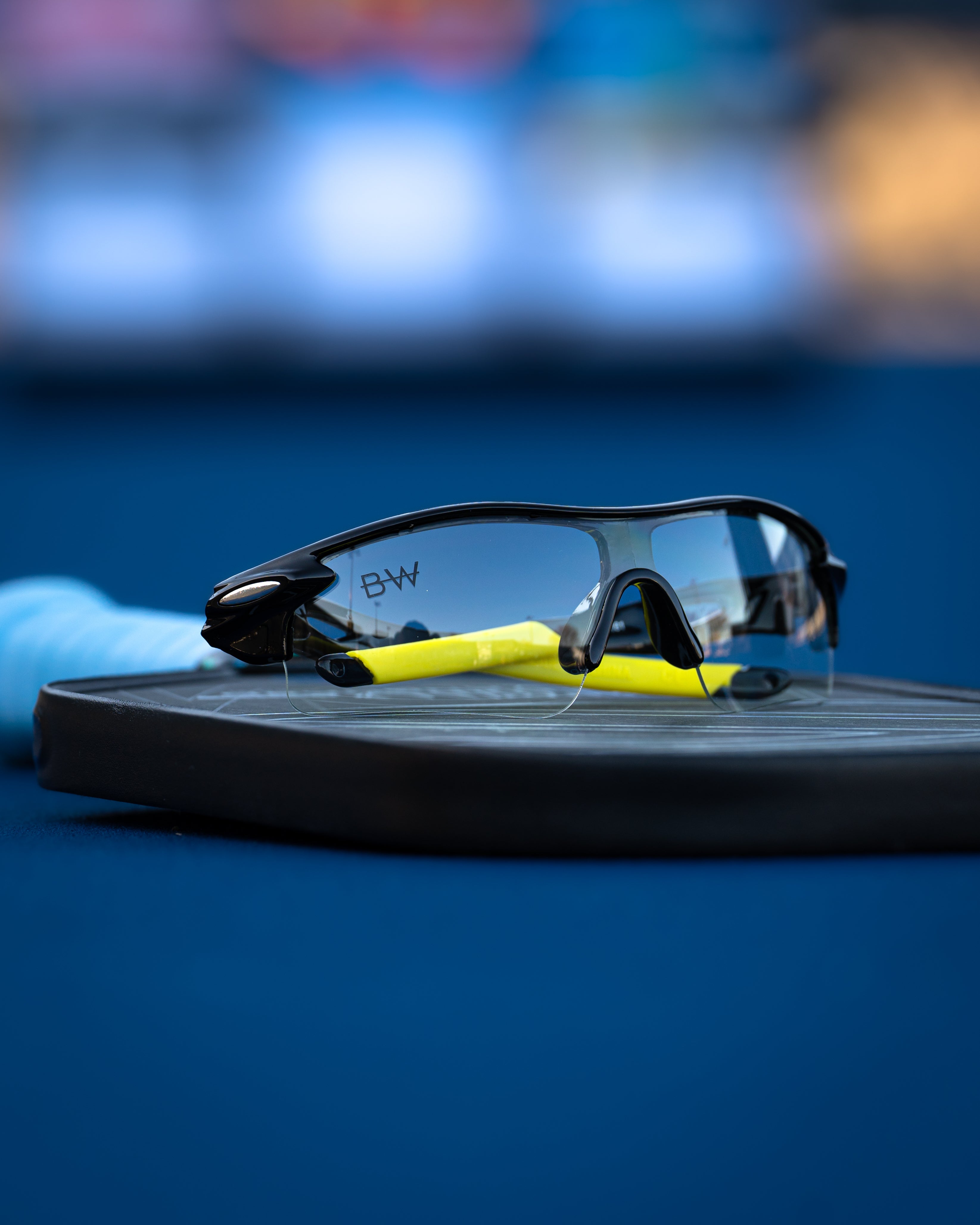
The Top RX Sports Glasses Pros Are Wearing This Season
Share
What prescription sports glasses are professional athletes wearing in 2026? Across pickleball and other court sports, athletes who require vision correction have several eyewear options, including direct prescription sports glasses, prescription inserts, and contact lenses paired with non-prescription eyewear. The right choice depends on prescription requirements, frame fit, court lighting, comfort, and the type of protection needed.
Professional athletes do not all wear the same eyewear, and there is no single prescription frame that can be considered the best for every player. Although certain eyewear brands and models appear in professional competition, individual player endorsements and equipment choices should be verified rather than assumed.
For recreational and competitive pickleball players, the more useful question is this: What makes a pair of prescription sports glasses suitable for serious court play, and which options are worth considering?
In this updated 2026 guide, we examine the characteristics athletes should prioritize, compare prescription pickleball glasses from Blinded Wear Co., and explain how to select eyewear for indoor tournaments, outdoor matches, recreational leagues, and regular training.
Rather than promising faster reactions, perfect ball tracking, or professional-level performance, this guide focuses on practical considerations: obtaining appropriate prescription correction, finding a comfortable fit, evaluating lens materials, understanding impact resistance, and choosing eyewear that suits your playing conditions.
If you are ready to explore prescription options, start with the Blinded Wear RX pickleball glasses collection, or compare prescription and non-prescription options in our 2026 pickleball glasses buying guide.
Quick Answer: What Makes RX Sports Glasses Suitable for Competitive Play?
The best prescription sports glasses for a competitive pickleball player are those that provide the required vision correction, fit comfortably during movement, suit the court's lighting conditions, and offer an appropriate level of protection for the intended activity. A professional-looking design or premium price does not automatically establish better performance or safety.
For players comparing RX sports eyewear, the most important factors are:
- Prescription compatibility: The selected frame and lens configuration must accommodate the wearer's prescription and optical requirements.
- Comfortable frame fit: The glasses should sit appropriately on the nose and ears without excessive pressure or distracting movement.
- Appropriate lens coverage: The lens shape and frame geometry should provide a usable field of view without creating unnecessary visual obstructions.
- Suitable lens material: Impact resistance, lens thickness, weight, and optical requirements should be considered separately.
- Lighting compatibility: Lens tint and visible light transmission should match the conditions in which the glasses will be used.
- Safety considerations: Players seeking certified sports eye protection should verify the exact eyewear's applicable safety rating rather than assuming ordinary sports glasses qualify.
- Practical ownership value: Price, prescription customization, care requirements, return restrictions, and replacement support should all influence the purchasing decision.
These considerations matter whether you play pickleball once a week or compete in organized tournaments throughout the year.
Bottom line: Prescription sports eyewear is worth considering when ordinary glasses or contact lenses do not adequately meet your needs. The objective is to find a suitable visual solution, not to purchase an unverified competitive advantage.
Why Athletes Choose Prescription Sports Glasses
Pickleball involves rapid changes in direction, close-range exchanges, overhead shots, and frequent shifts in attention between the ball, opponents, and open court. Players who need prescription correction must account for these demands when choosing eyewear.
Some athletes are comfortable using their everyday prescription glasses. Others prefer a dedicated sports pair because their ordinary frames are uncomfortable, move during activity, or are not well suited to their playing environment.
1. Consistent Access to Prescription-Corrected Vision
For athletes with nearsightedness, farsightedness, astigmatism, or other refractive needs, an appropriate prescription helps correct the visual issues identified by their eye-care professional.
On a pickleball court, this may be particularly relevant when viewing distant players, reading court markings, or switching attention between different distances.
However, a prescription lens does not automatically improve an athlete's reaction time, hand-eye coordination, or ability to anticipate an opponent's shot. Those skills depend on multiple factors, including experience, technique, attention, and training.
The practical benefit is having access to the vision correction you need while participating in your sport.
2. A Frame Selected for Physical Activity
Everyday prescription glasses are commonly chosen for work, driving, reading, or general daily use. A frame that feels comfortable at a desk may not feel equally comfortable during repeated lateral movements or overhead swings.
Sports-specific eyewear gives players an opportunity to prioritize characteristics such as:
- Comfort during repeated movement and longer playing sessions.
- Appropriate positioning on the bridge of the nose.
- Temple length and shape that suit the wearer's head.
- Compatibility with hats, visors, and other court accessories.
- A lens and frame shape that does not unnecessarily obstruct the usable field of view.
- Reasonable weight for the wearer's comfort preferences.
Fit remains individual. A frame described as lightweight or sports-oriented is not guaranteed to stay in place on every face, and a wraparound appearance does not establish proper optical alignment or certified protection.
3. Eyewear Selected for the Playing Environment
Outdoor pickleball players may encounter strong sunlight, reflections, changing cloud cover, and late-afternoon shadows. Indoor players may face artificial lighting, darker backgrounds, and different levels of illumination.
These conditions can affect which lens tint and visible light transmission are comfortable for a particular player.
A dedicated prescription sports pair allows players to choose an eyewear configuration based on where they actually play, rather than relying entirely on glasses selected for everyday activities.
For a deeper explanation of lens colors, polarization, prescription options, and lighting considerations, read the Blinded Wear performance lens guide.
4. A Dedicated Pair for Court Use
Some players prefer to keep separate glasses for sports and everyday activities. This can reduce the need to repeatedly move a single pair between different environments and may make it easier to maintain an eyewear setup suited to their regular playing conditions.
For example, an athlete who works indoors but regularly plays outdoor pickleball may prefer clear everyday prescription glasses and a separate prescription sports pair selected for outdoor use.
Other players may find that one well-fitting prescription pair works adequately across both settings.
Neither approach is universally better. The decision depends on budget, prescription requirements, playing frequency, and personal comfort.
What Do Professional Pickleball Players Actually Look for in Eyewear?
Professional athletes may evaluate eyewear differently depending on their visual needs, sponsorship arrangements, preferences, and playing conditions. There is no verified universal standard describing which prescription glasses all professional pickleball players prefer.
When shopping for eyewear inspired by competitive play, it is important to separate measurable product characteristics from marketing language.
Professional-Level Marketing Claims vs. What Buyers Can Verify
| Common Marketing Claim | What Buyers Should Understand | What to Check Instead |
|---|---|---|
| Improves reaction time | Eyewear alone cannot be assumed to make an athlete react faster. | Prescription suitability, visibility, comfort, and training needs. |
| Guarantees better ball tracking | Tracking a moving ball involves vision, attention, anticipation, and motor skills. | Appropriate prescription correction and an unobstructed usable field of view. |
| Never slips during play | Frame stability depends on individual fit, movement, and conditions. | Frame measurements, nose fit, temple positioning, and comfort. |
| Perfect depth perception | Depth perception is complex and cannot be guaranteed by a lens tint or polarization choice. | Prescription accuracy, binocular vision needs, and professional optical guidance. |
| Shatterproof lenses | Impact-resistant materials are not necessarily unbreakable or safety-certified. | Verified lens specifications and applicable safety certification. |
| Eliminates glare | Glare management depends on lighting, tint, polarization, coatings, and the environment. | Actual lens configuration and intended lighting conditions. |
| Trusted by the pros | Professional use or endorsement requires verifiable evidence. | Documented athlete relationships or independently confirmed equipment use. |
Important distinction: Blinded Wear offers prescription sports eyewear designed for pickleball, but the products discussed in this guide are not presented as verified equipment used or endorsed by specific professional players. They are shopping options for athletes seeking similar practical categories of eyewear.
This distinction helps buyers make informed decisions without mistaking an athletic design for proof of professional endorsement or superior performance.
Seven Features to Evaluate Before Buying RX Sports Glasses in 2026
Before comparing individual frames, it helps to understand which specifications and design characteristics matter most. Not every feature will be equally important for every prescription or playing environment.
1. Prescription Compatibility and Optical Positioning
The starting point for any prescription sports glasses purchase is an appropriate, current eyeglass prescription.
Depending on your prescription, lens configuration, and frame geometry, certain designs may be more suitable than others. Strong prescriptions, astigmatism, multifocal needs, and highly curved frames can introduce additional fitting considerations.
Factors to evaluate include:
- Sphere, cylinder, and axis requirements where applicable.
- Pupillary distance and other measurements needed for the chosen lens design.
- Lens position relative to the eyes.
- Frame size and lens shape.
- Whether the selected frame supports the required prescription.
- Any adaptation concerns associated with the lens configuration.
These considerations are especially important because prescription strength and lens geometry can affect the suitability of a particular sports frame.
Blinded Wear requires customers to upload a clear picture of their eyeglass prescription on the RX product page before adding the eyewear to their cart and completing the purchase.
For ordering instructions, visit How to Order RX Glasses from Blinded Wear.
2. High-Index Prescription Lens Options
High-index prescription lenses use materials with a higher refractive index than conventional lower-index lens materials. Depending on the prescription, lens design, and frame, this can help manage lens thickness.
For players with stronger prescriptions, lens thickness may influence appearance, weight distribution, and frame selection.
However, several distinctions are important:
- High-index lenses are not automatically more impact-resistant than other lens materials.
- A higher refractive index does not guarantee sharper vision or less distortion.
- Lens thickness also depends on prescription strength, lens size, shape, and other design factors.
- Optical performance depends on appropriate prescription correction, measurements, lens design, and fitting.
- High-index material does not guarantee improved athletic performance.
Blinded Wear includes high-index prescription lenses at no additional cost with its RX eyewear. This is a useful purchasing consideration for shoppers comparing the total cost of prescription eyewear, particularly when another retailer charges separately for high-index materials.
Before purchasing, confirm that the specific prescription and selected frame configuration are supported.
3. Impact Resistance and Eye Protection
Pickleball involves a fast-moving ball, paddles, nearby players, and the possibility of accidental contact. These conditions make eye protection an important consideration.
Blinded Wear offers impact-resistant lens options. However, impact resistance should not be confused with certified sports eye protection.
When evaluating eyewear, understand the following distinctions:
- Impact-resistant: Describes a material or lens characteristic, but does not by itself establish that the complete eyewear system meets a particular sports safety standard.
- Shatterproof: An absolute claim that should not be assumed for sports eyewear.
- Safety-certified: Indicates that eyewear has been evaluated against a specific applicable standard, provided the certification is genuine and covers the intended configuration.
- Prescription-ready: Means a frame can accommodate prescription correction, not that it provides certified sports protection.
Players specifically seeking protection from ball or paddle impacts should look for eyewear with verified certification appropriate to the sport and intended use. ASTM F803 is one standard associated with protective eyewear for certain sports; buyers should verify whether the applicable edition and sport coverage include their intended activity.
Do not assume that a product meets ASTM F803 or another safety standard unless the exact eyewear configuration is documented as compliant.
4. Frame Weight, Fit, and Comfort
Comfort is one of the most practical reasons to consider dedicated sports eyewear. A frame that feels heavy, pinches behind the ears, or requires frequent repositioning may become distracting during a long playing session.
Blinded Wear designs lightweight sports eyewear for pickleball, but individual fit and comfort depend on the wearer.
When comparing frames, consider:
- Bridge fit: Whether the frame sits comfortably on the nose without excessive pressure.
- Temple fit: Whether the arms are appropriately positioned without causing discomfort.
- Frame width: Whether the glasses feel too narrow or too loose.
- Lens height: Whether the lens shape provides adequate visibility for the player's needs.
- Weight distribution: Whether the frame and prescription lenses feel balanced.
- Movement: Whether the glasses remain reasonably positioned during typical athletic activity.
A lighter frame may feel more comfortable for some players, but weight alone does not establish superior fit or durability.
5. Lens Tint and Visible Light Transmission
Lens tint is an important purchasing consideration because indoor and outdoor pickleball courts can have very different lighting conditions.
Visible light transmission, commonly abbreviated VLT, describes the percentage of visible light that passes through a lens. Lower VLT generally means less visible light passes through, while higher VLT allows more visible light through.
VLT should be evaluated alongside the lens tint, lighting environment, and the wearer's preferences.
| Playing Environment | Lens Considerations | What to Avoid Assuming |
|---|---|---|
| Indoor pickleball courts | Clear or sufficiently light-transmitting lenses may be practical depending on court illumination. | That a tinted lens always improves contrast or ball visibility. |
| Bright outdoor courts | Consider appropriate sun protection, lens darkness, and comfort in strong light. | That darker lenses automatically provide greater UV protection. |
| Cloudy outdoor conditions | Evaluate whether the lens allows enough light for comfortable visibility. | That a particular lens color is universally best for overcast weather. |
| Late-afternoon or shaded courts | Consider changing illumination and whether a dark tint becomes uncomfortable. | That one fixed tint is ideal across every lighting condition. |
| Mixed indoor and outdoor play | Consider a clear pair, multiple lens options, or other configurations when available. | That all prescription sports glasses include photochromic lenses. |
Lens color alone does not establish UV protection, impact resistance, or visual performance. Always evaluate the actual product configuration rather than relying on color descriptions.
6. Polarized vs. Non-Polarized Lenses
Polarization is frequently discussed in sports eyewear, particularly for outdoor activities where reflected glare can be distracting.
Polarized lenses are designed to reduce certain forms of reflected glare. However, polarization does not automatically improve or impair depth perception, reaction time, or ball tracking for every player.
Some athletes prefer non-polarized eyewear because of how particular polarized lenses interact with displays, reflections, or their individual visual preferences.
Blinded Wear offers non-polarized lens options for shoppers who prefer that configuration.
The best choice depends on your environment and personal experience. Neither polarized nor non-polarized lenses should be marketed as a guaranteed way to improve pickleball performance.
For a detailed explanation of the tradeoffs, explore the pickleball lens color, clarity, and RX options guide.
7. Durability, Care, and Long-Term Ownership
Prescription sports glasses are a customized purchase, so long-term ownership considerations deserve attention before checkout.
Durability depends on more than frame appearance. Lens material, frame construction, handling, cleaning habits, storage, and exposure to heat or chemicals can all influence eyewear longevity.
Before purchasing any RX sports glasses, ask:
- Will I use these glasses frequently enough to justify the purchase?
- Do I understand the prescription customization process?
- Am I comfortable with the applicable return restrictions?
- What happens if the eyewear becomes damaged?
- Will I need separate eyewear for different playing conditions?
- How might future prescription changes affect the value of this purchase?
Blinded Wear offers 50% lifetime replacement support for eligible broken eyewear, subject to its policy terms. This is not a free replacement: eligible damaged glasses must be returned, and qualifying customers receive 50% credit toward a replacement pair.
For damaged prescription eyewear, customers should contact blindedwearco@gmail.com before returning their glasses.
Customized prescription eyewear is final sale and excluded from the standard 30-day return policy. Eligible standard non-customized purchases are subject to the 30-day return policy.
Review the complete Blinded Wear protection, returns, and replacement terms before ordering.
Which Prescription Sports Eyewear Setup Fits Your Playing Style?
There is no universal winner among direct prescription sports glasses, everyday prescription glasses, prescription inserts, and contact lenses. Each solution offers different advantages and limitations.
The following comparison helps identify a sensible starting point based on your playing habits.
| Player Profile | Eyewear Worth Considering | Main Reason | Important Consideration |
|---|---|---|---|
| Weekly recreational player | Existing prescription glasses or dedicated RX sports glasses | A separate sports pair may be useful if everyday glasses are uncomfortable. | Additional cost may not be justified if current eyewear works well. |
| Frequent competitive player | Dedicated prescription sports eyewear | Allows frame and lens selection around regular court use. | Fit, prescription compatibility, and protection requirements remain essential. |
| Outdoor pickleball player | Prescription sports sunglasses | Combines vision correction with a lens configuration selected for outdoor conditions. | Verify tint, UV protection, and other specifications individually. |
| Indoor league player | Clear prescription sports eyewear | A clear lens may be practical where dark tint is unnecessary. | Confirm lighting suitability and any required impact protection. |
| Contact lens wearer | Contacts with appropriate non-RX sports eyewear | May provide flexibility for players who tolerate contacts comfortably. | Contacts do not replace protective eyewear. |
| Player with a stronger prescription | RX frame compatible with the prescription and appropriate lens design | Lens thickness and optical positioning may deserve additional attention. | Not every frame or lens configuration supports every prescription. |
| Multi-sport athlete | Sports eyewear suited to each activity | A versatile frame may be practical for multiple uses. | Safety requirements and appropriate fit can differ between sports. |
When Dedicated RX Sports Glasses Make the Most Sense
A dedicated prescription sports pair may be especially worthwhile if you play frequently, experience discomfort with ordinary glasses, prefer not to wear contacts, or regularly encounter lighting conditions that your current eyewear does not handle comfortably.
For players who rarely play and are already satisfied with their existing glasses, the more economical option may be to continue using their current prescription eyewear, provided it is appropriate for the activity and any necessary eye protection is addressed.
Competitive participation alone does not mean you must purchase expensive sports eyewear. The value comes from solving specific needs, not from the level of competition printed on a product description.
How to Narrow Your Choices Before Shopping
- Identify your main environment: Determine whether you primarily play indoors, outdoors, or across both settings.
- Review your prescription: Confirm that it is current and that your preferred eyewear configuration can accommodate it.
- Evaluate your current glasses: Identify specific issues with comfort, fit, lighting, or practicality.
- Decide whether you need certified protection: Verify appropriate safety standards where impact protection is a priority.
- Set a realistic budget: Account for prescription lenses, customization, and future ownership needs.
- Compare individual frames: Choose based on fit, appearance, verified specifications, and personal preferences rather than unsupported performance promises.
If you are unsure where to begin, use the Blinded Wear pickleball sunglasses quiz to help explore your preferences, then review the relevant product details before purchasing.
Top Blinded Wear RX Sports Glasses to Consider in 2026
With the fundamentals established, the next step is comparing actual prescription eyewear options.
Blinded Wear offers several RX models for pickleball players who want a combination of prescription customization, lightweight sports-oriented styling, and a dedicated eyewear option for court use.
Among the models worth exploring are Frost RX, Zebra II RX, Havana Melt RX, Blue Shield RX, and Crystal Wave II RX.
These are Blinded Wear shopping options, not a verified ranking of frames worn by professional athletes. Their suitability depends on your prescription, fit preferences, lens configuration, and intended use.
In the next section, we'll examine these models individually, compare their buying considerations, and explain how to choose between them without relying on invented endorsements, unverified lens technology, or exaggerated performance claims.
Explore the collection: Shop Blinded Wear prescription pickleball glasses to view current models and available configurations.
Blinded Wear RX Sports Glasses: 2026 Model-by-Model Comparison
Choosing prescription sports glasses is not simply about selecting the most expensive frame or the model with the most aggressive athletic styling. For pickleball players, the right choice depends on prescription compatibility, personal fit, court conditions, lens preferences, and how often the eyewear will be used.
Blinded Wear Co. offers several prescription eyewear designs that players can compare based on appearance, intended use, and available customization. Rather than presenting these products as officially endorsed by professional athletes, this section examines them as potential options for recreational, league, and competitive pickleball players.
Important: The comparisons below are shopping guidance, not independent laboratory rankings or evidence of professional athlete use. Specific lens tints, coatings, frame dimensions, prescription compatibility, and safety certifications should always be confirmed on the individual product page before purchasing.
Quick Comparison: Which Blinded Wear RX Model Should You Explore?
| RX Model | Reason to Consider It | What to Evaluate | Product |
|---|---|---|---|
| Frost RX | Dedicated prescription pickleball eyewear option | Frame fit, lens configuration, and prescription suitability | View Frost RX |
| Zebra II RX | Alternative frame styling within the RX collection | Frame proportions, comfort, and personal style | View Zebra II RX |
| Havana Melt RX | Another prescription frame design to compare | Frame appearance, lens choices, and intended court environment | View Havana Melt RX |
| Blue Shield RX | Additional RX design for players comparing frame options | Actual lens specifications rather than assumptions based on the model name | View Blue Shield RX |
| Crystal Wave II RX | Prescription sunglasses option to investigate for outdoor play | Tint, light transmission, UV specifications, and comfort | View Crystal Wave II RX |
| Steel Ice RX | Additional prescription eyewear design | Frame geometry, prescription compatibility, and lens preferences | View Steel Ice RX |
| Rippled X RX | Alternative RX sunglasses design | Outdoor suitability, frame fit, and available lens configurations | View Rippled X RX |
| Gray Wash RX | Another RX frame option for style and fit comparison | Lens characteristics, frame proportions, and intended use | View Gray Wash RX |
No model in this table should be assumed to have superior optical accuracy, greater impact resistance, better retention, or improved athletic performance solely because of its name or appearance.
For the full selection, browse the Blinded Wear prescription pickleball eyewear collection.
1. Frost RX: A Dedicated Prescription Pickleball Glasses Option
Frost RX Prescription Pickleball Glasses are a useful starting point for shoppers who want to explore a dedicated RX model rather than relying exclusively on everyday prescription eyewear.
The main purchasing consideration is whether the frame's fit, appearance, and supported prescription configuration suit your needs. A sports-oriented frame may be appealing, but its design alone cannot establish that it will fit every face or provide certified impact protection.
Who Should Consider Frost RX?
Frost RX may be worth exploring if you:
- Need prescription correction while playing pickleball.
- Want a dedicated pair of glasses for recreational or competitive court use.
- Prefer to compare sports-oriented frames rather than relying only on everyday eyewear.
- Are looking for prescription customization within the Blinded Wear collection.
- Want to evaluate frame appearance and lens suitability before investing in a dedicated sports pair.
What to Check Before Ordering Frost RX
Begin by reviewing the frame dimensions and available prescription options. The shape of a frame can affect how its lenses sit relative to the eyes, and certain prescriptions may require additional consideration.
For players with stronger prescriptions, it is worth asking whether the chosen lens configuration is appropriate for the frame's geometry.
Blinded Wear includes high-index prescription lenses at no additional cost with RX eyewear. High-index material can help manage thickness in some prescriptions, but it does not automatically improve visual processing, reaction time, or impact resistance.
Also consider whether you primarily play indoors or outdoors. A lens configuration that feels comfortable on a sunny outdoor court may not be appropriate for a dimmer indoor venue.
Buying takeaway: Frost RX deserves consideration as a dedicated prescription pickleball eyewear option, but the deciding factors should be your prescription, fit needs, and intended use rather than unsupported claims about professional-level performance.
2. Zebra II RX: An Alternative for Players Comparing Frame Designs
Zebra II RX provides another prescription eyewear option for pickleball players who want to compare frame aesthetics and personal fit preferences.
For many athletes, appearance is a legitimate part of choosing eyewear. A player who likes the way a frame looks may be more inclined to wear it consistently. However, style should complement rather than replace practical evaluation.
Why Frame Choice Matters
Two prescription frames can feel different even when fitted with lenses made to the same prescription. Differences in frame dimensions, bridge geometry, lens shape, and temple positioning may influence comfort and optical positioning.
When comparing Zebra II RX with another model, focus on:
- Overall frame width: Does the design appear appropriate for your face size?
- Bridge dimensions: Is the frame likely to sit comfortably on your nose?
- Lens proportions: Does the design offer a usable field of view for your needs?
- Temple geometry: Could the frame interfere with your preferred hat or visor?
- Prescription requirements: Is the model compatible with the correction you need?
- Personal preference: Would you be comfortable wearing the frame for an entire playing session?
Does Zebra II RX Improve Ball Visibility?
No specific improvement in ball visibility, contrast sensitivity, or tracking should be assumed without evidence about the exact lens configuration and the wearer's visual needs.
Appropriate prescription correction may address refractive blur, while tint, lighting, lens positioning, and individual visual characteristics can influence the wearing experience.
The important distinction is that selecting a sports frame does not guarantee that a player will recognize spin faster, anticipate shots more accurately, or improve competitive results.
Buying takeaway: Consider Zebra II RX if you prefer its frame design and it accommodates your prescription. Compare its fit and verified specifications against other RX models before making a final choice.
3. Havana Melt RX: A Prescription Frame for Players Who Value Style and Practicality
Havana Melt RX is another model worth reviewing when comparing prescription eyewear within the Blinded Wear collection.
Some players want a frame they feel comfortable wearing beyond organized matches, while others prefer eyewear reserved specifically for court use. Both approaches can make sense depending on prescription needs, lifestyle, and personal preferences.
Can One RX Frame Work for Sports and Everyday Activities?
Potentially, yes. A prescription frame that fits properly and suits the intended environment may be useful across multiple activities.
However, versatility depends on more than appearance. A player who uses dark-tinted prescription sunglasses outdoors may still need another solution for indoor courts, nighttime activities, or everyday tasks in lower light.
Similarly, a frame that is comfortable for casual use is not automatically suitable for every sporting activity or impact hazard.
Questions to Ask Before Choosing Havana Melt RX
- Will I use these glasses primarily for pickleball or for several activities?
- Do the frame dimensions appear suitable for my face?
- Is my prescription compatible with the selected configuration?
- What lens options are actually available for this product?
- Will the chosen lenses suit the lighting conditions where I play?
- Do I need certified sports eye protection for my intended use?
- Am I comfortable with the final-sale terms for customized RX eyewear?
These questions help determine whether Havana Melt RX fits your needs without relying on claims about guaranteed comfort, universal lens availability, or professional endorsements.
Buying takeaway: Havana Melt RX is worth comparing if you want another frame design within Blinded Wear's prescription collection. Prioritize fit, prescription suitability, and the specific lens options offered at checkout.
4. Blue Shield RX: What to Know About Lens Names and Blue-Light Claims
Blue Shield RX is another prescription eyewear model available for shoppers to investigate.
Its name also provides an opportunity to address a common source of confusion in the eyewear market: the difference between a product name and a verified lens specification.
Does Blue Shield RX Automatically Include Blue-Light Filtering?
A model name alone does not establish whether a specific lens has blue-light filtering properties, how much light it filters, or whether any particular coating is included.
Buyers should review the actual lens configuration and product details rather than assuming that the words used in a model name describe a tested optical feature.
It is also important to distinguish blue-light filtering from other lens characteristics:
- Blue-light filtering: Refers to reducing transmission of certain wavelengths of visible light.
- UV protection: Concerns ultraviolet radiation and is a separate specification.
- Polarization: Reduces certain types of reflected glare and is not equivalent to blue-light filtering.
- Anti-reflective coatings: Are designed to reduce reflections from lens surfaces when included.
- Lens tint: Influences visible light transmission and appearance, but does not independently establish all other properties.
Do Blue-Light Glasses Improve Pickleball Performance?
There is no sound basis for promising that blue-light filtering alone improves reaction time, ball tracking, competitive accuracy, or athletic performance.
Although players may have individual preferences about lens appearance or comfort under artificial lighting, these preferences should not be confused with proven improvements in sports performance.
If you regularly play indoors, the more useful questions are whether your prescription is appropriate, whether the lenses allow sufficient light through, and whether the frame fits comfortably.
For additional information about lens choices, visit the Blinded Wear pickleball lens guide.
Buying takeaway: Evaluate Blue Shield RX based on its actual available specifications and frame design. Do not assume that the product name guarantees a particular coating, visual benefit, or performance advantage.
5. Crystal Wave II RX: Prescription Sunglasses for Outdoor Pickleball Consideration
Crystal Wave II RX Sunglasses are worth investigating if you regularly play pickleball outdoors and prefer prescription eyewear in a sunglasses format.
Outdoor players face lighting conditions that can differ substantially from those found inside a dedicated pickleball facility. Bright sunshine, reflections from nearby surfaces, and changing shadows can all influence visual comfort.
Prescription sunglasses combine the convenience of vision correction with a lens configuration selected for outdoor light conditions.
What Makes Prescription Sunglasses Useful for Outdoor Players?
The primary practical advantage is the ability to wear prescription correction and sun-oriented eyewear in the same pair of glasses.
This can appeal to athletes who:
- Need prescription lenses but prefer not to wear contact lenses.
- Frequently play during daylight hours.
- Find ordinary clear prescription glasses uncomfortable in bright conditions.
- Want a dedicated pair for outdoor recreation and pickleball.
- Prefer a sunglasses-style frame for their personal appearance and comfort.
What Should You Verify Before Buying?
Not every pair of sunglasses offers identical protection or light transmission. Before purchasing Crystal Wave II RX, review the available product details for the exact configuration you intend to order.
Important questions include:
- What lens tint is included or available?
- Is the visible light transmission appropriate for your usual playing conditions?
- What UV protection specifications are documented?
- Is the selected lens polarized or non-polarized?
- Is your prescription compatible with the selected frame?
- Does the eyewear have any documented sports safety certification?
Blinded Wear offers non-polarized options within its eyewear selection, but buyers should confirm the configuration available for the individual model.
Are Non-Polarized Prescription Sunglasses Better for Pickleball?
Not universally. Polarization can reduce certain reflected glare, while non-polarized lenses may be preferred by players who dislike particular effects of polarized lenses.
Neither option guarantees better depth perception, faster reactions, or improved ball tracking.
For outdoor pickleball, the better choice is the lens configuration that provides suitable correction, lighting comfort, and any necessary protection for your circumstances.
Buying takeaway: Crystal Wave II RX is worth exploring if you want prescription sunglasses for outdoor court use. Confirm the actual lens specifications rather than assuming that every sunglasses model offers the same tint, UV rating, or coating package.
6. More Blinded Wear RX Frames Worth Comparing
The models above are not the only prescription options worth exploring. Blinded Wear also offers additional RX designs that may appeal to players with different frame preferences.
Steel Ice RX
Steel Ice RX provides another prescription frame option for players who want to compare styling, fit, and available lens configurations.
When reviewing Steel Ice RX, consider whether the frame's proportions are suitable for your face and whether the product supports your prescription requirements.
A frame's visual appearance cannot establish optical accuracy, impact certification, or its ability to remain stable during movement. These characteristics must be evaluated separately.
Rippled X RX
Rippled X RX Sunglasses are another option for shoppers exploring prescription sunglasses within the Blinded Wear collection.
If you play outdoors frequently, compare Rippled X RX against Crystal Wave II RX based on frame preferences, verified lens specifications, and prescription compatibility.
Neither model should be considered automatically superior without knowing your individual needs and the exact configurations being compared.
Gray Wash RX
Gray Wash RX offers another frame design to consider when narrowing down your prescription eyewear choices.
As with other RX models, do not infer the exact lens tint, visible light transmission, coatings, or protective properties from the product name alone.
Instead, compare the documented configuration against your playing environment, prescription requirements, and fit preferences.
How Many RX Frames Should You Compare?
For most shoppers, comparing three or four promising frames is a practical starting point.
Rather than browsing dozens of models without a clear decision framework, identify the features that matter most and eliminate options that do not meet your needs.
For example, a player who primarily competes indoors may want to begin with the clear-lens collection and investigate compatible prescription options. A player who spends most of their time outdoors may prefer to begin with RX sunglasses designs.
This approach keeps the decision focused on usability instead of treating every frame as interchangeable.
Prescription Sports Glasses vs. Contacts vs. Prescription Inserts
One of the most important decisions for athletes who need vision correction is whether to purchase direct prescription sports glasses or use an alternative setup.
Each approach has potential advantages, but none is universally superior.
Direct Prescription Sports Glasses
Direct RX eyewear incorporates prescription correction into the primary lenses rather than using a separate prescription insert.
This can appeal to players who prefer a single eyewear assembly and do not want to manage contact lenses during activity.
Potential advantages include:
- Prescription correction incorporated directly into the eyewear.
- No need to insert or remove contact lenses before playing.
- No separate prescription insert positioned behind an outer lens.
- Frame and lens choices that can be selected for the intended activity.
Potential limitations include:
- Not every prescription is compatible with every sports frame.
- Strong prescriptions may create additional lens thickness or fitting considerations.
- Customized eyewear may have more restrictive return terms.
- A prescription change may require new lenses or another eyewear purchase.
- One fixed lens tint may not be suitable for every environment.
Contact Lenses With Non-Prescription Sports Eyewear
Some athletes prefer wearing contact lenses for vision correction and using non-prescription eyewear when needed for lighting or protection.
This arrangement can be practical for players who already tolerate contacts comfortably.
Potential advantages include:
- Freedom to choose from a broader selection of non-prescription frames.
- Ability to switch non-RX eyewear without changing the prescription lenses.
- No prescription lens thickness within the outer sports frame.
- Convenience for players already accustomed to contact lenses.
Potential limitations include:
- Some wearers experience dryness or discomfort with contacts.
- Proper contact lens hygiene and replacement remain necessary.
- Contacts do not provide protection against ball or paddle impacts.
- Wind, dust, and environmental conditions may affect comfort.
- Not every patient is a suitable candidate for contact lenses.
An eye-care professional can help determine whether contact lenses are appropriate for your prescription and ocular health.
Players who choose this approach can explore Blinded Wear non-prescription pickleball sunglasses, currently priced at $149.99, while confirming that the selected eyewear meets their individual requirements.
Prescription Inserts Behind Sports Lenses
Prescription inserts are separate corrective lenses positioned behind the primary lens or shield of a compatible sports eyewear system.
Some athletes prefer inserts because they can separate the prescription component from the outer eyewear configuration.
However, this setup also introduces additional considerations.
- Compatibility between the insert and outer frame must be confirmed.
- The insert adds another optical component to the eyewear assembly.
- Comfort may vary depending on the distance between the insert, outer lens, and face.
- Additional lens surfaces can create cleaning and reflection considerations.
- Not every insert system accommodates every prescription.
- The safety characteristics of the complete assembled system must be verified.
Blinded Wear's direct RX products should not be assumed to include or support prescription inserts unless the individual product information explicitly confirms that capability.
Side-by-Side Comparison of Vision Correction Options
| Factor | Direct RX Sports Glasses | Contacts + Non-RX Eyewear | Prescription Inserts |
|---|---|---|---|
| Prescription location | Primary lenses | Contact lenses on the eyes | Separate lenses behind outer eyewear |
| Contact lens handling | Not required | Required | Not required |
| Changing outer lens configurations | Depends on eyewear design | Can switch compatible non-RX eyewear | Depends on insert system |
| Prescription compatibility | Depends on frame and lens design | Depends on contact lens suitability | Depends on insert design |
| Additional optical surfaces | Primary lenses | Contacts plus any outer eyewear | Insert plus outer lenses |
| Comfort considerations | Frame fit and lens configuration | Contact tolerance and outer frame fit | Insert clearance and frame fit |
| Impact protection | Depends on verified eyewear specifications | Depends on protective outer eyewear | Depends on certified complete assembly |
| Best starting point | Players wanting prescription correction in one pair of glasses | Comfortable contact lens wearers | Players considering compatible modular eyewear systems |
Decision rule: If you dislike contact lenses and want a dedicated prescription pair, direct RX sports eyewear is a logical category to explore. If you already wear contacts comfortably and value the flexibility of changing outer frames, contacts paired with suitable non-RX eyewear may be more convenient. Prescription inserts deserve consideration when a compatible system offers advantages for your particular needs.
Indoor vs. Outdoor RX Sports Glasses: What Competitive Players Should Consider
Indoor and outdoor pickleball environments create different visual and practical requirements. The best lens configuration for one setting may be uncomfortable or impractical in another.
Indoor Pickleball: Prioritize Appropriate Light Transmission
Indoor courts vary widely in lighting quality. Some facilities have bright, evenly distributed illumination, while others have darker corners, reflective surfaces, or uneven overhead lighting.
For many indoor environments, clear or sufficiently light-transmitting prescription lenses are a reasonable starting point.
When selecting indoor RX eyewear, consider:
- Whether the lenses allow enough visible light through.
- Whether your prescription is appropriate for the distances involved in play.
- Whether the frame remains comfortable during longer sessions.
- Whether reflections from the lens surfaces are distracting.
- Whether the eyewear meets any necessary impact protection requirements.
Do not assume that yellow, amber, blue, or another tinted lens will universally improve indoor ball visibility. Individual preferences and lighting conditions vary, and the same tint can behave differently across environments.
Explore Blinded Wear clear-lens eyewear as a starting point, and verify prescription availability for the specific product you are considering.
Outdoor Pickleball: Consider Sunlight, Reflections, and Changing Conditions
Outdoor courts can expose players to direct sunlight, reflected light, and changing brightness throughout a match.
Prescription sunglasses may provide a more convenient solution than repeatedly switching between ordinary glasses and separate sunglasses.
However, lens darkness and UV protection are not the same thing. A darker lens does not automatically offer better ultraviolet protection, and a light-colored lens is not necessarily inadequate.
For outdoor use, evaluate the documented UV protection, visible light transmission, polarization, and any other relevant lens characteristics.
Also consider the time of day. A lens that feels comfortable at midday may be too dark during late-afternoon play or under heavy cloud cover.
What If You Play Both Indoors and Outdoors?
Players who regularly switch between indoor and outdoor courts have several possible approaches:
- Use clear prescription eyewear across environments when lighting conditions permit.
- Own separate clear and tinted prescription pairs.
- Use contact lenses with different non-prescription eyewear configurations.
- Investigate photochromic or interchangeable-lens systems where explicitly available and compatible.
Photochromic lenses are not universally available on all prescription sports frames, and their behavior depends on the specific lens technology and environmental conditions. Do not assume that every RX model automatically changes tint.
For frequent players, maintaining two suitable eyewear configurations may offer more flexibility, but it also increases the initial purchase cost.
The right solution depends on how often you switch environments and whether the convenience justifies the expense.
Before You Buy: A Practical RX Sports Glasses Checklist
Use this checklist to narrow down your options before ordering customized prescription eyewear.
- Prescription: Confirm that you have a current eyeglass prescription and understand any additional measurements required.
- Frame fit: Compare available dimensions with eyewear that already fits you comfortably.
- Lens material: Understand the difference between high-index materials and impact-resistant options.
- Lighting: Select a lens configuration suited to your indoor or outdoor playing conditions.
- Protection: Verify any necessary sports safety certification rather than assuming it is included.
- Polarization: Choose based on your needs rather than claims of guaranteed athletic benefits.
- Coatings: Confirm that any desired anti-reflective, anti-fog, hydrophobic, or scratch-resistant feature is actually offered.
- Customization: Review the RX ordering process and upload requirements.
- Returns: Understand that customized Blinded Wear RX eyewear is final sale.
- Replacement support: Review eligibility and conditions for Blinded Wear's 50% lifetime replacement support.
Once you have identified the appropriate lens category and frame preferences, visit the Blinded Wear RX collection to compare available models.
The goal is to purchase prescription sports eyewear that suits your actual needs, not simply to imitate an athlete's appearance or pay extra for unsupported performance claims.
Are Professional-Style RX Sports Glasses Worth the Investment in 2026?
Prescription sports glasses can be worth the investment for pickleball players who need vision correction and want eyewear selected specifically for active use. However, the value depends on how frequently you play, how well your existing glasses work, your prescription requirements, and whether a dedicated sports pair solves a meaningful problem.
The phrase "professional-style" should describe an athletic design or intended use, not imply that a frame is endorsed by professional athletes or guarantees competitive improvements.
For many buyers, the strongest reasons to consider RX sports eyewear are practical: prescription correction, frame comfort, suitable lens configurations, and the convenience of having a dedicated pair for pickleball.
When RX Sports Glasses Are Likely Worth Considering
A dedicated pair may be a worthwhile purchase when:
- You play pickleball several times per week and regularly need prescription correction.
- Your everyday prescription glasses feel uncomfortable during extended matches.
- You dislike wearing contact lenses or have difficulty tolerating them.
- You want prescription sunglasses for outdoor pickleball.
- Your current glasses frequently require repositioning during movement.
- You want separate eyewear for sports and everyday activities.
- You have identified a frame and lens configuration that better suits your needs.
These circumstances do not guarantee that sports-specific eyewear will outperform your current glasses. They simply provide reasonable grounds for considering a different eyewear setup.
When Regular Prescription Glasses May Be Enough
Not every pickleball player needs a dedicated RX sports frame.
If your existing prescription glasses provide appropriate vision correction, fit comfortably, and do not interfere with your activity, purchasing another pair may offer limited additional value.
For occasional recreational players, the cost of customized sports eyewear may be difficult to justify unless there is a specific problem to solve.
One important exception involves eye protection. Ordinary prescription glasses should not be assumed to provide adequate protection from sports impacts. If impact protection is needed, evaluate eyewear with verified certification appropriate for the intended activity.
When a Dedicated Pair May Not Be the Best Purchase
Consider postponing a purchase if:
- Your eyeglass prescription is outdated and you need a new examination.
- You are unsure whether a frame supports your prescription.
- You have not identified the lighting conditions in which you will use the glasses.
- You need certified protective eyewear but cannot verify the product's safety rating.
- You expect customized prescription eyewear to qualify for ordinary returns despite final-sale restrictions.
- Your existing eyewear already meets your needs and the additional expense would strain your budget.
Buying the right eyewear at the right time is more valuable than purchasing a new frame simply because it is marketed toward competitive athletes.
The Long-Term Value of Prescription Sports Glasses
When comparing RX sports eyewear, the initial purchase price is only one part of the ownership decision.
Long-term value also depends on playing frequency, lens customization costs, care habits, prescription changes, and the manufacturer's return or replacement policies.
Cost Per Use: A Simple Way to Evaluate Your Purchase
One practical method is to divide the total eyewear purchase cost by the number of times you expect to wear it.
Cost per use = Total purchase cost ÷ Number of uses
For example, consider a hypothetical pair of prescription sports glasses costing $250. This figure is an illustration, not a stated Blinded Wear RX product price.
| Playing Frequency | Estimated Uses in One Year | Illustrative Cost Per Use |
|---|---|---|
| Once per month | 12 | $20.83 |
| Once per week | 52 | $4.81 |
| Three times per week | 156 | $1.60 |
| Five times per week | 260 | $0.96 |
These calculations assume the same initial $250 purchase and one year of use. They exclude prescription examinations, maintenance, repairs, replacements, and other expenses. They also do not predict how long any particular pair will last.
A player who uses dedicated prescription sports glasses frequently may find the purchase easier to justify than someone who only plays occasionally.
However, a low cost per use does not necessarily mean that a product was the best choice. The glasses must still meet the wearer's prescription, fit, comfort, and protection requirements.
Why Included High-Index Lenses Matter When Comparing Prices
Some eyewear retailers charge separately for high-index prescription lens materials. These materials can help manage lens thickness depending on the prescription and frame design.
Blinded Wear includes high-index prescription lenses at no additional cost with RX eyewear.
This can simplify price comparisons for customers who would otherwise face an additional charge for high-index materials.
When comparing retailers, evaluate the full checkout price rather than the advertised frame price alone.
Remember that high-index describes a material's refractive index. It does not establish superior impact resistance, guaranteed optical accuracy, or better athletic performance.
What Happens When Your Prescription Changes?
Prescription changes are an important ownership consideration, especially for players planning to use the same eyewear over several seasons.
If your prescription changes, your existing lenses may no longer provide the correction recommended by your eye-care professional.
Depending on the frame and retailer, updating the prescription could require replacement lenses or a new pair of glasses. Do not assume that every sports frame supports replacement lenses or that a prescription update is included at no cost.
Before buying, consider how frequently your prescription has changed and whether your current eye examination is up to date.
How Replacement Support Affects Ownership Value
Blinded Wear offers 50% lifetime replacement support for eligible broken eyewear, subject to policy terms.
Under this program, eligible damaged glasses must be returned, and qualifying customers receive 50% credit toward a replacement pair. It is not a free replacement guarantee or an assurance that all damage qualifies.
For damaged prescription eyewear, contact blindedwearco@gmail.com before returning the glasses.
Review the Blinded Wear protection and returns policy for eligibility, procedures, and applicable conditions.
Replacement support can be a useful ownership consideration, but it should not be interpreted as proof that eyewear is unbreakable or certified for sports impacts.
How to Order Blinded Wear Prescription Sports Glasses
Ordering customized prescription eyewear requires more attention than purchasing ordinary non-prescription sunglasses.
Blinded Wear customers must provide their eyeglass prescription during the RX ordering process. Taking time to confirm your information before checkout can help avoid preventable ordering problems.
Step 1: Start With a Current Eyeglass Prescription
Use a valid, current eyeglass prescription from your eye-care professional. A contact lens prescription is not automatically interchangeable with an eyeglass prescription.
If your prescription is outdated, your vision has changed, or you are uncertain about your optical needs, consult an eye-care professional before purchasing.
Step 2: Browse the RX Collection
Visit the Blinded Wear prescription pickleball glasses collection and compare available frame designs.
Models worth exploring include:
- Frost RX Prescription Pickleball Glasses
- Zebra II RX
- Havana Melt RX
- Blue Shield RX
- Crystal Wave II RX Sunglasses
- Steel Ice RX
- Rippled X RX Sunglasses
- Gray Wash RX
Compare the available frame dimensions, prescription compatibility, lens options, and product details before making your selection.
Step 3: Review the Available Lens Configuration
Choose from the options actually offered for the specific product. Do not assume that every RX frame supports identical tints, coatings, or prescription ranges.
If you need a particular lens characteristic, confirm its availability before ordering.
Step 4: Upload a Clear Picture of Your Prescription
On the selected RX product page, upload a clear picture of your eyeglass prescription before adding the eyewear to your cart and purchasing.
Ensure that the image is legible and includes the relevant prescription information. Follow any additional instructions provided on the product page.
For more detailed guidance, see How to Order RX Glasses.
Step 5: Review Your Order and the Final-Sale Policy
Before completing checkout, confirm the selected frame, lens configuration, prescription upload, and order details.
Customized Blinded Wear RX eyewear is final sale and is excluded from the standard 30-day return policy.
Eligible standard non-customized purchases have a 30-day return policy, subject to the applicable terms.
Review the complete protection and returns information before placing your order.
How to Care for Your RX Sports Glasses
Proper cleaning, handling, and storage can help maintain the condition of prescription eyewear during regular use.
Sports glasses are exposed to sweat, fingerprints, dust, and repeated handling. Following appropriate care instructions is especially important when your eyewear includes customized prescription lenses.
Clean Your Lenses Carefully
When appropriate for your lens materials and coatings, rinse away loose particles before cleaning. Use a lens-compatible cleaning solution and a clean microfiber cloth.
Avoid rubbing abrasive dirt across dry lenses, as particles may scratch lens surfaces.
Do not assume that household cleaners, solvents, or harsh chemicals are safe for your eyewear. Follow the applicable product care instructions.
Store Your Glasses When Not in Use
Use a suitable protective case when transporting or storing your glasses.
Avoid placing lenses face-down on hard surfaces or leaving eyewear unsecured in a sports bag with paddles, keys, and other equipment.
Avoid Excessive Heat
High temperatures can affect some frame materials and lens coatings. Avoid leaving eyewear in excessively hot environments, such as a vehicle exposed to strong sunlight, unless the manufacturer specifically states that the product can tolerate those conditions.
Inspect Your Glasses After an Impact
If your eyewear is struck by a ball, paddle, or another object, inspect it for visible damage, loose components, or changes in fit.
Visible inspection cannot establish that damaged eyewear remains safe. If you suspect structural damage, stop using the glasses until their suitability can be assessed.
If your Blinded Wear prescription glasses are damaged and you want to explore replacement eligibility, contact blindedwearco@gmail.com before returning them.
Frequently Asked Questions About Prescription Sports Glasses in 2026
What RX sports glasses do professional pickleball players wear?
Professional pickleball players use different eyewear solutions depending on their prescriptions, preferences, sponsorship arrangements, and playing conditions. Some use prescription eyewear, while others use contact lenses or non-prescription glasses.
There is no verified universal ranking of prescription glasses worn by all professional pickleball players. The Blinded Wear products in this guide are shopping options, not confirmed professional endorsements.
Are prescription sports glasses better than regular prescription glasses?
Not automatically. Sports-specific prescription eyewear may offer a more suitable frame design or lens configuration for certain activities, but the benefits depend on individual fit, prescription compatibility, and intended use.
Regular prescription glasses may be sufficient for some recreational players, although ordinary eyewear should not be assumed to provide certified sports impact protection.
Can prescription sports glasses improve my pickleball game?
Appropriate prescription correction can address refractive blur, and a suitable frame may improve comfort compared with eyewear that fits poorly.
However, prescription sports glasses do not guarantee better reaction time, ball tracking, shot accuracy, depth perception, or competitive performance. Those outcomes depend on multiple visual, physical, and skill-related factors.
Are high-index lenses good for pickleball?
High-index lenses can be useful for managing prescription lens thickness, particularly with some stronger prescriptions. Their suitability depends on the prescription, frame design, and other optical requirements.
High-index material does not automatically provide superior impact resistance or improved athletic performance.
Blinded Wear includes high-index prescription lenses at no additional cost with RX eyewear.
Do professional pickleball players prefer polarized or non-polarized lenses?
Preferences vary, and there is no verified universal choice among professional players.
Polarized lenses can reduce certain reflected glare, while some athletes prefer non-polarized lenses for their individual visual preferences or playing conditions.
Polarization alone does not determine depth perception, reaction time, or ball tracking. Blinded Wear offers non-polarized lens options.
What lens color is best for pickleball?
No single lens color is best for every player or environment.
Clear lenses may be practical in many indoor settings, while appropriately selected tinted lenses may be more comfortable in bright outdoor conditions.
The most suitable option depends on visible light transmission, lighting, prescription requirements, and individual preferences.
See the Blinded Wear lens guide for more information.
Are RX sports glasses better than contact lenses for pickleball?
Neither is universally better. Direct prescription glasses may be convenient for players who dislike contacts, while contact lenses may appeal to athletes who prefer separate non-prescription sports eyewear.
Contact lenses do not provide sports impact protection. Players who need protective eyewear should evaluate an appropriate outer eyewear system regardless of their vision-correction method.
Can I wear prescription sunglasses for indoor pickleball?
It depends on the lens's visible light transmission and the facility's lighting. Dark prescription sunglasses may reduce visibility in lower-light environments.
Clear or sufficiently light-transmitting prescription lenses may be more appropriate for many indoor courts.
Are RX sports glasses impact-proof or shatterproof?
No eyewear should be assumed to be impact-proof or shatterproof.
Impact-resistant materials and certified sports eye protection are different concepts. Blinded Wear offers impact-resistant lens options, but buyers should verify any required safety certification for the exact eyewear configuration.
Do Blinded Wear RX glasses include anti-fog coatings?
Do not assume that every model includes an anti-fog coating. Coatings and other lens features must be verified on the individual product page.
The same applies to anti-reflective, hydrophobic, scratch-resistant, and other specialty coatings.
Do Blinded Wear prescription glasses include high-index lenses?
Yes. Blinded Wear includes high-index prescription lenses at no additional cost with RX eyewear.
Prescription compatibility and available lens configurations should still be confirmed for the selected frame.
How do I submit my prescription to Blinded Wear?
Upload a clear picture of your eyeglass prescription on the RX product page before adding the eyewear to your cart and purchasing.
Visit the RX ordering guide for further instructions.
Can I return customized Blinded Wear RX glasses?
Customized RX eyewear is final sale and excluded from Blinded Wear's standard 30-day return policy.
Eligible standard non-customized purchases are subject to the 30-day return policy and its terms.
Review the official returns and protection information before ordering.
What happens if my Blinded Wear RX glasses break?
Blinded Wear offers 50% lifetime replacement support for eligible broken eyewear, subject to policy conditions.
Qualifying customers must return eligible damaged eyewear and receive 50% credit toward a replacement pair. This is not a free replacement.
For damaged RX eyewear, contact blindedwearco@gmail.com before returning the glasses.
How long does prescription sports eyewear take to arrive?
Processing and delivery times can vary depending on prescription customization, order requirements, and shipping circumstances.
Do not assume a universal delivery timeframe. Check the current ordering and shipping information before purchasing.
Can I use the same RX sports glasses for pickleball, tennis, and other sports?
Possibly, depending on frame fit, prescription suitability, and the specific requirements of each activity.
However, different sports can involve different impact hazards and protective eyewear standards. A frame suitable for casual pickleball use should not automatically be considered certified protective eyewear for tennis, basketball, racquetball, or other sports.
Which Blinded Wear RX glasses should I buy first?
Start by identifying your playing environment, prescription requirements, frame preferences, and budget.
Then compare models such as Frost RX, Zebra II RX, Havana Melt RX, and Crystal Wave II RX.
There is no universally best model. The appropriate choice is the one whose verified specifications and fit are suitable for your needs.
Final Verdict: What Are the Best RX Sports Glasses to Consider in 2026?
The best prescription sports glasses are not necessarily the ones associated with the biggest athletes or the most aggressive marketing claims. They are the ones that provide appropriate prescription correction, suit your playing environment, fit comfortably, and meet your protection requirements.
For pickleball players who need vision correction, dedicated RX eyewear can be a practical alternative to ordinary glasses or contact lenses.
Blinded Wear offers several prescription eyewear designs worth exploring, including Frost RX, Zebra II RX, Havana Melt RX, Blue Shield RX, Crystal Wave II RX, Steel Ice RX, and other models within its collection.
These frames should be compared on their actual product specifications, available configurations, and individual suitability rather than unverified professional endorsements or promises of athletic improvement.
Before buying, remember the most important considerations:
- Use an appropriate, current eyeglass prescription.
- Choose a frame that suits your face and intended activity.
- Evaluate lens tint and light transmission for your playing environment.
- Distinguish impact-resistant options from certified sports protection.
- Confirm any desired coatings or specialty lens features.
- Consider long-term ownership value, not just the initial purchase price.
- Review prescription customization and final-sale terms before checkout.
For players who frequently use prescription eyewear on the court, finding a suitable dedicated pair may be a worthwhile investment in comfort, convenience, and practical vision correction.
The right purchase should address your actual needs without requiring exaggerated claims about performance.
Find Your Next Pair of Prescription Pickleball Glasses
Ready to compare RX sports eyewear for your next pickleball season?
Explore Blinded Wear Co.'s prescription collection to find frame designs and lens configurations that align with your preferences, prescription needs, and playing environment.
Start with the collection: Shop Blinded Wear RX Pickleball Glasses.
Not Sure Which Eyewear Category You Need?
Use these resources to narrow down your choices:
- Best Pickleball Glasses of 2026 — Compare eyewear considerations and explore the broader buying guide.
- Prescription Pickleball Eyewear — Browse Blinded Wear RX models.
- Non-Prescription Pickleball Sunglasses — Explore non-RX eyewear options.
- Clear-Lens Eyewear — Investigate options for environments where a dark tint may not be appropriate.
- Pickleball Performance Lens Guide — Understand tint, polarization, prescription lenses, and visual considerations.
- Pickleball Sunglasses Quiz — Explore eyewear preferences and possible starting points.
- How to Order RX Glasses — Learn about prescription submission before checkout.
- Protection and Returns — Understand final-sale restrictions and eligible replacement support.
Performance Eyewear With a Purpose
Blinded Wear Co. is focused on making sports eyewear part of the pickleball experience while connecting its brand to a broader mission involving children's vision.
Learn more about the company's values and initiatives on The Blinded Wear Mission.
Make your next eyewear purchase an informed one. Compare the frames, understand your prescription requirements, verify the lens details, and choose a pair that makes sense for the way you play.