Top Trends in Sports Eyewear for 2026
Share
Explore Pickleball Performance Eyewear
Sports eyewear in 2026 continues to combine performance-oriented frame design with increasingly expressive styling, prescription options, and lens configurations for different playing environments. For pickleball players, the most useful trends are the ones that match your vision needs, fit preferences, and where you actually play.
Top Trends in Sports Eyewear for 2026
Sports eyewear is no longer defined by one standard wraparound frame and a dark lens. In 2026, athletes can choose from a much wider range of frame shapes, prescription configurations, clear and tinted lenses, oversized silhouettes, expressive colors, and technology-focused eyewear.
For pickleball players in particular, this variety can be useful. Someone playing outdoors in bright daylight may want a different lens configuration from a player competing indoors. A player who requires prescription correction has different needs from someone who wears contacts or does not require corrective lenses at all.
At the same time, trends should not be confused with guaranteed performance benefits. A fashionable shield frame does not automatically improve peripheral vision. A particular lens color does not automatically improve ball tracking. Smart technology does not automatically make an athlete perform better.
This guide explores notable sports eyewear trends for 2026 while separating useful design developments from exaggerated performance claims.
1. Sports Eyewear Is Becoming More Specialized
One of the broader developments in athletic eyewear is increasing specialization.
Rather than treating every pair of sunglasses as interchangeable, athletes can compare eyewear according to:
- Sport and playing environment
- Prescription requirements
- Frame dimensions
- Physical coverage
- Clear or tinted lens preference
- Polarized or non-polarized configuration
- Impact characteristics
- Weight and comfort preferences
- Verified lens specifications
For pickleball players, this means there is less reason to choose eyewear solely because it is labeled "sport." The complete configuration matters more than the category name.
2. Smart Sports Glasses Continue to Develop
Smart eyewear remains one of the most visible technology trends in the broader glasses market. Depending on the product, smart glasses can incorporate features such as cameras, microphones, speakers, voice controls, connectivity, or other digital functions.
The category demonstrates how eyewear can increasingly function as both something you wear and a technology platform.
For athletes, however, it is important to separate technology features from sports-performance claims.
A pair of glasses having a camera, voice assistant, display, sensor, or connected feature does not by itself mean it will:
- Improve reaction time
- Improve depth perception
- Improve ball tracking
- Increase shot accuracy
- Improve athletic decision-making
- Provide a particular level of impact protection
Those are separate questions from whether a pair of glasses includes smart technology.
Will Smart Glasses Become More Common in Sports?
Connected eyewear is an important category to watch as consumer technology continues moving into products worn on the body.
For sports use, practical considerations extend beyond the technology itself. Athletes also need to consider frame weight, fit, battery requirements, durability, lens configuration, physical coverage, and whether the product is actually designed for the activity in question.
The presence of advanced electronics should therefore be viewed as one characteristic of the eyewear rather than proof that it is a better sports product.
3. Bold Shield-Style Sports Eyewear Remains Popular
Large shield-style lenses and oversized sports silhouettes remain visually prominent in athletic eyewear.
The style creates a distinctive performance-oriented appearance and can provide substantial physical lens coverage depending on the specific frame.
Shield-inspired designs can be seen across sports such as:
- Cycling
- Running
- Tennis
- Pickleball
- Other outdoor and court activities
For pickleball players, a larger lens may appeal to someone who prefers more physical coverage around the eyes.
However, larger lens area does not automatically mean greater certified protection, improved peripheral vision, better ball tracking, or improved athletic performance.
4. Oversized Sports Frames Are Becoming a Style Statement
Performance eyewear increasingly overlaps with fashion. Large lenses, sculpted temples, geometric shapes, and aggressive frame profiles can create a distinctive look while still being used during athletic activity.
This gives players more freedom to choose eyewear that reflects their personal style instead of treating sports glasses as purely functional equipment.
When considering an oversized frame, evaluate more than appearance:
- Overall frame width
- Bridge geometry
- Temple length
- Finished eyewear weight
- Physical coverage
- Prescription compatibility when applicable
- How the frame fits your face
5. Expressive Colors Are Expanding Beyond Traditional Sports Eyewear
Black, gray, and neutral sports frames remain common, but athletes increasingly have access to more expressive eyewear.
Sports eyewear can now incorporate bright frame colors, translucent materials, contrasting lens-and-frame combinations, mirrored appearances, and unconventional visual designs.
For pickleball, this can be especially appealing because equipment and court culture already allow considerable personal expression.
Color is primarily an aesthetic choice unless a specific functional characteristic has been established separately.
6. Transparent and Translucent Frames Continue to Stand Out
Transparent and translucent frame designs offer another alternative to conventional solid-color sports eyewear.
These frames can range from nearly transparent appearances to lightly colored or strongly tinted translucent materials.
The visual appearance of the frame does not establish its durability, weight, impact characteristics, or suitability for a particular sport. Those characteristics should be evaluated separately.
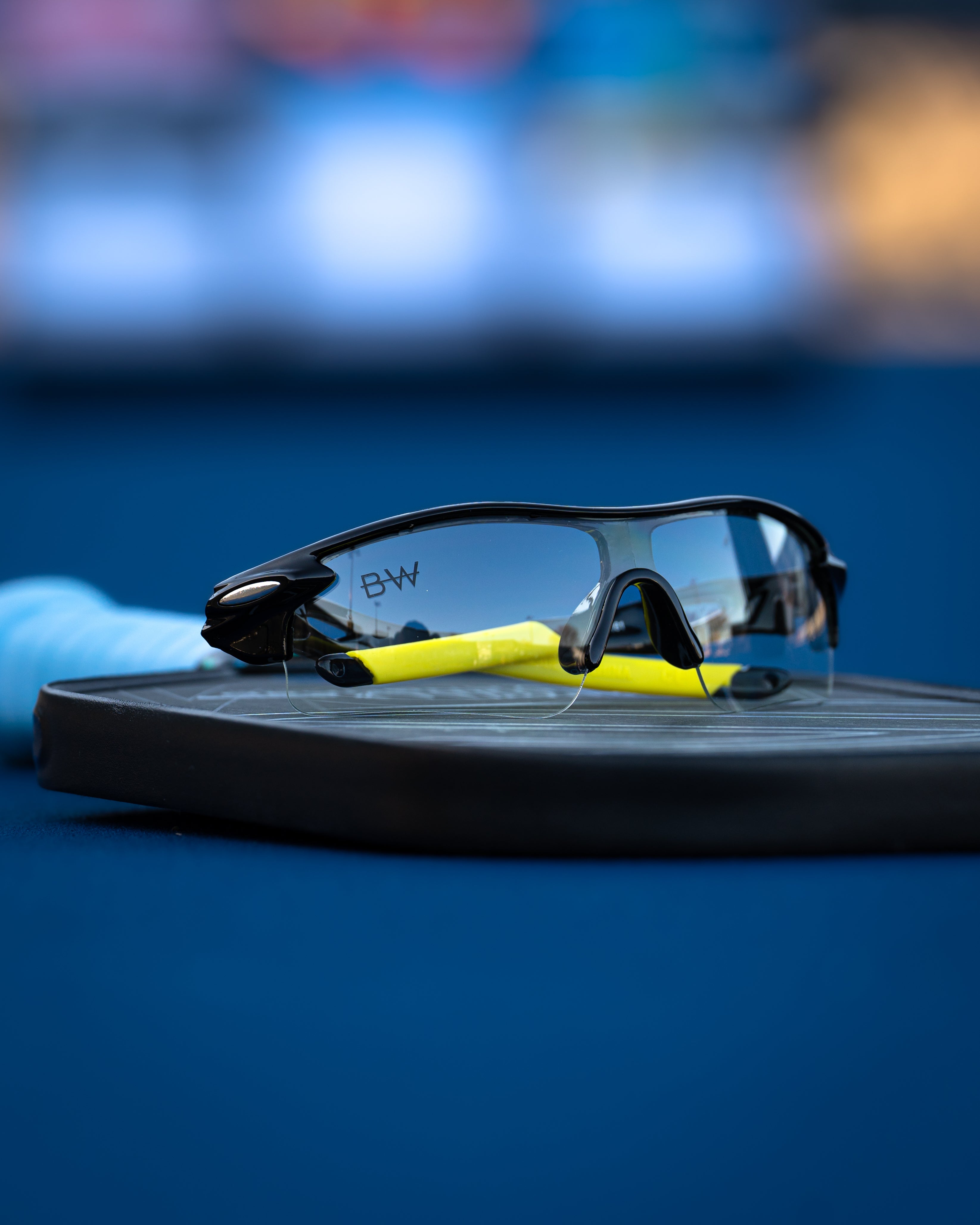
7. Clear Lens Sports Eyewear Has a Distinct Role
Not every athlete wants dark sunglasses during every session.
Clear sports eyewear can be considered for:
- Indoor sports
- Evening play
- Lower-light environments
- Shaded environments
- Players who simply do not want dark sunglass tint
A clear lens does not create additional light. Instead, it avoids the dark tint associated with traditional sunglasses.
For pickleball players interested in this configuration, browse the Blinded Wear Non-RX Clear Lens Collection.
Are Clear Lenses a Performance Upgrade?
Clear lenses should not automatically be described as a performance upgrade.
The absence of dark tint does not by itself improve:
- Reaction time
- Depth perception
- Ball tracking
- Contrast
- Spin recognition
- Shot accuracy
Their value is more straightforward: they allow athletes to wear sports eyewear without intentionally darkening their view with a sunglass tint.
8. Athletes Have More Lens Color Choices
Sports eyewear is available with an increasingly diverse range of lens appearances, including neutral dark lenses, colored tints, mirrored appearances, clear lenses, and other configurations.
Different tints can alter visible-light transmission and color appearance. That does not mean every lens color produces a predictable athletic benefit.
A specific tint should not automatically be claimed to improve:
- Ball tracking
- Depth perception
- Reaction time
- Contrast
- Spin recognition
Lighting environment and individual visual preference remain important when comparing lens colors.
9. Athletes Are Looking Beyond One Lens for Every Environment
Another useful direction in sports eyewear is choosing lens configurations according to the environment rather than expecting one tint to be ideal everywhere.
For example, a pickleball player might prefer:
- A tinted lens during bright daytime outdoor play
- A clear lens during indoor sessions
- A clear lens for nighttime play under court lighting
- A different tint based on personal preference in changing outdoor conditions
This does not mean athletes need several pairs of glasses. It simply reflects the fact that indoor and outdoor lighting environments can be very different.
10. Non-Polarized Sports Eyewear Remains an Option
Polarized and non-polarized lenses continue to give athletes different eyewear configurations to consider.
Polarized lenses use a filter designed to reduce certain reflected light. Non-polarized lenses do not use that polarization filter.
Some pickleball players prefer non-polarized eyewear, and Blinded Wear offers non-polarized options.
However, polarization status alone does not determine depth perception, contrast, reaction time, or ball tracking.
Polarized vs. Non-Polarized Sports Eyewear in 2026
| Characteristic | Polarized | Non-Polarized |
|---|---|---|
| Polarization Filter | Yes | No |
| Designed to Reduce Certain Reflected Light | Yes | No polarization filter |
| Automatically Improves Ball Tracking | No | No |
| Automatically Improves Depth Perception | No | No |
| Automatically UV400 | No | No |
| Automatically Impact-Resistant | No | No |
11. Prescription Sports Eyewear Continues to Expand
Athletes who require corrective vision do not necessarily have to choose between ordinary everyday glasses and sports-oriented eyewear.
Prescription sports eyewear gives players the ability to combine corrective vision with a frame and lens configuration intended for active use.
For pickleball players, prescription options can be especially relevant when standard everyday eyewear does not match the frame style, coverage, or sports-oriented design they want on the court.
Blinded Wear offers a dedicated Prescription Pickleball Eyewear Collection.
12. Direct RX and RX Clip Systems Give Players More Choices
Prescription sports eyewear does not always use the same construction.
Two configurations pickleball players may encounter are:
- Direct RX: Prescription correction is incorporated into the RX lens configuration of the eyewear.
- RX Clip: Prescription correction is provided through a separate inner prescription insert within a compatible eyewear system.
An RX clip should not be described as something that can be placed into any arbitrary pair of sunglasses. The insert and outer eyewear must be part of a compatible configuration.
13. High-Index Prescription Lenses Remain Relevant
High-index prescription lens materials are commonly used to help manage lens thickness, particularly as prescription strength increases.
Finished lens thickness depends on the individual prescription, lens or insert dimensions, frame geometry, and other optical requirements.
High-index does not automatically mean:
- More impact-resistant
- Shatterproof
- Safety-certified
- Thinner in every possible prescription and frame combination
- Lighter in every possible configuration
Blinded Wear custom RX eyewear includes high-index prescription lenses at no additional cost.
How to Order Blinded Wear RX Sports Eyewear
If you need prescription correction for pickleball, the ordering process is:
- Select product and available options.
- Have current eyeglass prescription ready.
- Upload a clear photo or picture of your eyeglass prescription on the product page before adding the eyewear to your cart.
- Your prescription information will be associated with your custom RX order.
For additional information, visit How to Order RX Glasses.
14. Sports Eyewear Is Becoming More Style-Driven
Athletic eyewear does not have to look purely utilitarian. Performance-oriented frames increasingly incorporate design elements that make them visually distinctive enough to become part of an athlete's overall style.
That can include:
- Large shield-inspired profiles
- Angular and geometric frames
- Bright frame colors
- Contrasting lens colors
- Transparent or translucent frame elements
- Minimalist designs
- Bold mirrored appearances
Style and sports function are not mutually exclusive, but appearance should not be used as evidence of technical performance characteristics.
15. Lightweight Sports Frames Remain Important
Weight remains an important consideration for eyewear worn during extended physical activity.
Blinded Wear offers lightweight sports-frame options, but lightweight does not automatically mean better for every athlete.
Comfort also depends on:
- Frame width
- Bridge geometry
- Temple length
- Weight distribution
- Prescription configuration
- Individual face shape
A slightly heavier frame that fits someone appropriately may be more comfortable for that individual than a lighter frame with unsuitable dimensions.
16. Physical Coverage Is Becoming a Bigger Buying Consideration
Large sports lenses and wraparound-inspired designs have made physical coverage an increasingly visible part of sports-eyewear design.
Greater coverage means more of the area around the eyes is physically occupied by the eyewear. Some athletes prefer this appearance and coverage.
However, physical coverage should not be confused with a documented safety rating.
A larger lens does not automatically mean the eyewear is:
- ANSI-certified
- Ballistic-rated
- Shatterproof
- Guaranteed to prevent injury
17. Impact Characteristics Matter More Than Marketing Terms
Sports eyewear is often described using broad words such as "protective," "durable," or "performance." Those words should not replace actual product specifications.
Blinded Wear offers impact-resistant lens options. Impact resistance, however, does not mean the eyewear is indestructible or guaranteed to prevent every injury.
When protection is a major purchase priority, distinguish between:
- Impact-resistant lens characteristics
- Physical coverage
- Frame construction
- Fit
- Specific documented safety certifications
18. Athletes Are Becoming More Informed About Lens Specifications
One useful direction for sports eyewear is a more detailed understanding of what individual lens terms actually mean.
Tint, polarization, UV specifications, impact resistance, photochromic behavior, anti-fog treatment, scratch resistance, and prescription material are separate characteristics.
One feature does not automatically establish another.
| Feature | What It Does Not Automatically Establish |
|---|---|
| Dark Tint | UV400, polarization, or impact resistance |
| Clear Lens | UV specifications, anti-fog, impact resistance, or polarization status |
| Polarization | UV400, impact resistance, or improved depth perception |
| Impact Resistance | Shatterproof construction or safety certification |
| Mirrored Appearance | Polarization, UV specifications, or athletic-performance benefits |
| High-Index RX | Greater impact resistance or safety certification |
19. Pickleball Is Creating Its Own Eyewear Category
As players shop specifically for pickleball equipment, eyewear can increasingly be evaluated around the conditions encountered on the court rather than treated as generic sunglasses.
Pickleball players may want to compare:
- Indoor vs. outdoor lens preferences
- Clear vs. tinted eyewear
- Prescription vs. Non-RX configurations
- Direct RX vs. RX clip systems
- Frame dimensions and fit
- Physical lens coverage
- Impact characteristics
- Polarized vs. non-polarized configurations
Explore these categories together in the Blinded Wear 2026 Pickleball Glasses Guide.
20. Sports Eyewear Is Moving Away From One-Size-Fits-All Recommendations
Perhaps the most useful sports-eyewear trend is recognizing that different athletes have different visual requirements.
The same lens does not need to be considered best for an indoor player, a bright-sun outdoor player, someone requiring prescription correction, and someone wearing contacts.
Instead of looking for one universally superior product, athletes can compare eyewear according to their own environment, vision needs, fit requirements, and verified product characteristics.
21. Indoor and Outdoor Players Are Choosing Different Lens Strategies
The growth of indoor pickleball and other indoor sports makes lighting environment an increasingly important consideration when choosing sports eyewear.
Someone who primarily plays outdoors in bright daylight may prefer a different lens from someone who spends most of their time inside a dedicated pickleball facility.
For example:
- Indoor players may consider clear eyewear when they do not want a dark sunglass tint.
- Outdoor daytime players may prefer a tinted lens that reduces visible-light transmission.
- Evening players may prefer clear eyewear once outdoor brightness decreases.
- Mixed-environment players may choose different pairs or lens configurations for different conditions.
These are starting points rather than universal rules. Lighting conditions and individual preferences vary considerably.
22. Clear Sports Eyewear Is Becoming More Relevant for Indoor Play
Clear sports eyewear serves a straightforward purpose: allowing athletes to wear sports-oriented eyewear without the dark tint associated with traditional sunglasses.
This can make the category particularly relevant to indoor pickleball, indoor tennis, evening sessions, and other environments where a player may not want substantial visible-light reduction.
A clear lens does not create more available light or automatically improve contrast, depth perception, reaction time, or ball tracking.
Players interested in this category can explore the Blinded Wear Non-RX Clear Lens Collection.
23. Multi-Environment Eyewear Is Getting More Attention
Many athletes no longer play under one consistent set of conditions. A pickleball player might practice outdoors during the afternoon, compete indoors on the weekend, and play recreational games under court lights at night.
This makes versatility an important buying consideration.
When evaluating eyewear for several environments, consider:
- How much visible-light reduction you prefer
- Whether you need prescription correction
- Whether clear or tinted lenses better match each environment
- Frame fit and comfort
- Physical lens coverage
- Impact characteristics
- Verified UV specifications for outdoor use
No single lens configuration should automatically be described as ideal for every lighting condition.
24. Photochromic Lenses Remain Part of the Sports-Eyewear Conversation
Photochromic lenses are designed to change tint in response to certain environmental conditions. That makes the technology relevant to discussions about eyewear used across changing environments.
However, "clear" and "photochromic" do not mean the same thing.
- Clear lens: Describes a lens without a dark sunglass tint in its clear configuration.
- Photochromic lens: Describes lens technology designed to change tint under certain environmental conditions.
Do not assume every clear lens is photochromic or that every sports frame is available with photochromic technology. Availability should be verified for the exact product.
25. Lens Tint Is Becoming More About Environment and Preference
Sports eyewear marketing has often assigned specific performance benefits to particular lens colors. A more useful approach is to understand that different tints primarily alter visible-light transmission and color appearance in different ways.
A player might personally prefer one tint over another because of how the environment appears through it, but that preference should not be converted into a universal performance claim.
A lens color alone should not be said to guarantee:
- Improved ball tracking
- Better depth perception
- Faster reactions
- Greater shot accuracy
- Better spin recognition
For a broader explanation of lens options, visit the Pickleball Performance Lens Guide.
26. Mirrored Sports Lenses Continue to Make a Visual Statement
Mirrored appearances remain common in bold athletic eyewear because they can create a distinctive visual style.
However, the appearance of a mirrored lens does not by itself tell you whether the lens is polarized, what UV specifications it has, how impact-resistant it is, or whether it provides any particular performance benefit.
Those characteristics should be verified independently.
27. Sports Eyewear Is Becoming More Personal
One of the clearest design directions in sports eyewear is greater visual variety.
Athletes can choose eyewear that better reflects their personal style through:
- Frame color
- Lens color
- Frame shape
- Lens size
- Transparent or translucent materials
- Minimalist or oversized designs
- Contrasting frame-and-lens combinations
For players who view their court gear as part of their overall look, sports eyewear can function as both equipment and a style choice.
28. Prescription Sports Glasses Are Becoming a More Visible Alternative to Everyday Eyewear
Players who require prescription correction may want eyewear that differs from the everyday frames they use away from the court.
Sports-oriented RX eyewear can give players access to different frame shapes, lens coverage, and styling while still addressing their corrective-vision requirements.
Blinded Wear offers prescription pickleball glasses for players who need corrective vision on the court.
29. RX Clip Systems Give Sports Eyewear a Different Prescription Approach
RX clip systems separate the prescription correction from the primary outer sports lens.
In a compatible RX clip configuration:
- The outer lens remains part of the sports-eyewear system.
- A separate inner prescription insert provides corrective vision.
- The RX insert is specifically designed to work with the compatible outer eyewear.
This configuration should not be confused with placing an arbitrary prescription insert inside any pair of sunglasses.
For players comparing direct RX and RX clip options, browse the Blinded Wear RX Collection.
30. Athletes Are Paying More Attention to Frame Fit
Sports-eyewear trends may change, but fit remains one of the most practical buying considerations.
A visually impressive frame is not useful if its dimensions are poorly suited to the wearer.
Important fit considerations include:
- Overall frame width
- Bridge geometry
- Temple length
- Finished eyewear weight
- Weight distribution
- Individual face shape
- Prescription requirements
When possible, compare the dimensions of sports eyewear with a pair you already find comfortable.
31. "Zero-Bounce" Claims Should Be Treated Carefully
Sports frames are often marketed as staying completely stationary during activity. In practice, no frame should be universally guaranteed never to move.
Movement can depend on:
- Face shape
- Bridge fit
- Temple fit
- Frame dimensions
- Perspiration
- Movement intensity
- Finished eyewear weight
A more useful goal is finding a frame that fits comfortably and appropriately for your intended activity.
32. Comfort Is Becoming as Important as Appearance
Athletes can wear eyewear for extended practices, matches, tournaments, and recreational sessions, making comfort an important consideration.
There is no single frame material, shape, or weight that guarantees comfort for every person.
Instead, comfort results from the interaction between the eyewear and the wearer.
Lightweight sports-frame options can be attractive, but frame dimensions, bridge geometry, temple fit, prescription configuration, and weight distribution also matter.
33. Impact-Resistant Lenses Remain Important in Sports Eyewear
Impact characteristics are naturally relevant when eyewear is used during active sports.
Blinded Wear offers impact-resistant lens options. The term should still be understood accurately.
Impact-resistant does not automatically mean:
- Shatterproof
- Indestructible
- Ballistic-rated
- ANSI-certified
- Guaranteed to prevent injury
If a particular protective certification is important to you, verify it for the complete eyewear system.
34. Sports Eyewear and Eye Protection Are Not Identical Categories
The appearance of sports eyewear can create an impression of protection, particularly when a frame has a large shield or wraparound design.
However, sports styling, physical coverage, impact-resistant lens characteristics, and safety certification are separate concepts.
When eye protection is a primary buying objective, look beyond appearance and evaluate what has actually been established for the product.
35. More Coverage Does Not Automatically Mean Certified Protection
A large lens can physically cover more of the area around the eyes than a smaller lens. That may appeal to athletes who prefer greater coverage.
However, lens size does not by itself establish how the eyewear will perform during an impact or whether it complies with a particular protective standard.
A large shield-style frame should therefore not automatically be described as safer than a smaller frame without supporting evidence.
36. Anti-Fog Features Remain a Major Sports-Eyewear Consideration
Fogging can interfere with the experience of wearing sports eyewear, particularly in humid environments or during strenuous activity.
Fogging can be influenced by:
- Humidity
- Perspiration
- Temperature differences
- Moisture
- Airflow
- How the eyewear sits relative to the face
However, sports styling does not automatically mean a pair has an anti-fog coating or specialized ventilation system. Those features should be verified for the exact product.
37. Lens Coatings Are Becoming a Bigger Part of Product Comparisons
Consumers may encounter sports eyewear marketed with specialized lens treatments and coatings.
Depending on the exact product, these can include claims involving:
- Anti-fog characteristics
- Scratch resistance
- Anti-reflective treatments
- Water-related surface treatments
- Other lens coatings
These characteristics should not be assumed across an entire sports-eyewear category. Verify the exact lens before making a purchase based on a particular coating.
38. UV Specifications Are Being Separated From Lens Darkness
One important distinction when comparing sports sunglasses is that lens darkness and UV specifications are not the same thing.
A darker lens does not automatically mean greater UV protection, and a clear-looking lens does not automatically mean the absence of UV filtering characteristics.
If UV protection is important to your intended use, verify the specification for the exact lens rather than judging it from appearance.
39. UV400 Is a Specification, Not a Style
UV400 is a specification associated with filtering ultraviolet wavelengths up to 400 nanometers.
A lens should only be described as UV400 when that specification has been established for the exact product.
You cannot determine UV400 status simply by looking at:
- Lens darkness
- Lens color
- Mirrored appearance
- Polarization status
- Clear appearance
- Sports styling
40. Polarization Is Being Treated as One Feature Rather Than a Complete Performance System
Polarization is designed to reduce certain reflected light. That can be useful in particular environments, but it does not determine every other characteristic of a sports lens.
Polarization alone does not establish:
- UV specifications
- Impact resistance
- Tint darkness
- Safety certification
- Depth perception
- Ball-tracking ability
- Reaction time
Likewise, a non-polarized lens should not automatically be described as improving those visual or athletic characteristics.
41. Athletes Are Comparing Eyewear by Use Case Instead of Buzzwords
A useful sports-eyewear purchase begins with the athlete rather than the marketing terminology.
Ask:
- Where will I use these glasses?
- Do I need prescription correction?
- Do I primarily play indoors or outdoors?
- Do I want a clear or tinted lens?
- How much physical coverage do I prefer?
- What frame dimensions fit me?
- What impact characteristics have been established?
- Are there specific lens specifications I require?
Those questions can be more useful than choosing eyewear because it is described with broad terms such as "elite," "advanced," or "pro."
42. Pickleball Eyewear Is Expanding Beyond Sunglasses
Pickleball eyewear can include several distinct categories rather than only traditional sunglasses.
| Eyewear Category | Primary Consideration |
|---|---|
| Non-RX Sunglasses | Tinted sports eyewear without prescription correction built into the glasses |
| Non-RX Clear Eyewear | Sports eyewear without a dark sunglass tint or prescription correction |
| Direct RX Eyewear | Prescription correction incorporated into the RX lens configuration |
| RX Clip Eyewear | Prescription correction provided by a separate inner insert in a compatible system |
This gives players more ways to match eyewear to their actual vision requirements and playing environment.
43. Players Are Comparing Clear and Tinted Eyewear More Carefully
| Characteristic | Clear Lens | Tinted Lens |
|---|---|---|
| Dark Sunglass Tint | No | Yes, to varying degrees |
| Visible-Light Reduction | Avoids dark sunglass tint | Reduces visible-light transmission to varying degrees |
| Can Be Used Indoors | Yes | Potentially, depending on tint and environment |
| Can Be Used Outdoors | Yes | Yes |
| Automatically UV400 | No | No |
| Automatically Impact-Resistant | No | No |
| Automatically Improves Athletic Performance | No | No |
44. Style and Performance Features Are Being Evaluated Separately
A bold frame can look athletic without proving anything about its technical specifications.
Likewise, a minimalist frame can potentially have useful sports characteristics without looking aggressive or futuristic.
In 2026, a better way to compare eyewear is to separate:
- Style: Frame shape, color, lens appearance, and overall aesthetic
- Fit: Dimensions, bridge geometry, temple length, and weight distribution
- Vision: Prescription requirements and lens configuration
- Environment: Indoor, outdoor, bright, shaded, or evening conditions
- Protection: Physical coverage, impact characteristics, and verified standards
45. Sports Eyewear Buyers Are Becoming More Skeptical of Performance Claims
Eyewear can be useful sports equipment without claiming that it changes an athlete's underlying abilities.
Claims such as "react faster," "track every ball," "improve depth perception," or "gain a competitive edge" can overstate what a particular lens or frame can establish.
A more useful product comparison focuses on measurable or verifiable characteristics such as:
- Prescription configuration
- Frame dimensions
- Lens tint
- Polarization status
- Impact characteristics
- Physical coverage
- Verified UV specifications
- Verified lens treatments
46. Sustainability Claims Require Specific Evidence
Sustainability remains part of the broader eyewear conversation, with consumers increasingly interested in materials, packaging, manufacturing, product longevity, and waste.
However, terms such as "eco-friendly," "sustainable," "carbon-neutral," "recycled," "bio-based," and "compostable" describe different claims and should not be used interchangeably.
A sports frame should only be described as using recycled ocean plastic, plant-based material, bio-acetate, carbon-neutral manufacturing, or another environmental characteristic when that claim has been established for the exact product or process.
For that reason, material-specific sustainability claims should be verified rather than inferred from a brand's overall positioning.
47. Durability and Sustainability Are Different Questions
A product's durability and its environmental characteristics should also be evaluated separately.
A durable frame is not automatically sustainable, while a frame incorporating a recycled or bio-based material is not automatically more durable.
Consumers interested in both characteristics should look for evidence supporting each claim independently.
48. Longer-Term Product Support Can Matter to Eyewear Buyers
Sports equipment can experience wear or damage over time, making return and replacement policies another useful part of the buying decision.
Blinded Wear offers 50% lifetime replacement support if eligible glasses break, subject to current policy terms.
For an eligible claim, damaged eyewear must be returned. Once the applicable claim and return requirements are satisfied, the customer can receive 50% credit toward a replacement pair.
This is not a free full-replacement guarantee and should not automatically be interpreted as coverage for loss, prescription changes, or every possible form of damage.
Review the current Blinded Wear Protection Plan, Replacement & Returns information for eligibility and policy details.
49. Sports Eyewear Is Becoming More Education-Driven
As the number of frame and lens choices increases, understanding the terminology becomes increasingly useful.
Before buying sports eyewear, players benefit from knowing that:
- Clear does not automatically mean non-polarized.
- Dark does not automatically mean stronger UV protection.
- Polarized does not automatically mean UV400.
- Impact-resistant does not mean shatterproof.
- Sports styling does not mean safety-certified.
- Mirrored does not automatically mean polarized.
- High-index does not automatically mean more impact-resistant.
- A particular tint does not automatically improve ball tracking.
Understanding these distinctions makes it easier to compare products according to what they actually offer.
50. The Biggest 2026 Trend: More Choice Without a Universal "Best" Pair
The growing variety of sports eyewear means athletes have more opportunities to choose a configuration that matches their individual needs.
A pickleball player can consider prescription or Non-RX eyewear, clear or tinted lenses, direct RX or RX clip configurations, lightweight frames, oversized styles, different colors, and varying amounts of physical coverage.
The result is not one universally superior type of sports eyewear. Instead, the 2026 market gives players more ways to match their eyewear to their vision requirements, playing environment, fit preferences, and personal style.
How to Choose Sports Eyewear in 2026
Trends can provide inspiration, but your final decision should be based on how and where you intend to use the eyewear.
- Start with your vision requirements. Determine whether you need prescription correction in the eyewear.
- Identify your primary environment. Consider whether you mostly play indoors, outdoors, during daylight, or at night.
- Choose a lens category. Decide whether clear or tinted eyewear better matches your preferences.
- Compare frame dimensions. Do not choose solely by appearance.
- Consider physical coverage. Different frame designs cover different amounts of the area around your eyes.
- Evaluate impact characteristics. Distinguish impact resistance from shatterproof or safety-certified claims.
- Verify specialized features. Confirm UV specifications, anti-fog characteristics, scratch resistance, photochromic behavior, or other features when they matter to you.
- Review return and replacement policies. Know the applicable terms before ordering.
Which Blinded Wear Collection Should You Start With?
| If You... | Start Here |
|---|---|
| Need prescription correction in your sports eyewear | RX Pickleball Glasses |
| Do not need prescription correction and want tinted eyewear | Non-RX Pickleball Sunglasses |
| Do not need prescription correction and want no dark sunglass tint | Non-RX Clear Lens Eyewear |
| Want to compare the major pickleball-eyewear categories | 2026 Pickleball Glasses Guide |
| Want help narrowing your preferences | Pickleball Sunglasses Quiz |
Sports Eyewear Trends: Myths vs. Reality
| Common Claim | What to Know |
|---|---|
| "Smart glasses make athletes perform better." | Technology features do not automatically establish an athletic-performance improvement. |
| "Oversized lenses improve peripheral vision." | Greater physical lens area does not by itself prove improved peripheral vision. |
| "Wraparound glasses provide maximum protection." | Frame shape and physical coverage do not automatically establish a particular protective rating. |
| "Clear lenses improve reaction time." | Clear lenses do not make neurological reaction processes faster. |
| "Non-polarized lenses improve depth perception." | Polarization status alone does not determine depth perception. |
| "A darker tint means better UV protection." | Tint darkness and UV specifications are separate characteristics. |
| "Impact-resistant means shatterproof." | Impact resistance does not mean a lens is incapable of breaking. |
| "Sports glasses are automatically safety-certified." | Sports styling does not establish compliance with a particular protective standard. |
| "Mirrored lenses are polarized." | Mirrored appearance and polarization are separate characteristics. |
| "Eco-friendly means recycled." | Environmental claims describe different characteristics and should be individually verified. |
Sports Eyewear Trends for 2026: Frequently Asked Questions
What are the biggest sports eyewear trends for 2026?
Notable directions include bold shield-inspired frames, more expressive colors, clear sports eyewear, a wider variety of lens tints, prescription sports glasses, RX clip systems, lightweight designs, greater attention to physical coverage, and continued interest in smart eyewear.
At the same time, athletes are becoming more selective about technical claims. Tint, polarization, impact resistance, UV specifications, prescription material, and protective certification are separate characteristics that should be evaluated individually.
Are oversized sports glasses still popular?
Large lenses and shield-inspired silhouettes remain a prominent sports-eyewear style. They can provide substantial physical lens coverage and create a distinctive athletic appearance.
Lens size alone, however, does not establish greater safety, improved peripheral vision, or better athletic performance.
Are wraparound sports glasses better?
Not universally. Some athletes prefer wraparound-inspired designs because of their appearance, physical coverage, or fit. Others may prefer a different frame geometry.
The appropriate choice depends on the exact frame dimensions, your face shape, prescription requirements, playing environment, and personal preferences.
Are shield sunglasses good for pickleball?
Shield-inspired sports eyewear can be considered for pickleball, particularly by players who prefer larger lens profiles and greater physical coverage.
The shield shape itself does not guarantee better ball tracking, increased peripheral vision, improved depth perception, or a particular level of impact protection.
Are colorful sports glasses just for style?
Frame color is primarily an aesthetic characteristic. Lens color can additionally affect visible-light transmission and color appearance depending on the exact tint.
Neither a particular frame color nor lens color should automatically be associated with better athletic performance.
Are transparent sports frames popular?
Transparent and translucent frame designs provide an alternative to traditional solid-color sports eyewear and fit within the broader trend toward more expressive athletic equipment.
Transparency does not establish the frame's weight, durability, impact characteristics, or suitability for a particular sport.
Are clear sports glasses good for indoor pickleball?
Clear sports eyewear can be a practical option for indoor pickleball players who do not want a dark sunglass tint.
A clear lens should not automatically be described as improving contrast, ball tracking, reaction time, or depth perception. Its primary distinction is the absence of a dark sunglass tint.
Can clear sports glasses be worn outdoors?
Yes. Clear sports eyewear is not restricted to indoor use. However, a clear lens does not provide the visible-light reduction associated with a dark sunglass tint.
If UV specifications are important for your intended outdoor use, verify them for the exact lens rather than assuming them from lens appearance.
Are tinted sports glasses better outdoors?
Tinted lenses reduce visible-light transmission to varying degrees, which can make them appealing to players who prefer less visible light in bright outdoor conditions.
There is no universally best tint for every athlete or outdoor environment.
What lens color is best for sports?
There is no single lens color that is best for every sport, athlete, or lighting environment.
Different tints can alter visible-light transmission and color appearance. Personal preference, brightness, playing environment, and the exact lens characteristics should guide the decision.
Do certain lens colors improve reaction time?
No lens color should be universally claimed to make an athlete's neurological reaction process faster.
Do certain lens colors improve ball tracking?
No universal ball-tracking improvement should be attributed solely to a particular tint. Individual vision, prescription correction when needed, lighting, background, ball color, attention, and other factors contribute to what an athlete sees.
Are mirrored sports lenses polarized?
Not automatically. Mirrored appearance and polarization are separate lens characteristics.
Are polarized sports glasses better?
Not universally. Polarized lenses are designed to reduce certain reflected light. Whether that configuration matches an athlete's preferences depends on the environment and intended use.
Are non-polarized glasses better for pickleball?
Some pickleball players prefer non-polarized eyewear, and Blinded Wear offers non-polarized options. However, non-polarized lenses should not automatically be described as improving depth perception, contrast, reaction time, or ball tracking.
Do polarized lenses hurt depth perception?
Polarization status alone does not determine depth perception, so polarized lenses should not universally be described as reducing it.
Are sports glasses becoming more specialized?
Sports eyewear can increasingly be compared according to specific use cases rather than treated as one broad category. Players can consider prescription requirements, clear or tinted lenses, physical coverage, frame dimensions, polarization status, impact characteristics, and playing environment separately.
Are prescription sports glasses worth considering?
For athletes who require corrective vision, prescription sports eyewear provides an alternative to relying on ordinary everyday frames during activity.
The appropriate choice depends on your prescription, frame fit, available lens configuration, playing environment, and other individual requirements.
What is the difference between direct RX and RX clip sports glasses?
With direct RX eyewear, prescription correction is incorporated into the RX lens configuration. With an RX clip system, a separate inner prescription insert provides corrective vision within compatible outer sports eyewear.
Can an RX clip fit any sports sunglasses?
No. An RX clip should be used as part of a compatible eyewear system rather than assumed to fit arbitrary sunglasses.
What are high-index prescription lenses?
High-index refers to a category of prescription lens material commonly used to help manage lens thickness, particularly as prescription strength increases.
Final thickness depends on the individual prescription, lens or insert dimensions, frame geometry, and other optical requirements.
Are high-index lenses stronger than regular lenses?
Refractive index should not be treated as a durability score. High-index does not automatically mean more impact-resistant, shatterproof, or safety-certified.
Are thinner prescription lenses always lighter?
No. Finished eyewear weight depends on more than lens thickness. Lens material, prescription, dimensions, frame construction, and other factors can affect total weight.
Does Blinded Wear include high-index RX lenses?
Yes. Blinded Wear custom RX eyewear includes high-index prescription lenses at no additional cost.
How do I order Blinded Wear prescription sports glasses?
Choose your product and available options, have your current eyeglass prescription ready, and upload a clear photo or picture of your eyeglass prescription on the product page before adding the eyewear to your cart. Your prescription information will then be associated with your custom RX order.
Are lightweight sports glasses always better?
No. Many athletes prefer lightweight eyewear, but comfort also depends on frame dimensions, bridge geometry, temple fit, weight distribution, prescription configuration, and individual face shape.
Should sports glasses fit tightly?
Sports eyewear does not need to be excessively tight. The goal is an appropriate balance of comfort and stability rather than maximum pressure against the head or face.
Can sports glasses move during activity?
Yes. No sports frame should be guaranteed never to shift. Movement can vary with face shape, fit, perspiration, frame dimensions, activity intensity, and finished eyewear weight.
Are sports glasses automatically impact-resistant?
No. Sports styling alone does not establish impact resistance. Verify the characteristics of the exact lens and eyewear configuration.
Does impact-resistant mean shatterproof?
No. Impact resistance does not mean a lens is incapable of breaking or that the complete eyewear system is indestructible.
Are sports glasses safety glasses?
Not automatically. Sports styling, large lenses, wraparound shapes, and impact-resistant characteristics do not by themselves establish compliance with a specific protective standard.
Does more lens coverage mean better protection?
A larger lens can physically cover more of the area around the eyes, but coverage does not automatically establish a particular level of protective performance or safety certification.
Are sports glasses anti-fog?
Not automatically. Anti-fog characteristics should be verified for the exact product.
Are sports glasses scratch-resistant?
Not automatically. Scratch resistance is a separate lens characteristic that should be verified for the exact product.
Does dark tint mean better UV protection?
No. Tint darkness and UV specifications are separate characteristics.
Can clear lenses have UV protection?
A clear-looking lens can potentially have UV filtering characteristics. The specification must still be verified for the exact lens.
Are all sports sunglasses UV400?
No. Sports styling, lens color, mirrored appearance, tint darkness, and polarization status do not automatically establish UV400.
What does UV400 mean?
UV400 is a specification associated with filtering ultraviolet wavelengths up to 400 nanometers. A lens should only be described as UV400 when that specification has been established for the exact product.
Are sustainable sports glasses a major trend?
Environmental considerations remain part of the broader eyewear market, but sustainability claims should be specific and verifiable.
Terms such as recycled, bio-based, compostable, carbon-neutral, and eco-friendly do not all mean the same thing.
Does Blinded Wear use recycled ocean plastic?
No such claim should be made unless the material has been specifically verified for the exact Blinded Wear product. Environmental characteristics should not be inferred from appearance or general sports-eyewear trends.
2026 Sports Eyewear Trend Comparison
| Trend | Why Athletes May Consider It | What Not to Assume |
|---|---|---|
| Shield-Style Frames | Bold styling and substantial physical lens coverage | Certified protection or improved peripheral vision |
| Clear Sports Eyewear | No dark sunglass tint | Improved contrast, reaction time, or ball tracking |
| Colorful Lenses | Different visible-light transmission, color appearance, and styling | A universal athletic-performance advantage |
| Mirrored Lenses | Distinctive visual appearance | Polarization, UV400, or performance improvement |
| Non-Polarized Lenses | No polarization filter | Improved depth perception or ball tracking |
| Prescription Sports Eyewear | Corrective vision within a sports-oriented eyewear configuration | Automatic improvement in athletic ability |
| RX Clip Systems | Separate inner prescription correction within compatible sports eyewear | Compatibility with arbitrary sunglasses |
| Lightweight Frames | May appeal to athletes seeking lower eyewear weight | Perfect fit or comfort for every wearer |
| Impact-Resistant Options | Impact-related lens characteristics | Shatterproof construction or automatic safety certification |
| Smart Eyewear | Can incorporate connected technology and digital features | Automatic athletic-performance improvement |
Sports Eyewear Features That Should Be Evaluated Separately
One of the most important changes in how athletes shop for eyewear is recognizing that common lens terms describe different characteristics.
| Characteristic | What It Describes | What It Does Not Automatically Establish |
|---|---|---|
| Tint | Visible-light transmission and color appearance | UV400, polarization, impact resistance, or safety certification |
| Polarization | A filter designed to reduce certain reflected light | UV400, impact resistance, tint darkness, or athletic performance |
| Clear Lens | Absence of a dark sunglass tint | UV400, anti-fog, polarization status, or contrast enhancement |
| Impact Resistance | Impact-related lens characteristics | Shatterproof, ballistic-rated, or automatically safety-certified |
| High-Index | A category of prescription lens material | Greater impact resistance or protective certification |
| Mirrored Appearance | A visible lens appearance | Polarization, UV400, or improved athletic performance |
| Sports Frame | A frame intended or styled for active use | Compliance with a specific protective standard |
Sports Eyewear for Indoor Pickleball in 2026
Indoor pickleball players can focus on eyewear that matches indoor lighting rather than assuming outdoor sunglasses are the only sports-eyewear option.
Players who do not want a dark sunglass tint can consider Non-RX Clear Lens Eyewear.
If you require prescription correction, start with the Blinded Wear RX Collection and verify the available lens configuration for the exact product.
Sports Eyewear for Outdoor Pickleball in 2026
Outdoor players may prefer tinted sports eyewear when they want to reduce visible-light transmission in bright conditions.
When comparing outdoor eyewear, consider:
- Tint and visible-light preference
- Prescription requirements
- Frame fit
- Physical coverage
- Impact characteristics
- Verified UV specifications
- Polarization preference
Browse Non-RX Pickleball Sunglasses for current Blinded Wear options.
Sports Eyewear for Players Who Wear Contacts
Athletes whose contact lenses provide their required corrective vision can consider Non-RX sports eyewear over their contacts.
This can allow the player to choose between clear Non-RX eyewear and tinted Non-RX sports sunglasses according to the environment and personal preference.
Sports Eyewear for Players Who Need Prescription Correction
Players who want corrective vision incorporated into their sports eyewear can explore direct RX and RX clip configurations.
Blinded Wear custom RX eyewear includes high-index prescription lenses at no additional cost.
To order:
- Select product and available options.
- Have current eyeglass prescription ready.
- Upload a clear photo or picture of your eyeglass prescription on the product page before adding the eyewear to your cart.
- Your prescription information will be associated with your custom RX order.
Explore the Prescription Pickleball Eyewear Collection or read How to Order RX Glasses.
How to Compare Sports Eyewear Before Buying
Whether you are shopping for pickleball, tennis, running, or another activity, use a consistent comparison process.
- Determine whether you need prescription correction.
- Identify your primary playing environment.
- Choose between clear and tinted eyewear based on your visible-light preference.
- Compare frame dimensions with eyewear that already fits you.
- Consider how much physical coverage you want.
- Verify impact characteristics instead of relying on sports styling.
- Verify UV specifications if they matter for your intended use.
- Confirm specialized coatings or technologies individually.
- Review return and replacement policies before purchasing.
Common Mistakes When Shopping for Sports Eyewear in 2026
Buying Only Because a Frame Looks Athletic
Aggressive styling does not establish fit, protection, lens characteristics, or prescription suitability.
Assuming a Large Lens Is Automatically Safer
Physical coverage and documented protective performance are separate considerations.
Choosing Lens Color Based on Performance Promises
Different tints can change visible-light transmission and color appearance, but a particular color should not automatically be associated with better ball tracking or reaction time.
Assuming Darker Means Better UV Protection
Tint darkness and UV specifications are separate characteristics.
Assuming Polarized Means Better
Polarization is one lens characteristic rather than a universal measure of lens quality.
Assuming Non-Polarized Means Better for Every Sport
Non-polarized lenses should not automatically be credited with improving depth perception, contrast, or ball tracking.
Ignoring Frame Dimensions
A visually appealing frame can still be a poor match if its dimensions do not fit you appropriately.
Assuming Impact-Resistant Means Indestructible
Impact resistance should not be interpreted as shatterproof construction or guaranteed injury prevention.
Assuming Every Sports Lens Has Special Coatings
Anti-fog, scratch-resistant, anti-reflective, and other treatments should be verified for the exact product.
Trusting Unverified Sustainability Claims
Specific environmental claims should be supported by information about the actual product, material, or manufacturing process.
2026 Sports Eyewear Buying Checklist
Before choosing your next pair, ask:
- What sport or activity will I primarily use these for?
- Do I require prescription correction?
- Will I primarily use them indoors or outdoors?
- Do I want a clear or tinted lens?
- Do I have a preference regarding polarization?
- What frame dimensions fit me?
- How much physical lens coverage do I want?
- What impact characteristics are actually established?
- Do I require a specific safety certification?
- Have I verified UV specifications if they matter to me?
- Have I verified anti-fog or scratch-resistant characteristics if I want them?
- Am I choosing a lens color because I prefer it rather than because of an unsupported performance promise?
- Have I verified any sustainability claims that matter to my purchase?
- Have I reviewed the applicable return and replacement policies?
Explore Blinded Wear Pickleball Eyewear
If you are comparing sports-eyewear trends because you need new pickleball glasses, start with the category that matches your actual vision requirements and playing environment.
- RX Pickleball Glasses — explore prescription sports eyewear for players who require corrective vision.
- Non-RX Pickleball Sunglasses — explore sports sunglasses without prescription correction built into the eyewear.
- Non-RX Clear Lens Eyewear — explore sports eyewear without a dark sunglass tint.
- 2026 Pickleball Glasses Guide — compare major eyewear categories in one place.
- Pickleball Performance Lens Guide — learn more about lens colors, clarity, and RX options.
- Pickleball Sunglasses Quiz — narrow your choices based on your eyewear preferences.
What Sports Eyewear Will Look Like Beyond 2026
The exact direction of future sports eyewear cannot be predicted with certainty, but several areas are likely to remain important to consumers: fit, prescription accessibility, lens choice, personal style, physical coverage, verified product specifications, and technology integration.
The most useful innovation will not necessarily be the product with the longest list of marketing terms. It will be eyewear that clearly communicates what it does, what it does not do, and who it is designed for.
For athletes, that means future-looking design should still be evaluated with the same practical questions: Does it fit? Does it address your vision requirements? Does the lens match your environment? And are its technical claims actually supported?
Sports Eyewear in 2026: Performance Meets Personal Choice
The defining sports-eyewear trend of 2026 is not a single frame shape, lens color, or piece of technology. It is choice.
Athletes can choose bold shield-style frames or more understated designs. They can compare clear and tinted lenses, direct RX and RX clip systems, polarized and non-polarized configurations, and different amounts of physical coverage.
Pickleball players in particular can select eyewear around indoor or outdoor conditions, prescription requirements, personal style, and the frame characteristics they value most.
The important part is separating appearance from verified function. A futuristic design does not automatically improve performance. A large lens does not automatically provide certified protection. A specific tint does not automatically improve ball tracking. And a sports label does not establish every technical feature.
Use trends as inspiration, then choose based on your vision, environment, fit, and verified product characteristics.
Find Your Pickleball Eyewear for 2026
Ready to explore current options? Start with the 2026 Pickleball Glasses Guide for a broader comparison of prescription and Non-RX eyewear.
If you already know what category you need, browse RX Pickleball Glasses, Non-RX Pickleball Sunglasses, or Non-RX Clear Lens Eyewear.
If you are still deciding, use the Pickleball Sunglasses Quiz to narrow your options based on your preferences.
Blinded Wear Returns and Lifetime Replacement Support
Blinded Wear offers a 30-day return policy for eligible standard purchases. Customized RX eyewear is final sale and excluded from the standard 30-day return policy.
Blinded Wear also offers 50% lifetime replacement support if eligible glasses break, subject to current policy terms.
Eligible claims require the damaged eyewear to be returned. Once the applicable claim and return requirements are satisfied, the customer can receive 50% credit toward a replacement pair.
This is not a free full-replacement guarantee and should not automatically be interpreted as coverage for lost eyewear, prescription changes, travel loss, or every possible type of damage.
For damaged RX eyewear, contact blindedwearco@gmail.com before returning the pair.
Review the current Blinded Wear Protection Plan, Replacement & Returns information for eligibility and complete policy details.