
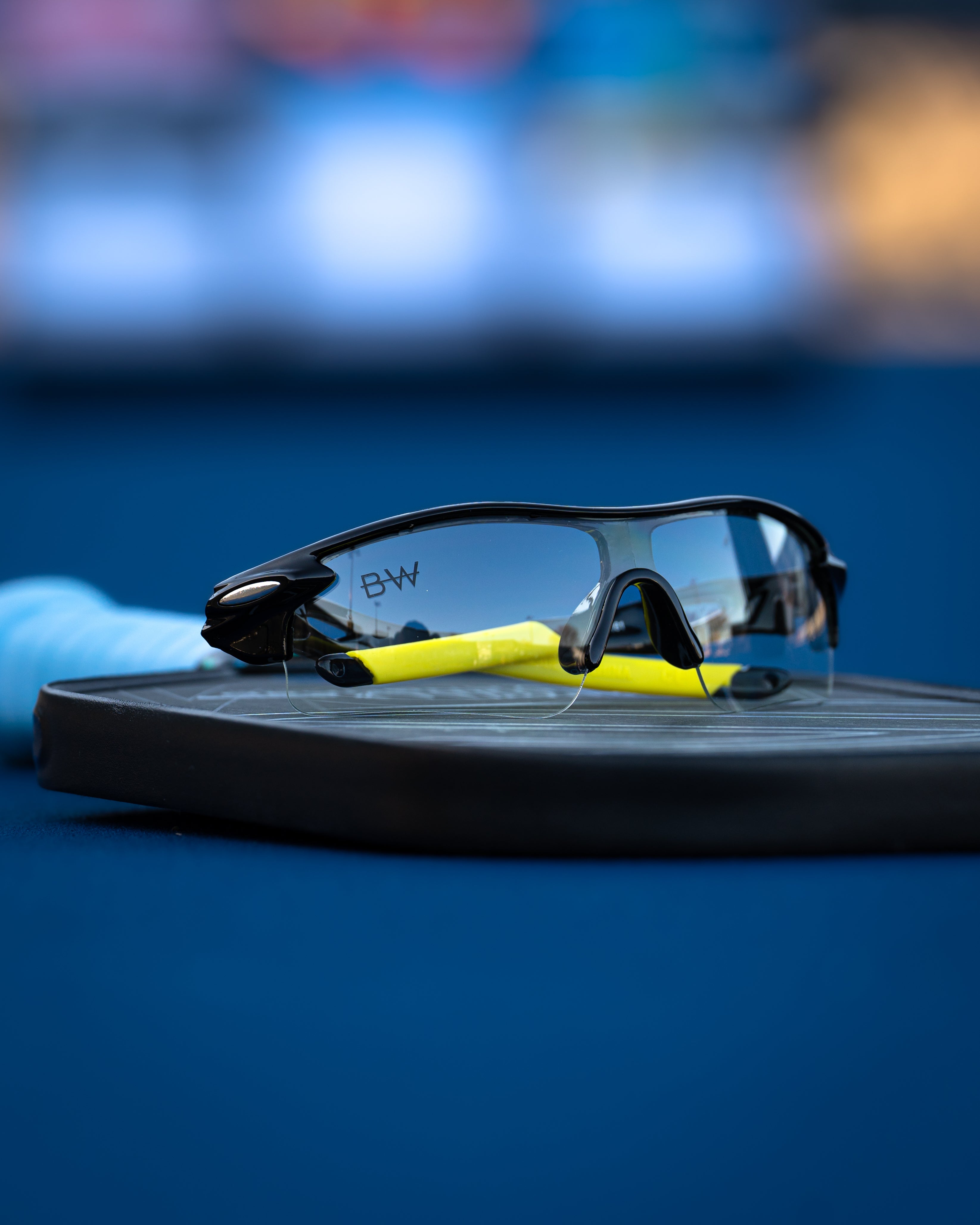
The Future of Clarity — Transition, Blue Light, and Progressive RX Sports Glasses Explained
Share
The Future of Clarity: Transition, Blue Light & Progressive RX Sports Glasses Explained
Prescription sports eyewear is no longer limited to choosing a frame and adding one basic lens. Athletes can now compare different RX configurations based on prescription needs, playing environment, changing light, and how they use their eyewear on and off the court.
For pickleball players, three options come up repeatedly: photochromic or transition RX lenses, clear blue-light-filtering RX lenses, and progressive RX lenses. They solve different problems—and they should not be treated as interchangeable performance upgrades.
Transition lenses are designed to change tint in response to environmental conditions. Blue-light-filtering lenses add a filtering feature for selected wavelengths of light. Progressive prescriptions provide multiple corrective powers within one lens for people whose prescriptions require them.
This guide explains what each option actually does, where it may fit into a pickleball eyewear setup, and how to choose without relying on exaggerated claims about reaction time, depth perception, glare, fatigue, or athletic performance.
Find Your Pickleball Eyewear
Transition vs. Blue Light vs. Progressive RX: What's the Difference?
| RX Option | Primary Function | Who Might Compare It? |
|---|---|---|
| Transition / Photochromic RX | Changes tint in response to environmental conditions | Players moving between different lighting environments |
| Clear Blue-Light RX | Provides prescription correction without dark sunglass tint while adding a blue-light-filtering feature | Players who specifically want blue-light filtering in a clear RX setup |
| Single-Vision RX | Provides one prescribed corrective power | Players whose prescriptions call for single-vision correction |
| Progressive RX | Provides multiple corrective powers across different areas of one lens | People whose prescriptions and daily visual needs call for progressive correction |
The most advanced-sounding option is not automatically the best one. The right starting point is your actual prescription and how you intend to use the glasses.
What Are Transition RX Sports Glasses?
Transition or photochromic prescription lenses are designed to change tint in response to environmental conditions rather than remaining at one fixed tint all the time.
For an athlete, the practical appeal is straightforward: one RX setup can provide changing-light functionality instead of requiring the wearer to manually switch between clear prescription glasses and a separate tinted prescription pair every time the environment changes.
That makes photochromic RX particularly relevant to players whose days may include:
- Indoor practice
- Outdoor court sessions
- Travel between locations
- Training at different times of day
- General everyday use beyond pickleball
However, photochromic functionality should not automatically be translated into claims of better reaction time, reduced eye strain, enhanced contrast, improved ball tracking, or better athletic performance.
How Do Photochromic Lenses Work?
Photochromic lenses contain light-responsive technology that changes the lens tint when environmental conditions trigger the photochromic process. When those conditions change, the lens moves back toward its lighter state.
The important distinction is that photochromic describes changing tint—not automatic optimization of athletic vision.
The amount and speed of change can depend on the particular lens technology and conditions. Because of that, players should avoid assuming every photochromic lens will behave identically in every environment.
Are Transition RX Lenses Good for Pickleball?
They can be a useful configuration to compare if you require prescription correction and regularly move between environments where you do not want the same fixed tint all day.
Consider transition RX if:
- You play both indoors and outdoors
- You train at different times of day
- You want to reduce the number of prescription pairs you carry
- You use your sports glasses outside pickleball as well
- You prefer changing-light functionality over a fixed lens tint
That does not make transition RX universally better than dedicated clear and outdoor pairs. It is a different eyewear strategy.
Transition RX vs. Separate Indoor & Outdoor Glasses
| Setup | Main Advantage | Consideration |
|---|---|---|
| Transition RX | Changing-light functionality within one prescription setup | Lens behavior depends on the specific technology and environment |
| Clear RX + Outdoor RX | Dedicated lens configurations for different environments | Requires carrying and switching between multiple pairs |
| Clear RX Only | Prescription correction without dark sunglass tint | Does not provide a changing sunglass tint |
| Outdoor RX Only | Dedicated outdoor configuration | May not suit environments where dark tint is not preferred |
Players who value simplicity may prefer one changing-light setup. Players who want dedicated configurations may prefer multiple pairs.
What Transition Lenses Don't Automatically Do
Photochromic technology is useful without assigning additional effects that have not been established for the exact lens.
Avoid assuming transition RX automatically:
- Improves reaction time
- Enhances depth perception
- Improves ball tracking
- Reduces glare in every situation
- Eliminates eye strain
- Improves contrast
- Recognizes spin faster
- Improves court awareness
The verified reason to choose photochromic technology is much simpler: you want a lens capable of changing tint as environmental conditions change.
What Are Clear Blue-Light RX Sports Glasses?
Clear blue-light RX glasses combine prescription correction with a blue-light-filtering feature while avoiding the dark tint associated with traditional sunglasses.
For pickleball players, that makes them most relevant when two preferences overlap:
- You require prescription correction.
- You specifically want blue-light filtering in a clear lens configuration.
The presence of a blue-light filter does not automatically make the lens a better athletic-performance lens.
Are Blue-Light RX Glasses Better for Indoor Pickleball?
Not automatically.
If you play indoors and do not want dark sunglass tint, clear RX eyewear is a logical category to compare. Blue-light filtering is an additional feature that some shoppers may specifically want.
But the filtering feature itself should not automatically be credited with:
- Better focus
- Reduced digital fatigue
- Reduced sports fatigue
- Better contrast
- Improved reaction time
- Better ball tracking
- More accurate color perception
- Improved athletic endurance
This distinction helps you shop based on what the lens actually offers rather than turning one feature into several unsupported performance claims.
Looking for Blue-Light-Filtering RX Pickleball Glasses?
If blue-light filtering is specifically part of your eyewear preferences, H Blue Shield RX is a Blinded Wear prescription option to compare.
Evaluate it around your prescription requirements, current lens configuration, frame preferences, playing environment, and the verified features listed on the current product page.
What About Blue-Light RX Glasses for Screens & Match Film?
Pickleball players may spend plenty of time away from the court watching match footage, working on a computer, editing video, or using a phone.
If you want blue-light filtering during those activities, a clear RX configuration with that feature may fit your preference.
However, avoid assuming that filtering blue light automatically prevents digital eye strain or improves concentration. Screen comfort can involve multiple factors beyond the eyewear itself.
What Are Single-Vision RX Sports Glasses?
A single-vision prescription uses one prescribed corrective power rather than multiple corrective zones within the same lens.
For a pickleball player whose prescription calls for single-vision correction, this can provide a straightforward RX sports-eyewear setup.
Single-vision should not be described as inherently better for reaction time, depth perception, or ball tracking simply because it uses one corrective zone.
The relevant question is whether single-vision correction matches your prescription needs.
What Are Progressive RX Sports Glasses?
Progressive lenses contain multiple corrective powers across different portions of a single lens without the visible dividing line associated with traditional lined multifocals.
They are designed for people whose prescriptions require correction across more than one viewing distance.
That makes progressive RX fundamentally different from transition lenses:
- Progressive describes how corrective powers are distributed through the lens.
- Transition/photochromic describes changing tint.
- Blue-light filtering describes an additional filtering feature.
These terms describe different lens characteristics and should not be used interchangeably.
Are Progressive Lenses Good for Pickleball?
The answer depends on the player's prescription and individual visual needs.
Progressive lenses contain different corrective zones, so they should not automatically be marketed as the best configuration for every athlete simply because they provide multiple viewing powers.
If your prescription requires progressive correction and you are considering sports eyewear, relevant questions include:
- What correction do you require?
- How do you currently use progressive lenses?
- What viewing distances matter during your normal activities?
- How will you use the glasses on and off the court?
- What current RX configurations are available in the frame you prefer?
The correct prescription should drive the decision—not the assumption that more lens zones equal better sports performance.
Progressive vs. Single-Vision RX for Pickleball
| Feature | Single-Vision RX | Progressive RX |
|---|---|---|
| Corrective Powers | One prescribed power | Multiple corrective powers |
| Primary Reason to Choose | Your prescription calls for single-vision correction | Your prescription and visual needs call for progressive correction |
| Multiple Viewing Zones | No | Yes |
| Automatically Better for Sports? | No | No |
| Automatically Improves Reaction Time? | No | No |
| Decision Driver | Your prescription, visual needs, and intended use | |
Progressive RX Sports Glasses: Set the Right Expectations
Progressive prescriptions can be valuable for people who need them, but they should not be marketed as creating “seamless athletic focus across every distance” without qualification.
Because different areas of the lens provide different corrective powers, the experience is not identical to wearing a single-vision lens.
If you use progressives and plan to wear them for pickleball, familiarity matters. Use the intended setup during normal activity and practice before making an important tournament the first extended test.
Can Transition, Blue-Light & Progressive Features Exist in the Same RX Setup?
These features describe different aspects of a prescription lens, so they are not inherently mutually exclusive:
- Progressive refers to multiple corrective powers.
- Photochromic refers to changing tint.
- Blue-light filtering refers to filtering a portion of the light spectrum.
However, do not assume every feature combination is available in every Blinded Wear frame or RX configuration. Check the current options for the specific product you are considering before ordering.
Which RX Lens Type Fits Your Pickleball Routine?
| Your Routine | Option to Compare | Why |
|---|---|---|
| Mostly indoor play | Clear RX | Prescription correction without dark sunglass tint |
| Indoor + outdoor play | Photochromic RX | Changing-light functionality in one setup |
| Dedicated indoor + outdoor setups | Clear RX + outdoor RX | Separate configurations for substantially different environments |
| Specifically wants blue-light filtering | Clear blue-light RX | Adds the requested filtering feature |
| Prescription requires multiple corrective powers | Progressive RX | Provides multiple corrective zones within one lens |
| Prescription requires one corrective power | Single-vision RX | Provides the required single-vision correction |
What Matters Most When Choosing RX Sports Glasses?
Lens terminology can become complicated quickly. A simple hierarchy can make the decision easier.
- Prescription: Start with the correction you actually require.
- Environment: Consider whether you primarily play indoors, outdoors, or across both.
- Lens configuration: Decide whether clear, changing-light, or another current option fits that environment.
- Prescription design: Use single-vision or another prescribed design based on your corrective needs and available options.
- Frame: Compare design and current dimensions.
- Verified sports features: Look at characteristics such as lightweight construction, impact-resistant lenses, and polarization status.
- Support: Understand the current replacement policy before buying.
Don't Forget Frame Fit When Comparing Lens Technology
A sophisticated lens configuration does not eliminate the importance of choosing a frame that works for you.
If you are unsure about fit, compare the current dimensions of the frame you are considering with a pair of glasses that already fits you well.
Avoid assuming a frame has adjustable nose pads, non-slip components, a particular material, or a specific fit characteristic unless that information is verified for the exact product.
Where Do High-Index Lenses Fit Into the Comparison?
High-index is another term shoppers may encounter when configuring prescription eyewear. It refers to a category of prescription lens material rather than a tint, filtering feature, or multifocal design.
It is therefore separate from:
- Photochromic functionality
- Blue-light filtering
- Single-vision prescriptions
- Progressive prescriptions
Blinded Wear includes high-index prescription lenses at no additional cost with RX eyewear.
High-index should not automatically be described as distortion-free or as improving reaction time, depth perception, or athletic performance.
10 RX Lens Technology Myths to Avoid
1. “Transition Lenses Change Instantly”
Photochromic response varies by lens technology and environmental conditions. Avoid promising a universal transition time unless it is verified for the exact lens.
2. “Transition Lenses Automatically Reduce Eye Strain”
Changing tint and eliminating eye strain are separate claims.
3. “Blue-Light Lenses Improve Athletic Focus”
Blue-light filtering should not automatically be credited with improved concentration or sports performance.
4. “Blue-Light Lenses Are Required for Indoor Pickleball”
They are not. Players who do not want dark tint indoors can compare clear eyewear whether or not blue-light filtering is part of their preferences.
5. “Progressive Lenses Improve Every Viewing Distance for Sports”
Progressive lenses provide multiple corrective powers, but that does not make them a universal athletic upgrade.
6. “Single-Vision Is Always Better for Pickleball”
The appropriate prescription design depends on the individual's corrective needs.
7. “High-Index Means Faster Vision”
High-index describes a lens-material category, not neurological processing speed.
8. “Clear Lenses Increase Available Light”
Clear means the lens does not have dark sunglass tint. It should not automatically be described as increasing the light available to the eye.
9. “Photochromic RX Replaces Every Other Pair”
Some players may value one changing-light setup, while others may prefer dedicated eyewear for different environments.
10. “More Lens Technology Always Means Better Performance”
The most useful configuration is the one that appropriately addresses your prescription needs and intended use.
FAQs About Transition, Blue Light & Progressive RX Sports Glasses
What is the difference between transition and progressive lenses?
Transition or photochromic describes changing tint. Progressive describes a prescription design containing multiple corrective powers across the lens.
Are transition lenses the same as prescription sunglasses?
Not exactly. Photochromic lenses are designed to change tint with environmental conditions, while a conventional prescription sunglass lens can use a fixed tint.
Are transition lenses good for indoor and outdoor pickleball?
They are worth comparing if you require RX correction and want changing-light functionality in one setup. Whether they suit you depends on your prescription, environment, and preferences.
How fast do transition lenses change?
The response can vary by the specific photochromic technology and environmental conditions, so a universal change time should not be assumed.
Do transition lenses reduce glare?
Do not automatically assign glare-reduction performance to a photochromic lens unless that characteristic is verified for the exact configuration.
Do transition lenses improve pickleball performance?
The verified function is changing tint. Improved athletic performance should not automatically be attributed to that feature.
What are blue-light RX lenses?
They combine prescription correction with a blue-light-filtering feature.
Do blue-light glasses improve focus?
Blue-light filtering should not automatically be credited with improved concentration or athletic focus.
Are blue-light glasses good for indoor pickleball?
If you specifically want blue-light filtering in a clear RX setup, they are an option to compare. Blue-light filtering itself should not be treated as a requirement for indoor play.
What are progressive RX glasses?
Progressive lenses provide multiple corrective powers across different areas of one lens without a visible dividing line.
Are progressive lenses better than single-vision for pickleball?
Neither is universally better. The appropriate option depends on your prescription and visual needs.
Can I play sports in progressive lenses?
People who require progressive correction may consider progressive sports eyewear, but suitability depends on individual prescription needs and the available product configuration.
What are high-index RX lenses?
High-index refers to a category of prescription lens material. Blinded Wear includes high-index prescription lenses at no additional cost with RX eyewear.
How do I know which RX configuration to choose?
Start with your prescription, then consider your normal playing environment, desired lens functionality, frame preferences, and the current options available for that product.
Transition RX Glasses in Real-World Pickleball
The appeal of photochromic RX eyewear becomes easier to understand when you look at an entire day rather than a single rally.
A player might:
- Leave home wearing prescription glasses.
- Drive or travel to an indoor facility.
- Play several indoor games.
- Move to an outdoor court later in the day.
- Continue wearing the same prescription eyewear afterward.
A changing-light RX configuration may reduce the need to manually switch between separate clear and tinted prescription pairs throughout that routine.
That convenience—not an unsupported promise of faster reactions—is one of the strongest reasons to consider photochromic RX sports glasses.
Why Transition Lenses Don't Behave Exactly the Same Everywhere
Photochromic lenses respond to environmental conditions, which means their behavior is not identical in every situation.
The specific lens technology and surrounding conditions can influence how the lens changes. That is why shoppers should be cautious with claims promising an exact universal transition time.
A better expectation is:
- The lens is designed to change tint under appropriate conditions.
- The degree of tint can vary with conditions.
- The transition is a process rather than an instantaneous switch.
- Different photochromic products may behave differently.
If exact performance characteristics matter to your purchase, verify them for the specific lens configuration rather than assuming every “transition” lens works identically.
Do Transition RX Lenses Work the Same in a Car?
Not necessarily. Photochromic performance depends on the technology and the environmental conditions reaching the lens, so players should not assume the same tint response in every indoor, outdoor, or vehicle environment.
If changing tint while driving is an important part of your eyewear needs, check the current specifications of the exact photochromic configuration you are considering.
Does Temperature Affect Photochromic RX Lenses?
Environmental conditions can influence the behavior of photochromic technology. The exact response depends on the specific lens system rather than a universal rule that applies identically to every transition lens.
For pickleball players, the practical takeaway is simple: evaluate photochromic eyewear as changing-light technology, not as a perfectly identical tint response under every condition.
Clear RX vs. Blue-Light RX: What's the Actual Difference?
These categories can overlap, but they do not mean exactly the same thing.
| Lens | Prescription Correction | Dark Sunglass Tint | Blue-Light Filtering |
|---|---|---|---|
| Standard Clear RX | Yes | No | Only if included in that configuration |
| Clear Blue-Light RX | Yes | No | Yes, as specified for that configuration |
| Transition RX | Yes | Changes with environmental conditions | Do not assume unless specified |
If your primary goal is simply prescription correction without dark sunglass tint, start with clear RX. If you specifically want blue-light filtering as well, compare a configuration that includes that feature.
What Should Pickleball Players Know About Blue-Light Marketing?
Blue-light filtering is a real lens characteristic, but marketing can sometimes extend that feature into much broader claims.
A blue-light filter should not automatically be described as:
- A concentration enhancer
- A reaction-time booster
- A treatment for digital eye strain
- A sports-fatigue solution
- A contrast-enhancing pickleball technology
- A way to track the ball faster
- A requirement for LED-lit courts
Instead, ask a simpler question: Do I specifically want blue-light filtering as part of my prescription eyewear?
If the answer is yes, that preference can help narrow your RX configuration.
How Do Progressive RX Lens Zones Work?
A progressive prescription incorporates different corrective powers across different areas of the lens.
Broadly, progressive designs are intended to accommodate visual needs across different viewing distances without a visible line separating the prescription zones.
That makes them useful for people whose prescriptions call for multiple corrective powers, but it also means they are optically different from single-vision lenses.
For an athlete, that distinction is more important than marketing progressives as a “multi-distance performance upgrade.”
New to Progressive RX? Don't Make Tournament Day Your First Test
If you are beginning a new progressive prescription or changing your eyewear setup, give yourself opportunities to use the glasses during normal activity before relying on them in an important competition.
A practical progression could include:
- Normal everyday wear appropriate to your prescription.
- Basic pickleball serves and returns.
- Controlled dinking and volleys.
- Transition-zone movement.
- Open recreational games.
- Longer competitive sessions.
The objective is equipment familiarity—not trying to neurologically “train” the prescription into your brain.
If your prescription vision feels incorrect, address that as a corrective-vision concern rather than simply forcing additional practice.
What Should Progressive RX Players Pay Attention to on Court?
Because progressive prescriptions contain different corrective zones, players considering them for sports should think about how the eyewear fits their individual prescription and normal visual needs.
Useful questions include:
- Do I already wear progressives comfortably?
- What prescription correction do I require?
- How will I use these glasses outside pickleball?
- Have I practiced in this RX configuration?
- Does the current frame offer the prescription configuration I need?
There is no reason to assume every progressive wearer will have the same sports experience.
Progressive RX vs. Reading Glasses vs. Single-Vision RX
| Prescription Type | General Purpose | Sports Decision |
|---|---|---|
| Single-Vision RX | One prescribed corrective power | Consider when it matches your prescription needs |
| Progressive RX | Multiple corrective powers in one lens | Consider when your prescription and visual needs call for progressive correction |
| Reading Correction | Near-task correction | Do not assume eyewear intended for near tasks is appropriate for court use |
Your prescription requirements should determine the corrective design. Pickleball marketing should not override those needs.
Understanding RX Features: One Lens Can Have Multiple Characteristics
One reason RX shopping becomes confusing is that shoppers often compare terms that describe completely different aspects of a lens.
| Term | What It Describes |
|---|---|
| RX | Prescription correction |
| Single-Vision | One prescribed corrective power |
| Progressive | Multiple corrective powers within one lens |
| High-Index | A category of prescription lens material |
| Clear | No dark sunglass tint |
| Photochromic / Transition | Changing-tint functionality |
| Blue-Light Filtering | A filtering feature |
| Non-Polarized | No polarization filter added |
Understanding these categories makes it easier to build an RX configuration around what you actually need instead of searching for one buzzword that supposedly solves everything.
Where Do Non-Polarized Lenses Fit?
Blinded Wear sports eyewear uses non-polarized lenses. This means the lenses do not add a polarization filter and preserve the visual information available without that filter.
Some court players prefer non-polarized eyewear.
Non-polarized is separate from whether a prescription lens is:
- Single-vision
- Progressive
- Clear
- Photochromic
- Blue-light filtering
- High-index
It should also not automatically be credited with better depth perception, faster reactions, improved ball tracking, or better spin recognition.
Impact-Resistant RX Lenses: What the Term Actually Means
Blinded Wear sports eyewear uses impact-resistant lenses, an important characteristic to consider when comparing eyewear intended for active use.
However, impact-resistant does not automatically mean:
- Shatterproof
- Unbreakable
- Certified protective eyewear
- Approved under a specific safety standard
Those are separate claims and should only be made when the exact product has the relevant verified characteristics or certifications.
Choose the Frame After You Understand Your RX Needs
It is easy to begin shopping by choosing the frame you like most. For prescription sports eyewear, it can be more useful to understand your RX requirements and desired lens configuration first.
Then compare available frames based on:
- Current prescription options
- Current lens configurations
- Frame dimensions
- Design preference
- Intended playing environment
- How you plan to use the eyewear outside pickleball
If you are uncertain about fit, compare the listed dimensions with eyewear that already fits you comfortably.
Blinded Wear RX Sports Glasses to Compare
Once you understand the type of RX configuration you want, you can narrow the frame selection.
| RX Model | Why Explore It | Shop |
|---|---|---|
| Frost RX | Compare the Frost prescription sports-frame design and current RX options | Frost RX |
| H Blue Shield RX | Compare when blue-light filtering is specifically part of your preferences | H Blue Shield RX |
| Ocean Wave RX | Compare the Ocean Wave prescription sports-frame design and current lens options | Ocean Wave RX |
| Rocket Fire RX | Compare the Rocket Fire prescription sports-frame design and current RX options | Rocket Fire RX |
| Silver Line RX | Compare the Silver Line prescription sports-frame design and available configuration | Silver Line RX |
| Red Shine RX | Compare the Red Shine prescription sunglass design and current RX options | Red Shine RX |
What You Can Expect From Blinded Wear RX Eyewear
Blinded Wear RX eyewear can be compared around verified characteristics rather than exaggerated performance promises.
- Designed for pickleball players
- Prescription correction
- Lightweight sports frames
- Impact-resistant lenses
- Non-polarized lenses
- Comfort for extended matches
- Performance-first design
- Suitable for recreational and competitive players
- High-index prescription lenses included at no additional cost
- 50% lifetime replacement support if glasses break, subject to current policy terms
These characteristics provide plenty to compare without promising that eyewear automatically improves reaction time, depth perception, focus, contrast, or ball tracking.
How to Order Blinded Wear RX Sports Glasses
Once you have narrowed your frame and lens preferences, the RX ordering process starts with your actual eyeglass prescription.
- Review the RX collection. Compare the current prescription frames.
- Choose your frame. Review its current dimensions and available options.
- Select the appropriate RX configuration. Base the decision on your prescription and intended use.
- Prepare a clear photo or picture of your eyeglass prescription.
- Upload your prescription before purchasing.
High-index prescription lenses are included at no additional cost with Blinded Wear RX eyewear.
RX Sports Glasses Decision Tree
Step 1: Do you require prescription correction?
If no, explore Non-RX Pickleball Glasses.
If yes, continue.
Step 2: Does your prescription require one corrective power or multiple corrective powers?
Use the prescription design appropriate for your corrective needs and the options currently available.
Step 3: Where do you play most?
- Primarily indoors → compare clear RX.
- Primarily outdoors → compare current outdoor RX configurations.
- Across indoor and outdoor environments → compare photochromic RX with dedicated indoor/outdoor setups.
Step 4: Do you specifically want blue-light filtering?
If yes, compare a current RX configuration offering that feature.
Step 5: Which frame fits your preferences?
Compare design, available dimensions, RX compatibility, and current lens options.
Which RX Lens Features Are Actually Worth Paying Attention To?
Instead of asking which configuration contains the longest list of technologies, ask which features solve a real need for you.
| Feature | Ask Yourself |
|---|---|
| Prescription Correction | Does this match the correction I require? |
| Photochromic | Do I regularly move between different lighting environments? |
| Blue-Light Filtering | Is this a filtering feature I specifically want? |
| Progressive | Does my prescription require multiple corrective powers? |
| High-Index | What lens material is included with my RX order? |
| Clear | Do I need prescription correction without dark sunglass tint? |
| Impact Resistance | Does the product use impact-resistant lenses for active use? |
| Non-Polarized | Do I prefer eyewear without a polarization filter? |
The best value comes from paying for—or selecting—features you actually need rather than collecting specifications that do not change how you will use the eyewear.
Should Your Backup RX Pair Use the Same Lens Technology?
Not necessarily.
A backup exists primarily to preserve access to suitable corrective eyewear if your main pair becomes unavailable.
Depending on your needs, a backup could be:
- Another similar RX sports pair
- A clear RX pair
- A different suitable prescription setup
- Another corrective option you can appropriately use
If you compete or travel frequently and depend on prescription correction, redundancy may matter more than matching every optional feature between the two pairs.
More FAQs About Modern RX Sports Lens Technology
Can transition lenses replace prescription sunglasses?
They can reduce the need to switch pairs for some wearers, but they are not identical to every dedicated prescription sunglass configuration. Compare the functionality you actually need.
Do transition lenses become completely clear indoors?
Photochromic behavior depends on the specific lens technology and environmental conditions. Check the specifications of the exact configuration rather than assuming universal performance.
Can transition lenses be used at night?
Whether a particular RX configuration is appropriate for your environment depends on its current lens state, prescription, and intended use. Avoid treating every photochromic product as identical.
Do photochromic lenses work instantly?
No universal instant-change time should be assumed. Photochromic change is a process influenced by the particular lens technology and conditions.
Are transition lenses better than clear RX?
Neither is universally better. Clear RX provides correction without dark sunglass tint, while photochromic RX adds changing-tint functionality.
Can blue-light lenses and clear lenses be the same thing?
Yes. A clear lens can include a blue-light-filtering feature, but not every clear lens should automatically be assumed to include one.
Do all transition lenses include blue-light filtering?
Do not assume they do. Verify the current features of the exact lens configuration.
Can I get progressive transition RX glasses?
Progressive and photochromic describe different lens characteristics, so the concepts can coexist. Availability should be verified for the specific product and configuration you are ordering.
Can I get single-vision transition RX glasses?
Single-vision and photochromic also describe different lens characteristics. Check the current configuration options for the specific product.
Are progressives only for older athletes?
Progressive correction is based on an individual's prescription needs rather than whether someone considers themselves an older or younger athlete.
Do progressive lenses have a visible line?
Progressive lenses are designed to provide multiple corrective powers without the visible dividing line associated with traditional lined multifocals.
Are progressive lenses harder to use for pickleball?
Individual experiences vary. Because progressives contain multiple corrective zones, familiarity with the prescribed setup is important rather than assuming the experience will be identical to single-vision lenses.
Do high-index lenses cost extra at Blinded Wear?
High-index prescription lenses are included at no additional cost with Blinded Wear RX eyewear.
Does high-index mean the lenses are scratch-resistant?
No. High-index describes a lens-material category and does not automatically establish scratch resistance.
Are Blinded Wear RX lenses shatterproof?
Blinded Wear describes its lenses as impact-resistant. Impact-resistant should not be treated as synonymous with shatterproof or unbreakable.
Does Blinded Wear offer a lifetime warranty?
Blinded Wear offers 50% lifetime replacement support if glasses break, subject to current policy terms. That should not be described as a generic unlimited lifetime warranty.
Build Your RX Setup Around Your Actual Playing Environment
The easiest way to simplify a complicated lens decision is to stop asking which technology sounds most advanced and start with where you actually wear your glasses.
A player who spends nearly every session indoors has different priorities from someone who regularly moves between indoor facilities and outdoor courts.
| Playing Routine | RX Setup to Compare |
|---|---|
| Mostly Indoor | Clear RX, with blue-light filtering if that is specifically desired |
| Mostly Outdoor | Current outdoor RX configurations |
| Indoor + Outdoor | Photochromic RX or separate dedicated pairs |
| Multiple Corrective Powers Required | Available progressive RX configurations |
| One Corrective Power Required | Available single-vision RX configurations |
| Frequent Tournament Travel | Primary RX setup plus another suitable corrective option |
Building an Indoor Pickleball RX Setup
If you primarily play indoors and require prescription correction, begin by considering whether you want a clear lens without dark sunglass tint.
From there, ask whether blue-light filtering is specifically something you want included.
Do not assume indoor eyewear needs special technology that automatically:
- Boosts contrast
- Improves ball tracking
- Eliminates glare
- Prevents fatigue
- Speeds up reactions
A clear RX setup can have a much simpler purpose: providing your prescription correction without a dark sunglass tint.
Building an Indoor + Outdoor RX Setup
Players who regularly move between substantially different environments have two straightforward strategies to compare.
Strategy 1: One Photochromic RX Pair
Choose changing-light functionality so one prescription setup can adjust its tint as environmental conditions change.
Strategy 2: Dedicated RX Pairs
Use one configuration for indoor or lower-light environments and another configuration for outdoor use.
Neither strategy is universally superior. One emphasizes convenience and fewer eyewear changes; the other gives you dedicated configurations for different environments.
Transition RX Lenses for Pickleball Travel
Travel can make changing-light RX particularly interesting because a single day may involve airports, cars, hotels, indoor facilities, outdoor courts, restaurants, and general everyday use.
A player who depends on prescription correction may value having one RX setup capable of changing tint rather than constantly switching between clear prescription glasses and prescription sunglasses.
For tournament travel, however, consider redundancy too. If losing your primary pair would significantly affect your ability to play, another suitable corrective option can be valuable regardless of how versatile the primary pair is.
Test Your RX Setup Before Tournament Day
Whether you choose clear, photochromic, single-vision, progressive, or another available configuration, an important competition should not be the first time you use unfamiliar prescription sports eyewear for an extended period.
Use the setup during:
- Serves and returns
- Dinking
- Volley exchanges
- Transition-zone movement
- Overheads
- Open games
- Longer practice sessions
This gives you experience with the actual eyewear during the activities you bought it for.
Can You Combine RX Lens Technologies?
Potentially, depending on the current options available for the specific product.
Remember that these terms describe different characteristics:
- RX = prescription correction
- Single-vision = one prescribed corrective power
- Progressive = multiple corrective powers within one lens
- High-index = a prescription lens-material category
- Photochromic = changing-tint functionality
- Blue-light filtering = a filtering feature
- Clear = no dark sunglass tint
- Non-polarized = no polarization filter added
Because these characteristics describe different parts of a lens configuration, some can potentially coexist. Always verify the options currently offered for the exact Blinded Wear RX product before purchasing.
What Does the Future of RX Sports Eyewear Actually Look Like?
The future of prescription sports eyewear does not have to depend on claims that glasses will make athletes react faster or transform neurological performance.
A more useful direction is increased flexibility: giving athletes more ways to configure prescription eyewear around their vision needs, environments, and routines.
For pickleball players, that means comparing questions such as:
- Can one RX setup work across the environments I use?
- Would dedicated indoor and outdoor pairs make more sense?
- Do I need single-vision or multiple corrective powers?
- Do I specifically want a filtering feature?
- Would changing-light functionality simplify my routine?
- How important is a backup RX pair?
- Which sports frame works best for my preferences?
That kind of customization is more meaningful than simply adding more technology to a lens.
8 Mistakes to Avoid When Buying RX Sports Glasses
1. Choosing Lens Technology Before Understanding Your Prescription
Your corrective needs should come first.
2. Assuming Transition Means Instant Tint Changes
Photochromic response varies with the specific technology and environmental conditions.
3. Assuming Blue-Light Filtering Improves Athletic Focus
A filtering feature should not automatically be converted into a sports-performance claim.
4. Choosing Progressives Because They Sound More Advanced
Progressive correction is useful when it matches your prescription and visual needs—not because it contains more zones.
5. Ignoring Your Main Playing Environment
An indoor-focused player and an indoor/outdoor player may benefit from comparing different configurations.
6. Assuming Every Feature Is Available on Every Frame
Verify the current options for the exact RX product you are considering.
7. Ignoring Frame Dimensions
If fit is uncertain, compare current dimensions with glasses that already fit you well.
8. Testing New RX Eyewear for the First Time at a Tournament
Use unfamiliar sports eyewear during normal practice first.
Choose Your RX Lens Direction in 30 Seconds
I need RX glasses primarily for indoor pickleball.
Start by comparing clear RX.
I specifically want blue-light filtering.
Compare an available clear blue-light RX configuration such as H Blue Shield RX.
I constantly move between indoor and outdoor environments.
Compare photochromic RX with the option of keeping dedicated indoor and outdoor pairs.
My prescription requires one corrective power.
Compare available single-vision RX configurations.
My prescription requires multiple corrective powers.
Compare the progressive RX options currently available for your preferred frame.
I already wear contacts for sports.
If your contacts provide the correction you require, compare Non-RX Pickleball Glasses →
I still don't know what to choose.
Take the Pickleball Glasses Quiz →
Final FAQs: Transition, Blue Light & Progressive RX Glasses
What are the best RX lenses for pickleball?
There is no single configuration that is best for every player. Start with your prescription needs, then consider your playing environment, desired lens functionality, frame preferences, and current product options.
Should I choose transition or clear RX glasses?
Clear RX is straightforward when you want prescription correction without dark sunglass tint. Photochromic RX is worth comparing when you want changing-light functionality.
Should I choose transition or prescription sunglasses?
Photochromic RX emphasizes changing-light functionality, while prescription sunglasses can provide a dedicated outdoor configuration. Which approach makes sense depends on how and where you use your eyewear.
Are transition lenses good for athletes?
They can be useful for athletes who require prescription correction and value changing-light functionality. That does not mean they automatically improve athletic performance.
Are transition lenses good for pickleball tournaments?
They can be considered when changing-light functionality fits the environments in which you compete. Practice in the intended setup before relying on it during an important tournament.
Are blue-light glasses better for indoor sports?
Not automatically. If you specifically want blue-light filtering, it is a feature to compare. It should not be treated as a requirement for indoor sports.
Do blue-light lenses prevent eye fatigue?
Do not automatically treat blue-light filtering as a solution for eye fatigue. Comfort can involve multiple factors.
Do blue-light lenses improve contrast?
Do not assume improved contrast unless that characteristic is established for the exact lens configuration.
Do progressive RX glasses work at different distances?
Progressive lenses provide multiple corrective powers across different areas of the lens for people whose prescriptions require them.
Are progressives better for coaches who look between a court and a screen?
Progressive correction may be relevant when someone requires multiple corrective powers, but it should be chosen based on prescription needs rather than a job or sport label alone.
Can progressive lenses be photochromic?
The two terms describe different lens characteristics, so they can potentially coexist. Verify availability for the exact product and configuration.
Can blue-light filtering and photochromic technology be combined?
Potential combinations depend on the specific lens configuration. Do not assume a photochromic lens includes blue-light filtering unless it is specified.
Are high-index lenses included with Blinded Wear RX glasses?
Yes. Blinded Wear includes high-index prescription lenses at no additional cost with RX eyewear.
Are Blinded Wear lenses polarized?
Blinded Wear sports eyewear uses non-polarized lenses.
What does impact-resistant mean?
It describes resistance to impact. It should not automatically be interpreted as shatterproof, unbreakable, or certified under a particular protective-eyewear standard.
How long will my Blinded Wear RX order take?
Production and delivery timing can vary, so check the current ordering information rather than relying on an older fixed delivery estimate.
What happens if my Blinded Wear glasses break?
Blinded Wear offers 50% lifetime replacement support if glasses break, subject to current policy terms.
How do I send Blinded Wear my prescription?
Upload a clear photo or picture of your eyeglass prescription before purchasing your RX eyewear.
Explore More RX Pickleball Eyewear Resources
Transition vs. Blue Light vs. Progressive RX: 30-Second Summary
| Term | Remember This |
|---|---|
| Transition / Photochromic | Changes tint in response to environmental conditions |
| Blue-Light Filtering | Adds a filtering feature; it is not automatically an athletic-performance enhancer |
| Progressive | Provides multiple corrective powers within one lens |
| Single-Vision | Provides one prescribed corrective power |
| High-Index | Describes a prescription lens-material category |
| Clear | Means no dark sunglass tint |
| Non-Polarized | Means no polarization filter is added |
Find the RX Sports Glasses That Fit How You Actually Play
The future of prescription sports eyewear is not about finding one lens technology that supposedly does everything. It is about having enough options to build eyewear around your prescription, your environment, and your routine.
Maybe that means clear RX for indoor pickleball. Maybe it means changing-light photochromic RX for a schedule that moves between environments. Maybe your prescription calls for progressive correction. Or maybe a straightforward single-vision RX setup is exactly what you need.
Blinded Wear RX eyewear combines prescription correction with lightweight sports frames, impact-resistant non-polarized lenses, performance-first design, and high-index prescription lenses included at no additional cost.
The Bottom Line: Choose RX Technology for a Reason
Transition, blue-light filtering, progressive prescriptions, single-vision correction, and high-index materials solve different eyewear needs.
Transition lenses provide changing-tint functionality. Blue-light lenses add a filtering feature. Progressive lenses provide multiple corrective powers. Single-vision lenses provide one prescribed corrective power. High-index describes a category of prescription lens material.
None of those terms automatically means faster reflexes, better depth perception, improved ball tracking, less fatigue, or superior pickleball performance.
The better approach is to start with your prescription, identify where you actually play, choose the functionality that fits that environment, and select a sports frame you want to use consistently.
That is the real future of clarity: less hype, more choice, and an RX setup built around how you actually see and play.