
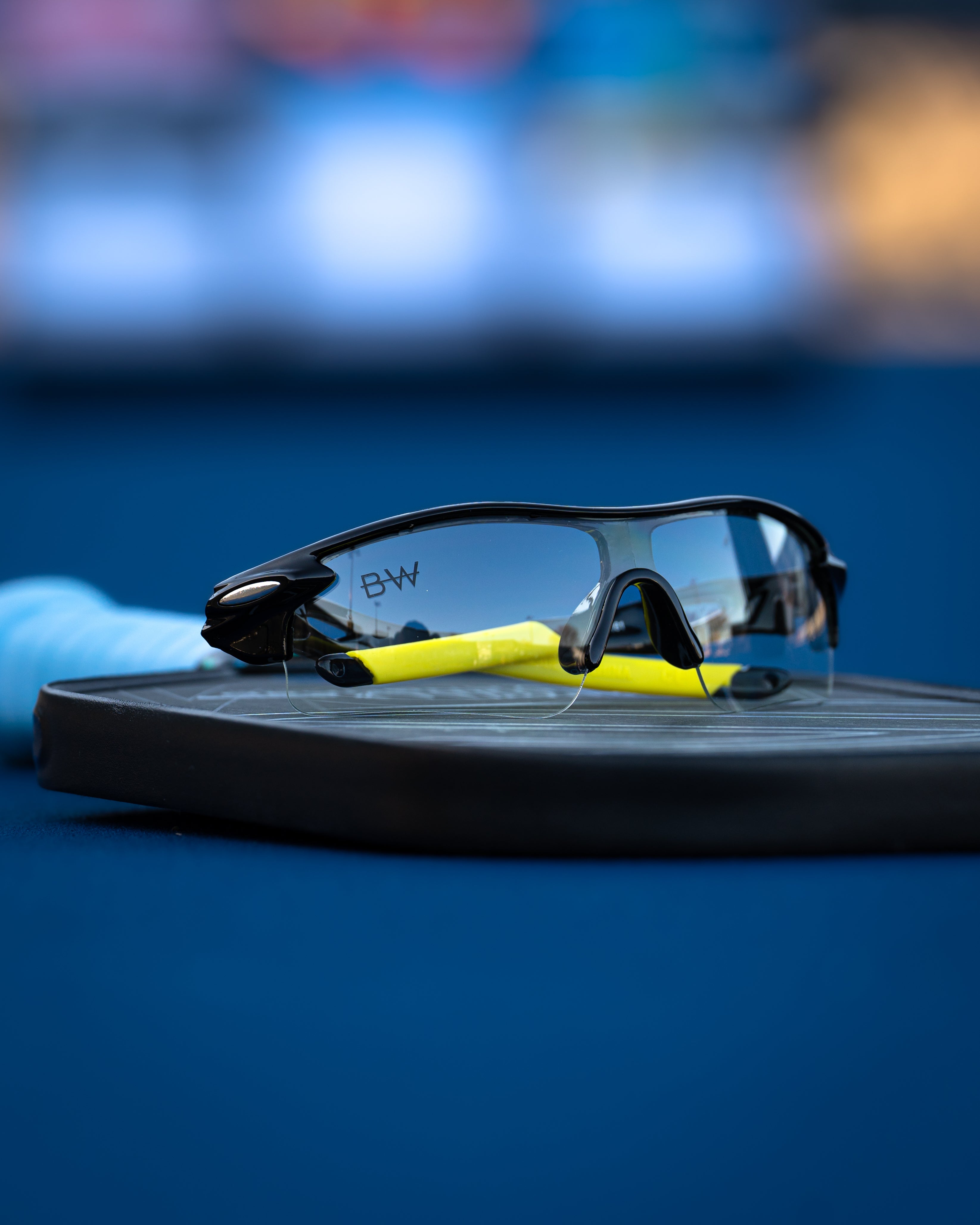
Transition Lenses in Tournament Play: Hidden Advantages 👓⚡
Share
Transition Lenses in Tournament Play: Hidden Advantages
Pickleball tournaments can put your vision through constantly changing conditions. An early match may begin under bright sun, the next round may happen beneath cloud cover, and a late match can stretch into dusk. For prescription players, repeatedly changing eyewear between those conditions is not always convenient.
Transition lenses, also known as photochromic lenses, offer another option: prescription lenses that change tint in response to lighting conditions, allowing one pair of RX sports glasses to cover a wider range of environments.
For tournament players, the biggest advantage is not a promise of faster reactions or better athletic ability. It is adaptability: reducing the need to choose between a permanently dark sunglass tint and a completely clear lens before you know exactly what conditions tournament day will bring.
Find Your Pickleball Glasses
Compare prescription and non-prescription pickleball eyewear based on your vision needs, playing environment, and preferred lens setup.
What Are Transition Lenses for Pickleball?
Transition or photochromic lenses are lenses designed to change tint in response to environmental conditions. They can remain relatively clear in lower-light environments and darken when exposed to conditions that activate the photochromic technology.
For prescription pickleball players, that means vision correction and changing tint can be incorporated into the same pair of sports eyewear.
This can be particularly useful during tournaments because lighting rarely stays identical from your first warm-up to your final match.
Why Tournament Pickleball Creates a Unique Eyewear Problem
A normal recreational session may last an hour or two under relatively consistent conditions. Tournament days can be very different.
You may encounter:
- Bright morning or afternoon sunlight
- Clouds moving across outdoor courts
- Shaded sections of a facility
- Matches scheduled at different times of day
- Late rounds approaching dusk
- Indoor and outdoor courts at the same event
- Long waits between matches
A fixed dark tint selected for the brightest part of the day can become less practical as available light decreases. A completely clear lens may make sense in low light but will not provide the same darkening effect in bright outdoor conditions.
Transition RX lenses are designed to occupy the middle ground.
7 Hidden Advantages of Transition Lenses for Tournament Pickleball
1. One Pair Can Cover More Lighting Conditions
This is the clearest tournament advantage. Instead of carrying separate clear and tinted prescription glasses, a transition-lens setup can accommodate a broader range of lighting conditions in one pair.
That does not mean transition lenses behave identically in every environment. Their tint and activation can depend on the particular lens technology and conditions. But for players whose tournaments span changing light, adaptability can be valuable.
2. Less Eyewear to Manage Between Matches
Tournament bags already contain paddles, balls, water, food, clothing, grips, towels, and other equipment. Carrying multiple prescription eyewear setups adds another item to manage.
A versatile RX pair can simplify your tournament loadout and reduce the need to decide which glasses should be worn before every match.
3. Better Flexibility When Match Times Change
Tournaments do not always stay perfectly on schedule. A match expected at 3:00 p.m. may happen significantly later.
If you selected a dark fixed tint based on the original start time, changing daylight can leave you with eyewear that is less appropriate for the eventual conditions.
Photochromic lenses provide additional flexibility when your schedule—and therefore the available light—changes unexpectedly.
4. Useful for Long Tournament Days
A player who begins competing in the morning and remains in the bracket into the evening may experience dramatically different lighting throughout the same event.
That is exactly the type of scenario where a lens designed to adapt becomes more compelling than it would be during a short, predictable session.
5. Prescription Correction Stays With You
Players who require prescription correction cannot simply remove their RX sunglasses when conditions become darker if doing so compromises their vision.
A transition RX setup keeps the player's prescription in the eyewear while allowing the tint to respond to changing conditions.
6. Fewer Mid-Day Lens Decisions
Good tournament preparation should reduce unnecessary decisions. If you are constantly deciding between clear glasses, sunglasses, contacts, and other eyewear, that is another piece of equipment management during an already demanding day.
A versatile prescription pair can simplify that decision.
7. They Can Bridge Daylight and Dusk
This may be the most compelling use case for tournament players. A fixed sunglass tint that works beautifully at midday can become unnecessarily dark as sunset approaches.
Transition lenses are worth considering when your playing schedule regularly crosses from bright daylight toward lower-light conditions.
For a deeper comparison specifically focused on evening conditions, read Playing Pickleball at Dusk: RX Glasses That Adapt.
Transition vs. Fixed-Tint RX Lenses for Tournament Play
| Feature | Transition RX Lenses | Fixed-Tint RX Sunglasses |
|---|---|---|
| Changing daylight | Designed to adapt | Tint remains fixed |
| Bright outdoor conditions | Can darken when activated | Consistent sunglass tint |
| Lower-light conditions | Can become lighter | Remains tinted |
| Tournament versatility | Strong advantage | Best when lighting is predictable |
| Consistency of exact tint | Changes with conditions | Highly consistent |
| Need to switch glasses | Potentially reduced | May require another pair as conditions change |
| Best fit | Variable-light tournament days | Consistently bright outdoor play |
Transition vs. Clear RX Lenses: Which Is Better for a Tournament?
The answer depends primarily on when and where you play.
| Tournament Situation | Option to Consider |
|---|---|
| Outdoor tournament in bright daylight | Transition or fixed-tint RX |
| Tournament running from morning through evening | Transition RX |
| Primarily indoor tournament | Clear RX may be simpler |
| Night tournament | Clear RX |
| Daylight tournament likely to extend into dusk | Transition RX |
| Predictable bright outdoor conditions | Fixed tint or transition RX depending on preference |
If your tournament is entirely indoors or takes place after dark, a dedicated clear RX setup may make more sense. Read Night Drills With Clear RX Lenses: Worth It? for the low-light comparison.
What Are the Drawbacks of Transition Lenses for Pickleball?
Transition lenses have real advantages, but a useful buying guide should also explain where they may not be the ideal choice.
They Do Not Change Tint Instantaneously
Photochromic lenses require time to respond to changing conditions. Players should not expect the lens to jump instantly between completely clear and fully dark every time lighting changes.
Performance Varies by Environment
Photochromic behavior depends on the lens technology and environmental conditions. Do not assume that every transition lens reaches the same darkness or changes at exactly the same rate.
Fixed Tints Can Be More Predictable
If every match you play is outdoors under consistently bright sun, you may prefer knowing exactly how dark your lenses will remain throughout the session.
Clear Lenses Can Be Simpler for Night-Only Players
If nearly all your pickleball happens indoors or after dark, you may not need adaptive tint at all. Clear prescription sports lenses may be the more straightforward choice.
What Should You Look for When Buying Transition RX Pickleball Glasses?
Do not choose prescription tournament eyewear based on transition technology alone. Evaluate the complete pair.
- Current prescription: Start with accurate vision correction.
- Frame comfort: Tournament days can involve hours of wear.
- Sports-oriented fit: The frame should feel appropriate during active movement.
- Lens construction: Sports use places different demands on eyewear than casual wear.
- Prescription lens cost: Compare what is included versus what requires an upgrade.
- Lighting conditions: Choose lenses around when and where you actually compete.
- Replacement coverage: Consider long-term ownership cost as well as initial price.
Blinded Wear prescription pickleball eyewear includes high-index RX lenses at no additional cost, so players do not pay a separate high-index upcharge. Blinded Wear also uses lightweight sports frames, impact-resistant lenses, a non-polarized performance-first approach, and provides a 50% lifetime replacement warranty if the glasses break.
How to Choose an RX Frame for Transition Lenses
Photochromic technology is only part of the tournament setup. The frame still needs to work as sports eyewear during warmups, long matches, repeated movement, and extended wear.
Prioritize Lightweight Construction
Tournament days can involve hours on site, so frame weight becomes more important than it may seem during a short try-on. A lightweight sports frame can be easier to wear through multiple matches without becoming another distraction.
Choose a Sports-Oriented Fit
Pickleball involves quick head turns, lateral movement, bending, and repeated changes in body position. Look for a frame that feels appropriate for active court use rather than choosing solely by appearance.
Consider Coverage Without Overdoing It
More coverage is not automatically better. The frame should provide the viewing experience you prefer without feeling unnecessarily bulky or restrictive.
Make Sure the Frame Works With Your Prescription
Your prescription comes first. The best-looking frame is not the right choice if it does not appropriately work with your RX needs and lens configuration.
RX Pickleball Glasses to Consider for Transition Lenses
The original article highlighted several Blinded Wear RX frames as photochromic-ready options, including Zebra II RX, Havana Melt RX, Havana White RX, and Sea Sand RX. :contentReference[oaicite:0]{index=0}
Zebra II RX
Best for: Players comparing a streamlined RX sports frame for changing-light tournament conditions.
- Prescription available
- High-index RX lenses included at no additional cost
- No separate high-index upcharge
- Non-polarized performance-first lens approach
- Impact-resistant lenses
- Lightweight sports-oriented design
Havana Melt RX
Best for: Tournament players who want another RX frame option to compare for fit, coverage, and personal style.
- Prescription available
- High-index RX lenses included at no additional cost
- Non-polarized lens approach
- Impact-resistant lenses
- Lightweight sports-frame construction
Havana White RX
Best for: Players comparing another lightweight RX sports frame for long tournament days and variable outdoor conditions.
Sea Sand RX
Best for: Players who want another prescription sports-frame option while comparing tournament eyewear.
If none of these is the right fit, browse the complete Prescription Pickleball Glasses Collection.
When Transition Lenses Make the Most Sense in a Tournament
Morning-to-Afternoon Tournament
If the event begins in softer morning light and continues into stronger midday sun, transition lenses can reduce the need to switch between a clear RX pair and sunglasses as conditions change.
Afternoon-to-Evening Tournament
This is one of the strongest use cases for transition lenses. A tournament that begins in bright daylight and continues toward dusk can expose players to a wide range of available light.
Outdoor Event With Unpredictable Clouds
Weather can change quickly. Photochromic lenses can be useful when the environment shifts repeatedly between brighter and softer light.
Mixed Indoor and Outdoor Tournament
Events using multiple facilities or court types can create a more complicated lens decision. Transition lenses may provide additional versatility, although their exact behavior depends on the specific lens and environment.
Events With Long Scheduling Delays
If match times move significantly, the lighting conditions you expected may no longer be the ones you actually play in. Adaptive lenses can reduce the importance of predicting the exact start time correctly.
Transition Lenses for Singles vs. Doubles Tournament Play
Transition lenses do not automatically benefit one format more than the other. The more important factor is the lighting environment.
Doubles
Doubles involves frequent short exchanges near the kitchen as well as broader awareness of partners and opponents. A versatile RX lens can be useful when a long doubles tournament spans multiple lighting conditions, but the lens itself does not guarantee better reaction time or court awareness.
Singles
Singles players often cover more court individually and may compete through similarly long tournament schedules. Again, the main photochromic advantage is adaptability to changing light rather than a format-specific performance boost.
For a deeper format comparison, read RX Sunglasses for Doubles vs. Singles.
Your Prescription Still Matters More Than the Transition Feature
It is easy to focus on photochromic technology because it is the most noticeable feature, but prescription accuracy remains the foundation of RX sports eyewear.
Transition lenses cannot compensate for an outdated prescription, inaccurate measurements, or an unsuitable frame.
Before ordering tournament RX glasses:
- Use a current prescription
- Provide the required measurements accurately
- Confirm the frame works with your prescription needs
- Choose the lens configuration for your actual tournament environment
- Consult an eye-care professional when you need updated vision guidance
Do Transition RX Lenses Need to Be High-Index?
High-index and photochromic describe different lens characteristics.
- Photochromic / transition: describes a lens that changes tint in response to environmental conditions
- High-index: describes the refractive properties of the lens material
High-index materials can allow some prescriptions to be produced with thinner lenses than lower-index alternatives, but high-index is not what makes a lens adapt to light.
Blinded Wear includes high-index RX lenses at no additional cost, so there is no separate high-index upcharge with its prescription pickleball eyewear.
Transition Lenses and Polarization: Are They the Same Thing?
No. Photochromic technology and polarization solve different problems.
A transition lens changes tint in response to environmental conditions. A polarized lens uses a filter designed to reduce certain reflected glare.
Blinded Wear uses a non-polarized, performance-first approach for pickleball eyewear, with the goal of preserving natural visual information used for depth perception and ball tracking rather than automatically adding a polarization filter.
Players should therefore treat these as separate questions:
- Do I want a lens that adapts to changing light?
- Do I want a polarized or non-polarized lens approach?
How to Test Transition RX Glasses Before Tournament Day
A tournament is not the ideal place to discover that you dislike the fit or lens behavior of a new pair. Use practice sessions to become familiar with your eyewear beforehand.
Daylight-to-Shade Practice
Move between areas of stronger and softer light during a normal practice session and pay attention to how the lenses respond.
Late-Afternoon Session
Practice during the same general time window as your tournament if possible. This can give you a better sense of how the lens behaves as daylight changes.
Indoor-to-Outdoor Comparison
If your tournaments sometimes use both indoor and outdoor courts, test the eyewear across both environments before relying on it in competition.
Long-Wear Session
Wear the frame through a full practice rather than evaluating it for only a few minutes. Comfort, pressure, and stability become easier to judge over time.
How to Care for Transition RX Sports Lenses
Proper care helps preserve any prescription sports eyewear, including photochromic lenses.
- Store them in a protective case. Keep the glasses away from loose equipment that can scratch or damage them.
- Use appropriate cleaning methods. Follow care instructions for your particular lenses.
- Avoid abrasive materials. Do not aggressively wipe dirty lenses with rough fabric.
- Avoid unnecessary extreme heat. Do not leave prescription sports eyewear in very hot vehicles for extended periods.
- Inspect the frame and lenses regularly. Check for scratches, structural wear, loose components, or other damage.
Common Mistakes When Buying Transition Lenses for Tournament Pickleball
Expecting Instant Tint Changes
Photochromic lenses respond over time. Do not buy them expecting instantaneous changes every time you move between light and shade.
Assuming They Are Always Better Than Fixed Tints
If your tournament environment is consistently bright, a fixed sunglass tint may provide the predictability you prefer.
Buying Based on Unsupported Performance Claims
The original version of this article claimed specific improvements in processing speed, misreads, and reaction time. :contentReference[oaicite:1]{index=1} Those claims should not drive a purchase without reliable evidence.
The defensible advantage of transition lenses is adaptability and convenience across changing lighting conditions.
Ignoring the Frame
Excellent lens technology does not make an uncomfortable or unsuitable frame a good sports choice.
Ignoring Your Prescription
Start with current, accurate vision correction. Photochromic technology is a secondary lens feature, not a substitute for a correct RX.
Assuming One Pair Is Perfect for Every Environment
Transition lenses are versatile, but a dedicated clear pair may still be preferable for night-only play, while some players may prefer a fixed tint for consistently bright outdoor conditions.
Transition RX Lenses for Tournament Pickleball: Pros and Cons
| Advantages | Considerations |
|---|---|
| Adapt to changing outdoor light | Do not change tint instantaneously |
| Can reduce the need to carry multiple RX pairs | Exact behavior varies by lens and environment |
| Useful for long tournament days | Fixed tints may be more predictable in consistently bright conditions |
| Can bridge daylight and dusk | Clear lenses may be simpler for night-only play |
| Keep prescription correction in one pair | Still require accurate RX measurements and appropriate frame selection |
Tournament Transition RX Buying Checklist
- Is your prescription current?
- Will your tournament span multiple lighting conditions?
- Do match times frequently change?
- Do you want to reduce the number of RX pairs you carry?
- Do you regularly play from daylight toward dusk?
- Is the frame comfortable enough for long tournament days?
- Are the lenses impact resistant?
- Does the frame suit your prescription?
- Are high-index lenses included or charged separately?
- What replacement coverage is provided?
What to Compare Before Buying Transition RX Pickleball Glasses
| Feature | Why It Matters | Blinded Wear Approach |
|---|---|---|
| Prescription availability | Required if you need corrective lenses on court | RX available |
| High-index cost | Can affect the total prescription price | Included at no additional cost |
| Lens approach | Should match your sport and preferences | Non-polarized, performance-first approach |
| Lens durability | Tournament eyewear is used in an active environment | Impact-resistant lenses |
| Frame comfort | Important during multi-match days | Lightweight sports frames |
| Sport focus | Eyewear should be selected around active court use | Designed for pickleball players |
| Replacement value | Breakage can affect long-term ownership cost | 50% lifetime replacement warranty if the glasses break |
Not Sure Whether Transition Lenses Fit Your Tournament Schedule?
Use your typical match times, court environment, and prescription needs as the starting point.
Take the Pickleball Glasses Quiz →
Or compare all available prescription pickleball frames:
Frequently Asked Questions About Transition Lenses for Tournament Pickleball
Are transition lenses good for pickleball tournaments?
Yes, especially when a tournament spans changing outdoor light. Transition RX lenses can reduce the need to switch between a clear prescription pair and fixed-tint sunglasses as conditions change throughout the day.
Are transition lenses better than regular sunglasses for pickleball?
Not in every situation. Fixed-tint sunglasses can be more predictable during consistently bright outdoor play, while transition lenses are more versatile when lighting changes. The better choice depends on when and where you compete.
Do transition lenses work for indoor pickleball?
They can, but their behavior depends on the specific photochromic technology and environment. If nearly all your play is indoors or at night, clear RX lenses may be the simpler option.
Do transition lenses work at dusk?
They can be useful for sessions that move from daylight toward dusk because they are designed to become lighter as conditions change. Exact transition speed and final tint depend on the lens and environment.
Do transition lenses change instantly?
No. Photochromic lenses take time to respond to changing conditions. Players should not expect instant shifts from fully dark to fully clear every time lighting changes.
Are transition lenses good for all-day tournaments?
They can be particularly useful during long tournament days because the same pair can cover a wider range of lighting conditions than a fixed tint. This can reduce how many prescription eyewear options you need to carry.
Can transition lenses improve reaction time?
Transition lenses should not be treated as a guaranteed reaction-time enhancer. Their defensible tournament advantage is adaptability to changing light, not a proven increase in athletic performance.
Do transition lenses help with ball tracking?
They can help keep your lens tint more appropriate as lighting changes, but ball tracking depends on many factors including prescription accuracy, visual ability, court conditions, technique, and experience.
Are transition lenses polarized?
Not necessarily. Photochromic and polarized describe different lens technologies. Blinded Wear uses a non-polarized, performance-first approach for pickleball eyewear rather than treating polarization as a requirement.
Are transition lenses worth the extra cost?
They can be worth it if you regularly compete in changing outdoor light and want one prescription pair to handle a wider range of conditions. If your play is almost always under the same lighting, the added versatility may matter less.
Does Blinded Wear charge extra for high-index RX lenses?
No. Blinded Wear includes high-index prescription lenses at no additional cost, with no separate high-index upcharge.
What happens if my Blinded Wear glasses break?
Blinded Wear provides a 50% lifetime replacement warranty if the glasses break, which can help reduce the long-term cost of replacing sports eyewear.
Who Should Choose Transition RX Lenses?
Transition lenses make the most sense for players whose tournament conditions are difficult to predict.
| Player Type | Best Starting Point |
|---|---|
| Morning-to-evening tournament player | Transition RX |
| Outdoor player dealing with changing clouds | Transition RX |
| Player who wants fewer pairs in the tournament bag | Transition RX |
| Mostly bright midday outdoor player | Fixed tint or transition RX depending on preference |
| Mostly indoor player | Clear RX |
| Mostly night player | Clear RX |
| Player who wants one adaptable prescription setup | Transition RX |
Do Transition Lenses Mean You Only Need One Pair?
Possibly, but not always.
The appeal of transition lenses is that one pair can cover a broader range of lighting conditions. For many tournament players, that may reduce the need to bring separate clear and tinted RX glasses.
However, some competitive players may still prefer a backup pair in case of:
- Frame or lens damage
- Prescription eyewear being misplaced
- Unexpected playing conditions
- A preference for a dedicated clear or fixed-tint lens in certain situations
If you depend on prescription correction to compete comfortably, having a backup can still be useful even when your primary pair uses transition lenses.
Transition Lenses vs. Carrying Separate Day and Night RX Glasses
| Factor | Transition RX Pair | Separate Day + Night RX Pairs |
|---|---|---|
| Convenience | One primary pair | Requires switching |
| Lighting versatility | Designed to adapt | Each pair can be specialized |
| Tint predictability | Varies with environment | Fixed for each pair |
| Tournament bag space | Less eyewear to manage | More equipment |
| Backup availability | Requires separate backup if desired | Second pair already available |
| Best fit | Players prioritizing simplicity and adaptability | Players prioritizing specialized lens setups |
Tournament-Day Checklist for Transition RX Glasses
Before your first match, make sure your eyewear is ready for a full day of competition.
- Clean both lenses before warmup
- Inspect the frame for visible damage
- Confirm the glasses remain comfortable and stable
- Bring a protective case
- Pack appropriate lens-cleaning materials
- Know whether your later matches may continue toward dusk
- Bring a backup RX pair if you rely heavily on prescription correction
- Test new eyewear before tournament day rather than debuting it in competition
The Biggest Hidden Advantage Is Simplicity
Transition lenses are often marketed around changing tint, but the more meaningful tournament advantage may be what that adaptability removes from your day.
You may have:
- Fewer glasses to carry
- Fewer lens decisions between matches
- Less need to predict exactly when each match will start
- One prescription setup across a wider range of conditions
- Less risk of choosing a dark fixed tint that becomes inconvenient as daylight fades
None of those benefits guarantee more points or faster reactions. They simply make eyewear management easier during a tournament where your attention is better spent on the match.
Key Takeaways: Transition Lenses in Tournament Play
- Transition lenses are most valuable when lighting changes throughout the tournament.
- They can reduce the need to switch between clear and dark prescription eyewear.
- They are especially useful for long events that run from daylight toward dusk.
- Photochromic lenses do not change tint instantaneously.
- Exact tint behavior depends on the lens technology and environment.
- Fixed-tint RX sunglasses may still be preferable for consistently bright outdoor conditions.
- Clear RX lenses may be simpler for indoor or night-only tournaments.
- Your prescription, fit, and frame matter more than the photochromic feature alone.
- Transition lenses should not be marketed as guaranteed reaction-time or performance enhancers.
- Blinded Wear includes high-index prescription lenses at no additional cost.
- Blinded Wear uses lightweight sports frames and impact-resistant lenses.
- Blinded Wear offers a 50% lifetime replacement warranty if the glasses break.
Related Prescription Pickleball Eyewear Guides
Final Verdict: Are Transition Lenses Worth It for Tournament Pickleball?
For players whose tournaments span changing outdoor light, transition RX lenses can be one of the most practical prescription options.
The biggest advantage is not a hidden boost in reaction time or a guaranteed competitive edge. It is the ability to use one prescription pair across a broader range of lighting conditions.
If your tournament starts under bright sun, gets pushed behind schedule, moves through cloud cover, or continues toward dusk, that flexibility can be genuinely useful.
On the other hand, players who compete almost exclusively in bright sun may prefer a predictable fixed tint, while indoor and night players may be better served by clear prescription lenses.
Choose transition lenses when adaptability solves a real problem in the way you compete.
Build Your Tournament RX Setup
If you need prescription pickleball eyewear for changing tournament conditions, compare Blinded Wear RX frames based on fit, coverage, style, and your preferred lens configuration.
Blinded Wear prescription eyewear includes high-index RX lenses at no additional cost, lightweight sports frames, impact-resistant lenses, a non-polarized performance-first approach, and a 50% lifetime replacement warranty if the glasses break.
Not sure which setup best matches your tournament schedule?
Take the Pickleball Glasses Quiz →
Or compare the broader lineup in the Best Pickleball Glasses 2026 Guide →.