
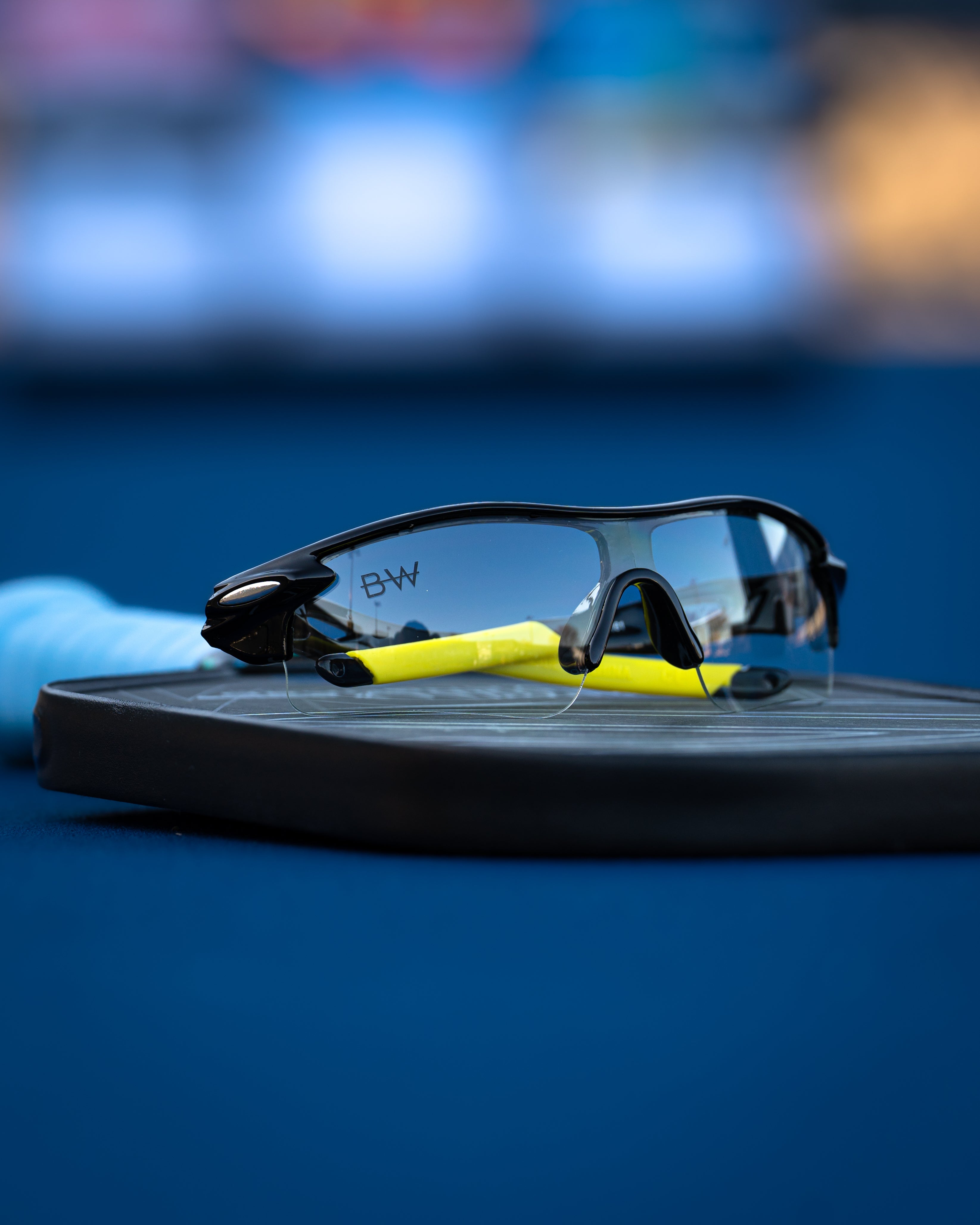
Transition RX Lenses for Travel & Competition: One Pair for Every Light
Share
Transition RX Lenses for Travel & Competition: One Pair for Every Light
Traveling with prescription sports eyewear can get complicated fast. You may leave an indoor hotel or airport, step into brighter outdoor conditions, warm up on an outdoor pickleball court, move back inside between matches, and finish your day under completely different lighting than where it started.
That is the practical appeal of Transition RX lenses for travel and competition. Photochromic prescription lenses are designed to change tint in response to light exposure, potentially allowing one corrective pair to cover more of your day without constantly switching between clear prescription glasses and tinted RX sunglasses.
For pickleball players and other active travelers, the biggest advantage is versatility and convenience. Transition RX lenses should not be treated as an instant, universal solution for every lighting condition, but the right adaptive setup can make a multi-environment sports routine considerably simpler.
Start With Your Pickleball Eyewear Setup
What Are Transition RX Lenses?
Transition RX lenses combine prescription correction with photochromic lens technology. Instead of maintaining one fixed tint, photochromic lenses change tint according to their response to light exposure.
That makes them fundamentally different from both clear prescription glasses and fixed-tint prescription sunglasses.
| RX Lens Setup | How the Tint Behaves | Potential Role |
|---|---|---|
| Clear RX | Remains untinted | Indoor, evening, lower-light, or other situations where you prefer no dark sunglass tint |
| Fixed-Tint RX | Maintains the selected tint | Consistent configuration for environments where you prefer that tint |
| Transition / Photochromic RX | Changes tint in response to light exposure | Mixed environments where reducing eyewear changes may be useful |
The goal is not to make one category universally superior. Each solves a different problem. Transition RX becomes especially relevant when your environment changes more often than you want to change your glasses.
Why Consider Transition RX Glasses for Travel?
Travel can turn a simple eyewear routine into a multi-pair packing system. A prescription-dependent athlete may otherwise consider bringing everyday glasses, prescription sunglasses, dedicated sports RX eyewear, and a backup corrective pair.
Adaptive RX lenses can potentially combine some of those regular-use roles.
A Typical Tournament Travel Day Might Include:
- Indoor hotel lighting
- An airport or terminal
- Outdoor walks between locations
- A vehicle or rideshare
- Outdoor warmups
- Indoor staging or rest areas
- Outdoor competition
- Changing afternoon conditions
- Evening activities after competition
If one prescription frame can remain useful through several of those environments, you have fewer reasons to repeatedly retrieve, store, and switch between different corrective pairs.
The Real Benefit of Transition RX: Fewer Eyewear Changes
Adaptive prescription lenses are sometimes marketed with dramatic sports-performance promises. A more useful way to evaluate them is much simpler.
How many times during a normal day would you otherwise change prescription eyewear?
Suppose you currently use:
- Clear RX glasses indoors
- Prescription sunglasses outdoors
- Clear RX glasses again after sunset
A suitable adaptive RX configuration may allow one pair to cover more of that sequence.
That does not automatically improve reaction time, depth perception, ball tracking, or athletic performance. What it can do is simplify the equipment routine surrounding your sport.
One Pair Across a Full Competition Day
To understand the potential value, look beyond a single match and consider the entire day.
| Time | Environment | Potential Transition RX Role |
|---|---|---|
| 7:00 AM | Hotel / breakfast | Prescription correction while indoors |
| 8:00 AM | Travel to venue | Same corrective frame remains in use |
| 9:00 AM | Outdoor warmup | Photochromic tint responds to activating conditions |
| 11:30 AM | Indoor break | Lens begins responding to the changed environment |
| 1:00 PM | Outdoor competition | Same RX frame can remain your corrective setup |
| 5:30 PM | Later-day conditions | Tint behavior continues responding as conditions change |
| 8:00 PM | Indoor post-tournament activities | No automatic need to change frames solely because you moved indoors |
This is what “one pair for every light” should mean in practice: one RX pair designed to remain useful across more parts of your day—not a promise that one lens is perfect in literally every possible lighting condition.
Do Transition RX Lenses Change Tint Instantly?
No. Photochromic lenses should not be described as instantly jumping between completely clear and fully dark states.
The transition happens progressively. How quickly and how strongly a particular lens changes can depend on the photochromic technology and environmental conditions.
This matters for athletes because your surroundings can change faster than the lens itself.
Walking from an outdoor court into an indoor facility takes seconds. The lens response is a process rather than an electronic on/off switch.
If you frequently move between dramatically different environments in short intervals, transition behavior should be part of your buying decision.
Are Transition RX Lenses Good for Indoor and Outdoor Pickleball?
Players who regularly alternate between indoor and outdoor pickleball have one of the clearest reasons to compare adaptive RX lenses with separate clear and tinted prescription setups.
| Your Pickleball Routine | What to Compare |
|---|---|
| Mostly Indoor | Clear RX vs. transition RX |
| Mostly Outdoor | Fixed-tint RX vs. transition RX |
| Indoor + Outdoor Every Week | Transition RX vs. separate clear and tinted RX pairs |
| Morning + Evening Play | Adaptive RX vs. dedicated configurations for each environment |
| Frequent Tournament Travel | Transition RX + suitable corrective backup |
If you specifically prefer untinted eyewear for indoor or lower-light play, explore the Clear Lens Pickleball Glasses Collection → and compare that approach with an adaptive setup.
Transition RX vs. Clear RX Sports Glasses
Clear RX and transition RX eyewear serve different types of players.
Clear RX glasses make sense when you want prescription correction without a dark sunglass tint. That can be useful for indoor, evening, and lower-light environments where a dark tint may not be preferred.
Transition RX glasses become more relevant when the same pair needs to move between different environments and you value adaptive tint.
| Factor | Clear RX | Transition RX |
|---|---|---|
| Tint | Untinted | Changes according to photochromic response |
| Indoor State | Consistently untinted | Depends on the specific photochromic lens and conditions |
| Outdoor State | Remains untinted | Can darken under activating conditions |
| Main Strength | Simplicity and consistent untinted appearance | Versatility across changing environments |
| Best Buying Question | Do I primarily want untinted prescription sports eyewear? | Would adaptive tint meaningfully reduce my eyewear changes? |
Transition RX vs. Fixed-Tint Prescription Sunglasses
A fixed-tint prescription sunglass maintains its selected tint instead of adapting throughout the day. For athletes who spend most of their playing time in a relatively stable outdoor environment, that consistency may be exactly what they want.
Transition RX takes the opposite approach: one lens configuration intended to remain useful as conditions change.
Compare Transition RX First If:
- You frequently move between indoor and outdoor environments
- You play at several times of day
- You travel frequently
- You dislike carrying multiple active-use RX pairs
- You want one prescription frame to cover more of your day
Compare Fixed-Tint RX First If:
- Most of your play happens in similar outdoor conditions
- You prefer a consistent tint
- You do not mind switching to another corrective pair indoors
- You prefer dedicated eyewear configurations for specific environments
Do Transition RX Lenses Work the Same Way Inside a Car?
Driving is an important consideration for athletes traveling to tournaments and practices.
Photochromic behavior depends on the specific lens technology and the light exposure reaching the lenses. Vehicle windows can change that exposure, which means you should not assume transition lenses will darken inside a vehicle exactly as they do outdoors.
If your main reason for wanting adaptive RX eyewear is long-distance tournament driving, review the behavior of the specific photochromic lens option before assuming it can replace dedicated prescription sunglasses for that role.
Can Weather and Temperature Affect Photochromic Lenses?
Photochromic behavior can vary with environmental conditions. That is particularly relevant to athletes who travel between climates or compete through different seasons.
Your trip might include:
- A cooler early-morning warmup
- A warmer afternoon match
- Climate-controlled indoor facilities
- Cloudy outdoor conditions
- Bright outdoor conditions
- Evening play
Instead of asking only, “Do these lenses transition?” ask “Does the behavior of this specific lens technology fit the environments where I expect to use it?”
Do Transition RX Lenses Improve Reaction Time or Ball Tracking?
Transition RX lenses should be evaluated for what they actually provide: prescription correction combined with adaptive tint behavior.
| What Adaptive RX Can Offer | What Adaptive Tint Does Not Automatically Provide |
|---|---|
| Prescription correction | Faster reaction time |
| Changing tint behavior | Better depth perception |
| Potentially fewer eyewear changes | Improved ball tracking |
| One primary pair across multiple environments | Better spin recognition |
| Travel convenience | Improved shot accuracy |
| A simpler equipment routine | An automatic competitive advantage |
For athletes, the strongest case for transition RX is therefore versatility rather than an unsupported performance promise.
Transition RX Lenses Beyond Pickleball
The same convenience question can apply to athletes who participate in more than one activity.
| Activity | Why Adaptive RX May Be Relevant |
|---|---|
| Pickleball | Indoor, outdoor, daytime, and evening sessions can create changing environments |
| Tennis | Outdoor schedules may span different parts of the day |
| Running | Training may begin or end under different light conditions |
| Cycling | Longer outdoor sessions can span changing conditions |
| Gym + Outdoor Training | The same workout routine may move between indoor and outdoor environments |
| Travel Training | One corrective frame may potentially cover more parts of the trip |
The value still comes from the athlete's actual schedule rather than the sport name itself.
Can Transition RX Help You Pack Fewer Glasses?
This is one of the best tests of whether adaptive prescription eyewear provides real value.
List the corrective eyewear you would normally bring:
- Everyday prescription glasses
- Clear RX sports glasses
- Fixed-tint RX sunglasses
- Backup corrective glasses
Now ask which regular-use roles a transition RX sports pair could realistically cover.
If one adaptive pair lets you leave one environment-specific pair at home—or at least stops you from constantly switching between two pairs—the convenience is measurable.
However, packing fewer active-use pairs is not the same as eliminating your backup.
Do You Still Need Backup Glasses If You Have Transition RX?
Transition lenses solve a lighting problem. A backup pair solves a redundancy problem.
Those are separate needs.
| Problem | Practical Solution |
|---|---|
| I keep changing between clear and tinted RX eyewear | Transition RX may reduce those changes |
| I want a consistent tint | Fixed-tint RX may fit better |
| I want consistently untinted lenses | Clear RX may fit better |
| My primary RX glasses are lost | A separate corrective backup provides redundancy |
| My primary RX glasses break | A separate corrective backup can keep another option available |
For frequent travelers who depend heavily on prescription correction, a strong system may therefore be one versatile primary pair plus one suitable corrective backup.
What to Look for in Blinded Wear RX Sports Eyewear
When comparing Blinded Wear prescription sports glasses, focus on the verified characteristics of the eyewear and the current configuration of the individual product.
- Designed for pickleball players
- Lightweight sports frames
- Impact-resistant lenses
- Non-polarized lenses
- Comfortable for extended matches
- High-index prescription lenses included at no additional cost
- 50% lifetime replacement support if glasses break, subject to current policy terms
Impact-resistant should not be interpreted as shatterproof or indestructible, and no specific high-index number should be assumed unless it is verified for the current order.
Blinded Wear RX Frames to Compare for Travel and Competition
Frame choice is separate from lens technology. Compare the current lens configuration, available dimensions, design, and intended use of the specific RX frame you are considering.
Havana Melt RX
Havana Melt RX is one RX sports frame to compare when building a primary or secondary travel setup.
Crystal Wave II RX
Crystal Wave II RX can be evaluated according to its current configuration, dimensions, design, and your intended environments.
Lava Rock RX
Lava Rock RX is another prescription sports option to compare for competition and travel.
H Blue Shield RX
H Blue Shield RX provides another frame choice within Blinded Wear's RX pickleball eyewear selection.
Check the current product options before ordering if you specifically want a photochromic configuration. Do not assume every RX frame automatically includes the same transition-lens option.
Are Blinded Wear RX Sports Lenses Polarized?
Blinded Wear sports eyewear uses non-polarized lenses.
Non-polarized lenses do not add a polarization filter and preserve the visual information available without that filter. Some court players prefer non-polarized eyewear.
That should not be converted into claims that non-polarized lenses inherently improve depth perception, reaction time, ball tracking, spin recognition, or athletic performance.
Photochromic and polarized also describe different lens characteristics. A lens should never be assumed polarized simply because its tint changes.
Are High-Index Prescription Lenses Included?
Blinded Wear includes high-index prescription lenses at no additional cost with RX eyewear.
That is worth considering when comparing the total value of a prescription sports setup because you are evaluating more than the frame alone.
No exact numerical lens index should be assumed unless it is verified for the current order.
Is Transition RX Right for Your Travel Routine?
Answer yes or no to each question:
- □ I need prescription correction while playing
- □ I regularly play both indoors and outdoors
- □ I train or compete at different times of day
- □ I travel frequently for sports
- □ I currently carry multiple prescription pairs
- □ I frequently change between clear glasses and prescription sunglasses
- □ I want one primary frame to cover more of my day
- □ I am comfortable with tint that changes instead of remaining fixed
- □ I understand that photochromic changes are not instantaneous
- □ I have considered how much driving is part of my routine
If many of the first seven statements describe you, adaptive RX eyewear has a clearer convenience problem to solve.
If almost none of them describe your routine, a dedicated clear or fixed-tint RX configuration may be simpler.
Common Mistakes When Shopping for Transition RX Sports Glasses
Assuming “Transition” Means Instant
Photochromic tint changes progressively rather than functioning like an electronic switch.
Assuming One Pair Is Perfect Everywhere
Adaptive eyewear is designed for versatility, but different environments and preferences can still favor different configurations.
Assuming Transition Means Polarized
Photochromic behavior and polarization are separate lens characteristics.
Assuming Adaptive Tint Automatically Improves Sports Performance
Tint-changing behavior alone should not be credited with faster reactions, improved depth perception, or better ball tracking.
Ignoring Driving
If tournament travel includes significant driving, consider how the specific lens technology behaves behind vehicle windows.
Ignoring the Frame
A versatile lens does not help much if the frame itself is not something you would realistically use through your normal sports and travel routine.
Eliminating Your Backup
One adaptive pair may replace an environment-specific pair, but it cannot physically back itself up.
FAQ: Transition RX Lenses for Travel and Competition
What are transition RX lenses?
Transition RX lenses are prescription lenses with photochromic technology that changes tint in response to light exposure.
Are transition RX lenses good for athletes?
They can be useful for prescription-dependent athletes who regularly move between different environments and want to reduce how often they change eyewear.
Are transition lenses useful for pickleball?
They may be especially relevant to players who alternate between indoor and outdoor pickleball or compete at different times of day.
Do transition RX lenses change instantly?
No. Photochromic tint changes progressively, and behavior can vary according to the specific lens technology and environment.
Can transition RX lenses work indoors and outdoors?
That is one of their primary use cases. Whether a specific configuration matches your preferences depends on its behavior in the environments where you actually use it.
Are transition lenses always completely clear indoors?
Do not assume every photochromic lens reaches exactly the same indoor state. Review the characteristics of the specific lens option you are considering.
Do transition lenses work behind a windshield?
Do not assume they will behave exactly as they do outdoors. Vehicle windows can affect the light exposure involved in photochromic activation.
Do transition RX lenses improve reaction time?
Adaptive tint alone should not automatically be credited with faster reaction time.
Do transition lenses improve depth perception?
Photochromic behavior itself should not automatically be claimed to improve depth perception.
Do transition lenses help you track the pickleball?
Adaptive tint should not automatically be described as improving ball tracking.
Are transition lenses polarized?
Photochromic and polarized are separate characteristics. One does not automatically imply the other.
Are Blinded Wear sports lenses polarized?
Blinded Wear sports eyewear uses non-polarized lenses.
Are Blinded Wear RX lenses impact-resistant?
Blinded Wear sports eyewear uses impact-resistant lenses. Impact-resistant does not mean shatterproof or indestructible.
Does Blinded Wear include high-index prescription lenses?
Yes. High-index prescription lenses are included at no additional cost with Blinded Wear RX eyewear.
Should traveling athletes carry backup RX glasses?
If you rely heavily on prescription correction, another suitable corrective pair can provide redundancy if your primary eyewear becomes unavailable.
What's better: transition RX or two separate prescription pairs?
Transition RX prioritizes versatility and fewer eyewear changes. Separate clear and fixed-tint RX pairs provide dedicated configurations for different environments. Your routine determines which structure makes more sense.
How do I know if transition RX is worth considering?
Ask how frequently you change environments and how often adaptive lenses would prevent you from changing prescription eyewear. The more often that happens, the stronger the practical use case.
Part 2: Build the Right One-Pair or Two-Pair Travel System
Next, compare transition RX versus clear + tinted two-pair systems, indoor-to-outdoor competition scenarios, driving considerations, tournament-day light changes, travel packing strategies, backup correction, cost per use, frame fit, storage, and a practical decision matrix for deciding whether adaptive prescription eyewear genuinely simplifies your routine.
Transition RX vs. Two Separate RX Pairs: Which Setup Is Better for Travel?
Once you understand how adaptive prescription lenses work, the next decision is whether you want one versatile primary RX pair or separate prescription eyewear for different environments.
For many athletes, the comparison comes down to two systems:
| Travel System | How It Works | Primary Advantage | Main Tradeoff |
|---|---|---|---|
| Transition RX + Backup | One adaptive RX pair handles most regular use while another suitable corrective pair remains available | Fewer active eyewear changes | Adaptive tint does not remain at one fixed state |
| Clear RX + Fixed-Tint RX | You manually select the pair intended for the current environment | Dedicated lens configurations | More eyewear to carry and switch between |
Neither system is automatically better. The strongest choice depends on whether you prioritize versatility or specialization.
3 Prescription Eyewear Systems for Traveling Athletes
System 1: One Adaptive Primary + Corrective Backup
This is the streamlined approach.
Your transition RX pair becomes the eyewear you expect to use through most of the trip. Another suitable corrective pair remains stored as backup rather than being switched into every time your environment changes.
This system can make sense when you:
- Frequently move between indoor and outdoor environments
- Travel for tournaments or training
- Want fewer active-use RX pairs
- Play at different times of day
- Still want redundancy if your primary pair becomes unavailable
System 2: Clear RX + Fixed-Tint RX
This is the dedicated-configuration approach.
Instead of asking one lens to adapt, you choose the pair you want for the current environment.
For example, you might use an untinted RX pair indoors and a fixed-tint prescription sunglass outdoors.
This may fit athletes who prefer predictable lens configurations and do not mind carrying two active-use pairs.
System 3: Transition RX + Dedicated Secondary RX
This hybrid system gives your adaptive pair the primary role while preserving a specialized second configuration.
For example, your transition RX eyewear might handle most of the day while a dedicated untinted or fixed-tint pair remains available for the environment where you have a strong preference.
This requires more equipment than the minimalist approach, but it prevents the adaptive pair from having to satisfy every possible preference.
Which RX System Fits Your Pickleball Schedule?
| Playing Schedule | System to Compare | Why |
|---|---|---|
| Indoor Only | Clear RX | An adaptive tint may provide limited additional utility if your environment rarely changes |
| Outdoor Daytime Only | Fixed-Tint RX vs. Transition RX | Compare consistent tint with adaptive versatility |
| Indoor During Week + Outdoor Weekends | Transition RX vs. Clear RX + Fixed-Tint RX | You regularly encounter different environments |
| Morning + Afternoon + Evening Play | Transition RX | One pair may remain useful through more of your changing schedule |
| League + Tournament Play | Transition RX + Backup | Combines regular-use versatility with corrective redundancy |
| Frequent Tournament Travel | Transition RX + Backup or Hybrid System | Travel creates more environments and more opportunities to simplify eyewear changes |
Transition RX Through a Full Pickleball Tournament Day
A tournament is one of the easiest ways to understand why a prescription athlete might consider adaptive lenses. Your eyewear needs can begin hours before your first match and continue long after your final point.
6:30 AM — Getting Ready
You are inside your hotel or home. Your prescription correction is already needed, but a dark fixed-tint sunglass may not be the configuration you want indoors.
7:30 AM — Leaving for the Venue
You move outside and begin traveling. The same adaptive RX frame can remain in use while its photochromic behavior responds according to the conditions.
8:30 AM — Outdoor Warmup
You begin warming up outside. Instead of retrieving another prescription frame simply because you changed environments, your adaptive pair remains your corrective eyewear.
10:30 AM — Indoor Break
You move inside between matches. The environment changes immediately while the photochromic response occurs progressively.
12:30 PM — Back Outside
You return to outdoor competition. The same prescription frame can continue serving as your primary corrective setup.
4:30 PM — Later Matches
Conditions may differ from those during your morning warmup. An adaptive lens does not remain locked into the tint it had earlier in the day.
7:00 PM — Leaving the Tournament
You may move into evening conditions, restaurants, hotels, or other indoor environments without automatically needing to switch to a completely different prescription frame.
The potential advantage is not that the lens makes every environment identical. It is that one corrective frame can potentially remain useful while the environment changes around you.
What If You Move Indoors and Outdoors Repeatedly?
This is where expectations matter.
Your body can cross a doorway immediately. Photochromic lenses do not instantly switch tint states at that exact moment.
Consider a tournament facility where you repeatedly move through:
Outdoor court → indoor lobby → outdoor court → indoor staging area → outdoor court.
If those changes happen within short intervals, the transition itself becomes a meaningful part of your experience.
An athlete who remains outdoors for three hours and then moves indoors has a different use case from an athlete who changes environments every 15 minutes.
That is why the question should not simply be, “Do I play indoors and outdoors?” It should also be:
“How often do I switch between them?”
Transition RX for Road Trips: What Should Tournament Players Know?
If you drive to practices and tournaments, evaluate driving separately from outdoor court use.
Photochromic behavior can be affected by the light exposure that reaches the lenses through vehicle windows. As a result, the tint state you experience outdoors should not automatically be expected inside a vehicle.
That creates three possible needs:
- Prescription correction while driving
- Adaptive tint while moving between indoor and outdoor environments
- A particular sunglass experience while inside the vehicle
One lens technology may not address all three in exactly the same way.
If long drives are a major part of your tournament schedule, verify the characteristics of the specific photochromic lens option you are considering before deciding that it can replace a dedicated driving setup.
Are Transition RX Glasses Useful for Airports and Flights?
The biggest travel benefit is not necessarily what the lens does while you are sitting on an airplane. It is how many different environments the same corrective frame can potentially cover throughout the trip.
A flight-based tournament trip could involve:
- Leaving home
- Walking outdoors
- Entering an airport
- Flying
- Leaving the destination airport
- Traveling to a hotel
- Walking outdoors again
- Entering a tournament venue
- Playing indoors or outdoors
- Going out after competition
If you need prescription correction throughout that entire sequence, a versatile primary RX frame may be more convenient than eyewear you only want to use for one portion of the trip.
Sunny, Cloudy, Indoor, and Evening: How Should You Think About Adaptive Tint?
A common mistake is treating transition lenses as if they have only two possible states:
Outside = dark. Inside = clear.
Real-world environments are more complicated.
Outdoor conditions vary. Indoor environments vary. Time of day changes. Weather changes. Temperature can also influence photochromic behavior.
That means the lens may spend part of your day somewhere between the states you mentally picture as “clear” and “dark.”
For travel, that variability is part of the feature rather than necessarily a flaw. The lens is designed to respond rather than maintain one fixed tint.
If you strongly prefer one exact tint whenever you compete, however, a dedicated fixed-tint configuration deserves comparison.
Can Temperature Affect Transition RX Lenses?
Environmental conditions, including temperature, can influence photochromic behavior. That matters more to a traveler than someone who always plays in the same climate.
Imagine a competition schedule that includes:
- A cool early-morning outdoor warmup
- A warmer afternoon match
- An air-conditioned indoor break
- Outdoor evening play
The practical lesson is to avoid relying on one universal transition-time or tint expectation for every environment.
If adaptive behavior is central to your buying decision, review the specifications of the actual lens option being offered and evaluate it under conditions similar to your normal use.
Can Transition RX Let You Pack One Less Pair of Glasses?
For a frequent traveler, this may be a more useful question than asking whether transition lenses are “better.”
Start with your current packing list:
| Eyewear | Why You Pack It |
|---|---|
| Everyday RX Glasses | General prescription correction |
| Clear RX Sports Glasses | Untinted sports eyewear |
| Fixed-Tint RX Sunglasses | Tinted prescription sports eyewear |
| Backup RX Glasses | Corrective redundancy |
Now determine whether an adaptive sports pair could realistically combine some of the first three roles.
If it can, you may be able to simplify the number of pairs you actively switch between.
The fourth role is different. A backup exists because another physical pair might become unavailable. Transition technology cannot solve that problem by itself.
The Minimalist RX Tournament Packing System
A prescription-dependent athlete who wants to travel light could structure their eyewear like this:
Primary Pair
Adaptive RX sports eyewear used through most of the travel and competition routine.
Backup Pair
Another suitable corrective pair stored appropriately and available if the primary becomes lost, damaged, or otherwise unavailable.
Why This System Works
The primary pair handles the environment changes. The backup handles the equipment failure.
Those are two different jobs, and assigning them separately creates a much stronger travel plan than assuming “one pair for every light” means “bring only one physical pair.”
When Two Dedicated RX Sports Pairs May Make More Sense
Transition RX is not automatically the most practical solution for every prescription athlete.
Two dedicated pairs may deserve stronger consideration if:
- You strongly prefer an untinted lens indoors
- You strongly prefer a fixed tint outdoors
- You spend long periods in each environment
- You do not mind switching eyewear
- You want each pair to have a clearly defined role
- You already own one suitable configuration and only need to add the other
A dedicated two-pair system might be:
Pair 1: Clear RX sports eyewear for indoor, evening, or other situations where you prefer no dark sunglass tint.
Pair 2: Fixed-tint RX sports eyewear for the outdoor environments where you prefer that configuration.
There is no requirement that a sophisticated sports-eyewear system use adaptive lenses. Sometimes the simplest solution is two predictable configurations.
Are Transition RX Lenses Worth It? Calculate Cost Per Use
If you are evaluating prescription sports eyewear as equipment, look beyond the purchase price and estimate how frequently you will actually use it.
| Playing Frequency | Approximate Annual Sessions | Potential Relevance of Versatility |
|---|---|---|
| 2 Times Per Month | About 24 | Adaptive convenience may matter less unless the eyewear is also used throughout travel |
| 1 Time Per Week | About 52 | A primary sports RX pair receives regular use |
| 2 Times Per Week | About 104 | Environment changes can create repeated opportunities for adaptive use |
| 3 Times Per Week | About 156 | A versatile primary pair may become heavily used equipment |
| 4 Times Per Week | About 208 | Small convenience differences can occur many times across the year |
Then add tournament and travel use.
If the same pair is also worn while traveling, walking between locations, or moving through multiple environments, its annual use may extend far beyond the number of matches you play.
5 Questions to Ask Before Paying for Adaptive RX
-
How often do I actually move between different environments?
If the answer is rarely, adaptive tint may provide limited additional utility.
-
How often do I currently change prescription eyewear?
Every avoided switch represents a concrete convenience benefit.
-
Would I wear the same sports frame outside the court?
If not, the lens may be versatile while your overall travel setup remains specialized.
-
Do I prefer adaptive tint or predictable fixed tint?
This preference can matter more than the number of environments you encounter.
-
What would I wear if the primary pair disappeared today?
If you have no answer and rely heavily on prescription correction, you have a separate backup-planning issue.
Don't Choose Transition RX Based on Lens Technology Alone
If your goal is one primary pair for travel and competition, the frame itself becomes even more important.
You may be wearing it:
- Before competition
- During warmups
- During matches
- Between matches
- While traveling
- During extended tournament days
Review available frame dimensions and compare them with eyewear that already fits you well.
Also ask whether the frame is something you would realistically choose to wear beyond the court. If you would immediately change into another frame after every match, the “one primary pair” strategy becomes less useful.
Test Your New RX Sports Glasses Before Tournament Day
Whenever possible, become familiar with new prescription sports eyewear before making an important competition its first full test.
A simple evaluation can include:
- Wear the glasses during normal indoor activity
- Wear them outside under conditions similar to your usual schedule
- Move between environments and observe the transition behavior
- Warm up normally
- Hit controlled dinks
- Move through the kitchen and transition zone
- Hit from the baseline
- Play several normal points
- Continue through a typical practice session
- Evaluate the frame and lens behavior based on your actual preferences
This is not a durability test. Do not intentionally drop, bend, strike, or otherwise damage the eyewear.
RX Frames to Compare When Building a Travel System
Blinded Wear offers multiple RX frame options that can be compared according to their current lens configuration, available dimensions, appearance, and intended role in your eyewear system.
| RX Frame | Possible Role | What to Compare |
|---|---|---|
| Havana Melt RX | Primary or secondary RX sports frame | Current lens options, dimensions, design, and intended environments |
| Crystal Wave II RX | Primary or alternate competition RX setup | Current configuration, dimensions, appearance, and travel role |
| Lava Rock RX | Primary or backup RX sports option | Current configuration, available dimensions, design, and use case |
| H Blue Shield RX | Another RX sports option to compare | Current product options, dimensions, design, and intended role |
Blinded Wear RX sports eyewear shares several verified characteristics, including lightweight sports frames, impact-resistant lenses, non-polarized lenses, pickleball-focused design, and high-index prescription lenses included at no additional cost.
If you specifically want a transition or photochromic configuration, verify that the desired lens option is currently available for the frame you are considering.
Your Prescription Still Matters More Than the Tint Feature
Adaptive tint is an additional lens characteristic. It does not replace the need for suitable prescription correction.
Before ordering RX sports eyewear:
- Have your eyeglass prescription available
- Make sure the prescription information is readable
- Take a clear photo or picture of the prescription
- Upload the prescription before purchasing
- Review your selected product and current options before submitting the order
If you are using an older pair as your travel backup, also consider whether its prescription remains suitable for your needs.
High-Index RX Lenses and the Total Cost of Your Setup
Blinded Wear includes high-index prescription lenses at no additional cost with RX eyewear.
That means your comparison should consider the complete prescription setup rather than looking only at the listed frame price.
No specific numerical lens index should be assumed unless it is verified for the current order.
Transition RX and Non-Polarized Sports Lenses: What's the Difference?
Photochromic behavior and polarization describe two separate characteristics.
Photochromic refers to a lens changing tint according to its response to light exposure.
Polarized refers to the addition of a polarization filter.
Blinded Wear sports eyewear uses non-polarized lenses. Non-polarized lenses do not add a polarization filter and preserve the visual information available without that filter.
Some court players prefer non-polarized eyewear, but this should not be converted into a claim that non-polarized lenses inherently improve reaction time, depth perception, ball tracking, spin recognition, or athletic performance.
Why Impact Resistance Still Matters for a Travel Pair
A pair that travels frequently may be handled more often than eyewear that simply moves from home to a local court.
It may repeatedly move between:
- Your face
- Eyewear storage
- A sports bag
- Luggage
- A hotel room
- A tournament venue
Blinded Wear sports eyewear uses impact-resistant lenses, which is relevant for active sports use.
Impact-resistant does not mean unbreakable, shatterproof, crush-proof, or immune to damage. Appropriate storage still matters.
How Should You Store RX Sports Glasses While Traveling?
Give both your primary and backup eyewear a predictable place in your travel system.
| Travel Habit | Better System |
|---|---|
| Loose in luggage | Use appropriate eyewear storage |
| Primary and backup constantly moved between bags | Assign each pair a consistent location |
| Backup buried under equipment | Keep it accessible and appropriately protected |
| Both pairs stored together all day | Consider whether separating them reduces the chance of both becoming unavailable together |
| Leaving without checking eyewear | Add primary and backup glasses to your departure checklist |
RX Tournament Travel Checklist
Before leaving for a competition, check:
- □ Primary RX eyewear
- □ Suitable corrective backup
- □ Current prescription information if needed
- □ Indoor conditions considered
- □ Outdoor conditions considered
- □ Evening schedule considered
- □ Driving needs considered
- □ Primary eyewear visually inspected
- □ Backup eyewear visually inspected
- □ Appropriate storage packed
- □ Both pairs assigned a known location
- □ Current replacement-support terms reviewed if relevant
What Happens If Your Primary RX Pair Breaks During a Trip?
This is where a travel system matters more than lens versatility.
If your primary eyewear experiences an impact or appears damaged, inspect it before continuing to rely on it.
Obvious issues may include:
- Visible lens damage
- Frame damage
- A loose component
- A lens no longer positioned normally
- A major change in how the frame sits
If the pair is no longer suitable for use, your backup corrective eyewear addresses the immediate problem.
Blinded Wear also offers 50% lifetime replacement support if glasses break, subject to current policy terms.
Transition RX Decision Matrix for Athletes
| Your Situation | First Setup to Compare |
|---|---|
| Recreational Player, One Stable Environment | Dedicated clear or fixed-tint RX based on that environment |
| Weekly Indoor + Outdoor Player | Transition RX vs. two dedicated RX pairs |
| Day + Evening Player | Transition RX vs. separate environment-specific configurations |
| League Competitor | Primary sports RX + suitable backup |
| Tournament Competitor | Transition RX + backup or two dedicated sports RX pairs |
| Frequent Traveler | Versatile primary RX + corrective backup |
| Athlete Who Wants Exact Fixed Tint | Fixed-tint RX + separate indoor correction |
| Athlete Who Wants Minimal Eyewear Switching | Transition RX + backup |
Use Your Last 30 Days to Decide Whether Transition RX Makes Sense
Instead of imagining hypothetical situations, look at what you actually did during the last month.
Count how many times you:
- Played indoors
- Played outdoors
- Played in the morning
- Played later in the evening
- Switched between prescription glasses and prescription sunglasses
- Traveled to another city for sports
- Spent most of a day moving between different environments
- Carried more than one active-use corrective pair
If these situations occurred repeatedly, transition RX has a clear practical problem it may help solve.
If your entire month consisted of the same court, same environment, and same approximate time of day, adaptive tint may offer less incremental utility.
The One Question That Reveals Whether Transition RX Simplifies Your Bag
Imagine you already own the transition RX pair you are considering.
Now pack for your next tournament.
Which pair of glasses can you remove from your active-use packing list because the adaptive pair now fills that role?
If you can immediately identify one, you have found a tangible travel benefit.
If the answer is none, the transition feature may still appeal to you, but it is not actually simplifying your current eyewear system.
More Questions About Transition RX Lenses for Travel and Competition
Is transition RX better than owning two prescription sports pairs?
Not universally. Transition RX prioritizes versatility and fewer eyewear changes, while two dedicated pairs let you select a specific configuration for each environment.
Can transition RX replace my clear sports glasses?
Potentially, if the indoor behavior of the specific photochromic configuration matches your preferences.
Can transition RX replace prescription sunglasses?
Potentially for some users and environments, but compare the specific adaptive behavior with the fixed tint you currently prefer.
Can transition RX replace my backup pair?
No. A lens feature cannot provide physical redundancy for the frame containing it.
Should I carry two pairs to a pickleball tournament?
If you depend heavily on prescription correction, having another suitable corrective option can protect against your primary pair becoming unavailable.
Should both tournament pairs be sports glasses?
Not necessarily. The key question for a contingency pair is whether it provides suitable correction and is appropriate for the situation in which you may need it.
Can I use everyday prescription glasses as my backup?
Potentially, if they remain suitable for your prescription and intended use. A dedicated second sports pair may make more sense for frequent competitors.
Do transition lenses work at night?
Photochromic tint behavior depends on activating conditions. If nighttime or lower-light use is important, evaluate the specific lens configuration and whether you prefer an untinted setup for that environment.
Are transition lenses useful on cloudy days?
Photochromic behavior responds to the conditions relevant to the specific lens technology rather than simply whether the weather is labeled sunny or cloudy.
Will transition lenses always have the same outdoor darkness?
Do not assume one fixed tint state. Photochromic behavior can vary with conditions and technology.
How quickly should sports transition lenses change?
A universal transition time should not be assumed. Review the specifications of the actual lens option you are considering.
Are transition RX lenses good for tournament travel?
They can be useful when a tournament trip regularly takes you through multiple environments and adaptive tint reduces the number of times you need to change prescription eyewear.
Should I buy transition RX if I only play indoors?
If nearly all of your play occurs indoors and you prefer an untinted lens, compare a dedicated clear RX setup before deciding whether adaptive tint adds enough value.
Should I buy transition RX if I only play outdoors?
Compare adaptive RX with a fixed-tint prescription sunglass. A stable environment may reduce the need for changing tint.
What if I play both indoor and outdoor pickleball?
That creates a stronger reason to compare transition RX against a two-pair clear-and-tinted system.
Do transition lenses automatically reduce eye fatigue?
Adaptive tint alone should not be claimed to reduce eye fatigue for every athlete.
Do transition RX lenses improve depth perception?
Photochromic behavior itself should not automatically be credited with improved depth perception.
Do transition lenses make it easier to see pickleballs?
Adaptive tint should not automatically be claimed to improve ball visibility, tracking, or recognition.
Are Blinded Wear RX lenses polarized?
Blinded Wear sports eyewear uses non-polarized lenses.
Does non-polarized mean better reaction time?
No. Non-polarized means the lens does not add a polarization filter. Faster reaction time should not automatically be attributed to that characteristic.
Does Blinded Wear include high-index prescription lenses?
Yes. High-index prescription lenses are included at no additional cost with Blinded Wear RX eyewear.
How do I provide my prescription?
RX customers upload a clear photo or picture of their eyeglass prescription before purchasing.
Does Blinded Wear offer support if my glasses break?
Blinded Wear offers 50% lifetime replacement support if glasses break, subject to current policy terms.
What is the simplest RX setup for a frequent traveler?
One practical system is a versatile primary RX sports pair plus another suitable corrective pair stored as backup.
Part 3: Make the Final Transition RX Decision
Part 3 will complete the guide with a 60-second transition RX selector, one-pair-versus-two-pair final comparison, pre-trip inspection, tournament emergency workflow, first-week testing plan, prescription ordering process, additional RX frame shopping paths, replacement strategy, high-intent FAQs, and a final framework for deciding whether adaptive prescription eyewear truly earns a place in your travel bag.
60-Second Transition RX Selector: Is One Adaptive Pair Right for You?
If you are still deciding between transition RX, clear RX, fixed-tint RX, or multiple prescription pairs, use this quick decision path.
-
Do you need prescription correction while playing pickleball?
If no, you do not need an RX-specific system. Compare non-prescription pickleball eyewear instead.
-
Do you regularly move between indoor and outdoor environments?
If yes, transition RX has a clear convenience problem to potentially solve. Continue to the next question.
-
Do you prefer one consistent lens state?
If you strongly prefer an untinted lens, compare clear RX. If you strongly prefer a consistent sunglass tint, compare fixed-tint RX. If you value a tint that adapts to changing light exposure, transition RX deserves stronger consideration.
-
Do you travel frequently for leagues, tournaments, or training?
If yes, one versatile primary RX pair may reduce how many environment-specific pairs you actively switch between.
-
Would you still have suitable correction if the primary pair were lost or damaged?
If no, add a corrective backup to your travel system. Adaptive tint and backup redundancy solve different problems.
Simple rule: the more frequently your environment changes, the more useful adaptive tint can become. The more stable your environment is, the stronger the case becomes for comparing a dedicated clear or fixed-tint RX configuration.
One Transition RX Pair vs. Two Dedicated RX Pairs: Final Comparison
| System | Best Suited For | Primary Benefit | Tradeoff |
|---|---|---|---|
| Transition RX + Corrective Backup | Frequent travelers and players moving between multiple environments | One primary pair can potentially handle more of the day | Tint changes progressively rather than remaining fixed |
| Clear RX + Fixed-Tint RX | Players who prefer dedicated configurations | You select a specific pair for each environment | More active eyewear switching |
| Transition RX + Dedicated Secondary Sports RX | Frequent competitors who want versatility plus specialization | Adaptive primary with another environment-specific option | More equipment and potentially higher total system cost |
| One Dedicated RX Pair + Everyday Corrective Backup | Recreational players with relatively stable conditions | Simple system without buying multiple dedicated sports pairs | Less environment-specific versatility |
The important distinction is between how many pairs you regularly use and how many corrective options you have available. A traveler can use one transition RX pair for most of a trip while still carrying another suitable pair strictly for backup.
The Best Transition RX Setup Can Solve Two Different Travel Problems
A well-planned prescription eyewear system assigns a clear job to each piece of equipment.
Job 1: Handle Changing Environments
This is where transition RX can provide value. One prescription pair may remain useful as you move through indoor spaces, outdoor environments, different times of day, and competition-related travel.
Job 2: Protect Against Losing Your Primary Correction
This is the backup pair's job. If your primary frame is lost or damaged, adaptive tint does not help—you need another physical corrective option.
A streamlined tournament system can therefore be:
Transition RX primary + suitable corrective backup = versatility + redundancy.
Pre-Trip RX Eyewear Inspection: Check This Before You Leave
A few minutes before a tournament trip can prevent an avoidable equipment problem from becoming a competition-day problem.
Check Your Primary Pair
- □ Confirm you packed the intended RX eyewear
- □ Look over the lenses for obvious damage
- □ Check the frame for obvious damage
- □ Confirm the eyewear sits normally
- □ Confirm you are comfortable using the pair during your planned activities
Check Your Backup
- □ Confirm the backup is actually packed
- □ Make sure its prescription remains suitable for your needs
- □ Inspect it for obvious damage
- □ Store it appropriately
- □ Put it somewhere you can find quickly
Check Your Schedule
- □ Indoor play?
- □ Outdoor play?
- □ Morning matches?
- □ Evening matches?
- □ Long driving periods?
- □ Multiple venues?
- □ Overnight travel?
Your schedule tells you more about the usefulness of transition RX than the word “athlete” alone.
What Should You Do If Your RX Glasses Become Unusable During a Tournament?
A backup system works best when you already know what you will do instead of making the decision under pressure.
-
Stop and inspect the primary eyewear.
If the glasses experienced an impact or something appears wrong, check them rather than assuming they remain suitable.
-
Look for obvious damage.
Visible lens damage, frame damage, loose components, or a lens no longer sitting normally are reasons to evaluate the pair carefully.
-
Switch to your suitable corrective backup when necessary.
This is why the second pair should be accessible rather than buried somewhere in luggage.
-
Store the damaged pair.
Keep it rather than creating another opportunity for loss or additional damage.
-
Address replacement after the immediate competition need is handled.
Blinded Wear offers 50% lifetime replacement support if glasses break, subject to current policy terms.
Final Prescription Eyewear Packing Checklist for Competition Travel
| Stage | What to Check |
|---|---|
| Before Leaving Home | Primary RX pair, corrective backup, appropriate storage, prescription information if needed |
| During Transit | Know which pair you are wearing and where the backup is stored |
| After Arrival | Confirm both pairs arrived and remain in suitable condition |
| Night Before Competition | Review the next day's environment and place primary and backup eyewear where you can access them |
| Tournament Morning | Inspect primary pair and confirm backup is in your equipment |
| After Competition | Account for both pairs before leaving the venue |
| Return Home | Inspect and appropriately store the eyewear for the next use |
What to Do During Your First Week With New Transition RX Glasses
New prescription sports eyewear is easier to evaluate before an important tournament than during one. Give yourself several ordinary situations in which to learn how the frame and lens configuration fit your routine.
Day 1: Confirm the Order
Check that you received the intended frame and configuration and inspect the eyewear for obvious issues.
Day 2: Indoor Wear
Wear the glasses during normal activity and evaluate whether the frame is comfortable for the way you intend to use it.
Day 3: Outdoor Wear
Use the glasses outdoors and observe the actual photochromic response under conditions similar to your normal routine.
Day 4: Environment Changes
Move naturally between indoor and outdoor environments and pay attention to the transition itself rather than expecting an instantaneous change.
Day 5: Short Pickleball Session
Use the eyewear during warmups, dinks, baseline shots, movement through the transition zone, and normal points.
Day 6: Normal Session
Wear the pair through a typical playing session to determine whether it is realistically suitable as your primary sports eyewear.
Day 7: Build the Travel System
Decide where the primary and backup pairs will be stored and which role each pair will fill.
The 30-Second RX Travel Audit
Before every important trip, answer these six questions:
- If my primary RX glasses disappeared right now, what would I wear?
- Is that backup prescription still suitable for me?
- Do I know exactly where the backup is?
- Would I actually bring it to the tournament venue?
- Is it appropriately stored?
- Does my primary pair cover the environments on today's schedule?
If you can answer all six immediately, you have an actual RX travel system rather than simply owning multiple pairs of glasses.
How to Order Blinded Wear RX Sports Eyewear
If you decide an RX sports pair belongs in your travel or competition setup, use a role-first ordering process.
-
Browse the RX collection.
Start with the Blinded Wear Prescription Pickleball Glasses Collection.
-
Decide what job the pair will perform.
Will it be your primary competition pair, a versatile travel pair, a dedicated environment-specific pair, or a backup?
-
Review the current product configuration.
Check the available lens options, dimensions where provided, frame design, and current product information.
-
Confirm the lens type you actually want.
If transition or photochromic behavior is important to you, verify the desired option is currently available for the product rather than assuming every RX frame includes the same lens configuration.
-
Prepare your prescription.
Have a clear photo or picture of your eyeglass prescription ready.
-
Upload your prescription before purchasing.
Make sure the information in the image is readable.
-
Review the order details.
Confirm the frame and selected options before completing your purchase.
-
Test the eyewear before important competition when possible.
Become familiar with the frame and lens behavior through ordinary use and practice.
Blinded Wear includes high-index prescription lenses at no additional cost with RX eyewear.
More Blinded Wear RX Frames to Explore
If you are comparing several prescription sports frames, use the current product pages to evaluate available configurations, dimensions, design, and how each option would fit into your travel system.
| RX Frame | How to Evaluate It |
|---|---|
| Phantom II RX | Compare the current configuration, dimensions, design, and intended role |
| Frost RX | Review current product options and whether the frame fits your primary or secondary RX plan |
| Gray Hound RX | Compare its current configuration with the environments where you expect to use it |
| Silver Line RX | Review current dimensions, configuration, design, and travel role |
| Jet Black RX | Compare current product details with the fit and use case you need |
| Onyx Glacier RX | Evaluate the current configuration as a potential primary or secondary RX option |
| Steelwave RX | Compare current product information with your intended competition environment |
| Clear Frost RX | Review the current product configuration when comparing additional RX options |
Do not choose a frame solely because another athlete uses it. Compare available dimensions with eyewear that already fits you well and select according to your own prescription, environment, fit preferences, and intended role.
3 Final RX Systems: Which One Matches Your Routine?
System A: One Dedicated Sports Pair + Everyday Corrective Backup
Best suited for: recreational or regular players whose environments are relatively predictable.
Structure: one primary sports RX pair for playing, with suitable everyday prescription eyewear available as contingency correction.
Benefit: simple and avoids buying multiple dedicated sports pairs immediately.
Tradeoff: the backup may not serve the same specialized sports role as the primary.
System B: Two Dedicated Sports RX Pairs
Best suited for: frequent league and tournament competitors who want a dedicated sports backup.
Structure: primary sports RX plus another suitable sports RX pair.
Benefit: both pairs are intended for active use.
Tradeoff: more equipment and a larger total eyewear investment.
System C: Transition RX Primary + Environment-Specific Secondary
Best suited for: frequent travelers and players whose schedules cross several environments.
Structure: adaptive RX primary plus a dedicated clear, fixed-tint, or other suitable corrective secondary based on the environment where you want a separate configuration.
Benefit: one pair handles most routine changes while the second adds redundancy and another defined role.
Tradeoff: requires deciding which situations genuinely need the secondary pair rather than carrying extra eyewear without a purpose.
Transition RX Replacement Strategy: What Happens After Breakage?
A backup pair and replacement support work at different points in the problem.
| Stage | Solution |
|---|---|
| Primary Pair Is Working Normally | Continue using the eyewear according to its intended role |
| Primary Pair Becomes Unavailable | Use your suitable corrective backup |
| Broken Blinded Wear Pair Needs to Be Addressed | Review current replacement-support terms |
| Replacement Arrives | Rebuild the primary-and-backup system rather than forgetting about redundancy |
Blinded Wear offers 50% lifetime replacement support if glasses break, subject to current policy terms.
Replacement support does not eliminate the value of carrying a backup because it addresses what happens after breakage rather than providing another pair at the exact moment your primary becomes unavailable.
Final FAQ: Transition Prescription Glasses for Pickleball Travel
How many pairs of glasses should a prescription athlete travel with?
There is no universal number. If you depend heavily on prescription correction, a practical system is one primary RX pair plus another suitable corrective option for redundancy.
What is the minimum viable RX travel setup?
At minimum, know what your primary corrective eyewear is and what suitable correction you would use if that pair became unavailable.
Should my backup glasses be cheaper than my primary pair?
Price alone should not define the backup. Focus on whether the pair provides suitable correction and can realistically perform the role you expect from it.
Can my backup RX glasses use a different frame?
Yes. A backup does not need to be an identical frame. The important questions are whether its prescription remains suitable, whether it fits appropriately, and whether it works for the intended situation.
When should I replace an old backup pair?
Reevaluate it when it becomes damaged, no longer provides suitable correction for your needs, no longer fits appropriately, or is otherwise no longer suitable for the role you assigned it.
Should I have a backup pair before my first tournament?
If prescription correction is important to your ability to participate comfortably, deciding what you would use if your primary pair became unavailable is a sensible part of tournament preparation.
Do I need transition RX if I only play indoors?
If your environment rarely changes and you prefer an untinted lens, compare clear RX first. Adaptive tint may provide less additional utility for an indoor-only schedule.
Do I need transition RX if I only play outside?
Not necessarily. Compare transition RX with fixed-tint prescription sunglasses and decide whether adaptive behavior provides enough additional utility for your routine.
Are transition RX lenses better for players who travel?
Frequent travelers may have a stronger use case because they encounter more environments. The benefit is potential convenience and fewer eyewear changes rather than an automatic athletic-performance advantage.
Can I leave transition RX glasses in my car?
Follow the care and storage guidance for your specific eyewear rather than treating a vehicle as the default storage location.
What should I check after my prescription changes?
Review both your primary and backup corrective setups. A backup is less useful if its prescription is no longer suitable for your needs.
Can transition RX replace clear RX glasses?
Potentially for some users, depending on the specific photochromic configuration and whether its indoor behavior matches their preferences.
Can transition RX replace fixed-tint prescription sunglasses?
Potentially for some environments and users. Players who strongly prefer a consistent tint may still favor a dedicated fixed-tint configuration.
Can transition RX replace both clear and tinted RX sports glasses?
That is one of the reasons to consider adaptive RX, but whether it actually replaces both roles depends on your environments and preferences.
Do transition lenses improve pickleball performance?
Adaptive tint should not automatically be credited with faster reaction time, better depth perception, improved ball tracking, spin recognition, or better shot accuracy.
What is the primary advantage of transition RX for pickleball?
The primary practical advantage is versatility: prescription correction combined with tint that responds to changing light exposure may reduce how often you need to switch corrective eyewear.
Are Blinded Wear RX lenses impact-resistant?
Yes. Blinded Wear sports eyewear uses impact-resistant lenses. Impact-resistant does not mean shatterproof or indestructible.
Are Blinded Wear RX lenses polarized?
Blinded Wear sports eyewear uses non-polarized lenses.
Are high-index lenses included with Blinded Wear RX?
Yes. High-index prescription lenses are included at no additional cost.
How do I submit my prescription?
Upload a clear photo or picture of your eyeglass prescription before purchasing your RX eyewear.
Does Blinded Wear offer replacement support?
Blinded Wear offers 50% lifetime replacement support if glasses break, subject to current policy terms.
What is the best way to decide if transition RX is worth it?
Count how often you actually switch environments and prescription eyewear. If an adaptive pair would eliminate repeated real-world eyewear changes, it has a clear convenience role in your routine.
Are Transition RX Lenses Really “One Pair for Every Light”?
Transition RX lenses can potentially make one prescription pair useful across more lighting environments, but “one pair for every light” should be understood as a versatility goal rather than a literal guarantee.
The strongest use case is a prescription-dependent athlete whose routine regularly crosses different environments: indoor pickleball during the week, outdoor play on weekends, morning-to-evening tournaments, or travel days involving airports, hotels, vehicles, outdoor venues, and indoor spaces.
In those situations, adaptive tint may reduce the number of times you need to switch between separate clear and tinted prescription pairs.
If you play almost entirely in one stable environment, the decision changes. A dedicated clear RX or fixed-tint RX configuration may already cover most of what you need.
And if losing access to prescription correction would disrupt your competition, one versatile pair should not automatically become your only pair. A strong travel system can use transition RX as the primary eyewear while keeping another suitable corrective pair available for backup.
The value equation is therefore simple:
Prescription correction + adaptive tint + fewer eyewear changes = the core reason to consider transition RX for travel and competition.
Build Your Pickleball Eyewear System
Transition RX Travel Checklist: The Bottom Line
- Choose transition RX for versatility, not unsupported performance promises.
- Compare clear RX if you primarily want an untinted setup.
- Compare fixed-tint RX if you prefer a consistent tint.
- Consider adaptive RX more strongly when you regularly move between environments.
- Remember that photochromic changes are progressive rather than instantaneous.
- Consider driving separately because vehicle windows can affect photochromic activation.
- Verify the current lens configuration available for the specific RX frame you want.
- Compare frame dimensions with eyewear that already fits you well.
- Keep a suitable corrective backup if prescription correction is important to your competition routine.
- Use Blinded Wear's 50% lifetime replacement support for breakage according to current policy terms.
If your sports schedule regularly moves from indoors to outdoors, morning to evening, home to airport, hotel to court, and competition back to everyday life, an adaptive prescription setup may give one pair a much larger role in your routine.