
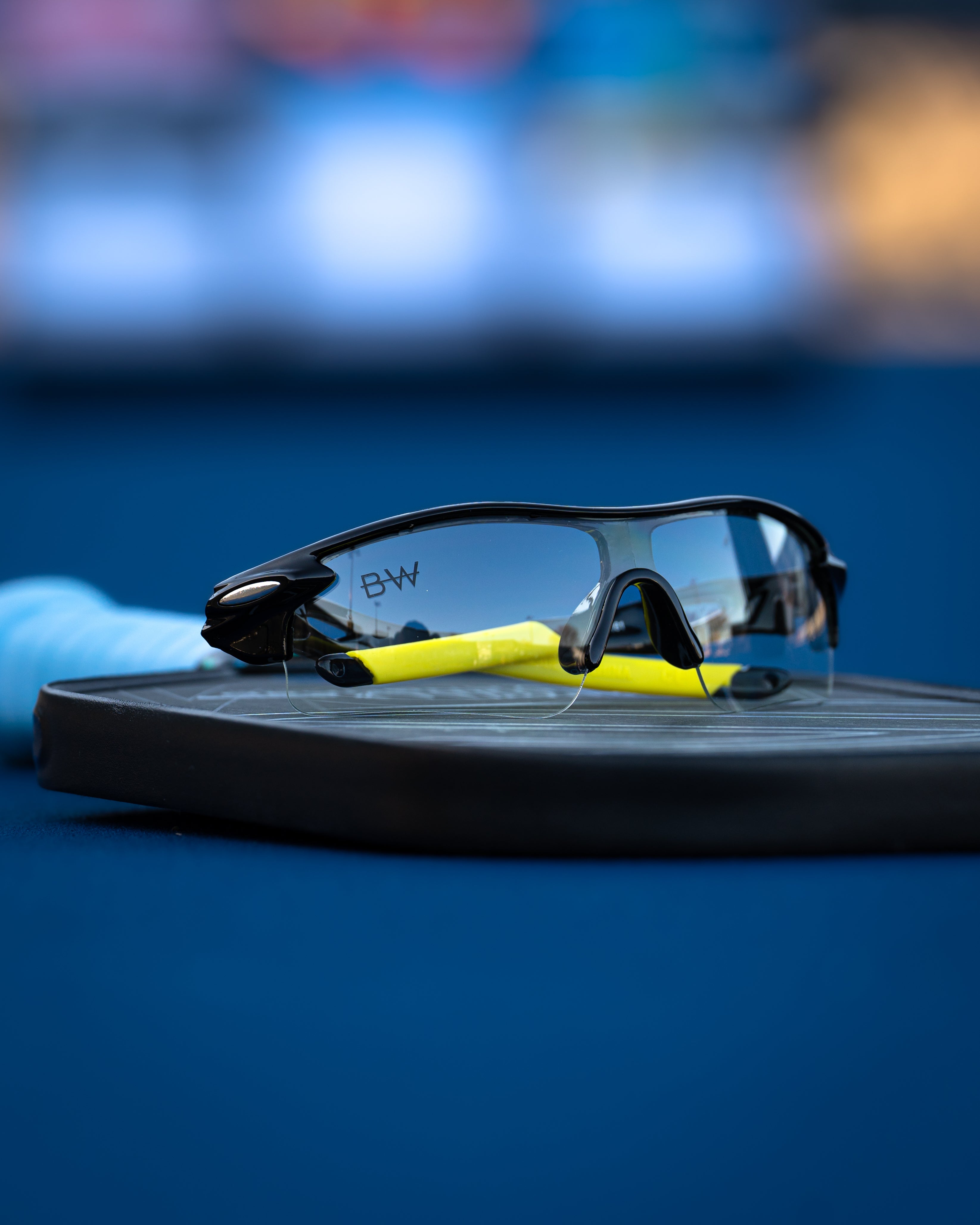
The Visual Advantage: How RX Glasses Improve Shot Accuracy 🎯
Share
The Visual Advantage: How RX Glasses Support Shot Accuracy in Pickleball
Pickleball accuracy looks simple from the outside: see the target, swing the paddle, and place the ball where you want it. In reality, every accurate dink, drive, serve, volley, and reset combines vision, positioning, anticipation, decision-making, movement, and technique.
For players who require prescription correction, properly corrected vision is one piece of that system. RX sports glasses can provide the correction a player needs on the court—but they should not be marketed as automatically increasing shot accuracy, reaction speed, depth perception, or ball-tracking ability.
The better question is: How does appropriate vision correction fit into accurate pickleball? This guide separates the real role of RX eyewear from exaggerated performance claims and shows you what actually goes into placing the ball where you intend.
Find Pickleball Eyewear for Your Vision Needs
What Does Vision Have to Do With Pickleball Shot Accuracy?
Vision supplies information used during the shot. The player still has to interpret that information and execute the movement.
During a rally, you may be processing:
- The approaching ball
- Ball trajectory
- Opponent preparation and positioning
- Your own position relative to the court
- Your partner's location in doubles
- Available court space
- The intended target
Then your body must produce the paddle movement required to execute the shot.
This is why accuracy should not be reduced to a single lens feature. Vision provides information; athletic execution determines what happens with it.
Do Prescription Glasses Improve Pickleball Shot Accuracy?
If you require prescription correction, RX eyewear can provide that correction while you play. That is a meaningful function without needing to promise an automatic improvement in your accuracy percentage.
However, it is too broad to say that putting on RX sports glasses inherently makes every player:
- Hit targets more accurately
- React faster
- Judge depth more precisely
- Read spin earlier
- Track the ball better
- Make fewer unforced errors
Shot accuracy depends on more than correction alone.
| RX Eyewear Can Reasonably Provide | RX Eyewear Does Not Automatically Provide |
|---|---|
| Your required prescription correction | Perfect shot placement |
| A sports-oriented frame for play | Faster neurological processing |
| A lens configuration suited to your selected product | Automatic improvement in depth perception |
| A consistent corrective setup during play | Automatic spin recognition |
| Available sports-eyewear features | Better technique or tactical decisions |
The Shot-Accuracy Chain: From Seeing the Ball to Hitting the Target
An accurate pickleball shot is the result of a sequence—not one isolated visual event.
- Information: The ball, opponents, court, and other visual information are available.
- Recognition: You identify what is happening.
- Decision: You select a response and target.
- Positioning: Your body arrives in a workable position.
- Preparation: Your paddle and body prepare for contact.
- Contact: You execute the swing.
- Control: Paddle angle, speed, direction, and timing influence the resulting shot.
A problem anywhere in that chain can produce an inaccurate ball.
Visual Acuity vs. Shot Accuracy: They're Not the Same Thing
Visual acuity and athletic accuracy describe different things.
| Concept | What It Describes |
|---|---|
| Visual Acuity | A measure related to resolving visual detail |
| Prescription Correction | Optical correction for the wearer's refractive needs |
| Depth Perception | Perception of spatial relationships and distance using multiple cues |
| Ball Tracking | Following and processing information about a moving ball |
| Shot Accuracy | How successfully the executed shot reaches its intended target |
Improving one measurement does not automatically establish a specific percentage improvement in another.
Can Uncorrected Blur Affect Pickleball?
If you have a refractive error that requires correction, playing without the correction you need can change the visual information available to you.
That does not mean every missed shot can be blamed on blur. It means that appropriate correction should be treated as part of your normal visual setup rather than expecting technique to compensate for a prescription need.
If your prescription vision seems unexpectedly blurry even while wearing your corrective eyewear, consider whether the issue needs evaluation rather than assuming another sports-lens feature will solve it.
Does RX Eyewear Improve Depth Perception?
Depth perception matters when players interpret spatial relationships on the court, but it is too broad to claim that RX sports glasses inherently “boost” depth perception.
Prescription correction and depth perception are related but distinct concepts. Individual visual needs also differ.
For a deeper explanation, see Depth Perception Science in Pickleball →
Does Better Correction Automatically Mean Better Ball Tracking?
Ball tracking involves processing information about a moving object while you are also moving, positioning, anticipating, and preparing a response.
RX correction can provide the correction required by the wearer, but it should not automatically be described as making the eyes track faster or making the brain process motion more quickly.
Players develop sport-specific tracking experience by repeatedly seeing realistic trajectories during practice and competition.
Can RX Glasses Help You Read Pickleball Spin?
Players can use several sources of information when interpreting spin:
- Opponent preparation
- Paddle movement
- Contact
- Ball trajectory
- Ball movement after the bounce
- Previous patterns from the same opponent
Prescription correction can provide the visual correction you require while observing those cues. It should not be marketed as automatically enhancing spin recognition.
Do RX Glasses Make Your Reactions Faster?
No universal reaction-time improvement should be promised simply because someone begins wearing prescription sports glasses.
Pickleball reaction involves more than visual correction:
- Information becomes available.
- You recognize the situation.
- You choose a response.
- Your body initiates movement.
- You execute the shot.
That is why claims that RX eyewear saves a specific number of milliseconds or produces a specific percentage improvement require evidence involving the exact product, population, comparison, and task.
Why Clearer Vision Can't Replace Paddle Technique
You can see your target clearly and still miss it.
Common execution problems include:
- Incorrect paddle angle
- Late contact
- Poor spacing
- Excessive swing speed
- Loss of balance
- Poor footwork
- Changing the target too late
- Trying a low-percentage shot
RX eyewear cannot correct these technical or tactical issues.
This distinction is important because the most useful equipment supports the player without pretending to replace skill development.
RX Vision and Dink Accuracy
Dinking requires controlled execution in a relatively small target area. If you require prescription correction, wearing appropriate RX eyewear provides that correction while you process the ball and court.
But consistently placing a dink still requires:
- Good positioning
- Stable balance
- Appropriate paddle control
- Contact in a manageable position
- Target selection
- Repetition
A prescription lens cannot determine the correct paddle angle or control your swing.
RX Vision and Drive Accuracy
Drives introduce more speed, making preparation and contact quality especially important.
Instead of expecting eyewear to “lock in” your target, work through the actual accuracy sequence:
- Recognize the incoming ball.
- Move into position.
- Select the intended target.
- Prepare the paddle.
- Maintain balance.
- Execute the swing.
If your correction is required to see appropriately, use it. Then train the movement pattern that produces the shot.
Does RX Eyewear Improve Serve Accuracy?
A serve begins under relatively controlled conditions compared with an open rally, making it a useful example of why vision and execution should be separated.
Serve accuracy can depend on:
- Starting position
- Routine
- Ball release
- Contact
- Paddle path
- Target selection
- Repetition
Prescription correction may be part of your normal visual setup, but it does not automatically produce a more accurate serve.
What About Return Accuracy?
A return adds another variable: you are responding to an opponent's serve.
Now accuracy involves receiving visual information, moving, establishing spacing, selecting a target, and executing the return.
This makes return practice especially valuable because it combines visual information with real movement rather than isolating accuracy as a purely optical problem.
Why Volley Accuracy Feels Different at the Kitchen
At the kitchen line, exchanges can develop quickly. Players have less time to correct poor positioning or late preparation.
If a volley repeatedly misses its intended target, investigate:
- Ready position
- Paddle preparation
- Contact point
- Balance
- Paddle angle
- Decision timing
- Whether the target was realistic
Do not automatically conclude that the lens failed to provide enough “visual processing speed.”
Reset Accuracy: Vision Plus Control
Transition-zone resets are another example of the interaction between perception and execution.
You must recognize the incoming ball while managing your position and paddle response. A corrective lens can provide required RX correction, but the soft control needed for a successful reset is developed through practice.
Seeing the ball and controlling the ball are connected tasks—but they are not the same task.
Sometimes the Accuracy Problem Is Actually Target Selection
A ball can land exactly where you aimed and still be a poor pickleball decision.
That is why “accuracy” should include more than the ability to hit a tiny target.
Good players also learn:
- When to aim safely inside the lines
- When the middle is the higher-percentage target
- When an aggressive angle is justified
- When simply keeping the ball in play is valuable
- When an opponent's position changes the best target
Better tactical choices can make a player look more accurate even though no lens characteristic has changed.
Why Shot Accuracy Can Change Under Pressure
A player may hit a target repeatedly in practice and miss the same shot at 10–10.
That does not necessarily mean vision changed.
Competition can change:
- Shot selection
- Movement
- Swing tension
- Timing
- Attention
- Decision-making
One way to prepare is to practice accuracy inside scored, unpredictable rallies rather than relying only on stationary target drills.
Can RX Glasses Build Confidence?
Confidence should not be presented as an automatic optical effect of prescription eyewear.
However, a player who requires correction may value having a familiar corrective setup specifically intended for sports use.
Equipment familiarity can become part of a broader preparation routine alongside practice, technique, tactics, and match experience.
The distinction matters: the glasses provide correction; the player develops confidence through preparation and experience.
Does Shot Accuracy Change Indoors vs. Outdoors?
Indoor and outdoor courts can present different lighting and background environments. Players may also prefer different lens configurations across those environments.
| Playing Environment | Eyewear Starting Point |
|---|---|
| Primarily Indoor | Consider clear RX when correction is required and dark sunglass tint is not preferred |
| Primarily Outdoor | Compare current outdoor RX configurations |
| Indoor + Outdoor | Compare photochromic RX with dedicated environment-specific pairs |
| Blue-Light Filtering Preference | Compare a verified blue-light-filtering RX option |
| Contacts Provide Correction | Compare non-RX sports eyewear |
A change in environment should not automatically be translated into claims that indoor glare distorts timing or outdoor conditions alter depth perception.
Clear RX Glasses for Indoor Pickleball
If you require prescription correction indoors and do not want dark sunglass tint, clear RX eyewear is a straightforward category to consider.
Clear lenses should not automatically be described as:
- Increasing available light
- Improving contrast
- Reducing glare
- Improving shot accuracy
- Making ball tracking faster
The useful distinction is simpler: clear lenses do not use dark sunglass tint.
Do Non-Polarized Lenses Improve Shot Accuracy?
Blinded Wear sports eyewear uses non-polarized lenses. A non-polarized lens does not add a polarization filter, preserving the visual information available without that filter.
Some court players prefer non-polarized eyewear.
However, non-polarized lenses should not automatically be described as improving:
- Shot accuracy
- Depth perception
- Reaction time
- Ball tracking
- Spin recognition
Do High-Index RX Lenses Make Your Shots More Accurate?
High-index describes a prescription lens-material category. It should not automatically be associated with better shot accuracy, faster visual processing, improved contrast, or “pinpoint” depth perception.
Blinded Wear includes high-index prescription lenses at no additional cost with RX eyewear.
That verified benefit can stand on its own without attaching an unsupported performance percentage to it.
Impact-Resistant Lenses and Pickleball
Blinded Wear sports eyewear uses impact-resistant lenses.
Impact resistance describes a lens characteristic. It does not automatically mean the lens is:
- Shatterproof
- Unbreakable
- Certified to a particular protective standard
- More accurate optically
- Capable of improving athletic performance
Keep impact resistance separate from unrelated optical and performance claims.
Blinded Wear RX Pickleball Glasses to Compare
Rather than ranking RX frames by unsupported promises about accuracy or reaction time, compare their current configurations, designs, dimensions, and verified characteristics.
| RX Frame | What to Compare | Explore |
|---|---|---|
| Rocket Fire RX | Current RX configuration, frame design, and dimensions | Rocket Fire RX |
| Frost RX | Current RX configuration, frame design, and dimensions | Frost RX |
| Ocean Wave RX | Current RX configuration, frame design, and dimensions | Ocean Wave RX |
| Phantom II RX | Current prescription configuration and frame design | Phantom II RX |
| Silver Line RX | Current prescription sunglass configuration and frame design | Silver Line RX |
| Red Shine RX | Current prescription sunglass configuration and frame design | Red Shine RX |
| H Blue Shield RX | Compare when blue-light filtering is specifically part of your preferences | H Blue Shield RX |
What Blinded Wear RX Eyewear Actually Offers
Shot-accuracy marketing does not need to rely on promises such as “40% more accurate” or “perfect optical centering.” Focus on verified characteristics instead.
- Designed for pickleball players
- Lightweight sports frames
- Impact-resistant lenses
- Non-polarized lenses
- Comfortable for extended matches
- Suitable for recreational and competitive players
- Performance-first design
- High-index prescription lenses included at no additional cost
- 50% lifetime replacement support if glasses break, subject to current policy terms
8 RX Shot-Accuracy Myths to Avoid
1. “RX Glasses Automatically Improve Accuracy”
RX eyewear provides required prescription correction. A universal improvement in shot accuracy should not be promised.
2. “Every Bit of Blur Ruins Depth Perception”
Vision and depth perception are more complex than a universal one-to-one claim between blur and missed shots.
3. “RX Glasses Make You React Faster”
No automatic reaction-time improvement should be attributed to prescription sports eyewear.
4. “Sports Frames Guarantee Perfect Optical Alignment During Movement”
Do not claim perfect centering or visual stability during rapid movement unless the exact characteristic is verified.
5. “Anti-Glare Technology Prevents Missed Shots”
Do not claim an anti-glare feature unless verified, and do not automatically connect it to shot accuracy.
6. “High-Index Means More Accurate Vision”
High-index describes a lens-material category, not a guaranteed sports-performance improvement.
7. “RX Lenses Automatically Help You Read Spin”
Spin recognition involves available visual information, opponent cues, ball movement, and experience.
8. “Better Vision Replaces Technique”
Appropriate correction supports your visual needs. The player still develops movement, paddle control, positioning, and decision-making.
FAQs About RX Glasses and Pickleball Shot Accuracy
Do RX glasses improve pickleball accuracy?
If you require prescription correction, RX glasses can provide that correction while you play. They should not be presented as guaranteeing a specific improvement in shot accuracy.
Can prescription glasses help me see the pickleball more clearly?
Prescription eyewear is designed to provide the correction prescribed for the wearer. Individual visual needs vary.
Will RX sports glasses make my reactions faster?
No universal reaction-time improvement should be promised from RX eyewear alone.
Can RX glasses improve depth perception?
Do not assume prescription sports glasses inherently increase depth perception. Correction and depth perception are related but distinct visual concepts.
Can RX glasses help me read spin?
Prescription correction can provide the correction you require while observing the rally, but improved spin recognition should not automatically be attributed to the eyewear.
Can RX glasses improve dink accuracy?
RX correction can be part of your visual setup, while dink accuracy also depends on positioning, paddle control, contact, target selection, and practice.
Can RX glasses improve serve accuracy?
No automatic improvement should be promised. Serve accuracy depends heavily on repeatable technique and target control.
Can RX glasses improve volley accuracy?
Prescription correction can provide required visual correction, but volley accuracy also depends on preparation, positioning, contact, paddle angle, and decision-making.
Should I use clear RX glasses indoors?
If you require prescription correction and do not want dark sunglass tint indoors, clear RX eyewear is a category to consider.
Does Blinded Wear offer high-index RX lenses?
Yes. High-index prescription lenses are included at no additional cost with Blinded Wear RX eyewear.
Are Blinded Wear sports lenses polarized?
Blinded Wear sports eyewear uses non-polarized lenses.
What if my glasses break?
Blinded Wear offers 50% lifetime replacement support if glasses break, subject to current policy terms.
Why Are Your Pickleball Shots Missing?
When a player misses a target, “I didn't see it well enough” is only one possible explanation. Before changing eyewear, identify where the shot actually broke down.
| What Happened | Possible Issue to Investigate |
|---|---|
| Ball repeatedly goes long | Paddle angle, swing speed, contact, target margin, or technique |
| Ball repeatedly goes into the net | Paddle angle, contact height, spacing, movement, or shot selection |
| You feel late against fast balls | Preparation, positioning, anticipation, decision timing, or technique |
| You misread opponent shots | Recognition, anticipation, positioning, or experience |
| Your vision seems blurry | Prescription or another visual issue may need attention |
| Accuracy drops only under pressure | Decision-making, tension, timing, or competitive execution |
| Accuracy falls late in matches | Fatigue, movement, concentration, technique, or decision quality |
| New RX eyewear feels unfamiliar | Allow appropriate familiarization and verify the prescription if something seems wrong |
The more precisely you identify the problem, the less likely you are to buy a lens feature expecting it to solve something that is actually technical, tactical, or physical.
Shot Accuracy Starts Before Paddle Contact
The final paddle-ball contact gets most of the attention, but much of the shot has already been shaped before contact occurs.
A useful sequence is:
- Recognize the developing ball.
- Move into a workable position.
- Create appropriate spacing.
- Select a realistic target.
- Prepare the paddle.
- Contact the ball.
- Recover for the next shot.
If you arrive late or poorly spaced, even a clear view of the ball cannot automatically rescue the shot.
This is why accurate pickleball is best understood as a perception-to-action skill rather than simply an eyesight test.
Want Better Accuracy? Stop Aiming at Targets That Are Too Small
One of the easiest ways to misunderstand accuracy is to judge every shot by how close it lands to a line.
Competitive accuracy often means selecting a target large enough to make the shot repeatable while still accomplishing the tactical goal.
| Approach | Potential Result |
|---|---|
| Aim directly at a sideline | Very little margin for directional error |
| Aim safely inside the boundary | More room for normal execution variation |
| Force a tiny opening | Requires more precise execution |
| Choose a larger available space | Can provide a more forgiving target |
| Change targets during the swing | Can disrupt committed execution |
Sometimes the fastest path toward more successful placement is not seeing a smaller target—it is choosing a smarter one.
Accuracy vs. Precision: A Useful Difference for Pickleball
Players often use accuracy and precision interchangeably, but separating them can make training more useful.
For practical pickleball training:
- Accuracy: Are your shots reaching the intended target area?
- Consistency: Can you produce a similar result repeatedly?
- Precision: How tightly are your shots grouped?
A player who occasionally hits a perfect sideline but sprays the next five balls may have less useful control than a player consistently landing inside a larger tactical target.
Track repeatable outcomes rather than highlight-reel shots.
A Better Way to Train Pickleball Shot Accuracy
Target drills can be useful, but accuracy training should eventually resemble the game itself.
Level 1: Stationary Target Practice
Choose a large target zone and develop repeatable control without significant movement or decision pressure.
Level 2: Add Movement
Move before contact so positioning becomes part of the task.
Level 3: Add Multiple Targets
Use two or more possible target zones so placement requires a decision.
Level 4: Add an Opponent
Let opponent positioning influence the target.
Level 5: Add Uncertainty
Randomize the incoming ball so you cannot predetermine every response.
Level 6: Add Scoring
Use normal points or competitive drills so target selection and execution occur under realistic pressure.
If you require prescription correction, wear your intended RX sports glasses during these later stages so your competition setup is familiar.
The 3-Zone Accuracy Drill
Instead of trying to hit tiny cones, divide the opponent's court into three practical target zones:
- Left zone
- Middle zone
- Right zone
Begin with a predictable feed and call the intended zone before contact.
Once you can reliably direct the ball, make the drill more realistic:
- Randomize the incoming feed.
- Require movement before contact.
- Add an opponent.
- Choose the target based on opponent position.
- Finish by using the same concept during open points.
This progresses from pure placement toward actual pickleball decision-making.
Dink Accuracy Drill: Build Control Before Chasing the Sidelines
Create a reasonably sized crosscourt target area rather than aiming directly for the line.
Then progress through:
- 10 controlled crosscourt dinks
- 10 controlled middle dinks
- Alternating crosscourt and middle targets
- Random target selection
- Live dinking with an opponent
- Dink-or-speed-up points
The final stages matter because match accuracy requires recognizing when the intended shot is appropriate—not simply hitting a predetermined target.
Serve Accuracy Drill: Measure Repeatability
Divide the service box into broad target regions and record where each serve lands.
Instead of counting only perfect targets, track:
- Total serves attempted
- Serves in
- Serves reaching the intended target region
- Common miss direction
For example, if most misses consistently travel long, that pattern gives you more useful information than simply recording “miss.”
Repeat the drill over multiple sessions before deciding that equipment caused a change in performance.
Return Accuracy Drill: Add the Incoming Ball
Serve-return practice moves accuracy training closer to actual competition because the player no longer controls the incoming ball.
Have a partner vary serve location while you attempt to return into a broad target area.
Track:
- Returns in play
- Returns reaching the intended area
- Miss direction
- Whether poor movement preceded the miss
- Whether target selection changed late
This helps separate visual information from movement and execution problems.
Third-Shot Accuracy: Drive, Drop, or Something Else?
Third-shot accuracy cannot be evaluated without considering the shot you selected.
If you attempt a drop, the objective and acceptable trajectory differ from a drive. If you choose an aggressive angle, the available margin may be smaller than a more conservative middle target.
Before labeling the result inaccurate, ask:
- Was the shot selection appropriate?
- Was I balanced?
- Did I have enough space to execute it?
- Was the target realistic?
- Did I commit to the decision?
These questions are often more useful than assuming you need a lens that “improves aim.”
Shot Accuracy in Doubles Is Also About Your Partner
Doubles adds another layer to accurate placement because the best target depends partly on where four players are positioned.
You may need to consider:
- Your position
- Your partner's position
- The ball-side opponent
- The other opponent
- Open court space
- Middle coverage
- Likely opponent responses
This is one reason tactical awareness can improve match results even when a player's raw ability to hit a target has not changed.
Shot Accuracy in Singles: Placement Meets Court Coverage
Singles creates different positioning and recovery demands. Because more court is your responsibility, target selection should account for where you can recover after the shot.
A technically accurate shot that leaves you badly positioned for the next ball may still be a poor tactical choice.
Useful singles accuracy therefore combines:
- Placement
- Movement
- Opponent positioning
- Recovery
- Risk management
Again, the visual system provides information, but the player has to turn that information into a useful decision.
Anticipation Can Make Accurate Shots Easier to Execute
Imagine two players who see the same incoming ball. One recognizes the developing pattern early and begins preparing. The other recognizes it later and rushes the response.
The first player may appear to have “faster vision,” even though the difference could involve experience and anticipation.
Pattern recognition can give a player more useful preparation time by helping them interpret:
- Opponent positioning
- Paddle preparation
- Previous shot patterns
- Likely court openings
- Common responses from similar situations
This is developed through sport-specific experience—not automatically installed by RX lenses.
Why Practice in the RX Glasses You Plan to Compete In?
If you rely on prescription correction during pickleball, your eyewear becomes part of your normal playing setup.
Using your intended pair during practice allows you to become familiar with the complete setup before an important match.
A sensible progression for new RX sports eyewear is:
- Normal everyday wear where appropriate
- Controlled pickleball drills
- Movement drills
- Live rallies
- Full games
- Competitive play
Familiarity should not be confused with a claim that the eyewear itself trains accuracy. The player is training; the eyewear is providing the prescribed correction.
What If a New Prescription Feels Different on Court?
A new corrective setup may feel different from what you are accustomed to. That does not automatically mean the eyewear is defective or that your athletic performance will improve once you “push through” it.
If something seems unexpectedly wrong, especially persistent blur or another concerning visual change, appropriate professional evaluation is more useful than trying to solve the problem through additional sports drills.
Training should not be used as a substitute for evaluating an actual prescription or vision concern.
Keep Your Pickleball Lenses Clean Without Turning Cleaning Into a Performance Claim
Dirty or obstructed eyewear can simply be annoying during play, so normal lens care is worthwhile.
Follow appropriate care instructions for your eyewear and keep the lenses reasonably clean before competition.
However, avoid claims that microscopic debris automatically creates measurable visual shifts or that perfectly clean lenses guarantee consistent shot accuracy.
Clean eyewear is good equipment care—not an accuracy hack.
How Court Lighting Fits Into Shot Accuracy
Indoor and outdoor courts can create different visual environments, but lighting should not automatically be blamed for every missed target.
If you regularly play across different conditions, think about your eyewear configuration before competition:
| Routine | Eyewear Strategy to Consider |
|---|---|
| Mostly Indoor | Clear RX when prescription correction is required and dark tint is not preferred |
| Mostly Outdoor | Compare available outdoor RX configurations |
| Indoor + Outdoor | Compare photochromic RX with separate environment-specific pairs |
| Specific Blue-Light Preference | Compare verified blue-light-filtering RX options |
Lens selection can be based on your environment without claiming the lens automatically increases your shot accuracy.
Do Photochromic RX Lenses Improve Accuracy?
Photochromic lenses provide changing-tint functionality under appropriate conditions.
That functionality may be useful to players whose routines include changing environments, but it should not automatically be described as improving:
- Shot placement
- Depth perception
- Reaction speed
- Contrast
- Spin recognition
The value proposition is the changing-tint functionality itself.
Do Blue-Light RX Glasses Improve Indoor Shot Accuracy?
Blue-light filtering is a lens characteristic, not an automatic accuracy-enhancement technology.
If blue-light filtering is specifically important to you, compare an RX option that provides that characteristic. Do not assume the filter automatically:
- Improves aim
- Eliminates LED glare
- Reduces visual fatigue
- Improves ball tracking
- Speeds reactions
Does Sports-Frame Fit Affect Shot Accuracy?
A sports frame should be evaluated as eyewear, but avoid turning general fit characteristics into guaranteed accuracy claims.
If fit is important to your buying decision:
- Review current product dimensions when available.
- Compare them with glasses that already fit you well.
- Consider your own comfort preferences.
- Become familiar with the frame during practice.
Do not assume a frame provides anti-slip temples, perfect optical centering, non-slip performance, or a custom fit unless those exact characteristics are verified for the product.
How to Measure Whether Your Shot Accuracy Is Actually Improving
If you want to know whether training is working, collect repeatable pickleball-specific information instead of relying only on how accurate you felt.
| Metric | Example |
|---|---|
| Target Success | Shots landing inside the intended zone ÷ total attempts |
| Serve Percentage | Legal serves in ÷ total serves |
| Return Success | Returns successfully placed in play ÷ total returns |
| Miss Direction | Long, short, left, right, or net |
| Unforced Errors | Track patterns rather than blaming individual misses on equipment |
| Pressure Accuracy | Compare controlled drills with scored or competitive drills |
Tracking patterns over time is more useful than claiming a new pair of glasses made you “40% more accurate” after one session.
Use Video to Find the Real Cause of Inaccurate Shots
Video can help reveal problems that are difficult to notice while playing.
When reviewing a miss, look at:
- Your starting position
- Your first movement toward the ball
- Your spacing at contact
- Your balance
- Your paddle preparation
- Your contact point
- Your recovery
Then compare successful and unsuccessful attempts.
This can reveal repeatable movement patterns without assuming the cause was visual.
A 4-Week Pickleball Shot-Accuracy Training Plan
Week 1: Build Repeatable Targets
- Use large target zones.
- Practice serves, dinks, and returns.
- Record common miss directions.
- Prioritize repeatable technique over tiny targets.
Week 2: Add Movement
- Move before each target attempt.
- Practice wide-ball recovery.
- Add transition-zone resets.
- Track whether misses occur after poor positioning.
Week 3: Add Decisions
- Use multiple possible target zones.
- Let opponent position determine the target.
- Mix drops and drives.
- Practice dink-or-speed-up decisions.
Week 4: Add Match Pressure
- Play scored target drills.
- Start games at pressure scores.
- Play open points.
- Use the RX eyewear you intend to compete in.
- Track outcomes rather than individual highlight shots.
This progression trains the athlete behind the lenses rather than assigning the improvement to eyewear alone.
RX Pickleball Glasses Buying Checklist
If shot accuracy is your reason for researching prescription sports eyewear, keep the buying process grounded in what the eyewear can actually provide.
- ☐ Start with the prescription correction you require.
- ☐ Identify whether you primarily play indoors, outdoors, or both.
- ☐ Compare available lens configurations.
- ☐ Review current frame dimensions when available.
- ☐ Compare dimensions with eyewear that already fits you.
- ☐ Distinguish verified features from performance marketing.
- ☐ Practice in the finished eyewear before important competition.
- ☐ Consider another corrective option if you rely on RX eyewear during tournaments.
How to Order Blinded Wear RX Pickleball Glasses
- Have your current eyeglass prescription available.
- Browse the RX pickleball collection.
- Compare frame designs and available configurations.
- Consider where you play most often.
- Upload a clear photo or picture of your eyeglass prescription before purchasing.
High-index prescription lenses are included at no additional cost with Blinded Wear RX eyewear.
Replacement Support for Your RX Pickleball Glasses
Blinded Wear offers 50% lifetime replacement support if glasses break, subject to current policy terms.
This should not be interpreted as meaning the eyewear is unbreakable, that every type of damage is automatically covered, or that every replacement is free.
More Questions About RX Glasses & Shot Accuracy
Why am I still missing shots even with the correct prescription?
Shot accuracy also depends on positioning, movement, timing, paddle control, target selection, decision-making, and technique. Corrective eyewear cannot eliminate those variables.
Can I become more accurate by practicing in my RX glasses?
Practice can improve your pickleball skills, and players who require prescription correction can practice in their intended corrective setup. The training effect should not automatically be attributed to the glasses themselves.
Should I aim directly at pickleball court lines?
Not necessarily. Larger target areas can provide more margin and may be more appropriate depending on the tactical situation.
What's the best way to practice accuracy?
Start with repeatable target zones, then progressively add movement, decisions, opponents, uncertainty, and scoring.
How can I tell whether my accuracy is improving?
Track target success, serve percentage, return success, miss direction, and performance during increasingly realistic drills.
Does better ball tracking guarantee better accuracy?
No. Even when the incoming ball is recognized correctly, the player must still position, decide, prepare, and execute the shot.
Does a lightweight frame improve accuracy?
Blinded Wear uses lightweight sports frames, but an automatic improvement in shot accuracy should not be attributed to frame weight.
Do impact-resistant lenses improve visual accuracy?
No. Impact resistance describes a lens characteristic and should not be confused with optical or athletic accuracy.
Can photochromic lenses make my shots more consistent?
Photochromic lenses provide changing-tint functionality under appropriate conditions. Consistent shot execution should not automatically be attributed to that feature.
Do I need special lenses for accurate indoor play?
If you require prescription correction indoors, start with your corrective needs. Clear RX can be considered when you do not want dark sunglass tint, while other available characteristics can be evaluated separately.
Should tournament players carry backup RX glasses?
If prescription correction is important to your ability to play, another suitable corrective option can provide useful redundancy if your primary pair becomes unavailable.
What if my prescription seems wrong while playing?
If you experience persistent unexpected blur or another concerning visual issue, appropriate professional evaluation is more useful than trying to correct it through sports drills or lens marketing.
Your Match-Day Shot Accuracy System
Once your prescription and eyewear setup are handled, match-day accuracy becomes less about searching for another lens feature and more about creating repeatable decisions and execution.
Use a simple sequence:
- See: Take in the ball, opponents, partner, and available court.
- Recognize: Identify the developing situation.
- Move: Get your body into a workable position.
- Choose: Select a realistic target before contact.
- Commit: Execute the intended shot without a late target change.
- Recover: Prepare for the next ball instead of watching your previous shot.
Prescription correction can support the first part of that process when you require it. The remaining steps belong to the player.
Before the Match: Remove Avoidable Variables
You cannot control every bounce, opponent, or rally, but you can make your equipment setup predictable before competition begins.
- Wear the RX eyewear you already practiced in.
- Make sure your lenses are reasonably clean.
- Confirm that your intended eyewear matches the playing environment.
- Bring another suitable corrective option when appropriate.
- Use warm-up to experience the actual court and background.
- Avoid introducing unfamiliar eyewear immediately before an important match.
The objective is not to create “perfect vision.” It is to avoid unnecessary equipment uncertainty once the match begins.
A 5-Minute Pickleball Accuracy Warm-Up
Use warm-up to connect your visual information, movement, and paddle control before points count.
Minute 1: Dinks
Use broad crosscourt and middle targets. Focus on controlled placement rather than hitting lines.
Minute 2: Volleys
Alternate directions while maintaining a compact, controlled response.
Minute 3: Resets
Move through the transition area and practice controlling incoming pace.
Minute 4: Drives & Returns
Choose a target before contact and note whether misses follow poor spacing or late preparation.
Minute 5: Serves
Finish with several serves toward realistic target areas rather than tiny corners.
This warm-up does more than ask whether the ball “looks clear.” It tests whether your complete playing setup feels familiar under realistic movement.
Where Should Your Attention Go During a Rally?
Accurate placement requires more than staring at the location where you want the ball to land.
During a point, relevant information can include:
- The incoming ball
- The opponent contacting it
- Opponent movement
- Your partner's position
- Open court space
- Your own balance and positioning
Different moments require attention to different information. The objective is not to keep your eyes permanently locked onto one object; it is to gather enough useful information to make and execute the next decision.
Choose the Target Before Contact
Late indecision can make an otherwise manageable shot more difficult.
When possible, identify the intended target before the final stage of the swing. Then execute the selected shot rather than repeatedly changing your mind as the ball arrives.
A simple mental cue is:
Recognize → Choose → Commit → Recover.
This does not guarantee accuracy, but it gives your decision and execution a clear sequence.
5 High-Value Target Concepts for More Controlled Pickleball
1. Use the Middle
The middle can provide a larger target and can also create decision pressure between opponents in some doubles situations.
2. Give Yourself Margin
Aiming safely inside a boundary leaves more room for normal execution variation than aiming directly at the line.
3. Respect Your Position
A difficult ball may call for a more conservative target than a ball contacted from a balanced position.
4. Notice Opponent Position
Available court space can change throughout the rally.
5. Think About the Next Ball
The best target is not always the one most likely to end the point immediately. Placement can also be used to create a more favorable next shot.
Accuracy Is Also Risk Management
A player can become more effective without suddenly gaining the ability to hit smaller targets.
Consider two options:
| Shot Choice | Execution Demand | Margin |
|---|---|---|
| Sideline winner | Higher directional precision required | Small |
| Aggressive angle | More demanding placement | Smaller |
| Deep central return | Broader target available | Larger |
| Controlled middle dink | Can use a larger target area | Larger |
| Defensive reset | Prioritizes regaining control | Depends on situation |
Shot selection determines how much accuracy the situation demands before your paddle ever contacts the ball.
When Accuracy Disappears Under Pressure, Simplify
If your placement becomes less consistent late in a close game, adding more technical thoughts can make execution harder.
Try a simple between-point routine:
- Reset after the previous rally.
- Identify the next basic tactical intention.
- Choose a realistic target.
- Return to your ready position.
- Play the next ball rather than replaying the previous miss.
If you can execute large targets consistently under pressure, you can gradually introduce more demanding placement when the situation justifies it.
Turn Misses Into Useful Information
Instead of labeling every error as “bad accuracy,” classify the miss.
| Miss | Question to Ask |
|---|---|
| Long | Was the paddle angle, swing speed, contact, or target margin appropriate? |
| Into the Net | Was I balanced and contacting the ball from a workable position? |
| Wide | Did I choose too small a target or lose directional control? |
| Late Contact | Was preparation delayed by positioning, recognition, or indecision? |
| Wrong Target | Was the execution inaccurate, or was the decision itself poor? |
| Unexpected Blur | Does my corrective vision need to be evaluated? |
Patterns across multiple shots are more informative than one isolated error.
What the RX Glasses Handle vs. What You Handle
| RX Eyewear | Player |
|---|---|
| Provides required prescription correction | Reads the developing rally |
| Provides the selected lens configuration | Selects the target |
| Provides the physical sports frame | Moves into position |
| Can use clear, tinted, or other available lens configurations | Controls paddle angle and swing |
| Can provide verified lens characteristics | Develops anticipation |
| Becomes part of a familiar playing setup | Builds consistency through practice |
RX eyewear handles correction. You handle execution.
When Does RX Eyewear Matter Most?
If you require prescription correction, the most important reason to consider RX sports eyewear is straightforward: you need corrective vision while participating in the sport.
You do not need a claim that the glasses increase accuracy by a certain percentage to make that relevant.
A sports-oriented RX setup can combine your corrective needs with characteristics such as:
- Lightweight sports frames
- Impact-resistant lenses
- Non-polarized lenses
- Comfort for extended matches
- Available lens configurations for different preferences
Those are more useful buying considerations than unsupported promises about automatic athletic improvement.
When an Accuracy Problem May Actually Be a Vision Problem
Most missed pickleball shots are not evidence of an eye condition. However, an unexpected or persistent change in how you see should not simply be treated as a technique problem either.
If you experience persistent unexpected blur, double vision, a noticeable visual-field change, or another concerning change in vision, consider appropriate evaluation by an eye-care professional.
Likewise, if your current prescription no longer seems to provide the correction you expect, a new sports frame or different tint is not a substitute for addressing the underlying corrective need.
Find Your RX Pickleball Setup in 30 Seconds
| Your Situation | Starting Point |
|---|---|
| I need prescription correction for pickleball | Explore RX Pickleball Glasses |
| I play mainly indoors and don't want dark tint | Explore Clear Lens Eyewear |
| I play in changing environments | Compare photochromic RX with separate environment-specific pairs |
| I specifically want blue-light filtering | Explore H Blue Shield RX |
| I don't need RX in the frame | Explore Non-RX Pickleball Eyewear |
| I'm not sure which category fits me | Take the Pickleball Glasses Quiz |
7 Mistakes to Avoid When Buying RX Glasses for Pickleball Accuracy
1. Expecting the Glasses to Fix Technique
Prescription correction cannot correct paddle angle, footwork, timing, or shot selection.
2. Buying Based on a Reaction-Time Percentage
Specific performance percentages require evidence for the exact product, test, and population.
3. Assuming “Sports Lens” Means Better Depth Perception
Do not infer an automatic depth-perception improvement from a sports-eyewear label.
4. Ignoring Your Actual Playing Environment
Indoor, outdoor, and changing-environment players may prefer different lens configurations.
5. Ignoring Frame Dimensions
If fit matters to you, compare available dimensions with eyewear you already know fits well.
6. Introducing New RX Eyewear During an Important Match
Become familiar with your intended playing setup during practice first.
7. Blaming Every Miss on Vision
Track patterns and evaluate movement, technique, decisions, positioning, and target selection too.
Final FAQs: Prescription Glasses & Pickleball Accuracy
Are prescription sports glasses worth it for pickleball?
If you require prescription correction while playing, RX sports eyewear provides a way to combine that correction with a sports-oriented frame. Whether a particular product suits you depends on your prescription needs, environment, fit preferences, and available lens configuration.
Will RX glasses make me a better pickleball player?
RX glasses can provide the prescription correction you require. Becoming a better player still depends on training, technique, positioning, anticipation, decisions, and match experience.
Can RX glasses make my dinks more accurate?
They can provide required correction while you play, but dink accuracy also depends on balance, spacing, paddle control, contact, target selection, and repetition.
Can RX glasses help with third-shot drops?
Prescription correction can be part of your visual setup. Successful drops still require appropriate positioning, touch, trajectory, paddle control, and decision-making.
Will RX glasses help me hit the sidelines?
No eyewear should guarantee sideline accuracy. In many situations, aiming safely inside the line provides more margin for execution.
Can RX glasses help me stop hitting balls long?
Repeated long misses can involve paddle angle, swing speed, contact, positioning, or target selection. Eyewear should not automatically be assumed to be the cause or solution.
Can RX glasses improve hand-eye coordination?
Do not automatically attribute improved hand-eye coordination to prescription sports eyewear. The glasses provide correction; coordination is part of the player's broader visual-motor performance.
Can RX glasses improve consistency?
No universal consistency improvement should be promised from RX eyewear alone. Consistency is developed through repeatable decisions and execution.
Should I practice with the same glasses I use in tournaments?
If you rely on RX eyewear during competition, practicing in your intended setup can help make the equipment familiar before important matches.
Should I have backup prescription pickleball glasses?
If prescription correction is important to your play, another suitable corrective option can provide useful redundancy.
Does Blinded Wear use polarized lenses?
Blinded Wear sports eyewear uses non-polarized lenses. A non-polarized lens does not add a polarization filter, preserving visual information available without that filter.
Are Blinded Wear RX lenses impact-resistant?
Yes. Blinded Wear sports eyewear uses impact-resistant lenses. Impact-resistant should not automatically be interpreted as shatterproof, unbreakable, or as a specific safety certification.
Do Blinded Wear RX glasses include high-index lenses?
Yes. High-index prescription lenses are included at no additional cost with Blinded Wear RX eyewear.
How do I submit my prescription?
Upload a clear photo or picture of your eyeglass prescription before purchasing RX eyewear.
What happens if my glasses break?
Blinded Wear offers 50% lifetime replacement support if glasses break, subject to current policy terms.
Continue Building Your Pickleball Vision Setup
RX Glasses & Pickleball Shot Accuracy in 30 Seconds
| Question | Bottom Line |
|---|---|
| What is the primary role of RX glasses? | Provide the prescription correction required by the wearer |
| Do RX glasses automatically improve shot accuracy? | No universal accuracy improvement should be assumed |
| Do they automatically improve reaction time? | No |
| Do they automatically improve depth perception? | No universal improvement should be assumed |
| What else determines accuracy? | Positioning, anticipation, decisions, movement, paddle control, contact, and target selection |
| How should accuracy be trained? | Progress from targets to movement, decisions, opponents, uncertainty, and pressure |
| What should RX players do before tournaments? | Practice in the corrective setup they intend to use |
| What should you do if prescription vision seems unexpectedly wrong? | Consider appropriate professional evaluation rather than trying to train through it |
Build Your Visual Setup—Then Build Your Accuracy
If you require prescription correction, your pickleball eyewear has an important job: provide the correction you need in a sports-oriented setup that fits your playing routine.
From there, accuracy is built on the court.
Practice realistic targets. Improve your positioning. Recognize patterns earlier. Choose higher-percentage placements. Develop paddle control. Track your misses. Add pressure to training. Become familiar with the eyewear you intend to compete in.
Blinded Wear RX eyewear combines prescription correction with lightweight sports frames, impact-resistant non-polarized lenses, comfort for extended matches, performance-first design, and high-index prescription lenses included at no additional cost.
The Bottom Line: RX Glasses Correct Vision—Players Develop Accuracy
Prescription sports glasses can be an important part of pickleball for players who require corrective vision. But their value does not depend on promising that a lens automatically makes serves, dinks, drives, volleys, or drops more accurate.
Shot placement is the result of an entire performance chain: visual information, recognition, positioning, target selection, movement, contact, and paddle control.
Use RX eyewear for the correction you require. Choose verified lens and frame characteristics according to your real playing environment. Then develop accuracy through deliberate, increasingly realistic pickleball practice.
The glasses provide the correction. Your decisions choose the target. Your training puts the ball there.