
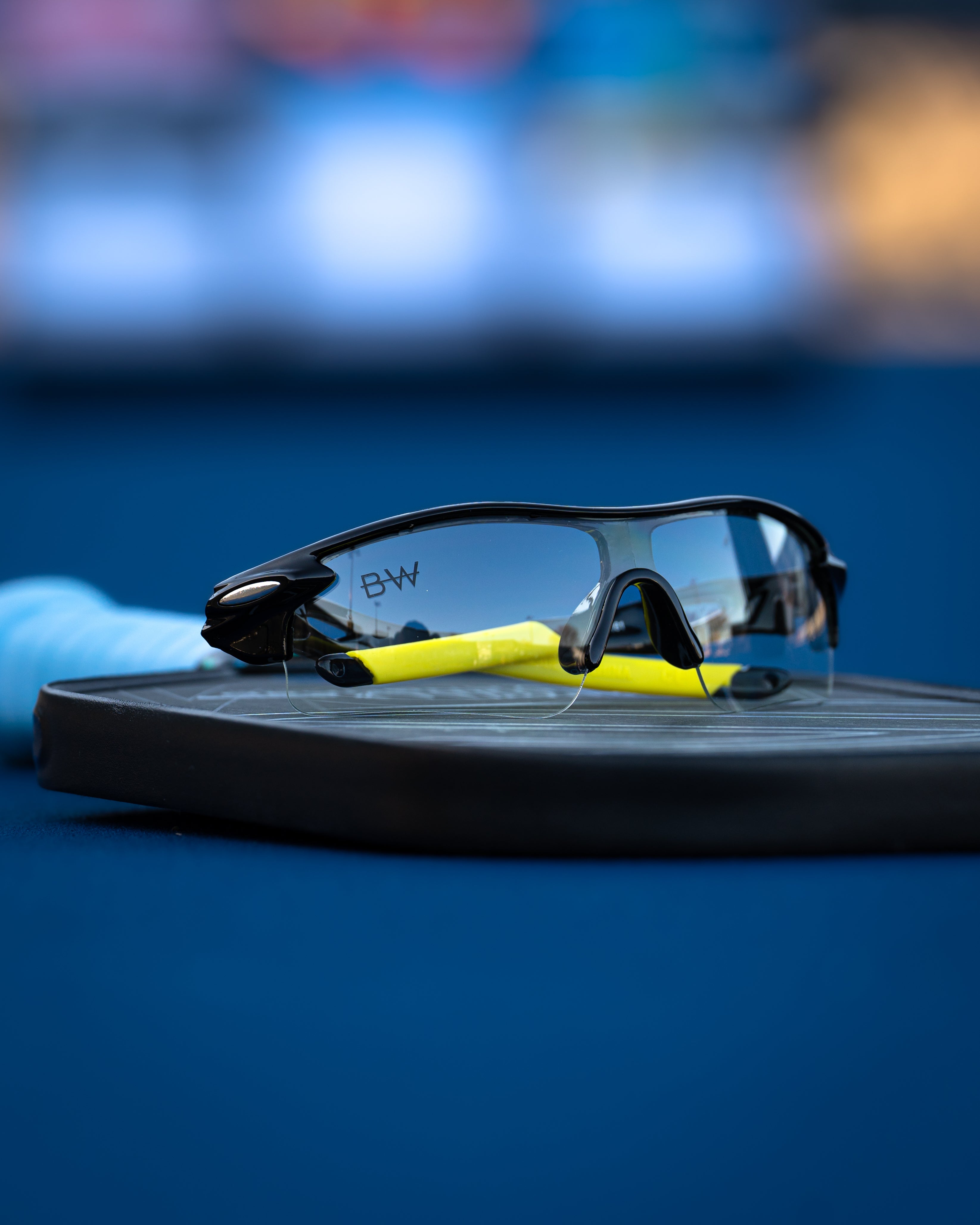
What Does 20/20 Vision Actually Mean? (And Why It Matters on the Court)
Share
What Does 20/20 Vision Actually Mean? (And Why It Matters on the Court)
20/20 vision is a measure of distance visual acuity—not a score for “perfect vision.” In practical terms, it means that at 20 feet, you can resolve detail that a person with standard visual acuity is expected to resolve at 20 feet.
That matters for athletes because sharp distance vision is useful, but visual acuity is only one part of seeing effectively during movement. Pickleball also asks your visual system to deal with changing distances, moving targets, court positioning, lighting, peripheral information, and rapid shifts in attention.
So while 20/20 is an important benchmark, it does not tell you everything about how well you see during a match.
Find Your Pickleball Glasses
If you already know whether you need prescription correction, start with the collection that matches your vision setup.
What Does 20/20 Vision Mean?
20/20 refers to visual acuity, or how clearly you can distinguish detail at a standardized distance.
The two numbers describe a comparison:
- The first 20 refers to the testing distance: 20 feet.
- The second 20 refers to the distance at which a person with standard visual acuity would be expected to see the same level of detail.
If your vision is 20/20, you can see at 20 feet what the standard reference expects to be visible at 20 feet.
That is why 20/20 is generally described as normal or standard distance visual acuity rather than “perfect vision.”
What Does 20/40 Vision Mean?
With 20/40 vision, a person standing 20 feet away must be that close to resolve detail that someone with standard 20/20 acuity could resolve from 40 feet away.
In other words, 20/40 represents less sharp distance acuity than 20/20.
| Visual Acuity | Simple Meaning |
|---|---|
| 20/20 | You can resolve at 20 feet what the standard reference can resolve at 20 feet. |
| 20/40 | You need to be at 20 feet to resolve detail the standard reference can resolve at 40 feet. |
| 20/15 | You can resolve at 20 feet detail the standard reference may need to be 15 feet away to resolve. |
Is 20/15 Vision Better Than 20/20?
20/15 represents sharper measured distance acuity than 20/20.
A person with 20/15 acuity can resolve at 20 feet detail that the standard reference would need to be about 15 feet away to resolve.
That does not automatically make someone a better athlete. Visual acuity is only one part of sports vision, and athletic performance depends on many visual, physical, technical, and cognitive factors.
Does 20/20 Mean Perfect Vision?
No. A 20/20 result mainly tells you about distance visual acuity under the conditions of that test.
It does not fully measure:
- Peripheral vision
- Depth perception
- Contrast sensitivity
- Color vision
- Eye coordination
- Focusing ability
- Near vision
- How your eyes perform while you or an object are moving
That is why someone can technically see 20/20 and still have other visual concerns worth discussing with an eye-care professional.
Can You Have 20/20 Vision and Still Wear Glasses?
Yes.
20/20 can describe acuity with correction as well as without correction.
For example, someone may have blurry distance vision without glasses but reach 20/20 acuity when wearing the appropriate prescription.
That is an important distinction for athletes: needing prescription correction does not automatically mean you cannot achieve standard distance acuity while wearing appropriate corrective lenses.
Corrected vs. Uncorrected 20/20 Vision
| Term | What It Refers To |
|---|---|
| Uncorrected visual acuity | How clearly you see without glasses or contact lenses. |
| Corrected visual acuity | How clearly you see while wearing the appropriate vision correction. |
For a prescription athlete, corrected acuity is often the more relevant number when evaluating how they see while actually wearing their glasses or contacts.
Why Does 20/20 Vision Matter in Pickleball?
Pickleball requires players to visually follow a ball moving between different distances, positions, and speeds.
Clear distance vision can be useful when:
- Tracking the ball from the opposite side of the court
- Reading an opponent's position
- Seeing court boundaries
- Switching attention between nearby and more distant objects
But having 20/20 acuity does not guarantee better ball tracking, faster reactions, superior depth perception, or more match wins.
It simply means one important component of distance vision meets the standard 20/20 benchmark.
Does Better Vision Automatically Mean Faster Reaction Time?
No. Vision provides information your brain and body use, but reaction time depends on much more than distance acuity alone.
Reaction performance can involve:
- Attention
- Anticipation
- Experience
- Motor response
- Decision-making
- Positioning
- Fatigue
Sports eyewear should therefore not be marketed as guaranteeing faster reactions simply because it provides prescription correction or clearer vision.
Does 20/20 Vision Guarantee Better Ball Tracking?
No.
Distance acuity is relevant to visual clarity, but tracking a moving pickleball involves more than reading a stationary eye chart.
Real court vision can involve:
- Following movement
- Changing focus
- Using peripheral information
- Judging where objects are relative to one another
- Processing visual information while your body is moving
A player can have 20/20 distance acuity and still experience difficulty in another area of vision.
Does 20/20 Vision Mean You Have Good Depth Perception?
Not necessarily.
Visual acuity and depth perception are related to vision, but they are not the same measurement.
20/20 describes the ability to resolve detail at a standardized distance. Depth perception involves judging spatial relationships and distance.
That means a standard eye-chart result alone does not tell you everything about how you perceive depth during pickleball.
Does 20/20 Test Peripheral Vision?
No. A standard visual-acuity measurement focuses on central visual detail rather than the full extent of your peripheral visual field.
Peripheral awareness can matter in sports because players may need to remain aware of:
- Partner positioning
- Opponent movement
- Court boundaries
- Activity outside the exact point they are looking at
So a 20/20 result should not be treated as a complete assessment of sports vision.
Does 20/20 Measure Contrast Sensitivity?
Not fully.
Contrast sensitivity relates to how well you can distinguish an object from its background when the difference in brightness or contrast is reduced.
A standard acuity chart primarily measures your ability to resolve high-contrast detail. That means someone can perform well on an acuity chart while still having concerns involving other aspects of visual function.
Can Your Vision Feel Different in Different Lighting Even If You Have 20/20?
Yes. An eye-chart measurement does not mean every lighting environment will feel identical.
Pickleball players may move between:
- Bright outdoor sunlight
- Shade
- Indoor courts
- Artificial lighting
- Nighttime courts
Your eyewear should therefore be selected for the environment you actually play in rather than based on your acuity number alone.
If You Have 20/20 Vision, Do You Need Prescription Sports Glasses?
Not simply because you play sports.
Prescription eyewear is used when you need vision correction. If you already see appropriately without corrective lenses, you should not assume an RX sports frame will somehow make your eyesight “better than 20/20.”
If you do require prescription correction, dedicated sports RX eyewear may allow you to use that correction in a frame designed for active use.
Can Someone With 20/20 Vision Still Wear Non-RX Sports Glasses?
Yes.
Players without prescription needs may still choose non-prescription sports eyewear for its frame design, lens configuration, or active-use characteristics.
Blinded Wear offers both prescription and non-prescription pickleball eyewear.
What If You Need Prescription Correction on the Court?
If your normal vision requires correction, prescription sports eyewear can provide that correction directly in the sports frame.
Blinded Wear offers RX pickleball glasses with:
- High-index prescription lenses included at no additional cost
- Lightweight sports frames
- Impact-resistant lenses
- Non-polarized lenses
- Pickleball-focused design
- Comfort designed for extended matches
How Do You Order Blinded Wear Prescription Sports Glasses?
Blinded Wear RX customers upload a clear photo of their eyeglass prescription before purchasing.
- Select an RX frame.
- Prepare a clear photo of your eyeglass prescription.
- Make sure the complete prescription is readable.
- Avoid glare, blur, or cropped information.
- Upload the prescription before purchasing.
The prescription information is then associated with the custom RX order.
What Do High-Index Lenses Have to Do With 20/20 Vision?
High-index describes lens material, not how sharp your measured acuity is.
A high-index lens can be used to provide the prescription correction written for you, but simply choosing high-index material does not guarantee 20/20 vision.
Your corrected acuity depends on your eyes, prescription, and other visual factors.
Blinded Wear includes high-index prescription lenses at no additional cost, which can be useful when comparing the overall value of RX sports eyewear.
Does Polarization Affect Whether You Have 20/20 Vision?
20/20 is a visual-acuity measurement. Polarization is a lens-filter property. They are different concepts.
Blinded Wear uses non-polarized lenses in its pickleball-focused eyewear.
Non-polarized lenses preserve natural visual information without adding a polarization filter. Some court players prefer this approach because they want to avoid potential depth-perception concerns they may associate with polarization.
This does not mean polarized lenses universally cause depth-perception problems.
Does 20/20 Vision Tell You Anything About Eye Protection?
No. Visual acuity and protective eyewear are separate issues.
A person can have excellent distance acuity and still need to consider the physical characteristics of sports eyewear.
Blinded Wear uses impact-resistant lenses, but impact resistance should not automatically be interpreted as:
- Shatter-proof
- Unbreakable
- ANSI-certified
- Certified to another named protective standard
If you require a specific safety certification, verify the exact product documentation.
20/20 Vision Doesn't Tell You Which Lens to Wear
Your acuity measurement alone does not determine whether you should choose a clear, tinted, or another verified lens configuration.
| Playing Environment | Practical Starting Point |
|---|---|
| Indoor pickleball | Clear lenses |
| Nighttime play | Clear or another verified low-light option |
| Bright outdoor play | An appropriate sunglass tint |
| Changing conditions | Separate pairs or another verified adaptive option |
What If Your Vision Changes?
Your visual needs can change over time, so an older prescription may no longer reflect how you currently see.
Possible signs that your vision deserves professional evaluation can include:
- New or worsening blur
- Difficulty seeing at distances that used to feel clear
- New double vision
- Unexpected changes in visual comfort
- Sudden or unexplained changes in sight
Sports eyewear cannot diagnose or correct an unknown vision problem by itself. New, sudden, or concerning visual changes should be evaluated by an eye-care professional.
Does the Blinded Wear Warranty Cover Prescription Changes?
Do not assume that a change in prescription automatically qualifies for a free replacement or prescription update.
Blinded Wear offers a 50% lifetime replacement warranty if the glasses break, subject to the current policy terms.
That should not be rewritten as:
- Free RX updates for life
- Free replacements for every prescription change
- Full coverage for every type of damage
- Unlimited free lens replacement
Common Myths About 20/20 Vision
| Myth | Reality |
|---|---|
| 20/20 means perfect vision. | It primarily describes standard distance visual acuity. |
| You cannot wear glasses and have 20/20 vision. | You may achieve 20/20 corrected acuity while wearing prescription lenses. |
| 20/20 guarantees excellent depth perception. | Depth perception is not the same measurement as visual acuity. |
| 20/20 means your peripheral vision is normal. | Peripheral visual fields are assessed separately. |
| Better than 20/20 makes you a better athlete. | Athletic performance depends on many factors beyond visual acuity. |
| Sports glasses can automatically improve you beyond 20/20. | Eyewear should not be marketed as guaranteeing enhanced athletic vision or performance. |
Verified Blinded Wear Features for Players Who Need Sports Eyewear
| Feature | Blinded Wear |
|---|---|
| Prescription options | Available |
| Non-prescription options | Available |
| High-index RX lenses | Included at no additional cost |
| Lightweight sports frames | Yes |
| Impact-resistant lenses | Yes |
| Non-polarized lenses | Yes |
| Pickleball-focused design | Yes |
| Extended-match comfort | Yes |
| Recreational and competitive players | Suitable for both |
| Replacement support | 50% lifetime replacement warranty if glasses break |
20/20 Is One Number—Choose Eyewear for Your Actual Needs
Need prescription correction for pickleball?
Already see clearly without prescription correction or wear contacts?
Shop Non-RX Pickleball Glasses →
Play primarily indoors or at night?
Need help narrowing your options?
20/20 Vision Is a Static Test—Sports Vision Is Dynamic
A standard visual-acuity test is usually performed while you are relatively still and looking at a stationary target. Pickleball is very different.
During a rally, both you and the ball may be moving while your eyes repeatedly shift between:
- The ball
- Your opponent
- Your partner
- The kitchen line
- The baseline
- Open court space
That is one reason a 20/20 result should not be interpreted as a complete measurement of how someone will visually experience a fast-moving sport.
What Other Visual Skills Matter on a Pickleball Court?
Distance acuity is useful, but court vision can involve several other visual functions.
| Visual Function | Why It May Matter During Play |
|---|---|
| Distance acuity | Helps resolve detail at farther distances. |
| Near and intermediate vision | Relevant as the ball moves closer to the body and kitchen area. |
| Depth perception | Contributes to judging spatial relationships and distance. |
| Peripheral vision | Helps maintain awareness outside the exact point of fixation. |
| Contrast sensitivity | Relates to distinguishing objects from backgrounds under different contrast conditions. |
| Eye coordination | Relates to how the eyes work together. |
| Focusing ability | Helps when attention shifts between different distances. |
A standard 20/20 measurement does not completely evaluate all of these areas.
Why Reading an Eye Chart Is Different From Seeing a Pickleball
An eye chart presents controlled visual targets. A pickleball court presents a much more complicated visual environment.
On court, the ball can:
- Move toward or away from you
- Cross different backgrounds
- Change apparent speed
- Move through bright and shaded areas
- Be partially obscured by players or paddles
That does not make the eye-chart test unimportant. It simply means the test measures one specific part of visual function rather than every visual demand of athletic play.
Pickleball Constantly Changes Your Viewing Distance
A standard 20/20 measurement focuses on distance acuity. Pickleball requires attention at several distances.
Within a single point, you may need to look at:
- An opponent across the court
- A ball approaching the kitchen
- A volley only a short distance from your face
- Your partner beside you
- A line near your feet
This is another reason a distance-acuity score should not be treated as a complete description of sports vision.
Can One Eye Be 20/20 While the Other Is Not?
Yes. Visual acuity can be measured separately for each eye as well as with both eyes together.
That means a person can have different acuity measurements between their right and left eyes.
If you wear prescription lenses, the prescription may also differ between the two eyes. Sports eyewear should therefore be made according to your actual prescription rather than assuming both eyes require identical correction.
Why Testing Each Eye Separately Matters
Testing both eyes together can sometimes produce a different result from testing each eye individually.
Separate testing helps identify whether:
- One eye sees more clearly than the other
- Both eyes require correction
- The prescription differs between eyes
Your eye-care professional can interpret those findings within the broader context of your vision.
Does Having a Strong Prescription Mean You Can't See 20/20?
No.
Prescription strength and corrected visual acuity are not the same thing.
A person can require substantial refractive correction and still achieve 20/20 acuity while wearing the appropriate prescription. Another person may have a relatively mild prescription yet not reach 20/20 for reasons unrelated to the strength of that prescription.
That is why prescription numbers alone do not tell you someone's final visual acuity.
Can Someone Who Is Nearsighted Have 20/20 Vision?
Yes, with appropriate correction in many cases.
Nearsightedness, or myopia, commonly makes farther objects appear less clear without correction. Prescription glasses or contact lenses can provide the correction prescribed for that person's eyes.
The resulting acuity depends on the individual rather than on the diagnosis of nearsightedness alone.
Can Someone Who Is Farsighted Still Measure 20/20?
Yes. Farsightedness does not automatically mean a person will fail a 20/20 distance-acuity test.
How farsightedness affects vision can depend on factors including the amount of refractive error and the person's focusing ability.
If you have questions about your own visual acuity or prescription, an eye-care professional can evaluate the complete picture rather than relying on the 20/20 number alone.
What About Astigmatism and 20/20 Vision?
Astigmatism can affect visual clarity, but an appropriate prescription may correct the refractive error well enough for some people to achieve 20/20 acuity.
An astigmatism prescription may include:
- Sphere
- Cylinder
- Axis
Those prescription measurements are different from the 20/20 visual-acuity score.
Your Eyeglass Prescription Is Not the Same as Your 20/20 Score
This distinction causes a lot of confusion.
| Eyeglass Prescription | Visual Acuity |
|---|---|
| Describes corrective lens power and related measurements | Describes how clearly you resolve detail during acuity testing |
| May include SPH, CYL, axis, and ADD | Commonly written as 20/20, 20/40, 20/15, and similar values |
| Used to make corrective lenses | Used to describe measured clarity at a standardized distance |
You cannot reliably convert a glasses prescription directly into a 20/20-style acuity score.
Can Contacts and Glasses Both Correct You to 20/20?
Potentially, depending on your eyes and prescription.
Some athletes prefer:
- Prescription sports glasses
- Contact lenses with non-RX sports eyewear
Neither setup is automatically superior for every player.
| Setup | How It Works |
|---|---|
| RX sports glasses | Vision correction is built directly into the sports eyewear. |
| Contacts + non-RX eyewear | Contact lenses provide the correction while the sports glasses remain non-prescription. |
Why Choose Dedicated RX Sports Glasses If Regular Glasses Already Correct You?
Reaching your corrected acuity is only one part of choosing eyewear for sports.
Dedicated sports eyewear may also be selected because of:
- Sports-oriented frame design
- Lightweight construction
- Impact-resistant lenses
- Comfort during active movement
- Lens options suited to the playing environment
Blinded Wear combines prescription availability with lightweight sports frames and impact-resistant lenses designed around pickleball use.
Your Acuity Can Be 20/20 and Your Sports Glasses Can Still Fit Poorly
Visual acuity does not tell you whether a frame fits correctly.
A sports frame should also be evaluated for:
- Bridge comfort
- Temple pressure
- Frame width
- Movement during activity
- Comfort during longer sessions
A correct prescription inside an uncomfortable frame does not automatically create a good sports-eyewear experience.
Why Prescription and Frame Selection Work Together
The frame is not simply a container for the lenses.
Prescription compatibility can be influenced by factors such as:
- Frame size
- Lens shape
- Frame curvature
- Prescription strength
That is why athletes who need RX eyewear should choose a frame offered for their prescription needs instead of assuming every sports frame can accept every prescription.
Do High-Index Lenses Give You Better-Than-20/20 Vision?
No.
High-index refers to a lens material's refractive properties. It does not mean the lens provides superhuman eyesight or automatically increases acuity beyond what your eyes and prescription allow.
Blinded Wear includes high-index prescription lenses at no additional cost, but that feature should be understood as part of the RX lens offering rather than as a performance guarantee.
Does 20/20 Vision Help You See Pickleball Court Lines?
Clear visual acuity can contribute to resolving detail, including court markings, but whether a particular line is easy to see can also depend on:
- Distance
- Lighting
- Contrast
- Viewing angle
- Obstruction
A 20/20 result therefore should not be treated as a guarantee that every line call will always be visually obvious.
Why Contrast Can Matter Even With 20/20 Acuity
An athlete may see small high-contrast letters clearly on an eye chart while finding some real-world objects harder to distinguish against certain backgrounds.
On a pickleball court, the visual scene may change depending on:
- Ball color
- Court color
- Background scenery
- Shadows
- Indoor lighting
- Bright sunlight
This does not mean a specific lens color is guaranteed to improve contrast or performance. Lens claims should be evaluated individually rather than assumed from tint color alone.
Can You Have 20/20 Vision and Still Be Bothered by Bright Light or Glare?
Yes.
Visual acuity and visual comfort in bright conditions are different issues.
A person who reads 20/20 may still prefer tinted eyewear outdoors because of the playing environment or personal light sensitivity.
Likewise, polarization is a separate lens property and should not be confused with acuity.
What Eyewear Makes Sense for Indoor Pickleball If You Have 20/20 Vision?
If you do not require prescription correction, a non-RX clear-lens sports frame can be a practical starting point for indoor play.
If you reach 20/20 only while wearing prescription correction, an RX clear-lens configuration may make more sense.
The important distinction is whether your 20/20 measurement is:
- Uncorrected
- Corrected with glasses
- Corrected with contact lenses
What About Outdoor Pickleball?
Outdoor play introduces different lighting considerations, but your 20/20 score does not determine which sunglass tint is right for you.
Consider:
- Brightness
- Time of day
- Shade
- Personal light sensitivity
- Your prescription needs
Any UV-protection claim should be verified for the exact lens rather than inferred from how dark the lens appears.
Does 20/20 Daytime Vision Guarantee Great Night Vision?
No.
A standard acuity result does not necessarily describe how comfortable or clear your vision feels under every nighttime lighting condition.
For nighttime pickleball, dark sunglass lenses generally are not the practical starting point. Clear prescription or non-prescription lenses may make more sense when tint is unnecessary.
Do Photochromic Lenses Affect Your 20/20 Score?
Photochromic technology refers to lenses that change tint under certain conditions. It is separate from the concept of 20/20 visual acuity.
If considering adaptive lenses for sports, remember that behavior can depend on:
- The exact lens technology
- Environmental conditions
- Available light
- Temperature
Do not assume a photochromic lens will change instantly or behave identically in every setting.
Does Non-Polarized Mean Sharper Than Polarized?
No.
Polarization type and visual-acuity score are different characteristics.
Blinded Wear's non-polarized design should not be interpreted as a claim that the lenses automatically make a player see more sharply than polarized lenses.
Some pickleball players simply prefer non-polarized eyewear because it preserves natural visual information without adding a polarization filter.
Seeing Clearly and Protecting Your Eyes Are Separate Goals
You could have 20/20 acuity and still choose eyewear because of its physical lens and frame characteristics.
When comparing sports glasses, distinguish between:
| Vision Question | Protection Question |
|---|---|
| Does my prescription provide appropriate correction? | Are the lenses impact-resistant? |
| What is my measured acuity? | Does the product have any certification I specifically require? |
| Do I need RX lenses? | Is the frame appropriate for my intended activity? |
Blinded Wear uses impact-resistant lenses, but a named protective certification should be verified separately if required.
What If the Court Suddenly Looks Different Than It Used To?
A noticeable change in how you see during sports should not automatically be blamed on your eyewear or lighting.
Examples worth paying attention to include:
- New blur
- Double vision
- A sudden change in one eye
- New difficulty judging visual information
- Unexpected loss of visual clarity
New, sudden, or unexplained changes in vision should be evaluated by an eye-care professional rather than self-diagnosed from an eye-chart number.
Can an Old Prescription Still Give You 20/20 Vision?
Possibly, but you should not assume an older prescription still matches your current eyes simply because the glasses seem usable.
If your prescription has changed, you may notice:
- Blur
- Difficulty at certain distances
- Visual discomfort
- A difference between your current and previous clarity
An eye-care professional can determine whether your current prescription remains appropriate.
Ordering Blinded Wear RX Glasses: Use Your Actual Eyeglass Prescription
Knowing that you can see 20/20 with correction is not enough information to manufacture prescription lenses.
Blinded Wear RX customers upload a clear photo of their eyeglass prescription before purchasing.
Before uploading, check that:
- The prescription is fully visible.
- The numbers are readable.
- The image is in focus.
- There is no glare hiding important information.
- No important section has been cropped out.
Your 20/20 measurement and your eyeglass prescription serve different purposes, so the actual prescription information is what matters for the RX order.
What Eyewear Do You Need Based on How You Reach 20/20?
| Your Situation | Possible Starting Point |
|---|---|
| 20/20 without correction | Non-RX sports eyewear if you want dedicated court glasses. |
| 20/20 with eyeglasses | RX sports eyewear using your prescription. |
| 20/20 with contacts | Contacts plus non-RX sports eyewear may be an option. |
| Not sure how well you see | Have your vision evaluated rather than guessing from court performance. |
What Should a Prescription Pickleball Player Look for Beyond 20/20?
If you need RX correction, consider the complete eyewear setup rather than focusing only on acuity.
- Correct prescription
- Prescription compatibility with the frame
- Comfortable frame dimensions
- Lightweight construction
- Impact-resistant lenses
- A lens configuration suited to your environment
- Reliable comfort during extended matches
Blinded Wear incorporates lightweight sports frames, impact-resistant lenses, and high-index RX lenses at no additional cost.
What Blinded Wear Eyewear Can Provide vs. What It Shouldn't Promise
| Verified Product Characteristic | What It Does Not Guarantee |
|---|---|
| Prescription options | That every wearer will achieve exactly 20/20 acuity |
| High-index RX lenses at no additional cost | Better-than-20/20 eyesight |
| Lightweight sports frames | Perfect fit for every face |
| Impact-resistant lenses | That the eyewear is unbreakable or certified to every safety standard |
| Non-polarized lenses | Guaranteed improvement in depth perception |
| Pickleball-focused design | Faster reactions or more match wins |
Be Careful With “Sports Vision Performance” Claims
It is reasonable for an athlete to care about seeing appropriately during competition. It is not reasonable to promise that a pair of glasses will automatically:
- Increase reaction speed
- Improve ranking
- Guarantee better depth perception
- Make the ball appear slower
- Eliminate missed shots
- Produce perfect tracking
Appropriate vision correction can address refractive needs. Athletic outcomes still depend on the player.
Court Vision Checklist for Pickleball Players
If you are thinking about your vision because of something happening during play, ask yourself:
- Do I normally wear prescription glasses or contacts?
- Am I using that correction while playing?
- Does distant detail look less clear than it used to?
- Does my eyewear fit comfortably during movement?
- Is my lens setup appropriate for the court lighting?
- Is a visual concern happening consistently or only in one environment?
- Has my vision changed suddenly or unexpectedly?
A persistent or unexplained vision concern is a reason to seek professional evaluation rather than simply purchasing a darker tint or different frame.
Test New Prescription Sports Glasses Before a Tournament
Even if your prescription is correct, it is sensible to become familiar with new eyewear before important competition.
During practice, evaluate:
- General visual comfort
- Frame fit
- Movement during quick turns
- Bridge and temple pressure
- Suitability for the lighting environment
If something about your vision feels unexpectedly wrong, address it before relying on the glasses in competition.
Choosing Pickleball Eyewear Based on Your Vision Setup
-
Determine Whether Your 20/20 Vision Is Corrected or Uncorrected
This helps clarify whether you need prescription correction while playing.
-
Choose RX or Non-RX
Use RX sports eyewear when built-in prescription correction is appropriate, or consider non-RX eyewear if you do not need correction or already wear contacts.
-
Match the Lens to Your Environment
Consider indoor, outdoor, nighttime, and changing-light conditions.
-
Check Frame Fit
Visual acuity does not compensate for an uncomfortable or unstable frame.
-
Verify Product Features
Check impact resistance and any specific UV, coating, photochromic, or certification requirements individually.
-
Practice Before Competing
Give yourself time to evaluate a new frame and prescription setup before an important match.
Match Your Court Eyewear to How You Actually See
Reach your best corrected vision with eyeglasses?
Explore RX Pickleball Glasses →
See clearly without correction or play in contacts?
Explore Non-RX Pickleball Glasses →
Need an indoor or nighttime option?
Still deciding what type of pickleball glasses fit your needs?
Frequently Asked Questions About 20/20 Vision and Sports
Is 20/20 vision considered perfect eyesight?
No. 20/20 describes standard distance visual acuity. It does not fully measure depth perception, peripheral vision, contrast sensitivity, eye coordination, near vision, or every other aspect of visual function.
Can you have better than 20/20 vision?
Yes. Measurements such as 20/15 indicate sharper distance acuity than 20/20. That does not automatically mean someone has superior overall vision or will perform better in sports.
Is 20/40 vision worse than 20/20?
20/40 represents less sharp measured distance acuity than 20/20. A person with 20/40 acuity needs to be at 20 feet to resolve detail that the standard 20/20 reference can resolve at 40 feet.
Can you have 20/20 vision while wearing glasses?
Yes. Someone may have blurry uncorrected vision but reach 20/20 visual acuity while wearing the appropriate prescription glasses or contact lenses.
Does having 20/20 vision mean I do not need glasses?
Not necessarily. Your 20/20 measurement may be your corrected acuity while wearing glasses. Visual acuity also does not describe every reason an eye-care professional might prescribe corrective lenses.
Does 20/20 vision mean both eyes are 20/20?
Not necessarily. Each eye can be tested individually, and acuity may differ between the right and left eyes. Vision can also be measured with both eyes together.
Does 20/20 vision mean I have good depth perception?
No. Depth perception and visual acuity are different aspects of vision. A 20/20 eye-chart result alone does not establish how well someone perceives depth.
Does 20/20 vision mean I have good peripheral vision?
No. Standard visual-acuity testing primarily measures central visual detail. Peripheral visual fields are evaluated differently.
Can I have 20/20 vision and still struggle to see at night?
Yes. A standard acuity measurement does not fully describe how you see under every lighting condition.
Can I have 20/20 vision and still have astigmatism?
Yes. A person with astigmatism may achieve 20/20 acuity with appropriate correction. The prescription and the resulting visual-acuity measurement describe different things.
Can I be nearsighted and still see 20/20?
Yes. Someone with myopia may achieve 20/20 corrected acuity while wearing the appropriate prescription.
Does a stronger prescription mean worse visual acuity?
Not necessarily. Prescription strength and corrected acuity are different measurements. A stronger prescription does not by itself tell you what someone's corrected visual acuity will be.
Can sports glasses make my vision better than 20/20?
Sports glasses should not be expected to create better-than-20/20 vision simply because they are designed for athletics. Prescription lenses provide the correction prescribed for your eyes, while the sports frame can address considerations such as fit, comfort, and active use.
Do you need 20/20 vision to play pickleball?
There is no general requirement that recreational pickleball players must have exactly 20/20 acuity. Your individual vision needs and any requirements for a particular competition or officiating role should be evaluated separately.
Should I wear RX pickleball glasses if I need prescription correction?
They can be a practical option if you want your prescription built directly into sports eyewear. Another possible setup for some players is contact lenses with non-RX sports glasses.
What if I suddenly notice blurry vision while playing?
A new, sudden, or unexplained change in vision should not simply be blamed on your glasses or the court lighting. Seek evaluation from an eye-care professional, particularly when a change is significant or concerning.
20/20 Vision vs. Sports Vision: What's the Difference?
| Visual Factor | Does 20/20 Fully Measure It? | Potential Relevance on Court |
|---|---|---|
| Distance visual acuity | Yes, this is the primary purpose of the measurement | Resolving distant visual detail |
| Depth perception | No | Judging spatial relationships and distance |
| Peripheral vision | No | Awareness outside your central point of focus |
| Contrast sensitivity | No | Distinguishing objects from lower-contrast backgrounds |
| Eye coordination | No | How the eyes work together |
| Near vision | No | Seeing closer visual detail |
| Dynamic visual demands | No | Processing visual information while objects and players move |
The key point: 20/20 is useful information, but it is not a complete sports-vision score.
What Does Your Vision Setup Mean for Pickleball Eyewear?
| Player | Practical Eyewear Starting Point |
|---|---|
| 20/20 without glasses or contacts | Consider non-RX sports eyewear if you want dedicated pickleball glasses. |
| 20/20 while wearing prescription glasses | Consider RX sports eyewear if you want your correction built into the sports frame. |
| 20/20 while wearing contacts | Contacts plus non-RX sports eyewear may be a practical option. |
| Mostly indoor player | Consider a clear-lens configuration appropriate for your RX or non-RX needs. |
| Mostly nighttime player | Clear lenses are a practical starting point when dark tint is unnecessary. |
| Mostly outdoor player | Consider an appropriate outdoor lens configuration and verify any UV specifications that matter to you. |
| Vision seems different than before | Consider professional evaluation rather than assuming new eyewear alone will solve the issue. |
7 Common Mistakes Athletes Make About 20/20 Vision
-
Assuming 20/20 Means Perfect Vision
It primarily describes distance visual acuity, not every component of sight.
-
Confusing an Eyeglass Prescription With Visual Acuity
SPH, CYL, axis, ADD, and related prescription information are not interchangeable with a measurement such as 20/20.
-
Assuming 20/20 Means You Don't Need Corrective Lenses
Your 20/20 measurement may be the acuity you achieve while wearing correction.
-
Assuming Better-Than-20/20 Makes Someone a Better Athlete
Sports performance depends on far more than distance visual acuity.
-
Assuming Sports Glasses Automatically Improve Reaction Time
Eyewear should not be marketed as guaranteeing faster athletic reactions.
-
Ignoring Lighting Conditions
A 20/20 result does not determine whether clear, tinted, or another lens configuration is best for a particular environment.
-
Ignoring a New Change in Vision
Persistent, sudden, or unexplained visual changes deserve appropriate professional attention rather than self-diagnosis.
Can Correcting Your Vision Help You Play Better?
If you need prescription correction, being able to see according to that prescription can be important during everyday life and sports.
But there is an important difference between correcting a refractive error and promising an athletic-performance improvement.
Prescription sports eyewear should not promise:
- More wins
- A higher pickleball rating
- Faster reflexes
- Perfect ball tracking
- Guaranteed better depth perception
- Fewer unforced errors
The purpose of RX eyewear is to provide the prescribed vision correction. Your athletic results still depend on technique, positioning, anticipation, fitness, practice, decision-making, and many other factors.
20/20 Doesn't Tell You Which Sports Frame to Buy
Once you understand your prescription needs, evaluate the actual eyewear separately.
For pickleball, useful considerations include:
- Frame fit
- Frame weight
- Comfort during longer matches
- Prescription compatibility
- Impact-resistant lens construction
- Indoor vs. outdoor use
- Whether you prefer RX or contacts with non-RX eyewear
- Warranty terms
Choose a frame because it matches your vision and playing needs—not because a product promises to turn normal acuity into a competitive advantage.
Prescription Pickleball Glasses to Compare
If you need prescription correction on court, Blinded Wear offers multiple RX frames to compare by fit, dimensions, style, and current lens configuration.
| RX Model | What to Compare Before Buying |
|---|---|
| Frost RX | Frame fit, dimensions, prescription compatibility, and current lens options |
| Smoked Shadow RX | Fit, style, prescription compatibility, and current configuration |
| Lava Rock RX | Frame fit, dimensions, RX compatibility, and current lens options |
| Sea Sand RX | Fit, style, prescription compatibility, and current configuration |
| Blue Shield RX | Frame fit, RX compatibility, and current lens options |
| H Blue Shield RX | Frame dimensions, fit, prescription compatibility, and current configuration |
| Crystal Wave II RX | Fit, prescription compatibility, and current lens options |
| Heatseek RX | Frame fit, dimensions, and current prescription configuration |
| Runway RX | Fit, frame design, prescription compatibility, and current configuration |
| Cold Slate RX | Frame fit, style, prescription compatibility, and current lens options |
What Is Actually Verified About Blinded Wear RX Eyewear?
| Feature | Verified Information |
|---|---|
| Prescription eyewear | Available |
| High-index prescription lenses | Included at no additional cost |
| Prescription ordering | Customers upload a clear photo of their eyeglass prescription before purchasing |
| Frame construction | Lightweight sports frames |
| Lens construction | Impact-resistant lenses |
| Polarization | Non-polarized lenses |
| Primary sports focus | Designed for pickleball players |
| Comfort | Designed for extended-match comfort |
| Player level | Suitable for recreational and competitive players |
| Replacement warranty | 50% lifetime replacement warranty if the glasses break |
Features You Should Verify Instead of Assuming
A sports-eyewear product should not be credited with a feature simply because that feature is common in the category.
Check the exact product information before assuming:
- A specific UV rating
- 100% UVA/UVB protection
- Anti-fog coating
- Scratch-resistant coating
- Anti-reflective coating
- Photochromic technology
- A specific lens material
- A named impact certification
- Progressive prescription compatibility
- Guaranteed no-slip performance
This is especially important when comparing sports eyewear because terms such as “performance,” “protective,” and “sports-ready” can mean different things across products.
Visual Acuity and Impact Resistance Solve Different Problems
Prescription correction addresses your refractive vision needs. Impact-resistant construction addresses a physical characteristic of the lens.
| Feature | What It Addresses |
|---|---|
| Prescription correction | Refractive vision needs |
| 20/20 acuity measurement | Measured distance clarity |
| Impact-resistant lens | Physical resistance to impact |
| Named safety certification | Compliance with the requirements of that specific standard |
Impact-resistant should not automatically be rewritten as shatter-proof, unbreakable, or certified protective eyewear.
20/20 Vision, Polarization, and Pickleball: Keep the Concepts Separate
These three concepts are often mixed together in sports-eyewear marketing.
- 20/20 describes measured distance visual acuity.
- Polarization describes a type of lens filter.
- Depth perception describes another aspect of visual function.
Blinded Wear uses non-polarized lenses. This preserves natural visual information without adding a polarization filter, which some court players prefer when considering potential depth-perception concerns associated with polarization.
That does not prove polarized lenses universally reduce depth perception, nor does it mean non-polarized lenses automatically improve it.
Before Buying RX Pickleball Glasses, Check These 10 Things
- Know whether you actually require prescription correction.
- Use your eyeglass prescription rather than trying to order from a 20/20 acuity number.
- Choose a frame offered in RX.
- Compare frame dimensions and fit.
- Consider your prescription strength.
- Choose a lens setup appropriate for your playing environment.
- Verify optional coatings or certifications individually.
- Review the replacement and return policy.
- Upload a complete, readable prescription photo before purchasing.
- Test new eyewear during practice before relying on it in important competition.
Prescription Photo Checklist for Blinded Wear RX Orders
When you are ready to order, make your prescription upload easy to read.
- Photograph the complete eyeglass prescription.
- Keep the image in focus.
- Avoid glare across the prescription.
- Make sure important numbers are not cropped.
- Check that the text is readable before uploading.
Remember: “20/20” by itself is not an eyeglass prescription and cannot replace the prescription information needed for an RX order.
Quick 20/20 Vision Checklist for Pickleball Players
- 20/20 measures distance visual acuity.
- 20/20 does not mean perfect vision.
- You can have 20/20 corrected vision while wearing glasses.
- Your prescription and your acuity score are not the same thing.
- 20/20 does not fully measure depth perception.
- 20/20 does not fully measure peripheral vision.
- 20/20 does not fully measure contrast sensitivity.
- 20/20 does not guarantee faster reactions.
- 20/20 does not guarantee better ball tracking.
- 20/15 represents sharper measured distance acuity than 20/20.
- 20/40 represents less sharp measured distance acuity than 20/20.
- RX athletes can consider dedicated prescription sports eyewear.
- Contact-lens users may consider non-RX sports eyewear.
- New or unexplained visual changes should be professionally evaluated.
Key Takeaways: What 20/20 Vision Really Means
20/20 is a useful benchmark, but it is only one piece of the vision puzzle.
- 20/20 means you can resolve at 20 feet detail that the standard reference is expected to resolve at 20 feet.
- It primarily measures distance visual acuity.
- It does not mean your entire visual system is “perfect.”
- You can achieve 20/20 with prescription correction.
- Acuity does not tell you your eyeglass prescription.
- Sports vision involves more than reading a stationary eye chart.
- Pickleball introduces movement, changing distances, varying lighting, and peripheral visual information.
- Correcting a refractive error should not be confused with guaranteeing better athletic performance.
Explore Pickleball Eyewear for Your Vision Needs
Final Verdict: Why Does 20/20 Vision Matter on the Pickleball Court?
20/20 matters because clear distance vision is one useful part of seeing what is happening across the court—but it is not a complete measurement of sports vision.
A pickleball player also encounters moving objects, changing distances, peripheral information, different backgrounds, and changing lighting. None of those factors can be summarized completely by a single number on an eye chart.
If you require prescription correction, the goal is not to buy glasses that promise “superhuman” sports vision. It is to use the appropriate prescription in eyewear that fits your playing needs.
For Blinded Wear RX customers, that means prescription availability, high-index lenses at no additional cost, lightweight sports frames, impact-resistant lenses, non-polarized lenses, and a design focused on pickleball players.
If you do not need prescription correction, non-RX sports eyewear may be the more appropriate choice.
Know how you see, choose eyewear for the environment you actually play in, and treat 20/20 as an important measurement—not the definition of perfect vision.
Choose Pickleball Glasses Based on Your Actual Vision
Need your prescription built directly into your court eyewear?
See clearly without correction or already wear contacts?
Shop Non-RX Pickleball Glasses →
Mostly play indoors or at night?
Not sure which direction fits your setup?
Take the Pickleball Glasses Quiz →
Want to compare more pickleball eyewear options?