
What Makes a Great Pair of Sports Prescription Sunglasses?
Share
What Makes a Great Pair of Sports Prescription Sunglasses?
A great pair of sports prescription sunglasses should combine accurate vision correction, a comfortable active-use frame, verified lens construction, and a lens configuration suited to the conditions where you actually play. Features such as tint, photochromic technology, anti-reflective treatments, scratch resistance, and protective certifications should be evaluated individually rather than assumed from the words “sports sunglasses.”
For athletes who need corrective lenses, prescription accuracy comes first. A frame can look athletic and include multiple features, but it still needs to work with your prescription, fit comfortably during movement, and make sense for your sport and environment.
Explore Prescription Sports Eyewear
What Are Sports Prescription Sunglasses?
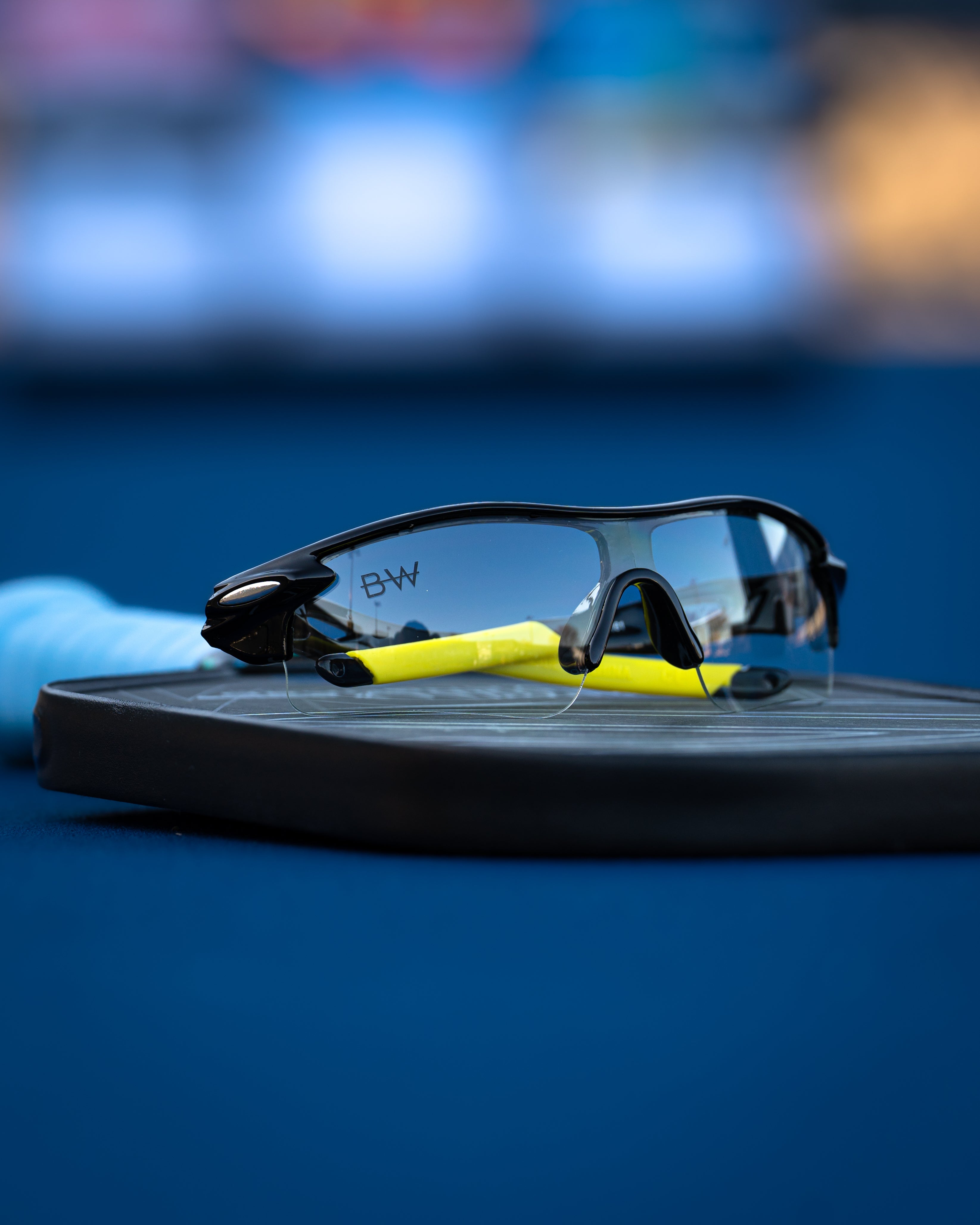
Sports prescription sunglasses combine corrective lenses with a frame intended for active use. Depending on the exact product, they may be used for activities such as pickleball, running, cycling, tennis, golf, or other outdoor sports.
The strongest sports RX eyewear is not defined by one feature. It is the combination of:
- Appropriate prescription correction
- Prescription compatibility with the frame
- Comfortable fit
- Lightweight construction
- Verified lens characteristics
- A lens configuration appropriate for the environment
- Practical durability
- Long-term value
1. Start With the Prescription
The first requirement for great sports prescription sunglasses is not tint, frame shape, or marketing terminology. It is whether the eyewear appropriately supports your prescription.
Before ordering, confirm:
- Your current eyeglass prescription
- Any measurements required for the order
- Whether the selected frame supports your prescription
- Whether the lens configuration you want is compatible with that prescription
Do not assume every prescription works with every sports frame. Prescription compatibility can depend on factors such as lens power, frame geometry, lens material, and the available configuration.
Can You Use a Contact Lens Prescription for Sports Sunglasses?
Do not assume a contact lens prescription can be substituted directly for an eyeglass prescription. Contact lenses and eyeglass lenses sit at different positions relative to the eye and may require different prescription information.
If you are ordering sports prescription sunglasses online, use the appropriate eyeglass prescription information requested by the seller.
2. Understand High-Index Prescription Lenses
High-index refers to a lens material's refractive index. Depending on the prescription and design, high-index materials can allow a prescription lens to be made with different thickness characteristics than some lower-index alternatives.
Blinded Wear includes high-index prescription lenses at no additional cost.
That is relevant when comparing the completed price of prescription sports sunglasses because some eyewear sellers charge separately for different lens-material options.
However, high-index should not automatically be interpreted as:
- Better athletic performance
- Better ball tracking
- Faster reaction time
- Greater impact resistance
- Scratch resistance
- Guaranteed compatibility with every prescription
High-index is one lens characteristic, not a complete measure of sports-eyewear quality.
3. Fit Matters During Movement
A great sports frame should feel comfortable while you are actually moving—not just while standing in front of a mirror.
When evaluating fit, consider:
- Frame width
- Bridge comfort
- Temple pressure
- Overall frame weight
- How the frame feels while looking up and down
- How it feels during lateral movement
- Whether it remains comfortable during extended wear
No frame should be described as universally “no-slip” or perfectly secure for every athlete because individual face shape and fit preferences vary.
Why Lightweight Sports Frames Are Worth Considering
Weight can influence how eyewear feels during longer practices, matches, runs, or training sessions.
Blinded Wear uses lightweight sports frames designed with active use and extended-match comfort in mind.
Lightweight construction does not guarantee perfect fit, but it can be a useful factor when comparing a dedicated sports frame with heavier everyday eyewear.
4. Match the Lens Configuration to Your Environment
The best lens configuration depends on where and when you plan to wear the sunglasses.
| Environment | What to Evaluate |
|---|---|
| Bright outdoor conditions | Available tint or other lens configuration appropriate for brightness |
| Overcast outdoor conditions | Whether the selected lens remains practical under reduced brightness |
| Indoor sports | Whether an untinted or other available configuration makes sense under artificial lighting |
| Changing environments | Whether one available lens configuration works for your needs or separate setups are more practical |
| Night play | Whether the selected configuration is practical in low-light court conditions |
Do not assume every sports RX model is available in clear, gray, photochromic, or another specific lens option. Verify availability for the exact frame.
What About Clear Lenses for Indoor Sports?
Untinted prescription lenses can be a practical option for indoor sports when reducing outdoor brightness is not the goal.
That does not make clear lenses universally better for indoor play. Court lighting, prescription needs, visual preferences, and the actual lens configuration all matter.
If you are specifically looking for untinted eyewear, browse Blinded Wear's Clear Lens Collection.
Are Transition or Photochromic Lenses Good for Sports?
Photochromic lenses can be useful for some athletes who move between different lighting environments, but their behavior depends on the specific lens technology and environmental conditions.
Do not assume every sports prescription frame offers photochromic lenses or that every photochromic lens:
- Changes tint instantly
- Reaches the same darkness
- Behaves identically indoors and outdoors
- Works identically at different temperatures
- Provides a particular UV protection level unless documented
Verify the exact lens technology available for the frame you are considering.
5. Understand Impact Resistance
Impact resistance is a relevant consideration for active eyewear, especially in sports involving balls, equipment, or frequent movement.
Blinded Wear uses impact-resistant lenses.
That term should be interpreted accurately. Impact-resistant does not automatically mean:
- Impact-proof
- Shatter-proof
- Unbreakable
- Guaranteed prevention of eye injury
- Certified to a particular protective standard
If you require a specific protective certification for your sport, verify that exact standard for the exact eyewear product.
Scratch Resistance Is Separate From Impact Resistance
Scratch resistance concerns surface abrasion. Impact resistance concerns physical impact. One should not be inferred from the other.
If scratch resistance is important to you, verify whether the exact lens includes a documented scratch-resistant treatment instead of assuming it is standard because the eyewear is made for sports.
A scratch-resistant lens should also never be described as scratch-proof.
6. Consider Fogging Without Assuming “Fog-Proof” Performance
Fogging can occur when temperature, humidity, perspiration, airflow, and lens temperature interact. It can affect ordinary glasses and sports eyewear alike.
Some products may offer anti-fog treatments or ventilation features, but those should be verified for the exact frame and lens configuration.
Do not assume every sports prescription sunglass has:
- Anti-fog coating
- Advanced ventilation
- Fog-proof performance
- Guaranteed clear vision in every climate
Even a verified anti-fog feature should not be treated as a guarantee that fogging can never occur.
7. Understand Anti-Reflective Treatments and Glare
Anti-reflective treatments are designed to reduce certain reflections from lens surfaces. They are separate from tint, polarization, scratch resistance, impact resistance, and anti-fog treatments.
A sports sunglass should not be described as “glare-free” merely because it has one of these features.
If an anti-reflective treatment matters to your use case, verify whether it is available on the exact prescription lens configuration you want.
8. Decide Whether Polarization Makes Sense for Your Sport
Polarization can reduce certain types of reflected glare, but it is not automatically necessary for every athletic activity.
Blinded Wear uses non-polarized lenses as part of its performance-first approach to pickleball eyewear. This approach is intended to preserve natural visual information and avoid potential depth-perception concerns associated with polarization during court play.
Polarization does not universally cause depth-perception problems, and non-polarized lenses do not guarantee better depth perception, reaction time, or ball tracking.
The appropriate choice depends on the activity and environment.
9. Frame and Lens Curvature Should Work With the Prescription
Sports frames can range from relatively flat designs to more wrapped shapes. Curvature can influence fit, coverage, frame geometry, and prescription requirements.
A more wrapped frame should not automatically be marketed as providing:
- Better peripheral vision
- Better depth perception
- Faster reactions
- Better ball tracking
- Less distortion
For prescription athletes, compatibility between the prescription and the chosen frame geometry is more important than assuming a particular wrap level is universally superior.
Does a Sports Frame Improve Peripheral Vision?
Frame design can influence how much of the frame or lens edge you notice while wearing the eyewear, but no universal peripheral-vision improvement should be promised based on sports styling alone.
Your visual field depends on your individual vision, frame geometry, lens design, and how the eyewear sits on your face.
Can Sports Prescription Sunglasses Improve Ball Tracking?
Sports prescription sunglasses should not be marketed as guaranteeing improved ball tracking.
For an athlete who needs corrective lenses, having appropriate prescription correction can address their refractive needs while playing. Ball tracking itself also involves:
- Visual attention
- Anticipation
- Eye and head movement
- Lighting
- Object-background contrast
- Positioning
- Experience
Eyewear is one part of the visual setup, not a substitute for training or individual visual ability.
Can Better Sports Sunglasses Make You React Faster?
No universal reaction-time improvement should be promised from prescription sunglasses.
Reaction in sport involves vision, anticipation, decision-making, movement, technique, and experience. Appropriate prescription correction can be important to an athlete who needs it, but that is different from claiming eyewear makes the athlete physically react faster.
10. Style Still Matters
Sports prescription sunglasses are functional equipment, but appearance is still a legitimate buying consideration.
A pair you actually like wearing may be more practical than one that stays in a case because you dislike the style.
Consider whether the frame:
- Fits your preferred aesthetic
- Feels appropriate for your sport
- Can work for other activities if you want versatility
- Matches the amount of coverage you prefer
Style should complement prescription compatibility, fit, and verified lens construction rather than replace those priorities.
Examples of Blinded Wear RX Sports Frames
If pickleball is your primary sport, Blinded Wear offers multiple prescription models that you can compare based on frame style, fit, prescription compatibility, and available lens configuration.
Do not assume these models have identical tint options, coatings, photochromic technology, protective certifications, or other lens features. Evaluate the exact configuration available for the model you are considering.
11. Use Customer Reviews Carefully
Reviews can help evaluate subjective factors such as comfort, style, fit, and individual experience, but they should not be used to establish unsupported product capabilities.
Useful sports-eyewear reviews often explain:
- How long the buyer has owned the glasses
- Which sport they play
- How often they use the eyewear
- Whether they play indoors or outdoors
- How the frame fits
- How comfortable it feels over time
- Whether the prescription setup met their needs
- What they liked and disliked
Do not treat an anecdotal statement about better performance, zero fogging, perfect fit, or permanent scratch resistance as a universal product guarantee.
Why Trustworthy Sports Eyewear Content Shouldn't Invent Reviews
Customer testimonials should come from actual customer feedback. Product content should not create names, locations, star ratings, or quotations and present them as real experiences when their authenticity has not been verified.
Instead, evaluate sports prescription sunglasses using confirmed product characteristics and genuine customer feedback when it is available.
12. Think About Long-Term Durability and Care
Sports eyewear is frequently handled, transported, cleaned, and exposed to active environments. Durability matters, but good care matters too.
Useful habits include:
- Storing eyewear in a protective case
- Avoiding direct lens contact with rough surfaces
- Removing loose debris before wiping
- Using an appropriate clean microfiber cloth
- Following product-specific care instructions
No coating or lens technology makes sports eyewear indestructible.
13. Look at Replacement Coverage
Long-term value includes more than the purchase price.
Blinded Wear offers a 50% lifetime replacement warranty if your glasses break.
Review the current terms rather than assuming that scratches, prescription changes, ordinary wear, or every possible form of damage are automatically covered.
Sports Prescription Sunglasses: Features to Evaluate Separately
| Feature | What It Tells You | What It Does Not Automatically Tell You |
|---|---|---|
| Prescription lenses | Provides corrective vision according to the configured RX | That every prescription works with every frame |
| High-index material | A lens-material characteristic | Impact or scratch resistance |
| Impact resistance | Resistance to physical impact | That the lens is impact-proof or certified to a specific standard |
| Scratch resistance | Resistance to certain surface abrasions | That the lens cannot scratch |
| Anti-reflective treatment | Reduces certain lens-surface reflections | That all glare disappears |
| Anti-fog treatment | Addresses fogging | That fogging can never occur |
| Polarization | Filters particular orientations of reflected light | That it is automatically best for every sport |
| Photochromic technology | Changes tint according to the lens technology and environmental conditions | Identical performance in every environment |
What Is Verified About Blinded Wear Prescription Pickleball Eyewear?
For pickleball players considering Blinded Wear, the verified value proposition includes:
- Prescription options available
- High-index prescription lenses included at no additional cost
- Lightweight sports frames
- Impact-resistant lenses
- Non-polarized lenses
- Performance-first design
- Comfort-focused eyewear for extended matches
- Options for recreational and competitive players
- 50% lifetime replacement warranty if the glasses break
Specific anti-fog, anti-reflective, scratch-resistant, UV, photochromic, tint, nose-pad, grip, or certification claims should be verified for the exact product before being treated as included.
Quick Checklist: What Makes Sports RX Sunglasses Great?
- An appropriate prescription
- Compatibility between your prescription and the frame
- A comfortable active-use fit
- Manageable frame weight
- Verified lens construction
- A lens configuration suited to your environment
- Clear separation between impact resistance, scratch resistance, tint, coatings, and polarization
- Realistic product claims
- Reasonable care requirements
- Strong completed RX value
- Useful replacement coverage
Find Prescription Sports Eyewear for Pickleball
If pickleball is your primary sport, compare RX eyewear based on your prescription, fit, playing environment, verified lens characteristics, and total value.
Shop Prescription Pickleball Glasses →
Not sure where to start?
Sports Prescription Sunglasses vs. Everyday Prescription Sunglasses
Everyday prescription sunglasses and sports prescription sunglasses can both provide corrective vision, but they may be designed around different priorities.
| Consideration | Sports Prescription Sunglasses | Everyday Prescription Sunglasses |
|---|---|---|
| Primary use | Active movement and sport | General daily wear |
| Prescription correction | Yes, when configured appropriately | Yes, when configured appropriately |
| Frame priorities | Often emphasizes active comfort, weight, fit, and coverage | Often emphasizes everyday comfort, appearance, and general use |
| Lens construction | Should be evaluated for the demands of the intended sport | Varies by product |
| Playing environment | Lens configuration should match the sport and conditions | May not be selected around a particular athletic environment |
Everyday prescription sunglasses are not automatically unsuitable for sports. The question is whether their fit, prescription, lens construction, and configuration meet the demands of your activity.
Do Athletes Need a Dedicated Pair of Sports RX Sunglasses?
Not every athlete needs separate prescription eyewear for sports. A dedicated pair becomes more compelling when your normal glasses create a problem that sports-oriented eyewear can realistically address.
You may want a dedicated pair if:
- You play or train frequently
- Your everyday frame feels uncomfortable during movement
- You want eyewear reserved specifically for athletic use
- You need a different lens configuration for your playing environment
- You prefer a lighter sports-oriented frame
- You want impact-resistant lenses for active use
If your existing prescription eyewear already works comfortably for your activity, buying another pair may be a lower priority.
How Should Sports Prescription Sunglasses Fit?
A good sports fit should feel comfortable and predictable during the movements your activity requires.
Before deciding a frame fits well, test more than how it feels while standing still.
-
Check the Bridge
Notice whether the frame sits comfortably without creating distracting pressure.
-
Check the Temples
The temples should not create uncomfortable pressure during extended wear.
-
Look Up and Down
Test the positions you naturally use while serving, tracking a lob, running, or changing direction.
-
Move Side to Side
Evaluate whether the frame remains comfortable during lateral movement.
-
Wear the Frame for Longer Than a Few Minutes
A frame that feels comfortable initially can feel different after an extended practice or match.
Individual face shape matters, so no sports frame should be described as a universally perfect or guaranteed no-slip fit.
Frame Size Can Matter as Much as Sports Styling
A frame can have an athletic appearance and still be a poor match for your face. Before ordering prescription sports sunglasses online, compare available frame dimensions with a pair you already know fits comfortably.
Useful measurements can include:
- Overall frame width
- Lens width
- Bridge width
- Temple length
- Lens height
The exact measurements provided vary by product. Use available sizing information rather than assuming that terms such as “sports fit” or “universal fit” guarantee compatibility.
How Much Coverage Should Sports Sunglasses Have?
Coverage preferences vary by sport, frame design, prescription, and individual wearer. Some athletes prefer a larger lens area or more wrapped frame, while others prioritize a flatter design or a particular aesthetic.
More coverage should not automatically be interpreted as:
- Better peripheral vision
- Guaranteed protection
- Better depth perception
- Less glare
- Better ball tracking
- Greater prescription accuracy
Choose coverage based on the complete frame-and-lens setup rather than assuming that more wrap is always better.
What Should Athletes With Stronger Prescriptions Consider?
Prescription strength can influence which frame and lens configurations are practical. A highly wrapped sports frame, for example, may introduce different optical considerations than a flatter frame.
If your prescription is stronger or otherwise complex, prioritize compatibility over appearance alone.
Questions worth asking include:
- Can this frame accommodate my exact prescription?
- What lens material will be used?
- Are there limitations associated with the frame geometry?
- Does my prescription require measurements or considerations beyond the basic RX values?
Blinded Wear includes high-index prescription lenses at no additional cost, but high-index availability does not guarantee that every prescription is compatible with every frame.
What About Progressive or Multifocal Sports Sunglasses?
Players who use progressive, bifocal, or other multifocal correction may have different needs from single-vision wearers.
Frame geometry, lens design, viewing zones, and the visual demands of the sport can all matter. Do not assume that a frame supporting one prescription type automatically supports every other prescription configuration.
If your prescription or visual needs are complex, confirm compatibility before ordering and seek appropriate optical guidance when necessary.
Sports Prescription Sunglasses vs. Contacts With Non-RX Sports Glasses
Athletes who need vision correction may have more than one workable setup. Prescription sports sunglasses are one option; contact lenses combined with non-prescription sports eyewear are another.
| Consideration | Sports RX Sunglasses | Contacts + Non-RX Sports Eyewear |
|---|---|---|
| Vision correction | Built into the eyewear | Provided by contact lenses |
| Need to wear contacts | No | Yes |
| Frame options | Limited to frames compatible with the prescription | Can use compatible non-RX sports eyewear |
| Comfort | Depends on frame, prescription, and individual wearer | Depends on contact-lens tolerance and eyewear fit |
| Best choice | Depends on individual needs | Depends on individual needs |
Contacts are not inherently worse for sports, and prescription sports sunglasses are not inherently better for every athlete. Choose the vision-correction approach that works appropriately for you.
Can One Pair Work for Indoor and Outdoor Sports?
Possibly, but it depends on the exact lens configuration and your environments.
A lens that feels appropriate in bright outdoor conditions may not be your preferred choice inside a gym. An untinted lens that works well indoors may not address your preferences in bright sunlight.
Some athletes therefore prefer:
- One versatile configuration
- Separate indoor and outdoor pairs
- A photochromic option when available and appropriate
- Contacts paired with different non-RX eyewear
There is no universal best setup. Evaluate how often you change environments and what exact lens options are available.
How Should You Choose a Sports Sunglass Tint?
Tint selection should begin with the environment rather than assumptions that one color automatically improves athletic performance.
Consider:
- Typical brightness
- Indoor versus outdoor use
- Time of day
- Weather variability
- Background conditions
- Your personal visual preferences
A tint may change perceived brightness or color appearance, but do not assume a particular tint automatically improves reaction time, depth perception, contrast sensitivity, or performance.
Clear, Tinted, or Photochromic: Which Is Better?
| Lens Type | Potential Use | Important Consideration |
|---|---|---|
| Clear or untinted | Can be practical when reducing brightness is not needed | Does not automatically provide better sports performance |
| Tinted | Can reduce perceived brightness depending on the tint | Choose according to the actual environment and product specifications |
| Photochromic | Can adjust tint depending on the specific technology and conditions | Behavior varies and should not be described as instantaneous or identical in every environment |
Verify which configurations are actually available for the sports RX frame you are considering.
What Makes Prescription Sunglasses Good for Pickleball?
For a pickleball player who needs prescription correction, a practical pair should bring together the same fundamentals that define good sports RX eyewear generally:
- An appropriate prescription
- A frame compatible with that prescription
- Comfort during repeated movement
- A lightweight sports-oriented design
- Impact-resistant lens construction
- A lens configuration appropriate for the court conditions
- Realistic, verified product claims
Blinded Wear is designed specifically around pickleball players, with prescription options for recreational and competitive use.
What Should Runners Look for in Prescription Sports Sunglasses?
Runners may prioritize lightweight comfort, frame fit during repeated movement, prescription compatibility, and a lens configuration appropriate for the brightness and conditions where they run.
Do not assume a frame that works well for pickleball will automatically be ideal for running, cycling, or every other sport. Different activities can place different demands on eyewear.
Can the Same Prescription Sports Sunglasses Work for Multiple Sports?
Yes, if the frame, prescription, and lens configuration suit each activity. Multi-sport use can increase the value of a prescription pair, but versatility should be tested rather than assumed.
Ask whether the eyewear works for:
- The movement involved in each activity
- The lighting environments you encounter
- The amount of coverage you prefer
- Your prescription requirements
- The amount of time you typically wear the glasses
A frame does not need to be labeled for every sport to be useful across multiple activities.
Comfort Becomes More Important During Long Sessions
Sports sunglasses that feel fine for five minutes may feel different after an hour or more of active wear.
During an extended test, pay attention to:
- Bridge pressure
- Temple pressure
- Frame weight
- Whether the eyewear becomes distracting
- How the frame feels as you perspire
- Whether your prescription remains visually comfortable
Blinded Wear's lightweight sports-frame approach is designed with extended-match comfort in mind, but comfort remains individual.
What About Sweat and Sports Eyewear?
Perspiration is a normal part of active use and can influence how a frame feels, how frequently lenses need cleaning, and whether fogging becomes noticeable.
Avoid assuming that a sports frame is automatically sweat-proof, non-slip, or fog-proof.
Instead, evaluate actual fit during activity and verify any product-specific grip, ventilation, or anti-fog feature before relying on it.
How Should Athletes Think About Fog Control?
Fogging can depend on temperature, humidity, perspiration, airflow, and other environmental factors.
If fogging is a recurring problem for you, consider:
- How the frame sits on your face
- The environments where you train
- Whether the exact product has documented ventilation features
- Whether an anti-fog treatment is actually included
- Product-specific care instructions
No eyewear should be called universally fog-proof without evidence supporting that claim.
Which Durability Features Matter Most?
“Durable” is a broad marketing term. A better approach is to identify the specific characteristics that matter for your use.
| Durability Consideration | What It Addresses |
|---|---|
| Impact resistance | How the lens responds to physical impact |
| Scratch resistance | Resistance to certain surface abrasions |
| Frame construction | How the frame is built for normal intended use |
| Proper storage | Reduces unnecessary contact with equipment and rough surfaces |
| Proper cleaning | Reduces avoidable lens-surface wear |
| Replacement coverage | Can affect long-term ownership value if the glasses break |
No single durability characteristic makes sports eyewear indestructible.
Does “Sports Eyewear” Mean Certified Protective Eyewear?
No. The words “sports glasses,” “sports sunglasses,” or “impact-resistant” should not automatically be interpreted as proof that a product meets a particular protective standard.
If your sport, league, workplace, or personal needs require a specific certification, verify that exact standard for the exact product.
Similarly, do not treat impact resistance as a guarantee that eyewear will prevent every possible eye injury.
How Much Should Price Influence Your Sports RX Decision?
The best value is not necessarily the cheapest frame or the most expensive pair. Compare the completed prescription package.
Look at:
- Frame price
- Prescription lens cost
- Lens-material charges
- Any selected lens-option charges
- Shipping or other applicable costs
- Replacement coverage
- How frequently you expect to use the eyewear
Blinded Wear's inclusion of high-index prescription lenses at no additional cost can simplify one part of that comparison.
Think About Cost Per Use
An athlete who wears prescription sports sunglasses several times each week may evaluate value differently from someone who uses them a few times per year.
A simple way to think about value is:
Completed eyewear cost ÷ expected number of uses = approximate cost per use.
This is not a reason to overspend. It is a way to compare purchase price with how much you realistically expect to use the eyewear.
Are More Expensive Sports Prescription Sunglasses Automatically Better?
No. Price alone does not establish prescription quality, comfort, fit, durability, or suitability for a particular sport.
A higher price may reflect materials, branding, lens options, manufacturing, styling, or other factors. The better question is whether the finished eyewear provides the characteristics you actually need.
Compare verified specifications rather than assuming the most expensive pair will perform best.
Sports Sunglass Marketing Claims to Question
Be cautious when prescription sports eyewear is marketed with absolute performance promises.
| Claim | Better Question |
|---|---|
| “Improves reaction time” | What evidence shows the eyewear itself causes faster reactions? |
| “Perfect ball tracking” | Is this a subjective experience rather than a guaranteed product effect? |
| “Never fogs” | Is a specific anti-fog technology documented, and what are its limitations? |
| “Unbreakable” | What exact lens and frame characteristics support the durability claim? |
| “Maximum eye protection” | Is a specific protective certification documented? |
| “Works in every light condition” | Which exact lens configuration is being described? |
| “No-slip fit” | How does the frame fit your individual face? |
How to Read Sports Prescription Sunglass Reviews
Customer reviews can add useful context, particularly for subjective characteristics that specifications cannot fully describe.
Higher-value reviews usually explain:
- The sport being played
- How frequently the eyewear is used
- How long the reviewer has owned it
- The playing environment
- Fit and comfort
- The reviewer's prescription experience
- Specific strengths and weaknesses
One athlete's experience should not be converted into a universal claim. A reviewer saying a frame never slipped on their face does not prove it will fit every athlete the same way.
How to Test New Sports Prescription Sunglasses After Delivery
-
Check the Prescription at Rest
Make sure the correction feels appropriate before using the eyewear for demanding activity.
-
Evaluate the Fit
Check bridge comfort, temple pressure, and overall frame position.
-
Move Naturally
Use movements relevant to your sport rather than only walking around indoors.
-
Test the Intended Environment
Evaluate the selected lens configuration under representative lighting conditions.
-
Wear the Glasses for an Extended Practice
Longer use can reveal comfort issues that a quick try-on misses.
-
Practice Before Competition
A tournament or important event should not be your first extended experience with a new prescription setup.
What if New Sports RX Sunglasses Don't Feel Visually Right?
Do not assume that persistent visual problems are simply something every athlete must “get used to.”
Seek appropriate optical or eye-care guidance if new prescription eyewear causes persistent:
- Blur
- Double vision
- Significant distortion
- Headaches associated with wearing the eyewear
- Unexpected difficulty using the prescribed correction
Changes in vision should also be evaluated appropriately rather than self-diagnosed as an eyewear issue.
How to Care for Sports Prescription Sunglasses
Good care is useful regardless of which coatings or lens technologies are included.
- Store the glasses in a protective case when not in use.
- Avoid placing lenses directly against rough surfaces.
- Remove loose debris appropriately before wiping.
- Use an appropriate clean microfiber cloth.
- Follow product-specific cleaning instructions.
- Avoid assuming any lens is scratch-proof.
Sports eyewear may be durable, but no pair should be treated as indestructible.
Should Athletes Have a Backup Pair?
A backup vision-correction option can be useful for athletes who rely on prescription eyewear, especially during tournaments, travel, races, or other important events.
A backup can help if your primary pair becomes damaged, misplaced, or otherwise unavailable.
If you plan to compete using a backup pair, test it beforehand rather than assuming it will feel identical to your primary eyewear.
Why Pickleball Players May Consider Blinded Wear
For pickleball players who need prescription eyewear, Blinded Wear combines several verified characteristics in its performance-first approach:
- Prescription options
- High-index prescription lenses at no additional cost
- Lightweight sports frames
- Impact-resistant lenses
- Non-polarized lenses
- Comfort-focused design for extended matches
- Options for recreational and competitive players
- 50% lifetime replacement warranty if the glasses break
Specific tint, photochromic, scratch-resistant, anti-reflective, anti-fog, UV, grip, nose-pad, or protective-certification features should be verified for the exact model and configuration.
12 Questions to Ask Before Buying Sports Prescription Sunglasses
- Is my prescription compatible with this frame?
- Does the frame size make sense for my face?
- Will the frame be comfortable during my sport?
- What lens material is included?
- Are the lenses impact-resistant?
- Does the exact product have any documented protective certification?
- What lens configurations are available?
- Does the configuration suit my normal playing environment?
- Which coatings or treatments are actually included?
- What is the completed prescription price?
- What care does the eyewear require?
- What replacement coverage applies if the glasses break?
Compare Sports RX Eyewear Based on What Actually Matters
A great pair of sports prescription sunglasses is not defined by the longest feature list. Start with your prescription, fit, lens construction, environment, comfort, and verified product specifications.
Browse Prescription Pickleball Glasses →
Want help narrowing down your options?
Frequently Asked Questions About Sports Prescription Sunglasses
What makes prescription sunglasses good for sports?
Good sports prescription sunglasses combine appropriate vision correction, prescription compatibility, comfortable active-use fit, verified lens construction, and a lens configuration suited to the athlete's environment. Durability, weight, care requirements, and replacement coverage can also influence the overall value.
Are prescription sports sunglasses worth it?
They can be worthwhile for athletes who need corrective vision and regularly participate in activities where their everyday prescription eyewear is uncomfortable or poorly suited to movement. The value depends on how often you use them, your prescription needs, fit, available lens configurations, and completed cost.
Can you play pickleball in prescription sunglasses?
Yes. Prescription sunglasses can provide corrective vision while playing outdoor pickleball when the frame and lens configuration are appropriate for the player and conditions. Blinded Wear offers prescription eyewear designed specifically with pickleball players in mind.
Can prescription sports sunglasses be used for multiple sports?
Potentially. A pair may work across multiple activities if its fit, prescription, lens configuration, and construction suit each sport. Multi-sport suitability should be evaluated rather than assumed.
Are sports prescription sunglasses better than regular prescription sunglasses?
Not automatically. Sports-oriented eyewear may offer a frame and lens setup better suited to active use, but everyday prescription sunglasses can still work for some athletes. The better option is the one that meets your prescription, fit, comfort, environment, and activity requirements.
Are sports prescription sunglasses impact-proof?
No. Impact-resistant should not be interpreted as impact-proof, shatter-proof, unbreakable, or guaranteed to prevent injury. If you require a particular protective standard, verify that certification for the exact product.
Do sports prescription sunglasses improve reaction time?
No universal reaction-time improvement should be promised. Appropriate prescription correction can address refractive needs, but athletic reaction also depends on anticipation, attention, decision-making, movement, technique, and experience.
Do prescription sports sunglasses improve depth perception?
Eyewear should not be marketed as universally improving depth perception. Appropriate vision correction may be important for an athlete who needs it, while depth perception depends on the individual's visual system and other factors.
Are polarized prescription sunglasses best for sports?
Not necessarily. Polarization can reduce certain reflected glare, but the appropriate choice depends on the sport and environment. Blinded Wear uses non-polarized lenses as part of its performance-first pickleball approach while avoiding the claim that polarization universally causes depth-perception problems.
Are non-polarized sunglasses better for pickleball?
Blinded Wear's non-polarized approach is intended to preserve natural visual information and avoid potential depth-perception concerns associated with polarization during court play. However, non-polarized lenses do not guarantee better depth perception, ball tracking, or performance.
Do sports prescription sunglasses need anti-fog lenses?
Anti-fog technology can be useful for athletes who experience fogging, but it is not automatically required or included. Verify whether the exact product has a documented anti-fog treatment and remember that no treatment should automatically be interpreted as guaranteeing zero fogging.
Should sports sunglasses have scratch-resistant lenses?
Scratch resistance can be a useful durability feature, but it is separate from impact resistance. If it matters to you, verify whether the exact lens includes a documented scratch-resistant treatment rather than assuming all sports eyewear has one.
Are high-index lenses good for sports prescriptions?
High-index is a lens-material characteristic that can be useful depending on the prescription and lens design. Blinded Wear includes high-index prescription lenses at no additional cost, but high-index does not itself guarantee sports performance, impact resistance, scratch resistance, or compatibility with every frame.
Can I wear sports prescription sunglasses indoors?
That depends on the lens configuration. A dark outdoor tint may not be practical indoors, while an untinted configuration may be more appropriate when brightness reduction is unnecessary. Verify the exact lens options available for your frame.
How should sports prescription sunglasses fit?
They should feel comfortable during the movements and duration of your activity. Evaluate bridge pressure, temple pressure, frame position, weight, and how the glasses behave when looking up, down, and side to side. Fit remains individual.
How long do sports prescription sunglasses last?
There is no universal lifespan. Replacement depends on frame and lens condition, frequency of use, care, accidental damage, prescription changes, and whether the eyewear still meets your needs.
How to Choose Great Sports Prescription Sunglasses in 5 Steps
-
Start With Your Vision
Use an appropriate prescription and confirm that the frame can accommodate it.
-
Choose the Frame for the Activity
Evaluate size, weight, comfort, movement, coverage, and how long you expect to wear it.
-
Match the Lens to the Environment
Choose from the configurations actually available based on whether you play indoors, outdoors, in bright conditions, or across changing environments.
-
Verify Every Important Feature
Do not assume impact resistance, scratch resistance, anti-fog treatment, anti-reflective treatment, photochromic technology, polarization, or protective certification are interchangeable.
-
Compare the Finished Value
Consider the completed prescription price, frequency of use, care requirements, and replacement coverage rather than judging the frame price alone.
Which Sports RX Features Matter Most for You?
| Athlete or Situation | Start With | Then Evaluate |
|---|---|---|
| Outdoor pickleball player | Prescription, fit, and outdoor lens configuration | Weight, impact resistance, comfort, and verified additional features |
| Indoor pickleball player | Prescription and an appropriate indoor lens configuration | Fit, comfort, lens construction, and fogging considerations |
| Tournament player | Prescription familiarity and reliable fit | Extended comfort, environment, backup eyewear, and replacement coverage |
| Recreational player | Comfort and appropriate vision correction | Frequency of use and overall value |
| Multi-sport athlete | Prescription and compatibility across intended activities | Versatility across different movement and lighting conditions |
| Athlete with a stronger prescription | Prescription compatibility | Frame geometry, lens material, fit, and available configurations |
| Contact lens wearer | Comfort with contacts during activity | Whether non-RX sports eyewear provides the preferred setup |
What Should You Prioritize First?
Long feature lists can make prescription sports eyewear difficult to compare. A simpler priority order helps separate essential requirements from optional features.
| Priority | What to Evaluate | Why It Matters |
|---|---|---|
| 1 | Prescription | The eyewear must appropriately address your corrective needs |
| 2 | Prescription compatibility | Not every prescription works with every sports frame |
| 3 | Fit and comfort | The eyewear needs to remain practical during active use |
| 4 | Lens configuration | The lens should make sense for the environment where it will be used |
| 5 | Verified lens construction | Specific characteristics are more useful than vague durability claims |
| 6 | Optional lens features | Coatings and technologies should solve an actual need and be verified |
| 7 | Price and replacement coverage | The finished value matters more than frame price alone |
What Great Sports Prescription Sunglasses Can and Cannot Do
| They Can | They Cannot Be Assumed to |
|---|---|
| Provide appropriate prescription correction when properly configured | Make an athlete react faster |
| Use a frame designed around active wear | Guarantee better ball tracking |
| Provide verified lens characteristics | Guarantee better depth perception |
| Offer a lens configuration suited to particular environments | Work perfectly in every lighting condition |
| Provide impact resistance when documented | Become impact-proof or guarantee injury prevention |
| Include additional lens treatments when documented | Include every coating because the product is labeled “sports” |
| Provide a comfortable active-use option for many athletes | Fit every face perfectly |
The 5-Minute Test for New Sports Prescription Sunglasses
When your new prescription sports eyewear arrives, perform a basic initial evaluation before relying on it for a full match, tournament, run, or training session.
-
Check Distance Vision
Evaluate whether the prescription feels appropriate during normal viewing.
-
Look in Different Directions
Move your eyes and head naturally and notice whether anything feels unexpectedly distracting.
-
Test the Fit
Move your head up, down, and side to side while paying attention to bridge and temple comfort.
-
Simulate Your Sport
Use a few controlled movements relevant to your activity.
-
Check the Lens Environment
Evaluate the lens configuration under the type of lighting for which you selected it.
This short check does not replace a longer practice session. Test new prescription eyewear under realistic conditions before important competition.
Tournament Checklist for Prescription Eyewear
- Practice in the eyewear before tournament day.
- Make sure the prescription feels appropriate.
- Inspect the frame and lenses for significant damage.
- Clean the lenses before play.
- Bring an appropriate cleaning cloth and storage case.
- Know how the selected lens configuration behaves in the expected environment.
- Consider an appropriate backup vision-correction option.
There is no universal adaptation period that applies to every new pair. Persistent blur, significant distortion, double vision, or headaches associated with new prescription eyewear deserve appropriate optical or eye-care evaluation.
Verify Sports Sunglass Features Instead of Assuming Them
| Feature | What You Should Confirm |
|---|---|
| Prescription availability | Whether the exact frame supports your prescription |
| High-index lenses | Whether they are included and compatible with your prescription |
| Impact resistance | Whether the exact lens is documented as impact-resistant |
| Protective certification | Whether the exact product meets a specifically documented standard |
| Scratch resistance | Whether the exact lens has a documented scratch-resistant treatment |
| Anti-fog | Whether a specific anti-fog treatment or feature is documented |
| Anti-reflective treatment | Whether it is included in the selected lens configuration |
| Photochromic technology | Whether it is available for the exact model and how the technology is specified to behave |
| UV protection | The documented protection level for the exact lens rather than an assumption based on tint |
| Polarization | Whether the exact lens is polarized or non-polarized |
Common Mistakes When Buying Sports Prescription Sunglasses
-
Choosing the Frame Before Checking Prescription Compatibility
A frame you like still needs to work with your prescription.
-
Assuming “Sports” Means Certified Protection
Verify any protective standard separately.
-
Buying Based Only on Tint
Tint is one characteristic among prescription, fit, construction, comfort, and environment.
-
Assuming More Wrap Is Always Better
Frame geometry should work with your prescription and fit preferences.
-
Assuming Polarized Is Automatically Better
Polarization is useful in some situations but is not universally necessary for every sport.
-
Believing “Scratch-Resistant” Means Scratch-Proof
Resistance does not eliminate the possibility of lens damage.
-
Assuming Sports Glasses Cannot Fog
Fogging depends on several environmental and design factors.
-
Focusing Only on Frame Price
Compare the completed prescription cost and long-term value.
-
Using New RX Eyewear for the First Time in Competition
Practice in your finished setup beforehand.
-
Trusting Performance Guarantees
Eyewear should not promise wins, rankings, faster reactions, or perfect ball tracking.
What Blinded Wear Brings to Prescription Pickleball Eyewear
For pickleball players, Blinded Wear focuses on a straightforward set of verified characteristics rather than relying on unsupported performance promises.
| Feature | Blinded Wear Approach |
|---|---|
| Prescription eyewear | Available |
| High-index prescription lenses | Included at no additional cost |
| Frame design | Lightweight sports frames |
| Lens construction | Impact-resistant lenses |
| Polarization | Non-polarized lenses |
| Intended use | Performance-first eyewear designed for pickleball players |
| Comfort | Designed with extended-match comfort in mind |
| Player level | Options for recreational and competitive players |
| Replacement | 50% lifetime replacement warranty if the glasses break |
Exact tint, photochromic, anti-reflective, anti-fog, scratch-resistant, UV, grip, nose-pad, and certification features should be checked for the specific product rather than assumed across every Blinded Wear frame.
Which Blinded Wear RX Model Should You Choose?
The right model depends on your prescription, frame preferences, fit, and available lens configuration. Rather than turning a general sports-sunglasses guide into a model ranking, use Blinded Wear's dedicated pickleball eyewear guide to compare your options.
Compare Pickleball Glasses in the 2026 Guide →
You can also narrow your options based on your needs:
Final Sports Prescription Sunglasses Buying Checklist
- Use an appropriate eyeglass prescription.
- Confirm that the frame supports your prescription.
- Check available frame dimensions.
- Prioritize comfortable active-use fit.
- Consider frame weight for extended wear.
- Choose a lens configuration for your actual environment.
- Verify impact resistance.
- Do not interpret impact-resistant as impact-proof.
- Verify any protective certification you specifically require.
- Verify scratch resistance separately.
- Verify anti-reflective and anti-fog treatments separately.
- Confirm whether the exact lens is polarized or non-polarized.
- Verify photochromic availability rather than assuming it.
- Verify any specific UV-protection claim.
- Compare the completed prescription price.
- Review replacement coverage.
- Test the finished eyewear before important competition.
Key Takeaways
- Prescription accuracy and compatibility come first.
- A great sports frame should be comfortable during actual movement and extended wear.
- Lightweight construction can be useful, but fit remains individual.
- Choose the lens configuration according to the environment where you actually play.
- Impact resistance, scratch resistance, anti-fog, anti-reflective treatments, polarization, photochromic technology, and protective certifications are separate characteristics.
- Sports prescription sunglasses should not promise faster reactions, better rankings, perfect ball tracking, or guaranteed athletic improvement.
- Price alone does not determine quality; compare the completed prescription package.
- Blinded Wear includes high-index prescription lenses at no additional cost.
- Blinded Wear uses lightweight sports frames, impact-resistant lenses, and non-polarized lenses for its performance-first pickleball eyewear.
- Blinded Wear offers a 50% lifetime replacement warranty if the glasses break.
Explore Blinded Wear Sports Eyewear
Final Verdict: What Makes Sports Prescription Sunglasses Great?
The best sports prescription sunglasses are the pair that correctly addresses your vision needs, fits comfortably during your activity, uses verified lens construction, and has a lens configuration appropriate for where you actually wear it.
For prescription athletes, start with the RX rather than the feature list. Then evaluate frame compatibility, fit, weight, lens construction, environment, durability, completed cost, and replacement coverage.
Features such as polarization, photochromic technology, scratch resistance, anti-reflective treatments, anti-fog treatments, and protective certifications can be valuable when they solve a real need, but none should be assumed simply because a product is marketed as sports eyewear.
For pickleball players specifically, Blinded Wear offers a performance-first approach with prescription availability, high-index RX lenses at no additional cost, lightweight sports frames, impact-resistant lenses, non-polarized lenses, extended-match comfort, and a 50% lifetime replacement warranty if the glasses break.
Find Your Prescription Pickleball Eyewear
Ready to compare prescription sports eyewear designed with pickleball players in mind?
Shop Prescription Pickleball Glasses →
Already know you do not need prescription lenses in the frame?
Shop Non-RX Pickleball Glasses →
Need help deciding which direction to take?