
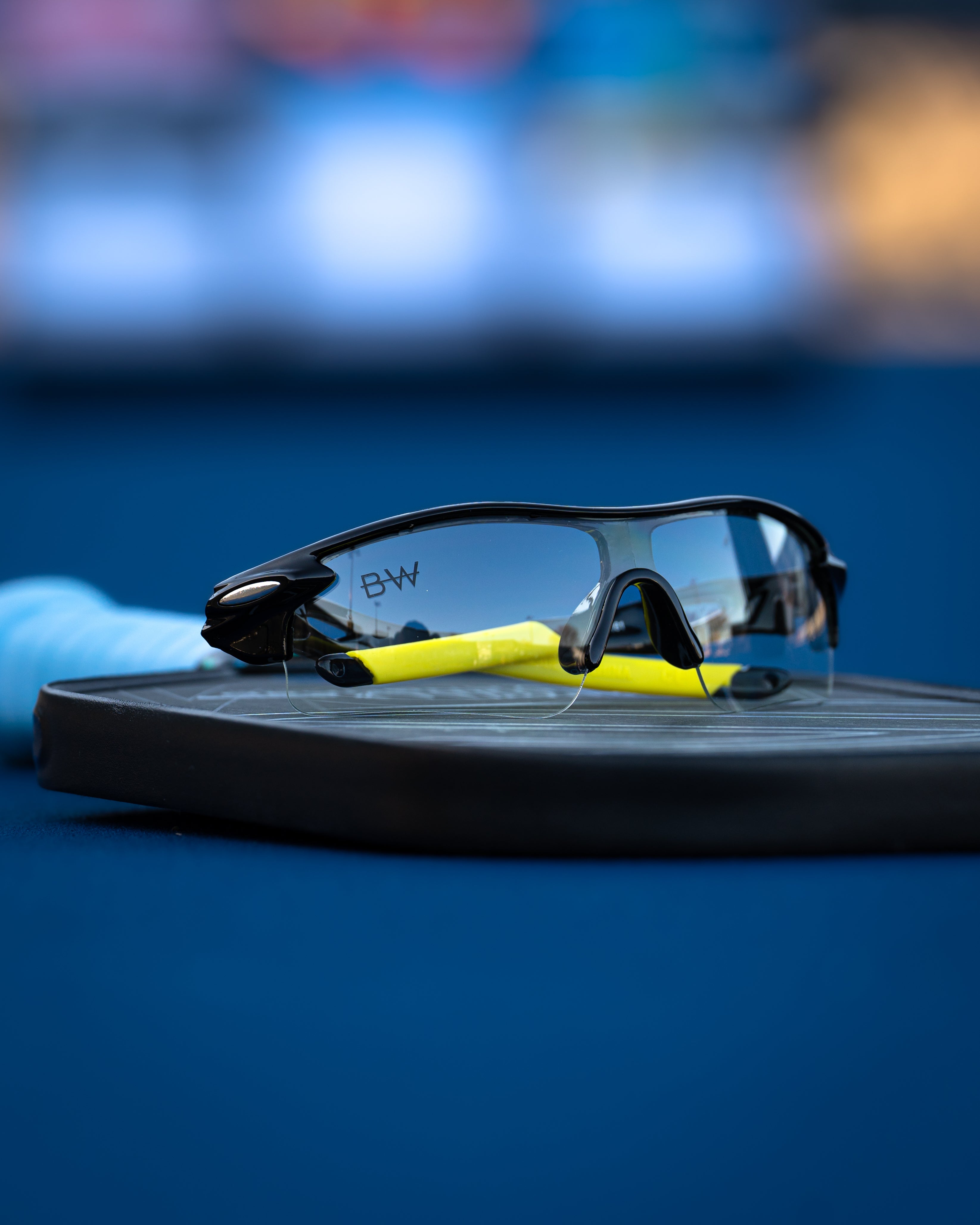
What to Look for When Getting Sports Glasses
Share
What to Look for When Getting Sports Glasses
The best sports glasses are the pair that fit your face, match your vision needs, suit your playing environment, and use verified lens and frame features appropriate for active use.
That sounds simple, but sports eyewear can vary significantly in fit, prescription compatibility, lens type, frame design, impact resistance, and comfort. A good buying decision comes from comparing those factors instead of relying on vague claims like “performance eyewear” or “pro-level vision.”
For pickleball players, the priorities are especially practical: clear vision, a secure and comfortable fit, appropriate lenses for the environment, and eyewear that works with your prescription if you need correction.
Find Your Pickleball Glasses
If you already know whether you need prescription or non-prescription eyewear, start here.
What Are the Most Important Things to Look for in Sports Glasses?
Start with these six priorities:
- Fit and comfort
- Prescription compatibility
- Lens type for your playing environment
- Impact-resistant construction
- Frame weight and stability
- Warranty and replacement support
Those fundamentals matter more than marketing terms or unverified claims about performance improvements.
1. Start With Fit
Sports glasses should feel secure enough for active movement without creating uncomfortable pressure points.
A good sports fit should be evaluated around:
- Face width
- Bridge fit
- Temple pressure
- Frame movement
- Comfort during longer wear
The goal is not to find a frame that is universally “no-slip.” Fit is individual, and even a well-designed sports frame can feel different from one player to another.
How Do You Test Whether Sports Glasses Fit Properly?
Once you have the frame, use movements similar to actual play.
- Turn your head quickly from side to side.
- Look up and down.
- Bend forward.
- Shuffle laterally.
- Wear the frame through a practice session.
Pay attention to excessive movement, pressure behind the ears, bridge discomfort, or the need to keep readjusting the frame.
2. Look for Lightweight Sports Frames
Weight matters because sports eyewear may be worn for long practices, multiple matches, or tournament sessions.
Blinded Wear uses lightweight sports frames designed for extended-match comfort.
Lightweight does not mean every frame will feel identical on every face, but it is a useful characteristic to prioritize when comparing active eyewear.
3. Decide Whether You Need Prescription Sports Glasses
If you normally wear prescription glasses for distance or everyday vision, dedicated RX sports eyewear may be worth considering.
Prescription sports glasses combine vision correction with a sports-oriented frame rather than requiring you to rely on your everyday eyeglasses during play.
Blinded Wear offers prescription pickleball eyewear and includes high-index prescription lenses at no additional cost.
How Does Ordering RX Sports Glasses Work?
Blinded Wear RX customers upload a clear photo of their eyeglass prescription before purchasing.
Before uploading:
- Make sure the entire prescription is visible.
- Keep the image in focus.
- Avoid glare over the prescription numbers.
- Do not crop out important information.
- Confirm the text is readable.
Your prescription information is then associated with your custom RX order.
RX Sports Glasses or Contacts With Non-RX Eyewear?
Both setups can work.
| Setup | Why a Player Might Choose It |
|---|---|
| RX sports glasses | Vision correction is built directly into the sports eyewear. |
| Contacts + non-RX sports glasses | Vision correction and outer eyewear remain separate. |
If you already play comfortably in contacts, non-prescription sports glasses may be a practical option.
4. Match the Lens to Where You Play
Your lens setup should match the lighting conditions you actually play in.
| Environment | Practical Starting Point |
|---|---|
| Indoor courts | Clear lenses |
| Night play | Clear or another verified low-light configuration |
| Bright outdoor courts | An appropriate sunglass tint |
| Mixed conditions | Separate clear and tinted pairs or another verified adaptive option |
Are Clear Lenses Good for Sports?
Clear lenses can be a practical choice when you do not need a dark tint.
They are especially relevant for:
- Indoor pickleball
- Nighttime play
- Lower-light environments
Clear appearance alone does not establish a specific UV rating or protective certification, so those characteristics should still be verified separately if they matter to you.
What About Tinted Sports Glasses?
Tinted lenses can be useful in brighter environments, but darkness alone does not prove UV protection or superior sports performance.
When comparing a tint, think about:
- How bright your normal playing environment is
- Whether you play in direct sunlight or shade
- Your personal light sensitivity
- Whether the tint is appropriate for the conditions
A darker lens is not automatically a better sports lens.
Should You Consider Transition or Photochromic Sports Lenses?
Adaptive lenses may appeal to players who move between different lighting conditions, but their behavior depends on the exact lens technology and environmental conditions.
Do not assume all transition lenses:
- Change instantly
- Reach the same darkness
- Behave identically indoors and outdoors
- React the same way in every temperature
Verify photochromic availability and behavior for the exact lens configuration you are considering.
Polarized or Non-Polarized Sports Glasses?
Blinded Wear uses non-polarized lenses in its pickleball-focused eyewear.
Non-polarized lenses preserve natural visual information without adding a polarization filter. Some court players prefer this approach because they want to avoid potential depth-perception concerns they may associate with polarization.
This does not mean polarized lenses universally cause depth-perception problems or are wrong for every athlete.
The better choice depends on your sport, environment, and personal visual preference.
5. Look for Impact-Resistant Lenses
Sports eyewear should be designed with active use in mind.
Blinded Wear uses impact-resistant lenses.
That is an important product characteristic, but it should not be confused with stronger claims such as:
- Shatter-proof
- Unbreakable
- Impact-proof
- ANSI-certified
- Certified to another named safety standard
If you require a specific protective certification, verify that certification for the exact product before purchasing.
Impact Resistance vs. Safety Certification
| Term | What It Means for Your Buying Decision |
|---|---|
| Impact-resistant | Describes resistance to impact and is a verified Blinded Wear lens characteristic. |
| Shatter-proof | Should not be assumed from impact resistance. |
| ANSI-certified | Requires documentation for the exact product. |
| Protective eyewear certification | Should be verified independently when required for a sport or activity. |
6. Verify UV Protection Instead of Assuming It
UV protection is an important consideration for outdoor eyewear, but it should be verified through product specifications.
Do not assume a particular UV rating simply because a lens is:
- Dark
- Mirrored
- Polarized
- Designed for outdoor use
Tint darkness and UV protection are separate characteristics.
7. Check Which Lens Coatings Are Actually Included
Sports eyewear may be offered with optional or product-specific lens treatments, but shoppers should verify them instead of assuming they are included.
Features worth checking on the exact product include:
- Anti-reflective treatment
- Scratch-resistant treatment
- Anti-fog treatment
- Hydrophobic or water-repellent treatment
- Photochromic technology
A product should not be described as “fog-proof” or “scratch-proof” unless the evidence genuinely supports that level of claim.
Can Any Sports Glasses Guarantee They Will Never Fog?
No universal no-fog claim should be assumed.
Fogging can depend on:
- Humidity
- Temperature
- Perspiration
- Airflow
- Frame fit
- Lens treatment
If anti-fog treatment matters to you, verify whether it is included on the exact lens or product configuration.
Should Sports Lenses Be Scratch-Resistant?
Scratch resistance can be useful for active eyewear, but it should be verified for the exact lens.
Even when a scratch-resistant treatment is present, it does not make a lens scratch-proof.
Good care still matters:
- Use an appropriate cleaning cloth.
- Avoid wiping gritty lenses while dry.
- Store eyewear in a protective case.
- Avoid placing the lenses face-down.
Should Sports Glasses Be Wraparound?
Wraparound and semi-wrap designs are common in sports eyewear, but more wrap is not automatically better for every prescription or player.
Frame curvature can affect:
- Fit
- Coverage
- Prescription compatibility
- Peripheral experience
- Personal comfort
If you need RX lenses, confirm that the exact frame is appropriate for your prescription rather than choosing based on appearance alone.
Why High-Index Lenses Matter for Prescription Sports Glasses
High-index lens material can be especially relevant when comparing prescription eyewear value.
Blinded Wear includes high-index RX lenses at no additional cost.
That does not guarantee the same thickness, weight, or appearance for every prescription because those results depend on factors such as:
- Prescription strength
- Frame dimensions
- Lens shape
- Final lens configuration
Still, including high-index lenses without an added upgrade charge is a concrete consideration when comparing RX sports eyewear.
What If You Wear Progressive Lenses?
Progressive compatibility should be verified for the exact sports frame and prescription setup.
Do not assume every sports frame works with every progressive prescription.
If progressive lenses are important to you, confirm compatibility before ordering rather than relying on a general collection description.
What Should You Look for With a Strong Prescription?
Stronger prescriptions may make frame selection more important.
Consider:
- Frame dimensions
- Prescription compatibility
- Lens material
- Lens shape
- How the frame fits your face
High-index availability can be helpful, but the finished result still depends on your individual prescription and frame choice.
8. Don't Ignore Style
Sports glasses are functional equipment, but you are more likely to wear a pair consistently if you also like how it looks.
Style can include:
- Frame shape
- Frame color
- Lens appearance
- How the eyewear works with your normal court clothing
Style is subjective, so there is no single frame that looks best on every player.
9. Review the Warranty Before You Buy
Sports eyewear is used in active environments, so replacement support can matter.
Blinded Wear offers a 50% lifetime replacement warranty if the glasses break, subject to the current policy terms.
That should not be interpreted as:
- Free replacements for life
- Full coverage for every scratch
- Unlimited free lenses
- Coverage for every type of damage
Verified Blinded Wear Sports Eyewear Features
| Feature | Verified Blinded Wear Offering |
|---|---|
| Prescription eyewear | Available |
| Non-prescription eyewear | Available |
| High-index RX lenses | Included at no additional cost |
| Lightweight sports frames | Yes |
| Impact-resistant lenses | Yes |
| Non-polarized lenses | Yes |
| Pickleball-focused design | Yes |
| Extended-match comfort | Yes |
| Recreational and competitive use | Yes |
| Lifetime replacement support | 50% replacement warranty if glasses break |
Features You Should Verify on the Exact Product
Do not assume these are included across every sports frame or lens:
- Specific UV rating
- Anti-fog coating
- Scratch-resistant coating
- Anti-reflective coating
- Photochromic technology
- Progressive compatibility
- Specific lens material
- ANSI or another named safety certification
- Specialized grip or anti-slip hardware
Exact product specifications should always take priority over generic category claims.
Prescription Sports Glasses to Compare
Instead of choosing based on an “athlete favorite” label, compare frames using your own prescription, fit, and playing needs.
Common Mistakes When Buying Sports Glasses
-
Choosing Style Before Fit
A frame can look great and still be wrong for your face or prescription.
-
Assuming Dark Lenses Automatically Mean UV Protection
UV performance should be verified separately.
-
Assuming Impact-Resistant Means Certified Protective Eyewear
Certification requires its own documentation.
-
Buying One Lens for Every Environment
Your indoor and outdoor needs may be different.
-
Assuming Anti-Fog or Scratch Resistance Is Standard
Verify those features on the exact product.
-
Ignoring Prescription Compatibility
Not every frame is appropriate for every prescription.
-
Expecting Eyewear to Improve Athletic Skill
Sports glasses should meet your visual and fit needs, not promise better rankings or faster reactions.
Quick Checklist Before Buying Sports Glasses
- Choose RX or non-RX.
- Confirm frame fit and dimensions.
- Check prescription compatibility if needed.
- Match the lens setup to your playing environment.
- Look for impact-resistant construction.
- Verify any required safety certification.
- Verify UV specifications for outdoor eyewear.
- Check any anti-fog, scratch-resistant, or anti-reflective claims.
- Consider frame weight and extended comfort.
- Review warranty and replacement terms.
- Test the eyewear during practice before competition.
Start With Your Vision Needs, Then Choose the Frame
Need built-in prescription correction?
Wear contacts or do not need prescription correction?
Shop Non-RX Pickleball Glasses →
Mostly play indoors or at night?
Still not sure what fits your needs?
How Should Sports Glasses Fit During Real Movement?
A sports frame should feel secure without creating excessive pressure. The best fit is one that remains comfortable while you move naturally.
Check the frame during:
- Quick head turns
- Forward bends
- Lateral movement
- Serving motions
- Extended wear
If the frame constantly needs adjustment, pinches at the temples, or creates discomfort around the bridge, that may be a sign the fit is not right for you.
Why Face Width Matters
A frame that is too narrow can create pressure, while one that is too wide may feel unstable.
When comparing sports glasses, look at:
- Overall frame width
- Lens width
- Bridge width
- Temple length
- How the frame sits relative to your cheeks and brows
Frame dimensions are especially important for prescription users because fit and lens compatibility can affect the overall experience.
Bridge Fit Can Make or Break Comfort
The bridge area supports much of the frame's weight.
A poor bridge fit may cause:
- Sliding
- Pressure
- Frequent readjustment
- Uneven positioning
Do not assume every sports frame uses adjustable nose pads or specialized grip hardware unless that feature is confirmed on the exact model.
What Should You Look for Around the Temples?
The temples should help keep the frame stable without feeling overly tight.
Pay attention to:
- Pressure behind the ears
- Pinching at the sides of the head
- Whether the temples feel too loose
- Whether movement causes the frame to shift
Comfort during a quick try-on does not always predict comfort during a two-hour playing session, so extended testing matters.
Does Ventilation Matter in Sports Glasses?
Airflow can influence comfort and fogging, but ventilation design varies by frame.
Do not assume a frame has specialized ventilation unless the exact product confirms it.
When evaluating a pair, pay attention to how close the lenses sit to your face and how the eyewear feels during warm or humid play.
Prescription Compatibility Is More Important Than Style Alone
Not every sports frame is ideal for every prescription.
Compatibility can depend on:
- Prescription strength
- Astigmatism correction
- Frame curvature
- Lens size
- Progressive requirements
If you need prescription sports eyewear, choose from frames specifically offered in RX configurations rather than assuming any non-RX model can accept your prescription.
Sports RX Glasses vs. Everyday Prescription Glasses
Everyday eyeglasses and sports RX eyewear serve different purposes.
| Everyday Glasses | Sports RX Glasses |
|---|---|
| Designed primarily for daily wear | Designed with active use in mind |
| May prioritize fashion or casual comfort | May prioritize lightweight construction and movement |
| May not be optimized for sports environments | Can be selected specifically for court conditions |
| Prescription correction | Prescription correction plus sports-focused frame design |
That does not mean everyday glasses are automatically unusable for sports. It means dedicated sports frames may better match the needs of active play.
How Much Does Lens Color Matter?
Lens color can influence the visual experience, but no tint should be treated as universally superior for every athlete or environment.
Consider:
- Indoor vs. outdoor play
- Brightness
- Time of day
- Personal comfort
- The actual lens properties of the product
Do not rely on claims that a specific color automatically improves reaction time, ball tracking, or ranking.
Clear vs. Tinted Sports Lenses
| Lens Type | Common Use | What to Verify |
|---|---|---|
| Clear | Indoor or nighttime play | Exact coatings and any UV specification |
| Tinted | Brighter outdoor conditions | Tint level, UV specification, and lens technology |
| Photochromic | Variable lighting for some users | Availability, activation behavior, and environmental limitations |
Do You Need One Pair or Two?
Some players are satisfied with one pair. Others may prefer separate eyewear for different conditions.
A two-pair setup can make sense if you regularly switch between:
- Indoor and outdoor courts
- Day and night play
- Bright sunlight and lower-light environments
For example, a clear-lens pair may be practical for indoor play while a tinted pair may better suit bright outdoor conditions.
Can One Pair Work for Multiple Sports?
Possibly, but the requirements of each sport can differ.
Before using one pair across several activities, consider:
- Lighting conditions
- Impact risk
- Frame stability
- Prescription needs
- Whether a specific certification is required
A pair that works well for pickleball may not automatically be appropriate for every sport.
What Should Cyclists Look for in Sports Glasses?
Cyclists may prioritize different characteristics from court players.
Common considerations include:
- Coverage
- Wind exposure
- Fit with a helmet
- Outdoor light conditions
- Prescription compatibility
Do not assume a pickleball-focused frame is automatically optimized for cycling unless the product is intended for that use.
What Should Runners Look for?
Runners often care about lightweight comfort and stability during repeated movement.
When testing a frame for running, check:
- Whether it bounces
- How it feels as you sweat
- Whether the temples create pressure
- How secure the bridge feels
Personal fit remains more important than a generic “running glasses” label.
What Should Pickleball Players Prioritize?
For pickleball, a practical checklist includes:
- Prescription correction if needed
- Comfort during extended matches
- Lightweight frame construction
- Impact-resistant lenses
- An appropriate lens setup for indoor or outdoor play
- A frame that feels secure during quick head movement
Blinded Wear is specifically designed around pickleball players, making the RX and non-RX collections a natural place to compare sport-focused options.
Why Some Pickleball Players Prefer Non-Polarized Lenses
Blinded Wear uses non-polarized lenses.
Some court players prefer this because non-polarized lenses preserve natural visual information without adding a polarization filter.
This can appeal to players who want to avoid potential depth-perception concerns they may associate with polarization.
That does not establish that polarized lenses are universally harmful for court sports.
Can Sports Glasses Improve Depth Perception?
Sports glasses should not be marketed as guaranteed to improve depth perception.
Proper prescription correction may help a person see according to their vision needs, but athletic depth perception also depends on the visual system and the individual player.
Any sudden or unexplained change in depth perception or vision should be discussed with an eye-care professional.
Do Sports Glasses Improve Reaction Time?
There is no reason to promise that a pair of sports glasses will directly improve reaction time.
Eyewear can provide appropriate prescription correction and a suitable lens setup, but reaction speed depends on many factors beyond the glasses themselves.
Can Sports Eyewear Help With Ball Tracking?
A player who needs prescription correction may prefer being able to use that correction during play, but sports glasses should not be marketed as guaranteeing improved ball tracking.
Frame fit, lens clarity, prescription accuracy, lighting conditions, and the player's own vision all contribute to the overall experience.
Comfort and Protection Are Different Buying Questions
A frame can feel comfortable without having a specific protective certification.
Likewise, a certified protective product may still need to fit properly to be practical for the user.
When buying sports eyewear, evaluate both:
- How the frame feels
- What the product is actually documented to protect against
Do not use comfort claims as evidence of protection.
When Should You Care About a Specific Safety Certification?
A named certification matters when your sport, league, workplace, or personal safety requirements call for it.
In those cases:
- Identify the exact standard you need.
- Check the exact product documentation.
- Do not assume impact resistance is equivalent to certification.
- Do not rely on a customer review as proof.
How Much Should You Spend on Sports Glasses?
The best value is not necessarily the lowest price or the most expensive frame.
Compare what is actually included:
- Frame
- Prescription lenses
- Lens material
- Optional coatings
- Warranty
- Replacement terms
For Blinded Wear RX orders, high-index prescription lenses are included at no additional cost, which is worth considering when comparing total RX pricing.
What Makes Sports Glasses a Good Value?
Value comes from whether the eyewear meets your needs over time.
A useful value comparison can include:
- How often you play
- Whether you need prescription correction
- How comfortable the frame is
- How well the lens setup fits your environment
- What the warranty includes
A more expensive pair may be worth it for a frequent player if it fits better and matches their prescription and playing conditions.
How Much Should Customer Reviews Influence Your Decision?
Reviews are useful for subjective topics such as:
- Fit
- Comfort
- Style
- Ordering experience
- Actual court use
Reviews should not be used as proof of:
- Safety certification
- UV rating
- Guaranteed fog resistance
- Guaranteed scratch resistance
- Performance improvement
Use specifications for facts and reviews for personal experience.
Always Review the Return and Replacement Policy
Sports eyewear can be a more personalized purchase than casual sunglasses, especially for RX customers.
Before ordering, understand:
- Replacement terms
- Return terms
- What damage is covered
- Whether any exclusions apply
Blinded Wear offers a 50% lifetime replacement warranty if the glasses break, subject to the current policy.
Test New Sports Glasses Before Competition
Do not wait until an important match to find out whether a new frame or lens configuration works for you.
Test it during practice and evaluate:
- Comfort
- Frame movement
- Prescription experience
- Lighting suitability
- Any pressure points
That gives you time to identify fit or lens issues before relying on the eyewear in a competitive setting.
How Should You Care for Sports Glasses?
Good care helps protect your eyewear regardless of the lens treatment.
- Store the glasses in a protective case.
- Use an appropriate lens cloth.
- Rinse away grit before wiping when possible.
- Avoid leaving the lenses face-down.
- Avoid unnecessary exposure to extreme heat.
No scratch-resistant treatment eliminates the need for proper care.
When Should You Replace Sports Glasses?
There is no universal calendar-based replacement schedule.
Consider replacing or reassessing the eyewear if:
- Your prescription has changed
- The frame is damaged
- The lenses are significantly scratched
- The fit has become unreliable
- Your playing environment has changed
- The eyewear no longer meets your needs
Condition and function matter more than an arbitrary replacement interval.
Should Serious Players Carry a Backup Pair?
A backup pair can be useful if you play frequently or compete in tournaments.
It can help if your primary pair is:
- Lost
- Damaged
- Unsuitable for changing lighting conditions
Prescription players may especially appreciate having another usable pair available rather than relying on a single set of eyewear.
The Best Order for Choosing Sports Glasses
-
Determine Whether You Need RX or Non-RX
Start with your vision correction needs.
-
Choose the Playing Environment
Identify whether you primarily play indoors, outdoors, at night, or in mixed conditions.
-
Compare Frame Fit
Look at dimensions, bridge fit, temple fit, and overall comfort.
-
Review Lens Construction
Check impact resistance and the exact lens configuration.
-
Verify Optional Features
Confirm coatings, UV specifications, photochromic technology, or certifications if they matter to you.
-
Review Warranty Terms
Understand replacement support before buying.
-
Test the Eyewear
Use it in practice before relying on it during important play.
Compare Verified Blinded Wear RX Options
| RX Model | What to Compare |
|---|---|
| Frost RX | Fit, prescription compatibility, and current lens options |
| Smoked Shadow RX | Frame design, dimensions, and RX compatibility |
| Lava Rock RX | Fit, style, and available configuration |
| Sea Sand RX | Frame fit, prescription compatibility, and personal style |
| Blue Shield RX | Fit and current RX options |
| Crystal Wave II RX | Prescription compatibility, fit, and current lens options |
| Heatseek RX | Fit and current prescription configuration |
| Runway RX | Frame design, fit, and RX compatibility |
| Cold Slate RX | Fit, style, and prescription compatibility |
Deeper Sports Glasses Buying Checklist
- Does the frame fit your face width?
- Is the bridge comfortable?
- Do the temples feel secure without excessive pressure?
- Does the frame remain stable during movement?
- Is the frame compatible with your prescription?
- Is the lens setup appropriate for your playing environment?
- Are the lenses impact-resistant?
- Do you need a specific protective certification?
- Have you verified the UV specification for outdoor use?
- Have you verified any anti-fog, scratch-resistant, or anti-reflective treatment?
- Do you need clear, tinted, or another verified lens configuration?
- Have you compared the total RX cost rather than only the frame price?
- Have you read the warranty terms?
- Will you test the eyewear before competition?
Narrow Your Sports Eyewear Options
Need prescription correction built into your sports glasses?
Prefer contacts or do not need corrective lenses?
Shop Non-RX Pickleball Glasses →
Mostly play indoors or in lower light?
Want a guided starting point?
Frequently Asked Questions About Choosing Sports Glasses
What should I look for first when buying sports glasses?
Start with fit, prescription needs, playing environment, lens construction, and comfort. Those factors usually matter more than style claims or marketing labels.
Are sports glasses different from regular glasses?
They can be. Sports glasses are often designed with active movement in mind, while everyday glasses may prioritize casual wear and style. If you need prescription correction, dedicated RX sports eyewear can combine that correction with a sports-oriented frame.
Do I need prescription sports glasses if I already wear contacts?
Not necessarily. Some players prefer contacts with non-RX sports eyewear, while others prefer having their prescription built directly into the sports glasses.
Are high-index lenses worth it for sports glasses?
High-index lenses can be useful in prescription eyewear, especially for stronger prescriptions. Blinded Wear includes high-index RX lenses at no additional cost.
What lens color is best for sports?
There is no single lens color that is best for every sport or environment. Clear lenses are a practical option for indoor or nighttime play, while tinted lenses may be more appropriate for bright outdoor conditions.
Should sports glasses be polarized?
That depends on the sport and personal preference. Blinded Wear uses non-polarized lenses in its pickleball-focused eyewear. Some court players prefer non-polarized lenses because they preserve natural visual information without adding a polarization filter.
Are polarized lenses bad for pickleball?
Not universally. Some players prefer to avoid potential depth-perception concerns they associate with polarization, but polarized lenses should not be described as inherently harmful for every player.
Should sports glasses have impact-resistant lenses?
Impact resistance is a useful feature for active eyewear. Blinded Wear uses impact-resistant lenses, but impact-resistant does not automatically mean shatter-proof or certified to a named protective standard.
Do sports glasses need ANSI certification?
Only if your sport, league, workplace, or personal safety requirements call for a particular standard. If certification matters, verify the exact product documentation.
Are clear lenses good for indoor sports?
Yes. Clear lenses are a practical starting point for indoor and nighttime play because they do not add a dark tint.
Do darker lenses mean better UV protection?
No. Lens darkness and UV protection are separate characteristics. UV protection should be verified from the product specifications.
Are transition lenses good for sports?
They can be useful for some players who move between changing light conditions, but exact behavior depends on the lens technology and environment. Do not assume all photochromic lenses change instantly or perform identically.
Do sports glasses prevent fogging?
No universal no-fog guarantee should be assumed. Fogging can depend on airflow, temperature, humidity, perspiration, fit, and lens treatment.
Are scratch-resistant lenses scratch-proof?
No. Scratch resistance can help reduce wear, but it does not make a lens impossible to scratch.
Should I buy one pair for indoor and outdoor play?
You can, but some players prefer separate clear and tinted pairs because the lighting needs are different.
Can sports glasses improve reaction time?
Sports glasses should not be marketed as guaranteeing faster reactions. They can provide appropriate prescription correction and a suitable lens setup, but athletic reaction time depends on many factors.
Can sports glasses improve depth perception?
They should not be expected to guarantee better depth perception. Proper prescription correction may help a person see according to their visual needs, but depth perception is influenced by the visual system as a whole.
How do I order Blinded Wear prescription sports glasses?
Choose an RX frame and upload a clear photo of your eyeglass prescription before purchasing. Make sure the prescription is complete, readable, and free from glare or blur.
What warranty does Blinded Wear offer?
Blinded Wear offers a 50% lifetime replacement warranty if the glasses break, subject to the current policy terms.
What Type of Sports Glasses Fit Your Situation?
| Your Situation | What to Prioritize |
|---|---|
| You wear prescription glasses every day | RX compatibility, frame fit, high-index lens availability, and playing environment |
| You wear contacts while playing | Non-RX sports eyewear, fit, lens type, and impact resistance |
| You mostly play indoors | Clear lenses, comfort, frame stability, and prescription needs |
| You mostly play outdoors | Appropriate tint, verified UV specifications, impact resistance, and fit |
| You play day and night | Separate clear and tinted pairs or another verified adaptive option |
| You have a strong prescription | RX compatibility, frame dimensions, high-index lenses, and lens configuration |
| You compete frequently | Extended comfort, fit, backup eyewear, and warranty support |
| You need a specific safety standard | Documented certification for the exact product |
Sports Glasses Marketing Claims: What Should You Believe?
| Claim | How to Evaluate It |
|---|---|
| “No-slip fit” | Fit is individual; test the frame on your own face. |
| “Fog-proof” | Verify the exact lens treatment and avoid assuming a universal guarantee. |
| “Shatter-proof” | Do not assume this from impact resistance alone. |
| “UV protected” | Check the exact UV specification. |
| “Improves reaction time” | Treat as an unsupported performance claim unless strong evidence specifically supports it. |
| “Improves depth perception” | Do not assume a guaranteed visual-performance benefit. |
| “Best for every athlete” | No single frame or lens setup is right for everyone. |
| “ANSI certified” | Verify documentation for the exact product. |
Signs You Probably Found a Good Sports Glasses Fit
- The frame feels secure without painful pressure.
- The bridge feels comfortable.
- The temples do not pinch excessively.
- The frame does not require constant readjustment.
- The eyewear remains comfortable during longer wear.
- Your prescription feels appropriate during use.
- The lens setup matches your playing environment.
No single test guarantees perfect fit, but these are useful signs to watch for.
Signs a Sports Frame May Not Be Right for You
- Frequent sliding
- Excessive pressure at the bridge
- Pinching behind the ears
- Frame movement during basic head turns
- Discomfort during extended wear
- Difficulty using your prescription comfortably
- A lens setup that feels too dark or too light for your environment
Buying Your First Pair of Sports Glasses? Use This Sequence
-
Identify Your Vision Needs
Decide whether you need RX or non-RX eyewear.
-
Identify Your Primary Environment
Determine whether you mostly play indoors, outdoors, at night, or in mixed conditions.
-
Choose a Frame That Fits
Compare dimensions and comfort instead of choosing only by appearance.
-
Check Lens Construction
Look for verified features such as impact resistance.
-
Verify Optional Features
Confirm UV specifications, coatings, photochromic technology, and certifications when relevant.
-
Review the Warranty
Know what replacement support is available before ordering.
-
Test the Pair During Practice
Make sure it works for you before relying on it in competition.
Prescription Sports Glasses Checklist
- Have a current eyeglass prescription available.
- Choose a frame offered in RX.
- Check frame dimensions.
- Confirm prescription compatibility.
- Prepare a clear prescription photo.
- Make sure the prescription is readable before upload.
- Consider whether high-index lenses are included or cost extra.
- Match the lens configuration to your playing conditions.
- Verify any optional coating or certification you need.
- Review replacement and return terms.
For Blinded Wear, high-index prescription lenses are included at no additional cost.
Non-Prescription Sports Glasses Checklist
- Make sure you do not need built-in prescription correction.
- If you wear contacts, confirm that setup works comfortably for you.
- Compare frame fit and dimensions.
- Choose the lens setup for your environment.
- Look for impact-resistant construction.
- Verify UV specifications if playing outdoors.
- Check optional coatings individually.
- Review the warranty.
What Should Pickleball Players Check Before Buying?
Pickleball players should focus on practical needs rather than exaggerated performance promises.
- Can you see according to your prescription needs?
- Does the frame remain comfortable during extended play?
- Does it feel stable during quick lateral movement?
- Is the lens setup appropriate for the court lighting?
- Are the lenses impact-resistant?
- Do you need a specific safety certification?
- Do you prefer non-polarized lenses?
- Does the warranty make sense for how often you play?
How Blinded Wear Fits Into the Sports Glasses Buying Checklist
Blinded Wear's verified offering covers several of the core characteristics shoppers commonly look for.
| Buying Priority | Blinded Wear |
|---|---|
| Prescription options | Available |
| Non-RX options | Available |
| High-index RX lenses | Included at no additional cost |
| Lightweight sports frames | Yes |
| Impact-resistant lenses | Yes |
| Non-polarized lenses | Yes |
| Pickleball-focused design | Yes |
| Extended-match comfort | Yes |
| Recreational and competitive use | Yes |
| Replacement support | 50% lifetime replacement warranty if glasses break |
What You Should Not Automatically Assume About Any Sports Glasses
Unless the exact product says otherwise, do not assume:
- 100% UVA/UVB protection
- A specific UV400 rating
- Anti-fog treatment
- Scratch-resistant treatment
- Anti-reflective treatment
- Hydrophobic coating
- TR90 frame construction
- Polycarbonate or Trivex lenses
- Photochromic technology
- Progressive compatibility
- ANSI certification
- Guaranteed no-slip fit
- Guaranteed performance improvement
Specific features should be verified on the exact frame or lens configuration.
A Simple 5-Question Sports Glasses Decision Framework
- Do I need prescription correction?
- Where do I play most often?
- Does the frame fit my face comfortably?
- Are the lens and protection claims actually verified?
- Does the warranty and total value make sense for how often I play?
If you can answer those five questions confidently, you are much closer to choosing the right pair than someone shopping only by color, price, or marketing claims.
Final Sports Glasses Buying Checklist
- RX or non-RX?
- Correct frame dimensions?
- Comfortable bridge?
- Comfortable temples?
- Stable during movement?
- Appropriate for your prescription?
- Appropriate lens for indoor, outdoor, or nighttime play?
- Impact-resistant lenses?
- Required certification verified?
- UV specification verified if needed?
- Coatings verified individually?
- High-index included or extra?
- Warranty reviewed?
- Tested during practice?
Key Takeaways: What to Look for When Getting Sports Glasses
- Fit, vision needs, lens setup, and verified construction matter more than hype.
- Choose RX or non-RX based on how you correct your vision.
- Match the lens to your actual playing environment.
- Clear lenses are a practical choice for indoor and nighttime play.
- Tinted lenses can be useful outdoors, but darkness does not prove UV protection.
- Photochromic behavior varies by lens technology and environment.
- Blinded Wear uses non-polarized lenses.
- Blinded Wear uses impact-resistant lenses.
- Impact-resistant does not automatically mean certified protective eyewear.
- High-index RX lenses are included at no additional cost.
- RX customers upload a clear photo of their eyeglass prescription before purchasing.
- Lightweight sports frames can support comfort during longer play.
- Do not assume anti-fog, scratch-resistant, UV, or certification claims without verification.
- Sports eyewear should not promise better reaction time, rankings, or guaranteed depth perception.
- Blinded Wear offers a 50% lifetime replacement warranty if glasses break.
Explore Blinded Wear Sports Glasses
Final Verdict: What Matters Most When Choosing Sports Glasses?
The best sports glasses are not the pair with the most aggressive marketing claims. They are the pair that actually matches your face, prescription, playing environment, and needs.
Start with fit. Decide whether you need RX or non-RX. Choose a lens setup appropriate for where you play. Look for verified impact resistance. Confirm any UV protection, coatings, or safety certification that matters to you. Then consider warranty, style, and total value.
For pickleball players, Blinded Wear provides a practical starting point with lightweight sports frames, impact-resistant lenses, non-polarized lenses, RX and non-RX options, and high-index prescription lenses included at no additional cost.
Those are concrete product characteristics. The rest of the decision comes down to choosing the frame and lens configuration that best fits your own vision, face, and playing conditions.
Find Sports Glasses That Match How You Play
Need prescription correction?
Wear contacts or do not need built-in correction?
Shop Non-RX Pickleball Glasses →
Mostly play indoors or at night?
Need help narrowing your options?
Take the Pickleball Glasses Quiz →
Want to compare the wider lineup?
View the 2026 Pickleball Glasses Guide →
Want to review replacement support before buying?