
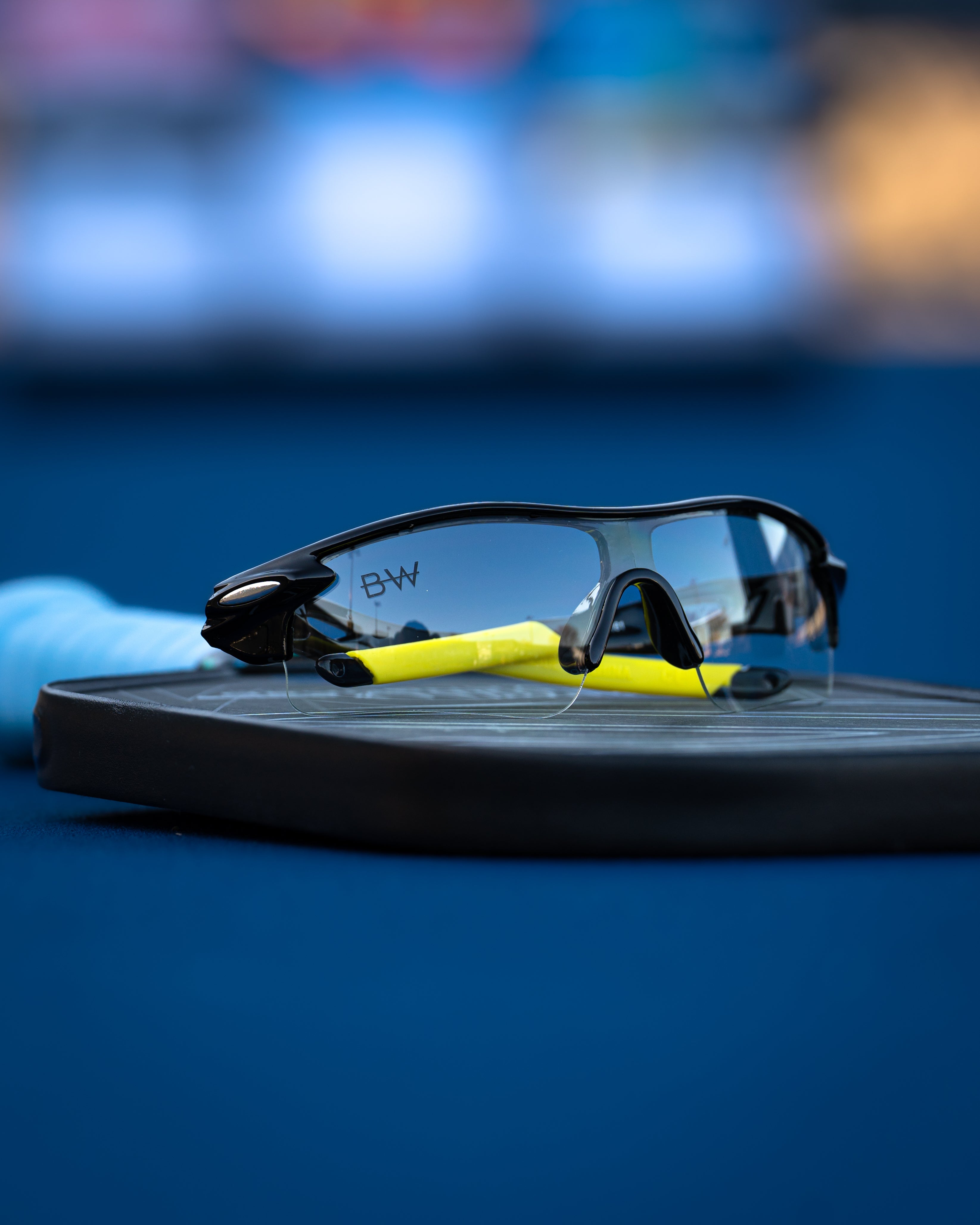
Which RX Lens Type Matches Your Playing Style?
Share
Find Your Pickleball Glasses
Choosing prescription pickleball eyewear starts with your prescription, then the lighting conditions where you actually play. Instead of assuming one lens type is best for every athlete, compare the exact lens options available for the RX product you are considering.
Which RX Lens Type Matches Your Playing Style?
The best prescription lens configuration for pickleball is not determined by whether you are an aggressive player, defensive player, tournament player, or recreational player. A more useful starting point is where and when you play.
A player who spends most sessions outdoors in bright daytime conditions may have different light-management preferences from someone who primarily plays indoors or at night. A player who frequently moves between environments may prioritize convenience differently from someone who plays under relatively consistent conditions.
This guide explains how to compare clear-looking lenses, fixed tints such as grey, and photochromic lenses when those options are available for the exact prescription product you are considering.
Availability varies by product and configuration, so do not assume every Blinded Wear RX frame is offered with every lens type discussed below.
Quick Answer: Start With Your Playing Environment
| Your Typical Environment | Lens Category to Consider | Main Reason to Consider It |
|---|---|---|
| Indoor courts | Clear-looking or other appropriate high-transmission option | A dark fixed tint may reduce more visible light than you want indoors |
| Night play | Clear-looking or another appropriate high-transmission option | Artificially illuminated courts already provide less ambient light than bright daytime conditions |
| Bright outdoor daytime play | Fixed tint such as grey, when available | A fixed tint reduces visible light according to the exact lens specification |
| Frequently changing environments | Photochromic, when available | The lens can change tint under the activating conditions of its specific technology |
| Predictable lighting every session | Fixed lens configuration | You can select for the environment you use most often |
| Multiple very different environments | One versatile configuration or multiple pairs | Convenience and environment-specific control are different priorities |
This is a starting framework, not a rule that one lens type is automatically best for everyone in a particular environment.
Your Playing Style Matters Less Than Your Lighting Conditions
Terms such as “power player,” “dinker,” “baseline player,” and “net player” describe aspects of how someone plays pickleball. They do not establish a particular lens tint.
A player at the kitchen line and a player at the baseline can be exposed to the same environmental light. Likewise, two players with similar strategies can have very different preferences if one plays indoors at night and the other plays outdoors at midday.
When choosing an RX lens configuration, prioritize:
- Your prescription needs
- The environments where you play
- Typical available light
- Whether those conditions remain consistent or change frequently
- Your individual lens preferences
- The options actually offered for the exact RX product
Three RX Lens Categories Players Commonly Compare
Three useful categories to understand are:
- Clear-looking lenses: lenses without a dark sunglass tint
- Fixed-tint lenses: lenses whose tint remains substantially fixed, such as a grey tint
- Photochromic lenses: lenses designed to change tint under particular activating and environmental conditions
These categories describe how lenses manage visible light or appearance. They do not determine prescription accuracy, impact resistance, polarization, scratch resistance, UV performance, anti-reflective properties, or other technical characteristics unless those features are separately specified.
Clear RX Lenses: When Should You Consider Them?
A clear-looking prescription lens can make sense when you do not want a dark sunglass tint reducing visible light.
That can make clear-looking lenses worth considering for environments such as:
- Indoor pickleball courts
- Night play
- Evening practices
- Other relatively low-light environments
- Players who simply prefer an untinted appearance
However, “clear” should not be interpreted as exactly 100% visible light transmission. Exact transmission depends on the actual lens.
Why Consider Clear RX Lenses for Indoor Pickleball?
Indoor courts rely on artificial lighting and generally do not present the same environment as direct outdoor daylight. A dark fixed sunglass tint may therefore remove more visible light than a player wants.
A clear-looking lens avoids intentionally adding a dark sunglass tint, making it a straightforward category to consider for indoor use.
That does not mean every clear lens provides identical transmission, coatings, optical characteristics, or performance. Compare the exact product rather than relying only on the word “clear.”
Are Clear RX Lenses a Good Choice for Night Pickleball?
Clear-looking prescription lenses are a logical category to consider when playing under court lights because a dark daytime sunglass tint may be unnecessary or undesirable in that environment.
The primary benefit is straightforward: you are not intentionally selecting a dark fixed tint for an already lower-light setting.
Do not turn that into claims that clear lenses automatically improve reaction time, ball tracking, depth perception, or shot accuracy.
What About Clear RX Lenses at Dawn or Dusk?
Dawn and dusk can involve rapidly changing light. A clear-looking lens may be preferable for someone who prioritizes visible-light transmission as daylight decreases, while another player may prefer a different lens configuration.
Clock time alone cannot tell you exactly how much light is available. Weather, court lighting, shade, season, and location can all affect the actual environment.
What Clear RX Lenses Do Not Automatically Mean
Do not assume a clear-looking lens automatically includes:
- 100% visible light transmission
- Anti-reflective coating
- Blue-light filtering
- Anti-fog treatment
- Scratch resistance
- Polarization
- A particular UV specification
- Impact certification
- Improved contrast
- Faster reaction time
Those are separate characteristics and should be verified for the exact lens when relevant.
Do Clear Lenses Eliminate Glare From Indoor Court Lights?
Do not assume that an untinted lens automatically eliminates reflections or glare.
Glare, reflections, visible-light transmission, polarization, tint, and anti-reflective treatments are separate concepts. If a particular optical treatment matters to you, verify that feature for the exact prescription lens rather than inferring it from the lens being clear.
Do Clear RX Lenses Automatically Block Blue Light?
No. A lens appearing clear does not establish whether it includes a blue-light filtering feature.
Blue-light filtering should also not be confused with prescription correction, impact resistance, UV performance, or sports performance.
Verify the exact lens specification rather than assuming the feature is included.
Who Might Prefer a Clear-Looking RX Lens?
A clear-looking prescription lens may appeal to players who:
- Play primarily indoors
- Play primarily at night
- Frequently practice under artificial court lighting
- Prefer an untinted appearance
- Want a prescription pair that is not intentionally darkened for bright daytime conditions
Preference still matters. There is no universal rule that every indoor or nighttime player must choose the same lens.
Grey RX Lenses: When Should You Consider a Fixed Grey Tint?
A fixed grey tint is a category worth considering for players who spend substantial time outdoors in brighter conditions and want a lens that reduces visible light according to the exact lens specification.
Grey is often described as relatively neutral in appearance compared with more strongly colored tints. That does not mean it produces zero color change or automatically improves contrast.
Its primary role is much simpler: a grey-tinted lens reduces visible light according to its actual Visible Light Transmission specification.
Why Consider Grey RX Lenses for Daytime Pickleball?
Outdoor daytime courts can expose players to substantially more ambient light than indoor or nighttime environments. A fixed sunglass tint can reduce the amount of visible light transmitted through the lens.
That makes grey worth considering if your playing schedule is dominated by bright daytime sessions.
The exact amount of visible-light reduction depends on the specific lens. Do not assume every grey lens has the same darkness or VLT.
What Is VLT and Why Does It Matter for Grey Lenses?
VLT stands for Visible Light Transmission. It describes the percentage of visible light transmitted through a lens.
- Higher VLT means more visible light is transmitted.
- Lower VLT means less visible light is transmitted.
Two lenses that are both described as grey do not necessarily have identical VLT values.
Do not assign a generic VLT number to a Blinded Wear lens unless that specification is verified for the exact product.
Does Grey Preserve Natural-Looking Color?
Grey tints are commonly considered relatively neutral compared with strongly colored tints, but avoid promising completely unchanged color perception.
Tint appearance and spectral transmission can vary by lens.
A safer comparison is that grey generally aims for a more neutral-looking tint than lens colors intentionally designed to create a stronger color cast.
Do Grey RX Lenses Improve Contrast?
Do not assume that grey universally improves contrast for every court, ball color, lighting condition, and wearer.
Contrast perception depends on more than the tint name. The exact lens transmission characteristics, environment, objects being viewed, prescription, and individual vision can all matter.
Choose grey primarily because you want a fixed tint and its visible-light characteristics, not because of an unsupported promise that it will automatically improve ball tracking.
Do Grey Lenses Improve Depth Perception?
No universal claim should be made that a grey tint improves depth perception.
Depth perception is a broader visual function. Lens tint alone should not be presented as a guaranteed way to enhance it.
Do Grey RX Lenses Make Reactions Faster?
No. A fixed grey tint should not be marketed as a reaction-time enhancement.
It changes visible-light transmission according to the exact lens. Reaction time involves perception, attention, anticipation, decision-making, and physical response, among other factors.
Grey vs. Polarized: They Are Not Opposites
Grey describes a tint color. Polarization describes a different lens characteristic designed to filter certain orientations of light.
A lens can potentially be grey without being polarized, and polarization should not be inferred merely from lens color.
Likewise, it is inaccurate to say that all polarized lenses inherently destroy depth perception or are universally unsuitable for pickleball.
Are Polarized Lenses Bad for Pickleball?
There is no universal rule that polarized lenses are inherently bad for every pickleball player.
Polarization alone does not determine depth perception, contrast, reaction time, or ball tracking. Your prescription, individual vision, lighting conditions, playing environment, and overall eyewear configuration also contribute to what you see on the court.
If polarization matters to you, verify whether the exact lens is polarized rather than assuming based on its color or appearance.
Does a Dark Grey Lens Automatically Provide More UV Protection?
No. Visible tint darkness and UV performance are separate characteristics.
A darker-looking lens should not automatically be assumed to provide a higher level of UV protection, and a clear-looking lens should not automatically be assumed to provide less.
Verify UV specifications separately when they matter to your purchase.
Who Might Prefer Grey RX Lenses?
A fixed grey tint may be worth considering for players who:
- Primarily play outdoors during the day
- Frequently encounter bright ambient conditions
- Prefer a fixed tint rather than a lens that changes with conditions
- Prefer the appearance of grey
- Want predictable tint behavior across a session
Again, exact suitability depends on the actual lens and the player's environment and preferences.
The Main Advantage of a Fixed Tint: Predictability
A fixed grey lens remains substantially fixed rather than intentionally changing tint in response to environmental activation.
That can appeal to players who use their glasses in relatively predictable conditions and prefer knowing that the lens will remain in the same general tint state throughout play.
The tradeoff is that the environment can change even though the fixed tint does not.
What Happens When You Use a Fixed Grey Tint in Lower Light?
A fixed tint continues reducing visible light even when the environment becomes darker.
That does not make grey universally inappropriate for every cloudy or evening situation, but it explains why a player who regularly moves between very bright and much darker environments may prefer a different strategy.
The relevant question is not simply “Is grey good?” It is “Does the exact tint make sense for the light where I will actually use it?”
Photochromic RX Lenses: When Should You Consider Them?
Photochromic lenses are designed to change tint under particular activating and environmental conditions.
They can be worth considering for players who value one-pair convenience across changing environments.
Photochromic technology should not be described as an instant electronic brightness-control system. The exact tint state and response depend on the specific technology and conditions.
Transitional vs. Photochromic: What's the Difference?
“Transitional” is commonly used conversationally to describe lenses that change tint, while photochromic is the broader technical category.
The important purchasing question is not the terminology alone. It is how the exact lens behaves under the conditions where you plan to use it.
How Do Photochromic Lenses Work?
Photochromic lenses contain technology designed to change tint in response to particular activating conditions. Exact activation mechanisms and behavior depend on the specific lens technology.
Avoid reducing every photochromic lens to the claim that it responds only to UV light. Different technologies can behave differently.
Are Photochromic RX Lenses Good for Indoor-Outdoor Players?
They can be convenient for someone who frequently changes environments and would rather use one prescription pair than manually switch between separate fixed-tint configurations.
However, that convenience should not be confused with a guarantee that the lens will always reach the exact tint you want at exactly the moment you want it.
The specific lens technology and environmental conditions matter.
Do Photochromic Lenses Change Instantly?
No universal instant-change claim should be made.
Activation and clearing speeds vary by technology and conditions. Avoid assuming a fixed number of seconds or minutes applies to every lens.
If rapid transitions between substantially different environments are central to your use case, exact product specifications are more useful than a generic “transition lens” label.
Are Photochromic Lenses Completely Clear Indoors?
Do not assume every photochromic technology reaches an identical indoor state.
The exact appearance and visible-light transmission depend on the lens and environmental conditions.
Likewise, “clear indoors” should not automatically be interpreted as exactly 100% visible-light transmission.
Do Photochromic Lenses Become as Dark as Sunglasses Outdoors?
That depends on the specific technology and conditions.
Do not assume every photochromic lens reaches the same outdoor darkness as every fixed sunglass tint.
If outdoor darkness is a major priority, compare verified specifications for the exact lens rather than relying on the category name.
Does Temperature Affect Photochromic Lenses?
Temperature can affect the behavior of some photochromic technologies, but there is no single formula that applies to every lens.
Do not promise an exact activation speed, clearing speed, or tint level based solely on temperature without specifications for the exact product.
What About Clouds and Shade?
Cloud cover and shade can change the environmental exposure reaching a lens, but the exact photochromic response depends on the technology and conditions.
A photochromic lens does not simply read labels such as “sunny,” “cloudy,” or “shade.” Its response depends on the activating environment reaching the lens.
Do Photochromic Lenses Work Behind a Windshield?
Do not make a universal promise about photochromic performance behind vehicle glass. The response depends on the particular lens technology and the environment reaching it.
If behind-glass activation matters to you, verify that behavior for the exact lens rather than assuming all photochromic products work identically.
Are Photochromic Lenses Automatically Ideal for Night Play?
Not automatically.
Evaluate the lens's actual state and transmission characteristics in the environment where it will be used. The word “photochromic” alone does not establish how a particular lens will appear under every nighttime court-lighting setup.
Who Might Prefer Photochromic RX Lenses?
When available for the exact product, photochromic lenses may appeal to players who:
- Frequently move between indoor and outdoor environments
- Play across changing daylight conditions
- Travel between different court environments
- Prefer carrying fewer prescription pairs
- Value convenience more than having a dedicated fixed tint for each environment
What Is the Main Tradeoff With Photochromic Lenses?
The primary tradeoff is adaptability versus direct control.
With a fixed lens, you choose the tint configuration in advance. With photochromic technology, the lens changes according to its design and the conditions reaching it.
Neither approach is universally superior.
Fixed Tint vs. Photochromic: Which Is Better?
| Priority | Fixed Tint | Photochromic |
|---|---|---|
| Predictable tint state | Strong fit for this priority | Tint changes according to conditions |
| Changing environments | May require switching pairs or accepting one fixed tint | Designed to change tint under activating conditions |
| One-pair convenience | Depends on whether one tint suits all environments | Potential advantage |
| Exact tint control | You select the fixed tint | Environmental response determines tint state |
| Response time | No tint transition is required | Technology and conditions affect activation and clearing |
Clear vs. Grey RX Lenses
The basic distinction is visible-light transmission and tint.
A clear-looking lens does not intentionally provide the same dark sunglass tint as a fixed grey lens. A grey lens intentionally reduces visible light according to its actual specification.
That makes the decision largely environmental:
- Consider clear-looking lenses when you do not want a dark sunglass tint.
- Consider fixed grey when you want a consistent tint for brighter conditions.
Neither lens type automatically produces better athletic performance.
Clear vs. Photochromic RX Lenses
A clear-looking fixed lens stays substantially untinted, while a photochromic lens is designed to change tint under particular conditions.
A player who primarily uses eyewear indoors or at night may value the simplicity of a fixed clear-looking lens. Someone moving repeatedly between different environments may value the convenience of photochromic technology.
The better choice depends on use, available product options, and personal preference.
Grey vs. Photochromic RX Lenses
A fixed grey tint provides a predictable tint state. A photochromic lens changes according to its specific technology and environment.
If you almost always play in similar bright outdoor conditions, a fixed tint may provide the consistency you want. If your environment changes frequently, photochromic technology may offer more convenience.
Do not assume that every photochromic lens becomes the same shade, darkness, or VLT as a fixed grey lens.
Should You Own More Than One RX Pair?
Some prescription players may prefer separate eyewear for substantially different environments rather than asking one lens configuration to cover every situation.
For example, a player could prefer:
- One prescription pair for indoor or nighttime use
- Another prescription pair with a fixed tint for bright outdoor use
This is not necessary for everyone. It is simply an alternative to prioritizing one-pair convenience.
What If You Only Want One RX Pair?
If you want one pair, identify the environment that accounts for most of your actual playing time and the amount of variation you encounter.
Ask yourself:
- Do I primarily play indoors?
- Do I primarily play outside in bright daylight?
- Do I regularly move between indoor and outdoor courts?
- Do my sessions begin in daylight and end under lights?
- Do I want a fixed tint or a lens that can change?
- Which lens configurations are actually available for the RX frame I want?
Those questions are more useful than trying to match a lens to labels such as “aggressive” or “defensive.”
RX Lens Considerations for Morning Players
Morning conditions can range from relatively dim early light to full daylight later in the session.
If your matches routinely span that change, consider whether you prefer:
- A clear-looking configuration that does not add a dark fixed tint
- A fixed tint chosen for the brighter portion of play
- A photochromic option, when available, for changing conditions
There is no universal “morning pickleball lens” because actual light varies considerably.
RX Lens Considerations for Midday Outdoor Players
If most of your play occurs outside during bright daytime conditions, a fixed tint such as grey may be worth considering.
The exact choice should depend on the actual lens specification and your preference rather than assuming all grey lenses provide identical darkness or visual characteristics.
Photochromic may also be an option when available, particularly if your environment changes before or after the brightest part of the session.
RX Lens Considerations for Evening Players
Evening play can create a difficult lens-selection problem because the environment may change substantially during a single session.
A fixed dark tint that feels appropriate before sunset will remain tinted as ambient light decreases. A clear-looking lens avoids that issue but does not provide the same daytime light reduction. A photochromic lens may offer changing tint when the specific technology and conditions support it.
Think about the entire session rather than only the lighting at the moment you arrive.
RX Lens Considerations for Night Players
If nearly all of your pickleball takes place after dark under artificial court lighting, a dark daytime sunglass tint may not match your primary environment.
Clear-looking or another appropriate higher-transmission option may therefore be worth considering.
Verify the exact product rather than assuming that every clear-looking lens has identical transmission or coatings.
RX Lens Considerations for Indoor Players
Indoor players should consider how much visible light they want transmitted under the specific facility's lighting.
A dark fixed sunglass tint may remove more visible light than desired. A clear-looking configuration can therefore be a straightforward option to evaluate.
If you also play outside regularly, decide whether you prefer one adaptable configuration or separate pairs.
RX Lens Considerations for Outdoor Players
Outdoor play can include direct sun, clouds, shade, changing court orientation, morning sessions, and evening sessions. “Outdoor” alone therefore does not identify one ideal lens.
If your outdoor environment is consistently bright, a fixed tint may be appealing. If conditions vary considerably, photochromic technology may be worth considering when available.
RX Lens Considerations for Tournament Players
Tournaments can involve multiple match times and different court environments. The useful question is not whether a lens is “tournament-grade,” but whether your eyewear configuration makes sense for the environments you may encounter.
Before an event:
- Check expected match times.
- Consider whether courts are indoor or outdoor.
- Consider how conditions may change during the day.
- Use your RX eyewear before the tournament rather than debuting an unfamiliar pair during an important match.
- Bring usable backup correction when being without your prescription would create a major problem.
RX Lens Considerations for Players Who Travel
Travel can expose you to different court environments than those you normally use at home.
If you regularly travel for pickleball, consider whether your lens strategy can handle:
- Indoor facilities
- Outdoor courts
- Morning matches
- Midday matches
- Evening matches
- Artificial court lighting
A photochromic option may provide convenience when available, while separate fixed configurations can provide more direct control. Neither strategy is universally better.
RX Lens Considerations for Recreational Players
Recreational players do not need a different optical principle from competitive players.
Choose according to your prescription, environment, preferences, and available product configuration rather than buying a more complicated lens simply because it sounds more performance-oriented.
Do Aggressive Players Need a Different RX Lens?
No specific tint is required because you play aggressively, attack the kitchen, or prefer fast exchanges.
Your playing strategy does not automatically determine VLT, tint color, polarization, or photochromic technology.
Choose those characteristics based on your visual prescription needs and environment.
Do Defensive Players Need a Different RX Lens?
No. A defensive playing style does not create a special prescription-lens requirement.
The same decision framework applies: prescription first, environment second, individual preference next, and exact product specifications before purchase.
Singles vs. Doubles: Does It Change Your RX Lens Type?
Playing singles rather than doubles changes court movement and strategy, but it does not automatically create a different optimal tint.
A singles player and doubles player competing on the same court under the same lighting may reasonably prefer the same lens configuration.
Do not select a tint based solely on singles or doubles participation.
Your Prescription Comes Before Lens Tint
Before deciding between clear-looking, grey, photochromic, or another available lens option, make sure you are using the appropriate eyeglass prescription.
Depending on the prescription, information can include:
- OD and OS
- SPH
- CYL when prescribed
- AXIS when prescribed
- ADD when prescribed
- Prism when prescribed
- Appropriate positioning measurements when required
Lens tint does not correct inaccurate prescription information.
Do Not Use a Contact-Lens Prescription for RX Glasses
Contact-lens prescriptions and eyeglass prescriptions should not be treated as interchangeable.
Contacts sit directly on the eyes, while spectacle lenses are positioned in front of them.
When ordering Blinded Wear prescription eyewear, use the appropriate eyeglass prescription rather than substituting contact-lens values.
Does Your Lens Type Change Your Pupillary Distance?
No. Choosing a clear-looking lens, grey tint, or photochromic technology does not change your anatomical pupillary distance.
PD is prescription-positioning information. Tint and light-management characteristics are separate.
Do not alter PD because you select a different lens color or configuration.
How Does High-Index Fit Into the Lens-Type Decision?
Blinded Wear includes high-index prescription lenses at no additional cost.
High-index refers to lens material with a higher refractive index than conventional lens materials and can help manage finished lens thickness, particularly as prescription strength increases.
High-index should not be confused with lens tint.
| Characteristic | What It Describes |
|---|---|
| High-index | Lens-material refractive properties |
| Grey | A lens tint color |
| Clear-looking | Absence of a dark sunglass tint |
| Photochromic | Technology designed to change tint under activating conditions |
| Polarization | A separate light-filtering characteristic |
| VLT | Percentage of visible light transmitted through a lens |
Does High-Index Mean More Durable?
Do not use refractive index as a durability rating.
High-index does not automatically mean:
- Shatterproof
- Scratchproof
- Heat-proof
- Crushproof
- Impact certified
- Ballistic
- Longer lasting than every other lens material
Likewise, the exact index of every Blinded Wear RX lens should not be assumed to be 1.61 unless that specification is verified for the exact product and configuration.
Impact Resistance Is Separate From Lens Tint
A grey lens is not automatically more impact resistant than a clear-looking lens. A photochromic lens is not automatically less impact resistant than a fixed tint.
Blinded Wear can offer impact-resistant lens options, but impact resistance should be evaluated separately from tint, refractive index, polarization, and other lens characteristics.
Impact resistant also does not mean indestructible or shatterproof.
Does Lens Type Determine Scratch Resistance?
No. Clear-looking, grey, and photochromic labels do not by themselves establish scratch resistance.
Scratch resistance involves separate material and surface considerations. If a scratch-resistant treatment is important to you, verify it for the exact lens rather than inferring it from tint.
Do All RX Lens Types Include Anti-Reflective Coating?
Do not assume that every prescription lens automatically includes anti-reflective treatment.
Anti-reflective properties are separate from whether a lens is clear-looking, grey, photochromic, high-index, polarized, or impact resistant.
Verify the exact configuration when this feature matters.
Are Any of These Lens Types Automatically Anti-Fog?
No. Clear, grey, and photochromic descriptions do not establish anti-fog performance.
Fogging is condensation. A lens's tint category alone does not prevent it.
Is UV Protection Determined by Tint?
No. Visible tint darkness and UV characteristics should be treated separately.
Do not assume:
- Darker means more UV protection.
- Clear-looking means no UV protection.
- Grey automatically establishes a particular UV rating.
- Photochromic automatically establishes every UV specification.
Use verified product information when UV specifications are important to your decision.
Lens Type Manages Light; It Does Not Replace Skill
Prescription correction and light-management choices can be important parts of eyewear, but no lens type should be marketed as a shortcut to pickleball performance.
A clear, grey, or photochromic lens does not automatically improve:
- Reaction time
- Ball tracking
- Depth perception
- Hand-eye coordination
- Court awareness
- Decision speed
- Shot placement
- Anticipation
Those outcomes involve many factors beyond lens tint.
RX Lens Decision Tree for Pickleball
Use this simple sequence when comparing lens categories:
- Where do I play most? Indoors, outdoors, or both?
- When do I play most? Morning, midday, evening, or night?
- How consistent is the lighting? Mostly stable or frequently changing?
- Do I want a fixed tint? If yes, compare appropriate fixed-tint options.
- Do I value one-pair adaptability? If yes, investigate photochromic availability and exact specifications.
- Do I primarily play in lower-light environments? Consider whether a clear-looking configuration better matches that use.
- What does the exact RX product actually offer? Verify before purchasing.
Clear vs. Grey vs. Photochromic RX Lenses
| Characteristic | Clear-Looking | Fixed Grey | Photochromic |
|---|---|---|---|
| Dark fixed sunglass tint | No | Yes | Changes according to technology and conditions |
| Useful category to consider indoors | Yes | Depends on exact tint and preference | Depends on exact lens behavior |
| Useful category to consider at night | Yes | Dark fixed tint may be undesirable | Depends on exact lens behavior |
| Useful category to consider in bright daytime conditions | Depends on preference and exact lens | Yes | Potentially, depending on technology |
| Tint remains substantially fixed | Yes | Yes | No |
| Designed to change tint | No | No | Yes |
| Automatically polarized | No | No | No |
| Automatically impact resistant | No | No | No |
| Automatically scratch resistant | No | No | No |
| Automatically improves reaction time | No | No | No |
RX Lens Type Myths vs. Facts
| Myth | Reality |
|---|---|
| “Clear lenses transmit exactly 100% of visible light.” | Exact VLT depends on the specific lens. |
| “Grey lenses automatically improve contrast.” | Contrast cannot be predicted from the tint name alone. |
| “Grey lenses improve depth perception.” | Do not use tint alone to promise improved depth perception. |
| “Polarized lenses are always bad for pickleball.” | Polarization alone does not determine sports performance or depth perception. |
| “Photochromic lenses change instantly.” | Response depends on technology and environmental conditions. |
| “Photochromic lenses are always completely clear indoors.” | Exact indoor state depends on the specific lens and conditions. |
| “Every RX frame offers every lens type.” | Availability must be verified for the exact product. |
| “High-index means 1.61.” | High-index is a category; do not assume an exact index without verification. |
| “High-index means impact-proof.” | Refractive index and impact performance are separate. |
| “The right tint makes you react faster.” | Lens tint should not be marketed as a reaction-time enhancement. |
Verify the Exact Lens Options Before Choosing a Frame
One of the most important steps is also one of the easiest to overlook: verify which lens configurations are actually available for the exact RX product you want.
Do not assume that every current Blinded Wear RX model offers:
- Clear lenses
- Grey lenses
- Photochromic lenses
- Polarized lenses
- The same VLT
- The same coatings
- The same prescription configurations
Product-specific information should control the purchase decision.
Explore Current Blinded Wear RX Pickleball Glasses
Use current product pages to compare the actual options available for each prescription frame.
- Steel Ice RX
- Blue Shield RX
- Havana Melt RX
- Gray Wash RX
- Zebra II RX
- Lava Rock RX
- Frost RX
- Rippled X RX
- Crystal Wave II RX
Browse the complete Prescription Pickleball Glasses Collection for current options.
Use the Blinded Wear Lens Guide
If you want to compare lens considerations before selecting an RX frame, review the Pickleball Performance Lens Guide.
Use the guide to understand available categories, then confirm the actual specifications on the exact product you intend to purchase.
What About the Pickleball Eyewear Quiz?
If you want another way to narrow your options, use the current Blinded Wear Pickleball Sunglasses Quiz.
A quiz can help organize preferences, but it should not replace your eyeglass prescription, professional vision care, or verification of the exact product specifications.
How to Order Blinded Wear RX Glasses
Once you have chosen an RX product and available lens configuration, upload a clear picture of your eyeglass prescription on the applicable product page before adding the eyewear to your cart.
Before submitting the order:
- Use an eyeglass prescription rather than a contact-lens prescription.
- Make sure the image is readable.
- Check OD and OS.
- Check plus and minus signs.
- Preserve CYL and AXIS when prescribed.
- Preserve ADD or prism when prescribed and applicable.
- Do not guess missing prescription information.
- Use appropriate positioning measurements when required.
- Verify the exact lens option you selected.
For the current process, read How to Order RX Glasses.
Check Your Lens Choice Carefully Before Ordering
Customized Blinded Wear RX eyewear is final sale and excluded from the standard 30-day return policy.
That makes it important to confirm both the prescription information and the exact lens configuration before purchasing.
Do not assume that ordering a lens type that does not match your preference will automatically qualify for a standard return or exchange.
What If Your RX Glasses Break Later?
Blinded Wear offers 50% lifetime replacement support for eligible broken eyewear, subject to current policy terms.
This should not be described as an unlimited free warranty, and it should not be assumed to cover every circumstance, prescription change, loss, or lens-preference issue.
Eligible damaged eyewear must be returned according to the applicable process. For damaged RX eyewear, contact blindedwearco@gmail.com before returning the pair.
Review the Blinded Wear Protection Plan, Replacement & Returns information for current details.
FAQ: Choosing an RX Lens Type for Pickleball
What is the best RX lens type for pickleball?
There is no universal best lens type. Start with your prescription, playing environment, typical light conditions, preferences, and the options available for the exact RX product.
Are clear RX lenses best for indoor pickleball?
Clear-looking lenses are a useful category to consider indoors because they do not intentionally add a dark sunglass tint. Individual preferences and exact lens specifications still matter.
Are clear RX lenses good for night pickleball?
They can be worth considering because a dark daytime tint may be undesirable under nighttime court lighting.
Do clear lenses transmit exactly 100% of visible light?
Do not assume that. Exact VLT depends on the specific lens.
Do clear lenses automatically include blue-light filtering?
No. Verify that feature separately if it matters to you.
Do clear lenses automatically include anti-reflective coating?
No. Anti-reflective properties should be verified for the exact lens.
Are grey RX lenses good for outdoor pickleball?
A fixed grey tint can be worth considering for brighter outdoor conditions because it reduces visible-light transmission according to the exact lens specification.
Does grey improve contrast?
Do not assume universal contrast enhancement from the tint name alone.
Does grey improve depth perception?
No universal depth-perception benefit should be claimed from grey tint alone.
Does grey improve reaction time?
No. Tint should not be marketed as a reaction-time enhancement.
Are grey lenses polarized?
Not necessarily. Grey describes tint color; polarization is a separate characteristic.
Are polarized lenses bad for pickleball?
Not universally. Polarization alone does not determine depth perception, reaction time, contrast, or ball tracking.
Are darker lenses automatically better for UV protection?
No. Visible darkness and UV performance are separate characteristics.
What does VLT mean?
VLT means Visible Light Transmission, the percentage of visible light transmitted through a lens.
Is there one ideal VLT for pickleball?
No universal VLT is best for every player and environment.
What are photochromic lenses?
Photochromic lenses are designed to change tint under particular activating and environmental conditions.
Are transitional and photochromic lenses the same thing?
“Transitional” is commonly used conversationally for lenses that change tint, while photochromic is the broader technical category.
Do photochromic lenses change instantly?
No universal instant response should be assumed. Exact behavior depends on the technology and conditions.
Do photochromic lenses stay perfectly clear indoors?
Do not assume every technology has an identical indoor state.
Do photochromic lenses always get very dark outdoors?
No. Exact outdoor tint depends on the lens technology and conditions.
Are photochromic lenses best for players who move indoors and outdoors?
They can provide useful one-pair convenience when available, but they are not universally the best option for every player.
Do photochromic lenses work behind a windshield?
Behavior behind vehicle glass depends on the specific photochromic technology and environment. Verify the exact lens if this matters to you.
Does temperature affect photochromic lenses?
It can affect some technologies, but there is no universal response formula for every lens.
Should I buy clear and grey RX pairs?
Some players prefer separate pairs for substantially different environments. Others prioritize one-pair convenience. Either strategy can be reasonable.
Does an aggressive playing style require a special lens?
No. Playing strategy does not automatically determine lens tint.
Do singles players need different lenses from doubles players?
No. Match format alone does not determine the appropriate lens type.
Does high-index mean my lenses are 1.61?
Do not assume an exact refractive index unless it is verified for the exact product and configuration.
Does high-index make a lens more impact resistant?
Not automatically. Refractive index and impact resistance are separate characteristics.
Do all Blinded Wear RX products offer clear, grey, and photochromic options?
Do not assume universal availability. Verify the exact options on the product you are considering.
Can I use my contact prescription?
No. Use the appropriate eyeglass prescription when ordering prescription glasses.
Where can I compare current RX options?
Browse the Blinded Wear Prescription Pickleball Glasses Collection and verify the current configuration of each product.
The Bottom Line: Match the Lens to the Environment, Not a Playing-Style Label
The most useful way to choose an RX lens for pickleball is not to ask whether you are an aggressive, defensive, singles, doubles, recreational, or tournament player. Ask where you play, when you play, how much the lighting changes, and what lens configurations are actually available for your prescription eyewear.
A clear-looking lens can be worth considering when you do not want a dark sunglass tint. A fixed grey tint can make sense when you want consistent visible-light reduction in brighter conditions. A photochromic lens can provide convenience when you regularly move through changing environments and the technology is available for your chosen product.
None of those categories automatically improves reaction time, ball tracking, depth perception, or pickleball skill. They are different approaches to eyewear and light management.
Start with your prescription, evaluate your real playing environment, verify the exact product specifications, and then choose the configuration that best matches how you actually use your glasses.
Explore the Blinded Wear Prescription Pickleball Glasses Collection or review the Pickleball Performance Lens Guide to continue comparing your options.
How to Match an RX Lens to Your Actual Playing Environment
Once you understand the basic differences between clear-looking, fixed-tint, and photochromic lenses, the next step is to look more closely at the environments where you actually play.
Instead of choosing a lens because it is marketed as “competitive” or “performance,” build your decision around practical questions:
- How bright is the court?
- Is the lighting natural, artificial, or a combination?
- Does the light stay relatively consistent throughout the session?
- Do you move between indoor and outdoor courts?
- Does your session commonly begin in daylight and end after sunset?
- Would you rather have one adaptable prescription pair or separate pairs for different environments?
Those factors provide a more useful foundation than playing-style labels alone.
Early-Morning Pickleball: Clear, Grey, or Photochromic?
Early-morning sessions can begin in relatively low ambient light and become substantially brighter as the sun rises. That creates a different decision from playing at the same time and under the same conditions every day.
A clear-looking lens avoids adding a dark fixed tint during the lower-light portion of the session. A fixed grey tint provides consistent visible-light reduction but remains tinted even before the environment becomes bright. A photochromic option, when available, is designed to change tint according to its technology and the conditions reaching the lens.
If your morning sessions are short and consistently begin after full daylight, a fixed tint may be more straightforward. If you regularly play through a substantial change in daylight, adaptability may become more important to you.
Bright Midday Pickleball: Why Fixed Tint Becomes Relevant
For players who consistently play outside during bright daytime conditions, fixed-tint prescription sunglasses are one category worth comparing.
A fixed grey lens reduces visible-light transmission according to the exact lens specification. Unlike a photochromic lens, it does not intentionally change tint as environmental activation changes.
That consistency may appeal to players whose environment is relatively predictable.
However, the word “grey” alone does not tell you:
- The exact VLT
- UV specifications
- Whether the lens is polarized
- Whether it has anti-reflective treatment
- Whether it has a scratch-resistant treatment
- Its impact characteristics
- Whether it is appropriate for your prescription
Verify those characteristics separately for the exact product.
What RX Lens Works for Cloudy or Overcast Pickleball?
“Cloudy” is not a precise measurement of available light. A bright overcast afternoon can be very different from a dark stormy evening.
That means there is no single lens type that is automatically best whenever clouds appear.
Consider:
- How much visible light is actually available
- Whether conditions are expected to change
- Whether you prefer a fixed tint
- Whether the exact photochromic option available to you suits the environment
- Your individual comfort and preference
Do not assume that a fixed grey lens becomes inappropriate merely because the sky is cloudy, or that a photochromic lens automatically reaches a particular tint under cloud cover.
What About Outdoor Courts With Heavy Shade?
Trees, buildings, court covers, and surrounding structures can create an outdoor environment that receives less direct light than an exposed court.
This is another reason the label “outdoor player” is too broad to determine lens choice.
If you routinely play on shaded courts, evaluate those actual conditions rather than choosing the darkest available tint simply because the facility is outdoors.
If considering photochromic technology, remember that its response depends on the specific lens and the activating conditions reaching it.
What If Part of the Court Is in Sun and Part Is in Shade?
Mixed lighting can be visually challenging, but no lens type can be guaranteed to eliminate every difficulty created by uneven illumination.
A fixed tint remains substantially fixed across the court. A photochromic lens changes according to its technology and environmental exposure, but it should not be described as instantly adjusting separately to every bright and shaded region you look toward.
Do not expect a lens to function like an electronic exposure-control system.
What If Your Match Starts in Sunlight and Ends After Sunset?
This is one of the clearest examples of why playing schedule can matter more than playing style.
A dark fixed tint may feel appropriate during the brighter portion of the match but will remain tinted as ambient light falls. A clear-looking lens avoids the fixed dark tint but may not provide the same visible-light reduction during the bright portion. A photochromic lens can offer changing tint when its specific technology and conditions allow.
Another strategy is using separate prescription pairs when practical.
There is no universal answer. The tradeoff is between fixed control, changing-lens convenience, and carrying more than one pair.
How Should You Choose RX Lenses for Courts With Artificial Lighting?
Artificial court lighting does not create one universal optical environment. Facilities can differ in brightness, fixture placement, court surface, surrounding light, and other characteristics.
A clear-looking prescription lens is a logical category to consider when you do not want a dark sunglass tint reducing visible light.
Do not assume, however, that clear lenses automatically:
- Remove reflections
- Eliminate glare
- Prevent halos
- Increase contrast
- Filter blue light
- Prevent eye fatigue
- Improve ball tracking
Those claims require separate evidence or product specifications.
Not Every Indoor Pickleball Facility Has the Same Lighting
An indoor pickleball facility can be brightly illuminated, relatively dim, or somewhere in between. Ceiling height, fixture placement, windows, daylight entering the building, and court layout can all change the environment.
This is why a useful buying decision starts with the facility you actually use rather than a generic statement that one lens is “the indoor lens.”
Clear-looking prescription lenses remain a useful category to consider because they do not intentionally add a dark fixed sunglass tint.
What About Indoor Courts With Large Windows?
Facilities with significant natural daylight can create different conditions throughout the day. An indoor court beside large windows at midday may not resemble the same facility after sunset.
If your environment changes significantly, decide whether you value:
- A fixed clear-looking lens
- A separate outdoor prescription pair
- A changing lens technology when available and appropriate
Do not assume that photochromic behavior through windows or other glazing will be identical to its behavior in direct outdoor exposure. Exact behavior depends on the lens technology and environment.
Should Weather Determine Your RX Lens Type?
Weather can influence environmental light, but weather labels should not replace actual lens specifications or individual preferences.
For example:
| Condition | Useful Question |
|---|---|
| Bright sun | Do I want a fixed tint that reduces visible light? |
| Overcast | How bright is the environment actually? |
| Changing clouds | Do I prefer fixed tint or adaptable technology? |
| Shade | Is my current tint darker than I prefer for this environment? |
| Evening | Will available light continue decreasing during play? |
| Night | Do I need a dark sunglass tint at all? |
Do You Need Different RX Lenses for Different Seasons?
There is no universal seasonal prescription-lens rule.
Season can affect daylight duration, sun position, weather, and the times when you play, but the useful question remains the same: what conditions are you actually using the glasses in?
A player whose schedule and environment remain consistent may have little reason to change lens strategy simply because the calendar changes.
Does Court Color Determine Which RX Tint You Need?
Do not assign a universal lens tint based solely on whether a court is blue, green, red, grey, or another color.
Visual contrast involves the ball, court, background, illumination, lens transmission characteristics, prescription, and individual vision.
A generic claim such as “grey is best for blue courts” or “this tint makes yellow balls pop” should not be made without evidence for the exact lens and conditions.
Should You Choose an RX Lens Based on Pickleball Color?
Ball color can be part of the overall visual environment, but it does not create a universal prescription-tint formula.
A yellow, green, orange, or other ball can appear differently depending on:
- Available light
- Background
- Court color
- Lens transmission characteristics
- Individual vision
Do not assume one tint universally improves visibility of every pickleball color.
Brightness, Contrast, and Visibility Are Different Concepts
Reducing visible light is not the same as increasing contrast. Increasing perceived comfort is not automatically the same as improving visual acuity. Changing tint is not the same as changing the prescription.
Keep these concepts separate when comparing lenses:
- Visible-light transmission: how much visible light passes through the lens
- Tint: the coloration or darkening of the lens
- Contrast: differences between visual elements
- Prescription correction: optical correction prescribed for refractive needs
- Polarization: a separate filtering characteristic
- Photochromic response: a lens changing tint under activating conditions
Understanding Visible Light Transmission Before Choosing a Tint
VLT is one of the most useful concepts for understanding tinted lenses.
If a lens has a lower VLT, less visible light passes through it. If it has a higher VLT, more visible light passes through it.
However, VLT should not be treated as a complete description of everything you will perceive through a lens.
It does not by itself establish:
- UV specifications
- Polarization
- Color appearance
- Contrast performance
- Impact resistance
- Scratch resistance
- Anti-reflective properties
- Prescription accuracy
What Is the Best VLT for Pickleball?
There is no single VLT percentage that is best for every pickleball player.
The appropriate amount of visible-light transmission depends on the environment and individual preference. A VLT suitable for bright outdoor use may not be what the same person prefers at night.
Do not choose a lens because an article gives a universal “pickleball VLT” number without considering where you will use it.
Can Two Lenses With Similar VLT Look Different?
Yes. VLT describes overall visible-light transmission as a percentage, but it does not fully describe the lens's spectral transmission or tint appearance.
Two lenses can have similar overall VLT while differing in color or other characteristics.
That is another reason VLT should be considered alongside the exact lens design rather than used as the only buying criterion.
Is a Darker Lens Better for Outdoor Pickleball?
Not automatically.
A darker lens transmits less visible light, but “less light” is not universally better. The useful amount depends on the environment and wearer.
Do not select the darkest available lens merely because you play outside.
Why Do Players Consider Grey Tint?
The practical appeal of grey is that it is generally regarded as a relatively neutral tint compared with more strongly colored alternatives.
That should not be rewritten as:
- “Perfect color accuracy”
- “Zero color distortion”
- “Maximum contrast”
- “Better depth perception”
- “Faster tracking”
Those are much stronger claims than the tint name supports.
What If Bright Light Makes You Squint?
If you prefer less visible light in bright conditions, a tinted lens may be worth considering. That is different from claiming that a particular grey lens medically treats light sensitivity or eye strain.
If light sensitivity is new, severe, persistent, or concerning, eyewear selection should not replace appropriate professional evaluation.
Lens Preference vs. Medical Light Sensitivity
Choosing a sunglass tint because you prefer reduced brightness is a consumer eyewear decision. Significant photophobia or other unusual light sensitivity can be a health concern.
Do not use a pickleball lens guide to diagnose the cause of persistent or significant sensitivity to light.
Why Photochromic Response Is More Complicated Than “Light or Dark”
A photochromic lens is not simply either fully clear or fully dark.
Depending on the technology and conditions, it can exist at different tint states. Environmental exposure, temperature, and other factors can influence the response of particular technologies.
That means the most useful product questions include:
- What technology is being offered?
- What are its verified transmission characteristics?
- How does it behave in the environments where I will use it?
- How quickly does that specific technology activate and clear under relevant conditions?
Avoid substituting generic photochromic claims for exact product specifications.
Who Is the Strongest Candidate for Photochromic Convenience?
A player may find photochromic technology particularly appealing if several of these statements apply:
- I regularly play at different times of day.
- I use both indoor and outdoor courts.
- I frequently travel to unfamiliar facilities.
- I dislike carrying multiple prescription pairs.
- My sessions commonly span changing daylight.
- I prioritize convenience over selecting a dedicated fixed tint for each environment.
This describes a convenience use case, not a guarantee of better athletic performance.
Who Is the Strongest Candidate for a Fixed Tint?
A fixed tint may be appealing if:
- You play in relatively predictable bright conditions.
- You prefer consistent tint throughout a session.
- You want direct control over the tint you purchase.
- You do not regularly move between dramatically different lighting environments while wearing the same pair.
Verify the exact tint and transmission characteristics before buying.
Who Is the Strongest Candidate for Clear-Looking RX Lenses?
A clear-looking lens may be appealing if:
- You primarily play indoors.
- You primarily play after dark.
- You do not want a dark fixed sunglass tint.
- You want an RX pair for environments where a dark tint would reduce more visible light than you prefer.
The exact lens can still have characteristics not visible from appearance alone, so check its specifications.
One Adaptable Pair vs. Two Dedicated RX Pairs
There are two fundamentally different ways to handle highly variable playing environments.
Strategy 1: One Adaptable Pair
When an appropriate photochromic option is available, one pair can provide changing tint behavior without manually switching between separate prescription glasses.
Strategy 2: Separate Fixed Pairs
A player can use one prescription configuration for lower-light environments and another fixed-tint configuration for bright outdoor use.
The first strategy emphasizes convenience. The second emphasizes direct control over each configuration.
Neither strategy is inherently more competitive.
Why a Backup RX Pair Can Matter Beyond Lens Tint
If you depend on prescription correction to play, a backup can be useful regardless of which lens type you choose.
A backup can help if your primary eyewear becomes:
- Damaged
- Misplaced
- Unavailable during travel
- Uncomfortable because of an unexpected fit issue
A backup should itself provide usable correction for its intended purpose. An old pair with an outdated prescription should not automatically be assumed to be an appropriate backup.
How Should Traveling Players Pack Multiple RX Lens Options?
If you travel with more than one prescription pair, consider keeping them separated and appropriately protected rather than storing multiple lenses loosely with hard or abrasive objects.
When practical, keep essential prescription eyewear accessible rather than relying entirely on checked luggage.
Travel does not change your prescription or PD, but it can introduce physical risks such as compression, impact, abrasion, and repeated handling.
Protective Storage Matters Regardless of Lens Type
No tint makes prescription eyewear crushproof or scratchproof.
Whether your lenses are clear-looking, grey, or photochromic:
- Avoid storing them loose with keys or abrasive objects.
- Keep visible grit away from lens surfaces before wiping.
- Avoid unnecessary compression.
- Inspect the frame and lenses after significant impact.
- Avoid relying on lens tint as a durability feature.
Does Lens Type Determine Heat Resistance?
No. A lens being grey, clear-looking, or photochromic does not by itself establish heat resistance.
Do not assume a particular lens type is safe for prolonged extreme heat or that another lens type will automatically warp.
Avoid unnecessary prolonged exposure to extreme heat and follow appropriate care guidance for the exact eyewear.
Does Sweat Affect Clear, Grey, and Photochromic Lenses Differently?
Do not assume tint category alone determines sweat resistance.
Perspiration can leave residue on eyewear, but visible residue is not automatically lens damage.
Use appropriate lens-care methods and avoid aggressively rubbing dried debris across the surface.
What About Playing in Humid or Damp Conditions?
Moisture on a lens can affect visibility temporarily without changing the prescription or tint specification.
Water droplets, condensation, fogging, surface coatings, and tint are separate considerations.
Do not assume a lens is hydrophobic or anti-fog merely because it is marketed as sports eyewear.
Which RX Lens Type Fogs the Least?
Clear, grey, and photochromic categories do not establish anti-fog performance.
Fogging depends on condensation and environmental conditions, while anti-fog properties require separate product characteristics or treatments.
Verify an anti-fog claim for the exact product rather than assigning it to an entire tint category.
Does Cleaning Change the Tint or Prescription?
Appropriate cleaning removes surface contamination; it does not change your written prescription.
When cleaning RX sports glasses:
- Remove loose grit before rubbing the surface.
- Use lens-care methods appropriate for the eyewear.
- Keep cleaning materials clean.
- Avoid abrasive DIY polishing methods.
- Do not use household chemicals unless their compatibility with the lens and any coatings is established.
What If Your RX Lens Gets Scratched?
A scratch is physical surface damage. It does not change SPH, CYL, AXIS, PD, or the written prescription.
How noticeable a scratch is can depend on its location, severity, lighting, and other factors.
Do not attempt to polish prescription lenses with toothpaste, baking soda, car polish, or other abrasive DIY methods.
What If the Lens Cracks?
A crack is different from a scratch or surface residue.
If an RX lens develops a visible crack or other structural damage, inspect the eyewear and avoid trying to repair the optical surface with a home remedy.
Changing lens tint or prescription information does not solve structural damage.
Lens Problem or Lighting Problem? A Quick Troubleshooting Guide
| What You Notice | Possible Category to Check |
|---|---|
| Lens looks hazy but clears after cleaning | Surface contamination |
| Temporary haze in changing temperature or humidity | Condensation or fogging |
| Visible permanent surface line | Possible scratch |
| Visible structural damage | Possible crack or other physical damage |
| Outdoor fixed tint feels too dark after sunset | Lens/environment mismatch |
| Photochromic tint differs between environments | Potentially normal response to different conditions, depending on technology |
| Persistent visual concern with clean, intact eyewear | Prescription, positioning, lens, fit, or vision may need evaluation |
Does a Stronger Prescription Require a Different Tint?
No universal rule links prescription strength to clear, grey, or photochromic tint selection.
A stronger prescription can affect considerations such as finished lens thickness and optical design, but it does not automatically mean you need a darker or lighter tint.
Keep prescription power and light-management choices conceptually separate.
Why High-Index Is About More Than the Tint You See
High-index prescription lens material can help manage thickness under comparable conditions, particularly as prescription strength increases.
Finished thickness still depends on factors such as:
- Prescription
- Lens dimensions
- Frame dimensions
- Lens positioning
- Lens design
- Other optical requirements
Do not assume that high-index automatically means the lightest, strongest, clearest, or most impact-resistant lens.
Plus and Minus Prescriptions Can Produce Different Lens Geometry
Prescription lens thickness does not develop identically for every prescription. Plus and minus prescriptions can produce different thickness patterns, and final geometry depends on more than refractive index alone.
This is another reason tint selection and prescription-lens design should not be treated as the same decision.
Does Frame Size Affect Which Tint You Should Choose?
Frame and lens dimensions can matter to the finished prescription eyewear, but a larger frame does not automatically require grey, clear, or photochromic lenses.
Frame selection and tint selection answer different questions:
- Frame: physical fit, dimensions, compatibility, and construction
- Prescription: refractive correction
- Tint or photochromic technology: visible-light management and lens appearance
Does a More Wrapped Sports Frame Require a Certain Lens Type?
No universal tint requirement follows from frame wrap.
Frame geometry can be relevant to the finished prescription configuration, but it does not mean that a wrapped frame must use grey, clear, or photochromic lenses.
Verify prescription compatibility and the exact lens options available for the specific frame.
Does a Larger Lens Automatically Improve Peripheral Vision?
A larger physical lens or frame opening should not be marketed as automatically increasing a wearer's biological peripheral vision or improving ball tracking.
Frame geometry, lens coverage, fit, prescription design, and human peripheral vision are related but distinct concepts.
Choose a frame because its verified characteristics suit your needs, not because of an unsupported promise of enhanced peripheral performance.
Lens Type Cannot Compensate for Poor Frame Fit
A lens can have an appropriate tint for the environment while the frame itself is uncomfortable or unstable for the wearer.
When evaluating new RX sports eyewear, check:
- Overall comfort
- How the frame sits during ordinary movement
- Whether the eyewear interferes with your normal field of use
- Whether it remains practical during a typical practice session
Do not assume that the tightest possible fit is automatically the best sports fit.
How to Test a New RX Pair Before an Important Match
Use new prescription sports eyewear during ordinary practice before depending on it in a major competition.
A practical familiarization check can include:
- Clean the lenses.
- Inspect the frame and lenses for visible damage.
- Wear the glasses in the environment where you expect to use them.
- Check comfort during normal head movement.
- Use them during ordinary drills and practice.
- Notice whether the selected tint feels appropriate for the environment.
- Address persistent visual or fit concerns rather than ignoring them.
This is not a home laboratory test and does not verify the optical fabrication of the finished lenses.
Tournament-Day RX Lens Checklist
- Confirm which pair matches the expected playing environment.
- Clean the lenses before leaving.
- Inspect for cracks, significant scratches, or frame damage.
- Bring usable backup correction when appropriate.
- Protect spare eyewear from loose objects and compression.
- Consider whether matches extend from daylight into evening.
- Do not debut unfamiliar RX eyewear during your most important match.
- Do not assume weather forecasts perfectly predict actual court lighting.
What If a Tournament Includes Morning, Midday, and Evening Matches?
A long tournament day can expose one player to substantially different lighting conditions.
Three strategies are possible:
- Use one fixed configuration that you find acceptable across the expected range.
- Use photochromic technology when available and suitable for your preferences.
- Bring multiple prescription pairs configured for different environments.
Each strategy has tradeoffs. There is no universal tournament lens that eliminates the need to think about actual conditions.
If You Switch RX Pairs During the Day, Should the Prescription Match?
Separate pairs intended to provide the same current distance correction should be based on appropriate prescription information for their intended use.
Do not assume an old pair remains equivalent simply because it once used the same prescription.
If your prescription has changed, determine whether an older backup is still appropriate rather than treating it as automatically interchangeable.
Should You Change Lens Type When Your Prescription Changes?
A new prescription does not automatically require a new tint category.
Your refractive correction may change while your playing environment and tint preference remain the same.
Reassess the lens type if your use case has changed, not simply because SPH, CYL, AXIS, or another prescription value changed.
PD and Lens Tint Solve Different Problems
Pupillary distance provides horizontal positioning information used in prescription eyewear. Tint describes visible coloration and light transmission characteristics.
Changing from clear-looking to grey or photochromic does not create a new anatomical PD.
Do not alter prescription measurements in an attempt to compensate for a different tint.
Optical Positioning Is More Complex Than Lens Color
A prescription lens involves optical information and positioning that cannot be judged simply from whether the lens looks clear or dark.
Tint does not prove:
- Prescription accuracy
- Correct lens power
- Correct PD
- Correct optical positioning
- Appropriate fitting height when required
If you suspect a finished prescription pair has an optical issue, evaluate that issue separately from the tint.
Can the Wrong Tint Cause Every Visual Symptom?
No. Symptoms such as blur, discomfort, headaches, dizziness, or double vision cannot be reliably diagnosed from tint choice alone.
Possible categories can include:
- Prescription issues
- Optical positioning
- Frame fit
- Lens condition
- Environmental conditions
- Vision or eye-health factors unrelated to the eyewear
Persistent or concerning symptoms deserve appropriate evaluation rather than assuming that changing from grey to clear will solve the problem.
What If You Develop New Double Vision?
Do not treat new or persistent double vision as a simple lens-tint preference issue.
Seek appropriate professional evaluation rather than trying different sunglass colors or changing prescription measurements yourself.
Can the Right RX Lens Make You React Faster?
Do not promise that selecting clear, grey, or photochromic lenses directly increases reaction speed.
Appropriate prescription correction addresses the refractive error it was prescribed for. Light-management choices affect the light reaching the eyes according to the lens characteristics.
Reaction performance involves additional factors such as:
- Attention
- Anticipation
- Decision-making
- Experience
- Positioning
- Physical response
Can a Tint Guarantee Better Ball Tracking?
No.
A tint can change visible-light transmission and the appearance of the environment, but it should not be marketed as a guaranteed ball-tracking enhancement.
Ball tracking is a visual and perceptual task involving more than tint color.
Can Lens Type Guarantee Better Depth Perception?
No. Depth perception is a broader visual function and should not be reduced to a clear-versus-grey-versus-photochromic choice.
If depth perception is a concern, appropriate vision evaluation is more meaningful than assuming a specific tint will improve it.
Can Lens Type Improve Peripheral Vision?
No universal claim should be made that a tint or photochromic technology increases biological peripheral vision.
The eyewear's physical geometry and how it sits may influence what portions of the lens or frame are in the wearer's view, but that is different from enhancing the underlying peripheral visual field.
Does One Lens Type Prevent Eye Fatigue?
Do not promise that clear, grey, or photochromic lenses universally prevent eye fatigue.
Visual comfort can depend on prescription, environment, individual vision, lens characteristics, duration of use, and other factors.
Persistent symptoms should not be diagnosed from lens tint alone.
Does the Right Lens Make You a More Confident Player?
A player may personally prefer one eyewear configuration over another, but confidence is subjective and should not be promised as an optical performance outcome.
The practical goal is to select prescription eyewear that is appropriate for your needs and environment.
Do Competitive Players Need More Advanced Lens Types?
Competitive status does not automatically create a need for a more complicated lens technology.
A competitive player who always plays indoors may prefer a straightforward clear-looking prescription configuration. A recreational player who constantly moves between indoor and outdoor courts may value photochromic convenience.
Use case matters more than status.
Does a More Expensive Lens Type Mean Better Pickleball Performance?
Price alone does not establish that one lens will improve athletic performance.
Evaluate what the additional cost actually provides, such as a specific material, tint, treatment, or changing-lens technology, and decide whether that feature matches your use case.
RX Lens Marketing Claims to Question
Be cautious when eyewear is described with claims such as:
- “Makes the ball easier to track”
- “Speeds up reaction time”
- “Perfect depth perception”
- “Zero distortion”
- “100% light transmission”
- “Instant transitions”
- “Works perfectly in every light”
- “Best lens for every athlete”
- “High-index means impact-proof”
- “Darker lenses mean better UV protection”
Instead, look for specific, verifiable information about the exact product.
Better Questions to Ask Before Buying RX Pickleball Lenses
| Instead of Asking | Ask |
|---|---|
| “Which lens makes me react fastest?” | “Which available lens configuration fits the lighting where I play?” |
| “Which tint gives perfect contrast?” | “What are the verified characteristics of this exact tint?” |
| “Is grey always best outside?” | “How bright are my normal outdoor conditions?” |
| “Are transitions best for athletes?” | “Would changing tint be useful for my environments?” |
| “Does high-index make it stronger?” | “What material and impact characteristics are actually specified?” |
| “Does dark tint mean UV protection?” | “What UV specification is verified for this lens?” |
| “Is this tournament-grade?” | “What exact features make this lens appropriate for my use?” |
RX Lens Shopping Checklist
Before choosing your prescription pickleball eyewear, confirm:
- I have an appropriate eyeglass prescription.
- I am not substituting a contact-lens prescription.
- I know where I play most often.
- I know whether my lighting is relatively fixed or frequently changing.
- I understand the difference between clear-looking, fixed-tint, and photochromic lenses.
- I am not assuming grey means polarized.
- I am not assuming dark tint means better UV protection.
- I am not assuming photochromic means instant.
- I have verified which lens configurations are actually available for my chosen product.
- I understand that high-index and tint are separate characteristics.
- I am not using tint as a substitute for prescription accuracy.
- I have reviewed the customized RX final-sale policy.
Compare Current Blinded Wear Prescription Pickleball Glasses
Once you know what type of playing environment you need to accommodate, compare current RX frames and the exact configurations offered for each one.
- Steel Ice RX
- Blue Shield RX
- Havana Melt RX
- Gray Wash RX
- Zebra II RX
- Lava Rock RX
- Frost RX
- Rippled X RX
- Crystal Wave II RX
For all current options, visit the Blinded Wear Prescription Pickleball Glasses Collection.
Ordering Your RX Pickleball Glasses
After choosing an available frame and lens configuration, upload a clear picture of your eyeglass prescription on the applicable product page before adding the eyewear to your cart.
Review the prescription image carefully. Do not guess, round, or intentionally alter prescription values because you are ordering sports eyewear.
Use the Blinded Wear RX Ordering Guide for current ordering instructions.
Part 2 Summary: Choose for the Conditions You Actually Play In
The most useful lens decision comes from understanding your real environment rather than trying to identify a universal “best pickleball lens.”
If you primarily play indoors or at night, a clear-looking lens is one category to consider. If you consistently play outdoors in bright conditions, a fixed tint such as grey may fit your preferences. If your environments change frequently, photochromic technology may offer useful one-pair convenience when available for the exact RX product.
Then look beyond the category name. Verify VLT when specified, polarization when relevant, lens material, available prescription configuration, impact characteristics, and any coatings or treatments you actually care about.
Most importantly, keep prescription correction separate from marketing claims about athletic performance. The right RX configuration should address your prescription and fit your environment without promising that a tint will automatically improve reaction time, tracking, depth perception, or pickleball skill.
Final RX Lens Selection Framework for Pickleball
Choosing prescription pickleball eyewear becomes easier when you separate the decision into individual questions instead of searching for one lens that is supposedly “best” at everything.
Use this order:
- Prescription: Start with the appropriate eyeglass prescription.
- Playing environment: Identify where and when you actually play.
- Available light: Consider whether conditions are bright, lower-light, artificial, or frequently changing.
- Lens strategy: Decide whether you prefer a clear-looking lens, fixed tint, changing photochromic technology, or multiple pairs.
- Exact specifications: Verify what the specific product actually offers.
- Frame fit: Choose eyewear that is comfortable and practical for your use.
- Durability and care: Treat impact resistance, scratches, heat, coatings, and storage as separate considerations.
- Backup plan: Decide whether you need another usable prescription pair for tournaments or travel.
This approach keeps prescription correction, light management, frame characteristics, and athletic performance from being incorrectly treated as the same thing.
What Should Matter Most When Choosing RX Pickleball Glasses?
| Priority | What to Evaluate |
|---|---|
| 1. Prescription | Use appropriate current eyeglass prescription information |
| 2. Product compatibility | Confirm the frame and available RX configuration can accommodate your needs |
| 3. Playing environment | Indoor, outdoor, daytime, evening, night, or mixed |
| 4. Light-management preference | Clear-looking, fixed tint, photochromic, or multiple pairs when available |
| 5. Fit and comfort | How the eyewear works for you during ordinary court movement |
| 6. Verified lens characteristics | Material, tint, VLT, polarization, impact characteristics, or coatings when specified |
| 7. Care and storage | Cleaning, protection from abrasion, compression, and unnecessary extreme heat |
| 8. Backup strategy | Whether losing access to your primary RX pair would prevent you from playing comfortably |
Three Examples of Matching RX Lenses to Real Playing Habits
Player 1: Mostly Indoor Evening Play
This player practices and competes almost entirely inside under artificial lighting. A clear-looking prescription configuration may be a logical category to investigate because the player does not primarily need a dark daytime sunglass tint.
Player 2: Consistent Bright Outdoor Play
This player usually plays outdoors during similar daytime hours. A fixed tint such as grey may be worth comparing because the player wants consistent visible-light reduction in a relatively predictable environment.
Player 3: Indoor, Outdoor, Morning, and Evening Play
This player regularly changes facilities and match times. Photochromic technology may provide useful one-pair convenience when available for the chosen RX product. Alternatively, the player may prefer separate prescription pairs for different environments.
Notice that none of these recommendations depends on whether the player is aggressive, defensive, a dinker, a power player, or a tournament competitor. The environment is the more useful starting point.
What About the Player Who Does Everything?
Some players practice indoors during the week, play outside on weekends, enter tournaments, travel, and occasionally play at night.
For this type of schedule, there may not be one perfect fixed lens for every condition.
The decision becomes a tradeoff between:
- Convenience: using one adaptable prescription configuration when an appropriate photochromic option is available
- Control: using separate fixed configurations for substantially different environments
- Simplicity: choosing one configuration based on the environment where most play occurs
The best approach is the one that matches your actual use without relying on unsupported promises that one lens automatically optimizes every condition.
Choose a Clear-Looking RX Lens When...
A clear-looking lens is worth considering when:
- You primarily play indoors.
- You primarily play at night.
- You frequently practice under artificial court lighting.
- You do not want a dark fixed sunglass tint.
- Your primary environment has less available light than bright daytime outdoor conditions.
Before ordering, verify the exact product rather than assuming that “clear” establishes a particular VLT, coating package, UV specification, impact rating, or other feature.
Choose a Fixed Grey RX Lens When...
A fixed grey tint is worth considering when:
- You primarily play outdoors during brighter daytime conditions.
- You want a consistent tint throughout the session.
- You prefer a relatively neutral-looking tint.
- Your normal lighting environment is reasonably predictable.
- You prefer fixed tint behavior rather than a lens designed to change with conditions.
Remember that grey describes tint color. It does not automatically establish polarization, UV performance, contrast enhancement, impact resistance, or an exact VLT.
Choose a Photochromic RX Lens When...
When an appropriate photochromic configuration is available, it may be worth considering when:
- You regularly move between different lighting environments.
- You play at several times of day.
- You frequently use both indoor and outdoor courts.
- Your sessions can span changing daylight.
- You travel to facilities with different environments.
- You prioritize one-pair convenience.
Photochromic technology should not be treated as instantaneous electronic tint control. Exact activation, clearing, tint state, and environmental behavior depend on the specific technology.
Choose Multiple RX Pairs When...
Multiple prescription pairs may make sense when:
- You regularly play in dramatically different environments.
- You prefer a dedicated fixed tint for bright outdoor use.
- You also want a separate clear-looking configuration for lower-light use.
- You want a usable backup during tournaments or travel.
- You prefer direct control over each lens configuration instead of relying on one changing lens.
Multiple pairs are not necessary for every athlete. They are simply another way to handle substantially different playing environments.
Before Buying, Separate These Lens Characteristics
Several eyewear terms are often combined in marketing even though they describe different characteristics.
| Term | What It Actually Describes |
|---|---|
| Prescription | Optical correction prescribed for the wearer |
| High-index | A category of lens material based on refractive index |
| Grey | A tint color |
| Clear-looking | A lens without a dark sunglass tint |
| Photochromic | Technology designed to change tint under activating conditions |
| Polarized | A separate light-filtering characteristic |
| VLT | The percentage of visible light transmitted through a lens |
| Impact resistant | A separate physical-performance characteristic |
| Scratch resistant | A separate surface-performance characteristic when specified |
| Anti-reflective | A separate optical surface treatment when specified |
| Anti-fog | A separate fog-management characteristic when specified |
One characteristic does not automatically prove another.
Where High-Index RX Lenses Fit Into the Decision
Blinded Wear includes high-index prescription lenses at no additional cost.
High-index material can help manage finished lens thickness, particularly as prescription strength increases, but final thickness depends on more than refractive index alone.
Factors can include:
- Your prescription
- Lens dimensions
- Frame dimensions
- Positioning
- Lens design
- Other optical requirements
Do not assume every Blinded Wear RX lens uses an exact 1.61 index unless that specification is verified for the exact configuration.
What High-Index Does Not Automatically Mean
High-index should not automatically be translated into any of the following claims:
- More impact resistant
- Shatterproof
- Scratchproof
- Heat-proof
- Crushproof
- Anti-fog
- Polarized
- UV-rated to a particular specification
- Safety certified
- Optically more accurate
- Better ball tracking
- Faster reactions
- Improved depth perception
Refractive index is an optical material property, not a universal performance score.
Impact Resistance Is Important, but It Is a Separate Question
Blinded Wear can offer impact-resistant lens options, but impact resistance should not be confused with tint, refractive index, polarization, or photochromic technology.
An impact-resistant lens should also not automatically be described as:
- Unbreakable
- Shatterproof
- Ballistic
- Crushproof
- Scratchproof
- Certified protective eyewear
If your activity involves a specific occupational or high-impact hazard requiring rated protective eyewear, use eyewear appropriately designed and rated for that hazard.
Prescription Accuracy Comes Before Tint Preference
A lens can have exactly the tint you want and still be the wrong eyewear for you if the prescription information is incorrect.
Before ordering, review the appropriate eyeglass prescription and preserve the information exactly as prescribed.
Common prescription terms can include:
- OD: right eye
- OS: left eye
- SPH: spherical lens power
- CYL: cylinder power when prescribed
- AXIS: orientation associated with cylinder when prescribed
- ADD: additional power when prescribed
- Prism: prism information when prescribed
Do not guess, round, transpose, or intentionally change prescription information to make it fit an eyewear order.
Eyeglass RX and Contact-Lens RX Are Not Interchangeable
Do not upload a contact-lens prescription as a substitute for an eyeglass prescription.
Contacts sit directly on the eye, while spectacle lenses are positioned in front of it. The prescriptions should not be assumed to be interchangeable.
Use the appropriate eyeglass prescription when ordering Blinded Wear RX glasses.
Where Pupillary Distance Fits Into RX Eyewear
Pupillary distance is a positioning measurement used in prescription eyewear. It is not a tint specification and does not change because you choose a clear-looking, grey, or photochromic lens.
Do not assume that every written eyeglass prescription necessarily includes PD, and do not simply divide a binocular PD in half when monocular measurements are needed.
When appropriate positioning information is required, use accurate information rather than guessing.
Prescription Lens Positioning Is More Nuanced Than “Center the Lens Over the Pupil”
Prescription lens positioning can involve more than placing the geometric center of a lens directly in front of a pupil.
Depending on the lens and prescription design, relevant considerations can include horizontal positioning, vertical positioning, frame geometry, wearing position, and other optical requirements.
That is why:
- PD is not the same thing as lens tint.
- Geometric center is not necessarily the relevant optical reference point.
- A larger lens does not automatically provide more accurate optics.
- A darker lens does not improve optical centering.
- High-index material does not guarantee prescription accuracy.
Frame Fit Still Matters After You Choose the Lens
After selecting an appropriate prescription and lens configuration, consider how the frame works for you during normal use.
A practical sports fit should be comfortable enough for the intended session and usable during normal movement.
Avoid assuming:
- The tightest frame is automatically best.
- Every sports frame is zero-slip.
- A frame can never move during play.
- A larger lens automatically improves tracking.
- A more wrapped appearance automatically improves peripheral vision.
Fit is personal and should be evaluated as its own part of the purchase.
Use New RX Eyewear Before Tournament Day
Do not make an important tournament the first time you wear an unfamiliar prescription pair.
Instead:
- Inspect the glasses.
- Clean the lenses appropriately.
- Wear them in the intended environment.
- Use them during normal practice.
- Evaluate comfort and fit.
- Determine whether the chosen tint suits the environment.
- Address persistent visual concerns before relying on the pair in competition.
This familiarization process does not replace professional verification if you suspect a prescription or optical problem.
Care for Every RX Lens Type Properly
Regardless of tint category, good handling can help reduce avoidable surface damage.
A practical routine includes:
- Inspect the lens before wiping it.
- Remove loose grit rather than grinding it across the surface.
- Use appropriate lens-care methods and compatible products.
- Keep cleaning material itself clean.
- Avoid abrasive DIY scratch-removal methods.
- Store eyewear away from loose hard objects when possible.
- Avoid unnecessary compression.
- Avoid unnecessary prolonged exposure to extreme heat.
Do Not Try to Polish Scratches Out of RX Lenses at Home
Methods involving toothpaste, baking soda, automotive polish, abrasive compounds, or similar DIY techniques can alter a lens surface or its treatments rather than restoring it to its original optical condition.
If you cannot determine whether a mark is dirt, residue, a scratch, coating damage, or a crack, avoid aggressive repair attempts.
Scratch vs. Crack vs. Residue: Know the Difference
| Issue | What It Means | General Response |
|---|---|---|
| Residue | Material on the lens surface | Use appropriate cleaning methods |
| Fog | Condensation affecting visibility | Allow conditions to normalize and use compatible care methods |
| Scratch | Physical surface damage | Avoid abrasive DIY polishing; evaluate severity |
| Crack | Structural physical damage | Stop treating it as a cleaning issue and evaluate the damaged eyewear |
| Blur with a clean, intact lens | May have multiple possible causes | Evaluate prescription, positioning, fit, lens condition, environment, or vision as appropriate |
Does a Scratch Change Your Prescription?
No. A physical scratch does not rewrite the prescription values used to make the lens.
However, a scratch can be noticeable depending on its location and severity. Do not confuse a damaged viewing surface with a change in SPH, CYL, AXIS, or PD.
Does a Frame Moving Change Your Prescription?
The written prescription does not change because the frame moves.
However, a significant change in how eyewear sits can change the wearing position of the lenses relative to the eyes. That is different from the prescription itself changing.
If a frame becomes visibly deformed or no longer sits as intended after impact, evaluate the physical eyewear rather than attempting to compensate by changing prescription numbers yourself.
What to Check After Your RX Glasses Take an Impact
After a meaningful impact or drop, inspect the eyewear before continuing to rely on it.
- Look for visible cracks.
- Look for chips or obvious lens damage.
- Check whether a lens appears displaced.
- Check for obvious frame deformation.
- Check the temples and hinges for visible damage.
- Clean surface contamination before assuming a mark is permanent.
- Do not force a displaced lens back into position if you are unsure how the eyewear is constructed.
Impact resistance reduces neither every type of damage nor the need to inspect damaged eyewear.
Protect RX Eyewear From Unnecessary Extreme Heat
Do not assume a clear, grey, high-index, or photochromic lens is universally heat-proof.
Material systems and coatings can respond differently to environmental conditions. There is no single universal temperature threshold that should be assigned to every Blinded Wear RX product without product-specific testing.
A practical approach is to avoid unnecessary prolonged extreme heat rather than relying on a “heat-proof” marketing claim.
Traveling With RX Pickleball Glasses
Travel can expose eyewear to physical stresses that are separate from lens tint:
- Compression
- Impact
- Abrasion
- Repeated handling
- Heat
- Moisture and residue
No clear, grey, or photochromic configuration should be assumed to be suitcase-proof, TSA-proof, or crushproof.
Use protective storage and keep essential prescription correction accessible when practical.
Build a Backup Strategy Before an Important Event
If you depend on prescription eyewear to play, consider what you would do if your primary pair became unavailable during a tournament or trip.
A backup strategy can include another usable prescription pair appropriate for the circumstances.
Do not assume an old pair remains an ideal backup merely because you still own it. If your prescription has changed, determine whether the older pair remains appropriate for its intended use.
Final Tournament RX Eyewear Checklist
- Use an appropriate eyeglass prescription.
- Verify the lens configuration before ordering.
- Wear new eyewear during practice before the event.
- Check expected match environments and times.
- Consider whether conditions may change during the day.
- Clean the lenses before play.
- Inspect for physical damage.
- Store spare eyewear appropriately.
- Bring usable backup correction when practical.
- Do not rely on tint as a substitute for prescription accuracy.
Pickleball RX Lens Myths to Leave Behind
| Claim | Better Interpretation |
|---|---|
| “Grey lenses make you react faster.” | Grey is a tint; it should not be marketed as a reaction-time enhancement. |
| “Clear lenses give perfect indoor vision.” | Clear-looking lenses avoid a dark fixed tint, but vision depends on more than tint. |
| “Photochromic lenses instantly optimize every light change.” | Response depends on the exact technology and environmental conditions. |
| “Polarized lenses ruin depth perception.” | Polarization alone does not determine depth perception. |
| “Grey automatically improves contrast.” | Contrast cannot be predicted from tint name alone. |
| “High-index means stronger.” | Refractive index is not a durability rating. |
| “High-index means 1.61.” | Do not assume an exact index without product-specific verification. |
| “Dark lenses have better UV protection.” | Visible tint darkness and UV performance are separate. |
| “Sports frames automatically provide certified protection.” | Safety certification must be separately established. |
| “One lens is best for every pickleball player.” | Prescription needs, environment, preferences, and available products differ. |
Advanced FAQ: RX Lens Types for Pickleball
Which prescription lens is best for aggressive pickleball players?
There is no lens tint that becomes best simply because a player has an aggressive style. Choose based on prescription needs, playing environment, preferences, and verified product specifications.
Which RX lens is best for dink-heavy players?
Dinking does not create a special lens requirement. Lighting and prescription needs remain more useful selection factors.
Which lens is best for fast hands at the kitchen?
No clear, grey, or photochromic lens should be promised to increase hand speed or reaction time.
Which lens is best for singles?
Singles participation alone does not determine tint. Consider where and when you play.
Which lens is best for doubles?
Doubles participation alone does not determine the appropriate lens type.
Which RX lens is best indoors?
A clear-looking or otherwise appropriate higher-transmission option is worth considering when you do not want a dark sunglass tint indoors. Verify the exact lens.
Which RX lens is best for outdoor daytime pickleball?
A fixed tint such as grey can be worth considering when you consistently play in brighter conditions. Exact tint and VLT matter.
Which RX lens is best for night pickleball?
A clear-looking or other appropriate higher-transmission configuration may make more sense than a dark daytime tint for many nighttime environments.
Which RX lens is best if I play indoors and outdoors?
You can compare photochromic technology when available, choose one fixed configuration that suits most of your use, or maintain separate prescription pairs.
Is grey better than clear?
Neither is universally better. They serve different light-management preferences.
Is photochromic better than grey?
Not universally. Photochromic emphasizes changing tint and convenience, while fixed grey provides a substantially fixed tint.
Is photochromic better than owning two pairs?
That depends on whether you prioritize one-pair convenience or direct control over separate configurations.
Do photochromic lenses become instantly dark outside?
No universal instant response should be assumed. Exact behavior depends on the technology and conditions.
Do photochromic lenses immediately clear when I walk indoors?
Do not assume instantaneous clearing. Exact response varies by technology and conditions.
Are photochromic lenses always grey?
No universal color should be inferred from the term photochromic. Verify the exact lens.
Are photochromic lenses polarized?
Not automatically. Photochromic behavior and polarization are separate characteristics.
Are grey lenses polarized?
Not automatically. Grey is a tint color; polarization is separate.
Are clear lenses automatically anti-reflective?
No. Anti-reflective treatment must be separately verified.
Are clear lenses automatically blue-light filtering?
No. Lens appearance alone does not establish blue-light filtering.
Does a darker tint mean more UV protection?
No. Visible-light transmission and UV characteristics are separate.
Does lower VLT mean better pickleball performance?
No. Lower VLT simply means less visible light is transmitted. There is no universal VLT that guarantees better athletic performance.
Can tint improve my prescription?
Tint does not change SPH, CYL, AXIS, ADD, prism, or other prescribed correction.
Does high-index improve clarity?
Refractive index should not be used as a universal clarity ranking. High-index is primarily a lens-material characteristic useful for considerations such as thickness management.
Are all Blinded Wear RX lenses exactly 1.61?
Do not assume an exact index for every configuration unless that specification is verified for the exact product.
Does high-index mean shatterproof?
No. Refractive index does not establish shatterproof performance.
Can I use my contact-lens prescription?
Do not substitute a contact-lens prescription for the appropriate eyeglass prescription.
Should I change my PD for a different tint?
No. Tint does not change your anatomical pupillary distance.
What if my new RX glasses still seem blurry?
Blur can have multiple possible causes, including prescription, positioning, fit, lens condition, environmental factors, or vision-related issues. Persistent concerns deserve appropriate evaluation rather than assuming tint is responsible.
Can I fix a scratched RX lens with toothpaste?
Avoid abrasive DIY polishing methods. They can alter the lens surface rather than restoring the original optical condition.
What if my RX lens cracks?
Treat a crack as structural damage rather than a cleaning problem. Blinded Wear's applicable replacement-support policy may be relevant for eligible broken eyewear.
Explore Current Blinded Wear RX Pickleball Glasses
After deciding which type of environment you need to accommodate, compare the exact options available on current prescription product pages.
- Steel Ice RX
- Blue Shield RX
- Havana Melt RX
- Gray Wash RX
- Zebra II RX
- Lava Rock RX
- Frost RX
- Rippled X RX
- Crystal Wave II RX
Browse the complete Prescription Pickleball Glasses Collection for current products and available configurations.
Continue Your RX Pickleball Eyewear Research
How to Order Your Blinded Wear RX Glasses
When you have selected a prescription product and available lens configuration, upload a clear picture of your eyeglass prescription on the applicable product page before adding the eyewear to your cart.
Before submitting your order:
- Use the appropriate eyeglass prescription.
- Do not substitute a contact-lens prescription.
- Make sure the prescription image is readable.
- Confirm OD and OS.
- Check all plus and minus signs.
- Preserve CYL and AXIS when prescribed.
- Preserve ADD and prism when prescribed and applicable.
- Do not guess missing information.
- Verify the exact frame and lens configuration.
For current instructions, review How to Order RX Glasses.
Remember: Customized RX Eyewear Is Final Sale
Customized Blinded Wear prescription eyewear is final sale and excluded from the standard 30-day return policy.
Because prescription eyewear is customized, review your prescription information, selected product, and chosen lens configuration carefully before completing the order.
Do not assume that deciding later that you prefer another tint automatically qualifies the customized RX pair for a standard return.
Lifetime Replacement Support for Eligible Broken Eyewear
Blinded Wear offers 50% lifetime replacement support if eligible glasses break, subject to current policy terms.
This is different from a free unlimited lifetime warranty. Eligible damaged eyewear must be returned according to the applicable process, and qualifying support provides 50% credit toward a replacement pair.
For damaged RX eyewear, contact blindedwearco@gmail.com before returning the pair.
Replacement support should not automatically be interpreted as coverage for lost eyewear, prescription changes, lens-preference changes, or every possible form of damage.
Review the Blinded Wear Protection Plan, Replacement & Returns information for current eligibility and policy details.
10 Rules for Choosing RX Pickleball Lenses
- Start with your prescription. Tint cannot correct inaccurate prescription information.
- Choose for your environment. Indoor, outdoor, daytime, and nighttime conditions can create different preferences.
- Do not choose by playing-style label. Aggressive and defensive players do not inherently require different tints.
- Understand VLT. Lower VLT means less visible light transmission; higher VLT means more.
- Keep tint and polarization separate. Grey does not automatically mean polarized.
- Keep tint and UV specifications separate. Darker does not automatically mean more UV protection.
- Keep high-index and durability separate. Refractive index is not an impact or scratch rating.
- Treat photochromic as technology, not magic. Exact behavior depends on the specific lens and conditions.
- Verify the exact product. Do not assume every frame offers every lens configuration.
- Ignore guaranteed performance claims. No tint automatically makes you react faster, track the ball better, or play better pickleball.
Final Buying Checklist: Which RX Lens Type Matches You?
Before ordering, answer these questions:
- Do I have the appropriate eyeglass prescription?
- Where do I play most often?
- What time of day do I usually play?
- Is my environment consistently bright, consistently lower-light, or frequently changing?
- Do I want a dark fixed tint?
- Would I benefit from changing tint when an appropriate photochromic option is available?
- Would separate prescription pairs make more sense for my environments?
- Have I verified the exact VLT if that specification matters to me?
- Have I verified polarization rather than assuming it from tint?
- Have I verified any UV, coating, impact, or other feature I care about?
- Am I treating high-index and tint as separate characteristics?
- Have I confirmed the exact lens options available for my chosen frame?
- Have I reviewed the RX ordering instructions?
- Do I understand that customized RX eyewear is final sale?
- Do I have a backup strategy if I rely heavily on prescription eyewear?
Final Verdict: Match Your RX Lens to Your Environment, Not Your Pickleball Identity
The best prescription lens choice is not determined by whether you call yourself a power player, dinker, tournament player, singles specialist, doubles player, beginner, or advanced athlete.
Start with the prescription correction you need. Then look at the conditions where you actually play.
If you primarily play indoors or at night and do not want a dark sunglass tint, a clear-looking RX configuration may be worth considering. If you consistently play outdoors in brighter daytime conditions and prefer a stable tint, a fixed grey RX lens may make sense when available. If your environment changes frequently and you value one-pair convenience, photochromic technology may be worth evaluating when offered for your chosen product.
For players who want greater control across very different environments, separate prescription pairs can also be a practical strategy.
None of these categories should be sold as a shortcut to faster reactions, better depth perception, improved ball tracking, or automatic competitive performance. Prescription correction, tint, VLT, polarization, high-index material, impact characteristics, coatings, fit, and frame construction are separate considerations.
The strongest buying decision is therefore simple: use the appropriate prescription, understand your playing environment, verify the exact product specifications, and choose the available lens configuration that best matches how you actually use your eyewear.
Explore current options in the Blinded Wear Prescription Pickleball Glasses Collection, compare lens considerations in the Pickleball Performance Lens Guide, or review the RX Ordering Guide before purchasing.