
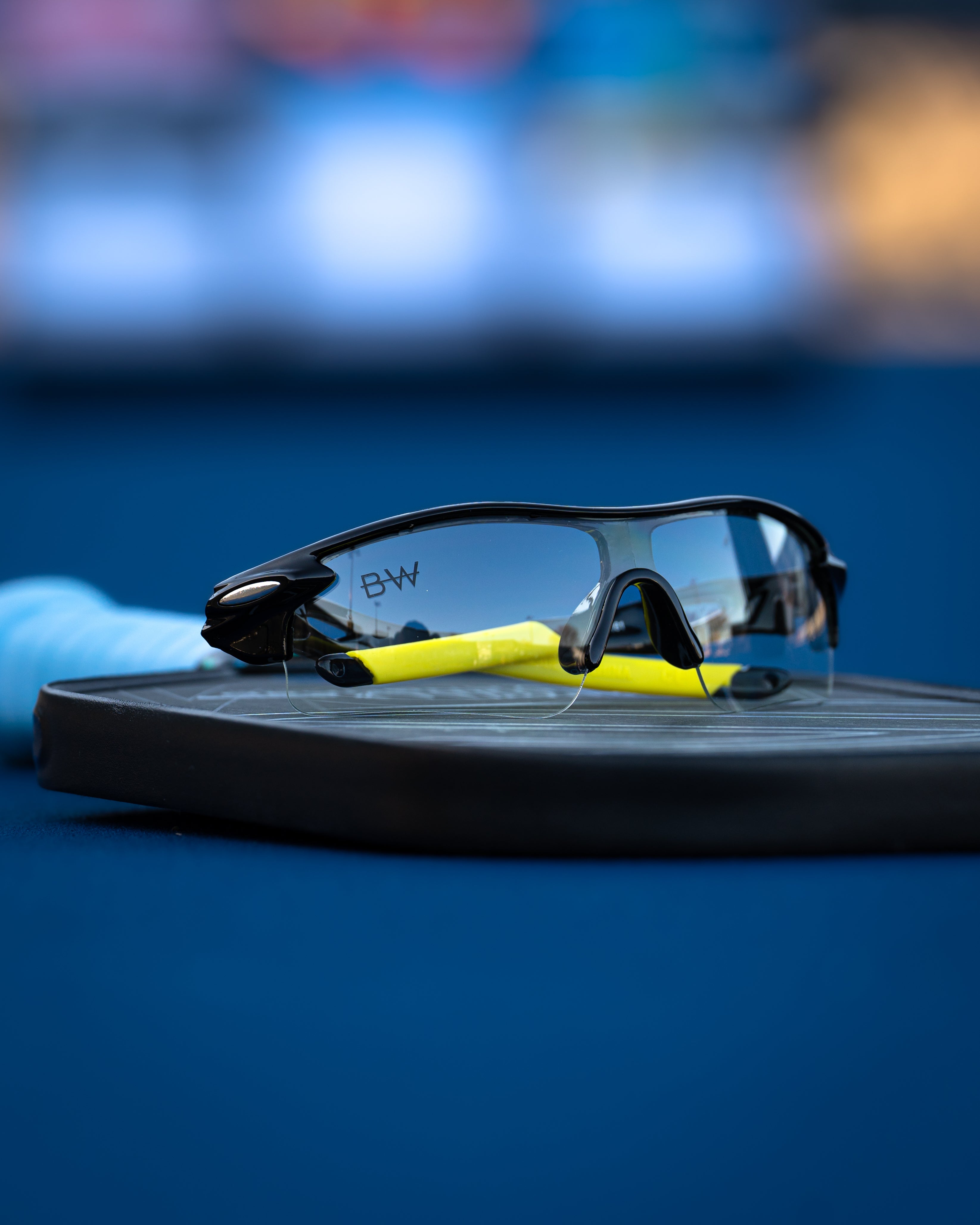
Why Your Non-RX Glasses Are Costing You Games (And How to Fix It)
Share
Why Your Non-RX Glasses Are Costing You Games (And How to Fix It)
If you need prescription correction but play pickleball in non-prescription glasses or sunglasses, the problem is not that non-RX eyewear is inherently bad for pickleball. The problem is simpler: non-RX lenses do not provide the prescription correction you need.
That distinction matters. A player who does not require corrective lenses can use non-RX sports eyewear perfectly appropriately. But if you normally depend on prescription glasses or contacts to see clearly, switching to non-prescription sunglasses on court means you are also choosing to play without that correction.
The solution is not a lens promising faster reactions, perfect depth perception, or instant accuracy. It is choosing eyewear that matches your actual vision needs, playing environment, and sport.
The original version of this guide attributed delayed depth perception, misjudged angles, eye fatigue, slower cognitive responses, and other performance losses directly to non-RX glasses. :contentReference[oaicite:0]{index=0} This updated guide separates what prescription eyewear actually does from athletic outcomes that depend on far more than the lenses you wear.
Find the Right Pickleball Eyewear Category
Are Non-RX Glasses Really Costing You Pickleball Games?
Only needing RX correction makes this comparison meaningful.
If you do not require prescription correction, there is no reason to assume prescription pickleball glasses would improve your game. Non-RX sports eyewear may be the appropriate category for you.
If you do require prescription correction, however, non-RX lenses cannot provide it. That can make your on-court visual setup different from the corrected vision you normally use for everyday activities.
| Player | Non-RX Eyewear | RX Eyewear |
|---|---|---|
| Does Not Need Prescription Correction | Potentially appropriate | Not needed solely for pickleball |
| Needs Prescription Correction | Does not provide the required RX | Provides individualized prescription correction |
| Wears Contacts for Correction | Can potentially be worn over contacts depending on the setup | Another corrective option |
| Indoor / Night Player | Clear non-RX may be relevant if correction is not needed | Clear RX may be relevant if correction is needed |
| Outdoor Player | Non-RX sports sunglasses may be relevant if correction is not needed | RX sports sunglasses may be relevant if correction is needed |
First: Non-RX Pickleball Glasses Are Not “Bad” Eyewear
The phrase “non-RX glasses are costing you games” needs an important qualification.
Non-RX simply means non-prescription. It does not mean cheap, low quality, inaccurate, or unsuitable for sports.
A non-RX player can still choose eyewear with:
- Lightweight sports frames
- Impact-resistant lenses
- Non-polarized lenses
- Clear or tinted configurations depending on the product
- A design intended for pickleball
Blinded Wear offers both non-prescription pickleball eyewear and prescription pickleball glasses because different players have different vision needs.
Who Should Consider RX Pickleball Glasses?
If you already rely on prescription correction, that is the clearest reason to compare RX sports eyewear.
For example, RX pickleball glasses may be relevant if you normally wear prescription glasses and do not want to play without your correction.
The question is not:
“Will RX glasses magically make me better at pickleball?”
It is:
“Do I need prescription correction, and how do I want that correction incorporated into the eyewear I use on court?”
What Happens When You Need RX Correction but Wear Non-RX Sunglasses?
A non-prescription sunglass lens can provide the characteristics built into that sunglass, but it does not contain your individualized prescription correction.
That means the central difference is straightforward:
| Feature | Non-RX Sports Sunglasses | RX Sports Sunglasses |
|---|---|---|
| Sports Frame | Can have one | Can have one |
| Impact-Resistant Lenses | Can have them | Can have them |
| Tint | Depends on product | Depends on product |
| Non-Polarized Lens | Can be non-polarized | Can be non-polarized |
| Your Prescription Correction | No | Yes |
If correction matters to your normal vision, that final row is the reason to consider RX—not exaggerated claims about turning ordinary reflexes into elite reaction speed.
Do RX Pickleball Glasses Improve Clarity?
Prescription lenses are made to provide the correction prescribed for the wearer. For someone who needs corrective lenses, that is fundamentally different from looking through a non-prescription lens.
However, avoid turning “prescription correction” into promises such as:
- Perfect clarity for every player
- Zero distortion
- Perfect ball tracking
- Instantly improved accuracy
- Guaranteed better depth perception
- Faster cognitive processing
The useful claim is also the simplest: RX eyewear provides your prescription correction while you play.
Will Switching From Non-RX to RX Glasses Improve Your Reaction Time?
There is no universal percentage by which prescription glasses make pickleball players react faster.
A reaction during a rally can involve several stages:
- Visual information becomes available
- You recognize what is happening
- You interpret the developing shot
- You choose a response
- You initiate movement
- You execute the shot
If you need corrective vision, appropriate RX eyewear addresses your corrective requirement. It does not independently control the rest of that chain.
Reaction speed is therefore better trained through realistic pickleball practice than purchased through a claim attached to a lens.
Do Prescription Pickleball Glasses Improve Depth Perception?
Do not assume that switching to an RX sports frame automatically produces a universal improvement in depth perception.
Your prescription may address specific corrective needs, but depth perception is not a simple product feature that should be guaranteed from a particular Blinded Wear frame.
Likewise, avoid claims that RX eyewear automatically helps every player:
- Judge ball height more accurately
- Read lobs earlier
- Recognize spin sooner
- See paddle angle faster
- Judge trajectory perfectly
Those outcomes involve multiple visual and sport-specific skills.
Can RX Glasses Help You Track the Pickleball?
If you require corrective lenses, wearing your appropriate correction addresses a different issue from learning to track a moving pickleball.
Ball tracking can involve:
- Your underlying vision
- Attention
- Anticipation
- Experience
- Head and eye movement
- Ball speed and trajectory
- The surrounding environment
RX sports eyewear should not be marketed as automatically making the ball appear slower or easier to track.
Can Prescription Lenses Make Pickleball Spin Easier to Read?
There is no reason to promise that an RX lens automatically improves spin recognition.
Players can learn to read information from:
- Opponent paddle movement
- Contact
- Ball flight
- Bounce
- Previous shot patterns
If you require correction, RX eyewear provides that correction while you develop those skills. The prescription itself is not a spin-reading technology.
Will RX Glasses Make Your Dinks, Drives, and Serves More Accurate?
No specific improvement in shot accuracy should be guaranteed from switching eyewear.
Accuracy can depend on:
- Paddle control
- Contact point
- Footwork
- Balance
- Shot selection
- Timing
- Practice
For players who require correction, the purpose of RX eyewear is to avoid abandoning that corrective setup when they step onto the court—not to replace technical training.
Do Non-RX Glasses Cause Eye Strain?
Do not assume that non-prescription sports glasses inherently cause eye strain.
A player who does not require prescription correction may appropriately use non-RX eyewear. Even for someone who does require correction, individual symptoms and visual experiences should not be diagnosed from the type of sports eyewear alone.
If you experience persistent visual discomfort or difficulty seeing, that is a better reason to discuss your vision needs with an appropriate eye-care professional than to assume a particular sports frame will solve the problem.
RX Pickleball Glasses vs. Contacts + Non-RX Glasses
There is another option that makes the phrase “non-RX glasses are costing you games” especially important to qualify: some players already receive their correction through contact lenses.
If your contacts provide your corrective vision, non-prescription sports eyewear can potentially be used as the separate eyewear layer you prefer.
| Setup | Where Correction Comes From | Sports Eyewear |
|---|---|---|
| RX Sports Glasses | Prescription lenses in the glasses | RX sports frame |
| Contacts + Non-RX Sports Glasses | Contact lenses | Non-prescription sports frame |
| Non-RX Glasses Without Needed Correction | No prescription correction from the glasses | Non-prescription sports frame |
The appropriate corrective method is individual. Neither setup should be declared universally superior for pickleball performance.
Why Not Just Wear Your Everyday Prescription Glasses?
If your everyday glasses already provide your prescription, they address the correction question. The next question is whether you prefer eyewear designed specifically around sports use.
When comparing everyday prescription glasses with sports RX eyewear, consider:
- Frame design
- Frame weight
- Impact-resistant lenses
- Comfort during extended play
- Lens configuration for your environment
- Available frame dimensions
Blinded Wear RX eyewear combines prescription correction with lightweight sports frames designed for pickleball players.
Prescription Correction Is Only One Part of Sports Eyewear
Choosing RX does not mean you should ignore the sports characteristics of the eyewear.
Blinded Wear sports eyewear uses impact-resistant lenses. That is a verified characteristic relevant to active use.
However, impact-resistant does not automatically mean:
- Shatterproof
- Unbreakable
- Indestructible
- Certified to a particular protective standard
Keep the claim specific: impact-resistant lenses are not the same thing as a guarantee that eyewear cannot break.
Are Blinded Wear RX Pickleball Glasses Polarized?
Blinded Wear sports eyewear uses non-polarized lenses.
Non-polarized lenses do not add a polarization filter and preserve visual information available without that filter. Some court players prefer non-polarized eyewear.
That does not mean non-polarized lenses automatically:
- Improve depth perception
- Improve ball tracking
- Increase reaction speed
- Improve spin recognition
- Make shots more accurate
Polarization and prescription are also separate characteristics. A lens can be prescription or non-prescription independently of whether a polarization filter is present.
What Are High-Index RX Lenses?
High-index describes a category of prescription lens material. It should not be confused with tint, polarization, photochromic behavior, blue-light filtering, or an athletic-performance technology.
Blinded Wear includes high-index prescription lenses at no additional cost with RX eyewear.
That is the relevant verified benefit. Avoid automatically describing high-index lenses as:
- Distortion-free
- Laser calibrated
- Reaction enhancing
- Depth enhancing
- Ball-tracking enhancing
Need RX Glasses for Indoor Pickleball?
If you require prescription correction and play indoors, start with the correction you need and then consider whether you want a lens without dark sunglass tint.
Clear eyewear is particularly relevant for:
- Indoor pickleball
- Night pickleball
- Evening sessions
- Lower-light environments where dark sunglass tint is not preferred
Clear lenses should not be described as increasing available light or automatically improving reaction time, contrast, or ball tracking.
Explore Clear Lens Pickleball Glasses →.
Need RX Glasses for Outdoor Pickleball?
If you need prescription correction and primarily play outside during bright daytime conditions, compare the outdoor lens configurations currently available for the RX frame you want.
Keep two decisions separate:
Prescription: What corrective lenses do I need?
Environment: What lens configuration do I prefer for the conditions where I play?
An outdoor tint should not automatically be credited with improved depth perception, contrast, reaction speed, or spin recognition.
What If You Need RX and Play Indoors and Outdoors?
Players who move between different lighting environments have several strategies to compare.
- Use separate RX pairs for substantially different environments.
- Use a primary RX pair and another suitable corrective option when needed.
- Compare an available photochromic configuration if you want a lens designed to change tint as lighting conditions change.
Photochromic availability and behavior depend on the exact lens configuration, so verify current options rather than assuming every Blinded Wear RX frame includes transition lenses.
What About Blue-Light RX Glasses for Indoor Pickleball?
Blue-light filtering is a separate lens characteristic. It should not be assumed to be included with every clear or RX lens.
If you specifically want a blue-light-focused prescription option, compare H Blue Shield RX →.
Do not convert blue-light filtering into guaranteed claims about:
- Reduced fatigue
- Improved focus
- Faster reactions
- Better ball tracking
- Improved pickleball performance
Blinded Wear RX Pickleball Glasses to Compare
If you need prescription correction, compare RX models based on current product options, frame design, available dimensions, playing environment, and your individual preferences.
| RX Model | Explore the Current Product |
|---|---|
| Phantom II RX | View Phantom II RX → |
| Frost RX | View Frost RX → |
| Rocket Fire RX | View Rocket Fire RX → |
| Ocean Wave RX | View Ocean Wave RX → |
| Silver Line RX | View Silver Line RX → |
| H Blue Shield RX | View H Blue Shield RX → |
RX vs. Non-RX Pickleball Glasses: Which Do You Actually Need?
You normally wear prescription glasses and want correction built into your sports eyewear?
→ Start with RX Pickleball Glasses.
You do not require prescription correction?
→ Start with Non-RX Pickleball Eyewear.
You wear contact lenses for correction?
→ You can compare whether contacts plus non-RX sports eyewear or RX sports glasses better fits your individual routine.
You need RX and mostly play indoors or at night?
→ Compare prescription options appropriate for those conditions and Clear Lens Pickleball Glasses.
Still unsure which category fits you?
→ Take the Pickleball Glasses Quiz →.
How to Order Blinded Wear Prescription Pickleball Glasses
- Choose an RX frame.
- Review the exact product's current lens configuration.
- Compare available dimensions with eyewear that already fits you.
- Consider where and when you normally play.
- Upload a clear photo or picture of your eyeglass prescription before purchasing.
Blinded Wear includes high-index prescription lenses at no additional cost with RX eyewear.
What If Your RX Pickleball Glasses Break?
Blinded Wear offers 50% lifetime replacement support if glasses break, subject to current policy terms.
This is different from an unlimited free lifetime warranty. Review the current Protection Plan & Returns → for details.
7 Mistakes Players Make When Choosing RX vs. Non-RX Glasses
1. Assuming Every Pickleball Player Needs RX
If you do not require prescription correction, you do not need prescription lenses simply because you play pickleball.
2. Playing Without Correction When You Normally Depend on It
If you require corrective vision, consider how you plan to maintain that correction on court.
3. Treating RX as a Reaction-Time Upgrade
Prescription correction and reaction training are different things.
4. Assuming RX Automatically Improves Depth Perception
A sports RX frame should not be given a universal depth-perception claim.
5. Assuming Non-RX Means Low Quality
Non-RX simply means the lenses do not contain prescription correction.
6. Ignoring the Playing Environment
Clear, tinted, and changing-light configurations solve a different question from RX vs. non-RX.
7. Believing Every Feature Listed for One RX Product Applies to All RX Products
Verify the current configuration of the exact frame before purchasing.
FAQs About RX vs. Non-RX Pickleball Glasses
Are non-RX glasses bad for pickleball?
No. Non-RX means non-prescription. They can be appropriate for players who do not require prescription correction or players whose correction is provided another way, such as contact lenses.
Should I wear prescription glasses for pickleball?
If you require prescription correction and want that correction built into your sports eyewear, RX pickleball glasses are a relevant option to compare.
Will RX glasses make me better at pickleball?
No universal performance improvement should be promised. RX eyewear provides prescription correction for players who need it.
Will RX glasses improve my reaction time?
No universal reaction-time improvement or percentage should be promised from prescription eyewear.
Will RX glasses improve my depth perception?
No automatic depth-perception improvement should be promised simply because a frame contains prescription lenses.
Can RX glasses improve ball tracking?
RX lenses provide corrective vision based on the prescription. They should not automatically be marketed as a ball-tracking enhancement.
Can RX glasses help me read spin?
No automatic spin-recognition improvement should be promised from prescription lenses.
Can RX glasses improve dink accuracy?
No specific accuracy improvement should be guaranteed. Technique, timing, positioning, and practice remain major factors.
Can I wear contacts with non-RX pickleball glasses?
Players who receive their corrective vision through contact lenses may choose separate non-prescription sports eyewear depending on their individual needs and preferences.
Are non-RX sunglasses distorted?
Do not assume that a lens is distorted simply because it is non-prescription. RX vs. non-RX describes whether prescription correction is present.
Are Blinded Wear RX glasses polarized?
No. Blinded Wear sports eyewear uses non-polarized lenses.
Are Blinded Wear RX lenses impact-resistant?
Yes. Blinded Wear sports eyewear uses impact-resistant lenses.
Does impact-resistant mean shatterproof?
No. Impact-resistant should not automatically be interpreted as shatterproof, unbreakable, or certified to a specific protective standard.
Does every RX pair have transition lenses?
No. Verify the current configuration of the exact product you are considering.
Does every RX pair have blue-light filtering?
No. Blue-light filtering should only be claimed where it is specifically offered.
Does every RX pair have anti-fog or anti-glare coating?
Do not assume those coatings are included unless they are specifically verified for the exact product.
Are Blinded Wear high-index RX lenses extra?
No. High-index prescription lenses are included at no additional cost with Blinded Wear RX eyewear.
How do I send Blinded Wear my prescription?
Upload a clear photo or picture of your eyeglass prescription before purchasing your RX eyewear.
Does Blinded Wear offer replacement support?
Yes. Blinded Wear offers 50% lifetime replacement support if glasses break, subject to current policy terms.
The Real Performance Gap: Correction vs. No Correction
The most useful way to compare RX and non-RX pickleball glasses is not to ask which one is inherently “better.” Instead, ask whether the eyewear provides the vision correction you personally require.
If you do not need prescription correction, non-RX sports eyewear can be completely appropriate. If you do need correction, playing in non-RX glasses without contacts means the glasses are not correcting your prescription.
| Situation | What the Eyewear Provides | What It Does Not Guarantee |
|---|---|---|
| Non-RX + No Prescription Need | Sports eyewear without prescription correction | Automatic athletic improvement |
| Non-RX + Needed Correction | Sports eyewear without your required prescription built in | Your individualized corrective vision |
| Contacts + Non-RX | Correction from contacts plus separate sports eyewear | Better performance than RX glasses |
| RX Sports Glasses | Prescription correction incorporated into sports eyewear | Guaranteed reaction, accuracy, or depth-perception improvements |
When Should You Reconsider Playing in Non-RX Glasses?
If you normally rely on corrective lenses but remove them to put on non-prescription sunglasses for pickleball, it is worth reconsidering your setup.
Ask yourself:
- Do I normally wear prescription glasses to see clearly at similar distances?
- Am I removing my normal corrective eyewear specifically to put on non-RX sunglasses?
- Do I already have an eyeglass prescription?
- Would I prefer having my correction incorporated directly into my sports eyewear?
- Do I want one sports-oriented frame instead of switching between everyday prescription glasses and non-RX sunglasses?
If the answer to several of these questions is yes, prescription pickleball glasses may be the more logical category to compare.
Was That Miss Your Vision—or Your Pickleball Technique?
One of the biggest mistakes players can make is blaming every late volley, missed dink, or mishit return on eyewear.
A missed shot can come from many different places.
| What Happened? | Possible Variables to Evaluate |
|---|---|
| Late on a Fast Volley | Ready position, anticipation, recognition, paddle preparation, movement |
| Dink Goes Into the Net | Contact point, paddle angle, footwork, touch, shot selection |
| Return Goes Long | Timing, swing path, contact, pace, technique |
| Misread Opponent's Shot | Anticipation, positioning, experience, attention, visual correction if needed |
| Difficulty Seeing Clearly | Your current corrective setup may be one variable worth evaluating |
If you need prescription correction, addressing that need gives you an appropriate visual baseline. From there, technique and decision-making still have to be trained.
Think of RX as a Visual Baseline—not a Pickleball Shortcut
A useful way to think about prescription sports eyewear is as part of your setup.
Your paddle does not automatically create good technique. Your shoes do not automatically create good footwork. In the same way, RX glasses do not automatically create faster reactions or better shot selection.
For a player who requires correction, prescription eyewear can provide the corrective setup they need while playing.
From that baseline, performance still depends on variables such as:
- Practice quality
- Experience
- Anticipation
- Footwork
- Paddle preparation
- Positioning
- Decision-making
- Shot execution
What If You Keep Switching Between Everyday RX Glasses and Non-RX Sunglasses?
Some prescription wearers encounter a simple problem outdoors: their everyday glasses provide their correction, while their non-prescription sunglasses provide the darker tint they prefer.
That can leave them choosing between two different eyewear functions.
| Setup | Prescription Built Into Eyewear? | Sports-Oriented Blinded Wear Option? |
|---|---|---|
| Everyday RX Glasses | Yes | Not necessarily |
| Non-RX Sports Sunglasses | No | Yes |
| RX Sports Eyewear | Yes | Yes |
For players who want both correction and sports-oriented eyewear in one pair, RX pickleball glasses provide a straightforward category to investigate.
Do Doubles Players Need RX Glasses?
Doubles does not create a special prescription requirement. If you need corrective lenses away from pickleball, however, consider how you will maintain that correction during doubles play.
Doubles frequently involves:
- Close-range kitchen exchanges
- Partner positioning
- Opponent positioning
- Middle-ball decisions
- Rapid changes in shot direction
RX eyewear does not automatically improve any of these skills. It provides prescription correction for the player who needs it while those skills are being used.
Do Singles Players Need RX Glasses?
The same principle applies to singles. Singles can involve substantial individual court coverage, lateral movement, recovery, and one-on-one decision-making, but it does not require a special “singles prescription.”
If you need corrective vision, start with that requirement. Then compare:
- Sports-frame design
- Frame weight
- Impact resistance
- Comfort
- Frame dimensions
- Your playing environment
- The exact lens configuration offered
Read Doubles vs. Singles: Which RX Glasses Fit Your Playstyle Best for a deeper breakdown of how playstyle changes training and eyewear preferences without changing the fundamental purpose of your prescription.
Don't Ignore Frame Fit When Moving to RX Sports Glasses
Prescription correction is only one part of choosing sports eyewear. A frame still has to make sense for the individual wearing it.
When product dimensions are available, compare:
- Overall frame width
- Lens width
- Lens height
- Bridge measurement
- Temple length
One practical strategy is to measure or check the dimensions of eyewear you already know fits you comfortably, then compare those measurements with the sports frame you are considering.
Avoid assuming any frame provides a universal custom, locked-in, or non-slip fit unless that characteristic has been specifically verified for the product.
Why Lightweight RX Sports Frames Are Worth Comparing
Pickleball sessions can involve repeated games and extended time wearing the same eyewear. Blinded Wear uses lightweight sports frames designed for pickleball players.
Lightweight construction can be relevant to comfort, but it should not be turned into unsupported claims that lighter glasses automatically:
- Improve reaction time
- Increase athletic speed
- Reduce fatigue
- Improve balance
- Increase accuracy
A lightweight frame is already a useful sports-eyewear characteristic without exaggerating what it does.
RX Eyewear for Long Pickleball Sessions
If you play open play, leagues, tournaments, or multiple matches in one session, you may wear your eyewear for hours at a time.
Blinded Wear sports frames are designed for comfort during extended matches and are suitable for recreational and competitive players.
That makes comfort a reasonable comparison point when moving from everyday glasses to sports RX eyewear.
It does not mean the eyewear should be credited with preventing physical fatigue or maintaining athletic performance late in a tournament.
RX vs. Non-RX Is Different From Clear vs. Tinted
Two eyewear decisions are often incorrectly combined:
- Do I need prescription correction?
- What lens configuration makes sense for where I play?
Answer them separately.
| Question | Possible Categories |
|---|---|
| Do I Need Correction? | RX or non-RX |
| Do I Want Dark Sunglass Tint? | Clear or tinted |
| Do My Conditions Change? | Fixed configuration, multiple pairs, or an available changing-light option |
| Do I Want a Polarization Filter? | Polarized or non-polarized; Blinded Wear sports eyewear uses non-polarized lenses |
This makes shopping much easier than trying to find one lens described as universally best for pickleball.
Clear RX vs. Clear Non-RX Pickleball Glasses
Clear does not mean prescription, and prescription does not automatically mean tinted.
Clear non-RX eyewear can be relevant for a player who does not need prescription correction and does not want dark sunglass tint.
Clear RX eyewear can be relevant for a player who requires prescription correction and does not want dark sunglass tint.
This distinction is particularly useful for indoor, evening, night, and lower-light pickleball.
Outdoor RX vs. Non-RX Pickleball Sunglasses
For outdoor daytime play, the same correction question comes first.
If you do not require prescription correction: compare non-RX outdoor sports eyewear.
If you do require prescription correction: compare RX outdoor configurations so your prescription can be incorporated into your sports eyewear.
The fact that one lens is RX does not automatically make its tint better than a non-RX tint. Prescription and tint solve different problems.
Should Prescription Players Choose Transition-Style Lenses?
Photochromic or transition-style lenses are designed to change tint in response to lighting conditions. That can make the category relevant to players whose environments change.
Examples include players who:
- Practice at different times of day
- Move between indoor and outdoor environments
- Travel to different pickleball facilities
- Play sessions that extend from daytime toward evening
That does not make changing-light lenses automatically superior to dedicated clear and tinted pairs. It is a different eyewear strategy.
Always verify the current configuration of the exact RX product rather than assuming every Blinded Wear prescription frame is photochromic.
If You Depend on RX, Should You Carry a Backup Pair?
If you depend on corrective eyewear to play, another suitable corrective option can be useful during tournaments and travel.
Think of backup RX glasses as redundancy rather than a performance upgrade.
A backup may be particularly relevant if:
- You are traveling for competition
- You have several matches scheduled
- You cannot comfortably play without your correction
- Your primary eyewear becomes damaged or unavailable
Switching to RX Sports Glasses? Practice in Them First
Do not make an important tournament the first time you use new sports eyewear.
Instead, wear the pair during normal practice and evaluate practical factors:
- Do I like the frame fit?
- Is it comfortable during a full session?
- Is this lens configuration appropriate for the environment?
- Do I prefer this setup to my previous corrective setup?
- Would another configuration make more sense for different courts?
Individual experiences with new prescription eyewear vary, so there is no universal adjustment period that should be promised.
A Simple On-Court Test for Your New RX Setup
Instead of trying to prove that RX glasses instantly improve your game, use several normal practice sessions to evaluate whether the setup works for you.
Session 1: Basic Familiarization
Wear the eyewear through warm-ups, dinks, serves, returns, and normal rallies.
Session 2: Movement
Use drills involving lateral movement, transitions, and recovery while paying attention to frame comfort and fit.
Session 3: Realistic Points
Play normal singles or doubles points rather than testing only predictable feeds.
Session 4: Longer Wear
Use the glasses through a full normal session to evaluate your comfort preference over time.
Session 5: Different Conditions
If your schedule allows, evaluate the configuration in another environment where you realistically expect to use it.
The objective is to determine whether the eyewear fits your needs—not to manufacture a before-and-after performance claim.
How to Tell Whether Your Eyewear Change Actually Helped Your Setup
If you want to compare two eyewear setups, keep the comparison practical.
| Track | What to Record |
|---|---|
| Correction | RX glasses, contacts + non-RX, or another setup |
| Environment | Indoor, outdoor, daytime, evening |
| Frame Comfort | Your personal experience during the session |
| Fit Preference | Whether you preferred the frame during normal movement |
| Lens Configuration | Clear, tinted, or changing-light where applicable |
| Playing Conditions | Practice, open play, singles, doubles, tournament |
Do not treat a few wins or losses as proof that the glasses caused the result. Opponents, technique, decision-making, fatigue, and normal performance variation can all change from session to session.
Which Pickleball Eyewear Setup Sounds Like You?
Player 1: “I Wear Prescription Glasses Every Day but Take Them Off for Sunglasses on Court.”
This is the clearest situation in which RX sports sunglasses may be worth comparing. Your non-RX sunglasses are not providing the prescription correction you normally use.
Player 2: “I Have Perfect Vision and Wear Non-RX Pickleball Glasses.”
There is no reason to switch to prescription lenses simply because RX eyewear exists. Continue comparing non-RX sports eyewear based on your playing environment and preferences.
Player 3: “I Wear Contacts and Non-RX Sports Glasses.”
Your corrective vision is coming from the contacts. You can compare that setup with RX sports eyewear based on your individual preferences rather than assuming one is universally better.
Player 4: “I Need RX and Mostly Play Indoors.”
Compare prescription sports eyewear and consider a clear configuration when dark sunglass tint is not preferred.
Player 5: “I Need RX and Mostly Play Outside.”
Compare the current outdoor RX configurations available for the frames you are considering.
Player 6: “I Need RX and Play Everywhere.”
Compare separate environment-specific pairs with any available changing-light RX configuration that fits your routine.
Player 7: “I Already Wear My Everyday RX Glasses on Court.”
Your prescription correction is already present. The reason to compare sports RX eyewear would be sports-oriented characteristics such as lightweight frame design, impact-resistant lenses, comfort, and available environment-specific configurations.
Compare Blinded Wear RX Pickleball Glasses
There is no verified “fastest RX frame” or model guaranteed to improve accuracy. Compare the current products based on their actual configurations, available dimensions, frame design, and your preferences.
What You Actually Get With Blinded Wear RX Eyewear
Instead of relying on exaggerated promises about winning more games, focus on the verified characteristics of Blinded Wear prescription sports eyewear.
- Designed for pickleball players
- Lightweight sports frames
- Impact-resistant lenses
- Non-polarized lenses
- Designed for comfort during extended matches
- Suitable for recreational and competitive players
- High-index prescription lenses included at no additional cost
- 50% lifetime replacement support if glasses break, subject to current policy terms
Those features give prescription players concrete reasons to compare sports RX eyewear without promising that a purchase will automatically lower their unforced errors or increase their win percentage.
RX Pickleball Glasses Claims: Fact vs. Marketing Hype
| Claim You May See | Better Way to Evaluate It |
|---|---|
| “RX makes you react faster” | RX provides prescription correction; reaction involves recognition, decisions, and movement |
| “RX improves depth perception” | Do not assume a universal depth-perception improvement from a sports frame |
| “RX makes you track the ball better” | Separate prescription correction from the trainable skill of tracking a moving ball |
| “High-index means distortion-free” | High-index is a prescription lens-material category, not a zero-distortion guarantee |
| “Non-polarized improves depth” | Non-polarized means no polarization filter is added; do not turn it into a guaranteed depth advantage |
| “Impact-resistant means shatterproof” | Impact-resistant is not automatically equivalent to shatterproof or unbreakable |
| “Clear lenses improve reactions indoors” | Clear means no dark sunglass tint; it does not guarantee faster reactions |
Don't Replace One Eyewear Mistake With Another
Moving from non-RX to prescription sports eyewear can make sense if you need correction, but avoid solving that problem by buying based on another unsupported assumption.
Don't Buy RX Solely Because You Think It Will Make You Win More
Buy RX because you require prescription correction and want it incorporated into sports eyewear.
Don't Choose a Tint Because It Promises Better Ball Tracking
Choose around your environment and the exact configuration offered.
Don't Assume Every RX Frame Fits the Same
Compare available measurements.
Don't Assume Every RX Product Has the Same Coatings
Review the exact product rather than transferring features from one frame to another.
Don't Ignore Backup Correction
If you depend on RX eyewear during tournaments, consider what you would use if your primary pair became unavailable.
How to Fix Your Pickleball Eyewear Setup in 5 Steps
Step 1: Determine Where Your Correction Comes From
If you need prescription correction, decide whether you want it from contacts or directly from your sports eyewear.
Step 2: Choose RX or Non-RX
If the glasses themselves need to provide your prescription, choose RX. If you do not need correction from the glasses, compare non-RX.
Step 3: Match the Lens Configuration to Your Court
Consider indoor, outdoor, daytime, evening, and changing-light play separately from the prescription decision.
Step 4: Compare Frame Fit and Verified Features
Look at available dimensions, lightweight construction, impact resistance, comfort, and the exact configuration of the product.
Step 5: Practice in the Setup
Use the eyewear during realistic sessions before relying on it for an important match or tournament.
Before Ordering RX Pickleball Glasses
- □ I know that I require prescription correction
- □ I want that correction incorporated into my sports eyewear
- □ I have a clear photo or picture of my eyeglass prescription
- □ I reviewed the current configuration of the exact RX product
- □ I considered where I normally play
- □ I compared available frame measurements when provided
- □ I understand that Blinded Wear sports lenses are non-polarized
- □ I understand that the lenses are impact-resistant
- □ I am not interpreting impact-resistant as automatically shatterproof
- □ I know high-index prescription lenses are included at no additional cost
- □ I am not expecting the eyewear to guarantee faster reactions or better accuracy
More Questions About Non-RX vs. RX Pickleball Glasses
What does non-RX mean on glasses?
Non-RX means the lenses do not contain prescription correction.
What does RX mean on pickleball glasses?
RX refers to prescription eyewear made to provide the wearer's required corrective prescription.
Are prescription pickleball glasses only for competitive players?
No. Blinded Wear RX sports eyewear is suitable for recreational and competitive players who require prescription correction.
Should beginners buy RX pickleball glasses?
A beginner who needs prescription correction can compare RX sports eyewear just like a more experienced player. Skill level does not determine whether you need vision correction.
Should advanced players switch from non-RX to RX?
Competitive level alone is not a reason to switch. The relevant question is whether the player requires prescription correction from the eyewear.
Can I play pickleball without my prescription glasses?
If you normally require corrective lenses, your individual vision needs determine the appropriate corrective setup. RX sports glasses are one way to incorporate correction into your pickleball eyewear.
Can I use normal prescription glasses for pickleball?
Everyday RX glasses can provide your prescription correction. Sports RX eyewear adds sports-oriented frame and lens characteristics that you can compare based on your needs.
Are sports RX glasses better than everyday glasses?
They serve different design purposes. Avoid declaring one universally better; compare the exact frame, lens characteristics, fit, and intended use.
Do I need RX sunglasses if I already wear contacts?
Not necessarily. If your contacts provide your correction, you may choose non-RX sports eyewear depending on your individual preferences.
Can I get clear prescription pickleball glasses?
Clear RX configurations can be relevant when you need prescription correction without dark sunglass tint. Review the exact current product options before ordering.
Are RX pickleball glasses good for indoor courts?
RX sports eyewear can be used indoors when prescription correction is needed. Choose a lens configuration appropriate for the environment.
Are RX pickleball glasses good for outdoor courts?
RX sports eyewear can also be used outdoors. Compare the current outdoor configurations available for your chosen product.
Do RX glasses make the pickleball look bigger?
No universal effect like this should be promised. Prescription lenses are made to provide individualized corrective vision.
Do RX glasses make the ball look slower?
No. Prescription sports eyewear should not be marketed as slowing the apparent speed of the ball.
Can RX glasses prevent unforced errors?
No. Unforced errors can involve technique, positioning, timing, decisions, and many other factors.
Will I win more games after switching to RX?
No win-rate improvement can be guaranteed. If you require prescription correction, RX sports eyewear addresses that corrective need while you play.
How much extra are Blinded Wear high-index prescription lenses?
Blinded Wear includes high-index prescription lenses at no additional cost with RX eyewear.
What happens if my Blinded Wear glasses break?
Blinded Wear offers 50% lifetime replacement support if glasses break, subject to current policy terms.
Build Your RX Setup Around Where You Actually Play
Once you know whether your sports eyewear needs prescription correction, the next step is matching the lens configuration to your normal pickleball environment.
This is where many players overcomplicate the decision. RX vs. non-RX answers the correction question. Clear vs. tinted vs. changing-light answers a different question about the conditions where you play.
| Your Routine | Correction Question | Lens Category to Compare |
|---|---|---|
| Indoor Player Who Needs RX | Prescription correction needed | Clear or another current indoor-relevant RX configuration |
| Indoor Player Who Does Not Need RX | No prescription correction needed | Clear non-RX sports eyewear |
| Outdoor Daytime Player Who Needs RX | Prescription correction needed | Current outdoor RX configurations |
| Outdoor Daytime Player Who Does Not Need RX | No prescription correction needed | Non-RX pickleball sunglasses |
| Player Who Needs RX and Changes Environments | Prescription correction needed | Multiple RX configurations or an available changing-light option |
| Contact Lens Wearer | Correction may already come from contacts | Non-RX sports eyewear can still be compared |
Prescription, Fit, Lens Type, or Impact Resistance: What Comes First?
Instead of chasing one pair that promises to solve everything, work through your eyewear decision in a logical order.
1. Corrective Vision
If you need prescription correction from your glasses, start with RX eyewear. If you do not need correction from the glasses, start with non-RX.
2. Playing Environment
Decide whether your normal court is indoor, outdoor, daytime, evening, or variable. This helps narrow the lens configuration.
3. Frame Fit
Compare available dimensions with eyewear you already know fits you well.
4. Sports-Oriented Characteristics
Look at verified features such as lightweight frame construction and impact-resistant lenses.
5. Personal Preference
Once the essential requirements are covered, compare frame design and the options you actually prefer wearing.
This process is much more useful than selecting eyewear because a product claims it will automatically make you react faster, see spin sooner, or win more games.
The One-Pair RX Strategy
Some prescription players want the simplest possible setup: one sports-oriented pair they can use for most of their pickleball sessions.
A one-pair strategy can make sense when:
- Your prescription requirements are consistent
- You usually play under similar lighting conditions
- You have found a frame you prefer wearing
- The current lens configuration fits your normal environment
- You do not regularly need a substantially different tint strategy
If your playing conditions vary considerably, the simplicity of one pair has to be weighed against the flexibility of having another suitable configuration.
The Two-Pair RX Strategy
Players who regularly move between very different environments may prefer two prescription setups.
| Primary Pair | Second Pair | Why the Combination May Be Useful |
|---|---|---|
| Outdoor RX | Clear RX | Daytime outdoor play plus indoor, evening, or night play |
| Primary RX | Backup RX | Redundancy for tournaments and travel |
| Clear RX | Outdoor RX | Regular movement between indoor and outdoor facilities |
The second pair is not automatically a performance upgrade. It can simply give you another corrective option for a different environment or provide backup if your primary eyewear becomes unavailable.
What Should an RX-Dependent Player Keep in a Pickleball Bag?
If you depend on prescription correction, your eyewear deserves the same pre-match planning as the rest of your equipment.
- Your primary RX sports eyewear
- A protective storage case
- An appropriate lens-cleaning cloth
- Another suitable corrective option if you rely heavily on RX
- A second lens configuration if your schedule spans substantially different environments
Before leaving for a tournament, make sure the pair you plan to use is the same setup you have already worn during practice.
RX Pickleball Glasses on Tournament Day: A Simple Plan
- Check your venue. Know whether the event is indoors or outdoors.
- Check your match schedule. Morning and late-day conditions may differ from the middle of the day.
- Select your corrective setup. Do not accidentally leave yourself without the correction you normally use.
- Use familiar eyewear. Tournament day is not the ideal time to experiment with a completely new setup.
- Clean your lenses. Keep the viewing surface free of obvious dirt and smudges.
- Bring backup correction when appropriate. This is especially useful when playing without corrective eyewear would be difficult for you.
Traveling for Pickleball? Don't Forget Your Prescription Strategy
Travel can expose players to courts and lighting environments they do not encounter during normal weekly play.
An RX-dependent player traveling for pickleball can plan around three questions:
- What correction do I need?
- What environments will I realistically encounter?
- What will I use if my primary pair becomes unavailable?
If you depend on prescription eyewear, another suitable corrective pair can provide useful redundancy away from home.
How to Compare Non-RX and RX Without Fooling Yourself
If you currently play without your needed correction and move to RX sports eyewear, it can be tempting to judge the change entirely by whether you won more games.
That is a poor test because your opponents, shot execution, positioning, decision-making, and normal day-to-day performance can all change.
Instead, compare the eyewear itself.
| Question | What You're Evaluating |
|---|---|
| Does this setup provide my required correction? | Corrective function |
| Do I prefer the frame during normal play? | Individual fit and preference |
| Am I comfortable wearing it for my normal session? | Wear experience |
| Does the lens configuration fit this environment? | Clear, tinted, or changing-light strategy |
| Would I choose this setup again for the same court? | Overall preference |
You can still track your pickleball results, but a short winning streak does not prove the eyewear caused the wins.
Use a Simple Eyewear Testing Log
If you play several times per week, a short log can help you identify which setup you actually prefer across different courts.
| Record | Example |
|---|---|
| Corrective Setup | RX sports glasses or contacts + non-RX |
| Court | Indoor or outdoor |
| Time | Morning, afternoon, evening, night |
| Lens Configuration | Clear, tinted, or changing-light where applicable |
| Session Length | Your approximate playing time |
| Frame Preference | What you liked or disliked about wearing the frame |
| Next-Time Choice | Whether you would use the same setup again |
RX vs. Non-RX Pickleball Glasses: Common Myths
Myth: RX Pickleball Glasses Automatically Make You a Better Player
Prescription eyewear provides corrective vision for players who need it. It does not replace practice, technique, anticipation, or decision-making.
Myth: Non-RX Glasses Are Low-Quality Glasses
Non-RX simply means non-prescription. A non-RX product can still be legitimate sports eyewear.
Myth: Every Pickleball Player Should Upgrade to RX
If you do not need prescription correction from your glasses, there is no reason to buy prescription lenses solely because you play pickleball.
Myth: RX Lenses Automatically Improve Ball Tracking
Prescription correction should not be converted into a guaranteed ball-tracking improvement.
Myth: RX Lenses Automatically Improve Depth Perception
No universal depth-perception improvement should be promised from switching to a particular sports RX frame.
Myth: RX Lenses Automatically Improve Reaction Time
Reaction involves recognition, decisions, movement, and execution in addition to visual input.
Myth: High-Index Means Better Pickleball Performance
High-index describes a prescription lens-material category. Blinded Wear includes high-index RX lenses at no additional cost, but high-index should not be treated as a performance technology.
Myth: Impact-Resistant Means Unbreakable
Impact-resistant does not automatically mean shatterproof, indestructible, or certified to a particular protective standard.
Myth: Non-Polarized Lenses Automatically Improve Depth Perception
Non-polarized lenses do not add a polarization filter. That characteristic should not be turned into a guaranteed depth-perception or reaction-time benefit.
7 Common Pickleball Players—and the Eyewear Category to Start With
1. “I Don't Wear Prescription Glasses or Contacts.”
Start with non-RX pickleball eyewear. There is no reason to add prescription correction you do not need.
2. “I Wear Prescription Glasses Every Day.”
If you want your correction built directly into your sports eyewear, start with the RX pickleball collection.
3. “I Wear Contacts When I Play.”
Your contacts may already provide your correction, making non-RX sports eyewear another category you can compare.
4. “I Need Prescription Glasses and Only Play Indoors.”
Start with RX correction and compare clear or other current configurations appropriate for an environment where dark sunglass tint is not preferred.
5. “I Need RX and Play Outside During the Day.”
Compare the outdoor configurations currently available for Blinded Wear RX frames.
6. “I Play Indoors During the Week and Outdoors on Weekends.”
Consider whether you prefer multiple environment-specific configurations or an available changing-light RX option.
7. “I Travel for Tournaments and Can't Play Comfortably Without My Prescription.”
Choose your primary RX sports eyewear and consider another suitable corrective pair for redundancy.
How to Choose Between Blinded Wear RX Models
Once you know you need prescription sports eyewear, narrow your options using the actual product information rather than trying to find a frame with the strongest performance promise.
Compare:
- Current lens configuration
- Available frame dimensions
- Frame design
- Your playing environment
- Your personal fit preferences
- Whether you want clear, outdoor, or another available configuration
Current RX options include:
Why Choose Blinded Wear RX Pickleball Glasses?
For prescription players, the value proposition does not need exaggerated claims about guaranteed wins or faster reactions.
Blinded Wear RX eyewear combines:
- Prescription correction incorporated into sports eyewear
- High-index prescription lenses at no additional cost
- Lightweight sports frames
- Impact-resistant lenses
- Non-polarized lenses
- Design focused on pickleball players
- Comfort for extended matches
- Options suitable for recreational and competitive players
- 50% lifetime replacement support if glasses break, subject to current policy terms
That gives players who need prescription correction a sports-oriented alternative to simply removing their everyday RX glasses and playing in non-prescription sunglasses.
Ready to Switch From Non-RX to RX? Here's How Ordering Works
- Browse the RX collection. Choose the prescription frame you prefer.
- Review the current product information. Check the exact lens configuration and available options.
- Compare frame measurements. When dimensions are available, compare them with eyewear that already fits you.
- Think about your court environment. Consider whether you normally play indoors, outdoors, at night, or across multiple environments.
- Prepare your prescription. Upload a clear photo or picture of your eyeglass prescription before purchasing.
High-index prescription lenses are included at no additional cost.
What Happens If Your Blinded Wear Glasses Break?
Blinded Wear offers 50% lifetime replacement support if glasses break, subject to current policy terms.
This provides ongoing replacement support without describing the program as unlimited free replacements or claiming the eyewear itself cannot break.
Before You Buy: RX vs. Non-RX Checklist
- □ Do I actually need prescription correction?
- □ If yes, will my correction come from my glasses or contacts?
- □ Am I currently removing needed prescription glasses to wear non-RX sunglasses?
- □ Do I primarily play indoors, outdoors, at night, or across several environments?
- □ Do I want clear or tinted eyewear?
- □ Have I reviewed the exact configuration of the product I want?
- □ Have I compared available frame dimensions?
- □ Do I understand that Blinded Wear sports lenses are non-polarized?
- □ Do I understand that Blinded Wear lenses are impact-resistant rather than automatically shatterproof?
- □ Do I know that high-index RX lenses are included at no additional cost?
- □ If I depend on RX during tournaments, have I considered backup correction?
Final FAQs: Prescription vs. Non-Prescription Pickleball Glasses
What is the biggest difference between RX and non-RX pickleball glasses?
RX eyewear contains prescription correction for the wearer. Non-RX eyewear does not.
Are non-RX pickleball glasses costing me games?
Not simply because they are non-RX. If you do not require prescription correction, non-RX eyewear may be completely appropriate. If you do require correction and are playing without it, the non-RX lenses are not providing that corrective function.
Should everyone who wears glasses buy RX pickleball glasses?
If you need prescription correction and want it built into your sports eyewear, RX glasses are a relevant option. Some players may instead use contact lenses with non-RX sports eyewear.
Can I use the same RX glasses for singles and doubles?
Potentially, yes. Your prescription does not change simply because the pickleball format changes.
Can I use RX pickleball glasses for recreational play?
Yes. Blinded Wear sports eyewear is suitable for recreational and competitive players.
Do prescription sports glasses guarantee better accuracy?
No. Shot accuracy also depends on technique, timing, positioning, balance, decision-making, and practice.
Do prescription glasses guarantee faster reactions?
No. RX eyewear provides prescription correction; it does not guarantee a specific reaction-time improvement.
Will prescription lenses help me see spin sooner?
No automatic spin-recognition benefit should be promised from RX lenses.
Do RX lenses improve paddle-angle reads?
No specific improvement in reading paddle angle should be guaranteed from prescription eyewear.
Are non-RX lenses blurry?
Non-RX does not mean blurry. It means the lenses do not contain prescription correction. Whether you personally require corrective vision is a separate question.
Can I wear non-RX pickleball sunglasses over contacts?
If your contact lenses provide your correction, non-RX sports eyewear can be a separate eyewear option depending on your preferences.
Do I need separate RX glasses for indoor and outdoor pickleball?
Not necessarily. Some players may prefer separate configurations for substantially different environments, while others may compare an available changing-light option.
Are clear RX glasses only for indoor pickleball?
No. Clear lenses simply do not have dark sunglass tint. They can also be relevant for evening, night, and other lower-light environments where dark tint is not preferred.
Are Blinded Wear prescription lenses polarized?
Blinded Wear sports eyewear uses non-polarized lenses.
Why does Blinded Wear use non-polarized sports lenses?
Non-polarized lenses do not add a polarization filter and preserve visual information available without that filter. Some court players prefer non-polarized eyewear.
Does non-polarized mean better depth perception?
No guaranteed depth-perception improvement should be attributed to the absence of a polarization filter.
Are Blinded Wear RX lenses impact-resistant?
Yes. Blinded Wear sports eyewear uses impact-resistant lenses.
Are they shatterproof?
Impact-resistant should not automatically be interpreted as shatterproof, unbreakable, or certified to a specific protective standard.
Does Blinded Wear include high-index RX lenses?
Yes. High-index prescription lenses are included at no additional cost with Blinded Wear RX eyewear.
How do I submit my prescription?
Upload a clear photo or picture of your eyeglass prescription before purchasing your RX eyewear.
What if my prescription pickleball glasses break?
Blinded Wear offers 50% lifetime replacement support if glasses break, subject to current policy terms.
Where should I start if I still don't know whether I need RX?
Start with whether your normal vision requires prescription correction. If you need that correction built into your sports eyewear, browse RX. If you do not need prescription correction from the glasses, browse non-RX.
Find Your Pickleball Eyewear Setup
Fix Your Pickleball Eyewear Setup in 30 Seconds
Do you need prescription correction from your glasses?
Yes → Start with RX Pickleball Glasses.
No → Start with Non-RX Pickleball Eyewear.
Do contacts already provide your correction?
Yes → Non-RX sports eyewear can still be an option.
Do you need RX and dislike dark tint for your normal court?
Yes → Compare Clear Lens Options and the current RX configurations available.
Do your lighting conditions change regularly?
Yes → Compare multiple environment-specific pairs with any available changing-light RX option.
Still unsure?
Use the Pickleball Glasses Quiz →.
The Bottom Line: Non-RX Isn't the Problem—Missing the Correction You Need Is
Non-prescription pickleball glasses are not inherently worse than prescription glasses. For players who do not require corrective vision—or who already receive correction through contact lenses—non-RX sports eyewear can be exactly the right category.
The problem occurs when a player needs prescription correction but removes that correction to wear non-RX eyewear on court.
In that situation, the fix is straightforward: consider incorporating your prescription directly into sports eyewear instead of expecting a non-prescription lens to perform a job it was never designed to do.
Blinded Wear RX eyewear combines prescription correction with lightweight sports frames, impact-resistant non-polarized lenses, comfort for extended matches, and a design focused on pickleball players. High-index prescription lenses are included at no additional cost, and Blinded Wear offers 50% lifetime replacement support if glasses break, subject to current policy terms.
RX eyewear will not replace footwork, anticipation, technique, or practice. It does something more fundamental for the player who needs it: it keeps prescription correction in the eyewear you take onto the pickleball court.