
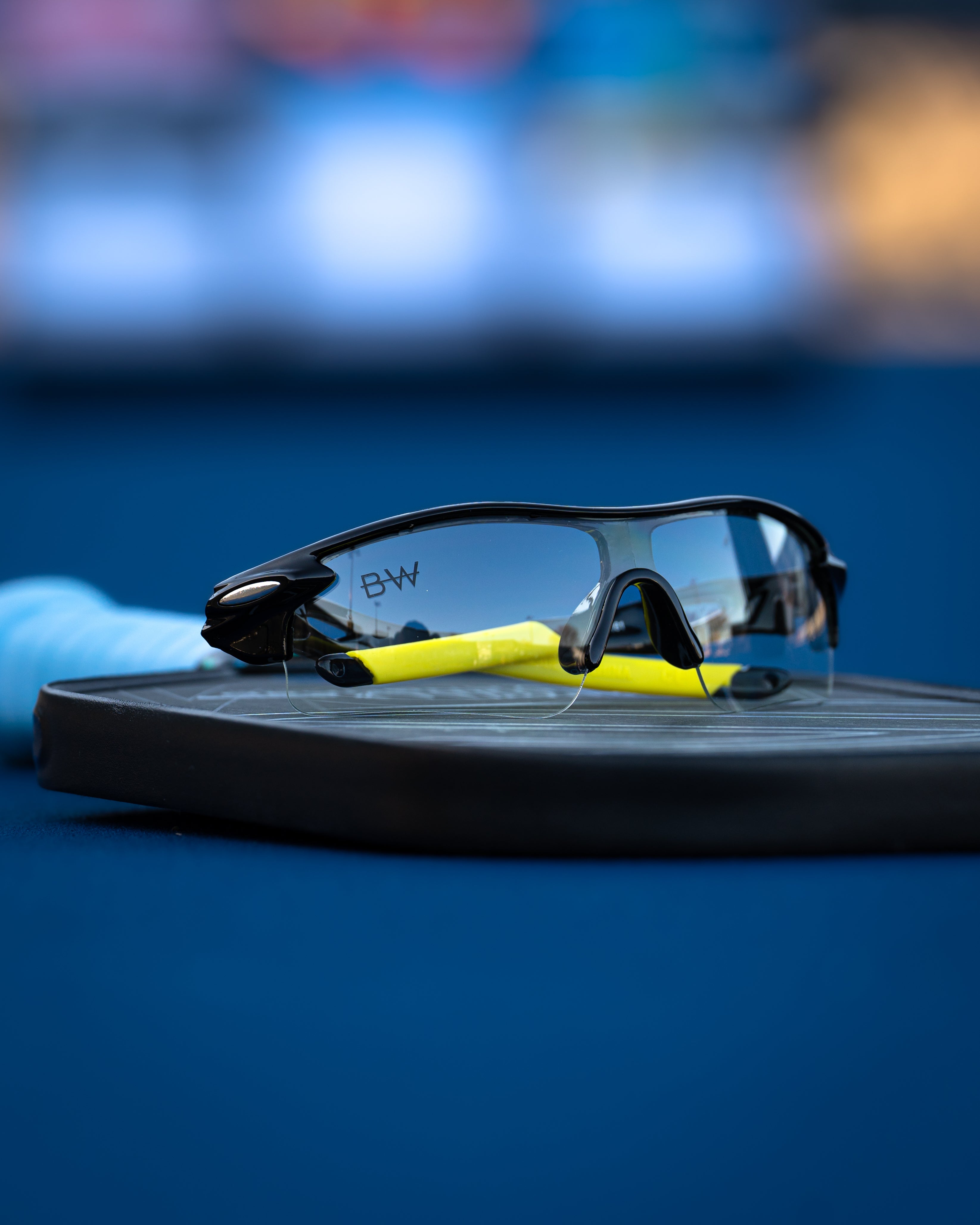
Why Athletes with RX Lenses React Faster Than You Think
Share
Find Your Perfect Pickleball Glasses
Whether you need prescription (RX) or non-prescription eyewear, start with the Blinded Wear guides and collections built around pickleball.
Do Prescription Sports Glasses Actually Make Athletes React Faster?
Not automatically. Prescription lenses correct the refractive error they were prescribed to correct. If an athlete otherwise sees a fast-moving ball, opponent, court line, or open space unclearly, appropriate prescription correction can provide a clearer visual input. But that is different from saying the lenses directly accelerate the brain, nervous system, or physical reaction time.
Reaction in pickleball is a chain of events. You first receive visual information, interpret what is happening, choose a response, and physically execute it. Prescription eyewear can address the refractive-correction part of that system when correction is needed. Experience, anticipation, attention, positioning, decision-making, and physical response remain separate factors.
That distinction makes prescription sports eyewear valuable without exaggerating what a lens can do.
Why an Athlete Wearing RX Lenses Can Look Faster on Court
Imagine two versions of the same player. In one, the athlete is using appropriate prescription correction. In the other, the athlete is trying to play through uncorrected blur.
The corrected player may have access to a clearer representation of the scene because the refractive error is being corrected. That does not mean the prescription has increased the player's neurological reaction speed. It means one potential visual limitation has been addressed.
This is the more accurate way to understand the relationship between RX sports glasses and reaction time: correction can support the vision an athlete relies on, while reaction speed itself depends on much more than the lenses.
The Visual Reaction Chain in Fast Pickleball
A fast exchange at the kitchen line can feel instantaneous, but several different processes are involved.
- Visual information reaches the athlete.
- The athlete identifies relevant information.
- The situation is interpreted.
- A response is selected.
- The body executes the movement.
Prescription correction is relevant primarily to the visual information entering that process. It should not be credited with independently accelerating every step that follows.
Seeing the Ball and Reacting to the Ball Are Not the Same Skill
It is tempting to reduce sports vision to a simple formula:
clearer vision = faster reaction.
Real competition is more complicated.
A player may see the ball clearly and still make a late decision. Another player may anticipate a shot early because of experience with an opponent's positioning, paddle preparation, tendencies, and available angles.
Reaction depends on the complete athlete, not one optical characteristic.
What Prescription Correction Actually Does
An eyeglass prescription is intended to correct refractive error according to the values prescribed for the wearer.
Depending on the prescription, this can involve values such as:
- SPH: spherical correction
- CYL: cylinder correction for astigmatism
- AXIS: orientation associated with cylinder correction
- ADD: additional near power when prescribed
- Prism: when specifically prescribed
Pupillary distance, or PD, can also be relevant to positioning prescription lenses appropriately for the wearer.
These values are about optical correction. They are not reaction-time settings.
Why Uncorrected Blur Can Matter in Pickleball
Pickleball asks players to observe information at different distances and during movement. Depending on the player's refractive error, playing without appropriate correction can mean some parts of the scene are not as clear as they are with correction.
Relevant visual information can include:
- The ball
- The net
- Boundary lines
- Opponent position
- Partner position
- Open court space
- Surrounding visual references
If a prescription is needed to see appropriately at those distances, wearing the prescribed correction addresses that optical need. It does not guarantee what the athlete will do with the information.
Visual Acuity and Reaction Time Are Different Measurements
Visual acuity concerns the ability to resolve visual detail under particular testing conditions. Reaction time concerns the interval between a stimulus and a response under a particular task.
An athlete can have excellent corrected visual acuity without having elite reaction time. Likewise, two athletes with similar visual acuity can react differently because of differences in anticipation, attention, experience, decision-making, and physical ability.
This is why RX eyewear should not be marketed as a reaction-time upgrade simply because it corrects vision.
Dynamic Vision Is Not the Same as a Static Eye Chart
A standard visual-acuity measurement and seeing during sport are not identical tasks. Pickleball involves moving targets, changing viewing distances, body movement, attention, and rapidly changing visual scenes.
However, that does not mean a sports frame or high-index prescription lens automatically enhances dynamic visual acuity.
An appropriate prescription provides the correction it was prescribed to provide. Claims that a particular lens improves dynamic visual performance require separate evidence.
Anticipation Can Make a Player Seem Exceptionally Fast
Experienced athletes often appear to have extraordinary reactions because they begin processing a situation before a less experienced player recognizes what is developing.
In pickleball, anticipation can involve information such as:
- Opponent court position
- Paddle preparation
- Available shot angles
- Previous shot patterns
- Partner position
- Score and strategy
- Ball trajectory
Prescription lenses do not teach these skills. Appropriate correction can help an athlete access the visual scene according to their prescription, while learning how to interpret that scene comes from other factors such as practice and experience.
Simple Reaction Time vs. Choice Reaction
Not every reaction task is equally complex.
A simple reaction task might involve responding when one expected stimulus appears. Competitive pickleball usually involves choices: the opponent can hit different speeds, directions, spins, heights, and shot types.
The player may have to choose among:
- Forehand or backhand
- Volley or let the ball bounce
- Attack or reset
- Middle or sideline coverage
- Move or hold position
This decision component is another reason it is inaccurate to say that prescription lenses alone make an athlete react faster.
Do RX Lenses Improve Hand-Eye Coordination?
Prescription correction and hand-eye coordination should not be treated as the same thing.
Appropriate RX lenses can correct refractive error. Hand-eye coordination involves using visual information to guide movement and depends on multiple sensory, neurological, learned, and physical processes.
Therefore, Blinded Wear RX glasses should not be described as automatically improving hand-eye coordination.
Do Prescription Sports Glasses Improve Depth Perception?
Prescription correction should not be given a blanket claim of improving depth perception.
Depth perception involves multiple visual cues and individual visual function. An eye-care professional can evaluate concerns involving binocular vision, prescription needs, or other aspects of visual function.
Likewise, grey tint, high-index material, polarization, and frame shape should not automatically be described as improving depth perception.
Do RX Sports Glasses Improve Peripheral Vision?
A prescription sports frame does not expand a person's biological peripheral visual field simply because it is designed for athletics.
Frame geometry can affect how noticeable parts of the frame are within the wearer's view, but that is different from improving biological peripheral vision.
A larger-looking lens or shield-style appearance should therefore not be marketed as proof of enhanced peripheral awareness.
Do RX Lenses Improve Ball Tracking?
“Ball tracking” is often used as a broad sports-eyewear claim, but it combines multiple processes.
The athlete has to see the scene, direct attention, interpret trajectory, anticipate where the ball is going, move appropriately, and execute a response.
Prescription correction can address refractive blur when correction is needed. It should not be described as a technology that independently improves tracking ability.
Can RX Lenses Make Spin Easier to Read?
A prescription lens should not automatically be credited with improved spin recognition.
Recognizing what a ball is doing can involve visual information, experience, familiarity with an opponent's mechanics, trajectory, speed, and other contextual cues.
Correcting refractive error is valuable, but it is not the same as giving the athlete a new spin-reading ability.
RX Glasses and Court Awareness
Court awareness is another term that extends far beyond visual acuity.
A player must distribute attention among:
- The ball
- Opponents
- A doubles partner
- Open space
- Boundaries
- The net
- Likely next shots
Prescription correction can support the wearer's vision according to their RX. It does not automatically expand attention or tactical awareness.
Do RX Lenses Make Your Brain Process Information Faster?
No blanket claim like this should be made.
A properly prescribed lens corrects refractive error. It does not overclock the brain, accelerate neural processing, or create faster decision-making simply because the image is corrected.
A more accurate statement is that an athlete who needs refractive correction does not have to intentionally compete through the same uncorrected blur when wearing appropriate prescription eyewear.
Do RX Glasses Reduce Cognitive Load?
“Reduced cognitive load” can sound scientific, but it should not be assumed simply because someone wears prescription lenses.
Cognitive load depends on the task, athlete, environment, experience, attention demands, and many other factors.
Unless evidence directly supports a specific claim, it is more accurate to say that RX lenses correct refractive error rather than claiming they free up brainpower for faster play.
What About Eye Strain and Long Tournament Days?
Visual discomfort has many possible causes, and it should not automatically be attributed to an incorrect prescription or solved by a particular sports lens.
Factors during a long tournament day can include:
- Lighting
- Environmental conditions
- Dryness
- General fatigue
- Screen use between matches
- Lens contamination
- Individual vision needs
Do not promise that RX sports glasses prevent eye fatigue or preserve reaction speed late in a tournament.
A Better Way to Explain the Clarity-Reaction Relationship
| Factor | What RX Correction Can Do | What It Does Not Guarantee |
|---|---|---|
| Refractive blur | Correct according to the prescribed RX | Faster neurological reaction |
| Visual acuity | Support corrected acuity according to individual needs | Better tactical decisions |
| Moving ball | Provide prescribed correction while viewing the scene | Improved tracking skill |
| Court positioning | Provide corrected visual input | Greater court awareness |
| Opponent movement | Provide prescribed correction | Better anticipation |
| Physical response | No direct muscular acceleration | Faster hands or feet |
Can a Mild Prescription Still Matter for an Athlete?
A mild prescription should not be dismissed simply because the numbers look small to someone without clinical context.
Whether correction is useful depends on the individual prescription, visual needs, and professional guidance. Do not create a universal prescription-strength threshold at which sports correction suddenly becomes worthwhile.
Likewise, do not promise that correcting a mild prescription will produce a measurable reaction-time improvement.
What About Athletes With Stronger Prescriptions?
Stronger prescriptions can make factors such as frame dimensions, finished lens thickness, lens design, and optical positioning particularly relevant to the finished eyewear.
Blinded Wear includes high-index prescription lenses at no additional cost with RX eyewear. High-index material can help manage finished lens thickness depending on the prescription, frame dimensions, lens design, and other optical requirements.
High-index should not be described as making an athlete react faster.
Does High-Index Material Improve Reaction Time?
No. Refractive index is a property of lens material, not a reaction-time specification.
High-index does not automatically provide:
- Faster visual processing
- Better ball tracking
- Greater contrast
- Improved depth perception
- Better peripheral vision
- Faster decision-making
Its primary relevance is optical material selection and management of factors such as finished lens thickness.
Does High-Index Automatically Mean Sharper Vision?
High-index should not be used as a synonym for optical accuracy or “crystal-clear” vision.
Finished prescription eyewear involves multiple factors, including:
- The prescription
- Lens design
- Appropriate positioning
- Frame characteristics
- Material selection
- Manufacturing of the finished eyewear
Refractive index alone does not establish the quality of every other part of that system.
Can Lens Tint Improve Reaction Time?
No tint should be universally described as a reaction-time enhancer.
A fixed tinted lens reduces visible-light transmission according to its specifications. Different tint colors can also change the appearance of the visual scene.
Those characteristics should not automatically be converted into claims of faster reactions, improved ball tracking, or better decision-making.
Do Grey RX Lenses Make Athletes React Faster?
Grey prescription sunglass lenses can provide RX correction while reducing visible-light transmission according to the exact lens.
Grey is commonly associated with a relatively neutral-looking tint compared with more strongly colored alternatives.
That does not mean grey accelerates reaction time, improves depth perception, or universally increases contrast.
Does Better Contrast Always Mean Faster Reactions?
No universal equation links a lens described as having higher contrast with a guaranteed improvement in athletic reaction time.
Contrast sensitivity, visual acuity, attention, anticipation, decision-making, and motor response are different concepts.
A tint can change the relative appearance of colors without proving that an athlete will react faster.
Polarized vs. Non-Polarized and Reaction Time
Polarization should also be separated from reaction-time claims.
Polarization is designed to reduce certain reflected light. Whether an athlete personally prefers polarized or non-polarized lenses for a particular environment is a different question from whether the lens makes the nervous system respond faster.
Neither option should automatically be credited with superior reaction speed, depth perception, or tracking.
Do Photochromic RX Lenses Improve Reaction Time?
Photochromic lenses are designed to change tint according to their specific technology and activating environmental conditions.
Their potential advantage is convenience for wearers who encounter changing environments, not neurological acceleration.
Photochromic technology should not be marketed as automatically improving reaction time or maintaining a perfect light level throughout every point.
Frame Fit Matters, but Fit Is Not Reaction Speed
Sports eyewear should fit the individual wearer appropriately. A frame that feels unsuitable, moves excessively, or becomes distracting can be undesirable during play.
However, a comfortable active fit should not be translated into a claim that the frame increases reaction speed.
No frame should be promised to remain perfectly motionless on every face during every movement.
The Tightest Frame Is Not Automatically the Best Sports Frame
Secure fit and excessive tightness are not the same thing.
An athlete should evaluate:
- Overall comfort
- Frame position
- Movement during realistic play
- Pressure points
- Prescription compatibility
- Personal preference
The goal is appropriate fit, not simply maximum pressure against the head.
Why You Should Practice in New RX Sports Glasses
If you plan to compete in prescription sports eyewear, use it during practice before an important event.
This gives you an opportunity to evaluate:
- How the prescription feels
- Frame comfort
- Fit during movement
- Your chosen tint in realistic conditions
- Any unfamiliar aspects of the eyewear
There is no universal adaptation period that applies to every athlete or every prescription.
Does Frame Movement Create “Visual Lag”?
“Visual lag” should not be used as a generic explanation for normal frame movement.
If a frame changes position, the wearer's relationship to the prescription lenses can also change. Whether that movement is meaningful depends on the individual eyewear and prescription.
If a pair repeatedly shifts enough to interfere with use, evaluate the fit rather than assuming the athlete's brain is processing the image more slowly.
If the Court Suddenly Looks Blurry, Check More Than the RX
Blur during a match does not automatically mean your prescription is wrong.
Check for:
- Fog
- Sweat
- Fingerprints
- Sunscreen residue
- Dust
- Water droplets
- Frame position
- Physical lens damage
If the lenses are clean and intact but meaningful blur persists, appropriate professional evaluation may be warranted.
Fog Is a Visibility Issue, Not Proof of Slower Reactions
Condensation can temporarily interfere with what a wearer sees through a lens. That does not prove that the athlete's neurological reaction speed has changed.
It also does not mean every sports lens needs or includes an anti-fog treatment.
Verify anti-fog claims for the exact lens rather than assuming them from the frame's sports styling.
Do Scratched RX Lenses Slow Reaction Time?
A scratch can be noticeable depending on its location and severity, but there is no universal rule converting a scratch into a measurable reaction-time penalty.
A physical scratch also does not change the prescription written by an eye-care professional.
Distinguish surface damage from refractive correction and from neurological performance.
An Old Prescription and a Slow Reaction Are Not the Same Diagnosis
If a prescription no longer meets an athlete's visual needs, updated correction may be appropriate after professional evaluation. But poor play, a missed volley, or slower reactions do not prove that the prescription changed.
Athletic performance fluctuates for many reasons.
If vision itself has meaningfully changed, address the vision concern directly rather than diagnosing it from match results.
RX Sports Glasses vs. Contacts for Reaction Time
Neither prescription glasses nor contact lenses should automatically be declared faster for athletic reactions.
They provide refractive correction in different ways:
- Eyeglasses: prescription lenses sit in front of the eyes.
- Contact lenses: corrective lenses sit directly on the eyes.
Individual prescription needs, comfort, environment, eye health, fit, and preference can influence which approach a player chooses.
There is no universal “faster reaction” winner.
Direct RX vs. RX Clip: Which Is Faster?
Neither should be marketed as producing faster reactions simply because of its construction.
Direct RX eyewear incorporates prescription correction into the primary prescription lens. A compatible RX-clip system uses a separate prescription insert behind the outer sports lens.
Compare the systems based on prescription compatibility, fit, verified lens configuration, environment, and personal preference rather than an unsupported speed claim.
Optical Positioning Matters, but It Is Not a Reaction-Time Feature
Prescription eyewear involves positioning the appropriate optical reference points relative to the wearer and lens design.
This concept is more nuanced than simply saying that the “optical center must always sit exactly over the pupil.”
Relevant considerations can vary by lens design and prescription. They may include horizontal positioning, vertical positioning, frame geometry, and wearing position.
None of this means a perfectly positioned lens makes the brain react faster than its natural capability.
Does PD Affect Reaction Time?
Pupillary distance is relevant to prescription-lens positioning. It is not a reaction-time measurement.
Do not guess, round, or arbitrarily alter PD in an attempt to create a “sports” prescription.
Also remember that binocular PD cannot always be assumed to divide perfectly into two identical monocular measurements.
Is There a Special “Faster” Sports Prescription?
Do not modify prescription values yourself in an attempt to make an eyeglass prescription better for reaction time.
SPH, CYL, AXIS, ADD, prism, and other prescribed values have specific meanings. A plus sign, minus sign, axis value, or prism instruction should not be changed because the eyewear will be used for pickleball.
Use the appropriate eyeglass prescription supplied for you.
Do Not Enter a Contact-Lens Prescription as an Eyeglass Prescription
Contact-lens and eyeglass prescriptions are not interchangeable.
If you are ordering prescription sports glasses, use the appropriate eyeglass prescription rather than copying values from contact-lens packaging.
If you are uncertain about your prescription information, obtain clarification instead of guessing.
How to Order Blinded Wear RX Pickleball Glasses
When ordering custom Blinded Wear prescription eyewear, upload a clear image of your appropriate eyeglass prescription on the applicable product page before adding the eyewear to your cart.
Review How to Order RX Glasses for current ordering information.
Before submitting an order, review the prescription image and selected product carefully rather than relying on memory.
High-Index RX Lenses at No Additional Cost
Blinded Wear includes high-index prescription lenses at no additional cost with RX eyewear.
High-index material can be useful for managing finished lens thickness, particularly as prescription strength increases. Final thickness still depends on factors such as:
- Prescription
- Frame and lens dimensions
- Lens positioning
- Lens design
- Other optical requirements
High-index is an optical-material category, not a reaction-speed rating.
Impact Resistance and Reaction Time Are Separate
Blinded Wear offers impact-resistant lens options. Impact resistance is a mechanical characteristic and should not be confused with optical performance or neurological response.
Impact-resistant does not automatically mean:
- Shatterproof
- Safety certified
- Ballistic rated
- Scratchproof
- Faster for reaction time
If you need eyewear meeting a particular protective standard, verify the exact finished product's applicable certification.
How to Choose RX Pickleball Glasses Without Chasing Reaction-Time Claims
Instead of looking for a frame advertised as the “fastest,” evaluate characteristics that can actually be confirmed.
- Prescription compatibility: Start with your appropriate eyeglass prescription.
- Frame dimensions: Consider whether the frame is suitable for you.
- Fit: Evaluate comfort and position during realistic movement.
- Lens configuration: Verify the options available for the exact product.
- Lighting: Decide whether you want a fixed tint, another appropriate lens configuration, or multiple pairs for different conditions.
- Practice: Use new RX eyewear before an important tournament.
Blinded Wear RX Pickleball Glasses to Explore
Rather than ranking frames by unsupported reaction-time claims, compare current RX options according to prescription compatibility, fit, verified lens configuration, and your preferences.
- Steel Ice RX
- Blue Shield RX
- Havana Melt RX
- Gray Wash RX
- Zebra II RX
- Lava Rock RX
- Frost RX
- Rippled X RX
- Crystal Wave II RX
Do not infer reaction-time benefits, exact tint specifications, polarization, coatings, or other lens properties from a product's appearance or name.
Common Myths About RX Lenses and Reaction Speed
| Claim | More Accurate Explanation |
|---|---|
| RX lenses make your brain faster | RX lenses correct refractive error according to the prescription |
| Clearer vision guarantees faster reactions | Reaction also involves attention, decisions, anticipation, and physical response |
| High-index lenses process images faster | Refractive index is a material property, not neural-processing speed |
| Grey lenses increase reaction speed | Grey tint changes visible-light transmission according to the lens |
| Sports frames improve peripheral vision | Frame geometry does not expand biological peripheral vision |
| RX glasses improve hand-eye coordination | Correction and coordination are separate concepts |
| RX glasses improve depth perception | No universal depth-perception enhancement should be claimed |
| RX glasses train the brain | Prescription correction is not neurological training |
FAQ: Prescription Sports Glasses and Reaction Time
Do RX lenses really improve reaction time?
They should not be promised to directly improve neurological reaction time. Appropriate prescription lenses correct refractive error, which can address uncorrected blur for an athlete who needs correction.
Can clearer vision still matter in fast sports?
Yes. Vision provides information used during play. But clearer corrected vision and faster neurological reaction are not interchangeable claims.
Can an athlete react slowly even with perfect correction?
Yes. Reaction depends on attention, anticipation, decision-making, experience, physical response, and other factors in addition to vision.
Can an athlete with glasses compete at a high level?
Needing refractive correction does not by itself determine an athlete's competitive ability. Appropriate RX eyewear is one way to obtain needed correction.
Does a stronger prescription mean slower reactions?
No universal relationship like that should be assumed.
Do high-index lenses improve reaction time?
No. High-index refers to lens-material refractive index and should not be marketed as a reaction-time technology.
Do grey RX lenses improve reactions?
Grey tint can reduce visible-light transmission according to the exact lens, but it should not be described as directly accelerating reactions.
Does polarization improve reaction time?
No universal reaction-time advantage should be attributed to polarization.
Do photochromic lenses improve reaction time?
No. Their relevant characteristic is changing tint according to the particular technology and environmental conditions.
Do RX lenses improve ball tracking?
Prescription correction can address refractive blur. It should not be marketed as automatically improving the athlete's tracking ability.
Do RX lenses improve hand-eye coordination?
No universal hand-eye coordination improvement should be promised simply from wearing prescription lenses.
Do RX glasses improve depth perception?
No blanket depth-perception improvement should be claimed.
Can sports glasses expand peripheral vision?
No. A frame cannot expand the wearer's biological peripheral visual field.
Can an incorrect prescription affect what I see?
Prescription concerns can affect the visual experience, but symptoms alone cannot diagnose the cause. If meaningful visual problems persist through clean, intact eyewear, appropriate professional evaluation can help determine the issue.
The Real RX Advantage Starts With Appropriate Correction
Prescription sports glasses do not need exaggerated claims to be useful to competitive athletes.
If you need refractive correction, appropriate RX lenses can provide that correction while you serve, return, dink, volley, defend, and move around the court. That addresses an optical need without claiming that the lenses directly accelerate your nervous system.
Think of RX eyewear as correcting the visual input—not upgrading the speed of the athlete's brain.
The athlete still supplies the anticipation, attention, strategy, experience, decision-making, coordination, and physical response that turn visual information into a play.
Explore the Blinded Wear Prescription Pickleball Glasses Collection or review the Pickleball Performance Lens Guide to compare current options.
What Actually Determines Reaction Speed in Competitive Pickleball?
Once prescription correction is separated from unsupported performance claims, the reaction-time question becomes much more useful. A player's response during a fast rally depends on several systems working together rather than one lens characteristic.
| Factor | Role During Play | What RX Eyewear Can Address |
|---|---|---|
| Refractive correction | Helps the wearer see according to the prescribed correction | Yes, when appropriate RX lenses are used |
| Attention | Determines which information the player notices | No direct enhancement |
| Anticipation | Uses experience and context to predict what may happen next | No direct enhancement |
| Decision-making | Selects an appropriate response | No direct enhancement |
| Motor response | Turns the decision into physical movement | No direct enhancement |
| Technique | Influences execution of the selected shot | No direct enhancement |
| Positioning | Affects how much time and space the player has to respond | No direct enhancement |
This explains why prescription correction can be important without being a shortcut to elite reactions.
Sometimes “Faster Reactions” Are Really Better Positioning
A player who is positioned appropriately may have more time to respond than a player who starts the same exchange out of position. To an observer, the first player can look faster even if the difference is not raw neurological reaction speed.
The same principle applies to anticipation. Recognizing a likely shot early can allow movement to begin sooner.
RX lenses do not create those tactical skills. They provide prescribed refractive correction while the athlete uses them.
Why Experienced Players Can Seem Faster
Competitive experience can change how quickly a player recognizes familiar situations. A veteran player may notice useful information earlier because similar patterns have appeared thousands of times in practice and competition.
Examples can include:
- Recognizing an opponent's likely target from court position
- Knowing which angles are available
- Understanding when an attack is likely
- Recognizing a developing speed-up
- Knowing where a partner is positioned
- Anticipating common third-shot or return patterns
This is learned sports behavior, not a feature manufactured into prescription lenses.
Prescription Correction Does Not Replace Reaction Training
An athlete who wants to become quicker on court still has to develop the athletic skills involved in responding effectively.
Depending on the player's goals, training may involve:
- Technical repetition
- Decision-making drills
- Pattern recognition
- Positioning
- Footwork
- Anticipation
- Strength and conditioning
- Sport-specific practice
Appropriate prescription correction can be part of the athlete's equipment setup. It is not a replacement for those skills.
A Kitchen-Line Example: What Happens Before a Fast Volley?
Consider a quick exchange at the non-volley zone.
The opponent contacts the ball. The receiving player must gather visual information, recognize the developing trajectory, decide whether and how to respond, position the paddle, and execute the movement.
A player who requires prescription correction may prefer to perform that task while wearing the appropriate RX. But the prescription itself does not decide whether to counter, reset, move, or leave the ball.
That difference is important: RX lenses can correct the wearer's refractive error, while the athlete performs the sport.
RX Vision During the Return of Serve
A return involves a different visual and tactical situation than a kitchen-line exchange. The ball begins farther away, the player has more court to consider, and movement into the next position becomes part of the sequence.
Appropriate prescription correction can be relevant for an athlete who needs distance correction. However, a successful return still depends on factors such as:
- Reading the incoming ball
- Movement
- Timing
- Contact quality
- Shot selection
- Recovery and court positioning
RX correction should therefore be treated as one part of the player's visual setup rather than the explanation for the entire response.
Do RX Lenses Make You Faster During Dink Exchanges?
No lens can automatically improve a player's dink reactions.
Close-range exchanges may involve rapid changes in direction, pace, height, and tactical intention. Players also use information from an opponent's position and paddle preparation.
Appropriate RX lenses can provide the prescribed correction the wearer needs while viewing the exchange. They do not independently teach anticipation, paddle preparation, or shot selection.
What About Reacting to a Speed-Up?
A fast attack can make reaction time feel like the only factor that matters, but preparation can begin before the ball is traveling toward the player.
Position, anticipation, paddle readiness, opponent tendencies, and recognition of the developing shot can all influence the response.
That is why claiming that RX lenses directly make a player faster oversimplifies what happens during competitive play.
RX Correction and Overhead Shots
Overheads introduce another visual situation involving a moving ball, changing viewing angle, body movement, positioning, and timing.
Prescription correction may be important for an athlete who needs it, but an RX lens should not be credited with improving overhead timing, judging trajectory perfectly, or accelerating the physical response.
Singles vs. Doubles: The Visual Task Changes
The demands of singles and doubles are not identical.
Singles can require covering more court individually, while doubles adds constant awareness of a partner's position and responsibilities. In both formats, the athlete must combine visual information with strategy and movement.
RX lenses provide the prescribed correction; they do not automatically create greater awareness in either format.
Corrected Vision vs. Uncorrected Vision: The Important Distinction
The strongest case for prescription sports eyewear does not require claiming that RX athletes become superhuman.
If an athlete has refractive error that affects how they see at relevant distances, the meaningful comparison is often between using appropriate correction and competing without the correction they need.
| With Appropriate RX Correction | Without Needed Correction |
|---|---|
| Refractive error is corrected according to the prescription | Refractive blur may remain |
| The athlete uses corrected visual input | The athlete may be viewing relevant distances without needed correction |
| Reaction speed still depends on the athlete | Reaction speed still depends on the athlete |
| Strategy still requires training and experience | Strategy still requires training and experience |
| Coordination remains an athletic skill | Coordination remains an athletic skill |
The benefit is correcting a genuine optical need, not adding an artificial reaction-time boost.
RX Lenses Are Correction, Not a Performance Multiplier
Prescription eyewear should generally be understood as correction rather than a mechanism for pushing an athlete beyond their natural visual-processing ability.
If someone needs refractive correction, wearing an appropriate prescription addresses that refractive error. It does not automatically create vision superior to what the individual can otherwise achieve with appropriate correction.
This is an important distinction when comparing medical or optical correction with sports-performance marketing.
Reaction-Time Claims to Treat Carefully
Sports-eyewear marketing sometimes turns a reasonable optical concept into an unsupported athletic claim.
| Marketing Claim | Why It Needs Qualification |
|---|---|
| “See faster” | Seeing is not a single speed measurement |
| “React faster” | Reaction involves perception, decisions, and physical response |
| “Track the ball faster” | Tracking is not established by RX correction alone |
| “Process the court faster” | Prescription lenses do not directly accelerate cognition |
| “Improve hand-eye coordination” | Coordination is not equivalent to refractive correction |
| “Improve depth perception” | No universal improvement follows from wearing a particular sports frame |
| “Increase peripheral vision” | A frame does not expand the biological visual field |
| “Reduce reaction delay” | A measurable reaction-time benefit should not be assumed without supporting evidence |
Why Visual Clarity Still Matters Without the Hype
Rejecting exaggerated reaction-time claims does not make appropriate prescription correction unimportant.
An athlete who requires correction still needs to see according to their visual needs. Pickleball is visually demanding, and refractive blur does not become irrelevant simply because the player is athletic.
The accurate value proposition is strong on its own:
Prescription sports eyewear allows an athlete who needs eyeglass correction to compete while wearing that correction in an eyewear configuration intended for active use.
RX Sports Glasses vs. Everyday Prescription Glasses
Both can provide prescription correction when made appropriately. The phrase “sports glasses” should not be interpreted to mean that the prescription itself becomes faster or more powerful.
When comparing eyewear for pickleball, consider practical characteristics such as:
- Prescription compatibility
- Frame dimensions
- Comfort
- Fit during realistic movement
- Verified lens configuration
- Impact characteristics where relevant
- Lighting conditions
- Personal preference
Do not assume that every sports-styled frame is automatically optically superior to every conventional frame.
A Simple Fit Test Before Competition
Evaluate new RX eyewear during realistic practice rather than relying on aggressive shaking or artificial stress tests.
- Put the eyewear on normally.
- Check for obvious pressure points.
- Look forward, left, right, up, and down naturally.
- Walk and perform normal warm-up movements.
- Practice serves and returns.
- Perform normal lateral movement.
- Play representative points.
- Reassess comfort and frame position after perspiration.
If the frame repeatedly becomes distracting or unsuitable during normal play, fit deserves attention. Do not diagnose the problem as slower visual processing.
Prescription Checklist Before Ordering Sports Eyewear
Before placing an RX order, review the prescription information carefully.
- Use an appropriate eyeglass prescription.
- Make sure the prescription image is readable.
- Check OD and OS rather than assuming both eyes are identical.
- Preserve plus and minus signs exactly.
- Do not guess CYL or AXIS values.
- Do not copy a contact-lens prescription into an eyeglass order.
- Do not invent a PD value.
- Do not alter the prescription because the eyewear will be used for sports.
If anything is unclear, obtain clarification rather than guessing.
Why Plus and Minus Signs Matter
A plus sign and a minus sign are not interchangeable details in an eyeglass prescription.
When submitting an RX order, preserve the prescription exactly as provided rather than attempting to simplify, round, transpose, or reinterpret it yourself.
A sports frame does not require changing the signs of the prescription values.
Astigmatism and Competitive Sports
If CYL and AXIS appear on an eyeglass prescription, they relate to the prescribed correction for astigmatism.
Do not describe astigmatism as automatically causing slow reactions, poor ball tracking, or bad hand-eye coordination. Those conclusions cannot be made from a prescription value alone.
The relevant goal for eyewear ordering is to use the appropriate prescribed information accurately.
What If Your Prescription Includes Prism?
Prism should not be ignored, removed, or changed simply because the glasses will be used for pickleball.
If your prescription includes prism or another requirement that creates uncertainty about product compatibility, obtain appropriate guidance before ordering rather than altering the prescription yourself.
PD Is About Positioning, Not Performance Enhancement
Pupillary distance helps with horizontal positioning of prescription lenses relative to the wearer. Depending on the lens design and prescription, additional fitting considerations can also matter.
PD should not be marketed as a way to “unlock” faster reactions. It is part of properly configuring prescription eyewear.
Optical Centering Is More Nuanced Than “Lens Center = Pupil”
Prescription-lens positioning can involve more than aligning the geometric middle of a lens with the pupil.
The relevant reference points depend on the lens design and prescription. Frame geometry, decentration, wearing position, and other fitting considerations can influence the finished configuration.
That is why photos or product images alone cannot prove that prescription eyewear is optically positioned correctly for a specific wearer.
Why the Same RX Can Feel Different in Different Frames
Two pairs can contain the same prescribed refractive values while differing in frame dimensions, lens geometry, wearing position, material, tint, and overall fit.
That does not automatically mean one prescription is wrong.
If a new pair feels meaningfully different, consider the entire eyewear configuration rather than assuming that the prescription values have changed.
Is There a Standard Adaptation Period for New RX Sports Glasses?
No single adaptation period should be promised for every wearer.
Some people may find a new configuration familiar immediately, while others may notice differences associated with prescription changes, frame changes, lens design, tint, or wearing position.
If significant or persistent visual symptoms occur, seek appropriate professional evaluation rather than forcing yourself through an arbitrary adaptation deadline.
Do Not Treat New Double Vision as a Sports-Eyewear Training Issue
New, meaningful, or persistent double vision should not be dismissed as something an athlete simply needs to “adapt” to during practice.
Likewise, sudden or meaningful changes in vision deserve appropriate attention rather than being explained away as normal sports-glasses adjustment.
Before Blaming Your Reaction Time, Clean the Lenses
A simple surface issue can sometimes be mistaken for an optical problem.
During a tournament, lenses can collect:
- Dust
- Sweat
- Fingerprints
- Sunscreen residue
- Water spots
- Other debris
Use appropriate lens-care methods and avoid grinding loose grit across the surface.
A dirty lens does not change the underlying prescription.
Cleaning Mistakes to Avoid
Sports eyewear is exposed to more handling than many everyday pairs, so cleaning habits matter.
- Do not intentionally rub visible grit into the lens.
- Do not use toothpaste to polish scratches.
- Do not use baking soda as a scratch-removal compound.
- Do not use automotive polish or wax as a lens repair method.
- Do not assume every household cleaner is compatible with the lens and its treatments.
- Keep reusable cleaning material itself clean.
Appropriate cleaning removes contamination. It does not repair physical scratches or cracks.
Scratch, Smudge, Fog, and Prescription Error Are Different Problems
| Problem | What It Is | Does It Rewrite Your RX? |
|---|---|---|
| Smudge | Surface contamination | No |
| Fog | Temporary condensation | No |
| Scratch | Physical surface damage | No |
| Crack | Structural physical damage | No |
| Frame shift | Change in eyewear position | No |
| Prescription change | Change in the wearer's correction needs determined through appropriate evaluation | Potentially requires a new prescription |
Heat Does Not Make Your Prescription Slower
Environmental heat does not turn a prescription into a slower-reacting prescription.
Heat exposure and prescription power are separate concepts. Lens materials, frames, and surface treatments can have their own environmental limitations, so avoid unnecessary prolonged extreme heat when safer storage is available.
Do not assign an exact universal heat threshold without specifications for the exact eyewear.
Weather Changes the Environment, Not the Prescription
Clouds, humidity, wind, rain, and changing sunlight can alter the playing environment. They do not rewrite SPH, CYL, AXIS, or PD.
What can change is the practical experience of using eyewear. For example, moisture may collect on a lens or a fixed tint may feel different as available light changes.
Those are environmental or configuration issues, not evidence that the prescription itself has become less accurate.
Fixed Tints Stay Fixed While the Court Changes
A fixed tint does not automatically adapt as clouds move in, the sun sets, or a player moves between indoor and outdoor courts.
This is relevant to comfort and preference, but it does not create a direct reaction-time claim.
When comparing tints, evaluate the exact lens and the conditions where you expect to use it.
VLT Is Not a Reaction-Time Score
Visible Light Transmission (VLT) describes the percentage of visible light transmitted through a lens.
A higher VLT transmits more visible light. A lower VLT transmits less.
VLT does not directly tell you:
- How fast you will react
- How well you will track a pickleball
- Your depth perception
- Your hand-eye coordination
- Your decision-making speed
- Your prescription accuracy
There is no universal “best VLT for reaction time.”
UV Specifications and Reaction Time Are Separate
A lens's UV characteristics should be verified independently from its tint, darkness, prescription, and athletic-performance claims.
A darker-looking lens does not by itself establish a specific UV specification, and UV characteristics do not prove faster reaction time.
Scratch Resistance Does Not Mean Faster Vision
Scratch resistance, when verified for a particular lens, concerns resistance to surface damage. It is not an optical-processing or reaction-time technology.
Likewise:
- Scratch resistant does not mean scratchproof.
- Impact resistant does not mean scratch resistant.
- High-index does not mean scratch resistant.
- Grey tint does not mean scratch resistant.
Anti-Fog and Reaction Claims Should Stay Separate
An anti-fog feature, when verified for a particular product, relates to condensation management. It should not be converted into a claim that the athlete reacts faster.
Do not assume anti-fog performance from the shape, tint, or sports styling of a frame.
More Lens Coverage Does Not Automatically Mean Faster Reactions
Lens and frame geometry can change the physical eyewear design, but a larger lens does not automatically expand the wearer's biological peripheral vision or accelerate responses.
When evaluating a frame, focus on verified characteristics and individual fit rather than assuming that visual size equals performance enhancement.
Sports Performance and Eye Protection Are Different Questions
An athlete may care about both prescription correction and physical eye protection, but the two should not be collapsed into one claim.
A prescription lens can correct refractive error without being certified for a particular impact hazard. Similarly, a protective product can meet a specific safety purpose without making an athlete react faster.
If a particular safety standard is required, verify the exact finished eyewear against that requirement.
A Backup RX Pair Can Matter More Than a Reaction-Time Upgrade
For an athlete who depends on prescription correction, losing or damaging the only usable pair during travel or competition can create a much bigger practical problem than choosing between marketing claims about tiny performance advantages.
When practical, consider having an appropriate backup correction option available for important tournaments.
The backup does not need to promise faster reactions. Its purpose is continuity if the primary eyewear becomes unavailable.
What to Keep in Mind for an RX Tournament Bag
For prescription-dependent athletes, a simple eyewear plan can include:
- Primary prescription eyewear
- An appropriate backup correction option
- Protected storage
- Appropriate lens-care supplies
- Accessible prescription information when traveling
Keeping eyewear protected from loose abrasive objects can also reduce unnecessary surface damage.
Travel Does Not Change Reaction-Time Benefits of RX Lenses
Travel can expose eyewear to compression, impact, abrasion, heat, moisture, contamination, and repeated handling. None of those factors turns an RX lens into a reaction-time enhancer.
Protect prescription eyewear because you rely on the correction, not because the lenses contain a hidden athletic-speed advantage.
Inspect RX Glasses After a Significant Drop or Impact
If eyewear takes a meaningful impact, check the complete pair rather than looking only for obvious lens scratches.
Inspect for:
- Visible cracks
- Chips
- Lens displacement
- Frame deformation
- Hinge damage
- Changes in how the frame sits
If damage is uncertain or the eyewear no longer appears structurally normal, seek appropriate evaluation rather than deliberately stressing it to see whether it fails.
Can You Verify RX Accuracy at Home?
A home visual impression can tell you whether something feels unusual, but it cannot fully verify every aspect of finished prescription eyewear.
Professional optical equipment such as a lensmeter or focimeter can evaluate characteristics of prescription lenses that cannot be established simply by looking at the glasses or taking a selfie.
Do not diagnose a manufacturing problem solely from athletic performance or a missed shot.
Blur During Play: A Better Troubleshooting Order
- Check whether the lenses are dirty or fogged.
- Inspect for visible physical damage.
- Check whether the frame has shifted significantly.
- Consider whether the lighting or tint is making the environment feel different.
- Compare the experience under ordinary viewing conditions.
- If meaningful visual symptoms persist, seek appropriate professional evaluation.
This avoids immediately blaming either the prescription or reaction time.
Do Not Diagnose Vision Problems From Match Results
Missing a return, reacting late to a speed-up, mishitting an overhead, or losing a match does not establish that an athlete's prescription is wrong.
Sports performance is affected by too many variables for individual points to function as an eye exam.
Evaluate actual visual symptoms as visual symptoms.
When a Vision Concern Goes Beyond Sports Eyewear
Eyewear content cannot diagnose eye-health problems.
Sudden, significant, new, or persistent changes in vision deserve appropriate professional attention. New persistent double vision or other meaningful visual symptoms should not simply be blamed on frame style, tint, high-index material, or a need to “train through” a new pair.
Competitive Athlete RX Checklist
Instead of asking whether a pair of glasses will make you react faster, ask whether the eyewear meets the needs you can actually evaluate.
- Is my eyeglass prescription appropriate for me?
- Did I enter or upload it accurately?
- Is the frame compatible with my prescription?
- Does the frame fit comfortably during realistic movement?
- Have I practiced in the eyewear before competition?
- Does the lens configuration suit the environment where I play?
- Are the lenses clean and free of significant physical damage?
- Do I have backup correction for an important tournament?
- Am I relying on verified specifications rather than marketing assumptions?
Common Shopping Mistakes When Looking for “Faster” Sports Vision
- Choosing a frame solely because it claims to improve reaction time
- Assuming high-index means faster visual processing
- Assuming a larger lens improves peripheral vision
- Assuming grey automatically enhances contrast
- Assuming polarization improves depth perception
- Assuming impact resistance means shatterproof
- Ignoring prescription compatibility in favor of sports marketing
- Guessing prescription or PD information
- Wearing completely new eyewear for the first time in an important match
What Should Matter More Than a Reaction-Speed Claim?
For a prescription athlete, prioritize fundamentals:
- Appropriate prescription correction
- Accurate ordering information
- Prescription compatibility
- Comfortable active fit
- A lens configuration suited to your environment
- Verified product characteristics
- Practice familiarity before competition
- Backup correction when appropriate
These considerations are more useful than an unsupported promise that one pair will shave time off your reactions.
What If Your Blinded Wear RX Glasses Break?
Customized prescription eyewear is final sale and is excluded from the standard 30-day return policy. However, eligible broken eyewear may still qualify for Blinded Wear's 50% lifetime replacement support, subject to current policy terms.
Eligible claims require the damaged eyewear to be returned. Once a qualifying claim meets the applicable policy requirements, the customer can receive 50% credit toward a replacement pair.
This is not a promise of a free replacement, and coverage should not be assumed for loss, prescription changes, or every type of damage.
For damaged RX eyewear, contact blindedwearco@gmail.com before returning the pair.
Review the Blinded Wear Protection Plan, Replacement & Returns information for current eligibility and policy details.
Remember: Custom RX Eyewear Is Final Sale
Because prescription eyewear is customized, Blinded Wear RX products are final sale and are not covered by the standard 30-day return policy for eligible non-customized purchases.
That makes careful prescription submission and product selection especially important before ordering.
Final-sale status is separate from applicable 50% lifetime replacement support for eligible broken eyewear.
More Questions About RX Lenses and Athletic Reactions
Can correcting blur make the ball easier for me to see?
If refractive error is causing blur at the relevant viewing distance, appropriate prescription correction addresses that refractive error. That is different from promising improved tracking or reaction time.
Will RX glasses make me a better pickleball player?
No pair of prescription glasses can guarantee improved athletic performance. Eyewear is one part of the athlete's equipment and visual setup.
Can RX glasses make my hands faster?
No. Prescription lenses do not directly accelerate muscular response.
Can RX glasses improve anticipation?
No universal improvement should be claimed. Anticipation involves experience, pattern recognition, strategy, attention, and contextual information.
Can RX glasses improve decision-making?
Prescription correction should not be marketed as directly increasing decision-making speed.
Will a stronger RX make me react slower?
No universal relationship between prescription strength and reaction speed should be assumed.
Is 1.61 better for reaction time than another lens index?
Refractive index should not be ranked by reaction time. Blinded Wear includes high-index RX lenses at no additional cost, but an exact index should only be stated when verified for the specific configuration.
Are lighter glasses faster for sports?
Frame weight can affect personal comfort preferences, but lighter eyewear should not automatically be described as producing faster reactions.
Does a secure fit improve reaction speed?
A comfortable, appropriate fit can reduce practical distractions associated with an unsuitable frame, but it does not directly increase neurological reaction speed.
Should my sports glasses never move?
No frame should be promised to remain perfectly motionless on every wearer during every movement. Evaluate fit under realistic playing conditions.
Does a shield-style frame improve peripheral vision?
A frame's shape does not expand biological peripheral vision. Evaluate the exact design and personal experience without assuming a performance enhancement.
Can a tint help me react faster?
No tint should be universally marketed as a reaction-time enhancer.
Can polarization help me react faster?
Polarization is designed to reduce certain reflected light. It does not establish a universal reaction-time benefit.
Can photochromic lenses react to light faster than my eyes?
Photochromic lens behavior depends on the exact technology and environmental conditions. It should not be compared with biological visual adaptation using a universal speed claim.
Does high-index mean less distortion?
Refractive index alone does not establish the complete optical performance of finished prescription eyewear.
Can I use my contact prescription to order RX glasses?
No. Contact-lens and eyeglass prescriptions are not interchangeable.
Should I change my RX for sports?
Do not independently alter prescription values for athletic use. Questions about prescription needs should be addressed with the appropriate eye-care professional.
How long should I adapt to new sports glasses?
There is no universal adaptation period. Significant or persistent symptoms deserve appropriate evaluation rather than an arbitrary waiting period.
Can scratches make my prescription weaker?
No. A physical scratch does not rewrite the prescribed refractive values, although surface damage can affect the practical viewing experience depending on its location and severity.
Can heat change my prescription?
Environmental heat does not change the prescription written for the wearer. Avoid unnecessary extreme heat exposure because finished eyewear materials and treatments can have their own environmental limitations.
The Competitive Advantage Is Not a Magic Reaction-Time Lens
Prescription sports eyewear is most valuable when it solves the problem it is actually designed to solve: providing appropriate refractive correction for an athlete who needs it.
That correction can matter greatly to the wearer without turning the lens into a neurological performance enhancer.
The fastest-looking players on a pickleball court are combining many things at once: vision, attention, anticipation, positioning, experience, decision-making, technique, and physical response.
RX lenses can correct refractive error. The athlete still creates the reaction.
For current prescription options, explore the Blinded Wear RX Pickleball Glasses Collection, review the RX Ordering Guide, or compare lens considerations in the Pickleball Performance Lens Guide.
A Final Framework for RX Lenses and Athletic Reaction Time
The relationship between prescription eyewear and athletic reactions becomes much clearer when each part of performance is separated.
| Part of Performance | Primary Question | Role of RX Lenses |
|---|---|---|
| Refractive correction | Does the athlete need optical correction? | Directly relevant |
| Visual acuity | How well can the athlete resolve detail under particular conditions? | Can be affected by appropriate refractive correction |
| Attention | What information does the athlete notice? | No direct enhancement |
| Anticipation | What does the athlete expect to happen next? | No direct enhancement |
| Decision-making | Which response does the athlete choose? | No direct enhancement |
| Motor response | How quickly and effectively does the body execute? | No direct enhancement |
| Technique | How effectively is the shot performed? | No direct enhancement |
Prescription sports eyewear can be important because vision is one input into the complete system. It should not be credited with independently improving every part of that system.
What RX Athletes Should Prioritize First
When selecting prescription eyewear for pickleball, a useful priority order is:
- Appropriate prescription correction
- Compatibility between the prescription and selected product
- Comfortable individual fit
- A lens configuration suited to the intended environment
- Verified product characteristics
- Practice familiarity before competition
- An appropriate backup plan
Reaction-time marketing belongs far below those fundamentals because no lens can guarantee that an athlete will respond faster.
Correct the Visual Input Without Overstating the Result
The most accurate way to discuss RX sports eyewear is straightforward: if refractive error affects what an athlete sees at relevant distances, appropriate prescription lenses provide correction according to the prescribed values.
Once that visual information is available, the athlete still has to:
- Direct attention
- Interpret the developing play
- Recognize relevant patterns
- Choose a response
- Position the body
- Execute the movement
That is why “corrected visual input” is more accurate than “faster brain processing.”
Great Reactions Often Begin Before the Opponent Hits the Ball
What looks like extraordinary reaction speed may partly be early recognition.
An experienced player can use information available before ball contact, including:
- Opponent position
- Paddle preparation
- Available angles
- Previous tendencies
- Partner position
- Current court geometry
Those skills are developed through experience, practice, attention, and strategy. Prescription lenses do not automatically create them.
What Happens After Ball Contact?
Once the opponent strikes the ball, the athlete still has to interpret its developing path and execute an appropriate response.
Depending on the situation, that can involve evaluating:
- Direction
- Speed
- Height
- Trajectory
- Available space
- Own court position
- Partner position in doubles
Appropriate prescription correction can be part of how the athlete views that scene. It does not independently perform the interpretation or response.
“Fast Hands” Are Not an Eyewear Specification
In pickleball, players often describe someone as having “fast hands,” particularly during rapid exchanges near the non-volley zone.
That phrase can reflect several abilities at once, including preparation, anticipation, compact technique, paddle positioning, decision-making, and physical response.
No RX lens should be marketed as creating fast hands.
RX Lenses Do Not Teach You to Read Opponents
Reading an opponent is a learned competitive skill.
A player may become better at recognizing patterns involving:
- Paddle position
- Body orientation
- Shot tendencies
- Court positioning
- Attack opportunities
- Defensive patterns
Prescription correction can address refractive error while the athlete observes the opponent, but it does not create tactical recognition.
Does a Faster Ball Make the RX More Important?
Ball speed does not change the prescription itself.
As the available response time becomes shorter, anticipation, positioning, preparation, and physical execution can become increasingly important. An athlete who needs refractive correction may still want to compete with appropriate correction, but the lens does not become a faster-processing lens because the rally accelerates.
Viewing Distance and Prescription Needs
Pickleball involves visual information across different distances. The ball may be on the opposite baseline, at the kitchen, directly in front of the player, or moving through intermediate distances.
The relevance of a particular prescription depends on the individual's refractive needs. Do not assume every athlete requires the same correction or that one prescription configuration is universally best for sports.
An eye-care professional is the appropriate source for determining the wearer's prescription.
Prescription Strength Is Not a Reaction-Speed Ranking
Prescription values should never be interpreted as an athletic ranking.
A stronger SPH or CYL value does not mean the athlete:
- Has slower reactions
- Has worse hand-eye coordination
- Cannot track a ball
- Has poor court awareness
- Will perform worse competitively
Prescription values describe optical correction needs, not athletic ability.
Frame Choice Can Matter More as RX Requirements Become More Complex
As prescription requirements change, frame dimensions, lens geometry, positioning, and finished lens thickness can become increasingly relevant to the final eyewear.
This is one reason athletes should choose RX eyewear based on prescription compatibility rather than selecting a frame solely because it is advertised as aggressive, fast, or high-performance.
Blinded Wear includes high-index prescription lenses at no additional cost with RX eyewear, but high-index material does not create faster reactions.
Does a Bigger Lens Make You React Faster?
No. A larger lens does not automatically improve biological peripheral vision or reaction speed.
Frame and lens dimensions can affect how the eyewear looks, fits, and interacts with a prescription. Those are legitimate product considerations without claiming that a larger visual opening makes the nervous system faster.
Does More Wrap Mean Better Reactions?
A more wrapped frame shape should not automatically be described as improving reaction time, ball tracking, or peripheral vision.
Frame geometry can influence fit, coverage, and the finished eyewear configuration, but wrap is not a neurological-performance specification.
Prescription compatibility should be considered for the exact frame and RX configuration.
Why Stable Fit Still Matters Without Claiming Faster Reactions
An athlete generally wants eyewear that fits appropriately during the activity for which it is being used.
If a frame repeatedly slides into an undesirable position or becomes distracting, addressing fit can improve the practical wearing experience. That does not mean a stable frame directly accelerates visual processing.
The accurate claim is simpler: fit matters because the athlete has to wear and use the eyewear during movement.
Evaluate Fit After You Start Perspiring
A frame that feels appropriate before warmup may feel different after extended activity.
Practice provides an opportunity to evaluate the complete wearing experience under more realistic conditions. Check comfort and position after normal perspiration without assuming any frame is universally sweat-proof or guaranteed not to move.
Choose Tint for the Environment, Not for a Reaction-Time Promise
Lens tint should primarily be evaluated according to the light environment, verified lens characteristics, and personal preference.
A tint can alter visible-light transmission and the appearance of colors. It should not automatically be described as improving:
- Reaction time
- Decision speed
- Depth perception
- Ball tracking
- Hand-eye coordination
Grey RX Lenses and Fast Play
Grey prescription sunglass lenses can be useful to players who prefer reduced visible-light transmission with a relatively neutral-looking tint.
That is a legitimate reason to consider grey without claiming that grey makes the athlete faster.
Exact VLT, polarization, UV characteristics, coatings, and other specifications should be verified independently for the exact lens.
Clear-Looking RX Lenses and Fast Play
A clear-looking prescription lens can provide refractive correction without the dark sunglass tint of a fixed grey lens.
That can make clear-looking configurations relevant to athletes who do not want a dark tint in a particular environment.
Clear-looking does not mean faster, and it should not be translated into a claim of improved reaction time.
Photochromic RX Lenses Are About Changing Tint, Not Changing Reflexes
Photochromic technology is designed to change tint according to the particular lens technology and activating environmental conditions.
Its potential value is convenience across changing environments. It does not directly:
- Accelerate neural processing
- Improve anticipation
- Increase reaction speed
- Improve depth perception
- Guarantee ideal brightness during every rally
Exact photochromic availability should be verified for the specific RX product.
There Is No “Fastest” VLT
Visible Light Transmission describes how much visible light passes through a lens.
Higher VLT means more visible light is transmitted. Lower VLT means less visible light is transmitted.
There is no universal VLT percentage that makes athletes react faster. Appropriate visible-light transmission depends on the exact lens, environment, and wearer.
Polarization Is Not a Reaction-Speed Upgrade
Polarization is a separate optical characteristic designed to reduce certain reflected light.
It does not automatically improve:
- Reaction speed
- Depth perception
- Ball tracking
- Contrast sensitivity
- Decision-making
Whether an athlete prefers polarized or non-polarized eyewear can depend on the individual and environment.
UV Protection and Reaction Time Are Separate Questions
A verified UV specification concerns ultraviolet wavelengths. Reaction time concerns an athlete's response to a stimulus.
One does not establish the other.
Likewise, do not infer a specific UV specification from tint darkness, lens color, or the fact that a product is prescription eyewear.
Impact Resistance Does Not Make Vision Process Faster
Impact resistance is a mechanical characteristic. Reaction speed is an athletic and neurological concept.
Blinded Wear offers impact-resistant lens options, but that characteristic should not be used to imply faster vision or improved tracking.
Impact-resistant also should not automatically be translated into shatterproof, ballistic, or safety-certified.
Scratch Resistance and Reaction Time Are Unrelated Specifications
A scratch-resistant treatment, when verified, concerns resistance to surface damage. It does not change how quickly the athlete's nervous system responds.
Do not infer scratch resistance from:
- Grey tint
- High-index material
- Impact resistance
- Sports styling
- Prescription correction
High-Index Is About Optical Material, Not Athletic Speed
High-index lens material has a higher refractive index than conventional lens materials and can help manage finished lens thickness under appropriate conditions.
Final thickness still depends on the prescription, frame dimensions, lens geometry, positioning, lens design, and other optical requirements.
High-index does not mean:
- Faster reaction time
- Faster light transmission
- Faster brain processing
- Better hand-eye coordination
- Improved tracking
- Improved depth perception
High-Index Does Not Give Athletes a “Faster Image”
Refractive index describes how a lens material refracts light. It should not be turned into a claim that the athlete receives a competitively meaningful “faster image” through the lens.
That explanation confuses an optical material property with neurological and athletic reaction time.
Optical Accuracy and Reaction Speed Are Different
Prescription eyewear should be configured according to the appropriate optical requirements, but optical accuracy does not automatically establish faster reactions.
Similarly, a late response during a match does not prove an optical manufacturing error.
Sports performance cannot be used as a substitute for appropriate optical evaluation.
Do Not Use Reaction Drills to Verify Your Prescription
A wall drill, reaction-light exercise, ball machine, or fast volley exchange cannot determine whether finished prescription lenses match prescribed values.
Those exercises include too many variables such as:
- Practice effect
- Fatigue
- Attention
- Technique
- Timing
- Expectation
- Physical readiness
If prescription accuracy is genuinely in question, appropriate optical evaluation is more useful than comparing rally speed.
Be Careful With “Before vs. After RX” Performance Tests
A player might feel dramatically better when moving from uncorrected blur to appropriate prescription correction. That experience can be meaningful without proving that neurological reaction time increased.
A casual before-and-after drill usually cannot isolate the lens from familiarity, expectation, changing lighting, practice, fatigue, or other variables.
Describe the visual experience accurately rather than converting every improvement into a reaction-time statistic.
Can Blinded Wear Promise a Measurable Reaction-Time Edge?
No specific reaction-time improvement should be promised without evidence supporting that exact claim.
Blinded Wear RX eyewear can instead focus on verified characteristics such as:
- Prescription eyewear designed for pickleball players
- Lightweight sports frames
- High-index RX lenses included at no additional cost
- Impact-resistant lens options
- Current verified lens configurations
- 50% lifetime replacement support for eligible broken eyewear, subject to policy terms
Those are stronger claims because they describe the product rather than predicting an athlete's neurological performance.
Individual Experiences Do Not Establish a Universal Reaction-Time Effect
A player may personally report feeling more comfortable or seeing better after receiving appropriate prescription correction. That experience should not automatically be generalized into a claim that all athletes will react faster.
Individual experience and universal product performance are different levels of evidence.
What About Confidence?
Some athletes may personally feel more confident in one eyewear configuration than another. Confidence is individual and should not be guaranteed as an automatic result of prescription sports glasses.
Likewise, feeling confident does not establish a measurable improvement in reaction time.
Does RX Correction Keep Reactions Fast Late in a Tournament?
No universal claim like this should be made.
Tournament performance can change throughout the day because of numerous factors, including physical fatigue, hydration, nutrition, concentration, competition volume, environmental conditions, and individual circumstances.
Prescription eyewear should not be credited with preventing normal performance decline.
Morning, Midday, and Evening Matches
The athlete's prescription does not change simply because the match occurs at a different time of day.
What can change substantially is the light environment.
This makes lens configuration a separate consideration from refractive correction. A fixed sunglass tint that a wearer prefers in bright midday conditions may not be the same configuration they prefer later in substantially lower light.
Indoor vs. Outdoor RX Competition
Indoor and outdoor environments can differ greatly in available light, reflections, backgrounds, and environmental exposure.
The same underlying prescription may still be relevant, while the preferred tint or lens configuration can differ.
Do not describe one RX tint as universally optimal for both environments unless the exact lens and wearer support that preference.
A Two-Pair Strategy Can Be More Practical Than Chasing One “Perfect” Lens
Some prescription-dependent athletes may prefer separate eyewear configurations for substantially different environments.
For example, an athlete might prefer:
- One appropriate RX configuration for bright outdoor conditions
- Another appropriate RX configuration when a dark sunglass tint is not wanted
This is a practical equipment strategy, not a claim that either pair increases reaction speed.
Your Backup Pair Does Not Have to Be Your Favorite Pair to Be Useful
The primary purpose of backup prescription eyewear is to preserve access to usable correction if the primary pair becomes unavailable.
For important competition or travel, that can be more valuable than carrying only one highly specialized pair.
Make sure any backup is appropriate for your actual visual needs rather than assuming an old prescription remains suitable indefinitely.
Can an Older RX Pair Be a Tournament Backup?
An older pair may physically remain intact while no longer reflecting the wearer's current visual needs.
Age alone does not tell you whether a prescription is appropriate. If your vision or prescription has changed, obtain appropriate professional guidance rather than assuming the older pair remains suitable because the lenses are undamaged.
24–48 Hours Before Competition
Instead of searching for a last-minute reaction-time advantage, prepare the eyewear you already intend to use.
- Inspect the lenses and frame.
- Clean the lenses appropriately.
- Confirm your primary RX pair is available.
- Prepare backup correction when appropriate.
- Check the expected playing environment.
- Make sure you have already practiced in new eyewear.
A major tournament is not the ideal time to experiment with an unfamiliar RX configuration solely because of a performance claim.
Use Warmup to Evaluate the Complete Setup
Warmup gives the athlete an opportunity to notice practical problems before competition begins.
Check:
- Whether the lenses are clean
- Whether the frame feels appropriately positioned
- Whether the tint suits the current environment
- Whether meaningful blur or other visual symptoms are present
- Whether physical damage is visible
Warmup is not a clinical reaction-time test, but it can reveal practical equipment issues.
What If Your Vision Feels Wrong Mid-Match?
Do not immediately conclude that your reaction time has deteriorated.
When safely possible, check for straightforward causes such as:
- Fog or moisture
- Sweat
- Fingerprints or sunscreen
- Dust or debris
- Frame displacement
- Visible scratches or physical damage
- A major change in lighting conditions
If meaningful visual symptoms persist through clean, intact eyewear, appropriate professional evaluation may be warranted.
Do Not Treat Significant Vision Symptoms as a Competitive Challenge
Athletes are often accustomed to playing through discomfort, but meaningful visual symptoms should not automatically be approached the same way as ordinary competitive fatigue.
Sudden or significant vision changes, new persistent double vision, substantial eye pain, or other concerning symptoms deserve appropriate professional attention.
Current Blinded Wear RX Frames to Explore
Instead of ranking prescription frames by unsupported reaction-speed claims, compare products based on prescription compatibility, fit, verified lens options, and personal preference.
- Steel Ice RX
- Blue Shield RX
- Havana Melt RX
- Gray Wash RX
- Zebra II RX
- Lava Rock RX
- Frost RX
- Rippled X RX
- Crystal Wave II RX
Verify the exact lens configuration available for the product you are considering. Product names and photos alone do not establish VLT, polarization, photochromic behavior, coatings, or other lens specifications.
Final RX Ordering Check
Before purchasing custom prescription eyewear:
- Use an appropriate eyeglass prescription.
- Upload a clear image of the prescription on the applicable product page before adding the eyewear to your cart.
- Do not substitute a contact-lens prescription.
- Do not guess missing prescription information.
- Preserve plus and minus signs.
- Confirm the selected frame and lens configuration.
- Review the custom RX final-sale policy.
For additional ordering information, review How to Order RX Glasses.
Replacement Support for Eligible Broken RX Eyewear
Blinded Wear offers 50% lifetime replacement support if eligible glasses break, subject to current policy terms.
Eligible damaged eyewear must be returned according to the applicable process. Once a qualifying claim meets the current requirements, the customer can receive 50% credit toward a replacement pair.
This is not an unlimited free replacement warranty and should not automatically be interpreted as coverage for loss, prescription changes, or every type of wear or damage.
For damaged RX eyewear, contact blindedwearco@gmail.com before returning the pair.
Review the Blinded Wear Protection Plan, Replacement & Returns information for current eligibility and policy details.
Custom RX Eyewear Is Final Sale
Customized Blinded Wear prescription eyewear is final sale and excluded from the standard 30-day return policy.
That makes it especially important to review your prescription information and selected configuration before ordering.
Final-sale status does not eliminate applicable 50% lifetime replacement support for eligible broken eyewear under the current policy.
RX Reaction-Time Myth vs. Reality
| Myth | Reality |
|---|---|
| RX lenses make your brain faster | They correct refractive error according to the prescription |
| Corrected vision guarantees faster reactions | Reaction involves attention, anticipation, decisions, and physical response |
| High-index makes images reach the brain faster | Refractive index is an optical material property |
| Grey tint improves reflexes | Grey tint changes visible-light transmission according to the lens |
| Polarization improves reaction time | Polarization is designed to reduce certain reflected light |
| Large lenses expand peripheral vision | Frame size does not expand biological peripheral vision |
| Sports frames improve hand-eye coordination | Coordination is an athletic ability, not a frame specification |
| RX glasses teach better anticipation | Anticipation develops through experience, attention, and pattern recognition |
| A missed shot proves the RX is wrong | Match performance cannot diagnose prescription accuracy |
| The strongest prescription means the slowest reactions | Prescription strength is not an athletic-performance ranking |
Advanced FAQ: RX Lenses, Vision, and Reaction Speed
Can RX lenses remove a visual disadvantage caused by uncorrected refractive blur?
Appropriate prescription correction can correct the refractive error it was prescribed to correct. That is more precise than claiming that the lenses directly increase reaction speed.
If I see the ball sooner, doesn't that automatically mean I react sooner?
Not necessarily. Perception, attention, recognition, decision-making, anticipation, and motor response are separate parts of the process.
Can better visual acuity improve my pickleball rating?
No rating improvement can be guaranteed from prescription correction. Competitive results depend on many athletic and strategic factors.
Do professional-level players need different RX lenses?
Competitive level alone does not determine a prescription. Prescription needs are individual.
Can I intentionally increase my prescription for sharper sports vision?
Do not independently alter prescribed values. Prescription decisions belong with the appropriate eye-care professional.
Can I reduce my prescription to get better peripheral vision?
Do not modify prescribed values for an unsupported performance theory. Peripheral vision and refractive prescription are not interchangeable concepts.
Does astigmatism correction improve reaction time?
Astigmatism correction addresses the refractive correction prescribed for the wearer. It should not automatically be described as increasing reaction speed.
Does prism improve athletic reactions?
Prism is used when prescribed for a specific optical purpose. It should not be treated as a general sports-performance enhancement.
Can PD errors slow my reactions?
PD relates to prescription-lens positioning, not neurological reaction speed. Symptoms cannot by themselves establish a PD error.
Can frame movement change the prescription?
No. Frame movement does not rewrite the prescribed values, although wearing position can affect the practical experience through the eyewear.
Can a scratch make my reactions slower?
There is no universal reaction-time penalty associated with a scratch. A scratch is physical surface damage and may affect the viewing experience depending on its location and severity.
Does fog make my RX weaker?
No. Fog is condensation on the lens and does not change the underlying prescription.
Are photochromic lenses faster for athletes?
Photochromic technology changes tint according to its design and environmental conditions. It should not be marketed as making the athlete react faster.
Is non-polarized eyewear better for reaction time?
No universal reaction-time advantage should be assigned to non-polarized lenses.
Is polarized eyewear better for reaction time?
No universal reaction-time advantage should be assigned to polarized lenses either.
Are grey lenses better for reaction time?
No. Grey can provide relatively neutral-looking brightness reduction, but it is not a reaction-time technology.
Does high-index improve visual processing speed?
No. High-index describes a lens material's refractive index, not brain-processing speed.
Does high-index automatically mean lighter lenses?
No. Finished weight depends on material density, prescription, lens dimensions, thickness, frame, and other factors.
Does high-index automatically mean tougher lenses?
No. Refractive index is not a durability score.
Can RX eyewear improve my confidence?
An individual may personally feel more confident in eyewear they prefer, but confidence should not be guaranteed as a product outcome.
Can RX eyewear reduce mental fatigue?
No universal cognitive-fatigue reduction should be claimed simply from prescription correction.
What should I do if new RX glasses cause persistent visual problems?
Make sure the lenses are clean and intact, but do not self-diagnose persistent symptoms from the product alone. Appropriate professional evaluation can help determine the cause.
10 Rules for RX Athletes Who Want Faster Play
- Correct refractive error appropriately instead of intentionally competing through blur.
- Do not confuse corrected vision with faster neurological reaction time.
- Use the appropriate eyeglass prescription rather than a contact-lens prescription.
- Do not alter RX values for an unsupported sports-performance theory.
- Choose frame fit and lens configuration for your actual playing environment.
- Do not treat high-index, tint, polarization, or VLT as reaction-speed ratings.
- Practice in new prescription eyewear before important competition.
- Keep lenses clean and inspect significant physical damage.
- Carry appropriate backup correction when losing your primary pair would compromise your ability to compete comfortably.
- Train anticipation, positioning, technique, decision-making, and physical response if your goal is to become a faster player.
Explore More Blinded Wear RX Resources
Final Verdict: Why Athletes With RX Lenses Can Seem Faster Than You Think
The most accurate explanation is not that prescription lenses contain technology that accelerates an athlete's brain.
When an athlete needs refractive correction, appropriate RX eyewear can address the refractive blur that would otherwise remain uncorrected. The athlete can then compete using the correction prescribed for their vision rather than intentionally playing without it.
From there, reaction remains a much larger system.
The athlete still has to pay attention, recognize patterns, anticipate possibilities, make decisions, position correctly, coordinate movement, and execute the shot. Those abilities are built through the athlete—not manufactured into the prescription lens.
That is the real relationship between RX lenses and fast reactions: prescription eyewear can correct the visual input an athlete relies on, while the athlete supplies the speed, anticipation, decisions, and movement that turn that information into action.
For players who need refractive correction, that is already a meaningful reason to use appropriate prescription eyewear without promising an artificial reaction-time advantage.
Explore the Blinded Wear Prescription Pickleball Glasses Collection to compare current RX options, or visit the 2026 Pickleball Glasses Hub for more eyewear guidance.