
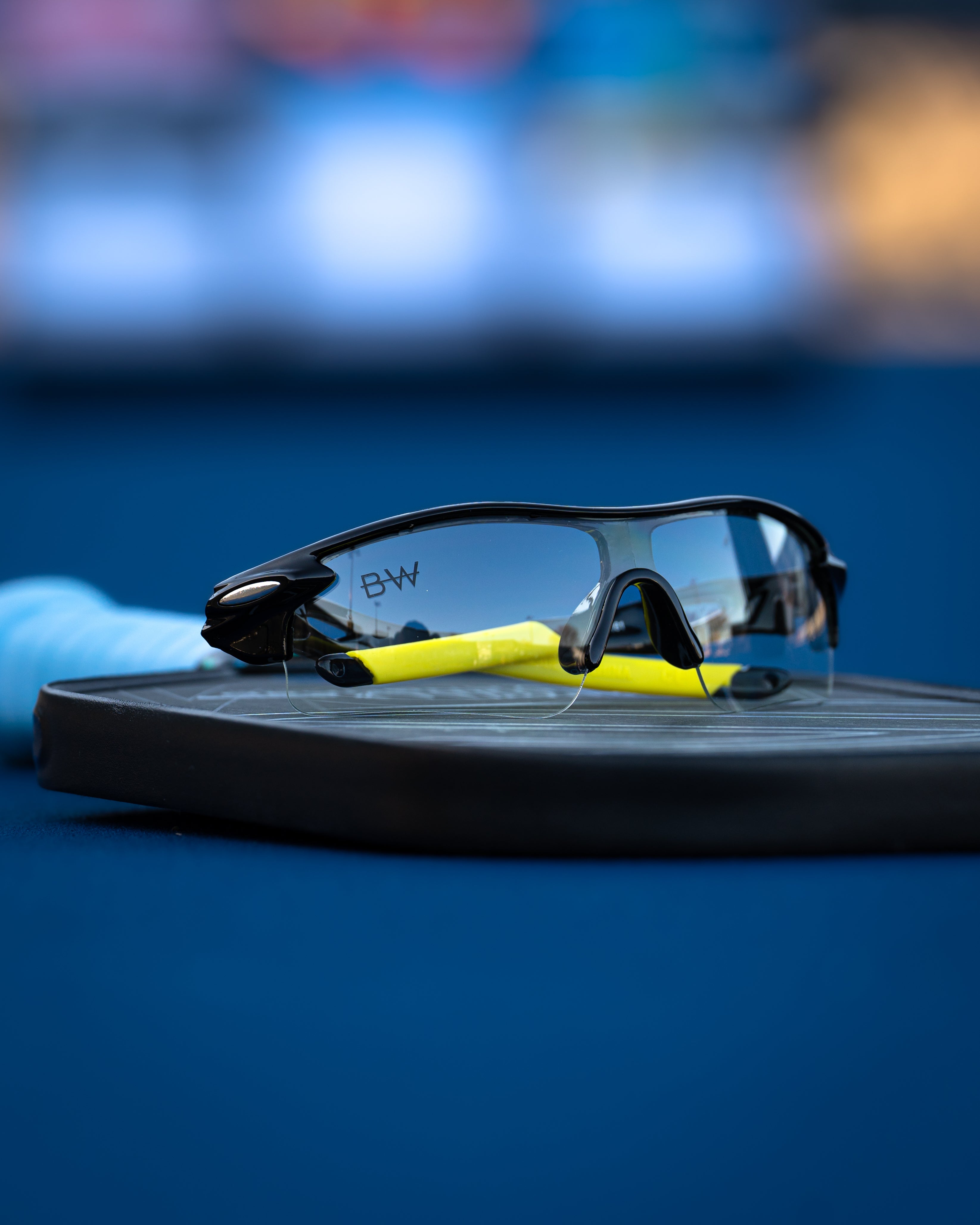
Why Some RX Athletes Struggle With Depth — and How to Fix It
Share
Find Your Perfect Pickleball Glasses
If you wear prescription eyewear for pickleball, accurate correction is only one part of the visual experience. Depth perception involves how your visual system interprets distance and three-dimensional space, while prescription accuracy, binocular vision, frame position, lens design, and individual eye health can all matter.
Why Some RX Athletes Struggle With Depth — and How to Fix It
Pickleball constantly asks players to judge where the ball is, where it is going, and how their own position relates to the net, court, partner, and opponents. A lob, dink, drive, volley, and overhead can each present a different visual problem.
When a prescription-glasses wearer starts misjudging distance, it can be tempting to blame the RX immediately. But depth perception is more complicated than prescription sharpness alone.
Refractive correction can help a person see appropriately according to the prescription they need. Depth perception, however, involves multiple visual cues and the way the visual system uses information from one or both eyes. An athlete can therefore experience a depth-related concern without the cause necessarily being the glasses.
The useful question is not simply, “Are my RX glasses ruining my depth?” It is: what changed, what exactly am I experiencing, and which part of the visual or eyewear system should be evaluated?
What Is Depth Perception?
Depth perception is the ability to perceive three-dimensional spatial relationships and judge relative distance. It is not a single specification built into a pair of prescription glasses.
Your visual system can use multiple cues when interpreting space. These can include binocular information from the two eyes as well as monocular cues that can provide useful spatial information even when viewed with one eye.
On a pickleball court, spatial judgments can be relevant when you are:
- Watching the trajectory of a lob
- Judging where a ball may bounce
- Positioning yourself relative to the kitchen line
- Following an approaching volley
- Moving relative to your doubles partner
- Judging the location of the net and boundaries
- Preparing for an overhead
That does not mean depth perception alone determines whether you successfully execute any of those actions. Technique, anticipation, movement, attention, experience, ball speed, spin, and many other factors also matter.
Depth Perception Is Not the Same as Visual Acuity
Visual acuity and depth perception are related to vision, but they are not interchangeable.
| Visual Concept | What It Generally Describes |
|---|---|
| Visual acuity | Ability to resolve visual detail under particular testing conditions |
| Depth perception | Perception of three-dimensional spatial relationships and distance |
| Contrast sensitivity | Ability to distinguish differences in contrast |
| Peripheral vision | Vision outside the central area of gaze |
| Dynamic visual acuity | Visual resolution involving a moving target or observer under particular conditions |
A person should not assume that excellent distance acuity automatically proves every other part of visual function is optimal.
Binocular Vision and Depth Perception
Binocular vision refers broadly to the use of information from both eyes. Differences between the views received by the two eyes can contribute to stereoscopic depth information.
However, depth perception should not be reduced to “both eyes working equals perfect depth.” The visual system is more complex, and individuals can use multiple spatial cues.
If you have a persistent concern about binocular vision, eye alignment, or depth perception, an eye-care professional can evaluate those issues more appropriately than an online frame-selection guide.
Depth Is Not Based on Stereopsis Alone
The visual system can also use monocular cues when interpreting space. Depending on the scene, these can include information related to relative size, overlap, perspective, motion, texture, and other visual relationships.
This matters because statements such as “your glasses control your depth perception” oversimplify the process.
Prescription eyewear can influence the visual information presented to the wearer, but the glasses are not the sole source of depth perception.
Why Pickleball Makes Spatial Judgment Noticeable
Pickleball can make small visual differences noticeable because the environment changes quickly.
A player may need to interpret:
- Ball position
- Ball trajectory
- Opponent position
- Partner position
- Net location
- Court boundaries
- Available space
But seeing these elements is only one part of responding to them. Successful play also requires decisions and physical execution.
That is why it is inaccurate to promise that a particular pair of RX glasses will directly improve depth perception, reaction time, ball tracking, or shot accuracy.
Can Prescription Glasses Affect How Space Looks?
Prescription lenses alter incoming light according to the refractive correction and lens design. A new prescription, different lens design, different frame, or different wearing position can therefore create a visual experience that feels different from an older pair.
That does not automatically mean the new eyewear has “bad depth.”
When someone reports that space feels unfamiliar through RX glasses, possible categories worth considering can include:
- The prescription itself
- Whether the prescription remains appropriate
- Prescription lens design
- Optical positioning
- Frame fit and wearing position
- Differences from the person's previous eyewear
- Physical lens or frame damage
- Surface contamination
- An underlying visual or eye-health issue
The symptom alone cannot identify which category is responsible.
Can an Outdated Prescription Affect Your Visual Experience?
If a person's vision needs have changed, an older prescription may no longer provide the correction that is currently appropriate.
However, do not assume that every missed volley, misjudged lob, or timing mistake proves that the prescription is outdated.
If you notice a meaningful persistent change in vision—on or off the court—an eye-care professional can determine whether your prescription or another aspect of your vision should be evaluated.
Why a New Prescription Can Feel Different
Changing to a new prescription can create a different visual experience, especially if the new pair also changes other variables at the same time.
For example, a new pair might have:
- A different prescription
- A different frame size
- A different lens shape
- A different lens design
- A different wearing position
- A different lens material
- A different tint or other lens configuration
If the new pair feels unfamiliar, that does not by itself prove that the prescription or PD is wrong.
Is There a Normal Adjustment Period for New RX Glasses?
There is no single adaptation period that applies to every person, prescription, lens design, and frame.
Avoid universal claims such as:
- Everyone adjusts within 24 hours.
- All new prescriptions require exactly one week.
- Any depth problem during the first few days is normal.
- If the glasses are correct, they should feel perfect instantly.
If a meaningful visual problem is persistent, severe, worsening, or otherwise concerning, professional evaluation is more useful than waiting for an arbitrary deadline.
Does Pupillary Distance Affect Depth Perception?
Pupillary distance, or PD, is an important measurement used in positioning prescription lenses. But it should not be marketed as a direct “depth accuracy” measurement.
PD does not measure:
- Stereopsis
- Depth perception ability
- Reaction time
- Ball tracking ability
- Pickleball accuracy
- Hand-eye coordination
Likewise, an incorrect PD should not be diagnosed simply because a player mistimed a shot.
PD and Optical Centering Are Related, but Not Identical Concepts
Prescription lens positioning is more nuanced than saying, “the optical center must always sit directly over each pupil.”
Depending on the prescription and lens design, optical reference points and fitting considerations can involve more than a single horizontal PD measurement.
This is also why you should not attempt to diagnose a centering problem from a selfie or court-performance mistake alone.
Binocular PD and Monocular PD Are Not Always Interchangeable
A binocular PD describes an overall distance between the pupils. Monocular measurements describe the relationship from a central reference to each eye separately.
Do not automatically assume that dividing a binocular PD exactly in half always produces the appropriate monocular values for every person.
If accurate prescription positioning information is required, use appropriate measurements rather than guessing.
Can Frame Fit Affect the Visual Experience?
Yes, the position of prescription eyewear relative to the wearer can matter. But the relationship should be described carefully.
If a frame moves, the prescription values manufactured into the lenses do not suddenly change. Instead, the eyewear's position relative to the wearer has changed.
Factors associated with wearing position can include:
- How high or low the frame sits
- Frame tilt
- Distance between the lenses and eyes
- Frame wrap
- Whether the frame is substantially displaced or deformed
Small ordinary movements should not automatically be described as destroying depth perception.
What Is Vertex Distance?
Vertex distance broadly refers to the distance between the eye and the spectacle lens. It is one of several concepts that can be relevant when discussing how prescription eyewear sits relative to the wearer.
That does not mean every tiny change in vertex distance creates a noticeable sports-performance problem.
The importance of wearing-position variables can depend on the prescription, lens design, magnitude of the change, and individual wearer.
What About Frame Tilt?
Spectacle frames can sit at an angle relative to the face. In optical discussions, wearing-position considerations can include frame tilt.
Again, the useful conclusion is not that “tilt ruins depth.” The point is that finished prescription eyewear is a system involving the prescription lenses, frame, positioning, and wearer.
If a frame becomes significantly bent or sits very differently after damage, appropriate inspection can be worthwhile.
Does a Wraparound Frame Automatically Improve Depth Perception?
No. A wrapped sports appearance does not independently prove better depth perception, optical accuracy, ball tracking, or peripheral performance.
Wrap is one element of frame geometry. How it interacts with a prescription lens system can depend on the complete eyewear design.
Choose sports eyewear because the complete RX configuration works for you—not because “more wrap” is assumed to equal better depth.
Do Wider Lenses Improve Depth Perception?
A larger lens can change the physical viewing area and eyewear coverage, but it does not automatically increase biological peripheral vision or depth-perception ability.
Likewise, wider lenses should not be marketed as guaranteeing:
- Better lob judgment
- More accurate overheads
- Faster ball tracking
- Better court awareness
- Improved depth perception
Those outcomes involve much more than lens dimensions.
Do High-Index RX Lenses Improve Depth Perception?
No universal depth-perception improvement should be attributed to high-index lens material.
Blinded Wear includes high-index prescription lenses at no additional cost. High-index materials can help manage finished lens thickness under comparable conditions, particularly as prescription requirements increase.
That benefit should remain separate from claims about depth perception.
What High-Index Does Not Automatically Mean
High-index does not inherently establish:
- Better depth perception
- More accurate distance judgment
- Faster reaction time
- Better ball tracking
- Greater peripheral vision
- Better contrast sensitivity
- Perfect optical accuracy
- Impact resistance
- Scratch resistance
- Anti-fog performance
- Heat resistance
- Distortion-free vision
Refractive index is an optical material property, not a sports-performance rating.
Does 1.61 Lens Material Fix Depth Problems?
A numerical refractive index such as 1.61 describes a lens-material property. It is not a depth-perception treatment.
It would therefore be inaccurate to claim that a 1.61 lens:
- Eliminates depth distortion
- Prevents lens warping
- Improves binocular coordination
- Guarantees accurate distance judgment
- Improves sports reaction time
Blinded Wear's verified general RX benefit is that high-index prescription lenses are included at no additional cost. Do not assume every RX configuration uses an exact 1.61 material unless that specification is confirmed for the product.
Do Not Diagnose “Lens Warping” From a Depth Complaint
If a player says that space looks unusual, it is not appropriate to conclude automatically that the lens has warped from heat or pressure.
Heat, compression, impact, frame deformation, coatings, lens condition, prescription factors, and vision itself are different variables.
If eyewear has experienced substantial physical stress and now appears damaged or produces an unfamiliar visual experience, inspection is more reliable than guessing the failure mechanism.
Heat Does Not Automatically Explain Depth Problems
Avoid claims that tournament heat routinely bends prescription lenses enough to alter depth perception.
Eyewear materials and coatings can respond differently to environmental exposure, and there is no single universal temperature threshold that predicts failure across every lens and frame system.
A practical care rule is simply to avoid unnecessary prolonged extreme heat, including avoidable storage in very hot environments.
Inspect the Eyewear After a Meaningful Impact
If a ball strike, drop, compression event, or other impact occurs and the eyewear suddenly feels visually different, inspect the complete pair.
Look for:
- Visible cracks
- Chips
- Lens displacement
- Frame deformation
- A significant change in fit
- A frame that now sits noticeably crooked
Impact resistance does not mean indestructible, and physical damage should not be treated as an adaptation issue.
Rule Out Dirty Lenses Before Blaming Depth Perception
Sweat, fingerprints, sunscreen, dust, water spots, and other residue can interfere with what you see through a lens.
Surface contamination does not change your prescription and does not necessarily indicate a binocular-vision problem.
If something suddenly looks wrong during a match:
- Check the lens surface.
- Look for condensation or residue.
- Clean appropriately if needed.
- Confirm that the frame is sitting normally.
- Then determine whether the visual concern remains.
Fog Can Obscure Vision Without Changing Depth Perception Ability
Fog is condensation on the lens surface. It can make the scene harder to see clearly, but it does not rewrite SPH, CYL, AXIS, PD, or the wearer's underlying depth-perception ability.
Do not confuse temporary condensation with:
- Prescription error
- Lens warping
- Incorrect PD
- Permanent distortion
- Loss of binocular vision
Those are different issues.
Can a Scratch Affect Depth Perception?
A scratch is physical surface damage. Depending on its characteristics and location, it may be noticeable or interfere with the view through part of the lens.
That does not mean every scratch directly changes depth perception.
A scratch also does not change the prescription values manufactured into the lens. Avoid DIY polishing methods such as toothpaste, baking soda, automotive compounds, or other abrasive products.
Do Polarized Lenses Hurt Depth Perception?
Polarization alone should not be treated as a universal cause of poor depth perception.
Likewise, non-polarized lenses should not be marketed as automatically providing superior depth perception.
Polarization is designed to manage certain reflected light. Depth perception depends on the visual system and should not be reduced to a simple polarized-versus-non-polarized rule.
Does Lens Tint Improve Depth Perception?
A lens tint changes visible-light transmission and the spectral characteristics of light reaching the eye according to the exact lens. That is separate from proving better depth perception.
Do not automatically claim that:
- Grey tint improves depth judgment.
- Clear lenses maximize depth accuracy.
- A colored tint improves ball tracking.
- Darker lenses improve spatial awareness.
- One tint is best for overheads or dinks.
Choose tint according to verified lens characteristics, playing conditions, and personal preference rather than unsupported depth claims.
VLT Is Not a Depth-Accuracy Score
Visible Light Transmission (VLT) describes the percentage of visible light transmitted through a lens.
Higher VLT means more visible light is transmitted; lower VLT means less visible light is transmitted.
VLT does not directly measure:
- Depth perception
- Prescription accuracy
- Ball tracking
- Reaction time
- Contrast sensitivity
- Peripheral vision
There is no universal VLT that guarantees better depth judgment for pickleball.
Do Photochromic Lenses Improve Depth?
Photochromic lenses are designed to change tint according to their specific technology and environmental conditions. Their primary practical appeal can be convenience across changing light environments when an appropriate configuration is available.
They should not be marketed as automatically improving:
- Depth perception
- Distance judgment
- Reaction time
- Ball tracking
- Shot accuracy
Exact photochromic behavior and availability depend on the specific lens configuration.
Are Contact Lenses Better Than RX Glasses for Depth Perception?
There is no responsible universal answer.
Contact lenses and prescription glasses position refractive correction differently, and individual experiences vary. But neither category should be declared universally superior for pickleball depth perception.
Contacts can be a legitimate option for some players. Prescription sports glasses can also be a legitimate option. Some players may use contacts with compatible non-prescription sports eyewear.
The best choice depends on the individual's prescription, eye health, comfort, professional guidance, environment, and preferences.
Wind and Sweat Do Not Make Contacts Universally Inferior
Some contact-lens wearers may experience discomfort in certain dry, windy, dusty, or otherwise challenging environments. That does not mean contacts universally dry out, shift, or fail during pickleball.
Likewise, ordinary prescription sports glasses should not be described as sealed protection from wind, dust, sweat, or airborne particles unless the exact eyewear is designed and rated for that purpose.
Your Contact Prescription Is Not Your Eyeglass Prescription
If you decide to order prescription sports glasses after playing in contacts, do not copy a contact-lens prescription into an eyeglass order.
Contact-lens and eyeglass prescriptions are not interchangeable.
For applicable Blinded Wear RX products, upload a clear image of your eyeglass prescription on the product page before adding the eyewear to your cart.
Review the How to Order RX Glasses guide before purchasing.
Depth Feels Wrong? Use This Troubleshooting Order
Rather than immediately replacing your glasses, work through the problem logically.
| Question | What It Helps Separate |
|---|---|
| Are the lenses dirty or fogged? | Surface problem vs persistent visual issue |
| Is the frame sitting normally? | Fit or displacement issue |
| Was the eyewear recently hit, dropped, heated, or compressed? | Possible physical damage |
| Is this a brand-new prescription or frame? | Change in eyewear configuration |
| Does the problem happen only on the pickleball court? | Sport-specific observation vs broader vision concern |
| Does the issue persist through clean, intact eyewear? | Reason to consider optical or vision evaluation |
| Is there new double vision or another significant visual change? | Reason for professional evaluation |
If the Problem Happens Only on the Pickleball Court
If everyday vision feels normal but you occasionally misjudge a pickleball, do not automatically diagnose a depth-perception disorder.
On-court outcomes can also be affected by:
- Ball speed
- Spin
- Lighting
- Background
- Opponent position
- Your own movement
- Timing
- Technique
- Anticipation
- Attention
- Experience
A missed shot is not a diagnostic test.
Misjudging Lobs Does Not Automatically Mean Your RX Is Wrong
Lobs involve changing ball height, trajectory, movement, and player positioning. A player can mistime an overhead for many reasons unrelated to prescription eyewear.
If lob judgment is consistently accompanied by broader visual concerns, that is different from occasionally making the wrong read during competition.
Missing a Dink Is Not Proof of Poor Depth Perception
Dink execution involves far more than visual distance judgment. Paddle angle, contact point, footwork, touch, ball spin, positioning, and decision-making can all influence the result.
Avoid using isolated pickleball mistakes as evidence that an RX prescription is inaccurate.
Overhead Timing and RX Vision
An overhead can involve looking upward, moving into position, interpreting the ball's path, coordinating the swing, and choosing where to place the shot.
Appropriate prescription correction can help provide the refractive correction the wearer needs, but RX glasses should not be marketed as guaranteeing better overhead timing or accuracy.
If looking through a particular area of the lens consistently creates an unusual visual experience, that is more useful information to investigate than simply counting missed overheads.
Peripheral Vision Is Not the Same as Depth Perception
Peripheral vision and depth perception are separate visual concepts.
A frame with a larger lens does not automatically expand a person's biological peripheral vision. Likewise, peripheral lens coverage does not independently prove better depth perception.
Avoid combining terms such as “full-field depth,” “peripheral sharpness,” and “depth accuracy” into a single unsupported performance claim.
Depth Perception and Reaction Time Are Not the Same Thing
Seeing spatial information and physically responding to a pickleball are different stages of performance.
Prescription glasses should not be marketed as making the brain process visual information faster or creating extra milliseconds of reaction time.
Likewise, correcting refractive error does not justify a blanket claim that RX athletes react faster than players with uncorrected vision.
Depth Perception and Ball Tracking Are Also Different
Tracking a moving ball, resolving visual detail, perceiving depth, and making a movement decision are related parts of the overall sports-vision experience, but they are not identical functions.
That is why a single eyewear feature should not be credited with improving all of them at once.
Contrast Sensitivity Is Another Separate Visual Function
Contrast sensitivity concerns the ability to distinguish differences in contrast. It is not interchangeable with depth perception.
A lens tint may alter the visual appearance of a scene, but that does not automatically prove an improvement in contrast sensitivity or depth judgment.
On-Court Symptoms Cannot Diagnose the Cause
Descriptions such as “I feel off,” “the ball looks weird,” or “my depth feels wrong” can be useful starting points, but they are not diagnoses.
The same general complaint could potentially involve very different categories, including:
- Lens contamination
- Frame fit
- New eyewear
- Prescription concerns
- Physical damage
- Environmental conditions
- Vision or eye-health factors
- Non-visual sports factors
Identifying the pattern is more useful than immediately assigning one cause.
New Double Vision Is Different From Missing a Ball
New or persistent double vision should not be dismissed as normal pickleball timing, frame adaptation, or an ordinary depth-perception mistake.
If you experience meaningful new or persistent double vision or another significant visual change, appropriate professional evaluation is warranted.
When to Ask an Eye-Care Professional About Depth
Consider professional evaluation when a depth or visual concern is persistent, meaningful, new, worsening, or present beyond isolated sports mistakes.
An eye-care professional can evaluate the relevant aspects of vision and eye health rather than relying on assumptions based on your pickleball results.
This is particularly important when symptoms involve:
- New or persistent double vision
- A meaningful unexplained vision change
- Persistent difficulty despite clean and intact eyewear
- A concern that the prescription is no longer appropriate
- Other new or concerning visual symptoms
When an Optical Inspection Can Help
If the concern appears to involve the eyewear rather than a change in your underlying vision, an optical professional may be able to evaluate relevant characteristics of the finished glasses.
Depending on the situation, this can include reviewing:
- Lens characteristics
- Frame condition
- Fit
- Wearing position
- Whether the eyewear appears physically damaged
A lensmeter or focimeter can help evaluate relevant lens characteristics, but it cannot determine your pickleball skill or diagnose every cause of a depth complaint.
Can You Test Depth Perception at Home?
Informal demonstrations may illustrate certain visual concepts, but they should not be treated as a complete diagnostic evaluation of depth perception, binocular vision, prescription accuracy, or eye health.
Likewise, do not deliberately cover one eye during active pickleball play as an improvised depth test. Testing visual concepts should not create an unnecessary court-safety problem.
Do Not Change Your Prescription Yourself to “Fix” Depth
Never intentionally modify prescription values because you think a slightly stronger or weaker lens might improve pickleball depth.
Do not:
- Increase or decrease SPH yourself
- Alter CYL
- Change AXIS
- Remove prescribed prism
- Guess PD
- Round prescription values
- Convert a contact-lens prescription yourself
Your prescription should be determined through appropriate professional care, not trial-and-error sports experimentation.
Know the Main Terms on an Eyeglass Prescription
Understanding the terminology can help you submit the prescription accurately without assigning each value an unsupported sports-performance effect.
- OD: Right eye
- OS: Left eye
- SPH: Spherical lens power
- CYL: Cylinder power when prescribed
- AXIS: Orientation associated with prescribed cylinder
- ADD: Additional power when prescribed
- Prism: Prescribed prism when applicable
These values should be entered or submitted accurately rather than altered to create a supposed “sports prescription.”
What About Prism?
If prism is prescribed, it is intentional prescription information and should not simply be removed because the eyewear will be used for sports.
Prism also should not be self-prescribed as a way to improve pickleball depth perception.
Questions about whether a particular prescription can be made in a specific sports-eyewear configuration should be addressed before ordering.
How to Choose RX Pickleball Glasses When Depth Is a Concern
Do not shop for a frame based on claims such as “maximum depth accuracy.” Instead, build the decision around verifiable factors.
Prioritize:
- An appropriate eyeglass prescription
- Accurate prescription information
- A frame that suits your fit preferences
- A lens configuration appropriate for your playing environment
- Familiarity with the eyewear before important competition
- Appropriate care and storage
- Professional evaluation when a persistent visual problem exists
Current Blinded Wear RX Options to Explore
There is no responsible basis for declaring one frame universally best for depth perception. Instead, compare current RX options according to your prescription needs, verified product specifications, fit preferences, and playing environment.
- Steel Ice RX
- Blue Shield RX
- Havana Melt RX
- Gray Wash RX
- Zebra II RX
- Lava Rock RX
- Frost RX
- Rippled X RX
- Crystal Wave II RX
Browse the complete Prescription Pickleball Glasses Collection for current options.
Common RX Depth-Perception Myths
| Myth | More Accurate Explanation |
|---|---|
| RX glasses automatically improve depth perception. | Prescription lenses provide refractive correction; depth perception involves the visual system and multiple cues. |
| Every missed overhead means the prescription is wrong. | Shot execution depends on many visual and non-visual factors. |
| PD is a depth-perception measurement. | PD is used in prescription lens positioning. |
| The optical center must always sit directly over the pupil. | Prescription lens positioning is more nuanced and depends on lens design and other factors. |
| High-index lenses improve depth. | High-index primarily relates to refractive index and can help manage lens thickness. |
| 1.61 lenses eliminate distortion. | A refractive-index number does not guarantee distortion-free vision or improved depth perception. |
| Wider lenses increase peripheral vision. | Lens dimensions do not expand biological peripheral vision. |
| Non-polarized lenses improve depth. | Polarization status alone does not determine depth perception. |
| Contacts are always better for depth. | There is no universal winner for every wearer. |
| A new pair should feel perfect immediately. | Individual experiences vary, but persistent meaningful problems should be evaluated. |
FAQ: RX Glasses and Depth Perception
Can prescription glasses affect how distance looks?
Prescription lenses alter incoming light according to the prescribed correction and lens design, so changing prescriptions or eyewear configurations can create a different visual experience. That does not mean glasses universally improve or worsen depth perception.
Does incorrect PD cause bad depth perception?
PD is relevant to prescription lens positioning, but a depth complaint alone cannot diagnose an incorrect PD.
Can I tell my PD is wrong because I keep missing lobs?
No. Pickleball performance is not a reliable PD test.
Can an outdated prescription affect my game?
An outdated prescription may no longer provide the correction currently appropriate for the wearer, but isolated sports mistakes do not prove that the prescription is outdated.
Why does a new pair make the court look different?
A new pair may differ in prescription, lens design, frame dimensions, wearing position, material, tint, or other characteristics. The symptom alone does not identify which difference is responsible.
Do I just need time to adjust?
There is no universal adaptation period. Persistent or concerning visual problems should be evaluated rather than automatically dismissed as adaptation.
Does high-index improve depth?
No universal depth-perception benefit should be attributed to high-index material. High-index can help manage lens thickness under comparable conditions.
Does Blinded Wear use 1.61 lenses in every RX product?
Do not assume an exact refractive index across every configuration unless it is specifically verified. Blinded Wear includes high-index prescription lenses at no additional cost.
Can heat warp lenses and ruin depth perception?
Do not diagnose lens warping solely from a depth complaint. Avoid unnecessary prolonged extreme heat, and have eyewear inspected if it appears damaged or produces a persistent unfamiliar visual experience after significant exposure.
Can a loose frame ruin depth perception?
Frame position can affect the wearing position of prescription eyewear, but ordinary movement should not automatically be described as destroying depth perception.
Are wider sports lenses better for depth?
Not automatically. Lens dimensions do not independently establish better depth perception.
Are contacts better for depth?
There is no universal winner. The appropriate correction method depends on the individual wearer and professional guidance.
What should I do if my depth suddenly feels different?
Check for lens contamination, fog, frame displacement, and physical damage. If a meaningful visual concern persists through clean and intact eyewear, consider appropriate professional evaluation.
The First Step Is Finding the Cause, Not Blaming the RX
Depth perception is important to how people understand three-dimensional space, but it is not a single feature that can be switched on by sports glasses.
If an RX athlete feels that distance or space looks unusual, the cause could involve the eyewear, the prescription, the wearing position, environmental conditions, physical damage, or the person's vision itself. A pickleball mistake cannot tell you which one.
The best approach is to separate prescription correction, lens positioning, frame fit, lens condition, depth perception, and sports execution rather than treating them as the same thing.
Blinded Wear RX eyewear can provide the prescription correction ordered in a sports-focused frame, with high-index prescription lenses included at no additional cost. It should not be marketed as guaranteeing perfect depth perception, faster reactions, better ball tracking, or more accurate shots.
When depth feels wrong, troubleshoot what you can observe—and when a meaningful visual issue persists, get the underlying vision or eyewear concern properly evaluated.
Depth Perception Problems Are Not the Same as Prescription Errors
When the court suddenly looks unfamiliar, it is easy to assume the prescription must be wrong. But prescription accuracy and depth perception are different questions.
A prescription describes refractive correction. Depth perception describes how the visual system interprets spatial relationships. A player can therefore experience an unusual sense of distance without that experience automatically proving that SPH, CYL, AXIS, PD, or another prescription-related value is incorrect.
| Observation | What It Does Not Prove by Itself |
|---|---|
| Missing the contact point on an overhead | Incorrect prescription |
| Misjudging one lob | Incorrect PD |
| Feeling unfamiliar in new glasses | Manufacturing error |
| Seeing blur through sweaty lenses | Changed prescription |
| Frame moves during play | Changed lens power |
| Difficulty judging distance outside sports too | A specific cause without further evaluation |
The pattern of the problem matters much more than a single missed shot.
Why the Two Eyes Do Not Always Have Identical Prescriptions
Many eyeglass prescriptions contain different values for the right and left eyes. That alone does not mean the wearer has defective depth perception.
The visual system receives information from both eyes and combines that information according to the individual's visual function. Prescription lenses are intended to provide the refractive correction prescribed for each eye.
A difference between OD and OS should not be:
- Self-corrected by making the prescriptions match
- Averaged between the two eyes
- Reduced because the glasses will be used for sports
- Changed because one eye “feels stronger”
Submit the prescription as written rather than modifying it in an attempt to improve depth perception.
What If the Two Eyes Need Different Amounts of Correction?
Some people have a meaningful difference in refractive correction between their two eyes. An eye-care professional can determine how that relates to the individual's overall visual experience and appropriate correction.
The important point for an RX pickleball order is simple: do not change one eye's prescription to make it closer to the other eye.
How a particular person experiences differences between the eyes cannot be predicted accurately from a pickleball article alone.
Prescription Lenses Can Change More Than Apparent Sharpness
Different spectacle prescriptions and lens systems can influence the visual experience in ways that are more complex than simply making an object “clear” or “blurry.”
This is one reason a substantially different prescription or eyewear configuration can sometimes feel unfamiliar even when a person can read clearly through it.
However, an unfamiliar visual experience should not automatically be labeled:
- Bad depth perception
- Lens distortion
- Incorrect PD
- Incorrect manufacturing
- A defective frame
If the issue is persistent or significant, the appropriate prescription and finished eyewear can be evaluated rather than diagnosing the cause from symptoms alone.
Why Optical Positioning Deserves More Nuance
Prescription lens optics are one reason proper measurements and finished-lens positioning matter. But this topic is often oversimplified online into statements such as, “If the lens is one millimeter off, your depth will be wrong.”
There is no responsible universal millimeter threshold that predicts a pickleball player's symptoms across every prescription.
The optical effect of viewing through different portions of a prescription lens can depend on factors including the lens power and amount of displacement involved. This is an optical question, not something that should be estimated from how many volleys a player missed.
What Is Prentice's Rule?
In ophthalmic optics, Prentice's rule describes the relationship between lens power, decentration, and induced prism. It helps illustrate why prescription power and optical positioning can interact.
It should not be used as a DIY tool to alter your prescription or decide that your glasses were manufactured incorrectly.
In particular, do not use an online calculation to:
- Change your PD
- Alter prescribed prism
- Modify SPH or CYL
- Diagnose the cause of double vision
- Decide whether a finished pair meets applicable optical requirements
An optical professional can evaluate the actual eyewear when verification is needed.
Do Stronger Prescriptions Make Positioning More Important?
Prescription magnitude can be relevant when considering optical effects associated with lens positioning. But there is no single prescription strength at which sports glasses suddenly become difficult to use.
Avoid blanket rules such as:
- Strong prescriptions cannot be used for pickleball.
- High prescriptions always distort peripheral vision.
- High-index completely eliminates distortion.
- Every strong RX requires the same frame shape.
The complete prescription, lens design, frame, measurements, and individual wearer matter.
What About Astigmatism Correction?
When cylinder correction is prescribed, both CYL and AXIS are meaningful prescription information. AXIS describes an orientation and is not measured in diopters.
Do not change cylinder or axis because you believe another value might improve pickleball depth.
Likewise, a missed ball cannot tell you that an axis value is wrong.
If your prescription contains cylinder and axis values, submit them exactly as prescribed.
Plus and Minus Signs Matter
Prescription signs should never be treated as minor formatting details.
If your eyeglass prescription lists a plus or minus value, enter or submit it accurately. Accidentally reversing a sign is not a sports-specific adjustment and should not be used as an experiment to improve distance judgment.
If the prescription image is difficult to read, obtain clarification rather than guessing.
What About Multifocal or Progressive Prescriptions?
Different prescription lens designs can involve different optical and fitting considerations. Do not assume that every Blinded Wear RX model supports every possible lens design unless the exact product configuration confirms it.
If your prescription or normal eyewear requires a particular multifocal design, verify compatibility before ordering rather than assuming the same configuration is available across the entire RX collection.
Likewise, do not remove an ADD value or otherwise simplify a prescription solely because the glasses will be used for pickleball without appropriate professional guidance.
Why the Same Prescription Can Feel Different in Another Frame
Two pairs can contain the same basic prescription values while still differing in physical configuration.
Differences can include:
- Lens dimensions
- Lens shape
- Frame dimensions
- Frame position
- Wrap
- Vertex distance
- Tilt
- Lens design
- Lens material
That does not mean one pair necessarily has more accurate depth perception. It means the complete spectacle system has changed.
Why Your Old Glasses Can Feel More “Natural”
Familiarity is another reason an older pair may initially feel different from a new pair.
Your previous glasses may differ in frame geometry, prescription, lens design, or wearing position. A familiar experience is not automatically proof that the old prescription is more accurate.
At the same time, persistent meaningful problems with new eyewear should not be dismissed indefinitely as familiarity or adaptation.
What If the Frame Slides Down During a Rally?
If prescription glasses repeatedly move substantially from their intended wearing position, the first question is generally one of fit, not whether the prescription needs to be changed.
Check whether:
- The frame fits comfortably
- The eyewear repeatedly requires repositioning
- The frame became bent or deformed
- The problem occurs only after substantial perspiration
- The fit has changed compared with when the eyewear was new
Do not make the frame excessively tight simply to eliminate every possible movement. A secure active fit and an uncomfortably tight fit are not the same thing.
Sweat Does Not Change Your Depth Perception Prescription
Perspiration can create practical eyewear issues. It can leave residue on the lenses or contribute to a frame feeling different on the face.
It does not change SPH, CYL, AXIS, prescribed prism, or your anatomical PD.
If the view becomes worse late in a match, check the lens surface and frame position before assuming that fatigue has somehow changed the prescription.
Rain and Water on RX Lenses
Water droplets can interfere with the view through prescription lenses. That is a surface-visibility problem rather than evidence that rain changed the prescription or underlying depth-perception ability.
Likewise, high-index material should not be described as naturally waterproof, hydrophobic, or resistant to moisture-related problems unless those characteristics are separately verified.
Lighting Can Change the Court Without Changing Your RX
The visual environment can change significantly during a long pickleball session.
You might move between:
- Direct sunlight
- Cloud cover
- Shade
- Indoor lighting
- Evening conditions
- Mixed bright and dark backgrounds
Your written prescription does not change every time the lighting changes.
When a visual issue occurs only in a particular environment, consider the environment as one variable rather than immediately concluding that the RX is wrong.
Backgrounds Can Affect How Easy the Ball Is to See
A ball can be easier or harder to distinguish depending on the visual relationship between the ball and its surroundings. That is different from saying a lens has improved the wearer's depth perception.
Backgrounds can vary considerably between facilities, including:
- Walls
- Fences
- Trees
- Spectators
- Other courts
- Sky
- Artificial lighting
A difficult visual background should not automatically be diagnosed as an RX problem.
Seeing the Ball Clearly Is Not the Same as Judging Its Distance Perfectly
Ball visibility and depth perception are distinct concepts.
A player may find a ball visually easy to distinguish from the background without that automatically producing perfect distance judgment. Likewise, difficulty seeing the ball against a particular background does not necessarily mean the person's stereoscopic depth perception is impaired.
Movement Also Provides Spatial Information
As an observer or object moves, the changing visual scene can provide spatial information. This is another reason depth perception should not be described as relying on one lens feature or one binocular mechanism alone.
On court, however, movement also introduces athletic variables such as footwork and positioning. A player who reaches the wrong location cannot automatically blame the eyewear.
Ball Speed Does Not Change Your Prescription
A faster ball gives a player less time to perceive the situation, decide what to do, move, and execute the shot. That does not mean fast shots expose a hidden change in lens power.
Prescription correction can provide the refractive correction the wearer needs, but it should not be marketed as adding reaction time or slowing the visual scene.
Spin Can Change the Ball's Path Without Changing Your Depth Vision
Spin can influence ball flight and bounce. A player who incorrectly predicts a spinning ball's behavior may describe the mistake as “bad depth,” even when the issue involved trajectory prediction.
This is an important distinction: perceiving where something is and predicting where it will go are not exactly the same task.
Depth Perception and Anticipation Are Different Skills
Experienced players often use contextual information to anticipate what may happen next. Opponent positioning, paddle preparation, previous patterns, and court geometry can all inform a decision.
That process should not be credited to prescription lenses.
RX glasses correct refractive error according to the prescription. They do not teach anticipation or strategy.
Depth Perception Is Not Hand-Eye Coordination
Hand-eye coordination involves coordinating visual information with physical movement. Depth perception can contribute visual information, but the two terms should not be treated as synonyms.
A player can see a ball clearly and still mistime the paddle. Likewise, a missed contact point does not prove defective depth perception.
Does Tournament Fatigue Change Depth Perception?
Physical or mental fatigue can change how an athlete performs, but a late-tournament mistake should not automatically be diagnosed as a depth-perception failure.
Likewise, do not claim that RX sports glasses prevent visual fatigue, maintain depth accuracy for a specific number of hours, or preserve reaction speed throughout a tournament without evidence supporting those claims.
Rapid Head Movement Does Not Automatically Create Optical Lag
Prescription lenses do not inherently “lag behind” the visual system when the wearer turns their head.
If eyewear physically shifts during movement, that is a fit or wearing-position consideration. It should not be described as a delay in the prescription itself.
If you are testing a new sports frame, use realistic pickleball movement rather than exaggerated head shaking.
Looking Up Through RX Glasses
Overheads and lobs may require the player to look upward. Depending on head and eye movement, the wearer may look through different portions of a spectacle lens.
That does not establish that a wider or taller lens automatically improves vertical depth perception.
If a player consistently experiences an unusual optical effect only when looking through a particular region of a prescription lens, that pattern can be useful information for an optical professional.
Looking Across the Lens During Lateral Play
Similarly, a player moving laterally may look through different portions of the lens rather than always viewing directly through the same location.
The visual experience can depend on the complete prescription lens and eyewear system. Avoid universal claims that one frame geometry eliminates all off-axis effects or creates perfect peripheral sharpness.
Direct RX vs. an RX Clip: Which Is Better for Depth?
There is no universal optical winner for every wearer.
A direct RX configuration places the prescription correction in the primary prescription lens system. A compatible RX clip configuration uses a separate inner prescription insert behind an outer sports lens.
These are different eyewear architectures, but architecture alone does not prove that one provides better depth perception, faster visual processing, or more accurate ball tracking.
Compare the exact configuration according to your prescription needs, fit preferences, lens options, and playing environment.
Do Clear Lenses Give the Most Accurate Depth?
A clear-looking lens does not automatically provide more accurate depth perception than a tinted lens.
“Clear” generally refers to the absence of a dark sunglass tint. It does not mean:
- 100% visible light transmission
- Perfect optical accuracy
- Better stereopsis
- Improved reaction time
- Better ball tracking
Players looking for clear-lens options can explore the Blinded Wear Clear Lenses Collection.
Do Grey Lenses Improve Spatial Accuracy?
Grey tint can reduce visible-light transmission according to the exact lens. It may also appear relatively neutral compared with some colored tints.
Those characteristics should not be converted into an unsupported promise of improved spatial accuracy or depth perception.
The exact lens specification matters more than the color name alone.
Darker Does Not Mean Better Depth
A darker lens transmits less visible light according to its exact VLT, but darkness is not a depth-perception rating.
Likewise, a darker appearance does not automatically prove stronger UV protection, polarization, greater impact resistance, or better contrast.
Evaluate each property separately.
UV Characteristics and Depth Perception Are Separate
UV characteristics should be verified for the exact lens rather than inferred from tint darkness.
UV protection also should not be marketed as a mechanism for improving immediate pickleball depth perception.
These are separate eyewear considerations.
Impact Resistance Does Not Improve Depth Perception
Impact resistance concerns how a material or finished system responds to impact under relevant conditions. It does not describe spatial vision.
Blinded Wear can discuss verified impact-resistant lens options without claiming that impact resistance improves:
- Depth perception
- Visual acuity
- Contrast sensitivity
- Reaction time
- Ball tracking
Impact-resistant also should not be treated as synonymous with shatterproof, ballistic-rated, or safety-certified.
A Sports Frame Does Not Automatically Mean Better Optics
Sports-focused frame design can be useful for active use, but appearance alone does not establish prescription accuracy or better depth perception.
Evaluate the entire RX system:
- Prescription
- Lens design
- Measurements
- Frame fit
- Wearing position
- Lens condition
- Playing environment
No single frame feature replaces the rest.
A Practical Fit Check Before Playing
Before relying on new RX eyewear in a tournament, wear it during normal activity and realistic pickleball movement.
Check whether:
- The frame is comfortable
- The eyewear sits normally
- You repeatedly need to reposition it
- The lenses remain sufficiently clear
- The prescription experience feels familiar enough for play
- Any unusual visual issue is persistent rather than momentary
Do not deliberately create unsafe movement or impact just to stress-test the glasses.
Do Not Make Tournament Day Your First Meaningful Test
If possible, become familiar with new prescription sports eyewear before an important competitive event.
Practice allows you to distinguish practical issues such as fit, cleaning, environmental preference, and general familiarity without the pressure of immediately deciding whether every missed ball is caused by the eyewear.
This is not because a specific number of practice hours is medically required. There is no universal adaptation timetable.
When Troubleshooting, Avoid Changing Everything at Once
If a player simultaneously changes prescription, frame, tint, lens design, and playing environment, it becomes difficult to know which difference is associated with an unfamiliar visual experience.
When practical, identify the variables rather than assuming one cause.
| Variable | Question to Ask |
|---|---|
| Prescription | Is this different from the previous pair? |
| Frame | Is the size or wearing position substantially different? |
| Lens design | Is this a different optical configuration? |
| Tint | Is the visual environment simply appearing different? |
| Condition | Are the lenses clean and undamaged? |
| Environment | Does the problem occur only in one lighting or court setting? |
If Depth Suddenly Feels Wrong in a Pair That Was Previously Fine
A sudden change deserves a different troubleshooting approach than an unfamiliar new pair.
- Stop and check the lenses for contamination or condensation.
- Confirm that the frame is sitting normally.
- Think about whether the eyewear was recently struck, dropped, compressed, or otherwise damaged.
- Check for visible cracks, chips, deformation, or lens displacement.
- Determine whether the visual concern exists away from the court as well.
- Seek appropriate professional evaluation if a meaningful unexplained change persists.
A prescription does not normally change inside the lens during a rally.
If Depth Feels Different After an Impact
Do not assume that the impact altered the refractive index or prescription power. Instead, inspect for physical consequences.
An impact could potentially affect the frame, lens position, lens surface, or overall condition of the eyewear depending on the event.
If the frame is visibly damaged or the lens is cracked, chipped, displaced, or otherwise questionable, stop treating the issue as simple adaptation.
Do Not Bend the Frame Until the Court “Looks Right”
Aggressively reshaping prescription eyewear at home is not a reliable method for correcting a depth complaint.
Changing frame geometry can alter fit and wearing position without addressing the actual cause of the problem.
If a frame requires significant adjustment, appropriate professional assistance is preferable to repeated trial-and-error bending.
Do Not Perform Destructive Lens Tests
A player does not need to heat, freeze, flex, drop, compress, or strike prescription lenses to determine whether they are suitable for sports use.
Home stress tests do not reproduce standardized laboratory methods and can create damage that was not present before the test.
What Can a Lensmeter Tell You?
A lensmeter, also called a focimeter, is an optical instrument used to evaluate relevant characteristics of spectacle lenses.
It can be useful when the question is whether the finished eyewear corresponds to relevant prescription characteristics.
It cannot directly measure:
- Your pickleball depth perception
- Your reaction time
- Your ball-tracking ability
- Your shot accuracy
- Your court awareness
Those are different questions.
How Is Depth-Related Vision Actually Evaluated?
Eye-care professionals can use appropriate clinical methods when evaluating binocular vision, stereopsis, refractive needs, eye alignment, and other relevant aspects of visual function.
An online article cannot reproduce a complete professional evaluation.
This is why a player with persistent depth concerns should not rely on:
- Pickleball statistics
- A phone selfie
- A home PD ruler alone
- A missed-overhead count
- A product photo
- A generic online depth test
Those tools and observations cannot independently establish the cause.
Do Not Treat a Home PD Measurement as a Depth Test
PD and depth perception are different concepts.
If you need PD information for prescription eyewear, use an appropriate measurement rather than guessing. But obtaining a PD value does not tell you whether your stereopsis or other depth-related visual functions are normal.
Likewise, Blinded Wear should not promise that a particular home-measurement method guarantees perfect PD accuracy for every wearer.
What If PD Is Not Written on My Prescription?
PD may not always appear on the written eyeglass prescription. Do not invent a number or copy someone else's measurement.
If PD information is required for an order and you do not have it, obtain an appropriate measurement rather than assuming an average value.
Do Not Confuse PD With Prescription Power
PD is a physical measurement used for lens positioning. SPH, CYL, AXIS, ADD, and prism describe different prescription information.
Changing one does not substitute for correcting another.
For example, you should not increase SPH because you suspect a PD issue, nor should you change PD because a lens feels too strong.
Submit a Clear Eyeglass Prescription
For applicable Blinded Wear RX products, upload a clear picture of your eyeglass prescription on the product page before adding the eyewear to your cart.
Before submitting it, make sure important information is readable. Do not:
- Crop away relevant prescription values
- Guess an unclear plus or minus sign
- Replace an eyeglass prescription with a contact-lens prescription
- Alter cylinder or axis
- Remove prescribed prism
- Self-convert the prescription
Review the Blinded Wear RX Ordering Guide for the current process.
Choose Lens Features for Their Actual Purpose
One of the easiest ways to avoid misleading eyewear claims is to separate what different specifications actually describe.
| Feature | What It Relates To | What It Does Not Automatically Prove |
|---|---|---|
| Prescription | Refractive correction | Perfect depth perception |
| PD | Lens-positioning measurement | Depth-perception ability |
| High-index | Refractive index and thickness management | Better depth or reaction time |
| Tint | Visible-light transmission characteristics | Improved depth |
| Polarization | Management of certain reflected light | Better or worse depth universally |
| Impact resistance | Response to impact under relevant conditions | Better spatial judgment |
| Photochromic technology | Changing tint under applicable conditions | Automatic depth optimization |
| Frame fit | Physical wearing position and comfort | Perfect binocular vision |
Do Not Rank RX Frames by “Depth Accuracy” Without Evidence
Terms such as “best for depth,” “maximum depth precision,” and “perfect spatial accuracy” sound useful but imply measurable advantages that should not be assigned to individual products without supporting evidence.
A more useful product comparison considers:
- Prescription compatibility
- Verified lens options
- Frame dimensions
- Individual fit preference
- Playing environment
- Verified impact characteristics
- Tint or photochromic availability when applicable
- Current product specifications
Browse current options in the Blinded Wear Prescription Pickleball Glasses Collection.
What If You Do Not Need Prescription Correction?
Players who do not require prescription correction should not choose RX eyewear simply because they believe prescription lenses improve depth perception.
Blinded Wear also offers non-prescription pickleball eyewear for players who do not need an RX configuration.
The appropriate category depends on the wearer's actual vision needs.
Consider a Backup Pair If You Depend on RX Correction
A backup prescription pair can be useful during tournaments because it provides redundancy if the primary pair is damaged or unavailable.
A backup should be:
- Physically intact
- Usable for the wearer
- Based on correction that remains appropriate
- Stored safely
- Familiar enough that it is not being tested for the first time during an important match
A backup does not need to claim superior depth perception to be useful.
What If Your RX Glasses Are Physically Damaged?
Blinded Wear offers 50% lifetime replacement support if eligible glasses break, subject to current policy terms.
Eligible damaged eyewear must be returned according to the current policy. When applicable requirements are met, qualifying customers can receive 50% credit toward a replacement pair.
For damaged RX eyewear, contact blindedwearco@gmail.com before returning the pair.
This is not an unlimited free lifetime warranty and should not be described as automatic coverage for every report of distortion, heat exposure, pressure, prescription change, scratch, loss, or depth-perception concern.
Review the Blinded Wear Protection Plan, Replacement & Returns information for current policy details.
Customized RX Eyewear and Returns
Customized Blinded Wear RX eyewear is final sale and excluded from the standard 30-day return policy.
That is separate from applicable 50% lifetime replacement support for eligible broken eyewear.
Because prescription products are customized, review the prescription information, exact product, available lens configuration, and current policies before completing the order.
More Myths About RX Glasses and Depth
| Claim | Better Explanation |
|---|---|
| Both eyes need the same prescription for good depth. | The two eyes can legitimately have different prescribed correction. |
| Stronger prescriptions cannot work for sports. | Suitability depends on the complete prescription and eyewear configuration. |
| Astigmatism correction slows ball tracking. | Do not assign sports-performance effects to CYL or AXIS without evidence. |
| Frame wrap automatically improves depth. | Wrap is one part of frame geometry and does not independently determine depth perception. |
| Clear lenses provide perfect depth. | Clear appearance does not establish depth-perception ability. |
| Grey lenses improve distance judgment. | Grey tint does not automatically improve depth perception. |
| Impact-resistant lenses improve spatial accuracy. | Impact characteristics and spatial vision are separate. |
| Sweat changes the RX late in a match. | Sweat can affect the lens surface or frame position, not the written prescription. |
| A lensmeter can test depth perception. | A lensmeter evaluates relevant characteristics of spectacle lenses. |
| One missed shot proves the RX is wrong. | Sports execution involves many visual and non-visual variables. |
FAQ: Troubleshooting Depth With RX Sports Glasses
Why does the ball look closer in my new glasses?
A different prescription or eyewear configuration can create a different visual experience, but that observation alone cannot identify the cause. Persistent meaningful differences should be evaluated rather than diagnosed from the symptom alone.
Can two correct pairs of glasses feel different?
Yes. Frames, lens dimensions, lens designs, materials, wearing positions, and other characteristics can differ even when basic prescription values are similar.
Does a stronger prescription mean worse depth perception?
No universal relationship like that should be assumed. Depth perception is not determined solely by prescription magnitude.
Can astigmatism cause depth problems?
Astigmatism and its correction are refractive considerations, but a specific depth complaint cannot be diagnosed from the presence of CYL and AXIS values alone.
Should I remove my cylinder correction for sports?
No. Do not alter a prescribed cylinder or axis on your own for pickleball.
Can I average my right and left prescriptions?
No. Submit the prescription for each eye as prescribed.
Should my monocular PD values always be exactly half my binocular PD?
Not necessarily. Do not automatically divide a binocular measurement in half and assume that it represents the appropriate monocular measurements for every person.
Does frame tilt change the prescription?
It does not rewrite the lens power, but wearing position can be relevant to the optical experience.
Can a bent frame make vision feel different?
A substantially deformed frame can change how the eyewear sits relative to the wearer. Have questionable damage inspected rather than repeatedly bending the frame yourself.
Can dirty lenses make my depth feel wrong?
Surface contamination can interfere with what you see, so clean lenses are an important first troubleshooting step. That does not mean dirt changes your underlying depth-perception ability.
Does fog change depth perception?
Fog can obscure the view, but ordinary condensation does not change the prescription.
Can tint fix depth problems?
No tint should be prescribed as a universal fix for depth perception. Tint selection and clinical depth-perception concerns are separate issues.
Are polarized lenses bad for depth?
Polarization alone does not determine depth perception and should not be described as universally good or bad for it.
Are non-polarized lenses better for depth?
Not automatically. Non-polarized status alone does not prove better spatial vision.
Can high-index lenses correct depth perception?
No. High-index describes lens material refractive characteristics and can help manage thickness. It is not a depth-perception treatment.
Does high-index mean distortion-free?
No. Refractive index alone does not establish distortion-free vision.
Can sports glasses make my reaction time faster?
No direct reaction-time improvement should be promised simply from wearing prescription sports glasses.
Can better depth perception make me a better pickleball player?
Vision is one input into sports performance, but skill, movement, anticipation, strategy, technique, attention, and many other factors also matter. Eyewear should not be marketed as guaranteeing improved pickleball performance.
Depth Problems Need Troubleshooting, Not Marketing Shortcuts
If an RX athlete says, “my depth feels off,” there is no single lens feature that automatically explains or fixes the problem.
The useful approach is to separate the possibilities:
- Is the lens dirty or fogged?
- Is the frame sitting differently?
- Is the eyewear damaged?
- Is the prescription new?
- Did the frame or lens design change?
- Does the problem happen only in one playing environment?
- Does it persist outside pickleball?
- Is there a meaningful new visual symptom that deserves professional evaluation?
Blinded Wear RX glasses can provide prescribed refractive correction in sports-focused eyewear, with high-index prescription lenses included at no additional cost. They should not be described as automatically restoring depth perception, maximizing binocular awareness, eliminating distortion, or making an athlete react faster.
The goal is simpler and more defensible: start with the appropriate prescription, submit it accurately, choose a suitable eyewear configuration, make sure the frame works for you, and investigate persistent visual concerns rather than trying to play through them.
A Practical Decision Framework When Depth Feels “Off”
When a pickleball player experiences an unusual sense of distance, the most useful response is not to assume that the prescription, PD, frame, or depth perception is automatically at fault.
Instead, work from the easiest observable causes toward the issues that require professional evaluation.
| What You Notice | First Thing to Check | Reasonable Next Step |
|---|---|---|
| Vision suddenly looks hazy during play | Sweat, fog, fingerprints, water, or residue | Clean the lenses appropriately and reassess |
| Glasses suddenly sit differently | Frame position or visible deformation | Inspect the fit and physical condition |
| Vision changed immediately after an impact | Lens and frame damage | Stop using questionable damaged eyewear and have it evaluated |
| Only the new pair feels unfamiliar | Differences in prescription, frame, lens design, and wearing position | Compare the new configuration with the previous pair |
| Problems happen only in certain lighting | Environment and lens configuration | Separate a lighting issue from a persistent prescription concern |
| Distance consistently looks wrong beyond pickleball | Broader visual pattern | Consider professional vision evaluation |
| New or persistent double vision occurs | Do not diagnose it from the eyewear alone | Seek appropriate professional evaluation |
Five Questions to Ask Before Blaming Your Prescription
- Are the lenses clean? Surface contamination can make the visual scene harder to interpret without changing the prescription.
- Is the frame sitting normally? A displaced or damaged frame can change the wearing position.
- Did anything physically happen to the glasses? A drop, ball strike, or compression event deserves inspection.
- Is the problem limited to one court or lighting condition? Environment can influence what is easy or difficult to see.
- Does the problem persist during normal everyday vision? A broader pattern can be more informative than one difficult pickleball session.
This process cannot diagnose a visual condition, but it can help distinguish simple eyewear issues from concerns that deserve further evaluation.
Compare a New RX Pair Systematically
If new prescription pickleball glasses feel different from your previous eyewear, compare the actual variables rather than simply deciding that one pair has “better depth.”
| Variable | Old Pair | New Pair |
|---|---|---|
| Prescription | Previous correction | Same or changed? |
| Frame dimensions | Previous size and shape | Larger, smaller, or different geometry? |
| Lens design | Previous configuration | Same or different? |
| Wearing position | How the old frame sat | Does the new frame sit differently? |
| Tint | Previous light transmission | Clear, fixed tint, or another verified option? |
| Lens material | Previous material | Same or different? |
| Physical condition | Familiar pair | Clean, intact, and correctly seated? |
Changing several variables simultaneously can create an unfamiliar experience without identifying any one of them as defective.
Prescription Change and Eyewear Damage Are Different Problems
A person's refractive needs can change over time. Separately, physical eyewear can become scratched, bent, cracked, or otherwise damaged.
Do not confuse the two.
A scratched lens does not rewrite SPH or CYL. A bent frame does not change the written prescription. Conversely, an intact pair of glasses can still contain an older prescription that may no longer be appropriate for the wearer.
Identifying which category you are dealing with helps determine the appropriate next step.
Scratch, Crack, and Surface Residue: Know the Difference
| Observation | General Category | What to Do |
|---|---|---|
| Mark disappears after appropriate cleaning | Surface contamination | Continue normal lens care |
| Permanent surface line remains | Possible scratch or other surface issue | Do not use abrasive DIY polishing methods |
| Visible fracture, chip, or structural line | Possible physical damage | Have questionable eyewear inspected |
| Cloudiness changes with temperature or humidity | Possible condensation | Allow conditions to normalize and clean if needed |
| Persistent unexplained visual effect | Cause uncertain | Seek appropriate optical or vision evaluation |
Do not diagnose coating failure, lens crazing, delamination, or another specific material problem from appearance alone when the cause is uncertain.
What to Do If Your RX Glasses Hit the Court
If your prescription glasses are dropped during pickleball, inspect them before immediately returning to play.
- Pick them up without stepping on or further compressing them.
- Check both lenses for obvious cracks, chips, or displacement.
- Check the frame for visible deformation.
- Confirm that the temples and other frame components appear normal.
- Remove loose contamination appropriately rather than grinding debris across the lens.
- Put the eyewear on and determine whether it sits substantially differently.
- If damage is visible or the visual experience is suddenly abnormal, stop treating the problem as routine dirt or adaptation.
A successful previous drop does not guarantee that every future impact will be harmless.
What If a Pickleball Strikes the Glasses?
An impact should be evaluated as an impact—not as proof that the prescription changed.
After a meaningful strike, inspect the frame and lenses. Pay particular attention to visible cracking, chipping, displacement, deformation, or a major change in fit.
Impact-resistant eyewear should not be described as unbreakable, shatterproof, ballistic, or certified protective equipment unless the exact product has the relevant verified characteristics.
Avoid DIY Repairs That Can Create a New Problem
If the glasses feel visually different after physical damage, avoid trying to solve the issue by aggressively bending the frame, forcing a lens into position, polishing the lens, or disassembling the eyewear.
Do not use:
- Toothpaste
- Baking soda
- Automotive polish
- Wax
- Abrasive compounds
- Unverified coating-removal methods
A damaged prescription system deserves inspection rather than an improvised optical repair.
What Professional Verification Can Help Determine
When a pair of RX glasses feels persistently different, professional evaluation can help separate questions about the eyewear from questions about the wearer's vision.
An optical evaluation may help assess relevant characteristics of the finished eyewear. An eye-care evaluation can address the person's refractive needs, binocular vision, eye health, and other visual concerns as appropriate.
Those are different evaluations, and neither should be replaced by guessing from pickleball performance.
When Not to Simply Play Through the Problem
An occasional missed shot is normal sports performance. A meaningful new visual problem is different.
Do not simply attribute a persistent issue to pickleball when you experience something such as:
- New or persistent double vision
- A significant unexplained change in vision
- Persistent unusual vision through clean, intact eyewear
- Vision that remains meaningfully different away from the court
- A concerning change following an eye or head injury
Those situations deserve appropriate professional attention rather than a new tint, frame, or self-adjusted prescription.
Be Careful With “Sports Vision” Marketing Claims
Prescription sports eyewear can be valuable because it combines needed refractive correction with an eyewear format intended for active use. That does not make every sports-performance claim scientifically interchangeable.
Be cautious when eyewear is said to automatically:
- Increase depth perception
- Speed visual processing
- Improve reaction time
- Improve hand-eye coordination
- Track the ball faster
- Expand peripheral vision
- Improve anticipation
- Make shots more accurate
Those are complex visual, neurological, perceptual, and athletic outcomes—not simple lens specifications.
What Appropriate RX Correction Actually Does
A more accurate way to discuss prescription sports eyewear is straightforward: the prescription lenses provide the refractive correction prescribed for the wearer.
That matters because a player who requires refractive correction should be able to use the correction appropriate for their vision while participating in the sport.
There is no need to turn that legitimate benefit into unsupported promises about faster brains or automatic performance improvements.
Separate the Components of Court Vision
When people say “court vision,” they may actually be describing several different things.
| Component | Example in Pickleball |
|---|---|
| Refractive correction | Seeing according to the correction provided by the RX |
| Depth perception | Perceiving three-dimensional spatial relationships |
| Contrast sensitivity | Distinguishing differences in contrast |
| Peripheral vision | Visual information outside central gaze |
| Attention | Directing mental resources toward relevant information |
| Anticipation | Using available information and experience to predict what may happen |
| Decision-making | Selecting a response |
| Movement execution | Physically carrying out the response |
Prescription eyewear participates in the optical portion of this system. It does not independently control every stage.
Can You Train Pickleball Depth Judgment?
Practice can help athletes become more familiar with ball trajectories, court dimensions, opponents, spin, movement patterns, and shot selection. That is different from claiming that practice changes a prescription or treats a visual condition.
If a player has an actual vision concern, training should not substitute for appropriate eye care.
If vision is appropriate and the challenge is sports execution, regular pickleball practice may help develop sport-specific experience without requiring unsupported eyewear claims.
Build Familiarity With New RX Sports Glasses
Before an important tournament, use new prescription sports eyewear in lower-pressure settings when practical.
This gives you an opportunity to evaluate:
- General comfort
- Active fit
- Whether the frame repeatedly moves
- How the lens configuration feels in your normal playing environment
- Cleaning needs
- Whether an unusual visual experience persists
There is no universal number of hours required before competition.
Indoor and Outdoor Play Can Feel Visually Different
Changing from outdoor daylight to indoor artificial lighting can change the visual environment considerably. The background, shadows, reflections, light levels, and court surroundings may all differ.
That does not mean the prescription itself became more or less accurate.
Players who regularly switch environments should evaluate verified lens options according to the conditions in which they actually play rather than choosing a product based on a promise of “perfect depth in every light.”
Variable Light Is a Lens-Selection Question, Not a Depth Diagnosis
If your concern is changing brightness throughout a session, consider the actual light-management characteristics of the lens.
Depending on the exact product, relevant questions may include:
- Is the lens clear or tinted?
- What is the verified VLT, if provided?
- Is photochromic technology available in this exact configuration?
- Is polarization present?
- What other verified lens properties are listed?
None of those specifications independently measures depth perception.
Explore the Pickleball Performance Lens Guide for additional lens-selection information.
When Two Pairs Can Be More Practical Than One
Some prescription players may prefer more than one pair for different environments or as a backup. That is a practical equipment strategy rather than a requirement.
For example, separate pairs may allow a player to prioritize different verified lens characteristics for different conditions without expecting one lens to optimize every environment.
A second pair can also provide redundancy if the primary prescription eyewear is damaged.
Make Sure the Backup Pair Is Actually Usable
A pair sitting in a tournament bag is not automatically a useful backup.
Periodically check:
- Whether the prescription remains appropriate for you
- Whether the lenses are intact
- Whether the frame is damaged
- Whether the eyewear still fits appropriately
- Whether you are comfortable using it
An old backup should not automatically be assumed equivalent to your current correction.
RX Tournament Bag Checklist
If prescription eyewear is essential to your play, plan for the equipment rather than waiting for a problem.
- Primary RX pickleball glasses
- Usable backup prescription eyewear when practical
- Appropriate lens-cleaning supplies
- Protective storage
- Your prescription information if useful during travel
- Any other vision-related items you personally require
Do not store prescription glasses loosely with keys, abrasive debris, or other objects that can damage the lenses or frame.
Protect the Optical System Off the Court
Good storage does not improve depth perception, but it can help reduce avoidable physical damage.
Protect prescription eyewear from unnecessary:
- Compression
- Abrasion
- Loose grit
- Impact
- Prolonged extreme heat
- Careless handling
Durability should never be used as an excuse to treat prescription eyewear as indestructible.
Traveling With RX Pickleball Glasses
Tournament travel can expose eyewear to different stresses than actual court use. Bags can be compressed, equipment can move during transport, and glasses can be handled repeatedly.
Keep essential RX eyewear accessible and protected when practical. Do not assume a sports frame is automatically crushproof, luggage-proof, or resistant to every travel-related stress.
Avoid Using a Hot Vehicle as an Eyewear Storage Test
There is no benefit to deliberately exposing prescription glasses to extreme heat to prove durability.
Lens materials, frames, and coatings can respond differently to environmental conditions. Avoid unnecessary prolonged extreme heat rather than relying on a universal temperature threshold.
If eyewear has been exposed to significant heat and now appears physically altered or produces a persistent unusual visual experience, have it evaluated rather than assuming a specific failure mechanism.
Clean RX Lenses Without Creating New Surface Damage
When dust, grit, or court debris is present, avoid aggressively rubbing it across the lens surface.
Use cleaning methods and products appropriate for the lens and any applicable coatings. Cleaning-product compatibility can vary, so avoid assuming that every household chemical is safe for every prescription lens system.
Clean lenses do not improve the prescription, but they remove an avoidable obstacle between the wearer and the visual scene.
Lens Coatings and Depth Perception Are Separate
Various lens treatments may be available in the eyewear market, but each serves a specific purpose and must be verified for the exact lens.
| Lens Property | What It Generally Addresses | Does It Automatically Improve Depth? |
|---|---|---|
| Scratch-resistant treatment | Surface scratch resistance | No |
| Anti-reflective treatment | Surface reflections | No |
| Hydrophobic treatment | Water interaction with the surface | No |
| Anti-fog treatment | Fog-management characteristics | No |
| UV characteristics | Ultraviolet transmission or protection as specified | No |
| Impact-resistant material or design | Impact performance under relevant conditions | No |
Do not assume these features are present on every Blinded Wear RX product unless the exact specification confirms them.
What to Verify Before Buying RX Pickleball Glasses
Instead of searching for vague claims such as “best depth perception glasses,” compare concrete specifications and requirements.
- Prescription compatibility: Can the exact configuration accommodate what you need?
- Ordering requirements: Make sure your eyeglass prescription information is clear and complete.
- Frame dimensions and fit: Consider whether the frame is appropriate for you.
- Lens material: Understand what is actually included.
- Tint: Verify the exact lens rather than assuming from product photography.
- VLT: Use exact verified values when available.
- Photochromic technology: Verify availability for the exact product.
- Polarization: Treat it as a separate specification.
- Impact characteristics: Verify rather than assuming from sports styling.
- Coatings: Confirm each claimed treatment separately.
- Return and replacement terms: Review them before ordering customized RX eyewear.
Before You Submit Your RX Order
For applicable Blinded Wear prescription products, upload a clear image of your eyeglass prescription on the product page before adding the eyewear to your cart.
Before completing the order:
- Confirm that the prescription belongs to you.
- Use an eyeglass prescription rather than a contact-lens prescription.
- Make sure OD and OS are not accidentally reversed.
- Check plus and minus signs carefully.
- Do not alter SPH, CYL, AXIS, ADD, or prism yourself.
- Do not guess an unreadable value.
- Provide appropriate measurement information when required.
- Verify the exact product and lens configuration you are purchasing.
See How to Order RX Glasses for additional ordering guidance.
Explore Current Blinded Wear RX Pickleball Glasses
No individual model should be declared universally best for depth perception. Compare current products according to your prescription requirements, preferred fit, verified lens specifications, and playing environment.
- Blue Shield RX
- Steel Ice RX
- Havana Melt RX
- Gray Wash RX
- Zebra II RX
- Lava Rock RX
- Frost RX
- Rippled X RX
- Crystal Wave II RX
View the complete Prescription Pickleball Glasses Collection to compare current options.
Replacement Support and Returns Are Not the Same Policy
| Situation | General Blinded Wear Policy Context |
|---|---|
| Eligible standard purchase return | Standard eligible purchases may fall under the 30-day return policy, subject to current terms. |
| Customized RX eyewear | Customized RX eyewear is final sale and excluded from the standard 30-day return policy. |
| Eligible broken eyewear | May qualify for 50% lifetime replacement support under current policy terms. |
| Qualifying replacement | Eligible damaged eyewear must be returned and qualifying customers can receive 50% credit toward a replacement pair. |
| Prescription changed | Do not assume a prescription change itself qualifies as broken-eyewear replacement coverage. |
| Lost glasses | Do not assume loss qualifies as eligible breakage. |
| Subjective depth concern | Does not automatically establish eligible physical damage. |
For damaged RX eyewear, contact blindedwearco@gmail.com before returning the pair.
Review the current Protection Plan, Replacement & Returns information for applicable terms.
Advanced FAQ: Depth Perception and Prescription Pickleball Glasses
Can RX glasses permanently change my depth perception?
Do not assume that wearing prescription glasses permanently changes depth-perception ability. Prescription lenses provide optical correction while they are being worn according to their design and prescription.
Can incorrect glasses make the court look unfamiliar?
An inappropriate prescription or another optical issue can affect the visual experience, but the description “the court looks unfamiliar” does not identify the cause by itself.
Can I know my prescription is wrong from my pickleball accuracy?
No. Shot accuracy is influenced by many variables and is not a prescription-verification test.
Can my PD change during a match?
Your anatomical pupil spacing does not change because you are playing pickleball. A frame can move relative to your face, which is a different issue.
Does frame movement change SPH or CYL?
No. Frame movement does not rewrite the manufactured prescription values, although substantial changes in wearing position can alter the eyewear's position relative to the wearer.
Can a lens scratch change my prescription?
A physical scratch does not rewrite the prescribed lens power. It may interfere with the view depending on its characteristics and location.
Can a crack be treated like a scratch?
No. A crack or chip is a structural concern and should not be treated as ordinary surface contamination.
Can I polish scratches out myself?
Avoid abrasive DIY polishing methods. They can alter the lens surface or applicable treatments without restoring the lens to its original condition.
Does a hydrophobic coating improve depth perception?
No. Hydrophobic surface behavior and depth perception are separate properties.
Does anti-reflective coating improve depth perception?
Anti-reflective characteristics should not be marketed as automatically improving depth perception.
Does anti-fog treatment improve depth?
Anti-fog characteristics concern condensation management. They do not directly measure or create depth perception.
Are impact-resistant lenses more optically accurate?
Impact resistance and prescription accuracy are separate characteristics.
Are thinner lenses better for depth?
No. Lens thickness alone does not determine depth-perception ability.
Are lighter lenses better for depth?
No. Weight and depth perception are separate considerations.
Does high-index mean the lens is lighter?
Not automatically. Finished lens weight depends on material density, lens volume, prescription, dimensions, design, and other factors. High-index primarily describes refractive index and can help manage thickness.
Can I use my contact prescription to order RX pickleball glasses?
No. A contact-lens prescription should not be substituted for an eyeglass prescription.
Can I remove prism because I only need the glasses for sports?
Do not alter prescribed prism yourself. Use the prescription and professional guidance appropriate to your vision needs.
Should I order a stronger prescription so I can see the ball better?
No. Do not intentionally increase prescription power for sports without appropriate professional guidance.
Is there a special “pickleball prescription” that improves depth?
Do not self-modify an eyeglass prescription into a supposed sports prescription. Your refractive correction should be determined appropriately for your visual needs.
Why can I see clearly but still miss the ball?
Visual acuity is only one part of sports performance. Timing, movement, paddle position, anticipation, spin, decision-making, and technique can all affect whether you make successful contact.
Does perfect 20/20 acuity guarantee perfect depth perception?
No. Visual acuity and depth perception describe different aspects of vision.
Does better depth perception guarantee better pickleball?
No. Pickleball performance involves visual information along with skill, strategy, anticipation, movement, coordination, attention, and physical execution.
Should I replace my glasses whenever my depth feels off?
Not automatically. First rule out surface contamination, frame displacement, obvious damage, environmental changes, and other observable factors. Persistent meaningful visual concerns deserve appropriate evaluation.
What if the problem happens with and without my glasses?
A concern that persists across different visual conditions may deserve professional evaluation rather than being attributed automatically to one pair of eyewear.
What if I suddenly develop double vision?
New or persistent double vision should not be diagnosed as a normal pickleball or eyewear-adjustment issue. Seek appropriate professional evaluation.
10 Rules for RX Athletes Concerned About Depth Perception
- Use the prescription intended for your eyeglasses. Do not substitute a contact-lens prescription.
- Do not self-adjust prescription values. SPH, CYL, AXIS, ADD, and prism are not performance settings.
- Do not treat PD as a depth-perception score. It is a lens-positioning measurement.
- Keep the lenses clean. Dirt, fog, sweat, and residue can interfere with the view without changing the RX.
- Check the frame after meaningful impacts. Look for deformation, cracks, chips, or lens displacement.
- Separate lens features. Tint, polarization, high-index, impact resistance, coatings, and depth perception are not interchangeable.
- Do not diagnose your vision from missed shots. Pickleball execution involves many variables.
- Become familiar with new eyewear before important competition. There is no universal adaptation timetable.
- Protect RX eyewear off the court. Avoid unnecessary abrasion, compression, impact, and extreme heat.
- Take persistent visual changes seriously. When a meaningful problem continues, obtain appropriate professional evaluation.
Related Blinded Wear Resources
- Prescription Pickleball Glasses — Browse current RX eyewear options.
- Non-RX Pickleball Glasses — Explore non-prescription options.
- Clear Lens Collection — Browse current clear-lens options.
- Pickleball Performance Lens Guide — Learn how to compare lens characteristics.
- How to Order RX Glasses — Review the prescription ordering process.
- Best Pickleball Glasses 2026 Hub — Explore the broader eyewear guide.
- Protection Plan, Replacement & Returns — Review current policy information.
What Should an RX Pickleball Player Prioritize?
If depth perception is one of your concerns, resist the temptation to shop for a frame promising to “fix” it. Start with the fundamentals instead.
First: use an appropriate eyeglass prescription.
Second: submit the prescription and required measurements accurately rather than guessing or changing them for sports.
Third: choose an RX eyewear configuration that works for your individual fit preferences and playing environment.
Fourth: evaluate verified specifications individually. High-index, tint, polarization, photochromic technology, impact resistance, and coatings describe different characteristics.
Fifth: become familiar with the eyewear during actual play.
Finally: if distance, double vision, or another aspect of your vision remains meaningfully different, address the underlying concern rather than trying to compensate with a different tint or an altered prescription.
Final Verdict: RX Glasses, Pickleball, and Depth Perception
Prescription glasses can be an important part of a pickleball player's equipment when refractive correction is needed. But they should not be marketed as a shortcut to perfect depth perception.
Depth perception is a complex visual function. Prescription correction, binocular vision, monocular cues, optical positioning, frame fit, lens design, environmental conditions, and individual visual characteristics are different pieces of the overall experience.
The most important distinction is this: appropriate RX correction can provide the refractive correction you need, but it does not automatically make your brain process the ball faster, improve your reaction time, expand your peripheral vision, or guarantee more accurate shots.
If your depth suddenly feels different, start with what you can observe. Clean the lenses. Check the frame. Look for damage. Consider whether the prescription or eyewear configuration recently changed. Pay attention to whether the problem occurs only on court or throughout everyday life.
When a meaningful visual concern persists, professional evaluation is more useful than guessing.
For players ready to explore prescription sports eyewear, Blinded Wear offers current RX pickleball options with high-index prescription lenses included at no additional cost.
The Bottom Line
Good RX eyewear should begin with the correction you actually need—not exaggerated promises about depth, reaction speed, or athletic performance.
Use an appropriate prescription. Submit it accurately. Choose a frame and verified lens configuration that fit your needs. Protect the eyewear from avoidable damage. Give yourself an opportunity to become familiar with a new setup. And if something persistently looks wrong, investigate the actual cause.
That approach gives prescription pickleball players something more useful than a “perfect depth” promise: a clear framework for choosing, using, troubleshooting, and caring for RX sports eyewear responsibly.