
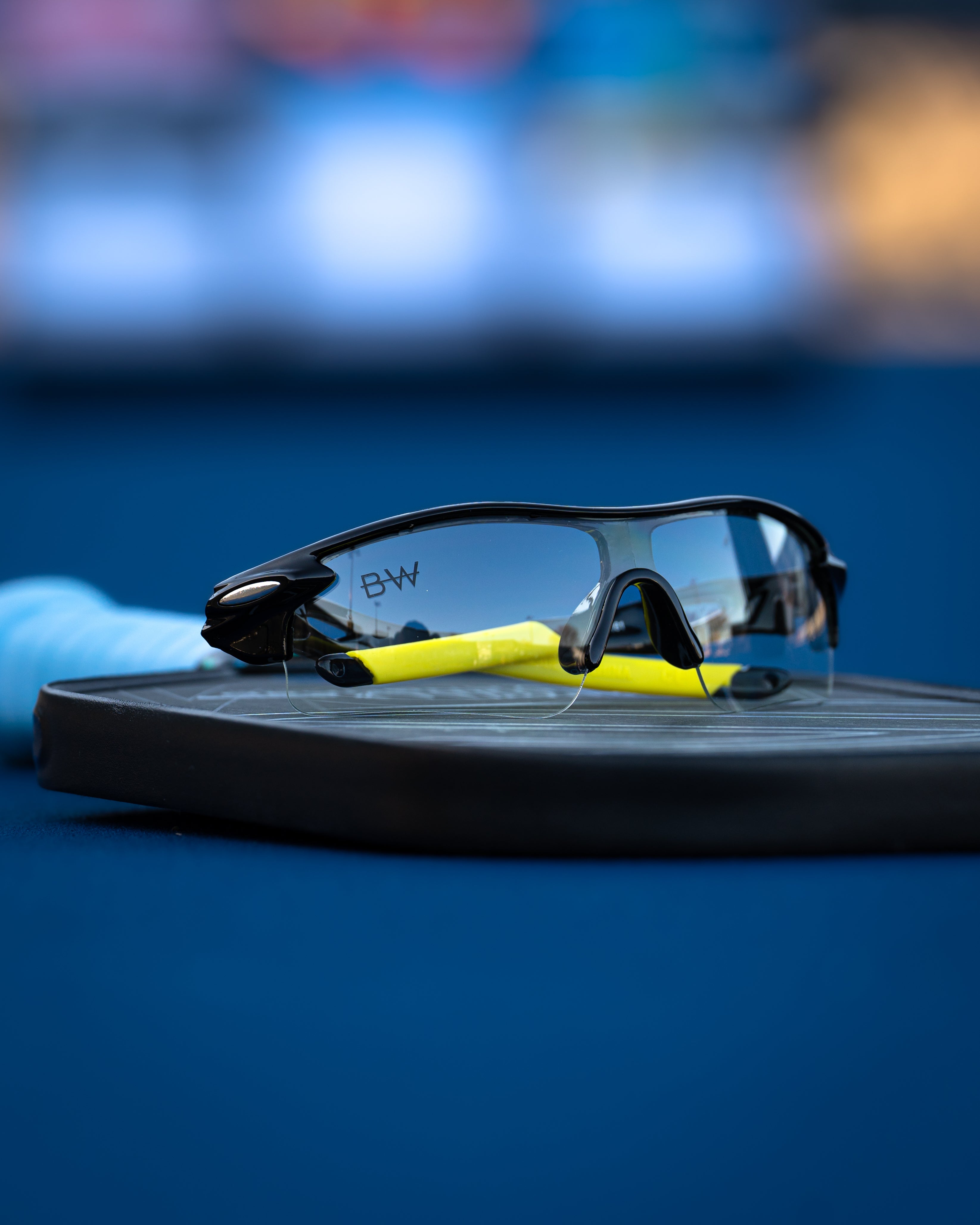
Benefits of Wide-Angle Curved Lenses in Sports Eyewear
Share
Benefits of Wide-Angle Curved Lenses in Sports Eyewear
Sports eyewear looks different from ordinary lifestyle glasses for a reason. Many performance-oriented frames use a curved or wrap-style lens design that extends around the face instead of presenting the flatter profile common in everyday eyewear.
For pickleball players, that design can be appealing because the sport involves constant head movement, changing ball positions, lateral movement, quick exchanges, and an active court environment. But curved lenses are often marketed with exaggerated promises about reaction time, depth perception, peripheral vision, and ball tracking.
The real benefits are more practical.
In this guide, we'll explain what wide-angle curved sports lenses are, how lens curvature changes eyewear design, what prescription players should know about curved RX lenses, how wrap-style frames compare with flatter eyewear, and which Blinded Wear RX styles you can compare for active court use.
Find Your Pickleball Eyewear
What Are Wide-Angle Curved Lenses?
Curved sports lenses follow more of the contour of the face than a traditional flatter eyewear design. You may also see similar designs described as wraparound glasses, sport-curved lenses, curved sports glasses, or wrap-style sports eyewear.
Instead of thinking of “wide-angle” as a special optical technology, think about the physical shape of the eyewear.
| Flatter Eyewear Design | Curved / Wrap-Style Design |
|---|---|
| Sits more directly across the front of the face | Extends farther around the sides of the face |
| More common in everyday eyewear | Common in many sports-oriented designs |
| Less pronounced side curvature | More pronounced side curvature |
| Often designed primarily around everyday use | Often designed around active-use styling |
Exactly how curved a frame or lens is varies by design. “Sports eyewear” is not one standardized shape, and not every curved frame wraps around the face to the same degree.
Why Is Sports Eyewear Often Curved?
Sports frames have to work in situations that are different from sitting at a desk or walking through a store.
During pickleball, for example, you may:
- Turn your head repeatedly
- Move laterally across the court
- Transition forward and backward
- Look toward balls arriving from different directions
- Play outdoors in moving air
- Remain active for multiple games
A curved sports design can extend the eyewear farther around the face and create a different coverage profile than a flatter frame.
That does not mean curvature automatically makes you react faster, track the ball better, or perceive depth more accurately. Those are much broader visual and athletic processes.
Curved vs. Flat Lenses for Sports: What's the Difference?
The difference is easiest to understand from above.
Imagine two pairs of glasses sitting on a table.
A relatively flat frame extends mostly from left to right across the front. A more curved sports frame turns farther backward toward the sides.
That physical difference affects how the eyewear surrounds the face.
| Feature | Flatter Design | More Curved Sports Design |
|---|---|---|
| Front Profile | Relatively flat | More contoured |
| Side Extension | Generally less | Generally more |
| Sport Styling | May resemble everyday eyewear | Often has a more performance-oriented appearance |
| Prescription Consideration | Prescription still requires appropriate lens fabrication | Prescription still requires appropriate lens fabrication |
| Automatic Performance Improvement? | No | No |
Benefit #1: More Side Coverage From the Frame Design
One of the clearest potential advantages of a more curved sports design is simply physical coverage around the sides of the face.
Because the eyewear can extend farther around the face than a flatter frame, there may be less open space at the sides depending on the specific design and how it fits the wearer.
That can be attractive for outdoor sports where players encounter:
- Moving air
- Dust
- Small airborne debris
- Changing outdoor conditions
The exact amount of coverage depends on the individual frame and fit. A curved appearance alone should not be interpreted as a specific safety certification or guarantee of complete eye protection.
Benefit #2: A Coverage Profile Designed Around Active Use
Curved sports eyewear can create a more encompassing profile around the face than traditional lifestyle frames.
For pickleball, that design makes intuitive sense because the wearer is rarely stationary. Your head and body repeatedly change position during serves, returns, dinks, volleys, lobs, drives, and transitions.
The useful distinction is coverage, not a promise of superhuman vision.
A wrap-style frame should not automatically be described as:
- Increasing reaction speed
- Eliminating blind spots
- Improving depth perception
- Increasing peripheral visual acuity
- Making ball tracking faster
- Improving anticipation
Those outcomes involve far more than frame curvature.
Benefit #3: Sport-Focused Frame Geometry
Another reason players consider curved eyewear is straightforward: many curved frames are intentionally styled for active use.
That allows a shopper to choose eyewear based on several needs at once:
- Prescription correction if required
- Sports-oriented frame design
- Lens coverage preference
- Available dimensions
- Playing environment
- Personal style
For some players, a traditional-looking RX frame may be exactly what they want. Others prefer eyewear that looks and feels more clearly connected to sports.
Neither choice automatically produces better pickleball performance.
Do Curved Lenses Increase Your Field of View?
This question deserves a more careful answer than the common claim that wraparound lenses simply “increase field of view by 20–40%.”
A curved frame can extend lens coverage farther around the sides of the face than some flatter designs. However, a universal percentage improvement should not be assigned to all curved sports eyewear.
Your usable visual experience depends on more than curvature, including:
- The specific frame geometry
- Lens size
- Frame position on your face
- Your prescription
- How the lens is fabricated
- Your individual fit
So instead of shopping for an invented “40% wider view,” compare the actual frame design and available dimensions.
Do Wide-Angle Sports Lenses Improve Peripheral Vision?
Curved eyewear and peripheral vision are frequently discussed together, but they are not the same thing.
Your peripheral vision is part of your visual system. A frame does not create new peripheral vision.
What the frame can change is how the physical eyewear sits within your existing field of view and how far its lens area extends around the face.
That is an important distinction.
For pickleball players, court awareness also involves:
- Attention
- Head position
- Eye movement
- Anticipation
- Opponent positioning
- Partner positioning in doubles
- Experience recognizing patterns
No frame shape replaces those skills.
Do Wraparound Lenses Eliminate Blind Spots?
No sports frame should be described as completely eliminating blind spots.
A curved design may provide a different side-coverage profile than flatter eyewear, but “no blind spots” is too absolute.
Human vision itself has limitations, and a player's awareness of the court depends on much more than whether a lens curves around the side of the face.
A more accurate buying question is:
“How does this frame's shape and coverage compare with the eyewear I already use?”
Do Curved Sports Lenses Improve Depth Perception?
Curved lenses should not automatically be credited with improving depth perception.
Depth perception is relevant to many pickleball situations, including:
- Judging an approaching ball
- Responding to a lob
- Moving toward a shorter ball
- Timing contact
- Recognizing changes in ball distance
But simply increasing lens curvature does not mean those abilities automatically improve.
For prescription players in particular, the important issue is that the RX lenses are made appropriately for the prescription and frame being used.
Can Prescription Glasses Use Curved Sports Lenses?
Prescription sports eyewear deserves special attention because an RX lens has to do more than fill a frame. It has to provide the prescribed correction the wearer needs.
That means you should not assume that any ordinary prescription lens can simply be bent into a more aggressive sports shape without optical considerations.
When shopping for RX pickleball eyewear, start with:
- Your current prescription
- The RX frame you are considering
- The product's available sizing information
- Your preferred playing environment
- Your lens preference
Blinded Wear customers ordering prescription eyewear upload a clear photo or picture of their eyeglass prescription before purchasing.
High-Index Prescription Lenses at No Additional Cost
Blinded Wear includes high-index prescription lenses at no additional cost with its RX eyewear.
This is a useful prescription benefit without needing to turn high-index lenses into a pickleball-performance claim.
The exact prescription remains individual to the customer, which is why the RX ordering process starts with the prescription rather than with generic claims about what one lens design can do for every player.
Why Curved Sports Eyewear Makes Sense to Compare for Pickleball
Pickleball includes many different ball paths and body positions during a single session.
A player may encounter:
- Crosscourt dinks
- Fast volleys
- Deep serves
- Returns
- Drives
- Resets
- Lobs
- Overheads
- Sideline shots
- Middle balls in doubles
That makes sports-oriented frame coverage a reasonable feature to compare.
But the frame is still equipment. Recognizing those shots and responding to them involves your prescription correction, visual system, anticipation, positioning, movement, timing, technique, and experience.
Are Curved Lenses Better for Doubles or Singles?
There is no need to assign curved sports lenses exclusively to one format.
In Doubles
You share the court with a partner and face two opponents. Partner positioning, communication, shared coverage, and awareness of the developing point become important.
In Singles
You cover your entire side yourself. Lateral movement, recovery, open-court positioning, and changing distances become major parts of play.
A curved RX sports frame can be considered for either format. The lens shape does not automatically provide a special doubles peripheral-vision advantage or a singles depth-perception advantage.
Curved and Non-Polarized Are Two Different Lens Characteristics
Lens curvature and polarization describe different things.
Curvature relates to the physical geometry of the eyewear.
Polarization refers to a filtering property of the lens.
Blinded Wear uses non-polarized lenses. These lenses do not add a polarization filter and preserve visual information available without that filter.
Some court players prefer non-polarized eyewear.
However, it is inaccurate to claim that polarization universally destroys depth perception or that non-polarized lenses inherently improve depth perception, reaction time, spin recognition, or ball tracking.
Does a Curved Lens Automatically Mean Better Eye Protection?
A wrap-style design can provide more physical coverage around portions of the face than some flatter frames, depending on the exact design and fit.
That should not be confused with a safety certification.
Blinded Wear sports eyewear uses impact-resistant lenses. Impact resistance is relevant for active eyewear, but it does not mean:
- Shatterproof
- Unbreakable
- Impact-proof
- Certified to a particular protective-eyewear standard unless specifically stated
Frame curvature and impact resistance should therefore be evaluated as separate characteristics.
Does a Curved Lens Automatically Provide More UV Protection?
No. Lens shape and UV filtering are not the same characteristic.
A curved frame may physically extend farther around the sides of the face, but curvature itself should not be used as proof of a particular UV rating.
Likewise, a dark tint does not by itself establish a specific UV specification.
When evaluating sports eyewear, keep these categories separate:
| Characteristic | What It Describes |
|---|---|
| Curvature | Physical lens/frame geometry |
| Tint | How dark or colored the lens appears |
| Polarization | Whether a polarization filter is present |
| Impact Resistance | Resistance to impact |
| Prescription | The wearer's corrective lens requirements |
Blinded Wear RX Sports Frames to Compare
If you are looking for prescription sports eyewear for pickleball, these are three RX styles from the original guide worth comparing based on their current product information, design, dimensions, prescription requirements, and available lens setup.
Ocean Wave RX
Consider Ocean Wave RX if its frame design matches the sports-eyewear aesthetic and coverage profile you want. Review the current product page for its available configuration and sizing information rather than assuming specific anti-slip, glare-reduction, or peripheral-performance benefits.
Havana Melt RX
Havana Melt RX provides another prescription style to compare. Evaluate its design, available dimensions, prescription compatibility, and current lens options instead of assuming photochromic technology or special optical performance unless currently listed for that product.
Crystal Wave II RX
Crystal Wave II RX is another option for prescription pickleball players. Compare its current design and product specifications without assuming anti-fog, scratch-resistant, transitional, or all-condition lens features unless they are specifically verified for the current configuration.
How to Compare Wide-Angle RX Sports Glasses
Use this checklist instead of choosing solely because a product description says “wide-angle” or “wraparound.”
- □ Does the frame accept the prescription setup I need?
- □ Do I like the amount of curvature in the design?
- □ Does the frame extend around the face in the way I prefer?
- □ Are dimensions available for comparison?
- □ How do those dimensions compare with eyewear I already own?
- □ Is the lens setup appropriate for where I normally play?
- □ Do I prefer tinted or untinted eyewear in that environment?
- □ Am I comfortable with the overall sports-frame style?
- □ Am I evaluating verified features rather than performance promises?
Wide-Angle Sports Lens Myths: What Curvature Does Not Guarantee
Myth 1: Curved Lenses Increase Field of View by a Fixed Percentage
There is no universal percentage that should be applied to every curved sports frame.
Myth 2: Wraparound Lenses Eliminate Blind Spots
No eyewear design should be described as eliminating all blind spots.
Myth 3: Curved Lenses Automatically Improve Reaction Time
Reaction involves recognition, decision-making, movement, timing, and execution. Curvature alone does not guarantee faster reactions.
Myth 4: Curved Lenses Automatically Improve Depth Perception
Depth perception should not be presented as an automatic consequence of lens curvature.
Myth 5: Curved Lenses Automatically Reduce Eye Strain
No universal reduction in eye fatigue should be promised from curvature alone.
Myth 6: A Wrap Design Automatically Means 100% UV Protection
Physical curvature and UV filtering are different characteristics.
Myth 7: Every Curved Sports Frame Is Certified Protective Eyewear
A sports-oriented shape does not itself establish a specific safety certification.
FAQ: Wide-Angle Curved Lenses in Sports Eyewear
What are wide-angle curved sports lenses?
They are lenses used in frames with a more curved profile that extends farther around the face than many traditional flatter eyewear designs.
Are curved lenses the same as wraparound lenses?
The terms are often used in similar contexts, although the degree of curvature can vary significantly between frame designs.
Are curved lenses good for pickleball?
They can be a useful sports-eyewear design to consider for pickleball, particularly if you prefer a frame with more side coverage and a sport-oriented profile.
Do curved lenses improve peripheral vision?
They should not be described as creating new peripheral vision. The frame's curvature can change how the eyewear sits within your existing field of view and how far the lens area extends around the face.
Do curved lenses improve reaction time?
No guaranteed reaction-time improvement should be attributed to curvature alone.
Do curved lenses improve depth perception?
Lens curvature should not automatically be credited with improving depth perception.
Can curved lenses be prescription?
Yes, curved sports eyewear can be designed for prescription use. RX lens fabrication must account for the prescription and frame being used.
Are curved prescription lenses different from ordinary RX lenses?
The geometry of a more curved sports frame creates different lens-design considerations than a flatter frame, which is why prescription compatibility should be evaluated for the specific RX product.
Does Blinded Wear offer prescription pickleball eyewear?
Yes. Blinded Wear offers RX eyewear designed for pickleball players, and high-index prescription lenses are included at no additional cost.
Are Blinded Wear lenses polarized?
No. Blinded Wear uses non-polarized lenses.
Does non-polarized mean better depth perception?
No automatic improvement in depth perception should be assumed simply because a lens does not have a polarization filter.
Are Blinded Wear sports lenses impact-resistant?
Yes. Blinded Wear sports eyewear uses impact-resistant lenses.
Does impact-resistant mean shatterproof?
No. Impact-resistant does not mean shatterproof or unbreakable.
Part 2: Curved-Lens Geometry, RX Fit, and Real Court Use
Part 2 will go deeper into how frame curvature interacts with prescription eyewear, why fit matters with wrap-style frames, how to compare curved and flatter eyewear during actual pickleball movement, indoor versus outdoor considerations, a curved-frame fit test, doubles and singles scenarios, common buying mistakes, and a practical decision system for determining whether a wide-angle sports frame actually makes sense for you.
Why Prescription Changes the Curved-Lens Conversation
For non-prescription sports eyewear, choosing a curved frame can largely be a question of design, coverage, fit, and lens preference. Prescription eyewear adds another requirement: the lenses must provide the correction prescribed for the wearer.
That makes RX sports eyewear different from simply taking an everyday prescription lens and placing it into any curved frame.
When comparing curved prescription pickleball glasses, think about the complete system:
- Your prescription
- The RX-compatible frame
- The shape and curvature of that frame
- The available frame dimensions
- The lens configuration offered for the product
- How the finished eyewear fits you
- The environment where you intend to wear it
Curvature can be part of a sports-oriented design, but prescription accuracy remains the foundation of RX eyewear.
More Curvature Does Not Automatically Mean Better Optics
It is tempting to treat sports-eyewear curvature like a performance scale:
Flat → curved → more curved → better.
That is not a useful way to shop.
A more aggressively curved frame is not automatically superior to a moderately curved one. The appropriate design depends on the complete frame-and-lens system and the individual wearer.
| What More Curvature Can Change | What It Does Not Automatically Improve |
|---|---|
| How far the frame extends around the face | Reaction time |
| Overall frame profile | Depth perception |
| Amount of physical side coverage | Ball tracking |
| Sports-oriented appearance | Visual acuity |
| How the frame sits relative to the face | Anticipation |
| Prescription lens-design considerations | Pickleball skill |
The goal is not maximum curvature. The goal is an RX sports frame that makes sense for your prescription, fit preferences, playing environment, and intended use.
Why Fit Matters With Wrap-Style Sports Eyewear
A frame's shape on a product page does not tell you exactly how it will sit on your face.
Two curved sports frames can look similar while differing in:
- Overall width
- Lens dimensions
- Bridge area
- Temple dimensions
- Amount of curvature
- How close the frame sits to the face
This is why available measurements are more useful than assuming every “wraparound” or “wide-angle” frame has the same fit.
If you already own glasses that fit well, use them as a reference when comparing available dimensions on a new RX sports frame.
The Curved Sports Frame Fit Test
Before deciding that a particular frame shape is right for pickleball, evaluate fit systematically.
Step 1: Start With Your Current Glasses
Choose a pair you already find comfortable and review its measurements if available.
Step 2: Compare Dimensions
Compare those measurements with the curved RX sports frame you are considering.
Step 3: Consider the Shape
Measurements are useful, but a flatter lifestyle frame and a curved sports frame can still sit differently even when some dimensions appear similar.
Step 4: Think About Active Use
Your goal is not simply to like the frame while standing still. Consider that pickleball involves repeated head turns, lateral movement, forward movement, and longer playing sessions.
Step 5: Evaluate the Complete Setup
Prescription, frame shape, lens configuration, dimensions, and personal preference should work together.
Static Fit vs. Active Fit: Why the Difference Matters
Sports eyewear is worn while your body is moving, so there is value in separating two different ideas.
| Static Evaluation | Active Evaluation |
|---|---|
| How the frame feels while standing | How it feels while moving |
| Overall appearance | Comfort during repeated head movement |
| Initial pressure points | Comfort later in a session |
| How the frame sits on your face | How noticeable the frame becomes during play |
| Initial prescription view | Prescription experience during normal court use |
A sports frame should not be judged only by how aggressive or streamlined it looks. Comfort during actual use matters more than appearance alone.
The 20-Minute Pickleball Test for Curved RX Eyewear
Once you have appropriate prescription sports eyewear, a progressive court session can help you evaluate how the setup feels during increasingly realistic movement.
Minutes 0–5: Controlled Dinking
Begin at the kitchen with predictable exchanges. Pay attention to general prescription correction and comfort.
Minutes 5–10: Crosscourt Movement
Add directional changes and modest lateral movement.
Minutes 10–15: Baseline + Transition
Move between deeper court positions and the transition area instead of remaining stationary.
Minutes 15–20: Live Points
Finish with normal pickleball points so the frame is experienced during realistic head and body movement.
Evaluate the overall experience rather than trying to determine whether the glasses made individual shots better or worse.
Curved Sports Eyewear Court-Test Scorecard
| Question | Your Result |
|---|---|
| Does my prescription view feel appropriate? | Yes / No |
| Is the frame comfortable initially? | Yes / No |
| Does it remain comfortable during head movement? | Yes / No |
| Does it remain comfortable during lateral movement? | Yes / No |
| Does the frame still feel comfortable later in the session? | Yes / No |
| Do I like the amount of coverage? | Yes / No |
| Does the lens setup match this environment? | Yes / No |
| Would I willingly wear this for an entire session? | Yes / No |
This provides more useful information than assuming a frame is ideal simply because it has an aggressive wrap-style appearance.
Curved Sports Eyewear for Outdoor Pickleball
Outdoor pickleball is one environment where players may particularly like a frame that extends farther around the sides of the face.
Outdoor courts can expose players to:
- Moving air
- Dust and small airborne particles
- Changing sun position
- Different backgrounds around the court
- Long sessions in open environments
A more encompassing sports-frame design can offer a different physical coverage profile than flatter eyewear.
However, curvature should not be used as proof of glare reduction, UV400 protection, 100% UVA/UVB protection, windproof performance, or any other specification that has not been separately verified.
Do You Need Curved Sports Glasses for Indoor Pickleball?
Indoor pickleball removes some outdoor variables, but players may still prefer a sports-oriented curved frame for its design, fit, and coverage profile.
The bigger lens decision indoors may be whether you want dark sunglass tint at all.
If you need prescription correction and prefer an untinted lens for indoor play, a clear RX setup can make more sense than choosing a dark lens simply because it is marketed as “performance eyewear.”
Clear lenses should be understood accurately: they provide an untinted viewing option. They should not automatically be claimed to increase available light, improve contrast, sharpen ball tracking, or speed up reactions.
What About Evening and Lower-Light Pickleball?
The same environment-first principle applies when the sun goes down.
A player may like the shape and coverage of a curved sports frame while preferring an untinted lens later in the day.
Those are two independent choices:
| Decision | Question |
|---|---|
| Frame Geometry | Do I prefer a curved, sports-oriented design? |
| Lens Setup | Do I want tinted or untinted eyewear in this environment? |
You do not have to abandon curved sports eyewear simply because you prefer a clear lens in a particular environment.
Do You Need One Pair for Indoor and Outdoor Pickleball?
Not necessarily.
Start with your actual schedule.
If You Mostly Play Outdoors
A single RX sports setup may cover most of your playing time if its lens configuration matches your preference.
If You Mostly Play Indoors
An untinted RX sports setup may make more sense if you do not prefer dark sunglass tint indoors.
If You Regularly Play Both
You can decide whether one setup works across your environments or whether you prefer separate tinted and untinted prescription options.
If You Travel for Tournaments
A second corrective pair can also provide backup if your primary prescription eyewear becomes unavailable.
Curved Sports Eyewear in Doubles Pickleball
Doubles places four players on the court. You process the ball while also dealing with partner positioning, two opponents, shared court coverage, and communication.
A curved sports frame may appeal to a doubles player because of its sports-oriented coverage profile.
But avoid the shortcut:
Curved frame → better peripheral vision → better doubles player.
That chain is not justified.
Doubles court awareness also comes from:
- Knowing your partner's position
- Communicating on middle balls
- Recognizing opponent positioning
- Understanding common patterns
- Moving with your partner
- Anticipating where the next ball may go
Frame geometry does not replace those skills.
Curved Sports Eyewear in Singles Pickleball
Singles removes the partner but makes you responsible for your entire side of the court.
That can involve:
- More individual lateral movement
- Recovering after wide shots
- Moving forward for shorter balls
- Covering open court
- Repeated changes in body position
A curved RX sports frame can be considered for this environment too, but it should not be described as automatically improving depth perception, baseline clarity, reaction time, or recovery speed.
The strongest reason to consider it remains much simpler: you prefer its sports-oriented design, coverage, fit, and available prescription setup.
Do Curved Lenses Reduce the Need to Turn Your Head?
This is another common sports-eyewear claim that needs context.
A frame with lens area extending farther around the sides can create a different eyewear coverage profile than a flatter design. But that does not mean athletes should stop turning their heads or that the frame eliminates the need for normal visual scanning.
In pickleball, head and eye movement remain part of following the developing point.
Players still need to orient toward:
- The ball
- The opponent making contact
- Changing court positions
- Their partner in doubles
- Different ball trajectories
A sports frame should support normal play, not be marketed as a substitute for normal scanning and awareness.
Do Curved Prescription Lenses Cause Distortion?
This is especially relevant for RX shoppers because curved prescription eyewear has different design considerations from non-prescription sunglasses.
It is too simplistic to say:
“Cheap curved lenses distort. Good curved lenses never distort.”
Prescription experience can depend on multiple factors, including:
- The wearer's prescription
- Frame geometry
- Lens design
- How the prescription lenses are fabricated
- How the frame sits on the wearer
This is why prescription sports eyewear should be treated as an integrated RX product rather than assuming any lens can be placed into any curved frame with identical results.
What If You Have a Stronger Prescription?
If you have a stronger prescription, do not assume that the most aggressively curved-looking frame is automatically your best choice.
Start with the prescription itself and the RX products available to you.
When ordering Blinded Wear prescription eyewear:
- Select the RX frame you are considering.
- Review its current product information.
- Compare available sizing information.
- Have your current eyeglass prescription available.
- Upload a clear photo or picture of that prescription before purchasing.
Blinded Wear includes high-index prescription lenses at no additional cost with RX eyewear.
No specific index should be assumed unless it is explicitly provided for the order.
Coverage vs. Protection: Don't Confuse the Two
These terms sound similar but describe different ideas.
| Term | Meaning |
|---|---|
| Coverage | How much of the area around the eyes and face is physically occupied or surrounded by the eyewear design |
| Impact Resistance | A lens characteristic related to resistance to impact |
| Safety Certification | Compliance with a particular testing standard when specifically verified |
A more curved frame can have a different coverage profile without automatically carrying a particular safety certification.
Blinded Wear sports eyewear uses impact-resistant lenses, but impact-resistant should not be expanded into “shatterproof,” “unbreakable,” or a certification that has not been verified.
The Coverage Test: Compare the Frame, Not the Marketing Term
Two products can both be called “wraparound” while having noticeably different shapes.
When comparing them, look at:
- Front shape: How wide and tall does the lens area appear?
- Side extension: How far does the frame appear to continue around the face?
- Frame geometry: Is the design moderately curved or more aggressive?
- Available dimensions: How does the size compare with eyewear you already wear?
- RX availability: Is the frame offered in the prescription setup you need?
- Environment: Where are you actually going to use it?
This creates a more useful comparison than treating “wide-angle” as a standardized performance rating.
Ocean Wave RX: What Should You Actually Compare?
Ocean Wave RX appeared in the original wide-angle sports-eyewear guide.
Rather than relying on claims such as anti-slip performance, guaranteed wide-angle visibility, or a particular tint automatically improving outdoor performance, evaluate:
- The current frame design
- Available dimensions
- Your prescription requirements
- The current lens configuration
- Your preferred amount of sports-frame coverage
- Your normal playing environment
Havana Melt RX: Curved Style Without Invented Optical Benefits
Havana Melt RX is another RX style to compare.
There is no need to claim that the frame automatically provides full-wrap optical coverage, all-day visual performance, or a particular adaptive lens technology unless those features are verified for the current product.
Use the frame's actual design and available product information to decide whether it matches what you want from prescription sports eyewear.
Crystal Wave II RX: Compare Verified Features First
Crystal Wave II RX can likewise be evaluated as a prescription pickleball option.
The original guide attributed dual-layer fog resistance, scratch resistance, transitional options, and universal indoor/outdoor performance to this frame. Those features should not be assumed without current product verification.
Instead, compare the design, dimensions, prescription requirements, and currently available lens setup.
Ocean Wave RX vs. Havana Melt RX vs. Crystal Wave II RX
| RX Frame | What to Compare | What Not to Assume |
|---|---|---|
| Ocean Wave RX | Design, dimensions, prescription, current lens setup | Anti-slip performance, glare reduction, faster tracking |
| Havana Melt RX | Design, dimensions, prescription, current lens setup | Automatic light adaptation, enhanced depth, reaction benefits |
| Crystal Wave II RX | Design, dimensions, prescription, current lens setup | Anti-fog, scratch resistance, universal court optimization |
All three can be evaluated as RX sports-eyewear options without creating unsupported performance specialties for each model.
Curved Lens Shape Does Not Determine the Best Tint
Another common mistake is combining frame shape and tint into one performance claim.
For example:
“Curved gray lenses are best for outdoor pickleball.”
That combines two separate decisions.
Decision 1: Frame Shape
Do you prefer a curved sports design?
Decision 2: Lens Appearance
Do you prefer tinted or untinted eyewear for the environment?
A tint should not automatically be claimed to improve contrast, ball tracking, depth perception, or reaction time.
Where Non-Polarized Lenses Fit Into the Decision
Blinded Wear uses non-polarized lenses in its sports eyewear.
Non-polarized means the lens does not add a polarization filter. Some court players prefer that configuration.
Keep this separate from curvature:
| Feature | What It Describes |
|---|---|
| Curved | Physical lens/frame geometry |
| Non-Polarized | Absence of a polarization filter |
| Tinted | Visible lens coloration/darkness |
| Clear | Untinted lens setup |
| Prescription | Corrective lens requirements |
| Impact-Resistant | Resistance to impact |
None of those characteristics should automatically be turned into a promise of better depth perception, reaction speed, or ball tracking.
10 Mistakes to Avoid When Buying Curved Sports Eyewear
-
Assuming more curvature is always better.
The right frame depends on your prescription, fit, design preference, and intended use.
-
Believing a universal field-of-view percentage.
There is no fixed percentage increase that applies to every curved frame.
-
Assuming wraparound means zero blind spots.
No frame eliminates every visual limitation.
-
Buying a frame because it promises faster reactions.
Curvature alone does not guarantee reaction-time improvement.
-
Assuming curved lenses improve depth perception.
That should not be presented as an automatic benefit.
-
Confusing coverage with certification.
A frame extending farther around the face does not establish a safety rating.
-
Assuming tint proves UV protection.
Tint appearance and UV filtering are different characteristics.
-
Assuming every sports frame has anti-fog or scratch-resistant coatings.
Those features should be verified for the specific product.
-
Ignoring frame dimensions.
Available measurements can help you compare a new sports frame with eyewear that already fits.
-
Ignoring your prescription.
For RX shoppers, appropriate prescription correction comes before sports-marketing terminology.
Should You Choose Wide-Angle Curved Sports Eyewear?
Do you want a sports-oriented frame?
→ Yes: A curved design is worth comparing.
Do you prefer eyewear that extends farther around the sides of your face?
→ Yes: Compare wrap-style frame designs and available dimensions.
Do you need prescription correction?
→ Yes: Start with RX-compatible sports frames and your current prescription.
Do you play primarily outdoors?
→ Evaluate the RX sunglass configurations available to you.
Do you play primarily indoors or in the evening?
→ Consider whether you prefer an untinted lens setup.
Do you play in several environments?
→ Decide whether one RX setup covers your preferences or whether multiple corrective setups would be useful.
Are you choosing the frame because it promises faster reactions or better depth perception?
→ Reevaluate the decision around verified frame, prescription, fit, and lens characteristics instead.
FAQ: Curved RX Sports Lenses, Fit, and Pickleball Use
Are more curved lenses always better for sports?
No. More curvature is not automatically better. The appropriate design depends on the frame, prescription, fit, and wearer's preferences.
Are wraparound glasses better than regular glasses for pickleball?
Wrap-style sports eyewear can offer a different coverage profile and sports-oriented design, but it should not automatically be described as improving pickleball performance.
Can I wear curved prescription glasses for pickleball?
Yes, when the sports frame is offered as an appropriate prescription product for your RX needs.
Can a strong prescription work with curved sports glasses?
Prescription compatibility depends on the specific RX product and prescription requirements. Start with your prescription and the available RX frame rather than assuming every prescription works identically with every curvature.
Does Blinded Wear include high-index RX lenses?
Yes. High-index prescription lenses are included at no additional cost with Blinded Wear RX eyewear.
Do curved glasses improve side vision?
A curved frame can extend lens coverage farther around the sides of the face than some flatter designs. That should not be translated into a guaranteed improvement in peripheral vision.
Do curved lenses reduce blind spots?
They can create a different coverage profile, but no claim of eliminating blind spots should be made.
Do curved sports glasses improve ball tracking?
No automatic ball-tracking improvement should be attributed to frame curvature.
Do curved sports glasses improve reaction time?
No. Reaction time depends on many factors, and curvature alone should not be presented as a reaction-time enhancer.
Do curved lenses improve depth perception?
No inherent depth-perception improvement should be assumed from curvature.
Do curved lenses reduce eye fatigue?
A universal reduction in eye fatigue should not be promised from lens curvature alone.
Are curved lenses better outdoors?
Some players may prefer the physical coverage and sports-oriented profile of a curved frame outdoors, but the best design remains individual.
Are curved lenses useful indoors?
They can be. Frame geometry and lens tint are separate decisions, so a player can prefer a sports-oriented frame while also preferring an untinted lens indoors.
Do I need clear lenses indoors?
Not universally. Clear lenses are an option for players who prefer prescription or non-prescription eyewear without dark sunglass tint indoors.
Are curved lenses automatically UV400?
No. Curvature does not establish a UV specification.
Does dark tint automatically mean UV protection?
No specific UV rating should be inferred solely from how dark a lens appears.
Are curved sports glasses shatterproof?
Curvature does not make a lens shatterproof. Blinded Wear sports eyewear uses impact-resistant lenses, but impact-resistant does not mean unbreakable.
Are Blinded Wear lenses polarized?
No. Blinded Wear uses non-polarized lenses.
Why does Blinded Wear use non-polarized lenses?
Non-polarized lenses do not add a polarization filter, and some court players prefer that configuration. This should not be expanded into a claim that polarization universally harms depth perception.
How do I choose between Ocean Wave RX, Havana Melt RX, and Crystal Wave II RX?
Compare current product information, frame design, available dimensions, prescription requirements, lens configuration, and your personal preferences rather than relying on invented performance differences.
Part 3: The Complete Wide-Angle Sports Eyewear Buying System
Part 3 will finish the guide with a wide-angle RX buying checklist, curved-versus-flat decision matrix, prescription ordering workflow, tournament and travel strategy, primary-and-backup eyewear system, final myths, expanded search-focused FAQs, Blinded Wear shopping resources, replacement support, and a final framework for deciding whether curved sports eyewear belongs in your pickleball setup.