Why Clear Lens Eyewear from Blinded Wear Co. Dominates the Court in 2026
Share
Why Clear Lens Eyewear From Blinded Wear Co. Stands Out on the Court in 2026
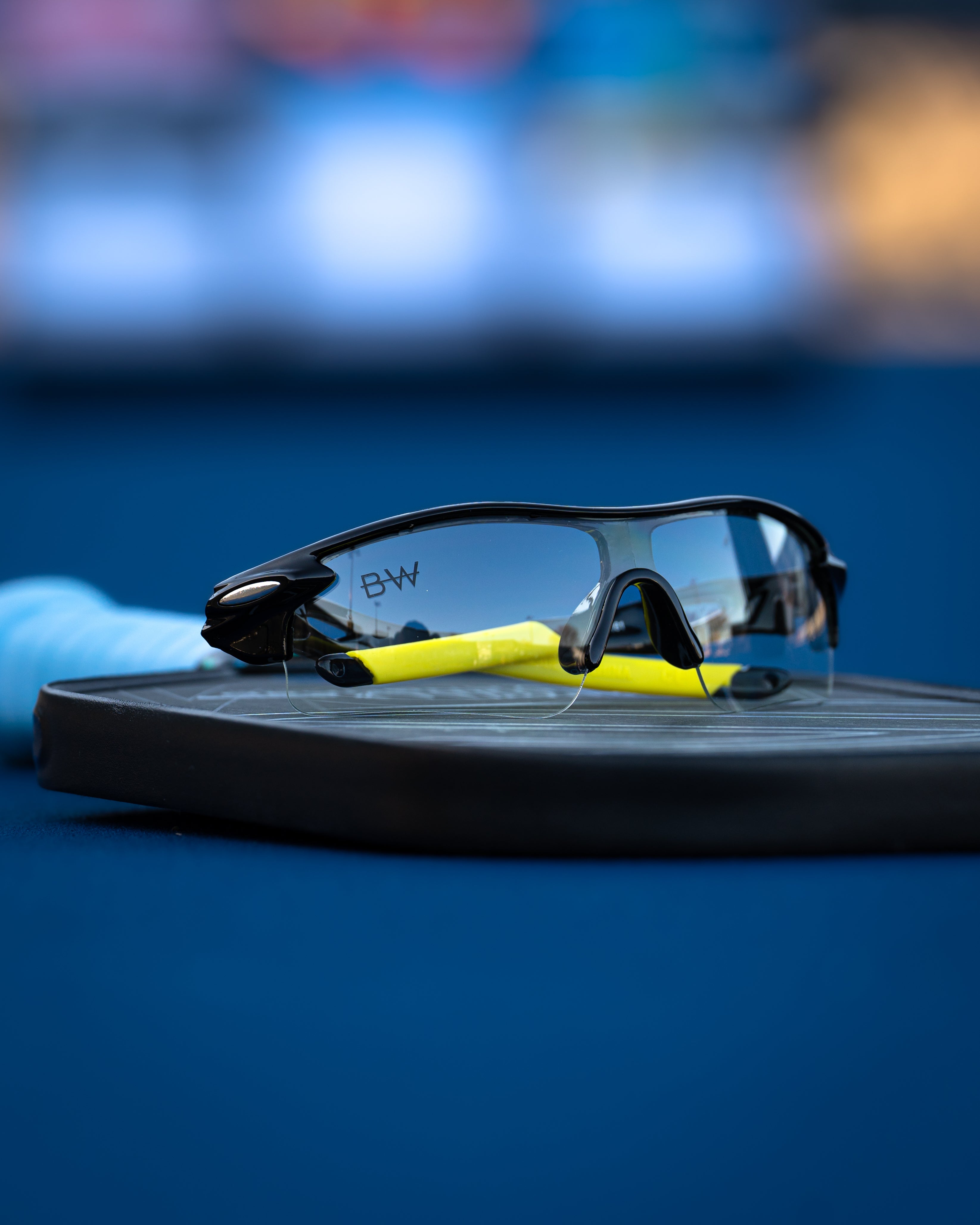
Clear lens sports glasses are built for athletes who want sports-oriented eyewear without a dark sunglass tint. That makes them especially worth considering for indoor pickleball, evening matches, lower-light conditions, covered courts, and other environments where dark lenses may not be preferred.
For pickleball players, choosing clear eyewear is not about finding the lens with the most aggressive tint or biggest performance claim. It is about matching your eyewear to the conditions in which you actually play.
Blinded Wear Co.'s clear lens collection gives players a dedicated option for those environments while maintaining the sports-focused design of the brand's eyewear.
This 2026 guide explains when clear sports glasses make sense, how they compare with tinted and transition lenses, what clear lenses do and do not provide, and what to look for before choosing a pair.
Find the Right Pickleball Eyewear for Your Court
What Are Clear Lens Sports Glasses?
Clear lens sports glasses use lenses without the dark sunglass tint associated with conventional outdoor sunglasses.
For athletes, that distinction matters because a dark tint is not desirable in every environment. Indoor courts, evening sessions, and some lower-light conditions may call for eyewear that does not intentionally darken the scene.
A clear lens can therefore provide a straightforward solution: sports eyewear without a dark tint.
Clear does not automatically mean:
- Anti-fog
- Anti-glare
- Anti-reflective
- Scratch-resistant
- Polarized
- A specific UV rating
- Distortion-free
- Certified protective eyewear
- Improved contrast
- Improved depth perception
Those are separate characteristics that should be verified independently when they matter to your purchase.
Why Do Athletes Wear Clear Lens Sports Glasses?
The strongest reason is simple: not every sport is played in bright sunlight.
Clear sports eyewear can be useful when a player wants sports-oriented eyewear but does not want a dark lens reducing visible light in an already dimmer environment.
Common use cases include:
- Indoor pickleball
- Indoor volleyball
- Indoor basketball
- Racquet sports played indoors
- Evening pickleball
- Night games under court lighting
- Covered courts
- Some overcast conditions
- Training in lower-light environments
The benefit comes from matching the lens configuration to the environment—not from clear lenses creating a universal competitive advantage.
Why Consider Clear Lens Glasses for Pickleball?
Pickleball can be played in dramatically different lighting environments. One player may spend nearly every session outdoors during the afternoon, while another plays primarily in an indoor facility or after work under court lights.
That makes lens selection an environmental decision.
| Playing Environment | Lens Configuration Worth Comparing | Why |
|---|---|---|
| Indoor Court | Clear | A dark sunglass tint may not be desirable indoors. |
| Night Match | Clear | Clear lenses avoid adding a dark sunglass tint under artificial lighting. |
| Covered / Shaded Court | Clear or another light-condition-specific option | Consider the actual brightness of the court rather than assuming outdoor automatically means dark tint. |
| Bright Outdoor Sun | Tinted or other outdoor configuration | A clear lens remains clear rather than providing a dark sunglass tint. |
| Frequently Changing Outdoor Light | Photochromic / transition worth comparing | An adaptive lens may be more convenient when lighting changes substantially. |
This is why there is no single lens color that is automatically best for every pickleball player.
Are Clear Lenses Good for Indoor Pickleball?
Indoor pickleball is one of the clearest use cases for clear sports eyewear.
Indoor facilities already rely on artificial lighting, so many players do not want to add the dark tint of conventional sunglasses.
A clear sports lens allows the player to wear sports-oriented eyewear without intentionally darkening the court through a sunglass tint.
When shopping specifically for indoor pickleball glasses, also consider:
- Individual frame fit
- Comfort during longer sessions
- Frame dimensions
- Physical coverage
- Impact resistance
- Prescription requirements, if applicable
- Fogging conditions
- Any protective standard required for your use
Clear lenses solve the tint question. They do not automatically solve every other eyewear consideration.
Are Clear Sports Glasses Good for Night Pickleball?
Clear lenses are also worth considering for pickleball played after sunset under artificial court lighting.
A dark sunglass tint that works well in bright afternoon sun may be unnecessary once natural light disappears. Clear eyewear avoids adding that dark tint while still allowing players to use a sports-oriented frame.
This does not mean a clear lens makes the court brighter than it actually is or creates additional available light. Rather, it does not intentionally darken the scene with a sunglass tint.
That distinction keeps expectations realistic while explaining why clear sports glasses are popular for evening and night play.
What About Clear Glasses on Overcast Pickleball Courts?
Clear lenses can be considered on overcast days, particularly when the environment is dim enough that the player does not want a dark sunglass tint.
However, “overcast” covers a wide range of conditions. A bright cloudy afternoon can feel very different from a dark evening court.
Instead of choosing purely according to the weather label, consider the actual amount of light and your own lens preference.
Players who frequently move between brighter and darker outdoor conditions may also want to compare clear eyewear with a photochromic configuration.
Clear vs. Tinted Sports Glasses: What's the Difference?
The fundamental difference is whether the lens has a visible sunglass tint.
| Feature | Clear Sports Lens | Tinted Sports Lens |
|---|---|---|
| Dark Sunglass Tint | No | Yes |
| Indoor Use | Often worth considering | Depends on tint and environment |
| Night Use | Often worth considering | Dark tint may not be preferred |
| Bright Outdoor Sun | Remains clear | Provides its selected tint |
| Automatically Changes With Light | No | No, unless specifically photochromic |
| Automatically Polarized | No | No |
| Automatically Anti-Fog | No | No |
Neither clear nor tinted lenses are universally better. The useful question is which lens configuration matches where you actually play?
Clear vs. Transition Sports Glasses
Clear and photochromic lenses solve different problems.
Clear lenses remain untinted rather than automatically becoming dark sunglasses.
Photochromic or transition lenses are designed to change darkness in response to relevant light conditions.
Clear eyewear may make more sense when:
- You primarily play indoors.
- You primarily play at night.
- You want a predictable untinted lens.
- You do not need adaptive darkening.
Transition eyewear may be worth comparing when:
- You regularly move between indoor and outdoor environments.
- Your outdoor lighting changes substantially.
- You want one pair to cover a wider range of lighting conditions.
If you consistently play in one lower-light environment, the simplicity of a clear lens can be an advantage. If your environment changes frequently, adaptability may become more useful.
Are Clear Sports Glasses Polarized?
Clear and polarized describe different characteristics.
A clear lens does not have a dark sunglass tint. Polarization refers to a filter designed to manage particular reflected light.
Therefore, you should never assume a lens is polarized or non-polarized solely because it is clear.
Blinded Wear sports lenses are non-polarized, meaning a polarization filter is not added.
Some court players prefer non-polarized eyewear, but non-polarized should not automatically be translated into claims of improved depth perception, faster reactions, better ball tracking, or better performance.
Do Clear Lenses Improve Depth Perception?
Clear lenses should not automatically be credited with improving depth perception.
Depth perception depends on how the visual system uses information from the eyes and brain to judge spatial relationships. A clear lens simply means that a dark sunglass tint has not been added.
If you need prescription correction, wearing an appropriate current prescription can be important to how you see the court, but that is different from claiming the clear lens itself enhances depth perception.
Do Clear Pickleball Glasses Improve Ball Tracking?
Clear lenses do not automatically make an athlete better at tracking the ball.
What they can do is provide an untinted lens option for environments where the player does not want the scene darkened by sunglasses.
Actual ball tracking involves multiple factors, including:
- Visual function
- Attention
- Experience
- Positioning
- Lighting
- Contrast between the ball and environment
- Prescription correction when needed
That makes “clear lenses improve ball tracking” too broad a claim. A more accurate benefit is that clear eyewear can better match environments where dark tint is unnecessary.
Do Clear Sports Glasses Improve Reaction Time?
No specific reaction-time improvement should be promised simply because a sports lens is clear.
Reaction time is influenced by visual processing, anticipation, experience, movement, attention, and many other factors.
The purpose of choosing clear sports eyewear should be to select an appropriate lens configuration for your environment—not to expect the lens color itself to make your nervous system react faster.
Do Clear Sports Lenses Have Zero Visual Distortion?
“Clear” refers to tint, not a guarantee of zero optical distortion.
Visual experience can be influenced by factors such as:
- Lens design
- Lens geometry
- Prescription, if applicable
- Frame curvature
- Optical positioning
- Fit
For this reason, claims such as “zero distortion” or “perfect optical clarity” should be supported by specific evidence rather than assumed from the fact that a lens is transparent.
Are Blinded Wear Clear Sports Lenses Impact-Resistant?
Blinded Wear sports eyewear uses impact-resistant lenses.
For pickleball and other active environments, impact resistance is an important characteristic to distinguish from the color of the lens. A clear lens can be impact-resistant, just as a tinted sports lens can be impact-resistant.
However, impact-resistant does not automatically mean shatterproof or certified protective eyewear.
If you require eyewear meeting a particular safety or protective standard, verify that standard for the exact product.
Do Clear Sports Glasses Protect Against UV?
Do not assume a specific UV rating from the fact that a lens is clear—or from the fact that a lens is dark.
Lens tint and UV specifications are separate characteristics.
A clear lens can potentially have UV-related properties, but claims such as:
- 100% UVA/UVB protection
- UV400
- Blocks 99% of UV
should be verified for the exact product and lens rather than applied broadly to an entire clear-lens collection without supporting specifications.
If UV protection is important for outdoor use, check the exact specification before purchasing.
Do Blinded Wear Clear Lens Glasses Prevent Fogging?
A clear lens is not automatically an anti-fog lens.
Sports eyewear can fog when moisture condenses on the lens surface. Factors can include:
- Perspiration
- Humidity
- Temperature differences
- Rapid indoor-to-outdoor temperature changes
- Breathing
- Airflow
- Frame-to-face spacing
- Lens-surface characteristics
Therefore, claims such as “never fogs,” “fog-proof,” or “built-in anti-fog” should only be used when verified for the exact product.
The clear color of a lens itself does not prevent condensation.
Do Clear Sports Glasses Reduce Glare?
Clear should not automatically be interpreted as anti-glare.
Glare can come from multiple sources, and different lens technologies address different aspects of light.
A clear lens primarily gives you an untinted view. It should not automatically be credited with:
- Reducing all glare
- Eliminating reflections
- Providing polarization
- Increasing contrast
- Improving visibility in every environment
If glare or reflections are a major concern, evaluate the specific lens technology and verified treatments rather than relying on lens color alone.
Are Clear Sports Lenses Scratch-Resistant?
Scratch resistance is another characteristic that should be verified independently.
A clear sports lens may use durable materials, but the words “clear,” “sports,” and “impact-resistant” do not automatically establish that a particular scratch-resistant treatment has been applied.
Follow the appropriate cleaning and care instructions for the exact eyewear to reduce unnecessary lens damage.
Clear Lens Pickleball Glasses From Blinded Wear to Compare
Blinded Wear's clear lens collection gives players multiple sports-oriented frame styles to compare for indoor, evening, and other conditions where a dark sunglass tint may not be preferred.
| Clear Lens Eyewear | What to Compare |
|---|---|
| Mirror II Pickleball Eyewear | Compare frame styling, dimensions, fit, physical coverage, and suitability for your typical playing environment. |
| Bird's Eye Clear Lens Pickleball Sunglasses | Compare the frame design and fit with your preferences for indoor, evening, or lower-light play. |
| Ghost Wall Pickleball Sunglasses | Compare its clear-lens configuration, frame styling, dimensions, and individual fit for your intended use. |
These products should be compared based on their verified specifications and your individual fit rather than unsupported promises such as “maximum protection,” “zero fog,” “anti-slip,” or “perfect clarity.”
How to Choose Between Blinded Wear Clear Lens Frames
If several clear lens products fit your intended environment, use the frame itself to narrow the options.
Compare Frame Dimensions
If you already own glasses that fit comfortably, comparing their measurements with a new sports frame can provide a useful starting point.
Compare Physical Coverage
Different frame and lens shapes can provide different amounts of physical coverage around the eyes. Evaluate the actual design instead of assuming every sports frame provides identical coverage.
Consider Your Face and Fit Preferences
A frame that works well for one athlete may fit another athlete differently. Comfort and stability should be evaluated individually.
Think About Your Primary Playing Environment
If most of your sessions are indoors or after dark, a clear configuration may fit your routine well. If you frequently play in bright sun, consider whether another lens configuration should also be part of your eyewear setup.
Clear Lens Sports Glasses: Myths vs. Facts
| Common Claim | What to Know |
|---|---|
| “Clear lenses improve depth perception.” | Lens transparency alone should not be credited with improving depth perception. |
| “Clear lenses make reaction time faster.” | No automatic reaction-time improvement follows from choosing a clear lens. |
| “Clear lenses give perfect ball tracking.” | Ball tracking depends on multiple visual, environmental, and athletic factors. |
| “Clear means zero distortion.” | Clear describes tint, not a universal guarantee of optical performance. |
| “Clear sports lenses never fog.” | Clear eyewear can fog under the right moisture and temperature conditions. |
| “Clear means anti-glare.” | Lens transparency and glare-management technology are different characteristics. |
| “Clear means UV protection.” | Any specific UV rating should be verified independently. |
| “Clear means scratch-resistant.” | Scratch-related treatments should be verified for the exact lens. |
| “Impact-resistant means shatterproof.” | Impact resistance should not be treated as an unlimited shatterproof guarantee. |
| “Clear lenses are only for beginners.” | Lens choice should be based on environment and individual needs rather than skill level. |
FAQ: Clear Lens Sports Eyewear
What are clear lens sports glasses used for?
Clear sports glasses provide sports-oriented eyewear without a dark sunglass tint. They are commonly worth considering for indoor, evening, night, covered-court, and other lower-light environments.
Are clear glasses good for pickleball?
They can be a practical choice for pickleball players who do not want a dark tint, particularly on indoor courts or during evening and night sessions.
Are clear lenses good for indoor pickleball?
Yes, indoor pickleball is one of the strongest use cases for clear sports eyewear because a dark sunglass tint may not be desirable under indoor lighting.
Can you wear clear sports glasses at night?
Yes. Clear lenses can be considered for night sports because they do not add a dark sunglass tint to the available lighting.
Are clear sports glasses better than sunglasses indoors?
For athletes who do not want a dark tint indoors, clear eyewear can be more appropriate. The best configuration still depends on the individual environment and preferences.
Do clear lenses make things brighter?
A clear lens should not be described as creating additional light. Its practical advantage is that it does not intentionally darken the scene with a sunglass tint.
Do clear sports glasses improve contrast?
Do not assume clear lenses automatically increase contrast. Contrast-related performance depends on the lens technology and visual environment.
Do clear pickleball glasses prevent fog?
Not automatically. Fogging depends on moisture, temperature, airflow, fit, and lens-surface characteristics rather than whether the lens is clear.
Are Clear Lens Glasses Useful for Sports Beyond Pickleball?
Yes. The basic reason athletes choose clear sports eyewear applies beyond pickleball: some sports are played in environments where a dark sunglass tint is unnecessary or undesirable.
Clear lens sports glasses may be worth considering for activities such as:
- Indoor volleyball
- Indoor basketball
- Racquetball
- Squash
- Indoor training
- Evening running
- Night practices
- Other indoor or lower-light recreational sports
However, different sports can have different eyewear requirements. A frame that works for recreational pickleball should not automatically be assumed to satisfy the protective requirements of every other activity.
If a particular sport or league requires certified protective eyewear, verify that certification separately.
Can You Wear Clear Sports Glasses for Indoor Volleyball?
Clear sports eyewear can be considered for indoor volleyball because the sport is generally played under artificial lighting where a dark sunglass tint may not be wanted.
When choosing eyewear for volleyball, evaluate more than lens color. Consider:
- Individual fit
- Comfort
- Frame dimensions
- Physical coverage
- Prescription requirements
- Impact resistance
- Any sport-specific protective requirements
The clear lens provides an untinted option. It does not automatically make a particular frame appropriate for every volleyball player or level of competition.
What About Clear Lens Glasses for Indoor Basketball?
Clear sports glasses can also be considered by basketball players who need or prefer eyewear during indoor activity without adding a dark tint.
As with any fast-moving sport, lens color is only one part of the decision. Frame fit, physical coverage, prescription compatibility when needed, and appropriate protection for the intended activity should also be evaluated.
Do not assume that any pair of clear sports glasses automatically qualifies as protective basketball eyewear solely because it uses impact-resistant lenses.
Are Clear Lens Sports Glasses Good for Evening Running?
Clear sports eyewear may be useful for runners who want an untinted lens during evening or lower-light activity.
Unlike a dark sunglass tint, a clear lens does not intentionally darken the runner's view.
That can make clear eyewear worth comparing for:
- Evening runs
- Night running
- Lower-light training
- Indoor track environments
Clear sports glasses should not, however, be described as making nighttime conditions brighter or automatically improving nighttime vision. The available environmental light remains a major limitation.
Can Clear Sports Glasses Have Prescription Lenses?
Yes. Clear sports lenses can be combined with prescription correction in compatible RX eyewear.
This can be particularly useful for prescription wearers who play indoors or in other environments where they want sports-oriented eyewear without a dark sunglass tint.
When choosing clear prescription sports glasses, consider:
- Your complete eyeglass prescription
- The exact RX frame
- Prescription compatibility
- Frame dimensions
- Lens material
- Individual fit
- Physical coverage
- Your primary playing environment
- Any additional lens features you require
A clear lens and a prescription lens are not competing categories. “Clear” describes the absence of a dark sunglass tint, while “prescription” describes the optical correction incorporated into the eyewear.
Clear RX vs. Clear Non-Prescription Sports Glasses
The right choice depends on whether you need prescription correction while playing.
| Feature | Clear Non-RX Sports Glasses | Clear RX Sports Glasses |
|---|---|---|
| Dark Sunglass Tint | No | No, when configured with clear RX lenses |
| Prescription Correction | No | Yes |
| Indoor / Evening Use | Worth considering when dark tint is not preferred | Worth considering for prescription wearers in the same environments |
| Prescription Required to Order | No | Yes |
| Primary Purpose | Untinted sports eyewear without prescription correction | Untinted sports eyewear with required prescription correction |
If you require prescription correction to see appropriately during play, choosing non-prescription clear glasses simply because you like the frame does not replace the vision correction you need.
Can Clear Prescription Sports Glasses Use High-Index Lenses?
Yes, clear and high-index describe different lens characteristics.
A prescription lens can be both clear and high-index when that configuration is appropriate and available.
Blinded Wear includes high-index prescription lenses at no additional cost with RX eyewear.
High-index lens material should not automatically be interpreted as:
- Anti-fog
- Anti-reflective
- Scratch-resistant
- Photochromic
- Polarized
- Distortion-free
- A guarantee that every prescription works in every frame
Those characteristics should be evaluated separately.
Can You Get Clear Sports Glasses With Astigmatism Correction?
Some prescription sports-eyewear configurations can accommodate prescriptions that include astigmatism correction.
Compatibility depends on more than whether the lens is clear. The complete prescription can include:
- Sphere
- Cylinder
- Axis
- Add power when applicable
- Other prescription requirements
The frame, lens material, lens geometry, and available RX configuration can also affect compatibility.
If your prescription includes astigmatism correction, evaluate the complete prescription rather than looking only at sphere power.
Can Clear Sports Glasses Have Progressive Prescription Lenses?
Some sports frames may support progressive prescription configurations, but compatibility should be verified for the exact frame and prescription.
The fact that a sports frame is available with prescription lenses does not automatically mean that every multifocal configuration is available.
If you need progressive correction, verify:
- Progressive availability
- Frame compatibility
- Your complete prescription
- Required optical measurements
- Available lens material
- Any other lens options you want to combine with the prescription
Clear Sports Glasses Over Contacts vs. Prescription Sports Glasses
Some athletes who wear contact lenses may choose non-prescription clear sports eyewear, while others may prefer prescription sports glasses instead of contacts.
These are different approaches.
A contact-lens wearer might consider non-RX clear sports glasses when:
- The contacts provide the needed prescription correction.
- The athlete wants a separate sports frame without an additional dark tint.
- The chosen eyewear otherwise fits the intended activity.
A prescription sports frame may make more sense for someone who prefers to play without contacts or wants their vision correction incorporated directly into the eyewear.
Personal comfort, prescription requirements, and guidance from an appropriate eye-care professional can help determine which approach fits the individual.
Can Clear Pickleball Glasses Help Provide Physical Eye Coverage?
A clear sports lens can still form a physical barrier in front of the eyes. The amount of physical coverage, however, depends on the actual frame and lens design.
Do not assume that every clear sports frame provides:
- The same side coverage
- The same lens dimensions
- The same impact performance
- The same protective certification
- The same fit
Lens color does not determine physical coverage. Compare the actual frame geometry and verified specifications.
Are Clear Pickleball Glasses the Same as Certified Protective Eyewear?
Not necessarily.
“Clear sports glasses” describes the lens tint and intended sports-oriented use. A protective certification is a separate, specific claim.
Blinded Wear sports eyewear uses impact-resistant lenses, but impact resistance alone should not be interpreted as proof that a product meets a particular certification.
If your league, sport, workplace, or personal use requires eyewear meeting a specific protective standard, verify that standard for the exact product before purchasing.
How Should Clear Pickleball Glasses Fit?
Lens color does not determine frame fit. Clear sports glasses still need to work with your face and intended activity.
When evaluating a frame, consider:
- Overall comfort
- Frame width
- How the bridge feels
- Temple comfort
- Physical coverage
- How the frame feels when you turn your head
- How it behaves once you begin perspiring
- Compatibility with hats or other equipment you regularly use
A frame described as “sports eyewear” should not automatically be assumed to fit every player securely.
How Do You Choose Clear Sports Glasses Online?
If you cannot try the frame on before ordering, measurements can help narrow your options.
One practical strategy is to compare the dimensions of a prospective sports frame with eyewear you already own and find comfortable.
Depending on the available product information, compare measurements such as:
- Overall frame width
- Lens width
- Lens height
- Bridge dimensions
- Temple length
Measurements do not guarantee an identical fit because frame shape and geometry also matter, but they provide more useful information than assuming terms such as “one size fits all” or “universal sports fit.”
Why Can Clear Glasses Fog on Indoor Pickleball Courts?
Indoor sports facilities can still create conditions that encourage condensation.
Fogging may occur when warm, moisture-rich air interacts with a cooler lens surface or when perspiration and limited airflow increase moisture around the eyewear.
Common contributors include:
- Heavy perspiration
- High indoor humidity
- Entering a facility from different outdoor temperatures
- Limited airflow around the lens
- Frame-to-face spacing
- Breathing patterns
Because fogging is a condensation issue, switching from tinted lenses to clear lenses does not automatically solve it.
How Can You Reduce Fogging on Clear Sports Glasses?
Instead of assuming that clear lenses are inherently fog-resistant, focus on the conditions that contribute to condensation.
Useful considerations can include:
- Keeping the lenses appropriately clean
- Managing perspiration around the face and forehead
- Evaluating frame-to-face spacing
- Considering airflow around the eyewear
- Managing rapid temperature transitions when practical
- Using only lens-safe anti-fog products when compatible with the exact eyewear
Avoid applying random household substances to sports lenses without knowing whether they are compatible with the lens material or any existing treatments.
How to Clean Clear Sports Glasses
Clear lenses can make fingerprints, sweat, dust, and smudges particularly noticeable, so appropriate cleaning is an important part of maintaining usable eyewear.
Follow the care guidance provided for the exact product. In general, avoid aggressively rubbing debris across a dry lens or using harsh chemicals that have not been confirmed as lens-safe.
A practical routine is to:
- Inspect the lens for visible debris.
- Use an appropriate lens-safe cleaning method.
- Use suitable lens-cleaning material rather than abrasive fabric.
- Allow the eyewear to dry appropriately.
- Store it where the lenses are less likely to contact damaging objects.
Good lens care does not make eyewear indestructible, but it can help avoid unnecessary damage caused by poor cleaning and storage habits.
How Should You Store Clear Pickleball Glasses?
Sports glasses often end up in backpacks, gym bags, pickleball bags, cars, and luggage. That makes storage part of everyday eyewear care.
Avoid leaving the lenses loose against keys, court equipment, bottles, or other objects that could contact the lens surface or place unnecessary pressure on the frame.
Prescription athletes traveling for tournaments should be especially careful with their primary pair because damage can be more disruptive when the eyewear also provides necessary vision correction.
Should You Keep Clear Sports Glasses as a Second Pair?
For players who use dark outdoor sunglasses during the day, a clear pair can serve as a separate configuration for indoor or evening play.
A two-pair setup can make sense when your environments are predictable but substantially different:
- Bright outdoor conditions: dedicated tinted sports eyewear
- Indoor / evening conditions: dedicated clear sports eyewear
Prescription wearers may also value a backup pair because losing or damaging their primary RX eyewear can affect their ability to play comfortably.
Clear + Tinted Glasses vs. One Transition Pair
Players who regularly move between bright outdoor conditions and indoor or evening courts generally have two broad strategies:
| Setup | Potential Advantage | Tradeoff |
|---|---|---|
| Clear + Tinted Pair | Each pair can be selected specifically for its primary environment. | You need to own, carry, and switch between two pairs. |
| Photochromic / Transition Pair | One lens configuration adapts across a broader range of relevant light conditions. | You rely on the transition behavior of one lens rather than dedicated fixed configurations. |
| Clear Primary Pair | Simple option for players who spend most of their time indoors or at night. | It remains clear in bright outdoor conditions. |
There is no universal winner. Your schedule and playing environment should drive the decision.
Who Should Consider Clear Lens Pickleball Glasses?
Clear sports eyewear may be particularly worth comparing if you are:
- An indoor pickleball player who does not want a dark sunglass tint.
- An evening or night player competing under court lighting.
- A recreational player who frequently uses covered or lower-light courts.
- A tournament player who encounters indoor events or later match times.
- A multi-sport athlete who wants an untinted sports-eyewear configuration for indoor activities.
- A prescription wearer looking for clear RX sports eyewear when a compatible configuration is available.
- An outdoor player with multiple pairs who wants separate eyewear for bright and lower-light conditions.
Skill level does not determine whether you “deserve” clear sports eyewear. The playing environment is much more relevant.
When Might Clear Sports Glasses Not Be Your First Choice?
A clear lens is not automatically the best configuration for every court.
You may want to compare another lens type if:
- You play almost exclusively in bright outdoor sunlight and prefer a dark tint.
- You want a lens that adapts automatically as relevant light conditions change.
- You need a specific lens technology unavailable in the clear configuration you are considering.
- You need a particular protective certification not verified for the selected eyewear.
- Your prescription is incompatible with the frame you want.
Choosing clear eyewear should be a deliberate response to your environment rather than a belief that clear lenses are universally superior.
How to Choose the Best Clear Lens Sports Glasses
1. Start With Where You Play
If you primarily play indoors or at night, clear eyewear deserves serious consideration. If most of your sessions happen in bright sun, compare other configurations as well.
2. Decide Whether You Need Prescription Correction
Prescription wearers should begin with RX compatibility. Non-prescription clear eyewear does not replace required vision correction.
3. Compare Frame Fit and Dimensions
The lens can be ideal for your environment while the frame is still wrong for your face. Treat lens choice and fit as separate decisions.
4. Look for Verified Sports-Eyewear Characteristics
Blinded Wear sports eyewear uses impact-resistant lenses and non-polarized sports lenses. Other characteristics should be verified individually when they matter to your purchase.
5. Separate Lens Color From Lens Technology
Do not assume that clear automatically means anti-fog, anti-glare, scratch-resistant, UV400, anti-reflective, or certified protective eyewear.
6. Think Beyond One Playing Session
Consider your full schedule. A player who practices indoors but competes outdoors may need a different strategy from someone who uses the same indoor facility every week.
7. Compare Support After Purchase
Eyewear used during sports can be exposed to active use, travel, drops, and other situations where replacement support may matter.
Features to Verify Before Buying Clear Sports Eyewear
| Feature | What to Check |
|---|---|
| Clear Lens | Confirm the product is actually offered with an untinted clear lens. |
| Prescription | If needed, verify the exact frame supports your complete RX. |
| Frame Dimensions | Compare measurements with eyewear that already fits you well. |
| Impact Resistance | Blinded Wear sports eyewear uses impact-resistant lenses. |
| Polarization | Blinded Wear sports lenses are non-polarized. |
| UV Specification | Verify any specific UV claim for the exact product. |
| Anti-Fog | Verify independently rather than assuming it from a clear lens. |
| Anti-Reflective | Verify whether an AR treatment is included or available. |
| Scratch Resistance | Verify the exact lens specification. |
| Protective Certification | Verify any standard required for your intended activity. |
| Replacement Support | Review the current terms before purchasing. |
12 Mistakes to Avoid When Buying Clear Pickleball Glasses
- Assuming clear automatically means better visibility everywhere. The surrounding environment still determines available light.
- Expecting clear lenses to make a dark court brighter. An untinted lens does not create additional light.
- Assuming clear lenses improve depth perception. Lens transparency alone does not establish that benefit.
- Assuming clear lenses improve reaction time. Reaction speed depends on much more than lens tint.
- Believing clear means anti-fog. Fogging is a condensation issue.
- Believing clear means anti-glare. Glare-management characteristics should be evaluated separately.
- Assuming clear means a specific UV rating. Verify exact UV specifications.
- Assuming impact-resistant means shatterproof. Those terms are not interchangeable.
- Ignoring frame fit. A suitable lens color cannot compensate for a poorly fitting frame.
- Buying non-RX eyewear when you require prescription correction. Determine your vision-correction needs first.
- Assuming every sports frame meets a safety standard. Certifications should be verified explicitly.
- Choosing based only on aggressive marketing claims. Compare verified specifications, environment, fit, and actual use.
More Questions About Clear Lens Pickleball Glasses
What color lenses are best for indoor pickleball?
Clear lenses are worth considering when you do not want a dark sunglass tint indoors. There is no universal lens color that is best for every facility or player.
Can I use clear pickleball glasses outdoors?
Yes, but a clear lens remains untinted. If you play in bright outdoor conditions and prefer a darker lens, compare tinted or photochromic options.
Are clear glasses good for cloudy pickleball?
They can be useful when overcast conditions are dim enough that you do not want a dark tint. Actual brightness can vary significantly between cloudy days.
Can I use clear pickleball glasses at night?
Yes. Clear sports eyewear is worth considering for night play because it does not add a dark sunglass tint under court lighting.
Do clear pickleball glasses protect your eyes?
A sports frame can provide physical coverage in front of the eyes, but the amount of coverage and level of protection depend on the exact design and verified specifications. Blinded Wear sports eyewear uses impact-resistant lenses, which should not be confused with a universal protective certification.
Are clear pickleball glasses non-polarized?
Clear does not inherently mean non-polarized, but Blinded Wear sports lenses are non-polarized.
Do clear pickleball glasses block UV?
A clear appearance alone does not establish a specific UV rating. Verify UV specifications for the exact lens when that feature matters to you.
Are clear pickleball glasses anti-fog?
Not automatically. Clear describes the lens tint, while anti-fog describes a separate lens characteristic or treatment.
Can clear pickleball glasses be prescription?
Yes. Compatible sports frames can be configured with clear prescription lenses when the prescription and available lens options support that setup.
Are clear sports glasses better for indoor sports?
They can be a logical option when you want sports eyewear without darkening an indoor environment. The appropriate choice still depends on the activity, facility, fit, prescription needs, and other required features.
Are Clear Lens Glasses Useful for Pickleball Tournaments?
They can be, particularly when tournament play includes indoor courts, evening matches, or other conditions where a dark sunglass tint is not preferred.
Tournament schedules can also change. A player who normally competes outdoors during the afternoon may eventually play later than expected or move to a different court environment.
Before relying on a new pair during competition:
- Wear the glasses during normal practice first.
- Test them in lighting similar to the tournament environment.
- Evaluate comfort over a full playing session.
- Pay attention to fit once you begin perspiring and moving normally.
- If they are prescription, confirm that the finished RX works appropriately for you.
- Consider bringing another suitable pair if your tournament can span substantially different lighting conditions.
Familiarity with your actual eyewear is more useful than discovering its fit or lens characteristics during an important match.
Why Clear Sports Glasses Can Be Useful for Tournament Travel
Traveling athletes may encounter indoor facilities, outdoor courts, evening practices, hotel gyms, and changing tournament schedules during the same trip.
A clear pair can provide a dedicated untinted option for the lower-light side of that schedule.
Prescription athletes should take additional care when traveling because replacing necessary RX eyewear away from home may be inconvenient.
A practical travel setup might include:
- Your primary sports eyewear
- A clear pair for indoor or evening conditions when appropriate
- A backup RX pair if you depend on prescription correction
- Appropriate storage
- Lens-safe cleaning supplies
When Should You Replace Clear Sports Glasses?
Clear sports eyewear does not need to be replaced simply because a certain amount of time has passed. Replacement depends on the condition of the eyewear and, for RX users, whether the prescription remains appropriate.
Consider replacing or reevaluating your sports glasses when:
- The frame is damaged
- The lenses have damage that interferes with use
- The frame no longer fits appropriately
- Your prescription has changed
- Your playing environment has changed
- You need a different lens configuration
- The eyewear no longer meets the requirements of your activity
If you use prescription sports glasses, follow appropriate eye-care guidance regarding prescription changes rather than assuming an older prescription remains suitable indefinitely.
What Happens if Your Blinded Wear Clear Glasses Break?
Blinded Wear provides 50% lifetime replacement support if your glasses break, subject to the current policy terms.
For active customers, replacement support can add long-term value because sports eyewear may be used during practices, matches, travel, and other active routines.
That support should not be interpreted as:
- A guarantee that the eyewear cannot break
- A universal free-replacement warranty
- A guarantee against scratches
- A guarantee against loss
- A free replacement whenever your prescription changes
- Proof of a specific protective certification
Review the current policy before purchasing so you understand how the replacement support applies.
What Makes Blinded Wear Clear Lens Eyewear Worth Comparing?
Blinded Wear's clear lens collection gives athletes another way to match their eyewear to how and where they actually play.
Instead of treating clear lenses as a universal performance enhancer, the collection is most useful for a straightforward reason: players can choose sports-oriented eyewear without a dark sunglass tint.
| Blinded Wear Feature | What It Means |
|---|---|
| Dedicated Clear Lens Collection | Players can browse sports-eyewear options specifically for an untinted lens setup. |
| Pickleball-Focused Options | Multiple styles are marketed toward pickleball players and active use. |
| Impact-Resistant Lenses | Blinded Wear sports eyewear uses impact-resistant lenses. |
| Non-Polarized Sports Lenses | Blinded Wear sports lenses do not add a polarization filter. |
| Lightweight Sports-Frame Options | Lightweight frame options are available within Blinded Wear's sports-eyewear lineup. |
| RX Collection | Prescription sports-eyewear options are available separately for players who require vision correction. |
| High-Index RX Lenses | High-index prescription lenses are included at no additional cost with Blinded Wear RX eyewear. |
| Replacement Support | 50% lifetime replacement support if glasses break, subject to current policy terms. |
The important distinction is that these are separate characteristics. Impact resistance does not prove anti-fog performance, non-polarized does not guarantee better depth perception, and a clear lens does not automatically establish a specific UV rating.
Why Shop Blinded Wear for Clear Pickleball Glasses?
Blinded Wear is building its sports-eyewear selection around pickleball and active use, with dedicated collections that let players shop according to their actual lens needs rather than treating every court environment the same.
That includes separate pathways for:
This makes it easier to begin with the question that actually matters: what type of lens configuration fits your playing environment and vision needs?
Sports Eyewear With a Broader Mission
Players comparing Blinded Wear can also learn more about the mission behind the brand and its focus on supporting children's vision.
For customers who want their purchase decision to consider both the eyewear itself and the company behind it, the brand's mission provides additional context beyond frame styling and lens configuration.
2026 Clear Lens Sports Glasses Buying Checklist
Before choosing clear pickleball or sports eyewear, use this checklist:
- ☐ I know the primary environment where I will use the glasses.
- ☐ I actually want an untinted lens rather than a dark sunglass tint.
- ☐ I have considered whether I play primarily indoors, outdoors, at night, or across multiple environments.
- ☐ I know whether I need prescription correction.
- ☐ If I need RX eyewear, I have checked prescription compatibility.
- ☐ I have compared frame dimensions with eyewear that fits me well.
- ☐ I have considered comfort and physical coverage separately from lens color.
- ☐ I understand that clear does not automatically mean anti-fog.
- ☐ I understand that clear does not automatically mean anti-glare.
- ☐ I understand that clear does not automatically mean scratch-resistant.
- ☐ I have verified any exact UV specification that matters to me.
- ☐ I have not confused impact resistance with shatterproof construction.
- ☐ I have verified any protective certification required for my activity.
- ☐ I have considered whether clear, tinted, or photochromic lenses best fit my overall schedule.
- ☐ I have reviewed the current replacement-support terms.
Should You Choose Clear Pickleball Glasses?
Do You Mostly Play Indoors?
Clear lenses deserve strong consideration. They give you sports-oriented eyewear without adding a dark sunglass tint to an indoor environment.
Do You Mostly Play at Night?
Clear lenses are worth comparing. They remain untinted under artificial court lighting.
Do You Play Outdoors Only in Bright Sun?
Compare tinted sports eyewear. Clear lenses remain clear and may not match your preference for bright outdoor conditions.
Do You Frequently Move Between Bright and Lower-Light Conditions?
Compare clear + tinted pairs with a photochromic setup. One strategy uses dedicated eyewear for each environment; the other prioritizes one-pair adaptability.
Do You Need Prescription Correction?
Start with RX compatibility. Look for a sports frame that supports your prescription and the lens configuration you need.
Do You Need a Specific Safety Certification?
Verify the exact product. Do not assume that “sports,” “clear,” or “impact-resistant” automatically establishes a particular certification.
Questions to Ask Before Ordering Clear Sports Glasses
- Is this exact lens actually clear and untinted?
- Where will I use these glasses most often?
- Do I need prescription correction?
- Does the exact frame support my prescription if I need RX lenses?
- How do the frame dimensions compare with eyewear I already know fits?
- How much physical coverage does the frame provide?
- Are the lenses impact-resistant?
- Are the lenses polarized or non-polarized?
- What exact UV specification applies, if any?
- Is an anti-fog characteristic verified?
- Is an anti-reflective treatment included or available?
- Is scratch resistance specifically verified?
- Does my activity require a protective certification?
- Would a tinted or photochromic lens better match some of my other playing environments?
- What replacement support applies if the eyewear breaks?
These questions help separate characteristics that are frequently bundled together in sports-eyewear marketing but are not actually interchangeable.
People Also Ask About Clear Lens Sports Glasses
Why do pickleball players wear clear glasses?
Clear sports glasses give pickleball players an untinted eyewear option. They can be particularly useful indoors, at night, and in other conditions where the player does not want a dark sunglass tint.
What are the best clear glasses for pickleball?
The best option depends on your fit, playing environment, prescription needs, physical-coverage preferences, and any additional lens or protective features you require. Blinded Wear offers multiple clear lens styles to compare rather than one universal frame for every player.
Should I wear clear glasses for indoor pickleball?
Clear sports eyewear is worth considering if you want to wear glasses on an indoor court without adding a dark sunglass tint. Frame fit, impact resistance, prescription needs, and other features should still be evaluated separately.
What lenses are best for night pickleball?
Clear lenses are a logical option to compare because they do not add a dark sunglass tint under nighttime court lighting. The ideal eyewear still depends on your vision needs, fit, and other required characteristics.
Are clear lenses better in low light?
A clear lens avoids intentionally darkening the environment with a sunglass tint. It should not be described as creating additional light or automatically improving low-light vision.
Can clear sports glasses be worn outside?
Yes. Clear lenses can be worn outdoors, but they remain untinted. Players who prefer darker eyewear in bright sun should compare a tinted or adaptive configuration.
Do clear pickleball glasses improve visibility?
The practical advantage is that they do not add a dark sunglass tint. Claims of improved visual performance should depend on verified lens characteristics and the individual's vision needs rather than transparency alone.
Do clear glasses help you see a pickleball better?
Clear lenses do not automatically improve ball tracking or contrast. Their main role is providing an untinted lens option for conditions where a dark tint may not be preferred.
Are clear lenses better for depth perception?
Clear lenses should not automatically be credited with improving depth perception. Prescription correction, binocular vision, and other visual factors are separate considerations.
Are clear pickleball glasses safer than playing without glasses?
A sports frame can provide a physical barrier in front of the eyes, but the level of protection depends on the exact eyewear. Impact resistance and any required protective certification should be evaluated rather than assuming all clear glasses provide the same protection.
Can clear sports glasses have prescription lenses?
Yes. Clear prescription sports eyewear can combine an untinted lens with vision correction when the prescription and frame are compatible.
Are clear sports glasses good for beginners?
They can be used by players at any experience level. Lighting environment, fit, prescription needs, and intended use are more relevant than whether someone is a beginner or advanced player.
Can competitive pickleball players use clear lenses?
Yes. Clear lenses are not limited to a particular skill level. A competitive player may choose clear eyewear when an untinted configuration fits the playing environment.
Are clear lenses good for indoor tournaments?
They can be a practical option when the tournament is played under indoor lighting and the athlete does not want a dark tint. Test any new eyewear during practice before relying on it during competition.
Related Pickleball & Sports Eyewear Guides
Key Takeaways: Blinded Wear Clear Lens Sports Eyewear
- Clear sports glasses provide an untinted lens option for athletes who do not want dark sunglasses in their playing environment.
- Indoor pickleball is one of the strongest use cases for clear lens eyewear.
- Clear lenses are also worth considering for evening, night, covered-court, and other lower-light sports environments.
- A clear lens does not create additional environmental light.
- Clear lenses do not automatically improve depth perception, reaction time, ball tracking, or contrast.
- Clear does not automatically mean anti-fog, anti-glare, anti-reflective, scratch-resistant, polarized, or a specific UV rating.
- Blinded Wear sports eyewear uses impact-resistant lenses.
- Impact-resistant does not automatically mean shatterproof or certified protective eyewear.
- Blinded Wear sports lenses are non-polarized.
- Clear prescription sports eyewear can combine an untinted lens with vision correction when the frame and prescription are compatible.
- Blinded Wear includes high-index prescription lenses at no additional cost with RX eyewear.
- Frame fit, dimensions, and physical coverage should be evaluated separately from lens color.
- Players who use bright outdoor and indoor courts can compare a two-pair clear + tinted setup with photochromic eyewear.
- Blinded Wear provides 50% lifetime replacement support if glasses break, subject to current policy terms.
Find Your Clear Lens Pickleball Glasses
If most of your matches happen indoors, after sunset, or in another environment where you do not want a dark sunglass tint, clear sports eyewear can be one of the most straightforward lens configurations to consider.
Blinded Wear's clear lens collection gives pickleball players multiple frame styles to compare while maintaining the brand's sports-focused approach.
Choose based on your actual court conditions, frame fit, vision needs, and verified product characteristics—not exaggerated promises about what a clear lens can do.
Bottom Line: Why Blinded Wear Clear Lens Eyewear Stands Out in 2026
Clear lens sports eyewear does not need exaggerated performance claims to have a valuable place in a player's bag.
Its advantage is practical: when you play indoors, at night, or in another environment where a dark sunglass tint is unnecessary, clear eyewear gives you a sports-oriented frame without intentionally darkening the scene.
Blinded Wear adds that clear-lens option to a broader sports-eyewear lineup that includes impact-resistant lenses, non-polarized sports lenses, lightweight frame options, prescription eyewear with high-index lenses included at no additional cost, and 50% lifetime replacement support if glasses break, subject to current policy terms.
The right lens still depends on the court. Clear may be the logical choice indoors or at night, a fixed tint may better match consistently bright outdoor play, and a photochromic lens may appeal to athletes whose lighting changes frequently.
That is the real advantage of choosing eyewear around your environment instead of chasing one supposedly universal “best” lens.