Best Clear Lens Sunglasses of 2026 (Rx & Non-Rx Guide)
Share
Best Clear Lens Sunglasses of 2026: RX & Non-RX Guide
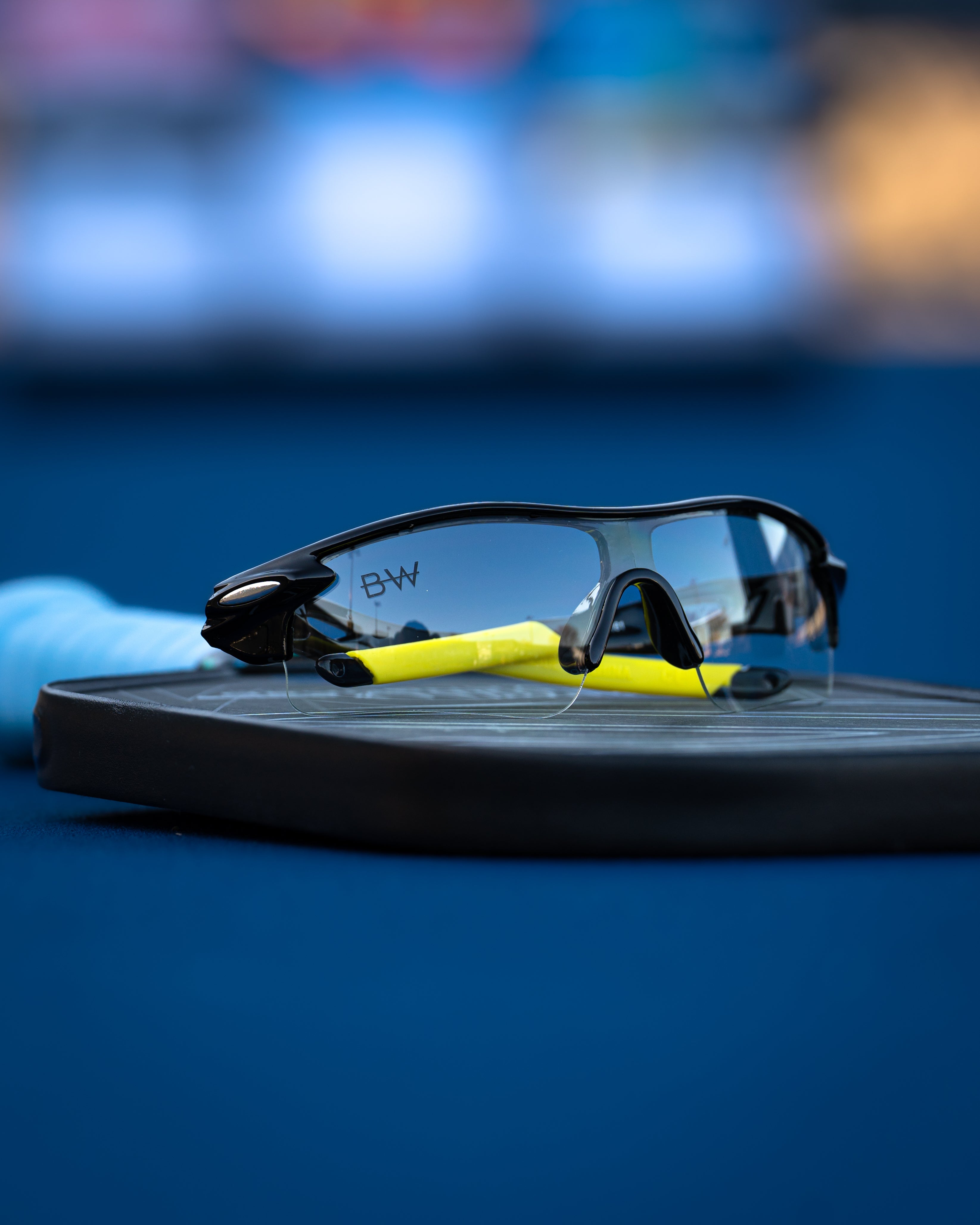
Clear lens sports glasses are built for situations where you want eyewear without a dark sunglass tint. That makes them especially relevant for indoor pickleball, evening matches, nighttime sports, gyms, training sessions, and other environments where traditional dark sunglasses may not be your preferred option.
But “clear lens” does not automatically mean anti-fog, anti-glare, UV400, scratch-resistant, shatterproof, or performance-enhancing. Those are separate characteristics that should be verified for the exact eyewear.
This 2026 guide explains how to choose clear lens sunglasses and sports glasses, the difference between RX and non-RX clear eyewear, where clear lenses make the most sense, and which Blinded Wear clear lens options are worth comparing.
Find Clear Lens Sports Glasses
What Are Clear Lens Sunglasses?
The phrase “clear lens sunglasses” is commonly used online for sunglass-style or sports frames fitted with untinted clear lenses. Technically, if the lens is completely clear rather than darkened, “clear lens eyewear” or “clear sports glasses” can be a more precise description.
The defining characteristic is simple:
A clear lens does not intentionally darken your view with a traditional sunglass tint.
That makes clear eyewear particularly useful to compare when you want to wear sports glasses but do not want a dark lens.
Clear lenses can be available in:
- Non-prescription sports eyewear
- Prescription sports eyewear
- Athletic-style frames
- Everyday-style frames
Other lens characteristics must be evaluated separately.
Clear Lens Glasses vs. Traditional Sunglasses
The main difference is visible tint.
| Feature | Clear Lens Eyewear | Traditional Tinted Sunglasses |
|---|---|---|
| Dark Sunglass Tint | No | Yes |
| Indoor Use | Often worth considering | Dark tint may not be preferred indoors |
| Night Use | Does not intentionally darken the scene | Dark tint reduces visible light reaching the eye |
| Bright Outdoor Use | Remains clear | Provides the selected visible tint |
| Prescription Availability | Can be RX when offered in a compatible configuration | Can be RX when offered in a compatible configuration |
| UV Specification | Must be verified for the exact lens | Must be verified for the exact lens |
| Impact Resistance | Depends on exact product | Depends on exact product |
Clear and tinted lenses are therefore not inherently “better” or “worse” than each other. They solve different environmental preferences.
Why Choose Clear Lens Sports Glasses?
The strongest reason to choose clear sports eyewear is straightforward: you want to wear glasses without adding a dark tint.
That can make clear lenses useful for:
- Indoor pickleball
- Indoor racquet sports
- Volleyball
- Basketball
- Gym training
- Evening sports
- Nighttime play under artificial lighting
- Other active environments where dark sunglasses are not preferred
A clear lens should not need exaggerated performance claims to justify its purpose. Its versatility comes from remaining untinted.
Best Clear Lens Sunglasses & Sports Glasses of 2026
The “best” clear lens glasses depend on your prescription needs, frame preference, fit, sport, and environment. Instead of declaring one universal winner, use the options below as a shortlist of Blinded Wear clear lens styles to compare.
For each model, verify the current product page for exact specifications and available configurations before purchasing.
Bumble Bee Clear Lens Pickleball Eyewear
Bumble Bee is a non-prescription clear lens option to compare if you want sports-oriented eyewear with a bold frame design and an untinted lens.
Consider Bumble Bee if:
- You do not need built-in prescription correction
- You want a clear lens for indoor or lower-light sports use
- You prefer its frame shape and styling
- Its dimensions work for your fit
Do not assume anti-fog, UV400, anti-glare, non-slip, or other treatments unless they are verified for the current product configuration.
Bird's Eye Clear Lens Pickleball Sunglasses
Bird's Eye is another non-RX clear lens sports option worth comparing for pickleball and other active environments where you want eyewear without a traditional dark sunglass tint.
Compare:
- Frame dimensions
- Overall fit
- Frame styling
- Physical lens coverage
- Your primary playing environment
A clear lens does not automatically provide anti-glare performance, improved peripheral vision, better ball tracking, or shatterproof protection.
Window View Clear Lens Pickleball Eyewear
Window View gives shoppers another clear non-prescription frame style to compare when an untinted lens matches their environment.
It may be worth considering if:
- You primarily want non-RX clear eyewear
- You play indoors, in the evening, or under artificial lighting
- You prefer its frame styling
- Its dimensions match your fit preferences
As with every model, verify exact lens treatments and specifications rather than assuming them from the clear-lens category.
More Blinded Wear Clear Lens Sports Glasses
If those three styles are not the right match, browse the complete clear lens collection and compare frame shape, dimensions, fit, and current specifications.
Clear RX vs. Non-RX Glasses: Which Do You Need?
The first question is not which frame looks best. It is whether you require prescription correction while wearing the glasses.
| Your Situation | Start With |
|---|---|
| You need prescription correction during your activity | Clear RX-compatible sports eyewear when available |
| You wear contact lenses | Non-RX clear sports eyewear can potentially be worn while contacts provide correction |
| You do not need vision correction | Non-prescription clear lens eyewear |
| You are unsure whether you need a prescription | Have your vision appropriately evaluated rather than guessing from sports performance |
There is no reason to add prescription correction simply because a frame is used for sports.
Can Clear Lens Sports Glasses Be Prescription?
Yes. Clear lenses can include prescription correction when the selected frame and lens configuration support your prescription.
A clear RX sports lens combines:
- Your prescribed vision correction
- An untinted lens configuration
This can be useful for prescription wearers who play indoors, train at night, or simply do not want a dark sunglass tint.
Not every prescription is compatible with every sports frame. Compatibility can depend on prescription strength, cylinder and axis values, frame geometry, lens geometry, and other requirements.
What About High-Index Clear Prescription Lenses?
Blinded Wear includes high-index prescription lenses at no additional cost with RX eyewear.
High-index describes a lens-material characteristic. It should not be interpreted as a promise of:
- Anti-fog performance
- Anti-reflective treatment
- Scratch resistance
- UV400 protection
- Photochromic behavior
- Polarization
- Improved depth perception
- Faster reaction time
Those are separate lens characteristics and should be verified independently.
Are Clear Lens Glasses Good for Indoor Pickleball?
Clear sports glasses are especially relevant for indoor pickleball because they allow you to wear eyewear without adding a dark sunglass tint.
That makes them worth comparing in:
- Dedicated indoor pickleball facilities
- Gym courts
- Indoor leagues
- Indoor tournaments
- Artificially lit courts
The benefit should be described accurately: the lens remains untinted.
Clear lenses do not automatically increase available light, sharpen the pickleball, enhance contrast, improve depth perception, or make you react faster.
Are Clear Lens Glasses Good for Night Sports?
Clear lenses are also a logical category for nighttime sports because they do not intentionally darken the scene with a traditional sunglass tint.
For example, a player moving from a sunny afternoon match into a nighttime session may prefer clear eyewear instead of continuing to wear dark sunglasses.
Clear lenses do not create additional environmental light, however. They should not be described as “night vision” glasses or as making a dark environment brighter.
Are Clear Lenses Good for Low-Light Conditions?
Clear eyewear can make sense when available light is lower and you do not want to reduce it further with a dark sunglass tint.
That can include:
- Dusk
- Evening practice
- Indoor courts
- Covered courts
- Nighttime sports
Again, the lens is not amplifying light. It is simply avoiding the intentional darkening produced by a traditional sunglass tint.
Can You Wear Clear Lens Glasses Outdoors?
Yes. Clear lenses can be worn outdoors when an untinted lens matches your preferences and the product is appropriate for the activity.
However, clear lenses do not provide the visible-light reduction of traditional tinted sunglasses. In bright conditions, some people may prefer a fixed tint or another lens configuration.
Also, do not assume a clear lens has or lacks a particular UV specification based solely on its appearance. Visible tint and UV specifications are separate characteristics.
Do Clear Lens Sunglasses Block UV?
Some clear lenses can be manufactured with UV-blocking characteristics, but you should not assume an exact UV rating merely because a lens is clear.
Likewise, a dark lens does not automatically prove a particular UV rating.
If UV protection matters to your intended use, look for an exact verified specification such as the manufacturer's stated UV performance for that specific lens.
Do not infer claims such as:
- UV400
- 100% UVA protection
- 100% UVB protection
- 100% UVA/UVB protection
unless they are specifically supported for the exact product.
Are Clear Lens Sports Glasses Impact-Resistant?
Impact resistance depends on the exact lens rather than whether it is clear or tinted.
Blinded Wear sports eyewear uses impact-resistant lenses.
Impact-resistant does not automatically mean:
- Shatterproof
- Indestructible
- Ball-proof
- Guaranteed to prevent injury
- ANSI certified
- ASTM certified
If you require eyewear meeting a particular protective standard, verify that certification for the exact product.
Are Clear Lens Sports Glasses the Same as Safety Glasses?
No. A clear lens and a safety certification describe completely different characteristics.
“Clear” describes the visible tint of the lens. “Sports eyewear” describes intended or marketed use. Neither term automatically establishes that a product meets a specific protective standard.
When protection is a priority, evaluate:
- Lens material
- Impact resistance
- Frame construction
- Physical coverage
- Any verified protective certification
Do not rely on appearance alone.
Are Clear Lens Glasses Anti-Fog?
Not automatically.
Clear lenses can experience condensation just like tinted prescription or non-prescription lenses.
Fogging can be influenced by:
- Perspiration
- Humidity
- Temperature changes
- Breathing
- Frame-to-face spacing
- Airflow
- Lens-surface characteristics
If a product claims anti-fog technology or treatment, verify that characteristic for the exact model instead of assuming it applies to every clear lens.
Do Clear Lens Glasses Reduce Glare?
Clear does not automatically mean anti-glare or anti-reflective.
These terms describe different characteristics:
- Clear: no intentional dark sunglass tint
- Anti-reflective: a specific lens treatment designed to affect reflections
- Polarized: uses a polarization filter
- Tinted: intentionally changes visible light transmission and appearance
If glare or reflections are important to you, verify the actual lens treatment instead of assuming all clear sports glasses address them.
Are Clear Lens Sports Glasses Polarized?
Clear lens eyewear does not need to be polarized. Polarization is a separate characteristic from visible tint.
Blinded Wear sports lenses are non-polarized, meaning a polarization filter is not added.
Some court-sport players prefer non-polarized eyewear, but it should not be claimed that non-polarized lenses inherently improve depth perception, reaction time, or ball tracking.
Are Clear Lens Glasses Scratch-Resistant?
Do not assume scratch resistance from the clear-lens category.
Scratch-resistant treatments, coatings, and lens materials vary by product. Likewise, “scratch-resistant” should not be interpreted as “scratch-proof.”
Verify the exact specification and care for the lenses appropriately to reduce avoidable damage.
Do Clear Lenses Improve Visibility?
A clear lens avoids the visible darkening produced by a traditional sunglass tint. That can make it a practical choice when you do not want a dark lens.
But “clear” should not automatically be translated into claims such as:
- Enhanced contrast
- Sharper vision
- Better depth perception
- Improved peripheral vision
- Better ball tracking
- Faster reactions
- Distortion-free vision
If you need prescription correction, the appropriate RX can address the refractive blur it is prescribed to correct. That is separate from the lens being clear.
What Sports Can You Use Clear Lens Glasses For?
Clear sports eyewear can be considered across activities where an untinted lens suits the environment.
| Activity | When Clear Lenses May Make Sense |
|---|---|
| Pickleball | Indoor, evening, night, or other situations where a dark tint is not preferred |
| Tennis | Indoor or lower-light sessions |
| Volleyball | Indoor play when sports eyewear is desired |
| Basketball | Indoor activity when compatible sports eyewear is appropriate |
| Gym / Training | When an untinted sports frame matches the activity |
| Cycling | Lower-light conditions when an untinted lens is preferred and the eyewear is suitable for the activity |
| Running | Evening or lower-light conditions when clear eyewear suits the environment |
Sport-specific requirements can differ, so a pair appropriate for one activity should not automatically be assumed to satisfy every requirement of another.
Can You Use Clear Lens Sports Glasses for Driving?
A clear lens does not intentionally darken the view, but sports eyewear should not automatically be marketed as improving nighttime driving or reducing driving glare.
If you need prescription correction for driving, use appropriate corrective eyewear. Any additional claims about anti-reflective treatments, glare reduction, or driving-specific performance should be verified for the exact lens.
Clear sports glasses are not a substitute for appropriate prescription correction when correction is required.
Clear vs. Tinted Sports Glasses: Which Is Better?
Neither is universally better. The more useful question is: which configuration matches your environment?
| Situation | Lens Type Worth Comparing |
|---|---|
| Indoor Sports | Clear |
| Night Sports | Clear |
| Evening / Lower-Light Play | Clear |
| Bright Outdoor Conditions | Fixed tint or another appropriate outdoor configuration |
| Changing Relevant Light Conditions | Photochromic / transition when compatible |
| Indoor + Outdoor Schedule | Compare multiple dedicated pairs with compatible adaptive options |
Your prescription requirements, fit, and exact product specifications still matter regardless of lens tint.
Clear Lenses vs. Photochromic Lenses
A standard clear lens and a photochromic lens are not the same thing.
A standard clear lens remains untinted unless the exact product includes another technology. A photochromic lens is designed to change darkness in response to relevant light conditions.
Clear may make sense if:
- You primarily play indoors
- You primarily play at night
- You specifically want an untinted lens
Photochromic may be worth comparing if:
- You frequently move through changing lighting conditions
- You train outdoors across different times of day
- You prefer one compatible adaptive pair rather than dedicated clear and tinted pairs
Photochromic behavior varies by exact lens technology and environment, so verify the configuration rather than assuming every adaptive lens behaves identically.
How Should Clear Lens Sports Glasses Fit?
The lens being clear does not change the importance of frame fit.
Before choosing a pair, compare:
- Overall frame width
- Bridge dimensions
- Temple length
- Lens width and height
- Overall weight
- Physical coverage
- How the frame feels during movement
- Comfort during longer sessions
If you already own eyewear that fits comfortably, its measurements can provide a useful reference.
Do not assume that every sports frame has anti-slip nose pads, rubberized temples, or a guaranteed secure fit unless those characteristics are specifically verified.
What Should You Look for in Clear Lens Sports Glasses?
| Feature | Question to Ask |
|---|---|
| RX vs. Non-RX | Do I require prescription correction? |
| Frame Fit | Do the dimensions match eyewear that fits me? |
| Playing Environment | Do I actually want an untinted lens where I will use these? |
| Impact Resistance | Is impact resistance verified for this eyewear? |
| Physical Coverage | Does the frame geometry provide the coverage I want? |
| UV Specification | Is an exact UV claim verified? |
| Anti-Fog | Is anti-fog technology actually specified? |
| Anti-Reflective | Is an AR treatment included or available? |
| Scratch Resistance | Is a scratch-resistant characteristic specifically supported? |
| Protective Standard | Does my activity require a particular certification? |
FAQ: Clear Lens Sunglasses & Sports Glasses
What are clear lens sunglasses?
The term commonly describes sunglass-style or sports frames fitted with untinted lenses. “Clear lens eyewear” is often the more technically precise description because the lens does not have a traditional dark sunglass tint.
What are clear lens glasses good for?
They are useful when you want eyewear without a dark tint, including many indoor, evening, nighttime, gym, and lower-light activities.
Are clear lens glasses good for pickleball?
They can be a practical option for indoor, evening, or nighttime pickleball when a dark sunglass tint is not preferred.
Can clear sports glasses have a prescription?
Yes. Compatible sports frames can use clear prescription lenses when the frame and lens configuration support your prescription.
Are clear lens glasses only for indoor use?
No. Clear lenses can also be worn outdoors. They simply do not provide the visible darkening of traditional tinted sunglasses.
Do clear lenses block UV?
UV performance depends on the exact lens. Do not assume an exact UV rating from the lens being clear or tinted.
Do clear sports glasses protect your eyes?
They place a physical lens and frame in front of the eyes, but the level of protection depends on the exact product. Clear does not automatically mean safety-certified.
Are clear sports glasses anti-fog?
Not automatically. Verify anti-fog characteristics for the exact product.
Are clear lenses better at night?
Clear lenses do not intentionally darken the scene, which can make them more appropriate to consider than dark sunglasses at night. They do not create additional light or provide “night vision.”
Can I wear contacts under clear sports glasses?
Yes. For some people, contact lenses provide prescription correction while non-RX clear sports eyewear is worn separately.
Best Clear Lens Glasses by Use in 2026
There is no single clear lens frame that is automatically best for every person. A more useful way to shop is to begin with where you plan to wear the glasses and whether you need prescription correction.
| Use | What to Prioritize | Lens Direction |
|---|---|---|
| Indoor Pickleball | Sports-oriented fit, impact resistance, physical coverage, RX compatibility if needed | Clear |
| Night Pickleball | Comfort, fit, untinted lens, prescription needs | Clear |
| Indoor Training | Comfort during movement, frame dimensions, weight | Clear |
| Evening Running | Fit, comfort, coverage, suitability for the activity | Clear may be worth considering |
| Lower-Light Cycling | Fit, coverage, activity-specific requirements, untinted lens preference | Clear may be worth considering |
| Prescription Indoor Sports | RX compatibility, frame fit, appropriate correction | Clear RX |
| Contacts + Sports Eyewear | Non-RX frame fit, coverage, impact resistance | Clear non-RX |
| Changing Indoor / Outdoor Use | Whether one adaptive pair or multiple dedicated pairs better fits your routine | Compare clear with compatible photochromic options |
Best Clear Lens Glasses for Pickleball
Clear lens eyewear is especially relevant to pickleball players who spend significant time indoors, play evening leagues, or continue playing after sunset.
Instead of looking for a lens that promises to “see the ball better,” focus on practical characteristics:
- Whether you need RX or non-RX eyewear
- Frame dimensions
- Comfort during longer matches
- Physical coverage
- Impact resistance
- Whether the untinted lens matches your court environment
- Any protective standard you specifically require
Blinded Wear sports eyewear uses impact-resistant lenses, but impact resistance should not be interpreted as a guarantee against breakage or as proof of a specific protective certification.
Clear Lens Glasses for Indoor vs. Outdoor Pickleball
Your court environment is one of the strongest reasons to choose one lens configuration over another.
Indoor Pickleball
Indoors, a clear lens lets you wear sports eyewear without intentionally darkening the court with a traditional sunglass tint.
That makes clear eyewear a straightforward option to compare for:
- Indoor recreational play
- Indoor leagues
- Indoor tournaments
- Gym courts
- Dedicated indoor pickleball facilities
Outdoor Pickleball
Clear lenses can still be worn outdoors, but they remain untinted. Players who prefer a darker lens in bright conditions may want to compare fixed-tint sports sunglasses instead.
Indoor and Outdoor Pickleball
If your schedule regularly includes both environments, you can compare:
- One clear pair plus one tinted pair
- A compatible photochromic option
- Clear eyewear for indoor/night use and dedicated sunglasses for daytime outdoor play
The right setup depends on how often you move between environments and whether you require prescription correction.
Best Clear Lens Glasses for Night Pickleball
For nighttime pickleball, the primary advantage of a clear lens is that it does not add a dark sunglass tint under artificial court lighting.
When choosing night pickleball glasses, prioritize:
- An untinted lens
- Comfort
- Appropriate frame dimensions
- Physical coverage
- Impact resistance
- Prescription correction when needed
Be cautious with products marketed as “night vision” sports glasses. A standard clear lens does not amplify available light or make a dark court brighter.
Best Clear Lens Glasses for Indoor Sports
Clear sports eyewear can extend beyond pickleball. An untinted lens can be relevant anywhere you want eyewear during an indoor activity without wearing dark sunglasses.
Potential uses include:
- Pickleball
- Volleyball
- Basketball
- Indoor tennis
- Racquet sports
- Gym training
- Other compatible indoor activities
However, different sports can have different protective requirements. A frame that works for recreational pickleball should not automatically be assumed to satisfy the requirements of another activity.
Can You Wear Clear Lens Sports Glasses at the Gym?
Yes, if the frame is appropriate and comfortable for your activity. Clear sports glasses can provide an untinted eyewear option for indoor training.
When evaluating a pair for gym use, consider:
- Frame fit
- Comfort during movement
- Overall weight
- How the temples interact with headphones or headwear
- Whether you need prescription correction
Do not assume a sports frame is automatically sweat-proof, non-slip, or fog-proof unless those characteristics are specifically verified.
Can You Use Clear Lens Glasses for Running?
Clear sports eyewear may be worth considering for evening or lower-light running when you do not want a dark sunglass tint.
For running, compare the actual frame according to:
- Fit during movement
- Comfort
- Weight
- Physical coverage
- Prescription needs
- Conditions where you expect to use it
The word “clear” describes the lens tint. It does not automatically establish wind protection, anti-fog performance, secure fit, or a particular UV specification.
Can You Use Clear Lens Glasses for Cycling?
Clear lenses can be considered for cycling in lower-light conditions when a dark tint is not preferred, but cycling introduces its own fit, coverage, and equipment considerations.
Evaluate whether the exact eyewear works with:
- Your helmet
- Your riding position
- Your prescription needs
- Your desired physical coverage
- Your typical lighting conditions
Do not assume that every clear pickleball or sports frame is automatically optimized for cycling simply because both activities involve movement.
Can Clear Lens Sports Glasses Be Worn Casually?
Yes. Some people prefer the appearance of sports or sunglass-style frames even when they do not want dark lenses.
If you want one pair for both sports and casual use, consider:
- Whether you like the frame styling off the court
- Comfort over longer periods
- Whether you need prescription correction
- Frame dimensions
- The exact lens specifications you need
Clear lens sports eyewear does not have to be limited to a court, but its suitability for everyday use depends on the exact frame and your preferences.
Fashion Clear Glasses vs. Clear Sports Glasses
Clear fashion eyewear and clear sports eyewear can look similar online, but their intended use may differ.
| Consideration | Fashion Clear Glasses | Clear Sports Glasses |
|---|---|---|
| Untinted Lens | Possible | Yes for clear-lens configurations |
| Active-Use Design | Not necessarily | Sports-oriented frames are intended for active use |
| Impact Resistance | Must be verified | Must be verified; Blinded Wear sports eyewear uses impact-resistant lenses |
| Prescription Availability | Depends on frame | Depends on exact RX sports frame |
| Protective Certification | Must be verified | Must still be verified |
Do not assume “sports” automatically means certified protection, and do not assume a fashion frame provides the same characteristics as dedicated sports eyewear.
How to Choose Clear Prescription Sports Glasses
If you require prescription correction, begin with the prescription rather than choosing a frame solely because you like its appearance.
- Use appropriate eyeglass prescription information.
- Choose an RX-compatible sports frame.
- Verify your complete prescription works with that frame.
- Confirm that a clear lens configuration is available for your setup.
- Compare frame dimensions and fit.
- Verify any additional lens characteristics you want.
- Review the order before submitting it.
Blinded Wear RX customers can upload a clear photo or picture of their eyeglass prescription when ordering.
Do not substitute a contact-lens prescription for an eyeglass prescription without appropriate guidance. The two are not automatically interchangeable.
Can Strong Prescriptions Use Clear Sports Lenses?
Potentially, but compatibility depends on the complete prescription and exact frame.
Factors can include:
- Sphere power
- Cylinder and axis values
- Frame curvature
- Lens dimensions
- Lens geometry
- Available lens material
- Other prescription requirements
Blinded Wear includes high-index prescription lenses at no additional cost with RX eyewear, but high-index material does not mean every prescription will work in every frame.
Can You Get Clear Sports Glasses for Astigmatism?
Compatible prescription sports eyewear can accommodate some prescriptions that include cylinder and axis correction.
Exact compatibility depends on the full prescription and selected frame. Do not assume that every RX sports frame supports every astigmatism prescription.
If you already have an appropriate eyeglass prescription, use the complete prescription information rather than estimating or rounding values yourself.
Can Clear Sports Glasses Have Progressive Lenses?
Some sports frames may support progressive correction, but compatibility should be verified for the exact frame, prescription, and available lens configuration.
Do not assume that every product offered in RX automatically supports:
- Progressive lenses
- Bifocals
- Every add power
- Every prescription range
Clear describes the tint of the lens, not the type of vision correction built into it.
Can You Wear Contacts With Clear Sports Glasses?
Yes. This can be a useful setup for people who already wear contact lenses during sports.
The contacts provide the prescription correction while the clear sports glasses remain non-prescription.
This may allow a player to choose from non-RX clear sports frames without duplicating their prescription in the glasses.
Whether contacts or dedicated RX sports glasses are preferable is an individual decision involving prescription needs, comfort, personal preference, and appropriate eye-care guidance.
Which Frame Shape Is Best for Clear Sports Glasses?
No single frame shape is universally best.
Instead, compare:
- Your face dimensions
- Frame width
- Bridge fit
- Temple length
- Lens height and width
- Physical coverage
- Prescription compatibility
- How the frame feels during your activity
A highly curved sports frame may appeal to one athlete while a less curved design may fit another person better or work differently with a particular prescription.
Fit should be evaluated separately from appearance.
Are Wraparound Clear Lens Glasses Better?
A wrap-style frame can provide a different shape and amount of physical coverage than a flatter frame, but it should not automatically be described as better.
Highly curved frames can also introduce additional prescription-compatibility considerations.
Compare:
- Coverage
- Fit
- Frame curvature
- Your prescription, if applicable
- Lens geometry
- Intended activity
Wraparound design alone does not prove anti-fog performance, secure fit, better peripheral vision, or certified protection.
How Comfortable Should Clear Sports Glasses Be?
Sports eyewear may be worn through warmups, games, practices, and tournaments, so comfort matters independently of lens technology.
When trying a new frame, pay attention to:
- Pressure at the bridge
- Pressure at the temples
- How the frame feels during head movement
- Whether the frame feels excessively loose
- How it interacts with hats, visors, helmets, or headphones
- How it feels after extended wear
A lightweight frame may feel comfortable for many people, but low weight does not automatically guarantee a secure or comfortable fit for every wearer.
Should You Test New Clear Sports Glasses Before a Tournament?
Yes. New sports eyewear should ideally be used during normal practice before you depend on it during an important match or event.
Use practice to evaluate:
- Fit during movement
- Comfort over time
- How the frame behaves once you begin perspiring
- Whether the untinted lens matches your environment
- How the eyewear interacts with other equipment
- Your prescription experience if the glasses are RX
If new prescription eyewear produces persistent or significant visual discomfort, contact the appropriate eye-care or eyewear professional rather than assuming that every issue should simply be ignored.
How Do You Clean Clear Lens Sports Glasses?
Clear lenses can make fingerprints, sweat, dust, and smudges easy to notice. Appropriate care helps keep debris from interfering with normal use and reduces avoidable lens damage.
Follow the instructions for the exact eyewear. In general:
- Check the lens surface for loose debris before wiping.
- Use a lens-safe cleaning method.
- Use appropriate lens-cleaning material rather than abrasive fabric.
- Avoid harsh household chemicals unless confirmed safe for the lens.
- Allow the eyewear to dry appropriately before storage.
Do not assume that a clear sports lens is scratch-proof.
How Should You Store Clear Sports Glasses?
Avoid leaving clear eyewear loose in a sports or travel bag where the lenses can repeatedly contact harder objects.
Keep them away from loose:
- Keys
- Sports equipment
- Water bottles
- Tools
- Other eyewear
- Abrasive objects
Prescription players should be especially mindful of storage because damage to a primary RX pair can leave them without their preferred correction during an event or trip.
Do You Need a Backup Pair of Clear Sports Glasses?
Not everyone does. A backup becomes more useful when you depend on prescription correction, travel for competition, or use different lens configurations in different environments.
For example, a pickleball player might carry:
- Clear eyewear for indoor or night matches
- Tinted eyewear for bright outdoor matches
- A backup RX pair if prescription correction is essential
The goal is not to own as many pairs as possible. It is to have eyewear that matches the environments you actually encounter.
Are Clear Lens Glasses Useful for Sports Travel?
Clear eyewear can be useful for athletes traveling between indoor venues, evening practices, and other environments where a dark tint is not preferred.
If you travel for tournaments, consider:
- Which environments you will play in
- Whether you need RX correction
- Whether you also need a tinted pair
- How you will store the eyewear
- Whether you depend on a backup prescription pair
12 Mistakes to Avoid When Buying Clear Lens Sunglasses
- Assuming “clear” means UV400. Verify exact UV specifications separately.
- Assuming clear lenses are automatically anti-fog. Anti-fog characteristics require separate verification.
- Assuming clear means anti-glare. Anti-reflective and glare-related characteristics are separate from visible tint.
- Calling every clear sports lens shatterproof. Impact resistance and shatterproof claims are not interchangeable.
- Assuming clear lenses improve depth perception. Clear primarily describes the absence of a dark tint.
- Assuming they make you react faster. Eyewear should not be marketed as a direct reaction-time enhancer.
- Assuming they improve ball tracking. Tracking is multifactorial and should not be credited to clear tint alone.
- Buying RX when you do not need prescription correction. Prescription lenses should address an actual correction need.
- Assuming every prescription works in every clear sports frame. Verify compatibility.
- Ignoring frame dimensions. A good lens cannot compensate for a frame that does not fit you appropriately.
- Assuming sports eyewear automatically means certified safety eyewear. Verify any protective standard required for your activity.
- Buying solely from a “best” ranking. The best choice depends on your RX needs, fit, environment, and verified product characteristics.
How to Compare the Best Clear Lens Glasses in 2026
Use this checklist before deciding which clear lens eyewear is best for you:
- ☐ Do I need prescription correction?
- ☐ If RX, is my complete prescription compatible with this frame?
- ☐ Do I primarily use the eyewear indoors, outdoors, at night, or across multiple environments?
- ☐ Do I actually want an untinted lens?
- ☐ Have I compared the frame dimensions with eyewear that already fits me?
- ☐ Is impact resistance verified?
- ☐ Is any UV claim specifically verified?
- ☐ Am I assuming an anti-fog or anti-reflective treatment that is not actually listed?
- ☐ Does my sport require a specific protective certification?
- ☐ Does the frame provide the physical coverage I want?
- ☐ Have I considered a tinted or photochromic alternative if I spend significant time in bright conditions?
- ☐ What replacement support is available if the eyewear breaks?
That process is more useful than choosing whichever product has the longest feature list or the most aggressive performance claims.
More Questions About Clear Lens Sunglasses
Why are clear lens sunglasses called sunglasses if they aren't dark?
The phrase is commonly used for sunglass-style frames with clear lenses. “Clear lens eyewear” or “clear sports glasses” can be more technically precise when the lenses are untinted.
Are clear lens sunglasses good for indoor sports?
They can be. Clear lenses allow you to wear eyewear without intentionally darkening the environment with a traditional sunglass tint.
Are clear lens glasses good for night pickleball?
Yes, clear eyewear is worth considering because it does not add a dark tint under nighttime court lighting. It does not create additional light or provide night vision.
Can clear lens glasses be used outside during the day?
Yes. However, they remain untinted, so people who prefer visible-light reduction in bright conditions may prefer a tinted lens.
Do clear lenses help you see a pickleball better?
That should not be assumed from the lens being clear. Appropriate prescription correction can address refractive blur, but a clear tint alone does not guarantee improved ball visibility or tracking.
Are clear lenses better than yellow lenses at night?
No lens color should be declared universally best for every nighttime user without supporting evidence and consideration of the specific lens. Clear lenses have the straightforward characteristic of not intentionally adding a dark tint.
Are clear lenses better than transition lenses?
Neither is universally better. Clear lenses remain untinted, while photochromic lenses are designed to change darkness under relevant conditions. Your environment determines which approach is more practical.
Can clear sports glasses be non-prescription?
Yes. Blinded Wear offers non-RX clear lens sports eyewear for people who do not need built-in prescription correction.
Can clear sports glasses be RX?
Yes, when the selected frame and lens configuration support your prescription.
Can I wear clear sports glasses over contacts?
Yes. Contact lenses can provide prescription correction while separate non-RX clear sports eyewear is worn.
Are clear sports glasses safety glasses?
Not automatically. Verify the exact protective standard if certified safety performance is required.
Do clear sports glasses stop wind?
The amount of wind exposure can depend on frame geometry, coverage, fit, and conditions. Do not assume every clear sports frame provides the same wind coverage.
Are clear sports glasses good for beginners?
They can be appropriate for beginners and experienced athletes alike when an untinted lens matches the environment. Skill level does not determine whether clear lenses are appropriate.
Can clear glasses be used for tournaments?
Yes, when the eyewear is appropriate for the sport, environment, prescription needs, and any applicable requirements. Test new eyewear during practice before relying on it during competition.
Clear Lens Sunglasses: Myths vs. Facts
Clear sports eyewear is often marketed with claims that go far beyond what the absence of a tint actually tells you. Before buying, separate the lens color from the other characteristics of the eyewear.
| Common Claim | What to Know |
|---|---|
| “Clear lenses are only fashion glasses.” | Clear lenses can also be used in sports-oriented eyewear when an untinted lens matches the activity and environment. |
| “Clear lenses automatically block 100% of UV.” | UV performance must be verified for the exact lens. Visible tint does not establish an exact UV specification. |
| “Clear sports glasses never fog.” | Fogging can occur depending on temperature, humidity, perspiration, airflow, frame spacing, and lens characteristics. |
| “Clear lenses improve depth perception.” | Clear describes the absence of a dark tint. It does not automatically improve depth perception. |
| “Clear lenses improve reaction time.” | Clear eyewear should not be marketed as directly making an athlete react faster. |
| “Clear lenses make the ball easier to track.” | Ball tracking involves multiple visual and athletic factors and should not be attributed to clear tint alone. |
| “Clear sports lenses are shatterproof.” | Impact resistance does not mean a lens is indestructible or shatterproof. |
| “Clear sports glasses are automatically safety glasses.” | Protective certification must be verified separately for the exact eyewear. |
| “Clear means anti-glare.” | Anti-reflective and glare-related characteristics are separate from whether a lens is visibly clear. |
| “Clear lenses are only useful indoors.” | They can also be worn outdoors when an untinted lens suits the wearer's environment and preferences. |
Clear Lens Features: What Is Verified vs. What Should You Check?
When shopping Blinded Wear clear lens and RX sports eyewear, it helps to distinguish established product characteristics from features that must be checked on the exact model or configuration.
| Characteristic | What to Know |
|---|---|
| Clear Lens | Clear-lens products use an untinted lens rather than a traditional dark sunglass tint. |
| Impact Resistance | Blinded Wear sports eyewear uses impact-resistant lenses. |
| Non-Polarized | Blinded Wear sports lenses are non-polarized. |
| Lightweight Sports Frames | Lightweight sports-frame options are available. |
| High-Index RX Lenses | Included at no additional cost with Blinded Wear prescription eyewear. |
| Prescription Upload | RX customers can upload a clear photo or picture of their eyeglass prescription. |
| UV400 / Exact UV Percentage | Verify the exact lens specification before making this claim. |
| Anti-Fog | Verify for the exact product or lens configuration. |
| Anti-Reflective / Anti-Glare | Verify for the exact product or lens configuration. |
| Scratch Resistance | Verify for the exact product or lens configuration. |
| Hydrophobic Treatment | Verify for the exact product or lens configuration. |
| Protective Certification | Verify the exact standard and exact product if certification is required. |
| 50% Lifetime Replacement Support | Available if glasses break, subject to current policy terms. |
What if Your Clear Lens Glasses Break?
Blinded Wear provides 50% lifetime replacement support if your glasses break, subject to the current policy terms.
That can be particularly relevant for eyewear used regularly for sports, training, travel, and other active situations.
Replacement support should not be confused with a claim that the eyewear is unbreakable. It also does not automatically mean:
- Free lifetime replacements
- Every type of damage is covered
- Loss is covered
- Every scratch qualifies for replacement
- The eyewear is shatterproof
- The eyewear meets a particular safety certification
Review the current policy for complete eligibility and replacement terms.
Not Sure Which Clear Lens Glasses to Choose?
If you already know whether you require prescription correction, the Blinded Wear eyewear quiz can help narrow your shopping options.
Use it to think through factors such as:
- RX vs. non-RX eyewear
- Where you normally play
- Your lens preference
- Your frame preference
- Your typical sports routine
The quiz is a product-selection tool, not an eye exam. It cannot diagnose a vision condition or determine whether you need prescription correction.
If you are unsure whether you need RX lenses, have your vision appropriately evaluated first.
Which Clear Lens Glasses Should You Buy?
Use this quick decision guide to narrow the category before comparing individual frames.
| If This Sounds Like You... | Start Here |
|---|---|
| I don't need prescription correction and primarily play indoors | Non-RX Clear Lens Sports Glasses |
| I wear contacts and want clear sports eyewear | Non-RX Clear Lens Sports Glasses |
| I need prescription correction | RX Sports Eyewear and verify the clear lens configuration available for your prescription |
| I primarily play pickleball at night | Clear Lens Sports Glasses |
| I primarily play in bright outdoor conditions | Compare Tinted Sports Eyewear |
| I regularly move between different lighting conditions | Compare dedicated clear/tinted pairs with compatible photochromic options. |
| I don't know whether I need RX correction | Have your vision appropriately evaluated before ordering prescription lenses. |
When Might Clear Lens Glasses Not Be Your Best Choice?
Clear eyewear is versatile, but it is not the right configuration for every situation.
You may prefer another lens type if:
- You specifically want a darker tint during bright outdoor sessions
- You frequently move between changing light conditions and prefer a compatible adaptive lens
- You require a protective certification that the clear eyewear you are considering does not meet
- Your prescription is incompatible with the frame
- The frame dimensions do not fit you well
- You need a verified lens treatment or specification that the selected product does not provide
The goal is not to choose clear lenses simply because they are versatile. The goal is to choose eyewear that matches your actual use.
People Also Ask About Clear Lens Sunglasses
What is the point of clear lens sunglasses?
Clear lens sunglasses or clear sports glasses let you wear sunglass-style or sports-oriented eyewear without adding a traditional dark tint. They can be particularly useful indoors, at night, during evening sports, and in other environments where dark sunglasses are not preferred.
What are the best clear lens sunglasses?
The best option depends on whether you need prescription correction, your intended activity, frame fit, physical coverage, impact resistance, and any additional verified lens characteristics you require.
What are the best clear lens glasses for pickleball?
Look for an RX or non-RX configuration that matches your vision needs, then compare fit, dimensions, physical coverage, impact resistance, and exact lens specifications. Blinded Wear's clear lens collection includes multiple non-RX sports styles for indoor and lower-light pickleball.
Why do athletes wear clear glasses?
One reason is to wear sports eyewear without the dark tint of traditional sunglasses. The exact reason can vary by athlete, activity, prescription requirements, and environment.
Why wear clear glasses indoors?
Clear lenses allow eyewear to be worn without intentionally darkening the indoor environment with a sunglass tint.
Can you wear clear lens sunglasses at night?
Clear lenses do not intentionally darken the environment, making them worth considering for nighttime use when the exact eyewear is appropriate for the activity. They do not amplify light or provide night vision.
Do clear glasses help with bright lights?
Do not assume that a standard clear lens reduces brightness, reflections, or glare. Those characteristics depend on the exact lens and any verified treatments.
Do clear lenses help with LED lights?
A standard clear lens does not automatically filter LED light, blue light, glare, or specific wavelengths. Verify any such claim for the exact lens.
Do clear lenses protect your eyes from pickleballs?
Eyewear places a physical lens and frame in front of the eyes, but the level of protection depends on the exact construction, impact resistance, coverage, and any verified protective certification. No eyewear should be described as guaranteeing prevention of injury.
Do clear lenses have UV protection?
They can, depending on the lens, but visible clarity does not establish an exact UV rating. Check the verified specification for the exact product.
Can clear glasses be prescription?
Yes. Clear prescription lenses can be used in compatible frames when the lens configuration supports the wearer's prescription.
Are clear glasses better than sunglasses?
Neither is universally better. Clear lenses avoid a dark tint, while traditional sunglasses intentionally reduce visible light through their tint. Your environment determines which is more appropriate.
2026 Clear Lens Buying Checklist
Before ordering clear sports eyewear, make sure you can answer these questions:
- Do I need RX or non-RX lenses?
- Where will I wear them most often?
- Do I actually want an untinted lens in that environment?
- Does the frame fit my face dimensions?
- If I need RX, is my prescription compatible with this frame?
- Is impact resistance verified?
- What level of physical coverage does the frame provide?
- Do I need a specific protective certification?
- Am I assuming UV, anti-fog, anti-glare, or scratch-resistant features that have not actually been verified?
- Would clear, tinted, or photochromic eyewear better match my normal environment?
- Have I considered how the glasses will be cleaned and stored?
- What replacement support is available if they break?
Key Takeaways: Clear Lens Sunglasses in 2026
- Clear lens sunglasses are sunglass-style or sports frames fitted with untinted lenses.
- “Clear sports glasses” is often the more technically precise term.
- Clear lenses are especially relevant indoors, at night, during evening sports, and whenever a dark tint is not preferred.
- Clear lenses can be non-prescription or prescription.
- If you wear contacts, non-RX clear sports eyewear can potentially be worn while contacts provide your correction.
- Clear does not automatically mean UV400.
- Clear does not automatically mean anti-fog.
- Clear does not automatically mean anti-glare or anti-reflective.
- Clear does not automatically mean scratch-resistant.
- Clear does not automatically mean shatterproof or safety-certified.
- A clear lens does not automatically improve depth perception, contrast, ball tracking, or reaction time.
- Blinded Wear sports eyewear uses impact-resistant lenses.
- Blinded Wear sports lenses are non-polarized.
- Blinded Wear includes high-index prescription lenses at no additional cost with RX eyewear.
- Blinded Wear RX customers can upload a clear photo or picture of their eyeglass prescription.
- Blinded Wear provides 50% lifetime replacement support if glasses break, subject to current policy terms.
- The best clear lens glasses depend on fit, prescription needs, environment, intended activity, and verified product specifications.
Related Clear Lens & Sports Eyewear Guides
Find the Right Clear Lens Glasses for Your Sport
The best clear lens glasses are not the pair with the biggest list of marketing claims. They are the pair that matches your vision needs, your environment, your activity, and your fit.
If you do not need prescription correction and want an untinted sports lens, start with Blinded Wear's clear lens collection. If you require correction, start with RX-compatible sports eyewear and verify that the clear configuration works with your prescription.
Bottom Line: What Are the Best Clear Lens Sunglasses of 2026?
The best clear lens sunglasses of 2026 are the ones that provide the frame fit, prescription configuration, impact resistance, physical coverage, and verified specifications you need while keeping the lens untinted for your intended environment.
For non-prescription shoppers, Blinded Wear's Bumble Bee, Bird's Eye, and Window View provide three clear sports-frame styles to compare, while the full clear lens collection provides additional options.
Prescription players should begin with their actual correction needs and an RX-compatible frame rather than assuming every non-RX clear model can accept a prescription.
For indoor pickleball, nighttime sports, evening training, and other situations where a dark tint is not preferred, the appeal of a clear lens is straightforward: you can wear sports eyewear without intentionally darkening your view.
No exaggerated promise is needed. Clear does not have to mean “better tracking,” “faster reactions,” “perfect clarity,” or “enhanced depth perception” to be useful.
Choose the lens for the environment, choose the frame for your fit and activity, and verify the features that actually matter.