
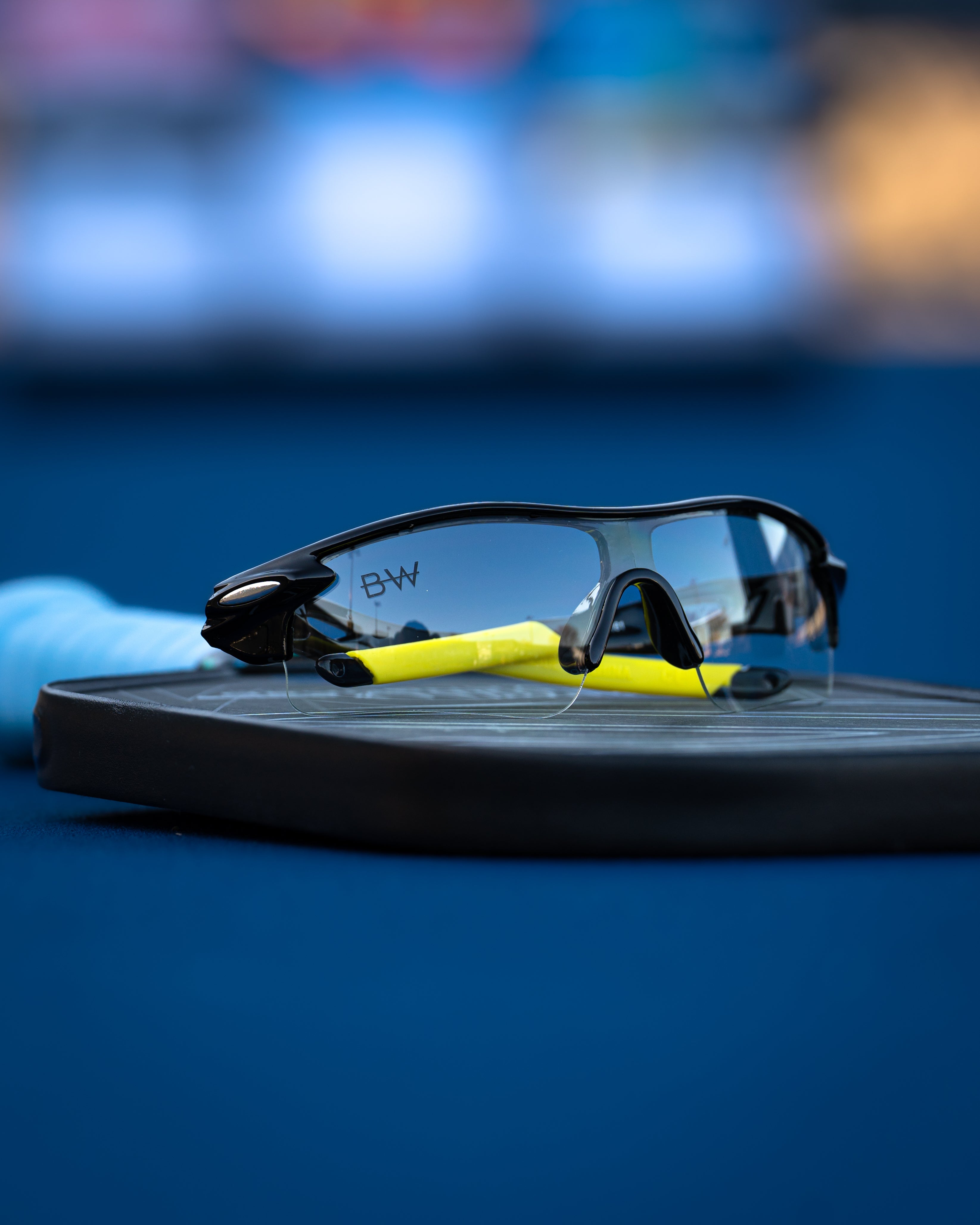
Can One Pair Really Last a Whole Season? These Can.
Share
Can One Pair Really Last a Whole Season? These Can.
A well-chosen pair of prescription pickleball glasses can potentially stay in your rotation for an entire season—but no honest eyewear brand should guarantee that one pair will survive every drop, tournament, hot day, or accident.
The original version of this guide promised that Blinded Wear RX glasses were specifically built to “survive and thrive” through an entire season and suggested that needing a replacement mid-season meant you were wearing the wrong eyewear. :chatgpt-content-reference{index="0"} That's stronger than the product characteristics alone can establish.
A better way to think about season-long durability is this: start with sports-focused prescription eyewear, take care of it properly, choose a frame that fits your prescription and face, and understand what its impact-resistant construction can—and cannot—protect against.
Find Your Pickleball Glasses
Compare RX and non-prescription eyewear before choosing your next court setup.
- Shop RX Prescription Pickleball Glasses
- Shop Non-RX Pickleball Sunglasses
- View the 2026 Pickleball Glasses Guide
These are the same primary shopping destinations used in the original guide. :chatgpt-content-reference{index="1"}
Quick Answer: Can RX Pickleball Glasses Last a Full Season?
They can, but lifespan varies. How long your prescription sports glasses last depends on how often you play, how they're stored, how they're cleaned, accidental impacts, individual fit, frame construction, and how they're treated away from the court.
| Factor | How It Can Affect Season-Long Use |
|---|---|
| Playing frequency | More court time generally means more handling and exposure |
| Storage | Keeping eyewear separated from loose gear can reduce avoidable damage |
| Cleaning | Improper cleaning can damage lenses over time |
| Drops and impacts | Impact-resistant doesn't mean indestructible |
| Fit | A properly matched frame can reduce constant adjustment and handling |
| Prescription changes | A physically intact pair may still need updating if your vision needs change |
| Accidents | No frame can guarantee survival through every incident |
What Does “Last a Whole Season” Actually Mean?
There's no universal pickleball season length or fixed number of matches that eyewear must survive before it qualifies as durable.
One player might play twice per week. Another may combine league matches, open play, drilling, and frequent tournaments. The original article describes demanding conditions including heat, sweat, back-to-back tournaments, rain delays, concrete courts, and long rallies. :chatgpt-content-reference{index="2"}
So “season-long” should be treated as a practical durability goal—not a guaranteed lifespan.
For this guide, a pair that lasts the season means eyewear that remains usable for your prescription and intended play without needing replacement because of avoidable physical damage.
Why Do Prescription Sports Glasses Need Replacing?
The original guide lists polarization, lack of sweat resistance, heavy lenses, cracked frames, and lack of a replacement program as the five major reasons glasses fail mid-season. :chatgpt-content-reference{index="3"}
Several of those points mix durability with unrelated lens characteristics. Polarization, for example, doesn't determine whether a frame physically lasts six months.
More practical reasons you might replace RX sports eyewear include:
- Accidental frame damage
- Lens damage
- Improper storage
- Repeated rough handling
- A fit problem that makes the pair impractical to use
- A prescription change
- Loss of the eyewear
- Changing lens or environment needs
Separating durability, prescription suitability, fit, and lens preference makes it easier to understand why a pair actually needs replacing.
Impact-Resistant Lenses Matter—But They Don't Make Glasses Indestructible
Blinded Wear sports eyewear uses impact-resistant lenses, an important characteristic for active eyewear.
But impact-resistant should never be expanded into claims such as:
- Shatterproof
- Drop-proof
- Crush-proof
- Impossible to break
- Guaranteed to survive an entire season
- Guaranteed to prevent eye injury
Impact resistance and season-long durability aren't the same thing.
Learn more in Why Impact Resistance Matters in Sports Eyewear.
What Does “Designed for Pickleball” Mean?
The original article says Blinded Wear RX frames aren't repurposed general-use glasses and claims that everything from temple angle to nose-grip tension is specifically tuned for the court. :chatgpt-content-reference{index="4"}
Without verified engineering specifications for every model, those exact design claims shouldn't be applied across the entire collection.
What can be stated clearly is that Blinded Wear's RX collection is built and marketed around prescription eyewear for pickleball players.
When choosing among frames, evaluate the actual product rather than assuming every model has identical construction:
- Prescription compatibility
- Frame dimensions
- Frame shape
- Current lens configuration
- Verified product characteristics
- Individual fit
High-Index Prescription Lenses Are Included
Blinded Wear RX eyewear includes high-index prescription lenses at no additional cost.
The original guide described every pair as using exactly 1.61 high-index lenses and linked that material to less distortion, a thinner profile, less sliding, and avoiding a $100+ upgrade. :chatgpt-content-reference{index="5"}
One exact index shouldn't be promised across every order unless the specific configuration is verified. High-index lenses also shouldn't be presented as inherently reducing frame slippage or guaranteeing better athletic performance.
High-index is primarily a prescription lens-material consideration. It doesn't make the eyewear:
- Indestructible
- Anti-fog
- Scratch-proof
- Better at ball tracking
- Guaranteed to last longer
Do Non-Polarized Lenses Make RX Glasses Last Longer?
No. Polarization status isn't a durability feature.
Blinded Wear sports eyewear uses non-polarized lenses. The original article argued that polarized lenses flatten depth perception and therefore cause missed timing, misjudged drop shots, and poor reads on ball spin. :chatgpt-content-reference{index="6"}
Those claims shouldn't be treated as universal facts.
Some court players prefer non-polarized lenses, but non-polarized eyewear doesn't inherently:
- Improve depth perception
- Improve reaction time
- Improve spin recognition
- Improve shot timing
- Extend the physical life of the glasses
It's one characteristic of the lens—not proof of season-long durability.
Fit May Matter More Than “Grip Technology”
The source claims Blinded Wear frames use anti-slip grip technology, built-in nose and temple grip zones, lightweight pressure points, and an athletic curve that holds during diving and sprinting. :chatgpt-content-reference{index="7"}
Those shouldn't be collection-wide promises without verification for each frame.
A more reliable approach is to evaluate individual fit.
Before ordering, compare:
- Frame width: Compare dimensions with glasses that already fit you well.
- Bridge fit: Consider how the frame sits on your nose.
- Temple length: Check how the arms interact with your ears and head.
- Frame shape: Consider your prescription and preferred coverage.
- Movement: Once you receive the pair, evaluate how it behaves during normal court movement.
No sports frame should be universally described as “no-slip” because faces, prescriptions, movement, and fit differ.
What Does Sweat Do to RX Sports Glasses?
Sweat doesn't automatically destroy prescription eyewear, but frequent play means your glasses may need more regular care.
After a hot session:
- Clean the eyewear using a method appropriate for the lenses
- Avoid aggressively wiping visible grit across the lens surface
- Let wet eyewear dry appropriately before longer-term storage
- Keep the storage sleeve or case reasonably clean
- Inspect the frame if something feels loose or unusual
Don't promise that a frame is sweat-proof or sweat-resistant unless that characteristic is verified for the exact product.
Will Blinded Wear RX Glasses Stay Fog-Free All Season?
No collection-wide fog-free guarantee should be made.
The original guide later promises “no fog” as part of what customers should expect throughout a full season. :chatgpt-content-reference{index="8"}
Fogging can depend on temperature, humidity, perspiration, airflow, frame geometry, and lens treatments. Unless an exact configuration has a verified anti-fog feature, don't market it as permanently fog-free.
Season-long use is about realistic durability and care—not pretending normal environmental issues can never happen.
Are Blinded Wear RX Lenses Scratch-Resistant?
The original FAQ says every lens includes a hard coating designed to reduce scratches. :chatgpt-content-reference{index="9"} Unless that coating is verified for the exact current configuration, it shouldn't be promised across the entire RX collection.
Regardless of lens construction, good habits matter:
- Don't place lenses face-down on rough surfaces
- Don't wipe visible sand or grit aggressively across them
- Keep eyewear separated from keys and loose objects
- Use appropriate lens-cleaning materials
- Store the glasses when they're not being worn
No prescription lens should be treated as scratch-proof.
Season-Long Durability Starts Off the Court Too
Some of the easiest damage to avoid happens when you're not playing.
Throwing RX glasses loose into a paddle bag with keys, balls, water bottles, shoes, and other equipment can expose them to unnecessary contact or pressure.
A better routine is to:
- Clean visible debris from the eyewear appropriately.
- Place the glasses in dedicated storage.
- Keep them away from heavier objects that could compress the frame.
- Use additional rigid protection when your travel or storage situation calls for it.
For more detail, read How to Store and Protect RX Glasses on the Go.
Ocean Wave RX for Season-Long Play
The original guide recommends Ocean Wave RX as one of the frames players wear from preseason drills through championship play. It also claims specific transition and gray options, lightweight stability, and includes an unverified six-month customer testimonial. :chatgpt-content-reference{index="10"}
Instead of guaranteeing a season-long lifespan, compare Ocean Wave RX according to:
- Your prescription compatibility
- Current frame dimensions
- Current available lens configuration
- Verified product specifications
- Individual fit
- Your playing frequency and environment
Frost RX for Frequent Pickleball Players
The original guide calls Frost RX a sweat-fighting, stay-put frame with “total visual control,” followed by an unverified testimonial claiming it outlasted every previous pair the customer owned. :chatgpt-content-reference{index="11"}
Those performance and durability guarantees aren't necessary.
Instead, evaluate Frost RX based on:
- Prescription compatibility
- Current dimensions
- Current lens configuration
- Verified specifications
- How the frame fits you personally
Red Shine RX for the Season
The original article recommends Red Shine RX for players seeking style and longevity, while also calling the frame grippy and glare-resistant. :chatgpt-content-reference{index="12"}
Unless those individual features are verified for the current configuration, keep the buying decision focused on prescription compatibility, current specifications, dimensions, lens configuration, fit, and style preference.
What About Zebra II RX and Havana White RX?
The original guide describes Zebra II RX as highly stable in wind, humidity, and high-movement matches, while Havana White RX is described as flexible and unusually rugged under stress. :chatgpt-content-reference{index="13"}
Before carrying those claims into a current 2026 guide, verify each model's current availability, specifications, prescription compatibility, and construction.
Historical copy shouldn't become a permanent product specification simply because it appeared in an older article.
What About the “Two Seasons” Customer Stories?
The original article contains several named testimonials claiming Blinded Wear glasses survived six months, repeated drops, rain, hot and windy conditions, and even two complete seasons. :chatgpt-content-reference{index="14"}
Those quotes should only be published as real customer experiences if the identities, statements, and permission to use them can be verified.
Verified long-term reviews would be extremely useful for this particular article because they could document:
- How many months the customer owned the pair
- Approximate playing frequency
- Indoor versus outdoor use
- Tournament frequency
- How the glasses were stored
- Any damage or maintenance over time
- Whether the prescription remained suitable
That would provide stronger evidence for season-long durability than invented or undocumented testimonials.
How to Give Your RX Glasses the Best Chance of Lasting the Season
No care routine can guarantee that prescription sports eyewear will last for a specific number of months. But avoiding unnecessary damage can give your pair a better chance of remaining usable throughout frequent play.
After Each Session
- Inspect the lenses. Check for visible dirt, sand, or debris before wiping them.
- Clean appropriately. Use materials and cleaning methods suitable for your lenses.
- Check the frame. Look for anything that appears loose, bent, or damaged.
- Let wet eyewear dry appropriately. Don't repeatedly store dirty or wet glasses without care.
- Use dedicated storage. Keep the pair separated from loose equipment in your bag.
Small habits repeated across dozens of practices and matches can matter more than treating the glasses as indestructible.
What if You Drop Your RX Glasses?
Drops happen. The original article repeatedly connects Blinded Wear with surviving drops and impacts, including customer stories about glasses remaining usable after multiple drops. :chatgpt-content-reference{index="0"}
Blinded Wear uses impact-resistant sports lenses, but that isn't a guarantee that the frame or lenses will survive every fall.
After a significant drop, inspect:
- The lenses for visible damage
- The frame for cracks or deformation
- The temples and connection points
- The overall alignment of the frame
- Whether the glasses still fit normally
If eyewear appears significantly damaged, don't rely on the fact that it still technically stays on your face as proof that nothing is wrong.
Concrete Courts Are a Good Reason to Handle Eyewear Carefully
The source specifically lists concrete courts among the demanding conditions a pickleball pair may encounter during a season. :chatgpt-content-reference{index="1"}
Impact-resistant lenses can be appropriate for active eyewear, but dropping prescription glasses onto a hard surface can still damage the lenses, frame, or other components.
When you're not wearing the pair, placing it in dedicated storage is generally better than leaving it on the ground, bench edge, or loose in your gear.
What About Rain and Changing Weather?
The original article references rain delays and includes a testimonial claiming a pair remained in use after a rain match. :chatgpt-content-reference{index="2"} :chatgpt-content-reference{index="3"}
Those references shouldn't be converted into a waterproof or weatherproof claim.
If your glasses become wet, care for them appropriately afterward. Don't assume sports eyewear is immune to every environmental condition simply because it's intended for active use.
Does Playing More Often Mean Your Glasses Won't Last as Long?
Not necessarily, but playing frequency changes the amount of use and handling your eyewear experiences.
| Player Type | Typical Eyewear Considerations |
|---|---|
| Occasional recreational player | Lower overall usage but storage and cleaning still matter |
| Several sessions per week | More frequent cleaning, handling, and inspection |
| League player | Regular use makes fit and reliable storage increasingly important |
| Frequent tournament player | Travel, packed bags, long playing days, and backup planning become more important |
| Daily player | High usage makes consistent care particularly valuable |
The original article specifically targets players doing weekly tournaments, after-work doubles, morning leagues, and summer training. :chatgpt-content-reference{index="4"} Those schedules can all represent very different amounts of actual wear.
Tournament Players Should Think Beyond Physical Durability
If you're traveling for tournaments, “Will these last?” isn't the only question worth asking.
Also consider:
- What happens if you lose your primary pair?
- What happens if the pair is damaged immediately before a match?
- Do you depend on your prescription to play comfortably?
- Will your lens configuration work in the expected environment?
- Do you have appropriate storage during travel?
A durable primary pair doesn't eliminate the value of contingency planning.
See Best RX Glasses for Travel and Tournament Days and When to Bring a Spare RX Pair in Your Bag.
Do You Still Need a Backup Pair?
The original conclusion suggests that players may not need a second pair at all if they choose the right Blinded Wear RX glasses. :chatgpt-content-reference{index="5"}
That's too absolute, especially for prescription-dependent players.
A backup pair can still make sense when:
- You're traveling for a tournament
- You rely heavily on prescription correction
- You can't easily replace your eyewear locally
- Your primary pair is your only usable prescription sports pair
- You're playing multiple days away from home
Carrying a backup doesn't mean you expect your primary pair to fail. It's simply insurance against damage, loss, or another unexpected problem.
One Pair for the Season vs. Multiple RX Pairs
| Setup | Potential Advantage | Tradeoff |
|---|---|---|
| One primary RX pair | Simple and familiar | No immediate backup if lost or damaged |
| Primary + backup RX pair | Redundancy for tournaments and travel | Additional cost and gear |
| Separate indoor/outdoor pairs | Different configurations can suit different environments | More eyewear to manage |
| Primary sports + everyday RX | Keeps sport and daily-use roles separate | Everyday pair may not be appropriate for your sport |
The right setup depends on your prescription, playing schedule, environments, and how disruptive losing your primary pair would be.
Do You Need Different RX Glasses for Indoor and Outdoor Play?
Potentially. The original FAQ says many players own clear and gray versions of the same frame so they can switch between conditions. :chatgpt-content-reference{index="6"}
That can be a practical strategy, but don't assume every current frame offers every lens configuration.
When comparing options, consider:
- Where you play most often
- Whether you're primarily indoors or outdoors
- Expected lighting conditions
- Your prescription
- Which configurations are currently available for the exact frame
A physically durable pair isn't automatically the correct lens configuration for every environment.
What About Photochromic RX Lenses for a Full Season?
A compatible photochromic configuration may be useful for customers moving between different lighting environments, but availability shouldn't be assumed across the entire Blinded Wear RX collection.
Photochromic lenses also shouldn't be described as:
- Instantly changing
- Anti-fog by default
- Scratch-resistant by default
- Automatically appropriate for every environment
- Improving reaction time or ball tracking
Verify the exact current lens configuration before purchasing.
Can Progressive RX Glasses Last a Whole Pickleball Season?
Physical durability isn't determined by whether a prescription is progressive or single vision.
The original FAQ says Blinded Wear supports both single-vision and progressive prescriptions as a general rule. :chatgpt-content-reference{index="7"} Instead, compatibility should be confirmed for the exact prescription, lens design, and frame.
If you wear progressives, consider:
- Your exact prescription
- Frame dimensions
- Lens-design requirements
- Compatibility with the selected frame
- How the configuration works for your actual visual needs
Don't choose a frame primarily because someone claims it lasts longer. Prescription compatibility comes first.
Your Glasses Can Outlast Your Prescription Needs
Physical condition is only one part of the lifespan of RX eyewear.
A frame might remain intact while your prescription or vision needs change. That means “still usable” shouldn't be judged solely by whether the glasses are physically broken.
If your vision changes or your current correction no longer seems appropriate, address the prescription rather than assuming the eyewear should continue being used simply because the frame survived the season.
What if Your RX Glasses Don't Make It Through the Season?
Blinded Wear provides 50% lifetime replacement support for eligible eyewear that breaks, subject to current policy terms.
The original article describes the program as 50% store credit, no expiration, unlimited uses, and requiring the broken pair to be returned. :chatgpt-content-reference{index="8"} Customers should rely on the current published policy for exact eligibility and procedures.
The program is valuable because even well-maintained sports eyewear can still be damaged.
It shouldn't be interpreted as:
- A guarantee your original pair will last forever
- A free replacement
- A conventional lifetime warranty against every problem
- A guarantee of immediate replacement
- A reason to stop taking care of the eyewear
Durability and Replacement Support Aren't the Same Thing
This distinction is important.
| Durability | Replacement Support |
|---|---|
| How the physical eyewear holds up during use | What happens after eligible eyewear breaks |
| Depends on construction, use, accidents, and care | Depends on current policy terms |
| Cannot guarantee a specific lifespan | Doesn't make the original pair indestructible |
| Relevant before damage occurs | Relevant after eligible breakage occurs |
The original article says the protection plan is why players say Blinded Wear glasses “really last.” :chatgpt-content-reference{index="9"} A replacement program doesn't increase the physical lifespan of the original pair; it reduces the cost of replacing eligible broken eyewear under the applicable terms.
RX Frames to Compare for Frequent Pickleball Play
Rather than claiming certain models will automatically last an entire season, compare verified RX options according to your prescription, fit, current specifications, and intended environment.
| RX Model | What to Compare |
|---|---|
| Ocean Wave RX | Prescription compatibility, dimensions, current configuration, individual fit |
| Frost RX | Prescription compatibility, dimensions, verified specifications |
| Crystal Wave II RX | Frame shape, prescription compatibility, dimensions, current configuration |
| H Blue Shield RX | Prescription compatibility, fit, dimensions, current specifications |
| Lava Rock RX | Prescription compatibility, dimensions, current lens configuration |
| Phantom II RX | Frame shape, prescription compatibility, current specifications |
| Rocket Fire RX | Prescription compatibility, dimensions, individual fit |
| Red Shine RX | Prescription compatibility, current configuration, dimensions, style preference |
What Should You Actually Expect From a Full Season?
The original article promises no fog, no glare, no bounce, no slipping, visual confidence under pressure, no fear of breaking, lightweight clarity regardless of lens type, and universal single-vision or progressive support. :chatgpt-content-reference{index="10"}
Those guarantees should be replaced with realistic expectations.
Over a season, you should expect to:
- Clean your eyewear regularly
- Deal with sweat and changing environmental conditions
- Store the pair properly between sessions
- Inspect it after significant drops or impacts
- Adjust your storage strategy when traveling
- Confirm that your prescription remains appropriate
- Potentially encounter normal wear from frequent use
Durable sports eyewear still requires care.
10 Season-Long RX Eyewear Myths
- “A sports frame should be guaranteed to last all season.” Lifespan varies with use, care, and accidents.
- “Impact-resistant means unbreakable.” It doesn't.
- “Non-polarized lenses improve depth perception.” Don't assume a universal performance advantage.
- “High-index lenses prevent slipping.” Lens index doesn't guarantee frame stability.
- “Sports glasses never fog.” Fogging can depend on environment and configuration.
- “Every sports frame is no-slip.” Individual fit matters.
- “Scratch-resistant means scratch-proof.” Even verified coatings wouldn't make lenses immune to damage.
- “If one pair is durable, you never need a backup.” Tournament and travel players may still benefit from one.
- “Replacement support means the original pair lasts longer.” It helps after eligible breakage; it doesn't alter physical durability.
- “Every RX frame supports every prescription.” Compatibility must be confirmed.
A Simple Season-Long RX Eyewear Plan
- Choose for prescription compatibility first.
- Compare frame dimensions and fit.
- Select an appropriate current lens configuration.
- Store the glasses away from loose or heavy equipment.
- Clean them appropriately throughout the season.
- Inspect them after significant impacts.
- Carry a backup when losing your primary pair would disrupt a tournament or trip.
- Know the current replacement-support terms before you need them.
That's a more useful season-long strategy than expecting any pair of glasses to be indestructible.
Frequently Asked Questions About RX Glasses Lasting a Full Pickleball Season
Can one pair of prescription pickleball glasses really last an entire season?
Yes, a pair can potentially remain usable throughout an entire season. But no specific lifespan should be guaranteed because playing frequency, storage, cleaning, accidents, prescription changes, and individual use all affect how long eyewear remains suitable.
How long should prescription sports glasses last?
There isn't one universal lifespan. A recreational player and someone playing several times per week may put very different amounts of use on the same type of eyewear.
Are Blinded Wear RX glasses unbreakable?
No. Blinded Wear sports eyewear uses impact-resistant lenses, but impact-resistant doesn't mean shatterproof, crush-proof, or indestructible.
Can dropping RX glasses ruin them?
Potentially. A drop can affect the frame, lenses, alignment, or other components. Inspect eyewear after a significant impact rather than assuming sports-oriented construction makes it immune to damage.
Will sweat damage prescription sports glasses?
Frequent athletic use can expose eyewear to sweat and moisture, making appropriate cleaning and storage important. Don't assume every frame has a specific sweat-resistant feature unless it's verified for that product.
Are Blinded Wear RX glasses anti-fog?
Don't assume collection-wide anti-fog performance unless that feature is verified for the exact configuration. The original article promised “no fog” throughout a season, along with no bounce or slipping. :chatgpt-content-reference{index="0"} Those shouldn't be universal guarantees.
Are Blinded Wear RX glasses scratch-resistant?
The original FAQ says the lenses include a hard coating intended to reduce scratching. :chatgpt-content-reference{index="1"} Unless that specification is verified for the current lens configuration, don't apply it across the entire collection. In any case, scratch-resistant would not mean scratch-proof.
Do non-polarized lenses make the glasses more durable?
No. Blinded Wear uses non-polarized sports lenses, but polarization status doesn't determine how long a frame or lens physically lasts.
Do high-index lenses last longer?
High-index describes a prescription lens material characteristic. It shouldn't be treated as a guarantee of longer lifespan, better ball tracking, less slipping, or greater durability.
Should tournament players carry backup RX glasses?
It can be a smart precaution if you rely heavily on your prescription. Even a durable primary pair can be lost or damaged immediately before or during an event.
Does Blinded Wear offer replacement support if my pair breaks?
Blinded Wear provides 50% lifetime replacement support for eligible broken eyewear, subject to current policy terms. The original guide also highlights this program as part of its season-long ownership proposition. :chatgpt-content-reference{index="2"}
What Actually Helps RX Glasses Last Through Frequent Play?
| Factor | What It Means | What It Doesn't Guarantee |
|---|---|---|
| Impact-resistant lenses | Designed with impact resistance in mind | Unbreakable or shatterproof eyewear |
| Sports-focused frame | Eyewear intended for active use | Perfect fit for every player |
| High-index RX lenses | Prescription lens-material option included at no additional cost | Longer frame life or better athletic performance |
| Non-polarized lenses | No polarization filter added | Better depth perception or reaction time |
| Proper storage | Helps separate eyewear from loose equipment | Protection from every accident |
| Appropriate cleaning | Part of responsible lens care | Scratch-proof lenses |
| Replacement support | Helps with eligible broken eyewear under current terms | An indestructible original pair |
Will One Pair Last for Your Playing Schedule?
Playing Once or Twice Per Week
A well-maintained pair may potentially remain in your rotation for the season and beyond. Storage, accidental damage, and prescription suitability still matter.
Playing Three to Five Times Per Week
Frequent use means more handling, cleaning, sweat exposure, and opportunities for accidental damage. Establishing a consistent care routine becomes increasingly useful.
Weekly League Play
Pay particular attention to fit, prescription compatibility, and storage because the eyewear will become a regular part of your equipment setup.
Frequent Tournament Play
Durability matters, but so does redundancy. A backup prescription pair can prevent a lost or damaged primary pair from becoming a larger problem during tournament travel.
Indoor and Outdoor Play
The frame may remain physically usable while one lens configuration isn't appropriate for every environment. Depending on your needs and currently available options, separate configurations may make more sense.
When Should You Stop Using a Pair?
“It hasn't completely broken” isn't necessarily the best test for whether RX sports eyewear should remain in use.
Take a closer look when:
- You notice significant lens damage
- The frame is visibly cracked or deformed
- The frame no longer sits as it normally does
- A component appears loose or damaged
- Your prescription no longer seems appropriate
- Your vision needs have changed
- The eyewear has experienced a significant impact and appears damaged
The goal isn't to force one pair through an arbitrary number of months. It's to use prescription eyewear that's appropriate for your current vision and playing needs.
Before the Season vs. During the Season vs. After the Season
| When | What to Check |
|---|---|
| Before the season | Prescription, frame compatibility, fit, dimensions, current lens configuration |
| After regular sessions | Cleanliness, visible debris, normal fit and condition |
| After a significant drop | Lenses, frame condition, alignment, fit |
| Before tournament travel | Primary pair, storage, backup prescription eyewear |
| Mid-season | Overall condition and whether the prescription remains suitable |
| End of season | Condition, prescription needs, and whether anything needs attention before the next period of play |
Season-Long Reviews Should Be Verifiable
The original guide uses customer stories claiming specific pairs lasted six months, two seasons, multiple drops, and demanding weather conditions. :chatgpt-content-reference{index="3"}
Long-term customer feedback could be powerful evidence for this topic—but only when the reviews are genuine and verifiable.
A strong real-world durability review should ideally explain:
- Which RX model was used
- How long the customer owned it
- How frequently they played
- Whether they played recreationally or competitively
- Indoor versus outdoor use
- How they stored and maintained the pair
- How the eyewear held up over that period
That gives prospective customers useful context instead of implying every buyer will experience the same lifespan.
Checklist: Choosing RX Glasses for a Full Pickleball Season
- Start with your current prescription.
- Confirm that the selected frame supports your RX needs.
- Compare frame dimensions with eyewear that already fits you.
- Choose a lens configuration appropriate for where you play.
- Review verified product specifications rather than assuming every RX model is identical.
- Plan how you'll clean and store the eyewear.
- Consider a backup for tournaments and travel.
- Understand the current replacement-support terms.
How to Order Blinded Wear RX Pickleball Glasses
Start by browsing the Blinded Wear RX Pickleball Glasses collection and comparing frames according to your prescription needs, dimensions, current configurations, and individual fit.
Blinded Wear customers provide a clear photo of their eyeglass prescription before purchasing. High-index prescription lenses are included at no additional cost.
The original FAQ gave a fixed 7–10 business-day shipping estimate and broadly promised progressive compatibility. :chatgpt-content-reference{index="4"} Those details can vary and shouldn't be promised unless they're verified for the current order and frame.
You can also use the Pickleball Sunglasses Quiz as a discovery tool, while confirming prescription compatibility separately.
If Your Pair Breaks During the Season
Even carefully maintained sports eyewear can be damaged. That's why replacement support and physical durability should be treated as two separate parts of ownership.
Blinded Wear offers 50% lifetime replacement support for eligible eyewear that breaks, subject to the current policy terms.
The original guide describes the program as a major reason customers can confidently use their RX glasses throughout a season. :chatgpt-content-reference{index="5"} A better interpretation is that the program gives eligible customers a replacement path if breakage occurs—it doesn't guarantee that breakage won't occur.
More Guides for Keeping Your RX Eyewear Ready
Final Verdict: Can One Pair Really Last a Whole Pickleball Season?
Yes, one pair can potentially last a whole season—and potentially longer—but the honest answer is that no pair should be guaranteed to survive a specific amount of time.
The original article's core idea is that pickleball eyewear has to deal with frequent play, heat, sweat, tournaments, weather, hard court environments, and repeated use. :chatgpt-content-reference{index="6"} That's a useful reason to prioritize sports-focused prescription eyewear and good ownership habits.
Blinded Wear RX eyewear offers:
- Prescription sports eyewear designed around pickleball players
- High-index prescription lenses at no additional cost
- Impact-resistant lenses
- Non-polarized lenses
- Multiple RX frame options
- 50% lifetime replacement support for eligible broken eyewear, subject to current terms
None of those characteristics mean you should expect “no fog,” “no slip,” zero scratches, perfect durability, or guaranteed season-long survival. The original article made several of those promises explicitly. :chatgpt-content-reference{index="7"}
The stronger promise is simpler: choose a compatible RX sports pair, take care of it, store it properly, and it can potentially remain part of your game throughout a demanding season.