
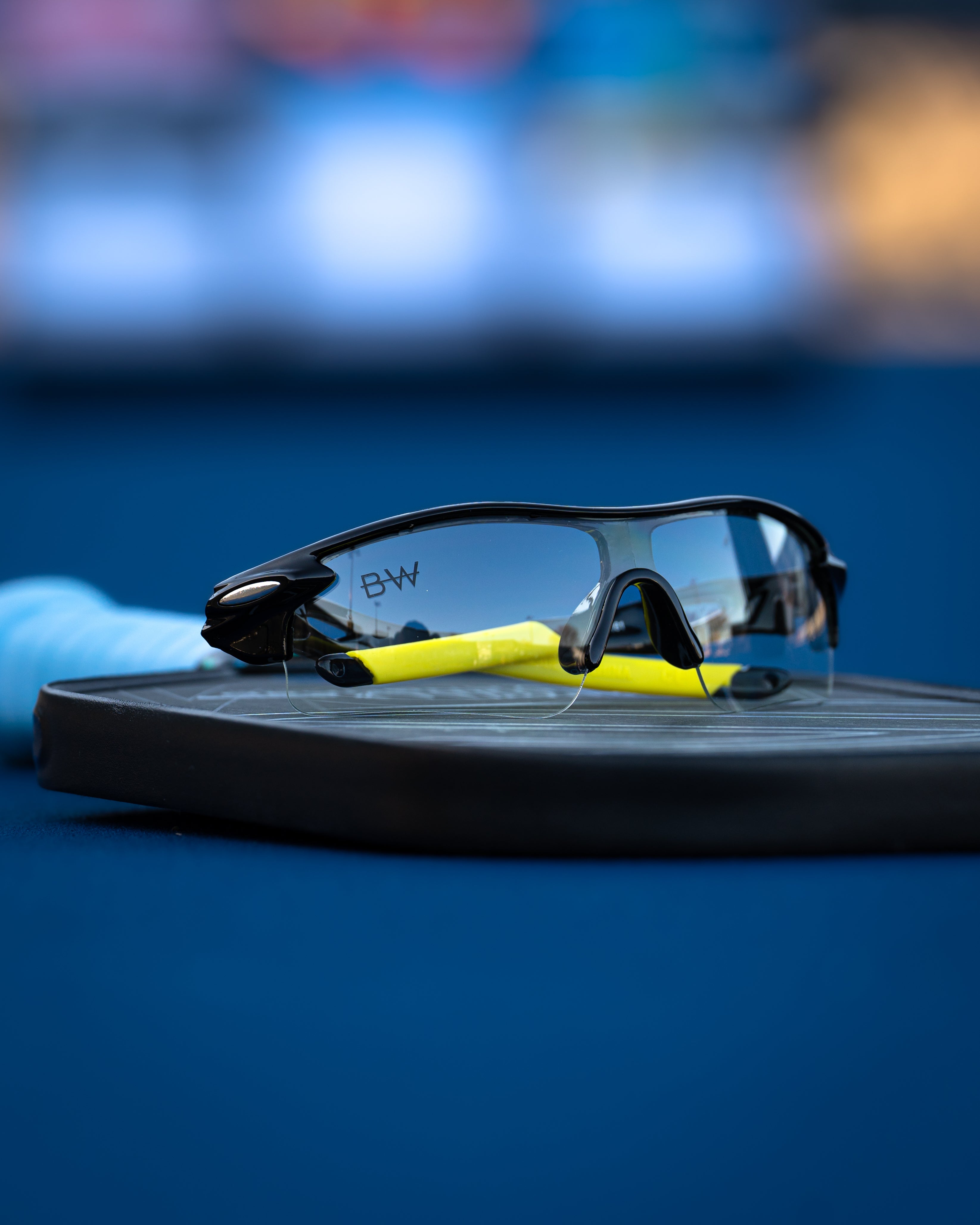
How to Choose Durable Sunglasses That Survive Travel and Tournaments
Share
How to Choose Durable Sunglasses for Travel and Pickleball Tournaments
Tournament eyewear has to handle more than the match itself. A pair of sports sunglasses may move from your home to a car or airport, into luggage, through warm-ups and multiple matches, back into a sports bag, and then repeat the process for several days.
For athletes who travel, durability is partly about impact resistance and partly about how well you choose, pack, handle, inspect, and protect your eyewear throughout the trip.
This guide explains how to choose durable sports sunglasses for pickleball tournaments and travel, what specifications deserve attention, how prescription athletes should prepare, what to pack in your tournament bag, and how to reduce the chance that damaged or missing eyewear disrupts your event.
Important: terms such as durable and impact-resistant do not mean indestructible, shatterproof, or automatically certified to a particular protective standard.
Find Your Pickleball Eyewear
Start with the type of eyewear you need, then use this guide to build your travel and tournament setup around it.
Quick Answer: What Should You Look for in Tournament Travel Sunglasses?
For frequent travel and tournament use, prioritize eyewear that matches your vision needs and playing environment while offering characteristics appropriate for active use.
A useful checklist includes:
- Impact-resistant lenses
- A sports-oriented frame
- Appropriate frame dimensions and fit
- Prescription compatibility if you need RX correction
- A clear or tinted configuration appropriate for where you play
- Any protective certification specifically required for your activity
- Appropriate storage during travel
- A backup plan if your primary eyewear becomes damaged or unavailable
- Replacement support you understand before leaving home
For RX athletes in particular, carrying a backup pair can be one of the most practical tournament preparations because damaged or lost eyewear may also mean losing the vision correction you rely on to play.
Travel Durability Is Different From On-Court Durability
Sports sunglasses can face two different categories of physical demands during a tournament trip.
| On the Court | During Travel |
|---|---|
| Possible ball contact | Compression inside luggage |
| Possible equipment contact | Contact with objects inside a bag |
| Fast movement | Repeated packing and unpacking |
| Sweat and frequent handling | Moving through cars, hotels, airports, and venues |
| Multiple matches | Risk of leaving eyewear behind |
| Repeated removal between games | More opportunities for accidental drops |
That distinction matters. A durable tournament-eyewear strategy should address both the physical characteristics of the glasses and how you manage them away from the court.
Why Travel Can Be Hard on Sports Sunglasses
Some of the greatest risks to tournament eyewear occur when nobody is playing.
Think about a typical tournament weekend. Your glasses may be:
- Packed beside paddles, shoes, chargers, keys, and water bottles
- Moved between luggage and a court bag
- Set down during meals or check-in
- Removed between matches
- Carried through an airport
- Stored in a vehicle or hotel room
- Handled repeatedly over several days
Every additional transition creates another opportunity for the eyewear to be dropped, compressed, misplaced, or contacted by other objects.
Choosing durable eyewear helps, but good travel habits are still necessary even with impact-resistant sports lenses.
Why Tournament Days Create Different Eyewear Demands
A casual game may last for one session. Tournament eyewear can be used repeatedly across warm-ups, matches, breaks, and potentially multiple days.
That can mean:
- More hours wearing the eyewear
- More frequent removal and storage
- More cleaning
- More movement between courts
- More opportunities for accidental impacts
- More dependence on a single pair if you require prescription correction
The best tournament setup therefore is not simply “buy the toughest-looking sunglasses.” It is a combination of appropriate eyewear + careful handling + redundancy when needed.
1. Start With Impact-Resistant Sports Lenses
Impact resistance is one of the most relevant physical lens characteristics for active sports.
Blinded Wear sports lenses are impact-resistant.
That characteristic can be valuable when eyewear is used around balls, paddles, equipment, repeated handling, and the normal physical demands of active use.
However, impact resistance should be interpreted precisely.
Impact-resistant does not mean:
- Impossible to break
- Shatterproof
- Indestructible
- Guaranteed to survive every drop
- Guaranteed to survive every ball or paddle impact
- Automatically certified to a particular protective standard
For tournament shoppers, that distinction is important because realistic durability planning assumes that equipment can eventually be damaged.
Impact-Resistant vs. Safety-Certified Sports Eyewear
If you require a particular level of protective eyewear, do not use the phrase impact-resistant as a substitute for a named certification.
| Term | What It Establishes | What It Does Not Automatically Establish |
|---|---|---|
| Impact-resistant | Resistance to physical impact is a lens characteristic | A particular protective certification |
| Sports eyewear | Eyewear is intended for athletic or active use | Compliance with every sports-eye-protection standard |
| Certified protective eyewear | Compliance with the specifically documented standard | Protection against every possible injury or impact |
If a league, sport, medical professional, or personal situation calls for a specific standard, verify that exact standard for the eyewear you are considering.
2. Evaluate the Complete Frame, Not Just the Lenses
Durability is not solely a lens issue.
A complete pair of sports eyewear also includes:
- The frame surrounding or supporting the lenses
- The bridge
- The temples
- Connection points
- How the lenses are retained by the frame
- How the complete pair fits the wearer
This is why claims such as “impact-resistant lenses” should not be expanded into “the entire pair cannot break.”
For frequent tournament use, visually inspect the entire pair—not only the lens surface.
Do You Need TR90, Nylon, or Another Specific Frame Material?
Material names can be useful when they are verified for a specific product, but shoppers should avoid treating one material label as a universal guarantee of durability.
Do not assume that a Blinded Wear frame uses TR90, nylon, or another particular material unless that specification is documented for the exact model.
Likewise, the material name by itself does not establish:
- How long the complete pair will last
- Whether the eyewear is safety-certified
- Whether the frame will survive every impact
- Whether the glasses will fit securely on every face
Focus on verified product characteristics rather than assuming a material from the way a frame looks.
3. Consider Weight for Long Tournament Days
Tournament athletes may wear their eyewear for extended periods, making frame weight a reasonable consideration.
Blinded Wear uses lightweight sports frames.
But lightweight should not be confused with other characteristics.
| Characteristic | What It Means |
|---|---|
| Lightweight | Relates to the weight of the eyewear |
| Impact-resistant | Relates to resistance to physical impact |
| Secure fit | Depends on the frame and individual wearer |
| Protective certification | Must be verified separately |
A lightweight frame should not automatically be called fragile, but it also should not automatically be called unbreakable or non-slip.
4. Choose a Frame That Fits Before Tournament Day
Fit becomes particularly important when you plan to wear the same eyewear through warm-ups, matches, breaks, and potentially several consecutive days.
When shopping online, compare available frame measurements with eyewear you already know fits you well.
Depending on the product information available, consider:
- Overall frame width
- Lens dimensions
- Bridge dimensions
- Temple length
- Your preferred amount of facial coverage
- How the frame feels during normal movement
Whenever possible, avoid making tournament morning the first time you seriously use a new pair.
Practice in New Eyewear Before You Travel
A tournament trip is a poor time to discover that you dislike the fit, tint, or overall feel of your new sports glasses.
Use the eyewear during normal practice before the event and pay attention to:
- Comfort over a longer session
- Frame fit during normal movement
- Your preference for the lens configuration
- How the eyewear works in the conditions where you normally play
- Whether your prescription feels appropriate if you use RX eyewear
This is a normal wear test. Do not intentionally hit, bend, drop, or otherwise abuse the glasses to perform your own durability test.
What About Non-Slip Nose Pads and Temple Grips?
Some sports frames may use product-specific components intended to influence fit or grip, but these should be verified for the exact model.
Do not assume every sports frame includes:
- Non-slip nose pads
- Adjustable nose pads
- Rubberized temples
- Temple grips
- A guaranteed non-slip fit
Even when a particular fit feature is documented, individual face shape and frame dimensions still matter.
5. Prescription Athletes Need a Tournament-Specific Plan
Prescription sports eyewear creates an additional travel consideration.
If a non-RX pair is lost or damaged, you lose that pair of eyewear. If your primary RX sports glasses are lost or damaged, you may also lose the vision correction you depend on for play.
That makes RX tournament planning especially important.
Blinded Wear prescription sports eyewear includes:
- Impact-resistant sports lenses
- Non-polarized sports lenses
- Lightweight sports frames
- High-index prescription lenses at no additional cost
RX customers provide a clear photo or picture of their eyeglass prescription before purchasing.
6. Consider Bringing a Backup RX Pair
For athletes who depend on prescription eyewear, one of the most practical tournament strategies is redundancy.
A backup pair can help if your primary eyewear becomes:
- Damaged
- Lost
- Misplaced
- Left at a hotel
- Unavailable during part of the trip
A backup does not imply that the primary pair is poorly made. Athletes routinely carry backups of important equipment because unexpected problems can happen.
The more important your prescription eyewear is to your ability to play, the more useful a backup plan can become.
Where Should You Keep Your Backup Glasses?
Carrying two pairs provides less redundancy if both are stored together and the entire bag becomes lost or damaged.
Depending on how you travel, consider keeping your primary and backup eyewear in separate appropriate locations when practical.
For example, an RX athlete might keep:
- The primary sports pair accessible for play
- A backup pair in another secure part of their travel setup
The goal is simple: avoid creating a single point of failure for equipment you rely on to see clearly.
Should Prescription Sports Glasses Go in Your Carry-On?
If you are flying and depend on prescription eyewear, keeping essential glasses accessible rather than placing every usable pair in checked luggage can be a practical travel strategy.
Consider what would happen if checked luggage were delayed or unavailable when you reached the tournament destination.
Items you may want readily accessible include:
- Your primary RX eyewear
- A backup pair if practical
- Appropriate eyewear storage
- Lens-cleaning supplies
- A copy or accessible record of your current prescription
This is less about the physical strength of the glasses and more about making your tournament setup resilient to travel disruptions.
Keep Your Prescription Accessible When Traveling
RX athletes may benefit from having access to their current eyeglass prescription while traveling.
That does not guarantee that replacement eyewear can be produced immediately, but it prevents the prescription information itself from becoming another missing piece if something happens to your glasses.
Depending on your preference, this might mean keeping an accessible digital copy or another appropriate record of your prescription.
7. Pack Sports Sunglasses to Reduce Unnecessary Damage
Travel durability is not just about buying stronger eyewear. It is also about avoiding preventable damage.
Do not assume impact-resistant sports glasses can simply be thrown loose into luggage beside other equipment.
A tournament bag may contain:
- Paddles
- Shoes
- Water bottles
- Keys
- Chargers
- Electronics
- Clothing
- Other hard or abrasive objects
Keeping eyewear appropriately stored and separated from objects that could press against or contact it is a basic part of travel durability.
Should You Use a Protective Case While Traveling?
Appropriate protective storage can help isolate eyewear from the other objects inside luggage or a tournament bag.
The important principle is to avoid leaving glasses loose where they can be:
- Compressed
- Bent
- Scraped against other objects
- Buried underneath equipment
- Accidentally dropped while searching through the bag
Impact resistance should not be treated as a substitute for appropriate storage.
Where You Put Sunglasses in Your Bag Matters
Even properly stored eyewear can be placed poorly inside luggage.
Avoid intentionally positioning your glasses where heavy equipment will repeatedly press against them.
When packing, think about:
- What will be placed above the eyewear
- Whether the bag will be compressed during travel
- How easily you can retrieve the glasses
- Whether hard objects can shift into the eyewear
- Whether you will repeatedly unpack and repack the same compartment
Good packing reduces avoidable stress on the eyewear before you ever reach the court.
Build a Dedicated Eyewear Zone in Your Tournament Bag
One useful tournament habit is giving your eyewear a consistent storage location.
Instead of placing glasses wherever there is room, use the same protected area of your bag whenever you remove them.
This can help reduce:
- Loose storage
- Accidental compression
- Searching through the entire bag
- Leaving glasses behind
- Placing them temporarily in unsafe locations
A consistent storage routine can be just as valuable during a busy tournament as the physical durability of the eyewear itself.
Create a Simple Hotel Eyewear Routine
Tournament travel often means moving equipment between a hotel room, vehicle, venue, and restaurant several times each day.
Choose a consistent location for your eyewear when you return to your room rather than leaving it on random surfaces.
A simple routine might be:
- Return eyewear to its normal storage location.
- Clean it appropriately if needed.
- Inspect it for visible damage.
- Prepare the primary pair for the next day's play.
- Confirm that your backup pair is still where expected.
Consistency reduces the chance of realizing the next morning that your tournament glasses are missing.
Traveling to a Tournament by Car
Driving removes airline luggage concerns, but sports eyewear can still be damaged or misplaced during a road trip.
Avoid:
- Throwing glasses loose among equipment
- Placing heavy bags on top of them
- Leaving them where they can fall when a door opens
- Mixing them loosely with keys or other hard objects
Keep the eyewear in a predictable, appropriately protected location so it is easy to find when you arrive.
Traveling to a Tournament by Plane
Air travel introduces more transitions: security, boarding, overhead storage, checked luggage, ground transportation, and hotels.
If your sports glasses are essential—especially prescription eyewear—consider accessibility and redundancy in addition to durability.
| Travel Concern | Practical Eyewear Strategy |
|---|---|
| Checked luggage unavailable | Keep essential eyewear accessible when practical |
| Bag compression | Use appropriate protective storage |
| Primary RX pair damaged | Consider traveling with backup correction |
| Prescription information needed | Keep an accessible record of your current prescription |
| Frequent handling | Use a consistent storage location |
8. Choose the Right Lens Configuration for the Tournament Environment
Durability alone does not tell you whether a lens is appropriate for the lighting environment where you will play.
Consider whether your tournament is primarily:
- Outdoors in brighter conditions
- Indoors
- In the evening
- Spread across multiple environments
For conditions where a dark sunglass tint is not preferred, clear sports eyewear may be useful.
For outdoor conditions, an athlete may prefer tinted sports sunglasses.
These are viewing and preference considerations. A clear lens is not inherently less durable, and a dark lens is not inherently more durable.
Clear Sports Eyewear for Indoor and Evening Tournament Play
If your tournament includes indoor courts or lower-light sessions where dark tint is not preferred, consider whether a clear pair belongs in your tournament setup.
Blinded Wear offers non-prescription clear sports eyewear including:
Clear describes the absence of dark sunglass tint. It should not automatically be interpreted as anti-fog, scratch-resistant, higher contrast, or better for reaction time or ball tracking.
Should Tournament Players Travel With More Than One Lens Setup?
For athletes who play across substantially different environments, more than one pair can provide flexibility.
For example, a player might prefer:
- Tinted sports eyewear for brighter outdoor sessions
- Clear sports eyewear when dark tint is not preferred
- A backup RX pair if prescription correction is essential
This is not necessary for every player, but frequent competitors may value having alternatives rather than expecting one configuration to handle every possible condition.
Lens Tint Does Not Determine Tournament Durability
Do not choose a lens color because you assume it is physically stronger.
Lens tint does not, by itself, establish:
- Impact resistance
- Scratch resistance
- Protective certification
- Anti-fog performance
- Overall lifespan
Choose lens appearance around your needs and preferences, then evaluate durability separately.
Does Polarization Matter for Durability?
No. Polarization and physical durability are separate characteristics.
A polarized lens is not automatically stronger, and a non-polarized lens is not automatically weaker.
Blinded Wear sports lenses are non-polarized. Some court players prefer non-polarized eyewear, but this should not be turned into a claim that non-polarized lenses inherently improve depth perception, reaction time, or durability.
9. Do Not Confuse Scratch Resistance With Impact Resistance
Tournament travel can expose eyewear to both impacts and abrasive contact, but these are different durability concerns.
| Characteristic | What It Addresses |
|---|---|
| Impact resistance | Physical impact |
| Scratch resistance | Surface scratching |
Do not assume that impact-resistant eyewear is scratch-resistant unless that characteristic is specifically documented for the exact product.
Likewise, even when a lens is described as scratch-resistant, that should not be interpreted as impossible to scratch.
10. Verify UV and Lens-Coating Claims Separately
Durability does not establish every other lens specification.
Do not infer an exact UV specification, anti-fog treatment, hydrophobic treatment, anti-reflective coating, or scratch-resistant coating solely because eyewear is designed for sports.
If one of those features matters to your tournament setup, verify it for the exact lens or product configuration.
| Feature | Does Impact Resistance Prove It? |
|---|---|
| Exact UV specification | No |
| Scratch resistance | No |
| Anti-fog treatment | No |
| Hydrophobic treatment | No |
| Anti-reflective treatment | No |
| Protective certification | No |
11. Pack Appropriate Lens-Cleaning Supplies
Tournament eyewear may need to be cleaned repeatedly over a multi-day event.
Use appropriate lens-cleaning materials rather than whatever fabric happens to be nearby.
In particular, avoid unnecessarily rubbing abrasive debris across the lens surface.
A simple travel eyewear setup should make proper cleaning convenient so you are less tempted to use unsuitable materials between matches.
12. Inspect Your Eyewear Before Leaving for the Tournament
Do not wait until the first match to discover visible damage.
Before traveling, inspect:
- The lenses
- Lens edges
- The frame
- The bridge
- The temples
- Connection points
- Overall alignment
- Whether the eyewear still fits as expected
If your primary pair already has significant visible damage, address the issue before relying on it for a trip.
Inspect Tournament Eyewear Each Day
For a multi-day tournament, a quick inspection can become part of your daily equipment routine.
Before play, look for:
- Visible cracks
- Chipped lens edges
- Visible frame damage
- Loose components
- A displaced-looking lens
- Unexpected changes in fit
If the eyewear takes a substantial impact during play, inspect it again rather than waiting until the next day.
13. Understand Replacement Support Before You Travel
Durability planning should include what happens if your eyewear eventually breaks.
Blinded Wear offers 50% lifetime replacement support if eligible eyewear breaks, subject to current policy terms.
This should not be interpreted as:
- A free lifetime replacement guarantee
- An unconditional lifetime warranty
- Coverage for every possible situation
- Proof that the original eyewear cannot break
Review the applicable policy before you need it.
Replacement Support Is Not the Same as a Tournament Backup
A replacement policy can be valuable, but it does not necessarily solve the immediate problem of losing usable eyewear minutes before a match.
That distinction is especially important for prescription athletes.
Think of the two strategies differently:
- Replacement support helps address what happens after eligible eyewear breaks.
- A backup pair can provide immediate redundancy during the trip.
Frequent tournament players may benefit from thinking about both.
Prescription Sports Eyewear to Explore for Tournament Travel
Rather than assigning an unsupported “most durable” ranking, RX athletes can compare Blinded Wear models by their prescription needs, frame preferences, and available configurations.
- Crystal Wave II RX →
- H Blue Shield RX →
- Gray Hound RX →
- Frost RX →
- Lava Rock RX →
- Phantom II RX →
- Havana Melt RX →
- Rocket Fire RX →
- Silver Line RX →
- Ocean Wave RX →
- Red Shine RX →
Exact prescription compatibility and available configurations should be confirmed for the model being ordered.
Why We Are Not Calling One Pair the “Most Durable” Tournament Sunglasses
A true durability ranking would require comparable testing under defined conditions.
Without that evidence, it would be misleading to claim that one frame:
- Survives more drops than every other model
- Handles the hardest impacts
- Lasts the greatest number of years
- Is universally the best tournament pair
A better shopping strategy is to compare verified characteristics, choose the configuration appropriate for your needs, and build good travel habits around the eyewear you select.
Travel & Tournament Sunglasses: Myth vs. Reality
| Myth | Reality |
|---|---|
| Impact-resistant means safe loose in luggage | Impact-resistant eyewear can still be damaged and should be stored appropriately |
| A durable pair cannot break during travel | No sports eyewear should be assumed indestructible |
| Scratch-resistant means scratch-proof | Scratch resistance, when documented, does not mean scratching is impossible |
| The darkest lens is the toughest | Tint does not determine impact resistance |
| RX eyewear is automatically weaker | Prescription status alone does not establish physical durability |
| One pair is always enough for a tournament | Some athletes, especially RX players, may value a backup |
| Replacement support eliminates the need for a backup | A backup solves a different, immediate problem during travel |
| Expensive eyewear automatically lasts longer | Price alone does not establish lifespan |
Travel & Tournament Sports Sunglasses FAQ
What makes sunglasses good for tournament travel?
Look for eyewear appropriate for your vision needs and playing environment, with documented impact resistance, suitable frame fit, and any protective standard you specifically require. Appropriate storage, inspection, and backup planning also matter during travel.
Should I bring two pairs of sports glasses to a pickleball tournament?
Not every athlete needs two pairs, but a backup can be particularly useful if you depend on prescription eyewear or are traveling far from home.
Should I put prescription glasses in checked luggage?
If your RX eyewear is essential, consider keeping usable correction accessible rather than placing every available pair in checked luggage. This can provide redundancy if luggage is delayed or unavailable.
Do impact-resistant sunglasses survive every drop?
No. Impact resistance does not mean indestructible or guarantee that eyewear will survive every fall or collision.
Are sports sunglasses scratch-proof?
Do not assume so. Impact resistance and scratch resistance are separate characteristics, and even scratch-resistant eyewear should not be interpreted as impossible to scratch.
Do I need clear glasses for indoor tournaments?
If you do not prefer a dark sunglass tint indoors, clear sports eyewear may be an option. The right configuration depends on your needs and preferences.
Should I test new sports sunglasses before a tournament?
Using new eyewear during normal practice can help you evaluate fit, comfort, and lens preference before an important event. Do not intentionally damage the eyewear as a home durability test.
Does Blinded Wear offer prescription sports sunglasses?
Yes. Blinded Wear offers RX sports eyewear with high-index prescription lenses at no additional cost. Customers provide a clear photo or picture of their eyeglass prescription before purchasing.
What happens if my Blinded Wear glasses break?
Blinded Wear offers 50% lifetime replacement support if eligible eyewear breaks, subject to current policy terms.
Does replacement support mean I do not need backup tournament glasses?
No. Replacement support and a backup pair serve different purposes. A backup can provide immediate usable eyewear during the event, while replacement support addresses eligible broken eyewear under the applicable policy.
What Should Be in Your Tournament Eyewear Kit?
A good tournament setup treats eyewear as essential equipment rather than an accessory thrown into the bag at the last minute.
Depending on your vision needs and playing environment, your eyewear kit might include:
- Your primary sports eyewear
- A backup pair if appropriate
- Clear eyewear if you expect indoor or lower-light play where dark tint is not preferred
- Appropriate protective storage
- Lens-cleaning supplies
- An accessible copy or record of your current eyeglass prescription if you use RX eyewear
- Information about your replacement-support options
The goal is not to carry unnecessary equipment. It is to avoid allowing one damaged, lost, or unsuitable pair of glasses to become a preventable tournament problem.
Build a Primary + Backup Eyewear System
For frequent travelers—especially prescription athletes—it can be useful to think in terms of a system rather than a single pair.
| Role | Purpose |
|---|---|
| Primary pair | Your normal sports eyewear for the event |
| Backup pair | Redundancy if the primary pair becomes unavailable |
| Alternative lens setup | An optional second configuration for substantially different playing environments |
| Everyday RX eyewear | Additional correction away from the court if you require prescription glasses |
Not every athlete needs all four. The appropriate setup depends on how dependent you are on prescription correction, how far you are traveling, how many days you will compete, and how much the playing environment changes.
One Pair vs. Two Pairs for a Tournament
There is no rule that every pickleball player needs multiple pairs of sports glasses.
For a local recreational event, one appropriate pair may be enough for your needs. As the consequences of losing that pair increase, however, redundancy can become more useful.
| Situation | Why a Backup May Be Worth Considering |
|---|---|
| Local recreational play | Backup may be optional depending on your needs |
| Multi-day tournament | More use and handling create more opportunities for problems |
| Out-of-town event | Your normal replacement options may not be nearby |
| Air travel | Luggage and travel disruptions add another variable |
| RX-dependent athlete | Damage can remove both the sports eyewear and the correction you rely on |
| Mixed indoor/outdoor event | A second lens configuration may provide more flexibility |
Does Your Backup Pair Need to Be Identical?
Not necessarily.
The purpose of a backup is to provide usable redundancy if your primary pair becomes unavailable.
For prescription athletes, the important consideration is whether the backup provides appropriate correction for the intended use—not whether the frame color or appearance exactly matches the primary pair.
If you are building a two-pair tournament setup, you may also choose different lens configurations for different environments rather than owning two visually identical pairs.
Traveling With RX Sports Glasses vs. Contacts + Non-RX Eyewear
Some athletes use prescription sports glasses, while others use appropriately prescribed contact lenses with non-prescription sports eyewear.
These setups create different travel considerations.
| Setup | Tournament Consideration |
|---|---|
| RX sports eyewear | Vision correction is built into the sports glasses, making backup eyewear particularly relevant if you depend on the pair |
| Contacts + non-RX sports eyewear | Correction and external eyewear are separate, so both parts of the setup need appropriate travel planning |
Contact lenses themselves should not be treated as an external impact barrier for the eyes.
Choose the correction method prescribed and appropriate for you, then plan your external sports eyewear accordingly.
What Do High-Index RX Lenses Mean for Tournament Travel?
Blinded Wear includes high-index prescription lenses at no additional cost with its RX sports eyewear.
High-index describes a prescription lens-material characteristic. It should not be confused with a durability rating.
High-index does not automatically mean:
- Impact-proof
- Scratch-proof
- Anti-fog
- Hydrophobic
- Safety-certified
- More durable during airline travel
With Blinded Wear RX eyewear, impact resistance and high-index prescription lenses are separately stated characteristics.
Plan for the Lighting Conditions at Your Destination
Before packing for a tournament, consider where and when you will actually play.
Your schedule might include:
- Bright outdoor matches
- Covered courts
- Indoor courts
- Morning sessions
- Evening sessions
- Different venues across the same weekend
Durability cannot compensate for bringing a lens configuration you dislike for the playing environment.
Check the tournament schedule and venue information before deciding which eyewear configurations belong in your bag.
Choosing Eyewear for Outdoor Tournaments
For outdoor tournament play, athletes may prefer tinted sports sunglasses rather than clear eyewear.
When comparing options, keep the decision categories separate:
- Tint relates to the lens's visible-light characteristics.
- Polarization relates to a specific reflected-light filtering property.
- Impact resistance relates to physical impact.
- Prescription correction addresses the wearer's prescribed vision needs.
- Frame fit concerns how the eyewear works for the individual wearer.
A single feature should not be used as proof of the others.
Choosing Eyewear for Indoor Tournaments
For indoor courts, some athletes prefer clear sports eyewear rather than a dark sunglass tint.
Clear lenses should be evaluated using the same durability framework as tinted eyewear:
- Is impact resistance documented?
- Does the frame fit appropriately?
- Do you need prescription correction?
- Do you require a specific protective standard?
- Are any additional features you care about actually documented?
Do not assume that clear eyewear automatically improves contrast, reaction time, ball tracking, or depth perception.
What If a Tournament Uses Indoor and Outdoor Courts?
Mixed environments can make a two-configuration setup more useful.
For example, a player may prefer:
- A tinted pair for brighter outdoor play
- A clear pair when dark tint is not preferred indoors
Prescription athletes should verify their RX options rather than assuming that every product is available in every lens configuration.
The goal is not to collect as many pairs as possible. It is to avoid forcing one lens configuration into conditions where you would prefer something different.
What About Changing Light During a Tournament?
A tournament can begin in one lighting environment and end in another.
Players who regularly move between different conditions may consider:
- Carrying more than one fixed lens configuration
- Using clear eyewear for situations where dark tint is not preferred
- Exploring photochromic technology where an appropriate compatible option is available
Photochromic lenses change tint under certain conditions, but that technology should not automatically be described as polarized, anti-fog, scratch-resistant, impact-resistant, or instant.
Are Photochromic Lenses Automatically the Best Travel Option?
No single lens technology is automatically best for every traveling athlete.
Photochromic technology may appeal to athletes who encounter changing environments, but the decision should account for:
- The conditions in which the lenses will be used
- The exact lens configuration available
- The athlete's preferences
- Prescription compatibility if needed
Do not assume that every Blinded Wear RX model offers a photochromic configuration unless that option is verified for the exact product being ordered.
Comfort Matters More During Multi-Match Days
A frame that feels acceptable for a short try-on may feel different after repeated use across a tournament day.
That is another reason to practice in your eyewear before traveling.
During longer sessions, evaluate:
- How the bridge feels
- How the temples feel
- Whether you remain comfortable wearing the frame
- Whether the eyewear's position changes during normal movement
- Whether you find yourself repeatedly adjusting it
Comfort is personal. Avoid assuming that a frame described as lightweight will automatically fit every athlete comfortably for the same amount of time.
What Should You Do With Sunglasses Between Matches?
Between-match handling can create unnecessary risk if eyewear is repeatedly placed on benches, tables, bags, or the ground.
A simple routine is more reliable:
- Remove the eyewear carefully.
- Clean it appropriately if needed.
- Return it to the same protected storage location.
- Retrieve it when preparing for the next match.
The fewer temporary places you use for your eyewear, the fewer opportunities there are to forget, sit on, step on, or pile equipment over it.
Avoid Loose Court-Side Storage
During a busy event, it is easy to place sunglasses somewhere “for just a minute.”
Potential problem locations include:
- On top of a sports bag
- Loose inside an open bag
- On a bench
- On the ground
- Beside paddles or other equipment
Using a consistent protected location can reduce unnecessary handling and accidental damage.
How to Clean Sports Sunglasses During a Tournament
Frequent play can mean frequent cleaning.
Use appropriate lens-cleaning materials and avoid grinding visible debris across the lens surface.
Do not assume that sports eyewear is scratch-proof simply because it is designed for active use.
Likewise, avoid using the shirt, towel, or nearest available fabric simply because you are in a hurry if it could introduce abrasive material against the lenses.
What If Your Glasses Fog During Tournament Play?
Fogging and durability are separate issues.
Do not assume that impact-resistant, high-index, clear, tinted, or non-polarized lenses are automatically anti-fog.
Fogging can be influenced by the conditions around the eyewear, including temperature, humidity, moisture, and airflow.
If anti-fog performance is important to you, verify any product-specific feature rather than assuming it is included.
What About Rain, Sweat, and Moisture?
Tournament conditions are not always ideal. Outdoor events can involve humidity, sweat, changing weather, and moisture.
Those conditions do not establish that the lenses include a hydrophobic treatment.
Do not assume sports eyewear is:
- Hydrophobic
- Water-repellent
- Fog-proof
- Anti-fog
unless the relevant characteristic is documented for the exact product.
What to Do If Your Glasses Take a Hit During a Tournament
If your eyewear experiences a significant ball strike, equipment impact, fall, or other substantial contact, inspect it before continuing to rely on it.
Look for:
- Visible cracks
- Chipped lens edges
- Lens displacement
- Visible frame damage
- Loose components
- A change in frame alignment
- A sudden change in fit
Impact-resistant does not mean that the eyewear should automatically continue being used after any possible collision.
What to Do If You Drop Your Sunglasses While Traveling
A drop does not automatically mean a pair is unusable, but it is worth inspecting the eyewear before putting it back into service.
Check the:
- Lens surfaces
- Lens edges
- Frame
- Bridge
- Temples
- Connection points
- Overall alignment
If the glasses appear damaged or fit substantially differently afterward, do not assume that their original impact-resistant specification means the damage can be ignored.
What If Your RX Sports Glasses Break Mid-Tournament?
This is where backup planning becomes especially valuable.
If your primary RX sports eyewear becomes unusable, a backup pair can potentially prevent the equipment problem from becoming an immediate vision-correction problem as well.
Without a backup, your options may depend on:
- Other correction you already have available
- Your location
- Your prescription
- Available optical services
- The remaining tournament schedule
Replacement support can help with eligible broken eyewear under the applicable terms, but it should not be treated as a guarantee of immediate same-event replacement.
What If You Lose Your Tournament Glasses?
Durability cannot solve loss.
A strong tournament-eyewear strategy therefore includes organization as well as physical protection.
Helpful habits include:
- Using the same storage location each time
- Checking for your eyewear before leaving the venue
- Checking your hotel room before departure
- Keeping backup correction separately when appropriate
- Avoiding unnecessary temporary storage locations
The most impact-resistant pair in your bag cannot help if it is left behind at the previous venue.
The 60-Second Eyewear Check Before Leaving a Venue
Before leaving the court, hotel, airport lounge, restaurant, or other stop, quickly confirm:
- ☐ Primary eyewear is accounted for
- ☐ Backup eyewear is accounted for
- ☐ Eyewear is stored appropriately
- ☐ Cleaning supplies are back in the bag
- ☐ No glasses were left on a bench, table, or court-side surface
A short routine can prevent a much larger problem later in the trip.
End-of-Day Tournament Eyewear Routine
After a long competition day, it can be tempting to throw everything into the hotel room and deal with it the next morning.
Instead, take a moment to:
- Account for your primary pair.
- Account for any backup pair.
- Clean the eyewear appropriately if needed.
- Inspect it for visible damage.
- Store it in its normal protected location.
- Confirm that the next day's lens setup is ready.
This makes eyewear part of the same preparation routine as your other tournament equipment.
Planning Eyewear for a Multi-Day Tournament
The longer the event, the more important repeatable habits become.
A useful multi-day routine looks like this:
Inspect → Play → Store → Clean → Inspect → Prepare → Repeat.
That routine helps address both sides of tournament durability:
- The physical condition of the eyewear
- The way the athlete handles it over repeated days
Durability is not only what happens when the glasses are struck. It is also how well the equipment is managed through repeated use.
How Trip Length Changes Eyewear Planning
| Trip Type | Eyewear Planning Considerations |
|---|---|
| Local day event | Primary eyewear, appropriate storage, cleaning supplies |
| Weekend tournament | Consider backup eyewear and multiple playing environments |
| Multi-day destination event | Backup planning becomes increasingly useful, especially for RX athletes |
| Flight-based tournament trip | Consider accessibility of essential eyewear if luggage becomes unavailable |
This is a planning framework, not a rule that every athlete must carry a particular number of pairs.
Tournament Sports Sunglasses vs. Everyday Sunglasses
An everyday pair may work well for casual life without being the pair you want to depend on through repeated tournament use.
Instead of assuming one category is always stronger than the other, compare the documented characteristics.
| Question | Why It Matters for Tournament Use |
|---|---|
| Is impact resistance documented? | Sports can involve accidental physical contact |
| Does the frame work for active use? | You may wear it through repeated movement and multiple matches |
| Does it provide the correction you need? | Essential for athletes who require RX lenses |
| Is the lens configuration appropriate? | Playing environments can vary throughout the event |
| Does it meet any standard you require? | Sports eyewear and certified protective eyewear are not automatically the same |
How to Read “Travel-Ready” and “Tournament-Ready” Eyewear Claims
Terms such as travel-ready, competition-ready, and tournament-ready can sound useful, but they are more meaningful when tied to actual product characteristics.
Instead of stopping at the marketing phrase, ask:
- Are the lenses impact-resistant?
- Is the eyewear prescription-compatible if I need RX?
- What are the frame dimensions?
- Is the lens clear or tinted?
- Is it polarized or non-polarized?
- Are any additional treatments explicitly documented?
- Does it meet a specific protective standard if I need one?
- What replacement support exists?
Specific information is more useful than an undefined “tournament-grade” label.
Durability Claims to Treat Carefully
Be cautious with absolute language that promises more than a product specification can reasonably establish.
| Claim | Better Question |
|---|---|
| “Travel-proof” | What exact durability characteristic is documented? |
| “Unbreakable” | What impact resistance is actually claimed? |
| “Scratch-proof” | Is scratch resistance documented? |
| “Perfect for every tournament” | Does the lens configuration match my venue and schedule? |
| “Never slips” | What fit feature is documented, and does the frame fit me? |
| “Maximum protection” | Is a specific protective standard documented? |
| “All-weather” | Which exact characteristics support the claim? |
Step-by-Step: How to Buy Sports Sunglasses for a Tournament Trip
-
Start with your prescription needs.
If you require RX correction in the glasses, begin with prescription-compatible sports eyewear.
-
Check the tournament environment.
Determine whether you expect outdoor, indoor, evening, or mixed-condition play.
-
Verify impact resistance.
Do not infer it solely from the frame's appearance.
-
Verify any required protective standard.
Impact resistance and certification are different.
-
Compare frame dimensions.
Use eyewear you already know fits as a reference when possible.
-
Verify additional lens features separately.
Do not assume scratch resistance, anti-fog performance, UV specifications, or other treatments.
-
Choose the style you prefer.
Functional sports eyewear can still reflect your personal style.
-
Practice in the eyewear.
Evaluate fit, comfort, and lens preference before traveling.
-
Decide whether you need a backup.
This can be especially important for RX athletes.
-
Prepare appropriate storage.
Do not depend on impact resistance alone to protect eyewear in luggage.
Prescription Tournament Eyewear Buying Checklist
- ☐ Current eyeglass prescription available
- ☐ Exact model checked for prescription compatibility
- ☐ Impact resistance confirmed
- ☐ Frame measurements reviewed
- ☐ Playing environment considered
- ☐ Lens configuration selected
- ☐ Any required protective standard verified
- ☐ New eyewear tested during normal practice
- ☐ Backup plan considered
- ☐ Travel storage prepared
- ☐ Replacement-support terms reviewed
For Blinded Wear RX orders, provide a clear photo or picture of your eyeglass prescription.
Non-RX Tournament Sunglasses Buying Checklist
- ☐ Playing environment identified
- ☐ Impact resistance verified
- ☐ Clear vs. tinted preference selected
- ☐ Polarization preference considered
- ☐ Frame dimensions reviewed
- ☐ Any required protective standard verified
- ☐ Product-specific features checked rather than assumed
- ☐ Eyewear tested during normal practice
- ☐ Travel storage prepared
- ☐ Replacement support reviewed
Durability Does Not Mean Giving Up Style
Once your functional requirements are established, appearance becomes a legitimate part of the buying decision.
You may compare:
- Frame shape
- Frame color
- Lens appearance
- Sport-forward versus understated styling
- Whether you also want to wear the frame away from the court
Traveling athletes may especially appreciate eyewear they enjoy wearing throughout the trip rather than only during a match.
The important distinction is that style should complement verified sports characteristics—not replace them.
Traveling for More Than Pickleball?
If you plan to use the same eyewear across several sports or activities, evaluate the pair for each intended use rather than relying solely on a “multi-sport” label.
Consider:
- The environment of each sport
- Movement patterns
- Fit preferences
- Impact considerations
- Any sport-specific protective requirements
One pair may work across several activities for the same athlete, but suitability should be evaluated rather than assumed.
Example: A Simple Tournament Eyewear Routine
Here is what a practical tournament day might look like:
Before Leaving the Hotel
- Inspect primary eyewear
- Confirm backup eyewear is packed if bringing one
- Confirm cleaning supplies are packed
- Place eyewear in its normal protected location
Before the First Match
- Put on the appropriate eyewear configuration
- Confirm normal fit and comfort
- Store any unused pair appropriately
Between Matches
- Return removed eyewear to its designated storage location
- Clean lenses appropriately if needed
- Inspect after any significant impact
Before Leaving the Venue
- Account for all eyewear
- Return each pair to appropriate storage
- Check that nothing was left court-side
At the End of the Day
- Inspect eyewear
- Clean if needed
- Store it consistently
- Prepare for the next day's conditions
12 Tournament Eyewear Mistakes to Avoid
- Putting every RX pair in checked luggage.
- Traveling without backup correction when losing your primary pair would seriously disrupt the event.
- Throwing eyewear loose into a paddle or equipment bag.
- Assuming impact-resistant means indestructible.
- Assuming sports eyewear is automatically safety-certified.
- Buying new eyewear immediately before the tournament without practicing in it.
- Assuming lightweight means universally secure.
- Assuming a dark tint makes a lens more durable.
- Assuming impact resistance also means scratch resistance.
- Leaving glasses in random locations between matches.
- Ignoring visible damage after a substantial impact.
- Relying on replacement support as if it were the same thing as having an immediate backup.
Travel & Tournament Eyewear Scorecard
Before buying, use this scorecard as a decision checklist rather than assigning arbitrary durability points.
| Question | Check |
|---|---|
| Does it provide the prescription correction I need? | ☐ |
| Is impact resistance documented? | ☐ |
| Have I checked the frame dimensions? | ☐ |
| Does the lens configuration fit my tournament environment? | ☐ |
| Have I verified any protective standard I require? | ☐ |
| Have I verified additional lens features rather than assuming them? | ☐ |
| Have I practiced in the eyewear? | ☐ |
| Do I have appropriate travel storage? | ☐ |
| Do I need a backup pair? | ☐ |
| Do I understand the replacement-support terms? | ☐ |
Verified Blinded Wear Characteristics for Traveling Athletes
When comparing Blinded Wear eyewear for tournament travel, focus on characteristics that can be stated without turning them into unsupported promises.
- Impact-resistant sports lenses
- Non-polarized sports lenses
- Lightweight sports frames
- Prescription sports-eyewear options
- High-index prescription lenses at no additional cost with RX eyewear
- Clear non-prescription sports-eyewear options
- 50% lifetime replacement support if eligible eyewear breaks, subject to current policy terms
These characteristics do not mean the eyewear should be described as shatterproof, scratch-proof, impossible to break, anti-fog, hydrophobic, or certified to a particular protective standard unless the exact additional claim is separately documented.
Explore Blinded Wear RX Sports Eyewear Before Your Next Tournament
Prescription athletes can compare available models rather than relying on unsupported claims that one is universally the “best” or “most durable” travel option.
| RX Model | Explore |
|---|---|
| H Blue Shield RX | View Model → |
| Crystal Wave II RX | View Model → |
| Gray Hound RX | View Model → |
| Frost RX | View Model → |
| Lava Rock RX | View Model → |
| Phantom II RX | View Model → |
| Havana Melt RX | View Model → |
| Rocket Fire RX | View Model → |
| Silver Line RX | View Model → |
| Ocean Wave RX | View Model → |
| Red Shine RX | View Model → |
Exact prescription compatibility and available configurations should be confirmed for the model being ordered.
More Questions About Tournament & Travel Sunglasses
How should I pack sports sunglasses for a flight?
Store eyewear appropriately and avoid leaving it loose where luggage contents can press against or contact it. If prescription eyewear is essential, consider keeping usable correction accessible rather than putting every available pair in checked luggage.
Should I carry backup prescription glasses when flying to a tournament?
A backup can be particularly useful when you depend on RX eyewear and would have difficulty competing without your primary pair. The farther you travel and the longer the event, the more valuable redundancy may become.
Can I keep sports sunglasses loose in my pickleball bag?
Appropriate storage is preferable. Sports bags commonly contain hard or abrasive objects that can contact eyewear during transportation and handling.
Are impact-resistant lenses enough for tournament travel?
Impact resistance is useful, but travel durability also involves frame condition, fit, storage, handling, inspection, and backup planning.
Should I bring clear and tinted glasses to a tournament?
If you expect substantially different playing environments and prefer different lens configurations for them, carrying more than one setup may be useful. It is not necessary for every player.
Are clear lenses weaker than tinted lenses?
Not because they are clear. Tint and impact resistance are separate characteristics.
Can I use one pair for indoor and outdoor pickleball?
Possibly, depending on your preferences and the exact lens configuration. Some athletes may prefer separate clear and tinted options for substantially different environments.
Do I need polarized sunglasses for outdoor tournaments?
Polarization is a lens preference and reflected-light filtering characteristic, not a universal tournament requirement. Blinded Wear sports lenses are non-polarized.
Are non-polarized lenses better for depth perception?
It is too broad to claim that non-polarized lenses universally improve depth perception. Some court players prefer them, but preference should not be converted into a guaranteed performance advantage.
Will lightweight sports sunglasses stay on better?
Weight alone does not establish secure fit. Frame dimensions, design, and the individual wearer also matter.
Are Blinded Wear sports lenses scratch-resistant?
Do not infer scratch resistance from impact resistance. A scratch-resistance claim should be verified separately for the exact product or lens configuration.
Are Blinded Wear sports glasses anti-fog?
Do not assume anti-fog performance unless it is specifically documented for the exact product or lens configuration.
Does Blinded Wear use TR90 frames?
A specific frame material should only be assigned to a model when it is documented for that exact product. Do not infer TR90 solely because a frame is lightweight or intended for sports.
Can Blinded Wear RX glasses use high-index lenses?
Blinded Wear includes high-index prescription lenses at no additional cost with its RX eyewear.
How do I submit my prescription?
Provide a clear photo or picture of your eyeglass prescription when ordering Blinded Wear RX eyewear.
What should I do if my glasses are damaged during a match?
Inspect the lenses, frame, and other components after a significant impact. Do not assume impact resistance means visible damage can be ignored.
Does Blinded Wear's replacement support cover broken eyewear?
Blinded Wear offers 50% lifetime replacement support if eligible eyewear breaks, subject to current policy terms.
Is replacement support the same as travel insurance for my sunglasses?
No. Review the actual replacement-support terms for eligible eyewear rather than assuming the policy covers every travel loss, accident, or circumstance.
Should I keep a copy of my prescription while traveling?
RX athletes may find it useful to keep their current prescription information accessible. Having the information does not guarantee immediate replacement eyewear, but it prevents the prescription itself from being unavailable if needed.
How far in advance should I test new tournament glasses?
Use new eyewear during normal practice before relying on it at an important tournament. The purpose is to evaluate fit, comfort, and lens preference—not to intentionally stress-test the glasses.
Final Decision Framework: Choosing Durable Sunglasses for Travel and Tournaments
For tournament travel, the strongest setup is not simply the pair with the longest feature list. It is eyewear that matches your vision needs, playing environment, fit preferences, and travel routine.
Use this order when making your final decision:
-
Determine whether you need prescription correction.
If you depend on RX eyewear, start with prescription compatibility before comparing secondary features.
-
Identify where you will play.
Consider outdoor, indoor, evening, and mixed-environment tournament schedules.
-
Verify impact resistance.
Look for an explicit product characteristic rather than assuming that every athletic-looking frame is impact-resistant.
-
Verify any protective standard you specifically require.
Impact-resistant sports eyewear should not automatically be treated as certified protective eyewear.
-
Evaluate frame dimensions and fit.
The eyewear still needs to work for the individual wearer through repeated tournament use.
-
Separate optional lens features from durability.
Tint, polarization, high-index material, anti-fog treatments, scratch resistance, and other characteristics should be evaluated independently.
-
Practice in the eyewear before traveling.
Evaluate normal fit, comfort, and lens preference before an important event.
-
Prepare appropriate travel storage.
Do not rely on impact resistance as a substitute for protecting eyewear inside luggage or equipment bags.
-
Decide whether you need a backup.
This is especially important when losing your primary RX pair would interfere with your ability to compete.
-
Understand your replacement options.
Know what support exists if eligible eyewear eventually breaks.
Which Tournament Eyewear Setup Fits Your Situation?
| Tournament Situation | Eyewear Considerations | Travel Consideration |
|---|---|---|
| Outdoor local tournament | Tinted sports eyewear may suit players who prefer tint outdoors | Appropriate storage and cleaning supplies |
| Indoor tournament | Clear eyewear may suit players who do not prefer dark tint indoors | Appropriate storage and cleaning supplies |
| Indoor + outdoor event | Consider whether more than one lens configuration would be useful | Keep each pair appropriately stored |
| RX-dependent player | Prescription compatibility is essential | Consider backup correction |
| Multi-day tournament | Comfort and repeated-use considerations become increasingly relevant | Use a repeatable inspect, clean, and storage routine |
| Fly-away tournament | Choose eyewear before the trip and practice in it | Consider keeping essential RX eyewear accessible |
| Frequent tournament traveler | Build a repeatable primary and backup system around your needs | Use consistent packing and storage locations |
The Three-Layer Tournament Eyewear System
A simple way to remember everything in this guide is to divide tournament eyewear planning into three layers.
Layer 1: The Eyewear
- Correct RX configuration if needed
- Impact-resistant sports lenses
- Appropriate frame dimensions and fit
- Clear or tinted lens configuration based on preference and conditions
- Any specifically required protective certification
Layer 2: The Travel Setup
- Appropriate storage
- Consistent location in your bag
- Cleaning supplies
- Accessible RX information when relevant
- Backup eyewear when appropriate
Layer 3: The Tournament Routine
- Inspect before play
- Store consistently between matches
- Clean appropriately
- Inspect after significant impacts
- Account for every pair before leaving the venue
Durable eyewear is most useful when the equipment itself and the way you manage it work together.
Tournament Week Eyewear Checklist
Several Days Before Travel
- ☐ Confirm your primary eyewear
- ☐ Practice in any newly purchased pair
- ☐ Inspect the lenses and frame
- ☐ Review the tournament venue and expected playing environments
- ☐ Decide whether you need clear, tinted, or multiple configurations
- ☐ Decide whether you need backup eyewear
- ☐ RX athletes: confirm your prescription information is accessible
When Packing
- ☐ Store primary eyewear appropriately
- ☐ Pack backup eyewear if bringing it
- ☐ Pack lens-cleaning supplies
- ☐ Keep eyewear away from unnecessary pressure and abrasive objects
- ☐ RX athletes flying: consider whether essential correction should remain accessible
Before Each Tournament Day
- ☐ Inspect lenses
- ☐ Inspect frame and connection points
- ☐ Confirm normal fit
- ☐ Choose the appropriate lens configuration for the day's environment
- ☐ Confirm backup eyewear is where expected
Before Leaving the Venue
- ☐ Account for primary eyewear
- ☐ Account for backup eyewear
- ☐ Return each pair to its normal storage location
- ☐ Check benches, tables, and court-side areas
After the Tournament
- ☐ Inspect eyewear for visible damage
- ☐ Clean appropriately
- ☐ Return eyewear to normal storage
- ☐ Address damage before the next event
Printable Pickleball Tournament Eyewear Packing List
| Item | Why You Might Pack It | Packed? |
|---|---|---|
| Primary sports eyewear | Main pair for competition | ☐ |
| Backup eyewear | Redundancy if the primary pair becomes unavailable | ☐ |
| Clear sports eyewear | Optional configuration when dark tint is not preferred | ☐ |
| Tinted sports eyewear | Optional configuration for players who prefer tint outdoors | ☐ |
| Appropriate protective storage | Helps separate eyewear from other equipment | ☐ |
| Lens-cleaning supplies | For appropriate cleaning during the trip | ☐ |
| Current RX information | Useful for prescription athletes while away from home | ☐ |
| Replacement-support information | Useful if eligible eyewear breaks | ☐ |
What Each Eyewear Feature Actually Tells You
Tournament shoppers frequently encounter several features listed together. They should not be treated as interchangeable.
| Feature | What It Relates To | What It Does Not Automatically Mean |
|---|---|---|
| Impact-resistant | Resistance to physical impact | Shatterproof, indestructible, or certified to a particular standard |
| Lightweight | Eyewear weight | Unbreakable or universally secure |
| High-index | Prescription lens-material characteristic | Anti-fog, scratch-resistant, or automatically more impact-resistant |
| Non-polarized | No polarization filter added | Better durability, reaction time, tracking, or depth perception |
| Clear lens | No dark sunglass tint | Better durability, tracking, contrast, or reaction time |
| Tinted lens | Visible-light characteristics | Greater physical durability |
| Scratch-resistant | Resistance to surface scratching when specifically documented | Scratch-proof or impact-proof |
| Anti-fog | A product-specific fog-management characteristic when documented | Impact resistance or physical durability |
| Protective certification | Compliance with the specific documented standard | Protection from every possible impact or injury |
Durability Does Not Automatically Improve Athletic Performance
Durability is valuable because sports eyewear is equipment used in active environments. That does not mean a more durable pair automatically makes an athlete perform better.
Impact-resistant eyewear does not inherently provide:
- Faster reaction time
- Better ball tracking
- Improved depth perception
- Greater accuracy
- Better anticipation
- Improved court positioning
Those athletic outcomes involve the athlete's vision, visual processing, skill, experience, movement, decision-making, and training.
The role of durable sports eyewear is more practical: provide eyewear suited to active use while addressing the wearer's actual lens and prescription needs.
What Does “Optical Clarity” Mean for Tournament Eyewear?
Terms such as clear vision and optical clarity can become vague when they are used as broad performance promises.
For prescription athletes, appropriate RX correction is intended to address the wearer's prescribed vision needs. For non-RX athletes, the lens configuration should be evaluated according to its actual documented characteristics.
Do not automatically translate “clarity” into claims of:
- Faster reactions
- Better tracking
- More accurate shots
- Enhanced depth perception
- Guaranteed tournament performance
What Does “Protect Your Eyes” Mean in Sports Eyewear?
Sports eyewear places a physical lens and frame in front of the eyes, and impact resistance is relevant when physical contact may occur.
However, durability language should remain precise.
A pair should not be described as guaranteeing that:
- No eye injury can occur
- Every ball strike will be harmless
- The lens can never break
- The frame can never fail
- The eyewear meets an unspecified safety standard
If a particular protective certification is important for your situation, verify that exact standard rather than relying on broad marketing terms such as “maximum protection.”
How Long Should Tournament Sports Sunglasses Last?
There is no universal lifespan for sports eyewear.
Longevity can depend on factors such as:
- How frequently the eyewear is used
- How it is stored
- Whether it experiences significant impacts
- How often it travels
- How it is cleaned and handled
- The condition of the complete frame and lenses
Claims such as “one pair lasts several years” should not be treated as a guarantee for every athlete.
A better habit is to inspect sports eyewear regularly and respond to its actual condition.
When Should You Consider Replacing Tournament Eyewear?
Age alone does not determine whether a pair needs replacement, but visible damage deserves attention.
Inspect or reassess eyewear when you notice:
- Visible lens cracks
- Chipped lens edges
- Significant frame damage
- A lens that appears displaced
- Loose or damaged components
- A substantial change in alignment
- A sudden change in fit after an impact
Do not intentionally continue stressing damaged eyewear to find out how much more abuse it can tolerate.
Are More Expensive Tournament Sunglasses More Durable?
Price alone is not a durability specification.
The cost of sports eyewear can reflect multiple factors, including:
- Prescription configuration
- Lens technology
- Frame design
- Brand positioning
- Manufacturing
- Available support
Instead of using price as a durability score, compare the characteristics that matter for your needs.
A higher price does not automatically mean indestructible, and a lower price does not automatically mean unsuitable for sports.
What Makes Tournament Eyewear a Good Value?
For a traveling athlete, value can include more than the initial purchase price.
Ask:
- Does it provide the correction I need?
- Is impact resistance documented?
- Does the frame work for my preferences?
- Does the lens configuration suit where I play?
- Will I actually wear it regularly?
- Can I travel with it appropriately?
- Do I have a backup strategy if necessary?
- What happens if eligible eyewear breaks?
A well-planned eyewear setup can be more useful than choosing solely by the number of features listed on a product page.
Can Durable Tournament Sunglasses Still Look Good?
Yes. Style and durability are separate buying considerations, not opposing goals.
First establish your functional requirements:
- RX or non-RX
- Impact resistance
- Required protective standard, if applicable
- Lens configuration
- Frame dimensions and fit
Then compare the visual details you care about:
- Frame color
- Frame shape
- Lens appearance
- Bold or understated design
- Whether you also want to wear the eyewear away from the court
Traveling athletes do not need to choose between eyewear intended for active use and a frame style they actually enjoy wearing.
Explore Prescription Sports Eyewear for Your Next Tournament
Blinded Wear offers multiple RX sports-eyewear designs. Rather than assigning an unsupported durability ranking, compare the models according to your prescription needs, frame preferences, and available configurations.
- H Blue Shield RX →
- Lava Rock RX →
- Phantom II RX →
- Crystal Wave II RX →
- Havana Melt RX →
- Rocket Fire RX →
- Silver Line RX →
- Frost RX →
- Ocean Wave RX →
- Red Shine RX →
- Gray Hound RX →
Exact prescription compatibility and available configurations should be confirmed for the model being ordered.
Explore Clear Sports Eyewear for Tournament Travel
For non-RX athletes who want sports eyewear without a dark sunglass tint, Blinded Wear offers clear options including:
Clear lenses can be considered for indoor, evening, covered, or other conditions where a dark sunglass tint is not preferred.
Build Replacement Support Into Your Tournament Plan
Even carefully chosen, impact-resistant sports eyewear can eventually break.
Blinded Wear provides 50% lifetime replacement support if eligible eyewear breaks, subject to current policy terms.
For traveling athletes, remember that replacement support and immediate redundancy solve different problems.
| Strategy | Purpose |
|---|---|
| Impact-resistant eyewear | Provides a lens characteristic relevant to physical impact |
| Appropriate travel storage | Reduces unnecessary exposure to damaging objects and compression |
| Backup pair | Provides immediate redundancy if the primary pair becomes unavailable |
| Replacement support | Provides a replacement path for eligible broken eyewear under the applicable terms |
FAQ: Durable Sunglasses for Travel & Pickleball Tournaments
What are the best sunglasses for pickleball tournament travel?
There is no universal best pair for every player. Start with your prescription needs, playing environment, impact resistance, frame fit, any required protective standard, and lens preferences. Then consider travel storage, backup eyewear, and replacement support.
What makes sports sunglasses durable?
Durability can involve several characteristics rather than one label. Impact resistance is particularly relevant to physical impact, while the frame, storage, handling, and care also affect how eyewear holds up during repeated use.
Can durable sunglasses survive being dropped?
Impact resistance can be relevant to accidental physical contact, but no pair should be assumed to survive every drop without damage.
Can I throw impact-resistant glasses into my luggage?
Appropriate storage is still recommended. Impact resistance does not mean the eyewear cannot be compressed, scratched, bent, or otherwise damaged during travel.
Should tournament players bring backup sunglasses?
A backup is optional for many players but can become particularly useful for multi-day travel and athletes who depend on prescription eyewear.
How many pairs of glasses should I take to a pickleball tournament?
There is no required number. Some players may only need one appropriate pair, while others may prefer a primary pair, backup eyewear, or separate clear and tinted configurations.
Should I bring a spare pair if I wear prescription sports glasses?
It can be a practical strategy because damage or loss of the primary pair may also remove the vision correction you depend on during play.
Should I carry my prescription when traveling for tournaments?
Having access to your current eyeglass prescription can be useful for RX athletes. It does not guarantee immediate replacement eyewear, but it keeps the prescription information available.
Should prescription sports glasses go in my carry-on when flying?
If you depend on them, consider keeping usable correction accessible rather than placing every available pair in checked luggage.
Do I need a hard case for tournament sunglasses?
Appropriate protective storage can help separate eyewear from other equipment and reduce unnecessary compression or contact during travel.
Are lightweight sunglasses durable?
Weight alone does not determine durability. Lightweight and impact-resistant are separate characteristics.
Are dark sunglasses more durable than clear glasses?
No. Tint does not establish physical durability.
Are polarized sunglasses more durable?
No. Polarization and impact resistance are separate lens characteristics.
Are non-polarized sunglasses better for pickleball?
Some court players prefer non-polarized eyewear, but it should not be claimed that non-polarized lenses universally improve depth perception, tracking, reaction time, or performance. Blinded Wear sports lenses are non-polarized.
Are high-index prescription lenses more durable?
High-index describes a prescription lens-material characteristic. It does not automatically establish impact resistance, scratch resistance, anti-fog performance, or protective certification.
Does Blinded Wear include high-index RX lenses?
Yes. Blinded Wear includes high-index prescription lenses at no additional cost with its RX sports eyewear.
Are Blinded Wear sports lenses impact-resistant?
Yes. Blinded Wear sports lenses are impact-resistant. Impact-resistant should not be interpreted as shatterproof, indestructible, or automatically certified to a specific protective standard.
Are Blinded Wear lenses scratch-proof?
Do not assume so. Scratch resistance is separate from impact resistance and should be verified for the exact product or configuration when relevant.
Are Blinded Wear glasses anti-fog?
Do not assume anti-fog performance unless it is specifically documented for the exact product or configuration.
Can I wear clear sports eyewear for an indoor tournament?
Clear sports eyewear can be considered for indoor or other conditions where a dark sunglass tint is not preferred.
What should I do if my glasses take a hard hit during a match?
Inspect the lenses, lens edges, frame, connection points, alignment, and fit. Do not assume that impact resistance means damage is impossible.
How often should I inspect tournament eyewear?
A quick inspection before tournament play and after significant impacts is a useful equipment habit. Multi-day competitors can also inspect their eyewear at the end or beginning of each day.
How long should tournament sunglasses last?
There is no universal lifespan. Usage frequency, impacts, storage, care, travel, and the condition of the complete eyewear all matter.
What happens if my Blinded Wear glasses break?
Blinded Wear offers 50% lifetime replacement support if eligible eyewear breaks, subject to current policy terms.
Does the replacement policy cover anything that happens while traveling?
Do not assume coverage for every type of loss, damage, or travel situation. Review the current policy terms to understand eligibility.
Related Pickleball Travel & RX Eyewear Guides
Not Sure Which Pair to Start With?
If you are comparing prescription and non-prescription options for your next tournament, use the Blinded Wear pickleball eyewear quiz as another way to explore the collection.
Sports Eyewear With a Broader Mission
Blinded Wear's eyewear offering is built around athletes while supporting a broader mission focused on children's vision.
Choose Your Tournament Eyewear
| Your Need | Start Here |
|---|---|
| I need prescription sports eyewear | Shop RX Sports Eyewear → |
| I want non-prescription sports sunglasses | Shop Non-RX Sunglasses → |
| I want clear sports eyewear | Shop Clear Sports Eyewear → |
| I need help exploring options | Take the Eyewear Quiz → |
| I want the complete buying guide | Explore the 2026 Eyewear Guide → |
| I want to understand replacement support | Review Replacement Support → |
Bottom Line: Durable Tournament Eyewear Is a System, Not Just a Pair of Glasses
The best tournament-travel strategy combines appropriate sports eyewear with smart packing, consistent handling, and a backup plan when the consequences of losing your primary pair are high.
Start with eyewear that matches your actual needs:
- Prescription correction if required
- Impact-resistant sports lenses
- Appropriate frame dimensions and fit
- A lens configuration suited to your playing environment
- Any specifically required protective standard
Then make that eyewear easier to depend on during travel:
- Practice in it before the tournament
- Store it appropriately
- Keep it in a consistent location
- Clean it with appropriate materials
- Inspect it after significant impacts
- Consider backup correction if you depend on RX eyewear
- Know your replacement options before something goes wrong
Blinded Wear sports eyewear features impact-resistant, non-polarized sports lenses and lightweight sports frames. Prescription options include high-index prescription lenses at no additional cost, while clear non-prescription options are available for athletes who do not prefer a dark sunglass tint in certain environments.
Eligible eyewear also receives 50% lifetime replacement support if it breaks, subject to current policy terms.
None of those characteristics mean a pair is shatterproof, impossible to scratch, impossible to break, or guaranteed to survive every tournament mishap. That is exactly why good tournament preparation matters.
Choose the right eyewear, protect it while traveling, bring redundancy when it matters, and make your glasses part of your tournament-equipment routine.