
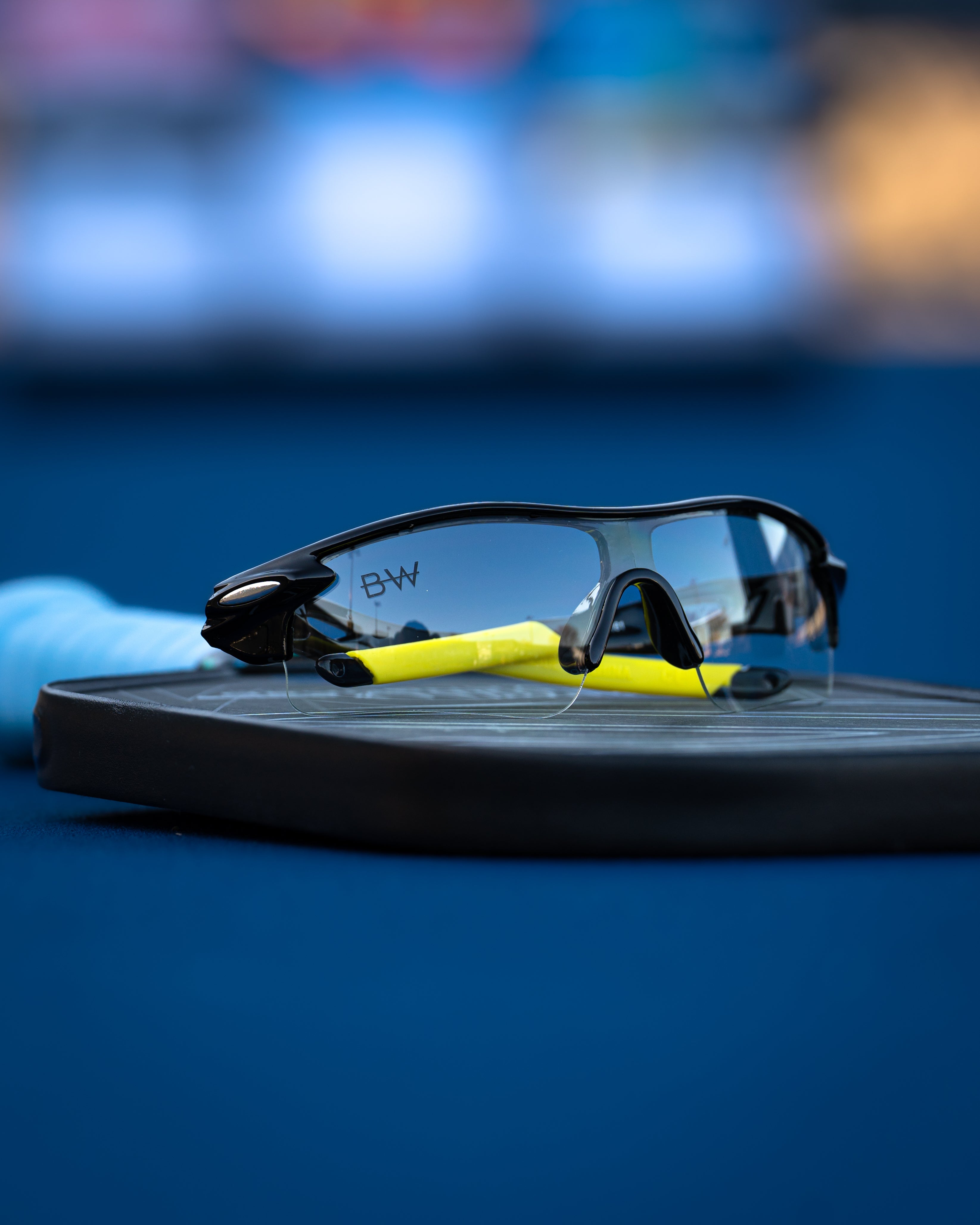
Clear vs. Grey RX Lenses for Indoor Pickleball
Share
Clear vs. Grey RX Lenses for Indoor Pickleball: Which Should You Choose?
If you need prescription correction for indoor pickleball, choosing between clear RX lenses and grey RX lenses is mainly a question of your playing environment—not which lens color promises better reaction time, ball tracking, or depth perception.
For most typical indoor courts, clear prescription lenses are the more straightforward starting point because they provide your required vision correction without adding a dark sunglass tint. Grey RX lenses reduce visible brightness through tint, which may appeal to some players in unusually bright environments, but adding tint indoors also means less available visible light reaches your eyes.
This guide compares clear vs. grey prescription pickleball lenses, explains when each configuration may make sense, and shows you what else matters when choosing RX eyewear for indoor courts.
Find Your Pickleball Glasses
Clear or Grey RX Lenses for Indoor Pickleball: Quick Answer
Clear RX lenses are generally the logical option to compare first for indoor pickleball when you want prescription correction without darkening the court. Grey RX lenses add tint and reduce the amount of visible light reaching your eyes, so they are more commonly associated with brighter conditions.
However, there is no universal lens color that is best for every indoor pickleball facility. Your decision should account for:
- Your prescription requirements
- The amount of available light in your facility
- Whether you want a tinted or non-dark lens
- Your individual visual preferences
- The exact RX configuration available
- Frame dimensions and fit
- Comfort and familiarity
- Whether you also use the eyewear outdoors
Clear vs. Grey Prescription Lenses: At-a-Glance Comparison
| Feature | Clear RX Lenses | Grey RX Lenses |
|---|---|---|
| Dark Sunglass Tint | No | Yes |
| Typical Environment to Compare | Indoor, evening, or other environments where a dark tint is not desired | Brighter environments where the wearer specifically prefers reduced visible brightness |
| Prescription Correction | Depends on the exact RX configuration | Depends on the exact RX configuration |
| Indoor Use | Logical starting point for many indoor players | More situational because tint reduces available visible light |
| Outdoor Use | Possible, but does not provide a dark sunglass tint | More naturally suited to outdoor sunglass use when available as an RX configuration |
| Automatically Improves Ball Tracking? | No | No |
| Automatically Improves Reaction Time? | No | No |
| Automatically Improves Depth Perception? | No | No |
| Best Choice? | Depends on prescription, environment, exact configuration, fit, and individual preference. | |
Why Indoor Pickleball Lighting Matters
Indoor pickleball facilities can vary substantially. One player may compete in a modern dedicated pickleball facility while another plays in a multipurpose gym, recreation center, or converted sports space.
Differences can include:
- Overall brightness
- Fixture placement
- Ceiling height
- Windows and incoming daylight
- Shadows around the court
- Wall and floor colors
- Backgrounds behind the ball
- Changes between different courts in the same facility
That is why simply labeling one lens “best for indoors” can be misleading. Your RX eyewear should first provide the correction you require, while the lens configuration should make sense for the environment where you actually play.
Clear RX Lenses for Indoor Pickleball
Clear RX lenses provide prescription correction without adding a dark sunglass tint. That makes them a natural configuration to compare for indoor pickleball, particularly when preserving the available visible light is more important to you than reducing brightness with tint.
When Do Clear RX Lenses Make Sense Indoors?
Clear prescription lenses may be worth prioritizing if:
- You primarily play indoors.
- Your facility is not excessively bright for you.
- You do not want a dark sunglass tint.
- You play in the evening or under artificial lighting.
- You want a dedicated indoor RX setup.
- You move between several indoor facilities with different lighting.
Clear lenses should not be marketed as automatically improving contrast, ball tracking, reaction speed, or depth perception. Their key distinction here is simpler: they do not darken the environment with a sunglass tint.
What Are the Advantages of Clear RX Lenses Indoors?
For an indoor pickleball player, the practical advantages of a clear configuration can include:
- No dark sunglass tint: Useful when you do not want to intentionally reduce visible brightness indoors.
- Prescription correction: The appropriate RX configuration addresses the wearer's corrective needs.
- Indoor practicality: Clear eyewear naturally fits environments where dark sunglasses are unnecessary or undesirable.
- Evening versatility: A non-dark configuration can also make sense when playing later in the day.
- Simpler lens decision: Players who primarily need correction indoors may not need a tinted sunglass configuration at all.
What Clear RX Lenses Do Not Automatically Mean
Clear lenses are easy to over-market. A lens being clear does not by itself establish any of the following:
- Better ball tracking
- Faster reaction time
- Improved depth perception
- Enhanced contrast
- Reduced eye strain
- Anti-glare performance
- Anti-reflective treatment
- Anti-fog performance
- Distortion-free vision
- A specific UV rating
Those characteristics should be evaluated or verified separately rather than inferred from the absence of tint.
Grey RX Lenses for Indoor Pickleball
Grey RX lenses add a tinted sunglass configuration. Because tint reduces the amount of visible light reaching the eyes, grey lenses are generally a more situational choice for indoor pickleball than clear lenses.
A player might still consider a grey configuration if an indoor environment feels unusually bright and they personally prefer a tinted lens. The important distinction is preference and environment—not a promise that grey tint will improve pickleball performance.
When Might Grey RX Lenses Make Sense Indoors?
- You play in an unusually bright facility.
- The building receives substantial daylight through windows.
- You personally prefer some tint in that environment.
- You use the same prescription eyewear for outdoor activities as well.
- You have already tested a grey configuration indoors and prefer it.
If you have never used tinted eyewear on your indoor courts, test whether reduced brightness actually feels appropriate before making grey tint the center of your RX buying decision.
What Are the Tradeoffs of Grey RX Lenses Indoors?
The biggest tradeoff is straightforward: a grey tint intentionally darkens what you see compared with a clear lens configuration.
That can make grey tint less appealing in facilities where available light is already limited.
| Indoor Condition | Lens Configuration to Compare First | Why |
|---|---|---|
| Typical Indoor Gym | Clear RX | No dark sunglass tint is added. |
| Dimmer Facility | Clear RX | Adding a dark tint may be undesirable when available light is already limited. |
| Evening Indoor Play | Clear RX | A non-dark configuration is a logical comparison point. |
| Very Bright Indoor Facility | Clear RX vs. grey RX | Individual brightness preference becomes more relevant. |
| Indoor Facility with Significant Daylight | Clear RX vs. grey RX | Evaluate the actual environment and your preference. |
| Indoor + Outdoor Routine | Clear RX, grey RX, transition RX, or multiple pairs | Your overall routine may matter more than one indoor session. |
Do Grey RX Lenses Reduce Indoor Glare?
Do not assume a grey tint automatically provides a specific glare-reduction benefit. Tint and glare-management technologies are not interchangeable terms.
If glare is a major concern in your facility, verify the exact characteristics of the lens configuration you are considering rather than assuming that:
- Grey automatically means anti-glare
- Grey automatically means anti-reflective
- Darker always means less visual discomfort
- A particular tint solves reflections from every indoor surface
The same principle applies to clear lenses: a clear appearance does not establish whether a specific anti-reflective or other coating is present.
Do Clear or Grey RX Lenses Improve Depth Perception?
Neither clear nor grey tint should automatically be described as improving depth perception.
Depth perception involves multiple visual cues and processes. Appropriate prescription correction can be important for someone who needs corrective lenses, but changing from clear to grey tint does not by itself establish better distance judgment on a pickleball court.
Likewise, Blinded Wear's non-polarized sports lenses should not be described as automatically enhancing depth perception simply because a polarization filter is not added.
For a deeper explanation, see Depth Perception Science in Pickleball →.
Do Clear or Grey Prescription Lenses Improve Reaction Time?
Neither lens color automatically creates faster reactions.
Pickleball reaction involves more than the tint in front of your eyes. It includes receiving visual information, anticipating what may happen, making a decision, initiating movement, and executing the response.
If you require prescription correction, wearing an appropriate RX configuration addresses your corrective needs. That should remain separate from claiming that clear or grey tint itself makes you react faster.
Read more in How RX Lenses Fit Into Pickleball Reaction Time →.
Which Lens Is Better for Tracking a Pickleball Indoors?
There is no universal evidence-based rule that simply choosing clear instead of grey—or grey instead of clear—automatically improves ball tracking for every indoor player.
A better buying framework is:
- Get the prescription correction you require.
- Choose a lens configuration appropriate for the amount of available light.
- Choose a frame with dimensions that make sense for you.
- Evaluate the finished eyewear during realistic play.
- Build familiarity before competition.
This keeps the lens decision grounded in what the configuration actually does rather than attributing an unverified performance effect to a color.
Should Indoor Pickleball Glasses Be Non-Polarized?
Blinded Wear sports eyewear uses non-polarized lenses. Non-polarized means a polarization filter is not added.
Some court players prefer non-polarized eyewear, but it is important not to turn that preference into unsupported claims.
| Statement | How to Treat It |
|---|---|
| Blinded Wear sports lenses are non-polarized. | Verified. |
| Non-polarized means no polarization filter is added. | Accurate description. |
| Non-polarized automatically improves depth perception. | Do not assume. |
| Non-polarized automatically improves reaction time. | Do not assume. |
| Non-polarized automatically improves ball tracking. | Do not assume. |
| Polarized lenses universally harm pickleball performance. | Do not make this universal claim. |
What About High-Index RX Lenses?
Blinded Wear includes high-index prescription lenses at no additional cost with its RX eyewear.
High-index describes a prescription lens-material category. It does not tell you whether the finished lens is clear or grey, and it should not automatically be associated with:
- Better reaction time
- Improved depth perception
- Enhanced contrast
- Distortion-free vision
- Greater impact resistance
- A guaranteed finished lens weight
Do not assume a specific index such as 1.61 unless that exact index is verified for the current product configuration.
What About Impact Resistance for Indoor Pickleball?
Blinded Wear sports eyewear uses impact-resistant lenses. That is a separate characteristic from whether the lens is clear, grey, prescription, non-polarized, or another configuration.
Impact-resistant should not be interpreted as:
- Shatterproof
- Indestructible
- Unable to scratch
- A guarantee against injury
- Automatic compliance with a specific protective-eyewear certification
If a particular safety standard or certification matters to you, verify it for the exact product before purchasing.
RX Pickleball Glasses to Compare for Indoor Play
For indoor use, start by comparing prescription models based on the exact current lens configuration. A frame being an RX product does not automatically tell you that a particular clear, grey, progressive, transition, or other lens option is available.
| RX Model | Why Compare It | What to Verify |
|---|---|---|
| Frost RX | Prescription pickleball-eyewear option | Current lens configuration, dimensions, prescription requirements, and fit |
| Phantom II RX | RX sports-eyewear option | Current clear/tint availability, dimensions, prescription configuration, and fit |
| Lava Rock RX | Lightweight RX option | Current lens configuration, dimensions, prescription requirements, and individual fit |
| H Blue Shield RX | Prescription sports-eyewear option | Exact current lens characteristics, dimensions, prescription configuration, and fit |
Do not assume any specific tint or lens enhancement is included solely because a frame appears in this comparison. Check the current product configuration before ordering.
Prescription Pickleball Frames to Explore
Frost RX
Frost RX is a prescription pickleball-eyewear option to compare for your indoor setup. Review the exact current lens configuration and available dimensions before ordering.
Phantom II RX
Phantom II RX provides another RX sports-frame option. Verify the exact clear or tinted configuration available for your prescription rather than relying on older descriptions.
Lava Rock RX
Lava Rock RX is a lightweight RX option to compare according to prescription requirements, available dimensions, exact lens configuration, and individual fit.
H Blue Shield RX
H Blue Shield RX is another prescription sports-eyewear option. Verify its current product-specific lens characteristics before choosing it for indoor play.
Choose Clear vs. Grey RX by Environment
Instead of asking which color is universally better, identify the environment you actually use.
| Your Environment | Starting Point | Reason |
|---|---|---|
| Standard Indoor Recreation Center | Clear RX | Provides correction without adding a dark sunglass tint. |
| Dim Indoor Gym | Clear RX | A grey tint intentionally reduces visible brightness. |
| Indoor Evening League | Clear RX | A non-dark configuration is the more direct comparison. |
| Very Bright Dedicated Indoor Facility | Clear vs. grey RX | Personal brightness preference may justify comparing both. |
| Facility with Large Windows | Clear vs. grey RX | Incoming daylight may change the environment during play. |
| Regular Indoor + Outdoor Play | Clear RX vs. grey RX vs. transition RX | A broader multi-environment setup may be more practical. |
Can One RX Pair Work for Indoor and Outdoor Pickleball?
Potentially, but the answer depends on what you expect that pair to do.
A clear RX configuration can provide correction without a dark tint, but a player may prefer a different configuration in bright outdoor conditions. A grey RX sunglass configuration may suit outdoor use but could feel unnecessarily dark for some indoor environments.
If you regularly move between both settings, compare three strategies:
- One clear RX pair: Simple if you primarily value a non-dark prescription configuration.
- Separate indoor and outdoor RX pairs: Gives each pair a dedicated environmental role.
- A verified transition RX configuration: May appeal to players who value a lens designed to change tint across particular conditions.
For the transition-specific decision, see Transition RX Lenses for Travel & Training →.
Lens Color Is Only Part of Choosing Indoor RX Glasses
A clear lens in a frame that does not work for you is not automatically a better indoor setup than a grey lens in a frame you prefer. Lens color is only one part of the purchase.
Use this priority order:
- Prescription requirements
- Indoor environment
- Clear vs. tinted preference
- Available frame dimensions
- Individual fit
- Verified lens characteristics
- Comfort and familiarity
- Final configured RX price
For a deeper fit guide, read Prescription Glasses That Stay Secure During Pickleball Rallies →.
How to Test Indoor RX Glasses Before Competition
Whether you choose clear or grey RX lenses, test the finished eyewear during actual pickleball movement before relying on it during an important match.
| Test | What to Evaluate |
|---|---|
| Normal Wear | Your experience with the finished prescription configuration |
| Indoor Warm-Up | Frame fit and your initial experience under the facility's lighting |
| Kitchen Exchanges | Whether you repeatedly adjust or notice the eyewear during quick movement |
| Baseline Movement | How the frame feels during lateral and forward movement |
| Full Game | Your overall experience with the tint choice, prescription, fit, and comfort |
| Long Session | Whether the setup remains appropriate over your normal playing duration |
8 Clear vs. Grey RX Lens Mistakes to Avoid
-
Assuming clear lenses automatically improve ball tracking.
Clear describes the absence of a dark sunglass tint, not a guaranteed tracking benefit.
-
Assuming grey lenses automatically reduce glare.
Tint and specific glare-management features should not be treated as interchangeable.
-
Assuming grey lenses improve contrast.
Verify any contrast-related claim separately.
-
Assuming non-polarized means better depth perception.
Non-polarized describes polarization status, not an automatic performance improvement.
-
Assuming high-index means 1.61.
Verify an exact index before stating one.
-
Assuming high-index means distortion-free.
Do not attach an unverified optical-performance claim to the high-index category.
-
Ignoring the actual facility.
The same lens choice may not make sense in a dim recreation center and an unusually bright indoor complex.
-
Choosing tint before prescription and fit.
Your corrective requirements and the finished eyewear setup should come before aesthetic tint preference.
Clear vs. Grey RX Lenses FAQ
Are clear or grey RX lenses better for indoor pickleball?
Clear RX lenses are the more straightforward starting point for many indoor environments because they provide prescription correction without adding a dark sunglass tint. Grey RX lenses may be worth comparing if you play in an unusually bright environment and personally prefer reduced visible brightness.
Why are clear prescription lenses commonly used indoors?
Clear lenses do not add a dark sunglass tint, making them a natural option when you want prescription correction without intentionally darkening the indoor environment.
Can I wear grey prescription lenses indoors?
You can consider them if the environment and your preferences make tint appropriate, but remember that grey tint reduces visible brightness compared with a clear configuration.
Are grey lenses only for outdoor pickleball?
Not necessarily. They are more naturally associated with brighter environments, but individual indoor facilities and preferences vary.
Do clear lenses let in 100% of available light?
Do not assume a universal 100% transmission figure without specifications for the exact lens. The useful distinction is that clear lenses do not use a dark sunglass tint.
Do clear RX lenses improve indoor contrast?
Not automatically. Clear appearance alone does not establish contrast enhancement.
Do grey RX lenses improve contrast indoors?
Not automatically. Any contrast-enhancement claim should be verified for the exact lens configuration.
Do grey lenses reduce glare from indoor lights?
Do not assume a grey tint provides a specific glare-reduction benefit. Verify any glare-management characteristics separately.
Which lens is better for a dim indoor pickleball court?
A clear RX configuration is a logical starting point because it does not add a dark sunglass tint to an environment where available light is already limited.
What about a very bright indoor pickleball facility?
Compare a clear configuration with any appropriately available tinted RX option based on your personal preference and the actual environment rather than assuming tint automatically improves performance.
Do clear or grey lenses improve depth perception?
Neither tint choice should automatically be described as improving depth perception.
Do clear or grey lenses improve reaction time?
No automatic reaction-time improvement should be attributed to either lens color.
Are Blinded Wear sports lenses non-polarized?
Yes. Blinded Wear sports eyewear uses non-polarized lenses, meaning a polarization filter is not added.
Does non-polarized mean better depth perception?
No automatic depth-perception improvement should be inferred from polarization status alone.
Does Blinded Wear include high-index prescription lenses?
Yes. High-index prescription lenses are included at no additional cost with Blinded Wear RX eyewear.
Are the high-index RX lenses always 1.61?
Do not assume a specific index such as 1.61 unless it is verified for the exact current configuration.
Are Blinded Wear sports lenses impact-resistant?
Yes. Blinded Wear sports eyewear uses impact-resistant lenses. Impact-resistant does not mean shatterproof, indestructible, or automatically certified to a particular protective standard.
How to Evaluate Your Indoor Court Before Choosing Clear or Grey RX Lenses
Instead of choosing a lens tint from a generic recommendation, evaluate the facility where you actually play. Indoor pickleball environments can differ enough that a lens preference in one building may not carry over perfectly to another.
Use this simple court-lighting check:
- Look at the overall brightness. Does the facility already feel dim, comfortable, or unusually bright to you?
- Check different court positions. Lighting may feel different at the baseline, kitchen line, or between courts.
- Notice incoming daylight. Large windows and open entrances can make some indoor facilities much brighter during the day.
- Consider when you normally play. The same facility can feel different during daytime and evening sessions.
- Evaluate your current eyewear. If you already wear prescription glasses indoors, use that experience as a reference.
- Decide whether tint solves a real problem. Do not add grey tint simply because it sounds more performance-oriented.
For many players, this process will lead back to a clear RX configuration. For others playing in unusually bright indoor environments, comparing clear and grey may be worthwhile.
What If Your Indoor Pickleball Facility Has Large Windows?
Not every “indoor” court is isolated from outdoor light. Dedicated pickleball facilities, recreation centers, and gyms may have large windows, glass doors, skylights, or other sources of daylight.
That creates an important distinction between court location and actual lighting conditions.
| Indoor Environment | What to Consider |
|---|---|
| Fully Enclosed Gym | A clear RX configuration may be the simplest starting point when you do not want a dark tint. |
| Facility with Large Windows | Evaluate how much daylight actually reaches the court during your normal playing time. |
| Court Near Glass Doors | Brightness may differ depending on court position and time of day. |
| Indoor Court with Changing Daylight | Compare clear, tinted, or verified transition RX configurations according to your actual routine. |
| Evening Use of Same Facility | A lens configuration preferred during daytime may not be your preference after outside daylight disappears. |
The word “indoor” alone does not tell you exactly how bright a facility will be.
Clear vs. Grey RX Lenses for Evening Indoor Pickleball
If you primarily play indoor pickleball at night, a clear RX configuration is a logical starting point because it provides prescription correction without intentionally darkening the environment with a sunglass tint.
Grey RX lenses may still be an individual preference in an unusually bright facility, but there is little reason to make tint the default simply because the eyewear is being used for sports.
Ask yourself:
- Do I actually find the indoor environment too bright?
- Would reducing visible brightness help my personal comfort preference?
- Do I also need this pair for outdoor daytime use?
- Would separate indoor and outdoor RX pairs make more sense?
- Is a verified transition configuration relevant to my routine?
Do Competitive Players Need Different Indoor Lens Colors?
Competitive play does not automatically create a requirement for grey, clear, or any other specific tint.
A recreational player and a tournament player may both prefer clear RX lenses in the same indoor facility. Likewise, individual preferences can differ even among players competing at similar levels.
| Player Type | What Matters More Than Skill Level |
|---|---|
| Recreational Player | Prescription, facility lighting, individual preference, fit, and comfort |
| League Player | Prescription, regular court environment, fit, and familiarity |
| Tournament Player | Prescription, event environment, familiarity, backup planning, and fit |
| Competitive Doubles Player | Prescription and environment rather than a doubles-specific tint |
| Competitive Singles Player | Prescription and environment rather than a singles-specific tint |
The more competitive the setting becomes, the more valuable familiarity with your finished eyewear can become. That does not mean you need a more aggressive tint.
Clear vs. Grey RX Lenses for Indoor Singles and Doubles
Lens tint should primarily respond to your environment and preferences—not whether you are playing singles or doubles.
Singles typically requires more individual court coverage, while doubles creates different positioning and movement patterns. Those differences can affect how you test frame fit, but they do not create a universal clear-versus-grey lens rule.
If you play both formats indoors, evaluate whether the same RX pair:
- Meets your prescription requirements
- Matches the facility lighting
- Fits appropriately during singles movement
- Fits appropriately during doubles movement
- Remains comfortable through your normal sessions
- Feels familiar during both formats
If it does, there is no inherent reason to change lens tint simply because the match format changes.
Clear vs. Grey RX Lenses for Indoor Pickleball Tournaments
For an indoor tournament, preparation matters more than trying to identify a special “competition tint.”
Before the event:
- Determine whether the tournament is fully indoors.
- Learn what you can about the facility.
- Use your normal indoor environment as a comparison.
- Choose an RX configuration you have already practiced in when possible.
- Test frame fit during realistic movement.
- Consider backup prescription eyewear if losing access to your primary pair would disrupt your play.
- Protect unused eyewear between matches.
If you already know that clear RX lenses work well for you indoors, an important tournament is generally not the ideal time to experiment with an unfamiliar grey tint simply because it sounds more specialized.
What If a Tournament Uses Both Indoor and Outdoor Courts?
A mixed-environment event changes the decision because your eyewear may need to cover substantially different conditions.
| Setup | Potential Role |
|---|---|
| Clear RX Pair | Dedicated non-dark prescription configuration for indoor use |
| Fixed-Tint RX Sunglasses | Dedicated prescription sunglass configuration for outdoor daytime use |
| Verified Transition RX | One-pair option to evaluate when you regularly move between changing environments |
| Primary + Backup RX | Provides corrective redundancy if your primary pair becomes unavailable |
The right setup depends on how different the environments are and whether you prefer one versatile pair or dedicated configurations.
For a broader tournament setup, see Top RX Glasses for Pickleball Tournament Days →.
Clear vs. Grey vs. Transition RX Lenses
If you play in more than one environment, the decision may extend beyond clear versus grey.
| RX Lens Configuration | Primary Distinction | When to Compare It |
|---|---|---|
| Clear RX | No dark sunglass tint | Indoor, evening, or other conditions where you do not want a dark tint |
| Grey RX | Grey tinted configuration | Brighter environments where you specifically prefer reduced visible brightness |
| Transition RX | Designed to change tint under particular conditions | Routines involving changing environments when verified for the exact RX model |
None of these configurations is universally superior. Each solves a different environmental or preference-based problem.
Should Indoor + Outdoor Players Consider Transition RX?
If you regularly switch between indoor and outdoor pickleball, a verified transition or photochromic RX configuration may be worth comparing with separate clear and fixed-tint prescription pairs.
The main potential advantage is adaptability, not an automatic improvement in pickleball performance.
Transition functionality should be verified for the exact RX model, and you should not assume:
- Every RX frame offers it
- The lenses change instantly
- They behave identically in every environment
- They automatically enhance contrast
- They automatically reduce glare
- They improve reaction time or depth perception
Read the full comparison in Transition RX Lenses for Travel & Training →.
One RX Pair vs. Separate Indoor and Outdoor Glasses
If you need prescription eyewear for both environments, decide whether one pair actually covers your needs or whether two pairs would have clearly different roles.
One-Pair Setup May Make Sense If:
- You primarily play indoors.
- A non-dark RX configuration meets most of your needs.
- You rarely need a dedicated outdoor sunglass setup.
- You have a verified transition configuration that appropriately covers your routine.
Two-Pair Setup May Make Sense If:
- You frequently play both indoors and outdoors.
- You prefer clear RX indoors and dedicated RX sunglasses outdoors.
- Your environments are substantially different.
- You want a suitable backup corrective pair for tournaments or travel.
Do not buy a second pair simply because two pairs sound more specialized. Give each pair a defined purpose.
Do Indoor Pickleball Players Need a Backup RX Pair?
A backup pair is not required simply because you play pickleball. It becomes more useful when you depend heavily on prescription correction and losing access to your primary pair would significantly interfere with your ability to continue playing, traveling, or functioning normally.
A backup does not necessarily need to duplicate your primary pair exactly. Its job is to provide suitable corrective redundancy for your needs.
For a dedicated backup framework, read When to Bring a Spare RX Pair in Your Pickleball Bag →.
How to Compare Indoor RX Frame Dimensions Online
Lens tint receives a lot of attention, but a good indoor RX setup also requires a frame you can realistically wear through an entire pickleball session.
If you cannot try the frame before ordering:
- Find a pair of glasses that currently fits you well.
- Review any available measurements on that pair.
- Compare them with the available dimensions of the RX frame you are considering.
- Do not judge fit solely from product photos.
- Remember that similar measurements do not guarantee identical fit.
- Test the finished eyewear during actual pickleball movement after it arrives.
Do not assume words such as “lightweight” or “sports frame” guarantee secure fit for every face.
The 5-Minute Indoor RX Movement Test
Once your prescription eyewear arrives, use a short movement check before progressing to full games.
- Look naturally in different directions. Notice your experience with the finished prescription.
- Walk and turn quickly. Pay attention to the frame's individual fit.
- Use light lateral movement. Check whether you repeatedly feel the need to adjust the glasses.
- Simulate kitchen movement. Add short forward, backward, and side-to-side movements.
- Progress to normal practice. A short test is only the beginning; full-session experience matters too.
If you constantly adjust the eyewear during movement, investigate the fit rather than assuming changing from clear to grey—or grey to clear—will solve a frame-related problem.
Does Clear vs. Grey Tint Affect Comfort?
Visual preference can influence how a player feels about a lens configuration, but comfort should not be reduced to tint alone.
Your experience with an RX pair can also depend on:
- Your prescription
- Frame dimensions
- Individual facial fit
- Finished lens configuration
- Frame weight and construction
- How long you wear the eyewear
- Your familiarity with the pair
- The environment where you use it
A clear lens is not automatically more comfortable, and a grey tint should not automatically be marketed as reducing eye fatigue.
Single-Vision vs. Progressive RX for Indoor Pickleball
Clear versus grey describes lens tint. Single-vision versus progressive describes prescription design. They answer different questions.
Your prescription design should be based on your actual corrective needs rather than your choice of indoor lens color.
| Lens Term | What It Describes |
|---|---|
| Clear | A lens without a dark sunglass tint |
| Grey | A grey tinted lens configuration |
| Single Vision | A prescription lens design |
| Progressive | A multi-range prescription lens design |
| High-Index | A prescription lens-material category |
| Non-Polarized | Polarization status |
Do not assume every RX model offers every prescription design. Verify the exact current configuration.
Indoor RX Lens Feature Decoder
Understanding what common eyewear terms actually describe can prevent a lot of confusion while shopping.
| Term | What It Means Here | What It Does Not Automatically Mean |
|---|---|---|
| Clear | No dark sunglass tint | Better tracking, contrast, or reaction time |
| Grey | A grey tinted configuration | Anti-glare or contrast enhancement |
| RX | Prescription correction | Automatic athletic-performance improvement |
| High-Index | Prescription lens-material category | An exact 1.61 index, greater durability, or distortion-free vision |
| Non-Polarized | No polarization filter is added | Improved depth perception |
| Impact-Resistant | Verified impact-resistance characteristic | Shatterproof or certified protective eyewear |
| Lightweight | A construction characteristic | Guaranteed comfort or non-slip fit |
Verified Blinded Wear RX Features vs. Features to Check
| Feature | Status |
|---|---|
| Prescription RX eyewear | Verified. |
| High-index prescription lenses included at no additional cost | Verified. |
| Lightweight sports frames | Verified. |
| Impact-resistant sports lenses | Verified. |
| Non-polarized sports lenses | Verified. |
| Clear RX configuration on a specific model | Verify for the exact current product. |
| Grey RX configuration on a specific model | Verify for the exact current product. |
| Progressive availability | Verify for the exact product. |
| Exact high-index number | Verify before stating a number such as 1.61. |
| Anti-reflective coating | Verify before claiming. |
| Anti-fog treatment | Verify before claiming. |
| Scratch resistance | Verify before claiming. |
| Glare reduction | Verify before claiming. |
| Contrast enhancement | Verify before claiming. |
| Specific UV rating | Verify before claiming. |
| Specific protective certification | Verify before claiming. |
How to Order RX Glasses for Indoor Pickleball
-
Start with prescription eyewear.
Browse the Blinded Wear RX Pickleball Collection →.
-
Define your primary environment.
Determine whether you primarily play indoors, outdoors, or across both.
-
Decide whether you want a dark tint.
For many indoor players, clear RX is the logical starting point. Grey is more situational.
-
Verify the exact lens configuration.
Do not assume every RX model is offered in clear, grey, transition, progressive, or any other specific configuration.
-
Compare frame dimensions.
Use eyewear that already fits you as a reference whenever possible.
-
Prepare your prescription.
Have a clear photo or picture of your eyeglass prescription ready to upload before purchasing.
-
Review the complete configured price.
Blinded Wear includes high-index prescription lenses at no additional cost, but review your complete current configuration before checkout.
-
Practice in the finished eyewear.
Test the prescription, lens configuration, and frame fit in the indoor facility where you actually play.
Replacement Support for Blinded Wear RX Glasses
Blinded Wear offers 50% lifetime replacement support if glasses break, subject to current policy terms.
This should not be interpreted as free lifetime replacements, universal coverage for every form of damage, or a guarantee that the eyewear cannot break.
Clear vs. Grey RX Indoor Pickleball Checklist
- ☐ I know my prescription requirements.
- ☐ I know whether my primary court is dim, typical, or unusually bright for me.
- ☐ I know whether daylight significantly affects my indoor facility.
- ☐ I decided whether I actually want a tinted lens indoors.
- ☐ I verified the exact current RX configuration.
- ☐ I reviewed available frame dimensions.
- ☐ I compared dimensions with eyewear that already fits me when possible.
- ☐ I am not assuming clear automatically improves ball tracking.
- ☐ I am not assuming grey automatically reduces glare.
- ☐ I am not assuming either tint improves reaction time.
- ☐ I am not assuming non-polarized automatically improves depth perception.
- ☐ I am not assuming high-index means exactly 1.61.
- ☐ I understand impact-resistant does not mean shatterproof.
- ☐ I have a clear photo or picture of my eyeglass prescription ready.
- ☐ I reviewed the final configured RX price.
- ☐ I plan to practice in the finished eyewear before important competition.
More Questions About Clear vs. Grey RX Pickleball Lenses
What color prescription lens is best for indoor pickleball?
There is no universal best color for every facility. Clear RX is a logical starting point for many indoor players because it provides prescription correction without adding a dark sunglass tint.
Should I wear clear lenses in a dim pickleball gym?
A clear RX configuration is generally the more logical option to compare first when available light is already limited because it does not intentionally darken the environment with a sunglass tint.
Can grey RX lenses be too dark indoors?
They can be less suitable for an individual if the tint reduces visible brightness more than that player prefers in the facility.
Can I use grey RX sunglasses inside a pickleball facility?
You can evaluate them according to your individual preference and environment, but a dedicated sunglass tint may be unnecessary in many indoor facilities.
Are clear lenses better for nighttime pickleball?
A clear configuration is a logical starting point when you want prescription correction without adding a dark sunglass tint. Individual needs and the actual environment still matter.
Should I use grey RX lenses in a very bright indoor facility?
They may be worth comparing if you personally prefer reduced visible brightness, but do not assume grey tint automatically improves contrast, glare, tracking, or performance.
Do indoor pickleball players need special lens colors?
Not automatically. Prescription requirements, available light, individual preference, frame fit, and familiarity can matter more than choosing a specialized tint.
Does competitive indoor pickleball require a specific tint?
No universal clear, grey, or other tint requirement follows from playing competitively.
Do doubles players need clear lenses?
Not because they play doubles. Lens configuration should be chosen primarily around prescription requirements, environment, and individual preference.
Do singles players need grey lenses?
No. Singles does not inherently require grey tint. Environment and prescription needs remain more relevant to the clear-versus-grey decision.
Can clear RX glasses work outdoors too?
Potentially, but clear lenses do not add a dark sunglass tint. Players who frequently use prescription eyewear outdoors may prefer to compare clear RX with fixed-tint or verified transition RX configurations.
Should I buy separate indoor and outdoor prescription pickleball glasses?
Only if each pair solves a defined need. Separate clear indoor RX and tinted outdoor RX configurations can make sense for players who regularly use both environments.
Are transition RX lenses better than owning clear and grey pairs?
Not universally. Transition functionality may simplify a mixed-environment setup, while dedicated pairs give each configuration a more specific role. Verify transition availability for the exact RX model.
Do clear lenses prevent eye strain?
Do not assume clear lenses universally prevent or reduce eye strain. Individual visual needs, prescription, environment, and other factors vary.
Do grey lenses prevent eye strain?
Do not assume grey tint universally reduces eye strain. Tint preference and individual comfort should be evaluated separately.
Are clear RX lenses distortion-free?
Do not infer a universal distortion-free claim solely because a lens is clear or prescription.
Are grey RX lenses non-polarized?
Blinded Wear sports eyewear uses non-polarized lenses. Verify the exact current configuration of the product you are considering.
What prescription information do I need to order?
Have a clear photo or picture of your eyeglass prescription ready to upload and review the requirements for the exact RX product you select.
Does Blinded Wear include high-index RX lenses?
Yes. High-index prescription lenses are included at no additional cost with Blinded Wear RX eyewear.
What happens if my Blinded Wear RX glasses break?
Blinded Wear offers 50% lifetime replacement support if glasses break, subject to current policy terms.
Clear or Grey RX Lenses? Use This Final Decision Guide
If you are still deciding between clear and grey prescription lenses for indoor pickleball, keep the decision focused on what each configuration actually changes.
| If This Sounds Like You... | Compare First | Why |
|---|---|---|
| I play almost entirely indoors. | Clear RX | You get prescription correction without adding a dark sunglass tint. |
| My gym is relatively dim. | Clear RX | Adding grey tint would further reduce visible brightness. |
| I play evening indoor leagues. | Clear RX | A non-dark configuration is the more direct starting point. |
| My indoor facility feels unusually bright to me. | Clear RX vs. grey RX | Your individual brightness preference makes comparing tint more relevant. |
| My facility gets substantial daylight. | Clear RX vs. grey RX | The actual environment may be brighter than a typical enclosed gym. |
| I regularly play indoors and outdoors. | Clear RX, fixed-tint RX, or verified transition RX | Your broader routine may justify a multi-environment solution. |
| I play tournaments and depend heavily on my prescription. | Primary RX + suitable backup | Corrective redundancy may matter more than owning multiple tint colors. |
The 60-Second Indoor RX Lens Selector
-
Do you require prescription correction?
Start with the RX configuration appropriate for your corrective needs.
-
Is your primary court indoors?
If yes, decide whether you have a real reason to intentionally darken the environment.
-
Does the facility feel too bright to you?
If not, clear RX is the more straightforward comparison point.
-
Do you also use the same eyewear outdoors?
If yes, compare whether separate RX pairs or a verified transition configuration better fits your routine.
-
Does the frame fit?
Compare available dimensions and test the finished eyewear during movement.
-
Are the features actually verified?
Do not choose a lens based on unsupported promises about tracking, contrast, glare, depth perception, or reaction time.
Clear vs. Grey RX for New Indoor Pickleball Players
If you are new to indoor pickleball and already require prescription correction, there is usually no reason to make your first eyewear decision more complicated than necessary.
A practical starting process is:
- Determine the prescription configuration you need.
- Evaluate the lighting in the facility where you normally play.
- Start by comparing clear RX if you do not have a specific reason to add dark tint.
- Compare available frame dimensions.
- Practice in the finished eyewear.
- Only add another lens configuration when it solves a defined problem.
This prevents a common buying mistake: assuming that more specialized-looking tint automatically means more specialized pickleball performance.
Clear vs. Grey RX for Frequent Indoor Players
Frequent players have an advantage when choosing eyewear: they already know their normal court environment.
If you play several times per week, think about your actual experience:
- Are your courts usually bright, moderate, or dim to you?
- Does the lighting change depending on which court you use?
- Does daylight enter the facility?
- Do you regularly play at the same time of day?
- Do you also play outdoors?
- Do you already prefer clear or tinted prescription eyewear away from pickleball?
Your repeated real-world experience is more useful for the clear-versus-grey decision than a universal tint recommendation.
What to Do When Your New Indoor RX Glasses Arrive
Do not judge new prescription sports eyewear only by looking at it in your home. Evaluate the finished pair in the environment where you bought it to use.
Step 1: Review the Finished Configuration
Confirm that the eyewear matches the RX configuration you ordered.
Step 2: Check the Frame
Wear the glasses normally and evaluate your individual fit before adding athletic movement.
Step 3: Visit Your Normal Indoor Court
Experience the clear or grey configuration under the facility's actual lighting.
Step 4: Warm Up
Add normal pickleball movement and notice whether you repeatedly adjust the frame.
Step 5: Play Full Games
Evaluate the complete setup—prescription, tint preference, fit, and comfort—during realistic play.
Step 6: Repeat Before Important Competition
Build familiarity rather than making a final judgment from one short test.
When Should You Reevaluate Your Indoor RX Pickleball Glasses?
There is no universal pickleball-specific replacement schedule for prescription sports eyewear. Instead, reevaluate your setup when something relevant changes.
Examples include:
- Your corrective needs change.
- Your current prescription information is no longer appropriate for your needs.
- The eyewear becomes damaged.
- The frame no longer fits appropriately.
- Your primary playing environment changes.
- You begin playing substantially more indoors or outdoors.
- You start traveling or competing often enough that a backup becomes useful.
- Your current tint configuration no longer matches your normal environment or preferences.
If you are uncertain about your prescription or changing vision needs, consult an appropriate eye-care professional.
8 Myths About Clear and Grey RX Pickleball Lenses
Myth 1: “Clear lenses improve ball tracking indoors.”
Reality: Clear means the lens does not use a dark sunglass tint. That alone does not establish better tracking.
Myth 2: “Grey lenses are better for competitive players.”
Reality: Competition level does not create a universal need for grey tint.
Myth 3: “Grey lenses automatically reduce glare.”
Reality: Tint should not automatically be treated as a specific glare-management technology.
Myth 4: “Clear lenses provide perfect light transmission.”
Reality: Do not claim a universal transmission percentage without specifications for the exact lens.
Myth 5: “Non-polarized lenses improve depth perception.”
Reality: Non-polarized means a polarization filter is not added. It does not automatically establish improved depth perception.
Myth 6: “High-index lenses are automatically more durable.”
Reality: High-index describes a lens-material category. Durability and impact resistance are separate characteristics.
Myth 7: “Every RX frame is available with clear and grey lenses.”
Reality: Verify the exact current configuration for the specific product.
Myth 8: “Indoor and outdoor players need completely different frames.”
Reality: The same frame may potentially work across environments depending on prescription, available lens configurations, individual fit, and preference. The lens setup may be the more important environmental difference.
Final Pre-Purchase Checklist for Indoor RX Pickleball Glasses
- ☐ I know my prescription requirements.
- ☐ I have a clear photo or picture of my eyeglass prescription ready.
- ☐ I know whether my normal facility feels dim, moderate, or unusually bright to me.
- ☐ I considered whether daylight enters the facility.
- ☐ I know whether I actually want a dark tint indoors.
- ☐ I verified the exact RX configuration available on the model I want.
- ☐ I reviewed available frame dimensions.
- ☐ I compared those dimensions with eyewear that already fits me when possible.
- ☐ I am not assuming clear automatically improves contrast or tracking.
- ☐ I am not assuming grey automatically reduces glare.
- ☐ I am not assuming either lens color improves reaction time.
- ☐ I am not assuming non-polarized automatically improves depth perception.
- ☐ I understand that high-index does not automatically mean 1.61.
- ☐ I understand impact-resistant does not mean shatterproof.
- ☐ I considered whether I need separate indoor and outdoor RX configurations.
- ☐ I considered whether backup correction matters for my routine.
- ☐ I reviewed the final configured RX price.
- ☐ I plan to practice in the finished eyewear before important matches.
Final FAQ: Clear vs. Grey Prescription Pickleball Lenses
What is the main difference between clear and grey RX lenses?
Clear RX lenses provide prescription correction without adding a dark sunglass tint. Grey RX lenses add grey tint and reduce visible brightness compared with a clear configuration.
Which should I try first for indoor pickleball?
For many typical indoor environments, clear RX is the logical starting point because it provides prescription correction without intentionally darkening the court.
When should I consider grey RX lenses indoors?
Grey tint may be worth comparing when an indoor facility feels unusually bright to you and you specifically prefer reduced visible brightness.
Will grey RX lenses make the pickleball easier to see?
Do not assume that grey tint automatically makes a pickleball easier to see. Ball visibility can depend on the environment, background, lighting, prescription, individual vision, and other factors.
Will clear RX lenses make the ball easier to see?
Clear lenses do not add a dark tint, but that characteristic alone does not establish better ball tracking or visibility for every player.
Which lens is better under LED indoor lighting?
There is no universal clear-versus-grey rule based only on the facility using LED lighting. Evaluate the actual brightness and your individual preference.
Which lens is better under fluorescent indoor lighting?
Again, the fixture category alone does not determine the ideal tint. Prescription needs, overall brightness, facility design, and individual preference remain relevant.
What if my indoor court has shadows?
A lens tint should not be expected to automatically correct uneven illumination or shadows. Evaluate how the complete RX configuration works for you in the actual facility.
What if my indoor court has bright windows behind the baseline?
Substantial incoming daylight can make the environment different from a fully enclosed gym. Compare clear and tinted configurations according to how the facility actually feels during your normal playing time.
Are grey lenses better for bright white pickleball courts?
Do not choose tint solely from court color. Consider total facility brightness, prescription requirements, and your individual preference.
Do clear lenses improve color accuracy?
Do not make a universal color-accuracy claim solely because a lens is clear. Verify any specific optical-performance claims for the exact lens.
Do grey lenses preserve natural colors?
Do not assume or promise a specific color-perception result without verified information for the exact lens configuration.
Can I use clear RX glasses for outdoor evening pickleball?
Potentially. A clear configuration may be appropriate when you do not want a dark sunglass tint, provided the prescription, frame, and overall setup meet your needs.
Can I use grey RX glasses outdoors?
Grey tinted prescription eyewear is more naturally associated with brighter outdoor conditions than typical indoor use, but evaluate the exact configuration and your preferences.
Should I choose my frame or lens tint first?
Start with your prescription requirements and environment, then consider lens configuration and a frame with appropriate available dimensions. The complete setup matters more than choosing one feature in isolation.
Should beginners use clear RX lenses?
Clear RX is a straightforward starting point for many indoor players who need prescription correction and do not have a specific reason to add dark tint. Being a beginner does not itself require a particular lens color.
Should tournament players use grey RX lenses?
Tournament participation does not automatically require grey tint. Use a configuration appropriate for the environment that you have already tested during realistic play.
Should I bring both clear and grey RX glasses to a tournament?
Only if both pairs have a defined role. A suitable backup may be useful for someone highly dependent on prescription correction, but it does not necessarily need to use a different tint.
Does Blinded Wear offer high-index prescription lenses?
Yes. Blinded Wear includes high-index prescription lenses at no additional cost with its RX eyewear.
Does Blinded Wear offer replacement support if my RX glasses break?
Yes. Blinded Wear offers 50% lifetime replacement support if glasses break, subject to current policy terms.
Related Indoor & Prescription Pickleball Eyewear Guides
Key Takeaways: Clear vs. Grey RX Lenses for Indoor Pickleball
- Clear RX lenses are the more straightforward starting point for many indoor pickleball environments.
- Clear means the lens does not add a dark sunglass tint.
- Grey RX lenses intentionally reduce visible brightness compared with a clear configuration.
- Grey tint may be worth comparing in an unusually bright indoor environment when you personally prefer reduced brightness.
- Neither clear nor grey tint automatically improves ball tracking.
- Neither lens color automatically improves reaction time.
- Neither lens color automatically improves depth perception.
- Grey tint should not automatically be described as reducing glare or enhancing contrast.
- Clear lenses should not automatically be described as maximizing contrast or reducing eye strain.
- Blinded Wear sports eyewear uses non-polarized lenses.
- Non-polarized does not automatically mean better depth perception.
- Blinded Wear includes high-index prescription lenses at no additional cost.
- Do not assume an exact high-index number such as 1.61 unless verified for the current configuration.
- Blinded Wear sports eyewear uses impact-resistant lenses.
- Impact-resistant does not mean shatterproof or automatically certified protective eyewear.
- Verify clear, grey, transition, progressive, and other configuration options for the exact RX model before purchasing.
- Frame dimensions and individual fit matter regardless of lens tint.
- Indoor and outdoor players may benefit from separate RX configurations when each pair has a defined role.
- A verified transition RX configuration is another option to compare for changing environments.
- Practice in your finished prescription eyewear before important competition.
Find Your Indoor Prescription Pickleball Glasses
For most players choosing between clear and grey RX lenses specifically for indoor pickleball, the decision starts with one simple question: do you actually want to reduce visible brightness with a tinted lens?
If the answer is no, clear RX is the more direct starting point. If your facility feels unusually bright and you personally prefer tint, grey RX may be worth comparing. If you regularly move between indoor and outdoor environments, consider whether dedicated pairs or a verified transition configuration better matches your routine.
Bottom Line: Clear or Grey RX for Indoor Pickleball?
For a typical indoor pickleball environment, clear RX lenses are the more logical starting point because they provide prescription correction without adding a dark sunglass tint.
Grey RX lenses are more situational indoors. They may make sense when a facility is unusually bright for you and you specifically prefer reduced visible brightness, but grey tint should not be treated as an automatic solution for glare, contrast, tracking, reaction time, or depth perception.
If you play across several environments, the decision may expand beyond clear versus grey. A dedicated clear indoor pair, fixed-tint outdoor RX sunglasses, or a verified transition RX configuration can each have a different role.
Choose in this order: prescription requirements → actual court environment → clear or tinted preference → exact available configuration → frame dimensions → individual fit → familiarity → final price.
That gives you an indoor RX setup based on what you actually need rather than choosing a lens color because of an unsupported performance promise.