
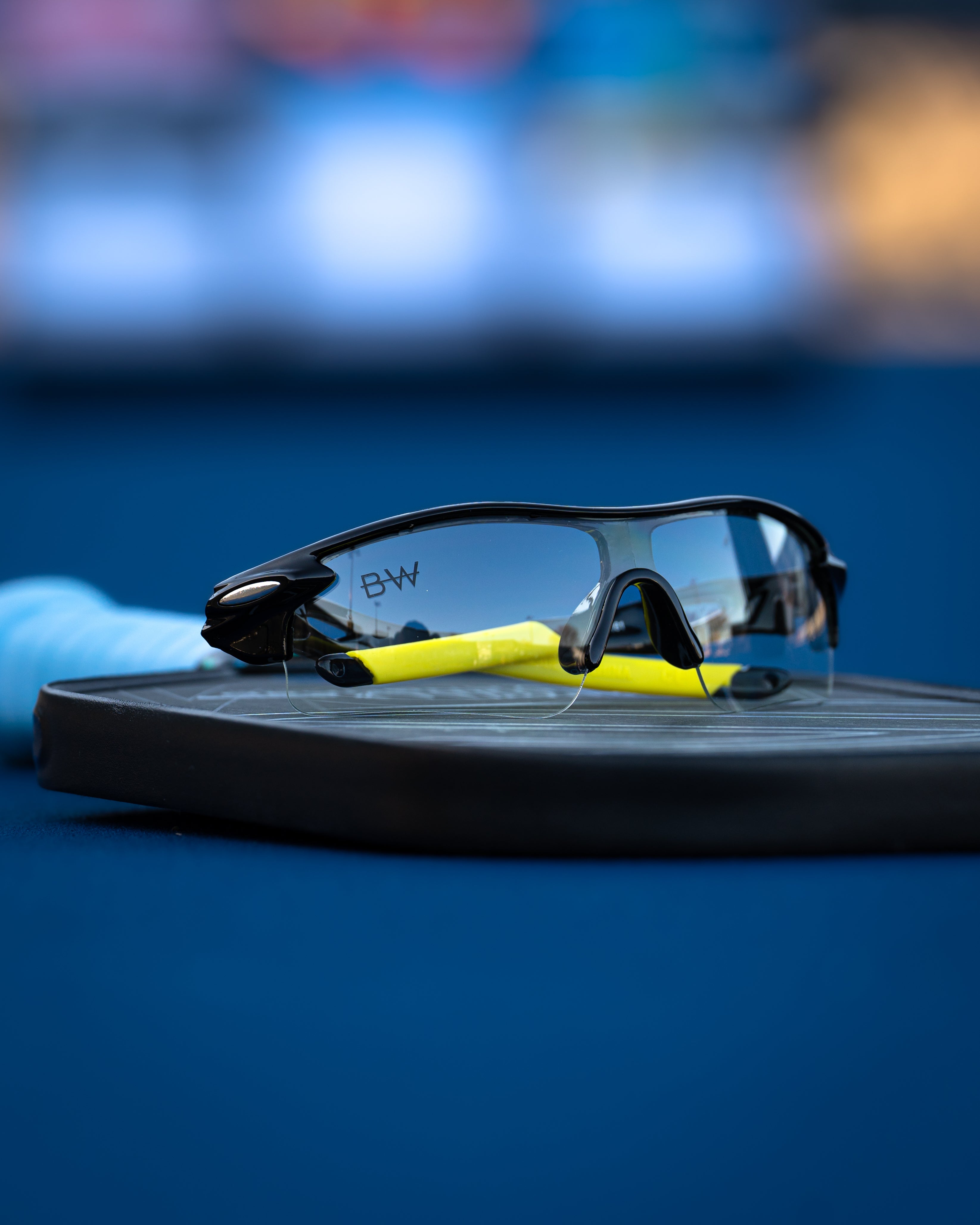
Clear vs. Tinted RX Lenses: Which is Best for Multi-Sport Athletes?
Share
Compare RX Lens Options for Multi-Sport Athletes
Clear and tinted prescription lenses serve different purposes. The better choice depends on your prescription, playing environment, available light, sport, and whether you regularly move between indoor and outdoor conditions.
Clear vs. Tinted RX Lenses: Which Is Better for Multi-Sport Athletes?
There is no universal winner between clear and tinted prescription lenses.
A multi-sport athlete who practices indoors at night may have very different lens needs from someone playing pickleball, tennis, beach volleyball, golf, or running outdoors in bright daytime conditions.
The simplest distinction is:
- Clear RX lenses provide prescription correction without a dark sunglass tint.
- Tinted RX lenses provide prescription correction while also reducing visible-light transmission according to the characteristics of the tint.
Neither option automatically improves reaction time, contrast, depth perception, ball tracking, accuracy, or overall athletic performance.
The goal is to match your prescription eyewear to the environment in which you actually use it.
Why Multi-Sport Athletes Have Different Lens Needs
Multi-sport athletes may move through dramatically different environments during the same week—or even the same day.
For example, an athlete might:
- Play pickleball outdoors in bright afternoon conditions
- Practice pickleball indoors at night
- Play tennis on an outdoor court
- Run early in the morning or near sunset
- Play beach volleyball in an open outdoor environment
- Train under artificial lighting
That is why asking whether clear or tinted lenses are simply "better for sports" is usually too broad.
A more useful question is:
Which lens configuration is appropriate for my prescription and the lighting conditions where I spend most of my time?
Clear RX Lenses Explained
Clear prescription lenses provide refractive correction without the dark tint associated with traditional sunglasses.
That makes clear RX eyewear worth considering when you require prescription correction but do not want a dark sunglass tint in your primary playing environment.
Possible environments include:
- Indoor pickleball courts
- Indoor tennis facilities
- Evening practices
- Nighttime training
- Some lower-light environments
- General situations where dark tint is unnecessary
Clear lenses should not be described as creating more environmental light, increasing reaction speed, or automatically providing superior visual acuity compared with another appropriate prescription configuration.
Tinted RX Lenses Explained
Tinted prescription lenses combine prescription correction with a lens tint that changes visible-light transmission.
This can make tinted RX eyewear worth considering for athletes who spend substantial time in brighter outdoor environments.
Potential uses include:
- Outdoor pickleball
- Outdoor tennis
- Outdoor running
- Beach volleyball
- Golf
- Other daytime outdoor activities
Tint should not automatically be described as increasing contrast, reducing all glare, improving ball tracking, preventing eye fatigue, or making an athlete perform better.
The characteristics of the actual lens matter more than the fact that it is simply "tinted."
Clear vs. Tinted Prescription Lenses at a Glance
| Consideration | Clear RX Lenses | Tinted RX Lenses |
|---|---|---|
| Prescription Correction | Yes | Yes |
| Dark Sunglass Tint | No | Yes, depending on configuration |
| Indoor Use | Worth considering when dark tint is unnecessary | Depends on tint and available light |
| Bright Outdoor Use | May not provide the visible-light reduction some athletes want | Worth considering for brighter conditions |
| Reaction-Time Improvement | Not automatic | Not automatic |
| Ball-Tracking Improvement | Not automatic | Not automatic |
| UV Protection | Must be verified separately | Must be verified separately |
| Polarization | Separate characteristic | Separate characteristic |
Clear RX Lenses for Indoor Pickleball
Indoor pickleball is one of the clearest examples of why an athlete might consider prescription eyewear without a dark sunglass tint.
Indoor facilities can have substantially less available light than bright outdoor courts. A dark sunglass tint that feels appropriate outdoors may therefore be poorly suited to some indoor environments.
For an indoor player who requires prescription correction, the priorities should include:
- An appropriate prescription
- A lens configuration suited to the facility
- Comfortable frame fit
- Prescription compatibility
- Physical coverage preferences
- Extended-wear comfort
Clear prescription lenses do not make your reflexes faster or automatically make the pickleball easier to track. Their primary distinction is providing prescription correction without a dark sunglass tint.
Tinted RX Lenses for Outdoor Pickleball
Outdoor pickleball can involve bright daytime conditions, making a tinted prescription lens worth considering for players who require RX correction and prefer a sunglass lens outdoors.
However, do not choose an outdoor lens solely because it promises to make the ball "pop."
Instead, evaluate:
- Your prescription
- Available lens tint
- Playing time
- Typical environmental brightness
- Whether you regularly play into the evening
- Frame fit
- Physical coverage
For a broader outdoor comparison, visit the Best Pickleball Sunglasses for Outdoor Play Guide.
Clear vs. Tinted RX Lenses for Tennis
Tennis players can use the same environment-first approach.
A player training inside an indoor tennis facility may not want the same tint as someone competing outdoors during a bright afternoon.
The prescription itself does not need to become a "sports performance" prescription simply because the activity is tennis. Instead, consider how your required correction works within the frame and lens configuration you intend to use.
If you move regularly between indoor and outdoor tennis, having more than one appropriate eyewear setup may be worth considering.
Clear vs. Tinted RX Lenses for Running
Running conditions can vary from bright midday sun to early-morning, shaded, evening, or nighttime environments.
That makes the time of day particularly relevant when choosing between clear and tinted RX eyewear.
A runner who trains primarily after dark may have different needs from someone who runs outdoors at noon.
Other considerations include frame fit, physical coverage, prescription compatibility, and how the complete eyewear setup feels during extended movement.
Clear vs. Tinted RX Lenses for Beach Volleyball
Beach volleyball is generally played in an open outdoor environment, making tinted prescription eyewear worth considering for athletes who require correction and prefer a sunglass lens.
But tinted lenses should not automatically be described as reducing all glare, preventing eye fatigue, improving depth perception, or increasing ball visibility.
Physical lens coverage may also matter to players who prefer more eyewear coverage outdoors, although standard sports eyewear should not automatically be treated as sealed or safety-certified protective equipment.
Clear vs. Tinted RX Lenses for Golf
Golf can involve several hours outdoors, so both the lens environment and extended-wear comfort can matter.
A tinted RX lens may be worth considering for bright daytime rounds, while a dark sunglass tint may become less appropriate as environmental light decreases.
Lens color should not automatically be credited with improving depth judgment, green reading, contrast, or accuracy.
Does a Clear Lens Provide Better Visual Acuity?
Clear does not automatically mean optically superior.
Prescription correction, lens material, lens design, manufacturing, frame configuration, and the wearer's individual vision all contribute to the completed eyewear.
A clear lens should therefore not be marketed as providing inherently better visual acuity than an appropriate tinted prescription lens.
The key difference is the absence of dark sunglass tint.
Do Tinted RX Lenses Improve Contrast?
A tint changes the way visible light passes through the lens and can alter how the environment appears to the wearer.
That does not justify a universal claim that tinted prescription lenses improve contrast for every athlete, sport, ball color, or playing environment.
If contrast characteristics matter to you, evaluate the specific lens rather than treating "tinted" as a single performance category.
Do Tinted Lenses Improve Ball Tracking?
No universal improvement should be assumed.
Ball tracking involves individual vision, eye and head movement, attention, anticipation, experience, lighting conditions, and other factors.
A lens tint should not automatically be credited with making a pickleball, tennis ball, or volleyball easier to track.
Do Tinted RX Lenses Improve Reaction Time?
No. Tint should not be described as directly increasing neurological reaction speed.
Reaction involves visual detection, processing, decision-making, and physical response. Prescription correction and lens tint are only parts of the broader visual environment.
Choose tinted RX lenses because their visible-light characteristics suit your environment—not because they promise faster reflexes.
Do Clear RX Lenses Improve Reaction Time?
Clear lenses should not be credited with faster reactions either.
A clear RX lens provides prescription correction without dark sunglass tint. That can make it a practical configuration in environments where dark tint is undesirable, but it does not enhance neurological reaction speed.
Lens Tint vs. Prescription: Two Different Functions
One of the most important concepts for multi-sport athletes is that prescription correction and lens tint perform different functions.
| Lens Characteristic | Primary Function |
|---|---|
| Prescription | Provides refractive correction according to the prescribed lens values |
| Tint | Changes visible-light transmission and lens appearance |
| Polarization | Designed to reduce certain reflected light |
| Photochromic Technology | Changes tint in response to certain light conditions |
| UV Characteristics | Separate lens specification that must be verified |
| Impact Resistance | Separate material or product characteristic; does not establish safety certification |
Keeping these characteristics separate makes it much easier to compare RX sports eyewear without relying on misleading marketing claims.
Lens Darkness and UV Protection Are Not the Same Thing
A dark-looking lens should not automatically be assumed to provide a particular level of UV protection.
Likewise, a clear-looking lens cannot be evaluated for UV characteristics based solely on its appearance.
UV performance is a separate lens specification and should be verified for the actual lens.
Tint and Polarization Are Not the Same Thing
A tinted lens is not automatically polarized.
Polarization refers to an added filter designed to reduce certain reflected light. Tint refers to visible-light characteristics and lens coloration.
You can therefore encounter tinted lenses that are non-polarized, and polarization should not be inferred from how dark a lens appears.
Polarized vs. Non-Polarized Tinted RX Lenses
Some multi-sport athletes may prefer polarization in certain environments, while some court-sport players may prefer non-polarized eyewear.
Neither should be treated as universally superior.
Polarization alone does not determine:
- Depth perception
- Contrast
- Reaction time
- Ball tracking
- Visual acuity
- Overall athletic performance
Your prescription, individual vision, lighting conditions, environment, and complete eyewear configuration also contribute to what you see.
What About Transition or Photochromic RX Lenses?
Photochromic lenses change tint in response to certain light conditions.
For multi-sport athletes who frequently encounter changing environments, that adaptability may be convenient because the lens can change tint without requiring a manual lens swap.
However, photochromic lenses should not automatically be described as:
- Changing instantly
- Adapting in less than one second
- Providing the ideal tint in every environment
- Improving reaction time
- Improving ball tracking
- Eliminating eye fatigue
Photochromic behavior depends on the specific lens technology and environmental conditions.
Do not assume that photochromic technology is available for a particular Blinded Wear RX product unless the option is currently verified for that model.
Clear vs. Tinted vs. Photochromic RX Lenses
| Lens Type | Primary Characteristic | Environment to Consider |
|---|---|---|
| Clear RX | Prescription correction without dark sunglass tint | Indoor, evening, nighttime, or other environments where dark tint is unnecessary |
| Tinted RX | Prescription correction with a fixed tint | Brighter outdoor conditions when the tint is appropriate |
| Photochromic RX | Tint changes according to the specific photochromic technology and conditions | Potentially useful when regularly moving through changing environments |
There is no universal winner. Your primary environment and available product options should guide the decision.
Should Multi-Sport Athletes Own Both Clear and Tinted RX Glasses?
For some athletes, having separate clear and tinted prescription setups can be practical.
Consider two setups if you regularly divide your training between environments such as:
- Indoor and outdoor pickleball
- Indoor and outdoor tennis
- Daytime and nighttime running
- Bright daytime competition and evening practices
- Multiple sports with substantially different lighting environments
However, owning multiple RX pairs is not automatically necessary. If one available configuration appropriately serves the environments in which you normally play, there may be no practical reason to add another.
When a Clear RX Pair Makes a Useful Backup
A clear prescription pair can be a useful secondary setup for an athlete whose primary RX eyewear uses a dark outdoor tint.
Potential situations include:
- A tournament continuing after sunset
- Moving from outdoor to indoor courts
- Evening practice after daytime competition
- Travel where your playing environment is uncertain
The benefit is flexibility between lighting environments—not a performance advantage inherent to clear lenses.
When a Tinted RX Pair Makes a Useful Second Setup
An athlete whose primary prescription eyewear is clear may consider a separate tinted RX pair when they begin spending substantial time outdoors.
This can allow the athlete to keep prescription correction while using a sunglass lens suited to brighter conditions.
Again, the reason to add the second pair is environmental versatility rather than an expectation that tint will increase athletic ability.
Direct RX vs. RX Clip for Multi-Sport Athletes
Lens tint is not the only decision multi-sport athletes may face. Prescription correction can also be incorporated into different eyewear configurations.
| Configuration | How Prescription Correction Is Provided |
|---|---|
| Direct RX | Prescription correction is incorporated into the primary prescription lenses. |
| RX Clip | Prescription correction is located in a separate inner prescription insert within the eyewear system. |
Neither system is automatically better for multi-sport use. Compare prescription compatibility, frame geometry, complete fit, available lens configurations, and your personal preferences.
High-Index Prescription Lenses for Multi-Sport Eyewear
Blinded Wear RX products include high-index prescription lenses at no additional cost.
High-index refers to a category of prescription lens material commonly used to help manage lens thickness, particularly as prescription strength increases.
Finished lens thickness depends on your individual prescription, lens dimensions, frame dimensions, lens design, and other optical requirements.
High-index should not automatically be described as:
- More impact-resistant than polycarbonate
- Shatterproof
- Lighter in every finished prescription
- Better for reaction time
- Better for ball tracking
- Better for multi-sport performance
Clear and Tinted Lenses Do Not Establish Protective Certification
Whether a lens is clear or tinted tells you nothing by itself about a specific protective-eyewear certification.
Impact-resistant does not mean shatterproof and does not establish a particular protective-eyewear certification or safety rating.
If your sport or activity requires eyewear meeting a particular safety standard, verify that standard for the complete product.
Which Lens Is Better for Changing Sports Throughout the Week?
Start by mapping your actual schedule.
For example:
| Typical Activity | Environment | Lens Question |
|---|---|---|
| Indoor Pickleball | Indoor court | Do I want prescription correction without a dark sunglass tint? |
| Outdoor Tennis | Bright daytime court | Would an appropriate tinted RX lens better suit this environment? |
| Evening Running | Decreasing environmental light | Would my daytime sunglass tint become unnecessarily dark? |
| Beach Volleyball | Open outdoor environment | What sunglass configuration fits my prescription and environment? |
Once you identify your most common environments, the clear-versus-tinted decision becomes much easier.
A Simple Clear vs. Tinted RX Decision Framework
- Start with your prescription. Make sure your vision correction reflects your current needs.
- Identify your primary sport or sports. Consider where you spend most of your training time.
- Identify the lighting environment. Indoor, outdoor, daytime, evening, or mixed?
- Decide whether you want a dark sunglass tint. Do not assume tint is automatically better for sports.
- Verify the actual lens options. Do not assume every RX model comes in clear, tinted, or photochromic configurations.
- Evaluate the frame. Prescription compatibility, fit, dimensions, coverage, and comfort still matter.
- Consider a second setup only when useful. Separate clear and tinted pairs can make sense when your environments differ substantially.
Blinded Wear RX Sports Glasses to Explore
Blinded Wear offers multiple prescription sports-eyewear designs for pickleball players and other active users.
Models to compare include:
- Crystal Wave II RX — a direct RX sports-eyewear option.
- Steel Ice RX — another direct RX sports frame to compare.
- Zebra II RX — a direct prescription sports-eyewear design with a distinctive aesthetic.
- Frost RX — a direct RX design with a white frame and bright blue lens appearance.
Verify the currently available lens configuration on the individual product page rather than assuming every model is offered in clear, gray, tinted, or photochromic versions.
Browse the full Blinded Wear Prescription Sports Glasses Collection to compare current RX options.
How to Choose Between Clear and Tinted RX Lenses by Time of Day
For multi-sport athletes, time of day can be one of the easiest ways to narrow down the clear-versus-tinted decision.
A lens configuration that makes sense during a bright afternoon may be less appropriate once environmental light decreases. Likewise, an athlete who trains primarily indoors may have little practical need for a dark sunglass tint during those sessions.
| Typical Time or Environment | RX Lens Approach to Consider |
|---|---|
| Bright Daytime Outdoors | An appropriate tinted RX configuration may be worth considering. |
| Cloudy Outdoor Conditions | Consider actual environmental brightness rather than assuming either clear or dark tint is automatically best. |
| Dawn or Dusk | Consider whether your normal sunglass tint becomes unnecessarily dark as available light decreases. |
| Indoor Training | Clear RX may be worth considering when a dark sunglass tint is unnecessary. |
| Nighttime Training | A clear RX configuration may be more appropriate than dark sunglass tint. |
| Changing Conditions | Consider multiple appropriate setups or a verified photochromic option if available. |
Are Clear RX Lenses Good for Cloudy Days?
They can be, depending on the actual amount of available light and your preferences.
"Cloudy" covers a wide range of conditions. A bright overcast afternoon can look very different from a dark stormy evening, so weather terminology alone should not determine your lens choice.
The better approach is to consider whether you want visible-light reduction in the conditions where you will actually be playing.
Are Tinted RX Lenses Good for Cloudy Days?
A tinted RX lens may still be appropriate in some cloudy outdoor conditions, but the presence of clouds does not automatically establish which tint or tint darkness is best.
Environmental brightness, time of day, your individual preferences, and the characteristics of the specific lens all matter.
A multi-sport athlete who regularly trains through changing weather may benefit from having more than one appropriate eyewear configuration rather than expecting one fixed tint to be ideal everywhere.
Clear vs. Tinted RX Lenses for Dawn and Dusk
Early-morning and evening sports create an important transition period because environmental light can change substantially during a single session.
If you begin a run, tennis match, or pickleball session while it is still bright and continue toward sunset, consider how your chosen lens will function as available light decreases.
A dark sunglass tint that was useful earlier may eventually become unnecessarily dark.
Potential strategies include:
- Using another appropriate RX pair when conditions change
- Selecting a fixed lens appropriate for the expected session
- Considering a verified photochromic RX option when available
- Using contacts with separate Non-RX eyewear when contacts are suitable for you
Is One RX Lens Setup Enough for Indoor and Outdoor Sports?
Sometimes, but not always.
If your activities take place under relatively similar lighting conditions, one appropriate RX configuration may meet your needs.
If you regularly alternate between a bright outdoor pickleball court and an indoor facility, however, the same fixed dark tint may not be equally appropriate in both environments.
This is why multi-sport athletes should think in terms of environmental versatility rather than searching for one lens that is supposedly best at everything.
Should Your Primary RX Pair Be Clear or Tinted?
Look at where you spend the majority of your training and competition time.
If most of your sports take place indoors or after dark, a clear RX setup may make more sense as your primary pair.
If most of your activity takes place outdoors during brighter daytime conditions, an appropriate tinted RX configuration may make more sense.
If your schedule is close to an even split, you may want to consider:
- Separate clear and tinted RX setups
- A verified photochromic option when appropriate and available
- Contacts plus separate Non-RX eyewear if contacts are suitable for you
There is no universal rule that every multi-sport athlete should start with one particular lens type.
Should Your Backup RX Pair Be Different From Your Primary Pair?
If you are buying a second pair specifically for versatility, choosing a configuration that serves a different environment can be practical.
For example:
- An outdoor athlete with tinted RX sunglasses may choose clear RX eyewear as a secondary setup for indoor or evening use.
- An athlete whose everyday sports eyewear is clear may choose a tinted RX pair for brighter outdoor activities.
Two nearly identical configurations may still be useful as backups, but they do less to expand the range of environments your eyewear can cover.
Clear vs. Tinted RX Lenses for Long Tournaments
Tournaments can make lens selection more complicated because a player may compete across several hours and changing environmental conditions.
A pickleball tournament might begin in the morning and continue into a bright afternoon. An evening event may move in the opposite direction, beginning while it is bright and continuing as environmental light decreases.
For tournament use, consider:
- Your expected start and finish times
- Indoor versus outdoor courts
- Expected environmental brightness
- Whether you can conveniently change eyewear between matches
- Whether you have backup prescription correction
- Frame comfort during extended wear
The best tournament setup is not necessarily the darkest, clearest, or most technologically complex lens. It is the setup that appropriately serves your prescription and expected environment.
Does Lens Tint Reduce Eye Fatigue?
It is better to avoid treating tint as a guaranteed solution for eye fatigue.
Visual discomfort during sports can involve multiple factors, including environmental brightness, prescription needs, dryness, prolonged visual demands, frame fit, and individual eye factors.
A sunglass tint changes visible-light transmission, which can make it an appropriate part of an outdoor eyewear setup, but it does not guarantee that an athlete will avoid eye fatigue.
For a deeper explanation, read How Prescription Sunglasses Can Reduce Eye Fatigue in Outdoor Sports.
Can Clear RX Lenses Cause More Eye Strain Outdoors?
You should not assume that a clear lens automatically causes eye strain outdoors.
Outdoor visual comfort varies by person and environment. Brightness, prescription needs, dryness, duration of exposure, and other factors can all contribute to discomfort.
If bright conditions are uncomfortable for you, an appropriate sunglass configuration may be worth considering, but that decision should not be reduced to a universal claim that clear lenses cause eye strain.
Can a Tint Be Too Dark for Sports?
Yes, a dark tint can become inappropriate when available environmental light is too low for that particular lens configuration.
This is especially relevant for athletes who:
- Play after sunset
- Move from outdoor to indoor facilities
- Train around dawn or dusk
- Compete during rapidly changing weather
Darker is not automatically better. The goal is to use a lens appropriate for the available light and your individual needs.
Does a Darker Tint Mean Better Glare Reduction?
Lens darkness alone should not be used as a complete measure of glare performance.
Glare is a broad term, and polarization is a separate characteristic specifically designed to reduce certain reflected light.
A dark lens should therefore not automatically be marketed as providing superior glare reduction simply because it appears darker.
Does Lens Color Matter More Than Tint Darkness?
Lens color and tint darkness describe different characteristics, and neither should be treated as a universal sports-performance ranking.
Color can change how the environment appears through the lens, while tint darkness affects visible-light transmission.
When comparing sports lenses, evaluate the specific configuration and intended environment rather than assuming a particular color is automatically best for pickleball, tennis, running, golf, or volleyball.
Gray, Brown, Amber, Rose, and Other Sports Lens Colors
Sports eyewear is available across many lens colors, and athletes often encounter claims that one particular color will make a ball stand out or dramatically improve contrast.
Those claims should not be generalized to every athlete.
Different lens colors alter the appearance of the environment, but individual vision, lighting, sport, playing surface, ball color, and specific lens characteristics all affect the wearing experience.
For a deeper comparison, read The Best Lens Colors for Pickleball, Tennis, and Outdoor Sports.
Can a Lens Tint Make a Yellow Pickleball Stand Out?
Some athletes may personally prefer the appearance produced by certain lens colors, but no tint should automatically be promised to make a yellow pickleball easier for every player to see.
Perceived contrast can depend on:
- The specific lens
- Ball color
- Court color
- Background
- Environmental lighting
- Individual vision
That is why lens-color preference should not be converted into a universal ball-tracking claim.
Clear vs. Tinted RX Lenses for Fast-Moving Balls
Pickleball, tennis, and volleyball all involve moving balls, but lens tint alone does not determine an athlete's ability to track motion.
Dynamic visual tasks involve individual vision, eye movements, head movements, attention, anticipation, experience, and other neurological and physical processes.
An appropriate RX lens provides the prescribed refractive correction. Clear versus tinted should then be chosen primarily according to the environment and verified lens characteristics.
Clear vs. Tinted RX Lenses for Depth Perception
Neither clear nor tinted prescription lenses should automatically be marketed as superior for depth perception.
Depth perception involves binocular vision and multiple visual cues. If an athlete requires refractive correction, an appropriate prescription can be important to their overall vision, but tint alone does not establish better depth judgment.
Clear vs. Tinted RX Lenses for Reaction Time
Neither lens type automatically makes an athlete react faster.
Reaction time involves several stages:
- Detecting information
- Processing what is happening
- Deciding how to respond
- Initiating movement
- Executing the physical response
Prescription correction and tint can be parts of the athlete's visual setup, but neither should be described as a direct neurological reaction-time enhancement.
Clear vs. Tinted RX Lenses for Visual Comfort
Visual comfort is more individualized than a simple clear-versus-tinted rule.
Factors can include:
- Environmental brightness
- Prescription accuracy
- Dryness
- Duration of wear
- Frame fit
- Individual sensitivity and preferences
- The specific lens configuration
A multi-sport athlete should therefore evaluate the complete eyewear setup rather than assuming tint alone determines comfort.
Frame Fit Still Matters No Matter Which Lens You Choose
Choosing the right lens does not compensate for a poorly fitting frame.
Whether your RX lenses are clear or tinted, evaluate:
- Frame width
- Bridge fit
- Temple fit
- Frame geometry
- Physical coverage
- Finished eyewear weight
- Weight distribution
- Comfort over your typical playing duration
Sports eyewear should not automatically be described as non-slip or guaranteed to remain perfectly positioned during every movement unless that performance has been specifically established.
Lightweight RX Glasses for Multi-Sport Athletes
Some athletes prefer less eyewear mass, particularly when glasses will be worn for several hours.
Lower weight can be a legitimate comfort preference, but lightweight construction should not automatically be described as improving reaction time, reducing neurological fatigue, or enhancing athletic performance.
Frame fit and weight distribution can be just as relevant as total finished weight.
Physical Lens Coverage for Multi-Sport Use
Sports frames can vary considerably in the amount of physical front and side coverage they provide.
Some athletes prefer greater coverage for outdoor activities, while others prioritize different frame shapes or fit characteristics.
More physical coverage does not automatically:
- Improve peripheral vision
- Improve reaction time
- Improve ball tracking
- Improve depth perception
- Establish impact certification
Coverage is one design characteristic to compare alongside prescription compatibility, lens configuration, and fit.
Clear vs. Tinted Lenses and Impact Resistance
Tint does not establish impact resistance.
A clear lens is not automatically stronger or weaker than a tinted lens simply because of its appearance. Impact characteristics depend on the actual lens material, construction, geometry, mounting, and other product factors.
Impact-resistant does not mean shatterproof and does not establish a particular protective-eyewear certification or safety rating.
Can One Pair of RX Sports Glasses Work Across Multiple Sports?
Potentially.
If one frame appropriately accommodates your prescription, fits comfortably, and uses a lens configuration suited to the environments where you participate, there is no rule that you need separate prescription glasses for every sport.
For example, the same appropriate RX setup could potentially be used across pickleball, tennis, running, and other activities when its configuration works for those environments.
The need for additional pairs usually becomes stronger when your environments or practical requirements differ—not simply because the name of the sport changes.
When Sport-Specific RX Setups May Be Useful
Separate setups can become useful when your activities create substantially different eyewear needs.
Examples include:
- Indoor pickleball combined with bright outdoor running
- Daytime tennis combined with nighttime training
- Activities where you prefer substantially different physical coverage
- Situations requiring a particular verified protective standard
- Sports where one frame configuration is significantly more comfortable for you
The decision should come from practical differences rather than marketing claims that every sport requires its own special tint.
Clear and Tinted RX Lenses for Prescription Changes
If your prescription changes, having multiple RX pairs can create an additional consideration: each prescription pair should reflect the correction you intend to use.
A second lens color does not compensate for outdated prescription correction.
If you are unsure whether your current prescription still meets your needs, appropriate eye-care guidance is more useful than trying to solve the issue by switching between clear and tinted lenses.
Contacts Plus Clear or Tinted Non-RX Sports Glasses
Multi-sport athletes who appropriately use contact lenses have another way to separate prescription correction from sports-lens selection.
In this setup:
- The contact lenses provide prescription correction.
- The outer sports eyewear can be selected separately as Non-RX.
- Clear or tinted outer eyewear can then be chosen according to the environment and available product configuration.
This can provide another form of flexibility, but contacts are medical devices. Prescription, fit, hygiene, replacement schedule, and wear should follow appropriate eye-care guidance.
Clear RX vs. Tinted RX vs. Contacts + Non-RX
| Setup | Where Prescription Correction Occurs | Lens Approach |
|---|---|---|
| Clear Direct RX | Primary prescription lens | No dark sunglass tint |
| Tinted Direct RX | Primary prescription lens | Fixed tint according to available configuration |
| RX Clip | Inner prescription insert | Outer lens is separate from the prescription insert |
| Contacts + Non-RX | Contact lenses | Outer clear or tinted Non-RX eyewear can be selected separately |
Common Clear vs. Tinted RX Lens Mistakes
Mistake 1: Assuming Tinted Always Means Better Outdoors
A tinted configuration can be useful in bright environments, but the specific tint and conditions still matter.
Mistake 2: Assuming Clear Is Always Best Indoors
Clear eyewear is worth considering when dark tint is unnecessary, but individual needs and facility conditions still matter.
Mistake 3: Choosing Tint Based on Reaction-Time Claims
No tint should automatically be credited with faster neurological reactions.
Mistake 4: Choosing Tint Solely to Improve Ball Tracking
Ball tracking involves far more than lens color.
Mistake 5: Assuming Darker Means More UV Protection
Lens darkness and UV characteristics are separate. Verify UV specifications independently.
Mistake 6: Assuming Tinted Means Polarized
Tint and polarization are separate characteristics.
Mistake 7: Assuming Photochromic Means Instant
Photochromic response depends on the specific technology and environmental conditions.
Mistake 8: Ignoring Prescription Compatibility
The lens color does not matter if the selected frame and lens configuration are inappropriate for your prescription requirements.
Mistake 9: Ignoring Frame Fit
Lens selection cannot compensate for an uncomfortable or poorly fitting frame.
Mistake 10: Expecting One Lens to Be Perfect Everywhere
Multi-sport athletes often encounter environments that are too different for one fixed configuration to be ideal in every situation.
Clear vs. Tinted RX Lens Checklist
Before deciding, ask yourself:
- Is my prescription current?
- Where do I play most often?
- Am I primarily indoors or outdoors?
- Do I usually train during the day or at night?
- Do my sessions regularly continue through sunset?
- Do I actually need a dark sunglass tint in my primary environment?
- What lens options are verified for the product I am considering?
- Am I assuming tint provides polarization or UV characteristics that have not been verified?
- Does the frame appropriately accommodate my prescription?
- Does the frame fit comfortably?
- Do I need one versatile setup or separate clear and tinted pairs?
- Would a direct RX or RX Clip configuration better suit my preferences?
- If I use contacts, would contacts plus separate Non-RX eyewear make sense for my existing routine?
How Multi-Sport Athletes Can Build a Practical RX Eyewear Setup
You do not need the largest possible eyewear collection. Start with the environments that account for most of your training.
- Identify your primary environment. Start with the conditions in which you spend the most time.
- Choose an appropriate primary RX setup. Clear or tinted should follow the environment rather than a generic sports rule.
- Identify your biggest gap. If your primary setup is tinted, perhaps indoor or nighttime use is the gap. If it is clear, bright outdoor use may be the gap.
- Add another setup only when it solves that gap. This can create more useful versatility than collecting several nearly identical pairs.
- Keep prescription needs first. Lens color and sports styling come after appropriate correction and compatibility.
Which Is More Versatile: Clear or Tinted RX?
Neither is universally more versatile.
Clear RX eyewear may cover a broad range of indoor, evening, and lower-light situations where dark tint is unnecessary. Tinted RX eyewear may better fit an athlete whose activities are overwhelmingly outdoors in brighter conditions.
For someone who genuinely moves between both environments, versatility may come from having multiple appropriate configurations rather than trying to make one fixed lens perform every role.
The Best RX Lens Is the One That Matches the Environment
The central idea behind clear versus tinted RX sports lenses is simple:
Choose according to what you need to see through, not according to which lens has the most aggressive performance claims.
Your prescription provides the required refractive correction. The lens configuration then needs to make sense for your environment, while the frame needs to fit and function appropriately for how you use it.
That framework works whether your weekly routine includes pickleball, tennis, running, volleyball, golf, or several different activities.
FAQ: Clear vs. Tinted RX Lenses for Multi-Sport Athletes
Are clear or tinted prescription lenses better for sports?
Neither is universally better. Clear RX lenses may be worth considering when you need prescription correction without a dark sunglass tint, while tinted RX lenses may be useful in brighter outdoor environments. Your prescription, sport, lighting conditions, available lens options, and personal preferences should guide the decision.
Are clear RX lenses good for pickleball?
They can be, particularly for indoor, evening, nighttime, or other environments where a dark sunglass tint is unnecessary. Clear lenses do not automatically improve reaction time, contrast, or ball tracking.
Are tinted RX lenses good for pickleball?
Tinted prescription lenses may be worth considering for outdoor pickleball in brighter conditions. Choose according to the specific lens and environment rather than assuming tint automatically improves ball visibility or athletic performance.
Are clear RX lenses good for tennis?
Clear prescription lenses can be considered for indoor tennis, evening sessions, and other environments where dark tint is unnecessary. The appropriate choice depends on your prescription and playing conditions.
Are tinted prescription lenses good for tennis?
Tinted RX lenses can be useful for players who require prescription correction and prefer a sunglass lens during brighter outdoor tennis sessions. Tint alone does not guarantee better contrast, depth perception, ball tracking, or reaction time.
Are clear lenses better for indoor sports?
Clear lenses are often worth considering when you do not want a dark sunglass tint indoors. However, there is no universal rule that every indoor athlete must use clear lenses.
Are tinted lenses better for outdoor sports?
A tinted lens can be appropriate in bright outdoor environments because tint changes visible-light transmission. The best configuration still depends on environmental brightness, the specific lens, and the wearer.
Do tinted lenses improve contrast?
Different tints can change how the environment appears, but tinted lenses should not universally be described as improving contrast for every athlete, sport, playing surface, or lighting condition.
Do tinted lenses help you track a pickleball or tennis ball?
No universal ball-tracking improvement should be promised. Ball tracking involves individual vision, attention, eye and head movements, anticipation, experience, lighting, and other factors in addition to the eyewear being worn.
Which lens color makes a yellow pickleball stand out?
There is no single lens color that can be guaranteed to make a yellow pickleball stand out for every player. Perceived contrast can depend on the specific lens, court and background colors, lighting conditions, ball color, and individual vision.
Do tinted lenses reduce eye fatigue?
A sunglass tint changes visible-light transmission and can be part of an outdoor eyewear setup, but it should not be treated as a guaranteed solution for eye fatigue. Prescription needs, environmental brightness, dryness, extended visual demands, frame fit, and individual factors can also contribute to visual discomfort.
Are clear lenses better in low light?
A clear lens does not have a dark sunglass tint, making it worth considering when available environmental light is lower and dark tint is unnecessary. Clear lenses should not be described as creating additional environmental light.
Can I wear tinted prescription sunglasses indoors?
You can physically wear them, but a dark tint may be poorly suited to some indoor environments. Consider the amount of available light and the characteristics of the specific lens.
Can I wear clear RX glasses outdoors?
Yes. Clear prescription lenses can provide refractive correction outdoors without a dark sunglass tint. Whether you prefer a sunglass tint in brighter conditions is a separate consideration.
Does a darker lens provide more UV protection?
Lens darkness and UV protection are separate characteristics. You should not determine UV performance by looking at how dark a lens appears. Verify UV specifications for the specific lens.
Are tinted lenses automatically polarized?
No. Tint and polarization are separate characteristics. A tinted lens can be non-polarized.
Are non-polarized lenses good for pickleball and tennis?
Some court-sport players may prefer non-polarized eyewear. However, non-polarized lenses are not automatically better for depth perception, contrast, reaction time, or ball tracking.
Are photochromic lenses the same as tinted lenses?
Not exactly. A fixed tinted lens maintains its tint characteristics, while photochromic technology changes tint in response to certain light conditions. The exact behavior depends on the specific photochromic lens and environment.
Do photochromic lenses change instantly?
No universal instant-change claim should be made. Activation and fading behavior varies according to the specific photochromic technology and environmental conditions.
Are photochromic lenses better for multi-sport athletes?
They may be convenient for some athletes who regularly encounter changing conditions, but they are not universally better. Fixed clear and tinted RX setups may be preferable for other athletes.
Should I own both clear and tinted RX glasses?
Consider separate setups if you regularly participate in substantially different environments, such as indoor pickleball and bright outdoor tennis. If one configuration appropriately serves your normal activities, multiple pairs may not be necessary.
Can I use the same RX glasses for multiple sports?
Potentially. If the frame appropriately accommodates your prescription, fits comfortably, and has a lens configuration suited to your different playing environments, there is no requirement to own separate prescription glasses for every sport.
Are high-index lenses available with Blinded Wear RX eyewear?
Blinded Wear RX products include high-index prescription lenses at no additional cost.
Are high-index lenses always lighter?
No. High-index materials can help manage lens thickness in appropriate prescriptions, but finished weight depends on prescription, frame and lens dimensions, lens design, material, and other factors.
Are sports lenses shatterproof?
No lens should automatically be described as shatterproof. Impact-resistant does not mean shatterproof and does not establish a particular protective-eyewear certification or safety rating.
Does a clear or tinted lens provide better eye protection?
Clear versus tinted appearance alone does not establish protective performance. If you require eyewear meeting a specific protective standard, verify the certification of the complete product.
Clear vs. Tinted RX Lenses by Sport
Use this table as a starting point rather than a universal prescription for every athlete:
| Sport or Activity | Clear RX May Be Worth Considering When | Tinted RX May Be Worth Considering When |
|---|---|---|
| Pickleball | Playing indoors, at night, or when dark tint is unnecessary | Playing outdoors in brighter daytime conditions |
| Tennis | Training indoors or under lower-light conditions | Playing outdoors in brighter conditions |
| Running | Running at night or when dark tint is unnecessary | Running outdoors during brighter daytime conditions |
| Beach Volleyball | When conditions do not call for a dark sunglass tint | During brighter outdoor sessions |
| Golf | When environmental light is lower and dark tint is unnecessary | During brighter daytime rounds |
| Indoor Training | When prescription correction is needed without dark tint | Only when the particular tint is appropriate for the available light |
The actual lens, prescription, environment, and individual wearer remain more important than the sport's name alone.
Clear vs. Tinted RX Lenses by Playing Environment
| Environment | What to Consider |
|---|---|
| Indoor Court | Whether a dark sunglass tint is necessary at all |
| Bright Outdoor Court | Whether an appropriate tinted RX configuration better suits the brightness |
| Cloudy Outdoor Court | Actual environmental brightness rather than the weather label alone |
| Dawn | How environmental light will change during the session |
| Dusk | Whether a fixed dark tint will become unnecessarily dark |
| Night | Whether clear RX better fits the available light than sunglass tint |
| Mixed Indoor/Outdoor | Whether multiple setups or an available photochromic option would provide useful flexibility |
How to Order Blinded Wear Prescription Sports Glasses
Once you have identified the type of RX sports eyewear you want to explore, ordering your prescription pair is straightforward.
- Browse the Blinded Wear Prescription Pickleball Glasses Collection.
- Select your preferred RX product and currently available options.
- Have your current eyeglass prescription ready.
- Upload a clear photo or picture of your eyeglass prescription on the product page before adding the eyewear to your cart.
- Your prescription information will be associated with your custom RX order.
For an RX Clip product, your prescription information will be associated with the custom RX clip included with your order.
Blinded Wear RX products include high-index prescription lenses at no additional cost.
For additional ordering information, visit How to Order Your Prescription Pickleball Glasses.
Before Ordering: Verify the Lens Configuration
Do not assume that every Blinded Wear RX frame is currently available with every lens type discussed in this guide.
Before purchasing, verify the current product options for the exact model you are considering.
This is particularly important for features such as:
- Clear lens availability
- Specific tint colors
- Photochromic or transitional options
- Polarization
- Other specialized lens features
A general educational guide can explain the differences between these technologies, but the individual product page should determine which options are currently available for a particular frame.
RX Returns and 50% Lifetime Replacement Support
Customized prescription eyewear is final sale and excluded from Blinded Wear's standard 30-day return policy.
RX final-sale status does not eliminate applicable 50% lifetime replacement support for eligible broken glasses.
For an eligible replacement claim, damaged eyewear must be returned. Once the claim and returned eyewear meet current policy requirements, the customer can receive 50% credit toward a replacement pair.
This is not a free full-replacement guarantee and should not be interpreted as automatic coverage for lost eyewear, prescription changes, or every form of damage.
Contact Blinded Wear before returning damaged RX eyewear and review the Protection Plan, Replacement & Returns information for current eligibility and policy details.
When Should You Replace Clear or Tinted RX Sports Glasses?
There is no universal schedule requiring athletes to replace prescription sports eyewear after a fixed number of months or seasons.
Instead, reevaluate your setup when:
- Your prescription changes
- Your existing correction no longer meets your needs
- The eyewear becomes damaged
- The frame no longer fits appropriately
- Your primary sport or playing environment changes
- Your existing lens configuration no longer suits when or where you play
A different lens color is not a substitute for an appropriate prescription.
Clear vs. Tinted RX: Final Buying Checklist
Before choosing your next prescription sports-eyewear setup, review these questions:
- Is my eyeglass prescription current?
- Does the frame appropriately accommodate my prescription?
- Do I primarily play indoors, outdoors, or both?
- Do I usually play during the day, evening, or night?
- Do I actually need a dark sunglass tint in my primary environment?
- Will my lighting conditions change substantially during long sessions?
- Would separate clear and tinted RX setups solve a real need?
- Is a verified photochromic option available for the product I am considering?
- Am I confusing tint with polarization?
- Am I assuming lens darkness determines UV protection?
- Am I expecting a lens color to automatically improve contrast or ball tracking?
- Does the frame fit comfortably?
- Does the physical coverage match my preferences?
- Do I understand whether the product is direct RX or RX Clip?
- Have I verified all product-specific lens features before ordering?
Related RX and Sports Lens Guides
Continue building your prescription sports-eyewear setup with these Blinded Wear guides:
- Pickleball Performance Lens Guide — compare lens colors, clarity considerations, and RX options.
- Best Lens Colors for Pickleball, Tennis, and Outdoor Sports — understand sports lens colors without relying on universal performance claims.
- Transition Lenses for Multi-Sport Athletes — learn where photochromic technology may offer practical convenience.
- Prescription Sunglasses for Nighttime and Indoor Training — explore RX considerations for lower-light environments.
- Prescription Sunglasses and Outdoor Eye Fatigue — understand the factors that can contribute to outdoor visual discomfort.
- Prescription Sunglasses vs. Contact Lenses for Athletes — compare two approaches to sports vision correction.
- Travel-Friendly Prescription Sports Eyewear — build a practical RX setup for tournaments and multi-sport travel.
- RX vs. Non-RX Pickleball Glasses — understand when prescription correction is incorporated into the sports eyewear itself.
Clear vs. Tinted RX Lenses: The Final Comparison
| Question | Clear RX | Tinted RX |
|---|---|---|
| Provides Prescription Correction? | Yes | Yes |
| Has a Dark Sunglass Tint? | No | Depends on tint configuration |
| Worth Considering Indoors? | Yes, particularly when dark tint is unnecessary | Depends on the tint and available light |
| Worth Considering Outdoors? | Yes, if you do not need or want sunglass tint | Yes, particularly in brighter conditions |
| Automatically Improves Contrast? | No | No |
| Automatically Improves Ball Tracking? | No | No |
| Automatically Improves Reaction Time? | No | No |
| Automatically Polarized? | No | No |
| UV Performance Determined by Appearance? | No | No |
| Can Work Across Multiple Sports? | Potentially, when appropriate for the environments | Potentially, when appropriate for the environments |
Final Takeaway: Clear or Tinted RX Depends on Where You Play
For multi-sport athletes, the clear-versus-tinted RX decision does not need to be complicated.
Start with your prescription, then match the lens configuration to your environment.
If you primarily compete indoors, at night, or in environments where a dark sunglass tint is unnecessary, clear RX lenses may be worth considering.
If most of your activity takes place outdoors in brighter daytime conditions, an appropriate tinted RX configuration may make more sense.
If your weekly routine includes both, separate clear and tinted setups—or a verified photochromic option when available—may provide additional flexibility.
Most importantly, do not choose a lens because it promises faster reactions, better depth perception, improved ball tracking, or guaranteed contrast. Those claims oversimplify how vision and athletic performance work.
The right RX setup is the one that provides your required prescription correction while fitting your playing environment, frame preferences, and practical needs.
Explore Prescription Sports Eyewear from Blinded Wear
Compare Blinded Wear prescription sports-eyewear designs and choose according to your prescription, preferred frame, available lens configuration, and playing environment.