
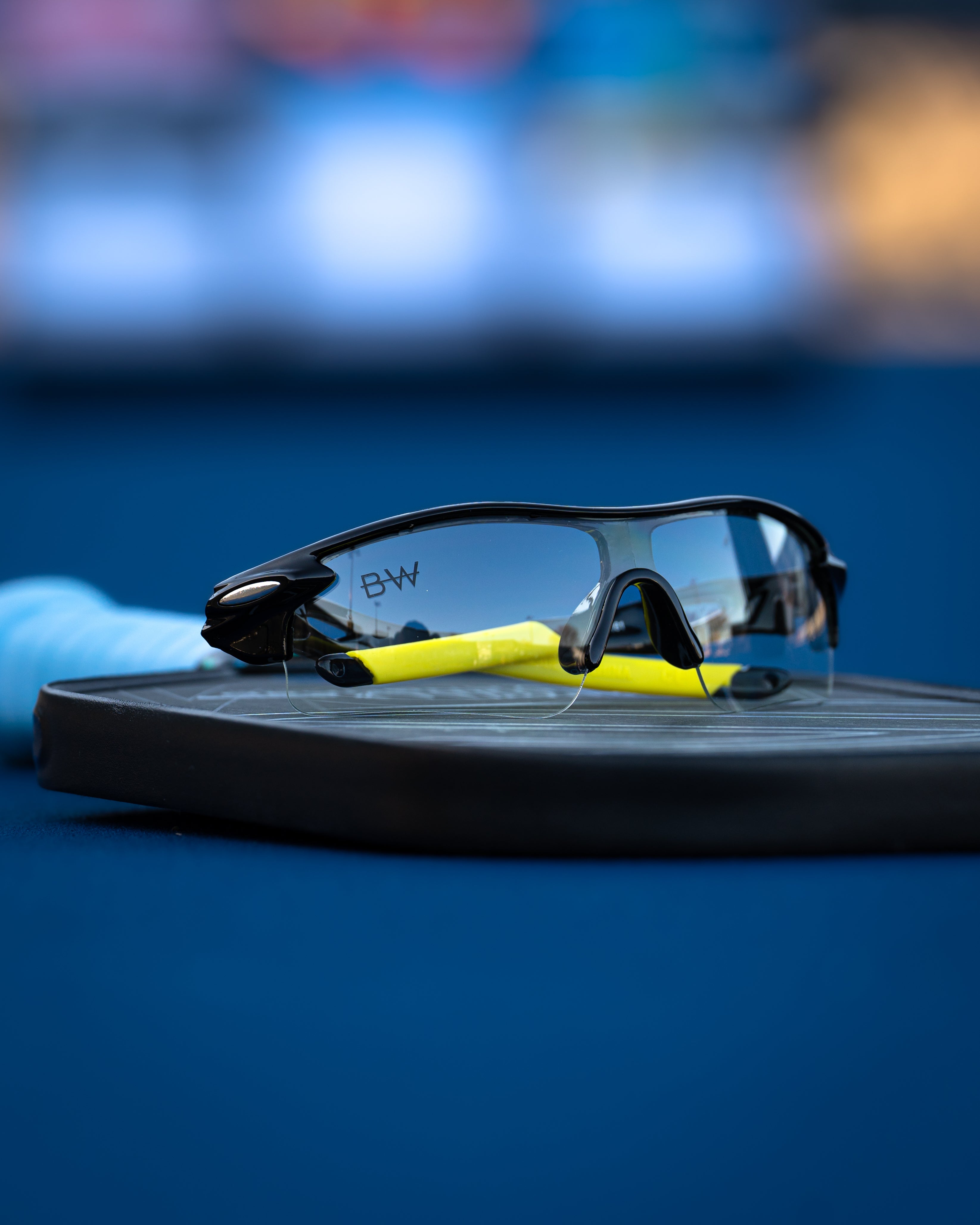
Doubles vs. Singles: Which RX Glasses Fit Your Playstyle? 🎾👓
Share
Doubles vs. Singles: Which RX Pickleball Glasses Fit Your Playstyle?
Singles and doubles pickleball can feel like two very different versions of the same sport. Doubles often features close-range exchanges, coordinated court positioning, dinks, speed-ups, and rapid volleys near the kitchen. Singles generally asks one player to cover more court and can involve more frequent movement between short and deeper court positions.
But does that mean you need different prescription pickleball glasses for singles and doubles? Usually, the format alone does not determine your prescription or require a completely different pair.
If you need RX correction while playing, start with your actual prescription. Then compare the playing environment, frame dimensions, lens configuration, fit preferences, and verified product characteristics that make sense for how and where you play.
This guide explains the practical eyewear differences between singles and doubles without claiming that one frame automatically improves peripheral vision, reaction time, depth perception, or court coverage.
Find Your Pickleball RX Setup
Do You Need Different RX Glasses for Singles and Doubles Pickleball?
Not necessarily. Many players can use the same prescription pickleball glasses for singles and doubles when their corrective needs, playing environment, and eyewear preferences remain the same.
Your prescription should reflect your individual refractive needs—not whether you have one partner, three other players on court, or no partner at all.
| Factor | Doubles | Singles |
|---|---|---|
| Prescription | Based on individual corrective needs | Based on individual corrective needs |
| Court Coverage | Shared with a partner | One player covers the court |
| Common Situations | Dinks, volleys, speed-ups, counters, coordinated positioning | More individual court coverage, movement, passing shots, and transitions |
| Lens Configuration | Choose around environment and individual needs | Choose around environment and individual needs |
| Need a Different RX? | The game format alone does not automatically require a different prescription. | |
What Are the Visual and Movement Demands of Doubles Pickleball?
Doubles can place players relatively close to each other and the action, particularly when all four players reach the non-volley zone.
Common doubles situations include:
- Dink exchanges
- Kitchen-line volleys
- Speed-ups and counters
- Partner movement and positioning
- Rapid changes between offense and defense
- Third-shot and transition-zone sequences
- Quick exchanges with multiple players near the action
A player may need to recognize relevant information, anticipate what could happen next, select a response, and execute it quickly.
If you require prescription correction, RX eyewear provides that correction during these situations. It should not automatically be credited with making your reactions faster or expanding your peripheral vision.
What Are the Visual and Movement Demands of Singles Pickleball?
Singles removes the partner, meaning one player is responsible for their side of the court.
Depending on the point, singles can involve:
- Covering more court individually
- Moving between different court positions
- Responding to passing shots
- Changing direction during rallies
- Transitioning between the baseline and kitchen
- Tracking the developing point while repositioning
- Managing repeated movement throughout a match
Those differences can affect how singles feels physically and tactically, but they do not automatically require “distance-enhancing” prescription lenses or a stronger RX.
Prescription correction should remain based on the player's individual visual needs.
Doubles vs. Singles RX Glasses: What Actually Changes?
The biggest differences are usually found in how you play and where you play, not in a special prescription category for each format.
| Consideration | Doubles Player | Singles Player |
|---|---|---|
| Corrective Need | Use the prescription correction appropriate to you. | Use the prescription correction appropriate to you. |
| Movement | Often coordinated with partner positioning. | More court is covered individually. |
| Fast Exchanges | Can be common during kitchen-line volleys and counters. | Can also occur depending on positioning and point development. |
| Frame Fit | Individual fit matters. | Individual fit matters. |
| Clear vs. Sunglass | Depends primarily on environment and preference. | Depends primarily on environment and preference. |
| Polarization | Blinded Wear uses non-polarized sports lenses. | Blinded Wear uses non-polarized sports lenses. |
| High-Index RX | Included at no additional cost with Blinded Wear RX eyewear. | Included at no additional cost with Blinded Wear RX eyewear. |
What Should Doubles Players Look for in RX Pickleball Glasses?
There is no special “doubles prescription.” Instead, doubles players who require RX correction can compare eyewear around their actual court routine.
Consider:
- Your current prescription
- Whether you usually play indoors or outdoors
- Available frame dimensions
- Overall frame shape
- Verified lens characteristics
- Individual fit preferences
- Whether the same pair will also be used for singles or other compatible activities
Claims about “maximum peripheral vision,” “instant reactions,” or “perfect net coverage” should not replace those practical comparison points.
What Should Singles Players Look for in RX Pickleball Glasses?
Singles players can use the same basic framework.
Compare:
- Your actual prescription requirements
- Your typical playing environment
- Available frame dimensions
- Individual fit preferences during active use
- Current lens configuration
- Verified product characteristics
- Whether you also play doubles frequently
A singles player should not automatically look for a stronger prescription or a lens marketed as providing enhanced long-distance tracking. If prescription correction is required, the RX should address the player's individual visual needs.
Can One Pair of RX Glasses Work for Both Singles and Doubles?
Yes, potentially. For many players, this is the simplest setup.
One pair becomes especially practical when:
- You require the same prescription correction regardless of format
- You play singles and doubles in similar environments
- You are comfortable with the same frame
- The lens configuration works for both
- You do not have another activity requiring specialized protective eyewear
If you play doubles on Tuesday and singles on Saturday at the same facility, for example, the change in format alone does not mean you need a second prescription pair.
The better question is: what would the second pair solve?
When Might a Singles and Doubles Player Want Two RX Pairs?
Two pairs make more sense when they serve different environments or practical roles—not simply because you alternate between singles and doubles.
| Primary Pair | Second Pair | Potential Reason |
|---|---|---|
| Clear RX | RX Sunglasses | You regularly play indoors and outdoors. |
| Primary RX Pair | Backup Corrective Pair | You compete or travel and depend on RX correction. |
| Pickleball RX | Specialized Protective Eyewear | Another activity has different protective requirements. |
Owning multiple pairs does not automatically improve durability, reaction speed, or performance. Each additional pair should ideally solve a specific need.
Do Doubles Players Need RX Glasses for Faster Reactions?
Doubles can produce extremely fast exchanges, but prescription glasses should not automatically be credited with increasing neurological reaction speed.
A rapid response can involve:
- Receiving visual information
- Recognizing relevant cues
- Anticipating what may happen
- Selecting a response
- Initiating movement
- Executing the shot
RX lenses provide prescribed refractive correction when needed. Anticipation, positioning, decision-making, movement, and technique remain separate parts of the response.
Do Singles Players Need Special RX Lenses for Long-Distance Tracking?
Singles can involve different court positions and more individual movement, but this does not automatically mean a player needs special “distance-enhancing” lenses.
If you require prescription correction, use the appropriate prescription for your individual visual needs.
A sports lens should not automatically be credited with:
- Improving long-distance tracking
- Increasing visual processing speed
- Improving anticipation
- Increasing shot accuracy
- Making an opponent easier to track
Competitive format does not determine prescription strength.
Do Doubles Players Need Wider Peripheral Vision?
Doubles players may need awareness of several pieces of court information at once, including partner and opponent positioning. However, that does not mean a particular sports frame should automatically be marketed as improving peripheral vision.
When comparing frames, evaluate what is actually known:
- Available frame dimensions
- Frame shape
- Lens configuration
- Individual fit preferences
- Verified product characteristics
A wraparound or sports-oriented appearance alone does not establish a measurable increase in peripheral vision.
Does Depth Perception Matter Differently in Singles and Doubles?
Players use spatial information throughout both formats, but depth perception should not be reduced to a claim about one lens feature.
Blinded Wear sports eyewear uses non-polarized lenses. Non-polarized lenses do not add a polarization filter and preserve visual information available without that filter.
Some court players prefer non-polarized eyewear. However, non-polarized lenses should not automatically be described as:
- Improving depth perception
- Improving ball tracking
- Increasing reaction speed
- Improving spatial awareness
- Providing a singles or doubles performance advantage
The same principle applies whether you spend most of your time covering half the court with a partner or playing singles.
Do High-Index Lenses Benefit Singles or Doubles Players More?
High-index lenses should not be ranked according to pickleball format.
High-index describes a category of prescription lens material. It does not automatically improve reaction time, distance tracking, depth perception, or stamina.
Blinded Wear includes high-index prescription lenses at no additional cost with RX eyewear, regardless of whether the customer primarily plays singles or doubles.
Clear RX vs. RX Sunglasses for Singles and Doubles
The playing environment is usually more relevant to this decision than the format.
| Where You Play | Configuration to Compare |
|---|---|
| Primarily Indoors | A clear or other non-dark-tinted RX configuration may be worth comparing. |
| Evening / Lower-Light Play | A non-dark-tinted configuration may be preferred when dark sunglasses are not wanted. |
| Primarily Outdoors | Compare current RX sunglass configurations according to your prescription needs and preferences. |
| Indoor + Outdoor | Determine whether one configuration covers your routine or whether two purposeful setups make more sense. |
A clear lens means there is no dark sunglass tint. It should not automatically be credited with increasing available light, improving contrast, or helping a player react faster.
Does Frame Fit Matter More for Singles or Doubles?
Fit matters for active eyewear in either format, but there is no universal “singles fit” or “doubles fit.”
Instead of assuming that a frame marketed for fast movement will automatically stay perfectly positioned, compare:
- Available frame dimensions
- Overall frame shape
- Measurements from glasses that already fit you
- Your individual preferences during movement
- Verified fit features for the exact product
Do not assume adjustable nose pads, anti-slip materials, grip temples, or other retention features unless they are specifically verified for the frame.
What About Impact Resistance for Singles and Doubles?
Blinded Wear sports eyewear uses impact-resistant lenses. That characteristic applies independently of whether you primarily play singles or doubles.
Impact-resistant should not automatically be interpreted as:
- Shatterproof
- Indestructible
- Certified to an unspecified protective standard
- Guaranteed to prevent injury
If you require eyewear meeting a specific protective standard, verify that requirement and the exact product certification separately.
Blinded Wear RX Pickleball Glasses to Compare
Rather than assigning one model to “doubles players” and another to “singles players,” compare RX frames according to your prescription, environment, available dimensions, design preferences, and verified characteristics.
| RX Model | What to Compare | Explore |
|---|---|---|
| Frost RX | Current RX configuration, available dimensions, frame design, and intended environment | View Frost RX → |
| Crystal Wave II RX | Current RX sunglass configuration, available dimensions, design, and intended use | View Crystal Wave II RX → |
| Gray Hound RX | Current prescription sunglass configuration, dimensions, design, and environment | View Gray Hound RX → |
| Rocket Fire RX | Prescription configuration, available dimensions, design, and intended environment | View Rocket Fire RX → |
| Phantom II RX | Current RX configuration, available dimensions, frame design, and intended use | View Phantom II RX → |
No model above is being assigned a guaranteed singles or doubles performance advantage.
How to Choose RX Pickleball Glasses for Your Playstyle
Use your playstyle as context rather than as the sole buying criterion.
-
Start with your prescription.
If you require correction during pickleball, choose an appropriate RX setup.
-
Identify where you play most.
Indoor, outdoor, evening, and mixed environments can affect which lens configuration you prefer.
-
Consider how often you play singles and doubles.
If you regularly play both, look for one appropriate setup before assuming you need two.
-
Compare frame dimensions.
Use eyewear that already fits as a reference when measurements are available.
-
Verify product characteristics.
Do not rely on unverified claims about peripheral vision, reaction time, anti-fog performance, or secure fit.
-
Practice in the eyewear.
Become familiar with a new corrective setup before relying on it during important competition.
How to Order Blinded Wear RX Glasses for Singles or Doubles
The ordering process does not change according to your preferred pickleball format.
- Browse the Prescription Pickleball Collection.
- Choose an RX product rather than a non-prescription version.
- Compare the available dimensions and current lens configuration.
- Have a clear photo or picture of your eyeglass prescription ready.
- Upload the prescription before purchasing your RX eyewear.
- Review current processing, delivery, and replacement information.
Blinded Wear includes high-index prescription lenses at no additional cost with RX eyewear.
Doubles vs. Singles RX Pickleball Glasses: FAQs
Do I need different prescription glasses for singles and doubles pickleball?
Not automatically. Many players can use the same RX pair for both when their prescription, environment, lens configuration, and eyewear preferences remain compatible.
What RX glasses are best for doubles pickleball?
There is no universal doubles-specific winner. Compare your prescription requirements, playing environment, available frame dimensions, individual preferences, and verified product characteristics.
What RX glasses are best for singles pickleball?
There is no universal singles-specific winner. Start with your corrective needs and compare frames according to environment, dimensions, lens configuration, and verified characteristics.
Do doubles players need wider lenses?
Do not assume a wider or sports-oriented frame automatically produces better peripheral vision. Compare actual frame dimensions and individual fit preferences.
Do singles players need stronger distance correction?
Singles play does not automatically require a stronger prescription. RX correction should reflect your individual visual needs.
Do doubles players need faster-reaction lenses?
There is no lens feature that should automatically be described as increasing neurological reaction speed. Doubles response also involves anticipation, positioning, decision-making, movement, and technique.
Do non-polarized lenses improve doubles court awareness?
Blinded Wear uses non-polarized sports lenses, and some court players prefer that configuration. Do not automatically attribute improved court awareness, depth perception, or reaction speed to polarization choice.
Are high-index lenses better for singles?
High-index describes a prescription lens-material category rather than a singles-specific performance technology.
Can I use clear RX glasses for indoor singles and doubles?
A clear or other non-dark-tinted RX configuration may be worth comparing when you require correction indoors and do not want a dark sunglass tint.
Can I use RX sunglasses for both singles and doubles outdoors?
Potentially. If the same prescription and sunglass configuration meet your needs in both formats, changing from singles to doubles alone does not require another pair.
Should I own two RX pairs if I play both formats?
Not necessarily. A second pair is most useful when it solves a distinct need such as indoor vs. outdoor play or backup correction.
Which RX Setup Fits Your Pickleball Routine?
Instead of labeling one frame as a “doubles pair” and another as a “singles pair,” look at the combination of formats and environments that make up your actual week.
| Your Pickleball Routine | RX Setup to Consider |
|---|---|
| Mostly Indoor Doubles | If you require correction, compare an RX configuration appropriate for indoor use without assuming doubles requires a special prescription. |
| Mostly Outdoor Doubles | Compare current RX sunglass configurations according to your prescription needs and preferences. |
| Mostly Indoor Singles | A clear or other non-dark-tinted RX configuration may be worth comparing when dark sunglasses are not preferred. |
| Mostly Outdoor Singles | Compare RX sunglass options based on prescription, frame dimensions, and verified characteristics. |
| Singles + Doubles at the Same Facility | One RX pair may cover both formats when the environment and corrective needs remain the same. |
| Indoor Doubles + Outdoor Singles | Different lens configurations may be useful because the environments differ—not because the number of players changed. |
| Frequent Tournament Player | Consider whether a suitable backup corrective option would be practical. |
RX Glasses for Doubles Kitchen-Line Play
Doubles often becomes fastest when players are positioned near the non-volley zone. Volleys, speed-ups, counters, resets, and dinks can occur within the same sequence.
During those exchanges, a player may rely on:
- Ready position
- Paddle preparation
- Opponent-cue recognition
- Partner positioning
- Anticipation
- Decision-making
- Compact movement
- Recovery for the next ball
If you require prescription correction, your RX eyewear provides that correction while these skills are being used. It does not automatically create faster reactions, better hands, or improved net coverage.
RX Glasses for Singles Court Coverage
Singles places responsibility for your side of the court on you alone. That can create more individual movement and changes in court position throughout a point.
However, increased court coverage does not mean your eyewear needs to “enhance distance vision” beyond your appropriate prescription.
A singles player can instead focus on:
- Using the correction appropriate to their individual needs
- Selecting a lens configuration that matches the playing environment
- Comparing available frame dimensions
- Choosing among verified product characteristics
- Becoming familiar with the eyewear during normal movement
Footwork, positioning, anticipation, and court coverage are developed through pickleball practice rather than added by the prescription lens.
Do RX Glasses Improve Partner Awareness in Doubles?
Prescription eyewear should not automatically be credited with improving teamwork or partner awareness.
Doubles awareness can involve recognizing:
- Where your partner is positioned
- Which player should take the next ball
- How opponents are positioned
- Whether your team is transitioning together
- Which areas of the court are available
- How the point is developing
These are tactical and perceptual components of doubles play. RX lenses can provide prescribed refractive correction when needed, while communication, positioning, experience, and decision-making remain separate skills.
Do Singles Players Need Different Glasses Because They Move More?
Singles can involve substantial individual court movement, but that does not automatically create a need for a different prescription or a frame marketed as “stamina enhancing.”
For active use, players can compare practical characteristics such as:
- Frame dimensions
- Frame weight
- Overall shape
- Lens configuration
- Individual fit preferences
- Verified product features
Blinded Wear offers lightweight sports frames and comfort-oriented designs for extended matches, but those characteristics should not be turned into promises of greater stamina or improved singles performance.
Singles vs. Doubles Frame Fit: What Matters and What Doesn't?
It can be tempting to assume doubles requires a wider frame while singles requires a lighter or more secure frame. Those categories are too simplistic.
| Common Assumption | Better Way to Choose |
|---|---|
| Doubles requires a wide frame. | Compare actual frame dimensions and your individual fit preferences. |
| Singles requires the lightest frame possible. | Frame weight is one characteristic; evaluate the complete fit and configuration. |
| Wraparound automatically means better peripheral vision. | Do not infer a measurable peripheral-vision advantage from frame appearance alone. |
| Sports frames never slip. | Individual fit varies, and specific retention features should be verified. |
| A tighter frame is always better for singles. | Do not intentionally choose an inappropriate fit simply because singles involves movement. |
How Should Singles and Doubles Players Train Their Responses?
If your goal is to handle each format more effectively, train the skills specific to the situations you encounter rather than expecting different RX lenses to change your reaction speed.
| Training Area | Doubles Emphasis | Singles Emphasis |
|---|---|---|
| Volley Practice | Rapid exchanges, counters, preparation, and recovery | Useful when points develop near the kitchen |
| Anticipation | Opponent and partner positioning, common doubles patterns | Opponent positioning, available angles, and court coverage |
| Movement | Coordinating position with a partner | Covering court individually and recovering efficiently |
| Decision-Making | Shot selection within a four-player court | Shot selection while managing individual court responsibility |
| Live Points | Practice realistic doubles situations | Practice realistic singles movement and patterns |
If you require RX correction, train in the corrective setup you expect to use during matches so it is already familiar when you compete.
Should You Practice in Your RX Glasses Before Switching Formats?
If you already use the same prescription eyewear comfortably for both formats, switching from doubles to singles does not necessarily require a new adaptation period.
However, when you introduce a new RX pair or new lens configuration, become familiar with it during practice before an important match.
- Wear the new corrective setup in an appropriate normal setting.
- Use it during basic pickleball drills.
- Practice normal court movement.
- Play doubles points if doubles is part of your routine.
- Play singles points if singles is part of your routine.
- Use the eyewear in competition once the setup feels familiar.
There is no universal adaptation period for every prescription or player.
Persistent unexpected distortion, double vision, significant discomfort, or another concerning visual change should be evaluated appropriately rather than ignored.
RX Glasses vs. Contacts for Singles and Doubles Pickleball
Players who require correction may have more than one practical setup. Neither glasses nor contacts should automatically be declared the faster option for singles or doubles.
| Corrective Setup | How Correction Is Provided | Singles vs. Doubles |
|---|---|---|
| RX Pickleball Glasses | Prescription correction is incorporated into the eyewear. | Can potentially be used for either format. |
| Contacts + Non-RX Eyewear | Contacts provide correction while sports eyewear is selected separately. | Can potentially be used for either format. |
| Everyday RX Glasses | Everyday eyewear provides prescription correction. | May already meet some players' needs during either format. |
The appropriate corrective approach depends on individual visual needs, preferences, and appropriate eye-care guidance rather than the singles-versus-doubles distinction alone.
What If You Play Doubles Indoors and Singles Outdoors?
This is an example where two RX configurations may become more useful—but because the environment changed, not because the pickleball format changed.
A player might compare:
- A clear or other non-dark-tinted RX configuration for indoor doubles
- An RX sunglass configuration for outdoor singles
Alternatively, one available configuration may still satisfy the player's preferences across both environments.
Do not assume that clear lenses increase available indoor light or that a particular outdoor tint improves ball tracking, depth perception, or reaction speed.
What If You Play Both Singles and Doubles at a Tournament?
Many players compete in both formats during the same event. If your normal RX setup works appropriately for both, there is no need to change eyewear simply because your event category changes.
A practical tournament eyewear plan can include:
- Your primary RX pickleball glasses
- A suitable backup corrective option when appropriate
- An appropriate storage case
- Lens-care items appropriate for your eyewear
- A second lens configuration if playing environments differ substantially
- Accessible prescription information when traveling
Using familiar eyewear can be more practical than experimenting with a completely different corrective setup between singles and doubles events.
Do Singles Players Need a Backup Pair More Than Doubles Players?
Neither format automatically creates a greater need for backup RX eyewear.
A backup is more closely related to how much you depend on prescription correction and how disruptive losing access to your primary pair would be.
Consider a suitable backup if you:
- Depend on RX correction during play
- Compete regularly
- Travel for tournaments
- Play several times per week
- Use one RX pair for both singles and doubles
- Would have difficulty continuing if the primary pair became unusable
A backup provides redundancy, not a performance advantage.
Singles vs. Doubles Eyewear Claims to Question
Product descriptions sometimes assign specific athletic advantages to a frame simply because it is being marketed toward a particular style of play.
| Marketing Claim | What to Check Instead |
|---|---|
| “Maximum peripheral vision for doubles” | Look for verified dimensions or optical characteristics rather than assuming the claim from frame shape. |
| “Enhanced distance tracking for singles” | Use appropriate prescription correction and verify any specific lens claim separately. |
| “Faster reactions at the kitchen” | Reaction involves recognition, anticipation, decision-making, movement, and execution. |
| “Non-polarized for perfect depth perception” | Non-polarized means a polarization filter is not added; do not infer perfect or enhanced depth perception. |
| “Guaranteed secure fit” | Individual fit varies; verify actual frame features and dimensions. |
| “High-index for better court performance” | High-index describes a prescription lens-material category. |
| “Impact-resistant means shatterproof” | Impact resistance does not mean indestructible or shatterproof. |
Is It Worth Buying Dedicated RX Glasses for Your Main Playstyle?
Dedicated RX pickleball eyewear can be worthwhile when it solves a recurring corrective need, but your main format does not necessarily require its own pair.
Consider how often you:
- Play pickleball each week
- Need prescription correction while playing
- Switch between indoor and outdoor courts
- Alternate between singles and doubles
- Travel for competition
- Use the same eyewear for other compatible activities
If one RX pair covers most of those situations appropriately, a second “singles” or “doubles” pair may add little practical value.
If two environments require meaningfully different configurations, however, two purposeful pairs can make more sense.
Think About Cost Per Use, Not Singles vs. Doubles Labels
For frequent players, value can be considered in terms of how often the eyewear is actually used.
An RX pair worn for:
- Weekly doubles leagues
- Singles practice
- Open play
- Drilling sessions
- Tournaments
- Other compatible activities
may serve a broader role than eyewear purchased around one narrow playstyle label.
The goal is not to buy the greatest number of specialized frames. It is to build a corrective setup that matches your actual routine.
What Blinded Wear RX Eyewear Offers for Both Playstyles
Blinded Wear's prescription collection can be compared by players who participate in singles, doubles, or both without assigning unsupported format-specific performance advantages to individual frames.
- Prescription correction for players who require RX eyewear
- High-index prescription lenses included at no additional cost
- Impact-resistant lenses
- Non-polarized lenses
- Lightweight sports frames
- Comfort-oriented designs for extended matches
- Multiple RX styles to compare according to individual preferences
- 50% lifetime replacement support if glasses break, subject to current policy terms
These characteristics apply independently of whether you spend more time playing singles or doubles.
60-Second Singles vs. Doubles RX Decision Guide
-
Do you require prescription correction during pickleball?
If yes, begin with RX eyewear. If not, compare non-prescription options.
-
Do you play mostly singles, doubles, or both?
Use this to understand your routine, but do not assume the format determines your prescription.
-
Are both formats played in the same environment?
If yes, one RX configuration may be practical for both.
-
Do you switch between indoor and outdoor courts?
The environmental difference may be a stronger reason to compare separate configurations.
-
Does your current frame size work during active use?
Compare available dimensions with eyewear you already find comfortable.
-
Are you buying because of a performance claim?
Separate verified characteristics from promises about reactions, tracking, peripheral vision, or depth perception.
-
Would a second pair solve a real problem?
If not, one appropriate RX setup may be enough for both singles and doubles.
More Questions About RX Glasses for Singles and Doubles
Can I switch from doubles to singles without changing glasses?
Potentially, yes. If your prescription, playing environment, lens configuration, and eyewear preferences remain compatible, changing formats alone does not require different RX glasses.
Do doubles players need better peripheral vision than singles players?
Doubles can require awareness of multiple players and court positions, but a particular frame should not automatically be credited with improving peripheral vision.
Do singles players need better distance vision?
Singles can involve different court positions, but players should use prescription correction appropriate to their individual visual needs rather than intentionally changing RX strength for the format.
Are lightweight RX glasses better for singles?
Lightweight construction can be a practical frame characteristic, but it should not automatically be described as improving singles stamina or performance.
Are wider RX glasses better for doubles?
Not automatically. Compare actual frame dimensions and individual fit preferences rather than assuming width creates a doubles advantage.
Do doubles players react faster than singles players?
The formats create different situations, and individual players vary. This eyewear guide does not require ranking reaction speed between singles and doubles players.
Can one pair work for indoor doubles and outdoor singles?
Potentially, depending on the available lens configuration and your preferences. If the environments create distinctly different needs, separate configurations may be useful.
Should tournament players own two RX pairs?
A suitable backup can be practical when you depend on prescription correction, but tournament participation does not automatically require two pairs.
Do I need different lens tints for singles and doubles?
Format alone does not determine tint. Consider the playing environment and verified lens configuration instead.
Does a darker tint help with outdoor singles?
A particular tint should not automatically be credited with improved tracking, reaction time, depth perception, or overall performance.
Are clear RX lenses only for doubles?
No. A clear or other non-dark-tinted configuration can be considered for either format when it suits the playing environment.
Does non-polarized eyewear help doubles players react at the kitchen?
Blinded Wear uses non-polarized sports lenses, but faster reactions should not automatically be attributed to polarization choice.
Can high-index RX lenses improve singles distance tracking?
High-index describes a prescription lens-material category. Improved distance tracking should not automatically be attributed to it.
Are RX glasses better than contacts for doubles?
There is no universal doubles-specific winner. RX glasses and contacts are different methods of providing correction, and the appropriate option depends on individual needs and preferences.
Are RX glasses better than contacts for singles?
There is no universal singles-specific winner. Choose a corrective approach according to individual visual needs, preferences, and appropriate eye-care guidance.
What matters more when buying RX pickleball glasses: playstyle or environment?
Both can provide useful context, but environment often has a more direct role in deciding between a clear or non-dark-tinted configuration and an RX sunglass configuration. Prescription needs remain individual regardless of format.
8 Mistakes to Avoid When Choosing RX Glasses for Singles or Doubles
-
Buying a “doubles frame” solely because it promises wider peripheral vision.
Frame shape alone does not establish a measurable improvement in peripheral vision. Compare actual dimensions and verified characteristics.
-
Choosing a stronger prescription for singles.
Covering more court does not mean you need stronger distance correction. Your prescription should reflect your individual visual needs.
-
Expecting RX lenses to increase reaction speed in doubles.
Prescription correction and neurological reaction speed are separate concepts.
-
Assuming non-polarized automatically improves depth perception.
Blinded Wear uses non-polarized sports lenses, but improved depth perception should not automatically be attributed to polarization choice.
-
Buying two pairs simply because you play both formats.
A second pair is more useful when it solves a distinct need such as a different playing environment or backup correction.
-
Ignoring frame dimensions.
Singles and doubles both involve movement. Compare available measurements with eyewear that already fits you.
-
Assuming every sports lens includes the same treatments.
Anti-fog, scratch-resistant, hydrophobic, anti-reflective, UV-rating, and similar characteristics should be verified for the exact configuration.
-
Trying a completely new RX setup for the first time during competition.
Become familiar with new corrective eyewear during normal practice before relying on it in an important match.
Singles vs. Doubles RX Glasses: Myths vs. Facts
| Myth | What Players Should Know |
|---|---|
| “Doubles requires a special RX.” | Your prescription is based on individual corrective needs, not the number of players on court. |
| “Singles requires stronger distance lenses.” | Do not intentionally alter prescription strength because you play singles. |
| “Doubles glasses make you react faster.” | RX lenses provide prescribed correction; neurological reaction speed should not automatically be credited to eyewear. |
| “Wide sports frames automatically improve peripheral vision.” | A measurable peripheral-vision improvement should not be inferred from frame appearance alone. |
| “High-index lenses are better for singles.” | High-index describes a prescription lens-material category rather than a playstyle-specific performance technology. |
| “Non-polarized lenses improve doubles depth perception.” | Non-polarized means a polarization filter is not added; improved depth perception should not automatically be inferred. |
| “Clear lenses are only for indoor doubles.” | A clear or other non-dark-tinted configuration can be considered for either format when appropriate for the environment. |
| “Singles players always need lighter frames.” | Frame weight is one characteristic among several and does not determine whether eyewear is appropriate for singles. |
| “Impact-resistant means the glasses cannot break.” | Impact-resistant does not mean shatterproof or indestructible. |
Pre-Purchase Checklist for Singles and Doubles Players
Before choosing your RX pickleball glasses, answer these questions:
- Do I require prescription correction while playing?
- Is my current eyeglass prescription appropriate for my needs?
- Do I primarily play singles, doubles, or both?
- Do I play indoors, outdoors, at night, or across several environments?
- Would one lens configuration work across most of my schedule?
- How do the available frame dimensions compare with glasses that already fit me?
- Which lens and frame characteristics are specifically verified?
- Am I relying on an unsupported claim about reaction time, peripheral vision, tracking, or depth perception?
- Does another sport I play have specialized protective-eyewear requirements?
- Would a second pair solve a real environmental or backup need?
- Have I practiced in the eyewear before an important tournament?
- Have I reviewed the current replacement terms?
How to Care for RX Glasses When You Play Both Formats
Playing singles and doubles does not require different eyewear-care routines. Follow the care guidance appropriate for your exact frame, lenses, and any verified treatments.
Useful habits include:
- Store the eyewear appropriately between matches
- Avoid placing the lenses directly against abrasive surfaces
- Use cleaning methods appropriate for the specific lenses
- Inspect the eyewear after significant impact or damage
- Keep your primary RX pair organized during tournament days
- Keep a suitable backup accessible if you depend heavily on prescription correction
Do not assume sports eyewear is immune to scratches, breakage, or other damage simply because it uses impact-resistant lenses.
When Should You Replace Your RX Pickleball Glasses?
Switching from singles to doubles is not, by itself, a reason to replace your prescription glasses.
It may be time to reassess your setup when:
- Your prescription changes
- The glasses break
- The current frame no longer fits appropriately
- Your primary playing environment changes
- Your lens configuration no longer matches how you use the eyewear
- You begin an activity with different protective requirements
- An eye-care professional recommends updating your corrective lenses
Rather than replacing eyewear according to an arbitrary playstyle schedule, evaluate whether your corrective and practical needs have actually changed.
Singles vs. Doubles Prescription Pickleball Glasses: Final FAQs
Can the same prescription work for singles and doubles pickleball?
Your prescription is based on your individual visual needs rather than the format of pickleball you play. The same appropriate correction can potentially be used in both.
Should I buy RX glasses based on my DUPR rating or skill level?
Skill level does not automatically determine prescription strength or require a particular RX frame. Compare your corrective needs, environment, frame dimensions, and verified product characteristics.
Do advanced doubles players need different RX lenses?
Playing faster or more competitive doubles does not automatically create a different prescription requirement.
Do advanced singles players need different RX lenses?
Competitive singles does not automatically require stronger or specialized prescription correction. RX needs remain individual.
What matters most when choosing between RX frames?
Start with your prescription needs, then compare your playing environment, available frame dimensions, lens configuration, verified characteristics, and individual preferences.
Can I wear the same RX glasses for doubles practice and singles tournaments?
Potentially, yes. If the prescription, environment, frame, and lens configuration remain appropriate, the change in format alone does not require another pair.
Can I wear one RX pair for pickleball leagues and tournaments?
Potentially. Regularly practicing in the same corrective setup you intend to use during competition can also make that setup familiar before tournament play.
Are RX sports glasses automatically safer than regular glasses?
Do not infer a universal safety advantage from the sports label alone. Review verified product characteristics and any specific protective standards required for your activity.
Are impact-resistant RX lenses shatterproof?
No. Impact-resistant does not mean shatterproof or indestructible.
Do Blinded Wear RX glasses stay secure during singles movement?
Individual fit varies. Do not assume guaranteed non-slip performance unless specific retention characteristics are verified for the exact frame.
Do Blinded Wear RX glasses stay secure during doubles hands battles?
Individual fit varies in doubles just as it does in singles. Compare available dimensions and verified frame characteristics.
Will RX glasses improve my hand-eye coordination?
Prescription eyewear should not automatically be credited with improving hand-eye coordination. RX lenses provide prescribed refractive correction.
Will RX glasses improve ball tracking?
Improved ball tracking should not automatically be attributed to prescription sports eyewear or a single lens characteristic.
Will RX glasses improve reaction time in doubles?
RX lenses provide prescribed correction when needed. Faster neurological reaction speed should not automatically be attributed to the glasses.
Will RX glasses help me cover more court in singles?
Court coverage involves positioning, movement, anticipation, conditioning, decision-making, and technique. It should not automatically be credited to RX eyewear.
Are clear RX glasses good for indoor singles?
A clear or other non-dark-tinted RX configuration may be worth comparing when you require prescription correction indoors and do not want a dark sunglass tint.
Are clear RX glasses good for indoor doubles?
The same principle applies to doubles. Clear describes a non-dark-tinted configuration and does not automatically imply improved tracking, contrast, or reaction time.
Should I use RX sunglasses for outdoor singles?
If you require correction and prefer a sunglass configuration outdoors, compare current RX sunglass options according to your individual needs.
Should I use RX sunglasses for outdoor doubles?
RX sunglasses can also be considered for outdoor doubles when the configuration matches your corrective needs and preferences.
Are high-index prescription lenses extra at Blinded Wear?
No. Blinded Wear includes high-index prescription lenses at no additional cost with RX eyewear.
How do I submit my prescription to Blinded Wear?
Have a clear photo or picture of your eyeglass prescription ready to upload before purchasing RX eyewear.
What happens if my Blinded Wear glasses break?
Blinded Wear offers 50% lifetime replacement support if glasses break, subject to current policy terms.
Singles & Doubles Pickleball Eyewear Resource Hub
Key Takeaways: Choosing RX Glasses for Singles vs. Doubles
- You do not automatically need different prescription glasses for singles and doubles pickleball.
- Your prescription should reflect your individual corrective needs rather than your preferred format.
- Doubles can feature close-range exchanges, coordinated positioning, speed-ups, volleys, and counters.
- Singles generally requires one player to cover more court individually.
- Those tactical differences do not automatically require different prescription strengths.
- Your playing environment can be more relevant to lens configuration than whether you play singles or doubles.
- A clear or other non-dark-tinted configuration may be worth comparing for indoor, evening, or lower-light use when prescription correction is required.
- Blinded Wear includes high-index prescription lenses at no additional cost with RX eyewear.
- Blinded Wear uses non-polarized sports lenses, but non-polarized should not automatically be credited with improved depth perception, peripheral awareness, tracking, or reaction time.
- Blinded Wear sports eyewear uses impact-resistant lenses, but impact-resistant does not mean shatterproof or indestructible.
- Frame appearance alone does not establish improved peripheral vision or a guaranteed secure fit.
- One RX pair can potentially serve both singles and doubles when prescription, environment, fit, and lens configuration remain compatible.
- A second pair makes more sense when it solves a distinct need such as indoor vs. outdoor use or backup correction.
- If you want to improve singles or doubles performance, train the relevant sport-specific skills rather than expecting the eyewear to create the improvement.
Find RX Pickleball Glasses That Fit Your Actual Game
You do not need to force yourself into a “singles glasses” or “doubles glasses” category.
Start with the factors that actually define your eyewear needs:
your prescription + playing environment + frame dimensions + lens configuration + individual preferences + verified product characteristics.
Then use your playstyle to refine the decision.
Blinded Wear RX eyewear offers prescription correction, high-index prescription lenses included at no additional cost, impact-resistant non-polarized lenses, lightweight sports frames, comfort-oriented designs for extended matches, and multiple RX styles to compare.
Blinded Wear also offers 50% lifetime replacement support if glasses break, subject to current policy terms.
The Bottom Line: Your Playstyle Matters—But It Doesn't Determine Your Prescription
Singles and doubles ask players to solve different tactical and movement problems. Doubles can produce rapid close-range exchanges while coordinating with a partner. Singles places the entire side of the court under one player's responsibility.
Those differences matter when you train and compete, but they do not automatically create separate prescription requirements.
If you require RX correction, begin there. Then consider where you play, how the frame fits, which lens configuration makes sense, and which product characteristics are actually verified.
If one pair meets those needs across singles and doubles, one RX setup may be all you need. If indoor and outdoor environments or backup needs create distinct roles, a second pair may make more sense.
Choose eyewear around your real routine—not a promise that one frame will make you a better singles or doubles player.