
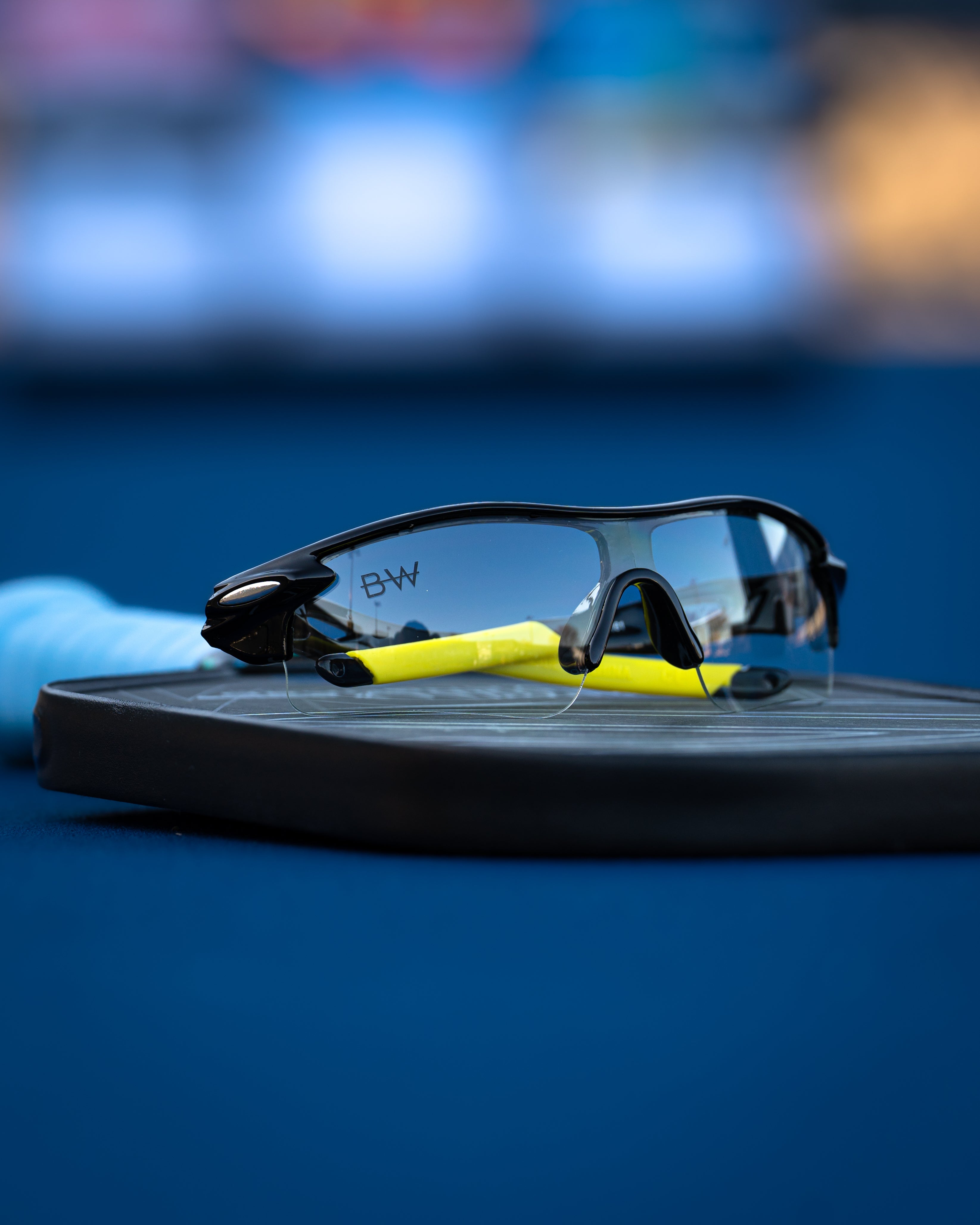
From Gym to Court: Sports Glasses That Transition Seamlessly
Share
From Gym to Court: Sports Glasses That Transition Seamlessly
If your training week includes the gym, running, pickleball, and other court sports, carrying different eyewear for every activity can become inconvenient. For athletes who need prescription correction, the better question is whether one RX sports-eyewear setup can realistically cover multiple activities and environments.
Sometimes it can. But “transition seamlessly” should not mean assuming one pair automatically adapts to every lighting condition, never fogs or slips, or improves athletic performance. The right multi-sport setup depends on your prescription, where you train, the lens configuration, frame design, verified product characteristics, and the requirements of each activity.
This guide explains how to choose prescription sports glasses for a gym-to-court routine, when one pair makes sense, when a second lens configuration may be useful, and which eyewear claims deserve a closer look.
Find Sports Eyewear for Your Training Routine
Can You Wear the Same Sports Glasses From the Gym to the Pickleball Court?
Potentially, yes. If the eyewear provides the correction you require, the lens configuration suits both environments, and the frame works for your activities and preferences, one pair can potentially serve multiple parts of your training routine.
That does not mean every pair of sports glasses is automatically appropriate for every activity.
| Question | Why It Matters |
|---|---|
| Do you require prescription correction? | Determines whether you should start with RX or non-RX eyewear. |
| Are you training indoors or outdoors? | Helps determine whether a clear or sunglass configuration fits your routine. |
| Do you regularly change environments? | You may need a versatile configuration or more than one pair. |
| Does the frame fit your preferences? | Multi-sport use still depends on individual frame fit. |
| Does another sport require a specific safety standard? | Do not assume general sports eyewear satisfies every sport-specific requirement. |
What Does “Gym-to-Court” Eyewear Actually Mean?
For most athletes, useful multi-environment eyewear is less about futuristic lenses that automatically optimize themselves for every sport and more about choosing a configuration that works across the situations in which you actually train.
A practical gym-to-court setup can combine:
- Prescription correction when required
- A sports-oriented frame
- Impact-resistant lenses
- A lens configuration appropriate for your training environments
- Frame dimensions that fit your preferences
- Verified product characteristics rather than assumed features
That is a more useful definition of versatility than expecting one pair to automatically change its optical performance every time you move from a treadmill to a pickleball court.
Why Multi-Sport Athletes Need to Think About Environment
A multi-sport training routine can expose the same athlete to very different conditions during the week.
| Environment | Eyewear Question |
|---|---|
| Indoor Gym | Do you want a dark sunglass tint while training indoors? |
| Indoor Pickleball Court | Would a clear corrective configuration better match your preference? |
| Outdoor Pickleball Court | Would you prefer a prescription or non-prescription sunglass configuration? |
| Evening Training | Is a dark tint still appropriate for the conditions? |
| Outdoor Running | Which current lens configuration suits your environment and preferences? |
| Mixed Indoor / Outdoor Day | Can one configuration cover both settings, or would separate options be more practical? |
The challenge is not necessarily finding a pair that “adapts” technologically. It is choosing eyewear that matches the environments where you expect to use it.
Can One Pair of RX Sports Glasses Really Do Everything?
One pair can potentially cover several activities, but there is no universal pair that should be declared perfect for every athlete, sport, and lighting condition.
A one-pair setup becomes more realistic when:
- You require the same prescription correction across your activities
- Your preferred lens configuration works in the environments where you train
- The frame dimensions and design suit your preferences
- The eyewear's verified characteristics fit your intended uses
- None of your activities require a different protective standard or specialized equipment
If you frequently move between substantially different environments, a second configuration may be more practical than forcing one pair to cover everything.
Clear Sports Glasses for Gym-to-Court Training
Clear lenses are one straightforward option for athletes who spend significant time training indoors.
A clear lens does not add a dark sunglass tint, which can make it worth comparing for:
- Weight training
- Indoor cardio
- Indoor pickleball
- Indoor court training
- Evening sessions
- Lower-light environments
Clear lenses should not automatically be credited with enhancing contrast, improving depth perception, increasing reaction speed, or making indoor spaces brighter.
If you require prescription correction, clear RX can simply combine that correction with a non-dark-tinted configuration.
Why RX Matters More Than the “Performance” Label
If you require prescription correction, that is the most important distinction between RX sports eyewear and a non-prescription pair.
Prescription lenses provide your prescribed refractive correction. They should not automatically be described as creating:
- Faster reactions
- Better depth perception
- Improved balance
- Better ball tracking
- Greater lifting precision
- Better coordination
The value proposition is simpler: you can incorporate your required correction into eyewear intended for active use.
What Does High-Index Mean for RX Sports Glasses?
High-index refers to a prescription lens-material category rather than a multi-sport performance technology.
Blinded Wear includes high-index prescription lenses at no additional cost with RX eyewear.
That is a concrete part of the RX offering, but high-index should not automatically be translated into claims of:
- Better athletic performance
- Greater optical accuracy
- Faster visual processing
- Better depth perception
- Improved reaction time
There is also no need to state a specific refractive index unless that exact specification has been verified for the current lens configuration.
Why Impact Resistance Matters—but Doesn't Mean Indestructible
Blinded Wear sports eyewear uses impact-resistant lenses.
Impact resistance is a physical lens characteristic. It should remain separate from absolute or certification-based claims that have not been specifically established for the product.
| Accurate Characteristic | What You Should Not Automatically Assume |
|---|---|
| Impact-Resistant Lens | Shatterproof |
| Sports-Oriented Eyewear | Certified for every sport |
| Lightweight Sports Frame | Indestructible construction |
| Active-Use Design | Guaranteed protection from injury |
If your gym activity or another sport requires a particular protective certification, verify the exact standard for the eyewear you intend to use.
Does One Pair of Sports Glasses Meet Every Sport's Safety Requirements?
Not necessarily.
The term “sports glasses” is broad. Different activities can involve different impact risks, equipment, rules, and protective requirements.
Do not assume that eyewear suitable for pickleball automatically satisfies a specific standard required for another activity simply because both involve physical movement.
For activities where certified protective eyewear is required or recommended, check the exact certification and product specifications.
Can You Wear Sports Glasses While Weight Training?
Prescription sports eyewear can potentially be part of a weight-training setup if the frame and lens configuration suit the athlete's needs.
But gym eyewear does not automatically need specialized “lifting technology.”
A frame should also not be described as guaranteed to stay in place through every lift unless that characteristic is specifically supported.
If you want one pair for lifting and pickleball, compare the frame's available dimensions, design, prescription configuration, and your individual preferences.
What About RX Sports Glasses for Cardio?
The same basic approach applies to treadmills, stationary bikes, conditioning sessions, and other gym cardio.
If you require correction, an RX sports frame can provide it while you train. However, do not assume that every sports frame includes:
- Anti-fog coating
- Ventilation channels
- Hydrophobic treatment
- Sweat-proof construction
- Anti-slip temples
Those are product-specific characteristics that should be verified rather than inferred from a “performance eyewear” label.
Do Sports Glasses Stay Put When You Sweat?
Individual fit can vary, and “sports” does not automatically mean a frame is guaranteed not to move.
Instead of relying on a universal non-slip claim, evaluate:
- Available frame dimensions
- Overall frame shape
- Your existing eyewear measurements
- Your individual comfort preferences
- Verified product-specific fit characteristics
When possible, compare measurements with eyewear you already know fits you well.
Are Multi-Sport Glasses Automatically Anti-Fog?
No. A pair being designed for active use does not automatically establish an anti-fog characteristic.
Fogging can depend on the eyewear, environmental conditions, temperature, moisture, airflow, and other factors.
If fogging is one of your primary concerns, verify whether the exact model and lens configuration specifically include a fog-related feature before purchasing.
What Changes When Your Training Moves Outdoors?
Moving from an indoor gym to an outdoor court can change the lighting environment substantially.
That does not necessarily mean your eyewear needs to be replaced every time you walk outside. It does mean you should consider whether your current lens configuration suits the new environment.
A multi-environment athlete might choose between:
- One configuration used across several environments
- A clear setup for indoor and lower-light use
- A sunglass configuration for outdoor use
- Separate RX and non-RX eyewear when correction is provided another way
The right setup depends on how frequently you move between environments and your individual preferences.
What About Photochromic RX Lenses for Indoor-to-Outdoor Training?
Photochromic lenses are often discussed when athletes want one lens configuration for changing environments.
However, availability and exact behavior should be verified for the specific RX product or configuration you are considering.
Do not assume every Blinded Wear RX model automatically includes photochromic technology or that a photochromic lens:
- Changes instantly
- Reaches the same darkness in every environment
- Is automatically ideal for every sport
- Improves reaction time or tracking
If changing-light eyewear is part of your plan, compare the current available configuration with your actual training routine.
What Role Do Non-Polarized Lenses Play?
Blinded Wear sports eyewear uses non-polarized lenses. Non-polarized lenses do not add a polarization filter and preserve visual information available without that filter.
Some court players prefer non-polarized eyewear.
That characteristic should not automatically be expanded into claims that non-polarized lenses improve:
- Depth perception
- Reaction time
- Ball tracking
- Peripheral vision
- Spin recognition
- Coordination
Likewise, polarized eyewear should not universally be described as harmful for every athletic activity.
Do Wraparound Sports Glasses Improve Peripheral Vision?
Frame shape and coverage can differ between sports-eyewear designs, but a wraparound appearance should not automatically be translated into a measurable peripheral-vision improvement.
When comparing frames, focus on verified design characteristics and whether the shape works for your preferences rather than assuming a specific athletic visual advantage.
Can One Pair of RX Glasses Improve Performance in Every Sport?
No eyewear should be expected to create an automatic performance improvement simply because it is used across several sports.
For example, RX lenses should not automatically be credited with:
- Making you react faster in pickleball
- Improving balance during weight training
- Increasing running efficiency
- Improving hand-eye coordination
- Making your peripheral vision wider
- Increasing athletic endurance
If you require prescription correction, the lenses handle the corrective part of the equation. Training and athletic development remain separate.
For more on this distinction, read RX Lenses & Pickleball Reaction Time →
Do RX Sports Glasses Improve Depth Perception Across Activities?
Prescription lenses provide correction according to your prescription. Depth perception is a broader visual process and should not automatically be described as enhanced simply because someone switches to sports eyewear.
Likewise, claims that one sports frame improves spatial judgment during lifting, running, pickleball, and every other activity go beyond the basic function of RX lenses.
What About Blue-Light Filtering for Indoor Training?
H Blue Shield RX has a verified blue-light filtering characteristic.
That characteristic can be evaluated on its own without claiming that blue-light filtering automatically:
- Reduces athletic fatigue
- Improves concentration
- Improves reaction time
- Improves indoor court performance
- Prevents eye strain
- Improves recovery
If blue-light filtering is a feature you want, choose it for that verified characteristic rather than an unrelated athletic promise.
Blinded Wear RX Sports Glasses to Compare
There is no universal “best” gym-to-court frame. Compare current RX models according to their lens configuration, available dimensions, frame design, verified characteristics, and your intended environments.
| RX Model | What to Compare | Explore |
|---|---|---|
| Rocket Fire RX | Current RX configuration, frame dimensions, design, and intended environment | Rocket Fire RX → |
| H Blue Shield RX | RX configuration, verified blue-light filtering characteristic, dimensions, and intended use | H Blue Shield RX → |
| Frost RX | Current prescription configuration, frame dimensions, design, and environment | Frost RX → |
| Ocean Wave RX | Current RX configuration, available dimensions, design, and intended use | Ocean Wave RX → |
The original version of this guide described these frames with anti-fog, anti-slip, adaptive, durability, and other performance characteristics that should not be assumed without current product-specific verification. :contentReference[oaicite:0]{index=0}
How to Choose a Sports Frame for Multiple Activities
Face shape alone does not determine whether a sports frame will work for you. When measurements are available, comparing them with eyewear that already fits you can provide a more concrete starting point.
- Choose a current pair of glasses that fits you well.
- Find its available frame measurements.
- Compare those dimensions with the sports frame you are considering.
- Account for differences in overall frame shape and design.
- Consider how and where you plan to use the new pair.
- Choose according to your individual fit and comfort preferences.
One Pair vs. Two Pairs: Which Gym-to-Court Setup Makes Sense?
| Training Routine | Possible Setup |
|---|---|
| Mostly Indoor Gym + Indoor Pickleball | A clear or otherwise appropriate RX configuration may cover both. |
| Indoor Gym + Frequent Outdoor Pickleball | Compare one versatile setup with separate indoor and outdoor configurations. |
| Mostly Outdoor Training | Start with the lens configuration that suits your normal outdoor routine. |
| Indoor + Evening Training | A non-dark-tinted configuration may cover more of your routine. |
| Several Sports With Different Protective Requirements | Sport-specific eyewear may be necessary rather than relying on one pair. |
| No Prescription Needed | Compare non-RX sports eyewear rather than paying for unnecessary RX. |
What to Look for Before Buying Multi-Sport RX Glasses
- Correction: Do you actually require prescription lenses?
- Environment: Where will you wear the glasses most often?
- Lens configuration: Clear, sunglass, or another currently available option?
- Frame dimensions: How do they compare with eyewear that already fits you?
- Impact resistance: Is it specifically stated for the lens?
- Polarization: Is the lens polarized or non-polarized?
- Additional features: Are coatings and technologies specifically verified?
- Sport requirements: Does another activity require a specific certification?
- Replacement support: What does the current policy actually cover?
- Frequency: Will you realistically use the same pair across enough activities to justify the setup?
FAQs About Gym-to-Court Sports Glasses
Can I use pickleball glasses at the gym?
Potentially. Consider your corrective needs, lens configuration, frame preferences, and the requirements of the activity you are performing.
Can I use the same prescription sports glasses for lifting and pickleball?
Potentially, if the eyewear provides the correction you need and the frame and lens configuration suit both activities.
Do I need different glasses for indoor and outdoor training?
Not necessarily. Some athletes may be satisfied with one configuration, while others may prefer separate options for substantially different environments.
Are sports glasses anti-slip?
Do not assume every sports frame has a verified anti-slip characteristic. Individual fit can also vary.
Are sports glasses anti-fog?
Not automatically. Verify whether an anti-fog characteristic is specified for the exact model and lens configuration.
Does Blinded Wear use impact-resistant lenses?
Yes. Blinded Wear sports eyewear uses impact-resistant lenses. This should not automatically be interpreted as shatterproof or certified to an unspecified protective standard.
Does Blinded Wear use polarized sports lenses?
Blinded Wear sports eyewear uses non-polarized lenses.
Does Blinded Wear include high-index prescription lenses?
Yes. High-index prescription lenses are included at no additional cost with Blinded Wear RX eyewear.
Are photochromic lenses available?
Check the current RX product and lens options for availability rather than assuming every model includes photochromic technology.
Can RX glasses improve my pickleball reaction time?
RX lenses provide prescribed correction. Faster neurological reaction time should not automatically be attributed to prescription sports eyewear.
Can sports glasses improve peripheral vision?
Do not automatically infer a measurable peripheral-vision improvement from a sports or wraparound frame design.
How long do RX orders take?
Check the current ordering information for the latest processing and delivery estimate rather than relying on an older fixed turnaround time.
How do I submit my prescription?
Upload a clear photo or picture of your eyeglass prescription before purchasing your RX eyewear.
Does Blinded Wear have replacement support?
Blinded Wear offers 50% lifetime replacement support if glasses break, subject to current policy terms.
Which Sports Glasses Setup Fits Your Training Week?
A useful multi-sport setup starts with your actual schedule. Someone who lifts indoors and plays indoor pickleball has different eyewear considerations from someone who runs outside before heading to an outdoor court.
| Training Routine | What to Consider |
|---|---|
| Weight Training + Indoor Pickleball | Clear or another non-dark-tinted RX configuration may cover both environments if you require correction. |
| Indoor Cardio + Indoor Pickleball | Compare a sports-oriented frame, your required correction, available dimensions, and verified lens characteristics. |
| Gym + Outdoor Pickleball | Decide whether one lens configuration suits both environments or whether separate indoor and outdoor options are more practical. |
| Outdoor Running + Outdoor Pickleball | Compare the current sunglass or other available configuration with your preferences for both activities. |
| Gym + Evening Pickleball | A clear or other non-dark-tinted configuration may be worth comparing when a dark sunglass tint is not preferred. |
| Indoor + Outdoor + Evening Training | A two-pair setup may offer more flexibility than expecting one configuration to cover every condition. |
What Actually Makes Sports Glasses Easy to Transition Between Activities?
The most useful gym-to-court eyewear does not need to perform a technological transformation between workouts. Instead, it should minimize the reasons you would need to change eyewear.
For an RX athlete, that can mean choosing a pair that:
- Provides the prescription correction you require
- Uses a lens configuration appropriate for several of your common environments
- Has a sports-oriented frame you are comfortable using during activity
- Uses impact-resistant lenses
- Has dimensions that work for your fit preferences
- Does not rely on unverified features to justify its versatility
If those characteristics overlap across your gym and court routines, using one pair becomes much more practical.
Clear vs. Sunglass RX: Which Is More Versatile?
Neither configuration is universally more versatile. It depends on where you spend most of your training time.
| Lens Setup | Worth Comparing When... |
|---|---|
| Clear RX | You frequently train indoors, in the evening, or in lower-light environments where you do not want a dark sunglass tint. |
| RX Sunglasses | Much of your training takes place outdoors and you prefer a sunglass configuration. |
| Separate Clear + Sunglass RX | You regularly move between distinctly different indoor and outdoor environments. |
| Contacts + Non-RX Eyewear | Your correction is provided by contacts and you prefer changing non-prescription sports eyewear according to the environment. |
The goal is not to find the most complicated lens system. It is to cover your normal training environments with the fewest practical compromises.
RX Sports Glasses vs. Contacts + Non-RX Sports Eyewear
Athletes who require vision correction are not limited to prescription sports glasses.
Depending on your individual corrective needs and preferences, you may compare:
| Setup | How Correction Is Provided | How Eyewear Changes Between Activities |
|---|---|---|
| RX Sports Glasses | Prescription is incorporated into the sports eyewear. | The same RX pair may potentially cover several activities. |
| Contacts + Non-RX Sports Glasses | Contacts provide correction. | Non-RX eyewear can be changed according to activity or environment. |
| Everyday Prescription Glasses | Everyday eyewear provides correction. | May already meet some athletes' training needs. |
There is no need to declare one method universally superior. The appropriate corrective approach depends on the individual.
Do You Really Need Sports Glasses Instead of Everyday RX Glasses?
Not every athlete automatically needs a separate pair of sports eyewear.
If your existing prescription glasses already meet your needs during a particular activity, they should not be described as inadequate simply because they are not marketed as “performance” glasses.
A dedicated RX sports pair becomes worth comparing when you specifically want to combine your prescription with characteristics such as:
- A sports-oriented frame
- Impact-resistant lenses
- A lightweight design
- A lens configuration selected around your training environments
- Replacement support designed around the eyewear purchase
The value should come from characteristics you will actually use—not simply from adding the word “sports” to a frame.
The Gym-to-Court Fit Test
If you want one frame to cover several activities, evaluate it as a multi-use piece of equipment rather than judging it only by appearance.
- Start with measurements. Compare available dimensions with eyewear that already fits you well.
- Consider your longest sessions. Think about how long you typically wear eyewear without removing it.
- Consider movement. Your training may include lifting, walking, running, bending, and court movement.
- Check the lens configuration. Make sure it suits the environments where you intend to wear it.
- Verify features. Do not assume anti-slip, anti-fog, or other characteristics unless they are specifically supported.
- Practice before competition. Become familiar with new RX eyewear before relying on it in an important match.
Should You Train in New RX Sports Glasses Before Competing?
Yes. If you change your prescription eyewear, give yourself an opportunity to become familiar with the new setup before depending on it during competition.
A simple progression can look like:
- Wear the glasses during normal daily activity.
- Use them during a controlled gym session.
- Try basic pickleball drills.
- Add normal court movement.
- Progress into volleys and faster exchanges.
- Play complete games in the intended eyewear.
There is no universal adaptation period that applies to every prescription and every player.
If you experience persistent unexpected distortion, double vision, significant discomfort, or another concerning visual change, seek appropriate professional evaluation rather than trying to “train through” the problem.
Do Multi-Sport Athletes Need a Special Sports Prescription?
Do not intentionally increase or otherwise alter your prescription simply because you plan to use the eyewear for sports.
Prescription strength is not an athletic-performance setting.
Your correction should be appropriate for your individual visual needs. If you are unsure whether your current prescription remains appropriate, an eye-care professional can evaluate it.
The same principle applies whether you are lifting, running, playing pickleball, or moving between several activities.
What Can RX Sports Glasses Actually Do for an Athlete?
It helps to separate the corrective role of prescription lenses from the athletic skills involved in each sport.
| RX Eyewear Can... | RX Eyewear Does Not Automatically... |
|---|---|
| Provide prescribed refractive correction | Make you react faster |
| Be incorporated into a sports-oriented frame | Improve your lifting technique |
| Use a lens configuration selected for your environment | Increase running speed |
| Provide verified physical lens characteristics | Improve pickleball shot accuracy |
| Allow some RX athletes to use one corrective setup across activities | Automatically improve depth perception or tracking |
That distinction creates a stronger reason to buy sports eyewear: choose it for what the product actually provides.
8 Gym-to-Court Eyewear Myths to Ignore
| Myth | Better Way to Think About It |
|---|---|
| Sports glasses never slip | Fit varies by frame and wearer; verify specific fit characteristics instead of assuming them. |
| Performance frames never fog | Anti-fog is a separate characteristic that should be verified. |
| One pair automatically adapts to every environment | Versatility depends on the lens configuration and where you train. |
| Wraparound frames automatically improve peripheral vision | Do not infer a measurable visual-performance improvement from frame shape alone. |
| RX lenses improve reaction time | RX lenses provide prescribed correction; reaction speed involves additional neurological and physical processes. |
| High-index means better sports performance | High-index refers to a prescription lens-material category. |
| Impact-resistant means shatterproof | Impact resistance should not be expanded into an absolute durability claim. |
| The most expensive setup is the most versatile | Versatility depends on how well the eyewear matches your actual activities and environments. |
Should You Build a One-Pair Gym-to-Court Setup?
Use these questions to decide whether minimizing your eyewear setup makes sense.
- Do you require prescription correction during both activities?
- Do you frequently go directly from one activity to another?
- Are most of your workouts performed in similar lighting environments?
- Would the same lens configuration work for most of your routine?
- Does the frame's available sizing align with your preferences?
- Are the product characteristics you care about actually verified?
- Do your other sports avoid requirements for different certified protective eyewear?
If several of those answers are yes, a single RX sports pair may be a practical starting point.
If your environments or equipment requirements differ substantially, a second pair may solve the problem more cleanly.
When a Two-Pair Sports Eyewear Setup Makes More Sense
Owning more eyewear is not automatically better, but a second pair can be useful when it has a clearly different job.
| Pair | Possible Role |
|---|---|
| Clear RX Sports Glasses | Indoor gym, indoor court, evening, or lower-light corrective setup |
| RX Sunglasses | Outdoor corrective setup when a sunglass configuration is preferred |
This can be more practical for athletes who regularly train across very different environments than expecting one lens configuration to be ideal everywhere.
Why a Backup RX Pair Can Matter for Multi-Sport Athletes
If you depend on prescription correction during sports, losing access to your primary eyewear can affect more than one part of your training routine.
A suitable backup can provide redundancy during:
- Regular training
- Pickleball tournaments
- Travel
- Multi-day events
- Periods when the primary pair is unavailable
A backup does not need to be identical to the primary pair, but it should provide appropriate correction and suit the environment where you may need it.
What About Gym-to-Court Eyewear While Traveling?
Multi-sport athletes may train at a hotel gym, play at unfamiliar courts, or compete in venues with different environments from those they use at home.
Before traveling, consider:
- Your primary corrective eyewear
- A suitable backup when appropriate
- Whether your destination includes indoor and outdoor activities
- How you will store the eyewear when it is not being worn
- Accessible prescription information
- Whether another activity requires different protective equipment
How Does Blinded Wear Replacement Support Work?
Blinded Wear offers 50% lifetime replacement support if glasses break, subject to current policy terms.
This is more precise than describing the program as an unlimited lifetime warranty.
Do not automatically assume that every scratch, loss, voluntary style change, lens upgrade, or other situation qualifies. Review the current terms before purchasing.
Are Multi-Sport RX Glasses Worth the Money?
For athletes who need prescription correction, value can come from how often the same eyewear is actually used.
A simple way to evaluate a pair is:
Cost per wear = total purchase cost ÷ number of times you use the eyewear
If one RX sports pair becomes part of your gym sessions, pickleball matches, evening training, and travel routine, it may receive significantly more use than eyewear purchased for one occasional activity.
That does not prove one pair is better than another, but it provides a practical way to evaluate whether a versatile setup fits your budget.
What Blinded Wear RX Eyewear Brings to a Multi-Sport Setup
Blinded Wear RX eyewear can be evaluated using concrete characteristics rather than exaggerated “do everything” promises.
- Prescription correction for athletes who require RX eyewear
- High-index prescription lenses included at no additional cost
- Impact-resistant lenses
- Non-polarized lenses
- Lightweight sports frames
- Comfort-oriented designs intended for extended matches
- Multiple RX styles to compare according to your preferences
- 50% lifetime replacement support if glasses break, subject to current policy terms
Those characteristics can support an active lifestyle without claiming that the eyewear automatically adapts to every environment or improves athletic ability.
How to Order RX Sports Glasses for a Gym-to-Court Routine
- Start with your corrective needs. Determine whether you require RX in the eyewear.
- Map your training environments. Identify whether you are primarily indoors, outdoors, or regularly use both.
- Choose a lens configuration. Compare current clear, sunglass, or other available RX options.
- Compare frames. Review dimensions, design, and verified characteristics.
- Have your prescription ready. Upload a clear photo or picture of your eyeglass prescription before purchasing RX eyewear.
- Review current order information. Use the latest processing and delivery estimates rather than relying on an older fixed timeframe.
Build Your Gym-to-Court Eyewear Setup in 60 Seconds
-
Need prescription correction?
Start with the RX collection.
-
No prescription needed?
Start with non-RX sports eyewear.
-
Mostly training indoors?
Compare whether a clear lens configuration fits your routine.
-
Frequently training outdoors?
Compare current sunglass configurations according to your environment and preferences.
-
Regularly doing both?
Decide whether one configuration covers your routine or whether separate clear and sunglass options make more sense.
- Still unsure?
More Questions About Multi-Sport Prescription Glasses
Can I wear the same sports glasses for the gym and pickleball?
Potentially, if the prescription, lens configuration, frame, and verified characteristics suit both activities.
Can I wear pickleball glasses while running?
Potentially, but evaluate the eyewear according to your corrective needs, frame preferences, environment, and any requirements of the activity.
Can I use RX sports glasses for multiple sports?
Possibly. Different sports can have different equipment and protective requirements, so do not assume one pair satisfies every activity.
What are the best glasses for someone who lifts and plays pickleball?
There is no universal best model. Compare RX needs, lens configuration, frame dimensions, verified characteristics, environment, and personal preferences.
Are clear sports glasses better for the gym?
If you do not want a dark sunglass tint indoors, clear eyewear is a logical configuration to compare. That does not make clear lenses universally superior.
Can I wear RX sunglasses inside the gym?
You can use the lens configuration that works for your needs and environment, but consider whether you actually want a dark sunglass tint indoors.
Do sports glasses automatically adjust when I go outside?
No. Automatic light-responsive behavior requires a specific lens technology. Do not assume it is included in every sports or RX model.
Are photochromic lenses the best option for gym-to-court athletes?
There is no universal best lens configuration. Compare current availability and whether the behavior of the lens suits your actual routine.
Do I need polarized lenses for outdoor sports?
Not universally. Blinded Wear sports eyewear uses non-polarized lenses, and some court players prefer non-polarized eyewear.
Will sports glasses stay on during intense exercise?
Fit varies by frame and wearer. Do not assume a guaranteed non-slip fit unless the specific product supports that characteristic.
Are lightweight frames automatically more comfortable?
Weight can be one factor in eyewear selection, but individual comfort depends on the wearer and frame.
Should I buy two RX pairs if I train indoors and outdoors?
Not necessarily. A second configuration becomes more useful when your environments differ enough that one setup does not comfortably cover both.
Can one RX pair replace all of my sports eyewear?
Possibly for some routines, but not when another activity requires different protective equipment or when your preferred lens configurations differ substantially by environment.
When Does Gym-to-Court Versatility Actually Matter?
Versatility matters most when it removes friction from a routine you already follow.
If you regularly finish a gym session and head directly to pickleball, travel with limited space, or use the same corrective eyewear through several activities, a multi-use RX setup can be genuinely convenient.
It matters less when your activities require completely different lens configurations or protective equipment.
| Situation | Potential Value of One Multi-Sport Pair |
|---|---|
| Gym → Indoor Pickleball | Potentially high if the same clear or non-dark-tinted RX configuration suits both. |
| Gym → Evening Pickleball | Potentially useful when the same corrective setup suits both environments. |
| Gym → Bright Outdoor Court | Depends on whether you want the same lens configuration outdoors. |
| Frequent Travel | One familiar pair can reduce the number of corrective setups you need to pack. |
| Multiple Sports With Different Safety Requirements | Lower; sport-specific protective eyewear may still be necessary. |
Convenience Is a Real Benefit—Without Calling It a Performance Boost
Not every advantage of sports eyewear needs to translate into more points, faster reactions, or better athletic performance.
For a multi-sport athlete, convenience can be valuable on its own.
A single suitable RX pair may mean:
- Less eyewear to carry between activities
- Fewer corrective setups to keep track of
- Using a familiar frame across more of your routine
- Keeping your prescription correction available during multiple activities
- Potentially reducing the need to switch glasses between compatible environments
Those are practical benefits rather than claims about changing your athletic ability.
5 Mistakes to Avoid When Building a Gym-to-Court Eyewear Setup
1. Choosing a Pair Only Because It Says “Sports”
Look at the actual product characteristics, RX configuration, dimensions, and intended use instead of relying on a category label.
2. Assuming Every Performance Frame Is Anti-Fog
Anti-fog is a specific characteristic that should be verified for the exact product.
3. Assuming One Lens Configuration Must Work Everywhere
An indoor gym and an outdoor afternoon court can create very different eyewear preferences.
4. Buying RX When You Don't Need Prescription Correction
If you do not require RX in the eyewear, compare non-prescription sports glasses instead.
5. Expecting Eyewear to Replace Training
Sports glasses can provide corrective and physical product characteristics. They do not replace technique, conditioning, recognition, movement, or practice.
Sports Eyewear Claims: What's a Feature and What's a Performance Promise?
| Claim | How to Evaluate It |
|---|---|
| Prescription Correction | A direct function of RX lenses. |
| Impact-Resistant Lenses | A physical lens characteristic. |
| Non-Polarized Lenses | A lens characteristic describing the absence of a polarization filter. |
| Lightweight Sports Frame | A frame characteristic. |
| Anti-Fog | Verify for the specific product rather than assuming it. |
| Anti-Slip | Verify specific design characteristics; individual fit can vary. |
| Faster Reaction Time | An athletic-performance claim that should not be inferred from RX correction. |
| Better Depth Perception | A visual-performance claim that should not automatically be attributed to sports eyewear. |
| Improved Ball Tracking | A performance outcome that should not be assumed from lens type alone. |
| Works for Every Sport | Check the requirements of each activity rather than relying on a universal claim. |
How to Compare Blinded Wear RX Frames Without Guessing
If several RX models appeal to you, compare them using characteristics that can actually help narrow the choice.
- Confirm the current RX configuration.
- Review the available frame dimensions.
- Compare the overall frame design.
- Consider where you expect to wear the pair most often.
- Check current lens characteristics.
- Compare measurements with eyewear that already fits you.
- Choose according to your individual preferences rather than an unsupported “best frame” ranking.
Current Blinded Wear RX models to explore include:
What to Verify Before Checkout
Before buying sports eyewear specifically because you want gym-to-court versatility, verify the details that determine whether the pair can realistically serve that role.
- RX status: Is the product prescription or non-prescription?
- Your prescription: Do you have the correction information needed to order?
- Lens configuration: Does it suit your most common environments?
- Frame dimensions: How do they compare with eyewear you already wear comfortably?
- Impact resistance: Is the characteristic confirmed?
- Polarization: Is the lens polarized or non-polarized?
- Additional coatings: Are they actually listed for the configuration?
- Other sports: Does another activity require specialized protective eyewear?
- Replacement support: What do the current terms cover?
- Processing: What is the current order timeline?
The 3-Session Test for Multi-Sport Eyewear
Before deciding that a new RX pair will become your do-everything sports setup, use it during the activities you actually plan to perform.
Session 1: Gym
Use the eyewear through a normal workout and evaluate your individual fit and comfort preferences.
Session 2: Pickleball Practice
Use the same pair through warmups, movement drills, serves, dinks, volleys, and normal points.
Session 3: Your Normal Transition
Replicate the routine that motivated the purchase. If you normally train at the gym and then head to the court, test that complete sequence.
The goal is not to prove that the glasses enhance performance. It is to determine whether the same setup practically works across your routine.
5 Signs a Second Pair May Make More Sense
Trying to force one pair to handle every situation can defeat the purpose of convenient sports eyewear.
- You frequently alternate between indoor and outdoor environments with very different lens preferences.
- You consistently prefer clear lenses indoors and a sunglass configuration outdoors.
- Another sport requires eyewear with a different verified protective standard.
- You depend heavily on RX correction and want another suitable corrective option available.
- Your primary pair is optimized around one environment that does not match the rest of your routine.
In those situations, two purposeful configurations can be more useful than searching for one theoretical pair that does everything.
Gym-to-Court Sports Glasses: Final FAQs
What are the best sports glasses for gym and pickleball?
There is no universal best pair. Compare your RX needs, lens configuration, frame dimensions, verified characteristics, playing environments, and individual preferences.
What makes sports glasses versatile?
Versatility comes from how well the prescription, lens configuration, frame, and verified characteristics overlap with the activities and environments where you intend to use the eyewear.
Are prescription sports glasses worth it for multi-sport athletes?
They can be especially practical for athletes who require correction and can use the same sports-oriented eyewear across several parts of their routine.
Can beginners use RX sports glasses?
Yes. Prescription needs are not determined by athletic skill level.
Do competitive athletes need different sports glasses?
Not automatically. Competition level alone does not determine the correct lens or frame configuration.
Can sports glasses improve hand-eye coordination?
Do not automatically attribute improved hand-eye coordination to sports eyewear. RX lenses provide prescribed correction when required.
Can RX sports glasses make me react faster?
No automatic neurological reaction-time improvement should be attributed to RX lenses.
Can sports glasses improve depth perception?
Depth perception is a broader visual process. Do not automatically attribute an improvement to a sports frame or lens configuration.
Are clear lenses best for gym-to-court use?
Clear lenses are worth comparing when much of your routine occurs indoors, in the evening, or in lower-light environments where you do not want a dark sunglass tint. They are not universally best.
Can I use clear sports glasses outdoors?
A clear lens is not restricted to indoor use. Whether it suits your outdoor environment depends on your needs and preferences.
Should I choose tinted lenses if I mostly play outdoors?
Compare current sunglass configurations if they better suit your normal outdoor environment and preferences.
Should I own clear RX and tinted RX glasses?
That can be useful if you frequently use distinctly different indoor and outdoor environments, but two pairs are not mandatory.
Do Blinded Wear RX glasses include high-index lenses?
Yes. Blinded Wear includes high-index prescription lenses at no additional cost with RX eyewear.
Are Blinded Wear lenses impact-resistant?
Yes. Blinded Wear sports eyewear uses impact-resistant lenses. That should not be expanded into an absolute shatterproof or unspecified certification claim.
Are Blinded Wear sports glasses polarized?
Blinded Wear sports eyewear uses non-polarized lenses.
Does Blinded Wear offer replacement support?
Yes. Blinded Wear offers 50% lifetime replacement support if glasses break, subject to current policy terms.
Can sports glasses replace an eye exam?
No. Sports eyewear does not determine whether your prescription is appropriate or replace professional eye-care evaluation.
Sports Eyewear & RX Training Resource Hub
Key Takeaways: Choosing Sports Glasses From Gym to Court
- One pair of sports glasses can potentially cover multiple activities when the prescription, lens configuration, frame, and environment align.
- Gym-to-court versatility is primarily about practical compatibility, not automatic lens adaptation.
- If you require correction, RX sports eyewear can incorporate that prescription into an active-use setup.
- Clear lenses are worth comparing for indoor, evening, and lower-light environments where a dark sunglass tint is not preferred.
- A separate sunglass configuration may be useful for athletes who frequently train outdoors.
- Not every sports frame is automatically anti-slip, anti-fog, hydrophobic, or scratch-resistant.
- Impact-resistant does not automatically mean shatterproof or certified for every sport.
- Non-polarized lenses do not automatically improve reaction time, depth perception, or ball tracking.
- High-index describes a prescription lens-material category rather than an athletic-performance technology.
- Different sports can have different protective requirements, so one pair should not automatically be assumed appropriate for every activity.
- Compare available frame dimensions with eyewear you already know fits you well.
- Practice in new RX eyewear before depending on it during competition.
- A second pair makes the most sense when it has a clearly different role.
Build a Sports Eyewear Setup That Fits Your Actual Routine
The best gym-to-court setup is not necessarily the pair with the longest list of performance claims. It is the eyewear that matches how you actually train.
If you require prescription correction, start there. Then consider your most common environments, whether you prefer clear or sunglass lenses, the frame dimensions, and the characteristics that are actually verified.
Blinded Wear RX eyewear offers prescription correction, lightweight sports frames, impact-resistant non-polarized lenses, comfort-oriented designs for extended matches, and high-index prescription lenses included at no additional cost.
Blinded Wear also offers 50% lifetime replacement support if glasses break, subject to current policy terms.
The Bottom Line: “Transition Seamlessly” Should Mean Practical Versatility
Sports glasses do not need to automatically change tint, eliminate fog, lock themselves to your face, or improve your reaction time to qualify as versatile.
For an athlete moving from the gym to the court, useful versatility is much simpler:
the correction you need + a lens configuration that suits your environment + a sports-oriented frame + verified product characteristics + a setup you are familiar wearing.
If one pair covers those requirements across several activities, it can simplify your training routine.
If your indoor and outdoor needs are substantially different, separate configurations may be the more practical answer.
Choose based on what you actually do—not on promises that one pair of glasses can magically optimize every workout, court, and lighting condition.