
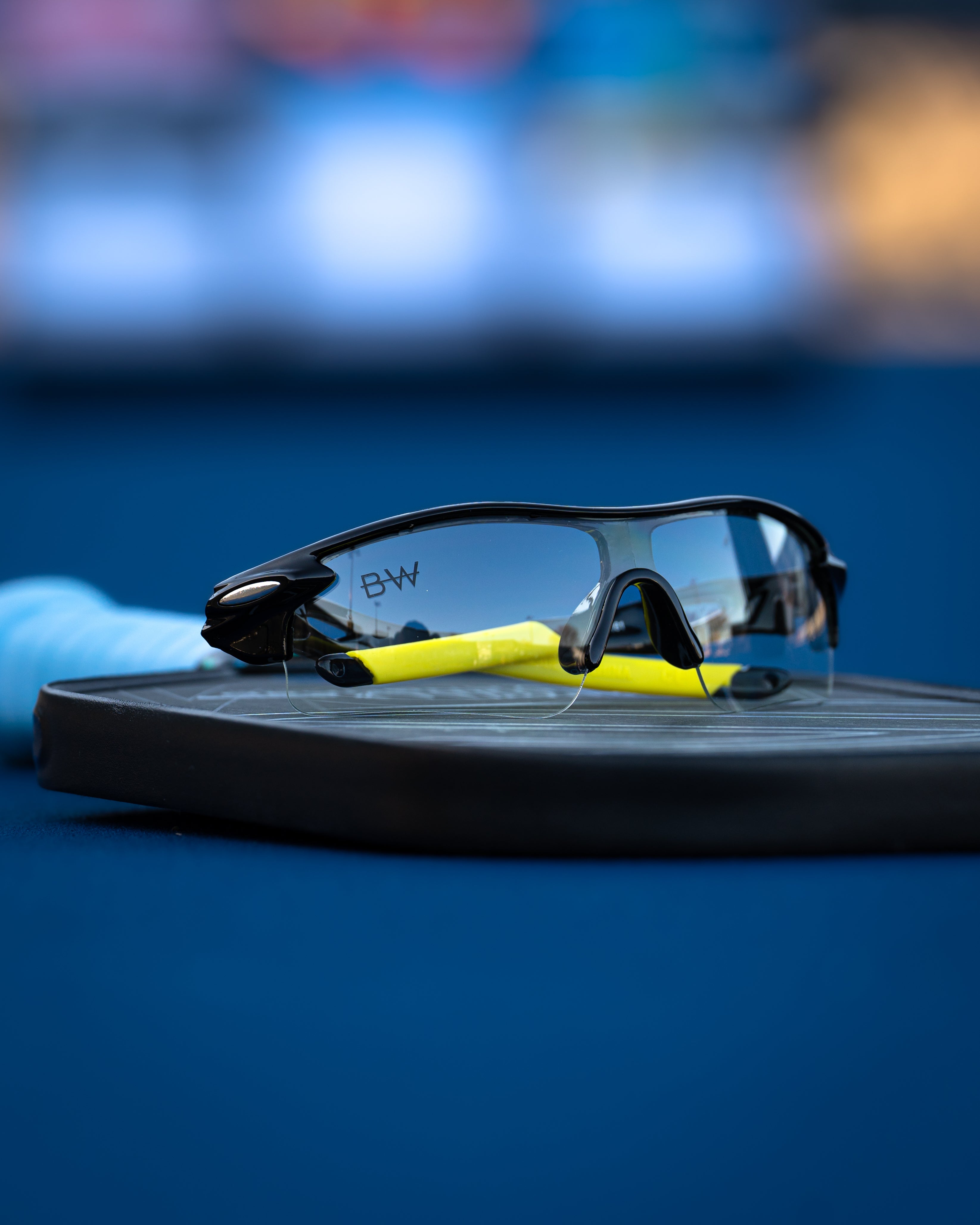
The Future of Sports Eyewear: Innovation, Performance & Style
Share
The Future of Sports Eyewear: Innovation, Performance & Style
The future of sports eyewear is moving toward lighter frames, more adaptable lens options, better prescription integration, sport-specific fit, and designs athletes actually want to wear. The biggest shift is not about adding technology for the sake of technology. It is about making eyewear more useful for the way athletes actually train and compete.
Prescription athletes increasingly expect sports eyewear to provide vision correction without forcing them into bulky or impractical designs. Indoor players want lenses appropriate for lower-light environments. Outdoor athletes want eyewear that matches changing conditions. And across sports, comfort, fit, impact resistance, and style continue to influence what athletes choose.
This guide looks at the most important trends shaping the future of sports eyewear—and separates realistic innovation from features that are still emerging, product-specific, or easy to exaggerate.
What Is the Future of Sports Eyewear?
The next generation of sports eyewear is likely to focus on several areas:
- Better integration of prescription lenses into athletic frames
- Lighter and more comfortable frame designs
- Lens options matched to specific lighting environments
- More individualized fit and product selection
- Greater crossover between performance eyewear and everyday style
- Continued development of smart and connected eyewear
- More transparency around lens materials, coatings, and performance claims
For most athletes, however, the fundamentals will continue to matter more than futuristic features: clear vision when correction is needed, comfortable fit, appropriate lens properties, impact resistance, and eyewear that suits the sport.
The Future of Pickleball Eyewear Is Already Taking Shape
Pickleball is a useful example of how sports eyewear is becoming more specialized.
Players may need:
- Prescription or non-prescription options
- Clear lenses for indoor or lower-light play
- Different lens setups for outdoor conditions
- Lightweight frames for extended matches
- Impact-resistant lenses
- A frame designed for active movement
Instead of expecting one generic pair of sunglasses to solve every problem, athletes can increasingly choose eyewear around how and where they actually play.
1. Sports Eyewear Is Becoming More Specialized
One of the most important changes in sports eyewear is specialization.
Instead of treating all athletic eyewear as interchangeable, manufacturers and shoppers increasingly distinguish between:
- Indoor and outdoor use
- Prescription and non-prescription needs
- Different sports and movement patterns
- Different lighting environments
- Different levels of required protection
- Different face and frame-fit preferences
This matters because eyewear that works well for an outdoor cyclist may not be the same configuration an indoor pickleball player wants.
Innovation Starts With Solving Real Problems
The most useful sports-eyewear innovation is not necessarily the most futuristic.
A better frame may simply:
- Feel lighter during a long session
- Work with a wider range of prescriptions
- Fit more comfortably during movement
- Use a lens appropriate for the environment
- Reduce unnecessary prescription-lens thickness
- Provide documented impact resistance
Those improvements may matter more to an athlete than adding electronics, displays, or complicated features that do not solve a real problem.
2. Prescription Sports Eyewear Is Becoming a Bigger Part of Performance Gear
Athletes who require vision correction should not have to treat their prescription as separate from the rest of their sports equipment.
Dedicated RX sports eyewear allows prescription correction to be built into an active-use frame rather than requiring an athlete to rely exclusively on ordinary eyeglasses, contact lenses, or another workaround.
As the category continues to develop, prescription compatibility is likely to remain one of the most important areas of sports-eyewear innovation.
Why Integrated Prescription Lenses Matter
Prescription sports eyewear can combine several needs into one product:
- Vision correction
- Sport-oriented frame design
- Active-use comfort
- Impact-resistant lenses
- Indoor or outdoor lens selection
The benefit is not that prescription sports glasses automatically make someone a better athlete. The benefit is that athletes who need correction can use eyewear designed around both their prescription and their activity.
High-Index Lenses Will Continue to Matter for RX Athletes
High-index prescription lenses can reduce finished lens thickness in many prescriptions because the material bends light more efficiently than lower-index materials.
This can be particularly relevant when prescription lenses need to work within sports-oriented frame designs.
High-index does not automatically mean:
- Better clarity
- Greater impact resistance
- Better athletic performance
- Lighter lenses in every prescription
- Improved depth perception
It is primarily a lens-material consideration that can help manage thickness depending on the prescription and frame.
Blinded Wear Includes High-Index RX Lenses at No Additional Cost
Blinded Wear includes high-index prescription lenses at no additional cost with its RX eyewear.
That pricing approach removes a separate high-index upgrade charge from the purchase and makes the complete RX cost easier to evaluate.
The exact numerical refractive index should still be confirmed for the specific product or order rather than assuming that every prescription configuration uses the same numerical index.
Future RX Innovation Still Has to Respect Prescription Compatibility
No matter how advanced a sports frame becomes, prescription compatibility remains fundamental.
The finished RX setup can depend on:
- Sphere power
- Cylinder and axis values
- ADD power when applicable
- Prism
- Frame dimensions
- Lens dimensions
- Frame curvature
More technology does not eliminate basic optical requirements.
3. Lightweight Design Will Remain a Major Priority
Sports eyewear is often worn through long practices, matches, races, rides, and training sessions. That makes unnecessary bulk an obvious area for improvement.
Future frame design is likely to continue emphasizing:
- Lower perceived weight
- Comfortable bridge fit
- Comfortable temple pressure
- Stable positioning during movement
- Efficient frame shapes
Blinded Wear already uses lightweight sports frames designed for active use.
Lighter Does Not Automatically Mean Better
Weight is only one part of fit.
A very light frame can still be uncomfortable if:
- It is too narrow
- It creates bridge pressure
- The temples are uncomfortable
- It shifts excessively during movement
- The dimensions do not suit the wearer's face
The future of fit is therefore not simply about making frames lighter. It is about balancing weight, stability, dimensions, and comfort.
4. Sports-Eyewear Fit Will Become More Individualized
A universal “perfect fit” for every athlete is unrealistic because faces differ in width, bridge shape, head size, and personal comfort preferences.
A better future for online sports-eyewear shopping is one where athletes can make more informed decisions using:
- Clear frame measurements
- Face-width comparisons
- Bridge-fit information
- Lens dimensions
- Product-selection tools
- Better guidance based on sport and environment
Technology may help simplify those decisions, but accurate product information remains essential.
Guided Product Selection Is Part of the Future of Online Eyewear
Large eyewear catalogs can create choice overload. Guided shopping tools can help customers narrow down their options before comparing individual products.
Blinded Wear's pickleball glasses quiz provides another way to explore the collection.
Take the Pickleball Glasses Quiz →
The result should be treated as a starting point. Prescription compatibility, frame dimensions, and individual needs should still be considered before purchasing.
5. Clear-Lens Sports Eyewear Will Remain Important Indoors
Sports eyewear is often associated with sunglasses, but not every athlete trains or competes in bright outdoor light.
Clear lenses can be useful for athletes who want eyewear without an unnecessary dark tint in environments such as:
- Indoor pickleball courts
- Basketball gyms
- Volleyball courts
- Indoor training facilities
- Nighttime activities
Clear Lenses Should Not Be Over-Marketed
A clear lens primarily avoids unnecessary tint. It does not automatically provide:
- Anti-glare performance
- Anti-reflective treatment
- Better contrast
- Improved reaction time
- Better ball tracking
- A specific UV rating
Those properties should be verified separately for the exact lens configuration.
6. More Adaptable Lens Technology Will Continue to Develop
Athletes frequently move through changing environments. An outdoor player may encounter bright sun, shade, cloud cover, and evening light during the same day.
That creates demand for lens technologies that can work across a wider range of conditions.
Future developments may continue to focus on areas such as:
- Changing lens tint
- Environment-specific lens options
- Improved indoor/outdoor versatility
- Greater customization of lens characteristics
The important distinction is that these technologies vary substantially by product. They should not be assumed to be included in every sports frame.
Photochromic Lenses Are One Example of Adaptive Eyewear
Photochromic lenses change tint depending on the specific lens technology and environmental conditions.
They may appeal to athletes who regularly move between different lighting environments, but their behavior can vary by technology and conditions.
Before choosing a photochromic sports lens, verify:
- Whether it is available for the selected frame
- Whether it supports your prescription
- Whether its intended behavior matches your activity
7. Lens Treatments Will Continue to Be an Area of Innovation
Coatings and surface treatments can add specific properties to a lens, and this is likely to remain an active area of sports-eyewear development.
Features shoppers may encounter include:
- Anti-fog treatments
- Scratch-resistant treatments
- Anti-reflective coatings
- Hydrophobic treatments
- Other environment-specific lens technologies
These should be evaluated individually rather than treated as automatic features of all performance eyewear.
Fog Management Remains a Real Sports-Eyewear Challenge
Fogging can be influenced by perspiration, humidity, temperature changes, airflow, and frame position.
Because those factors vary by athlete and environment, claims such as “fog-proof in every condition” should be treated cautiously.
Better ventilation, fit, lens treatments, and eyewear design may continue to improve fog management, but no universal solution should be assumed without supporting product information.
8. Protection Will Continue to Matter Alongside Innovation
No matter how advanced sports eyewear becomes, athletes still need to understand basic lens properties.
Blinded Wear uses impact-resistant lenses, which can be an important consideration for active eyewear.
However, impact-resistant should not be confused with:
- Unbreakable
- Guaranteed protection from every injury
- Automatic compliance with every sports-safety standard
More Technology Does Not Replace Safety Certification
If an athlete needs eyewear that meets a specific protective standard, the named certification should still be verified for the exact product.
| Product Claim | What It Establishes |
|---|---|
| Impact-resistant | Resistance to impact |
| Safety-certified | Documented compliance with a specific named standard |
| Smart eyewear | Integration of electronic or connected functionality; it does not establish protective certification |
9. Smart Sports Eyewear Could Become More Common
Connected eyewear is one of the most futuristic areas of the category.
Potential sports-oriented applications may include:
- Activity data
- Navigation information
- Training feedback
- Heads-up information
- Integration with other wearable devices
These ideas should be viewed as an evolving technology category rather than features that every modern sports frame currently includes.
Smart Eyewear Has to Solve the Weight and Comfort Problem
Adding electronics creates tradeoffs that traditional sports eyewear does not necessarily have.
Future smart sports glasses will need to balance:
- Battery requirements
- Added weight
- Frame dimensions
- Comfort
- Durability
- Prescription compatibility
- Useful functionality
If technology makes eyewear substantially heavier or more distracting, the additional features may not be worthwhile for every athlete.
Could Heads-Up Displays Become Part of Sports Eyewear?
Heads-up displays are one possible direction for specialized smart eyewear because information can potentially be presented within a wearer's field of view.
Possible future applications might include:
- Navigation for cycling
- Activity metrics
- Training information
- Other sport-specific data
Whether these features become practical for mainstream sports use will depend on factors such as weight, battery life, visibility, safety, comfort, cost, and whether athletes actually find the information useful.
10. AI May Change How Athletes Shop for Eyewear Before It Changes the Eyewear Itself
Artificial intelligence is often discussed as something that could be built directly into future eyewear. But one of its more immediate uses may be improving the buying process.
Digital tools may increasingly help shoppers compare eyewear using information such as:
- Sport
- Prescription needs
- Indoor vs. outdoor use
- Frame dimensions
- Style preferences
The most useful systems will still need accurate product data. A recommendation algorithm cannot make an unsuitable frame compatible with a prescription or create a product feature that does not exist.
Personalization Is More Than Choosing a Color
Meaningful sports-eyewear personalization can involve matching multiple variables:
| Variable | Why It Matters |
|---|---|
| Prescription | Determines whether RX correction is required and what configurations are compatible |
| Sport | Changes movement and protection considerations |
| Environment | Influences lens selection |
| Face dimensions | Affects frame fit |
| Style preference | Influences whether the athlete actually wants to wear the frame |
11. Sports Eyewear Is Becoming More Style-Conscious
Performance and appearance do not have to be competing priorities.
Athletes increasingly use sports eyewear in multiple settings: on the court, before and after a workout, during outdoor activities, and as part of everyday style.
That creates demand for products that combine active-use function with frame shapes and aesthetics people actually want to wear.
Style Should Follow the Functional Requirements
A visually striking frame is still the wrong choice if it does not meet the athlete's basic needs.
A useful buying order is:
- Prescription compatibility
- Appropriate fit
- Lens properties
- Protection requirements
- Playing environment
- Comfort
- Style
Once the functional requirements are met, style becomes a valuable differentiator.
12. Sustainability May Influence Future Sports-Eyewear Design
Materials, packaging, manufacturing, repairability, and product lifespan are increasingly part of how consumers evaluate many categories of physical products, including eyewear.
For sports eyewear, future sustainability efforts may involve areas such as:
- Packaging choices
- Material selection
- Longer product lifespans
- Repair or replacement programs
- Manufacturing efficiency
Specific environmental claims should be supported by documentation rather than inferred from a product's appearance or marketing language.
Long-Term Ownership Is Another Part of Product Value
The future of sports eyewear is not only about what happens at the moment of purchase. Athletes may also consider what happens when frequently used eyewear eventually breaks.
Blinded Wear offers a 50% lifetime replacement warranty if glasses break, subject to current policy terms.
This does not mean unlimited free replacements, but replacement support can be considered as part of the long-term ownership value.
13. The Future Should Bring Better Transparency, Not Just Bigger Claims
Sports-eyewear innovation is useful only when shoppers can understand what a product actually does.
Be cautious when futuristic marketing relies on vague phrases such as:
- “AI-powered vision”
- “Real-time vision optimization”
- “Guaranteed performance enhancement”
- “Next-generation clarity”
- “Unbreakable materials”
- “Universal fit”
Instead, look for specific information about the frame, lens, prescription compatibility, coatings, certifications, and supported features.
Current Sports-Eyewear Features vs. Emerging Technology
| Established Buying Considerations | Emerging or Product-Specific Areas |
|---|---|
| Prescription correction | Heads-up displays |
| High-index lens materials | Integrated activity sensors |
| Lightweight frame design | Advanced connected features |
| Impact resistance | Real-time digital information |
| Indoor and outdoor lens selection | More automated personalization |
| Frame fit and comfort | New adaptive lens technologies |
What Blinded Wear Offers Today
While future sports-eyewear technology continues to develop, athletes still need products that solve today's practical problems.
| Verified Blinded Wear Feature | Availability |
|---|---|
| Prescription eyewear | Available |
| Non-prescription eyewear | Available |
| High-index RX lenses | Included at no additional cost |
| Lightweight sports frames | Yes |
| Impact-resistant lenses | Yes |
| Non-polarized lenses | Yes |
| Pickleball-focused design | Yes |
| 50% lifetime replacement warranty if glasses break | Yes, subject to current policy terms |
Features That Should Still Be Confirmed for the Exact Product
Do not assume every current or future sports frame includes:
- A specific numerical high-index value
- Anti-fog treatment
- Scratch-resistant coating
- Anti-reflective coating
- A specific UV rating
- Hydrophobic treatment
- Photochromic technology
- A named safety certification
- Adjustable nose pads or temple grips
- Smart or connected features
The Best Future-Proof Eyewear Still Gets the Basics Right
Technology changes quickly, but a strong sports-eyewear purchase should still answer a few basic questions:
- Does it support my prescription?
- Does it fit my face?
- Is the lens appropriate for where I play?
- Does it provide the lens properties I actually need?
- Is the frame comfortable during movement?
- Are the product claims documented?
- Does the total cost make sense?
Those questions are likely to remain relevant no matter how advanced sports eyewear becomes.
Explore Today's Blinded Wear Sports Eyewear
Need prescription correction for pickleball?
Looking for non-prescription sports eyewear?
Shop Non-RX Pickleball Glasses →
Primarily play indoors?
Want a broader comparison?
14. Prescription Sports Eyewear Will Keep Moving Toward Better Integration
The future of prescription sports eyewear is not just about putting corrective lenses into an athletic-looking frame. The more meaningful goal is integrating prescription correction without creating unnecessary bulk, discomfort, or incompatibility.
That means future improvements will likely continue to focus on:
- Broader RX compatibility
- More efficient lens materials
- Better frame-to-prescription matching
- Lighter finished eyewear
- More practical sports-specific frame geometry
Stronger Prescriptions Will Continue to Shape Frame Design
A strong prescription can affect finished lens thickness and frame compatibility, which means sports-eyewear design cannot ignore optical requirements.
Useful future improvements may include better ways to help shoppers understand how:
- Frame width affects lens size
- Lens dimensions influence finished thickness
- Curvature can affect RX compatibility
- High-index materials can help manage bulk
- Different prescription types interact with different frame shapes
Better Prescription Transparency Should Be Part of Innovation
One of the simplest improvements in prescription sports eyewear would be clearer pricing and compatibility information.
Instead of forcing shoppers to discover multiple upgrade costs late in checkout, a better buying experience clearly explains:
- What the frame costs
- Whether prescription lenses are included
- Whether high-index material costs extra
- Which prescriptions are compatible
- Which optional lens features cost more
Blinded Wear includes high-index prescription lenses at no additional cost, which removes one potential upgrade fee from the RX purchase.
15. The Buying Experience Will Become More Important
Sports-eyewear innovation is often discussed in terms of frame materials and lens technology, but the shopping experience matters too.
Online buyers need enough information to answer questions such as:
- Will this frame fit me?
- Does it support my prescription?
- Is it appropriate for indoor or outdoor use?
- What lens properties are actually included?
- What will the finished RX pair cost?
The brands that make those answers easier to find may create a better customer experience even without adding futuristic electronics.
Digital Fit Tools May Become More Useful
Digital shopping tools can potentially help athletes narrow down frames before ordering.
Useful future tools may compare:
- Face width
- Frame width
- Bridge dimensions
- Lens size
- Sport type
- Prescription needs
- Playing environment
The strongest tools will still depend on accurate measurements and product information rather than relying only on appearance-based recommendations.
Virtual Try-On Can Help With Style, but Not Every Fit Question
Virtual try-on technology can help shoppers visualize how a frame may look, but appearance is only one part of sports-eyewear fit.
A virtual preview may not fully tell you:
- How much temple pressure the frame creates
- How the bridge feels
- Whether the frame shifts during movement
- How compatible it is with a complex prescription
- Whether it remains comfortable through a long match
Future shopping systems may become better at combining visual previews with actual measurement and fit data.
16. Better Product Data May Be More Valuable Than More Marketing
Sports-eyewear shoppers benefit when brands clearly document what a product includes.
Useful product information can include:
- Frame dimensions
- Lens dimensions
- Prescription compatibility
- Lens material
- Impact-resistance information
- Documented coatings
- UV specifications where applicable
- Safety certifications where applicable
The future of ecommerce eyewear should make this information easier to understand rather than hiding it behind vague phrases such as “premium performance technology.”
AI Recommendations Are Only as Good as the Product Data Behind Them
AI-assisted shopping may become more common, but the technology cannot replace accurate specifications.
For example, a recommendation system cannot determine that a frame supports a certain prescription unless that compatibility is actually documented.
Useful AI-guided shopping should help organize verified information rather than inventing benefits or features.
17. Pickleball Eyewear Will Likely Become More Specialized
As athletes become more deliberate about equipment, pickleball eyewear may continue to split into more specific use cases.
Instead of one generic “pickleball glasses” category, shoppers may increasingly compare:
- RX vs. non-RX
- Indoor vs. outdoor
- Clear vs. tinted lenses
- Different frame shapes
- Different face widths
- Different prescription needs
This kind of specialization can be useful because a player who needs strong RX correction indoors may have completely different priorities from a non-RX player competing outdoors.
Indoor Pickleball Eyewear May Keep Growing as a Separate Category
Indoor pickleball does not create the same lighting demands as bright outdoor play.
That makes clear and lower-light-appropriate eyewear an important category for players who want:
- Prescription correction indoors
- Impact-resistant lenses
- An active-use frame
- No unnecessary dark tint
Outdoor Pickleball Will Continue to Create Different Lens Needs
Outdoor players may experience bright sunlight, shade, clouds, and changing conditions during the same session.
Future lens innovation may continue to focus on creating more practical options for these changing environments.
Players should still verify exact lens specifications instead of assuming a dark or mirrored appearance automatically means:
- A specific UV rating
- Polarization
- Anti-reflective treatment
- Photochromic behavior
- Enhanced contrast
18. Polarized and Non-Polarized Options Will Remain Activity-Specific
Future sports eyewear is unlikely to move toward one universally correct polarization choice because different environments create different preferences.
Polarized lenses can reduce certain reflected light. Non-polarized lenses preserve natural visual information without adding a polarization filter.
Blinded Wear's pickleball-focused eyewear uses non-polarized lenses, which some court players may prefer.
Neither configuration should be marketed as automatically improving depth perception, ball tracking, or athletic performance for everyone.
Lens Selection May Become More Environment-Specific
Instead of selling one lens as ideal for every situation, future sports-eyewear systems may increasingly help athletes choose based on:
- Indoor vs. outdoor use
- Time of day
- Typical brightness
- Weather
- Sport type
- Prescription needs
This approach is more practical than assuming one tint can handle every environment equally well.
Clear vs. Tinted Lenses Will Remain a Practical Decision
| Clear Lens | Tinted Lens |
|---|---|
| Useful when unnecessary darkening is undesirable | May be useful in brighter environments |
| Common starting point for indoor conditions | Can be selected around outdoor brightness |
| Does not automatically include special coatings | Tint does not automatically establish UV protection |
| Can support RX or non-RX configurations | Can support RX or non-RX configurations depending on the product |
19. Impact Resistance Will Stay Relevant Even as Eyewear Gets Smarter
Smart features, digital displays, and advanced materials do not remove the need for basic physical performance.
Sports eyewear still needs to function as eyewear first.
That means future products will continue to be judged on factors such as:
- Lens impact resistance
- Frame durability
- Comfort
- Fit
- Prescription compatibility
Safety Claims Should Become More Specific
A useful future sports-eyewear market would make it easier for shoppers to distinguish between:
| Claim | Meaning |
|---|---|
| Impact-resistant | The lens has impact-resistant properties |
| Sport-specific protective eyewear | Designed for a particular protective use |
| Certified | Documented compliance with a named standard |
These descriptions should not be treated as interchangeable.
20. Frame Materials Will Keep Evolving
Sports-eyewear designers will likely continue experimenting with materials and construction methods that balance:
- Weight
- Flexibility
- Durability
- Comfort
- Manufacturing efficiency
But material names alone do not determine whether a frame is good.
A product should be evaluated by documented construction, fit, durability, and use case rather than assuming that one material label automatically makes it superior.
Frame Geometry May Become More Sport-Specific
Different sports create different movement and coverage needs, so future frame design may become more specialized.
Examples may include:
- Different levels of frame curvature
- Different lens heights
- Different temple shapes
- Different overall widths
- Different levels of environmental coverage
For RX wearers, however, additional curvature can affect prescription compatibility, so more wrap is not automatically better.
Wraparound Designs Will Continue to Have Tradeoffs
More wrap can provide a sport-oriented profile and additional coverage, but it can also create optical and prescription considerations.
Future sports-eyewear design will likely continue balancing:
- Coverage
- Field of view
- Prescription compatibility
- Comfort
- Frame stability
The most curved frame is not automatically the best option for every athlete.
21. Long-Term Comfort Will Become a Bigger Competitive Advantage
Sports eyewear can remain on the face for hours, which means comfort can be just as important as appearance.
Future frame design may continue to improve areas such as:
- Temple pressure distribution
- Bridge comfort
- Weight distribution
- Frame stability
- Compatibility with helmets or other equipment
The goal should be eyewear that stays useful through the entire activity rather than simply feeling comfortable during a quick try-on.
Better Fit Testing Could Reduce Poor Purchases
A useful sports-eyewear fit test should evaluate more than appearance.
Athletes can test a new pair by:
- Turning the head quickly in both directions
- Looking upward and downward
- Bending forward
- Moving laterally
- Jogging or walking briefly
- Wearing the frame long enough to identify pressure points
Future digital tools may help predict fit, but real movement still matters.
22. Fogging Will Remain an Area Worth Improving
Fogging is influenced by multiple factors, including:
- Humidity
- Perspiration
- Temperature changes
- Frame position
- Airflow
Future design improvements may involve better ventilation, coatings, or frame geometry, but universal “fog-proof” claims should still be treated cautiously.
Scratch Resistance Will Continue to Matter for Active Eyewear
Sports glasses are often handled more aggressively than ordinary eyewear because they may be placed in equipment bags, carried between courts, and exposed to sweat and debris.
Scratch-resistant treatments can be useful, but they should be verified for the exact lens rather than assumed from the fact that a frame is marketed for sports.
23. Durability and Replacement Support Will Remain Part of Value
More advanced technology does not automatically create better long-term value if the product is difficult or expensive to replace.
A more complete value comparison includes:
- Initial purchase price
- Prescription lens cost
- Upgrade costs
- Expected frequency of use
- Replacement support
Blinded Wear offers a 50% lifetime replacement warranty if glasses break, subject to current policy terms.
Product Lifespan May Become Part of Sustainability Conversations
Longer product life and practical replacement support may become increasingly relevant when shoppers think about sustainability.
That does not mean every replacement policy is automatically an environmental initiative. Sustainability claims should still be supported by documentation.
But product lifespan, repairability, and replacement options can be useful considerations when comparing long-term ownership.
24. Sports Eyewear Will Continue Crossing Into Fashion
Sports frames are increasingly expected to look intentional rather than purely functional.
Future designs may continue to blend:
- Athletic silhouettes
- Everyday styling
- Different frame shapes
- Different lens aesthetics
- Sport-specific function
This crossover can matter because athletes often wear the same eyewear before, during, and after activity.
Style Should Not Override Compatibility
The most fashionable frame is still a poor purchase if it:
- Does not support the prescription
- Does not fit comfortably
- Uses an unsuitable lens for the environment
- Does not provide the protection required for the sport
Future sports eyewear should make it easier to combine appearance with function rather than forcing shoppers to choose one or the other.
25. Sports Eyewear May Become Part of a Larger Wearable Ecosystem
As connected devices become more common, eyewear may increasingly interact with other fitness and training technology.
Potential future use cases could include:
- Navigation
- Training data
- Workout metrics
- Device connectivity
- Sport-specific information
Whether these features become mainstream will depend on whether they add enough value to justify added cost, complexity, and weight.
Smart Eyewear Will Also Create Privacy and Practical Questions
If sports eyewear increasingly includes cameras, sensors, microphones, or connected features, users may need to think about more than performance.
Future considerations may include:
- Data privacy
- Battery life
- Device security
- League rules
- Recording policies
- Weight and comfort
Technology that works well in lifestyle eyewear may require additional consideration in competitive sports environments.
26. Realistic Innovation vs. Marketing Hype
| Realistic Direction | Claim to Treat Carefully |
|---|---|
| Better RX integration | “Automatically improves athletic performance” |
| Lighter frames | “Feels weightless for everyone” |
| More environment-specific lens options | “Perfect vision in every condition” |
| More digital shopping tools | “AI guarantees the perfect fit” |
| Connected eyewear | “Smart glasses create a competitive advantage” |
| Improved coatings and treatments | “Never fogs or scratches” |
27. Should You Wait for Future Sports-Eyewear Technology?
For most athletes, probably not if you already have a practical eyewear need today.
If you currently need:
- Prescription correction
- A more active-use frame
- Impact-resistant lenses
- A clear indoor setup
- A better-fitting dedicated sports pair
Those needs can already be addressed without waiting for futuristic smart features.
Future innovation may add convenience and new capabilities, but the basic value of suitable eyewear exists now.
A Practical Buy-Now Framework
Instead of trying to future-proof every feature, focus on whether a pair solves your current needs.
- Confirm whether you need RX or non-RX eyewear.
- Check prescription compatibility.
- Match the lens to your normal environment.
- Review fit and frame dimensions.
- Confirm impact resistance.
- Verify any coatings or safety certifications that matter to you.
- Compare total cost.
- Review replacement support.
Blinded Wear RX Models to Compare Today
Prescription pickleball players can compare different current Blinded Wear models based on fit, prescription compatibility, and style preference.
28. Prescription Ordering Should Become Simpler, Not More Complicated
For current Blinded Wear RX orders, customers upload a clear photo of their eyeglass prescription before purchasing.
Before submitting it, make sure:
- The prescription is fully visible
- The image is in focus
- The values are readable
- Nothing important is cropped
- Glare is not covering the prescription information
The prescription information is associated with the custom RX order.
29. Compare Current Features Before Chasing Future Ones
| Feature | Why It Matters Today |
|---|---|
| RX compatibility | Determines whether the eyewear can correct your vision |
| High-index material | Can help reduce lens thickness in many prescriptions |
| Lightweight frame | Can reduce unnecessary bulk during activity |
| Impact-resistant lens | Provides a meaningful physical lens property |
| Indoor/outdoor lens suitability | Helps match eyewear to the playing environment |
| Replacement support | Can affect long-term ownership value |
The Biggest Innovation May Be Better Matching
The future of sports eyewear is not necessarily about turning every frame into a computer.
Some of the most valuable progress may come from doing a better job of matching:
- The athlete to the frame
- The prescription to the lens
- The lens to the environment
- The protection level to the sport
- The product to the actual use case
That kind of personalization can improve the buying experience without relying on exaggerated claims or unnecessary technology.
Explore Blinded Wear Sports Eyewear Available Now
Need prescription correction?
Looking for non-prescription sports eyewear?
Shop Non-RX Pickleball Glasses →
Primarily play indoors?
Want help narrowing down the lineup?
Frequently Asked Questions About the Future of Sports Eyewear
What is the future of sports eyewear?
The future of sports eyewear is likely to focus on better prescription integration, lighter frames, more individualized fit, more environment-specific lens options, improved digital shopping tools, and continued development of smart eyewear.
Will sports glasses become smarter?
Some sports eyewear may increasingly include connected features such as navigation, training data, or heads-up information. Whether those features become mainstream will depend on weight, comfort, battery life, cost, privacy, and real usefulness.
Will prescription sports glasses become more common?
That is a likely direction because many athletes need vision correction and want it integrated into frames designed for active use.
Are high-index lenses important for future RX sports eyewear?
They can be important because high-index materials can reduce lens thickness in many prescriptions. They do not automatically improve athletic performance or visual quality.
Does Blinded Wear include high-index RX lenses?
Yes. Blinded Wear includes high-index prescription lenses at no additional cost with its RX eyewear.
Will future sports eyewear automatically fit everyone better?
No. Fit is individual. Better digital measurement and recommendation tools may help shoppers narrow down options, but no single frame will fit every face perfectly.
Will AI be used in sports eyewear?
AI may be used in product recommendations, fit guidance, and potentially future connected eyewear. Its usefulness will depend on accurate data and practical implementation.
Will all sports glasses eventually have heads-up displays?
Probably not. HUDs may make sense in certain sports or training situations, but added weight, battery requirements, visibility, rules, and cost may limit broad adoption.
Are clear lenses part of the future of sports eyewear?
Yes. Clear lenses remain relevant for indoor and lower-light environments where a dark tint is unnecessary.
Will photochromic lenses become more common in sports?
Possibly. Photochromic technology may appeal to athletes who move through changing light, but behavior varies by lens technology and environmental conditions.
Will sports glasses become more sustainable?
Sustainability may play a larger role in materials, packaging, product lifespan, repairability, and manufacturing. Any specific environmental claim should still be verified rather than assumed.
Will future sports glasses be unbreakable?
No product should be assumed to be unbreakable. Impact resistance can be improved, but it does not mean indestructible.
Will smart sports glasses improve athletic performance?
Not automatically. Technology can provide information or convenience, but athletic performance still depends on many factors such as training, skill, conditioning, and decision-making.
Future Sports Eyewear: Myths vs. Reality
| Myth | Reality |
|---|---|
| All future sports glasses will be smart glasses | Traditional optical improvements will remain important even as connected eyewear grows. |
| AI will guarantee perfect fit | Digital tools can help, but fit still depends on real measurements and individual comfort. |
| More technology means better eyewear | Added features are only valuable if they solve a practical problem. |
| High-index lenses improve athletic performance | They primarily help manage lens thickness in many prescriptions. |
| Clear lenses automatically improve contrast | A clear lens simply avoids unnecessary dark tint unless other features are specifically documented. |
| Smart eyewear replaces proper prescription correction | Optical requirements still matter regardless of electronic features. |
| Impact-resistant means unbreakable | Impact resistance does not mean indestructible or automatically safety-certified. |
What Innovations Matter Most to Athletes?
Not every technological advancement has the same practical value.
| Innovation Area | Why It Matters |
|---|---|
| Better RX integration | Helps athletes who need vision correction use sport-oriented frames |
| Lighter frame design | Can improve comfort during long sessions |
| Improved fit guidance | Can reduce poor-fitting online purchases |
| Environment-specific lenses | Helps match eyewear to indoor, outdoor, and changing-light conditions |
| Better product transparency | Makes features and pricing easier to understand |
| Smart features | May add useful data or navigation when implemented well |
What Could Change Over the Next Several Years?
Several trends are likely to keep developing:
- More prescription options in sport-oriented frames
- More refined digital fit and recommendation tools
- More environment-specific lens choices
- Improved integration between eyewear and wearable technology
- More attention to product lifespan and replacement support
- Greater demand for transparent claims and specifications
- More crossover between performance eyewear and everyday style
Some changes may happen quickly, while others may remain niche because of cost, complexity, or limited practical value.
How Different Athletes May Benefit From Future Eyewear
| Athlete Type | Potentially Useful Developments |
|---|---|
| RX pickleball player | Better prescription integration, thinner lens options, sport-specific fit |
| Indoor player | More refined clear and low-light lens options |
| Outdoor athlete | More adaptable lens technologies and environment-specific options |
| Cyclist | Coverage, navigation, connected data, changing-light solutions |
| Runner | Lighter frames, better stability, wearable integration |
| Competitive athlete | More sport-specific fit, protection, and data tools where permitted |
Prescription Innovation May Matter More Than Smart Features for Many Athletes
For someone who cannot see clearly without correction, better RX compatibility may deliver more practical value than a heads-up display or connected sensor.
That is why prescription integration is likely to remain one of the most important areas of real-world sports-eyewear development.
Useful improvements include:
- Broader prescription ranges
- More frame choices
- Better high-index options
- More transparent RX pricing
- Improved fit guidance
The Buying Criteria That Are Unlikely to Change
Even if sports eyewear becomes dramatically more advanced, shoppers will still need to evaluate the fundamentals.
- Prescription compatibility
- Frame dimensions
- Bridge comfort
- Temple comfort
- Frame weight
- Movement stability
- Impact resistance
- Lens suitability for the environment
- Verified coatings and specifications
- Safety certifications where required
- Total price
- Replacement support
The Tradeoffs of Smart Sports Eyewear
| Potential Benefit | Potential Tradeoff |
|---|---|
| Real-time data | Added weight and complexity |
| Navigation | Battery dependence |
| Training metrics | Possible distraction |
| Connectivity | Privacy and security considerations |
| Integrated displays | Cost and visibility challenges |
| More features | More potential failure points |
Smart Eyewear May Also Face Sport-Specific Rules
Connected eyewear may not be treated the same way in every competitive environment.
Potential considerations include:
- Whether recording is permitted
- Whether electronic assistance is allowed
- Whether a device could create a distraction
- Whether eyewear complies with league equipment rules
As smart eyewear develops, athletes may need to check both product specifications and sport-specific regulations.
Performance and Style Will Continue to Converge
Athletes increasingly expect sports eyewear to function well without looking purely technical.
That may lead to:
- More varied frame shapes
- More color and finish options
- Cleaner silhouettes
- More crossover between sport and lifestyle design
- Greater personalization
Style can increase the likelihood that an athlete wants to wear a frame regularly, but it should not come at the expense of fit, RX compatibility, or appropriate lens selection.
What Sustainable Sports Eyewear Could Realistically Mean
Sustainability in eyewear may involve multiple parts of the product lifecycle.
- Material choices
- Reduced packaging
- Longer product life
- Replacement or repair programs
- Manufacturing efficiency
- More transparent environmental reporting
Specific claims such as “recyclable,” “biodegradable,” or “carbon neutral” should be supported by product-specific documentation.
Long-Term Value May Matter More as Eyewear Gets More Advanced
As products gain more technology, replacement costs can become more important.
A complete ownership comparison can include:
- Purchase price
- Prescription costs
- Lens upgrades
- Replacement costs
- Expected usage
- Warranty or replacement support
Blinded Wear offers a 50% lifetime replacement warranty if glasses break, subject to current policy terms.
Where Blinded Wear Fits Into the Future of Sports Eyewear
Blinded Wear's current focus is not on claiming futuristic technology that has not been documented. It is on practical sports-eyewear needs that matter today.
Verified Blinded Wear features include:
- Prescription eyewear
- Non-prescription eyewear
- High-index RX lenses included at no additional cost
- Lightweight sports frames
- Impact-resistant lenses
- Non-polarized lenses
- Pickleball-focused design
- 50% lifetime replacement warranty if glasses break, subject to current policy terms
Current Blinded Wear Features vs. Features to Confirm
| Verified | Confirm for the Exact Product |
|---|---|
| Prescription options | Exact numerical lens index |
| Non-prescription options | Specific UV rating |
| High-index RX lenses at no additional cost | Anti-reflective coating |
| Lightweight sports frames | Anti-fog treatment |
| Impact-resistant lenses | Scratch-resistant treatment |
| Non-polarized lenses | Photochromic availability |
| Pickleball-focused design | Named sport-specific safety certification |
| 50% lifetime replacement warranty if glasses break | Smart or connected features |
How Blinded Wear RX Ordering Works Today
Customers ordering Blinded Wear prescription eyewear upload a clear photo of their eyeglass prescription before purchasing.
Before uploading, make sure:
- The full prescription is visible
- The image is clear and in focus
- The values are readable
- Nothing important is cropped
- Glare is not covering the prescription details
The prescription information is associated with the custom RX order.
Future-Proof Sports Eyewear Buying Checklist
- Choose RX or non-RX based on your vision needs
- Confirm prescription compatibility
- Review frame dimensions
- Match the lens to your environment
- Check for impact resistance
- Verify any required safety certification
- Verify UV specifications if important
- Confirm coatings rather than assuming they are included
- Consider how the frame feels during movement
- Compare total RX cost
- Review warranty and replacement terms
- Only pay for smart features that solve a real problem for you
Key Takeaways
- The future of sports eyewear is likely to be more personalized, prescription-friendly, lightweight, and environment-specific.
- Smart features may grow, but they will not replace basic optical and fit requirements.
- Prescription integration may be one of the most important areas of practical innovation.
- High-index lenses can help manage thickness in many prescriptions.
- Clear lenses will remain important for indoor and lower-light sports.
- Adaptive lens technologies may become more common, but behavior varies by product and conditions.
- AI may improve the shopping experience before it meaningfully changes the eyewear itself.
- More technology does not automatically mean better performance.
- Safety certifications, coatings, UV claims, and smart features should be verified for the exact product.
- Blinded Wear already offers RX and non-RX sports eyewear with high-index RX lenses included at no additional cost.
Explore Blinded Wear Sports Eyewear
Final Verdict: The Best Sports-Eyewear Innovation Solves Real Problems
The future of sports eyewear will likely be lighter, more personalized, more prescription-friendly, more connected, and more stylish—but the fundamentals will still matter most.
Technology is valuable when it helps athletes solve a real problem. Better RX integration, more comfortable frames, improved lens selection, stronger product transparency, and better fit guidance may ultimately matter more than adding electronics to every pair.
The best future sports eyewear should make it easier to match:
- Your prescription
- Your face
- Your sport
- Your environment
- Your protection requirements
- Your style
- Your budget
For athletes shopping today, there is no need to wait for futuristic technology if your current problem can already be solved with properly selected sports eyewear.
Shop Sports Eyewear Built for Today's Game
Need prescription correction for pickleball?
Do not need built-in prescription correction?
Shop Non-RX Pickleball Glasses →
Primarily play indoors?
Want a complete pickleball comparison?
View the 2026 Pickleball Glasses Guide →
Need help narrowing down your options?