
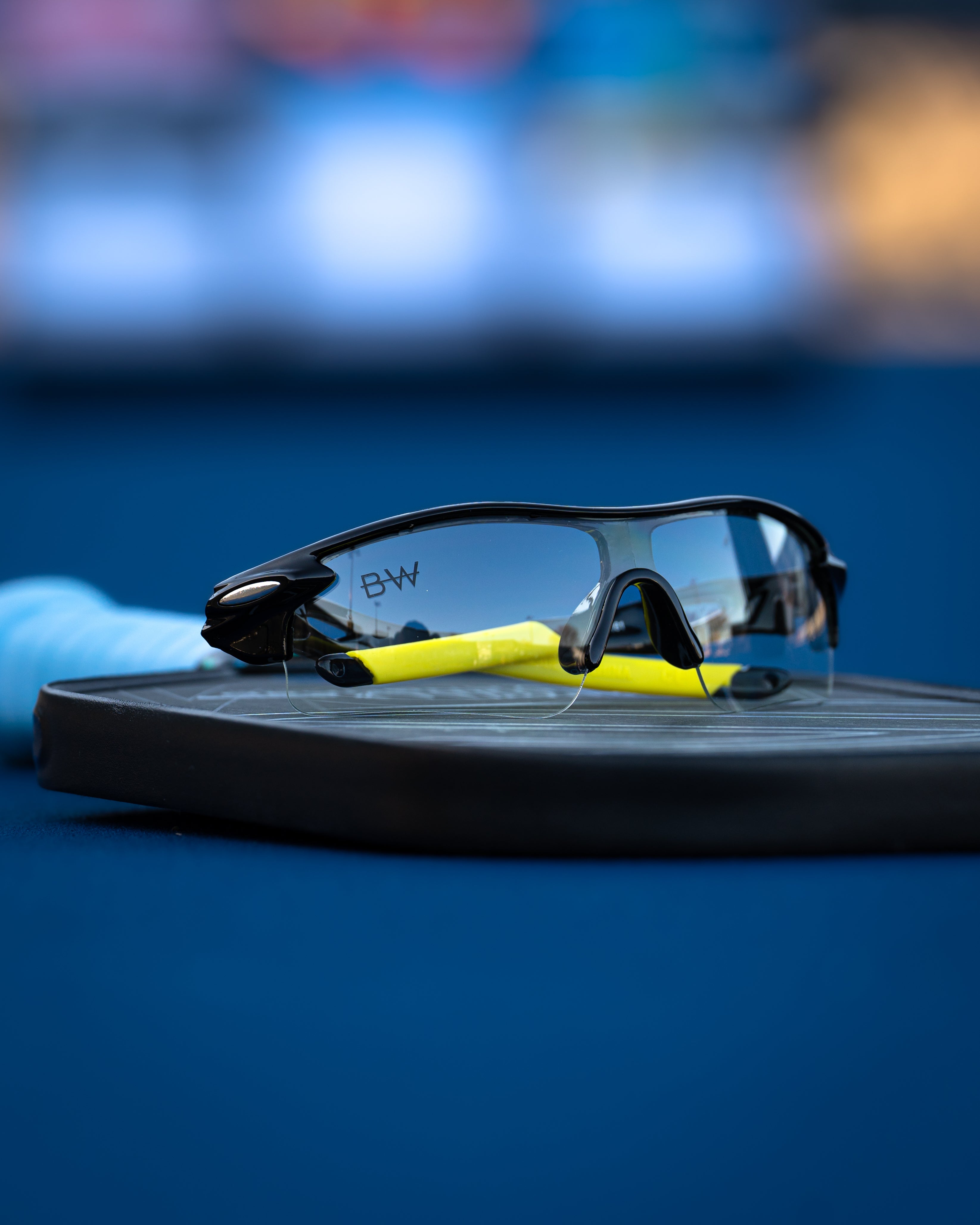
Glossary of Prescription Eyewear Terms for Athletes: What You Need to know
Share
Glossary of Prescription Eyewear Terms for Athletes: What You Need to Know
Find Your Perfect Pickleball Glasses
Shopping for prescription sports eyewear can get confusing fast. Use this glossary to understand the lens, frame, prescription, and fit terms that matter most when comparing RX glasses for pickleball and other active sports.
If you've ever looked at a prescription eyewear product page and wondered what terms like PD, sphere, cylinder, lens index, base curve, wraparound, photochromic, or anti-reflective coating actually mean, you're not alone.
Prescription eyewear has its own vocabulary, and understanding those terms can help you make much better buying decisions—especially when you're choosing glasses for an active sport like pickleball.
For athletes, the right RX setup isn't just about picking a frame you like. Your prescription, lens material, lens thickness, frame geometry, fit, light conditions, and available coatings can all influence how practical the finished glasses feel during play.
This glossary explains the most important prescription sports eyewear terms in plain English, plus why each one matters when you're shopping for RX pickleball glasses.
Prescription Eyewear Terms Every Athlete Should Know
1. RX
Definition: RX is shorthand for prescription.
When a frame is described as RX eyewear, it means the glasses can be configured with prescription lenses rather than only non-prescription lenses.
Why It Matters for Athletes
If you need vision correction, an RX-compatible sports frame can combine your prescription with eyewear selected specifically for active use.
That can be especially useful if you don't want to play in contacts or don't like using your everyday glasses on court.
2. Sphere (SPH)
Definition: Sphere is the part of your prescription that indicates the amount of lens power used to correct nearsightedness or farsightedness.
A minus sign generally indicates correction for nearsightedness, while a plus sign generally indicates correction for farsightedness.
Why It Matters for Athletes
Your sphere value is one of the primary numbers used when creating your prescription lenses.
Sports eyewear still needs to provide the correction prescribed for your eyes, regardless of how athletic or technical the frame looks.
That's why the first step in choosing RX sports glasses should always be making sure the frame and lens options are compatible with your prescription.
3. Cylinder (CYL)
Definition: Cylinder is the prescription value used to describe the amount of correction needed for astigmatism.
Not every prescription includes a cylinder value.
Why It Matters for Athletes
Astigmatism can affect how sharply you see objects and details. If your prescription includes cylinder correction, that information must be accurately incorporated into your lenses.
Don't assume that every sports frame works with every prescription range. Higher or more complex prescriptions may limit which frame and lens combinations are practical.
4. Axis
Definition: Axis is a number between 1 and 180 degrees that describes the orientation of cylinder correction for astigmatism.
Why It Matters for Athletes
Axis works together with the cylinder value. If your prescription includes astigmatism correction, both numbers matter when the lenses are made.
An RX sports frame doesn't change the prescription itself—it needs to accommodate the prescription accurately.
5. Pupillary Distance (PD)
Definition: Pupillary distance is the distance between the centers of your pupils, typically measured in millimeters.
You may see one total PD measurement or separate measurements for the right and left eyes.
Why It Matters
PD helps position the optical centers of the lenses appropriately in relation to your eyes.
Accurate measurements are important because prescription lenses need to be positioned correctly inside the frame—not simply cut to the right shape.
If you're ordering prescription glasses online, don't guess your PD if you can obtain an accurate measurement.
Learn More: What PD Means in an RX Order →
6. Single-Vision Lenses
Definition: Single-vision lenses provide one prescription power throughout the primary corrective area of the lens.
They're commonly used for either distance or near correction.
Why It Matters for Pickleball
Many athletes who primarily need distance correction use single-vision lenses for sports, but the right setup depends on the individual's prescription and visual needs.
If you're unsure whether your everyday prescription is appropriate for sports use, ask your eye-care professional rather than changing the prescription on your own.
7. Progressive Lenses
Definition: Progressive lenses contain multiple prescription powers that gradually change across the lens, allowing correction for different viewing distances without visible bifocal lines.
Why It Matters for Athletes
Some players are comfortable using progressive lenses during sports, while others prefer a different setup.
Frame size, lens design, prescription, fit, and how you use your vision on court can all influence whether a progressive configuration feels natural during play.
If you wear progressives, confirm that the specific frame and lens option you're considering can support your prescription requirements.
8. Lens Index
Definition: Lens index refers to the refractive index of the lens material—essentially, how strongly the material bends light.
Higher-index lens materials can often produce thinner lenses than lower-index materials for the same prescription, although the final thickness depends on several factors.
Why It Matters for Sports Eyewear
For stronger prescriptions, lens index can influence:
- Lens thickness
- Lens weight
- Frame compatibility
- Overall appearance
A higher index isn't automatically the best choice for every athlete. The right lens material depends on your prescription, frame, desired thickness, and other optical considerations.
9. 1.61 High-Index Lenses
Definition: 1.61 refers to a specific high-index lens material with a refractive index around 1.61.
It is often chosen when someone wants a thinner lens than standard lower-index plastic can provide for a given prescription.
Why It Matters
If 1.61 high-index lenses are available for the frame and prescription you're ordering, they may help reduce lens thickness compared with some lower-index materials.
Always check the current product and checkout specifications for the exact RX options offered by Blinded Wear rather than assuming every frame includes the same lens configuration.
Compare RX options here:
Browse Prescription Pickleball Eyewear →
10. Polycarbonate Lenses
Definition: Polycarbonate is a lightweight lens material known for high impact resistance.
Why It Matters for Athletes
Polycarbonate is widely used in sports and protective eyewear because of its combination of low weight and impact-resistant properties.
However, using polycarbonate lenses does not automatically mean that the finished pair of glasses meets a specific sports or safety certification.
If certified impact protection is important to you, verify the actual testing and standard stated for the complete eyewear.
11. Trivex
Definition: Trivex is another lightweight lens material commonly used in prescription eyewear. Like polycarbonate, it is known for impact resistance.
Polycarbonate vs. Trivex
Both materials can be useful in active eyewear, but they aren't identical.
Differences can include:
- Optical properties
- Weight
- Thickness
- Availability
- Prescription compatibility
- Cost
The “best” choice depends on the actual frame, prescription, and lens options available rather than assuming one material is always superior.
12. Base Curve
Definition: Base curve describes the curvature of a lens surface.
Sports frames often use more curved lens shapes than conventional lifestyle glasses.
Why It Matters for Athletes
Frame and lens curvature can influence:
- How closely the eyewear follows the shape of your face
- Lens positioning
- Peripheral coverage
- Prescription compatibility
Highly curved sports frames can sometimes require additional optical considerations when prescription lenses are installed.
That's why frame shape should be evaluated together with your prescription rather than separately.
13. Wraparound Frames
Definition: Wraparound glasses curve around the sides of the face rather than sitting relatively flat across the front.
Why Athletes Like Them
Depending on the design, wraparound frames can provide:
- Greater side coverage
- A sport-oriented field of view
- Additional shielding from wind and outdoor conditions
- A secure athletic appearance and fit
More wrap isn't automatically better for every prescription or face shape.
Prescription compatibility should be confirmed for the specific frame.
One frame to compare:
14. Bridge
Definition: The bridge is the portion of the frame that sits across or around your nose.
Why It Matters for Sports
Bridge fit can affect:
- How high the glasses sit
- Whether they slide during movement
- How the lenses align with your eyes
- Pressure and comfort around the nose
A frame that constantly slides can become distracting during long matches, even if the prescription itself is perfect.
Compare frame measurements and fit rather than choosing a sports frame solely by appearance.
15. Temple Arms
Definition: Temple arms are the portions of the frame that extend from the front of the glasses toward and behind your ears.
Why It Matters
For active use, the temples can influence both comfort and stability.
You want enough grip to keep the eyewear positioned without excessive pressure during longer sessions.
Fit is personal, so a temple design that feels excellent for one player may not work equally well for another.
Want to Compare RX Frames While You Learn?
Understanding prescription terminology is useful, but the next step is applying it to actual eyewear. Compare frame measurements, available lens options, your prescription requirements, and the conditions where you normally play.
Shop All RX Pickleball Glasses →
Or narrow down your options:
Take the Pickleball Eyewear Quiz →
16. Lens Width
Definition: Lens width is the horizontal measurement of one lens at its widest point, usually listed in millimeters.
Why It Matters for Athletes
Lens width is one of the measurements that can help you compare a new sports frame with glasses you already know fit comfortably.
A larger lens doesn't automatically mean better sports performance. What matters is how the complete frame fits your face, where the lenses sit relative to your eyes, and whether the frame provides the coverage and field of view you prefer.
17. Bridge Width
Definition: Bridge width is the distance between the two lenses at the bridge of the frame, usually measured in millimeters.
Why It Matters
Bridge width can influence how securely and comfortably a frame sits on your nose.
If the bridge doesn't fit properly, the glasses may:
- Slide down during play
- Sit too high or too low
- Create uncomfortable pressure
- Position the lenses differently from where they were intended to sit
When shopping online, compare the measurements with a pair of glasses that already fits you well.
18. Temple Length
Definition: Temple length is the measurement of the arms extending from the frame toward your ears, typically listed in millimeters.
Why It Matters for Sports
Temple length can affect stability and comfort. Arms that are poorly matched to your face may feel overly tight, sit awkwardly behind your ears, or fail to hold the frame where you want it during movement.
Frame dimensions aren't the only factor in fit, but they're useful when comparing one model with another.
19. Frame Width
Definition: Frame width refers to the overall horizontal width of the glasses.
Why It Matters
Overall width can be particularly useful when determining whether a sports frame is likely to feel too narrow or too wide for your face.
A secure sports fit shouldn't mean squeezing your temples. Likewise, an overly wide frame may move more than you want during rapid direction changes.
20. Optical Center
Definition: The optical center is the point in a prescription lens through which light can pass without inducing prism from decentration.
Why It Matters
Prescription lenses need to be positioned according to appropriate measurements so the optical design corresponds correctly with your eyes.
This is one reason measurements such as PD matter when prescription eyewear is made.
Buying RX sports glasses isn't simply choosing a frame and placing generic prescription lenses inside it. Lens positioning matters too.
21. Prism
Definition: Prism is a prescription component used in some cases to alter the direction light enters the eyes and address specific binocular-vision needs.
Why It Matters for Athletes
Not every prescription includes prism.
If yours does, confirm that the sports frame and lens configuration you're considering can accommodate it. More complex prescriptions can affect which frames and lens designs are practical.
22. ADD Power
Definition: ADD, or addition power, is additional magnifying power used for near vision in prescriptions such as progressives or bifocals.
Why It Matters
You'll commonly see an ADD value on prescriptions for people who need additional near correction.
If you're shopping for progressive sports eyewear, this information is part of determining the appropriate lens configuration.
Don't remove or modify prescription values yourself simply because you're ordering glasses for sports. Use the prescription supplied by your eye-care professional.
23. High-Index Lenses
Definition: High-index lenses are made from materials that bend light more efficiently than some traditional lower-index lens materials.
Why Athletes May Consider Them
Depending on prescription strength and frame size, a higher-index lens may help produce a thinner finished lens.
Potential considerations include:
- Lens thickness
- Weight
- Frame compatibility
- Prescription strength
- Cost
- Optical characteristics
Higher index doesn't automatically mean “higher performance.” It's one of several factors used to select an appropriate prescription lens.
When shopping Blinded Wear RX eyewear, check the current lens options available for your specific frame and prescription.
24. Scratch-Resistant Coating
Definition: A scratch-resistant coating is a treatment designed to make the lens surface more resistant to everyday scratching and abrasion.
Why It Matters for Athletes
Sports glasses are handled frequently and may encounter sweat, dust, bags, towels, and other equipment. A scratch-resistant treatment can help preserve lens clarity, but it does not make a lens completely scratch-proof.
Proper cleaning still matters.
Avoid wiping dirty lenses with shirts, paper towels, or other rough materials when grit may be present.
Read: RX Lens Care Hacks for Clearer, Longer-Lasting Vision →
25. Anti-Reflective (AR) Coating
Definition: An anti-reflective coating is a treatment designed to reduce reflections from lens surfaces.
Why It Matters for Sports
Reflections can be noticeable under certain lighting conditions, including artificial lights and bright environments.
AR coatings shouldn't be confused with polarization. They address different optical issues.
Availability can vary by lens and prescription configuration, so confirm the coating options offered for the exact RX lenses you're ordering.
Learn More About Anti-Reflective Coatings →
26. Hydrophobic Coating
Definition: A hydrophobic coating is designed to make water less likely to spread across or adhere to a lens surface.
Why Athletes Ask About It
Sweat, rain, and water can become annoying on sports eyewear, so coatings that make lenses easier to clean can be attractive to athletes.
Hydrophobic treatments vary, and you shouldn't assume a pair includes one unless it's specifically listed in the product or lens specifications.
Hydrophobic Coatings for Sport Glasses: What to Know →
27. Oleophobic Coating
Definition: An oleophobic coating is designed to resist oils and make fingerprints or oily residue easier to remove from the lens surface.
Why It Matters for Active Eyewear
Athletes frequently touch their glasses while sweaty or wearing sunscreen. An appropriate surface treatment may make lenses easier to maintain, but availability depends on the specific lens product.
28. Anti-Fog Treatment
Definition: Anti-fog treatments are designed to reduce condensation that can obstruct vision when temperature and humidity conditions cause moisture to form on lenses.
Why It Matters for Pickleball
Fog can be particularly annoying during:
- Humid outdoor sessions
- High-intensity play
- Indoor courts with limited airflow
- Transitions between air-conditioned and outdoor environments
Not every sports frame or RX lens includes an anti-fog coating.
Frame ventilation, fit, weather, and approved anti-fog products can all influence fogging.
29. UV Protection
Definition: UV protection refers to a lens's ability to reduce exposure to ultraviolet radiation.
Why It Matters for Outdoor Athletes
Players who spend significant time on outdoor courts should review UV protection when selecting sports eyewear.
Don't judge UV protection based solely on how dark a lens appears. Tint darkness and UV protection aren't the same thing.
Check the specifications for the actual lens configuration you're buying.
30. UV400
Definition: UV400 is a term commonly used for lenses designed to block ultraviolet wavelengths up to 400 nanometers.
Why Athletes See This Term So Often
It's frequently listed on sunglasses and outdoor sports eyewear because UV protection is an important consideration for extended outdoor use.
When comparing products, look for clear manufacturer specifications rather than assuming all tinted sports lenses provide identical UV performance.
31. Lens Tint
Definition: Lens tint refers to color added to a lens that alters how much and what type of visible light reaches your eyes.
Why It Matters for Pickleball
Different court environments create very different lighting conditions.
Common options can include:
- Clear: commonly considered for indoor and nighttime environments
- Gray: commonly used for general brightness reduction outdoors
- Other performance tints: may alter perceived contrast and color depending on their design
There is no universal best tint for every pickleball player.
Your normal playing time, court environment, light sensitivity, and personal preference should guide the choice.
Read the Pickleball Lens Tint Guide →
32. Visible Light Transmission (VLT)
Definition: Visible Light Transmission describes the percentage of visible light that passes through a lens.
Why It Matters
In general, a higher VLT means more visible light passes through, while a lower VLT means less visible light reaches your eyes.
This makes VLT useful when comparing lenses intended for very different lighting environments.
A dark sunny-day lens and a clear indoor lens should not be expected to transmit the same amount of visible light.
33. Photochromic Lenses
Definition: Photochromic lenses change tint in response to certain light and UV conditions. They're often referred to more casually as transition or light-adaptive lenses.
Why Athletes Consider Them
They can be convenient for players whose lighting conditions change during a session.
For example, someone who starts outdoors in daylight and finishes near dusk may value having one lens that changes rather than switching glasses.
Photochromic performance varies by lens technology, temperature, UV exposure, and environment, so don't assume all light-adaptive lenses behave identically.
34. Transition Lenses
Definition: “Transitions” is commonly used conversationally to describe photochromic lenses, although Transitions is also a specific brand name.
Why This Distinction Matters
Not every photochromic lens is a Transitions-brand lens.
When comparing RX eyewear, check which actual photochromic lens product is being offered and what its expected behavior is.
35. Polarized Lenses
Definition: Polarized lenses contain a filter designed to reduce certain horizontally oriented reflected glare.
Why Athletes Consider Polarization
Polarization is popular for activities involving strong reflected glare, including driving, boating, and fishing.
For pickleball, polarization is a preference rather than an automatic requirement.
Players should choose based on their lighting environment, visual preferences, and the available RX lens options rather than assuming polarized or non-polarized is universally superior for everyone.
36. Mirrored Lenses
Definition: A mirror treatment creates a reflective appearance on the front surface of a lens.
Why It Matters
Mirrored lenses can influence how much visible light reaches the eye depending on the complete lens design, while also giving the glasses a distinctive appearance.
A mirror finish should not be confused with polarization, UV protection, or prescription correction. These are separate lens characteristics.
37. Clear Lenses
Definition: Clear lenses provide little or no sunglass tint while still allowing prescription correction and other compatible lens treatments.
Why Pickleball Players Use Them
Clear RX sports lenses can be useful for:
- Indoor pickleball
- Night games
- Lower-light training
- Players who want prescription correction without a sun tint
Whether clear or tinted lenses are appropriate depends on where you actually play.
Lens Terms Are Only Half the Buying Decision
Knowing what SPH, CYL, PD, lens index, photochromic, AR, and VLT mean can make RX shopping much easier. But technical specifications don't replace fit.
A great prescription sports setup combines:
- Accurate vision correction
- Appropriate lens material
- A frame that fits your face
- A lens option suited to your playing environment
- Comfort during extended wear
Compare Blinded Wear Co.'s current prescription options here:
🕶️ Shop Prescription Pickleball Glasses →
🎯 Take the Pickleball Eyewear Quiz →
38. Lens Decentration
Definition: Lens decentration refers to positioning the optical center of a prescription lens away from the geometric center of the frame opening so it aligns appropriately with the wearer's eyes.
Why It Matters for Athletes
Sports frames can have wider or more curved shapes than conventional eyeglasses. Accurate measurements help ensure the prescription is positioned correctly within that frame.
This is another reason your PD and the dimensions of the frame matter when ordering prescription sports eyewear.
39. Vertex Distance
Definition: Vertex distance is the distance between the back surface of the lens and the front of your eye.
Why It Matters
How close a prescription lens sits to your eyes can affect the effective optical experience, particularly with stronger prescriptions.
Sports frames may sit differently from everyday glasses, so frame geometry and fit can become more important as prescriptions become stronger or more complex.
40. Pantoscopic Tilt
Definition: Pantoscopic tilt describes the vertical angle at which the lenses sit relative to your face when you're wearing the glasses.
Why Athletes Should Know the Term
Frame position isn't just about whether the temples feel comfortable. The way the lenses sit in front of your eyes is also part of the finished eyewear setup.
You generally don't need to calculate this measurement yourself, but understanding the term helps explain why professional frame fitting can matter.
41. Face Form or Wrap Angle
Definition: Face form describes how much the front of a frame curves around the face.
Why It Matters for Pickleball
Athletic frames often use more face-form curvature than traditional everyday glasses because many players prefer additional side coverage and a closer-fitting design.
However, increasing wrap can also make prescription lens design more complex.
This is why you should verify that your prescription is compatible with the specific sports frame you're considering instead of assuming every RX can be placed into every wraparound frame.
42. Peripheral Vision
Definition: Peripheral vision is what you can see outside your direct central line of sight.
Why It Matters in Pickleball
Pickleball doesn't happen directly in front of your eyes at all times.
During a point, you're simultaneously processing:
- The ball
- Your opponent's position
- Your partner in doubles
- Court boundaries
- Movement near the kitchen line
Frame shape and lens coverage can influence how much of the frame itself appears in your peripheral field. This is one reason many athletes prefer relatively open, sport-oriented lens designs.
43. Optical Distortion
Definition: Optical distortion refers to unwanted changes in how shapes, positions, or objects appear through a lens.
Why It Matters for Sports
In a fast-moving game, comfortable and consistent vision matters. Prescription strength, lens material, frame curvature, lens design, measurements, and positioning can all influence the finished optical experience.
If new prescription glasses cause persistent distortion or discomfort, don't simply assume you need to “push through it.” Verify your prescription and fit with an appropriate eye-care or optical professional.
44. Impact Resistance
Definition: Impact resistance describes a material's ability to resist damage when struck.
Why This Term Requires Extra Attention
Sports eyewear frequently uses materials chosen partly for durability, but terms such as impact resistant, sports eyewear, and protective eyewear should not automatically be treated as interchangeable.
A lens material being impact resistant does not by itself prove that the complete frame-and-lens assembly meets a particular safety standard.
If certified eye protection is important for your activity, check the specific certification stated for the complete product.
45. ASTM F803
Definition: ASTM F803 is a performance specification associated with protective eyewear used for certain sports.
Why Pickleball Players May Encounter It
As interest in eye protection grows, players may see ASTM terminology while researching sports eyewear.
Do not assume that eyewear meets ASTM F803 simply because it uses a durable frame or impact-resistant lens material.
A product should only be treated as meeting a specific standard when the manufacturer explicitly states that the complete eyewear has been tested or certified accordingly.
46. ANSI Z87.1
Definition: ANSI Z87.1 is a standard associated with occupational and educational eye and face protection.
Why You Might See It While Shopping
ANSI terminology appears frequently online when people discuss impact-resistant glasses. However, ANSI-rated safety eyewear and ordinary sports sunglasses aren't automatically the same thing.
Never assume a frame has an ANSI rating unless that rating is specifically documented for the product.
47. Prescription Range
Definition: Prescription range describes the RX values a particular frame-and-lens combination can accommodate.
Why It Matters Before You Fall in Love With a Frame
Not every frame is suitable for every prescription.
Compatibility can be influenced by:
- Sphere power
- Cylinder power
- Lens material
- Frame size
- Frame curvature
- Lens design
- Other prescription requirements
If you have a stronger or more complex prescription, confirm compatibility before ordering.
48. Prescription Verification
Definition: Prescription verification is the process of confirming the prescription information needed to make your lenses.
Why It Matters
Your RX eyewear is only useful if the lenses are made using accurate prescription information.
Before ordering, review your prescription carefully and make sure you're entering values in the correct fields rather than guessing what abbreviations mean.
That's exactly where knowing terms like OD, OS, SPH, CYL, AXIS, ADD, and PD becomes useful.
49. OD and OS
Definition:
- OD refers to the right eye.
- OS refers to the left eye.
You may also encounter OU, referring to both eyes.
Why It Matters
The prescription for your right eye may be different from the prescription for your left. Make sure you're entering each value in the correct field when ordering RX glasses.
50. RX Sports Glasses
Definition: RX sports glasses are prescription eyewear designed or selected with active use in mind.
Depending on the specific product, sports-oriented characteristics may include:
- Lightweight construction
- Secure frame geometry
- Increased lens coverage
- Prescription lens compatibility
- Different lens tint options
- Active-use styling
What Should You Look for in RX Pickleball Glasses?
Start with your prescription, then compare fit and the conditions where you play most frequently.
Ask yourself:
- Do I primarily play indoors or outdoors?
- Do I need clear, tinted, or light-adaptive lenses?
- What frame measurements already fit me well?
- Do I prefer more or less wraparound coverage?
- Does this frame support my prescription?
- Which lens options are actually available for this model?
Then compare the current RX collection:
Shop Blinded Wear RX Pickleball Glasses →
Popular Blinded Wear RX Frames to Compare
Now that you understand the terminology, use those concepts when comparing actual frame options. Rather than choosing solely by appearance, consider frame shape, coverage, measurements, available lens options, and your individual prescription.
Phantom II RX
Frost RX
Runway RX
Roses Quartz RX
Crystal Wave II RX
Not sure where to start?
Take the Pickleball Eyewear Quiz →
Frequently Asked Questions About Prescription Sports Eyewear
What does RX mean on glasses?
RX is shorthand for prescription. RX glasses contain lenses made to provide vision correction based on prescription information rather than simply using non-prescription lenses.
What does PD mean when ordering prescription glasses?
PD stands for pupillary distance. It measures the distance between your pupils and helps determine the appropriate horizontal positioning of the lenses' optical centers.
Learn more about PD and RX ordering →
What is the difference between SPH and CYL?
SPH, or sphere, indicates lens power used for nearsightedness or farsightedness. CYL, or cylinder, describes the amount of correction for astigmatism when it is present in a prescription.
Are high-index lenses better for sports?
Not automatically. Higher-index materials can help reduce lens thickness in certain prescriptions, but lens material should be selected based on your prescription, frame, desired thickness, optical needs, and available options.
Are polycarbonate lenses the same as safety glasses?
No. Polycarbonate is an impact-resistant lens material, but using polycarbonate does not automatically mean the complete pair of glasses meets a particular sports or occupational safety standard.
What lens tint is best for pickleball?
There isn't one universal best tint. Indoor players may prefer a clear or lightly tinted option, while outdoor players may want greater brightness reduction. Court lighting, time of day, weather, and personal preference all matter.
Do I need polarized prescription glasses for pickleball?
Polarization isn't automatically necessary for pickleball. It can reduce certain types of reflected glare, but whether you prefer it for court use depends on your environment and visual preferences.
Are photochromic lenses good for pickleball?
They can be convenient for players moving through changing light conditions because photochromic lenses adjust their tint based on environmental conditions. Their speed and darkness can vary depending on the specific lens technology, UV exposure, and temperature.
Can every prescription be put into a wraparound sports frame?
No. Prescription compatibility depends on the frame, curvature, prescription strength, lens material, and other optical factors. Check compatibility for the specific frame before ordering.
How do I know which RX pickleball glasses are right for me?
Start with your prescription and a frame that fits you correctly. Then consider whether you play indoors or outdoors, your preferred lens tint, the amount of coverage you want, and which lens configurations are available for your prescription.
You can also use the Blinded Wear pickleball eyewear quiz to narrow your options:
Take the Pickleball Eyewear Quiz →
Related Prescription Eyewear Guides
Continue learning about RX sports eyewear with these guides:
- Do RX Glasses Help with Focus or Just Clarity?
- RX Lens Care Hacks for Clearer, Longer-Lasting Vision
- How to Break in a New Pair of RX Sports Glasses
- Do RX Glasses Expire? When to Upgrade for Sports Performance
- Long-Term Benefits of Wearing Sports-Optimized RX Lenses
Use This Glossary Before Buying Your Next Pair
You don't need to become an optician to shop intelligently for prescription sports glasses. Understanding a few core terms can make it much easier to compare your options.
Remember the fundamentals:
- SPH, CYL, and AXIS describe important parts of your prescription.
- PD helps position the lenses relative to your eyes.
- Lens index can influence thickness and weight.
- Frame measurements help you compare fit.
- Base curve and wrap affect frame and lens geometry.
- AR, scratch-resistant, and other coatings perform different jobs.
- Clear, tinted, polarized, and photochromic lenses address different lighting needs.
- Impact-resistant materials shouldn't automatically be confused with certified protective eyewear.
The goal isn't to choose the eyewear with the longest list of technical terms. It's to find a prescription setup that matches your vision, your face, your playing conditions, and your game.
Ready to Find Your RX Pickleball Glasses?
Put what you've learned into practice. Explore Blinded Wear's prescription sports eyewear and compare options for your prescription and playing environment.
🕶️ Shop RX Pickleball Glasses →
Blinded Wear Co. — Understand your vision. Find your fit. Play with confidence.